
Jeremiah 30:24

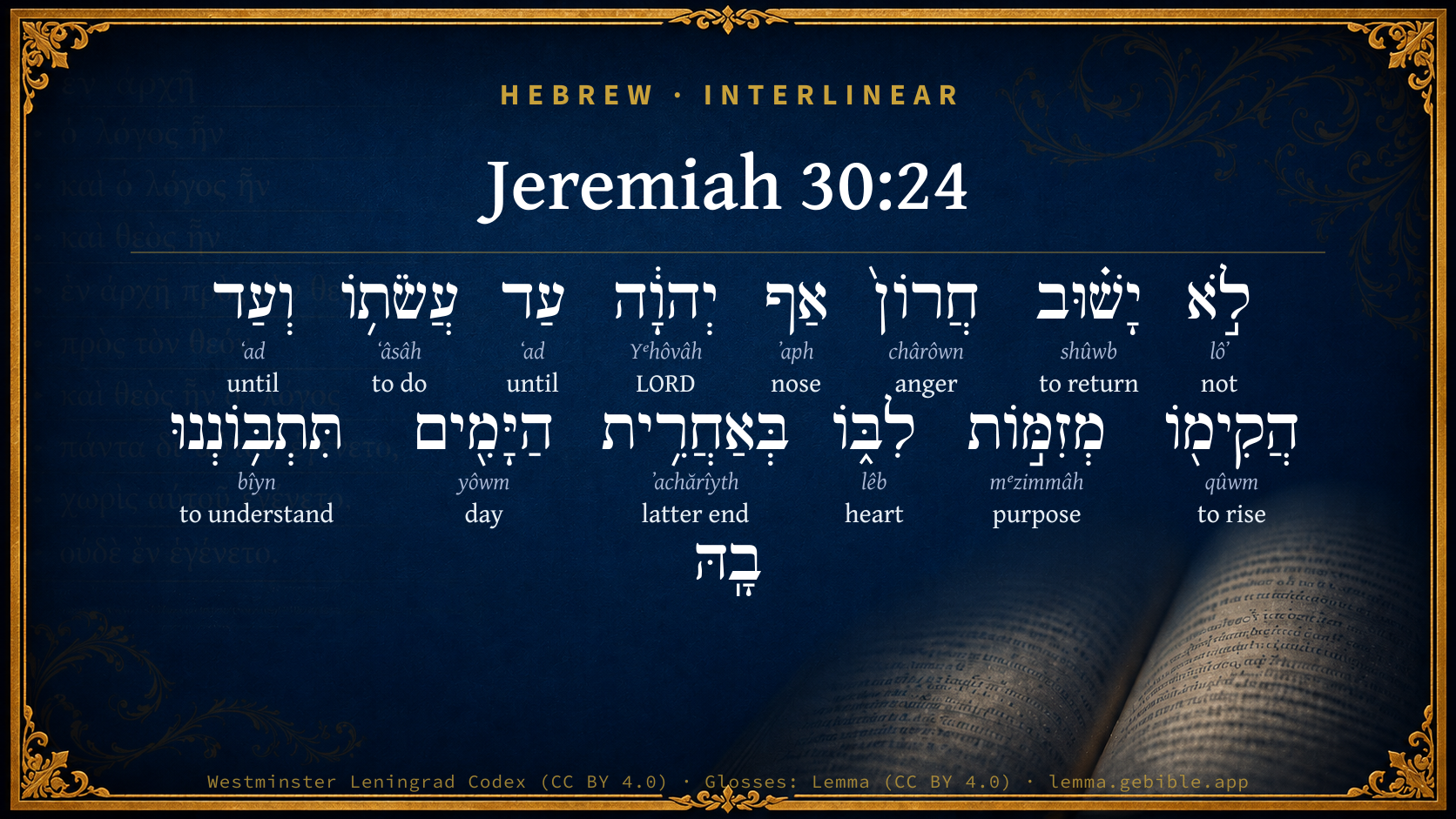
Hebrew (Westminster Leningrad Codex) Jeremiah 30:24 appears in the Hebrew Old Testament. The text above is from the Westminster Leningrad Codex. Each word links to its Strong’s number, a concise gloss, and parsing drawn from the Open Scriptures Hebrew Bible morphology. Click any word for its full Brown-Driver-Briggs (BDB) entry.
Download image
Cite this verse

Jeremiah 30:24 (World English Bible). Public Domain. Lemma interlinear Bible study tool, https://lemma.gebible.app/v/jeremiah/30/24.

Show BibTeX & RIS
BibTeX
RIS
English Translation
The fierce anger of Yahweh shall not return, until he has executed, and until he have performed the intents of his heart: in the latter days you shall understand it.
World English Bible · Public Domain
Download a study sheet

One document with this verse’s original text, its word-by-word gloss line, the meaning frame, cross-references with their text, attributed commentary, and full source and license credits — printable, and it pastes into notes with its structure intact.

This verse Autodidact and up

Study sheet (.html) Plain text (.txt)

A passage Seminary Student

Up to 50 verses in one chapter. A passage sheet keeps up to 6 commentary sources and 12 cross-references per verse, in the order this page ranks them, and says so on the sheet whenever that leaves anything out. Ask for a single verse and you get the Autodidact verse sheet above.

Everything on this page stays free to read, with no account — the sheet is a download of what is already on screen, not access to it.

Want to remove ads? Support Godless Engineer
Compare translations 3

The same verse in 3 English versions, stacked beneath the original-language interlinear above. Click any original word for its lexicon entry.

Each is an independent rendering of the whole verse — the interlinear is not word-aligned to these translations.

Highlighted words mark where these versions differ — a whole-verse word diff, not a word-by-word alignment.

  • World English Bible Public Domain
    The fierce anger of Yahweh shall not return, until he has executed, and until he have performed the intents of his heart: in the latter days you shall understand it.
  • King James Version Public Domain
    The fierce anger of the LORD shall not return, until he hath done it, and until he have performed the intents of his heart: in the latter days ye shall consider it.
  • unfoldingWord Literal Text CC BY-SA 4.0
    Yahweh’s wrath will not return until it has carried out and brought into being his heart’s intentions. In the final days, you will understand it.”

unfoldingWord Literal Text — © unfoldingWord, licensed CC BY-SA 4.0. Word-aligned USFM3 via Door43 (git.door43.org/unfoldingWord/en_ult).

Versions to compare (up to 4)

3 of 4 selected

Show all 18 translations

Every available English version of this verse, each an independent rendering of the whole verse.

  • World English Bible Public Domain
    The fierce anger of Yahweh shall not return, until he has executed, and until he have performed the intents of his heart: in the latter days you shall understand it.
  • Berean Standard Bible Public Domain
    The fierce anger of the LORD will not turn back until He has fully accomplished the purposes of His heart. In the days to come you will understand this.
  • Majority Standard Bible Public Domain
    The fierce anger of the LORD will not turn back until He has fully accomplished the purposes of His heart. In the days to come you will understand this.
  • King James Version Public Domain
    The fierce anger of the LORD shall not return, until he hath done it, and until he have performed the intents of his heart: in the latter days ye shall consider it.
  • American Standard Version (1901) Public Domain
    The fierce anger of Jehovah shall not return, until he have executed, and till he have performed the intents of his heart: in the latter days ye shall understand it.
  • Revised Version (1885) Public Domain
    The fierce anger of the LORD shall not return, until he have executed, and till he have performed the intents of his heart: in the latter days ye shall understand it.
  • Geneva Bible (1599) Public Domain
    The fierce wrath of the Lord shall not returne, vntill he haue done, and vntill he haue performed the intents of his heart: in the latter dayes ye shall vnderstand it.
  • Douay-Rheims (1899) Public Domain
    The Lord will not turn away the wrath of his indignation, till he have executed and performed the thought o his heart: in the latter days you shall understand these things.
  • Young's Literal Translation Public Domain
    The fierceness of the anger of Jehovah Doth not turn back till His doing, Yea, till His establishing the devices of His heart, In the latter end of the days we consider it!
  • Literal Standard Version CC BY-SA 4.0
    The fierceness of the anger of YHWH || Does not turn back until He has done [it], || Indeed, until His establishing the purposes of His heart. In the latter end of the days you consider it!
  • Unlocked Literal Bible CC BY-SA 4.0
    Yahweh's wrath will not return until it has carried out and brought into being his heart's intentions. In the final days, you will understand it.”
  • unfoldingWord Literal Text CC BY-SA 4.0
    Yahweh’s wrath will not return until it has carried out and brought into being his heart’s intentions. In the final days, you will understand it.”
  • Darby Bible Public Domain
    The fierce anger of Jehovah shall not return, until he have executed, and until he have performed the purposes of his heart. At the end of the days ye shall consider it.
  • World Messianic Bible Public Domain
    The fierce anger of the LORD will not return until he has accomplished, and until he has performed the intentions of his heart. In the latter days you will understand it.”
  • Webster's Bible Public Domain
    The fierce anger of the LORD shall not return, until he hath done it, and until he hath performed the intents of his heart: in the latter days ye shall consider it.
  • Free Bible Version CC BY-SA 4.0
    The Lord's anger won't fade until he's finished doing everything he wants. Only then will you really understand.
  • Bible in Basic English Public Domain
    The wrath of the Lord will not be turned back till he has done, till he has put into effect, the purposes of his heart: in days to come you will have full knowledge of this.
  • JPS Tanakh (1917) Public Domain
    The fierce anger of the LORD shall not return, until He have executed, and till He have performed the purposes of His heart; in the end of days ye shall consider it.

Literal Standard Version (2020), Covenant Press — licensed CC BY-SA 4.0. Text via the HelloAO Bible API (eBible.org). Unlocked Literal Bible (unfoldingWord) — licensed CC BY-SA 4.0. Text via the HelloAO Bible API (eBible.org). unfoldingWord Literal Text — © unfoldingWord, licensed CC BY-SA 4.0. Word-aligned USFM3 via Door43 (git.door43.org/unfoldingWord/en_ult). Free Bible Version, Dr. Jonathan Gallagher — licensed CC BY-SA 4.0. Text via the HelloAO Bible API (eBible.org).

Word by word

More ways to search: Search by grammar → Find every occurrence → Compare this word →

Practice this passage: Drill this verse → Learn its vocabulary →

מְזִמּ֣וֹת
mᵉzimmâh
H4209
“purposes of”
Noun, Common, Feminine, Plural, Construct
Part of Speech
Noun
Type
Common
Gender
Feminine
Number
Plural
State
Construct
Full BDB Definition

Origin: from H2161

TWOT: 556c

purpose, discretion, device, plot - purpose - discretion - devices (evil)
  1. לֹ֣א lôʼ H3808 “not” Particle, Negative
  2. יָשׁ֗וּב shûwb H7725 “to return” Verb, Qal, Imperfect, 3rd Person, Masculine, Singular
  3. חֲרוֹן֙ chârôwn H2740 “anger of” Noun, Common, Masculine, Singular, Construct
  4. אַף ʼaph H639 “nose” Particle, Accusative
  5. יְהוָ֔ה Yᵉhôvâh H3068 “LORD” Noun, Proper
  6. עַד ʻad H5704 “until” Preposition
  7. עֲשֹׂת֥וֹ ʻâsâh H6213 “to do · him” Verb, Qal, Infinitive Construct + Suffix, Personal, 3rd Person, Masculine, Singular
  8. וְעַד ʻad H5704 “and · until” Conjunction + Preposition
  9. הֲקִימ֖וֹ qûwm H6965 “to rise · him” Verb, Hiphil, Infinitive Construct + Suffix, Personal, 3rd Person, Masculine, Singular
  10. לִבּ֑וֹ lêb H3820 “heart · his” Noun, Common, Masculine, Singular, Construct + Suffix, Personal, 3rd Person, Masculine, Singular
  11. בְּאַחֲרִ֥ית ʼachărîyth H319 “in/at · latter end of” Preposition + Noun, Common, Feminine, Singular, Construct
  12. הַיָּמִ֖ים yôwm H3117 “the · days” Particle, Definite Article + Noun, Common, Masculine, Plural, Absolute
  13. תִּתְבּ֥וֹנְנוּ bîyn H995 “to understand” Verb, Hithpolel, Imperfect, 2nd Person, Masculine, Plural

About this verse

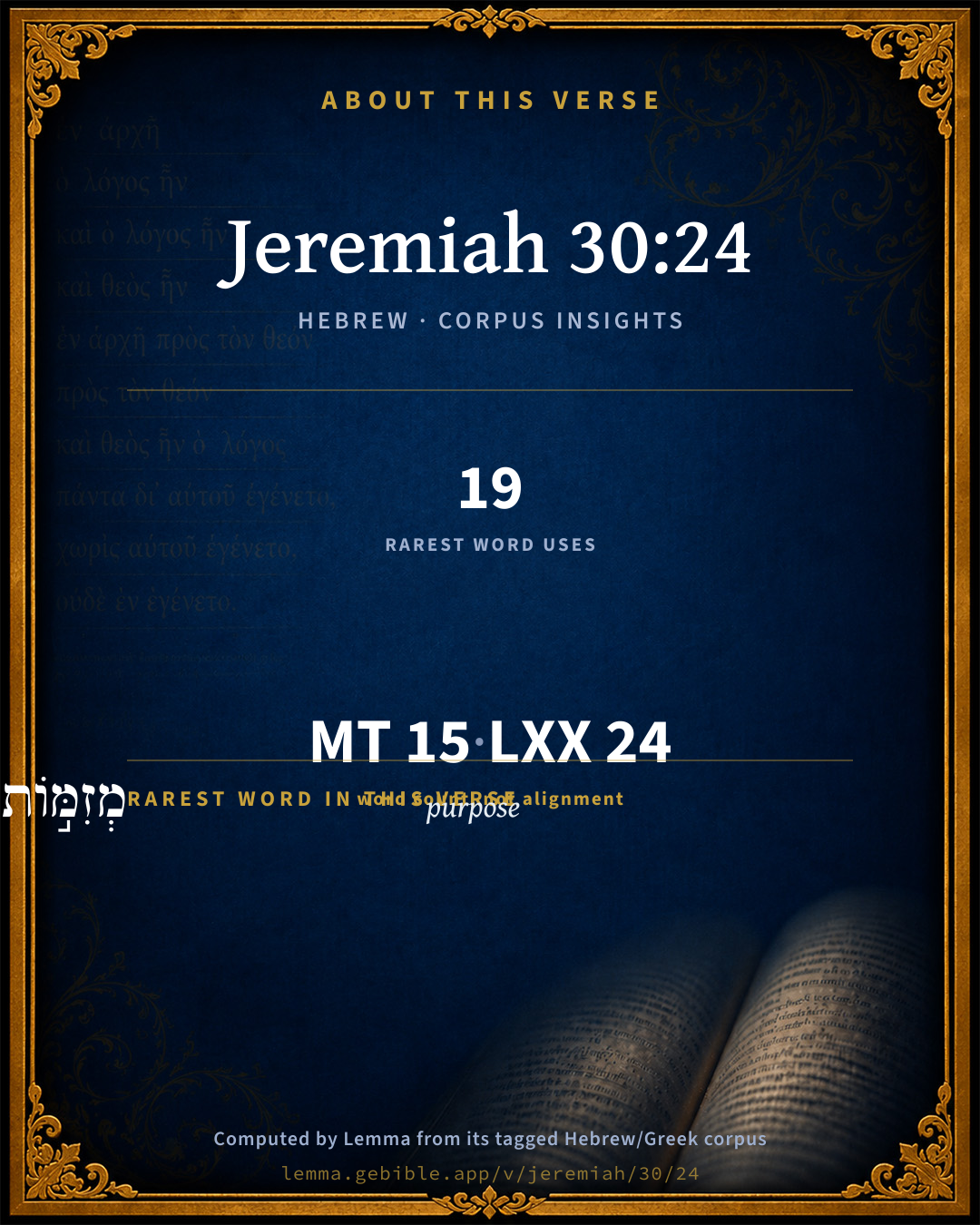
These counts appear in no published source. They are computed here, from the morphology-tagged text and Lemma’s own curated glosses. What Lemma adds →

15
words
13
distinct lemmas
Prophets
section

Notable vocabulary

The rarest word here is מְזִמּ֣וֹת purpose H4209 — appearing just 19 times in the whole Hebrew Bible.

Shared distinctive vocabulary

מְזִמּ֣וֹת purpose H4209 occurs in 19 verses of the Hebrew Bible. Also found in:

Grammatical profile

  • 4 verbs
  • 6 nouns
  • 3 prepositions
  • 2 particles

Verb forms

  • יָשׁ֗וּב Qal · Imperfect
  • עֲשֹׂת֥וֹ Qal · Infinitive Construct
  • הֲקִימ֖וֹ Hiphil · Infinitive Construct
  • תִּתְבּ֥וֹנְנוּ Hithpolel · Imperfect

Repetition

A word recurs within this verse — often emphatic in Hebrew:

Hebrew & Septuagint length

In the original languages it is 15 Hebrew tokens and 24 Greek tokens — but the two are counted differently (Hebrew bundles its prefixes and suffixes into one token; the Greek is in lemma form), so that isn’t a like-for-like length.

Cross-references

21

Topical passages linked to Jeremiah 30:24 in the Treasury of Scripture Knowledge — connected by theme and wording, ordered by reader-vote popularity; previews shown in the World English Bible.

  • Jeremiah 23:20 The anger of Yahweh shall not return, until he has executed, and until he have performed the intents of his heart: in the latter days you shall understand it perfectly.
  • Hosea 3:5 Afterward the children of Israel shall return, and seek Yahweh their God, and David their king, and shall come with trembling to Yahweh and to his blessings in the last days.
  • Micah 4:1 But in the latter days, It will happen that the mountain of Yahweh's temple will be established on the top of the mountains, And it will be exalted above the hills; And peoples will stream to it.
  • Jeremiah 4:28 For this shall the earth mourn, and the heavens above be black; because I have spoken it, I have purposed it, and I have not repented, neither will I turn back from it.
  • Ezekiel 38:16 and you shall come up against my people Israel, as a cloud to cover the land: it shall happen in the latter days, that I will bring you against my land, that the nations may know me, when I shall be sanctified in you, Gog, before their eyes.
  • Isaiah 14:24 Yahweh of Hosts has sworn, saying, Surely, as I have thought, so shall it happen; and as I have purposed, so shall it stand:
  • Ezekiel 20:47–48 and tell the forest of the South, Hear the word of Yahweh: Thus says the Lord Yahweh, Behold, I will kindle a fire in you, and it shall devour every green tree in you, and every dry tree: the flaming flame shall not be quenched, and all faces from the south to the north shall be burnt thereby.
  • Ezekiel 21:5–7 and all flesh shall know that I, Yahweh, have drawn forth my sword out of its sheath; it shall not return any more.
  • Daniel 2:28 but there is a God in heaven who reveals secrets, and he has made known to the king Nebuchadnezzar what shall be in the latter days. Your dream, and the visions of your head on your bed, are these:
  • Daniel 10:14 Now I have come to make you understand what shall happen to your people in the latter days; for the vision is yet for [many] days:
  • Genesis 49:1 Jacob called to his sons, and said: "Gather yourselves together, that I may tell you that which will happen to you in the days to come.
  • Numbers 24:14 Now, behold, I go to my people: come, [and] I will advertise you what this people shall do to your people in the latter days.
  • Deuteronomy 4:30 When you are in oppression, and all these things are come on you, in the latter days you shall return to Yahweh your God, and listen to his voice:
  • Deuteronomy 31:29 For I know that after my death you will utterly corrupt yourselves, and turn aside from the way which I have commanded you; and evil will happen to you in the latter days; because you will do that which is evil in the sight of Yahweh, to provoke him to anger through the work of your hands.
  • 1 Samuel 3:12 In that day I will perform against Eli all that I have spoken concerning his house, from the beginning even to the end.
  • Job 23:13–14 But he stands alone, and who can oppose him? What his soul desires, even that he does.
  • Isaiah 14:26–27 This is the purpose that is purposed on the whole earth; and this is the hand that is stretched out on all the nations.
  • Isaiah 46:11 calling a ravenous bird from the east, the man of my counsel from a far country; yes, I have spoken, I will also bring it to pass; I have purposed, I will also do it.
  • Jeremiah 4:8 For this gird you with sackcloth, lament and wail; for the fierce anger of Yahweh hasn't turned back from us.
  • Jeremiah 48:47 Yet will I bring back the captivity of Moab in the latter days, says Yahweh. Thus far is the judgment of Moab.
  • Jeremiah 49:39 But it shall happen in the latter days, that I will bring back the captivity of Elam, says Yahweh.

Cross-references courtesy of OpenBible.info (CC BY 4.0).

Hebrew and Greek witnesses Masoretic Hebrew ↔ Greek Septuagint

The same verse in the two great witnesses to the Old Testament, shown verse-for-verse.

These are two independent witnesses, not word-aligned to each other, and the Septuagint is shown in lemma (dictionary) form.

Hebrew Jeremiah 30:24 Masoretic · Westminster Leningrad Codex

לֹ֣א יָשׁ֗וּב חֲרוֹן֙ אַף יְהוָ֔ה עַד עֲשֹׂת֥וֹ וְעַד הֲקִימ֖וֹ מְזִמּ֣וֹת לִבּ֑וֹ בְּאַחֲרִ֥ית הַיָּמִ֖ים תִּתְבּ֥וֹנְנוּ בָֽהּ

The fierce anger of Yahweh shall not return, until he has executed, and until he have performed the intents of his heart: in the latter days you shall understand it.

World English Bible · Public Domain

Greek LXX Structure differs

In the Septuagint, Jeremiah is about an eighth shorter than the Hebrew and arranges its material differently — the Oracles Against the Nations (Hebrew chapters 46–51) appear in the middle of the Greek book, after 25:13. Because the chapter and verse boundaries do not line up, a verse-for-verse comparison with the Hebrew is not shown.

A verse-for-verse comparison isn’t shown here because the chapters and verses don’t line up. Switch to the LXX edition with the MT / LXX toggle above to read the Greek directly.

Hebrew: Westminster Leningrad Codex (CC BY 4.0). Greek: Septuagint (public domain); English from a public-domain English Septuagint. How the Septuagint differs from the Hebrew →

Targum (Aramaic paraphrase)

1

The Targum is the ancient Jewish Aramaic paraphrase of the Hebrew Scriptures — an interpretive translation, not the Hebrew text itself. Onkelos (literal) and Pseudo-Jonathan (expansive) render the Torah, and Jonathan the Prophets. Coverage is partial: where no permissively-licensed English translation exists for a verse, only the Aramaic is shown. This is verse-level text, not a word-by-word alignment to the Hebrew.

  1. Targum Jonathan Prophets (Joshua–Malachi)
    לָא יְתוּב תְּקוֹף רוּגְזָא דַייָ עַד דְיַעֲבַד וְעַד דִיקַיֵם מַחְשְׁבַת רְעוּתֵיהּ בְּסוֹף יוֹמַיָא תִּסְתַּכְּלוּן בָּהּ:

    (no public-domain English translation for this verse)

    Targum Jonathan — Aramaic: “Mikraot Gedolot” (public domain). English: “Sefaria Community Translation” (CC0 1.0 (public-domain dedication)); “London "Chaldee Paraphrase," 1871” (public domain). Text via Sefaria.

Commentary

Notes on Jeremiah 30:24 from classic Christian and Jewish commentators (each source and its license shown beneath its notes). The classic Christian expositions comment on the surrounding passage and are grouped to its opening verse, so a note may address several verses; the Jewish commentaries on the Tanakh (Rashi and others) are per-verse, so they appear only where the commentator wrote on this verse.

Lemma curates 59 commentaries, every one of them public domain or Creative Commons licensed, each selected and text-cleaned for this edition rather than reprinted as found. About our sources →

Trapp's Complete Commentary

John Trapp

Jer 30:24 The fierce anger of the LORD shall not return, until he have done [it], and until he have performed the intents of his heart: in the latter days ye shall consider it.

Ver. 24. The fierce anger of the Lord.] See Jer 23:20.

In the latter days ye shall consider it.] In the days of the Messiah, but especially at the end of the world, when all these things shall have their full accomplishment.

John Trapp, A Commentary or Exposition upon All the Books of the Old and New Testament (1647–1656) — public domain. Text from a community e-Sword module.

Tyndale Open Study Notes

Tyndale Open Resources

30:24 Punishment remained an important aspect of what the Lord had planned. The Israelites, including Jeremiah, found it difficult to reconcile divine promises with divine anger. Looking back on events at a later time would help the people to understand this paradox.

Tyndale Open Study Notes — © Tyndale Open Resources, licensed CC BY-SA 4.0. Text via the HelloAO Bible API.

Geneva Bible (1599)

Geneva Bible translators

When this Messiah and deliverer is sent.

Geneva Bible (1599) marginal notes — public domain. Text via Bolls.life.

Adam Clarke's Commentary

Verse 24. In the latter days ye shall consider it.] By the latter days the Gospel dispensation is generally meant; and that restoration which is the principal topic in this and the succeeding chapter refers to this time. Had the Jews properly considered this subject, they would long ere this have been brought into the liberty of the Gospel, and saved from the maledictions under which they now groan. Why do not the Jews read their own prophets more conscientiously?

Adam Clarke's Commentary on the Bible (1810–1826) — public domain. Text from a community e-Sword/MySword module.

John Calvin's Commentaries

He confirms the last sentence, and compares the wrath or the vengeance of God to a messenger or a minister, who is sent to carry a message, or to perform what has been commanded him. Of God’s word, that is, of his threatenings as well as of his promises, Isaiah speaks thus,

“My word shall not return to me void.” (Isaiah 55:11)

The meaning is, that whatever God promises or threatens, is never without its effect. But they wrongly understand the passage who say that the word of God returns not void, because it brings forth fruit; for he speaks of the effect of the word, whether for salvation or for perdition. So now also God declares that his vengeance, when gone forth, shall not return until it fulfils what has been commanded.

He then adds, and until he shall have confirmed, etc.; for so the verb הקימו ekimu, properly means: until God then shall have confirmed or established the thoughts of his heart The thoughts of his heart he calls the decrees or purposes of God; but it is a mode of speaking taken from men, and therefore metaphorical; for it is not consistent with what God is, either to think or to deliberate. But, as to the subject itself, there is nothing ambiguous; for the Prophet means, that when God sends forth his vengeance, all the wicked must perish, for so has God decreed, and his purposes can never be frustrated. Then he shews that God’s vengeance will be accomplished, because God has so determined. For God does not dissemble when he promises salvation to men, or denounces on them the punishment which they have deserved; but he executes the decrees or purposes of his heart.

Then the Prophet here condemns the stupidity of all those who thought that they could escape, though they had often heard that their guilt was so great that they must at last be visited with judgment. Though they had often heard this, yet they were deaf to all warnings; and it was for this reason that the Prophet spoke of the thoughts of God’s heart.

At last he adds, At the extremity of days ye shall understand this This may be applied to the faithful no less than to the wicked. For though the faithful embraced God’s promises, and relied on them, yet, as they had to contend constantly with the heaviest trials, it was necessary to stimulate and animate them to patience. It might then be suitably said to them, “Ye shall understand this in the last days;” it being a kind of exhortation, as though he had said, “Ye indeed think the wicked happy, because God does not immediately punish them, because his vengeance does not instantly break forth in thunders against them; but patiently bear your miseries, and ye shall at length find that their destruction has not been in vain predicted; and ye shall also receive a reward for your faith and patience, if ye continue resigned to the last.” But the sentence may also be suitably applied to the wicked, because they were wont to form their judgment according to the present aspect of things. Hence the Prophet exposes the false opinion by which they deceived themselves, and says, that too late they would understand what they were then unwilling to perceive.

If then we explain this sentence of the children of God, it is an exhortation to bear patiently their evils until God appeared as their defender: but if we apply it to the unbelieving, it is a derision of their insensibility, because they regarded as fables all threatenings; but the Prophet exclaims, “Ye shall at last become wise, but it will be too late.” Even experience becomes a teacher when there is no more opportunity to repent.

John Calvin's Commentaries (1540-1563) — public domain. Text from the Calvin Translation Society English edition (1840s-50s) via the Christian Classics Ethereal Library (ccel.org). Calvin's coverage is partial (roughly two-thirds of the Bible); uncommented books and verses are honest gaps, never fabricated. The 19th-century editor's footnotes and remarks are omitted so the notes are faithfully Calvin's own voice.

John Gill's Exposition

The fierce anger of the Lord shall not return,.... This explains what is meant by the continuing whirlwind in Jer 30:23;

until he hath done it; his whole will and pleasure; brought Babylon to ruin, and destroyed all the antichristian powers:

and until he hath performed the intents of his heart; in a way of grace and mercy to his people, and in a way of wrath and vengeance on their enemies:

in the latter day ye shall consider it; this prophecy, and understand it; and see it wholly and fully accomplished.

Next: Jeremiah Chapter 31

John Gill's Exposition of the Whole Bible (1746–1763) — public domain (CC PDM 1.0). Text via the HelloAO Bible API.

Matthew Poole's English Annotations

He expoundeth in these words the continuing whirlwind, spoken of Jer 30:23, and withal lets them know that what the false prophets said of a speedy return out of Babylon of those already there, or of the not going of those which as yet were in Judea, was all but falsehood; for the Lord was angry, and was resolved to fulfil the purpose of his heart in punishing them. And though at present they would not consider nor believe it, yet afterward, when they should see things come to pass according as he had said, then they should consider what he had told them.

Matthew Poole's English Annotations on the Holy Bible (1683–1685) — public domain. Text from a community e-Sword/MySword module.

John Wesley's Explanatory Notes

Consider - And though at present they will not consider, yet afterward, when they see things come to pass, then they shall consider what I have told them.

John Wesley, Explanatory Notes Upon the Whole Bible (1754–1765) — public domain. Text via the GEBible commentary corpus.

Lesson kit

Teaching starters — assembled from the data on this page, not authored interpretation. Every prompt links to the verse data it draws on. Edit before teaching.

Jeremiah, in the Prophets, opens this verse with 15 words (13 distinct Hebrew lemmas). Its most distinctive word is mᵉzimmâh (“purpose”). A historical commentator’s framing appears above. Read the whole chapter for the surrounding context.

Discussion questions

  1. What does “purpose” (mᵉzimmâh) contribute to the verse as a whole?
  2. Job 21:27 shares the word «purpose» with this verse. How do the two illuminate each other?
  3. “until” occurs 2× in this one verse. What is the effect of the repetition?
  4. The translations on this page render this verse differently — a whole-verse word diff, not a word-by-word alignment. What might account for the different wordings?
  5. The verb «יָשׁ֗וּב» is Qal Imperfect. How does its form color the action?
  6. Reading how Trapp's Complete Commentary and Tyndale Open Study Notes read this verse, where do the two commentators agree and where do they part?

Things to notice

Reading settings

Reading text

Shown beneath each verse's original-language words.

Old Testament
Old Testament edition

Read the OT as the Masoretic Hebrew (MT) or the Greek Septuagint (LXX).

English shown for the Greek Septuagint (in the Hebrew ↔ Greek comparison).

Comparing translations? Open the Compare panel on any verse page to stack up to four side by side.