
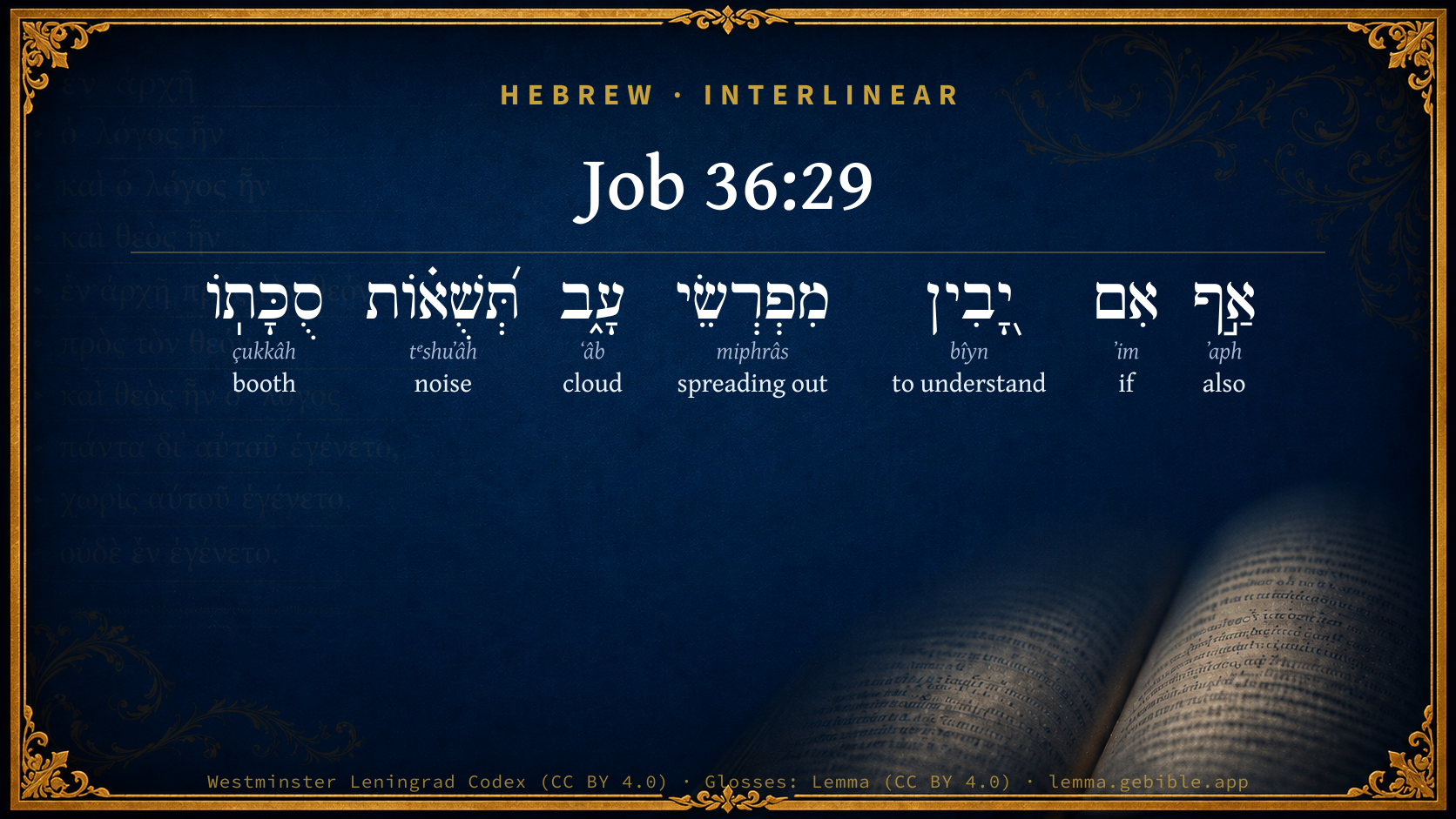
Job 36:29

Hebrew (Westminster Leningrad Codex) Job 36:29 appears in the Hebrew Old Testament. The text above is from the Westminster Leningrad Codex. Each word links to its Strong’s number, a concise gloss, and parsing drawn from the Open Scriptures Hebrew Bible morphology. Click any word for its full Brown-Driver-Briggs (BDB) entry.
Download image
Cite this verse

Job 36:29 (World English Bible). Public Domain. Lemma interlinear Bible study tool, https://lemma.gebible.app/v/job/36/29.

Show BibTeX & RIS
BibTeX
RIS
English Translation
Yes, can any understand the spreading of the clouds, And the thunderings of his pavilion?
World English Bible · Public Domain
Highlights
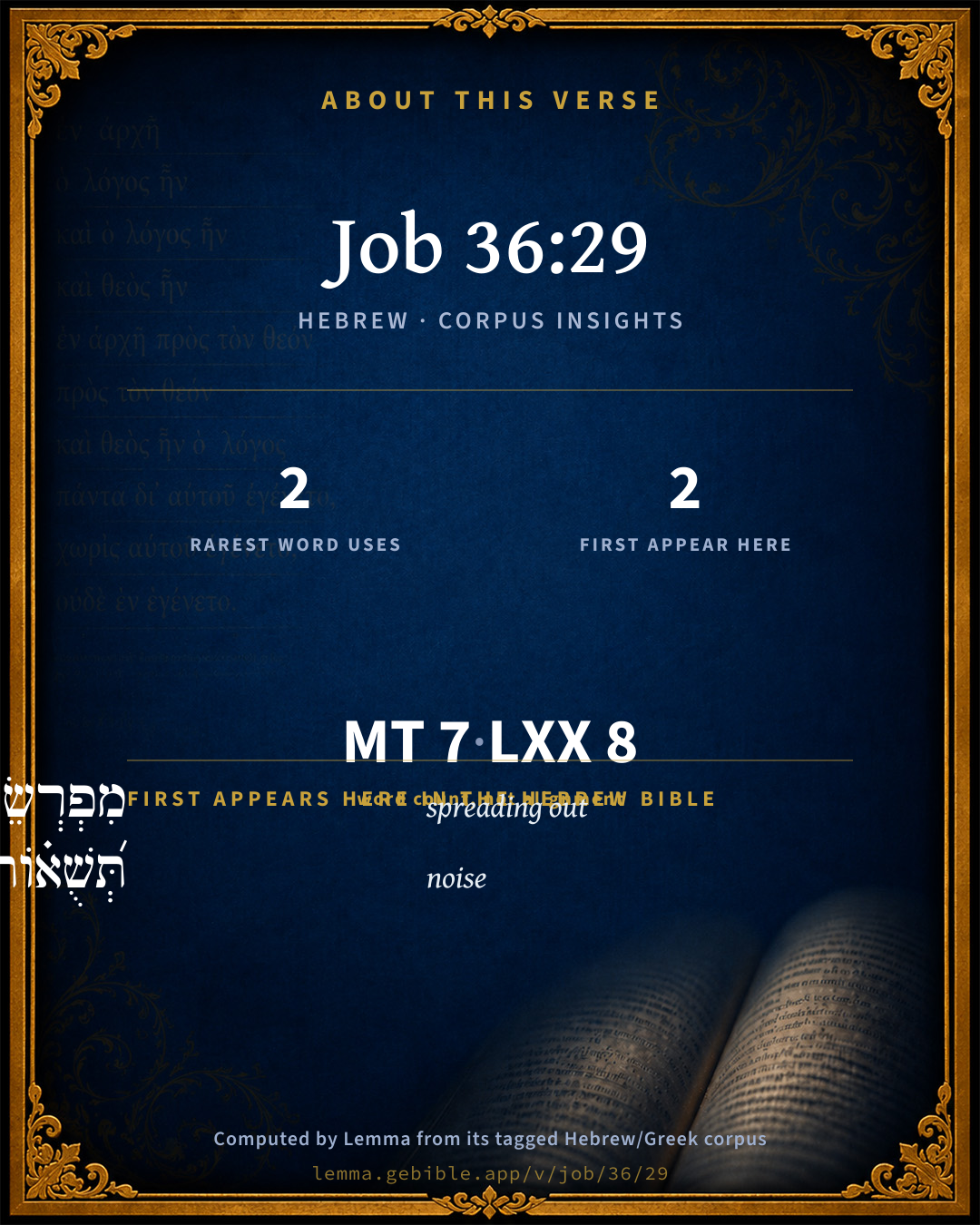
  • 2 first appearances in the Hebrew Bible
Full analysis ↓
Download a study sheet

One document with this verse’s original text, its word-by-word gloss line, the meaning frame, cross-references with their text, attributed commentary, and full source and license credits — printable, and it pastes into notes with its structure intact.

This verse Autodidact and up

Study sheet (.html) Plain text (.txt)

A passage Seminary Student

Up to 50 verses in one chapter. A passage sheet keeps up to 6 commentary sources and 12 cross-references per verse, in the order this page ranks them, and says so on the sheet whenever that leaves anything out. Ask for a single verse and you get the Autodidact verse sheet above.

Everything on this page stays free to read, with no account — the sheet is a download of what is already on screen, not access to it.

Want to remove ads? Support Godless Engineer
Compare translations 3

The same verse in 3 English versions, stacked beneath the original-language interlinear above. Click any original word for its lexicon entry.

Each is an independent rendering of the whole verse — the interlinear is not word-aligned to these translations.

Highlighted words mark where these versions differ — a whole-verse word diff, not a word-by-word alignment.

  • World English Bible Public Domain
    Yes, can any understand the spreading of the clouds, And the thunderings of his pavilion?
  • King James Version Public Domain
    Also can any understand the spreadings of the clouds, or the noise of his tabernacle?
  • unfoldingWord Literal Text CC BY-SA 4.0
    Indeed, if one will understand the spread of the cloud, the thunder from his booth?

unfoldingWord Literal Text — © unfoldingWord, licensed CC BY-SA 4.0. Word-aligned USFM3 via Door43 (git.door43.org/unfoldingWord/en_ult).

Versions to compare (up to 4)

3 of 4 selected

Show all 18 translations

Every available English version of this verse, each an independent rendering of the whole verse.

  • World English Bible Public Domain
    Yes, can any understand the spreading of the clouds, And the thunderings of his pavilion?
  • Berean Standard Bible Public Domain
    Furthermore, who can understand how the clouds spread out, how the thunder roars from His pavilion?
  • Majority Standard Bible Public Domain
    Furthermore, who can understand how the clouds spread out, how the thunder roars from His pavilion?
  • King James Version Public Domain
    Also can any understand the spreadings of the clouds, or the noise of his tabernacle?
  • American Standard Version (1901) Public Domain
    Yea, can any understand the spreadings of the clouds, The thunderings of his pavilion?
  • Revised Version (1885) Public Domain
    Yea, can any understand the spreadings of the clouds, the thunderings of his pavilion?
  • Geneva Bible (1599) Public Domain
    Who can know the diuisions of ye clouds and the thunders of his tabernacle?
  • Douay-Rheims (1899) Public Domain
    If he will spread out clouds as his tent,
  • Young's Literal Translation Public Domain
    Yea, doth `any' understand The spreadings out of a cloud? The noises of His tabernacle?
  • Literal Standard Version CC BY-SA 4.0
    Indeed, do [any] understand || The spreadings out of a cloud? The noises of His dwelling place?
  • Unlocked Literal Bible CC BY-SA 4.0
    Indeed, can anyone understand the extensive spread of the clouds and the thunder from his hut?
  • unfoldingWord Literal Text CC BY-SA 4.0
    Indeed, if one will understand the spread of the cloud, the thunder from his booth?
  • Darby Bible Public Domain
    But can any understand the spreadings of the clouds, [or] the crashing of his pavilion?
  • World Messianic Bible Public Domain
    Indeed, can anyone understand the spreading of the clouds and the thunderings of his pavilion?
  • Webster's Bible Public Domain
    Also can any understand the spreadings of the clouds, or the noise of his tabernacle?
  • Free Bible Version CC BY-SA 4.0
    Can anyone understand how the clouds spread out, or how thunder roars from where he lives?
  • Bible in Basic English Public Domain
    And who has knowledge of how the clouds are stretched out, or of the thunders of his tent?
  • JPS Tanakh (1917) Public Domain
    Yea, can any understand the spreadings of the clouds, the crashings of His pavilion?

Literal Standard Version (2020), Covenant Press — licensed CC BY-SA 4.0. Text via the HelloAO Bible API (eBible.org). Unlocked Literal Bible (unfoldingWord) — licensed CC BY-SA 4.0. Text via the HelloAO Bible API (eBible.org). unfoldingWord Literal Text — © unfoldingWord, licensed CC BY-SA 4.0. Word-aligned USFM3 via Door43 (git.door43.org/unfoldingWord/en_ult). Free Bible Version, Dr. Jonathan Gallagher — licensed CC BY-SA 4.0. Text via the HelloAO Bible API (eBible.org).

Word by word

More ways to search: Search by grammar → Find every occurrence → Compare this word →

Practice this passage: Drill this verse → Learn its vocabulary →

About this verse

These counts appear in no published source. They are computed here, from the morphology-tagged text and Lemma’s own curated glosses. What Lemma adds →

7
words
7
distinct lemmas
Wisdom
section

Notable vocabulary

The rarest word here is מִפְרְשֵׂי spreading out H4666 — appearing just 2 times in the whole Hebrew Bible.

First appearance in Scripture

These words make their first canonical appearance in the Hebrew Bible here:

  • מִפְרְשֵׂי spreading out H4666
  • תְּ֝שֻׁא֗וֹת noise H8663

Shared distinctive vocabulary

מִפְרְשֵׂי spreading out H4666 occurs in 2 verses of the Hebrew Bible. Also found in:

Grammatical profile

  • 1 verb
  • 4 nouns
  • 1 conjunction
  • 1 particle

Verb forms

  • יָ֭בִין Qal · Imperfect

Hebrew & Septuagint length

In English translation the verse runs 15 words from the Hebrew and 16 from the Septuagint (LXX English) — closely comparable.

A rough comparison of the two English renderings, which tokenize alike — not a word-level alignment.

Word counts can differ between the Hebrew and the Greek without any difference in meaning — e.g. the Hebrew direct-object marker אֵת has no separate Greek word, and Greek often adds the article ὁ.

In the original languages it is 7 Hebrew tokens and 8 Greek tokens — but the two are counted differently (Hebrew bundles its prefixes and suffixes into one token; the Greek is in lemma form), so that isn’t a like-for-like length.

Cross-references

13

Topical passages linked to Job 36:29 in the Treasury of Scripture Knowledge — connected by theme and wording, ordered by reader-vote popularity; previews shown in the World English Bible.

  • Job 37:16 Do you know the workings of the clouds, The wondrous works of him who is perfect in knowledge?
  • Job 37:2–5 Hear, oh, hear the noise of his voice, The sound that goes out of his mouth.
  • 1 Kings 18:44–45 It happened at the seventh time, that he said, "Behold, a small cloud, like a man's hand, is rising out of the sea." He said, Go up, tell Ahab, Make ready [your chariot], and get you down, that the rain not stop you.
  • Job 26:14 Behold, these are but the outskirts of his ways. How small a whisper do we hear of him! But the thunder of his power who can understand?"
  • Job 38:9 When I made clouds the garment of it, Thick darkness a swaddling-band for it,
  • Job 38:37 Who can number the clouds by wisdom? Or who can pour out the bottles of the sky,
  • Psalms 18:13 Yahweh also thundered in the sky, The Most High uttered his voice: Hailstones and coals of fire.
  • Psalms 29:3–10 Yahweh's voice is on the waters. The God of glory thunders, even Yahweh on many waters.
  • Psalms 77:16–19 The waters saw you, God. The waters saw you, and they writhed. The depths also convulsed.
  • Psalms 104:3 He lays the beams of his chambers in the waters. He makes the clouds his chariot. He walks on the wings of the wind.
  • Psalms 104:7 At your rebuke they fled. At the voice of your thunder they hurried away.
  • Nahum 1:3 Yahweh is slow to anger, and great in power, and will by no means leave the guilty unpunished. Yahweh has his way in the whirlwind and in the storm, and the clouds are the dust of his feet.
  • Habakkuk 3:10 The mountains saw you, and were afraid. The tempest of waters passed by. The deep roared and lifted up its hands on high.

Cross-references courtesy of OpenBible.info (CC BY 4.0).

Hebrew and Greek witnesses Masoretic Hebrew ↔ Greek Septuagint

The same verse in the two great witnesses to the Old Testament, shown verse-for-verse.

These are two independent witnesses, not word-aligned to each other, and the Septuagint is shown in lemma (dictionary) form.

Hebrew Job 36:29 Masoretic · Westminster Leningrad Codex

אַ֣ף אִם יָ֭בִין מִפְרְשֵׂי עָ֑ב תְּ֝שֻׁא֗וֹת סֻכָּתֽוֹ

Yes, can any understand the spreading of the clouds, And the thunderings of his pavilion?

World English Bible · Public Domain

Greek LXX Job 36:29 Septuagint · lemma form

καί ἐάν συνεἰμί ἀπέκτασις νεφέλη ἰσότης σκηνή αὐτός

And though one should understand the outspreadings of the clouds, or the measure of his tabernacle;

LXX2012 (modern English Septuagint) · Public Domain

Hebrew: Westminster Leningrad Codex (CC BY 4.0). Greek: Septuagint (public domain); English from LXX2012 (modern English Septuagint) (Public Domain). How the Septuagint differs from the Hebrew →

Commentary

Notes on Job 36:29 from classic Christian and Jewish commentators (each source and its license shown beneath its notes). The classic Christian expositions comment on the surrounding passage and are grouped to its opening verse, so a note may address several verses; the Jewish commentaries on the Tanakh (Rashi and others) are per-verse, so they appear only where the commentator wrote on this verse.

Lemma curates 59 commentaries, every one of them public domain or Creative Commons licensed, each selected and text-cleaned for this edition rather than reprinted as found. About our sources →

Trapp's Complete Commentary

John Trapp

Job 36:29 Also can [any] understand the spreadings of the clouds, [or] the noise of his tabernacle?

Ver. 29. Also can any understand the spreading of the clouds] That is, the skill that God showeth in spreading forth the clouds to that large extent, and muffling the whole heavens with them, so that nature finds herself buried in darkness? Some render it, the divisions or differences of the clouds; illic enim fiunt miracula magna (Vatab.); for some clouds are empty, and answer not expectation (worthless and vain boasters are compared to such, Pro 25:14; Jdg 1:12), some yield rain and drop fatness. Some, again, send forth hail, snow, frost, storm, thunder, lightnings, &c. (R. Levi). These are wonders in nature, far beyond human apprehension. The clouds God maketh one while as some airy seas, to hold water; another while as some airy furnaces, whence he scattereth the sudden fires into all parts of the earth, astonishing the world with the fearful noise of that eruption. Out of the midst of water he fetcheth fire, and hard stones out of the midst of thin vapours. Haec sunt sane admiranda et tremenda, saith Mercer. These are wonderful things, and no less dreadful. Is it not strange that of one and the same equal matter, viz. the vapours exhaled from the earth or water, various and different meteors should he engendered?

Or the noise of his tabernacle?] i.e. The swinging showers, or rustling winds, or rattling thunder claps, one in the neck of another, out of the clouds, called here God’s tabernacle; in quo velut abditus, tot rerum miracula creat, wherein he sits in secret and unseen, creating many strange meteors to send down upon the earth; whereof the profoundest philosopher of them all can give no certain and undoubted reason.

John Trapp, A Commentary or Exposition upon All the Books of the Old and New Testament (1647–1656) — public domain. Text from a community e-Sword module.

Joseph Benson's Commentary

Job 36:29-30. Can any understand the spreadings of the clouds? — Hebrew, of a cloud: whence it comes to pass that a small cloud, no bigger than a man’s hand, suddenly spreads over the whole heavens: how the clouds come to be suddenly gathered and so condensed as to bring forth thunder and lightning. Or the noise of his tabernacle — The thunder produced in the clouds, which are often called God’s tent or tabernacle. Behold, he spreadeth his light — That is, the lightning, fitly called God’s light, because God only can light it; upon it — That is, upon the cloud, which is, in a manner, the candlestick in which God sets up this light; and covereth the bottom of the sea — The lightning spreads far and wide over all parts of the sea, and pierceth deep, reaching even to the bottom of it.

Joseph Benson's Commentary on the Old and New Testaments (1811–1818) — public domain. Text from a community e-Sword module.

Geneva Bible (1599)

Geneva Bible translators

Meaning, of the clouds, which he calleth the Tabernacle of God.

Geneva Bible (1599) marginal notes — public domain. Text via Bolls.life.

Jamieson, Fausset & Brown

Robert Jamieson, A. R. Fausset & David Brown

(Job 37:5). God's marvels in thunder and lightnings.

spreadings, &c.--the canopy of thick clouds, which covers the heavens in a storm (Psa 105:39).

the noise--"crashing"; namely, thunder.

of his tabernacle--God being poetically said to have His pavilion amid dark clouds (Psa 18:11; Isa 40:22).

Jamieson, Fausset & Brown — Commentary Critical and Explanatory on the Whole Bible (1871) — public domain (CC PDM 1.0). Text via the HelloAO Bible API.

Adam Clarke's Commentary

Verse 29. Can any understand the spreadings of the clouds] Though the vapour appear to be fortuitously raised, and subject, when suspended in the atmosphere, to innumerable accidents, to different winds and currents which might drive it all to the sandy deserts, or direct its course so that it should fall again into the great deep from which it has been exhaled, without watering and refreshing the earth; yet so does the good and wise providence of God manage this matter, that every part of the arable terrene surface receives an ample supply; and in every place, where requisite, it may be truly said that "The rain cometh down, and the snow from heaven, and water the earth, and cause it to bring forth and bud, that it may minister seed to the sower, and bread to the eater."

In Egypt, where there is little or no rain, the earth is watered by the annual inundation of the Nile; there, because this system of evaporation is not necessary, it does not exist. Who can account for this economy? How are these clouds so judiciously and effectually spread through the atmosphere, so as to supply the wants of the earth, of men, and of cattle? I ask, with Elihu, "Who can understand the spreadings of these clouds?" And I should like to see that volunteer in the solution of paradoxes who would step forward and say, I am the man.

The noise of his tabernacle?] By the tabernacle we may understand the whole firmament or atmospheric expansion; the place where the Almighty seems more particularly to dwell; whence he sends forth the rain of his strength, and the thunder of his power.

The noise must refer to the blowing of winds and tempests. or to the claps, peals, and rattling of thunder, by means of the electric fluid.

Adam Clarke's Commentary on the Bible (1810–1826) — public domain. Text from a community e-Sword/MySword module.

Ellicott's Commentary for English Readers

(29) The spreading of the clouds—i.e., how the clouds are spread over the heavens, and heaped up one upon the other like mountains in the skies when the storm gathers.

Or the noise of His tabernacle?—Or the thunderings of His pavilion (Psa_18:12).

A Bible Commentary for English Readers, edited by Charles John Ellicott (1878–1897) — public domain. Text from a community e-Sword module.

The Cambridge Bible for Schools and Colleges

gen. ed. J. J. S. Perowne

29. The “spreadings” of the clouds refers probably to the accumulation and diffusion of the storm clouds over the heavens; and the second clause to the loud thundering within the dark cloud, where God is enshrouded, and which is therefore called His “pavilion.” So the word is rendered Psa_18:11, where the representation is similar.

29, 30. Job_36:30 needs some modification—

29. Also can any understand the spreadings of the clouds,

And the crashings of his pavilion?

30. Behold, he spreadeth his light around him,

And covereth him over with the deeps of the sea.

The Cambridge Bible for Schools and Colleges (gen. ed. J. J. S. Perowne; Cambridge University Press, 1878–1918) — public domain. Text from a community e-Sword module.

John Gill's Exposition

Also can any understand the spreadings of the clouds,.... Or "of a cloud" (l), a thick cloud, a single one; which sometimes at the beginning is very small, about the size of a man's hand, Kg1 18:44; and which in a little time spreads all over the heavens, and covers them with black clouds and darkness; none can understand, describe, and tell by what means so small a cloud at first appearance is spread to such a prodigious extent; and which is done partly for the use of God himself, to be a pavilion or tent around him, Psa 18:11; and partly for the use of men, either to let down ram on the several parts of the world, or to be a sort of an umbrella to men, to shelter them from scorching heat; nor can any understand how the clouds, stretched out to such a compass, are poised and balanced in the air, so as to retain their position as long as it is the pleasure of God; see Job 37:16. Ben Gersom, who is followed by others (m), interprets this of the differences of the clouds, which are unaccountable, as to the form and colour of them being curious, and the matter which they contain or what issues from them; out of some rain, others hail, others snow and sleet, others wind, others thunder and lightning; and yet all arise from the same, even from vapours exhaled from the earth and sea; some become moist and cold, others hot and dry. As clouds are emblems of Gospel ministers, Isa 5:6; this may lead us to observe the different gifts of grace bestowed on them, and the different uses they are of; some are Boanergeses, sons of thunder, Mar 3:17; others Barnabases, sons of consolation, Act 4:36; and the extent of the Gospel ministry all over the world, which first began as a small cloud over the land of Judea, and then was spread throughout the Gentile world;

or the noise of his tabernacle; the tabernacle of God, which are the clouds, which are laid as the flooring of his palace, and are drawn about him as a tent or pavilion, Psa 104:3, where he sits invisible, and from whence, as a general of an army, he issues out his orders, and sends forth his artillery, rain, hail, snow, thunder, and lightning, and stormy wind fulfilling his word; the noise hereof is either the noise of the waters in the clouds, the sound of an abundance of rain, Kg1 18:41; or of the blustering winds, by which the clouds are moved and portend rain; or of the thunder that bursts out of them with a vehement noise, and which is usually followed with rain; and the thunder of his power who can understand? Job 26:14. This may be an emblem of the voice of God in his Gospel out of his tabernacle, the church, which the natural man understands not; or the voice of God in his providences, in which he speaks to men once and twice, and they perceive it not.

(l) "nubis", Montanus, Tigurine version, Mercerus, Piscator, Schultens. (m) "differentias", Pagninus; "varietates", Vatablus.

John Gill's Exposition of the Whole Bible (1746–1763) — public domain (CC PDM 1.0). Text via the HelloAO Bible API.

Albert Barnes' Notes on the Bible

Also, can any understand the spreadings of the clouds? - The out spreading - the manner in which they expand themselves over us. The idea is, that the manner in which the clouds seem to “spread out,” or unfold themselves on the sky, could not be explained, and was a striking proof of the wisdom and power of God. In the early periods of the world, it could not be expected that the causes of these phenomena would be known. Now that the causes “are” better known, however, they do not less indicate the wisdom and power of God, nor are these facts less fitted to excite our wonder. The simple and beautiful laws by which the clouds are suspended; by which they roll in the sky; by which they spread themselves out - as in a rising tempest, and by which they seem to unfold themselves over the heavens, should increase, rather than diminish, our conceptions of the wisdom and power of the Most High.

Or, the noise of his tabernacle - Referring, doubtless, to thunder. The clouds are represented as a tent or pavilion spread out for the dwelling of God (compare the notes at Isa 40:22), and the idea here is, that the noise made in a thunder-storm is in the unique dwelling of God. Herder well expresses it, “The fearful thunderings in his tent,” compare Psa 18:11 -

He made darkness his secret place,

His pavilion round about him were dark waters and thick clouds of the skies.

The sense here is, who can understand and explain the cause of thunder? The object of Elihu in this is, to show how great and incomprehensible is God, and nature furnishes few more impressive illustrations of this than the crash of thunder.

Albert Barnes' Notes on the Bible (1834–1885) — public domain. Text from a community e-Sword/MySword module.

Haydock's Catholic Bible Commentary

If. Hebrew, "Also can any understand the spreading out of the clouds, the elevation or noise of his pavilion?" (Haydock) --- What could be more magnificent that the throne of God! (Calmet)

George Leo Haydock (1774–1849), Haydock's Catholic Family Bible and Commentary, 1859 edition — public domain. Excludes Psalms (Douay-Rheims chapter numbering differs from Protestant) and Deuterocanonical books (Catholic canon only).

Matthew Poole's English Annotations

Of the clouds; or rather, of a cloud, as it is in the Hebrew; whence it comes to pass that a small cloud, no bigger than a man’s hand, doth suddenly spread over the whole heavens: how the clouds come to be suddenly gathered together, and so condensed as to bring forth thunder and lightning, which here follows.

The noise of his tabernacle, i.e. the thunder produced in the clouds, which are oft called God’s tent or tabernacle, as Psa 18:1; 104:3, because there he ofttimes seems to dwell, and gives forth tokens of his powerful and glorious presence in those mighty works of thundering and lightning, wherewith men are frequently astonished and affrighted.

Matthew Poole's English Annotations on the Holy Bible (1683–1685) — public domain. Text from a community e-Sword/MySword module.

Whedon's Commentary on the Bible

Daniel D. Whedon

29. The spreadings of the cloud — The unfolding of the cloud (thundercloud) along the sky, as in 1Ki_18:44-45, where the swiftness with which the cloud spreads itself is, according to Maurer, compared to the movement of a hand “hither and thither.” For a like rendering of פרשׂ, “spread,” compare Psa_105:39; Eze_27:7. See note on Job_37:16.

The noise — Literally, “loud crashing” of thunder, which the poet represents as the crash of His tabernacle. The lofty imagination of Elihu conceived the thunder-cloud to be a booth, a temporary dwellingplace of the Most High. The deepest blackness of the cloud would favour the comparison to a tent, for, made of black goatskin, tents were pre-eminently dark. (Son_1:5.) It is probable that the storm-cloud in which God finally revealed himself was already spreading upon the sky.

Strophe c — The same wondrous providence and power of God subordinate the lightnings, even, to the benefit and well-being of men, and at the same time to the punishment of evil doers, Job_36:30-33.

Daniel D. Whedon (gen. ed.), Commentary on the Old and New Testaments (1874–1909) — public domain. Text from a community e-Sword module.

The Pulpit Commentary

Also can any understand the spreadings of the clouds? The rapid generation of clouds, their gathering together, seemingly, from all quarters, and the way they almost suddenly overspread the heavens. (1Ki_18:45) are among the most remarkable phenomena of nature, and are very difficult to "understand" and account for. Or the noise of his tabernacle. The awful crash of the thunder, which echoes along the sky God"s "tabernacle," or pavilion (Psa_18:11) is, if not as inexplicable, even more fearful and astounding. Man shrinks and quails before the terrible sound, and feels himself in the presence of a mighty and inscrutable power.

The Pulpit Commentary (1880–1919), ed. H.D.M. Spence-Jones & Joseph S. Exell — public domain. Text from a community e-Sword module.

John Wesley's Explanatory Notes

Understand - Whence it comes to pass, that a small cloud, no bigger than a man's hand, suddenly spreads over the whole heavens: how the clouds come to be suddenly gathered, and so condensed as to bring forth thunder and lightning. Noise - The thunder produced in the clouds, which are often called God's tent or tabernacle.

John Wesley, Explanatory Notes Upon the Whole Bible (1754–1765) — public domain. Text via the GEBible commentary corpus.

Rashi

Rabbi Shlomo Yitzchaki (Rashi)

Or will one understand Or will man understand what is in the spreadings of the clouds? This is a question.

the darkness Heb. תשאות, an expression of the thick darkness of His pavilion.

Rashi on the Tanakh — English translations: “The Judaica Press complete Tanach with Rashi, translated by A. J. Rosenberg” (CC BY 4.0); “Pentateuch with Rashi's commentary by M. Rosenbaum and A.M. Silbermann, 1929-1934” (public domain); “The Metsudah Tanach series, Lakewood, N.J” (CC BY 4.0); and “The Book of Joshua, Metsudah Publications, 1997” (CC BY 4.0). Text via Sefaria.

Lesson kit

Teaching starters — assembled from the data on this page, not authored interpretation. Every prompt links to the verse data it draws on. Edit before teaching.

Job, in the Wisdom, opens this verse with 7 words (7 distinct Hebrew lemmas). Its most distinctive word is miphrâs (“spreading out”). A historical commentator’s framing appears above. Read the whole chapter for the surrounding context.

Discussion questions

  1. How does “spreading out” (miphrâs) shape what this verse is saying?
  2. 2 words make their first appearance in Scripture here. What does this debut establish?
  3. How does Ezekiel 27:7, which shares the word «spreading out», read alongside this verse?
  4. The translations on this page render this verse differently — a whole-verse word diff, not a word-by-word alignment. What might account for the different wordings?
  5. «יָ֭בִין» is a Qal Imperfect verb. How does that grammatical form shape the action described?
  6. Compare how Trapp's Complete Commentary and Joseph Benson's Commentary read this verse. Where do they agree or differ?

Things to notice

Reading settings

Reading text

Shown beneath each verse's original-language words.

Old Testament
Old Testament edition

Read the OT as the Masoretic Hebrew (MT) or the Greek Septuagint (LXX).

English shown for the Greek Septuagint (in the Hebrew ↔ Greek comparison).

Comparing translations? Open the Compare panel on any verse page to stack up to four side by side.