
Proverbs 28:11

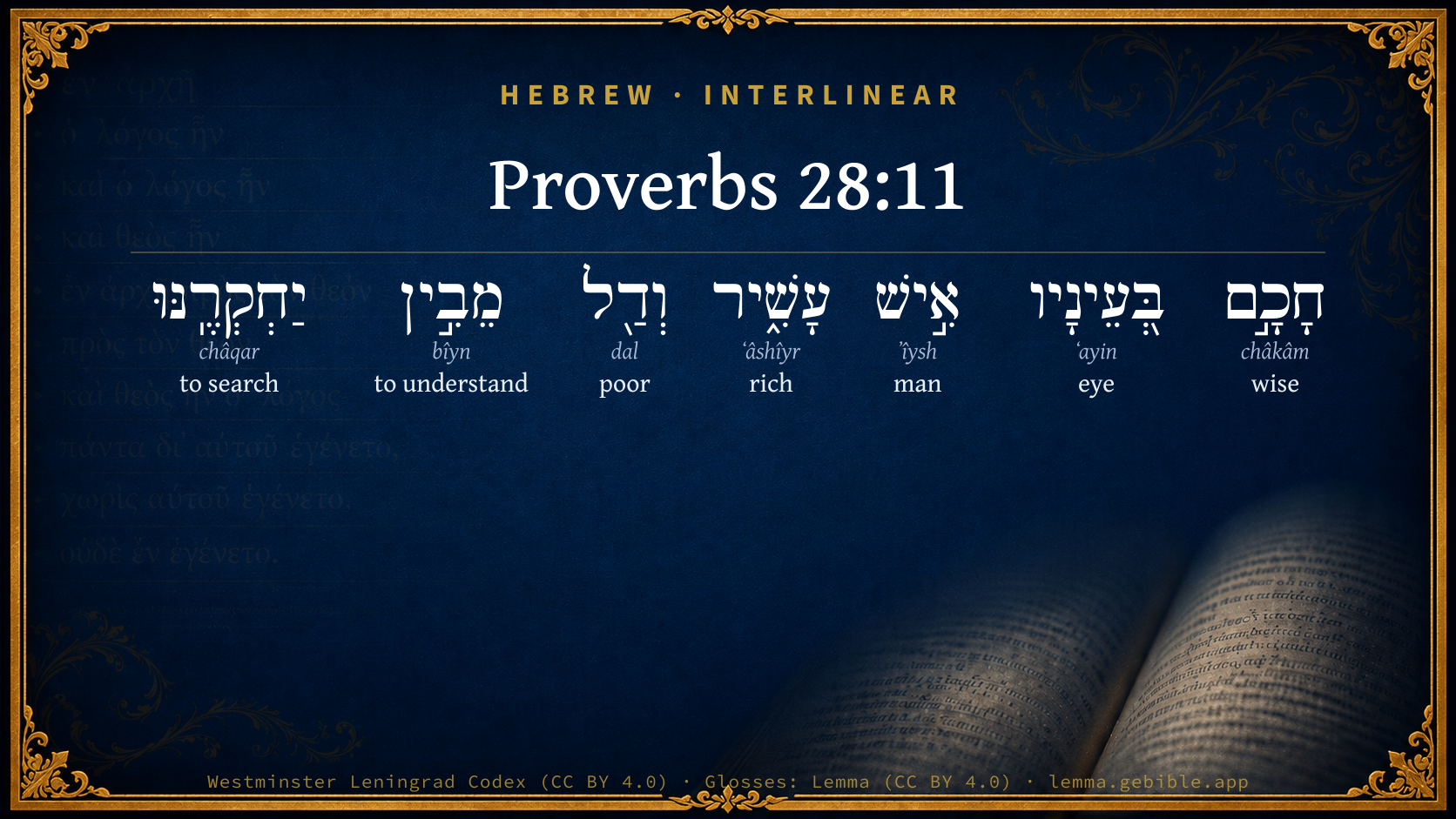
Hebrew (Westminster Leningrad Codex) Proverbs 28:11 appears in the Hebrew Old Testament. The text above is from the Westminster Leningrad Codex. Each word links to its Strong’s number, a concise gloss, and parsing drawn from the Open Scriptures Hebrew Bible morphology. Click any word for its full Brown-Driver-Briggs (BDB) entry.
Download image
Cite this verse

Proverbs 28:11 (World English Bible). Public Domain. Lemma interlinear Bible study tool, https://lemma.gebible.app/v/proverbs/28/11.

Show BibTeX & RIS
BibTeX
RIS
English Translation
The rich man is wise in his own eyes; But the poor who has understanding sees through him.
World English Bible · Public Domain
Download a study sheet

One document with this verse’s original text, its word-by-word gloss line, the meaning frame, cross-references with their text, attributed commentary, and full source and license credits — printable, and it pastes into notes with its structure intact.

This verse Autodidact and up

Study sheet (.html) Plain text (.txt)

A passage Seminary Student

Up to 50 verses in one chapter. A passage sheet keeps up to 6 commentary sources and 12 cross-references per verse, in the order this page ranks them, and says so on the sheet whenever that leaves anything out. Ask for a single verse and you get the Autodidact verse sheet above.

Everything on this page stays free to read, with no account — the sheet is a download of what is already on screen, not access to it.

Want to remove ads? Support Godless Engineer
Compare translations 3

The same verse in 3 English versions, stacked beneath the original-language interlinear above. Click any original word for its lexicon entry.

Each is an independent rendering of the whole verse — the interlinear is not word-aligned to these translations.

Highlighted words mark where these versions differ — a whole-verse word diff, not a word-by-word alignment.

  • World English Bible Public Domain
    The rich man is wise in his own eyes; But the poor who has understanding sees through him.
  • King James Version Public Domain
    The rich man is wise in his own conceit; but the poor that hath understanding searcheth him out.
  • unfoldingWord Literal Text CC BY-SA 4.0
    A rich man wise in his eyes, but a discerning lowly will search him out.

unfoldingWord Literal Text — © unfoldingWord, licensed CC BY-SA 4.0. Word-aligned USFM3 via Door43 (git.door43.org/unfoldingWord/en_ult).

Versions to compare (up to 4)

3 of 4 selected

Show all 18 translations

Every available English version of this verse, each an independent rendering of the whole verse.

  • World English Bible Public Domain
    The rich man is wise in his own eyes; But the poor who has understanding sees through him.
  • Berean Standard Bible Public Domain
    A rich man is wise in his own eyes, but a poor man with discernment sees through him.
  • Majority Standard Bible Public Domain
    A rich man is wise in his own eyes, but a poor man with discernment sees through him.
  • King James Version Public Domain
    The rich man is wise in his own conceit; but the poor that hath understanding searcheth him out.
  • American Standard Version (1901) Public Domain
    The rich man is wise in his own conceit; But the poor that hath understanding searcheth him out.
  • Revised Version (1885) Public Domain
    The rich man is wise in his own conceit; but the poor that hath understanding searcheth him out.
  • Geneva Bible (1599) Public Domain
    The riche man is wise in his owne conceite: but the poore that hath vnderstanding, can trie him.
  • Douay-Rheims (1899) Public Domain
    The rich man seemeth to himself wise: but the poor man that is prudent shall search him out.
  • Young's Literal Translation Public Domain
    A rich man is wise in his own eyes, And the intelligent poor searcheth him.
  • Literal Standard Version CC BY-SA 4.0
    A rich man is wise in his own eyes, || And the intelligent poor searches him.
  • Unlocked Literal Bible CC BY-SA 4.0
    The rich person may be wise in his own eyes, but a poor person who has understanding will find him out.
  • unfoldingWord Literal Text CC BY-SA 4.0
    A rich man wise in his eyes, but a discerning lowly will search him out.
  • Darby Bible Public Domain
    A rich man is wise in his own eyes; but the poor that hath understanding searcheth him out.
  • World Messianic Bible Public Domain
    The rich man is wise in his own eyes; but the poor who has understanding sees through him.
  • Webster's Bible Public Domain
    The rich man is wise in his own conceit; but the poor man that hath understanding searcheth him out.
  • Free Bible Version CC BY-SA 4.0
    The rich see themselves as wise, but poor people with insight see right through them.
  • Bible in Basic English Public Domain
    The man of wealth seems to himself to be wise, but the poor man who has sense has a low opinion of him.
  • JPS Tanakh (1917) Public Domain
    The rich man is wise in his own eyes; but the poor that hath understanding searcheth him through.

Literal Standard Version (2020), Covenant Press — licensed CC BY-SA 4.0. Text via the HelloAO Bible API (eBible.org). Unlocked Literal Bible (unfoldingWord) — licensed CC BY-SA 4.0. Text via the HelloAO Bible API (eBible.org). unfoldingWord Literal Text — © unfoldingWord, licensed CC BY-SA 4.0. Word-aligned USFM3 via Door43 (git.door43.org/unfoldingWord/en_ult). Free Bible Version, Dr. Jonathan Gallagher — licensed CC BY-SA 4.0. Text via the HelloAO Bible API (eBible.org).

Word by word

More ways to search: Search by grammar → Find every occurrence → Compare this word →

Practice this passage: Drill this verse → Learn its vocabulary →

About this verse

These counts appear in no published source. They are computed here, from the morphology-tagged text and Lemma’s own curated glosses. What Lemma adds →

7
words
7
distinct lemmas
Wisdom
section

Notable vocabulary

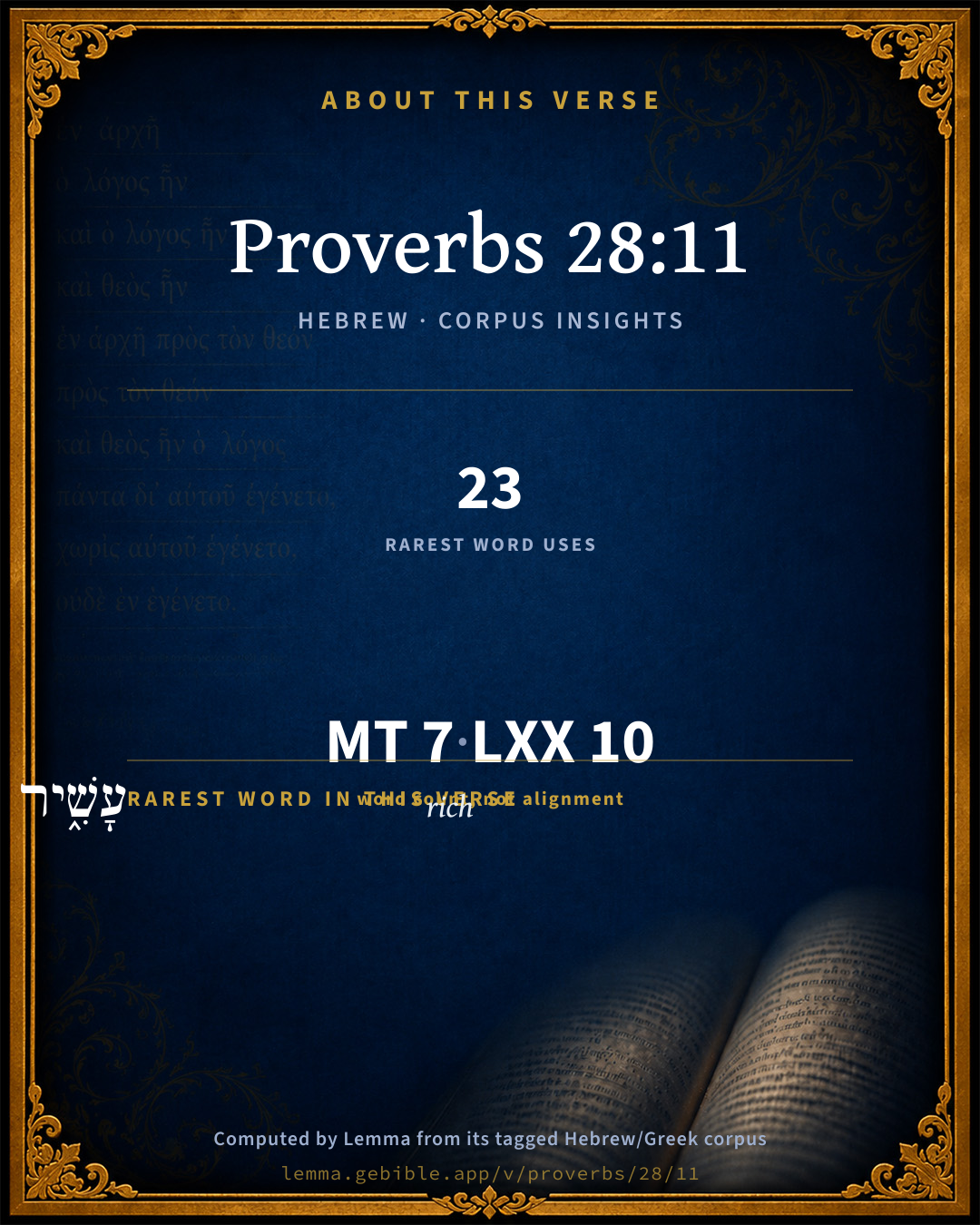
The rarest word here is עָשִׁ֑יר rich H6223 — appearing just 23 times in the whole Hebrew Bible.

Shared distinctive vocabulary

עָשִׁ֑יר rich H6223 occurs in 23 verses of the Hebrew Bible. Also found in:

Grammatical profile

  • 2 verbs
  • 2 nouns
  • 3 adjectives

Verb forms

  • מֵבִ֣ין Hiphil · Participle Active
  • יַחְקְרֶֽנּוּ Qal · Imperfect

Hebrew & Septuagint length

In English translation the verse runs 18 words from the Hebrew and 17 from the Septuagint (LXX English) — closely comparable.

A rough comparison of the two English renderings, which tokenize alike — not a word-level alignment.

Word counts can differ between the Hebrew and the Greek without any difference in meaning — e.g. the Hebrew direct-object marker אֵת has no separate Greek word, and Greek often adds the article ὁ.

In the original languages it is 7 Hebrew tokens and 10 Greek tokens — but the two are counted differently (Hebrew bundles its prefixes and suffixes into one token; the Greek is in lemma form), so that isn’t a like-for-like length.

Cross-references

16

Topical passages linked to Proverbs 28:11 in the Treasury of Scripture Knowledge — connected by theme and wording, ordered by reader-vote popularity; previews shown in the World English Bible.

  • Proverbs 18:17 He who pleads his cause first seems right; Until another comes and questions him.
  • Proverbs 26:16 The sluggard is wiser in his own eyes Than seven men who answer with discretion.
  • Ecclesiastes 9:15–17 Now a poor wise man was found in it, and he by his wisdom delivered the city; yet no man remembered that same poor man.
  • Proverbs 19:1 Better is the poor who walks in his integrity Than he who is perverse in his lips and is a fool.
  • Proverbs 23:4 Don't weary yourself to be rich. In your wisdom, show restraint.
  • Luke 16:13–14 No servant can serve two masters, for either he will hate the one, and love the other; or else he will hold to one, and despise the other. You aren't able to serve God and mammon."
  • Romans 12:16 Be of the same mind one toward another. Don't set your mind on high things, but associate with the humble. Don't be wise in your own conceits.
  • 1 Corinthians 3:18–19 Let no one deceive himself. If anyone thinks that he is wise among you in this world, let him become a fool, that he may become wise.
  • Job 32:9 It is not the great who are wise, Nor the aged who understand justice.
  • Proverbs 18:11 The rich man's wealth is his strong city, Like an unscalable wall in his own imagination.
  • Proverbs 26:5 Answer a fool according to his folly, Lest he be wise in his own eyes.
  • Isaiah 10:13–14 For he has said, By the strength of my hand I have done it, and by my wisdom; for I have understanding: and I have removed the bounds of the peoples, and have robbed their treasures, and like a valiant man I have brought down those who sit [on thrones]:
  • Ezekiel 28:3–5 behold, you are wiser than Daniel; there is no secret that is hidden from you;
  • Romans 11:25 For I don't desire, brothers, to have you ignorant of this mystery, so that you won't be wise in your own conceits, that a partial hardening has happened to Israel, until the fullness of the Gentiles has come in,
  • Isaiah 5:21 Woe to those who are wise in their own eyes, And prudent in their own sight!
  • 1 Timothy 6:17 Charge those who are rich in this present world that they not be haughty, nor have their hope set on the uncertainty of riches, but on the living God, who richly provides us with everything to enjoy;

Cross-references courtesy of OpenBible.info (CC BY 4.0).

Hebrew and Greek witnesses Masoretic Hebrew ↔ Greek Septuagint

The same verse in the two great witnesses to the Old Testament, shown verse-for-verse.

These are two independent witnesses, not word-aligned to each other, and the Septuagint is shown in lemma (dictionary) form.

Hebrew Proverbs 28:11 Masoretic · Westminster Leningrad Codex

חָכָ֣ם בְּ֭עֵינָיו אִ֣ישׁ עָשִׁ֑יר וְדַ֖ל מֵבִ֣ין יַחְקְרֶֽנּוּ

The rich man is wise in his own eyes; But the poor who has understanding sees through him.

World English Bible · Public Domain

Greek LXX Proverbs 28:11 Septuagint · lemma form

σοφός παρά ἑαυτοῦ ἀνήρ πλούσιος πένης δέ νοήμων καταγιγνώσκω αὐτός

A rich man is wise in his own conceit; but an intelligent poor man will condemn him.

LXX2012 (modern English Septuagint) · Public Domain

On this verse, The Pulpit Commentary discusses the Septuagint’s reading. Read the note in Commentary ↓

Hebrew: Westminster Leningrad Codex (CC BY 4.0). Greek: Septuagint (public domain); English from LXX2012 (modern English Septuagint) (Public Domain). How the Septuagint differs from the Hebrew →

Commentary

Notes on Proverbs 28:11 from classic Christian and Jewish commentators (each source and its license shown beneath its notes). The classic Christian expositions comment on the surrounding passage and are grouped to its opening verse, so a note may address several verses; the Jewish commentaries on the Tanakh (Rashi and others) are per-verse, so they appear only where the commentator wrote on this verse.

Lemma curates 59 commentaries, every one of them public domain or Creative Commons licensed, each selected and text-cleaned for this edition rather than reprinted as found. About our sources →

Trapp's Complete Commentary

John Trapp

Pro 28:11 The rich man [is] wise in his own conceit; but the poor that hath understanding searcheth him out.

Ver. 11. The rich man is wise in his own conceit.] He sacrificeth to himself, as Sejanus did; {a} to his "drag and net," {Hab 1:16} as the Babylonians did; he thanks his wit for his wealth, and takes upon him as if there were none such. {1Ti 6:17} {See Trapp on "1Ti 6:17"} Like Isis her ass, that had gone so oft to the temple of that goddess, that at length she thought herself worshipful. Every grain of riches hath a vermin of pride and self-conceit in it, and a very small wind will blow up a bubble.

But the poor that hath understanding.] That is, Well versed in the bigger volume of God’s word, and in the lesser volume of his own heart - which is better to him than any expositor, for the right understanding of the Scriptures; this poor wise man searcheth him out, finds the rich man’s folly, and if need be tells him of it, giving him a right character of himself. Sed divitibus fere ideo talis amicus deest, quia nihil deest.

{a} Seianus sibi sacrificabat. - Dio.

John Trapp, A Commentary or Exposition upon All the Books of the Old and New Testament (1647–1656) — public domain. Text from a community e-Sword module.

Joseph Benson's Commentary

Pro 28:11. The rich man is wise in his own conceit — Thinks himself wise when he is not, being puffed up by the opinion of his riches; but the poor, &c., searcheth him out — Knows him better than he knows himself, and, looking through all his pomp and vain show, sees him to be, what indeed he is, a foolish and miserable man, notwithstanding all his riches, and discovers the folly of his words and actions.

Joseph Benson's Commentary on the Old and New Testaments (1811–1818) — public domain. Text from a community e-Sword module.

The Preacher's Complete Homiletical Commentary

Joseph S. Exell (gen. ed.)

CRITICAL NOTES.—

Pro_28:12. Hidden. Or “sought for.” Delitzsch understands this to mean “plundered,” or “subjected to espionage.”

MAIN HOMILETICS OF Pro_28:11

WISDOM IN WEALTH AND POVERTY

I. Riches tend to produce self-deception. The power of riches to give external position and influence is almost unlimited. Wealth can bring its owners into the palaces of princes, and place them on an equal footing with men of talent and rank. It can surround a man with servants who will obey his nod, and with friends who will flatter him to his heart’s content. By means of riches a man can make his name famous in both hemispheres while he lives, and cause it to be remembered after he is dead. It is not therefore surprising that many men who possess this potent means of influence should be so dazzled by it as to be unable to see themselves apart from it, and should credit themselves with being more than ordinary men, while the only difference is that they have more. A rich man is always in danger of mistaking his wealth, which is but an appendage to his personality, for the wealth of wisdom, which is a part of oneself, and so of being the subject of the worst of all deception, viz., self-deception.

II. But the possessor of riches does not often deceive other people as to his real worth. Men around him may flatter him and treat him as if they thought him very wise and clever, but they are often despising him all the time, and oftentimes there are those about him who, although they are beneath him in rank and wealth, are far above him in sagacity and penetration, and can read his character and motives far better than he can himself. Wealth can do much for a man, but it cannot purchase for him the respect and esteem of even the poor man who “hath understanding,” and poverty has many drawbacks, but it is free from this one—it does not minister to human vanity.

III. A poor man who has moral and mental wealth is a greater blessing to the world than even a rich man who is wise and good. He can show the world that there are some things better than wealth, and that these better things are in no sense connected with it or dependent upon it. He can convince men that gold is but a shadow and that riches of heart and mind are the substance, and he can demonstrate how much more lasting and satisfying is the influence gained by wisdom than that which is born of wealth.

OUTLINES AND SUGGESTIVE COMMENTS

The phrase, “searcheth him out,” may be variously understood. He discerns his true character. He sees that wisdom and wealth do not always go together; that a full purse is quite compatible with an empty head. He sees, too, that a man’s wisdom is not to be estimated by his opinion of himself. He sees shallowness where the man himself fancies depth, and folly in what elates him with a vain consciousness of his own wisdom. He sees abundant reason for not making the rich man his oracle, or setting him up as his idol, or making his example the pattern for his imitation, merely for the number of his acres, or for the gold and silver in his coffers. He sees how prone men in general are to allow weight to counsel in proportion to the wealth of the counsellor. But the “understanding” which God has given him shows him the absurdity of this. He “searches out” the fallacy, and detects and exposes the imprudence and folly of sentiments and proposals, that are propounded and recommended by the wealthiest of the wealthy. And still further, taking “understanding” in its higher sense, as it is used in this Book, as including a mind divinely enlightened and under the influence of the fear of God and all the principles of true religion:—the poor man who has this, sees and knows that “a little with the fear of the Lord is better than the riches of many wicked;”—that “a good understanding have all they who do his commandments;”—that no folly can be more palpable and flagrant than the folly of “trusting in uncertain riches,”—“setting the eyes upon that which is not,” and neglecting provision for the soul and for eternity,—forfeiting the “unsearchable riches” provided by the mercy of God for sinners,—all the blessings, unspeakably precious, summed up in “life everlasting;”—spurning away the counsel that would put these in possession;—greedily coveting the treasures of the world that perish in the using, and rejecting the Divine offer of the treasures of immortality. The poor man who hath understanding—I can hardly say “searches out” the folly of this,—he discerns it by a kind of spiritual intuition.—Wardlaw.

The thought in Pro_28:12 is the same as in chap. Pro_11:10. See Homiletics on page 206.

The Preacher's Complete Homiletical Commentary (gen. ed. Joseph S. Exell; Funk & Wagnalls, c. 1892) — public domain (pre-1929). A full-Bible homiletical/sermon-outline anthology covering 65 of 66 books (2 John is absent from the source module). Text from a community e-Sword module.

Geneva Bible (1599)

Geneva Bible translators

And judge that he is not wise.

Geneva Bible (1599) marginal notes — public domain. Text via Bolls.life.

Matthew Henry's Commentary

Note, 1. Those that are rich are apt to think themselves wise, because, whatever else they are ignorant of, they know how to get and save; and those that are purse-proud expect that all they say should be regarded as an oracle and a law, and that none should dare to contradict them, but every sheaf bow to theirs; this humour is fed by flatterers, who, because (like Jezebel's prophets) they are fed at their table, cry up their wisdom. 2. Those that are poor often prove themselves wiser than they: A poor man, who has taken pains to get wisdom, having no other way (as the rich man has) to get a reputation, searches him out, and makes it to appear that he is not such a scholar, nor such a politician, as he is taken to be. See how variously God dispenses his gifts; to some he gives wealth, to others wisdom, and it is easy to say which of these is the better gift, which we should covet more earnestly.

Matthew Henry's Commentary on the Whole Bible (1708–1710) — public domain (CC PDM 1.0). Text via the HelloAO Bible API.

Jamieson, Fausset & Brown

Robert Jamieson, A. R. Fausset & David Brown

A poor but wise man can discover (and expose) the rich and self-conceited.

Jamieson, Fausset & Brown — Commentary Critical and Explanatory on the Whole Bible (1871) — public domain (CC PDM 1.0). Text via the HelloAO Bible API.

Ellicott's Commentary for English Readers

(11) The rich man is wise in his own conceit.—For the blinding effect of wealth comp. Rev_3:17.

A Bible Commentary for English Readers, edited by Charles John Ellicott (1878–1897) — public domain. Text from a community e-Sword module.

The Cambridge Bible for Schools and Colleges

gen. ed. J. J. S. Perowne

11. searcheth him out] sees through him, as we should say, “Bene novit, neutiquam, ut Euripidis utamur dicto, τὸν εὐτυχοῦντα πάντʼ ἐπίστασθαι καλῶς,” Maurer.

The Cambridge Bible for Schools and Colleges (gen. ed. J. J. S. Perowne; Cambridge University Press, 1878–1918) — public domain. Text from a community e-Sword module.

John Gill's Exposition

The rich man is wise in his own conceit,.... Ascribing his getting riches to his great sagacity, wisdom, and prudence; and being flattered with it by dependents on him;

but the poor that hath understanding searcheth him out: a man of good understanding, whether in things natural, civil, moral, or spiritual, though poor, as a man may be poor and yet a wise man; such an one, when he comes into company with a rich man, wise in his own conceit, he soon by conversation with him finds him out to be a very foolish man, and exposes him as one; for riches are not always to men of understanding, or all that have them are not such; and better is a poor wise man than even a foolish king; see Ecc 9:11.

John Gill's Exposition of the Whole Bible (1746–1763) — public domain (CC PDM 1.0). Text via the HelloAO Bible API.

Albert Barnes' Notes on the Bible

Wealth blunts, poverty sharpens, the critical power of intellect.

Albert Barnes' Notes on the Bible (1834–1885) — public domain. Text from a community e-Sword/MySword module.

Matthew Poole's English Annotations

Is wise in his own conceit; thinks himself to be wise when he is not, being puffed up with the opinion of his riches, which also he imputes to his own wisdom, and with the admirations and applauses of flatterers, which commonly attend upon them.

Searcheth him out; knoweth him better than he knoweth himself; and, looking through all his pomp and vain show, he sees him to be what indeed he is, a foolish and miserable man, notwithstanding all his riches, and discovers the folly of his words and actions.

Matthew Poole's English Annotations on the Holy Bible (1683–1685) — public domain. Text from a community e-Sword/MySword module.

Whedon's Commentary on the Bible

Daniel D. Whedon

11. Rich… conceit — Riches sometimes gives a man an overweening opinion of his own wisdom. A man of intelligence, though poor, easily sees through him, and can easily expose his pretensions.

Daniel D. Whedon (gen. ed.), Commentary on the Old and New Testaments (1874–1909) — public domain. Text from a community e-Sword module.

The Pulpit Commentary

The rich man is wise in his own conceit. (comp. Pro_18:11) A rich man thinks so highly of his position, is so flattered by parasites, and deems himself placed so immeasurably above social inferiors, that he learns to consider himself possessed of other qualifications, even mental and intellectual gifts, with which wealth has no concern. This purse-proud arrogance which looks upon financial skill and sharpness in bargaining as true wisdom, is confined to no age or country. But the poor man that hath understanding searcheth him out. (Pro_18:17) Wisdom is not to be bought with money. A poor man may be wise, his poverty probably making him a keener critic; and if he is brought into communication with this self-deluding plutocrat, he soon sees through him and recognizes his real value. Septuagint, "An intelligent poor man will condemn him."

The Pulpit Commentary (1880–1919), ed. H.D.M. Spence-Jones & Joseph S. Exell — public domain. Text from a community e-Sword module.

Keil & Delitzsch

C. F. Keil & F. Delitzsch

11 A rich man deems himself wise;

But a poor man that hath understanding searcheth him out,

or, as we have translated, Pro 18:17, goes to the bottom of him, whereby is probably thought of the case that he seeks to use him as a means to an ignoble end. The rich man appears in his own eyes to be a wise man, i.e., in his self-delusion he thinks that he is so; but if he has anything to do with a poor man who has intelligence, then he is seen through by him. Wisdom is a gift not depending on any earthly possession.

Keil & Delitzsch — Biblical Commentary on the Old Testament (1861–1891) — public domain (CC PDM 1.0). Text via the HelloAO Bible API. (Old Testament only.)

Bridges on Proverbs

Charles Bridges

To be truly wise, and wise in our own conceit, are two things often confounded, but essentially opposite. But though riches do not always bring wisdom (Job 32:9 ), the rich man often pretends to it, and ascribes his success to his own sagacity, though he may be manifestly simple and foolish. The Apostle therefore, with a reference to this besetting temptation, directs a "charge to them that are rich in this world, that they be not high-minded." (1Ti 6:17 .) The prophet brings the wealthy prince of Tyrus on the stage, and shews him to us in all the folly of his conceit. (Eze 28:2 .) Obviously indeed the rich man has many advantages above the poor, in leisure and opportunities of instruction. Yet on the other hand, worldly elevation operates unfavorably. He is shut out from many opportunities of Christian instruction. The atmosphere of flattery clouds that faculty of self-knowledge, which is the basis of true wisdom. And how natural is it to think himself as wise as his flatterers represent him; as much above his neighbors in understanding as in station! Hence he becomes dogmatical in over-weening conceit; fond every way of displaying his fancied superiority. Yet, as in the case of Naaman’s servants (2Ki 5:13 ), the intelligent good understanding of a poor man may search him out, and see through this false gloss. Specially, when endued with a measure of spiritual understanding, the poor man may expose his superior to just mortification. (Joh 9:30-34 .) Indeed the universe possesses not a more dignified character than the poor wise man. Did not the incarnate Lord honor this station supremely, by taking it on himself? (Php 2:7 .) To walk in his footsteps, in his spirit, is wisdom, honor, and happiness, infinitely beyond what this poor world of vanity can afford.

Footnotes:

Charles Bridges, An Exposition of the Book of Proverbs (1846) — public domain. Text from a community e-Sword module.

unfoldingWord translationNotes

Door43 World Missions Community

be wise in his own eyes

The eyes represent seeing, and seeing represents thoughts or judgment. AT: "be wise in his own thoughts" or "think he is wise" (See: Metaphor)

who has understanding

The abstract noun "understanding" can be expressed as a verb. AT: "who understands" (See: Abstract Nouns)

will find him out

This is an idiom that means the poor person will be able to determine whether or not the rich person is really wise. AT: "will see his true nature" (See: Idiom)

When the righteous triumph

"When righteous people succeed"

when the wicked arise

This is an idiom that means when the wicked gain power or start to rule. AT: "when the wicked rise to power" (See: Idiom)

the wicked

This refers to wicked people in general. AT: "wicked people" (See: Nominal Adjectives)

people are sought out

You may need to make explicit that those who "are sought out" have hidden themselves to escape from the wicked. This can be stated in active form. AT: "they seek people out" or "they seek out the people who hide from them" (See: Assumed Knowledge and Implicit Information and Active or Passive)

translationWords

wise

glory

evil

unfoldingWord translationNotes — © Distant Shores Media and the Door43 World Missions Community, licensed CC BY-SA 4.0. Source: git.door43.org/Door43/en_tn.

Rashi

Rabbi Shlomo Yitzchaki (Rashi)

A rich man...but a discerning poor man Scripture speaks about a teacher and a pupil, that the pupil searches out [the understanding of the subject matter,] and through him, the teacher gains wisdom.

Rashi on the Tanakh — English translations: “The Judaica Press complete Tanach with Rashi, translated by A. J. Rosenberg” (CC BY 4.0); “Pentateuch with Rashi's commentary by M. Rosenbaum and A.M. Silbermann, 1929-1934” (public domain); “The Metsudah Tanach series, Lakewood, N.J” (CC BY 4.0); and “The Book of Joshua, Metsudah Publications, 1997” (CC BY 4.0). Text via Sefaria.

Lesson kit

Teaching starters — assembled from the data on this page, not authored interpretation. Every prompt links to the verse data it draws on. Edit before teaching.

Proverbs, in the Wisdom, opens this verse with 7 words (7 distinct Hebrew lemmas). Its most distinctive word is ʻâshîyr (“rich”). A historical commentator’s framing appears above. Read the whole chapter for the surrounding context.

Discussion questions

  1. How does “rich” (ʻâshîyr) shape what this verse is saying?
  2. How does Exodus 30:15, which shares the word «rich», read alongside this verse?
  3. The translations on this page render this verse differently — a whole-verse word diff, not a word-by-word alignment. What might account for the different wordings?
  4. «מֵבִ֣ין» is a Hiphil Participle Active verb. How does that grammatical form shape the action described?
  5. Compare how Trapp's Complete Commentary and Joseph Benson's Commentary read this verse. Where do they agree or differ?

Things to notice

Reading settings

Reading text

Shown beneath each verse's original-language words.

Old Testament
Old Testament edition

Read the OT as the Masoretic Hebrew (MT) or the Greek Septuagint (LXX).

English shown for the Greek Septuagint (in the Hebrew ↔ Greek comparison).

Comparing translations? Open the Compare panel on any verse page to stack up to four side by side.