Micah 4:12

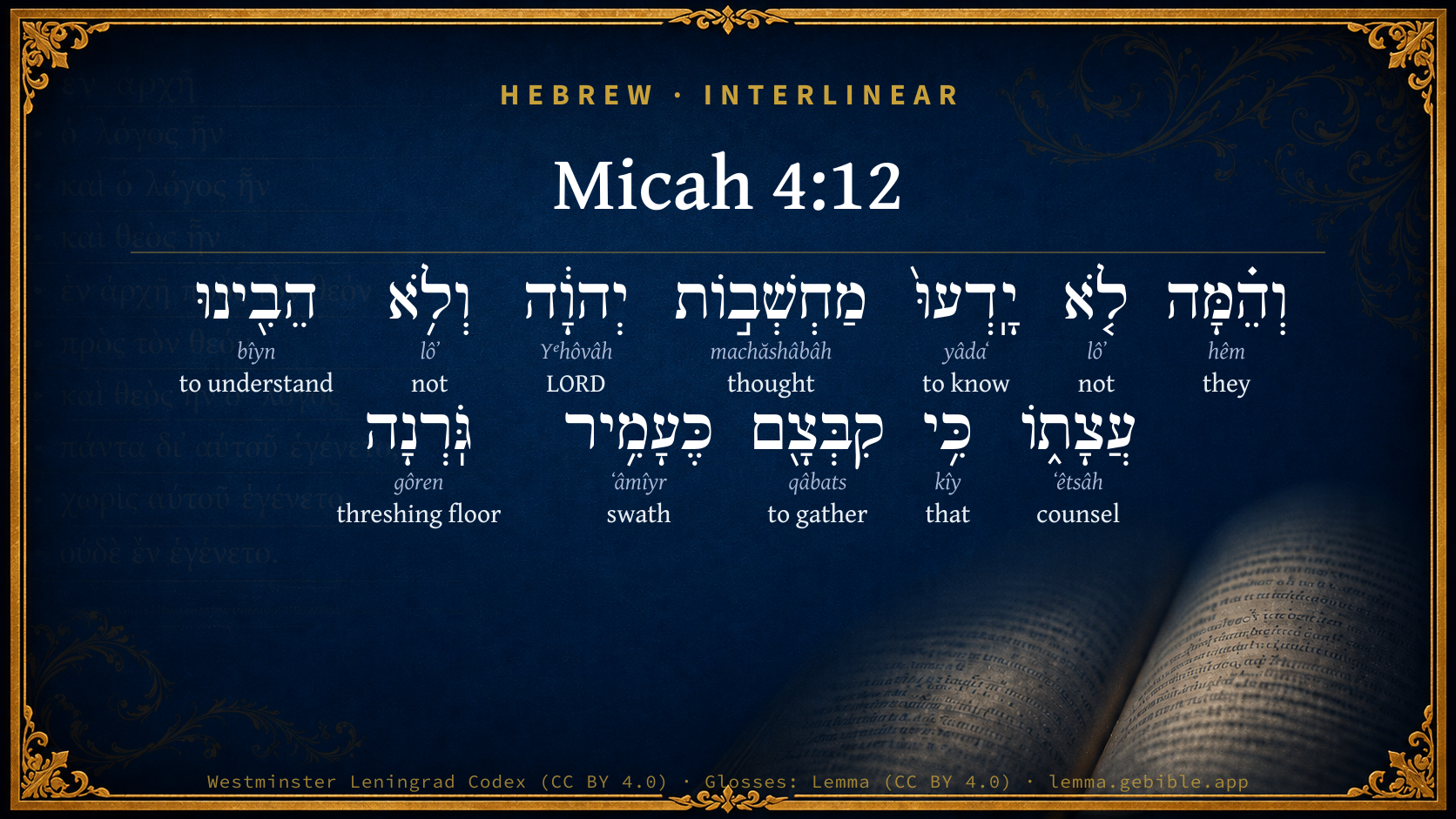
Hebrew (Westminster Leningrad Codex) Micah 4:12 appears in the Hebrew Old Testament. The text above is from the Westminster Leningrad Codex. Each word links to its Strong’s number, a concise gloss, and parsing drawn from the Open Scriptures Hebrew Bible morphology. Click any word for its full Brown-Driver-Briggs (BDB) entry.
Download image
Cite this verse

Micah 4:12 (World English Bible). Public Domain. Lemma interlinear Bible study tool, https://lemma.gebible.app/v/micah/4/12.

Show BibTeX & RIS
BibTeX
RIS
English Translation
But they don't know the thoughts of Yahweh, Neither do they understand his counsel; For he has gathered them like the sheaves to the threshing floor.
World English Bible · Public Domain
Download a study sheet

One document with this verse’s original text, its word-by-word gloss line, the meaning frame, cross-references with their text, attributed commentary, and full source and license credits — printable, and it pastes into notes with its structure intact.

This verse Autodidact and up

Study sheet (.html) Plain text (.txt)

A passage Seminary Student

Up to 50 verses in one chapter. A passage sheet keeps up to 6 commentary sources and 12 cross-references per verse, in the order this page ranks them, and says so on the sheet whenever that leaves anything out. Ask for a single verse and you get the Autodidact verse sheet above.

Everything on this page stays free to read, with no account — the sheet is a download of what is already on screen, not access to it.

Want to remove ads? Support Godless Engineer
Compare translations 3

The same verse in 3 English versions, stacked beneath the original-language interlinear above. Click any original word for its lexicon entry.

Each is an independent rendering of the whole verse — the interlinear is not word-aligned to these translations.

Highlighted words mark where these versions differ — a whole-verse word diff, not a word-by-word alignment.

  • World English Bible Public Domain
    But they don't know the thoughts of Yahweh, Neither do they understand his counsel; For he has gathered them like the sheaves to the threshing floor.
  • King James Version Public Domain
    But they know not the thoughts of the LORD, neither understand they his counsel: for he shall gather them as the sheaves into the floor.
  • unfoldingWord Literal Text CC BY-SA 4.0
    But they, they do not know the thoughts of Yahweh and they do not understand his plan, for he has gathered them like bundles of grain for the threshing floor.

unfoldingWord Literal Text — © unfoldingWord, licensed CC BY-SA 4.0. Word-aligned USFM3 via Door43 (git.door43.org/unfoldingWord/en_ult).

Versions to compare (up to 4)

3 of 4 selected

Show all 18 translations

Every available English version of this verse, each an independent rendering of the whole verse.

  • World English Bible Public Domain
    But they don't know the thoughts of Yahweh, Neither do they understand his counsel; For he has gathered them like the sheaves to the threshing floor.
  • Berean Standard Bible Public Domain
    But they do not know the thoughts of the LORD or understand His plan, for He has gathered them like sheaves to the threshing floor.
  • Majority Standard Bible Public Domain
    But they do not know the thoughts of the LORD or understand His plan, for He has gathered them like sheaves to the threshing floor.
  • King James Version Public Domain
    But they know not the thoughts of the LORD, neither understand they his counsel: for he shall gather them as the sheaves into the floor.
  • American Standard Version (1901) Public Domain
    But they know not the thoughts of Jehovah, neither understand they his counsel; for he hath gathered them as the sheaves to the threshing-floor.
  • Revised Version (1885) Public Domain
    But they know not the thoughts of the LORD, neither understand they his counsel: for he hath gathered them as the sheaves to the threshingfloor.
  • Geneva Bible (1599) Public Domain
    But they knowe not the thoughtes of the Lord: they vnderstand not his counsell, for he shall gather them as the sheaues in the barne.
  • Douay-Rheims (1899) Public Domain
    But they have not known the thoughts of the Lord, and have not understood his counsel: because he hath gathered them together as the hay of the floor.
  • Young's Literal Translation Public Domain
    They have not known the thoughts of Jehovah, Nor have they understood His counsel, For He hath gathered them as a sheaf `into' a threshing-floor.
  • Literal Standard Version CC BY-SA 4.0
    They have not known the thoughts of YHWH, || Nor have they understood His counsel, || For He has gathered them as a sheaf [into] a threshing-floor.
  • Unlocked Literal Bible CC BY-SA 4.0
    They do not know Yahweh's thoughts, neither do they understand his plans, for he has gathered them like bundles of grain prepared for the threshing floor.
  • unfoldingWord Literal Text CC BY-SA 4.0
    But they, they do not know the thoughts of Yahweh and they do not understand his plan, for he has gathered them like bundles of grain for the threshing floor.
  • Darby Bible Public Domain
    But they know not the thoughts of Jehovah, neither understand they his counsel; for he hath gathered them together as the sheaves into the threshing-floor.
  • World Messianic Bible Public Domain
    But they don’t know the thoughts of the LORD, neither do they understand his counsel; for he has gathered them like the sheaves to the threshing floor.
  • Webster's Bible Public Domain
    But they know not the thoughts of the LORD, neither understand they his counsel: for he will gather them as sheaves into the floor.
  • Free Bible Version CC BY-SA 4.0
    But they don't know what the Lord is thinking, and don't understand what he is planning. He has brought them together like bundles of grain to the threshing floor.
  • Bible in Basic English Public Domain
    But they have no knowledge of the thoughts of the Lord, their minds are not able to see his purpose: for he has got them together like stems of grain to the crushing-floor.
  • JPS Tanakh (1917) Public Domain
    But they know not the thoughts of the LORD, neither understand they His counsel; for He hath gathered them as the sheaves to the threshing-floor.

Literal Standard Version (2020), Covenant Press — licensed CC BY-SA 4.0. Text via the HelloAO Bible API (eBible.org). Unlocked Literal Bible (unfoldingWord) — licensed CC BY-SA 4.0. Text via the HelloAO Bible API (eBible.org). unfoldingWord Literal Text — © unfoldingWord, licensed CC BY-SA 4.0. Word-aligned USFM3 via Door43 (git.door43.org/unfoldingWord/en_ult). Free Bible Version, Dr. Jonathan Gallagher — licensed CC BY-SA 4.0. Text via the HelloAO Bible API (eBible.org).

Word by word

More ways to search: Search by grammar → Find every occurrence → Compare this word →

Practice this passage: Drill this verse → Learn its vocabulary →

כֶּעָמִ֥יר
ʻâmîyr
H5995
“like/as the · swath”
Preposition, Determined + Noun, Common, Masculine, Singular, Absolute
Part of Speech
Preposition + Noun
Type
Common
Gender
Masculine
Number
Singular
State
Absolute
Full BDB Definition

Origin: from H6014

TWOT: 1645c

swath, a row of fallen grain
  1. וְהֵ֗מָּה hêm H1992 “and · they” Conjunction + Pronoun, Personal, 3rd Person, Masculine, Plural
  2. לֹ֤א lôʼ H3808 “not” Particle, Negative
  3. יָֽדְעוּ֙ yâdaʻ H3045 “to know” Verb, Qal, Perfect, 3rd Person, Common, Plural
  4. מַחְשְׁב֣וֹת machăshâbâh H4284 “thoughts of” Noun, Common, Feminine, Plural, Construct
  5. יְהוָ֔ה Yᵉhôvâh H3068 “LORD” Noun, Proper
  6. וְלֹ֥א lôʼ H3808 “and · not” Conjunction + Particle, Negative
  7. הֵבִ֖ינוּ bîyn H995 “to understand” Verb, Hiphil, Perfect, 3rd Person, Common, Plural
  8. עֲצָת֑וֹ ʻêtsâh H6098 “counsel · his” Noun, Common, Feminine, Singular, Construct + Suffix, Personal, 3rd Person, Masculine, Singular
  9. כִּ֥י kîy H3588 “that” Conjunction
  10. קִבְּצָ֖ם qâbats H6908 “to gather · them” Verb, Piel, Perfect, 3rd Person, Masculine, Singular + Suffix, Personal, 3rd Person, Masculine, Plural
  11. גֹּֽרְנָה gôren H1637 “threshing floor · toward” Noun, Common, Both, Singular, Absolute + Suffix, Demonstrative

About this verse

These counts appear in no published source. They are computed here, from the morphology-tagged text and Lemma’s own curated glosses. What Lemma adds →

12
words
11
distinct lemmas
Prophets
section

Notable vocabulary

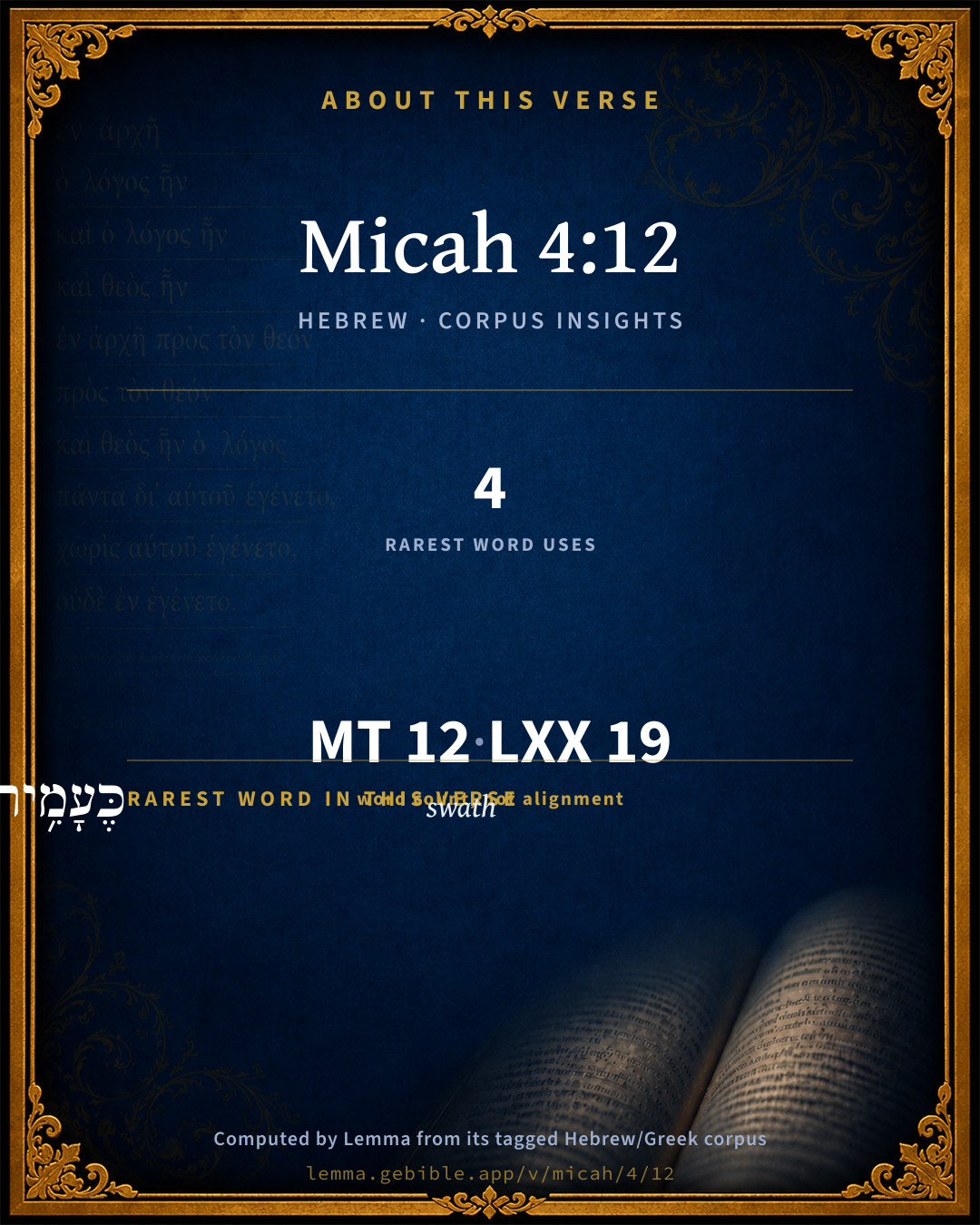
The rarest word here is כֶּעָמִ֥יר swath H5995 — appearing just 4 times in the whole Hebrew Bible.

Shared distinctive vocabulary

כֶּעָמִ֥יר swath H5995 occurs in 4 verses of the Hebrew Bible. Also found in:

Grammatical profile

  • 3 verbs
  • 5 nouns
  • 1 pronoun
  • 1 conjunction
  • 2 particles

Verb forms

  • יָֽדְעוּ֙ Qal · Perfect
  • הֵבִ֖ינוּ Hiphil · Perfect
  • קִבְּצָ֖ם Piel · Perfect

Repetition

A word recurs within this verse — often emphatic in Hebrew:

Hebrew & Septuagint length

In English translation the verse runs 26 words from the Hebrew and 25 from the Septuagint (LXX English) — closely comparable.

A rough comparison of the two English renderings, which tokenize alike — not a word-level alignment.

Word counts can differ between the Hebrew and the Greek without any difference in meaning — e.g. the Hebrew direct-object marker אֵת has no separate Greek word, and Greek often adds the article ὁ.

In the original languages it is 12 Hebrew tokens and 19 Greek tokens — but the two are counted differently (Hebrew bundles its prefixes and suffixes into one token; the Greek is in lemma form), so that isn’t a like-for-like length.

Cross-references

8

Topical passages linked to Micah 4:12 in the Treasury of Scripture Knowledge — connected by theme and wording, ordered by reader-vote popularity; previews shown in the World English Bible.

  • Isaiah 55:8 For my thoughts are not your thoughts, neither are your ways my ways, says Yahweh.
  • Jeremiah 29:11 For I know the thoughts that I think toward you, says Yahweh, thoughts of peace, and not of evil, to give you hope in your latter end.
  • Romans 11:33–34 Oh the depth of the riches both of the wisdom and the knowledge of God! How unsearchable are his judgments, and his ways past tracing out!
  • Joel 3:12–13 "Let the nations arouse themselves, And come up to the valley of Jehoshaphat; For there will I sit to judge all the surrounding nations.
  • Zechariah 14:1–3 Behold, a day of Yahweh comes, when your spoil will be divided in your midst.
  • Luke 3:17 whose fan is in his hand, and he will thoroughly cleanse his threshing floor, and will gather the wheat into his barn; but he will burn up the chaff with unquenchable fire."
  • Isaiah 21:10 You my threshing, and the grain of my floor! that which I have heard from Yahweh of hosts, the God of Israel, have I declared to you.
  • Revelation 14:14–20 I looked, and behold, a white cloud; and on the cloud one sitting like a son of man, having on his head a golden crown, and in his hand a sharp sickle.

Cross-references courtesy of OpenBible.info (CC BY 4.0).

Hebrew and Greek witnesses Masoretic Hebrew ↔ Greek Septuagint

The same verse in the two great witnesses to the Old Testament, shown verse-for-verse.

These are two independent witnesses, not word-aligned to each other, and the Septuagint is shown in lemma (dictionary) form.

Hebrew Micah 4:12 Masoretic · Westminster Leningrad Codex

וְהֵ֗מָּה לֹ֤א יָֽדְעוּ֙ מַחְשְׁב֣וֹת יְהוָ֔ה וְלֹ֥א הֵבִ֖ינוּ עֲצָת֑וֹ כִּ֥י קִבְּצָ֖ם כֶּעָמִ֥יר גֹּֽרְנָה

But they don't know the thoughts of Yahweh, Neither do they understand his counsel; For he has gathered them like the sheaves to the threshing floor.

World English Bible · Public Domain

Greek LXX Micah 4:12 Septuagint · lemma form

αὐτός δέ οὐ γιγνώσκω ὁ λογισμός κύριος καί οὐ συνἵημι ὁ βουλή αὐτός ὅτι συνἄγω αὐτός ὡς δράγμα ἅλων

But they know not the thought of the Lord, and have not understood his counsel: for he has gathered them as sheaves of the floor.

LXX2012 (modern English Septuagint) · Public Domain

Hebrew: Westminster Leningrad Codex (CC BY 4.0). Greek: Septuagint (public domain); English from LXX2012 (modern English Septuagint) (Public Domain). How the Septuagint differs from the Hebrew →

Targum (Aramaic paraphrase)

1

The Targum is the ancient Jewish Aramaic paraphrase of the Hebrew Scriptures — an interpretive translation, not the Hebrew text itself. Onkelos (literal) and Pseudo-Jonathan (expansive) render the Torah, and Jonathan the Prophets. Coverage is partial: where no permissively-licensed English translation exists for a verse, only the Aramaic is shown. This is verse-level text, not a word-by-word alignment to the Hebrew.

  1. Targum Jonathan Prophets (Joshua–Malachi)
    וְאִינוּן לָא יָדְעִין רָזַיָא דַייָ וְלָא מִסְתַּכְּלִין בְּמִלְכֵיהּ אֲרֵי קָרִיבִינוּן כַּעֲמִירָא לְאִידְרָא:

    (no public-domain English translation for this verse)

    Targum Jonathan — Aramaic: “Mikraot Gedolot” (public domain). English: “Sefaria Community Translation” (CC0 1.0 (public-domain dedication)); “London "Chaldee Paraphrase," 1871” (public domain). Text via Sefaria.

Commentary

Notes on Micah 4:12 from classic Christian and Jewish commentators (each source and its license shown beneath its notes). The classic Christian expositions comment on the surrounding passage and are grouped to its opening verse, so a note may address several verses; the Jewish commentaries on the Tanakh (Rashi and others) are per-verse, so they appear only where the commentator wrote on this verse.

Lemma curates 59 commentaries, every one of them public domain or Creative Commons licensed, each selected and text-cleaned for this edition rather than reprinted as found. About our sources →

Jamieson, Fausset & Brown

Robert Jamieson, A. R. Fausset & David Brown

thoughts of the Lord--Their unsearchable wisdom, overruling seeming disaster to the final good of His people, is the very ground on which the restoration of Israel hereafter (of which the restoration from Babylon is a type) is based in Isa 55:8; compare with Mic 4:3, Mic 4:12-13, which prove that Israel, not merely the Christian Church, is the ultimate subject of the prophecy; also in Rom 11:13. God's counsel is to discipline His people for a time with the foe as a scourge; and then to destroy the foe by the hands of His people.

gather them as . . . sheaves--them who "gathered" themselves for Zion's destruction (Mic 4:11) the Lord "shall gather" for destruction by Zion (Mic 4:13), like sheaves gathered to be threshed (compare Isa 21:10; Jer 51:33). The Hebrew is singular, "sheaf." However great the numbers of the foe, they are all but as one sheaf ready to be threshed [CALVIN]. Threshing was done by treading with the feet: hence the propriety of the image for treading under foot and breaking asunder the foe.

Jamieson, Fausset & Brown — Commentary Critical and Explanatory on the Whole Bible (1871) — public domain (CC PDM 1.0). Text via the HelloAO Bible API.

Trapp's Complete Commentary

John Trapp

Mic 4:12 But they know not the thoughts of the LORD, neither understand they his counsel: for he shall gather them as the sheaves into the floor.

Ver. 12. But they know not the thoughts of the Lord] Nothing like their thoughts, Isa 55:8. Confer Isa 10:7-8 Zec 11:15-16. His thoughts are fatherly, while theirs are butcherly. The physician in setting leeches to his patient seeks his good; he aims not at filling the leech’s gorge; neither will he set more on him than will make for his health. God by his wisdom, and according to his eternal counsel (which the wicked understand not), ordereth and draweth the blind and brute motions of the worst creatures to his own honour and his Church’s good; as the huntsman doth the rage of the dog to his pleasure, or the mariner the blowing of the wind to his voyage, or the artist the heat of the fire to his work, or the physician the blood thirstiness of the leech to a cure (Dr Reynolds). "Surely," saith the Psalmist, speaking of Sennacherib’s cruelty in the siege of Jerusalem, "the wrath of man shall praise thee" (eventually, though not intentionally): "the remainder of wrath shalt thou restrain," Psa 76:10. Let the enemies think and project as they please, let them rage and resolve upon your utter ruin; "I know the thoughts that I think toward you, saith the Lord; thoughts of peace, and not of evil, to give you an expected end; to recompense tribulation to them that trouble you; and to you who are troubled rest," Jer 29:11 2Th 1:6-7. "For thus saith the Lord God, the Holy One of Israel; In returning and rest shall ye be saved; in quietness and in confidence shall be your strength," Isa 30:15. "And I will strengthen the house of Judah, and I will save the house of Joseph, and I will bring them again to place them; for I have mercy upon them: and they shall be as though I had not cast them off: for I am the Lord their God, and I will hear them," Zec 10:6. Surely as it was said of old, neither shall Rome fall while Scipio standeth, neither shall Scipio live when Rome falleth; so may it more truly be affirmed of Christ, that he and his people shall stand and fall together. But "he shall stand at the latter day upon the earth," Job 19:25, yea, he shall set his right foot upon the sea, and his left foot upon the earth, Rev 10:2, as Lord of sea and land, maugre the malice of all that sought to supplant him, who shall therehence fall, and never rise up again, Amo 8:14.

John Trapp, A Commentary or Exposition upon All the Books of the Old and New Testament (1647–1656) — public domain. Text from a community e-Sword module.

Tyndale Open Study Notes

Tyndale Open Resources

4:12 God reveals his plans to his servants (Dan 2:19-23; Amos 3:7), but the nations don’t know—they are not privy to God’s great plans or to his behind-the-scenes activity on his people’s behalf. The hopes and plans of the nations around Israel were in vain—the Lord’s plans for his unique people will prevail, and he will rule the nations (Gen 12:1-3; 15:12-21; Exod 19:4-6; Isa 45:23; 66:23). • At the threshing floor, grain was beaten and trampled to separate it from the chaff. So, too, the nations will be crushed (Mic 4:13).

Tyndale Open Study Notes — © Tyndale Open Resources, licensed CC BY-SA 4.0. Text via the HelloAO Bible API.

Geneva Bible (1599)

Geneva Bible translators

He showeth that the faithful ought not to measure God’s judgments by the brags and threatenings of the wicked, but thereby are admonished to lift up their hearts to God to call for deliverance.

Geneva Bible (1599) marginal notes — public domain. Text via Bolls.life.

Adam Clarke's Commentary

Verse 12. But they know not the thoughts of the Lord] These think that God has utterly rejected his people, and they shall have a troublesome neighbour no more: but this is not his design; he will afflict them for a time; but these, the enemies of his people, he will gather as sheaves into the threshing-floor, there to be trodden, and the wheel to go over them. This is the counsel, the purpose of God, which these do not understand. The persons here referred to are not only the Chaldeans which were threshed by the Persians and Medes; but the Idumeans, Ammonites, Moabites, and Philistines, which the Jews afterwards subdued.

Adam Clarke's Commentary on the Bible (1810–1826) — public domain. Text from a community e-Sword/MySword module.

John Calvin's Commentaries

Consolation follows, But they know not the thoughts of Jehovah, nor understand his counsel: for verbs in the past tense have the meaning of the present. Here the Prophet recalls the attention of the godly to a subject the most suitable to them: for when the wicked rise up so cruelly against us, we are apt to think that all things are allowed to them, and then their reproaches and slanders immediately take possession of our minds and thoughts, so that we in a manner measure God’s judgment by their words. Hence when the ungodly deride our faith, and boast that we are forsaken by God, we succumb, being as it were filled with amazement: and nothing is easier than to shake off from us faith and the memory of God’s promises, whenever the ungodly are thus insolent. The Prophet then does not without cause apply a remedy which ought to be carefully observed by us. Who say, condemned is Zion; but they are like the blind when judging of colors, for they understand not the counsel of Jehovah and his thoughts they know not. We now then see what the Prophet had in view, which was to show, — that the faithful would be unwise and foolish, if they formed an opinion of God’s judgment according to the boasting of the ungodly: for Satan carries them away in a furious manner; and when the Lord gives them liberty to do evil, they think that they shall be conquerors to the end. As then the ungodly are thus inebriated with foolish confidence, and despise not only men, but God himself, the Prophet here holds up and supports the minds of the godly that they might ascend higher, and thus understand that the design of God was not the same as what the wicked thought, who neither belonged to nor approached God.

It is especially needful to know this truth. Some at the first sight may think it frigid, “O! than, what does the Prophet mean? he says that what these declare is not the design of Jehovah; and this we know.” But were all to examine the subject, they would then confess with one mouth, that nothing could have been more seasonable than this consolation. Now we are wounded by reproaches, and this very often happens to ingenuous men; and then, while the ungodly vomit forth their slanders, we think that God rests indifferently in heaven; and one of their words, like a cloud, obscures the judgment of God. As soon as any one of the wicked derides us, and laughs at our simplicity, threatens ferociously, and spreads forth his terrors, his words, as I have said, are like a cloud intervening between us and God. This is the reason why the Prophet says here, that the thoughts of Jehovah are different, and that his counsel is different: in short, the Prophet’s object is to show, that whenever the ungodly thus proudly despise us, and also reproachfully threaten and terrify us, we ought to raise our thoughts to heaven. — Why so? Because the design of God is another. Their boastings then will vanish, for they arise from nothing, and they shall come to nothing, but the purpose of God shall stand.

But let us now see why the Prophet spoke here of the design and thoughts of God: for if only these two words are brought before us, there is certainly but little solid comfort, and nothing that has much force or power. There is then another principle to be understood, — that the thoughts of God are known to us, who are taught in his school. The counsel of God then is not hidden, for it is revealed to us in his Word. Consolation therefore depends on a higher and a more recondite doctrine; that is, that the faithful, in their miseries, ought to contemplate the counsel of God as in a mirror. And what is this? that when he afflicts us, he holds a remedy in his hand, and that when he throws us into the grave, he can restore us to life and safety. When, therefore, we understand this design of God, — that he chastens his Church with temporal evils, and that the issue will ever be most salutary, — when this is known by us, there is then no reason why the slanders of the ungodly should deject our minds; and when they vomit forth all their reproaches, we ought to adhere firmly to this counsel of God. But that the ungodly are thus proud is no matter of wonder; for if they raise their horns against God, why should they not despise us also, who are so few in number, and of hardly any influence, at least not equal to what they possess? The Church is indeed contemptible in the eyes of the world; and it is no wonder if our enemies thus deride us, and load us with ridicule and contempt, when they dare to act so frowardly towards God. But it is enough for us to know, that they do not understand the counsel of God. We now then see the Prophet’s meaning, and an explanation follows, —

For thou shalt assemble them, he says, as a sheaf to the floor The Prophet adds this clause as an explanation, that we may know what the counsel of God is, which he has mentioned, and that is, that God will collect the enemies as a sheaf. What is a sheaf? It is a small quantity of corn, it may be three hundred or a thousand ears of corn: they are ears of corn, and carried in a man’s hand. And then, what is to be done with the sheaf? It is to be thrashed on the floor. It was indeed difficult to believe, that enemies, when thus collected together on every side, would be like a sheaf. If an army assembled against us, not only ten or twenty thousand, but a much larger number, who would think, according to the judgment of the flesh, that they would be like a sheaf? They shall be as so many deaths and graves: even the thought of God ought to be to us of more account than the formidable power of men. Whenever, therefore, our enemies exceed us in strength and number, let us learn to arise to that secret counsel of God, of which our Prophet now speaks; and then it will be easy for us to regard a vast multitude to be no more than a handful. And he says, that our enemies are to be gathered to a floor, that they may be thrashed there. They assemble themselves for another purpose; for they think that we shall be presently in their power, that they may swallow us up; but when they thus collect themselves and their forces, the Lord will frustrate their purpose and cause them to be thrashed by us. It follows, —

John Calvin's Commentaries (1540-1563) — public domain. Text from the Calvin Translation Society English edition (1840s-50s) via the Christian Classics Ethereal Library (ccel.org). Calvin's coverage is partial (roughly two-thirds of the Bible); uncommented books and verses are honest gaps, never fabricated. The 19th-century editor's footnotes and remarks are omitted so the notes are faithfully Calvin's own voice.

Ellicott's Commentary for English Readers

(12) They know not the thoughts of the Lord.—As a commentary upon this passage, we may compare the message of God with reference to the haughty thoughts of Sennacherib. Then the Lord declared that the Assyrian king was but His instrument in all he had done; so that when he presumed to arrogate to himself the glory of his victories, the Lord revoked his commission: “I will put my hook in thy nose, and my bridle in thy lips, and I will turn thee back by the way by which thou carnest.” And so it came to pass.

A Bible Commentary for English Readers, edited by Charles John Ellicott (1878–1897) — public domain. Text from a community e-Sword module.

The Cambridge Bible for Schools and Colleges

gen. ed. J. J. S. Perowne

12. for he shall gather them] Rather, for he hath gathered them. The fate which they have prepared for Zion will come upon themselves. This is Jehovah’s counsel, but they know it not, for he hath brought them together, as sheaves are brought together to be threshed. Their ignorance is taken up by Jehovah into his purpose.

The Cambridge Bible for Schools and Colleges (gen. ed. J. J. S. Perowne; Cambridge University Press, 1878–1918) — public domain. Text from a community e-Sword module.

John Gill's Exposition

But they know not the thoughts of the Lord, neither understand they his counsel,.... Which are very different from theirs: the thoughts and designs of the enemies of Zion, in the times of the Maccabees, were, to destroy utterly the people of God, and root them out of the earth, and abolish their religion and worship; but the intentions of God were to defeat them, and bring them to ruin: the views of the kings of the earth, being stirred up by unclean spirits to the battle of Almighty God, will be to extirpate the interest and kingdom of Christ; but the end of the Lord, in suffering them to be gathered together, will be utterly and totally to destroy them; and the counsel of the Lord, that shall stand, and the thoughts of his heart, to all generations. Men know their own designs, but they do not know the designs of the Lord; they intend the ruin of others, but God intends to bring about theirs; and his intentions are never frustrated, but theirs are;

for he shall gather them as sheaves into the floor; as, when the harvest is ripe, it is cut down, and bound up in sheaves, and brought home, and these are laid in order upon the floor to be threshed; so, when the nations of the earth are fully ripe for ruin, God will put, or order to be put; in the sickle, and cut them down, and bind them in bundles, and lay them on his threshingfloor of wrath and vengeance, and utterly destroy them contrary to their views and expectations.

John Gill's Exposition of the Whole Bible (1746–1763) — public domain (CC PDM 1.0). Text via the HelloAO Bible API.

Albert Barnes' Notes on the Bible

But they know not the thoughts of the Lord, neither understand they His counsel - The pagan did, for their own ends, what God willed for His. The first step was the same; God willed that His people should be punished; they willed to punish them. But all which lay beyond, they saw not; that God willed (on their repentance) to pardon His own people, but to punish themselves for their pride Isa 10:7, Isa 10:12 and cruelty Zec 1:15, Zec 1:19. : “Almighty God corrects the elect through the reprobate, as with a rod; after which He condemns the reprobate eternally, as when the son has been disciplined, the rod is cast into the fire.”

For He shall gather them as the sheaves into the floor - The multitude of the sheaves hinders not the threshing; the multitude of God’s enemies hinders not their destruction. They think that they strengthen themselves, as they gather together; God sees them but as ripened and fitted for destruction, gathered into one bundle together, to perish together. God gathers them, not by constraint or force, but by giving free scope to their own wayward wills, and overruling these to His ends.

Albert Barnes' Notes on the Bible (1834–1885) — public domain. Text from a community e-Sword/MySword module.

Haydock's Catholic Bible Commentary

CHAPTER IV.

Hay. Protestants, "sheaves." (Haydock) --- People were thus often trodden to death by oxen. (Atheneus xii. 5.)

George Leo Haydock (1774–1849), Haydock's Catholic Family Bible and Commentary, 1859 edition — public domain. Excludes Psalms (Douay-Rheims chapter numbering differs from Protestant) and Deuterocanonical books (Catholic canon only).

Matthew Poole's English Annotations

But they, the gathered confederate nations, Zion’s enemies,

know not, neither discern nor consider, the thoughts of the Lord; the design of the holy, just, gracious, and faithful God, who is the God of his people, of Israel; who will humble, but not extirpate; who will purify by, but not consume in, the furnace; God’s thoughts to Israel are, to give him an expected end.

Neither understand they his counsel; the same thing in somewhat different phrase: this elegancy is ever added to confirm the thing foretold.

He shall gather them; by his secret, just, and effectual providence disposing all things to facilitate their gathering together, that they shall do, and yet God also shall do it; he as the first cause, they as the second; he moves according to his own pleasure, they move as they are second and dependent agents; they shall as a fire purge out the dross, or as a wind blow away the chaff and lightest corn, which is that God intendeth; but they consult only to extinguish the people, to cut them off that they be no moro a nation.

As the sheaves into the floor; a plain and very intelligible simile. The husbandman gathers the sheaves into the floor to thrash them; so God gathers, i.e. in due time he will do this, and bring his enemies and his church’s enemies together, that they may be bruised, broken, and destroyed utterly, This seems to look to Sennacherib’s gathering his power against Jerusalem, and the circumstances well enough suit this; yet is not this to be confined or restrained to Sennacherib, but perhaps to the slaughter made on the enemies in one hundred and twenty-seven provinces in Esther’s time, looking to somewhat that is further off indeed running through all ages of the church, and shall be finally accomplished in the ruin of the antichristian kingdom: then shall that of Zec 12:3 be fulfilled, when though all nations gather themselves against Jerusalem, yet it is that they may be cut in pieces; when the vine of the earth shall be gathered into the wine-press of God’s wrath, Rev 14:19,20; 19:15-21.

Matthew Poole's English Annotations on the Holy Bible (1683–1685) — public domain. Text from a community e-Sword/MySword module.

The Pulpit Commentary

But the enemies who came to exult over Zion do not know God"s design while blindly working it out. God"s people are not to be destroyed, but their adversaries. They know not the thoughts of the Lord. The heathen, who were the instruments of God"s wrath against his people, knew nothing of his purpose in thus afflicting them, nor perceived that they themselves were drawn together for punishment. He shall gather (hath gathered) them as the sheaves into the floor. Their blindness is proved by their not perceiving till too late that God has brought them together before Jerusalem, as sheaves are brought into the threshing floor, in order to be broken up and destroyed. (comp. Isa_21:10 Jer_51:23) The metaphor is carried on in the next verse. Various are the explanations of the prophet"s reference in this prophecy. Many commentators see in it a reference to the destruction of the army of Sennacherib; (2Ki_19:35) others discern a defeat of the Scythians after the return from captivity; others, again, place it in the times of the Maccabees; and others interpret it of the defeat of the mystical adversaries of God"s Church adumbrated in Eze 38 Zec 12; and Re 20. But the prophet has not one definite event in view, but looks forward to the general conflict between the powers of the world and the Church, of which the historical events and material enemies were the types. Certain historical circumstances may exactly suit the prediction, but they do not exhaust it. And indeed we do wrong to seek for minute and definite fulfilment of particular predictions. Such utterances are often conditional and are modified by subsequent circumstances. The prophets are concerned with great moral truths and the righteous government of the world, and are not always to be interpreted with literal exactness.

The Pulpit Commentary (1880–1919), ed. H.D.M. Spence-Jones & Joseph S. Exell — public domain. Text from a community e-Sword module.

John Wesley's Explanatory Notes

The thoughts - The design of the holy, just and faithful God. As the sheaves - The husbandman gathers the sheaves into the floor to thresh them; so God in due time will bring his enemies together, that they may be bruised, broken and destroyed.

John Wesley, Explanatory Notes Upon the Whole Bible (1754–1765) — public domain. Text via the GEBible commentary corpus.

Rashi

Rabbi Shlomo Yitzchaki (Rashi)

for He gathered them as sheaves to a threshing floor—And eventually, He will gather them to the Valley of Jehoshaphat and around Jerusalem to war, as they gather a sheaf in order to thresh it there. The heathens, too, will be gathered there for their detriment, and the Holy One, blessed be He, will say to the people of Israel: “Arise and thresh, O daughter of Zion.”

Rashi on the Tanakh — English translations: “The Judaica Press complete Tanach with Rashi, translated by A. J. Rosenberg” (CC BY 4.0); “Pentateuch with Rashi's commentary by M. Rosenbaum and A.M. Silbermann, 1929-1934” (public domain); “The Metsudah Tanach series, Lakewood, N.J” (CC BY 4.0); and “The Book of Joshua, Metsudah Publications, 1997” (CC BY 4.0). Text via Sefaria.

Lesson kit

Teaching starters — assembled from the data on this page, not authored interpretation. Every prompt links to the verse data it draws on. Edit before teaching.

Micah, in the Prophets, opens this verse with 12 words (11 distinct Hebrew lemmas). Its most distinctive word is ʻâmîyr (“swath”). A historical commentator’s framing appears above. Read the whole chapter for the surrounding context.

Discussion questions

  1. The word ʻâmîyr carries the sense “swath.” How does it shape the verse?
  2. How does Jeremiah 9:22, which shares the word «swath», read alongside this verse?
  3. What does the repetition of “not” (2× in this one verse) do in this verse?
  4. The translations on this page render this verse differently — a whole-verse word diff, not a word-by-word alignment. What might account for the different wordings?
  5. «יָֽדְעוּ֙» is a Qal Perfect verb. How does that grammatical form shape the action described?
  6. Compare how Jamieson, Fausset & Brown and Trapp's Complete Commentary read this verse. Where do they agree or differ?

Things to notice

Reading settings

Reading text

Shown beneath each verse's original-language words.

Old Testament
Old Testament edition

Read the OT as the Masoretic Hebrew (MT) or the Greek Septuagint (LXX).

English shown for the Greek Septuagint (in the Hebrew ↔ Greek comparison).

Comparing translations? Open the Compare panel on any verse page to stack up to four side by side.