
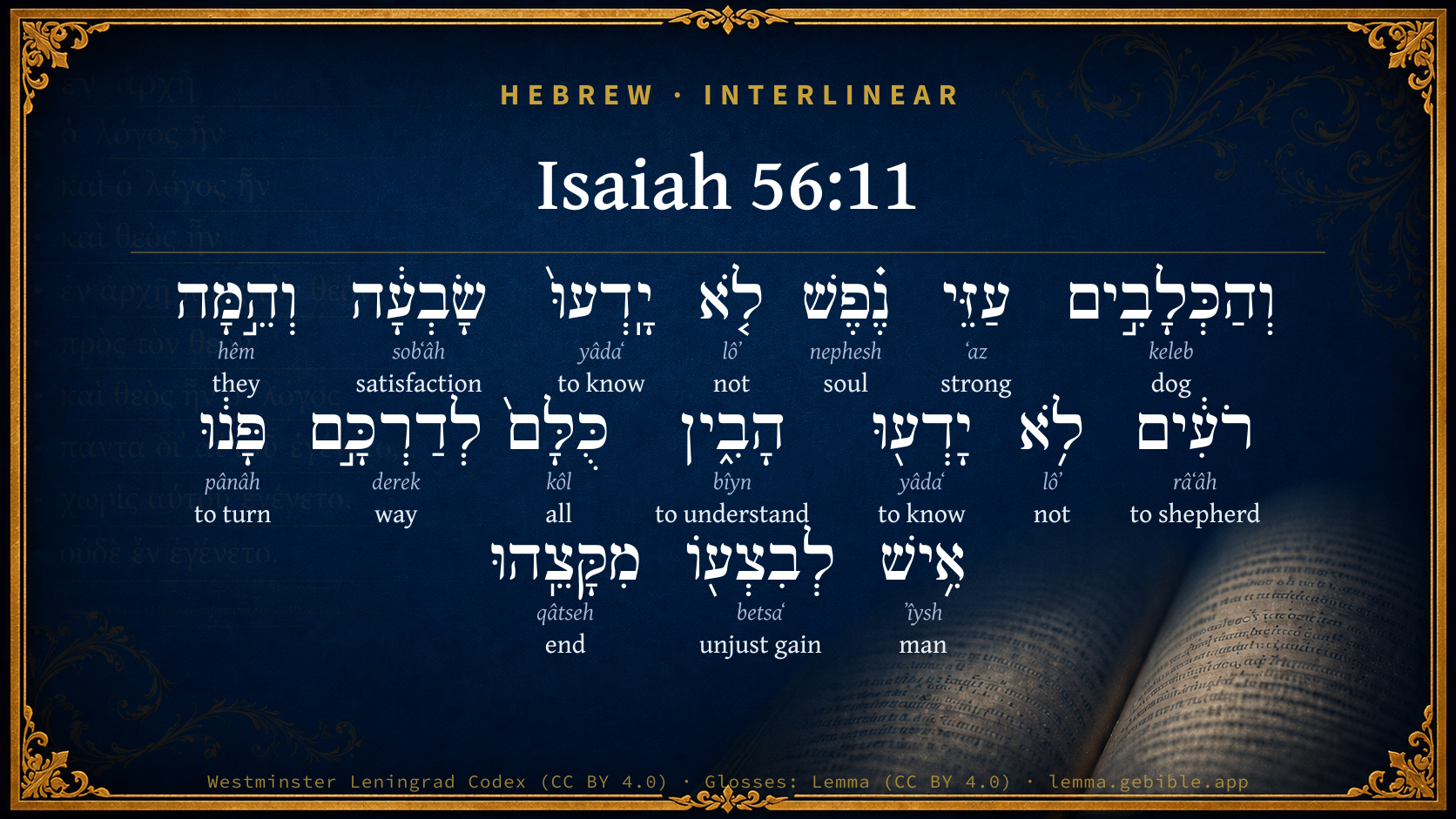
Isaiah 56:11

Hebrew (Westminster Leningrad Codex) Isaiah 56:11 appears in the Hebrew Old Testament. The text above is from the Westminster Leningrad Codex. Each word links to its Strong’s number, a concise gloss, and parsing drawn from the Open Scriptures Hebrew Bible morphology. Click any word for its full Brown-Driver-Briggs (BDB) entry.
Download image
Cite this verse

Isaiah 56:11 (World English Bible). Public Domain. Lemma interlinear Bible study tool, https://lemma.gebible.app/v/isaiah/56/11.

Show BibTeX & RIS
BibTeX
RIS
English Translation
Yes, the dogs are greedy, they can never have enough; and these are shepherds who can't understand: they have all turned to their own way, each one to his gain, from every quarter.
World English Bible · Public Domain
Download a study sheet

One document with this verse’s original text, its word-by-word gloss line, the meaning frame, cross-references with their text, attributed commentary, and full source and license credits — printable, and it pastes into notes with its structure intact.

This verse Autodidact and up

Study sheet (.html) Plain text (.txt)

A passage Seminary Student

Up to 50 verses in one chapter. A passage sheet keeps up to 6 commentary sources and 12 cross-references per verse, in the order this page ranks them, and says so on the sheet whenever that leaves anything out. Ask for a single verse and you get the Autodidact verse sheet above.

Everything on this page stays free to read, with no account — the sheet is a download of what is already on screen, not access to it.

Want to remove ads? Support Godless Engineer
Compare translations 3

The same verse in 3 English versions, stacked beneath the original-language interlinear above. Click any original word for its lexicon entry.

Each is an independent rendering of the whole verse — the interlinear is not word-aligned to these translations.

Highlighted words mark where these versions differ — a whole-verse word diff, not a word-by-word alignment.

  • World English Bible Public Domain
    Yes, the dogs are greedy, they can never have enough; and these are shepherds who can't understand: they have all turned to their own way, each one to his gain, from every quarter.
  • King James Version Public Domain
    Yea, they are greedy dogs which can never have enough, and they are shepherds that cannot understand: they all look to their own way, every one for his gain, from his quarter.
  • unfoldingWord Literal Text CC BY-SA 4.0
    And the dogs mighty of soul; they do not know satiety. And they shepherds do not know to discern. All of them have turned to their way, a man to his gain, from his end.

unfoldingWord Literal Text — © unfoldingWord, licensed CC BY-SA 4.0. Word-aligned USFM3 via Door43 (git.door43.org/unfoldingWord/en_ult).

Versions to compare (up to 4)

3 of 4 selected

Show all 18 translations

Every available English version of this verse, each an independent rendering of the whole verse.

  • World English Bible Public Domain
    Yes, the dogs are greedy, they can never have enough; and these are shepherds who can't understand: they have all turned to their own way, each one to his gain, from every quarter.
  • Berean Standard Bible Public Domain
    Like ravenous dogs, they are never satisfied. They are shepherds with no discernment; they all turn to their own way, each one seeking his own gain:
  • Majority Standard Bible Public Domain
    Like ravenous dogs, they are never satisfied. They are shepherds with no discernment; they all turn to their own way, each one seeking his own gain:
  • King James Version Public Domain
    Yea, they are greedy dogs which can never have enough, and they are shepherds that cannot understand: they all look to their own way, every one for his gain, from his quarter.
  • American Standard Version (1901) Public Domain
    Yea, the dogs are greedy, they can never have enough; and these are shepherds that cannot understand: they have all turned to their own way, each one to his gain, from every quarter.
  • Revised Version (1885) Public Domain
    Yea, the dogs are greedy, they can never have enough; and these are shepherds that cannot understand: they have all turned to their own way, each one to his gain, from every quarter.
  • Geneva Bible (1599) Public Domain
    And these griedy dogs can neuer haue ynough: and these shepheards cannot vnderstand: for they all looke to their owne way, euery one for his aduantage, and for his owne purpose.
  • Douay-Rheims (1899) Public Domain
    And meet impudent dogs, they never had enough: the shepherds themselves knew no understanding: all have turned aside into their own way, every one after his own gain, from the first even to the last.
  • Young's Literal Translation Public Domain
    And the dogs `are' strong of desire, They have not known sufficiency, And they `are' shepherds! They have not known understanding, All of them to their own way they did turn, Each to his dishonest gain from his quarter:
  • Literal Standard Version CC BY-SA 4.0
    And the dogs [are] strong of desire, || They have not known sufficiency, || And they [are] shepherds! They have not known understanding, || All of them turned to their own way, || Each to his dishonest gain from his quarter:
  • Unlocked Literal Bible CC BY-SA 4.0
    The dogs have big appetites; they can never get enough; they are shepherds without discernment; they have all turned to their own way, each one covetous for unjust gain.
  • unfoldingWord Literal Text CC BY-SA 4.0
    And the dogs mighty of soul; they do not know satiety. And they shepherds do not know to discern. All of them have turned to their way, a man to his gain, from his end.
  • Darby Bible Public Domain
    and the dogs are greedy, they know not to be satisfied, and these are shepherds that know not how to discern: they all turn to their own way, every one for his gain, even to the last of them:
  • World Messianic Bible Public Domain
    Yes, the dogs are greedy. They can never have enough. They are shepherds who can’t understand. They have all turned to their own way, each one to his gain, from every quarter.
  • Webster's Bible Public Domain
    Yes, they are greedy dogs which can never have enough, and they are shepherds that cannot understand: they all look to their own way, every one for his gain, from his quarter.
  • Free Bible Version CC BY-SA 4.0
    They're greedy dogs that are never satisfied. They're sheepdogs who don't know their job. All of them go their own way, each of them looking out for themselves.
  • Bible in Basic English Public Domain
    Yes, the dogs are for ever looking for food; while these, the keepers of the sheep, are without wisdom: they have all gone after their pleasure, every one looking for profit; they are all the same.
  • JPS Tanakh (1917) Public Domain
    Yea, the dogs are greedy, they know not when they have enough; and these are shepherds that cannot understand; they all turn to their own way, each one to his gain, one and all.

Literal Standard Version (2020), Covenant Press — licensed CC BY-SA 4.0. Text via the HelloAO Bible API (eBible.org). Unlocked Literal Bible (unfoldingWord) — licensed CC BY-SA 4.0. Text via the HelloAO Bible API (eBible.org). unfoldingWord Literal Text — © unfoldingWord, licensed CC BY-SA 4.0. Word-aligned USFM3 via Door43 (git.door43.org/unfoldingWord/en_ult). Free Bible Version, Dr. Jonathan Gallagher — licensed CC BY-SA 4.0. Text via the HelloAO Bible API (eBible.org).

Word by word

More ways to search: Search by grammar → Find every occurrence → Compare this word →

Practice this passage: Drill this verse → Learn its vocabulary →

שָׂבְעָ֔ה
sobʻâh
H7654
“satisfaction”
Noun, Common, Feminine, Singular, Absolute
Part of Speech
Noun
Type
Common
Gender
Feminine
Number
Singular
State
Absolute
Full BDB Definition

Origin: from H7648

TWOT: 2231b

satisfaction, satiety, one's fill
  1. וְהַכְּלָבִ֣ים keleb H3611 “and · the · dogs” Conjunction + Particle, Definite Article + Noun, Common, Masculine, Plural, Absolute
  2. עַזֵּי ʻaz H5794 “strong of” Adjective, Adjective, Masculine, Plural, Construct
  3. נֶ֗פֶשׁ nephesh H5315 “soul” Noun, Common, Both, Singular, Absolute
  4. לֹ֤א lôʼ H3808 “not” Particle, Negative
  5. יָֽדְעוּ֙ yâdaʻ H3045 “to know” Verb, Qal, Perfect, 3rd Person, Common, Plural
  6. וְהֵ֣מָּה hêm H1992 “and · they” Conjunction + Pronoun, Personal, 3rd Person, Masculine, Plural
  7. רֹעִ֔ים râʻâh H7462 “shepherding” Verb, Qal, Participle Active, Masculine, Plural, Absolute
  8. לֹ֥א lôʼ H3808 “not” Particle, Negative
  9. יָדְע֖וּ yâdaʻ H3045 “to know” Verb, Qal, Perfect, 3rd Person, Common, Plural
  10. הָבִ֑ין bîyn H995 “to understand” Verb, Hiphil, Infinitive Construct
  11. כֻּלָּם֙ kôl H3605 “all · their” Noun, Common, Masculine, Singular, Construct + Suffix, Personal, 3rd Person, Masculine, Plural
  12. לְדַרְכָּ֣ם derek H1870 “to/for · way · their” Preposition + Noun, Common, Both, Singular, Construct + Suffix, Personal, 3rd Person, Masculine, Plural
  13. פָּנ֔וּ pânâh H6437 “to turn” Verb, Qal, Perfect, 3rd Person, Common, Plural
  14. אִ֥ישׁ ʼîysh H376 “man” Noun, Common, Masculine, Singular, Absolute
  15. לְבִצְע֖וֹ betsaʻ H1215 “to/for · unjust gain · his” Preposition + Noun, Common, Masculine, Singular, Construct + Suffix, Personal, 3rd Person, Masculine, Singular
  16. מִקָּצֵֽהוּ qâtseh H7097 “from · end · his” Preposition + Noun, Common, Both, Singular, Construct + Suffix, Personal, 3rd Person, Masculine, Singular

About this verse

These counts appear in no published source. They are computed here, from the morphology-tagged text and Lemma’s own curated glosses. What Lemma adds →

17
words
15
distinct lemmas
Prophets
section

Notable vocabulary

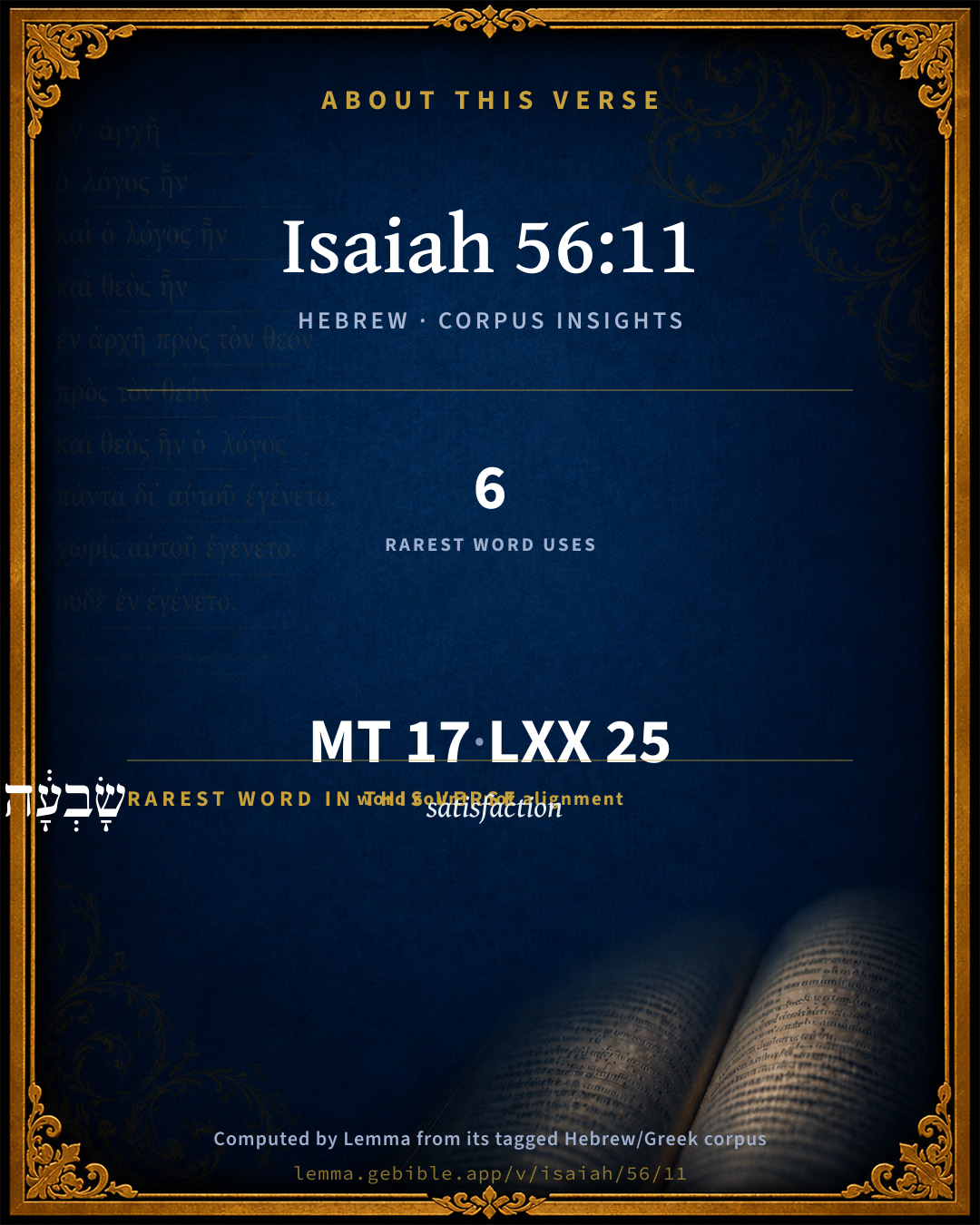
The rarest word here is שָׂבְעָ֔ה satisfaction H7654 — appearing just 6 times in the whole Hebrew Bible.

Shared distinctive vocabulary

שָׂבְעָ֔ה satisfaction H7654 occurs in 6 verses of the Hebrew Bible. Also found in:

Grammatical profile

  • 5 verbs
  • 8 nouns
  • 1 adjective
  • 1 pronoun
  • 2 particles

Verb forms

  • יָֽדְעוּ֙ Qal · Perfect
  • רֹעִ֔ים Qal · Participle Active
  • יָדְע֖וּ Qal · Perfect
  • הָבִ֑ין Hiphil · Infinitive Construct
  • פָּנ֔וּ Qal · Perfect

Repetition

Words recur within this verse — often emphatic in Hebrew:

  • יָֽדְעוּ֙ to know H3045 ×2
  • לֹ֤א not H3808 ×2

Hebrew & Septuagint length

In English translation the verse runs 33 words from the Hebrew and 32 from the Septuagint (LXX English) — closely comparable.

A rough comparison of the two English renderings, which tokenize alike — not a word-level alignment.

Word counts can differ between the Hebrew and the Greek without any difference in meaning — e.g. the Hebrew direct-object marker אֵת has no separate Greek word, and Greek often adds the article ὁ.

In the original languages it is 17 Hebrew tokens and 25 Greek tokens — but the two are counted differently (Hebrew bundles its prefixes and suffixes into one token; the Greek is in lemma form), so that isn’t a like-for-like length.

Cross-references

30

Topical passages linked to Isaiah 56:11 in the Treasury of Scripture Knowledge — connected by theme and wording, ordered by reader-vote popularity; previews shown in the World English Bible.

  • Ezekiel 34:2–3 Son of man, prophesy against the shepherds of Israel, prophesy, and tell them, even to the shepherds, Thus says the Lord Yahweh: Woe to the shepherds of Israel who feed themselves! Shouldn't the shepherds feed the sheep?
  • Ezekiel 13:19 You have profaned me among my people for handfuls of barley and for pieces of bread, to kill the souls who should not die, and to save the souls alive who should not live, by your lying to my people who listen to lies.
  • Micah 3:11 Her leaders judge for bribes, And her priests teach for a price, And her prophets of it tell forturnes for money: Yet they lean on Yahweh, and say, Isn't Yahweh in the midst of us? No disaster will come on us.
  • John 8:43 Why don't you understand my speech? Because you can't hear my word.
  • Isaiah 1:3 The ox knows his owner, And the donkey his master's crib; But Israel doesn't know, My people don't consider.
  • Isaiah 57:17 For the iniquity of his covetousness was I angry, and struck him; I hid [my face] and was angry; and he went on backsliding in the way of his heart.
  • Micah 3:5–6 Thus says Yahweh concerning the prophets who lead my people astray; for those who feed their teeth, they proclaim, "Peace!" and whoever doesn't provide for their mouths, they prepare war against him:
  • Zechariah 11:15–17 Yahweh said to me, "Take for yourself yet again the equipment of a foolish shepherd.
  • Titus 1:7 For the overseer must be blameless, as God's steward; not self-pleasing, not easily angered, not given to wine, not violent, not greedy for dishonest gain;
  • Revelation 22:15 Outside are the dogs, the sorcerers, the sexually immoral, the murderers, the idolaters, and everyone who loves and practices falsehood.
  • 1 Samuel 2:12–17 Now the sons of Eli were base men; they didn't know Yahweh.
  • 1 Timothy 3:8 Deacons, in the same way, must be reverent, not double-tongued, not addicted to much wine, not greedy for money;
  • Titus 1:11 whose mouths must be stopped; men who overthrow whole houses, teaching things which they ought not, for dishonest gain's sake.
  • 1 Peter 5:2 Shepherd the flock of God which is among you, exercising the oversight, not under compulsion, but voluntarily, not for dishonest gain, but willingly;
  • 2 Peter 2:3 In covetousness they will exploit you with deceptive words: whose sentence now from of old doesn't linger, and their destruction will not slumber.
  • 2 Peter 2:14–16 having eyes full of adultery, and who can't cease from sin; enticing unsettled souls; having a heart trained in greed; children of cursing;
  • Jude 1:11 Woe to them! For they went in the way of Cain, and ran riotously in the error of Balaam for hire, and perished in Korah's rebellion.
  • Jude 1:16 These are murmurers and complainers, walking after their lusts (and their mouth speaks proud things), showing respect of persons to gain advantage.
  • Exodus 23:3 neither shall you favor a poor man in his cause.
  • 1 Samuel 2:29 Why kick you at my sacrifice and at my offering, which I have commanded in [my] habitation, and honor your sons above me, to make yourselves fat with the best of all the offerings of Israel my people?
  • Ecclesiastes 5:10 He who loves silver shall not be satisfied with silver; nor he who loves abundance, with increase: this also is vanity.
  • Jeremiah 22:17 But your eyes and your heart are not but for your covetousness, and for shedding innocent blood, and for oppression, and for violence, to do it.
  • Malachi 1:10 "Oh that there were one among you who would shut the doors, that you might not kindle fire on my altar in vain! I have no pleasure in you," says Yahweh of hosts, "neither will I accept an offering at your hand.
  • Matthew 13:14–15 In them the prophecy of Isaiah is fulfilled, which says, 'By hearing you will hear, And will in no way understand; Seeing you will see, And will in no way perceive:
  • Acts 20:29 For I know that after my departure, vicious wolves will enter in among you, not sparing the flock.
  • Acts 20:33 I coveted no one's silver, or gold, or clothing.
  • 2 Corinthians 4:4 in whom the god of this world has blinded the minds of the unbelieving, that the light of the Gospel of the glory of Christ, who is the image of God, should not dawn on them.
  • Philippians 3:19 whose end is destruction, whose god is the belly, and whose glory is in their shame, who think about earthly things.
  • 1 Timothy 3:3 not a drinker, not violent, not greedy for money, but gentle, not quarrelsome, not covetous;
  • Philippians 3:2 Beware of the dogs, beware of the evil workers, beware of the false circumcision.

Cross-references courtesy of OpenBible.info (CC BY 4.0).

Hebrew and Greek witnesses Masoretic Hebrew ↔ Greek Septuagint

The same verse in the two great witnesses to the Old Testament, shown verse-for-verse.

These are two independent witnesses, not word-aligned to each other, and the Septuagint is shown in lemma (dictionary) form.

Hebrew Isaiah 56:11 Masoretic · Westminster Leningrad Codex

וְהַכְּלָבִ֣ים עַזֵּי נֶ֗פֶשׁ לֹ֤א יָֽדְעוּ֙ שָׂבְעָ֔ה וְהֵ֣מָּה רֹעִ֔ים לֹ֥א יָדְע֖וּ הָבִ֑ין כֻּלָּם֙ לְדַרְכָּ֣ם פָּנ֔וּ אִ֥ישׁ לְבִצְע֖וֹ מִקָּצֵֽהוּ

Yes, the dogs are greedy, they can never have enough; and these are shepherds who can't understand: they have all turned to their own way, each one to his gain, from every quarter.

World English Bible · Public Domain

Greek LXX Isaiah 56:11 Septuagint · lemma form

καί ὁ κύων ἀναιδής ὁ ψυχή οὐ οἶδα πλησμονή καί εἰμί πονηρός οὐ οἶδα σύνεσις πᾶς ἐν ὁ ὁδός αὐτός ἐκἀκολουθέω ἕκαστος κατά ὁ ἑαυτοῦ

Yes, they are insatiable dogs, that know not what it is to be filled, and they are wicked, having no understanding: all have followed their own ways, each according to his will.

LXX2012 (modern English Septuagint) · Public Domain

On this verse, Albert Barnes' Notes on the Bible discusses the Septuagint’s reading. Read the note in Commentary ↓

Hebrew: Westminster Leningrad Codex (CC BY 4.0). Greek: Septuagint (public domain); English from LXX2012 (modern English Septuagint) (Public Domain). How the Septuagint differs from the Hebrew →

Targum (Aramaic paraphrase)

1

The Targum is the ancient Jewish Aramaic paraphrase of the Hebrew Scriptures — an interpretive translation, not the Hebrew text itself. Onkelos (literal) and Pseudo-Jonathan (expansive) render the Torah, and Jonathan the Prophets. Coverage is partial: where no permissively-licensed English translation exists for a verse, only the Aramaic is shown. This is verse-level text, not a word-by-word alignment to the Hebrew.

  1. Targum Jonathan Prophets (Joshua–Malachi)
    וְכַלְבַיָא תַקִיפֵי נַפְשָׁן לָא יָדְעִין לְמִשְׂבַּע וְאִינוּן מַבְאֲשִׁין לָא יָדְעִין לְאִסְתַּכָּלָא כּוּלְהוֹן גְבַר לְקָבֵל אוֹרְחֵהּ גְלוֹ גְבַר לְמִבַּז מָמוֹנֵהּ דְיִשְׂרָאֵל:

    Yea, they are greedy dogs, they know not how to be satisfied; they are evildoers, they know not how to become wise: all of them go their own way, to rob the treasures of Israel.

    Targum Jonathan — Aramaic: “Mikraot Gedolot” (public domain). English: “Sefaria Community Translation” (CC0 1.0 (public-domain dedication)); “London "Chaldee Paraphrase," 1871” (public domain). Text via Sefaria.

Commentary

Notes on Isaiah 56:11 from classic Christian and Jewish commentators (each source and its license shown beneath its notes). The classic Christian expositions comment on the surrounding passage and are grouped to its opening verse, so a note may address several verses; the Jewish commentaries on the Tanakh (Rashi and others) are per-verse, so they appear only where the commentator wrote on this verse.

Lemma curates 59 commentaries, every one of them public domain or Creative Commons licensed, each selected and text-cleaned for this edition rather than reprinted as found. About our sources →

Trapp's Complete Commentary

John Trapp

Isa 56:11 Yea, [they are] greedy dogs [which] can never have enough, and they [are] shepherds [that] cannot understand: they all look to their own way, every one for his gain, from his quarter.

Ver. 11. Yea, they are greedy dogs that can never have enough.] Heb., Strong of soul, or of appetite; they know not to be satisfied. Lac et luna, is that they look for; the "instruments of a foolish shepherd," forcipes et mulctra, the shears and milk pail are in their hand; {Zec 11:15} they eat the fruit and drink the milk; {as Eze 25:4} yea, they eat the fat, and tear the claws in pieces. {Zec 11:16} Albertus Magnus complained heavily of the covetousness of pastors in his time. Temporalia colliguntper se, spiritualia seminant per alios saith he on Mat 10:16; {a} they take little pains, but care not how much profit they make. He that made Fasciculus temporum, doth the like. Another modern writer fitly applieth that to them, which Oedipus in Sophocles saith of Tiresias the heathen prophet -

“οστις εν τοις κερδεσι

Mονον δεδορκε, την τεχνην δ εφυτυφλος, ”

i.e., that he looked only to his gain, but was little seen in his profession. Such a one was Balaam; {Jdg 1:11} such were those false prophets; {Eze 13:2-3} the covetous Pharisees; {Luk 16:14} the false apostles, {Rom 16:18} called dogs; {Php 3:2} such as had a greedy worm under their tongues, and could never be satisfied.

And they are shepherds that cannot understand.] The dust of covetousness hath even put out their eyes. As it fared with the blind {a} and greedy Pharisees, Avidi a non videndo, the world is a pearl in their eyes; they cannot see God, nor skill of their office. Tremellius rendereth it nesciunt docere; they know not to teach, as being choked haply with a fat benefice - a common practice of the Pope.

They all look to their own way.] Mind their own commodity, whereby they are led up and down, as an ox may be all aground over by a bottle of hay.

{a} Midas secundum Etymologiam Graecam caecus est. Midas, according to Greek mythology, was blind.

John Trapp, A Commentary or Exposition upon All the Books of the Old and New Testament (1647–1656) — public domain. Text from a community e-Sword module.

Joseph Benson's Commentary

Isa 56:11. Yea, they are greedy dogs — Insatiably covetous: shepherds that cannot understand — Hebrew, that know not to understand; that do not care, or love, or desire either to understand the word of God themselves, or to make the people understand it. They all look to their own way — They regard neither God’s glory nor the people’s good, but only the satisfaction of their own base desires. Every one for his gain from his quarter — In their several places and stations, as they have opportunity.

Joseph Benson's Commentary on the Old and New Testaments (1811–1818) — public domain. Text from a community e-Sword module.

Tyndale Open Study Notes

Tyndale Open Resources

56:11 ignorant shepherds: Israel’s leaders did not know how to rule in a godly way (see also Ezek 34:1-6). By contrast, the Lord is the faithful Shepherd of his people (Isa 40:11). • all following their own path: They had no concern for God or his standards of godly leadership (see also 53:6). • personal gain: Cp. 33:15.

Tyndale Open Study Notes — © Tyndale Open Resources, licensed CC BY-SA 4.0. Text via the HelloAO Bible API.

Jamieson, Fausset & Brown

Robert Jamieson, A. R. Fausset & David Brown

greedy--literally, "strong" (that is, insatiable) in appetite (Eze 34:2-3; Mic 3:11).

cannot understand--unable to comprehend the wants of the people, spiritually: so Isa 56:10, "cannot bark."

look to . . . own way--that is, their own selfish interests; not to the spiritual welfare of the people (Jer 6:13; Eze 22:27).

from his quarter--rather, "from the highest to the lowest" [LOWTH]. "From his quarter"; that is, from one end to the other of them, one and all (Gen 19:4).

Jamieson, Fausset & Brown — Commentary Critical and Explanatory on the Whole Bible (1871) — public domain (CC PDM 1.0). Text via the HelloAO Bible API.

Adam Clarke's Commentary

Verse 11. Greedy dogs] Insatiably feeding themselves with the fat, and clothing themselves with the wool, while the flock is scattered, ravaged, and starved! O what an abundance of these dumb and greedy dogs are there found hanging on and prowling about the flock of Christ! How can any careless, avaricious, hireling minister read this without agitation and dismay?

Adam Clarke's Commentary on the Bible (1810–1826) — public domain. Text from a community e-Sword/MySword module.

Ellicott's Commentary for English Readers

(11) Shepherds that cannot understand . . .—Better, and such are shepherds; they cannot understand. There is no confusion or change of metaphors. What is implied is that the prophets who are not fit to be watch-dogs of the flock, assume the office of its shepherds.

From his quarter—i.e., in modern phrase, from his own sphere of influence.

A Bible Commentary for English Readers, edited by Charles John Ellicott (1878–1897) — public domain. Text from a community e-Sword module.

The Cambridge Bible for Schools and Colleges

gen. ed. J. J. S. Perowne

11. The first line reads, And the dogs are greedy (lit. “strong of soul,” i.e. appetite), they know not how to be satisfied. The charge of cupidity and of selling oracles for gain is one frequently brought against the false prophets (Mic_3:5; Mic_3:11; Jer_6:13; Eze_13:19; Eze_22:25); a contemporary instance may be the incident of Shemaiah (Neh_6:10 ff.). That the priesthood was infected with the same vice of covetousness is shown by Mal_1:12; on the upper classes generally see Neh_5:7 ff.

and they are shepherds &c.] The meaning can hardly be that those who have been called dogs are really the shepherds of the flock; but it is not easy to obtain a satisfactory sense. Cheyne renders “and these, pastors as they are,” taking “pastors” in the figurative sense of rulers. Dillmann with a slight change of the text reads “and even these, the shepherds,” supposing that a class of persons different from the “watchmen” (prophets) are now spoken of, viz., the nobles and elders. On any view the sentence is awkward; it adds nothing to the thought, and may originally have been a marginal gloss.

they all look to their own way] R.V. they have all turned to their own way; all pursue their selfish interests (cf. Isa_53:6).

from his quarter] Render, without exception, as Eze_25:9; Gen_19:4.

The Cambridge Bible for Schools and Colleges (gen. ed. J. J. S. Perowne; Cambridge University Press, 1878–1918) — public domain. Text from a community e-Sword module.

John Gill's Exposition

Yea, they are greedy dogs,.... Or "strong of soul" (y); of great appetites, and are never satisfied: or "strong of body"; the soul is sometimes put for the body; large bodied, fat bellied men, such as the priests, monks, and friars, that live upon the fat of the land; gluttons, epicures, men of a canine appetite, like dogs,

which can never have enough; know not fulness (z), or what it is to be filled to satisfaction, always craving more. Though some think this denotes their insatiable avarice, their greedy desire of money, not being satisfied with what they have, in order to support their voluptuous way of living.

And they are shepherds that cannot understand; or, "and they are", or "are they shepherds?" these blind and ignorant watchmen; these dumb and greedy dogs; these pretend to be the shepherds of the flock, and to feed them?

yet they know not to understand (a), or "know not understanding"; have no knowledge and understanding of divine things, and therefore unfit and incapable of feeding the people therewith:

they all look to their own way: to do that which is most pleasing to them, agreeable to their carnal lusts; they seek that which is most for their worldly profit and advantage, having no regard to the glory of God, the interest of Christ, and the welfare of the flock:

everyone for his gain from his quarter; from the province, city, or town he is in; from his archbishopric, bishopric, or parish; making the most of his benefice, of his tithes and revenues; increasing his salary as much as he can; getting as much as possible from all sorts of persons, rich and poor, high and low, that are under his jurisdiction; and this is the case of everyone, from the greatest to the least. The Targum is,

"everyone to spoil the substance of Israel;''

as the Pharisees devoured widows' houses, Mat 23:14.

(y) "fortes animo", Montanus; "fortes anima, sub. appetente", Vatablus; "sunt valido appetitu", Vitringa. (z) "nesciunt, vel non noverunt saturitatem", Paguinus, Montanus, &c, (a) "et iili pastores? non sciunt docere", Cocceius; "et illi cum pastores sunt, mulla pollent discernendi peritia", Vitringa.

John Gill's Exposition of the Whole Bible (1746–1763) — public domain (CC PDM 1.0). Text via the HelloAO Bible API.

Albert Barnes' Notes on the Bible

Yea, they are greedy dogs - Margin, ‘Strong of appetite.’ Literally, ‘Strong of soul’ (עזי־נפשׁ ‛azēy-nephesh. Jerome renders it, Canes impudentissimi. So the Septuagint, Κύνες ἀναιδεῖς τῇ ψυχῇ Kunes anaideis tē psuchē - ‘Dogs impudent in soul.’ They were greedy and insatiable in that which the soul or the appetite demands. The idea here is, that the prophets to whom reference is here made were sensual, and disposed to gorge themselves; living only for carnal indulgence, insensible to the rights of others, and never satisfied.

And they are shepherds that cannot understand - Who are ignorant of the needs of the people, and who cannot be made to comprehend what is needed by them (see Isa 56:10).

They all look to their own way - That is, they are all selfish. The ministers of religion are set apart not to promote their own interests bug the welfare and salavation of others.

Every one for his gain - For his own private ends and emoluments.

From his quarter - Lowth, ‘From the highest to the lowest.’ So Rosenmuller. Septuagint, Κατὰ τὸ ἑαυτοῦ Kata to heautou - ‘Each one according to his own purpose.’ The Hebrew is literally, ‘From his end,’ or extremity. Gen 19:4 : ‘From every quarter’ (מקצה mı̂qqâtseh) that is, from one end to the other; one and all, the whole. This seems to be the idea here, that one and all were given to selfishness, to covetousness, and to indulgence in luxury and sensuality.

Albert Barnes' Notes on the Bible (1834–1885) — public domain. Text from a community e-Sword/MySword module.

Haydock's Catholic Bible Commentary

Last. The scribes devour the houses of widows, making long prayers, Matthew xxiii. 14. They are blind, Matthew xv. 14. (Haydock)

George Leo Haydock (1774–1849), Haydock's Catholic Family Bible and Commentary, 1859 edition — public domain. Excludes Psalms (Douay-Rheims chapter numbering differs from Protestant) and Deuterocanonical books (Catholic canon only).

Matthew Poole's English Annotations

Greedy dogs which can never have enough; insatiably covetous.

That cannot understand, Heb. that know not to understand; that do not care, or love, or desire (as knowing is frequently taken) either to understand the law or word of God themselves, or to make the people to understand it.

They all look to their own way; they regard neither God’s command and glory, nor the people’s good, but only the satisfaction of their own base lusts. See Poole "Isa 53:6".

Every one for his gain, from his quarter; in their several places and stations, as they have opportunity. Heb. from his or their end or extremity, i.e. universally, or all from one end of that body or society of men unto the other; as the same word signifies, Gen 19:4; from one end of the city to the other; or, as we there render it,

from every quarter; and as the same word is by divers learned men rendered, 1Ki 12:31, out of the meanest of the people, but out of all the people, or indifferently out of every tribe; of which See Poole "1Ki 12:31". But if that phrase be rightly rendered there, out of the meanest of the people, as divers also expound the same phrase, Gen 47:2, of the meanest of his brethren, why may it not as well be rendered here, even from the meanest or poorest of his flock? which is a great aggravation of their covetousness and cruelty, to extort gains from such as needed their charity.

Matthew Poole's English Annotations on the Holy Bible (1683–1685) — public domain. Text from a community e-Sword/MySword module.

The Pulpit Commentary

Yea, they are greedy dogs. Another defect is noted. Not only do they fail in the way of neglect of duty, but they are actively culpable. Being worldly and not spiritually minded, they are "greedy" after gain. Anciently, the taking of a gift, or fee, from those who came to consult them was regarded as no dishonour to the prophetic office; (1Sa_9:7 1Ki_14:3) but the nobler class of prophets declined to make a profit of their spiritual powers, and would receive no. (2Ki_5:16 Mat_10:8 Act_8:20) In Ezekiel and Micah the taking of gifts by prophets is regarded as discreditable. (Eze_13:19 Eze_22:25 Mic_3:3) From his quarter; rather, to the uttermost (Kay), or every one, without exception (Cheyne).

The Pulpit Commentary (1880–1919), ed. H.D.M. Spence-Jones & Joseph S. Exell — public domain. Text from a community e-Sword module.

John Wesley's Explanatory Notes

They look - They regard neither God's glory, nor the peoples good, but only the satisfaction of their own base desires. Quarter - In their several stations.

John Wesley, Explanatory Notes Upon the Whole Bible (1754–1765) — public domain. Text via the GEBible commentary corpus.

J. A. Alexander on Isaiah

Joseph Addison Alexander

“And the dogs are greedy, they know not satiety, and they, the shepherds (or the shepherds themselves), know not how to distinguish (or act wisely); all of them to their own way are turned, (every) man to his own gain from his own quarter (or without exception).” A new turn is now given to the figures of the preceding verse. The dogs, though indolent, are greedy. The pronoun ‘they’ is emphatic, and may either mean that these same dogs are at the same time shepherds, thus affording a transition to a different though kindred image, or it may be intended to distinguish between two kinds of rulers; as if he had said, ‘while the dogs are thus indolent and greedy, they (the shepherds) are incompetent;’ or, ‘while the shepherds dogs are such, the shepherds themselves know not how to distinguish’. The latter is probably the true construction; for although the same class of persons may be successively compared to shepherds’ dogs and shepherds, it cannot even by a figure of speech be naturally said that the dogs themselves are shepherds. That voluptuous as well as avaricious indulgences are here referred to, is apparent from what follows in the next verse. The last word literally means ‘from his end or his extremity’, to which the older writers gave the sense of ‘his quarter or direction’, corresponding to ‘his own way’.

Joseph Addison Alexander, The Prophecies of Isaiah (1846–1847; New York: Scribner, 1870–1878) — public domain. Text from a community e-Sword module.

unfoldingWord translationNotes

Door43 World Missions Community

General Information:

Yahweh continues describing the evil leaders of his people.

The dogs have big appetites

Yahweh continues comparing Israel's bad leaders to dogs. (See: Metaphor)

translationWords

shepherd

discern

turn

wine

unfoldingWord translationNotes — © Distant Shores Media and the Door43 World Missions Community, licensed CC BY-SA 4.0. Source: git.door43.org/Door43/en_tn.

Rashi

Rabbi Shlomo Yitzchaki (Rashi)

And the dogs are of greedy disposition wanting to fill their stomachs [engrote talent in O.F.], sick with hunger.

and they are shepherds Just as the dogs know no satiety, neither do the shepherds know to understand what will occur at the end of days.

they all turned to the way of their benefit, each one to his gain, to rob the rest of the people over whom they are appointed.

every last one Heb. מִקָּצֵהוּ, [lit. from its end.] Comp. (Gen. 19:4) “all the people from the end (מִקָּצֶה),” from one end of their number until its other end, they all behave in this manner.

Rashi on the Tanakh — English translations: “The Judaica Press complete Tanach with Rashi, translated by A. J. Rosenberg” (CC BY 4.0); “Pentateuch with Rashi's commentary by M. Rosenbaum and A.M. Silbermann, 1929-1934” (public domain); “The Metsudah Tanach series, Lakewood, N.J” (CC BY 4.0); and “The Book of Joshua, Metsudah Publications, 1997” (CC BY 4.0). Text via Sefaria.

Ibn Ezra

Rabbi Abraham ibn Ezra

עזי נפש Greedy. The word נפש is mostly used in Scripture to express the appetitive soul; comp. ונפשו מאכל תאוה and his soul (abhorreth) dainty meat (Job 33:20). All these dogs are useless; they do only harm, because of their strong, insatiable appetite, called עזות נפש greediness; they can never have enough. The words which follow contain the explanation of the figure used here.

And they, the dogs mentioned here, Are the shepherds of Israel, that cannot understand. הבין Understand. It is infinitive.

לבצעו For his gain, for that which brings him profit; comp. מה בצע what profit is there (Ps. 30:10).

מקצהו From his quarter. Every one from his quarter.

Ibn Ezra on the Tanakh — English translations: “Sefaria Community Translation” (CC0 1.0 (public-domain dedication)); “Yalkut, Sifsei Chachomim Chumash, Metsudah Publications, 2009” (CC BY 4.0); and “Commentary of Ibn Ezra on Isaiah - trans. by M. Friedlander, 1873” (public domain). Text via Sefaria.

Lesson kit

Teaching starters — assembled from the data on this page, not authored interpretation. Every prompt links to the verse data it draws on. Edit before teaching.

Isaiah, in the Prophets, opens this verse with 17 words (15 distinct Hebrew lemmas). Its most distinctive word is sobʻâh (“satisfaction”). A historical commentator’s framing appears above. Read the whole chapter for the surrounding context.

Discussion questions

  1. How does “satisfaction” (sobʻâh) shape what this verse is saying?
  2. Isaiah 23:18 shares the word «satisfaction» with this verse. How do the two illuminate each other?
  3. “to know” occurs 2× in this one verse. What is the effect of the repetition?
  4. These translations render this verse differently; the difference is in the English rendering, not the original. What questions does that raise?
  5. The verb «יָֽדְעוּ֙» is Qal Perfect. How does its form color the action?
  6. Reading how Trapp's Complete Commentary and Joseph Benson's Commentary read this verse, where do the two commentators agree and where do they part?

Things to notice

Reading settings

Reading text

Shown beneath each verse's original-language words.

Old Testament
Old Testament edition

Read the OT as the Masoretic Hebrew (MT) or the Greek Septuagint (LXX).

English shown for the Greek Septuagint (in the Hebrew ↔ Greek comparison).

Comparing translations? Open the Compare panel on any verse page to stack up to four side by side.