
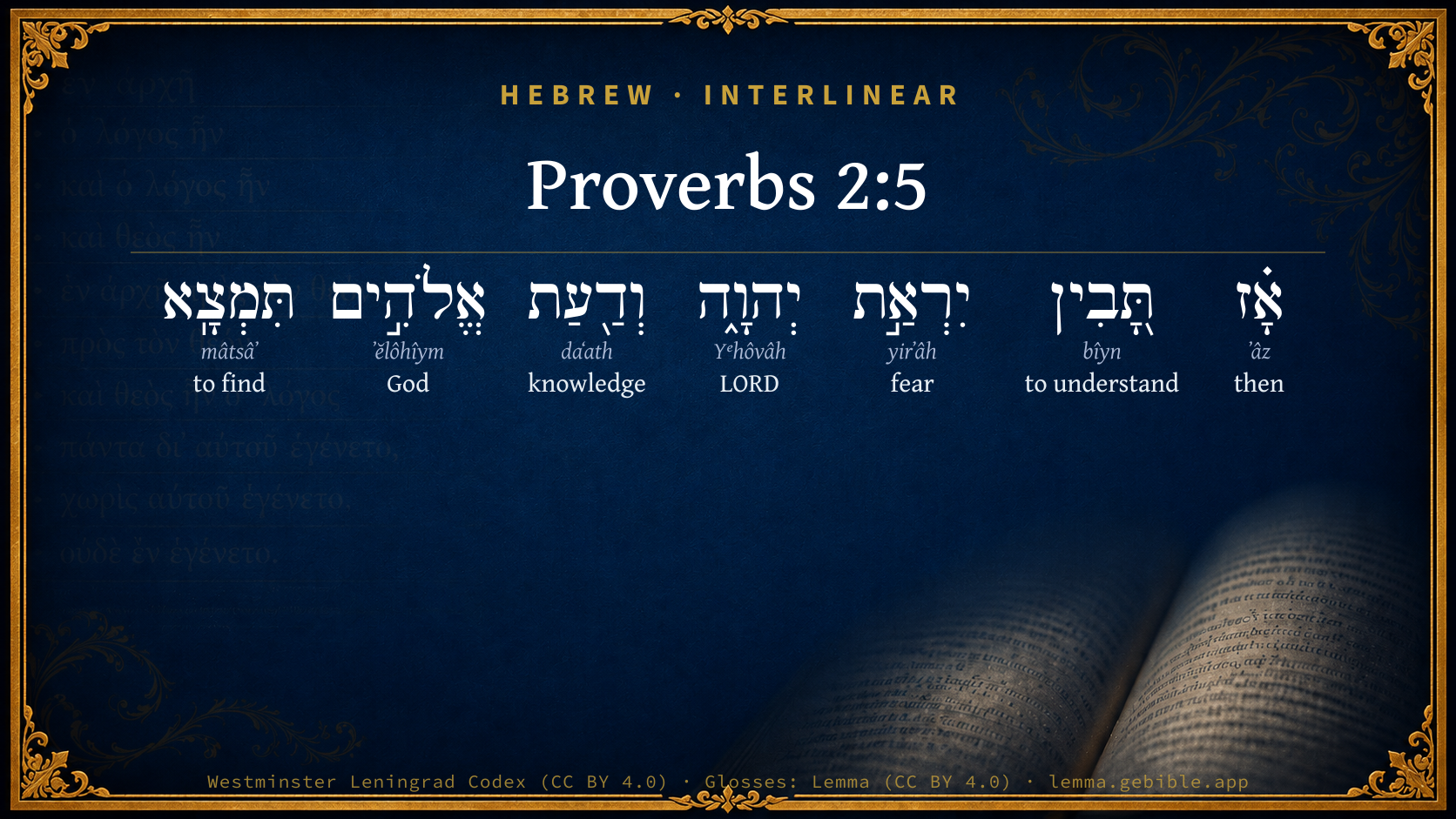
Proverbs 2:5

Hebrew (Westminster Leningrad Codex) Proverbs 2:5 appears in the Hebrew Old Testament. The text above is from the Westminster Leningrad Codex. Each word links to its Strong’s number, a concise gloss, and parsing drawn from the Open Scriptures Hebrew Bible morphology. Click any word for its full Brown-Driver-Briggs (BDB) entry.
Download image
Cite this verse

Proverbs 2:5 (World English Bible). Public Domain. Lemma interlinear Bible study tool, https://lemma.gebible.app/v/proverbs/2/5.

Show BibTeX & RIS
BibTeX
RIS
English Translation
Then you will understand the fear of Yahweh, And find the knowledge of God.
World English Bible · Public Domain
Download a study sheet

One document with this verse’s original text, its word-by-word gloss line, the meaning frame, cross-references with their text, attributed commentary, and full source and license credits — printable, and it pastes into notes with its structure intact.

This verse Autodidact and up

Study sheet (.html) Plain text (.txt)

A passage Seminary Student

Up to 50 verses in one chapter. A passage sheet keeps up to 6 commentary sources and 12 cross-references per verse, in the order this page ranks them, and says so on the sheet whenever that leaves anything out. Ask for a single verse and you get the Autodidact verse sheet above.

Everything on this page stays free to read, with no account — the sheet is a download of what is already on screen, not access to it.

Want to remove ads? Support Godless Engineer
Compare translations 3

The same verse in 3 English versions, stacked beneath the original-language interlinear above. Click any original word for its lexicon entry.

Each is an independent rendering of the whole verse — the interlinear is not word-aligned to these translations.

Highlighted words mark where these versions differ — a whole-verse word diff, not a word-by-word alignment.

  • World English Bible Public Domain
    Then you will understand the fear of Yahweh, And find the knowledge of God.
  • King James Version Public Domain
    Then shalt thou understand the fear of the LORD, and find the knowledge of God.
  • unfoldingWord Literal Text CC BY-SA 4.0
    then you will understand the fear of Yahweh, and the knowledge of God you will find.

unfoldingWord Literal Text — © unfoldingWord, licensed CC BY-SA 4.0. Word-aligned USFM3 via Door43 (git.door43.org/unfoldingWord/en_ult).

Versions to compare (up to 4)

3 of 4 selected

Show all 18 translations

Every available English version of this verse, each an independent rendering of the whole verse.

  • World English Bible Public Domain
    Then you will understand the fear of Yahweh, And find the knowledge of God.
  • Berean Standard Bible Public Domain
    then you will discern the fear of the LORD and discover the knowledge of God.
  • Majority Standard Bible Public Domain
    then you will discern the fear of the LORD and discover the knowledge of God.
  • King James Version Public Domain
    Then shalt thou understand the fear of the LORD, and find the knowledge of God.
  • American Standard Version (1901) Public Domain
    Then shalt thou understand the fear of Jehovah, And find the knowledge of God.
  • Revised Version (1885) Public Domain
    Then shalt thou understand the fear of the LORD, and find the knowledge of God.
  • Geneva Bible (1599) Public Domain
    Then shalt thou vnderstand the feare of the Lord, and finde the knowledge of God.
  • Douay-Rheims (1899) Public Domain
    Then shalt thou understand the fear of the Lord, and shalt find the knowledge of God.
  • Young's Literal Translation Public Domain
    Then understandest thou fear of Jehovah, And knowledge of God thou findest.
  • Literal Standard Version CC BY-SA 4.0
    Then you understand the fear of YHWH, || And you find the knowledge of God.
  • Unlocked Literal Bible CC BY-SA 4.0
    then you will understand the fear of Yahweh and you will find the knowledge of God.
  • unfoldingWord Literal Text CC BY-SA 4.0
    then you will understand the fear of Yahweh, and the knowledge of God you will find.
  • Darby Bible Public Domain
    then shalt thou understand the fear of Jehovah, and find the knowledge of God.
  • World Messianic Bible Public Domain
    then you will understand the fear of the LORD, and find the knowledge of God.
  • Webster's Bible Public Domain
    Then shalt thou understand the fear of the LORD, and find the knowledge of God.
  • Free Bible Version CC BY-SA 4.0
    then you will understand how to relate to the Lord and discover the truth about God.
  • Bible in Basic English Public Domain
    Then the fear of the Lord will be clear to you, and knowledge of God will be yours.
  • JPS Tanakh (1917) Public Domain
    Then shalt thou understand the fear of the LORD, and find the knowledge of God.

Literal Standard Version (2020), Covenant Press — licensed CC BY-SA 4.0. Text via the HelloAO Bible API (eBible.org). Unlocked Literal Bible (unfoldingWord) — licensed CC BY-SA 4.0. Text via the HelloAO Bible API (eBible.org). unfoldingWord Literal Text — © unfoldingWord, licensed CC BY-SA 4.0. Word-aligned USFM3 via Door43 (git.door43.org/unfoldingWord/en_ult). Free Bible Version, Dr. Jonathan Gallagher — licensed CC BY-SA 4.0. Text via the HelloAO Bible API (eBible.org).

Word by word

More ways to search: Search by grammar → Find every occurrence → Compare this word →

Practice this passage: Drill this verse → Learn its vocabulary →

About this verse

These counts appear in no published source. They are computed here, from the morphology-tagged text and Lemma’s own curated glosses. What Lemma adds →

7
words
7
distinct lemmas
Wisdom
section

Shared distinctive vocabulary

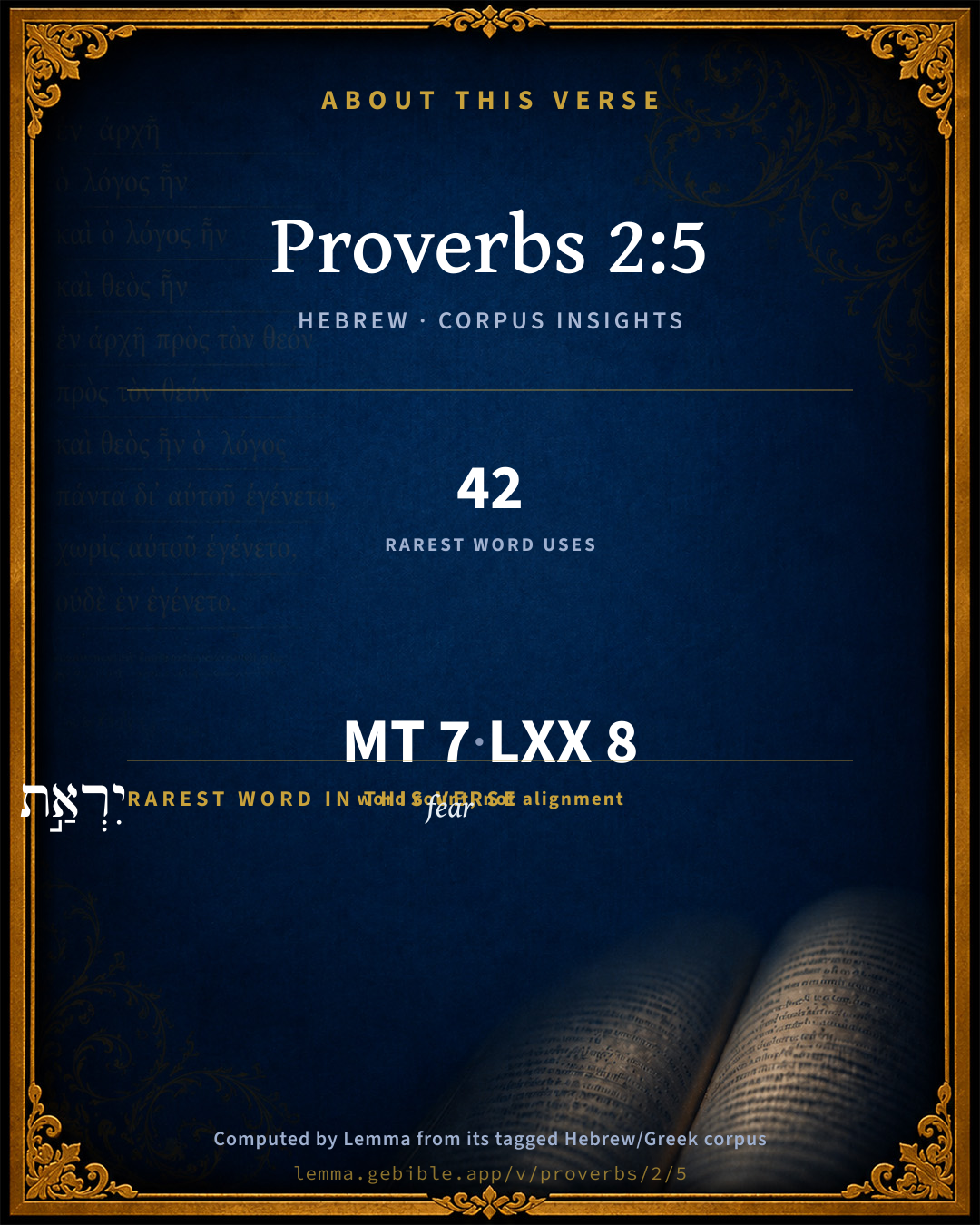
יִרְאַ֣ת fear H3374 occurs in 42 verses of the Hebrew Bible. Also found in:

Grammatical profile

  • 2 verbs
  • 4 nouns
  • 1 adverb

Verb forms

  • תָּ֭בִין Qal · Imperfect
  • תִּמְצָֽא Qal · Imperfect

Hebrew & Septuagint length

In English translation the verse runs 14 words from the Hebrew and 15 from the Septuagint (LXX English) — closely comparable.

A rough comparison of the two English renderings, which tokenize alike — not a word-level alignment.

Word counts can differ between the Hebrew and the Greek without any difference in meaning — e.g. the Hebrew direct-object marker אֵת has no separate Greek word, and Greek often adds the article ὁ.

In the original languages it is 7 Hebrew tokens and 8 Greek tokens — but the two are counted differently (Hebrew bundles its prefixes and suffixes into one token; the Greek is in lemma form), so that isn’t a like-for-like length.

Cross-references

15

Topical passages linked to Proverbs 2:5 in the Treasury of Scripture Knowledge — connected by theme and wording, ordered by reader-vote popularity; previews shown in the World English Bible.

  • Proverbs 1:7 The fear of Yahweh is the beginning of knowledge; But the foolish despise wisdom and instruction.
  • Jeremiah 24:7 I will give them a heart to know me, that I am Yahweh: and they shall be my people, and I will be their God; for they shall return to me with their whole heart.
  • 2 Chronicles 1:10–12 Give me now wisdom and knowledge, that I may go out and come in before this people; for who can judge this your people, that is so great?
  • Jeremiah 32:40–41 and I will make an everlasting covenant with them, that I will not turn away from following them, to do them good; and I will put my fear in their hearts, that they may not depart from me.
  • Luke 10:22 Turning to the disciples, he said, "All things have been delivered to me by my Father. No one knows who the Son is, except the Father, and who the Father is, except the Son, and he to whomever the Son desires to reveal him."
  • Luke 11:9–13 "I tell you, keep asking, and it will be given you. Keep seeking, and you will find. Keep knocking, and it will be opened to you.
  • 1 John 5:20 We know that the Son of God has come, and has given us an understanding, that we know him who is true, and we are in him who is true, in his Son Jesus Christ. This is the true God, and eternal life.
  • Jeremiah 9:24 but let him who glories glory in this, that he has understanding, and knows me, that I am Yahweh who exercises loving kindness, justice, and righteousness, in the earth: for in these things I delight, says Yahweh.
  • Matthew 11:27 All things have been delivered to me by my Father. No one knows the Son, except the Father; neither does anyone know the Father, except the Son, and he to whom the Son desires to reveal him.
  • Proverbs 9:10 The fear of Yahweh is the beginning of wisdom. The knowledge of the Holy One is understanding.
  • Jeremiah 31:34 and they shall teach no more every man his neighbor, and every man his brother, saying, Know Yahweh; for they shall all know me, from the least of them to the greatest of them, says Yahweh: for I will forgive their iniquity, and their sin will I remember no more.
  • Hosea 6:3 Let us acknowledge Yahweh. Let us press on to know Yahweh. As surely as the sun rises, Yahweh will appear. He will come to us like the rain, Like the spring rain that waters the earth."
  • Matthew 7:7–8 "Ask, and it will be given you. Seek, and you will find. Knock, and it will be opened for you.
  • Job 28:28 To man he said, 'Behold, the fear of the Lord, that is wisdom. To depart from evil is understanding.'"
  • John 17:3 This is eternal life, that they should know you, the only true God, and him whom you sent, Jesus Christ.

Cross-references courtesy of OpenBible.info (CC BY 4.0).

Hebrew and Greek witnesses Masoretic Hebrew ↔ Greek Septuagint

The same verse in the two great witnesses to the Old Testament, shown verse-for-verse.

These are two independent witnesses, not word-aligned to each other, and the Septuagint is shown in lemma (dictionary) form.

Hebrew Proverbs 2:5 Masoretic · Westminster Leningrad Codex

אָ֗ז תָּ֭בִין יִרְאַ֣ת יְהוָ֑ה וְדַ֖עַת אֱלֹהִ֣ים תִּמְצָֽא

Then you will understand the fear of Yahweh, And find the knowledge of God.

World English Bible · Public Domain

Greek LXX Proverbs 2:5 Septuagint · lemma form

τότε συνἵημι φόβος κύριος καί ἐπίγνωσις θεός εὑρίσκω

then shall you understand the fear of the Lord, and find the knowledge of God.

LXX2012 (modern English Septuagint) · Public Domain

Hebrew: Westminster Leningrad Codex (CC BY 4.0). Greek: Septuagint (public domain); English from LXX2012 (modern English Septuagint) (Public Domain). How the Septuagint differs from the Hebrew →

Commentary

Notes on Proverbs 2:5 from classic Christian and Jewish commentators (each source and its license shown beneath its notes). The classic Christian expositions comment on the surrounding passage and are grouped to its opening verse, so a note may address several verses; the Jewish commentaries on the Tanakh (Rashi and others) are per-verse, so they appear only where the commentator wrote on this verse.

Lemma curates 59 commentaries, every one of them public domain or Creative Commons licensed, each selected and text-cleaned for this edition rather than reprinted as found. About our sources →

Trapp's Complete Commentary

John Trapp

Pro 2:5 Then shalt thou understand the fear of the LORD, and find the knowledge of God.

Ver. 5. Then shalt thou understand.] Then shalt thou be as those noble Romans were, {Rom 15:14} "full of goodness, filled with all knowledge, able also to admonish others"; in fine, well accomplished Christian, that hath Christian for his name, and Catholic for his surname, Such a Catholic as Augustine describeth when he saith, Boni Catholici sunt qui et fidem integram sequuntur et bonos mores. Those be good Catholics that believe well and live well. These be not those ancient Roman Catholics.

John Trapp, A Commentary or Exposition upon All the Books of the Old and New Testament (1647–1656) — public domain. Text from a community e-Sword module.

The Biblical Illustrator

Joseph S. Exell

Pro_2:5

Find the knowledge of God.

The benefits of religion

Religion, whether natural or revealed, has always the same beneficial influence on the mind. In youth, in health and prosperity, it awakens feelings of gratitude and sublime love, and purifies at the same time that which it exalts; but it is in misfortune, in sickness, in age, that its effects are more truly and beneficially felt; when submission is cherished in faith and humble trust in the Divine will, when duties become pleasures, undecaying sources of consolation, then it creates powers which were believed to be extinct, and gives a freshness to the mind which was supposed to have passed away for ever, but which is now renovated as an immortal hope. Its influence outlives all earthly enjoyments, and becomes stronger as the organs decay and the frame dissolves; it appears as that evening star of light in the horizon of life which we are sure is to become, in another season, a morning star, and to throw its radiance through the gloom and shadow of death. (Sir Humphrey Davey.)

Knowledge of God the result of revelation

I do not look to the Bible to teach me what I or my successors may some day find out by the use of observations and the inductive faculties; I go to the Bible to learn what I cannot find out for myself. Apart from revelation, what do I know about the world to come, about anything but what I can touch, taste, and handle? What hope have I for the future if I look only to nature? Nature tells me that when I die I shall probably be just like the dog, or horse, or any other animal. All immortal, none immortal, she seems to say. Therefore I must get light from revelation. I must even look to revelation for the motives which influence conduct, for personally I am not satisfied with these systems of ethics that are founded on utilitarian motives. I do not see how I can be said to have knowledge of God unless He in some way reveal Himself to me. (Prof. Bonney.)

The Biblical Illustrator, edited by Joseph S. Exell (c. 1880s–1900s) — public domain. Text from a community e-Sword module.

Whedon's Commentary on the Bible

Daniel D. Whedon

5. Then — When thou so seekest and searchest.

Shalt thou understand — Discern, comprehend, and attain to.

Fear of the Lord — That true piety, of which the author speaks, and which is the highest of all knowledge.

Knowledge of God — Divine knowledge, sanctified learning. This is the first instance where the word God occurs in parallelism with Jehovah. It occurs only eight times in the book, namely: in Pro_2:5; Pro_2:17; Pro_3:4; Pro_21:12; Pro_25:2; Pro_26:10; Pro_30:5; Pro_30:9. Comp. Pro_1:7; 1Ki_10:10; 1Ki_10:27; Job_28:28; Jer_41:8; Mat_13:14.

Daniel D. Whedon (gen. ed.), Commentary on the Old and New Testaments (1874–1909) — public domain. Text from a community e-Sword module.

Tyndale Open Study Notes

Tyndale Open Resources

2:5 The quest for true wisdom leads to God. Wisdom is impossible without fear of the Lord (1:7).

Tyndale Open Study Notes — © Tyndale Open Resources, licensed CC BY-SA 4.0. Text via the HelloAO Bible API.

Geneva Bible (1599)

Geneva Bible translators

This (saith he) is the true wisdom, to know and fear God.

Geneva Bible (1599) marginal notes — public domain. Text via Bolls.life.

Jamieson, Fausset & Brown

Robert Jamieson, A. R. Fausset & David Brown

understand--or, "perceive intelligently."

find--obtain.

Jamieson, Fausset & Brown — Commentary Critical and Explanatory on the Whole Bible (1871) — public domain (CC PDM 1.0). Text via the HelloAO Bible API.

Ellicott's Commentary for English Readers

(5) Find the knowledge of God.—It is the highest of all gifts, even eternal life itself, to know God, the Giver of all good things. It was to bestow this knowledge upon man that Christ came into the world (Joh_17:3). He promises (Pro_14:21) the manifestation of Himself as the reward of obedience and love. And yet our highest knowledge of God in this life must be so imperfect, in comparison with the knowledge of Him hereafter, when we shall see Him “face to face” (1Co_13:12), that St. Paul. (Gal_4:9) describes our relation to Him now as better expressed by “being known of Him:” i.e., recognised, acknowledged by Him as His children, rather than by “knowing” Him.

A Bible Commentary for English Readers, edited by Charles John Ellicott (1878–1897) — public domain. Text from a community e-Sword module.

John Gill's Exposition

Then shalt thou understand the fear of the Lord,.... The grace of fear, and the exercise of it: which is the beginning of wisdom and knowledge, and is a treasure itself, Pro 1:7. By means of the Gospel the Lord works it in the hearts of his people by his Spirit; and by the same leads them into the riches of his special grace and "goodness", which they are influenced by to "fear", and the Lord for the sake of it: and particularly they are led hereby to the pardoning grace and mercy of God, which is with him, that he may "be feared"; and it is the Gospel which induces and encourages a true filial fear of God, by which men "depart from evil"; for that teaches them to deny all manner of sin, and to live a godly life and conversation: so that through a diligent search after the knowledge of the Gospel, and an attaining it, men come to have a spiritual, experimental, and practical understanding of the fear of God as a grace; and also, as it includes the whole worship of God, by means of Gospel light, they come to understand what sort of worship that is God is to be worshipped with; that it is pure, spiritual, and evangelical, suited to his nature and will: what the ordinances of divine service are; and that these are to be kept as they were delivered, and in the exercise of faith, from a principle of love, and with a view to the glory, of God, without trusting to them or depending on them for salvation. And this is the advantage arising from a diligent search after the doctrine of wisdom, or the Gospel, and a knowledge and understanding of it; and is used as an argument encouraging to it; and another follows;

and find the knowledge of God; such a knowledge of God as is not to be found by the light of nature, in the whole volume of the creatures, and in all the writings of the philosophers; no, nor in the law of Moses; for though much of God and his perfections may be seen and known by the things that are made, and much of the will of God by the law he gave; yet by neither of these is the knowledge of God in Christ, which is "life eternal". This only is to be found in the Gospel, and by means of it; here only it is brought to light; and through this men not only find it, but increase more and more in it: herein is a glorious display of his persons and perfections, of his counsels and purposes, of his covenant and promises, of his mind and will, with respect to doctrine and worship; and of the way of peace, life, and salvation, by Jesus Christ; which must serve greatly to engage and excite persons to a diligent search and pursuit after it. And all that is here said is designed to encourage a diligent search after divine things; for, as the poet (n) says, there is nothing so difficult but by searching may be found out.

(n) Terent. Heautont. Act. 4. Sc. 1.

John Gill's Exposition of the Whole Bible (1746–1763) — public domain (CC PDM 1.0). Text via the HelloAO Bible API.

Albert Barnes' Notes on the Bible

The promise. The highest blessedness is to know God Joh 17:3. If any distinction between “the Lord” יהוה yehovâh and “God” אלהים 'elohı̂ym can be pressed here, it is that in the former the personality, in the latter the glory, of the divine nature is prominent.

Albert Barnes' Notes on the Bible (1834–1885) — public domain. Text from a community e-Sword/MySword module.

Matthew Poole's English Annotations

Understand more perfectly and profitably; for that very seeking and searching after it, Pro 2:4, supposed some understanding.

The fear of the Lord; which is the beginning of this wisdom, Pro 1:7.

Matthew Poole's English Annotations on the Holy Bible (1683–1685) — public domain. Text from a community e-Sword/MySword module.

The Pulpit Commentary

Then shalt thou understand the fear of the Lord. Then (a), introducing the first apodosis, and answering to the conditional "if" of vers. 1, 3, 4. The earnest endeavour after Wisdom meets with its reward, and those that seek shall find: (cf. Mat_7:7) and thus an inducement is held forth to listen to the admonition of the teacher. Understand implies the power of discernment, but Zockler gives it the further moaning of taking to one"s self as a spiritual possession, just as "find" meaning primarily "to arrive at" conveys the idea of getting possession of (Mercerus). The fear of the Lord (hwOjy tary, yir"ath y"hovah); "the fear of Jehovah," as in Pro_1:7. As it is the beginning, so it is the highest form of knowledge and the greatest good. Elsewhere it is represented as a fountain of life. (Pro_15:27) All true wisdom is summed up in "the fear of the Lord." It here means the reverence due to him, and so comprises the whole range of the religious affections and feelings, which respond to various attributes of the Divine character as they are revealed, and which find their expression in holy worship. The knowledge of God ( td, daath Elohim); literally, the knowledge of Elohim. Not merely cognition, but knowledge in its wider sense. The two ideas of "the fear of the Lord" and "the knowledge of God" act reciprocally on each other. Just as without reverence of God there can be no knowledge of him in its true sense, so the knowledge of God will increase and deepen the feeling of reverence. But it is noticeable that the teacher here, as in Pro_9:10, where, however, it is "the knowledge of the holy" ( td, daath k"doshim), gives the chief place to reverence, and thus indicates that it is the basis of knowledge, which is its fruit and result. The relation here suggested is analogous to that which subsists between faith and knowledge, and recalls the celebrated dictum of Anselm: "Neque enim quaero intelligere ut credam; sed credo, ut intelligam." Elohim, here interchanged with Jehovah, is not of frequent occurrence in the Proverbs, as it is only found therein five times, while the predominating word which is used to designate the Deity is Jehovah. But it is difficult to draw any distinction between them here. Jehovah may refer more especially to the Personality of the Divine nature, while Elohim may refer to Christ"s glory (Plumptre). Bishop Wordsworth thinks that a distinction is made between the knowledge of Elohim and the knowledge of man which is of little worth.

The Pulpit Commentary (1880–1919), ed. H.D.M. Spence-Jones & Joseph S. Exell — public domain. Text from a community e-Sword module.

Scofield Reference Notes

C. I. Scofield

fear

Also; Pro 3:7, (See Scofield "Psa 19:9").

The Scofield Reference Bible (1917 edition), notes by C. I. Scofield — public domain. Text from a community e-Sword module.

Rashi

Rabbi Shlomo Yitzchaki (Rashi)

then you will understand the fear of the Lord This refers back to the topic above, in which he said, “For if you call for understanding.”

Rashi on the Tanakh — English translations: “The Judaica Press complete Tanach with Rashi, translated by A. J. Rosenberg” (CC BY 4.0); “Pentateuch with Rashi's commentary by M. Rosenbaum and A.M. Silbermann, 1929-1934” (public domain); “The Metsudah Tanach series, Lakewood, N.J” (CC BY 4.0); and “The Book of Joshua, Metsudah Publications, 1997” (CC BY 4.0). Text via Sefaria.

Lesson kit

Teaching starters — assembled from the data on this page, not authored interpretation. Every prompt links to the verse data it draws on. Edit before teaching.

Proverbs, in the Wisdom, opens this verse with 7 words (7 distinct Hebrew lemmas). Its most distinctive word is yirʼâh (“fear”). A historical commentator’s framing appears above. Read the whole chapter for the surrounding context.

Discussion questions

  1. How does “fear” (yirʼâh) shape what this verse is saying?
  2. Genesis 20:11 shares the word «fear» with this verse. How do the two illuminate each other?
  3. These translations render this verse differently. What is at stake in choosing one wording over another?
  4. The verb «תָּ֭בִין» is Qal Imperfect. How does its form color the action?
  5. Reading how Trapp's Complete Commentary and The Biblical Illustrator read this verse, where do the two commentators agree and where do they part?

Things to notice

Reading settings

Reading text

Shown beneath each verse's original-language words.

Old Testament
Old Testament edition

Read the OT as the Masoretic Hebrew (MT) or the Greek Septuagint (LXX).

English shown for the Greek Septuagint (in the Hebrew ↔ Greek comparison).

Comparing translations? Open the Compare panel on any verse page to stack up to four side by side.