Daniel 10:14

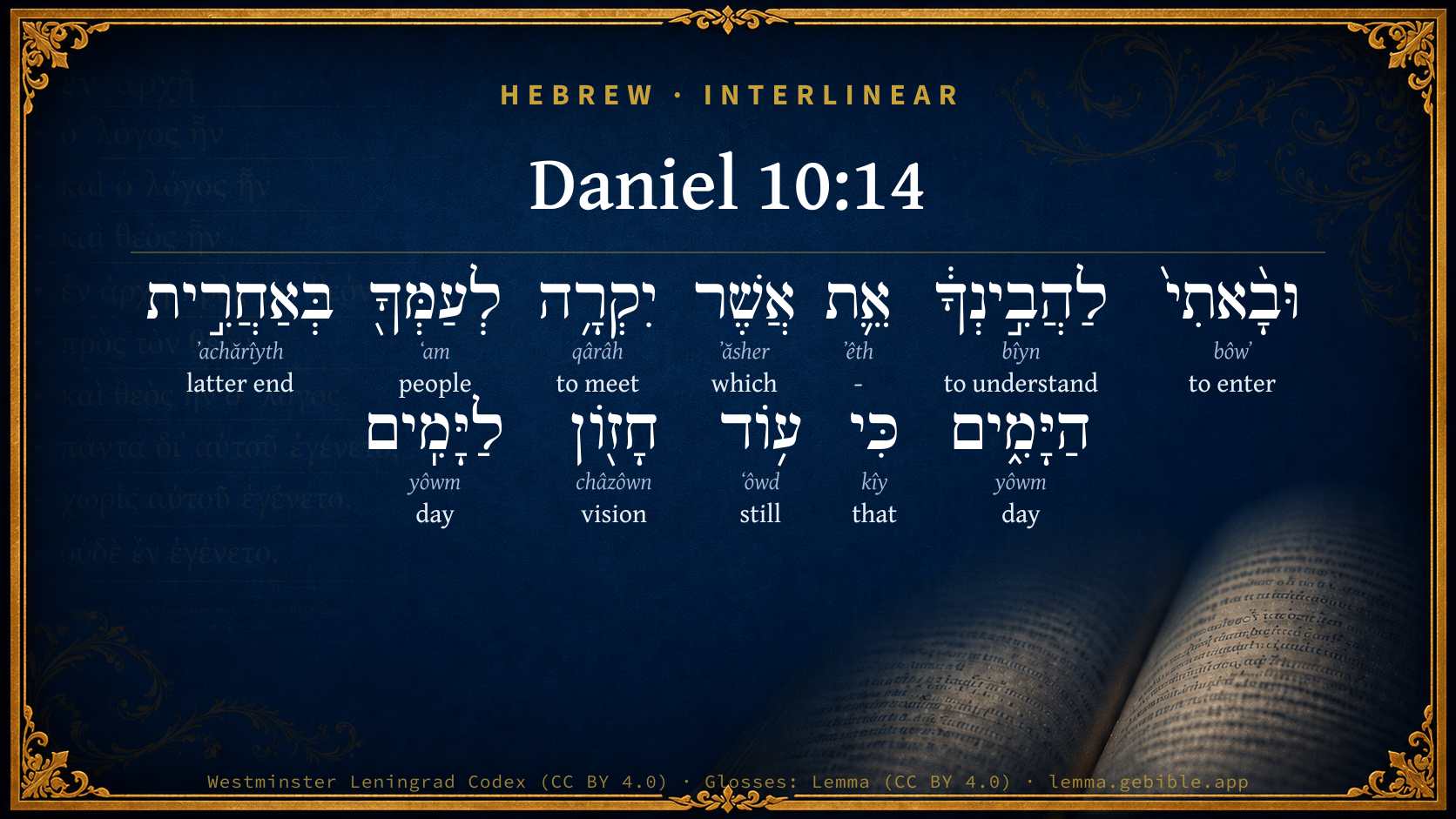
Hebrew (Westminster Leningrad Codex) Daniel 10:14 appears in the Hebrew Old Testament. The text above is from the Westminster Leningrad Codex. Each word links to its Strong’s number, a concise gloss, and parsing drawn from the Open Scriptures Hebrew Bible morphology. Click any word for its full Brown-Driver-Briggs (BDB) entry.
Download image
Cite this verse

Daniel 10:14 (World English Bible). Public Domain. Lemma interlinear Bible study tool, https://lemma.gebible.app/v/daniel/10/14.

Show BibTeX & RIS
BibTeX
RIS
English Translation
Now I have come to make you understand what shall happen to your people in the latter days; for the vision is yet for [many] days:
World English Bible · Public Domain
Download a study sheet

One document with this verse’s original text, its word-by-word gloss line, the meaning frame, cross-references with their text, attributed commentary, and full source and license credits — printable, and it pastes into notes with its structure intact.

This verse Autodidact and up

Study sheet (.html) Plain text (.txt)

A passage Seminary Student

Up to 50 verses in one chapter. A passage sheet keeps up to 6 commentary sources and 12 cross-references per verse, in the order this page ranks them, and says so on the sheet whenever that leaves anything out. Ask for a single verse and you get the Autodidact verse sheet above.

Everything on this page stays free to read, with no account — the sheet is a download of what is already on screen, not access to it.

Want to remove ads? Support Godless Engineer
Compare translations 3

The same verse in 3 English versions, stacked beneath the original-language interlinear above. Click any original word for its lexicon entry.

Each is an independent rendering of the whole verse — the interlinear is not word-aligned to these translations.

Highlighted words mark where these versions differ — a whole-verse word diff, not a word-by-word alignment.

  • World English Bible Public Domain
    Now I have come to make you understand what shall happen to your people in the latter days; for the vision is yet for [many] days:
  • King James Version Public Domain
    Now I am come to make thee understand what shall befall thy people in the latter days: for yet the vision is for many days.
  • unfoldingWord Literal Text CC BY-SA 4.0
    Now I have come to make you understand what will happen to your people in the latter days. For the vision is for days yet to come.”

unfoldingWord Literal Text — © unfoldingWord, licensed CC BY-SA 4.0. Word-aligned USFM3 via Door43 (git.door43.org/unfoldingWord/en_ult).

Versions to compare (up to 4)

3 of 4 selected

Show all 18 translations

Every available English version of this verse, each an independent rendering of the whole verse.

  • World English Bible Public Domain
    Now I have come to make you understand what shall happen to your people in the latter days; for the vision is yet for [many] days:
  • Berean Standard Bible Public Domain
    Now I have come to explain to you what will happen to your people in the latter days, for the vision concerns those days.”
  • Majority Standard Bible Public Domain
    Now I have come to explain to you what will happen to your people in the latter days, for the vision concerns those days.”
  • King James Version Public Domain
    Now I am come to make thee understand what shall befall thy people in the latter days: for yet the vision is for many days.
  • American Standard Version (1901) Public Domain
    Now I am come to make thee understand what shall befall thy people in the latter days; for the vision is yet for `many' days:
  • Revised Version (1885) Public Domain
    Now I am come to make thee understand what shall befall thy people in the latter days: for the vision is yet for many days.
  • Geneva Bible (1599) Public Domain
    Nowe I am come to shewe thee what shall come to thy people in the latter dayes: for yet the vision is for many dayes.
  • Douay-Rheims (1899) Public Domain
    But I am come to teach thee what things shall befall thy people in the latter days, for as yet the vision is for days.
  • Young's Literal Translation Public Domain
    and I have come to cause thee to understand that which doth happen to thy people in the latter end of the days, for yet the vision `is' after days.
  • Literal Standard Version CC BY-SA 4.0
    and I have come to cause you to understand that which happens to your people in the latter end of the days, for yet the vision [is] after days.
  • Unlocked Literal Bible CC BY-SA 4.0
    Now I have come to help you understand what will happen to your people in the last days. For the vision is for days yet to come.”
  • unfoldingWord Literal Text CC BY-SA 4.0
    Now I have come to make you understand what will happen to your people in the latter days. For the vision is for days yet to come.”
  • Darby Bible Public Domain
    And I am come to make thee understand what shall befall thy people at the end of the days: for the vision is yet for [many] days.
  • World Messianic Bible Public Domain
    Now I have come to make you understand what will happen to your people in the latter days, for the vision is yet for many days.”
  • Webster's Bible Public Domain
    Now I have come to make thee understand what shall befall thy people in the latter days: for yet the vision is for many days.
  • Free Bible Version CC BY-SA 4.0
    Now I've come to explain to you what will happen to your people in the last days, for the vision is about a time in the future.”
  • Bible in Basic English Public Domain
    Now I have come to give you knowledge of the fate of your people in the later days; for there is still a vision for the days.
  • JPS Tanakh (1917) Public Domain
    Now I am come to make thee understand what shall befall thy people in the end of days; for there is yet a vision for the days.'

Literal Standard Version (2020), Covenant Press — licensed CC BY-SA 4.0. Text via the HelloAO Bible API (eBible.org). Unlocked Literal Bible (unfoldingWord) — licensed CC BY-SA 4.0. Text via the HelloAO Bible API (eBible.org). unfoldingWord Literal Text — © unfoldingWord, licensed CC BY-SA 4.0. Word-aligned USFM3 via Door43 (git.door43.org/unfoldingWord/en_ult). Free Bible Version, Dr. Jonathan Gallagher — licensed CC BY-SA 4.0. Text via the HelloAO Bible API (eBible.org).

Word by word

More ways to search: Search by grammar → Find every occurrence → Compare this word →

Practice this passage: Drill this verse → Learn its vocabulary →

יִקְרָ֥ה
qârâh
H7136
“to meet”
Verb, Qal, Imperfect, 3rd Person, Masculine, Singular
Part of Speech
Verb
Stem
Qal
Form
Imperfect
Person
3rd Person
Gender
Masculine
Number
Singular
Full BDB Definition

Origin: a primitive root

TWOT: 2068 , 2068e

to encounter, meet, befall, happen, come to meet - (Qal) - to encounter, meet - to befall - (Niphal) - to encounter, meet (without pre-arrangement) - to chance to be present - to come to meet - (Hiphil) to cause to meet, appoint - to build with beams - (Piel) to lay the beams of, furnish with beams
  1. וּבָ֨אתִי֙ bôwʼ H935 “and · to enter” Conjunction + Verb, Qal, Perfect, 1st Person, Common, Singular
  2. לַהֲבִ֣ינְךָ֔ bîyn H995 “to understand · you” Preposition + Verb, Hiphil, Infinitive Construct + Suffix, Personal, 2nd Person, Masculine, Singular
  3. אֵ֛ת ʼêth H853 “-” Particle, Direct Object
  4. אֲשֶׁר ʼăsher H834 “which” Particle, Relative
  5. לְעַמְּךָ֖ ʻam H5971 “to/for · people · your” Preposition + Noun, Common, Masculine, Singular, Construct + Suffix, Personal, 2nd Person, Masculine, Singular
  6. בְּאַחֲרִ֣ית ʼachărîyth H319 “in/at · latter end of” Preposition + Noun, Common, Feminine, Singular, Construct
  7. הַיָּמִ֑ים yôwm H3117 “the · days” Particle, Definite Article + Noun, Common, Masculine, Plural, Absolute
  8. כִּי kîy H3588 “that” Conjunction
  9. ע֥וֹד ʻôwd H5750 “still” Adverb
  10. חָז֖וֹן châzôwn H2377 “vision” Noun, Common, Masculine, Singular, Absolute
  11. לַיָּמִֽים yôwm H3117 “to/for the · days” Preposition, Determined + Noun, Common, Masculine, Plural, Absolute

About this verse

These counts appear in no published source. They are computed here, from the morphology-tagged text and Lemma’s own curated glosses. What Lemma adds →

12
words
11
distinct lemmas
Prophets
section

Shared distinctive vocabulary

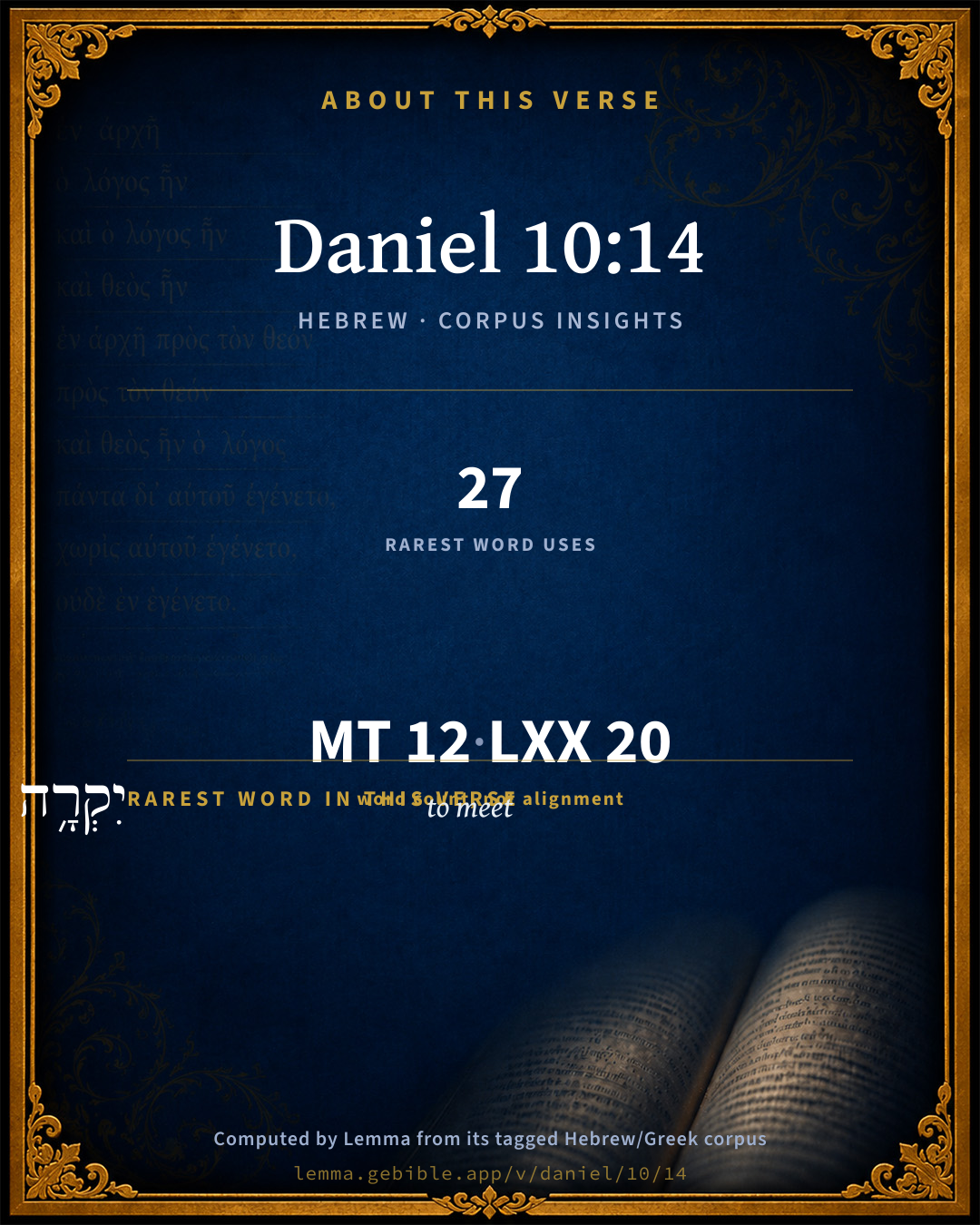
יִקְרָ֥ה to meet H7136 occurs in 27 verses of the Hebrew Bible. Also found in:

Grammatical profile

  • 3 verbs
  • 5 nouns
  • 1 conjunction
  • 1 adverb
  • 2 particles

Verb forms

  • וּבָ֨אתִי֙ Qal · Perfect
  • לַהֲבִ֣ינְךָ֔ Hiphil · Infinitive Construct
  • יִקְרָ֥ה Qal · Imperfect

Repetition

A word recurs within this verse — often emphatic in Hebrew:

  • הַיָּמִ֑ים day H3117 ×2

Hebrew & Septuagint length

In English translation the verse runs 26 words from the Hebrew and 26 from the Septuagint (LXX English) — the same length.

A rough comparison of the two English renderings, which tokenize alike — not a word-level alignment.

Word counts can differ between the Hebrew and the Greek without any difference in meaning — e.g. the Hebrew direct-object marker אֵת has no separate Greek word, and Greek often adds the article ὁ.

In the original languages it is 12 Hebrew tokens and 20 Greek tokens — but the two are counted differently (Hebrew bundles its prefixes and suffixes into one token; the Greek is in lemma form), so that isn’t a like-for-like length.

Cross-references

15

Topical passages linked to Daniel 10:14 in the Treasury of Scripture Knowledge — connected by theme and wording, ordered by reader-vote popularity; previews shown in the World English Bible.

  • Daniel 8:26 The vision of the evenings and mornings which has been told is true: but seal up the vision; for it belongs to many days [to come].
  • Daniel 2:28 but there is a God in heaven who reveals secrets, and he has made known to the king Nebuchadnezzar what shall be in the latter days. Your dream, and the visions of your head on your bed, are these:
  • Daniel 12:4 But you, Daniel, shut up the words, and seal the book, even to the time of the end: many shall run back and forth, and knowledge shall be increased."
  • Habakkuk 2:3 For the vision is yet for the appointed time, and it hurries toward the end, and won't prove false. Though it takes time, wait for it; because it will surely come. It won't delay.
  • Daniel 12:9 He said, Go your way, Daniel; for the words are shut up and sealed until the time of the end.
  • Genesis 49:1 Jacob called to his sons, and said: "Gather yourselves together, that I may tell you that which will happen to you in the days to come.
  • Deuteronomy 4:30 When you are in oppression, and all these things are come on you, in the latter days you shall return to Yahweh your God, and listen to his voice:
  • Isaiah 2:2 It shall happen in the latter days, that the mountain of Yahweh's house shall be established on the top of the mountains, And shall be raised above the hills; And all nations shall flow to it.
  • Hosea 3:5 Afterward the children of Israel shall return, and seek Yahweh their God, and David their king, and shall come with trembling to Yahweh and to his blessings in the last days.
  • Micah 4:1 But in the latter days, It will happen that the mountain of Yahweh's temple will be established on the top of the mountains, And it will be exalted above the hills; And peoples will stream to it.
  • 2 Timothy 3:1 But know this, that in the last days, grievous times will come.
  • Deuteronomy 31:21 It shall happen, when many evils and troubles are come on them, that this song shall testify before them as a witness; for it shall not be forgotten out of the mouths of their seed: for I know their imagination which they frame this day, before I have brought them into the land which I swore.
  • Daniel 9:22 He instructed me, and talked with me, and said, Daniel, I am now come forth to give you wisdom and understanding.
  • Daniel 10:1 In the third year of Cyrus king of Persia a thing was revealed to Daniel, whose name was called Belteshazzar; and the thing was true, even a great warfare: and he understood the thing, and had understanding of the vision.
  • Hebrews 2:3 how will we escape if we neglect so great a salvation-- which at the first having been spoken through the Lord, was confirmed to us by those who heard;

Cross-references courtesy of OpenBible.info (CC BY 4.0).

Hebrew and Greek witnesses Masoretic Hebrew ↔ Greek Septuagint

The same verse in the two great witnesses to the Old Testament, shown verse-for-verse.

These are two independent witnesses, not word-aligned to each other, and the Septuagint is shown in lemma (dictionary) form.

Hebrew Daniel 10:14 Masoretic · Westminster Leningrad Codex

וּבָ֨אתִי֙ לַהֲבִ֣ינְךָ֔ אֵ֛ת אֲשֶׁר יִקְרָ֥ה לְעַמְּךָ֖ בְּאַחֲרִ֣ית הַיָּמִ֑ים כִּי ע֥וֹד חָז֖וֹן לַיָּמִֽים

Now I have come to make you understand what shall happen to your people in the latter days; for the vision is yet for [many] days:

World English Bible · Public Domain

Greek LXX Daniel 10:14 Septuagint · lemma form

καί εἶπον ἐγώ ἔρχομαι ὑποδεικνύω σύ τίς ὑποἀντάω ὁ λαός σύ ἐπί ἔσχατος ὁ ἡμέρα ἔτι γάρ ὅρασις εἰς ἡμέρα

and I have come to inform you of all that shall befall your people in the last days: for the vision is yet for many days.

LXX2012 (modern English Septuagint) · Public Domain

Hebrew: Westminster Leningrad Codex (CC BY 4.0). Greek: Septuagint (public domain); English from LXX2012 (modern English Septuagint) (Public Domain). How the Septuagint differs from the Hebrew →

Commentary

Notes on Daniel 10:14 from classic Christian and Jewish commentators (each source and its license shown beneath its notes). The classic Christian expositions comment on the surrounding passage and are grouped to its opening verse, so a note may address several verses; the Jewish commentaries on the Tanakh (Rashi and others) are per-verse, so they appear only where the commentator wrote on this verse.

Lemma curates 59 commentaries, every one of them public domain or Creative Commons licensed, each selected and text-cleaned for this edition rather than reprinted as found. About our sources →

Trapp's Complete Commentary

John Trapp

Dan 10:14 Now I am come to make thee understand what shall befall thy people in the latter days: for yet the vision [is] for [many] days.

Ver. 14. Now I am come.] As it were with weariness of flight. {as Dan 9:21} Comfort will come at length. {Heb 10:37}

In the latter days.] Toward the end of their state, and not long before the coming of the Messiah, who shall begin another age, and as it were a new world. {Eze 38:8 Heb 2:3}

John Trapp, A Commentary or Exposition upon All the Books of the Old and New Testament (1647–1656) — public domain. Text from a community e-Sword module.

Geneva Bible (1599)

Geneva Bible translators

For though the Prophet Daniel should end and cease, yet his doctrine should continue till the coming of Christ, for the comfort of his Church.

Geneva Bible (1599) marginal notes — public domain. Text via Bolls.life.

Jamieson, Fausset & Brown

Robert Jamieson, A. R. Fausset & David Brown

what shall befall thy people in the latter days--an intimation that the prophecy, besides describing the doings of Antiochus, reaches to the concluding calamities of Israel's history, prior to the nation's full restoration at Christ's coming--calamities of which Antiochus' persecutions were the type.

vision is for many days--that is, extends far into the future.

Jamieson, Fausset & Brown — Commentary Critical and Explanatory on the Whole Bible (1871) — public domain (CC PDM 1.0). Text via the HelloAO Bible API.

Adam Clarke's Commentary

Verse 14. For yet the vision is for many days.] There are many things which remain yet to be revealed, and the time of their accomplishment is very distant.

Adam Clarke's Commentary on the Bible (1810–1826) — public domain. Text from a community e-Sword/MySword module.

John Calvin's Commentaries

The angel follows up the same sentiment. He states his arrival for the purpose of predicting to Daniel coming events, and those, too, for a long period of time. He further proves the prayers of Daniel to have been neither vain nor fruitless, as they produced this conflict with the kings of Persia, both father and son. He now brings forward another proof of this, because God wished his Prophet to be instructed in patiently waiting for the arrival of the events, after being made fully aware of the elect people being under God’s care and protection. This he would readily acknowledge from the prophecies of the next chapter. He next adds, at the end of the days By this expression the angel commends God’s grace towards the Prophet, as he was its special minister. His mission was not only to announce to him the occurrences of three or four years, or of any brief period, but he had to extend his predictions over many years, even to the extremity of the days. I willingly refer this period to the renovation of the Church which happened at the advent of Christ. The Scriptures in using the phrase, the last days, or times, always point to the manifestation of Christ, by which the face of the world was renewed. It is exactly similar to the angel saying he would make Daniel fully acquainted with all future events, until the final redemption of the people, when Christ was exhibited for the salvation of his Church. Hence the angel embraces the 490 years of which he had spoken. For Christ’s advent determined the fullness of times, and the subjoined reason suits the passage exceedingly well. The vision is yet for days, says he; thus frigidly some expounders take these words. I feel persuaded that the angel intends to shew how God is now opening future events to his servant, and thus these prophecies become like a lamp ever shining in the Church. The faithful complain in the 74th Psalm (Psalm 74:9) of the absence of all signs, because no prophets are left. We see no signs, say they, no Prophet exists among us. This was an indication of God having rejected and deserted them. However faintly the light of his doctrine may shine upon us, the slightest glimmer ought to be sufficient to produce patience and repose. But when all the light of the Word is extinguished, we seem completely enveloped in tartarean darkness. As the Israelites suffered so many afflictions for nearly 500 years, this remedy ought completely to restore them; for when the angel testifies, the vision is yet for days, it means, although God permits his people to be miserably afflicted, yet by this new proof he shews that he had not entirely cast them off. Some vision remained; that is, by the light of prophecy he will always manifest his care for his chosen, and they may even anticipate a happy issue out of all their sorrows. We now understand the angel’s meaning when he says, the vision is yet for days. Prophecies, indeed, ceased soon afterwards, and God no longer sent other prophets to his people, yet their teaching always remained permanent like a finger-post, for in it was completed the whole series of times up to the advent of Christ. His children were never destitute of all necessary consolation; for although there were no prophets surviving who could instruct the people in God’s commands by the living voice, yet Daniel’s teaching flourished for nearly 500 years after his death. It also performed its part in supporting the courage of the pious, and shewing them the firmness of God’s covenant not withstanding all opposition. Although the Church was agitated in a variety of ways, yet God is consistent in all his promises, until the complete redemption of his Church by the advent of his only-begotten Son.

John Calvin's Commentaries (1540-1563) — public domain. Text from the Calvin Translation Society English edition (1840s-50s) via the Christian Classics Ethereal Library (ccel.org). Calvin's coverage is partial (roughly two-thirds of the Bible); uncommented books and verses are honest gaps, never fabricated. The 19th-century editor's footnotes and remarks are omitted so the notes are faithfully Calvin's own voice.

Ellicott's Commentary for English Readers

(14) The latter days.—Comp. Dan_2:28; Dan_8:17. The time is here more narrowly defined as “those days,” that is, the period when the vision of Daniel 11 shall receive its complete fulfilment. The “vision” is identical with “the thing” (Dan_10:1), or “the vision” (Dan_10:16). It must be carefully borne in mind that there is no reference to preceding visions, except so far as the revelation contained in Daniel 11 develops certain details of other visions.

A Bible Commentary for English Readers, edited by Charles John Ellicott (1878–1897) — public domain. Text from a community e-Sword module.

The Cambridge Bible for Schools and Colleges

gen. ed. J. J. S. Perowne

14. And I am come to make thee understand, &c.] cf. Dan_8:16, Dan_9:22; also Dan_9:23 b.

what shall befall thy people in the end of the days] The sentence seems to be framed on the model of Gen_49:1. On the ‘end (a different word from that occurring in Dan_8:17; Dan_8:19) of the days,’ see on Dan_2:28. Here the expression denotes the age of Antiochus Epiphanes.

for there is yet a vision for the days] viz. the days just mentioned: a vision, relating to these, remains still to be told. Or, altering the point which indicates the article, for the vision is yet for (many) days: it relates to the ‘end of the days,’ not to the present; cf. Dan_8:17 b, 26 b.

The Cambridge Bible for Schools and Colleges (gen. ed. J. J. S. Perowne; Cambridge University Press, 1878–1918) — public domain. Text from a community e-Sword module.

John Gill's Exposition

Now I am come to make thee to understand what shall befall thy people in the latter days,.... The contest being over with the prince of Persia, and having got an advantage, and carried his point in favour of the Jews; he came directly to Daniel, to inform him of what should befall the people of the Jews in the succeeding monarchies, especially in the times of Antiochus; and even of all that should befall them until the Messiah came, as Aben Ezra rightly interprets it; for the last days generally design the days of the Messiah; see Gen 49:1,

for yet the vision is for many days; before it will be accomplished; reaching not only to the times of Antiochus, three hundred years after this, but even to the times of antichrist, of whom he was a type; and to the resurrection of the dead, and the end of time, as the two next chapters show; see Hab 2:3.

John Gill's Exposition of the Whole Bible (1746–1763) — public domain (CC PDM 1.0). Text via the HelloAO Bible API.

Albert Barnes' Notes on the Bible

Now I am come to make thee understand ... - After these long delays, and after the arrangements have been made necessary to bring about the objects sought by your prayers.

In the latter days - In future times - extending down to the last period of the world. See the notes at Isa 2:2.

For yet the vision is for many days - Extends far into future time. It is probable that the prayer of Daniel referred more particularly to what he desired should soon occur - the restoration of the people to their own land; the angel informs him that the disclosures which he was to make covered a much more extended period, and embraced more important events. So it is often. The answer to prayer often includes much more than we asked for, and the abundant blessings that are conferred, beyond what we supplicate, are vastly beyond a compensation for the delay.

Albert Barnes' Notes on the Bible (1834–1885) — public domain. Text from a community e-Sword/MySword module.

Haydock's Catholic Bible Commentary

Days. It will not soon take place; or, I have many things to tell.

George Leo Haydock (1774–1849), Haydock's Catholic Family Bible and Commentary, 1859 edition — public domain. Excludes Psalms (Douay-Rheims chapter numbering differs from Protestant) and Deuterocanonical books (Catholic canon only).

Matthew Poole's English Annotations

Now at last, with much ado, after the contest is over, I am come to give thee understanding touching all the purposes and providences of God relating to his church: this made amends for the delay; this was the comfortable effect of effectual fervent prayer; this was God’s overflowing kindness to his servant Daniel, to certify him by so honourable a messenger as this, that God would not only give him the knowledge of the present times and dispensations towards his church and their enemies, but for a long time after, even four hundred and ninety years, to the coming of the Messias, as he did to David, 2Sa 7:19. By which we learn this solemn truth, that God will never leave himself without witness to his people; but in the worst of times he will afford them sufficient discoveries of his care of them; as he did by this prophecy in those dark days.

Matthew Poole's English Annotations on the Holy Bible (1683–1685) — public domain. Text from a community e-Sword/MySword module.

Whedon's Commentary on the Bible

Daniel D. Whedon

14. For yet the vision is for many days — R.V., “for the vision is yet for many days;” that is, the vision of victory for Israel and her complete deliverance from persecution and affliction reaches into the far distance. Jeremiah prophesied great glory for Israel at the end of the seventy years of captivity; but the perfect fulfillment and consummation of those prophecies will not come until the Messianic age. (See notes Dan_9:22; Dan_9:24.)

Daniel D. Whedon (gen. ed.), Commentary on the Old and New Testaments (1874–1909) — public domain. Text from a community e-Sword module.

The Pulpit Commentary

Now I am come to make thee understand what shall befall thy people in the latter days: for yet the vision is for many days. None of the versions call for remark. The Peshitta inserts lesooph, "at the end," before "days." The Massoretic Hebrew has a peculiarity unsupported by the curlier versions: it has "for the days." Of course, these versions may simply have neglected the article, as have our English versions, Authorized and Revised. In the latter drays. Kranichfeld holds that this refers to the tatter portion of the vision in ch. 8., not at the end of time. For yet the vision is for many days. Professor Bevan would translate, "since there is yet a vision for the days," i.e. for the days already referred to in the eighth chapter. This would make both clauses have practically the same meaning, which this logical connection implies. There seems no need to take the "end of days," as the end of the world.

The Pulpit Commentary (1880–1919), ed. H.D.M. Spence-Jones & Joseph S. Exell — public domain. Text from a community e-Sword module.

Keil & Delitzsch

C. F. Keil & F. Delitzsch

With this joyful message the angel comes to Daniel, to open up to him what would befall his people in the last time. The punctuation of יקרה (shall befall) is according to יקרא (Gen 49:1); the Kethiv יקרה has the correct form. חימים בּאחרית as Dan 2:28, the Messianic world-time, in Dan 8:17 is called the time of the end. "For," the angel adds, "the vision refers, or stretches itself out, to the days." ליּמים, with the article, are the days of the אחרית (the latter time), the Messianic world-time. חזון is the revelation which in Dan 10:1 is called דּבר and מראה, the following revelation in Daniel 11. Kliefoth is incorrect in thinking on the revelations already given, Daniel 7, 8, 9, to Daniel, regarding which the angel now seeks to bring to him further understanding. For although those revelations stretch out to the last time, and the revelations in Daniel 11 only give further disclosures regarding it, yet neither does the angel who speaks to Daniel here thus represent the matter, nor does the form of the revelation Daniel 10-12, namely, the majestic appearance of the Angel of the Lord, not a common angel-revelation, correspond with this supposition. חזון also cannot, without further definition, refer to those earlier revelations; and the opinion that הבּין denotes the understanding, as distinguished from the revelation or proclamation, does not accord with the usual style of Daniel's language. הבּין denotes here, as in Dan 8:16, the interpretation of the vision, which in both cases contains the things which shall befall the people of God in the future. Cf. Dan 9:22, where יבּין is used of the announcement of the revelation of God regarding the seventy weeks.

Keil & Delitzsch — Biblical Commentary on the Old Testament (1861–1891) — public domain (CC PDM 1.0). Text via the HelloAO Bible API. (Old Testament only.)

unfoldingWord translationNotes

Door43 World Missions Community

General Information:

The angel continues speaking to Daniel.

I turned my face toward the ground

"I looked at the ground." Daniel may have done this to show humble reverence, or because he was afraid.

translationWords

last day

vision

unfoldingWord translationNotes — © Distant Shores Media and the Door43 World Missions Community, licensed CC BY-SA 4.0. Source: git.door43.org/Door43/en_tn.

Rashi

Rabbi Shlomo Yitzchaki (Rashi)

for there is yet a vision to tell you what has not yet been told, and it will come in many days at an appointed time.

Rashi on the Tanakh — English translations: “The Judaica Press complete Tanach with Rashi, translated by A. J. Rosenberg” (CC BY 4.0); “Pentateuch with Rashi's commentary by M. Rosenbaum and A.M. Silbermann, 1929-1934” (public domain); “The Metsudah Tanach series, Lakewood, N.J” (CC BY 4.0); and “The Book of Joshua, Metsudah Publications, 1997” (CC BY 4.0). Text via Sefaria.

Lesson kit

Teaching starters — assembled from the data on this page, not authored interpretation. Every prompt links to the verse data it draws on. Edit before teaching.

Daniel, in the Prophets, opens this verse with 12 words (11 distinct Hebrew lemmas). Its most distinctive word is qârâh (“to meet”). A historical commentator’s framing appears above. Read the whole chapter for the surrounding context.

Discussion questions

  1. What does “to meet” (qârâh) contribute to the verse as a whole?
  2. How does Genesis 24:12, which shares the word «to meet», read alongside this verse?
  3. What does the repetition of “day” (2× in this one verse) do in this verse?
  4. The translations on this page render this verse differently — a whole-verse word diff, not a word-by-word alignment. What might account for the different wordings?
  5. «וּבָ֨אתִי֙» is a Qal Perfect verb. How does that grammatical form shape the action described?
  6. Compare how Trapp's Complete Commentary and Geneva Bible (1599) read this verse. Where do they agree or differ?

Things to notice

Reading settings

Reading text

Shown beneath each verse's original-language words.

Old Testament
Old Testament edition

Read the OT as the Masoretic Hebrew (MT) or the Greek Septuagint (LXX).

English shown for the Greek Septuagint (in the Hebrew ↔ Greek comparison).

Comparing translations? Open the Compare panel on any verse page to stack up to four side by side.