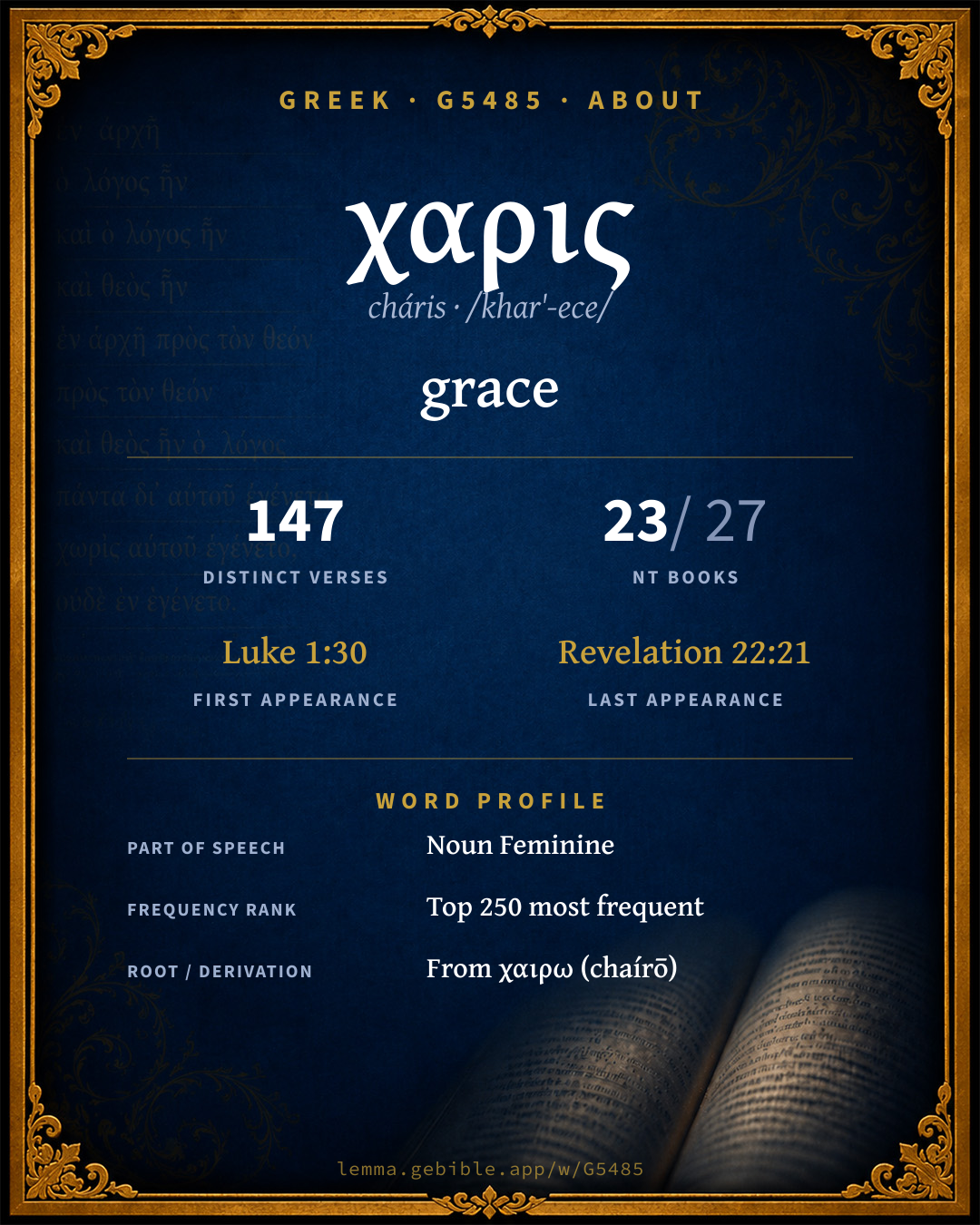
χάρις
grace
‘grace’ is one of 4 main senses fuller range ↓
Full lexicon entry — Thayer's Greek Lexicon
From Thayer's Greek Lexicon
Where this word appears
See every Nominative-case word in the Greek New Testament →
Grammar key — what these labels mean
Part of speech
- Noun
- A naming word — a person, place, thing, or idea.
Case
- Nominative
- The case of the subject (and the predicate nominative).
- Accusative
- The case of the direct object and of extent.
- Genitive
- The case of source, possession, or “of” — answers “whose / from what.”
- Dative
- The case of the indirect object, means, or location — “to / for / with / in.”
Gender
- Feminine
- Grammatically feminine.
Number
- Singular
- One.
Grammatical forms
- Noun, Nominative, Singular, Feminine 60 times (39%)
- Noun, Accusative, Singular, Feminine 44 times (28%)
- Noun, Genitive, Singular, Feminine 27 times (17%)
- Noun, Dative, Singular, Feminine 24 times (15%)
Parsed forms decoded from the imported morphology (Robinson–Tischendorf, public domain), counted across 155 parsed occurrences — not distinct verses.
Every verse where G5485 appears — 147 distinct verses across 23 books. Click any verse to open its interlinear word-by-word view. Verse text shown in the World English Bible for context — . Each verse’s Greek form is shown with its reference; the English is not keyword-highlighted, since the data carries no word-level English alignment. Use “Compare translations” on any verse to read it across multiple English versions. This concordance covers the Greek New Testament; Septuagint (Greek Old Testament) occurrences of this word are not indexed here.
Luke 8 verses
- Luke 1:30 χάριν n acc sg fem The angel said to her, "Don't be afraid, Mary, for you have found favor with God.
- Luke 2:40 χάρις n nom sg fem The child was growing, and was becoming strong in spirit, being filled with wisdom, and the grace of God was upon him.
- Luke 2:52 χάριτι n dat sg fem And Jesus increased in wisdom and stature, and in favor with God and men.
- Luke 4:22 χάριτος n gen sg fem All testified about him, and wondered at the gracious words which proceeded out of his mouth, and they said, "Isn't this Joseph's son?"
- Luke 6:32 χάρις n nom sg fem If you love those who love you, what credit is that to you? For even sinners love those who love them.
- Luke 6:33 χάρις n nom sg fem If you do good to those who do good to you, what credit is that to you? For even sinners do the same.
- Luke 6:34 χάρις n nom sg fem If you lend to those from whom you hope to receive, what credit is that to you? Even sinners lend to sinners, to receive back as much.
- Luke 17:9 χάριν n acc sg fem Does he thank that servant because he did the things that were commanded? I think not.
John 3 verses
- John 1:14 χάριτος n gen sg fem The Word became flesh, and lived among us. We saw his glory, such glory as of the one and only Son of the Father, full of grace and truth.
- John 1:16 χάριν χάριτος n acc sg fem n gen sg fem From his fullness we all received grace upon grace.
- John 1:17 χάρις n nom sg fem For the law was given through Moses. Grace and truth came through Jesus Christ.
Acts 17 verses
- Acts 2:47 χάριν n acc sg fem praising God, and having favor with all the people. The Lord added to the assembly day by day those who were being saved.
- Acts 4:33 χάρις n nom sg fem With great power, the apostles gave their testimony of the resurrection of the Lord Jesus. Great grace was on them all.
- Acts 6:8 χάριτος n gen sg fem Stephen, full of faith and power, performed great wonders and signs among the people.
- Acts 7:10 χάριν n acc sg fem and delivered him out of all his afflictions, and gave him favor and wisdom before Pharaoh, king of Egypt. He made him governor over Egypt and all his house.
- Acts 7:46 χάριν n acc sg fem who found favor in the sight of God, and asked to find a habitation for the God of Jacob.
- Acts 11:23 χάριν n acc sg fem who, when he had come, and had seen the grace of God, was glad. He exhorted them all, that with purpose of heart they should remain near to the Lord.
- Acts 13:43 χάριτι n dat sg fem Now when the synagogue broke up, many of the Jews and of the devout proselytes followed Paul and Barnabas; who, speaking to them, urged them to continue in the grace of God.
- Acts 14:3 χάριτος n gen sg fem Therefore they stayed there a long time, speaking boldly in the Lord, who testified to the word of his grace, granting signs and wonders to be done by their hands.
- Acts 14:26 χάριτι n dat sg fem From there they sailed to Antioch, from where they had been committed to the grace of God for the work which they had fulfilled.
- Acts 15:11 χάριτος n gen sg fem But we believe that we are saved through the grace of the Lord Jesus, just as they are."
- Acts 15:40 χάριτι n dat sg fem but Paul chose Silas, and went out, being commended by the brothers to the grace of God.
- Acts 18:27 χάριτος n gen sg fem When he had determined to pass over into Achaia, the brothers encouraged him, and wrote to the disciples to receive him. When he had come, he greatly helped those who had believed through grace;
- Acts 20:24 χάριτος n gen sg fem But these things don't count; nor do I hold my life dear to myself, so that I may finish my race with joy, and the ministry which I received from the Lord Jesus, to fully testify to the Gospel of the grace of God.
- Acts 20:32 χάριτος n gen sg fem Now, brothers, I entrust you to God, and to the word of his grace, which is able to build up, and to give you the inheritance among all those who are sanctified.
- Acts 24:27 χάριτα n acc sg fem But when two years were fulfilled, Felix was succeeded by Porcius Festus, and desiring to gain favor with the Jews, Felix left Paul in bonds.
- Acts 25:3 χάριν n acc sg fem asking a favor against him, that he would summon him to Jerusalem; plotting to kill him on the way.
- Acts 25:9 χάριν n acc sg fem But Festus, desiring to gain favor with the Jews, answered Paul and said, "Are you willing to go up to Jerusalem, and be judged by me there concerning these things?"
Romans 21 verses
- Romans 1:5 χάριν n acc sg fem through whom we received grace and apostleship, for obedience of faith among all the nations, for his name's sake;
- Romans 1:7 χάρις n nom sg fem to all who are in Rome, beloved of God, called to be saints: Grace to you and peace from God our Father and the Lord Jesus Christ.
- Romans 3:24 χάριτι n dat sg fem being justified freely by his grace through the redemption that is in Christ Jesus;
- Romans 4:4 χάριν n acc sg fem Now to him who works, the reward is not counted as grace, but as debt.
- Romans 4:16 χάριν n acc sg fem For this cause it is of faith, that it may be according to grace, to the end that the promise may be sure to all the seed, not to that only which is of the law, but to that also which is of the faith of Abraham, who is the father of us all.
- Romans 5:2 χάριν n acc sg fem through whom we also have our access by faith into this grace in which we stand. We rejoice in hope of the glory of God.
- Romans 5:15 χάρις χάριτι n nom sg fem n dat sg fem But the free gift isn't like the trespass. For if by the trespass of the one the many died, much more did the grace of God, and the gift by the grace of the one man, Jesus Christ, abound to the many.
- Romans 5:17 χάριτος n gen sg fem For if by the trespass of the one, death reigned through the one; so much more will those who receive the abundance of grace and of the gift of righteousness reign in life through the one, Jesus Christ.
- Romans 5:20 χάρις n nom sg fem The law came in besides, that the trespass might abound; but where sin abounded, grace did abound more exceedingly;
- Romans 5:21 χάρις n nom sg fem that as sin reigned in death, even so might grace reign through righteousness to eternal life through Jesus Christ our Lord.
- Romans 6:1 χάρις n nom sg fem What shall we say then? Shall we continue in sin, that grace may abound?
- Romans 6:14 χάριν n acc sg fem For sin will not have dominion over you. For you are not under law, but under grace.
- Romans 6:15 χάριν n acc sg fem What then? Shall we sin, because we are not under law, but under grace? May it never be!
- Romans 6:17 χάρις n nom sg fem But thanks be to God, that, whereas you were bondservants of sin, you became obedient from the heart to that form of teaching whereunto you were delivered.
- Romans 7:25 χάρις n nom sg fem I thank God through Jesus Christ, our Lord! So then with the mind, I myself serve God's law, but with the flesh, the sin's law.
- Romans 11:5 χάριτος n gen sg fem Even so then at this present time also there is a remnant according to the election of grace.
- Romans 11:6 χάριτι χάρις χάρις n dat sg fem n nom sg fem n nom sg fem And if by grace, then it is no longer of works; otherwise grace is no longer grace. But if it is of works, it is no longer grace; otherwise work is no longer work.
- Romans 12:3 χάριτος n gen sg fem For I say, through the grace that was given me, to every man who is among you, not to think of himself more highly than he ought to think; but to think reasonably, as God has apportioned to each person a measure of faith.
- Romans 12:6 χάριν n acc sg fem Having gifts differing according to the grace that was given to us, if prophecy, let us prophesy according to the proportion of our faith;
- Romans 15:15 χάριν n acc sg fem But I write the more boldly to you in part, as reminding you, because of the grace that was given to me by God,
- Romans 16:20 χάρις n nom sg fem And the God of peace will quickly crush Satan under your feet. The grace of our Lord Jesus Christ be with you.
1 Corinthians 8 verses
- 1 Corinthians 1:3 χάρις n nom sg fem Grace to you and peace from God our Father and the Lord Jesus Christ.
- 1 Corinthians 1:4 χάριτι n dat sg fem I always thank my God concerning you, for the grace of God which was given you in Christ Jesus;
- 1 Corinthians 3:10 χάριν n acc sg fem According to the grace of God which was given to me, as a wise master builder I laid a foundation, and another builds on it. But let each man be careful how he builds on it.
- 1 Corinthians 10:30 χάριτι n dat sg fem If I partake with thankfulness, why am I denounced for that for which I give thanks?
- 1 Corinthians 15:10 χάριτι χάρις χάρις n dat sg fem n nom sg fem n nom sg fem But by the grace of God I am what I am. His grace which was bestowed on me was not futile, but I worked more than all of them; yet not I, but the grace of God which was with me.
- 1 Corinthians 15:57 χάρις n nom sg fem But thanks be to God, who gives us the victory through our Lord Jesus Christ.
- 1 Corinthians 16:3 χάριν n acc sg fem When I arrive, I will send whoever you approve with letters to carry your gracious gift to Jerusalem.
- 1 Corinthians 16:23 χάρις n nom sg fem The grace of the Lord Jesus Christ be with you.
2 Corinthians 18 verses
- 2 Corinthians 1:2 χάρις n nom sg fem Grace to you and peace from God our Father and the Lord Jesus Christ.
- 2 Corinthians 1:12 χάριτι n dat sg fem For our boasting is this: the testimony of our conscience, that in holiness and sincerity of God, not in fleshly wisdom but in the grace of God we behaved ourselves in the world, and more abundantly toward you.
- 2 Corinthians 1:15 χάριν n acc sg fem In this confidence, I was determined to come first to you, that you might have a second benefit;
- 2 Corinthians 2:14 χάρις n nom sg fem Now thanks be to God, who always leads us in triumph in Christ, and reveals through us the sweet aroma of his knowledge in every place.
- 2 Corinthians 4:15 χάρις n nom sg fem For all things are for your sakes, that the grace, being multiplied through the many, may cause the thanksgiving to abound to the glory of God.
- 2 Corinthians 6:1 χάριν n acc sg fem Working together, we entreat also that you not receive the grace of God in vain,
- 2 Corinthians 8:1 χάριν n acc sg fem Moreover, brothers, we make known to you the grace of God which has been given in the assemblies of Macedonia;
- 2 Corinthians 8:4 χάριν n acc sg fem begging us with much entreaty to receive this grace and the fellowship in the service to the saints.
- 2 Corinthians 8:6 χάριν n acc sg fem So we urged Titus, that as he made a beginning before, so he would also complete in you this grace.
- 2 Corinthians 8:7 χάριτι n dat sg fem But as you abound in everything, in faith, utterance, knowledge, all earnestness, and in your love to us, see that you also abound in this grace.
- 2 Corinthians 8:9 χάριν n acc sg fem For you know the grace of our Lord Jesus Christ, that, though he was rich, yet for your sakes he became poor, that you through his poverty might become rich.
- 2 Corinthians 8:16 Χάρις n nom sg fem But thanks be to God, who puts the same earnest care for you into the heart of Titus.
- 2 Corinthians 8:19 χάριτι n dat sg fem Not only so, but who was also appointed by the assemblies to travel with us in this grace, which is served by us to the glory of the Lord himself, and to show our readiness.
- 2 Corinthians 9:8 χάριν n acc sg fem And God is able to make all grace abound to you, that you, always having all sufficiency in everything, may abound to every good work.
- 2 Corinthians 9:14 χάριν n acc sg fem while they themselves also, with supplication on your behalf, yearn for you by reason of the exceeding grace of God in you.
- 2 Corinthians 9:15 χάρις n nom sg fem Now thanks be to God for his unspeakable gift!
- 2 Corinthians 12:9 χάρις n nom sg fem He has said to me, "My grace is sufficient for you, for my power is made perfect in weakness." Most gladly therefore I will rather glory in my weaknesses, that the power of Christ may rest on me.
- 2 Corinthians 13:13 χάρις n nom sg fem All the saints greet you.
Galatians 7 verses
- Galatians 1:3 χάρις n nom sg fem Grace to you and peace from God the Father, and our Lord Jesus Christ,
- Galatians 1:6 χάριτι n dat sg fem I marvel that you are so quickly deserting him who called you in the grace of Christ to a different gospel;
- Galatians 1:15 χάριτος n gen sg fem But when it was the good pleasure of God, who separated me from my mother's womb, and called me through his grace,
- Galatians 2:9 χάριν n acc sg fem and when they perceived the grace that was given to me, James and Cephas and John, they who were reputed to be pillars, gave to me and Barnabas the right hand of fellowship, that we should go to the Gentiles, and they to the circumcision.
- Galatians 2:21 χάριν n acc sg fem I don't make void the grace of God. For if righteousness is through the law, then Christ died for nothing!"
- Galatians 5:4 χάριτος n gen sg fem You are alienated from Christ, you who desire to be justified by the law. You have fallen away from grace.
- Galatians 6:18 χάρις n nom sg fem The grace of our Lord Jesus Christ be with your spirit, brothers. Amen.
Ephesians 12 verses
- Ephesians 1:2 χάρις n nom sg fem Grace to you and peace from God our Father and the Lord Jesus Christ.
- Ephesians 1:6 χάριτος n gen sg fem to the praise of the glory of his grace, by which he freely bestowed favor on us in the Beloved,
- Ephesians 1:7 χάριτος n gen sg fem in whom we have our redemption through his blood, the forgiveness of our trespasses, according to the riches of his grace,
- Ephesians 2:5 χάριτί n dat sg fem even when we were dead through our trespasses, made us alive together with Christ (by grace you have been saved),
- Ephesians 2:7 χάριτος n gen sg fem that in the ages to come he might show the exceeding riches of his grace in kindness toward us in Christ Jesus;
- Ephesians 2:8 χάριτί n dat sg fem for by grace you have been saved through faith, and that not of yourselves; it is the gift of God,
- Ephesians 3:2 χάριτος n gen sg fem if it is so that you have heard of the administration of that grace of God which was given me toward you;
- Ephesians 3:7 χάριτος n gen sg fem of which I was made a servant, according to the gift of that grace of God which was given me according to the working of his power.
- Ephesians 3:8 χάρις n nom sg fem To me, the very least of all saints, was this grace given, to preach to the Gentiles the unsearchable riches of Christ,
- Ephesians 4:7 χάρις n nom sg fem But to each one of us was the grace given according to the measure of the gift of Christ.
- Ephesians 4:29 χάριν n acc sg fem Let no corrupt speech proceed out of your mouth, but such as is good for building up as the need may be, that it may give grace to those who hear.
- Ephesians 6:24 χάρις n nom sg fem Grace be with all those who love our Lord Jesus Christ with incorruptible love. Amen.
Philippians 3 verses
- Philippians 1:2 χάρις n nom sg fem Grace to you, and peace from God, our Father, and the Lord Jesus Christ.
- Philippians 1:7 χάριτος n gen sg fem It is even right for me to think this way on behalf of all of you, because I have you in my heart, because, both in my bonds and in the defense and confirmation of the Gospel, you all are partakers with me of grace.
- Philippians 4:23 χάρις n nom sg fem The grace of the Lord Jesus Christ be with you all. Amen.
Colossians 5 verses
- Colossians 1:2 χάρις n nom sg fem to the saints and faithful brothers in Christ at Colossae: Grace to you and peace from God our Father, and the Lord Jesus Christ.
- Colossians 1:6 χάριν n acc sg fem which has come to you; even as it is in all the world and is bearing fruit and growing, as it does in you also, since the day you heard and knew the grace of God in truth;
- Colossians 3:16 χάριτι n dat sg fem Let the word of Christ dwell in you richly; in all wisdom teaching and admonishing one another with psalms, hymns, and spiritual songs, singing with grace in your heart to the Lord.
- Colossians 4:6 χάριτι n dat sg fem Let your speech always be with grace, seasoned with salt, that you may know how you ought to answer each one.
- Colossians 4:18 χάρις n nom sg fem The salutation of me, Paul, with my own hand: remember my bonds. Grace be with you. Amen.
1 Thessalonians 2 verses
- 1 Thessalonians 1:1 χάρις n nom sg fem Paul, Silvanus, and Timothy, to the assembly of the Thessalonians in God the Father and the Lord Jesus Christ: Grace to you and peace from God our Father and the Lord Jesus Christ.
- 1 Thessalonians 5:28 χάρις n nom sg fem The grace of our Lord Jesus Christ be with you. Amen.
2 Thessalonians 4 verses
- 2 Thessalonians 1:2 χάρις n nom sg fem Grace to you and peace from God our Father and the Lord Jesus Christ.
- 2 Thessalonians 1:12 χάριν n acc sg fem that the name of our Lord Jesus may be glorified in you, and you in him, according to the grace of our God and the Lord Jesus Christ.
- 2 Thessalonians 2:16 χάριτι n dat sg fem Now our Lord Jesus Christ himself, and God our Father, who loved us and gave us eternal comfort and good hope through grace,
- 2 Thessalonians 3:18 χάρις n nom sg fem The grace of our Lord Jesus Christ be with you all. Amen.
1 Timothy 4 verses
- 1 Timothy 1:2 χάρις n nom sg fem to Timothy, my true child in faith: Grace, mercy, and peace, from God our Father and Christ Jesus our Lord.
- 1 Timothy 1:12 χάριν n acc sg fem And I thank him who enabled me, Christ Jesus our Lord, because he counted me faithful, appointing me to service;
- 1 Timothy 1:14 χάρις n nom sg fem The grace of our Lord abounded exceedingly with faith and love which is in Christ Jesus.
- 1 Timothy 6:21 χάρις n nom sg fem which some professing have erred concerning the faith. Grace be with you. Amen.
2 Timothy 5 verses
- 2 Timothy 1:2 χάρις n nom sg fem to Timothy, my beloved child: Grace, mercy, and peace, from God the Father and Christ Jesus our Lord.
- 2 Timothy 1:3 Χάριν n acc sg fem I thank God, whom I serve as my forefathers did, with a pure conscience. How unceasing is my memory of you in my petitions, night and day
- 2 Timothy 1:9 χάριν n acc sg fem who saved us and called us with a holy calling, not according to our works, but according to his own purpose and grace, which was given to us in Christ Jesus before times eternal,
- 2 Timothy 2:1 χάριτι n dat sg fem You therefore, my child, be strengthened in the grace that is in Christ Jesus.
- 2 Timothy 4:22 χάρις n nom sg fem The Lord Jesus Christ be with your spirit. Grace be with you. Amen.
Titus 4 verses
- Titus 1:4 χάρις n nom sg fem to Titus, my true child according to a common faith: Grace, mercy, and peace from God the Father and the Lord Jesus Christ our Savior.
- Titus 2:11 χάρις n nom sg fem For the grace of God has appeared, bringing salvation to all men,
- Titus 3:7 χάριτι n dat sg fem that, being justified by his grace, we might be made heirs according to the hope of eternal life.
- Titus 3:15 χάρις n nom sg fem All who are with me greet you. Greet those who love us in faith. Grace be with you all. Amen.
Philemon 2 verses
Hebrews 7 verses
- Hebrews 2:9 χάριτι n dat sg fem But we see him who has been made a little lower than the angels, Jesus, because of the suffering of death crowned with glory and honor, that by the grace of God he should taste of death for everyone.
- Hebrews 4:16 χάριτος χάριν n gen sg fem n acc sg fem Let us therefore draw near with boldness to the throne of grace, that we may receive mercy, and may find grace for help in time of need.
- Hebrews 10:29 χάριτος n gen sg fem How much worse punishment, do you think, will he be judged worthy of, who has trodden under foot the Son of God, and has counted the blood of the covenant with which he was sanctified an unholy thing, and has insulted the Spirit of grace?
- Hebrews 12:15 χάριτος n gen sg fem looking carefully lest there be any man who falls short of the grace of God; lest any root of bitterness springing up trouble you, and thereby the many be defiled;
- Hebrews 12:28 χάριν n acc sg fem Therefore, receiving a Kingdom that can't be shaken, let us have grace, through which we serve God acceptably, with reverence and awe,
- Hebrews 13:9 χάριτι n dat sg fem Don't be carried away by various and strange teachings, for it is good that the heart be established by grace, not by food, through which those who were so occupied were not benefited.
- Hebrews 13:25 χάρις n nom sg fem Grace be with you all. Amen.
James 1 verse
1 Peter 10 verses
- 1 Peter 1:2 χάρις n nom sg fem according to the foreknowledge of God the Father, in sanctification of the Spirit, that you may obey Jesus Christ and be sprinkled in his blood: Grace to you and peace be multiplied.
- 1 Peter 1:10 χάριτος n gen sg fem Concerning this salvation, the prophets sought and searched diligently, who prophesied of the grace that would come to you,
- 1 Peter 1:13 χάριν n acc sg fem Therefore, prepare your minds for action, be sober and set your hope fully on the grace that will be brought to you at the revelation of Jesus Christ--
- 1 Peter 2:19 χάρις n nom sg fem For it is commendable if someone endures pain, suffering unjustly, because of conscience toward God.
- 1 Peter 2:20 χάρις n nom sg fem For what glory is it if, when you sin, you patiently endure beating? But if, when you do well, you patiently endure suffering, this is commendable with God.
- 1 Peter 3:7 χάριτος n gen sg fem You husbands, in like manner, live with your wives according to knowledge, giving honor to the woman, as to the weaker vessel, as being also joint heirs of the grace of life; that your prayers may not be hindered.
- 1 Peter 4:10 χάριτος n gen sg fem According as each has received a gift, be ministering it among yourselves, as good stewards of the grace of God in its various forms.
- 1 Peter 5:5 χάριν n acc sg fem Likewise, you younger ones, be subject to the elder. Yes, all of you gird yourselves with humility, to subject yourselves to one another; for "God resists the proud, but gives grace to the humble."
- 1 Peter 5:10 χάριτος n gen sg fem But may the God of all grace, who called you to his eternal glory by Christ Jesus, after you have suffered a little while, perfect, establish, strengthen, and settle you.
- 1 Peter 5:12 χάριν n acc sg fem Through Silvanus, our faithful brother, as I consider him, I have written to you briefly, exhorting, and testifying that this is the true grace of God in which you stand.
2 Peter 2 verses
2 John 1 verse
Jude 1 verse
Revelation 2 verses
- Revelation 1:4 χάρις n nom sg fem John, to the seven assemblies that are in Asia: Grace to you and peace, from God, who is and who was and who is to come; and from the seven Spirits who are before his throne;
- Revelation 22:21 χάρις n nom sg fem The grace of the Lord Jesus Christ be with all the saints. Amen.
About this entry
At a glance — auto-summarized from this page’s data, not written by a person. Every figure links to its source below. This summary describes the numbers; it doesn’t interpret them.
χαρις — transliterated cháris — is a Greek noun carrying the sense “grace.” Thayer's distinguishes 4 senses for it. With 147 verses in 23 books, it is a common word in the Greek New Testament. Debuting at Luke 1:30, it then recurs through the corpus. Sharing its root, it stands alongside χαιρω, χαρα and χαριζομαι. Each statement above links to its evidence; the full detail follows below.
Gloss history
Strong's 1890 vs modern scholarship

About this word
Strong's G5485 catalogs a Greek word from the Greek New Testament.
These counts are not copied from any lexicon or concordance. They are computed here, from the morphology-tagged Greek New Testament. What Lemma adds →
- 147
- distinct verses
- The word appears in 147 distinct verses.
- 23 / 27
- NT books
- The word appears in 23 of 27 New Testament books.
- #103
- by frequency
- Top 250 most frequent Greek words (rank 103 of 5,347 Greek words by occurrence).
View all 147 occurrences in the concordance →
Most concentrated in
- Romans 21 verses 14%
- 2 Corinthians 18 verses 12%
- Acts 17 verses 12%
By section of the New Testament
By traditional corpus
Conventional, traditional groupings — biblical authorship is debated, so this is a traditional corpus grouping, not an authorship claim. Some books belong to more than one corpus (Luke is in both the Gospels and the Lukan corpus, and so on), so these shares overlap and need not total 100%. Each figure is a share of the word’s 147 distinct verses.
- Pauline corpus 95 verses · 65%
- Lukan (Luke–Acts) 25 verses · 17%
- General (Catholic) Epistles 15 verses · 10%
- Gospels 11 verses · 7%
- Hebrews 7 verses · 5%
- Johannine 6 verses · 4%
- Revelation 2 verses · 1%
How translations render this word
Counts come from each version’s own published word-to-Strong’s tagging or interlinear alignment — an approximate guide to how each version renders this word, not a word-level alignment the data otherwise carries. Because each total is that version’s own tagged count, the per-version totals vary from one another and need not match the appearance or distinct-verse counts above. These counts may also differ from a printed concordance because Lemma counts each distinctly tagged rendering and does not collapse phrase taggings into a single head-word total. This is a fixed set of word-tagged versions (KJV, ASV, BSB, ULT) and does not change with the reading translation you choose elsewhere. Each version’s license is shown beside its name below (and on Sources).
- King James Version: Grace 130×, Favour 6×, Thank 4×
- American Standard Version: Grace 124×, Favor 8×, Thank 5×
- Berean Standard Bible: Grace 121×, Thanks 6×, Favor 5×
- unfoldingWord Literal Text: Grace 127×, Favor 11×, Of 8×
King James Version Public Domain
Renders G5485 across 154 tagged occurrences — most commonly:
Plus 8 renderings that appear only once — usually multi-word phrases or single function words the recovered tagging swept in, not distinct renderings. Not rendered by a distinct English word in 2 further occurrences.
American Standard Version Public Domain
Renders G5485 across 153 tagged occurrences — most commonly:
Plus 9 renderings that appear only once — usually multi-word phrases or single function words the recovered tagging swept in, not distinct renderings.
Berean Standard Bible Public Domain
Renders G5485 across 153 tagged occurrences — most commonly:
Plus 9 renderings that appear only once — usually multi-word phrases or single function words the recovered tagging swept in, not distinct renderings. Not rendered by a distinct English word in 2 further occurrences.
unfoldingWord Literal Text CC BY-SA 4.0
Renders G5485 across 172 tagged occurrences — most commonly:
Plus 7 renderings that appear only once — usually multi-word phrases or single function words the recovered tagging swept in, not distinct renderings.
Senses in Thayer's
The 4 senses Thayer's distinguishes for this word, in lexicon order (not ranked by frequency or importance). The full entry — with sub-senses — is in the Lexicon Entry tab.
- grace
- good will, loving-kindness, favour
- what is due to grace
- thanks, (for benefits, services, favours), recompense, reward
Word origin
Derived from χαιρω (chaírō) (G5463) — to rejoice.
From G5463 ; graciousness (as gratifying ) of manner or act (abstract or concrete; literal figurative or spiritual; especially the divine influence upon the heart and its reflection in the life; including gratitude ): - acceptable benefit favour gift grace (-ious) joy liberality pleasure thank (-s -worthy).
— Strong’s Exhaustive Concordance (1890), public domain.
Forms in the corpus
The 8 distinct written forms G5485 takes in the Greek New Testament, most frequent first — each parse links to that case’s occurrences in the concordance.
| Form | Parsing | Example | Uses |
|---|---|---|---|
| χάρις cháris | Noun, Nominative, Singular, Feminine | Luke 2:40 | 59 |
| χάριν chárin | Noun, Accusative, Singular, Feminine | Luke 1:30 | 41 |
| χάριτος cháritos | Noun, Genitive, Singular, Feminine | Luke 4:22 | 27 |
| χάριτι cháriti | Noun, Dative, Singular, Feminine | Luke 2:52 | 22 |
| χάριτί chárití | Noun, Dative, Singular, Feminine | Ephesians 2:5 | 2 |
| χάριτα chárita | Noun, Accusative, Singular, Feminine | Acts 24:27 | 2 |
| Χάριν Chárin | Noun, Accusative, Singular, Feminine | 2 Timothy 1:3 | 1 |
| Χάρις Cháris | Noun, Nominative, Singular, Feminine | 2 Corinthians 8:16 | 1 |
Same root — word family
Other Thayer's entries built from the same root as G5485, grouped by Strong’s listed origin. These share a root / origin per the lexicon — not necessarily a shared meaning. Each links to that word’s own entry.
Derives from
Shares the same root
Derived from this word
Compare all same-root words → Showing 4 of 6 — not the complete family. They share a root, not necessarily a meaning.
Septuagint usage
The same Greek word χαρις appears 78 times in the Greek Old Testament (Septuagint), across 76 verses in 16 books.
- 78
- LXX occurrences
- Tagged occurrences of this Greek word in the Septuagint.
- 76
- verses
- Distinct Septuagint verses containing this word.
- 16 / 39
- OT books
- The word appears in 16 of the 39 Old Testament books.
Sample Septuagint occurrences
- Genesis 6:8 χάρις
- Exodus 3:21 χάρις
- Numbers 11:11 χάρις
- Deuteronomy 24:1 χάρις
- Ruth 2:2 χάρις
- 1 Samuel 1:18 χάρις
- 2 Samuel 14:22 χάρις
- 1 Kings 11:19 χάρις
- 2 Chronicles 7:21 χάρις
- Esther 2:9 χάρις
- Psalms 44:3 χάρις
- Proverbs 1:9 χάρις
Septuagint occurrences (same lexeme)
Every verse where the same Strong’s number (G5485) appears in the Greek Septuagint — showing the first 50 of 76. Verse text shown in the World English Bible for context; the Greek form is the matched word — the English is not keyword-highlighted.
- Genesis 6:8 χάρις But Noah found favor in Yahweh's eyes.
- Genesis 18:3 χάρις and said, "My lord, if now I have found favor in your sight, please don't go away from your servant.
- Genesis 30:27 χάρις Laban said to him, "If now I have found favor in your eyes, stay here, for I have divined that Yahweh has blessed me for your sake."
- Genesis 32:6 χάρις The messengers returned to Jacob, saying, "We came to your brother Esau. Not only that, but he comes to meet you, and four hundred men with him."
- Genesis 33:8 χάρις Esau said, "What do you mean by all this company which I met?" Jacob said, "To find favor in the sight of my lord."
- Genesis 33:10 χάρις Jacob said, "Please, no, if I have now found favor in your sight, then receive my present at my hand, because I have seen your face, as one sees the face of God, and you were pleased with me.
- Genesis 33:15 χάρις Esau said, "Let me now leave with you some of the folk who are with me." He said, "Why? Let me find favor in the sight of my lord."
- Genesis 34:11 χάρις Shechem said to her father and to her brothers, "Let me find favor in your eyes, and whatever you will tell me I will give.
- Genesis 39:4 χάρις Joseph found favor in his sight. He ministered to him, and he made him overseer over his house, and all that he had he put into his hand.
- Genesis 39:21 χάρις But Yahweh was with Joseph, and showed kindness to him, and gave him favor in the sight of the keeper of the prison.
- Genesis 43:14 χάρις May God Almighty give you mercy before the man, that he may release to you your other brother and Benjamin. If I am bereaved of my children, I am bereaved."
- Genesis 47:25 χάρις They said, "You have saved our lives! Let us find favor in the sight of my lord, and we will be Pharaoh's servants."
- Genesis 47:29 χάρις The time drew near that Israel must die, and he called his son Joseph, and said to him, "If now I have found favor in your sight, please put your hand under my thigh, and deal kindly and truly with me. Please don't bury me in Egypt,
- Genesis 50:4 χάρις When the days of weeping for him were past, Joseph spoke to the house of Pharaoh, saying, "If now I have found favor in your eyes, please speak in the ears of Pharaoh, saying,
- Exodus 3:21 χάρις I will give this people favor in the sight of the Egyptians, and it will happen that when you go, you shall not go empty-handed.
- Exodus 11:3 χάρις Yahweh gave the people favor in the sight of the Egyptians. Moreover the man Moses was very great in the land of Egypt, in the sight of Pharaoh's servants, and in the sight of the people.
- Exodus 12:36 χάρις Yahweh gave the people favor in the sight of the Egyptians, so that they let them have what they asked. They despoiled the Egyptians.
- Exodus 33:12 χάρις Moses said to Yahweh, "Behold, you tell me, 'Bring up this people:' and you haven't let me know whom you will send with me. Yet you have said, 'I know you by name, and you have also found favor in my sight.'
- Exodus 33:13 χάρις Now therefore, if I have found favor in your sight, please show me now your ways, that I may know you, so that I may find favor in your sight: and consider that this nation is your people."
- Exodus 33:16 χάρις For how would people know that I have found favor in your sight, I and your people? Isn't it in that you go with us, so that we are separated, I and your people, from all the people who are on the surface of the earth?"
- Exodus 33:17 χάρις Yahweh said to Moses, "I will do this thing also that you have spoken; for you have found favor in my sight, and I know you by name."
- Exodus 34:9 χάρις He said, "If now I have found favor in your sight, Lord, please let the Lord go in the midst of us; although this is a stiff-necked people; pardon our iniquity and our sin, and take us for your inheritance."
- Numbers 11:11 χάρις Moses said to Yahweh, Why have you dealt ill with your servant? and why haven't I found favor in your sight, that you lay the burden of all this people on me?
- Numbers 32:5 χάρις They said, If we have found favor in your sight, let this land be given to your servants for a possession; don't bring us over the Jordan.
- Deuteronomy 24:1 χάρις When a man takes a wife, and marries her, then it shall be, if she find no favor in his eyes, because he has found some unseemly thing in her, that he shall write her a bill of divorce, and give it in her hand, and send her out of his house.
- Ruth 2:2 χάρις Ruth the Moabitess said to Naomi, Let me now go to the field, and glean among the ears of grain after him in whose sight I shall find favor. She said to her, Go, my daughter.
- Ruth 2:10 χάρις Then she fell on her face, and bowed herself to the ground, and said to him, Why have I found favor in your sight, that you should take knowledge of me, seeing I am a foreigner?
- Ruth 2:13 χάρις Then she said, Let me find favor in your sight, my lord, because you have comforted me, and because you have spoken kindly to your handmaid, though I am not as one of your handmaidens.
- 1 Samuel 1:18 χάρις She said, Let your handmaid find favor in your sight. So the woman went her way, and ate; and her facial expression wasn't sad any more.
- 1 Samuel 16:22 χάρις Saul sent to Jesse, saying, Please let David stand before me; for he has found favor in my sight.
- 1 Samuel 20:3 χάρις David swore moreover, and said, Your father knows well that I have found favor in your eyes; and he says, Don't let Jonathan know this, lest he be grieved: but truly as Yahweh lives, and as your soul lives, there is but a step between me and death.
- 1 Samuel 20:29 χάρις and he said, Please let me go, for our family has a sacrifice in the city; and my brother, he has commanded me [to be there]: and now, if I have found favor in your eyes, let me get away, I pray you, and see my brothers. Therefore he is not come to the king's table.
- 1 Samuel 25:8 χάρις Ask your young men, and they will tell you: therefore let the young men find favor in your eyes; for we come in a good day. Please give whatever comes to your hand, to your servants, and to your son David.
- 1 Samuel 27:5 χάρις David said to Achish, If now I have found favor in your eyes, let them give me a place in one of the cities in the country, that I may dwell there: for why should your servant dwell in the royal city with you?
- 2 Samuel 14:22 χάρις Joab fell to the ground on his face, and did obeisance, and blessed the king: and Joab said, Today your servant knows that I have found favor in your sight, my lord, king, in that the king has performed the request of his servant.
- 2 Samuel 15:25 χάρις The king said to Zadok, Carry back the ark of God into the city: if I shall find favor in the eyes of Yahweh, he will bring me again, and show me both it, and his habitation:
- 2 Samuel 16:4 χάρις Then said the king to Ziba, Behold, all that pertains to Mephibosheth is yours. Ziba said, I do obeisance; let me find favor in your sight, my lord, O king.
- 1 Kings 11:19 χάρις Hadad found great favor in the sight of Pharaoh, so that he gave him as wife the sister of his own wife, the sister of Tahpenes the queen.
- 2 Chronicles 7:21 χάρις This house, which is so high, everyone who passes by it shall be astonished, and shall say, Why has Yahweh done thus to this land, and to this house?
- Esther 2:9 χάρις The maiden pleased him, and she obtained kindness of him; and he speedily gave her things for her purification, with her portions, and the seven maidens who were meet to be given her out of the king's house: and he removed her and her maidens to the best place of the house of the women.
- Esther 2:15 χάρις Now when the turn of Esther, the daughter of Abihail the uncle of Mordecai, who had taken her for his daughter, was come to go in to the king, she required nothing but what Hegai the king's chamberlain, the keeper of the women, appointed. Esther obtained favor in the sight of all those who looked at her.
- Esther 2:17 χάρις The king loved Esther above all the women, and she obtained favor and kindness in his sight more than all the virgins; so that he set the royal crown on her head, and made her queen instead of Vashti.
- Esther 5:6 χάρις The king said to Esther at the banquet of wine, What is your petition? and it shall be granted you: and what is your request? even to the half of the kingdom it shall be performed.
- Esther 6:3 χάρις The king said, What honor and dignity has been bestowed on Mordecai for this? Then the king's servants who ministered to him said, "Nothing has been done for him."
- Esther 7:3 χάρις Then Esther the queen answered, If I have found favor in your sight, O king, and if it please the king, let my life be given me at my petition, and my people at my request:
- Esther 8:5 χάρις She said, If it please the king, and if I have found favor in his sight, and the thing seem right before the king, and I be pleasing in his eyes, let it be written to reverse the letters devised by Haman, the son of Hammedatha the Agagite, which he wrote to destroy the Jews who are in all the king's provinces:
- Psalms 44:3 χάρις For they didn't get the land in possession by their own sword, Neither did their own arm save them; But your right hand, and your arm, and the light of your face, Because you were favorable to them.
- Psalms 83:12 χάρις Who said, "Let us take possession Of God's pasturelands."
- Proverbs 1:9 χάρις For they will be a garland to grace your head, And chains around your neck.
- Proverbs 3:3 χάρις Don't let kindness and truth forsake you. Bind them around your neck. Write them on the tablet of your heart.
These are occurrences of the same Greek lexeme (G5485) in the Septuagint — not a translation of any one Hebrew word. The store carries no word-level Hebrew↔Greek alignment, so no Hebrew original is asserted here. Counts come from the recovered LXX Strong's tagging — high-frequency vocabulary is well covered, while rare or late forms may be untagged — so they reflect tagged occurrences and may slightly undercount.