
Romans 12:6

Greek (Tischendorf 8th ed.) Romans 12:6 appears in the Greek New Testament. The text above is from the Tischendorf 8th edition. Each word links to its Strong’s number and a concise gloss. Click any word for its full Thayer’s Greek Lexicon entry.
Download image
Cite this verse

Romans 12:6 (World English Bible). Public Domain. Lemma interlinear Bible study tool, https://lemma.gebible.app/v/romans/12/6.

Show BibTeX & RIS
BibTeX
RIS
English Translation
Having gifts differing according to the grace that was given to us, if prophecy, let us prophesy according to the proportion of our faith;
World English Bible · Public Domain
Highlights
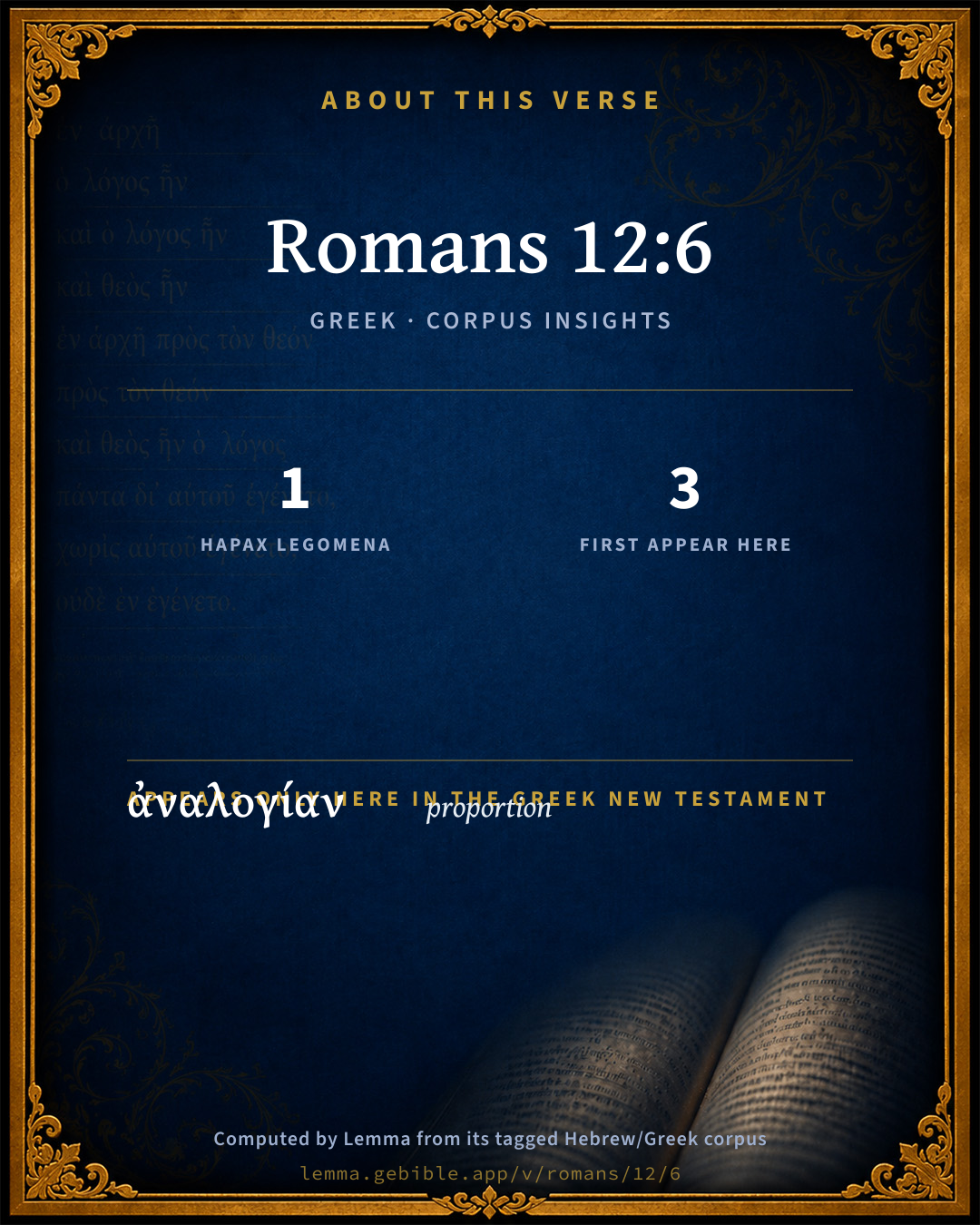
  • 1 hapax legomenon — only here in the Greek New Testament
  • 3 first appearances in the Greek New Testament
Full analysis ↓
Download a study sheet

One document with this verse’s original text, its word-by-word gloss line, the meaning frame, cross-references with their text, attributed commentary, and full source and license credits — printable, and it pastes into notes with its structure intact.

This verse Autodidact and up

Study sheet (.html) Plain text (.txt)

A passage Seminary Student

Up to 50 verses in one chapter. A passage sheet keeps up to 6 commentary sources and 12 cross-references per verse, in the order this page ranks them, and says so on the sheet whenever that leaves anything out. Ask for a single verse and you get the Autodidact verse sheet above.

Everything on this page stays free to read, with no account — the sheet is a download of what is already on screen, not access to it.

Want to remove ads? Support Godless Engineer
Compare translations 3

The same verse in 3 English versions, stacked beneath the original-language interlinear above. Click any original word for its lexicon entry.

Each is an independent rendering of the whole verse — the interlinear is not word-aligned to these translations.

Highlighted words mark where these versions differ — a whole-verse word diff, not a word-by-word alignment.

  • World English Bible Public Domain
    Having gifts differing according to the grace that was given to us, if prophecy, let us prophesy according to the proportion of our faith;
  • King James Version Public Domain
    Having then gifts differing according to the grace that is given to us, whether prophecy, let us prophesy according to the proportion of faith;
  • unfoldingWord Literal Text CC BY-SA 4.0
    But we have different gracious gifts according to the grace given to us: if prophecy, according to the proportion of his faith;

unfoldingWord Literal Text — © unfoldingWord, licensed CC BY-SA 4.0. Word-aligned USFM3 via Door43 (git.door43.org/unfoldingWord/en_ult).

Versions to compare (up to 4)

3 of 4 selected

Show all 19 translations

Every available English version of this verse, each an independent rendering of the whole verse.

  • World English Bible Public Domain
    Having gifts differing according to the grace that was given to us, if prophecy, let us prophesy according to the proportion of our faith;
  • Berean Standard Bible Public Domain
    We have different gifts according to the grace given us. If one’s gift is prophecy, let him use it in proportion to his faith;
  • Majority Standard Bible Public Domain
    We have different gifts according to the grace given us. If one’s gift is prophecy, let him use it in proportion to his faith;
  • King James Version Public Domain
    Having then gifts differing according to the grace that is given to us, whether prophecy, let us prophesy according to the proportion of faith;
  • American Standard Version (1901) Public Domain
    And having gifts differing according to the grace that was given to us, whether prophecy, `let us prophesy' according to the proportion of our faith;
  • Revised Version (1885) Public Domain
    And having gifts differing according to the grace that was given to us, whether prophecy, let us prophesy according to the proportion of our faith;
  • Geneva Bible (1599) Public Domain
    Seeing then that we haue gifts that are diuers, according to the grace that is giuen vnto vs, whether we haue prophecie, let vs prophecie according to the portion of faith:
  • Douay-Rheims (1899) Public Domain
    And having different gifts, according to the grace that is given us, either prophecy, to be used according to the rule of faith;
  • Young's Literal Translation Public Domain
    And having gifts, different according to the grace that was given to us; whether prophecy -- `According to the proportion of faith!'
  • Literal Standard Version CC BY-SA 4.0
    And having gifts, different according to the grace that was given to us: whether prophecy, according to the proportion of faith;
  • Unlocked Literal Bible CC BY-SA 4.0
    We have different gifts according to the grace that was given to us. If one's gift is prophecy, let it be done according to the proportion of his faith.
  • unfoldingWord Literal Text CC BY-SA 4.0
    But we have different gracious gifts according to the grace given to us: if prophecy, according to the proportion of his faith;
  • Darby Bible Public Domain
    But having different gifts, according to the grace which has been given to us, whether [it be] prophecy, [let us prophesy] according to the proportion of faith;
  • World Messianic Bible Public Domain
    having gifts differing according to the grace that was given to us: if prophecy, let’s prophesy according to the proportion of our faith;
  • Webster's Bible Public Domain
    Having then gifts differing according to the grace that is given to us, whether prophecy, let us prophesy according to the proportion of faith;
  • Free Bible Version CC BY-SA 4.0
    We each have different gifts that vary according to the grace given to us. So if it's speaking for God, then you should do so depending on how much you trust in God.
  • Bible in Basic English Public Domain
    And having different qualities by reason of the grace given to us, such as the quality of a prophet, let it be made use of in relation to the measure of our faith;
  • Text-Critical English NT CC BY 4.0
    We have different gifts according to the grace given to us. If someone's gift is prophecy, he should prophesy in proportion to his faith;
  • Tyndale New Testament (1534) Public Domain
    Seynge that we have dyvers gyftes accordynge to the grace that is geven vnto vs: yf eny man have the gyft of prophesye let him have it that it be agreynge vnto the fayth.

Literal Standard Version (2020), Covenant Press — licensed CC BY-SA 4.0. Text via the HelloAO Bible API (eBible.org). Unlocked Literal Bible (unfoldingWord) — licensed CC BY-SA 4.0. Text via the HelloAO Bible API (eBible.org). unfoldingWord Literal Text — © unfoldingWord, licensed CC BY-SA 4.0. Word-aligned USFM3 via Door43 (git.door43.org/unfoldingWord/en_ult). Free Bible Version, Dr. Jonathan Gallagher — licensed CC BY-SA 4.0. Text via the HelloAO Bible API (eBible.org).

Word by word

More ways to search: Search by grammar → Find every occurrence → Compare this word →

Practice this passage: Drill this verse → Learn its vocabulary →

ἀναλογίαν
analogía
G356
“proportion”
Noun, Accusative, Singular, Feminine
Part of Speech
Noun
Case
Accusative
Number
Singular
Gender
Feminine
Full Thayer's Definition

Origin: from a compound of G303 and G3056

TDNT: 06:47,6

1. proportion
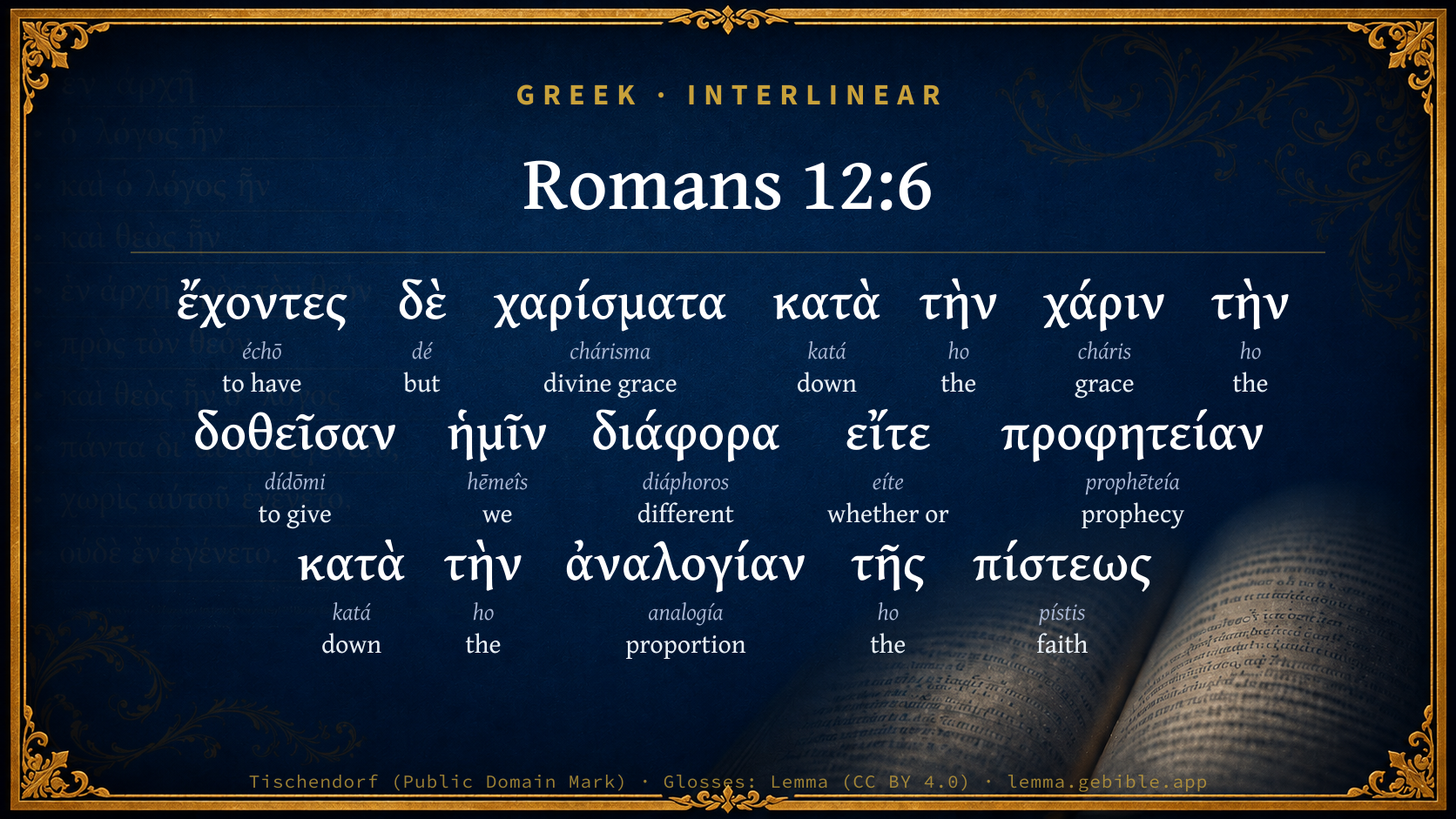
  1. ἔχοντες échō G2192 “to have” Verb, Present, Active, Participle, Nominative, Plural, Masculine
  2. δὲ dé G1161 “but” Conjunction
  3. χαρίσματα chárisma G5486 “divine grace” Noun, Accusative, Plural, Neuter
  4. κατὰ katá G2596 “down” Preposition
  5. τὴν ho G3588 “the” Article, Accusative, Singular, Feminine
  6. χάριν cháris G5485 “grace” Noun, Accusative, Singular, Feminine
  7. τὴν ho G3588 “the” Article, Accusative, Singular, Feminine
  8. δοθεῖσαν dídōmi G1325 “to give” Verb, Aorist, Passive, Participle, Accusative, Singular, Feminine
  9. ἡμῖν hēmeîs G2249 “we” Personal pronoun, 1st person, Dative, Plural
  10. διάφορα diáphoros G1313 “different” Adjective, Accusative, Plural, Neuter
  11. εἴτε eíte G1535 “whether or” Conjunction
  12. προφητείαν prophēteía G4394 “prophecy” Noun, Accusative, Singular, Feminine
  13. κατὰ katá G2596 “down” Preposition
  14. τὴν ho G3588 “the” Article, Accusative, Singular, Feminine
  15. τῆς ho G3588 “the” Article, Genitive, Singular, Feminine
  16. πίστεως pístis G4102 “faith” Noun, Genitive, Singular, Feminine

About this verse

These counts appear in no published source. They are computed here, from the morphology-tagged text and Lemma’s own curated glosses. What Lemma adds →

17
words
13
distinct lemmas
Pauline Epistles
section

Notable vocabulary

1 hapax legomenon — a word that appears only here in the entire Greek New Testament:

  • ἀναλογίαν proportion G356

First appearance in Scripture

These words make their first canonical appearance in the Greek New Testament here:

  • διάφορα different G1313
  • εἴτε whether or G1535
  • ἀναλογίαν proportion G356

Shared distinctive vocabulary

διάφορα different G1313 occurs in 4 verses of the Greek New Testament. Also found in:
Repetition

Words recur within this verse:

Cross-references

26

Topical passages linked to Romans 12:6 in the Treasury of Scripture Knowledge — connected by theme and wording, ordered by reader-vote popularity; previews shown in the World English Bible.

  • 1 Peter 4:10–11 According as each has received a gift, be ministering it among yourselves, as good stewards of the grace of God in its various forms.
  • 1 Corinthians 7:7 Yet I wish that all men were like me. However each man has his own gift from God, one of this kind, and another of that kind.
  • 1 Corinthians 12:28–31 God has set some in the assembly: first apostles, second prophets, third teachers, then miracle workers, then gifts of healings, helps, governments, and various kinds of languages.
  • 1 Corinthians 12:4–11 Now there are various kinds of gifts, but the same Spirit.
  • Romans 12:3 For I say, through the grace that was given me, to every man who is among you, not to think of himself more highly than he ought to think; but to think reasonably, as God has apportioned to each person a measure of faith.
  • 1 Corinthians 13:2 If I have the gift of prophecy, and know all mysteries and all knowledge; and if I have all faith, so as to remove mountains, but don't have love, I am nothing.
  • Romans 1:11 For I long to see you, that I may impart to you some spiritual gift, to the end that you may be established;
  • 1 Corinthians 14:1 Follow after love, and earnestly desire spiritual gifts, but especially that you may prophesy.
  • 1 Corinthians 14:3–5 But he who prophesies speaks to men for their edification, exhortation, and consolation.
  • 1 Corinthians 1:5–7 that in everything you were enriched in him, in all speech and all knowledge;
  • Ephesians 4:11 He gave some to be apostles; and some, prophets; and some, evangelists; and some, shepherds and teachers;
  • 2 Corinthians 8:12 For if the readiness is there, it is acceptable according to what you have, not according to what you don't have.
  • 1 Corinthians 4:6–7 Now these things, brothers, I have in a figure transferred to myself and Apollos for your sakes, that in us you might learn not to think beyond the things which are written, that none of you be puffed up against one another.
  • 1 Corinthians 14:31–32 For you all can prophesy one by one, that all may learn, and all may be exhorted.
  • 1 Thessalonians 5:20 Don't despise prophesies.
  • Acts 15:32 Judas and Silas, also being prophets themselves, encouraged the brothers with many words, and strengthened them.
  • 1 Corinthians 14:29 Let the prophets speak, two or three, and let the others discern.
  • Matthew 23:34 Therefore, behold, I send to you prophets, wise men, and scribes. Some of them you will kill and crucify; and some of them you will scourge in your synagogues, and persecute from city to city;
  • Luke 11:49 Therefore also the wisdom of God said, 'I will send to them prophets and apostles; and some of them they will kill and persecute,
  • Acts 2:17 'It will be in the last days, says God, That I will pour out my Spirit on all flesh. Your sons and your daughters will prophesy. Your young men will see visions. Your old men will dream dreams.
  • Philippians 3:15 Let us therefore, as many as are perfect, think this way. If in anything you think otherwise, God will also reveal that to you.
  • Acts 21:9 Now this man had four virgin daughters who prophesied.
  • 1 Corinthians 14:24 But if all prophesy, and someone unbelieving or unlearned comes in, he is reproved by all, and he is judged by all.
  • Ephesians 3:5 which in other generations was not made known to the children of men, as it has now been revealed to his holy apostles and prophets in the Spirit;
  • Acts 11:27–28 Now in these days, prophets came down from Jerusalem to Antioch.
  • Acts 18:24–28 Now a certain Jew named Apollos, an Alexandrian by race, an eloquent man, came to Ephesus. He was mighty in the Scriptures.

Cross-references courtesy of OpenBible.info (CC BY 4.0).

Commentary

Notes on Romans 12:6 from classic Christian and Jewish commentators (each source and its license shown beneath its notes). The classic Christian expositions comment on the surrounding passage and are grouped to its opening verse, so a note may address several verses; the Jewish commentaries on the Tanakh (Rashi and others) are per-verse, so they appear only where the commentator wrote on this verse.

Lemma curates 59 commentaries, every one of them public domain or Creative Commons licensed, each selected and text-cleaned for this edition rather than reprinted as found. About our sources →

Adam Clarke's Commentary

Verse 6. Having then gifts differing, c.] As the goodness of God, with this view of our mutual subserviency and usefulness, has endowed us with different gifts and qualifications, let each apply himself to the diligent improvement of his particular office and talent, and modestly keep within the bounds of it, not exalting himself or despising others.

Whether prophecy] That prophecy, in the New Testament, often means the gift of exhorting, preaching, or of expounding the Scriptures, is evident from many places in the Gospels, Acts, and St. Paul's Epistles, see 1Co 11:4, 1Co 11:5; and especially 1Co 14:3 : He that prophesieth speaketh unto men to edification, and exhortation, and comfort. This was the proper office of a preacher; and it is to the exercise of this office that the apostle refers in the whole of the chapter from which the above quotations are made. See also Lu 1:76; Lu 7:28; Ac 15:32; 1Co 14:29. I think the apostle uses the term in the same sense here-Let every man who has the gift of preaching and interpreting the Scriptures do it in proportion to the grace and light he has received from God, and in no case arrogate to himself knowledge which he has not received; let him not esteem himself more highly on account of this gift, or affect to be wise above what is written, or indulge himself in fanciful interpretations of the word of God.

Dr. Taylor observes that the measure of faith, Ro 12:3, and the proportion of faith, Ro 12:6, seem not to relate to the degree of any gift considered in itself, but rather in the relation and proportion which it bore to the gifts of others; for it is plain that he is here exhorting every man to keep soberly within his own sphere. It is natural to suppose that the new converts might be puffed up with the several gifts that were bestowed upon them; and every one might be forward to magnify his own to the disparagement of others: therefore the apostle advises them to keep each within his proper sphere; to know and observe the just measure and proportion of the gift intrusted to him, not to gratify his pride but to edify the Church.

The αναλογια της πιστεως, which we here translate the proportion of faith, and which some render the analogy of faith, signifies in grammar "the similar declension of similar words;" but in Scriptural matters it has been understood to mean the general and consistent plan or scheme of doctrines delivered in the Scriptures; where every thing bears its due relation and proportion to another. Thus the death of Christ is commensurate in its merits to the evils produced by the fall of Adam. The doctrine of justification by faith bears the strictest analogy or proportion to the grace of Christ and the helpless, guilty, condemned state of man: whereas the doctrine of justification by WORKS is out of all analogy to the demerit of sin, the perfection of the law, the holiness of God, and the miserable, helpless state of man. This may be a good general view of the subject; but when we come to inquire what those mean by the analogy of faith who are most frequent in the use of the term, we shall find that it means neither more nor less than their own creed; and though they tell you that their doctrines are to be examined by the Scriptures, yet they give you roundly to know that you are to understand these Scriptures in precisely the same way as they have interpreted them. "To the law and to the testimony," says Dr. Campbell, "is the common cry; only every one, the better to secure the decision on the side he has espoused, would have you previously resolve to put no sense whatever on the law and the testimony but what his favourite doctrine will admit. Thus they run on in a shuffling, circular sort of argument, which, though they studiously avoid exposing, is, when dragged into the open light, neither more nor less than this; 'you are to try our doctrine by the Scriptures only; but then you are to be very careful that you explain the Scripture solely by our doctrine.' A wonderful plan of trial, which begins with giving judgment, and ends with examining the proof, wherein the whole skill and ingenuity of the judges are to be exerted in wresting the evidence so as to give it the appearance of supporting the sentence pronounced before hand." See Dr. Campbell's Dissertations on the Gospels, Diss. iv. sect. 14, vol. i, page 146, 8vo. edit., where several other sensible remarks may be found.

Adam Clarke's Commentary on the Bible (1810–1826) — public domain. Text from a community e-Sword/MySword module.

The Biblical Illustrator

Joseph S. Exell

Rom_12:6-8

Having then gifts differing according to the grace that is given to us.

Gifts of grace

1. Their common source.

2. Diverse character.

3. Liberal distribution.

4. Faithful exercise.

5. Happy influence. (J. Lyth D.D.)

Gifts: their Divine source

As many vapours, rising from the sea, meet together in one cloud, and that cloud falls down divided into many drops, and those drops run together, making rills of water, which meet in channels, and those channels run into brooks, and those brooks into rivers, and those rivers into the sea; so it either is or should be with the gifts and graces of the Church. They all come down from God, divided severally as He will to various Christians. They should flow through the channels of their special vocations into the common streams of public use for church or commonwealth, and ultimately return into the great ocean of His glory, from whence they originally came. (Bp. Hall.)

Gods gifts to the Church to be used for His service

I. Those of whom the apostle speaks. Members of Christs body, i.e., the Church (Eph_1:22-23).

1. But what is the Church? Ask Roman Catholics, the members of the Greek Church, some members of our own Church, or the various sects, they would claim each for themselves the title of the Church. Now these are equally wrong. The Church here spoken of is no particular ecclesiastical government whatsoever, but the spiritual Church of Gods elect throughout the whole world.

2. Here is the test of Church membership--the measure of faith. No person is a member of this Church but a true believer, nor can he exercise the gifts here spoken of except he has the gift of faith. The apostles illustration of the human body is totally inapplicable to the nominal Church. No such sympathy can be exercised unless men be mentally and morally conformed to God. Again, the string of spiritual duties inculcated in the text cannot be performed by mere nominal Christians. If you want a description of real Church members, read the opening address of almost every Epistle.

II. The persons of whom the apostle speaks are all possessed of gifts.

1. The time would fail me to tell of the gifts of God to individual members of His Church--outward gifts, such as station, property, influence, talent; official gifts, gifts of prophecy, of instruction, or those more directly spiritual gifts accumulated in the Church.

2. But the point of the passage is its reference to the diversity of gifts. Sometimes they almost appear to be capricious; one man rich, another poor; one richly gifted, another next akin to idiotcy; some with dispositions very amiable, others just the reverse. Spiritual gifts are not equally given to all. Some have such views of truth, such contemplations of heavenly things, that they seem to be admitted within the veil. Others seem just the reverse, going on heavily, and oftentimes cast down. So it is with all spiritual knowledge and attainments. This point is illustrated under the figure of the human body. What harmony, yet what diversity there! There is the head, the seat of wisdom; the countenance, of feeling and animation; then the various limbs or members of the body, more or less honourable; yet is the whole fitly framed together, each part marvellously adjusted to the other, and all mutually dependent.

3. But the most striking thought is that all are gifts of God. Money we may have earned by our own intelligence and diligence, but God gave us that diligence and intelligence. So with regard to our station in life. So most preeminently with His spiritual gifts. If we have any knowledge of the Scriptures, it is revealed to us by the Spirit of God.

4. Mark the lessons.

(1) The least of Gods gifts are talents entrusted to us, and should not be despised. Do not despise the day of small things, and say, I have nothing, or I can do nothing. Perhaps, too, there is a greater danger of our despising small gifts in others.

(2) These talents being the gift of God, we must not be unduly elated by them (verse 3; 1Co_4:7). How humbling the thought that we have nothing we can call our own!

(3) The lowest gifts are as much Gods as the highest. He that planted the sun in the firmament taught the little glow-worm to shine on the summer bank. He that raises up the most talented to fill with honour distinguished situations is the same God that puts the candle in the cottage and bids it shine there. How encouraging is this to the weakest, the poorest, the youngest!

III. It is their duty and privilege to consecrate those gifts to the service of God. As masters and servants, parents and children, brothers and sisters, as individual members of Christs universal Church, we have each gifts entrusted to us; and whether our talents be few or many, feeble or strong, they are the gifts of God, and must be thrown by us into the common treasury of the Church for the glory of God and the salvation of souls. (Dean Close.)

Varied gifts

There is not greater variety of colour and qualities in plants and flowers, with which the earth, like a carpet of needlework, is variegated, for the delight and service of man, than there is of gifts natural and spiritual in the minds of men, to render them useful to one another, both in civil society and Christian fellowship. (W. Gurnall.)

Gifts, diversity of

Every man has received some gift--no man has all gifts; and this, rightly considered, would keep all in a more even temper; as, in nature, nothing is altogether useless, so nothing is self-sufficient. This, duly considered, would keep the meanest from repining and discontent, even him that hath the lowest rank in most respects; yet something he hath received that is not only a good to himself, but rightly improved, may be so to others likewise. And this will curb the loftiness of the most advanced, and teach them not only to see some deficiencies in themselves, and some gifts in far meaner persons which they want; but, besides the simple discovery of this, it will put them upon the use of lower persons, not only to stoop to the acknowledgment, but even withal to the participation and benefit of it; not to trample upon all that is below them, but to take up and use things useful, though lying at their feet. Some flowers and herbs that grow very low are of a very fragrant smell and healthful use. (Abp. Leighton.)

Unity and diversity

Diversity without unity is disorder; unity without diversity is death. (J. P. Lange, D.D)

Unity in diversity

The spirit resolves the variety into unity, introduces variety into the unity, and reconciles unity to itself through variety. (Baur.)

The requirements of true religion

I. Faithfulness in the church. Our gifts must be improved for the common edification (verses 6-8).

II. Love to the brethren--it must be faithful, yet kind.

III. Consistency in the world.

1. Diligence.

2. Fervour.

3. Cheerfulness.

4. Patience.

5. Prayer.

IV. Kindness to all men.

1. To the saints.

2. To enemies.

3. To all according to their need.

V. Humility.

1. In our intercourse with others.

2. In our aims.

3. In our judgments. (J. Lyth, D.D.)

Usefulness, the least Christian to aim at

Many true saints are unable to render much service to the cause of God. See, then, the gardeners going down to the pond and dipping in their watering-pots to carry the refreshing liquid to the flowers. A child comes into the garden and wishes to help, and yonder is a little watering-pot for him. Note well the little water-pot, though it does not hold so much, yet carries the same water to the plants; and it does not make any difference to the flowers which receive that water, whether it came out of the big pot or the little pot, so long as it is the same water, and they get it. You who are as little children in Gods Church, you who do not know much, but try to tell to others what little you know; if it be the same gospel truth, and be blessed by the same Spirit, it will not matter to the souls who are blessed by you whether they were converted or comforted under a man of one or ten talents. (C. H. Spurgeon.)

Let us prophesy according to the proportion of faith.

The gift of prophecy

I. Its nature and requisites.

II. Its design.

1. The edification of the Church.

2. The spread of truth.

3. Salvation of souls.

III. Its use.

1. According to the analogy of faith.

2. In faith. (J. Lyth, D.D.)

The proportion of faith

1. Prophet means one who is the interpreter of anothers thought. In the Hebrew word there is involved the idea of a fountain bubbling up as from between rocks, subjected to pressure from without. The prophet often declared future events; but we must not limit his function to the prediction. He brought messages to men pertaining to the present practical duty of life.

2. According to the proportion of faith. The sense is made clearer by inserting the or our faith, i.e., the objective system of truth, the gospel. It is a vast, vital, co-ordinated system, built up a unity, like the root, the stem, and branch, or the wall, the tower, and spire of a building. The balance of every part with every other part is hinted at. What is it that Gods Word brings?

I. Great doctrines.

1. The eternal personality of God--a thought the pagan mind did not grasp. And science is dwarfed when it hides this pivotal thought.

2. His providential goodness and redeeming grace. His hand is in history. The history of the race is the history of redemption. It was God who led Paul to Damascus, Augustine to Rome, Savonarola to Florence, and Luther to Worms, His creative power, His providence and grace, like the mysterious trinity of Being to which they are related, fill us with adoring wonder. The Bible lifts the race, exalting its intellectual as well as its moral capacity.

II. The law of God which is as great as the doctrine of God. It is high above the codes of uninspired teachers. Love to God and man are the essential elements. Every element of life is reached and ruled by it. As one sunshine floods the breadth of the sea and the face of the smallest flower, so the law touches alike the mightiest and the meanest. It enters into the whole man. Courtesy in manner is philanthropy in a trait, and heroism of character is shown in the patience of love. In a word, the law is matched to the doctrine in its supernal character and reach.

III. A Saviour as great as either. He was announced by angels; a star led worshippers to His cradle; at His baptism a voice proclaimed Him the well-beloved of the Father. He laid claims on mans service--blasphemous were He not God. He put Himself between parent and child, wife and husband; or, rather, above them all, in supreme authority. By His pierced hands, Christ, the crucified and risen Redeemer, has been guiding the course of empires, and is bringing in millennial eras. Really, though often unconsciously, has the world in its advancing civilisation reflected the glory of this majestic Prince of Life. He shall yet see of the travail of His soul and be satisfied. On His head will rest many crowns.

IV. A universal spiritual kingdom is coincident in majesty and might with the foregoing elements. The idea of such a kingdom is unique and grand. To the Greeks other nations were but barbarians. Rome made other peoples her captives, without extinguishing their enmity or assimilating their life. But Christ founded His throne in the love of His redeemed people. All genius shall be developed, and all wealth shall be consecrated under the supremacy of Christ. Christianity shall be the glory of the nations.

V. Great warnings. How shall we escape, if we neglect so great salvation? Here is, then, the proportion of faith, the harmony of truth, the analogy which knits all together in a definite unity. These are the substructural truths of revelation, which are to be studied and proclaimed, each in its time, place, and proportion. Conclusion:

1. As we infer the genius of the architect from the grandeur of the building, the genius of the poet from his verse, or that of the statesman and jurist from what emanates from each, so we infer the sublime greatness of God from this revelation of truth. Can any one say that the Scriptures are the product of the Jewish mind? As well might we say that the Atlantic came from the upsetting of a childs breakfast-cup!

2. Attacking one point of this revelation is an attack on the whole. If one part be in error the value of the whole is vitiated, the entire edifice tumbles to pieces. All these facts of our common faith stand or fall together, as heart and brain are united. If one be paralysed, the whole suffers. If one stone be plucked from the arch, they all tumble in one heap; but in their entirety they reflect the Divine unity and eternity.

3. We rise into sympathy with God as we come into fuller comprehension of His truth. How unwise it is for one to try to banish Gods Word from his thoughts! Here is the romance of the world. The imagination, as well as the conscience of the race, is exalted by the truth of God. It ennobles the whole man. It enriches the life that is, as well as the life that is to come. (R. S. Storrs, D.D.)

Right proportions of truth

I. What is faith here?

1. If we are to understand the trust of the heart towards God, then the passage will mean, that if any man prophesy, or preach, he must do it according to the spiritual experience which God has given him. The measure of the faith is the measure of the life; and if we wish to raise the standard of our life, we must begin by elevating our faith. We cannot go beyond our faith; and we must not fall short of it. The great business of life is to square our words and actions to the faith which God has given us.

2. But we are to take faith here rather as signifying not the belief, but the things believed--our creed--the faith once delivered to the saints.

II. We must keep the general symmetry of the whole body of the truth as it is in Jesus.

1. There is no greater danger than disproportion--the source of almost all error. For the enemy of truth to present what is palpably false would at once startle and offend! But he secures his end much better, by putting before us what is in itself perfectly true, but which becomes false when not balanced by another and equal truth.

2. God has been pleased to give us a revelation; but He has given us also common sense. The Bible was never intended to be cut up into isolated texts. No book would bear it. If you take single sentences you may prove Socinianism, Popery, anything. What we have to do is to know all; to collate all; and to gather, from the Bible, in its integrity, the mind of God.

III. One or two things in which it is most important to keep the proportion of faith.

1. Each Person in the Blessed Trinity has His own prerogative, office, and dispensation. Some persons religion is all of the Father, others all of the Son, others all of the Spirit. See, however, how the works of each stand related to each other in the proportion of faith. The Father loved the world, and gave His Son to save it. The Son wrought out for us a complete salvation, and with Him we have union by faith. That union is our strength, and our life. That union once made, the Holy Spirit flows into us as the blood flows into a member of the body; or, as the sap flows into a branch, grafted into the tree. So that it is impossible to say to which we owe most.

2. According to the proportion of faith, there is a wide distinction between the process of our justification and our sanctification. We are justified at once, and perfectly, by a single act of faith; hut we are sanctified by degrees with effort, and even painfulness. (J. Vaughan, M.A.)

The doctrine of proportion

Proportion means things in their right place, i.e., when one object does not unduly attract our attention above another. A well-proportioned figure, e.g., is where the head is not too large, or the hands and feet too small for the body. A well-proportioned building is that in which nothing is out of place or too large or small for its place. Apply this doctrine to--

I. Christian practice.

1. It is not enough to ask what is right in itself, but what is right under the circumstances. It is a great thing to have right men in right places, but it is also a great thing to have the right man doing the right thing in the right place, in the right way. A right thing done in a wrong way is often more mischievous than a thing done wrong altogether. A saying most true loses all its savour if said at a wrong time; and it is no defence to argue that it was good years ago or miles away. Is it good for us here and now?

2. Congruity, fitness, proportion, are the graces required for the spiritual as well as the material temple. We are not mere isolated blocks of stone, but living stones, built up into a spiritual house. What in one station or age is a grace, in another is a deformity. To everything there is a season, etc., says the preacher in that ancient discourse on the doctrine of proportion. How many good plans have come to nought, not from wickedness or opposition, but because men have exalted a virtue or custom out of proportion, and so have driven men into an equal disproportion on the other side--over strictness leading to over laxity, excessive rashness to excessive caution, etc.

3. And so the apostle tells us to act according to the gifts given to us. He that is endowed with the gift of preaching is to exercise his gift not in any other line, but in that. He that has the gift of practical work is not to rush out of his way in prophesying. Each has his own special calling; let us not waste our time or mar our usefulness by intruding into provinces disproportioned to our powers. Any one faculty indulged in excess becomes a curse, e.g., music, study, mechanical pursuits. How fatal to Louis XVI., who in the crisis of the French monarchy devoted himself to his favourite craft rather than to the task of saving the state; how useful to Peter the Great, who made it the means of civilising his barbarian empire!

4. In the defence of Lucknow the courage, subordination and zeal of each individual was sustained by the consciousness that on him rested the safety of the whole--a single outpost lost would be the loss of all. So if the fortress of goodness and truth is to be saved, it must be by every one doing at his own post the work that belongs to him alone. What discipline effects in the army is effected in our moral duties by a sense of the apostolical doctrine of proportion. Each one has his own work assigned him by the Captain of his salvation. Allow in others, claim for yourselves a division of labour and responsibility. A good master, servant, soldier, teacher, is made in no other way but by waiting on his place.

II. Christian method.

1. He that giveth with simplicity. How greatly the value of a gift depends on the manner of giving! He gives twice who gives soon; so he who gives with simplicity, i.e., with singleness of purpose, gives a hundredfold more than he who gives grudgingly, late, or ostentatiously. A thousand gifts ill given are hardly better than none.

2. He that ruleth, with diligence. He that has charge of a household, school, or commonwealth, may rule imperiously, and so that the institution may go on in apparent prosperity; and yet there may be wanting that peculiar method which will give life and substance to the whole. What is wanted is that he should rule with diligence, i.e. with heart and soul. This is the true secret of influence.

3. He that showeth mercy, with cheerfulness. How easy to show mercy in such a way that it shall be no mercy! What is wanted is the bright smile, the playful word.

III. Christian truth.

1. It is important for the teacher to teach according to the proportion of his own faith; not to assume feelings which are not his own, not to urge truths of which he does not feel the value, but to teach according to his own knowledge and experience.

2. It is important for us all so to seek, find, and teach all truth, so as not to forget what are the due proportions of the truth itself. Christian truth is not of one kind only. It has lights and shades, foregrounds and distances, lessons of infinitely various significance. Woe be to us if instead of rightly dividing the word of truth, we confound all its parts together. We may believe correctly on every single point, yet if we view these points out of their proper proportions our view may be as completely wrong as if on every point we had been involved in error. (Dean Stanley.)

The danger of exaggerations in religion

1. Lord Bacon compares religion to the sun, which invigorates and cheers live animal substances, but turns the dead to corruption. Similarly religion invigorates a sound mind, and cheers a sound heart, while in a morbid mind it breeds superstitions, scruples, and monstrous fancies. We have only to survey the history of Christianity to see how just their comparison is. What follies, superstitions, licentious doctrines, have been founded on the Bible! This has arisen from a certain morbid tendency in the human mind to caricature truths presented to it.

I. Every heresy has been a caricature of some one point of Christian truth--an exaggeration by which the fair proportion of the faith has been distorted.

1. The truth upon which the Quaker founds his system, is that the New Dispensation is spiritual. No truth can well be more vital, and through the subtle encroachments of formalism it is necessary for all of us every now and then to ask ourselves whether we are properly awake to the fact that the law, under which Christians live, is the law of the Spirit of life in Christ Jesus, written on the fleshy table of the heart, and that God is a Spirit, and therefore to be worshipped in spirit and in truth. The Quakers would have deserved the warmest thanks if they had done nothing more than bring these truths forward. But, unhappily, they caricatured them, and robbed the Church of her sacraments.

2. The fundamental truth of our religion is that God is love, and that He has shown His love by the sacrifice of His dear Son. Now certain divines have perceived this truth clearly, and it is impossible to perceive it too clearly, or proclaim it too loudly. But to say that anger is inconsistent with love, or that justice is inconsistent with compassion, and to acknowledge no relations with God as a Judge, because He stands to us in the relation of a Father, is to caricature the faith and mar its fair proportions. God loves me deeply, but He hates my sin, and will never consent to save me from its guilt without saving me from its power.

3. And where there is no actual heresy, this tendency may lead to a vast amount of unsuspected mischief. In many spiritual books a strain is put upon certain precepts which caricatures them, sets them at issue with other precepts, and cramps the mind which should strive after obedience to them. Take an example. When St. Francis of Sales was dying, he said to one of his attached disciples, Bishop, God has taught me a great secret, and I will tell it you, if you will put your head closer. The bishop did so, anxious to know what Francis considered as the crowning lesson of a life of holiness. He has taught me, said the dying man, who was acutely suffering, to ask nothing, and to refuse nothing. Now at this a sentimental pietism might perhaps whisper, What beautiful resignation! But is it in conformity to the Word of God, and the mind of Christ? We admit that we should refuse nothing which comes from our Fathers hand. But where has God taught His people to ask nothing? Did not our Lord pray, Father, if it be possible, let this cup pass from Me? Good St. Francis erred by exaggeration, and caricatured the grace of resignation. Resignation is a heavenly and Christ-like grace; but if you will push it to every length, it becomes absolutely mischievous. Thus one might conceive a beggar doing nothing to improve his condition, on the plea that such was the will of God, and that mendicancy was the state of life to which tie had been called; forgetting that there is a maxim which says that if any man would not work, neither should he eat. In the lives of the Scriptural saints nothing is so remarkable as their perfect naturalness, and freedom from all overstrained spirituality. The great Apostle of the Gentiles, after a miraculous escape from shipwreck, gathers a bundle of sticks, and puts them on the fire (for St. Paul was not above feeling cold and wet); and when writing under the affiatus of the Holy Ghost, he bids Timothy bring the cloak which be left at Troas with Carpus, in anticipation of an approaching winter, and the books, but especially the parchments; for what studious man can bear to be without his books and papers? Among the early disciples you would have seen nothing overcharged in character or manner; nay, you would have seen little foibles, of temper, of superstition, of prejudice--you might have heard sharp words passing between great apostles, and you might have seen a damsel, recently engaged with others in prayer, in such a joyful trepidation of nerves when the answer arrived, that she opened not the gate for gladness.

II. How, then, shall the devout man keep his mind free from exaggerations both in doctrine and practice? By an impartial study of the whole of Scripture. Pray for the Bereans nobleness of mind who brought even the doctrine of apostles to the test of inspiration, and searched the Scriptures daily, whether these things were so. How much more, when men are not apostles, must their doctrine be thus searched and sifted! (Dean Goulburn.)

The proportion of faith

It has been a matter of controversy whether the faith is to be understood in its objective or subjective sense, in other words, whether the caution is intended to guard the preacher against violating the due relation existing between one and another of the truths of revelation; or whether he does not rather use the word faith in its subjective meaning, and bid the Christian who is to exercise the prophetic office so to regulate his teaching as may be in accordance with the measure of faith attained by himself or his hearers. I can myself see no reason why we should not use the words in both applications.

I. First, taking the text in its objective meaning, what shall we say is the true proportion which is to guide us in our teaching? Surely in the first instance we must go to the Catholic creeds: these, surely, in the first place, are the natural exponents to us of the revelation of the New Testament. The great truth of the incarnation of the eternal Son lies, as we all should admit, at the root of all sound teaching connected with mans relation to God. It is the one great central truth round which a theologian would group all the subsidiary truths, which we connect with the words atonement, reconciliation, pardon, justification, and the like. A number of other points of teaching, whether we count them matters of faith or of opinion, flow out of this central head. A clergyman--a scribe instructed into the kingdom of heaven--ought to see this relation between the several parts of revelation; but every clergyman even is not a formal theologian; and, deep as is the reverence still amongst our people for the English Bible, St. Pauls Epistles are mostly read for other purposes than for that of tracing the interdependence of religious truth. We complain sometimes, and not without reason, of the way in which a past generation so magnified one particular doctrine, which they thought to be embodied in St. Pauls writings, as to obscure altogether collateral and complementary truths; so as to give a thoroughly distorted image of the apostles teaching concerning the doctrine nearest to their own hearts. Our generation surely is not altogether clear from the same error.

II. But I suggested that St. Pauls words, where he speaks of the proportion of faith, might fairly bear the subjective as well as the objective interpretation; in other words, he seems to imply that prophecy, to be effective for the edification of the Church, must be exercised in subordination, not only to the analogy of the faith of the Church itself, but also to the faith of the preacher, and I think also of the hearer. Am I wrong in saying that the prophecy of our days has not been always mindful of this rule? And has not this forgetfulness been one fruitful source of much of the disappointment which has waited on the ministry of good and earnest men? And we hear a great deal about the importance of defending the outworks from some who do not seem to understand altogether what is the citadel which they suppose these outworks to defend. I do not at all mean that there is of necessity any insincerity in all this, but there is, I think, a measure of unreality. The learner is not attracted by very decided statements on the part of the teacher, so long as there is a certain secret instinct in his own mind that the conviction of the speakers heart is not altogether in unison with the strength of his language. Out of the abundance of the heart the mouth speaketh--words not spoken out of that abundance fall dead and powerless even upon the untaught ear. But there is a third, and a different aspect of the whole question.

III. The proportion of faith which we have to take into account is the faith of our hearers as well as the faith of the Church at large, and the force with which we ourselves have apprehended the realities with which faith deals. The days in which we live are days of excitement, of controversy; I must add also days of failure and disappointment to those who have the cure of souls. We have gone out, many of us, full of expectation, and we have returned full of disappointment, we have sown much and we have brought in little, and the bright lights of the early morning have ended in a very sober grey. Doubtless there are many causes working up to this result. Our expectation has been unreasonable, and it has been good for us that tears, prayers, and watchings should fail. But I venture to think that there has been also a great forgetfulness of St. Pauls precept among us clergy. We have again and again looked for a sympathy amongst our people, which we had no right to expect; we have failed to apprehend the very wide difference between their standpoint and our own: we have expected to quicken their interest in religious truth, simply because our own has been quickened: and that new, possibly important, phases of doctrine should commend themselves to the spiritual apprehension of our people because they have so commended themselves to our own. These things are doubtless in a measure inevitable. I suppose every clergyman, in reviewing his own work and teaching, has found that he has fallen into many a mistake in his younger days from attempting to build up a super-structure where there was no sufficient foundation already laid. Sympathy with the spiritual and intellectual condition of others must of course be the result of experience. In a word, as years go on, I believe the oldest and the simplest standards alike of faith, and of devotion, and of practice satisfy us best. For dogmatic statements about the sacraments we turn to the catechism of our childhood, and we learn to see that all the refinements of more elaborate definition have added not one whit to the clearness of our apprehension of what is confessedly mystical. In like manner as the Lords prayer becomes to us the most complete and satisfying formula of communion with God, each petition in its iteration becoming more and more formal, but ever pregnant with fresh meaning and with new life, so also do the Catholic creeds supply us with all that we want as a standard of faith. Curious and intricate questions about which we were once very much inclined to speculate, we are content to leave where the creeds leave them, implicitly contained perhaps in their statements of truth, but no more. It is in them that we learn the true balance, the real proportion; and alike for our own souls guidance and for the teaching of our people, we fall back upon truths learnt at our mothers knee, and we find words which once sounded a little cold and formal become ever instinct with a new life; for that indeed they contain all that a Christian ought to know and believe to his souls health, the love of the Father, the Incarnation of the Son, and the indwelling power of the Spirit of God. (Archdn. Pott.)

Or ministry, let us wait on our ministering.--

Waiting on our ministering needs extra grace

I was in Cologne on a very rainy day, and I was looking out for similes and metaphors, as I generally am; but I had nothing on earth to look at in the square of the city but an old pump, and what kind of a simile I could make out of it I could not tell. All traffic seemed suspended, it rained so hard; but I noticed a woman come to the pump with a bucket. Presently I noticed a man come in with a bucket; nay, he came with a yoke and two buckets. As I kept on writing and looking out every now and then, I saw the same friend with the often-buckets and blue blouse coming to the same pump again. In the course of the morning I think I saw him a dozen times. I thought to myself, Ah, yon do not fetch water for your own house, I am persuaded: you are a water-carrier; you fetch water for lots of people, and that is why you come oftener than anybody else. Now, there was a meaning in that at once to my soul, that, inasmuch that I had not only to go to Christ for myself, but had been made a water-carrier to carry the water of everlasting life to others, I must come a great deal oftener than anybody else. (C. H. Spurgeon.)

He that teacheth, on teaching; or he that exhorteth, on exhortation.--

The faculties of teaching and exhorting

May be combined in the same individual; and indeed in these days, they are best laid upon one person, the ordinary minister of a congregation. Yet the two faculties are so far separate, as in other times to have given rise to separate functions; and accordingly, in the machinery of more churches than one, have we read both of the doctor and the pastor as distinct office-bearers. The one expounds truth; the other applies it, and presses it home on the case and conscience of every individual. The didactic and the hortatory are two distinct things, and imply distinct powers--insomuch, that, on the one hand, a luminous, logical, and masterly didactic may be a feeble and unimpressive hortatory preacher; and, on the other, the most effective of our hortatory men may, when they attempt the didactic, prove very obscure and infelicitous expounders of the truth. Both are best; and we should conform more to the way of that Spirit who divideth His gifts severally as He will, did we multiply and divide our offices so as to meet this variety. It were more consonant both to philosophy and Scripture, did we proceed more on the subdivision of employment in things ecclesiastical. (T. Chalmers, D.D.)

Requisites to faithful teaching

I. Study--to secure right material.

II. Method--or the right way of communicating the truth.

III. Diligence.

IV. Simplicity--Or a right aim.

V. Above all faith--Or dependence upon Divine help. (J. Lyth, D.D.)

Duty of teachers and ministers

On Egypts far-off soil, away from friends and home, just as the morning beams lit up the Eastern sky, an officer lay dying. With gallant daring he had led his followers through many a devious path, guided alone by the pale starlight of the heavens, until at last they reached the enemy; and now the strife is over, but he is wounded, mortally! As the general, his cheeks bedewed with tears, gazed down with sadness on his face, a sudden radiancy illumined for a moment the youths countenance as, looking up to Wolseley, he exclaimed, General, didnt I lead them straight? and so he died. Oh, brothers, when Oer our eyes there steals the film of death, and when the soul flits solemnly from time into eternity, may it be ours to say in truthful earnestness to Christ concerning those committed to our care, We led the people straight. (H. D. Brown, B.A.)

He that giveth, let him do it with simplicity.--

The triple lesson

What is the great object of human life?

1. To prepare to die, say many, an answer which contains a small modicum of right, and an overwhelming preponderance of wrong. To be prepared to meet death is, of course, a great object, but it is not itself the great object of life. If it were, on the same principle the great object of a journey would be to get home again; and of getting up in the morning to go to bed again at night, of a fire to consume fuel, and of reading a book to get through its pages. These absurdities bring out the truth that the fag end of a thing is not always the chief object of it.

2. The great object of life is to live, i.e., to do ones duty as a Christian. And wherever this object is fairly and fully followed out, the last stage of life will be safe and easy. What thought is there so disheartening and disturbing as the thought that we must die, and we know not how soon? Let it be chased away with the reflection that it is our present duty to live, and the text is suited exclusively to living men; to men who will one day have to die, but whose business now is to live and do their duty.

I. To give with simplicity. The word simplicity is the opposite of duplicity. Let him do it with a single eye and heart, and without any second or double meaning. Let there be no undercurrent of unworthy motive, but one pure and simple desire of benefiting the recipients of his bounty (Luk_6:35). The case of those who never, or scarcely ever, give anything, is not mentioned. Perhaps the apostle left it as a case which carried its own condemnation with it, and therefore required no special mention. But those who do give are to watch the motive of their giving. They have been bought with a price, and they must give out of a feeling of gratitude to Him who hath done so much for them. Whatever they have has been given to them by God, and sooner or later they will have to give an account of their stewardship. That they may do so with joy they must aim at simplicity in the exercise of their trust.

II. To rule with diligence.

1. Persons in authority are too apt to forget or shelve their responsibilities; and there are numbers who repudiate the idea of having any authority at all. But there are very few who do not exercise some influence. Now the text drops a word of warning to all, from the queen downwards, and condemns those who talk about taking it easy, and leaving things to take care of themselves.

2. Ruling is not a process which can be performed anyhow. It requires care, and thought, and discretion. And if parents, masters, and mistresses will not take the trouble to look after their dependents, or lack moral courage to do it, we may be sure of an unsatisfactory result sooner or later. Wherever habits of idleness and indulgence, waste and extravagance, recklessness and imprudence, of unbecoming finery in dress, and morbid delicacy in eating, go uncorrected, there the seed of a fruitful crop of social evils is being sown broadcast. Such habits cling tenaciously to young people, and in the case of servants, the humble fare of whose future homes may present a painful contrast to the profusion of domestic service, such habits make them poor and keep them so.

III. To show mercy with cheerfulness. There is a great deal in the way in which a thing is done. The man who does a kind action, accompanying it with kind words and looks, doubles the favour which he confers. The term cheerfulness refers particularly to looks. What a beautiful illustration of the spirit of our religion, which seeks to bring our whole man, body as well as soul, our very looks as well as our words and actions, into captivity to the obedience of Christ! How it carries us back to the example of our Master, who never said an unkind word, or gave an unkind look, or did a favour grudgingly. There is a good deal of kindness in the world, but the kindness we experience is not always associated with cheerfulness. Who has not heard of the poor relation, and the dependent friend, mourning in secret, not always over unkind actions, but over kind actions unkindly done? (J. Mould, M.A.)

Giving

I. Is a Christian duty. Because--

1. An acknowledgment of our stewardship.

2. An expression of--

(1) Gratitude to God.

(2) Self-denial.

(3) Goodwill to man.

II. Should be performed with simplicity. With--

1. A generous heart.

2. A single eye.

3. A clean hand. (J. Lyth, D.D.)

Giving with simplicity

is giving just as if giving were so natural that when a man gave he did not think of changing his countenance, manners, or air at all; but did it quietly, easily, beautifully. When you are going around for proper help, some men give so that you are angry every time you ask them to contribute. They give so that their gold and silver shoot you like a bullet. Others give with such beauty that you remember it as long as you live; and you say, It is a pleasure to go to such men. There are some men that give as springs do. Whether you go to them or not they are always full, and your part is merely to put your dish under the ever-flowing stream. Others give just as a pump does where the well is dry and the pump leaks! (H. W. Beecher.)

Giving, blessedness of

It is told of John Wesley that when he bestowed a gift or rendered any one a service he lifted his hat as though he were receiving instead of conferring an obligation.

Giving, penalty of not

A lady who refused to give, after hearing a charity sermon, had her pocket picked as she was leaving church. On making the discovery she said, The parson could not find the way to my pocket, but the devil did.

Giving, a sign of perfectness

When wheat is growing it holds all its kernels tight in its own ear. But when it is ripe the kernels are scattered every whither, and it is only the straw that is left. (H. W. Beecher.)

He that ruleth, with diligence.--

Ruling with diligence

I. The necessity of the ruler.

1. In the world.

2. In the Church.

II. The functions of the ruler

1. To maintain order.

2. Protect liberty.

3. Secure the common weal.

III. The duty of the ruler. Diligence, implying--

1. Self-sacrifice.

2. Attention to all. (J. Lyth, D.D.)

He that showeth mercy, with cheerfulness--

Showing mercy with cheerfulness

This instruction may mean--

1. That we should carry sunshine with us in our visits to the sick chamber or distressed home. In no case is cheerfulness or brightness so needed or so welcome.

2. That we should perform kind offices to the sick or sorrowful, not of constraint, but of a ready mind, con amore; not because it is our business as the paid or voluntary staff of a Church, nor as a matter merely of principle or habit, but of pleasure and privilege. That manner is something to everybody, and everything to some, is a maxim we should act upon when consoling those claiming our compassion. Besides, it is our privilege to show cheerfulness in soothing the sorrows of the afflicted, for no task tends more than this, if entered upon in a right spirit, to banish gloom and discontent from our own minds, and to enliven our own souls. (C. Neil, M.A.)

The Biblical Illustrator, edited by Joseph S. Exell (c. 1880s–1900s) — public domain. Text from a community e-Sword module.

The Pulpit Commentary

Vers. 6-8. Having then gifts differing according to the grace that is given to us, whether prophecy, according to the proportion of our faith; or ministry, in our ministry; or he that teacheth, in his teaching; or he that exhorteth, in his exhortation; he that giveth, in simplicity; he that ruleth, with (literally, in) diligence; he that showeth mercy, with (literally, in) cheerfulness. The elliptical form of the original has been retained in the above translation, without the words interposed for elucidation in the Authorized Version. There are two ways in which the construction of the passage might possibly be understood.

(1) Taking econtev de in ver. 6 as dependent on esmen in ver. 5, and kata than thv pistewv , not as hortatory, but as parallel to kata thrin th , and understanding in a like sense the clauses that follow. Thus the general meaning would be we are all one body, etc., but having our several gifts, to be used in accordance with the purpose for which they are severally given.

(2) As in the Authorized Version, which is decidedly preferable, hortation being evidently intended from the beginning of Rom_12:6. The drift is that the various members of the body having various gifts, each is to be content to exercise his own gift in the line of usefulness it fits him for, and to do so well. The references are not to distinct orders of ministry, in the Church, but rather to gifts and consequent capacities of all Christians. The gift of prophecy, which is mentioned first, being of especial value and importance, (cf. 1Co_14:1, seq.) was the gift of inspired utterance, not of necessity in the way of prediction, but also, and especially, for "edification, and exhortation, and comfort", (1Co_14:3) for "convincing," and for "making manifest the secrets of the heart". (1Co_14:24, 1Co_14:25) He that has this special gift is to use it "according to the proportion of his faith;" for the meaning of which expression see on metron pistewv above. (Rom_12:3) According to the prophet"s power of faith to be receptive of this special gift, and to apprehend it if granted to him, would be the intensity and truth of its manifestation. It would seem that prophets might be in danger of mistaking their own ideas for a true Divine revelation; (cf. Jer_23:28) and also that they might speak hastily and with a view to self-display, (see 1Co_14:29-33) and that there was a further gift of diakrisiv pneumatwn required for distinguishing between true and imagined inspiration. (see 1Co_12:10 1Co_14:29) Further, the spirits of the prophets were subject to the prophets; (1Co_14:32) they were not carried away, as the heathen mantiv was supposed to be, by an irresistible Divine impulse; they retained their reason and consciousness, and were responsible for rightly estimating and faithfully rendering any revelation (apokaluqiv , 1Co_5:3) granted to them. Delusion, inconsiderate utterance, extravagance, as well as repression of any real inspiration may be meant to be forbidden in the phrase. (The view of thv pistewv being meant objectively of the general Christian doctrine, from which the prophecy was not to deviate whence the common use of the expression, analogia fidei is precluded by the whole drift of the passage. It is not found in the Greek Fathers, having been apparently suggested first by Thomas Aquinas.) The gift of ministry (diakonia) must be understood in a general sense, and not as having exclusive reference to the order of deacons, (Act_6:1-6 Php_1:1 1Ti_3:8 Rom_16:1) who were so called specifically because their office was one of diakonia . The words diakonein diakonia diakonov , though sometimes denoting any kind of ministry, even of the highest kind, were used and understood in a more specific sense with reference to subordinate ministrations, especially in temporal matters"). (cf. Act_6:2, "It is not reason that we should leave the Word of God, and serve tables (diakonein trapezwv) If any had a gift for any such kind of administrative work under others, they were to devote themselves to it, and be content if they could do it well. Teaching (didaskalia) may denote a gift for mere instruction in facts or doctrines, catechetical or otherwise, different from that of the inspired eloquence of prophecy. Exhortation (as paraklhsiv , which bears also the sense of consolation, seems here to be rightly rendered) may be understood with reference to admonitory addresses, in the congregation or in private, less inspired and rousing than prophetic utterances. In Act_13:15 the word paraklhsiv denotes the exhortation which any person in the synagogue might be called upon by the rulers to address to the people after the reading (anagnwsin) of the Law and the prophets; cf. 1Ti_4:13, where Timothy is told to give attendance to reading (anagnwsin), to exhortation (paraklhsin), and to teaching (didaskalian). He that giveth (oo metadidouv) points to the gift of liberality, to the endowment with which both means supplied by Providence and a spirit of generosity might contribute. The almsgivers of the Church had their special gift and function; and they must exercise them in simplicity (en aplothti), which may perhaps mean singleness of heart, without partiality, or ostentation, or secondary aims. But in 2Co_8:2 2Co_9:11, 2Co_9:13, the word seems to have the sense of liberality, and this may be the meaning here. "Uti Deus dat, Jam_1:5" (Bengel). In the "Shepherd of Hermas" (written, it is supposed, not later than the first half of the second century) aplwv is explained thus: Pasin usteroumenoiv didou aplwv mh distazwn tini dwv h tini mh dwv pasi didou ("Hermae Pastor," mandatum 2). Possibly this gives the true original conception, from which that of general liberality would follow. The idea that the almoners of the Church, rather than the almsgivers, are intended, viz. the deacons, (Act_6:3, seq. ) is inconsistent with the general purport of the passage, as explained above. Besides, metadidonai means elsewhere to give up what is one"s own, not to distribute the funds of others. O diadidouv might rather have been expected in the latter case. (cf. Act_4:35) He that ruleth (o proistamenov) means, according to our view all along, any one in a leading position, with authority over others; and not, as some have thought, exclusively the presbyters. Such are not to presume on their position of superiority so as to relax in zealous attention to its duties. He that showeth mercy (o elewn) is one who is moved by the Spirit to devote himself especially to works of mercy, such as visiting the sick and succouring the distressed. Such a one is to allow no austerity or gloominess of demeanour to mar the sweetness of his charity. On the general subject of these gifts for various administrations (cf. 1Co 12, seq.; 1Co 14 Eph_4:11, seq. ) it is to be observed that in the apostolic period, though presbyters and deacons, under the general superintendence of the apostles, seem to have been appointed in all organized Churches for ordinary ministrations, (Act_11:30 Act_14:23 Act_15:2, seq. ; Act_16:4 Act_20:17 Act_21:18 Php_1:1 1Ti_3:1, 3 5:17 Tit_1:5) yet there were other spiritual agencies in activity, recognized as divinely empowered. The "prophets and teachers" at Antioch (Act_13:1) who, moved by the Holy Ghost, separated and ordained Barnabas and Saul for apostolic ministry, do not appear to have been what we should now call the regular clergy of the place, but persons, whether in any definite office or not, divinely inspired with the gifts of profhteia and didaskalia . In like manner, the appointment of Timothy to the office he was commissioned to fill, though he was formally ordained by the laying on of hands of St. Paul himself (2Ti_1:6) and of the presbyters, (1Ti_4:14) appears to have been accompanied perhaps sanctioned by prophecy. (1Ti_4:14) Persons thus divinely inspired, or supposed to be so, appear, as time went on, to have visited the various Churches, claiming authority some, it would seem, even the authority of apostles; the term "apostle" not being then confined exclusively to the original twelve; else Barnabas could not have been called one, as he is, (Act_14:14) or indeed even Paul himself. But such claims to inspiration were not always genuine; and against false prophets we find various warnings. (cf. 2Co_11:3, seq.; Gal_1:6, seq.; 1Jn_4:1, seq. ; 2Jn_1:10 Rev_2:2) Still, these extraordinary agencies and ministrations, in addition to the ordinary ministry of the presbyters and deacons, were recognized as part of the Divine order for the edification of the Church as long as the special charismata of the apostolic age continued. Afterwards, as is well known, the episcopate, in the later sense of the word as denoting an order above the general presbytery, succeeded the apostolate, though how soon this system of Church government became universal is still a subject of controversy. It appears, however, from "The Teaching of the Twelve Apostles" (Didach twn Dwdeka Apostolwn), recently brought to light by Archbishop Bryennius (the date of which appears to have been towards the end of the first century or the beginning of the second), that the earlier and less regular system continued, in some regions at least (it does not follow that it was so everywhere), after the original apostles had passed away. For in this early and interesting document, while directions are given for the ordination (or election; the word is ceirotonhsate , the same as in Act_14:23) of bishops and deacons in the several Churches, there is no allusion to an episcopate of a higher order above them, but marked mention of teachers, apostles, and prophets (especially the last two, apostles being also spoken of as prophets), who appear to have been itinerant, visiting the various Churches from time to time, and claiming authority as "speaking in the Spirit." To these prophets great deference is to be paid; they are to be maintained during their sojourn; they are to be allowed to celebrate the Eucharist in such words as they will; (cf. 1Co_14:16) while speaking in the Spirit they are not to be tried or proved (oude diakrineite ; cf. dia kriseiv pneumatwn , 1Co_14:10; and oi alloi diakrinetwsan , Rom_14:23) lest risk be run of blasphemy against the Holy Ghost. Still, among these itinerants there might often be false prophets, (qeudoprofhtai ; cf. Mat_7:15 Mat_24:11, 24 Mar_13:22 1Jn_4:1) and the Churches are to exercise judgment in testing them. If they taught anything contrary to the received doctrine; if they remained for the sake of maintenance without working for mere than two days; if they asked in the Spirit for worldly goods for themselves; if their manner of life was not what it should be; they were false prophets, and to be rejected, Similarly, in the "Shepherd of Hermas" (apparently a document of the first half of the second century, and in some parts corresponding closely with the Teaching, from which such parts may have been derived) like directions are given for distinguishing between true and false prophets, between those who had to Pneua to Yeion and those whose pneuma was epigeion (mandatum 11). And even in the "Apostolical Constitutions" (a compilation supposed to date from the middle of the third to the middle of the fourth century) there is a passage corresponding to what is said in the Teaching about distinguishing between true and false prophets or teachers who might visit Churches. (Rom_7:23) The Teaching seems to denote a state of things, after the apostolic period, in which the special charismata of that period were believed to be still in activity, though with growing doubts as to their genuineness in all cases. As has been said above, it does not follow that this order of things continued everywhere at the time of the compilation of the Teaching; but that it was so, at any rate in some parts, seems evident; and hence some light is thrown on the system of things alluded to in the apostolical Epistles. It is quite consistent with the evidence of the Teaching to suppose that in Churches which had been organized by St. Paul or other true apostles, the more settled order of government which soon afterwards became universal, and the transition to which seems to be plainly marked in the pastoral Epistles, already prevailed.

Vers. 6-8. Grace and gifts.

It is presumed that every member not only refrains from disparaging or envying the offices of fellow-members, but fulfils his own office. And it is also presumed that, as there is no member in the human body without a function, so, in Christian society, the Creator and Lord has assigned to every individual a place to fill, a work to do, and service to render as well as to receive. In this comprehensive passage several great principles are explicitly or implicitly presented.

I GOD"S GRACE ACCOUNTS FOR HUMAN GIFTS. We speak of our fellow-creatures" "gifts," and say of some that they are "gifted," that they "have talents;" but what is involved in this language does not always come before our minds. Yet, if from the Father of lights cometh down every good gift and every perfect boon, surely the gifts of intellect and heart, the gifts of sympathy and ministration, are as truly and really from above, as are those we term the gifts of Providence. The risen and glorified Redeemer bestows gifts upon men. The Holy Spirit is given, and that Spirit"s presence imparts moral power and adaptation and influence. Freely, and not of constraint, or because of our desert, is the Spirit given. It is ours to receive with gratitude, and to use with fidelity; but our receiving and employing are only possible through Divine grace and liberality.

II GOD"S INFINITE RESOURCES SUPPLY MAN"S MANIFOLD NEED. We may well admire the goodness of our Father in heaven, in the bestowal of his gifts; his bounty, manifest in the universal diffusion of those gifts; and his wisdom, conspicuous in their endless variety. God has created man with many wants, and has so constituted human society that "no man liveth unto himself;" that we are mutually dependent one upon another for all our knowledge, happiness, and means of usefulness. Every congregation of Christians may be regarded as a collection of spiritual, as well as of more obvious and physical, necessities. The young need to be taught and trained; the misled need to be recovered; the feeble need to be confirmed; the sorrowful need to be comforted; the presumptuous need to be repressed; the petulant and quarrelsome need to be corrected; the inexperienced need to be advised. These, and other cases, can only be met by a provision inexhaustible in quantity and exquisitely adapted in character. In this and parallel passages the apostle takes pleasure in dwelling upon the vastness and variety of the resources which the Lord of all places at the disposal of his people. It is indeed a delightful thought: "All things are yours," etc.

III THE WORK OF CHRISTIANS IN THIS WORLD IS THE FULFILLING A TRUST FROM GOD. We live, not certainly to seek our own pleasure, not certainly to respond to every passing social impulse, not even merely to develop our own nature and cultivate our own powers. We are summoned to take a higher view of life and its opportunities. As St. Peter expresses it, "According as each hath received a gift, ministering it among yourselves, as good stewards of the manifold grace of God." It is good for the young and unformed to come under the control of a superior human mind and will, and so to shape life as to secure approval and commendation from a master, a leader. How much better for us all to live as those whose fidelity the Master in heaven is testing, and who are held responsible to him! When we read of God"s gifts, we are not to infer that we possess them absolutely, in such a sense that it is in our option either to use or neglect them, that we are at liberty to treat them otherwise than as a sacred trust. On the contrary, "every one of us must give an account of himself to God." The talents the Lord has entrusted to his servants are for them so to employ that, when he comes in judgment, they may give in their account with joy and not with

IV EVERY CHRISTIAN IS CALLED TO USE HIS GIFTS FOR THE BENEFIT OF HIS FELLOWS. It is observable that every several admonition in this passage.has reference to benefits to be conferred upon others. The Christian is called to look, not upon his own things, but also upon the things of others. This is the lesson which Christianity has from the beginning been inculcating; and modern society is for it under a debt, which is not always frankly and fully acknowledged. Some modern systems of morality and schemes of human life, as positivism, make the whole of religion consist in living for others (altruism). But it is vain to rear a superstructure without first laying the foundation. To induce and sustain an unselfish life, it is needful to begin with the counsels of God; to feel the one, sacred motive of the cross of Christ, to seek the guidance and aid of the Spirit of God. At the same time, unselfishness and self-denying benevolence are one great evidence of a renewed nature, and of the action of Christian principle.

V CHRISTIAN MINISTRATION IS CONFINED TO NO CLASS, BUT DEVOLVES UPON THE WHOLE CHURCH. The apostle is not writing to the officers of the society at Rome, but to all in the city, who are "beloved of God, and called to be saints." The duties here enumerated are diffused amongst the community, amongst whom the gifts necessary for their discharge are graciously and wisely distributed. There is a mischievous tendency in human nature towards doing good by deputy. It is, indeed, right that a man should not meddle with work which is not his; but some, who profess to act upon this principle, not only neglect other people"s business, but neglect their own. You may not be gifted with much power of teaching, but you may be able to show mercy. You may have little to give, but you may, if you will exercise your gift, prove able to console and sympathize. In any case, let us not fall into the error of supposing that, because we cannot do everything, therefore we can do nothing. One of the disadvantages attending a professional ministry is this that many suppose that it is the exclusive business of the clergy to attend to the consolation of the saints and to labour for the evangelization of the world. The fact is that, wherever the gift has been bestowed and the opportunity for its exercise provided, there the responsibility lies, and there the service is required.

APPLICATION.

1. Let us ask, "Lord, what wilt thou have me to do?

2. Let us cultivate the spirit of mutual respect and consideration as fellow-members of Christ.

3. Let us co-operate for the great ends which the Divine Head of the Church has set before us, viz. the increase and the harmony of the body of Christ.

Vers. 6-8. Gifts (second homily).

In enumerating the various gifts imparted by the Lord to his Church, the various services its members are called to render to one another, the apostle writes for all time. In the primitive congregations there were persons endowed with special and supernatural gifts; but these, with one exception, the apostle does not include in this instructive catalogue; he rather chooses to put upon record his own judgment as to the graces and qualifications necessary, through all ages, for the edification of the Church and the evangelization of mankind. We observe

I GIFTS INTELLECTUAL AND INSTRUCTIVE. The truth is the great gift and deposit entrusted by the Head of the Church. The truth is first apprehended and appropriated; and then, as a natural result, is communicated and propagated. And this has been and is done in various methods.

1. By prophecy. This is, in the strictest sense of the term, a supernatural gift; the word designates the power of uttering forth the mind and will of God, and implies a special illumination from above. There are traces, in the Book of the Acts, of the existence and ministry of such a class, who authoritatively announced the will of Heaven, and sometimes foretold events to come. We may justly regard the apostles as themselves prophetically endowed; so that we, and the whole Church, are benefited through the impartation of this gift.

2. By teaching. Christianity is a teaching religion, and commits to every generation the sacred duties of instructing the succeeding race, and assigns to the enlightened the office of evangelizing those who are in spiritual darkness and ignorance. When the Son of God became incarnate, he condescended to live the life of a Teacher; and when he committed to his apostles the final trust, he bade them go forth and teach all nations. In the early Church the office of the teacher was magnified; and it was an evil time for Christianity when the teacher became a priest. It is true that not every Christian has the qualifications of the teacher. Yet there is a vast amount of teaching power in many Christian congregations, which needs to be called out, sanctified, and employed in the holy cause of religion.

3. By exhortation, or consolation. Teaching appeals to the understanding; exhortation to the heart, the conscience, the will. We are reminded that human nature is reached in various ways. Teaching alone is apt to become dull and mechanical; exhortation, unless based upon sound, sober instruction, is vapid and unpractical. It is in the combination of the two that a spiritual ministry reaches its perfection.

II GIFTS PRACTICAL AND ADMINISTRATIVE.

1. By ministry seems to be meant all practical service. The deacons or ministers of the early Churches were no doubt entrusted with the charge of the poor, and the administration of the secular affairs of the Christian community; yet their service seems to have been varied and general, and was limited only by their own powers and the several opportunities of their lives. The apostle here specifies several forms of ministry, as samples of the rest, and as of peculiar interest and value.

2. These gifts may take the practical form of government. Rule is a Divine idea, just as is teaching; and without rule, in some form and to some extent, no society of imperfect human beings can be held together. There is order and rule in the Church, which fails to answer its Founder"s ends, and fails to produce a right impression upon the world, unless decency and order and harmony are maintained. There must be rule in the State, which is an organism in which the head must needs direct and control the members. And there should be order and law in the household, which should be the Church in miniature.

3. Some possess the gift, and are entrusted with the privilege of giving, of liberality. It is obvious that there is propriety in regarding this as a proper consequence of receiving from Heaven. "Freely ye have received; freely give." Gifts may be either for the relief of the poor and needy, or for the promotion of evangelization. In any case, we are here taught that giving should be with simplicity, without ostentation, and with a single eye to the glory of God.

4. Closely allied to this gift is that of showing mercy. Whether in ministrations to the aged, the sick, and the dying, in the release or ransom of captives, in the instruction of the young, or in the recovery of the degraded and the lost, there has ever been, and there still is, abundant room in sinful human society for the showing of mercy. We are admonished that this gift that of compassion and kindness should be exercised with cheerfulness. There should be a sense of the dignity and privilege of being called to so Christ-like, so God-like, a vocation. Not grudgingly, not even from a constraining sense of duty, merely; but with the spirit of the Divine Physician, the Divine Liberator, should the followers of Jesus engage in these sacred and beautiful ministrations.

The Pulpit Commentary (1880–1919), ed. H.D.M. Spence-Jones & Joseph S. Exell — public domain. Text from a community e-Sword module.

MacLaren's Expositions of Holy Scripture

Alexander MacLaren

Romans

GRACE AND GRACES

Rom 12:6 - Rom 12:8.

The Apostle here proceeds to build upon the great thought of the unity of believers in the one body a series of practical exhortations. In the first words of our text, he, with characteristic delicacy, identifies himself with the Roman Christians as a recipient, like them, of ‘the grace that is given to us,’ and as, therefore, subject to the same precepts which he commends to them. He does not stand isolated by the grace that is given to him; nor does he look down as from the height of his apostleship on the multitude below, saying to them,-Go. As one of themselves he stands amongst them, and with brotherly exhortation says,-Come. If that had been the spirit in which all Christian teachers had besought men, their exhortations would less frequently have been breath spent in vain.

We may note

I. The grace that gives the gifts.

The connection between these two is more emphatically suggested by the original Greek, in which the word for ‘gifts’ is a derivative of that for ‘grace.’ The relation between these two can scarcely be verbally reproduced in English; but it may be, though imperfectly, suggested by reading ‘graces’ instead of ‘gifts.’ The gifts are represented as being the direct product of, and cognate with, the grace bestowed. As we have had already occasion to remark, they are in Paul’s language a designation of natural capacities strengthened by the access of the life of the Spirit of Christ. As a candle plunged in a vase of oxygen leaps up into more brilliant flame, so all the faculties of the human soul are made a hundred times themselves when the quickening power of the life of Christ enters into them.

It is to be observed that the Apostle here assumes that every Christian possesses, in some form, that grace which gives graces. To him a believing soul without Christ-given gifts is a monstrosity. No one is without some graces, and therefore no one is without some duties. No one who considers the multitude of professing Christians who hamper all our churches to-day, and reflects on the modern need to urge on the multitude of idlers forms of Christian activity, will fail to recognise signs of terribly weakened vitality. The humility, which in response to all invitations to work for Christ pleads unfitness is, if true, more tragical than it at first seems, for it is a confession that the man who alleges it has no real hold of the Christ in whom he professes to trust. If a Christian man is fit for no Christian work, it is time that he gravely ask himself whether he has any Christian life. ‘Having gifts’ is the basis of all the Apostle’s exhortations. It is to him inconceivable that any Christian should not possess, and be conscious of possessing, some endowment from the life of Christ which will fit him for, and bind him to, a course of active service.

The universality of this possession is affirmed, if we note that, according to the Greek, it was ‘given’ at a special time in the experience of each of these Roman Christians. The rendering ‘was given’ might be more accurately exchanged for ‘has been given,’ and that expression is best taken as referring to a definite moment in the history of each believer namely, his conversion. When we ‘yield ourselves to God,’ as Paul exhorts us to do in the beginning of this chapter, as the commencement of all true life of conformity to His will, Christ yields Himself to us. The possession of these gifts of grace is no prerogative of officials; and, indeed, in all the exhortations which follow there is no reference to officials, though of course such were in existence in the Roman Church. They had their special functions and special qualifications for these. But what Paul is dealing with now is the grace that is inseparable from individual surrender to Christ, and has been bestowed upon all who are His. To limit the gifts to officials, and to suppose that the universal gifts in any degree militate against the recognition of officials in the Church, are equally mistakes, and confound essentially different subjects.

II. The graces that flow from the grace.

The Apostle’s catalogue of these is not exhaustive, nor logically arranged; but yet a certain loose order may be noted, which may be profitable for us to trace. They are in number seven-the sacred number; and are capable of being divided, as so many of the series of sevens are, into two portions, one containing four and the other three. The former include more public works, to each of which a man might be specially devoted as his life work for and in the Church. Three are more private, and may be conceived to have a wider relation to the world. There are some difficulties of construction and rendering in the list, which need not concern us here; and we may substantially follow the Authorised Version.

The first group of four seems to fall into two pairs, the first of which, ‘prophecy’ and ‘ministry,’ seem to be bracketed together by reason of the difference between them. Prophecy is a very high form of special inspiration, and implies a direct reception of special revelation, but not necessarily of future events. The prophet is usually coupled in Paul’s writings with the apostle, and was obviously amongst those to whom was given one of the highest forms of the gifts of Christ. It is very beautiful to note that by natural contrast the Apostle at once passes to one of the forms of service which a vulgar estimate would regard as remotest from the special revelation of the prophet, and is confined to lowly service. Side by side with the exalted gift of prophecy Paul puts the lowly gift of ministry. Very significant is the juxtaposition of these two extremes. It teaches us that the lowliest office is as truly allotted by Jesus as the most sacred, and that His highest gifts find an adequate field for manifestation in him who is servant of all. Ministry to be rightly discharged needs spiritual character. The original seven were men ‘full of faith and of the Holy Ghost,’ though all they had to do was to hand their pittances to poor widows. It may be difficult to decide for what reason other than the emphasising of this contrast the Apostle links together ministry and prophecy, and so breaks a natural sequence which would have connected the second pair of graces with the first member of the first pair. We should have expected that here, as elsewhere, ‘prophet,’ ‘teacher,’ ‘exhorter,’ would have been closely connected, and there seems no reason why they should not have been so, except that which we have suggested, namely, the wish to bring together the highest and the lowest forms of service.

The second pair seem to be linked together by likeness. The ‘teacher’ probably had for his function, primarily, the narration of the facts of the Gospel, and the setting forth in a form addressed chiefly to the understanding the truths thereby revealed; whilst the ‘exhorter’ rather addressed himself to the will, presenting the same truth, but in forms more intended to influence the emotions. The word here rendered ‘exhort’ is found in Paul’s writings as bearing special meanings, such as consoling, stimulating, encouraging, rebuking and others. Of course these two forms of service would often be associated, and each would be imperfect when alone; but it would appear that in the early Church there were persons in whom the one or the other of these two elements was so preponderant that their office was thereby designated. Each received a special gift from the one Source. The man who could only say to his brother, ‘Be of good cheer,’ was as much the recipient of the Spirit as the man who could connect and elaborate a systematic presentation of the truths of the Gospel.

These four graces are followed by a group of three, which may be regarded as being more private, as not pointing to permanent offices so much as to individual acts. They are ‘giving,’ ‘ruling,’ ‘showing pity,’ concerning which we need only note that the second of these can hardly be the ecclesiastical office, and that it stands between two which are closely related, as if it were of the same kind. The gifts of money, or of direction, or of pity, are one in kind. The right use of wealth comes from the gift of God’s grace; so does the right use of any sway which any of us have over any of our brethren; and so does the glow of compassion, the exercise of the natural human sympathy which belongs to all, and is deepened and made tenderer and intenser by the gift of the Spirit. It would be a very different Church, and a very different world, if Christians, who were not conscious of possessing gifts which made them fit to be either prophets, or teachers, or exhorters, and were scarcely endowed even for any special form of ministry, felt that a gift from their hands, or a wave of pity from their hearts, was a true token of the movement of God’s Spirit on their spirits. The fruit of the Spirit is to be found in the wide fields of everyday life, and the vine bears many clusters for the thirsty lips of wearied men who may little know what gives them their bloom and sweetness. It would be better for both giver and receiver if Christian beneficence were more clearly recognised as one of the manifestations of spiritual life.

III. The exercise of the graces.

There are some difficulties in reference to the grammatical construction of the words of our text, into which it is not necessary that we should enter here. We may substantially follow the Authorised and Revised Versions in supplying verbs in the various clauses, so as to make of the text a series of exhortations. The first of these is to ‘prophesy according to the proportion of faith’; a commandment which is best explained by remembering that in the preceding verse ‘the measure of faith’ has been stated as being the measure of the gifts. The prophet then is to exercise his gifts in proportion to his faith. He is to speak his convictions fully and openly, and to let his utterances be shaped by the indwelling life. This exhortation may well sink into the heart of preachers in this day. It is but the echo of Jeremiah’s strong words: ‘He that hath my word, let him speak my word faithfully. What is the chaff to the wheat? saith the Lord. Is not my word like as fire, saith the Lord, and like a hammer that breaketh the rock in pieces?’ The ancient prophet’s woe falls with double weight on those who use their words as a veil to obscure their real beliefs, and who prophesy, not ‘according to the proportion of faith,’ but according to the expectations of the hearers, whose faith is as vague as theirs.

In the original, the next three exhortations are alike in grammatical construction, which is represented in the Authorised Version by the supplement ‘let us wait on,’ and in the Revised Version by ‘let us give ourselves to’; we might with advantage substitute for either the still more simple form ‘be in,’ after the example of Paul’s exhortation to Timothy ‘be in these things’; that is, as our Version has it, ‘give thyself wholly to them.’ The various gifts are each represented as a sphere within which its possessor is to move, for the opportunities for the exercise of which he is carefully to watch, and within the limits of which he is humbly to keep. That general law applies equally to ministry, and teaching and exhorting. We are to seek to discern our spheres; we are to be occupied with, if not absorbed in, them. At the least we are diligently to use the gift which we discover ourselves to possess, and thus filling our several spheres, we are to keep within them, recognising that each is sacred as the manifestation of God’s will for each of us. The divergence of forms is unimportant, and it matters nothing whether ‘the Giver of all’ grants less or more. The main thing is that each be faithful in the administration of what he has received, and not seek to imitate his brother who is diversely endowed, or to monopolise for himself another’s gifts. To insist that our brethren’s gifts should be like ours, and to try to make ours like theirs, are equally sins against the great truth, of which the Church as a whole is the example, that there are ‘diversities of operations but the same Spirit.’

The remaining three exhortations are in like manner thrown together by a similarity of construction in which the personality of the doer is put in the foreground, and the emphasis of the commandment is rested on the manner in which the grace is exercised. The reason for that may be that in these three especially the manner will show the grace. ‘Giving’ is to be ‘with simplicity.’ There are to be no sidelong looks to self-interest; no flinging of a gift from a height, as a bone might be flung to a dog; no seeking for gratitude; no ostentation in the gift. Any taint of such mixed motives as these infuses poison into our gifts, and makes them taste bitter to the receiver, and recoil in hurt upon ourselves. To ‘give with simplicity’ is to give as God gives.

‘Diligence’ is the characteristic prescribed for the man that rules. We have already pointed out that this exhortation includes a much wider area than that of any ecclesiastical officials. It points to another kind of rule, and the natural gifts needed for any kind of rule are diligence and zeal. Slackly-held reins make stumbling steeds; and any man on whose shoulders is laid the weight of government is bound to feel it as a weight. The history of many a nation, and of many a family, teaches that where the rule is slothful all evils grow apace; and it is that natural energy and earnestness, deepened and hallowed by the Christian life, which here is enjoined as the true Christian way of discharging the function of ruling, which, in some form or another, devolves on almost all of us.

‘He that showeth mercy with cheerfulness.’ The glow of natural human sympathy is heightened so as to become a ‘gift,’ and the way in which it is exercised is defined as being ‘with cheerfulness.’ That injunction is but partially understood if it is taken to mean no more than that sympathy is not to be rendered grudgingly, or as by necessity. No sympathy is indeed possible on such terms; unless the heart is in it, it is nought. And that it should thus flow forth spontaneously wherever sorrow and desolation evoke it, there must be a continual repression of self, and a heart disengaged from the entanglements of its own circumstances, and at leisure to make a brother’s burden its very own. But the exhortation may, perhaps, rather mean that the truest sympathy carries a bright face into darkness, and comes like sunshine in a shady place.

Alexander MacLaren, Expositions of Holy Scripture (1904–1910) — public domain. Text from a community e-Sword module.

Tyndale Open Study Notes

Tyndale Open Resources

12:6 The ability to prophesy was one of the most important of the New Testament gifts (see also 1 Cor 12:28; Eph 4:11). Although prophets are mentioned in several passages in Acts as predicting the future (see Acts 11:28; 21:10-12), the prophet’s most fundamental responsibility is to communicate God’s message to the community of believers (1 Cor 12:3, 24-25, 29-30; see also 1 Cor 14:1-40). • as much faith as God has given you (literally in proportion to the faith): Proportion (Greek analogia) is a word drawn from mathematics and logic, where it refers to the correct proportions in a relationship among things, quantities, or ideas. Paul uses the phrase to remind prophets to make sure that their utterances are in right proportion to faith, whether the amount of individual faith the prophet has been given, or the Christian faith in general (see study note on Rom 12:3). This passage has given theology the phrase the analogy of faith, which refers to the importance of bringing the interpretation of any particular passage into line with the teaching of all of Scripture.

Tyndale Open Study Notes — © Tyndale Open Resources, licensed CC BY-SA 4.0. Text via the HelloAO Bible API.

Bengel's Gnomon

Johann Albrecht Bengel

Rom 12:6. Ἔχοντες, having) This word also depends on ἐσμέν [Rom 12:5]: for there is an apodosis at the end of Rom 12:4; but ἐσμὲν denotes we are, and at the same time inclines to [borders on] a gentle exhortation [let us be, by implication], as Gal 4:28, note. Hence in the several parts of this enumeration, the imperative ought to be understood, comp. Rom 12:14; but it is Paul’s characteristic ἦθος, not to express the imperative often, after it has been once put at the beginning, as in Rom 12:3.—χαρίσματα, gifts) these are of different kinds, χάρις, grace is one.—προφητείαν, prophecy) This stands first among the gifts. Act 2:17-18; Act 11:27; Act 13:1; Act 15:32; Act 19:6; Act 21:9-10; 1Co 11:4, etc., 12, etc.; Eph 2:20; Eph 3:5; Eph 4:11; 1Th 5:20; 1Ti 1:18; 1Ti 4:14; Rev 1:3, etc. When these passages are compared together, it is evident, that prophecy is the gift, by which the heavenly mysteries, sometimes also future events, are brought under the notice of men, especially believers, with an explanation of Scripture prophecies, which could not be elicited by the ordinary rules of interpretation. But the other gifts, which we find in the first epistle to the Corinthians, are not added in this epistle, which is otherwise so copious. See ch. Rom 1:11; 1Co 9:2, notes.—κατὰ, according to) Repeat, we having, viz., the gift, prophecy, and so in succession. So just before, according to the grace, [as here, “according to the proportion of faith]. As it is given to a man, so ought a man to be of service to others.—τὴν ἀναλογίαν τῆς πίστεως, the proportion [analogy of faith]) i.e., as God distributes (to every prophet) the measure of faith, Rom 12:3: for there already Paul slightly touched upon this point, and he now returns to it, after some other topics had been introduced in the intervening verses. Prophecy and faith are closely connected, 1Co 12:9-10; 1Co 13:2. Peter treating of the same subject, first epistle Rom 4:11, says, Ὡς λόγια Θεοῦ, as the oracles of God. It is much the same as if Paul were to say, whether it be prophecy, [let it be restricted within the limits of, or] in prophecy; with which compare what follows: let it not be carried outside of and beyond the bounds of faith; nor let any one prophesy from the promptings of his own heart, beyond what he has seen; and again, on the other hand, let him not conceal or bury the truth; let him only speak so far as he has seen, and knows, and believes,[130] see Col 2:18; Rev 1:2. Paul himself affords an example of such a proportion [analogy], 1Co 7:25. Erasmus says, The phrase, ACCORDING TO THE PROPORTION, gives one to understand, that the gifts are the greater [are bestowed in the greater number], in proportion as one’s faith shall have [hath] been the more perfect; so also, Corn. a Lapide, Piscator, Peter Martyr. Basilius M. on the Holy Spirit, He fills all things with His powerful working, and they, who are worthy, can alone receive Him, nor is He merely received in one, μέτρῳ, measure, but, κατὰ ἀναλογίαν τῆς πίστεως, according to the proportion of faith, He distributes his operations, c. 9. Chrysostom: for although it is grace, yet it is not poured out uniformly, but taking the several measures [the various proportions in which it is poured out] from the [several states] of those who receive it, it flows in proportionally to what it has found the size of the vessel of faith presented to it. Lichtscheid discusses this point at great length in Tr. Germ. vom ewigen evangelio (of the everlasting Gospel), p. 60, etc. As with Paul here, so with Mark the Hermit, the measure, μέτρον, and the proportion, ἀναλογία, are one and the same thing: see his book, ΠΕΡῚ ΤῶΝ ΟἸΟΜΈΝΩΝ ἘΞ ἜΡΓΩΝ ΔΙΚΑΙΩΘῆΝΑΙ (concerning those who think that they are justified by works), a little past the middle. The knowledge of a man’s affairs (business, conduct) depends on the proportion in which he puts in practice the precepts of the law, but the knowledge of the truth (of the doctrine of salvation) depends on the measure of faith in Christ; and this same writer often uses the word, ἀναλογίαν, in this sense. In the writings of Paul, however, the word ΜΈΤΡΟΝ is used in the sense of limiting, in reference to moderation or the avoiding of excess; whereas ἈΝΑΛΟΓΊΑ has a fuller meaning (if we compare it with what follows) in reference to the avoiding of deficiency [the full proportion]. In what theologians call the creed, all the heads agree together in an admirable analogy [completeness of proportion], and each article, respecting which a question occurs, should be decided according to the articles already certainly known, the interpretation of the rest should be adjusted according to the declaration [the dictum] of Scripture clearly explained; and this is the analogy of Scripture itself, and of the articles of faith, which form the creed. But every man does not know all things; and, of what he does know, he does not know all with equal certainty; and yet he holds the things, which he certainly knows, by that very faith, by which the creed is formed; wherefore both he himself, in prophesying, should determine all things according to the analogy of the faith, by which he believes, and others, in hearing [also ought to determine all points] according to the analogy of the faith, whereby they believe [and form their creed]. 1Co 14:29; 1Co 14:37; Heb 13:8-9; 1Jn 2:20, and the following verses.

[130] The construction is, whether it be prophecy, we are [i.e. we ought to be as Christians] persons who have it according to the proportion of faith.—ED.

Bengel's Gnomon of the New Testament — English translation (T&T Clark, Edinburgh, 1860) — public domain. Text from a community e-Sword module.

Meyer's Critical & Exegetical Commentary

Heinrich August Wilhelm Meyer

Rom_12:6-8. In the poseession, however, of different gifts. This ἔχοντες δὲ χαρίσματα κ.τ.λ. corresponds to τὰ δὲ μέλη πάντα οὐ τὴν αὐτὴν ἔχει πρᾶξιν, Rom_12:4.

As regards the construction, the view adopted by Reiche, de Wette, and Lachmann makes ἔχοντες a participial definition of ἐσμεν, Rom_12:5; accordingly, εἴτε προφητείαν and εἴτε διακονίαν depend on ἔχοντες as a specifying apposition to χαρίσματα; whilst the limiting definitions κατὰ τὴν ἀναλ. τ. πίστ., ἐν τῇ διακ., ἐν τῇ διδασκ., ἐν τῇ παρακλ. κ.τ.λ. are parallel to the κατὰ τὴν χάριν δοθ. ἡμῖν, and with εἴτε ὁ διδάσκων the discourse varies, without however becoming directly hortatory. Comp. also Rückert. But usually κατὰ τὴν ἀναλ. τ. πιστ., ἐν τῇ διακ. κ.τ.λ., are regarded as elliptical hortatory sentences, whilst ἔχοντες is by some likewise attached to the foregoing (Theodoret, Erasmus, Luther, Castalio, Calvin, Estius, and others, including Flatt, Tholuck, Reithmayr), and with others ἔχοντες begins a new sentence (so Olshausen, Fritzsche, Baumgarten-Crusius, Philippi, van Hengel, Hofmann, following Beza). The usual construction is the only correct one (in which, most suitably to the progressive δέ, a new sentence commences with ἔχοντες), because, under the mode followed by Reiche and de Wette, the alleged limitations ἐν τῇ διακ., ἐν τῇ διδασκ., and ἐν τῇ παρακλ. either express nothing, or must be taken arbitrarily in a variety of meaning different from that of the words with which they stand; and because ἐν ἁπλότητι, ἐν σπουδῇ, and ἐν ἱλαρότητι, Rom_12:8, are obviously of a hortatory character, and therefore the previous expressions with ἐν may not be taken otherwise. By way of filling up the concise maxims thrown out elliptically, and only as it were in outline, it is sufficient after κατὰ τὴν ἀναλογ. τ. πίστ. to supply: προφητεύωμεν, after ἐν τῇ διακονίᾳ: ὦμεν, after ἐν τῇ διδασκαλίᾳ; ἔστω, the same after ἐν τῇ παρακλήσει; and lastly, after the three following particulars, ἐν ἁπλότητι κ.τ.λ., the imperatives of the corresponding verbs (μεταδιδότω κ.τ.λ.). Comp. the similar mode of expression in 1Pe_4:10-11.

χαρίσματα] denotes the different peculiar aptitudes for the furtherance of Christian life in the church and of its external welfare, imparted by Gods grace through the principle of the Holy Spirit working in the Christian communion (hence πνευματικά, 1Co_12:1), On their great variety, amidst the specific unity of their origin from the efficacy of this Spirit, see esp. 1Co_12:4 ff.

Paul here mentions by way of example (for more, see 1 Corinthians 12), in the first instance, four of such χαρίσματα, namely: (1) προφητεία, the gift of theopneustic discourse, which presupposes ἀποκάλυψις, and the form of which, appearing in different ways (hence also in the plural in 1Co_13:8; 1Th_5:20), was not ecstatic, like the speaking with tongues, but was an activity of the νοῦς enlightened and filled with the consecration of the Spirits power, disclosing hidden things, and profoundly seizing, chastening, elevating, carrying away mens hearts, held in peculiar esteem by the apostle (1Co_14:1). Comp. on 1Co_12:10. Further, (2) διακονία: the gift of administration of the external affairs of the church, particularly the care of the poor, the sick, and strangers; comp. 1Co_12:28, where the functions of the diaconia are termed ἀντιλήψεις. Act_6:1 ff.; Php_1:1; 1Ti_3:8; 1Ti_3:12; 1Pe_4:11; Rom_16:1. The service of the diaconate in the church, which grew out of that of the seven men of Acts 6, is really of apostolic origin: Clem. Cor. 1:42, 44; Ritschl, altkath. Kirche, p. 359; Jul. Müller, dogmat. Abh. p. 560 ff. (3) The διδασκαλία, the gift of instruction in the usual form of teaching directed to the understanding (ἐξ οἰκείας διανοίας, Chrysostom, ad 1Co_12:28), see on Act_13:1; Eph_4:11; 1Co_14:26. It was not yet limited to a particular office; see Ritschl, p. 350 f. (4) παράκλησις, the gift of hortatory and encouraging address operating on the heart and will, the possessor of which probably connected his discourses, in the assemblies after the custom of the synagogue (see on Act_13:15), with a portion of Scripture read before the people. Comp. Act_4:36; Act_11:23-24; Justin, Apol. I. c. 67.

κατὰ τὴν ἀναλ. τ. πίστ.] Conformably to the proportion of their faith the prophets have to use their prophetic gift, i.e. (comp. Rom_12:3): they are not to depart from the proportional measure which their faith has, neither wishing to exceed it nor falling short of it, but are to guide themselves by it, and are therefore so to announce and interpret the received ἀποκάλυψις, as the peculiar position in respect of faith bestowed on them, according to the strength, clearness, fervour, and other qualities of that faith, suggestsso that the character and mode of their speaking is conformed to the rules and limits, which are implied in the proportion of their individual degree of faith. In the contrary case they fall, in respect of contents and of form, into a mode of prophetic utterance, either excessive and overstrained, or on the other hand insufficient and defective (not corresponding to the level of their faith). The same revelation may in factaccording to the difference in the proportion of faith with which it, objectively given, subjectively connects itselfbe very differently expressed and delivered. ἀναλογία, proportio, very current (also as a mathematical expression) in the classics (comp. esp. on κατὰ τ. ἀναλογ. Plato, Polit. p. 257 B, Locr. p. 95 B; Dem. 262. 5), is here in substance not different from μέτρον, Rom_12:3; comp. Plato, Tim. p. 69 B: ἀνάλογα καὶ ξύμμετρα. Hofmann groundlessly denies this (in consequence of his incorrect view of μέτρον πίστεως, Rom_12:3), yet likewise arrives at the sense, that prophetic utterance must keep equal pace with the life of faith. Paul might, in fact, have written συμμέτρως τῇ πίστει, and would have thereby substantially expressed the same thing as κατὰ τ. ἀναλ. τ. πίστ. or ἀναλόγως τ. π. The old dogmatic interpretation (still unknown, however, to the Greek Fathers, who rightly take τ. πίστεως subjectively, of the fides qua creditur) of the regula fidei (πίστις in the objective sense, fides quae creditur), i.e. of the conformitas doctrinae in scripturis (see esp. Colovius), departs arbitrarily from the thought contained in Rom_12:3, and from the immediate context (κατὰ τ. χάρ. τ. δοθ. ἡμῖν), and cannot in itself be justified by linguistic usage (see on Rom_1:5). It reappears, however, substantially in Flatt, Klee, Glöckler, Köllner, Philippi (to remain subject to the norma et regula fidei Christianae), Umbreit, Bisping, although they do not, like many of the older commentators, take prophecy to refer to the explanation of Scripture.

ἐν τῇ διακονίᾳ] If it be the case that we have diaconia (as χαρίσμα), let us be in our diaconia. The emphasis lies on ἐν. He who has the gift of the diaconia should not desire to have a position in the life of the church outside of the sphere of service which is assigned to him by this endowment, but should be active within that sphere. That by διακονία is not intended any ecclesiastical office generally (Chrysostom, Luther, Reithmayr, Hofmann), is shown by the charismatic elements of the entire context. On εἶναι ἐν, versari in, comp. 1Ti_4:15; Plato, Prot. p. 317 C, Phaed. p. 59 A; Demosth. 301. 6, et al.; Krüger, ad Dion. Hist. p. 269, 70.

εἴτε ὁ διδάσκων] Symmetrically, Paul should have continued with εἴτε διδασκαλίαν (sc. ἔχοντες), as A. actually reads. Instead of this, however, he proceeds in such a way as now to introduce the different possessors of gifts in the third person, and therefore no longer dependent on the we implied in ἔχοντες. The change of conception and construction may accordingly be thus exhibited: While, however, we have different gifts, we should, be it prophecy that we have, make use of it according to the proportion of our faith,be it diaconia that we have, labour within the diaconia,be it that it is the teacher, (he should) be active within the sphere of teaching, etc. After ὁ διδάσκων, simply ἐστί is to be supplied: if it, viz. one charismatically gifted, is the teacher. The apostle, in the urgent fulness of ideas which are yet to be only concisely expressed, has lost sight of the grammatical connection; comp. Buttmann, neut. Gr. p. 331. Hofmanns expedient, that here εἴτε … εἴτε are subordinated to the preceding ἐν τῇ διακονίᾳ, and ὁ διδάσκων and ὁ παρακαλῶν are to be taken as a parenthetical apposition to the subject of the verb to be supplied (be it that he, the teacher, handles teaching, etc.), is an artificial scheme forced upon him by his incorrect view of διακονία, and at variance with the co-ordinated relation of the first two cases of εἴτε.

Meyer — Critical and Exegetical Commentary on the New Testament — English translation by Peter Christie, edited by Frederick Crombie (T&T Clark, 1880) — public domain. Text from a community e-Sword module.

Expositor's Greek Testament

ed. W. Robertson Nicoll

Rom 12:6 ff. At this point an application, apparently, is made of what has been said in Rom 12:4-5 , but the grammar is very difficult. Both A.V. and R.V. supply what is needed in order to read the verses as an exhortation; thus in Rom 12:6 , “ let us prophesy ”; in Rom 12:7 , “ let us wait ”; and in Rom 12:8 , answering to the change of construction in the Greek, “ let him do it ”. This is the simplest way out of the difficulty, and is followed by many scholars (Meyer, Lipsius, Gifford). But it is not beyond doubt, and there is something to say for the more rigorous construction adopted by Weiss and others, who put only a comma after μέλη at the end of Rom 12:5 , and construe ἔχοντες with ἐσμεν . In either case, there is an apodosis to be supplied; but while in the former case it is hinted at in the second half of every clause (as is seen in our English Bibles), in the latter it is simply forgotten. It is as if Paul had said, “We are members one of another, and have gifts differing according to the grace given to us; our gift may be prophecy, prophecy in the proportion of our faith; it may be διακονία in the sphere appropriate for that; another instance would be that of the teacher in his department, or of the exhorter in his ; or again you may have the distributor, whose gift is in the form of ἁπλότης ; or the ruler, who is divinely qualified for his function by the gift of σπουδή , moral earnestness; or the man who to show mercy is endowed with a cheerful disposition”. All this requires an apodosis, but partly because of its length, partly because of the changes in construction as the Apostle proceeds, the apodosis is overlooked. Its import, however, would not vary, as in the A.V., from clause to clause, but would be the same for all the clauses together. Even with the ordinary punctuation, which puts a period at the end of Rom 12:5 , I prefer this reading of the passage. The varying apodoses supplied in the English Bible to the separate clauses are really irrelevant; what is wanted is a common apodosis to the whole conception. “Now having gifts differing according to the grace given to us as one may see by glancing at the phenomena of church life let us use them with humility (remembering that they are gifts) and with love (inasmuch as we are members one of another).” It is easier to suppose that the construction was suspended, and gradually changed, with some general conclusion like this before the mind from the beginning, than that it broke down, so to speak, as soon as it began; which we must suppose if we insert προφητεύωμεν in Rom 12:6 . But it is not a question which can be infallibly decided. It ought to be observed that there is no hint of anything official in this passage; all ministry is a function of membership in the body, and every member has the function of ministry to some intent or other. χαρίσματα : Rom 1:11 , 1Co 1:7 ; 1Co 12:4 ; 1Co 12:9 ; 1Co 12:31 ; 1Co 12:1 P. Rom 4:10 . With the exception of 1 P. Rom 4:10 (which is not without relation to this passage) Paul alone uses χάρισμα in the N.T. Every χάρισμα is a gift of the Holy Spirit given to the believer for the good of the Church. Some were supernatural (gifts of healings, etc.), others spiritual in the narrower sense: this passage is the best illustration of the word. τὴν δοθεῖσαν , sc. , when we believed. προφητείαν κατὰ τὴν ἀναλογίαν τῆς πίστεως . προφητεία is the highest of χαρίσματα , 1Co 14:1 ff. When one has it, he has it κατὰ τὴν ἀναλογ . τῆς πίστεως = in the proportion of his faith. The faith meant is that referred to in Rom 12:3 , the measure of which is assigned by God: and since this is the case, it is obviously absurd for a man to give himself airs ὑπερφρονεῖν on the strength of being a προφήτης : this would amount to forgetting that in whatever degree he has the gift, he owes it absolutely to God. The expression προφητείαν κατὰ τὴν ἀναλογίαν τῆς πίστεως implies that the more faith one has the more completely Christian he is the greater the prophetic endowment will be. [In theology, “the analogy of the faith” is used in quite a different sense, though it was supposed to be justified by this passage. To interpret Scripture, e.g. , according to the analogy of the faith meant to interpret the parts, especially difficult or obscure parts, in consistency with the whole. The scope of the whole, again, was supposed to be represented in the creed or rule of faith; and to interpret κατὰ τ . ἀ . τ . πίστεως meant simply not to run counter to the creed. In the passage before us this is an anachronism as well as an irrelevance. There was no rule of faith when the Apostle was thinking out the original interpretation of Christianity contained in this epistle; and there is no exhortation or warning, but only a description of fact, in the words.] διακονία as opposed to προφητεία and the other functions mentioned here probably refers to such services as were material rather than spiritual: they were spiritual however (though connected only with helping the poor, or with the place or forms of worship) because prompted by the Spirit and done in it. One who has this gift has it ἐν τῇ διακονίᾳ , i.e. , in the qualities and in the sphere proper to it: it is in its own nature limited; it is what it is, and nothing else, and fits a man for this function and no other. This is not “otiose,” and it provides a good meaning without importing anything. ὁ διδάσκων ἐν τῇ διδασκαλίᾳ : it is in his teaching that the διδάσκαλος possesses the gift peculiar to him: 1Co 14:26 . ὁ παρακαλῶν ἐν τῇ παρακλήσει : so again with the exhorter, the man who speaks words of encouragement: cf. Rom 15:4-5 ; Act 4:36 ; Act 9:31 ; Act 13:15 . It is in his παράκλησις , and not in something else, that his χάρισμα lies. Thus far Paul has not defined the quality of the χαρίσματα , or shown in what they consist; the functionary is merely said to have his gift in his function teaching, exhorting, or service. But in the cases which follow, he tells us what the gift, proper to the special functions in view, is; in other words, what is the spiritual quality which, when divinely bestowed, capacitates a man to do this or that for the Church. Thus there is ὁ μεταδιδούς ( cf. Eph 4:28 , Luk 3:11 ), the man who imparts of his means to those who need; he has his χάρισμα in ἁπλάτης . Cf. 2Co 9:11 ; 2Co 9:13 ; Jas 1:5 . It is not exactly “liberality,” though in these passages it approaches that sense: it is the quality of a mind which has no arrière-pensée in what it does; when it gives, it does so because it sees and feels the need, and for no other reason; this is the sort of mind which is liberal, and God assigns a man the function of μεταδιδόναι when He bestows this mind on him by His Spirit. ὁ προϊστάμενος is the person who takes the lead in any way. He might or might not be an official ( 1Th 5:12 , 1Ti 5:17 , 1Ti 3:4-5 ; 1Ti 3:12 : cf. also πρόστατις Rom 16:2 , and Hort, The Christian Ecclesia , p. 126 f.); but in any case he had the χάρισμα which fitted him for his special function in σπουδή , moral earnestness or vigour. A serious masculine type of character is the pre-supposition for this gift. Finally ὁ ἐλεῶν , he who does deeds of kindness, has his charisma in ἱλαρότης . A person of a grudging or despondent mood has not the endowment for showing mercy. He who is to visit the poor, the sick, the sorrowful, will be marked out by God for His special ministry by this endowment of brightness and good cheer. Cf. 2Co 9:7 = Pro 22:8 and Sirach 32(35):11: ἐν πάσῃ δόσει ἱλάρωσον τὸ πρόσωπόν σου , καὶ ἐν εὐφροσύνῃ ἁγίασον δεκάτην .

The Expositor's Greek Testament, edited by W. Robertson Nicoll (1897–1910) — public domain. Text from a community e-Sword module.

International Critical Commentary

6-13. ἔχοντες δὲ χαρίσματα, κ.τ.λ. These words may be taken grammatically either (1) as agreeing with the subject of ἐσμέν, a comma being put at μέλη, or (2) as the beginning of a new sentence and forming the subject of a series of verbs supplied with the various sentences that follow; this is decidedly preferable, for in the previous sentence the comparison is grammatically finished, and ἔχοντες δέ suggests the beginning of a new sentence.

Two methods of construction are also possible for the words κατὰ τὴν ἀναλογίαν τῆς πίστεως ̣ ̣ ̣ ἐν τῇ διακονίᾳ, &c. Either they must be taken as dependent on ἔχοντες, or a verb must be supplied with each and the sentences become exhortations. (1) If the first construction be taken the passage will run, ‘So are we all one body in Christ, but individually members one of another, having gifts which are different according to the grace which is given us, whether we have prophecy according to the proportion of faith, or a function of ministry in matters of ministration, or whether a man is a teacher in the exercise of functions of teaching, or one who exhorteth in exhortation, one who giveth with singleness of purpose, one who zealously provides, one who showeth mercy cheerfully.’ (2) According to the second interpretation we must translate ‘having gifts which vary according to the grace given us,—be it prophecy let us use it in proportion to the faith given us, be it ministry let us use it in ministry,’ &c.

That the latter (which is that of Mey. Go. Va. Gif.) is preferable is shown by the difficulty of keeping up the former interpretation to the end; few commentators have the hardihood to carry it on as far as ver. 8; nor is it really easier in ver. 7, where the additions ἐν τῇ διακονίᾳ are very otiose if they merely qualify ἔχοντες understood. In spite therefore of the somewhat harsh ellipse, the second construction must be adopted throughout.

12:6. κατὰ τὴν ἀναλογίαν τῆς πίστεως (sc. προφητεύωμεν). The meaning of πίστεως here is suggested by that in ver. 3. A man’s gifts depend upon the measure of faith allotted to him by God, and so he must use and exercise these gifts in proportion to the faith that is in him. If he be σώφρων and his mind is enlightened by the Holy Spirit, he will judge rightly his capacity and power; if, on the other hand, his mind be carnal, he will try to distinguish himself vain-gloriously and disturb the peace of the community.

Liddon, with most of the Latin Fathers and many later commentators, takes πίστεως objectively: ‘The majestic proportion of the (objective) Faith is before him, and, keeping his eye on it, he avoids private crotchets and wild fanaticisms, which exaggerate the relative importance of particular truths to the neglect of others.’ But this interpretation is inconsistent with the meaning he has himself given to πίστις in ver. 3, and gives a sense to ἀναλογίαν which it will not bear; the difficulty being concealed by the ambiguity of the word ‘proportion’ in English.

International Critical Commentary — older volumes (1896–1929), various authors — public domain. Text from a community e-Sword module.

Godet's Commentaries

Frédéric Louis Godet

Vv. 6-8. “Having then gifts differing according to the grace that is given to us [let us exercise them], whether prophecy, according to the proportion of faith; or ministry, in ministering; or he that teacheth, in teaching; or he that exhorteth, in exhortation; he that giveth, with simplicity; he that ruleth, with zeal; he that doeth works of mercy, with cheerfulness.”

There is no occasion for making the participle ἔχοντες, having, as De Wette and Lachmann do, the continuation of the preceding proposition: “We are one body, but that while having different gifts.” This idea of the diversity of gifts has been sufficiently explained in the previous verses. And if this participle still belonged to the previous proposition we should require to take all the subordinate clauses which immediately follow: according to the proportion...in ministering...in teaching...etc., as simple descriptive appendices, which would be tautological and superfluous. The words having then are therefore certainly the beginning of a new proposition. Paul takes up the last thought of the previous verse, to make it the point of departure for all the particular precepts which are to follow: “As, then, we have different gifts, let us exercise them every one as I proceed to tell you: confining our activity modestly within the limits of the gift itself.” As to the meaning, it is always the σωφρονεῖν, self-rule, which remains the fundamental idea. Grammatically, the principal verb should be taken from the participle having: “Having then different gifts, let us have (exercise) them by abiding simply in them, by not seeking to go out of them.”

The term χάρισμα, gift, denotes in the language of Paul a spiritual aptitude communicated to the believer with faith, and by which he can aid in the development of spiritual life in the church. Most frequently it is a natural talent which God’s Spirit appropriates, increasing its power and sanctifying its exercise.

The gift which holds the first place in the enumerations of 1 Corinthians 12 and Ephesians 4 is apostleship. Paul does not mention it here; he pointed to it in Rom 12:3 fulfilling its task.

After the apostolate there comes prophecy in all these lists. The prophet is, as it were, the eye of the church to receive new revelations. In the passages, Eph 2:20; Eph 3:5, it is closely connected with the apostolate, which without this gift would be incomplete. But it may also be separate from it; and hence prophets are often spoken of as persons distinct from apostles in the primitive church, for example, Act 13:1, and 1 Corinthians 14. Prophets differed from teachers, in that the latter gathered up into a consecutive body of doctrine the new truths revealed to the church by the prophets.

Wherein, then, will the voluntary limitation consist which the prophet should impose on himself in the exercise of his gift (his σωφρονεῖν)? He should prophesy according to the analogy of faith. The word ἀναλογία is a mathematical term; it signifies proportion. The prophet is not absolutely free; he ought to proportion his prophecy to faith. What faith? Many (Hofmann, for example) answer: his own. He should take care in speaking not to exceed the limit of confidence, of real hope communicated to him by the Spirit, not to let himself be carried away by self-love to mingle some human alloy with the holy emotion with which he is filled from above. But, in that case, would not the apostle have required to add the pronoun αὐτοῦ: “his faith”? And would not the term revelation have been more suitable than that of faith? Others think it possible to give the term faith the objective meaning which it took later in ecclesiastical language, as when we speak of the evangelical faith or the Christian faith; so Philippi. The prophet in his addresses should respect the foundations of the faith already laid, the Christian facts and the truths which flow from them. But the word faith never in the N. T. denotes doctrine itself; it has always a reference to the subjective feeling of self-surrender, confidence in God, or in Christ as the revealer of God. And may not we here preserve this subjective meaning, while applying it also to the faith of the whole church? The prophet should develop the divine work of faith in the heart of believers, by starting from the point it has already reached, and humbly attaching himself to the work of his predecessors; he should not, by giving scope to his individual speculations, imprudently disturb the course of the work begun within souls already gained. In a word, the revelations which he sets forth should not tend to make himself shine, but solely to edify the church, whose present state is a sort of standard for new instructions. It is obvious how, in the exercise of this gift, it would be easy for one to let himself go beyond the measure of his revelations, and thus add heterogeneous elements to the faith and hope of the church itself. No more in the New Testament than in the Old does it belong to every prophet to recommence the whole work. Hence no doubt the judgment to be pronounced on prophesyings, mentioned 1Co 14:29.

Vv. 7. The term διακονία, which we translate by ministry, denotes generally in the N. T. a charge, an office confided to some one by the church. Such an office undoubtedly supposes a spiritual aptitude; but the holder is responsible for its discharge, not only in relation to God from whom the gift comes, but also to the church which has confided to him the office. Such is the difference between the functions denoted by this name and the ministry of the prophet, or of him who speaks with tongues. These are pure gifts, which man cannot transform into a charge. In our passage this term ministry, placed as it is between prophecy and the function of teaching, can only designate an activity of a practical nature, exerted in action, not in word. It is almost in the same sense that in 1Pe 4:11 the term διακονεῖν, serving, is opposed to λαλεῖν, speaking. We think it probable, therefore, that this term here denotes the two ecclesiastical offices of the pastorate (bishop or presbyter) and of the diaconate properly so called. Bishops or presbyters were established in the church of Jerusalem from the first times of the church, Act 11:30. Paul instituted this office in the churches which he had just founded, Act 14:23; comp. Php 1:1; 1Ti 3:1 et seq.; Tit 1:5 et seq. They presided over the assemblies of the church, and directed its course and that of its members in respect of spiritual matters; comp. 1Th 5:12-13. Hence their title ποιμένες, pastors, Eph 4:11.

Deacons appear even before elders in the church of Jerusalem (Act 6:1 et seq.). They were occupied especially with the care of the poor. This office, which emanates so directly from Christian charity, never ceased in the church; we find it again mentioned Php 1:1; 1Ti 3:12.

Each of these functionaries, says the apostle, should keep to his part, confine himself within the administration committed to him. The elder should not desire to mount the tripod of prophet, nor the deacon aspire to play the part of bishop or teacher. It is ever that voluntary limitation which the apostle had recommended, Rom 12:3-5.

In the passage from the first to the second part of this verse, we observe a slight change of construction. Instead of mentioning the gift or the office, as in the two preceding terms, Paul addresses himself directly to the man who is invested with it. This is not a real grammatical incorrectness; for, as the preceding accusatives: προφητείαν (prophecy), διακονίαν (ministry), were placed in apposition to the object χαρίσματα, gifts (Rom 12:6), so the nominatives: ὁ διδάσκων, he that teacheth, ὁ παρακαλῶν, he that exhorteth, are in apposition to the participle ἔχοντες, having (same verse).

As to the following clauses: in teaching, in exhortation, they continue to depend on the understood verb ἔχωμεν, let us have, exercise, abide in.

He that teacheth (the teacher, ὁ διδάσκαλος), like the prophet, exercises his gift by speech; but while the latter receives by revelations granted to him new views which enrich the faith of the church, the teacher confines himself to an orderly and clear exposition of the truths already brought to light, and to bringing out their connection with one another. He it is who, by the word of knowledge or of wisdom (1Co 12:8), shows the harmony of all the parts of the divine plan. In the enumeration, Eph 4:11, the teacher is at once associated with and distinguished from the pastor. In fact, the gift of teaching was not yet essentially connected with the pastorate. But more and more it appeared desirable that the pastor should be endowed with it, 1Ti 5:17; Tit 1:9.

Vv. 8. In 1Co 14:3, the function of exhorting is ascribed to the prophet, and the surname Barnabas, son of prophecy, Act 4:36, is translated into Greek by υἱὸς παρακλήσεως, son of exhortation. The prophet therefore had certainly the gift of exhorting, stimulating, consoling. But it does not follow from the fact that the prophet exhorts and consoles, that, as some have sought to persuade themselves in our day, any one, man or woman, who has the gift of exhorting or consoling, is a prophet, and may claim the advantage of all that is said of the prophets in other apostolical declarations. Our passage proves clearly that the gift of exhorting may be absolutely distinct from that of prophecy. So it is also from that of teaching. The teacher acts especially on the understanding; he would be in our modern language the catechist or dogmatic theologian. He that exhorts acts on the heart, and thereby on the will; he would rather be the Christian poet. Also in 1Co 14:26, Paul, bringing these two ministries together as he does here, says: “Hath any one a doctrine, hath any one a psalm?”

The three last functions mentioned in this verse are no longer exercised in the assemblies of the church; they come, to a certain point, under the exercise of private virtues. It is wrong, indeed, to regard the μεταδιδούς, he that distributeth, as has been done, to indicate the official deacon, and the προι·στάμενος, he that ruleth, the elder or bishop. The verb μεταδιδόναι does not signify to make a distribution on behalf of the church (this would require διαδιδόναι, Act 4:35); but: to communicate to others of one’s own wealth; comp. Luk 3:11; Eph 4:28. And as to the bishop, the position here assigned to this ministry would not be in keeping with his elevated rank in the church; and the matter in question is especially works of beneficence. The first term: he that giveth (communicateth), therefore denotes the believer, who by his fortune and a natural aptitude sanctified by faith, feels himself particularly called to succor the indigent around him. Paul recommends him to do so with simplicity. The Greek term might be translated: with generosity, with large-heartedness; such is the meaning which the word ἁπλότης (2Co 8:2; 2Co 9:13) often has. According to its etymological meaning, the word signifies: the disposition not to turn back on oneself; and it is obvious that from this first meaning there may follow either that of generosity, when a man gives without letting himself be arrested by any selfish calculation, or that of simplicity, when he gives without his left hand knowing what his right does—that is to say, without any vain going back on himself, and without any air of haughtiness. This second meaning seems to us preferable here, because the prevailing idea throughout the entire passage is that of σωφρονεῖν, self-limiting, self-regulating.

The second term: he that ruleth, should be explained by the sense which the verb προΐστασθαι frequently has in Greek: to be at the head of; hence: to direct a business. So, in profane Greek, the term is applied to the physician who directs the treatment of a disease, to the magistrate who watches over the execution of the laws. In the Epistle to Titus, Tit 3:8, there occurs the expression: προΐστασθαι καλῶν ἔργων, to be occupied with good works;whence the term προστάτις, patroness, protectress, benefactress, used in our Epistle, Rom 16:2, to express what Phoebe had been to many believers and to Paul himself. Think of the numerous works of private charity which believers then had to found and maintain! Pagan society had neither hospitals nor orphanages, free schools or refuges, like those of our day. The church, impelled by the instinct of Christian charity, had to introduce all these institutions into the world; hence no doubt, in every community, spontaneous gatherings of devout men and women who, like our present Christian committees, took up one or other of these needful objects, and had of course at their head directors charged with the responsibility of the work. Such are the persons certainly whom the apostle has in view in our passage. Thus is explained the position of this term between the preceding: he that giveth, and the following: he that showeth mercy. The same explanation applies to the following clause ἐν σπουδῇ, with zeal. This recommendation would hardly be suitable for one presiding over an assembly. How many presidents, on the contrary, would require to have the call addressed to them: Only no zeal! But the recommendation is perfectly suitable to one who is directing a Christian work, and who ought to engage in it with a sort of exclusiveness, to personify it after a manner in himself.

The last term: ὁ ἐλεῶν, he that showeth mercy, denotes the believer who feels called to devote himself to the visiting of the sick and afflicted. There is a gift of sympathy which particularly fits for this sort of work, and which is, as it were, the key to open the heart of the sufferer. The phrase ἐν ἱλαρότητι, literally, with hilarity, denotes the joyful eagerness, the amiable grace, the affability going the length of gayety, which make the visitor, whether man or woman, a sunbeam penetrating into the sick-chamber and to the heart of the afflicted.

In the preceding enumeration, the recommendation of the apostle had in view especially humility in those who have to exercise a gift. But in the last terms we feel that his thought is already bordering on the virtue of love. It is the spectacle of this Christian virtue in full activity in the church and in the world which now fills his mind, and which he presents in the following description, Rom 12:9-21: First, self-limiting, self-possessing: this is what he has just been recommending; then self-giving: this is what he proceeds to expound.

Frédéric Louis Godet — Commentaries on Luke, John, Romans, and 1 Corinthians — English translation (T&T Clark, Edinburgh, 1870s–1890s) — public domain. Text from a community e-Sword module.

Hodge's Commentary on Romans, Ephesians & First Corinthians

Charles Hodge

Rom_12:6

Having therefore gifts differing according to the grace given unto us, etc. In this and the following verses we have the application of the preceding comparison to the special object in view. If Christians are all members of the same body, having different offices and gifts, instead of being puffed up one above another, and instead of envying and opposing each other, they should severally discharge their respective duties diligently and humbly for the good of the whole, and not for their own advantage. It is a common opinion that the apostle, in specifying the various gifts to which he refers, meant to arrange them under the two heads of prophesying and administering; or that he specifies the duties of two classes of officers, the prophets and deacons (dia&κονοι). To the former would then belong prophesying, teaching, exhortation; to the latter, ministering, giving, ruling, showing mercy. This view of the passage, which is adopted by De Brais, Koppe, and others, requires that the terms prophet and deacon should be taken in their widest sense. Both are indeed frequently used with great latitude; the former being applied to any one who speaks as the mouth of God, or the explainer of his will; and the latter to any ministerial officer in the church, 1Co_3:5; Eph_3:7; Col_1:7, Col_1:23, etc. Although this interpretation is consistent with the usage of the words, and in some measure simplifies the passage, yet it is by no means necessary. There is no appearance of such a systematic arrangement; on the contrary, Paul seems to refer without any order to the various duties which the officers and even private members of the church were called upon to perform. The construction in the original is not entirely regular, and, therefore, has been variously explained. There is no interpretation more natural than that adopted by our translators, who, considering the passage as elliptical, have supplied in the several specifications the phrases which in each case the sense requires. Instead of beginning, a new sentence with Rom_12:6, many commentators connect ἔχοντες in ἐσμεν Rom_12:5, and make the following accusatives depend on it. The whole passage is then regarded as declarative, and not exhortative. We are one body having gifts, prophecy according to the proportion of faith; or the gift of ministering, in the ministry, he that teacheth, in teaching, etc. It is plain, however, that this requires a very forced interpretation to be given to the several terms here used. Διακονία does not in the same clause mean first the gift, and then the exercise of the gift; much less can ἐν τῇ παρακλήσει, ἐν ἁπλότητι, etc., indicate the sphere within which the gifts mentioned are exercised. Others retaining the exhortatory character of the passage, still connect ἔχοντες with Rom_12:5. We are having gifts, whether prophecy or ministry, let us use them aright. On the whole, the simplest method is to begin a new sentence with ἔχοντες, and supply the necessary verb in the several clauses, as is done in our version, and by Olshausen, Fritzsche, Phillipi. Compare 1Pe_4:11, εἴ τις λαλεῖ, ὡς λόγια Θεοῦ (sc. λαλείτω), etc.

Having therefore gifts differing according to the grace given unto us, i.e. as there are in the one body various offices and gifts, let every one act in a manner consistent with the nature and design of the particular gift which he has received. Whether prophecy, let us prophesy according to the proportion of faith. The first gift specified is that of prophecy, with regard to the precise nature of which there is no little diversity of opinion. The original and proper meaning of the Hebrew word rendered prophet in the Old Testament, is interpreter, one who explains or delivers the will of another. And to this idea the Greek term also answers. It matters little whether the will or purpose of God which the prophets were called upon to deliver, had reference to present duty or to future events. They derived their Hebrew name not from predicting what was to come to pass, which was but a small part of their duty, but from being the interpreters of God, men who spoke in his name. We accordingly find the term prophet applied to all classes of religious teachers under the old dispensation. Of Abraham it is said, He is a prophet, and he shall pray for thee and thou shalt live, Gen_20:7. The name is often applied to Moses as the great interpreter of the will of God to the Hebrews, Deu_18:18; and the writers of the historical books are also constantly so called. The passage in Exo_7:1, is peculiarly interesting, as it clearly exhibits the proper meaning of this word. And the Lord said unto Moses, See, I have made thee a God to Pharaoh; and Aaron thy brother shall be thy prophet, i.e. he shall be thy interpreter. In Rom_4:16, it is said, He shall be a mouth to thee; and of Jeremiah, God says, Thou shalt be as my mouth, Jer_15:19; compare Deu_18:18. Any one, therefore, who acted as the mouth of God, no matter what was the nature of the communication, was a prophet. And this is also the sense of the word in the New Testament;‹64› it is applied to any one employed to deliver a divine message, Mat_10:41; Mat_13:57; Luk_4:24; Luk_7:26-29, What went ye out to see? A prophet? yea, I say unto you, and much more than a prophet. This is he of whom it is written, Behold I send my messenger, etc. Joh_4:19, Sir, I perceive that thou art a prophet, i.e. an inspired man. Act_15:32, And Judas and Silas, being prophets also themselves, exhorted the brethren and confirmed them. 1Co_12:28, God hath set in the church, first, apostles; secondarily, prophets; thirdly, teachers; etc. 1Co_14:29-32, Let the prophets speak two or three, and let the other judge. If anything be revealed to another that sitteth by, let the first hold his peace. For ye may all prophesy one by one, that all may learn and all may be comforted. And the spirits of the prophets are subject to the prophets. If any man think himself to be a prophet or spiritual (inspired), let him acknowledge, etc. From these and numerous similar passages, it appears that the prophets in the Christian church were men who spoke under the immediate influence of the Spirit of God, and delivered some divine communication relating to doctrinal truths, to present duty, to future events, etc., as the case might be.‹65› The point of distinction between them and the apostles, considered as religious teachers, appears to have been that the inspiration of the apostles was abiding, they were the infallible and authoritative messengers of Christ; whereas the inspiration of the prophets was occasional and transient. The latter differed from the teachers (διδάσκαλοι), inasmuch as these were not necessarily inspired, but taught to others what they themselves had learned from the Scriptures, or from inspired men.

Agreeably to this view of the office of the prophets, we find the sacred writers speaking of the gift of prophecy as consisting in the communication of divine truth by the Spirit of God, intended for instruction, exhortation, or consolation. Though I have the gift of prophecy, and understand all mysteries and all knowledge, 1Co_13:2; He that prophesieth speaketh unto men to edification, and exhortation, and comfort, 1Co_14:3; If all prophesy and there come in one that believeth not, or one unlearned, he is convinced of all, he is judged of all, etc., v. 24.

The gift of which Paul here speaks, is not, therefore, the faculty of predicting future events, but that of immediate occasional inspiration, leading the recipient to deliver, as the mouth of God, the particular communication which he had received, whether designed for instruction, exhortation, or comfort. The apostle required that those who enjoyed this gift should exercise it according to the proportion of faith. This clause admits of different interpretations. The word (ἀναλογία) rendered proportion, may mean either proportion, or measure, rule, standard. Classic usage is rather in favor of the former of these meanings. The latter, however, is necessarily included in the former; and the word is defined by Hesychius, measure, canon, or rule. The choice between the two meanings of the word must depend on the sense given to the word faith, and on the context. Faith may here mean inward confidence or belief; or it may mean the gift received, i.e. that which is confided (τὸ πεπιστευμένον); or, finally, that which is believed, truths divinely revealed. If the first of these three senses be adopted, the passage means, Let him prophesy according to his internal convictions; that is, he must not exceed in his communication what he honestly believes to have been divinely communicated, or allow himself to be carried away by enthusiasm, to deliver, as from God, what is really nothing but his own thoughts. If the second sense (of πίστις) be preferred, the clause then means, Let him prophesy according to the proportion of the gifts which he has received; i.e. let every one speak according to the degree and nature of the divine influence, or the particular revelation imparted to him. If, however, faith here means, as it does in so many other places, the object of faith, or the truths to be believed, (see Gal_1:23; Gal_3:25; Gal_6:10; Eph_4:5; 1Th_3:5, etc.,) then according to the proportion signifies, agreeably to the rule or standard; and the apostles direction to the prophets is, that in all their communications they are to conform to the rule of faith, and not contradict those doctrines which had been delivered by men whose inspiration had been established by indubitable evidence. In favor of this view of the passage is the frequent use of the word faith in the sense thus assigned to it. The ordinary subjective sense of the word does not suit the passage. The amount or strength of faith does not determine either the extent to which the gift of prophecy is enjoyed, or the manner in which it is exercised. There were prophets who had no saving faith at all just as many performed miracles who were not the true disciples of Christ. In that day, says our Lord, many shall say unto me, Lord, Lord, have we not prophesied in thy name, and in thy name cast out devils? and in thy name done many wonderful works? to whom he will say, I never knew you. The second sense given to πίστις, that which is confided to any one, i.e. a gift, is without any authority. The objective sense of the word, although denied by many of the strict philological interpreters, is nevertheless well established by such expressions, obedience to the faith, doer of faith, faith once delivered to the saints, and is perfectly familiar in ecclesiastical usage.

2. The fact that similar directions respecting those who consider themselves prophets or inspired persons, occur in other passages. Thus Paul says, If any man think himself to be a prophet, or spiritual, let him acknowledge that the things that I write unto you are the commandments of the Lord, 1Co_14:37. This was the standard; and no man had a right to consider himself inspired, or to require others so to regard him, who did not conform himself to the instructions of men whose inspiration was beyond doubt. Thus, too, the apostle John commands Christians, Believe not every spirit, but try the spirits whether they are of God; because many false prophets are gone out into the world, 1Jo_4:1. And the standard by which these prophets were to be tried, he gives in 1Jo_4:6 : We are of God: he that knoweth God, heareth us; he that is not of God, heareth not us. Hereby we know the spirit of truth and the spirit of error. It was obviously necessary that Christians, in the age of immediate inspiration, should have some means of discriminating between those who were really under the influence of the Spirit of God, and those who were either enthusiasts or deceivers. And the test to which the apostles directed them was rational, and easily applied. There were inspired men to whose divine mission and authority God had born abundant testimony by signs and wonders, and divers miracles, and gifts of the Holy Spirit. As God cannot contradict himself, it follows that anything inconsistent with the teachings of these men, though proceeding from one claiming, to be a prophet, must be false, and the pretension of its author to inspiration unfounded. Accordingly, the apostle directed that while one prophet spoke, the others were to judge, i.e. decide whether he spoke according to the analogy of faith; and whether his inspiration was real, imaginary, or feigned.

3. This interpretation is also perfectly suitable to the context. Paul, after giving the general direction contained in the preceding verses, as to the light in which the gifts of the Spirit were to be viewed, and the manner in which they were to be used, in this and the following verses, gives special directions with respect to particular gifts. Those who thought themselves prophets should be careful to speak nothing but truth, to conform to the standard; those who ministered should devote themselves to their appropriate duties, etc.

Charles Hodge — Commentary on Romans (1835), First Corinthians (1857), and Ephesians (1856) — public domain. Text from a community e-Sword module.

Geneva Bible (1599)

Geneva Bible translators

That every man observe the measure of that which is revealed unto him.

That which he spake before in general, he applieth particularly to the holy functions, wherein men offend with greater danger. And he divideth them into two sorts, to wit, into Prophets, and Deacons, and again he divideth the Prophets into doctors, and Pastors. And of Deacons he maketh three sorts: to wit, the one to be such as are (as it were) treasurers of the Church coffers, whom he calleth properly Deacons: the other to be the governors of discipline, who are called Seniors or Elders: the third to be such as properly served in the help of the poor, of which sort the company of widows were.

Geneva Bible (1599) marginal notes — public domain. Text via Bolls.life.

Jamieson, Fausset & Brown

Robert Jamieson, A. R. Fausset & David Brown

Having then gifts differing according to the grace given to us--Here, let it be observed, all the gifts of believers alike are viewed as communications of mere grace.

whether--we have the gift of

prophecy--that is, of inspired teaching (as in Act 15:32). Anyone speaking with divine authority--whether with reference to the past, the present, or the future--was termed a prophet (Exo 7:1).

let us prophesy according to the proportion of faith--rather, "of our faith." Many Romish expositors and some Protestant (as CALVIN and BENGEL, and, though, hesitatingly, BEZA and HODGE), render this "the analogy of faith," understanding by it "the general tenor" or "rule of faith," divinely delivered to men for their guidance. But this is against the context, whose object is to show that, as all the gifts of believers are according to their respective capacity for them, they are not to be puffed up on account of them, but to use them purely for their proper ends.

Jamieson, Fausset & Brown — Commentary Critical and Explanatory on the Whole Bible (1871) — public domain (CC PDM 1.0). Text via the HelloAO Bible API.

John Calvin's Commentaries

6. Having gifts, etc. Paul speaks not now simply of cherishing among ourselves brotherly love, but commends humility, which is the best moderator of our whole life. Every one desires to have so much himself, so as not to need any help from others; but the bond of mutual communication is this, that no one has sufficient for himself, but is constrained to borrow from others. I admit, then that the society of the godly cannot exist, except when each one is content with his own measure, and imparts to others the gifts which he has received, and allows himself by turns to be assisted by the gifts of others.

But Paul especially intended to beat down the pride which he knew to be innate in men; and that no one might be dissatisfied that all things have not been bestowed on him, he reminds us that according to the wise counsel of God every one has his own portion given to him; for it is necessary to the common benefit of the body that no one should be furnished with fullness of gifts, lest he should heedlessly despise his brethren. Here then we have the main design which the Apostle had in view, that all things do not meet in all, but that the gifts of God are so distributed that each has a limited portion, and that each ought to be so attentive in imparting his own gifts to the edification of the Church, that no one, by leaving his own function, may trespass on that of another. By this most beautiful order, and as it were symmetry, is the safety of the Church indeed preserved; that is, when every one imparts to all in common what he has received from the Lord, in such a way as not to impede others. He who inverts this order fights with God, by whose ordinance it is appointed; for the difference of gifts proceeds not from the will of man, but because it has pleased the Lord to distribute his grace in this manner.

Whether prophecy, etc. By now bringing forward some examples, he shows how every one in his place, or as it were in occupying his station, ought to be engaged. For all gifts have their own defined limits, and to depart from them is to mar the gifts themselves. But the passage appears somewhat confused; we may yet arrange it in this manner, “Let him who has prophecy, test it by the analogy of faith; let him in the ministry discharge it in teaching,” etc. They who will keep this end in view, will rightly preserve themselves within their own limits.

But this passage is variously understood. There are those who consider that by prophecy is meant the gift of predicting, which prevailed at the commencement of the gospel in the Church; as the Lord then designed in every way to commend the dignity and excellency of his Church; and they think that what is added, according to the analogy of faith, is to be applied to all the clauses. But I prefer to follow those who extend this word wider, even to the peculiar gift of revelation, by which any one skillfully and wisely performed the office of an interpreter in explaining the will of God. Hence prophecy at this day in the Christian Church is hardly anything else than the right understanding of the Scripture, and the peculiar faculty of explaining it, inasmuch as all the ancient prophecies and all the oracles of God have been completed in Christ and in his gospel. For in this sense it is taken by Paul when he says,

“I wish that you spoke in tongues, but rather that ye prophesy,” (1 Corinthians 14:5;)

“In part we know and in part we prophesy,” (1 Corinthians 13:9.)

And it does not appear that Paul intended here to mention those miraculous graces by which Christ at first rendered illustrious his gospel; but, on the contrary, we find that he refers only to ordinary gifts, such as were to continue perpetually in the Church.

Nor does it seem to me a solid objection, that the Apostle to no purpose laid this injunction on those who, having the Spirit of God, could not call Christ an anathema; for he testifies in another place that the spirit of the Prophets is subject to the Prophets; and he bids the first speaker to be silent, if anything were revealed to him who was sitting down, (1 Corinthians 14:32;) and it was for the same reason it may be that he gave this admonition to those who prophesied in the Church, that is, that they were to conform their prophecies to the rule of faith, lest in anything they should deviate from the right line. By faith he means the first principles of religion, and whatever doctrine is not found to correspond with these is here condemned as false.

As to the other clauses there is less difficulty. Let him who is ordained a minister, he says, execute his office in ministering; nor let him think, that he has been admitted into that degree for himself, but for others; as though he had said, “Let him fulfill his office by ministering faithfully, that he may answer to his name.” So also he immediately adds with regard to teachers; for by the word teaching, he recommends sound edification, according to this import, — “Let him who excels in teaching know what the end is, that the Church may be really instructed; and let him study this one thing, that he may render the Church more informed by his teaching:” for a teacher is he who forms and builds the Church by the word of truth. Let him also who excels in the gift of exhorting, have this in view, to render his exhortation effectual.

But these offices have much affinity and even connection; not however that they were not different. No one indeed could exhort, except by doctrine: yet he who teaches is not therefore endued with the qualification to exhort. But no one prophesies or teaches or exhorts, without at the same time ministering. But it is enough if we preserve that distinction which we find to be in God’s gifts, and which we know to be adapted to produce order in the Church.

John Calvin's Commentaries (1540-1563) — public domain. Text from the Calvin Translation Society English edition (1840s-50s) via the Christian Classics Ethereal Library (ccel.org). Calvin's coverage is partial (roughly two-thirds of the Bible); uncommented books and verses are honest gaps, never fabricated. The 19th-century editor's footnotes and remarks are omitted so the notes are faithfully Calvin's own voice.

Ellicott's Commentary for English Readers

(6) Gifts differing according to the grace.—The English loses a point here. The word translated “gifts” means specially “gifts of grace,” grace standing here for the operation of the Spirit. Different kinds of grace, with different forms of expression, are given to different individuals, and they are to be cherished and used accordingly.

Prophecy.—The gift of prophecy is treated at length in 1 Corinthians 14. From the detailed description there given, we gather that it was a kind of powerful and inspired preaching which, unlike the gift of tongues, was strictly within the control of the person who possessed it. What precise relation this bore to the prediction of future events, mentioned in Act_11:27-28; Act_21:10-11, does not appear.

According to the proportion of faith.—It seems best to take this, not as having reference to the objective rule of faith or doctrine, the due proportions of which are to be preserved, but rather of the active faculty of faith present in him who prophesies. It would then be very nearly equivalent to the condition above—“according as God hath dealt to every man the measure of faith.” The prophet is to let his utterances be regulated strictly by the degree of faith of which he is conscious in himself. The inward inspiration and the outward deliverance must keep pace, and advance step by step together. Preaching in which this proportion is not observed is sure to become rhetorical and insincere.

A Bible Commentary for English Readers, edited by Charles John Ellicott (1878–1897) — public domain. Text from a community e-Sword module.

The Cambridge Bible for Schools and Colleges

gen. ed. J. J. S. Perowne

6. whether prophecy, &c.] The Gr. construction from hence to the end of Rom_12:8 is peculiar, because elliptical; but the E. V. well interprets the ellipses.

prophecy] Here probably the charisma, or special miraculous gift, of preaching; of utterance in the Christian assemblies under immediate Divine impulse and guidance. It is now no longer possible to analyze minutely this sacred phenomenon; but we gather (from the great passage on the subject, 1 Corinthians 14) that up to a certain point the utterances were under the conscious will of the utterer, and (as we see in the present passage) might be, by negligence or extravagance of will, distorted and otherwise misused. See next note.

according to the proportion of faith] Lit. according to the proportion of the faith, i.e. the faith of the utterer. The meaning “the (Christian) faith” would in itself be allowable, but in this Epistle (see note “on measure of faith” above) it is not probable. The Gr. word rendered “proportion” is analogia, (whence our analogy). It is used in classical Greek for arithmetical proportion, and in its derived meanings closely resembles our word “proportion.” Here, accordingly, we may fairly render in proportion to his faith; as regulated by his faith, in respect of less or more. This may be explained thus:—The “prophecy” would, above all else, deal with Christ, His Person and Work; with Christ as made known to the “prophet” as the Object of his own faith; a faith which itself (if genuine) was based not on his own impulses and reveries, but on the solid ground of Divine revelation, verifiable as such. Accordingly the “prophet,” in exercising his gift, was to watch over his utterances, and not to allow them to fluctuate with his own independent thinking or wishing, but to see that they were steadily adjusted to the eternal Truth concerning his Lord, already revealed to him as a believer.

The Cambridge Bible for Schools and Colleges (gen. ed. J. J. S. Perowne; Cambridge University Press, 1878–1918) — public domain. Text from a community e-Sword module.

John Gill's Exposition

Having then gifts, differing,.... As in a natural body, the various members of it have not the same office, and do not perform the same actions, thus they have not the same, but different faculties; one has one faculty, another another; the eye has the faculty of seeing, the ear of hearing, &c. thus in the spiritual body the church, as there are different members, these members have not the same work and business assigned them; some are employed one way, and some another; also they have diversities of gifts for their different administrations and operations, and all from Christ their head, by the same Spirit, and for the service of the whole body,

according to the grace that is given unto us; for all these gifts are not the effects of nature, the fruits of human power, diligence, and industry, but flow from the grace of God, who dispenses them when, where, and to whom he pleases in a free and sovereign manner; and therefore to be acknowledged as such, and used to his glory, and for the good of his church and people. Wherefore

whether prophecy, let us prophesy according to the proportion of faith. The offices here, and hereafter mentioned, are not of an extraordinary, but ordinary kind, such as are lasting, and will continue in the church unto the end of time: and are divided into two parts, which are after subdivided into other branches. The division is into "prophesying" and "ministering". By "prophesying" is meant, not foretelling things to come, thought this gift was bestowed upon some, as Agabus, and others in the Christian church; but this, as it is of an extraordinary nature, so it is not stinted and limited according to the proportion of faith; but preaching the Gospel is here designed, which is the sense of the word in many places of Scripture, particularly in Co1 13:2. Now such who have this gift of prophecy, or of opening and explaining the Scriptures, ought to make use of it, and constantly attend toil: "let us prophesy"; diligently prepare for it by prayer, reading and meditation, and continually exercise it as opportunity offers; nor should any difficulty and discouragement deter from it: or whereas this last clause is not in the original text, it may be supplied from Rom 12:3; thus, "let us think soberly", who have this gift, and not be elated with it, or carry it haughtily to those who attend on the exercise of it: but behave with sobriety, modesty, and humility, in the discharge thereof: "according to the proportion of faith". There must be faith, or no prophesying; a man must believe, and therefore speak, or speak not at all; a Gospel minister ought not to be a sceptic, or in doubt about the main principles of religion; such as concern the three divine persons, the office, grace, and righteousness of Christ, and the way of salvation by him: he should be at a point in these things, should firmly believe, and with assurance assert them, nor fear to be called dogmatical on that account: he is to preach according to his faith, the proportion of it: which may be the same with the measure of it, Rom 12:3. And so the Syriac version reads it, , "according to the measure of his faith"; to which the Arabic version agrees; that is, according to the measure of the gift of Christ he has received; according to the abilities bestowed on him; according to that light, knowledge, faith, and experience he has; he ought to preach up unto it, and not in the least come short of it; or by "the proportion", or "analogy of faith", may be meant a scheme of Gospel truths, a form of sound words, a set of principles upon the plan of the Scriptures, deduced from them, and agreeably to them; and which are all of a piece, and consistent with themselves, from which the prophesier or preacher should never swerve: or the Scriptures themselves, the sure word of prophecy, the rule and standard of faith and practice: the scope of the text is to be attended to, its connection with the preceding or following verses, or both; and it is to be compared with other passages of Scripture, and accordingly to be explained: and this is to follow the rule directed to.

John Gill's Exposition of the Whole Bible (1746–1763) — public domain (CC PDM 1.0). Text via the HelloAO Bible API.

Trapp's Complete Commentary

John Trapp

6 Having then gifts differing according to the grace that is given to us, whether prophecy, let us prophesy according to the proportion of faith;

Ver. 6. According to the proportion] That form of sound words, 2Ti 1:13, those principles of the doctrine of Christ, Heb 6:1, with which all interpretations of Scripture must bear due proportion.

John Trapp, A Commentary or Exposition upon All the Books of the Old and New Testament (1647–1656) — public domain. Text from a community e-Sword module.

Albert Barnes' Notes on the Bible

Having then gifts - All the endowments which Christians have are regarded by the apostle as gifts. God has conferred them; and this fact, when properly felt, tends much to prevent our thinking of ourselves more highly than we ought to think, Rom 12:3. For the use of the word rendered “gifts,” see Rom 1:11; Rom 5:15-16; Rom 6:23; Rom 11:29; 1Co 7:7; 1Co 12:4, 1Co 12:9,1Co 12:28, etc. It may refer to natural endowments as well as to the favors of grace; though in this place it refers doubtless to the distinctions conferred on Christians in the churches.

Differing - It was never designed that all Christians should be equal. God designed that people should have different endowments. The very nature of society supposes this. There never was a state of perfect equality in any thing; and it would be impossible that there should be, and yet preserve society. In this, God exercises a sovereignty, and bestows his favors as he pleases, injuring no one by conferring favors on others; and holding me responsible for the right use of what I have, and not for what may be conferred on my neighbor.

According to the grace - That is, the favor, the mercy that is bestowed on us. As all that we have is a matter of grace, it should keep us from pride; and it should make us willing to occupy our appropriate place in the church. True honor consists not in splendid endowments, or great wealth and function. It consists in rightly discharging the duties which God requires of us in our appropriate sphere. If all people held their talents as the gift of God; if all would find and occupy in society the place for which God designed them, it would prevent no small part of the uneasiness, the restlessness, the ambition, and misery of the world.

Whether prophecy - The apostle now proceeds to specify the different classes of gifts or endowments which Christians have, and to exhort them to discharge aright the duty which results from the rank or function which they held in the church. “The first is prophecy.” This word properly means to predict future events, but it also means to declare the divine will; to interpret the purposes of God; or to make known in any way the truth of God, which is designed to influence people. Its first meaning is to predict or foretell future events; but as those who did this were messengers of God, and as they commonly connected with such predictions, instructions, and exhortations in regard to the sins, and dangers, and duties of people, the word came to denote any who warned, or threatened, or in any way communicated the will of God; and even those who uttered devotional sentiments or praise. The name in the New Testament is commonly connected with teachers; Act 13:1, “There were in the church at Antioch certain prophets, and teachers, as Barnabas, etc.;” Act 15:32, “and Judas and Silas, being prophets themselves, etc.;” Act 21:10, “a certain prophet named Agabus.” In 1Co 12:28-29, prophets are mentioned as a class of teachers immediately after apostles, “And God hath set some in the church; first apostles, secondly prophets; thirdly teachers, etc.”

The same class of persons is again mentioned in 1Co 14:29-32, 1Co 14:39. In this place they are spoken of as being under the influence of revelation, “Let the prophets speak two or three, and let the other judge. If anything be revealed to another that sitteth by, let the first hold his peace. And the spirits of the prophets are subject to the prophets;” 1Co 14:39, “Covet to prophesy, and forbid not to speak with tongues.” In this place endowments are mentioned under the name of prophecy evidently in advance even of the power of speaking with tongues. Yet all these were to be subject to the authority of the apostle. 1Co 14:37. In Eph 4:11, they are mentioned again in the same order; “And he gave some apostles; and some prophets; and some evangelists; and some pastors, and teachers, etc.” From these passages the following things seem clear in relation to this class of persons:

(1) They were an order of teachers distinct from the apostles, and next to them in authority and rank.

(2) They were under the influence of revelation, or inspiration in a certain sense.

(3) They had power of controlling themselves, and of speaking or keeping silence as they chose. They had the power of using their prophetic gifts as we have the ordinary faculties of our minds, and of course of abusing them also. This abuse was apparent also in the case of those who had the power of speaking with tongues, 1Co 14:2, 1Co 14:4,1Co 14:6, 1Co 14:11, etc.

(4) They were subject to the apostles.

(5) They were superior to the other teachers and pastors in the church.

(6) The office or the endowment was temporary, designed for the settlement and establishment of the church; and then, like the apostolic office, having accomplished its purpose, to be disused, and to cease. From these remarks, also, will be seen the propriety of regulating this function by apostolic authority; or stating, as the apostle does here, the manner or rule by which this gift was to be exercised.

According to the proportion - This word ἀναλογίαν analogian is no where else used in the New Testament. The word properly applies to mathematics (Scheusner), and means the ratio or proportion which results from comparison of one number or magnitude with another. In a large sense, therefore, as applied to other subjects, it denotes the measure of any thing. With us it means analogy, or the congruity or resemblance discovered between one thing and another, as we say there is an analogy or resemblance between the truths taught by reason and revelation. (See Butler’s Analogy.) But this is not its meaning here. It means the measure, the amount of faith bestowed on them, for he was exhorting them to Rom 12:3. “Think soberly, according as God hath dealt to every man the measure of faith.” The word “faith” here means evidently, not the truths of the Bible revealed elsewhere; nor their confidence in God; nor their personal piety; but the extraordinary endowment bestowed on them by the gifts of prophecy.

They were to confine themselves strictly to that; they were not to usurp the apostolic authority, or to attempt to exercise their special function; but they were to confine themselves strictly to the functions of their office according to the measure of their faith, that is, the extraordinary endowment conferred on them. The word “faith” is thus used often to denote that extraordinary confidence in God which attended the working of miracles, etc., Mat 17:26; Mat 21:21; Luk 17:6. If this be the fair interpretation of the passage, then it is clear that the interpretation which applies it to systems of theology, and which demands that we should interpret the Bible so as to accord with the system, is one that is wholly unwarranted. It is to be referred solely to this class of religious teachers, without reference to any system of doctrine, or to any thing which had been revealed to any other class of people; or without affirming that there is any resemblance between one truth and another. All that may be true, but it is not the truth taught in this passage. And it is equally clear that the passage is not to be applied to teachers now, except as an illustration of the general principle that even those endowed with great and splendid talents are not to over-estimate them, but to regard them as the gift of God; to exercise them in subordination to his appointment and to seek to employ them in the manner, the place, and to the purpose that shall be according to his will. They are to employ them in the purpose for which God gave them; and for no other.

Albert Barnes' Notes on the Bible (1834–1885) — public domain. Text from a community e-Sword/MySword module.

Matthew Poole's English Annotations

Having then gifts differing according to the grace that is given to us; or, seeing we have different gifts and offices, according as the grace of God hath bestowed them upon us, let us use them aright. This is added to prevent pride and envy: none should be proud of that he hath himself or envy what another hath, seeing all is of grace.

Whether prophecy, let us prophesy; the words, let us prophesy, are not in the text; but they are put in by our translators, to fill up the sense. There is an ellipsis in the words, and something must be inserted. Some make the supply from the last words in the foregoing verse: Let us be one another’s members in prophesying, teaching, exhorting, &c. Others think it ought to be supplied out of Rom 12:3; q.d. Whether we have prophecy, let us be wise unto sobriety in prophesying; and so in all the rest that follow: in all the several gifts and offices, he showeth how they should behave themselves. The Greek scholiast will have supplied in them all, let us persevere. By prophesying, in this place, you may understand an extraordinary gift that some had in understanding Divine mysteries and Old Testament prophecies, with a wonderful dexterity in applying the same; to which was joined sometimes the revelation of secret and future things: see Act 11:27; 21:9.

According to the proportion of faith; i.e. they that have this gift of prophesying, must exercise it according to the measure of knowledge, in heavenly mysteries, that God hath given them; or else, in their prophesying they must have regard to the articles of Christian faith, and see that they regulate themselves according thereunto. Some think he calls the Holy Scripture in general, an analogy or proportion of faith; by these, the false prophets of old were discerned, if they delivered anything contrary thereunto, Deu 13:1, &c. Others think he speaks of certain principles, or heads of Christian religion, see Heb 6:1 from which the prophets and others were not to swerve; yea, some think he aims at the symbol and creed, called the Apostles’, which, from the beginning, was called the analogy of faith.

Matthew Poole's English Annotations on the Holy Bible (1683–1685) — public domain. Text from a community e-Sword/MySword module.

Whedon's Commentary on the Bible

Daniel D. Whedon

6. Gifts—Charisms or supernatural endowments; sometimes added to and heightening particular natural endowments. The possessors of the gifts who are here mentioned might be divided into those of utterance and those of action. To the former class belong prophets, teachers, and exhorters; to the latter ministers, (servitors, stewards,) distributers, (almoners,) compassionaters. (Note on Rom_12:8.)

Prophecy—Primarily, the inspired prediction of future events; secondly, the inspired utterance of any divine truth; thirdly, the living and powerful preaching of truth contained in God’s inspired word. In fact all Bible truth, being originally inspired and taking hold of the eternal future, is prophecy; and every true preacher is in a true sense a prophet. The New Testament prophet blended and exercised by turn, as grace was given him, these various gifts.

Proportion of faith—Conceded to each one.

Daniel D. Whedon (gen. ed.), Commentary on the Old and New Testaments (1874–1909) — public domain. Text from a community e-Sword module.

John Wesley's Explanatory Notes

Having then gifts differing according to the grace which is given us - Gifts are various: grace is one. Whether it be prophecy - This, considered as an extraordinary gift, is that whereby heavenly mysteries are declared to men, or things to come foretold. But it seems here to mean the ordinary gift of expounding scripture. Let us prophesy according to the analogy of faith - St. Peter expresses it, "as the oracles of God;" according to the general tenor of them; according to that grand scheme of doctrine which is delivered therein, touching original sin, justification by faith, and present, inward salvation. There is a wonderful analogy between all these; and a close and intimate connection between the chief heads of that faith "which was once delivered to the saints." Every article therefore concerning which there is any question should be determined by this rule; every doubtful scripture interpreted according to the grand truths which run through the whole.

John Wesley, Explanatory Notes Upon the Whole Bible (1754–1765) — public domain. Text via the GEBible commentary corpus.

Burkitt's Expository Notes on the New Testament

William Burkitt

As if our apostle had said, "Seeing it has pleased God to appoint distinct officers in his church, and to furnish those officers with various degrees of gifts, and not to make all equal either in gifts or office, let every one in general faithfully execute his office, and keep within the limits of his calling, neither neglecting his own duty, nor invading another’s; in particular let him that prophesieth, that is, expoundeth the scriptures in the church, do it according to the proportion of faith, or according to what is taught plainly and uniformly in the whole scriptures of the Old and New Testament, as the rule of our faith."

We must not rack nor wrest the scriptures, to make them speak what we please, but what the prophets and the apostles taught, whom we interpret; otherwise we do not expound according to the analogy and proportion of faith.

"Let him that ministereth, teacheth, or exhorteth, and attend upon that work with all diligence; and he that performs the office of a deacon, (who are called helps, 1Co 12:28) and is employed to relieve the poor out of the church’s stock, and to care of strangers, orphans, aged, sick, and impotent persons; let him so it with simplicity, that is, without partiality and respect of persons; and with cheerfulness, that is, with alacrity of heart, with gentleness in words, with pleasantness of countenance, bearing with the infirmities of the aged, with the loathsomeness of the sick and diseased, and administering with delight to the necessities of all that want."

Now from the whole note, 1. That God of his free bounty has beautified his church with divers officers and gifts.

Note, 2. That those whom God has bestowed ministerial gifts upon, ought humbly and faithfully to improve them to the church’s benefit and edification.

William Burkitt's Expository Notes on the New Testament (1700–1703) — public domain. Text from a community e-Sword module.

Godbey's Commentary on the New Testament

William B. Godbey

6. “And having gifts differing according to the grace given to us: whether prophecy, according to the proportion of faith.” Precisely as the corporeal members, actuated by five hundred muscles and a thousand nerves, all have a diversity of office and work, equally dependent upon one another, and all equally important and honorable in the human organism, so every member of God’s kingdom in all the earth has a grand, glorious and important office to fill in the gracious economy, all equally honorable and remunerative in the sight of God. You can not fill my place, and it is equally true that I can not fill yours. There is no room for us to envy another, as we all have enough to do in our appointed sphere, while the angels look down with sympathy and admiration, and God is ready to say, “Well done,” and place upon our brow a never fading crown if we will only be true. We see here that our availability as a soldier of Christ is in direct proportion to our faith. As doubt vitiates faith, we should constantly hold up the glittering two- edged sword, ready to slay every one that comes skulking around in order that our faith may be made perfect, i. e., free from doubt. Then we should constantly pray, Lord, increase our faith. When your garden is perfectly clean, it is in good fix to grow with paradoxical rapidity.

William B. Godbey, Commentary on the New Testament (1896–1900) — public domain. Text from a community e-Sword module.

McGarvey & Pendleton's Commentaries

J. W. McGarvey

And having gifts differing according to the grace that was given to us, whether prophecy, let us prophesy according to the proportion of our faith [It would be as unreasonable and unwise to give all Christians the same gift as it would be to give all the members of the body the same function. Since, then, the gifts had to differ, and since God dealt them out, each member was to exercise humbly and contentedly that gift which God had portioned out to him, whether, compared with others, proportionately large or small, important or unimportant, for should the ear stubbornly refuse to hear, and set up a determined effort to smell or to see, it would produce anarchy in the body. Let each Christian, therefore, retain the place and station and discharge the work which God has designated as his by the proportion of faith, a miracle-working power, assigned to him. The power of Christ, operating through the Holy Spirit, awoke in Christians talents and endowments unexampled in the world's history. The greatest of these were bestowed upon the apostles. The next in order of importance were the gifts bestowed upon the prophet ( 1Co_12:28 ; 1Co_14:29-32 ; 1Co_14:39 ). His gift was that inspiration of the Holy Spirit which enabled him to proclaim the divine truth, and make known the will and purpose of God, etc., whether as to past, present or future events. His work was supplementary to that of the apostles, and was greatly needed in the days when the New Testament was but partly written, and when even what was written was not yet diffused among the churches. Eventually the prophet ceased ( 1Co_13:8-9 ) and the Scripture took his place. In his day he was as the mouth of God ( Exo_7:1 ; Exo_4:16 ; Jer_15:19 ; Deu_18:18 ); he delivered a divine message at first-hand ( Eze_2:7-10 ; Eze_3:4-11 ; Luk_7:26-29 ) and was inspired of God-- 1Pe_1:10-12 ; Act_2:2-4 ; 2Pe_1:19-21 ];

J. W. McGarvey (with Philip Y. Pendleton), Commentaries on the New Testament (The Fourfold Gospel, 1914; Acts; and the epistles) — public domain. Text from a community e-Sword/MySword module.

The People's New Testament

B. W. Johnson

6–8. Having then gifts. Each in the church had his duties, just as the hand, or foot, or eye of the body. These duties were indicated by the “gift” dealt out by “the measure of faith.” They differed according to the grace that was given. Compare verse 3. One gift was given to one, as he was seen to be fitted for it, and another gift to another. Seven gifts are now spoken of in succession. The first four are official, and some of them are extraordinary. Whether prophecy. To prophesy was to speak by inspiration. As the early church did not yet have the New Testament, many were thus inspired to speak. One would be called to this work.

B. W. Johnson's The People's New Testament with Notes (1889–1891) — public domain. Electronic text from the Christian Classics Ethereal Library (CCEL) ThML edition.

unfoldingWord translationNotes

Door43 World Missions Community

We have different gifts according to the grace that was given to us

Paul speaks of believers' different abilities as being free gifts from God. You can translate this in an active form. AT: "God has freely given each of us the ability to do different things for him" (See: Metaphor)

let it be done according to the proportion of his faith

Possible meanings are 1) "let him speak prophecies that do not go beyond the amount of faith God has given us" or 2) "let him speak prophecies that agree with the teachings of our faith."

If one's gift is giving

Here "giving" refers to giving money and other things to people. You can make this meaning explicit in your translation. AT: "If one has the gift of giving money or other goods to people in need" (See: Assumed Knowledge and Implicit Information)

translationWords

gift

grace

prophet

faith

servant

teacher

mercy

unfoldingWord translationNotes — © Distant Shores Media and the Door43 World Missions Community, licensed CC BY-SA 4.0. Source: git.door43.org/Door43/en_tn.

Cambridge Greek Testament for Schools and Colleges

6. ἔχοντες δὲ κ.τ.λ. δὲ brings out, in contrast with the unity just emphasised, the difference of function indicated in 4 b. But, as we have different gifts, we must use them in relation to others, in service. Some place a comma after μέλη; but the balance of the sentences and the connexion of thought are against this.

χαρίσματα—χάρις. χάρις is the one gift of life in Christ, given to all; χάρισμα is the special character which this gift assumes as differentiated in each. “χάρις is the vital force of the σῶμα τ. χρ. which flows from Christ through all its living members; χάρισμα a special determination of this force to enable a particular μέλος to do its part towards the whole σῶμα,” Lid.; cf. 1Pe 4:10; 1Co 12:4; 1Co 12:7 (where τὸ πνεῦμα takes the place of χάρις).

τῆν δοθεῖσαν ἡμῖν. Cf. 3 (δοθείσης—ἐμέρισεν) of baptism.

εἴτε προφητείαν κ.τ.λ. A very characteristic series of elliptical clauses. What is the ellipse? The first member of each clause clearly describes a χάρισμα, the second member its manner of use; the context demands that all these uses should be instances of σωφροσύνη, the sober thought of self as meant for service; the ellipse must, then, be supplied in each case to bring out this point.

προφητείαν. The decisive passage in S. Paul is 1Co 14:1-33; the Rev. claims to be a book προφητείας (Rev 1:3, Rev 22:7 f.); here = a χάρισμα the gift or power of prophecy as 1Co 12:10; 1Co 13:2; as a particular act, 1Co 14:22; 1Th 5:20; 1Ti 1:18; 1Ti 4:14. It may include foretelling, but its normal exercise has οἰκοδομὴ in view (1Co 14:3; 1Co 14:5; 1Co 14:26), i.e. exposition of divine truth in such a way as to bring out the condition of the human heart (1Co 14:25) and to encourage and console. It seems to differ from διδάσκειν as involving the consciousness of acting under direct inspiration, rather than of drawing upon personal experience and reflexion. It is clear from 1Co 14:32 that S. Paul had to heighten and spiritualise the current thoughts about ‘prophecy’ and ‘prophets.’

κατὰ τὴν ὀ. τ. π. Sc. we must use this gift—προφητεύωμεν.

κατὰ τὴν ἀναλογίαν = in due or full proportion to or correspondence with.

τῆς πίστεως. The faith which animates and enlightens the prophet. The aim of προφητεία is οἰκοδομή; its inspiration therefore must be the faith of the προφήτης; and that faith must be allowed free play, so that he delivers all that he believes, “without exaggeration, display, or self-seeking,” Giff. Lid. follows the Latin as against the Greek fathers in taking τῆς πίστεως = the Christian Faith (objective), and κατὰ τὴν ἀναλ. = “according to the majestic proportion, etc.”; but this is exactly a case where the instinctive interpretation of the Greek fathers is decisive. Moreover, the context requires here a reference, not to an external standard, but to the temper and spirit in which the action is performed.

Cambridge Greek Testament for Schools and Colleges (Cambridge University Press, 1896; 21 vols, various authors incl. Carr, Maclear, Plummer, Farrar, Lumby, Moule, M. R. James, Simcox) — public domain. Text from a community e-Sword module.

Alford’s Greek Testament

Henry Alford

6.] The δέ = ‘and not only so, but’.… χάρις, see above, ver. 3, on μέτρ. πίστ. These χαρίσματα are called, 1Co 12:7, ἡ φανέρωσις τοῦ πνεύματος. “These χαρίσματα δάφορα are next specified. The two first accusatives are grammatically dependent on ἔχοντες: by degrees the Apostle loses sight of the construction, and continues with the concrete ὁ διδάσκων, which still he binds on to the foregoing by εἴτε,—but at ὁ μεταδιδούς, omits this also, and, at ver. 9, introduces the abstract ἡ ἀγάπη.” Thol.

εἴτε προφητείαν] There is some dispute about the construction of these clauses. The ordinary rendering regards them as elliptical, and supplies before κατὰ and ἐν, χρησάσθω αὐτῇ or ὥστε εἶναι αὐτήν or the like. But Reiche, Meyer, De Wette, suppose no ellipsis, joining κατὰ τὴν ἀναλ., &c. to the foregoing substantives, as κατὰ τὴν χάριν to χαρίσματα. This construction must however be dropped at ἐν ἁπλότητι, which is manifestly to be rendered with a verb supplied: and (2) it reduces the four first mentioned gifts to a bare catalogue, and deprives the passage of its aim, which is to keep each member of the body in its true place and work without any member boasting against another. Tholuck quotes a passage of very similar construction from Epictet. Dissert. iii. 23. 5. He is speaking of reading and philosophizing from ostentation, and says that every thing which we do, must have its aim, its ἀναφορά;—λοιπόν, ἡ μὲν τίς ἐστι κοινὴ ἀναφορά, ἡ δʼ ἰδία. πρῶτον, ἵνʼ ὡς ἄνθρωπος. ἐν τούτῳ τί περιέχεται; … ἡ δʼ ἰδία πρὸς τὸ ἐπιτήδευμα ἑκάστου καὶ τὴν προαίρεσιν· ὁ κιθαρῳδός, ὡς κιθαρῳδός· ὁ τέκτων, ὡς τέκτων· ὁ φιλόσοφος, ὡς φιλόσοφος· ὁ ῥήτωρ, ὡς ῥήτωρ. See also the same construction in 1Pe 4:10, 1Pe 4:11.

On προφητεία, the gift of the προφῆται, see note, Act 11:27.

κατ. τ. ἀναλ. τ. πίστ.] (let us prophesy) according to the proportion (compare Justin Mart. Apol. i. 17, p. 54: “each will be punished πρὸς ἀναλογίαν ὧν ἔλαβε δυνάμεων παρὰ θεοῦ”) of faith. But what faith? Objective (‘fides quæ creditur’), or subjective (‘fides quâ creditur’)? the faith, or our faith? The comparison of μέτρον πιστεως above, and the whole context, determine it to be the latter; the measure of our faith: ‘quisque se intra sortis suæ metas contineat, et revelationis suæ modum teneat, ne unus sibi omnia scire videatur.’ To understand ἀναλογία τ. π. objectively, as ‘the rule of faith,’ as many R.-Cath. expositors, and some Protestant, e.g. Calvin, ‘fidei nomine significat prima religionis axiomata,’—seems to do violence to the context, which aims at shewing that the measure of faith, itself the gift of God, is the receptive faculty for all spiritual gifts, which are therefore not to be boasted of, nor pushed beyond their provinces, but humbly exercised within their own limits.

Henry Alford, The Greek Testament (1849–1861) — public domain. Text from a community e-Sword module.

Vincent's Word Studies in the New Testament

Marvin R. Vincent

Prophecy. See on prophet, Luk 7:26. In the New Testament, as in the Old, the prominent idea is not prediction, but the inspired delivery of warning, exhortation, instruction, judging, and making manifest the secrets of the heart. See 1Co 14:3, 24, 25. The New - Testament prophets are distinguished from teachers, by speaking under direct divine inspiration.

Let us prophesy. Not in the Greek.

According to the proportion of faith [κατα την αναλογιαν της πιστεως] . Analogia proportion, occurs only here in the New Testament. In classical Greek it is used as a mathematical term. Thus Plato : "The fairest bond is that which most completely fuses and is fused into the things which are bound; and proportion [αναλογια] is best adapted to effect such a fusion" (" Timaeus, "31)." Out of such elements, which are in number four, the body of the world was created in harmony and proportion "(" Timaeus," 32). Compare "Politicus," 257 The phrase here is related to the measure of faith (ver. 3). It signifies, according to the proportion defined by faith. The meaning is not the technical meaning expressed by the theological phrase analogy of faith, sometimes called analogy of scripture, i e., the correspondence of the several parts of divine revelation in one consistent whole. This would require hJ pistiv the faith, to be taken as the objective rule of faith, or system of doctrine (see on Act 6:7), and is not in harmony with ver. 3, nor with according to the grace given. Those who prophesy are to interpret the divine revelation "according to the strength, clearness, fervor, and other qualities of the faith bestowed upon them; so that the character and mode of their speaking is conformed to the rules and limits which are implied in the proportion of their individual degree of faith" (Meyer).

Marvin R. Vincent, Word Studies in the New Testament (1887–1900) — public domain. Text from a community e-Sword/MySword module.

Lesson kit

Teaching starters — assembled from the data on this page, not authored interpretation. Every prompt links to the verse data it draws on. Edit before teaching.

Romans, in the Pauline Epistles, opens this verse with 17 words (13 distinct Greek lemmas). Its most distinctive word is analogía (“proportion”). A historical commentator’s framing appears above. Read the whole chapter for the surrounding context.

Discussion questions

  1. What does “proportion” (analogía) contribute to the verse as a whole?
  2. 1 word here appears nowhere else in the Greek New Testament. Why might the author reach for such rare wording?
  3. 3 words make their first appearance in Scripture here. What does this debut establish?
  4. How does Hebrews 1:4, which shares the word «different», read alongside this verse?
  5. What does the repetition of “down” (2× in this one verse) do in this verse?
  6. These translations render this verse differently. What is at stake in choosing one wording over another?
  7. Compare how Adam Clarke's Commentary and The Biblical Illustrator read this verse. Where do they agree or differ?

Things to notice

  • 1 word in this verse appears nowhere else in the Greek New Testament.
  • 3 words make their first canonical appearance in Scripture here.
  • These translations choose different wording for 9 words in this verse.
  • “down” occurs 2× in this single verse.
  • 13 distinct Greek lemmas span 17 words in this verse.

Reading settings

Reading text

Shown beneath each verse's original-language words.

Old Testament
Old Testament edition

Read the OT as the Masoretic Hebrew (MT) or the Greek Septuagint (LXX).

English shown for the Greek Septuagint (in the Hebrew ↔ Greek comparison).

Comparing translations? Open the Compare panel on any verse page to stack up to four side by side.