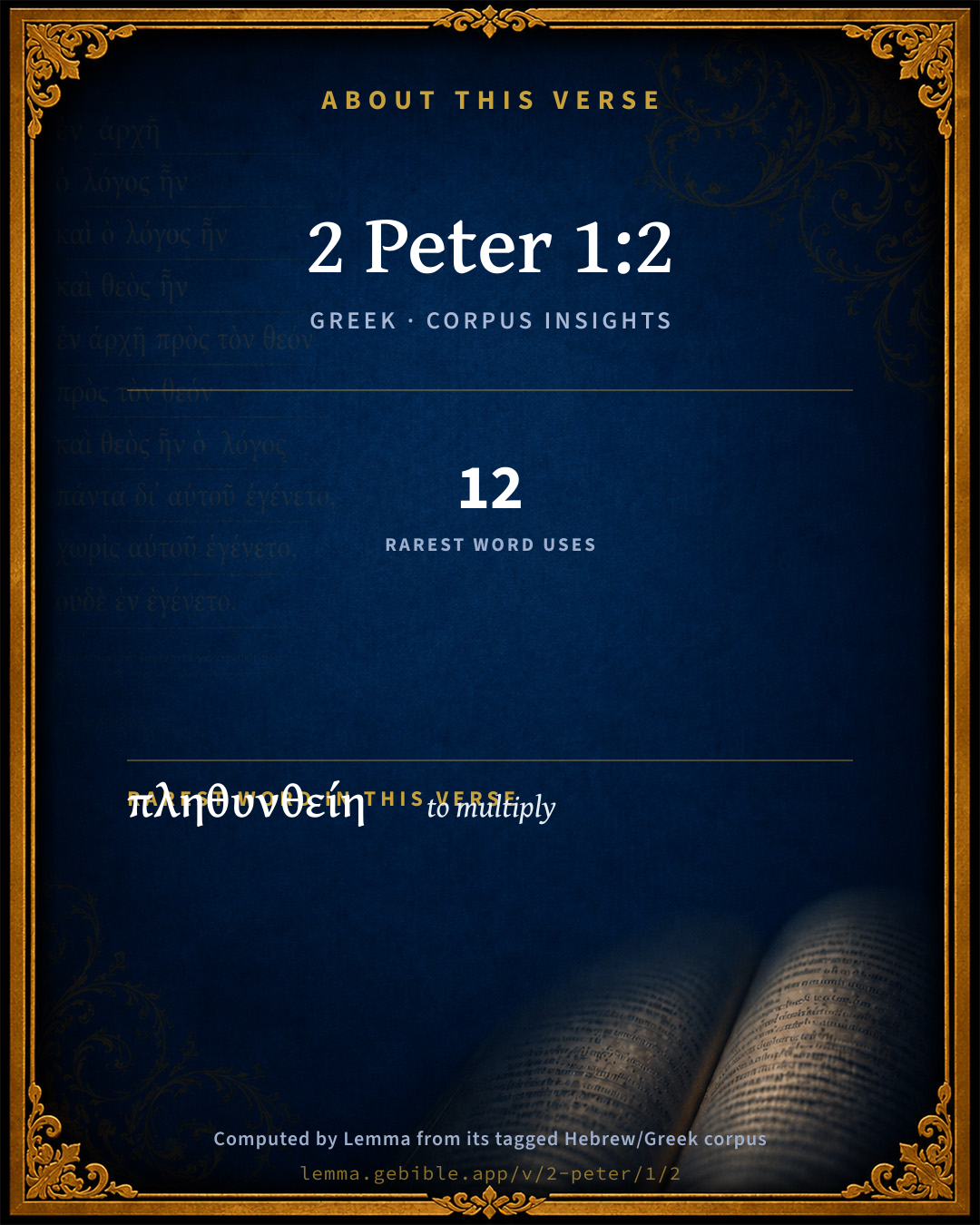
2 Peter 1:2

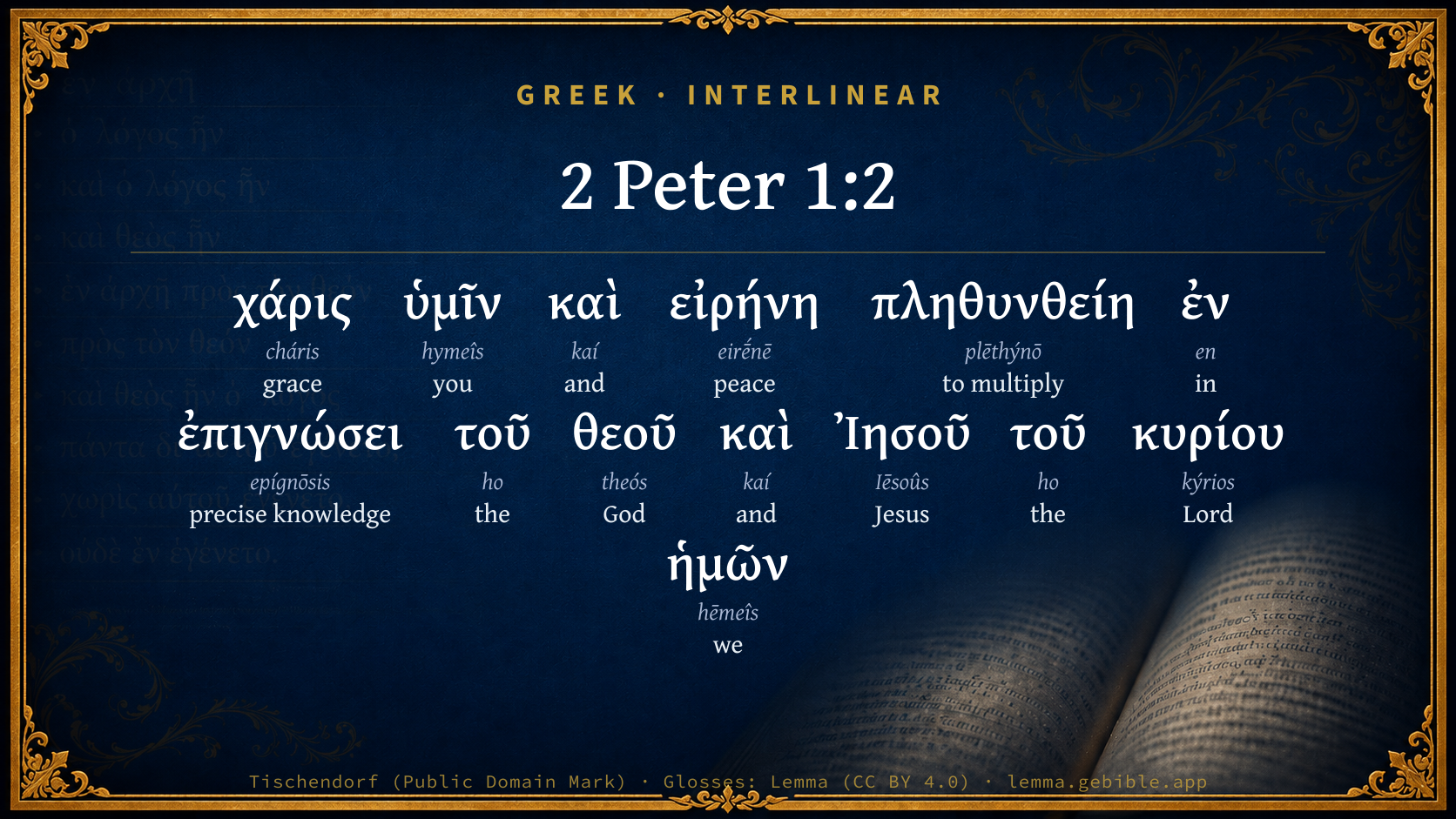
Greek (Tischendorf 8th ed.) 2 Peter 1:2 appears in the Greek New Testament. The text above is from the Tischendorf 8th edition. Each word links to its Strong’s number and a concise gloss. Click any word for its full Thayer’s Greek Lexicon entry.
Download image
Cite this verse

2 Peter 1:2 (World English Bible). Public Domain. Lemma interlinear Bible study tool, https://lemma.gebible.app/v/2-peter/1/2.

Show BibTeX & RIS
BibTeX
RIS
English Translation
Grace to you and peace be multiplied in the knowledge of God and of Jesus our Lord,
World English Bible · Public Domain
Download a study sheet

One document with this verse’s original text, its word-by-word gloss line, the meaning frame, cross-references with their text, attributed commentary, and full source and license credits — printable, and it pastes into notes with its structure intact.

This verse Autodidact and up

Study sheet (.html) Plain text (.txt)

A passage Seminary Student

Up to 50 verses in one chapter. A passage sheet keeps up to 6 commentary sources and 12 cross-references per verse, in the order this page ranks them, and says so on the sheet whenever that leaves anything out. Ask for a single verse and you get the Autodidact verse sheet above.

Everything on this page stays free to read, with no account — the sheet is a download of what is already on screen, not access to it.

Want to remove ads? Support Godless Engineer
Compare translations 3

The same verse in 3 English versions, stacked beneath the original-language interlinear above. Click any original word for its lexicon entry.

Each is an independent rendering of the whole verse — the interlinear is not word-aligned to these translations.

Highlighted words mark where these versions differ — a whole-verse word diff, not a word-by-word alignment.

  • World English Bible Public Domain
    Grace to you and peace be multiplied in the knowledge of God and of Jesus our Lord,
  • King James Version Public Domain
    Grace and peace be multiplied unto you through the knowledge of God, and of Jesus our Lord,
  • unfoldingWord Literal Text CC BY-SA 4.0
    May grace and peace be multiplied to you in the knowledge of God and of Jesus our Lord.

unfoldingWord Literal Text — © unfoldingWord, licensed CC BY-SA 4.0. Word-aligned USFM3 via Door43 (git.door43.org/unfoldingWord/en_ult).

Versions to compare (up to 4)

3 of 4 selected

Show all 19 translations

Every available English version of this verse, each an independent rendering of the whole verse.

  • World English Bible Public Domain
    Grace to you and peace be multiplied in the knowledge of God and of Jesus our Lord,
  • Berean Standard Bible Public Domain
    Grace and peace be multiplied to you through the knowledge of God and of Jesus our Lord.
  • Majority Standard Bible Public Domain
    Grace and peace be multiplied to you through the knowledge of God and of Jesus our Lord.
  • King James Version Public Domain
    Grace and peace be multiplied unto you through the knowledge of God, and of Jesus our Lord,
  • American Standard Version (1901) Public Domain
    Grace to you and peace be multiplied in the knowledge of God and of Jesus our Lord;
  • Revised Version (1885) Public Domain
    Grace to you and peace be multiplied in the knowledge of God and of Jesus our Lord;
  • Geneva Bible (1599) Public Domain
    Grace and peace be multiplied to you, through the acknowledging of God, and of Iesus our Lord,
  • Douay-Rheims (1899) Public Domain
    Grace to you and peace be accomplished in the knowledge of God and of Christ Jesus our Lord:
  • Young's Literal Translation Public Domain
    Grace to you, and peace be multiplied in the acknowledgement of God and of Jesus our Lord!
  • Literal Standard Version CC BY-SA 4.0
    Grace and peace be multiplied to you in the acknowledgment of God and of Jesus our Lord!
  • Unlocked Literal Bible CC BY-SA 4.0
    May grace and peace increase in measure in the knowledge of God and of Jesus our Lord.
  • unfoldingWord Literal Text CC BY-SA 4.0
    May grace and peace be multiplied to you in the knowledge of God and of Jesus our Lord.
  • Darby Bible Public Domain
    Grace and peace be multiplied to you in [the] knowledge of God and of Jesus our Lord.
  • World Messianic Bible Public Domain
    Grace to you and peace be multiplied in the knowledge of God and of Yeshua our Lord,
  • Webster's Bible Public Domain
    Grace and peace be multiplied to you through the knowledge of God, and of Jesus our Lord,
  • Free Bible Version CC BY-SA 4.0
    May you have ever more grace and peace as you grow in the knowledge of God and of Jesus our Lord.
  • Bible in Basic English Public Domain
    May grace and peace ever be increasing in you, in the knowledge of God and of Jesus our Lord;
  • Text-Critical English NT CC BY 4.0
    Grace and peace be multiplied to you in the knowledge of God and of Jesus our Lord.
  • Tyndale New Testament (1534) Public Domain
    Grace with you and peace be multiplied in the knowledge of God and of Iesus oure Lorde.

Literal Standard Version (2020), Covenant Press — licensed CC BY-SA 4.0. Text via the HelloAO Bible API (eBible.org). Unlocked Literal Bible (unfoldingWord) — licensed CC BY-SA 4.0. Text via the HelloAO Bible API (eBible.org). unfoldingWord Literal Text — © unfoldingWord, licensed CC BY-SA 4.0. Word-aligned USFM3 via Door43 (git.door43.org/unfoldingWord/en_ult). Free Bible Version, Dr. Jonathan Gallagher — licensed CC BY-SA 4.0. Text via the HelloAO Bible API (eBible.org).

Word by word

More ways to search: Search by grammar → Find every occurrence → Compare this word →

Practice this passage: Drill this verse → Learn its vocabulary →

πληθυνθείη
plēthýnō
G4129
“to multiply”
Verb, Aorist, Passive, Optative, 3rd person, Singular
Part of Speech
Verb
Tense
Aorist
Voice
Passive
Mood
Optative
Person
3rd person
Number
Singular
Full Thayer's Definition

Origin: from another form of G4128

TDNT: 10:39,9

1. to increase, to multiply a. to be increased, (be multiplied) multiply 2. to be increased, to multiply
  1. χάρις cháris G5485 “grace” Noun, Nominative, Singular, Feminine
  2. ὑμῖν hymeîs G5210 “you” Personal pronoun, 2nd person, Dative, Plural
  3. καὶ kaí G2532 “and” Conjunction
  4. εἰρήνη eirḗnē G1515 “peace” Noun, Nominative, Singular, Feminine
  5. ἐν en G1722 “in” Preposition
  6. ἐπιγνώσει epígnōsis G1922 “precise knowledge” Noun, Dative, Singular, Feminine
  7. τοῦ ho G3588 “the” Article, Genitive, Singular, Masculine
  8. θεοῦ theós G2316 “God” Noun, Genitive, Singular, Masculine
  9. καὶ kaí G2532 “and” Conjunction
  10. Ἰησοῦ Iēsoûs G2424 “Jesus” Noun, Genitive, Singular, Masculine
  11. τοῦ ho G3588 “the” Article, Genitive, Singular, Masculine
  12. κυρίου kýrios G2962 “Lord” Noun, Genitive, Singular, Masculine
  13. ἡμῶν hēmeîs G2249 “we” Personal pronoun, 1st person, Genitive, Plural

About this verse

These counts appear in no published source. They are computed here, from the morphology-tagged text and Lemma’s own curated glosses. What Lemma adds →

14
words
12
distinct lemmas
General Epistles
section

Notable vocabulary

The rarest word here is πληθυνθείη to multiply G4129 — appearing just 12 times in the whole Greek New Testament.

Shared distinctive vocabulary

πληθυνθείη to multiply G4129 occurs in 11 verses of the Greek New Testament. Also found in:

Repetition

Words recur within this verse:

Cross-references

17

Topical passages linked to 2 Peter 1:2 in the Treasury of Scripture Knowledge — connected by theme and wording, ordered by reader-vote popularity; previews shown in the World English Bible.

  • 2 Peter 3:18 But grow in the grace and knowledge of our Lord and Savior Jesus Christ. To him be the glory both now and forever. Amen.
  • John 17:3 This is eternal life, that they should know you, the only true God, and him whom you sent, Jesus Christ.
  • Philippians 3:8 Yes most assuredly, and I count all things to be loss for the excellency of the knowledge of Christ Jesus, my Lord, for whom I suffered the loss of all things, and count them nothing but refuse, that I may gain Christ
  • 1 Peter 1:2 according to the foreknowledge of God the Father, in sanctification of the Spirit, that you may obey Jesus Christ and be sprinkled in his blood: Grace to you and peace be multiplied.
  • Numbers 6:24–26 'Yahweh bless you, and keep you.
  • Isaiah 53:11 He shall see of the travail of his soul, [and] shall be satisfied: by the knowledge of himself shall my righteous servant justify many; and he shall bear their iniquities.
  • Jude 1:2 Mercy to you and peace and love be multiplied.
  • Romans 1:7 to all who are in Rome, beloved of God, called to be saints: Grace to you and peace from God our Father and the Lord Jesus Christ.
  • Daniel 4:1 Nebuchadnezzar the king, to all the peoples, nations, and languages, who dwell in all the earth: Peace be multiplied to you.
  • Luke 10:22 Turning to the disciples, he said, "All things have been delivered to me by my Father. No one knows who the Son is, except the Father, and who the Father is, except the Son, and he to whomever the Son desires to reveal him."
  • 2 Corinthians 4:6 seeing it is God who said, "Light will shine out of darkness," who has shone in our hearts, to give the light of the knowledge of the glory of God in the face of Jesus Christ.
  • 1 John 5:20–21 We know that the Son of God has come, and has given us an understanding, that we know him who is true, and we are in him who is true, in his Son Jesus Christ. This is the true God, and eternal life.
  • 2 Peter 1:3 seeing that his divine power has granted to us all things that pertain to life and godliness, through the knowledge of him who called us by his own glory and virtue;
  • 2 Peter 1:8 For if these things are yours and abound, they make you to be not idle nor unfruitful to the knowledge of our Lord Jesus Christ.
  • 2 Peter 2:20 For if, after they have escaped the defilement of the world through the knowledge of the Lord and Savior Jesus Christ, they are again entangled therein and overcome, the last state has become worse with them than the first.
  • Revelation 1:4 John, to the seven assemblies that are in Asia: Grace to you and peace, from God, who is and who was and who is to come; and from the seven Spirits who are before his throne;
  • Daniel 6:25 Then king Darius wrote to all the peoples, nations, and languages, who dwell in all the earth: Peace be multiplied to you.

Cross-references courtesy of OpenBible.info (CC BY 4.0).

Commentary

Notes on 2 Peter 1:2 from classic Christian and Jewish commentators (each source and its license shown beneath its notes). The classic Christian expositions comment on the surrounding passage and are grouped to its opening verse, so a note may address several verses; the Jewish commentaries on the Tanakh (Rashi and others) are per-verse, so they appear only where the commentator wrote on this verse.

Lemma curates 59 commentaries, every one of them public domain or Creative Commons licensed, each selected and text-cleaned for this edition rather than reprinted as found. About our sources →

Jamieson, Fausset & Brown

Robert Jamieson, A. R. Fausset & David Brown

Grace . . . peace-- (Pe1 1:2).

through--Greek, "in": the sphere IN which alone grace and peace can be multiplied.

knowledge--Greek, "full knowledge."

of God, and of Jesus our Lord--The Father is here meant by "God," but the Son in Pe2 1:1 : marking how entirely one the Father and Son are (Joh 14:7-11). The Vulgate omits "of God and"; but oldest manuscripts support the words. Still the prominent object of Peter's exhortation is "the knowledge of Jesus our Lord" (a phrase only in Rom 4:24), and, only secondarily, of the Father through Him (Pe2 1:8; Pe2 2:20; Pe2 3:18).

Jamieson, Fausset & Brown — Commentary Critical and Explanatory on the Whole Bible (1871) — public domain (CC PDM 1.0). Text via the HelloAO Bible API.

Ellicott's Commentary for English Readers

(2) Grace and peace be multiplied unto you.—Identical with the last clause of 1Pe_1:2, and with no other greeting in any Epistle. What follows here is peculiar to this Epistle, which begins and ends with grace and knowledge. (Comp. 2Pe_3:18.)

Through the knowledge.—Better, as before, in. The preposition indicates the sphere or element in which the action takes place, or the aspect in which it is contemplated. Tyndale and the Rhemish version have “in.”“ Knowledge” is not quite strong enough. In the original we have a compound word, which implies fuller, riper, more minute knowledge. But any of these expressions would be a little too strong, as the simple word is a little too weak. The same compound recurs 2Pe_1:3. It is rare in St. Paul’s earlier letters, but is more common in the later ones. This fact, coupled with its appearance here, agrees well with the more contemplative aspect in which the Gospel began gradually to be presented; a change which finds its fullest expression in the transition from the first three Gospels to the fourth. The word is introduced here with telling emphasis; “in the fuller knowledge of God” anticipates the attack that is coming upon the godless speculations of the “false teachers” in 2 Peter 2.

And of Jesus our Lord.—Deliberately added. These false teachers “denied the Lord that bought them” (2Pe_2:1), and promised all kinds of high-sounding benefits to their followers (2Pe_2:18). The Apostle assures his readers that only in fuller knowledge of their Lord can grace and peace be multiplied to them. The combination “Jesus our Lord” is unusual; elsewhere only Rom_4:24. Another small indication of independence (see first Note). There should be a fullstop at “Lord;” so Tyndale, Cranmer, and Geneva.

A Bible Commentary for English Readers, edited by Charles John Ellicott (1878–1897) — public domain. Text from a community e-Sword module.

The Cambridge Bible for Schools and Colleges

gen. ed. J. J. S. Perowne

2. Grace and peace be multiplied unto you] Here the writer falls into the phraseology of the First Epistle (see note on 1Pe_1:2), but adds to the simple benediction the words “through (better in) the knowledge of God and Jesus our Lord.” The word for “knowledge” (epignosis) hovers between the meaning of “complete knowledge” and the recognition which implies love. It does not occur in the First Epistle. In St Paul’s Epistles it meets us first in Rom_1:28; Rom_3:20, and occurs more or less frequently in most of the subsequent Epistles. In 1Co_13:8; 1Co_13:12 the verb from which it is formed is contrasted with the less perfect knowledge expressed by gnosis. Looking to the history of the words, it would seem probable that in proportion as rash and self-asserting teaching boasted of the higher gnosis, the “science, falsely so called,” of 1Ti_6:20, which afterwards developed into the heresies of the Gnostic sect, the true teachers set up the other word as expressing something nobler and more excellent. “Not gnosis,” they seem to say, “but epignosis, not an abstract speculative knowledge, but that which implies a fulness of contemplation, loving as well as knowing.” St Peter’s use of the word in this Epistle, obviously written after closer contact with false teachers of this kind than is traceable in the First, admits, probably, of this explanation.

Jesus our Lord] The peculiar construction, as distinct from “Christ Jesus” and “the Lord Jesus,” occurs elsewhere only in Rom_4:24.

The Cambridge Bible for Schools and Colleges (gen. ed. J. J. S. Perowne; Cambridge University Press, 1878–1918) — public domain. Text from a community e-Sword module.

The Pulpit Commentary

Grace and peace be multiplied unto you. The order of the words in the Greek is the same as ingnwsiv) 1Pe_1:2. The exact correspondence should be noticed. The writer of the Second Epistle, if not St. Peter himself, must have been attempting to imitate of set purpose the opening salutation of the First Epistle. Through the knowledge of God, and of Jesus our Lord; rather, in the knowledge. The knowledge of God is the sphere in which grace and peace are communicated to the soul; they cannot be found outside that sphere. "Full knowledge" (ejpi) may be regarded as the key-note of this Epistle, as "hope" is of the first. jEpignwsiv is a stronger word than gnwsiv; it means "knowledge" directed towards an object, gradually approaching nearer and nearer to it, concentrated upon it, fixed closely upon it. So it comes to mean the knowledge, not merely of intellectual apprehension, but rather of deep contemplation; the knowledge which implies love for only love can concentrate continually the powers of the soul in close meditation upon its object.

Comp. 1Co 13, where, after saying in verse 8 that "knowledge (gnwsiv) shall be done away," St. Paul continues, in verse 12, "Now I know (ginwskw) in part, but then I shall know (ejpignwsomai) even as also I am known (ejpegnwsqhn)." He contrasts our present imperfect knowledge with the full knowledge which the blessed will have in heaven, and which God now has of us, using the verb ejpiginwdkw of that fuller knowledge, as he had used gnwsiv of the imperfect knowledge. The word ejpignwsiv occurs several times in the Gospels, and is common in St. Paul"s Epistles; it seems to imply a sort of protest against the knowledge that "puffeth up", (1Co_8:1) and especially against the knowledge "falsely so called", (1Ti_6:20) which was claimed by the false teachers, who were the precursors of the coming Gnosticism. (Col_1:9, 10 2:2 3:10) St. Peter had learned mere of the doings of these false teachers since he wrote the First Epistle, and this may perhaps be a reason for his frequent use of the word ejpignwsiv in the second. "Jesus our Lord" is a variation of the more common form, such as "the Lord Jesus;" it occurs only here and in Rom_4:24.

HOMILIES BY C. NEW

Vers. 2, 3.

Increase of spiritual life dependent on the knowledge of God.

Our text strikes the key-note of the Epistle the need of watchfulness against error. Scripture demands a clear knowledge of revealed truth. On this the maintenance of spiritual life depends; to swerve from Divine truth is to suffer spiritual loss.

I A GREAT INCREASE OF SPIRITUAL BLESSING IS POSSIBLE TO THE BELIEVER. "Grace and peace" we may take as including all spiritual good. Grace is God"s part therein; peace is man"s. God"s attitude towards us is grace; our attitude towards him, for that is the end of righteousness, is to be peace. Between these two lies all that pertains to life and godliness. And the apostle says this may be multiplied to the Christian.

1. Because of the great capacity of his nature. The life imparted in regeneration has almost unlimited possibilities; it is Heaven"s germ, from which will be developed the pure and perfect spirit which will gaze on the face of God, and reflect his glory. The believer is joint-heir with Christ; where Christ is, he is to be. Heaven will be a constant advance into the character of God; that is the capacity of spiritual life in the soul, "filled with all the fullness of God.

2. Because God has already given us all things that pertain to life and godliness. The power which God is prepared to manifest towards his people is equal to that which raised Christ from the helplessness of the grave to the supreme dominion of the universe. And in what way, but in giving us all things that pertain to life and godliness? Who can enumerate what is included in that "all things"? We do not always realize that with Christ God has already "freely given us all things." True, he holds them still, but it is on our behalf.

3. Because what we receive is through the Divine glory and virtue. In the Revised Version the third verse reads thus: "He hath called us by his own glory and virtue;" and that is the ground of our hopes, and triumphs over our sense of ill desert. God"s glory is his mercy, and it is set free to exercise itself by Christ in the atonement; and he finds there the reason why he should enrich us.

II THIS INCREASE OF BLESSING DEPENDS ON THE KNOWLEDGE OF GOD. God does not give us mature spiritual blessings, but rather supplies us with the means of acquiring them. When we can do anything to secure the answer to our prayers, God gives the answer by blessing our own efforts, and, apart from the effort, the answer does not come. He will not give spiritual enrichment to spiritual inaction. In answer to our prayers for grace and peace to be multiplied, God shows us how we may have it.

1. The means of spiritual increase is the knowledge of himself. Scripture invariably makes spiritual good to rest on the knowledge of God. For instance: Security have escaped the corruptions of the world through the knowledge of our Lord and Saviour Jesus Christ." Peace now thyself with him, and be at peace." Strength people that do know their God shall be strong." Obedience we do know that we know him, if we keep his commandments." Love that loveth not knoweth not God, for God is Love." Our Lord Jesus Christ sums it up in one sentence, "This is life eternal, that they might know thee the only true God, and Jesus Christ, whom thou hast sent? But there is a difference between knowing about God, and knowing God, and the difference is vital; the one knowledge is fruitful, the other barren. There is a natural connection between the increase of knowledge and the increase of grace.

2. Knowledge quickens desire. We cannot know God without longing to possess more of him and of what he has to give; and that longing means prayer for more, which will be answered, and effort for more, which will be successful.

3. Knowledge increases faith. Faith being the hand by which we appropriate and so possess. Why do we not take God as our own, with a confidence nothing can shake? To a great extent because we do not know him how real he is, how vast his love, how infinitely trustworthy his nature. If we only knew more of him, we should hold him in the embrace of a strong, restful assurance.

4. Knowledge tends to participation. Personal acquaintance with God must have incalculable results. We should have a new power constraining us to righteousness. The grace and peace of his own nature would reflect themselves in us.

III THIS INCREASE OF KNOWLEDGE SHOULD BE THE BELIEVER"S AIM. The difference in spiritual stature comes from different degrees of spiritual knowledge: then how can we know God better?

1. Greater knowledge is granted as the result of obedience. Unless God reveal himself, we cannot know him; and he reveals himself to him who lives in his fear. Sin blinds and deafens us; to do wrong is to put ourselves further from the knowledge of God; to do right is to thin the veil that hides him from us. If you would know him, obey him.

2. Greater knowledge is granted as the fruit of study and fellowship. It is only in face-to-face communion with God, such as is possible through the teaching of his Word, that we can really know him; therein he speaks to us, and in prayer we speak to him.

3. Greater knowledge is granted as the end of Divine discipline. That we may know him is the object of many of our sorrows. Sickness is often God shutting the busy soul up to himself. Trouble is often God showing us how tender a Father he is. Darkness is often God compelling us to look up

Darkness revealing worlds of light We never saw by day.

Presently the need of discipline will be ended, and from knowing God in part, we shall enter into his presence. C.N.

The Pulpit Commentary (1880–1919), ed. H.D.M. Spence-Jones & Joseph S. Exell — public domain. Text from a community e-Sword module.

Bengel's Gnomon

Johann Albrecht Bengel

2Pe 1:2. Ἐν ἐπιγνώσει τοῦ Κυρίου ἡμῶν, through the knowledge of our Lord) This short and simple reading seems to have been the original reading both of the Latin translator, and a little previously of the apostle himself. For this Epistle presupposes the knowledge of God; 2Pe 1:3; but it particularly urges the knowledge of our Lord, namely, Jesus Christ; 2Pe 1:8; 2Pe 2:20; 2Pe 3:18, where the conclusion answers to this beginning.1

Bengel's Gnomon of the New Testament — English translation (T&T Clark, Edinburgh, 1860) — public domain. Text from a community e-Sword module.

Expositor's Greek Testament

ed. W. Robertson Nicoll

2Pe 1:2 . χάρις … πληθυνθείη .: the same form of salutation as in 1Pe 1:2 . ἐν ἐπιγνώσει τοῦ Κυρίου ἡμῶν . (For history of ἐπίγνωσις see Mayor’s note, pp. 171 ff.; Robinson’s Excursus in Ephesians .) ἐπίγνωσις in this epistle corresponds to πίστις in the Pauline sense (Spitta, p. 522). In Rom 1:21 γνόντες is used of the imperfect knowledge of God possessed by the heathen world, and in Rom 1:28 he contrasts it with the Christian or perfect knowledge of God. ( καθὼς οὐκ ἐδοκίμασαν τὸν Θεὸν ἔχειν ἐν ἐπιγνώσει .) Cf. 1Co 13:12 , Col 1:9 . “ ἐπίγνωσις , involving the complete appropriation of all truth and the unreserved acquiescence in God’s will, is the goal and crown of the believer’s course” (Lightfoot, note on Col 1:9 ). Cf. Introd. p. 117; note 2Pe 1:8 ; Paget, Spirit of Discipline , pp. 112 ff. ἐπίγνωσις implies a more intimate and personal relationship than γνῶσις . It would be a useful word, seeing that γνῶσις . had become associated with Gnosticism, then incipient in the Church. Mayor quotes Clem. Alex. Strom. i. p. 372, and Str. , vi, p. 759, where κατʼ ἐπίγνωσιν is twice opposed to κατὰ περίφασιν (= on a broad general view, cf. Mayor’s note, p. 213). Grace and peace are multiplied in and through this more intimate heart knowledge of Jesus Christ, in contrast to a mere barren γνῶσις .

The Expositor's Greek Testament, edited by W. Robertson Nicoll (1897–1910) — public domain. Text from a community e-Sword module.

Cambridge Greek Testament for Schools and Colleges

2. χάρις ὑμῖν καὶ εἰρήνη πληθυνθείη. Identical with the salutation in 1Pe 1:2. χάρις and εἰρήνη without the verb are the rule in the Pauline salutations. See on Jud 1:1. Jude has the verb but differs in the substantives.

ἐν ἐπιγνώσει. For a very full treatment of this word see Dean Robinson’s excursus in his Comm. on Ephesians.

Grace and peace will be increased as the knowledge of God grows.

τοῦ θεοῦ κ. Ἰησοῦ τοῦ κυρίου ἡμῶν. This is the reading of most MSS.: but the uncial P, some important Latin MSS., and some good cursives omit τοῦ θεοῦ καὶ Ἰησοῦ, giving merely τοῦ κυρίου ἡμῶν or τ. κ. ἡμ. Ἰ. Χ.

There is some reason for preferring the shorter form, since the phrase is one which was much more likely to be expanded than abbreviated: but the weight of authority is difficult to resist. It is a very odd feature that the Sahidic version leaves out the whole verse.

Cambridge Greek Testament for Schools and Colleges (Cambridge University Press, 1896; 21 vols, various authors incl. Carr, Maclear, Plummer, Farrar, Lumby, Moule, M. R. James, Simcox) — public domain. Text from a community e-Sword module.

Geneva Bible (1599)

Geneva Bible translators

Faith is the acknowledging of God and Christ, from whence all our blessedness issueth and showed.

Geneva Bible (1599) marginal notes — public domain. Text via Bolls.life.

Adam Clarke's Commentary

Verse 2. Grace] God's favour; peace-the effects of that favour in the communication of spiritual and temporal blessings.

Through the knowledge of God] ενεπιγνωσει. By the acknowledging of God, and of Jesus our Lord. For those who acknowledge him in all their ways, he will direct their steps. Those who know Christ; and do not acknowledge him before men, can get no multiplication of grace and peace.

Adam Clarke's Commentary on the Bible (1810–1826) — public domain. Text from a community e-Sword/MySword module.

John Calvin's Commentaries

2. Grace and peace. By grace is designated God’s paternal favor towards us. We have indeed been once for all reconciled to God by the death of Christ, and by faith we come to the possession of this so great a benefit; but as we perceive the grace of God according to the measure of our faith, it is said to increase according to our perception when it becomes more fully known to us.

Peace is added; for as the beginning of our happiness is when God receives us into favor; so the more he confirms his love in our hearts, the richer blessing he confers on us, so that we become happy and prosperous in all things,

Through the knowledge, literally, in the knowledge; but the preposition ἐν often means “through” or “with:” yet both senses may suit the context. I am, however, more disposed to adopt the former. For the more any one advances in the knowledge of God, every kind of blessing increases also equally with the sense of divine love. Whosoever then aspires to the full fruition of the blessed life which is mentioned by Peter, must remember to observe the right way. He connects together at the same time the knowledge of God and of Christ; because God cannot be rightly known except in Christ, according to that saying,

“No one knoweth the Father but the Son, and he to whom the Son will reveal him.” (Matthew 11:27)

John Calvin's Commentaries (1540-1563) — public domain. Text from the Calvin Translation Society English edition (1840s-50s) via the Christian Classics Ethereal Library (ccel.org). Calvin's coverage is partial (roughly two-thirds of the Bible); uncommented books and verses are honest gaps, never fabricated. The 19th-century editor's footnotes and remarks are omitted so the notes are faithfully Calvin's own voice.

John Gill's Exposition

Grace and peace be multiplied unto you,.... By a multiplication of grace may be meant a larger discovery of the love and favour of God; which though it admits of no degrees in itself, being never more or less in God's heart, yet, as to the manifestations of it, it is different, and capable of being increased, and drawn out to a greater length; or else an increase of the internal graces of the Spirit of God, as to the actings and exercise of them; or a larger measure of the gifts of the Spirit, for greater usefulness among them; or a clearer view, and a more enlarged knowledge of the Gospel of the grace of God, and the truths of it; and indeed, the word grace may take in all these senses: and by a multiplication of peace, which the apostle in this salutation also wishes for, may be designed an affluence of all kind of prosperity, temporal, and spiritual, external and internal; and more especially an increase of spiritual peace, a fulness of joy and peace in believing, arising from a sense of free justification by Christ's righteousness, and full pardon and atonement by his blood and sacrifice:

through the knowledge of God, and of Jesus our Lord; which is to be understood, not of a natural, but of a spiritual and evangelical knowledge; of a knowledge of God, not as the God of nature and providence, but as the God of all grace, as in Christ, and a covenant God in him, and of the person, offices, and grace of Christ; and which designs true faith in him, by which means larger discoveries of the grace of God are made, and a greater enjoyment of spiritual peace is had: or it may be rendered, "with the knowledge of God", &c. and the sense then is, that the apostle prays, as for a multiplication of grace and peace, so along with it, an increase of spiritual and evangelical knowledge; which in the best is imperfect, but may be increased by the blessing of God on those means which he has appointed for that end, such as the word and ordinances. The Syriac version renders this clause, "through the knowledge of our Lord Jesus Christ", leaving out the word "God", and the copulative "and", and adding the word "Christ"; and the Ethiopic version reads, "in the knowledge of our God, Christ Jesus our Lord", without any distinction. After the inscription and salutation begins the epistle, with an account of various special favours bestowed upon these persons; and are mentioned by the apostle to encourage his faith and theirs, in expectation of enjoying what he here wishes unto them, since already such great and good things had been bestowed upon them.

John Gill's Exposition of the Whole Bible (1746–1763) — public domain (CC PDM 1.0). Text via the HelloAO Bible API.

Trapp's Complete Commentary

John Trapp

2 Grace and peace be multiplied unto you through the knowledge of God, and of Jesus our Lord,

Ver. 2. Through the knowledge] There is not a new notion, or a further enlargement of saving knowledge, but it brings some grace and peace with it. All the grace that a man hath, it passeth through the understanding; and the difference of stature in Christianity grows from different degrees of knowledge. "Grace and truth came by Jesus Christ," Joh 1:17.

John Trapp, A Commentary or Exposition upon All the Books of the Old and New Testament (1647–1656) — public domain. Text from a community e-Sword module.

Albert Barnes' Notes on the Bible

Grace and peace be multiplied unto you through the knowledge of God, and of Jesus our Lord - That is, grace and peace abound to us, or may be expected to be conferred on us abundantly, if we have a true knowledge of God and of the Saviour. Such a knowledge constitutes true religion: for in that we find “grace” - the grace that pardons and sanctifies; and “peace” - peace of conscience, reconciliation with God, and calmness in the trials of life. See the notes at Joh 17:3.

Albert Barnes' Notes on the Bible (1834–1885) — public domain. Text from a community e-Sword/MySword module.

Matthew Poole's English Annotations

Through the knowledge of God; or acknowledgment, i.e. faith, whereby we are made partakers of all the saving graces of the Spirit; and whereby being justified, we are at peace with God, Rom 5:1.

And of Jesus our Lord; there being no saving knowledge of God, or faith in him, but by Christ.

Matthew Poole's English Annotations on the Holy Bible (1683–1685) — public domain. Text from a community e-Sword/MySword module.

Whedon's Commentary on the Bible

Daniel D. Whedon

2. Grace—In which the believer lives.

Peace—Its fruit.

Be multiplied— With this prayer for increase agrees the final exhortation to growth, in chap. 2Pe_3:18.

Through the knowledge—’Επιγνωσις, knowledge upon, full knowledge; the keynote of the epistle. It occurs, also, in 2Pe_1:3; 2Pe_1:8, and 2Pe_2:20.

Of God—The Father, who is truly known only as revealed in the Son.

Of Jesus our Lord—The Saviour, who is also supreme Lord. This unusual expression, found only here and in Rom_4:24, lifts the standard against the deniers of 2Pe_2:1. This knowledge is both doctrinal and experimental. It lies at the foundation of all true religion, and is the element in which all grace and peace begin and grow. Moreover, increase of the knowledge is the indispensable condition of increase in the grace.

Daniel D. Whedon (gen. ed.), Commentary on the Old and New Testaments (1874–1909) — public domain. Text from a community e-Sword module.

John Wesley's Explanatory Notes

Through the divine, experimental knowledge of God and of Christ.

John Wesley, Explanatory Notes Upon the Whole Bible (1754–1765) — public domain. Text via the GEBible commentary corpus.

Scofield Reference Notes

C. I. Scofield

grace

Grace (imparted). Rom 6:1; 2Pe 3:18

The Scofield Reference Bible (1917 edition), notes by C. I. Scofield — public domain. Text from a community e-Sword module.

Burkitt's Expository Notes on the New Testament

William Burkitt

The person saluting, and the parties saluted, were mentioned in the former verse; here we have the salutation itself, 1. The matter of it, Grace and peace; grace to free us from God’s wrath, and reinstate us in his favour; peace to quiet our own consciences, and reconcile us to ourselves.

Observe,2. The measure of it, grace and peace be multiplied; they had both grace and peace already, yet the apostle prays for the farther increase of them; there is no complete perfection in grace attainable in this life. The best of saints must be multiplying and increasing their stores; for they are but imperfectly perfect, when at the best.

Observe, 3. The means for multiplying grace and peace, through the knowledge of God, and of Jesus Christ our Lord.

Learn, That the knowledge of God, in, by, and through our Lord Jesus Christ, is the special mean of multiplying grace and peace in our hearts; and indeed there is no comfortable knowledge of God, but in and through Christ, This is life eternal , &c Joh 17:3. Out of Christ God is a revenger, in Christ a reconciled Father.

William Burkitt's Expository Notes on the New Testament (1700–1703) — public domain. Text from a community e-Sword module.

Godbey's Commentary on the New Testament

William B. Godbey

2. “Grace and peace be multiplied unto you in the perfect knowledge of Jesus our Lord.” This beautiful verse contains the paradoxical problem of spiritual mathematics. Conversion is addition; sanctification, subtraction; the filling of the Holy Ghost, multiplication; and soul-saving benefaction, division. We do not teach four works of grace in salvation, but only two, as in arithmetic. Multiplication is but a rapid form of addition, while division is simply a wonderfully expeditious method of subtraction. No teacher is tolerated in the public schools who does not understand the elementary rules. Well did Jesus say, “The children of this world are wiser in their generation than the children of light.” How deplorable to find teachers everywhere in the school of Christ, i.e., the churches, who have never so much as reached subtraction, i.e., sanctification, to say nothing of multiplication and division. Good Lord, have mercy.

William B. Godbey, Commentary on the New Testament (1896–1900) — public domain. Text from a community e-Sword module.

The People's New Testament

B. W. Johnson

2. Grace and peace. The usual apostolic benediction. These come through the knowledge, etc. Those who have learned to know God and his Son have eternal life (John 17:3). This knowledge is one that comes from fellowship with Christ.

B. W. Johnson's The People's New Testament with Notes (1889–1891) — public domain. Electronic text from the Christian Classics Ethereal Library (CCEL) ThML edition.

Alford’s Greek Testament

Henry Alford

2.] Address and greeting. Symeon (see var. readd. The form, as belonging to our Apostle, is found, besides here, only in Act 15:14. Its occurrence is at all events a testimony in favour of the independence of the second Epistle. It was not adapted to the first: which, considering that it refers to the first, is a note, however slight, on the side of its genuineness) Peter, a servant (Rom 1:1) and apostle (an ingenious reason is given by De Wette for the occurrence of both these designations: that the Writer combined 1Pe 1:1, with Jud 1:1) of Jesus Christ, to them that have obtained (λαγχάνειν (with acc. as reff. Acts, 3 Macc.) shews, as Beng., that “non ipsi sibi pararunt:” as Huss in Huther, “sicut sors non respicit personam, ita nec divina electio acceptatrix est personarum”) like precious faith (faith,—i. e. substance of truth believed: faith objective, not subjective,—of equal value: not, as De W., which confers equal right to God’s kingdom, equal honour and glory: such a meaning would be unexampled. The E. V. has hit the meaning very happily by like precious. Cf. 1Pe 2:7. Huther quotes from Horneius (similarly Estius); “dicitur fides æque pretiosa, non quod omnium credentium æque magna sit, sed quod per fidem illam eadem mysteria et eadem beneficia divina nobis proponantur”) with us (apparently, in the first place, the Apostles: but more probably, in a wider sense, the Jewish Christians, with whom the Gentiles had been admitted into the same covenant, and the inheritance of the like precious promises) in the righteousness of our God and (our) Saviour Jesus Christ (first, concerning ἐν δικαιοσύνῃ. Some Commentators, as Beza, Grot., Piscator, al., take δικ. for an attribute of God, and ἐν as instrumental, by the righteousness, goodness, truth, of God: others, as Estius, Horneius, al., understand δικ. as “justitia quam Deus nobis dat et Christus peperit” (Horn.), explaining ἐν as ‘cum’ or ‘per:’ but, as Huther well replies, this is objectionable, seeing that righteousness comes by faith, not faith by righteousness. De Wette would give two different meanings to δικ. as applied to the Father and to the Son, in the former case making it mean grace, in the latter love: but this is evidently quite arbitrary. Gerhard would confine it altogether to the “obedientia et satisfactio Christi,” against which is τοῦ θεοῦ ἡμῶν. The best explanation seems to me that of Huther, that δικαιοσύνη here betokens the righteous dealing of God, corresponding to His attribute of righteousness, as opposed to προσωποληψία: and that the words are to be taken in close connexion with the foregoing, τοῖς ἰσότιμον ἡμῖν λαχοῦσιν πίστιν, ἐν being used of the conditional element, in which the λαχεῖν πίστιν ἰσότιμον is grounded: so that the sense is, in His righteousness, which makes no difference between the one party and the other, God has given to you the like precious faith, as to us. De W.’s objection to this, that thus the Epistle must be regarded as written to Gentile Christians, is not valid, or proves too much: for at all events there must be two parties in view in the words ἰσότιμον ἡμῖν, whatever these parties be.

Next, as to the words τοῦ θεοῦ ἡμῶν καὶ σωτῆρος Ἰησοῦ χριστοῦ. Undoubtedly, as in Tit 2:13, in strict grammatical propriety, both θεοῦ and σωτῆρος would be predicates of Ἰησοῦ χριστοῦ. But here, as there, considerations interpose, which seem to remove the strict grammatical rendering out of the range of probable meaning. I have fully discussed the question in the note on that passage, to which I would refer the reader as my justification for interpreting here, as there, τοῦ θεοῦ ἡμῶν of the Father, and σωτῆρος Ἰησοῦ χριστοῦ of the Son. Here, there is the additional consideration in favour of this view, that the Two are distinguished most plainly in the next verse):

2.] grace to you and peace be multiplied (so in ref.: but further specified here by what follows) in (as the vehicle, or conditional element of the multiplication) knowledge (ἐπίγνωσις, “cognitio maturior:” but this can hardly be given in English without too strong a phrase) of God, and of Jesus our Lord (every unusual expression, like Ἰης. τοῦ κυρ. ὑμῶν, occurring only Rom 4:24, should be noticed as a morsel of evidence to the independence of the Epistle).

Henry Alford, The Greek Testament (1849–1861) — public domain. Text from a community e-Sword module.

Vincent's Word Studies in the New Testament

Marvin R. Vincent

In the knowledge [εν επιγνωσει] . The compound expressing full knowledge, and so common in Paul 's writings.

Our Lord [κυριου ημων] . The word Lord in the second epistle is always used of God, unless Christ or Savior is added.

Marvin R. Vincent, Word Studies in the New Testament (1887–1900) — public domain. Text from a community e-Sword/MySword module.

Lesson kit

Teaching starters — assembled from the data on this page, not authored interpretation. Every prompt links to the verse data it draws on. Edit before teaching.

2 Peter, in the General Epistles, opens this verse with 14 words (12 distinct Greek lemmas). Its most distinctive word is plēthýnō (“to multiply”). A historical commentator’s framing appears above. Read the whole chapter for the surrounding context.

Discussion questions

  1. How does “to multiply” (plēthýnō) shape what this verse is saying?
  2. How does Matthew 24:12, which shares the word «to multiply», read alongside this verse?
  3. What does the repetition of “and” (2× in this one verse) do in this verse?
  4. These translations render this verse differently; the difference is in the English rendering, not the original. What questions does that raise?
  5. Compare how Jamieson, Fausset & Brown and Ellicott's Commentary for English Readers read this verse. Where do they agree or differ?

Things to notice

Reading settings

Reading text

Shown beneath each verse's original-language words.

Old Testament
Old Testament edition

Read the OT as the Masoretic Hebrew (MT) or the Greek Septuagint (LXX).

English shown for the Greek Septuagint (in the Hebrew ↔ Greek comparison).

Comparing translations? Open the Compare panel on any verse page to stack up to four side by side.