

Jude 1:4
Greek (Tischendorf 8th ed.) Jude 1:4 appears in the Greek New Testament. The text above is from the Tischendorf 8th edition. Each word links to its Strong’s number and a concise gloss. Click any word for its full Thayer’s Greek Lexicon entry.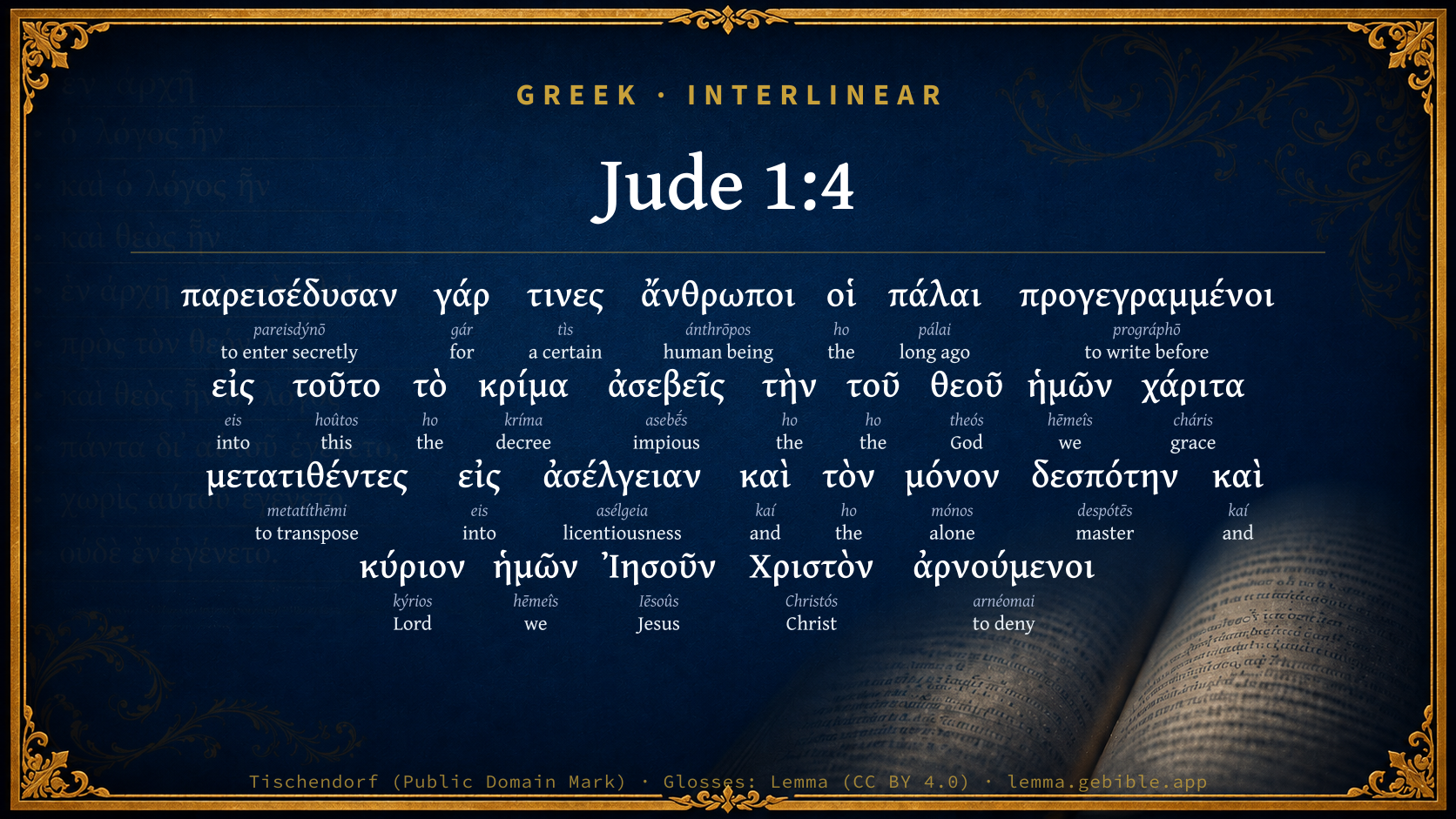
For there are certain men who crept in secretly, even those who were long ago written about for this condemnation: ungodly men, turning the grace of our God into lasciviousness, and denying our only Master, God, and Lord, Jesus Christ.
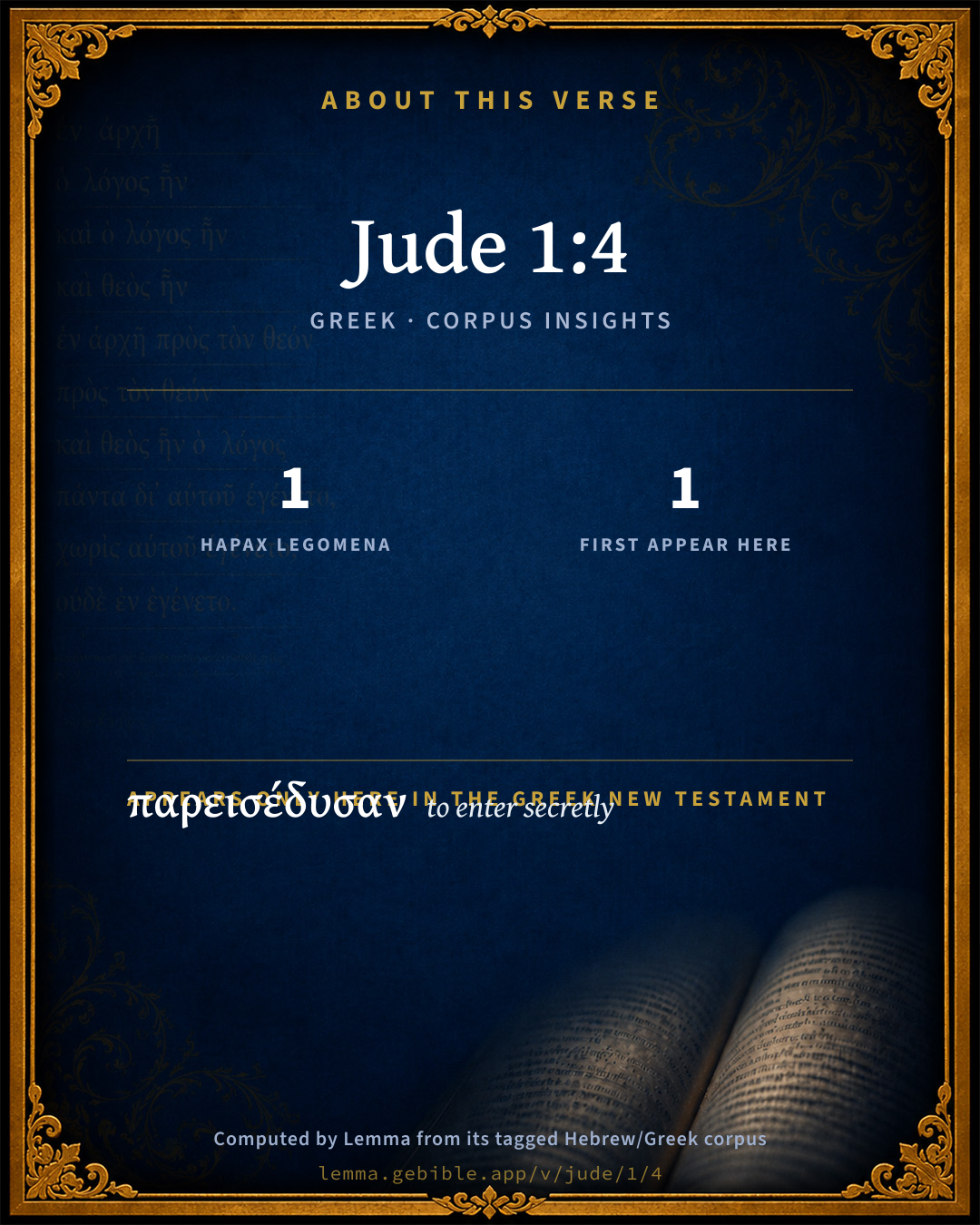
- 1 hapax legomenon — only here in the Greek New Testament
- 1 first appearance in the Greek New Testament
Download a study sheet
One document with this verse’s original text, its word-by-word gloss line, the meaning frame, cross-references with their text, attributed commentary, and full source and license credits — printable, and it pastes into notes with its structure intact.
This verse Autodidact and up
A passage Seminary Student
Up to 50 verses in one chapter. A passage sheet keeps up to 6 commentary sources and 12 cross-references per verse, in the order this page ranks them, and says so on the sheet whenever that leaves anything out. Ask for a single verse and you get the Autodidact verse sheet above.
Everything on this page stays free to read, with no account — the sheet is a download of what is already on screen, not access to it.
Compare translations 3
The same verse in 3 English versions, stacked beneath the original-language interlinear above. Click any original word for its lexicon entry.
Each is an independent rendering of the whole verse — the interlinear is not word-aligned to these translations.
Highlighted words mark where these versions differ — a whole-verse word diff, not a word-by-word alignment.
-
World English Bible Public Domain
For there are certain men who crept in secretly, even those who were long ago written about for this condemnation: ungodly men, turning the grace of our God into lasciviousness, and denying our only Master, God, and Lord, Jesus Christ.
-
King James Version Public Domain
For there are certain men crept in unawares, who were before of old ordained to this condemnation, ungodly men, turning the grace of our God into lasciviousness, and denying the only Lord God, and our Lord Jesus Christ.
-
unfoldingWord Literal Text CC BY-SA 4.0
For certain men have entered secretly, the ones long ago having been designated beforehand for this condemnation, ungodly ones, changing the grace of our God into licentiousness and denying our only Master and Lord, Jesus Christ.
unfoldingWord Literal Text — © unfoldingWord, licensed CC BY-SA 4.0. Word-aligned USFM3 via Door43 (git.door43.org/unfoldingWord/en_ult).
Show all 19 translations
Every available English version of this verse, each an independent rendering of the whole verse.
-
World English Bible Public Domain
For there are certain men who crept in secretly, even those who were long ago written about for this condemnation: ungodly men, turning the grace of our God into lasciviousness, and denying our only Master, God, and Lord, Jesus Christ.
-
Berean Standard Bible Public Domain
For certain men have crept in among you unnoticed—ungodly ones who were designated long ago for condemnation. They turn the grace of our God into a license for immorality, and they deny our only Master and Lord, Jesus Christ.
-
Majority Standard Bible Public Domain
For certain men have crept in among you unnoticed—ungodly ones who were designated long ago for condemnation. They turn the grace of our God into a license for immorality, and they deny God our only Master and the Lord Jesus Christ.
-
King James Version Public Domain
For there are certain men crept in unawares, who were before of old ordained to this condemnation, ungodly men, turning the grace of our God into lasciviousness, and denying the only Lord God, and our Lord Jesus Christ.
-
American Standard Version (1901) Public Domain
For there are certain men crept in privily, `even' they who were of old written of beforehand unto this condemnation, ungodly men, turning the grace of our God into lasciviousness, and denying our only Master and Lord, Jesus Christ.
-
Revised Version (1885) Public Domain
For there are certain men crept in privily, even they who were of old set forth unto this condemnation, ungodly men, turning the grace of our God into lasciviousness, and denying our only Master and Lord, Jesus Christ.
-
Geneva Bible (1599) Public Domain
For there are certaine men crept in, which were before of olde ordeined to this condemnation: vngodly men they are which turne the grace of our God into wantonnesse, and denie God the onely Lord, and our Lord Iesus Christ.
-
Douay-Rheims (1899) Public Domain
For certain men are secretly entered in, (who were written of long ago unto this judgment,) ungodly men, turning the grace of our Lord God into riotousness, and denying the only sovereign Ruler, and our Lord Jesus Christ.
-
Young's Literal Translation Public Domain
for there did come in unobserved certain men, long ago having been written beforehand to this judgment, impious, the grace of our God perverting to lasciviousness, and our only Master, God, and Lord -- Jesus Christ -- denying,
-
Literal Standard Version CC BY-SA 4.0
for there came in certain men stealthily, having been written beforehand to this judgment long ago, impious, perverting the grace of our God to licentiousness, and denying our only Master and Lord—Jesus Christ.
-
Unlocked Literal Bible CC BY-SA 4.0
For certain men have slipped in secretly among you. These are men who were marked out for condemnation. They are ungodly men who have changed the grace of our God into sensuality, and who deny our only Master and Lord, Jesus Christ.
-
unfoldingWord Literal Text CC BY-SA 4.0
For certain men have entered secretly, the ones long ago having been designated beforehand for this condemnation, ungodly ones, changing the grace of our God into licentiousness and denying our only Master and Lord, Jesus Christ.
-
Darby Bible Public Domain
For certain men have got in unnoticed, they who of old were marked out beforehand to this sentence, ungodly [persons], turning the grace of our God into dissoluteness, and denying our only Master and Lord Jesus Christ.
-
World Messianic Bible Public Domain
For there are certain men who crept in secretly, even those who were long ago written about for this condemnation: ungodly men, turning the grace of our God into indecency, and denying our only Master, God, and Lord, Yeshua the Messiah.
-
Webster's Bible Public Domain
For certain men have crept in unawares, who were before of old ordained to this condemnation, ungodly men, turning the grace of our God into lasciviousness, and denying the only Lord God, and our Lord Jesus Christ.
-
Free Bible Version CC BY-SA 4.0
For some people have quietly crept in among you. They were written about and condemned a long time ago, for they are wicked people who pervert God's grace, turning it into a license to immorality, while also denying our Lord and master Jesus Christ.
-
Bible in Basic English Public Domain
For certain men have come among you secretly, marked out before in the holy Writings for this evil fate, men without the fear of God, turning his grace into an unclean thing, and false to our only Master and Lord, Jesus Christ.
-
Text-Critical English NT CC BY 4.0
For certain men whose condemnation was written about long ago have crept in unnoticed. They are ungodly men who pervert the grace of our God, turning it into a license for sensuality. By doing so, they deny God, who is our only Master, and also the Lord Jesus Christ.
-
Tyndale New Testament (1534) Public Domain
For ther are certayne craftely crept in of which it was write afore tyme vnto soche iudgement. They are vngodly and turne the grace of oure God vnto wantannes and denye God the only Lorde and oure Lorde Iesus Christ.
Literal Standard Version (2020), Covenant Press — licensed CC BY-SA 4.0. Text via the HelloAO Bible API (eBible.org). Unlocked Literal Bible (unfoldingWord) — licensed CC BY-SA 4.0. Text via the HelloAO Bible API (eBible.org). unfoldingWord Literal Text — © unfoldingWord, licensed CC BY-SA 4.0. Word-aligned USFM3 via Door43 (git.door43.org/unfoldingWord/en_ult). Free Bible Version, Dr. Jonathan Gallagher — licensed CC BY-SA 4.0. Text via the HelloAO Bible API (eBible.org).
Word by word
More ways to search: Search by grammar → Find every occurrence → Compare this word →
Practice this passage: Drill this verse → Learn its vocabulary →
- Appears 1× in the Greek New Testament
- First appears here
- Part of Speech
- Verb
- Tense
- Aorist
- Voice
- Active
- Mood
- Indicative
- Person
- 3rd person
- Number
- Plural
Full Thayer's Definition
- παρεισέδυσαν pareisdýnō G3921 “to enter secretly” Verb, Aorist, Active, Indicative, 3rd person, Plural
- γάρ gár G1063 “for” Conjunction
- τινες tìs G5100 “a certain” Indefinite pronoun, Nominative, Plural, Masculine
- ἄνθρωποι ánthrōpos G444 “human being” Noun, Nominative, Plural, Masculine
- οἱ ho G3588 “the” Article, Nominative, Plural, Masculine
- πάλαι pálai G3819 “long ago” Adverb
- προγεγραμμένοι prográphō G4270 “to write before” Verb, Perfect, Passive, Participle, Nominative, Plural, Masculine
- εἰς eis G1519 “into” Preposition
- τοῦτο hoûtos G3778 “this” Demonstrative pronoun, Accusative, Singular, Neuter
- τὸ ho G3588 “the” Article, Accusative, Singular, Neuter
- κρίμα kríma G2917 “decree” Noun, Accusative, Singular, Neuter
- ἀσεβεῖς asebḗs G765 “impious” Adjective, Nominative, Plural, Masculine
- τὴν ho G3588 “the” Article, Accusative, Singular, Feminine
- τοῦ ho G3588 “the” Article, Genitive, Singular, Masculine
- θεοῦ theós G2316 “God” Noun, Genitive, Singular, Masculine
- ἡμῶν hēmeîs G2249 “we” Personal pronoun, 1st person, Genitive, Plural
- χάριτα cháris G5485 “grace” Noun, Accusative, Singular, Feminine
- μετατιθέντες metatíthēmi G3346 “to transpose” Verb, Present, Active, Participle, Nominative, Plural, Masculine
- εἰς eis G1519 “into” Preposition
- ἀσέλγειαν asélgeia G766 “licentiousness” Noun, Accusative, Singular, Feminine
- καὶ kaí G2532 “and” Conjunction
- τὸν ho G3588 “the” Article, Accusative, Singular, Masculine
- μόνον mónos G3441 “alone” Adjective, Accusative, Singular, Masculine
- δεσπότην despótēs G1203 “master” Noun, Accusative, Singular, Masculine
- καὶ kaí G2532 “and” Conjunction
- κύριον kýrios G2962 “Lord” Noun, Accusative, Singular, Masculine
- ἡμῶν hēmeîs G2249 “we” Personal pronoun, 1st person, Genitive, Plural
- Ἰησοῦν Iēsoûs G2424 “Jesus” Noun, Accusative, Singular, Masculine
- Χριστὸν Christós G5547 “Christ” Noun, Accusative, Singular, Masculine
- ἀρνούμενοι arnéomai G720 “to deny” Verb, Present, Middle or Passive deponent, Participle, Nominative, Plural, Masculine
About this verse
These counts appear in no published source. They are computed here, from the morphology-tagged text and Lemma’s own curated glosses. What Lemma adds →
- 30
- words
- 23
- distinct lemmas
- General Epistles
- section
Notable vocabulary
1 hapax legomenon — a word that appears only here in the entire Greek New Testament:
- παρεισέδυσαν to enter secretly G3921
First appearance in Scripture
This word makes its first canonical appearance in the Greek New Testament here:
- παρεισέδυσαν to enter secretly G3921
Shared distinctive vocabulary
προγεγραμμένοι to write before G4270 occurs in 4 verses of the Greek New Testament. Also found in:
Cross-references
28Topical passages linked to Jude 1:4 in the Treasury of Scripture Knowledge — connected by theme and wording, ordered by reader-vote popularity; previews shown in the World English Bible.
- 2 Peter 2:1–3 But there also arose false prophets among the people, as among you also there will be false teachers, who will secretly bring in destructive heresies, denying even the Master who bought them, bringing on themselves swift destruction.
- Galatians 2:4 This was because of the false brothers secretly brought in, who stole in to spy out our liberty which we have in Christ Jesus, that they might bring us into bondage;
- 2 Peter 2:10 but chiefly those who walk after the flesh in the lust of defilement, and despise authority. Daring, self-willed, they are not afraid to speak evil of dignitaries;
- Titus 1:15–16 To the pure, all things are pure; but to those who are defiled and unbelieving, nothing is pure; but both their mind and their conscience are defiled.
- 1 Peter 2:16 as free, and not using your freedom for a cloak of wickedness, but as bondservants of God.
- 1 John 2:22 Who is the liar but he who denies that Jesus is the Christ? This is the Antichrist, he who denies the Father and the Son.
- 2 Peter 2:18–22 For, uttering great swelling words of emptiness, they entice in the lusts of the flesh, by licentiousness, those who are indeed escaping from those who live in error;
- 1 Peter 2:8 and, "A stone of stumbling, and a rock of offense." For they stumble at the word, being disobedient, whereunto also they were appointed.
- 2 Peter 2:5–6 and didn't spare the ancient world, but preserved Noah with seven others, a preacher of righteousness, when he brought a flood on the world of the ungodly;
- Romans 6:1–2 What shall we say then? Shall we continue in sin, that grace may abound?
- 2 Timothy 3:6 For of these are those who creep into houses, and take captive gullible women loaded down with sins, led away by various lusts,
- Psalms 1:1 Blessed is the man who doesn't walk in the counsel of the wicked, Nor stand in the way of sinners, Nor sit in the seat of scoffers;
- Galatians 5:13 For you, brothers, were called for freedom. Only don't use your freedom for gain to the flesh, but through love be servants to one another.
- Titus 2:11–12 For the grace of God has appeared, bringing salvation to all men,
- Ephesians 4:14 that we may no longer be children, tossed back and forth and carried about with every wind of doctrine, by the trickery of men, in craftiness, after the wiles of error;
- Hebrews 12:15–16 looking carefully lest there be any man who falls short of the grace of God; lest any root of bitterness springing up trouble you, and thereby the many be defiled;
- 2 Peter 3:7 But the heavens that now are, and the earth, by the same word have been stored up for fire, being reserved against the day of judgment and destruction of ungodly men.
- Psalms 62:2 He alone is my rock and my salvation, my fortress-- I will never be greatly shaken.
- Matthew 13:25 but while people slept, his enemy came and sowed darnel also among the wheat, and went away.
- John 17:3 This is eternal life, that they should know you, the only true God, and him whom you sent, Jesus Christ.
- Acts 11:23 who, when he had come, and had seen the grace of God, was glad. He exhorted them all, that with purpose of heart they should remain near to the Lord.
- Acts 15:24 Because we have heard that some who went out from us have troubled you with words, unsettling your souls, saying, 'You must be circumcised and keep the law,' to whom we gave no commandment;
- 1 Peter 4:18 "If it is hard for the righteous to be saved, what will happen to the ungodly and the sinner?"
- Jude 1:15 to execute judgment on all, and to convict all the ungodly of all their works of ungodliness which they have done in an ungodly way, and of all the hard things which ungodly sinners have spoken against him."
- Romans 9:21–22 Or hasn't the potter a right over the clay, from the same lump to make one part a vessel for honor, and another for dishonor?
- Revelation 15:4 Who wouldn't fear you, Lord, And glorify your name? For you only are holy. For all the nations will come and worship before you. For your righteous acts have been revealed."
- 2 Samuel 22:5 For the waves of death compassed me; The floods of ungodliness made me afraid:
- 1 Timothy 6:15–16 which in its own times he will show, who is the blessed and only Ruler, the King of kings, and Lord of lords;
Cross-references courtesy of OpenBible.info (CC BY 4.0).
Where the printed editions differ
1 variantPlaces in this verse where the major printed Greek editions disagree on the wording in a way that affects the translation — a comparison of editions, not a manuscript-by-manuscript collation. The editions are the modern critical texts (Nestlé-Aland 28/27, SBL, Westcott-Hort, Tregelles, Tyndale House) and the traditional texts behind the KJV (the Textus Receptus and the Byzantine/Majority text). It is not a claim about which reading is original.
-
Extra text
θεόν
“God”
In TRByz Not in NA28NA27TynSBLWHTregθεόν (theon) 'God' is only in traditional manuscripts (TR+Byz)
Textual data: Translators Amalgamated Greek New Testament (STEPBible TAGNT) · CC BY 4.0.
Lesson kit
Teaching starters — assembled from the data on this page, not authored interpretation. Every prompt links to the verse data it draws on. Edit before teaching.
Jude, in the General Epistles, opens this verse with 30 words (23 distinct Greek lemmas). Its most distinctive word is pareisdýnō (“to enter secretly”). A historical commentator’s framing appears above. Read the whole chapter for the surrounding context.
Discussion questions
- What does “to enter secretly” (pareisdýnō) contribute to the verse as a whole?
- 1 word here appears nowhere else in the Greek New Testament. Why might the author reach for such rare wording?
- This is the first place “to enter secretly” appears in Scripture (first appears here). What does its debut here establish?
- How does Romans 15:4, which shares the word «to write before», read alongside this verse?
- What does the repetition of “into” (2× in this one verse) do in this verse?
- These translations render this verse differently; the difference is in the English rendering, not the original. What questions does that raise?
- Compare how The Cambridge Bible for Schools and Colleges and Albert Barnes' Notes on the Bible read this verse. Where do they agree or differ?
Things to notice
- 1 word in this verse appears nowhere else in the Greek New Testament.
- 1 word makes its first canonical appearance in Scripture here.
- These translations choose different wording for 25 words in this verse.
- “into” occurs 2× in this single verse.
- 23 distinct Greek lemmas span 30 words in this verse.
Commentary
Notes on Jude 1:4 from classic Christian and Jewish commentators (each source and its license shown beneath its notes). The classic Christian expositions comment on the surrounding passage and are grouped to its opening verse, so a note may address several verses; the Jewish commentaries on the Tanakh (Rashi and others) are per-verse, so they appear only where the commentator wrote on this verse.
Lemma curates 59 commentaries, every one of them public domain or Creative Commons licensed, each selected and text-cleaned for this edition rather than reprinted as found. About our sources →
The Cambridge Bible for Schools and Colleges
gen. ed. J. J. S. Perowne
The Cambridge Bible for Schools and Colleges (gen. ed. J. J. S. Perowne; Cambridge University Press, 1878–1918) — public domain. Text from a community e-Sword module.
Albert Barnes' Notes on the Bible
Albert Barnes' Notes on the Bible (1834–1885) — public domain. Text from a community e-Sword/MySword module.
The Biblical Illustrator
Joseph S. Exell
The Biblical Illustrator, edited by Joseph S. Exell (c. 1880s–1900s) — public domain. Text from a community e-Sword module.
Joseph Benson's Commentary
Joseph Benson's Commentary on the Old and New Testaments (1811–1818) — public domain. Text from a community e-Sword module.
The Expositor's Bible
William Robertson Nicoll, ed., The Expositor's Bible (London: Hodder & Stoughton, 1887–1910) — public domain. 65 of 66 books (1 Corinthians is not separately keyed, as that volume carries no machine-parseable verse references); section-level commentary keyed to the opening verse. Introductory and overview sections not keyed to a specific passage are excluded.
Tyndale Open Study Notes
Tyndale Open Resources
Tyndale Open Study Notes — © Tyndale Open Resources, licensed CC BY-SA 4.0. Text via the HelloAO Bible API.
Bengel's Gnomon
Johann Albrecht Bengel
Bengel's Gnomon of the New Testament — English translation (T&T Clark, Edinburgh, 1860) — public domain. Text from a community e-Sword module.
Meyer's Critical & Exegetical Commentary
Heinrich August Wilhelm Meyer
Meyer — Critical and Exegetical Commentary on the New Testament — English translation by Peter Christie, edited by Frederick Crombie (T&T Clark, 1880) — public domain. Text from a community e-Sword module.
Expositor's Greek Testament
ed. W. Robertson Nicoll
The Expositor's Greek Testament, edited by W. Robertson Nicoll (1897–1910) — public domain. Text from a community e-Sword module.
Geneva Bible (1599)
Geneva Bible translators
Geneva Bible (1599) marginal notes — public domain. Text via Bolls.life.
Jamieson, Fausset & Brown
Robert Jamieson, A. R. Fausset & David Brown
Jamieson, Fausset & Brown — Commentary Critical and Explanatory on the Whole Bible (1871) — public domain (CC PDM 1.0). Text via the HelloAO Bible API.
Adam Clarke's Commentary
Adam Clarke's Commentary on the Bible (1810–1826) — public domain. Text from a community e-Sword/MySword module.
John Calvin's Commentaries
John Calvin's Commentaries (1540-1563) — public domain. Text from the Calvin Translation Society English edition (1840s-50s) via the Christian Classics Ethereal Library (ccel.org). Calvin's coverage is partial (roughly two-thirds of the Bible); uncommented books and verses are honest gaps, never fabricated. The 19th-century editor's footnotes and remarks are omitted so the notes are faithfully Calvin's own voice.
John Gill's Exposition
John Gill's Exposition of the Whole Bible (1746–1763) — public domain (CC PDM 1.0). Text via the HelloAO Bible API.
Haydock's Catholic Bible Commentary
George Leo Haydock (1774–1849), Haydock's Catholic Family Bible and Commentary, 1859 edition — public domain. Excludes Psalms (Douay-Rheims chapter numbering differs from Protestant) and Deuterocanonical books (Catholic canon only).
Matthew Poole's English Annotations
Matthew Poole's English Annotations on the Holy Bible (1683–1685) — public domain. Text from a community e-Sword/MySword module.
Whedon's Commentary on the Bible
Daniel D. Whedon
Daniel D. Whedon (gen. ed.), Commentary on the Old and New Testaments (1874–1909) — public domain. Text from a community e-Sword module.
The Pulpit Commentary
The Pulpit Commentary (1880–1919), ed. H.D.M. Spence-Jones & Joseph S. Exell — public domain. Text from a community e-Sword module.
John Wesley's Explanatory Notes
John Wesley, Explanatory Notes Upon the Whole Bible (1754–1765) — public domain. Text via the GEBible commentary corpus.
Burkitt's Expository Notes on the New Testament
William Burkitt
William Burkitt's Expository Notes on the New Testament (1700–1703) — public domain. Text from a community e-Sword module.
The People's New Testament
B. W. Johnson
B. W. Johnson's The People's New Testament with Notes (1889–1891) — public domain. Electronic text from the Christian Classics Ethereal Library (CCEL) ThML edition.
Cambridge Greek Testament for Schools and Colleges
Cambridge Greek Testament for Schools and Colleges (Cambridge University Press, 1896; 21 vols, various authors incl. Carr, Maclear, Plummer, Farrar, Lumby, Moule, M. R. James, Simcox) — public domain. Text from a community e-Sword module.
Alford’s Greek Testament
Henry Alford
Henry Alford, The Greek Testament (1849–1861) — public domain. Text from a community e-Sword module.
International Critical Commentary
International Critical Commentary — older volumes (1896–1929), various authors — public domain. Text from a community e-Sword module.
Vincent's Word Studies in the New Testament
Marvin R. Vincent
Marvin R. Vincent, Word Studies in the New Testament (1887–1900) — public domain. Text from a community e-Sword/MySword module.