Galatians 1:15

Greek (Tischendorf 8th ed.) Galatians 1:15 appears in the Greek New Testament. The text above is from the Tischendorf 8th edition. Each word links to its Strong’s number and a concise gloss. Click any word for its full Thayer’s Greek Lexicon entry.
Download image
Cite this verse

Galatians 1:15 (World English Bible). Public Domain. Lemma interlinear Bible study tool, https://lemma.gebible.app/v/galatians/1/15.

Show BibTeX & RIS
BibTeX
RIS
English Translation
But when it was the good pleasure of God, who separated me from my mother's womb, and called me through his grace,
World English Bible · Public Domain
Download a study sheet

One document with this verse’s original text, its word-by-word gloss line, the meaning frame, cross-references with their text, attributed commentary, and full source and license credits — printable, and it pastes into notes with its structure intact.

This verse Autodidact and up

Study sheet (.html) Plain text (.txt)

A passage Seminary Student

Up to 50 verses in one chapter. A passage sheet keeps up to 6 commentary sources and 12 cross-references per verse, in the order this page ranks them, and says so on the sheet whenever that leaves anything out. Ask for a single verse and you get the Autodidact verse sheet above.

Everything on this page stays free to read, with no account — the sheet is a download of what is already on screen, not access to it.

Want to remove ads? Support Godless Engineer
Compare translations 3

The same verse in 3 English versions, stacked beneath the original-language interlinear above. Click any original word for its lexicon entry.

Each is an independent rendering of the whole verse — the interlinear is not word-aligned to these translations.

Highlighted words mark where these versions differ — a whole-verse word diff, not a word-by-word alignment.

  • World English Bible Public Domain
    But when it was the good pleasure of God, who separated me from my mother's womb, and called me through his grace,
  • King James Version Public Domain
    But when it pleased God, who separated me from my mother's womb, and called me by his grace,
  • unfoldingWord Literal Text CC BY-SA 4.0
    But when the one having set me apart from the womb of my mother and having called through his grace was pleased

unfoldingWord Literal Text — © unfoldingWord, licensed CC BY-SA 4.0. Word-aligned USFM3 via Door43 (git.door43.org/unfoldingWord/en_ult).

Versions to compare (up to 4)

3 of 4 selected

Show all 19 translations

Every available English version of this verse, each an independent rendering of the whole verse.

  • World English Bible Public Domain
    But when it was the good pleasure of God, who separated me from my mother's womb, and called me through his grace,
  • Berean Standard Bible Public Domain
    But when God, who set me apart from my mother’s womb and called me by His grace, was pleased
  • Majority Standard Bible Public Domain
    But when God, who set me apart from my mother’s womb and called me by His grace, was pleased
  • King James Version Public Domain
    But when it pleased God, who separated me from my mother's womb, and called me by his grace,
  • American Standard Version (1901) Public Domain
    But when it was the good pleasure of God, who separated me, `even' from my mother's womb, and called me through his grace,
  • Revised Version (1885) Public Domain
    But when it was the good pleasure of God, who separated me, even from my mother’s womb, and called me through his grace,
  • Geneva Bible (1599) Public Domain
    But when it pleased God (which had separated me from my mothers wombe, and called me by his grace)
  • Douay-Rheims (1899) Public Domain
    But when it pleased him, who separated me from my mother's womb, and called me by his grace,
  • Young's Literal Translation Public Domain
    and when God was well pleased -- having separated me from the womb of my mother, and having called `me' through His grace --
  • Literal Standard Version CC BY-SA 4.0
    and when God was well pleased—having separated me from the womb of my mother, and having called [me] through His grace—
  • Unlocked Literal Bible CC BY-SA 4.0
    But when God, who had set me apart from my mother's womb, and who called me through his grace,
  • unfoldingWord Literal Text CC BY-SA 4.0
    But when the one having set me apart from the womb of my mother and having called through his grace was pleased
  • Darby Bible Public Domain
    But when God, who set me apart [even] from my mother's womb, and called [me] by his grace,
  • World Messianic Bible Public Domain
    But when it was the good pleasure of God, who separated me from my mother’s womb and called me through his grace,
  • Webster's Bible Public Domain
    But when it pleased God, who separated me from my mother's womb, and called me by his grace,
  • Free Bible Version CC BY-SA 4.0
    But when God (who had set me apart from birth) called me through his grace, and was pleased
  • Bible in Basic English Public Domain
    But when it was the good pleasure of God, by whom I was marked out even from my mother's body, through his grace,
  • Text-Critical English NT CC BY 4.0
    But when God, who set me apart before I was born and called me by his grace, was pleased
  • Tyndale New Testament (1534) Public Domain
    But when it pleased God which seperated me from my mothers wombe and called me by his grace

Literal Standard Version (2020), Covenant Press — licensed CC BY-SA 4.0. Text via the HelloAO Bible API (eBible.org). Unlocked Literal Bible (unfoldingWord) — licensed CC BY-SA 4.0. Text via the HelloAO Bible API (eBible.org). unfoldingWord Literal Text — © unfoldingWord, licensed CC BY-SA 4.0. Word-aligned USFM3 via Door43 (git.door43.org/unfoldingWord/en_ult). Free Bible Version, Dr. Jonathan Gallagher — licensed CC BY-SA 4.0. Text via the HelloAO Bible API (eBible.org).

Word by word

More ways to search: Search by grammar → Find every occurrence → Compare this word →

Practice this passage: Drill this verse → Learn its vocabulary →

ἀφορίσας
aphorízō
G873
“to separate”
Verb, Aorist, Active, Participle, Nominative, Singular, Masculine
Part of Speech
Verb
Tense
Aorist
Voice
Active
Mood
Participle
Case
Nominative
Number
Singular
Gender
Masculine
Full Thayer's Definition

Origin: from G575 and G3724

TDNT: 12:34,7

1. to mark off from others by boundaries, to limit, to separate a. in a bad sense: to exclude as disreputable b. in a good sense: to appoint, set apart for some purpose
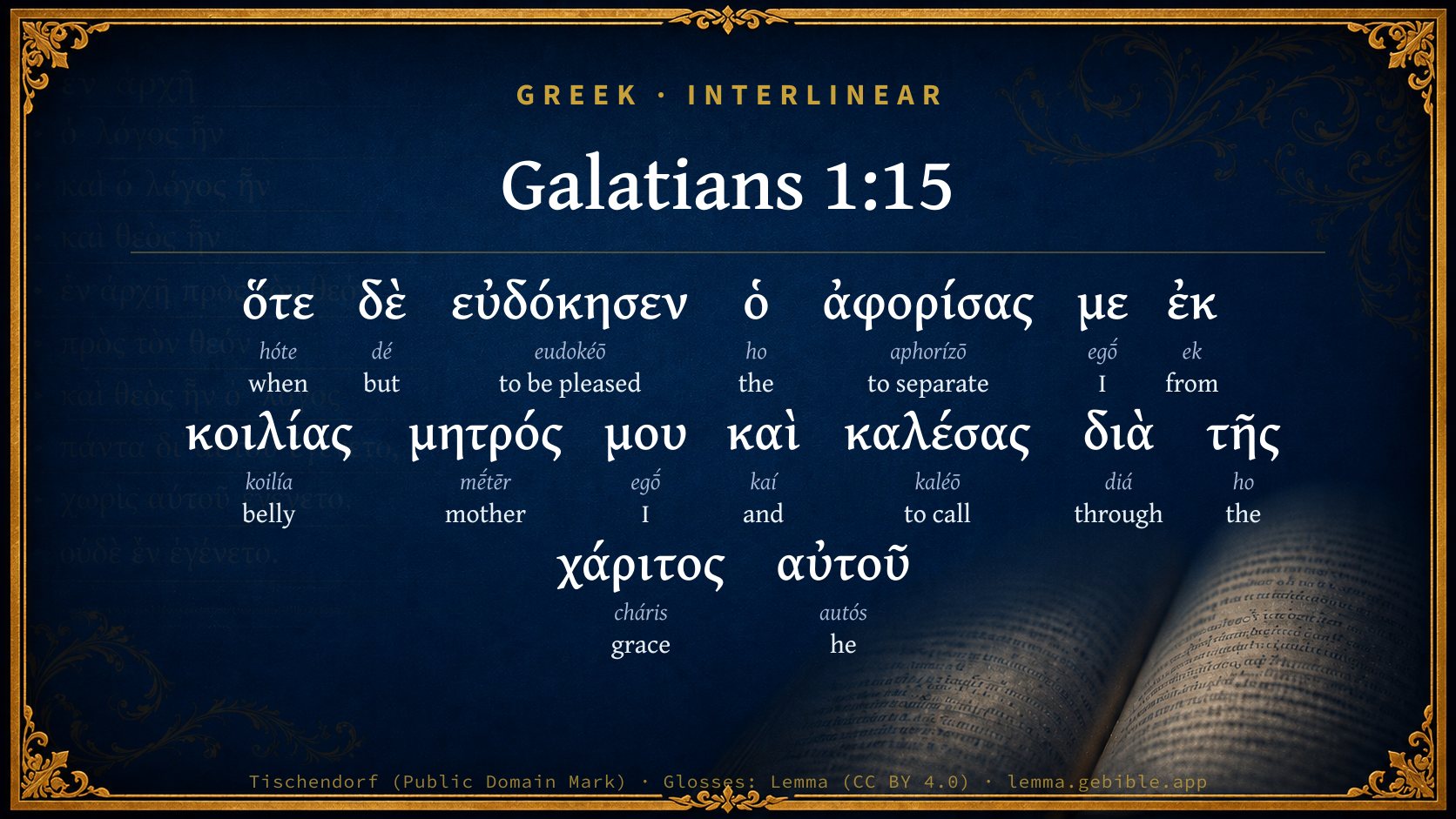
  1. ὅτε hóte G3753 “when” Adverb
  2. δὲ dé G1161 “but” Conjunction
  3. εὐδόκησεν eudokéō G2106 “to be pleased” Verb, Aorist, Active, Indicative, 3rd person, Singular
  4. ὁ ho G3588 “the” Article, Nominative, Singular, Masculine
  5. με egṓ G1473 “I” Personal pronoun, 1st person, Accusative, Singular
  6. ἐκ ek G1537 “from” Preposition
  7. κοιλίας koilía G2836 “belly” Noun, Genitive, Singular, Feminine
  8. μητρός mḗtēr G3384 “mother” Noun, Genitive, Singular, Feminine
  9. μου egṓ G1473 “I” Personal pronoun, 1st person, Genitive, Singular
  10. καὶ kaí G2532 “and” Conjunction
  11. καλέσας kaléō G2564 “to call” Verb, Aorist, Active, Participle, Nominative, Singular, Masculine
  12. διὰ diá G1223 “through” Preposition
  13. τῆς ho G3588 “the” Article, Genitive, Singular, Feminine
  14. χάριτος cháris G5485 “grace” Noun, Genitive, Singular, Feminine
  15. αὐτοῦ autós G846 “he” Personal pronoun, Genitive, Singular, Masculine

About this verse

These counts appear in no published source. They are computed here, from the morphology-tagged text and Lemma’s own curated glosses. What Lemma adds →

16
words
14
distinct lemmas
Pauline Epistles
section

Notable vocabulary

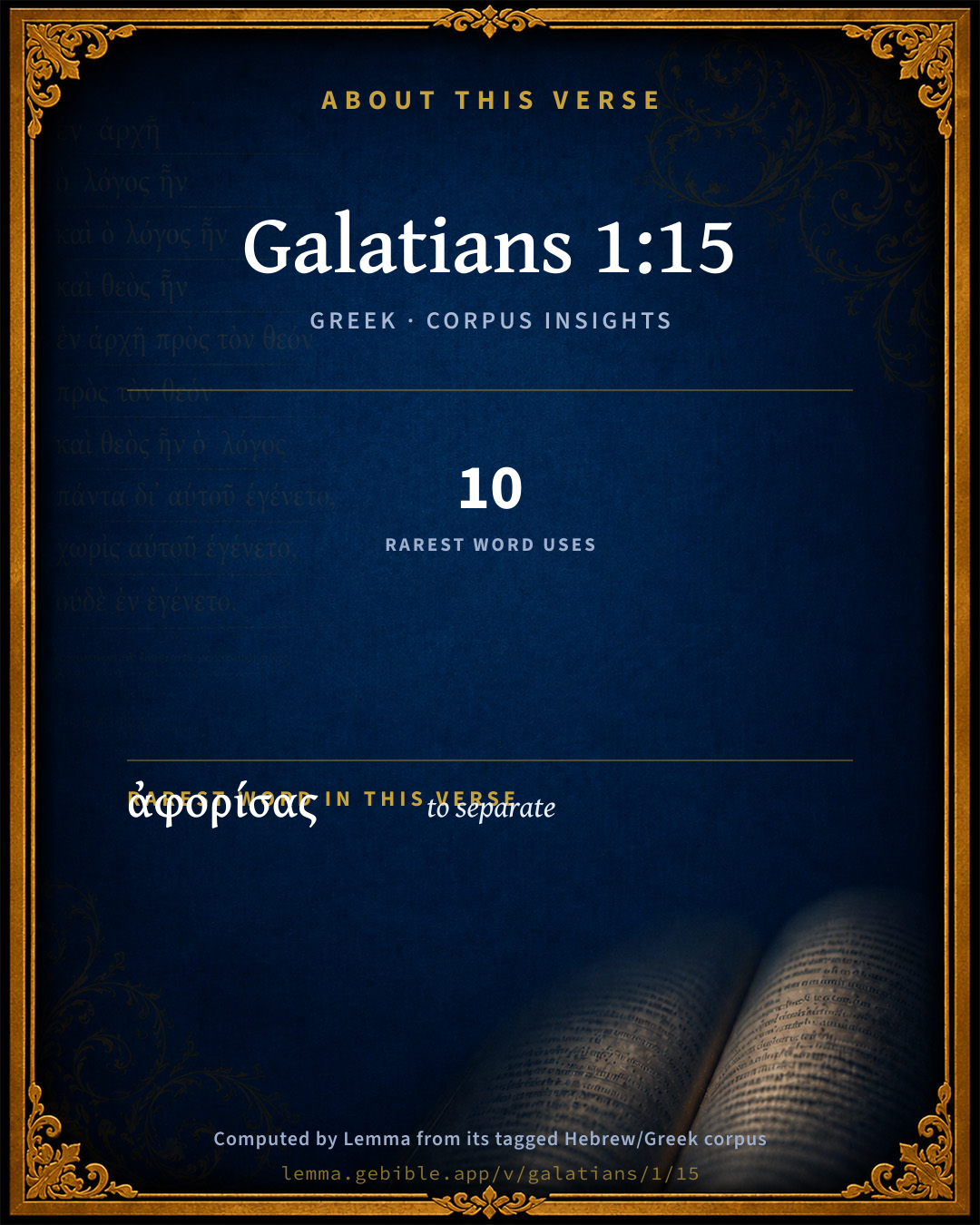
The rarest word here is ἀφορίσας to separate G873 — appearing just 10 times in the whole Greek New Testament.

Shared distinctive vocabulary

ἀφορίσας to separate G873 occurs in 9 verses of the Greek New Testament. Also found in:

Repetition

Words recur within this verse:

Cross-references

28

Topical passages linked to Galatians 1:15 in the Treasury of Scripture Knowledge — connected by theme and wording, ordered by reader-vote popularity; previews shown in the World English Bible.

  • Jeremiah 1:5 Before I formed you in the belly I knew you, and before you came forth out of the womb I sanctified you; I have appointed you a prophet to the nations.
  • Isaiah 49:5 Now says Yahweh who formed me from the womb to be his servant, to bring Jacob again to him, and that Israel be gathered to him (for I am honorable in the eyes of Yahweh, and my God is become my strength);
  • Isaiah 49:1 Listen, isles, to me; and listen, you peoples, from far: Yahweh has called me from the womb; from the bowels of my mother has he made mention of my name:
  • 2 Timothy 1:9 who saved us and called us with a holy calling, not according to our works, but according to his own purpose and grace, which was given to us in Christ Jesus before times eternal,
  • Ephesians 1:5 having predestined us for adoption as children through Jesus Christ to himself, according to the good pleasure of his desire,
  • 1 Corinthians 1:9 God is faithful, through whom you were called into the fellowship of his Son, Jesus Christ, our Lord.
  • 2 Thessalonians 2:13–14 But we are bound to always give thanks to God for you, brothers loved by the Lord, because God chose you from the beginning for salvation through sanctification of the Spirit and belief in the truth;
  • Romans 1:1 Paul, a servant of Jesus Christ, called to be an apostle, set apart for the Gospel of God,
  • Acts 9:15 But the Lord said to him, "Go your way, for he is my chosen vessel to bear my name before the nations and kings, and the children of Israel.
  • Acts 13:2 As they served the Lord and fasted, the Holy Spirit said, "Separate Barnabas and Saul for me, for the work to which I have called them."
  • 1 Samuel 12:22 For Yahweh will not forsake his people for his great name's sake, because it has pleased Yahweh to make you a people to himself.
  • 1 Chronicles 28:4–5 However Yahweh, the God of Israel, chose me out of all the house of my father to be king over Israel forever: for he has chosen Judah to be prince; and in the house of Judah, the house of my father; and among the sons of my father he took pleasure in me to make me king over all Israel;
  • Matthew 11:26 Yes, Father, for so it was well-pleasing in your sight.
  • Luke 1:15–16 For he will be great in the sight of the Lord, and he will drink no wine nor strong drink. He will be filled with the Holy Spirit, even from his mother's womb.
  • Romans 1:5 through whom we received grace and apostleship, for obedience of faith among all the nations, for his name's sake;
  • Romans 8:30 Whom he predestined, those he also called. Whom he called, those he also justified. Whom he justified, those he also glorified.
  • Deuteronomy 7:7–8 Yahweh didn't set his love on you, nor choose you, because you were more in number than any people; for you were the fewest of all peoples:
  • Luke 10:21 In that same hour Jesus rejoiced in the Holy Spirit, and said, "I thank you, O Father, Lord of heaven and earth, that you have hidden these things from the wise and understanding, and revealed them to little children. Yes, Father, for so it was well-pleasing in your sight."
  • Acts 22:14–15 He said, 'The God of our fathers has appointed you to know his will, and to see the Righteous One, and to hear a voice from his mouth.
  • 1 Corinthians 1:1 Paul, called to be an apostle of Jesus Christ through the will of God, and our brother Sosthenes,
  • 1 Corinthians 1:24 but to those who are called, both Jews and Greeks, Christ is the power of God and the wisdom of God.
  • 1 Corinthians 15:10 But by the grace of God I am what I am. His grace which was bestowed on me was not futile, but I worked more than all of them; yet not I, but the grace of God which was with me.
  • Galatians 1:6 I marvel that you are so quickly deserting him who called you in the grace of Christ to a different gospel;
  • Ephesians 1:9 making known to us the mystery of his will, according to his good pleasure which he purposed in him
  • Ephesians 3:11 according to the eternal purpose which he purposed in Christ Jesus our Lord;
  • 1 Peter 5:10 But may the God of all grace, who called you to his eternal glory by Christ Jesus, after you have suffered a little while, perfect, establish, strengthen, and settle you.
  • Romans 9:24 us, whom he also called, not from the Jews only, but also from the Gentiles?
  • 1 Timothy 1:12–14 And I thank him who enabled me, Christ Jesus our Lord, because he counted me faithful, appointing me to service;

Cross-references courtesy of OpenBible.info (CC BY 4.0).

Commentary

Notes on Galatians 1:15 from classic Christian and Jewish commentators (each source and its license shown beneath its notes). The classic Christian expositions comment on the surrounding passage and are grouped to its opening verse, so a note may address several verses; the Jewish commentaries on the Tanakh (Rashi and others) are per-verse, so they appear only where the commentator wrote on this verse.

Lemma curates 59 commentaries, every one of them public domain or Creative Commons licensed, each selected and text-cleaned for this edition rather than reprinted as found. About our sources →

Jamieson, Fausset & Brown

Robert Jamieson, A. R. Fausset & David Brown

separated--"set me apart": in the purposes of His electing love (compare Act 9:15; Act 22:14), in order to show in me His "pleasure," which is the farthest point that any can reach in inquiring the causes of his salvation. The actual "separating" or "setting apart" to the work marked out for him, is mentioned in Act 13:2; Rom 1:1. There is an allusion, perhaps, in the way of contrast, to the derivation of Pharisee from Hebrew, "pharash," "separated." I was once a so-called Pharisee or Separatist, but God had separated me to something far better.

from . . . womb--Thus merit in me was out of the question, in assigning causes for His call from Act 9:11. Grace is the sole cause (Psa 22:9; Psa 71:6; Isa 49:1, Isa 49:5; Jer 1:5; Luk 1:15).

called me--on the way to Damascus (Act 9:3-8).

Jamieson, Fausset & Brown — Commentary Critical and Explanatory on the Whole Bible (1871) — public domain (CC PDM 1.0). Text via the HelloAO Bible API.

The Biblical Illustrator

Joseph S. Exell

Gal_1:15-16

But when it pleased God to reveal His Son in me.

Prevenient grace

Although Paul was suddenly converted, yet God had had thoughts of mercy towards him from his very birth. God did not begin to work with him when he was on the road to Damascus. That was not the first occasion on which eyes of love had darted upon this chief of sinners.

I. The purpose of God preceding saving grace, as it may clearly be seen developing itself in human history. The life of men before conversion is really a working of them in the clay. You may perceive Gods purpose in St. Paul, when you think of

(1) the singular gifts with which he was endowed;

(2) his education;

(3) the spiritual struggles through which he passed;

(4) the singular formation of his mind.

Even as a sinner, Paul was great. A man full of energy and determination. His conversion only lifted him into a higher life, but left him unchanged as to temperament, nature, and force of character. He seems to have been constituted naturally a thorough-going, thorough-hearted man, in order that when grace did come to him he might be just as earnest, dauntless, fearless, in defence of the right. Such a man was wanted to lead the vanguard in the great crusade against the god of this world, and from his very birth God was fitting him for this position; before he was converted, prevenient grace was thus engaged, fashioning, moulding, and preparing the man, in order that by-and-by there might be put into his nostrils the breath of life.

II. Grace preceding calling in another sense. It is impossible to say, concerning the elect, when the grace of God begins to deal with them. You can tell when the quickening grace comes, but not when the grace itself comes.

1. Formative grace. This is to be born of Christian parents, in a Christian country, and nurtured in piety.

2. Preventive grace. Saved from sins that others fall into.

3. Restraining grace. Debarred by circumstances from sins to which we are inclined.

4. Preparatory work of grace. Before casting in the seed, God is pleased to give to some

(a) an attentive ear. Willingness to listen to the Word when it is brought to him;

(b) an ingenuousness of heart;

(c) a tender conscience;

(d) dissatisfaction with their present state.

Apples of Sodom, at one time fair and sweet to their taste, God turns to ashes and bitterness in their mouth.

Thus it was with Augustine, wandering wearily hither and thither with a death-thirst in his soul, that no fount of philosophy, or scholastic argument, or heretical teaching could ever assuage. He was aware of his unhappy estate, and turned his eye round the circle of the universe looking for peace, not fully conscious of what he wanted, though feeling an aching void the world could never fill. He had not found the centre, fixed and steadfast, around which all else revolved in ceaseless change. All this appetite, this hunger and thirst, is not of the devil, or of the human heart alone, but of God.

III. Pauls actual calling by Divine grace. All preparatory work of which we have spoken, was not the source or origin of the vital godliness which afterwards distinguished him; that came to him on a sudden. In a moment he saw everything in a different light; and from a foe he was changed into a staunch and loyal friend of Jesus. He was not disobedient to the heavenly vision. (C. H. Spurgeon.)

Providential dealings

Some of the good fathers amongst us are mourning very bitterly just now over their sons. Your children do not turn out as you wish they would; they are getting sceptical, some of them, and they are also falling into sin. Well, dear friends, it is yours to mourn; it is enough to make you weep bitterly; but let me whisper a word into your ear. Do not sorrow as those who are without hope, for God may have very great designs to be answered, even by these very young men who seem to be running so altogether in the wrong direction. I do not think I could go so far as John Bunyan did, when he said he was sure God would have some eminent saints in the next generation, because the young men in his day were such gross sinners, that he thought they would make fine saints; and when the Lord came and saved them by His mercy, they would love much because they had had so much forgiven. I would hardly like to say so much as that, but I do believe that sometimes in the inscrutable wisdom of God, when some of those who have been sceptical come to see the truth, they are the very best men that could possibly be found to do battle against the- enemy. Some of those who have fallen into error, after having passed through it, and happily come up from its deep ditch, are just the men to stand and warn others against it. I cannot conceive that Luther would ever have been so mighty a preacher of the faith, if he had not himself struggled up and down Pilates staircase on his knees, when trying to get to heaven by his penances and his good works. O let us have hope. We do not know but that God may be intending yet to call them and bless them. Who can tell, there may be a young man here to-night who will one day be the herald of the Cross in China, in Hindostan, in Africa, and in the islands of the sea? Remember John Williams wishing to keep an appointment with another young man who committed a certain sin. He wanted to know what time it was, and so just stepped into Moorfields Chapel; some one saw him, and he did not like to go out, and the word preached by Mr. Timothy East fell on his ears, and the young sinner was made a saint; and you all know how he afterwards perished as a martyr on the shores of Erromanga. (C. H. Spurgeon.)

Apostolic credentials

St. Paul here claims to be an apostle, an inspired apostle, one qualified to speak with authority, and to teach infallible truth.

I. A Divine communication of light and knowledge was made to him. He had been blind, now he saw.

II. The subject of this Divine communication was the Lord Jesus Christ.

1. In Christ was seen the glory of the Divine nature.

2. In Christ was seen the glory of the Divine attributes. As the wax bears the perfect image of the seal, so were all the perfections of the Divine character reflected in him.

3. In Christ was seen the glory of the Divine purposes. Redemption is the masterpiece of Divine wisdom; in redemption Christ is the central figure.

III. The sphere in which this Divine communication had place was the soul of the apostle. In me. He saw, believed, and loved. His intellect was more than satisfied; his heart was at peace. Judaism was superseded, and like a dissolving view, passed rapidly away; heathenism was seen more clearly to be a lie and an imposture. To know Christ, to win Christ, to preach Christ, to love Christ, to be with Christ, was all he desired. (Emilius Bayley, B. D.)

Personal conviction

What we need is the revelation of Christ within us; not the communication of truths yet unrevealed, as was necessary in the case of the founders of our religion, but the communication of truths already made known; the removal of the veil from our hearts, and the giving of the knowledge of God in the face of Jesus Christ. Each of us must for himself discover the hid treasure; whether the light flashes upon us in an instant, as with the woman at the well of Jacob, or comes to us as the result of long search and patient inquiry, as in the case of the Ethiopian eunuch, we must find the Messiah, we must hear Him ourselves, and know that this is indeed the Christ, the Saviour of the world. It will not suffice, in this day at least, to take religion upon trust, to accept the popular faith, just because it is popular. Such belief will not stand in the day of trial; it certainly will exercise no constraining influence upon our hearts and lives. Whether for our peace or for our usefulness, Christ must live within us; the reasonable mind must apprehend Him, the heart must cleave to Him. Thus our lives will tell upon the world around us. There will be a living power within, full of holy joy, and peace, and comfort; whilst a living power will go forth from us, and act silently, it may be, but effectually, upon the world without. (Emilius Bayley, B. D.)

Gods call and Pauls reply

The Christian religion is emphatically one. It may differ and does differ, in its development; but the foundation must be belief in Deity--an intelligent, devout recognition of the Almighty in His varied relationships to the world. Hence a perfect belief in a perfect Deity means this: That you believe in and regard that Deity as the Creator and Controller of the universe; as the Saviour of the world; as the appliancer of the redemptive scheme--in other words, Father, Son, and Holy Ghost. Unless this is recognized, there can be no true Christianity.

I. Christian Life Is Identified With A Knowledge Of Christ.

1. To know Christ is to know the great centre to which all other doctrines converge.

2. Knowing Christ as a Saviour, you realize the damnable nature of sin.

II. Christ Is Known Only As He Is Divinely Revealed.

1. Ordinary means. Bible reading. Church going. Conversation. Sunday Schools, etc.

2. Extraordinary. St. Pauls conversion.

III. The knowledge of Christ is given in pursuance of a divine purpose.

IV. Knowledge of Christ is preparatory for the highest usefulness. (A. F. Barfield.)

Doctrine of predestination

I look upon this earth in which I live. I find it grasped and girded by Gods all-embracing laws, as of gravitation, of the ebb and flow of the tides, of light, of the procession of the seasons--all utterly and absolutely beyond my control. They reach above, beneath, around, within me; I cannot touch them. There they are; unalterable, unswerving, necessitated--in its profoundest sense, predestinated. And what is the issue of obedience to these laws? Happiness, in the measure of such obedience. Is that no revelation of the character of the God of the universe. No revelation! I could shut my Bible, and from creation--from the meanest flower that blows, up to the stars that hang like lamps before the great white throne--find infinite proofs that my God is also my Father. Exactly so, I cannot tell how free will, choice, contingency, accord with predestination, election, foreordination, substitution. I do not feel that I am called upon to do so. But as we have seen, our own consciousness attests the former, while the Word of God recognizes and addresses them--recognizes and addresses man as free to think, feel, will, choose, reject. Equally does the Word of God affirm the latter. I therefore accept them also, and can defer knowing how the All-wise harmonizes them, until He pleases to reveal them to me. Nay, more, I have deepest belief that even as the physical world is grasped and girded by its great laws, so must the other and grander world of mind have underneath it, like the granite base of the everlasting hills, above it, like the dome of the sky, kindred laws. These laws I recognize and accept in predestination, election, foreordination, substitution. (A. B. Grosart, LL. D.)

The threefold revelation of Christ

I. To him. When he was called on the way to Damascus, and so to every one who becomes His servant Christ appears to arrest and claim him.

II. In him. The Lord is revealed in His servants heart as his life and strength.

III. Through him. The new life of Christs servant is a perpetual

(1) reflection;

(2) proclamation of His Redeemer. (W. B. Pope, D. D.)

Distinguishing grace

I. Is the foundation of all doctrinal and ethical truth.

II. Tends to personal edification, deep emotion, and dutiful submission to the Divine will.

III. Determines the tone and strength of our life.

IV. Is a means to consciousness of direct personal relationship to God. (T. Goadby.)

The personal history and public purpose of the conversion

I. Its personal history.

1. The inner revelation of Christ to the soul, which is something more than His revelation to

(1) the senses,

(2) the understanding,

(3) the conscience.

2. The inner revelation of Christ to the soul through God.

(1) By predetermination.

(2) By sovereignty.

II. Its public purpose.

1. Not his own good.

2. But to preach.

(1) Paul felt the duty of preaching to be paramount.

(2) He employed the best means for its effective discharge. (D. Thomas.)

Ministers are separated to their own work

I. A soldier who went to the war took with him some of the small instruments of his craft--he was a watchmaker and repairer--thinking to make some extra shillings now and then while in camp. He did so. He found plenty of watches to mend, and almost forgot that he was a soldier. One day, when ordered off on some duty, he exclaimed, Why, how can I go? Ive got ten watches to mend! Some ministers are so absorbed in self-seeking that they are ready to say to the Masters call, I pray Thee have me excused! They are nominally ministers of Christ, but really only watch-menders. Mr. Moody says:--I remember when I was in Chicago before the fire, I was on some ten or twelve committees. My hands were full. If a man came to me to talk about his soul I would say, I havent time; got a committee to attend to. But now I have turned my back on everything--turned my attention to saving souls, and God has blessed me and made me an instrument to save more souls during the last four or five years than during all my previous life. And so if a minister will devote himself to this undivided work, God will bless him. Take that motto of Pauls: One thing I do, forgetting those things which are behind, and reaching forth unto those things which are before, I press toward the mark for the prize of the high calling of God in Christ Jesus.

Divine calling

A river flowing with rapid and majestic current to the sea would defy the efforts of the whole world to turn it back again to its source; yet, by the returning tide it is not only arrested in its course but driven up again with great rapidity towards its fountain head. It is thus that a sinner is stopped in his career of sin, and turned towards high and heavenly things. (C. Simeon.)

The inward revelation of Christ

Now, there is nothing mysterious about this. Have we not all felt this inward revelation of Christ?--a discovery larger, sweeter and more and more luminous, of this nature and work, which enters and is woven like a thread of gold into the fabric of thought and character. The disciples doubtless had a conception at first of the Saviour as a general benefactor to the race and His teachings as generally helpful to men, but after their characters began to mature they came to understand the personal, individual and vital relationship between Him and them. A keen sense of personal sinfulness must precede any vivid conception of the grace of Christ as shown to burdened and aspiring souls. Again, in the silent government of the souls activities we recognize Christ revealed in us. We recognize inward impulsions that are not born of us, but of a resident and daily more regnant power that is working through our own volitions. In labour and worship, in acts of beneficence and in all the service of life, we feel the silent government of the indwelling Master. With these inward revelations and spiritual intuitions we are guided in duty. Truth is verified in our vision, because it is illuminated by Him who is the light of the world. Christ finds a home in our affectional nature. At first we feel that we ought to love Christ more than all else--parents, friends, or treasure; but it is hard to do this, and our obedience is apt to be mechanical until the inward grace and subtle sense of the indwelling Helper comes to be recognized. It is as indefinable a sense as the odour of the lily and rose that perfumes our dwelling, yet we know it to be a reality. We see bane changed to blessing and a spirit of nobleness begotten in us, so that we come naturally, that is, reasonably and by the tutelage of His grace, to love Him better than all things else. This love toward Christ as He is within us testifies of the Divine indwelling, and it is a love which He will crown and glorify. In the joyful assurance of the future we find evidence of this revelation of Christ in us. He satisfies and gratifies us every hour by these revelations to us. Men of the world wonder at us. They call our confidence credulity and superstition. Nay, it is the dictate of our assurance of Christ in us. The text illumines other utterances of Paul. The life he lived was the life of Christ in him: I, yet not I. Thus was fulfilled the promise, We will make our abode with him. We see from this subject how progressive Christian experience is. One may say, Would that I could at once step into the fulness of the knowledge of God! Do you expect to step at once into the fulness of earthly knowledge? Shall not this more august revelation be continuous and progressive? Begin now in obedience to Christ, go on step by step till Christs life is enthroned within you, and then it will be manifested by you. We have here a suggestion as to how the world influences us and crowds out Christ. Work for Christ wears a new significance when the fact and propulsive power of this indwelling are thus revealed. (R. S. Storrs.)

Pauls account of his conversion

I. Conversion described. Paul writes of the change through which he had passed in brief but forcible terms. It pleased God to reveal His Son in me.

1. The change in Paul was a spiritual one.

2. Gods great work is done in the soul, because the fountain of evil is there.

3. Conversion is a clear, definite recognition of Christ as the Saviour. He was revealed in Paul, so that he had no doubt of His Divinity or of His Messiahship. He believed Him to be the Christ, the Son of God.

II. Conversion explained.

1. Conversion is an act of Gods grace. It pleased God to reveal His Son in Paul.

2. Conversion is preceded by means which are altogether of Gods arrangement. Paul here refers to plans, remote and immediate, and both are of God. He separated him from his mothers womb.

III. Conversion manifested.

1. By his renouncing that which he had formerly sought after.

2. His voluntary exile and solitude was a further manifestation of his conversion.

3. His conversion was manifest by his return to Damascus, and engaging in active service.

Lessons:

1. The methods by which men are brought to Christ vary, but conversion is in every instance the same, the revealing of the Son of God to the heart.

2. All who have been renewed by the power of God, manifest in themselves the reality of the change. Conversion is regeneration realized in the heart and life. (R. Nicholls.)

The inward realization by St. Paul himself of the gospel

It pleased God to reveal His Son in me. He needed not to go to the traditions of the life of our Saviour. Christ was known to him in a more immediate way. He found in his own heart the living oracle, and needed not to travel further. One of his remarkable words is this:--Say not in thine heart, Who shall ascend into heaven, etc. But, more closely, what was this process? It was the translation of the historical Christ into the present Christ; of the Christ according to the flesh into the Christ of spiritual consciousness. What is translation? It is was the extracting a thought from its visible, or representative envelope, and then

(2) it is the recasting of this thought into another form of our own intelligent selection. By this process, faithfully carried out, you make the thought your own. You bring it out of its mere external relation to the mind as an object, and you make it a part of your mind, as subject. It is no longer now something that you contemplate merely with the minds eye, and which passes from memory when your attention is withdrawn, but it is now bound up with your mind, and must remain a part of your conscious being. We are always performing this process upon some matter or other. In this way the student gathers the thought of a foreign author, throws it out again into the best form in which he can recognize it in his own language, and now it is his possession. The artist gazes for hours at a picture of which we see little more than the surface, and throws out the sense of it on the canvas of his brain, or in visible studies of his own. The friend watches the face of his friend, quickly seizes the thought that is playing in living expression on his brow and eye and mouth, and projects the meaning again into some image or some verbal expression. In whatever interests us we separate the form from the contents; we grasp these contents, we pass them through our mind in deep reflection, until of themselves they flow into a new shape, which is a form of our consciousness, and may be a permanent stamp of it. So St. Paul gazed at the cross and the resurrection of Christ, extracted a marvellous fund of Divine meaning from them, which in turn he threw out into forms of thought which are so mighty in their power over us because they were first so mightily realized in himself. Thus the significance of the cross, translated into his own consciousness, became a personal experience: death unto sin, because Christ died; or, a revelation of Divine love: the Son of God who loved me. The resurrection in like manner, raised up together with Christ, alive unto God through Jesus Christ our Lord. There was something deeper even than this process of translation; there was an identification of himself with Christ (no other word will hardly express this deeper process). He felt that he was included in Christ. In the Sonship of Christ he saw his own sonship to God realized. As in Christ the Holy Spirit dwelt in a human body, so St. Paul realized the indwelling of God in himself. He saw a contrast of weakness with power in the crucifixion--he realized that contrast in himself. It seems no strain of language to say that in the consciousness of Paul, Christ was inseparable from himself. He could not abstract the ego, as metaphysicians would say, from a non-ego. He could not think of himself without thinking of Christ. I am crucified with Christ, etc. He applies the same mode of thought to his converts and disciples. (E. Johnson, M. A.)

Christ manifested to the soul

The co-essential, co-eternal Son of God, was revealed in the Apostle Paul. Were we possessed of all the knowledge Adam had in innocence, or which Solomon acquired by labour and industry, or which the prophets and apostles obtained by Divine inspiration--yet, without this internal revelation of Christ, we should be as remote from happiness as the devils in hell. Now observe--

I. How the revelation of Christ IN a man differs from the mere external revelation of Christ TO a man.

1. They differ in their original source and spring. Both proceed from God; but the one is the fruit of His general favour, the other of His special grace.

2. In the means by which they are wrought. The one, by outward means; the other by the internal agency of the Divine spirit. Moral suasion and human instruction may reveal Christ to a man; but it is the peculiar office of the Spirit to reveal Christ in us, to take of His things and show them to us so convincingly that we shall have no doubt of their truth and reality.

3. The subject of this knowledge is different, as well as the manner of conveyance. The external revelation of Christ affects only the head; that which is internal, the heart. The one reaches only to the understanding; the other influences the practical judgment, directs the will, and gives law to the affections. The necessity and excellency of Christ, in all His characters and offices, is now so clearly discerned, that the soul goes out after Him, and rests in Him, as its supreme good and everlasting portion.

4. In their nature and essential properties. The one dark and confused; the other clear and distinct. The one is seeing things in our own light; the other, in Gods light. The one is distant, and therefore undelightful; the other, appropriative and satisfying,--not equally so in every saint, but in a greater or less degree in all.

5. In their continuance. The revelation of Christ to a man may be lost, eclipsed, or destroyed; but the revelation of the text is permanent and abiding. God is the Author of it, and His gifts are without repentance; the Spirit is the efficient cause, and He never wholly withdraws His influence.

II. The necessity and excellence of an internal revelation of Christ.

1. It is the beginning of all Christian experience, the first blessed fruit of the Spirits influence on a sinners heart. Without it, no grace here, and no hope of salvation hereafter. The meritorious sufferings of Christ will not save us without the spiritual knowledge of Him.

2. The foundation of all spiritual comfort. When Christ enters, light, peace, glory enter, applying what He has done, bringing home to us what He has purchased.

3. The grand spring of holiness and obedience. The more we know of Christ, the more we shall love Him; and the more we love Him, the more conscientious, universal, and unwearied will be our obedience; subjection a delight and pleasure, instead of a task or burden. Knowledge which reaches the heart, will regulate the life and conversation.

4. This revelation is especially necessary to form the ministerial character. A faithful minister must be a good man, as well as bring good tidings.

5. This revelation is connected with eternal life, and a certain pledge of, as well as necessary preparation for, a future state of happiness and glory. If ignorant of Christ, we cannot believe on Him, or be saved by Him. Closing inferences:

(a) No wonder so many men of great ability arc enemies to the gospel and its doctrine of salvation. God has never yet revealed His Son in them.

(b) How should we pity those destitute of this revelation! Other wants may be afflicting: this is damning.

(c) What reason for thankfulness have those who are blessed with the spiritual saving knowledge of Christ. (B. Beddome, M. A.)

Conversion a revelation in the soul

Conversion is a revelation, i.e., not a discovery of something new, but the unveiling of what has been hidden. No explanation for such a change as followed this revelation, save in the region of the supernatural.

1. This revelation was to St. Paul a vindication of Christs character. St. Paul had thought Jesus an impostor; God removes the veil from his heart, and he sees Him to be the Christ, the only begotten Son of the Divine Father.

2. It was a revelation to him of his own position He not only saw who Christ was, but what he himself had been.

3. A revelation of the Divine long-suffering. When the light of that day of mercy dawned, what was the message? It might have been a message of doom; and Paul felt that. It might have been a voice of wrath, proclaiming wrath for his countless sins. But no; the voice comes with the old message of entreaty, Why persecutest thou Me? The voice comes with the Divine pathos and the Divine hope: Saul, Saul, arise and stand upon thy feet, for I have appeared to thee not to hurl the bolts of judgment, not to rehearse the catalogue of thy transgressions, not to ring the knell of thy doom, but to announce the true advent of thy noblest life, to make thee a minister of My gospel, to send thee to men. What wonder, then, that Paul counts himself an example of Gods long-suffering? What wonder that he speaks in such terms of redeeming love, of the riches--the unfathomed and unfathomable riches--of grace?

4. A revelation of a glorious destiny. No higher honour than to preach Christ, to be the minister of reconciliation to thousands.

5. This revelation was all-inclusive, In this Divine light, all things looked Divine. Henceforth, Jesus Christ was stamped on everything. The world was His; life was His; labour was His; love was His.

6. This revelation was ever increasing. The horizon widened. Every hour the light grew clearer, and spread to wider stretches. Even after thirty years acquaintance with Christ, Paul only feels there is so much to be known, that what he does know is as nothing to what he has yet to learn (Php_3:8-14). Is our conversion like his? (T. W. Handford.)

The inner revelation of Christ

The object of this Divine revelation was His Son; not the truth about Him, or His work, or His death, or His glory, but Himself--Himself including all. His person is the sum of the gospel. This revelation may have been in some sense subsequent to the direct call, or it may refer also to the appearance of the Redeemer near Damascus qualifying him for the apostleship (1Co_9:1). It gave him full and glowing views of the Redeemers person, including His various relations to God and to man,--such views as fixed the apostles faith upon Him, centred his love in Him, and enabled him to hold Him out in his preaching as the one living and glorified Saviour. It was by no process of reasoning that he came to such conclusions, by no elaborate and sustained series of demonstrations that he wrought out his Christology. Gad revealed His Son in him, Divine light was flashed in upon him, so that he saw what he had not seen before, fully, suddenly, and by a higher than intuitive suggestion. He had not been taught, and he did not need to be taught by any of the apostles. (John Eadie, D. D.)

Revelation unlike reasoning

Revelation is opposed to knowledge gained by prolonged and patient thought. It is unlike the common process by which an intellectual conclusion is reached, the inference of one syllogism forming but the premiss of another, till by a series of connected links, primary or abstract truth is reached. For it is sudden and perfect illumination, lifting the receptive power into intensest susceptibility, and so lighting up the whole theme disclosed, that it is immediately and fully apprehended in its evidence and reality. We know not, indeed, what the process is, what the waking up of the higher intuition is, or what the ecstasy which throws into momentary abeyance all the lower faculties. It may resemble that new sphere of vision in which genius enjoys gleams of unutterable beauty, or that demonstration of the Spirit which gives the truth new aspects of richness and grandeur to the sanctified soul in some mood of rapt meditation. But still it is different and higher far both in matter and purpose. It was Gods revelation of His Son,--not glimpses of the truth about Him, but Himself; not merely summoning His attention to His paramount claims, so as to elicit an acknowledgment of them,--not simply presenting Him to his intellectual perception to be studied and comprehended,--nor even shrining an image of Him in his heart to be loved and cherished,--but His Son unveiled in living reality; and in him--in his inner self, not in any distinct and separate realm of his being--with the conscious possession of all this infallible and communicable knowledge which was given, perhaps, first in clear and vivid outline, and then filled in surely and gradually. (John Eadie, D. D.)

Conversion of St. Paul

The vision which St. Paul saw on the way to Damascus, followed him through his whole life. There was one image which hovered over him, one thought which urged him onward, one spirit which he breathed, one life which he lived--the image, the thought, the spirit, the life of Christ. In the ruder times of Christianity we have heard of saints whose eyes were ever fixed on the material image of the crucified Redeemer, who bore in their body the marks of the Lord Jesus. What is true of them in a grosser and more literal sense, is true of St. Paul figuratively and spiritually: he felt himself and all other Christians to be crucified with Christ. In all His affliction they are afflicted, even as they are the partakers of His glory, dying with Him in sin and to sin, buried in baptism, filling up in their body the measure of His suffering, partaking of His hidden life in the grave, that with Him also they may rise again. If the apostle rejoices, he is as one risen with Christ; if he suffers, he is crucified with Him; if at one and the same instant he suffers, and triumphs, and is a spectacle to the world, to angels, and to men, he is but as Christ was, Who was lifted up from the earth that he might draw all men after Him. He is as one stricken to the earth, at the same time that he partakes of the vision of the Divine glory. It is this thought and image of Christ, not freedom or faith, or any form of the subjective principle, which is the primary idea of the gospel in the mind of the apostle, Neither is it the belief in Christ as an object without him, to whom he is to transfer all his sins, but the ever-present consciousness of Christ within him, Who is one and inseparable from him, that is the support and anchor of his soul. As it is to the apostle more than any other human teacher we trace back the great doctrine of righteousness by faith, so to this event in his life we must refer that impression of Divine truth, which opened the kingdom of heaven to all mankind by the sight of Christ Himself. St. Paul was the human medium through which it was conveyed; an apostle not of man, neither by man, but of Jesus Christ, in whom it pleased God to reveal His Son. As it was necessary for the other apostles that Christ should go away, or otherwise the Comforter would net come unto them, so also it was in a certain sense a preeminence that he possessed over them, that as one born out of due time he had not known Christ according to the flesh, but only in a heavenly and spiritual manner. (B. Jowett, M. A.)

Life in the revelation of Christ

A man often passes through many stages before he becomes truly converted to God. When he is first awakened to serious impressions, and sees the folly of intently pursuing worldly things, to the neglect of the more durable riches, he resembles a boy emerging from childhood, who throws aside his trifles and playthings for amusements of a higher and more intellectual kind. He now sets himself with all diligence to working out his own salvation in his own strength; multiplies his religious duties, and reforms his bad habits; yet all this while he is like one who has been employed in new painting and varnishing a wooden statue--it has no life within. But when the Holy Spirit influences his heart, and reveals Christ in him, he is in the state of one who has awakened from a dream, in which he has been acting a fictitious part, to live and move and use all his faculties in reality, and enter on the great business of life. (H. G. Salter.)

Readiness for service

Brutus visiting Ligarius found him ill, and said, What! sick, Ligarius? No, Brutus, said he; if thou hast any noble enterprise in hand I am well. So should the believer say of Christ; what might excuse us from other labour shall never prevent our engaging in His service. (C. H. Spurgeon.)

Personal responsibility as entrusted with a revelation

To reveal His Son in me, might seem to imply some internal revelation; doubtless there was, but St. Paul more immediately referred to the fact that God intended to reveal His Son to mankind by and through him; he was to be the instrument of the revelation; God had revealed Christ to him, that he might reveal Him to others. For God can never make a revelation of His Son through a man, until He has first made the revelation within him; the lamp cannot illuminate until the light has been lighted within it; the light shines without because it shines within; and if St. Paul could speak confidently of God having been pleased to call him by His grace, and to reveal Christ through him to the heathen, it was because he could speak confidently of that revelation of Christ to his own soul, which had so thoroughly converted his mind and changed the purpose of his life. Let us leave St. Paul, however, for a few moments, and let me remind you how that God has from the beginning revealed Himself to man, and that the spiritual condition of man before God has depended upon the way in which he has received the revelation. To be able to receive a revelation from God, this is one mark of humanity; and to be able to reject the revelation, this is another. Next observe that the whole course of sacred history, since the days of Adam, has been a history of revelations. God has revealed, unveiled, discovered Himself to this man and to that, in order that he to whom God has been revealed may reveal Him to ethers; the process of which St. Paul speaks when he says, to reveal His Son in me, is the very process which has been going on from the beginning. Look at Noah. Look at Abraham. The Lord had said unto Abraham. That is the very beginning of his history. Once more, look at Moses. You see precisely the same characteristics of conduct. He, too, received a revelation from God; and the pressure of the responsibility which that revelation brought with it is made all the more conspicuous by the fact that Moses shrank from it, and tried to evade it. We wish to regard ourselves as laid under a pressure of responsibility by the fact of our having received a revelation from God. (The Dean of Ely.)

The duty imposed by revelation

Let us then take the Holy Scriptures in our hands, or press them to our hearts, and say, Here is the record of the way in which God has at sundry times and in divers manners spoken to our fathers by the prophets, and has in these latter days spoken to us by His Son; and having done this, then let us go on to ask ourselves what ought to be the practical consequences of having such a possession? It is a common saying in these days that property has its duties as well as its privileges, and so the possession of the Word of God, compared with which all other possessions must be poor and trifling, must bring with it very great duties: what are they? These, at least; to honour it, to love it, to strive if necessary, or even to die, for it; but besides these, there is the more common and perhaps the more important duty, of exhibiting in our own lives the ideal which Holy Scripture sets before us, the duty of living like Christ, and becoming (as it were) a living practical commentary upon the contents of Gods book. This is just the difference between this book and others; other books you may read and forget, this you must not forget; others you may have on your shelves and not read unless you like, this you must read if you can; upon others you may pronounce any opinion you please, but this must govern your opinions, and you must take it as the light of your feet and the lamp to your paths. Yes, this is the way in which you must treat the Scriptures, not only for your own sakes, but for the sake of others. I said just now that you must strive, if necessary, for the Holy Scriptures, but undoubtedly the most effective way of defending them from assaults, and making men honour them, is to act them out in your conduct, and let Christ be revealed to men in your lives. St. Paul speaks in the text of Christ being revealed in him. I have spoken of the force of that phrase; and now, finally, I would ask you to compare it with a similar phrase with which the apostle closes the chapter from which I have taken my text; he says, they glorified God in me; they saw his life, they saw the change made by Gods revelation, and they glorified God in him when they saw Christ revealed in him; and so, Christian brethren, if we have received a revelation from God, and if a deep responsibility is laid upon us by the reception of that revelation, then the best mode of discharging our responsibility is to lead a holy and godly life. That will show forth Christ. (The Dean of Ely.)

St. Pauls call to the apostolic office

I. The source whence his religious impressions were derived. What does Paul mean to teach us when he says that he was called? He means that it was not he who first came to the Master, but that having been called to Him, he obeyed; that he did not spontaneously seek and find, but that he was found when he was wandering; that it was not he who first looked up to the light, but the light which sent its rays upon his vision, and having closed his outward, opened his inward eyes.

II. His destination to the apostolic office.

1. That this commission was co-incident with his conversion, and he became a successful advocate of the truth he once opposed. The suddenness of his preparation for the office strikes us as much as the suddenness of his call to it; and his history teaches us that Christ is at no loss for instruments in the advancement of His cause. If the interests of religion require some distinguished champion, He reverses the ordinary laws of procedure, and goes down to the camp of the enemy, and fixing His eye upon the hope and pride of all their hosts, converts him from a foe into a friend, and presents him to the world as a trophy of His power, and a successful herald of His praise. Christ rules in the midst of His enemies, and from the very stones that threaten to impede his triumphal march, can raise up children to Abraham. Luther was educated as a monk in the University of Wirtemburg, and was so eager an upholder of the existing system, that he publicly defended, in a thesis, the martyrdom of John Huss. He was, even after his conversion, long reluctant to throw off the authority of the Pope; yet this man was the instrument of the emancipation of Europe, and, once engaged, as Atterbury has observed, against the united forces of the papal world, stood the shock with bravery and success. I was, says Latimer, as obstinate a papist as any in England, and when made Bachelor of Divinity, my whole oration went against Philip Melancthon and his opinions. Soame Jenyns was for many years a deist, yet, after emerging from a labyrinth of scepticism, he wrote an ingenious work on the internal evidences of the Christian religion, the success of which gave him much joy on his death-bed. The late Mr. Biddulph, in his work on the Liturgy, states of Gilbert West, and his friend Lord Lyttleton, that they were both men of acknowledged talents, and had imbibed the principles of infidelity from a superficial view of the Scriptures. Fully persuaded that the system was an imposture, they were determined to expose the cheat. Mr. West chose the Resurrection of Christ, and Lord Lyttleton the Conversion of St. Paul, for the subject of hostile criticism, Both sat down to their respective tasks, full of prejudice and contempt for Christianity, but the result of their separate attempts was truly extraordinary. They were both converted by their efforts to overthrow the truth, and came together, not as they anticipated, to exult over an imposture turned to ridicule, but to lament their own folly, and felicitate each other upon their joint conviction that the Bible was the Word of God. And their inquiries have furnished two most valuable treatises in favour of revelation: one entitled, Observations on the Resurrection of Christ, and the other, Observations on the Conversion of St. Paul. This also cometh forth from the Lord of Hosts, who is wonderful in counsel, and excellent in working.

2. That the decision and energy he displayed in the service of Christ are worthy of universal imitation. Immediately I conferred not with flesh and blood. In the concerns of salvation flesh and blood are very bad counsellors. Flesh and blood would have kept the three Hebrew youths from the fiery furnace; Abraham from offering the child of promise, etc. (The Evangelist.)

.

The inward revelation of Christ

I. The sum of experience in conversion.

II. The chief essential qualification of the preacher.

III. The great religious want of the world. (T. Goadby.)

The inner revelation of Christ

Education refines and elevates but does not save and sanctify the soul; law civilizes but cannot change the heart and the will; science and philosophy give power and endless resources to enlarge the faculties of the mind, but they leave the problems of sin and pardon unsolved. The revelation of Christ fills the soul with light, and life, and joy; is the only solution of the problems of our moral being; the only deliverer from the law of sin and death; the only pledge of everlasting life, and indeed the beginning of a Divine education which ennobles and saves, and the dawn of a heavenly day which brings wisdom, and righteousness, and peace. (T. Goadby.)

Regeneration

is the calm exercise of omnipotent power like that which commanded the light to shine out of darkness: it commands the light of the glory of God to shine on the soul from the face of God internally revealed. (W. B. Pope, D. D.)

Conversion

is the personal interview of each conscience with God the Judge of all. (W. J. Irons, D. D.)

The conversion of St. Paul a witness to the truth of Christianity

He was not separated from the events, as we are, by centuries of time. He was not liable to be blinded by the dazzling glamour of a victorious Christendom. He had mingled daily with men who had watched from Bethlehem to Golgotha the life of the Crucified. He had talked with the priests who had consigned Him to the cross; he had put to death the followers who had wept beside His tomb. He had to face the horror of a Messiah who had hung upon a tree. He had heard again and again the:proofs which had satisfied an Annas and a Gamaliel that Jesus was a deceiver. The events on which the apostle relied as proof of His Divinity had taken place in the full blaze of contemporary knowledge. He had not to deal with the uncertainties of criticism or assaults on authenticity. He could question not ancient documents hut living men. He had thousands of means close at hand whereby to test truths which up to this time he had so passionately and contemptuously disbelieved. In accepting this half-crushed and wholly execrated faith he had everything in the world to lose--he had nothing conceivable to gain; and yet, in spite of all--over-whelmed by a conviction which he felt to be irresistible--Saul the Pharisee became a witness of the resurrection, a preacher of the Cross. (F. W. Farrar.)

Preach Him among the heathen.

Pauls mission

I. His great motive. To preach Christ.

II. His prompt surrender.

1. Personal.

2. Decisive.

3. Final. (A. F. Barfield.)

The very theory of Christianity, not merely its finest enthusiasm, is that when once Christ is in the heart the whole life must be entirely His. (W. B. Pope, D. D.)

Paul was not like the missionary of later times, whose great work is accomplished if he can add to the number of his converts; he was this, but he was much more than this; it was not the actual conversions themselves, but the principle which every conversion involved, that constitutes the enduring interest of that life-long struggle. It was not merely that he reclaimed from Paganism the Grecian cities of Asia Minor, but that at every step which he took westward he tore up the prejudice of ages. It was not merely that he cast out the false spirit from the damsel at Philippi, hut that here religion ceased to be Asiatic and became European. It was not merely that at Athens he converted Dionysius and Damaris, but that there was seen a Jew standing in the court of the Areopagus, and appealing to an Athenian audience as children of the same Father, and worshippers, though unconsciously, of the same God. It was not that at Rome he made some impression on the slaves of the Imperial palace, but that a descendant of Abraham recognized in that corrupt metropolis a field for his exertions as sacred as the courts of the Temple at Jerusalem. (Dean Stanley.)

The work of a missionary

I. By whom sent.

II. Whither sent.

III. To Whom sent.

IV. For what sent.

A missionarys work is not that of--

1. Science.

2. Politics.

3. Civilization.

4. But that of preaching to the heathen.

V. With what encouragement. Gods command: that is enough. (R. Wardlaw, D. D.)

The missionary an enthusiast

Whom shall the Lord send? The passive neutral? The respectable indolent selfist? The tame, dull, average religionist? The mere doctrinist, whose faiths, instead of being alive and part of himself, are like dry botanical preparations, classified and kept in a book? The man who studies how little he can give, or be, or do, or suffer for Christ, and yet be safe? The sluggard who, when a shadow shakes or a leaf rustles, says, a lion is in the way? The coward who makes his profession under shelter, and creeps along with slow cautious steps? No I all these must be cleared out of the way. Lord Lansdowne asked Dr. Price the Unitarian what was to be done to reform the profligate people of Calne? Send them an enthusiast, was the reply. And only an enthusiast is likely to be a divinely successful missionary to the heathen, whether at home or abroad. (C. Stanford, D. D.)

Religious impulses

I. Gods way of working in the hearts of His people is to start and quicken religious impulses.

1. By preaching.

2. Bible study.

3. Prayer.

4. Religious biography. But

5. there are impulses for which we cannot account at all.

II. God carries on His work in us by settling impulses into life principles. This is sanctification. The leaping mountain spring that bounds from rock to rock, and rushes over hindrances, gathers strength and becomes presently the noiseless quiet river that flows smoothly along, breathing out refreshment as it flows, and singing to its own quieter music the same song to God.

III. Sin checks these impulses by suggesting delay in acting them out.

IV. The Divine origin of these impulses may be tested by their tendency to--

1. Devotion.

2. Work.

3. Holiness.

4. Beneficence.

V. Such impulses may be safely followed.

VI. Divine impulses are checked by the cool calculations of selfishness. Application:

1. Some of you are not naturally impulsive. There is a side of your nature which needs cultivation.

2. Some of you are naturally very impulsive. Dont lay violent hands upon them, but strengthen your other faculties. (R. Tuck, B. A.)

I conferred not with flesh and blood.

Apostolic independence

It is difficult for us, at this distance of time, to feel, as St. Paul did, the importance of his apostolic independence. That the point was, in his opinion, a vital one, is evident from the fact that he devotes nearly a third part of this Epistle to the proof of it. It was important in two ways.

1. If it could be shown that for some considerable period after his conversion the apostle held little or no intercourse with the twelve, that he sought not their teaching, but maintained an independent course, and acted solely upon his own responsibility, it would go far to prove that he occupied no subordinate position, but possessed an authority which was equal in all respects to theirs.

2. Whilst if it could be further shown that, although deriving no instruction from the twelve, he yet taught a system of Divine truth which was recognized by them as identical with their own, it would be a strong argument in favour of his position that he had received his gospel, not of man, but by the revelation of Jesus Christ. For these reasons St. Paul asserts strongly, and argues out at length, the fact of his independence. (Emilius Bayley, B. D.)

Divine teaching for all

No man must rest satisfied with merely human teaching. In its proper place such teaching is most valuable. But it is not all that is required. There is a sense in which each Christian ought to be able to say, I conferred not with flesh and blood--I felt the necessity of higher teaching than that of man; I knew that there were endowments which flesh and blood could not bestow upon me; I sought them directly from God. There is doubtless a spirit of independence which is a spirit of pride; but there is an independence of man which is the independence of humility--an independence which is so conscious of the inadequacy of everything human to satisfy the longings of the soul, that it can only carry its great need to a source which is Divine. (Emilius Bayley, B. D.)

The duty of obedience

Implicit obedience is our first duty to God, and one for which nothing else will compensate. If a lad at school is bidden to cipher, and chooses to write a copy instead, the goodness of the writing will not save him from censure. We must obey, whether we see the reason or not; for God knows best. A guide through an unknown country must be followed without demur. A captain, in coming up the Humber or Southampton Water, yields complete authority to the pilot. A soldier in battle must fight when and where he is ordered; when the conflict is over, he may reflect upon and perceive the wisdom of his commander in movements that at the time of their execution were perplexing. The farmer must obey Gods natural laws of the seasons, if he would win a harvest; and we must all obey Gods spiritual laws if we would reap happiness here and hereafter. (Anon.)

Nature of obedience

Obedience is--

1. Active; not only avoiding what is prohibited, but performing what is commanded (Col_3:8; Col_3:10).

2. Personal; for though Christ has obeyed the law for us as a covenant of works, yet He has not abrogated it as a rule of life (Rom_7:22; Rom_3:31).

3. Sincere (Psa_51:6; 1Ti_1:5).

4. Affectionate; springing from love, not from terror (1Jn_5:19; 1Jn_2:5; 2Co_5:14).

5. Diligent; as St. Pauls at this time.

6. Conspicuous (Php_2:15; Mat_5:16).

7. Universal; not one duty, but all must be performed.

8. Perpetual; at all times, places, occasions. (C. Buck.)

Obligation to obedience

We are bound in all to obey God:

1. From the relation in which we stand to Him as His creatures.

2. From the law He has revealed to us in His Word.

3. From the blessings of His providence which we are constantly receiving.

4. From His love and goodness in the grand work of redemption. (C. Buck.)

Advantages of obedience

1. It adorns the gospel (Tit_2:10).

2. It evidences grace (2Co_5:17).

3. It rejoices the hearts of the ministers and people of God (3Jn_1:2; 2Th_1:19-20).

4. It silences gainsayers (2Pe_1:11-12).

5. It encourages the saints, while it reproves the lukewarm (Mat_5:16).

6. It affords peace to the subjects of it (Psa_25:12-13; Act_24:16).

7. It powerfully recommends religion, as that which is both delightful and practicable (Col_1:10).

8. It is the forerunner and evidence of eternal glory (Rom_6:22; Rev_22:14). (C. Buck.)

Actual obedience is the practice and exercise of the several graces and duties of Christianity. (C. Buck.)

Obedience is the performance of the commands of a superior. (C. Buck.)

Perfect

obedience is the exact conformity of our hearts and lives to the law of God, without the least imperfection. (C. Buck.)

Virtual

obedience consists in a belief of the gospel, of the holiness and equity of its precepts, of the truth of its promises, and a true repentance of all our sins. (C. Buck.)

Thorough obedience

A soul sincerely obedient will not pick and choose what commands to obey and what to reject, as hypocrites do. An obedient soul is like a crystal glass with a light in the midst, which shines forth through every part thereof. A man sincerely obedient lays such a charge upon his whole man; as Mary the mother of Christ did upon all the servants at the feast, Whatsoever He saith unto you, do it. Eyes, ears, hands, heart, lips, legs, body, and soul, do you all seriously and affectionately observe whatever Jesus Christ says unto you, and do it. (T. Brooks.)

Prompt obedience

A story is told of a great captain who, after a battle, was talking over the events of the day with his officers. He asked them who had done the best that day. Some spoke of one man who had fought very bravely, and some or another. No, he said, you are all mistaken. The best man in the field to-day was a soldier who was just lifting up his arm to strike an enemy, but, when he heard the trumpet sound a retreat, checked himself, and dropped his arm without striking the blow. That perfect and ready obedience to the will of his general is the noblest thing that has been done to-day.

Pauls promptitude

I. There was no pause, for he says immediately.

II. There was no giving opportunity for any counter influence. He conferred not, etc. He neither took counsel with himself nor with others.

III. It is as though he felt the danger of a moments delay: fearful lest his convictions should be weakened if they did not at once produce great energy of conduct. (H. Melvill, B. D.)

Promptness discriminated

In matters of prudence second thoughts are best; in matters of conscience first thoughts are the best. (H. Melvill, B. D.)

Promptness: its importance

Act immediately on your impressions of what is right. Stay not to debate when conscience has decided. Turn feelings into principles by forthwith employing them in practice. Do as Paul did. He was like the mariner who, if he can get a glimpse of the sun, seizes an observation and shifts the rudder. Get you but a glance of Gods will, and instantaneously shape your course by it. (H. Melvill, B. D.)

Promptness: the danger of a want of it in religion

You felt a conviction as to duty, but you determined to take time for consideration, and the conviction cooled. It was a golden moment, but in your prudence--the prudence when a leak is found out in the ship of waiting till to-morrow before trying to stop it--you determined to do nothing hastily, but to wait and see whether the conviction was aught else but a transient feeling. Of course it proved a transient feeling. The first touches of Gods Spirit are meant to be transient unless attended to. The Spirit is likened to the wind, and the soul is breathed upon rather than struck. It is your business to prevent the impression being transient. If you would keep the dew on the grass you must keep the sun from it. If you would keep the impression of the heart you must keep the world from the heart. But because you have paused to confer with flesh and blood, you have given the world time to rally its forces, and therefore by the next day the impression is gone, and you have perhaps secretly felt pleased that second thoughts were so different from the first. Second thoughts tie men to the world where first thoughts would have devoted them to God. (H. Melvill, B. D.)

Promptness: its blessedness

Happy he who has learned this one thing--to do the plain duty of the moment quickly and cheerfully, whatever it may be, and whatever may be the consequences,

Non-conference with flesh and blood

The subject--

I. Awakens reflection as to the sphere and limits of religious organization.

II. Enforces the necessity of individual culture and the importance of individual action.

III. Suggests hopeful anticipations as to the progress of the Kingdom of God. (T. Goadby.)

Individuality

There is not a spider hanging on the Kings wall but hath its errand; there is not a nettle that groweth in the corner of the churchyard but hath its purpose; there is not a single insect fluttering in the breeze but accomplisheth some Divine decree; and I will never have it that God created any man, especially any Christian man, to be a blank, a nothing. He made you for an cud; find out what that end is; find.out your niche and fill it. If it be ever so little, do something in this great battle for God and truth. (C. H. Spurgeon.)

Conferring with flesh and blood

Invading armies always endeavour to leave their ships riding in a safe and sheltered anchorage. In the event of their enterprise proving unsuccessful, they thus secure the means of retreat; and to provide for such an emergency is regarded as a good stroke of generalship. Wellington fought Waterloo with the Forest of Soigny at his back; and the fleet which carried our soldiers to fight the Russians before Sebastopol waited the issue in the Bay of Balaclava. The brave old Romans, whom Caesar led, invaded our country after a different fashion. The first thing they did on disembarking, was to burn their ships; doing so in sight of thousands who were bravely mustering on the heights of England, to defend their homes, their wives and little ones, their freedom and native land. Not leaving the enemy to cut off their retreat, they cut it off themselves. Their own hands put the torch to the fleet which had brought them to Britain, and, in the event of failure would have carried them back to Italy. With the glare of that brave conflagration on their eagles, banners, and serried ranks, we cannot wonder that, with such sons to fight her battles, Rome rose from a petty town to be mistress of the world. Both her destiny and their determination were to be plainly seen in the blaze of their burning ships. Bringing to the enterprise such an indomitable spirit and such decision of character, unless the stars of heaven fought against them as against Sisera, how could they fail to conquer? (Dr. Guthrie.)

Ministers must preach Christ

In a village church in one of the Tyrolese valleys, we saw upon the pulpit an outstretched arm, carved in wood, the hand of which held forth a cross. We noted the emblem as full of instruction as to what all true ministry should be, and must be--a holding forth of the cross of Christ to the multitude as the only trust of sinners. Jesus Christ must be set forth evidently crucified among them. Lord, make this the aim and habit of all our ministers. (C. H. Spurgeon.)

I have had to interline your sermon all through and through with the name of Christ, was the criticism which an aged parishioner once passed upon the discourse of a young pastor. Said the lamented MCheyne, Some speculate on doctrines about the gospel, rather than preach the gospel itself. I see a man cannot be a faithful minister, until he preaches Christ for Christs sake. (Christian Treasury.)

Preachers must not confer with flesh and blood

A distinguished general said to Luther, as he was about to enter the presence of the judges at Worms, Poor monk, thou art now going to make a nobler stand than I or any other captains have ever made in the bloodiest of our battles. But if thy cause is just and thou art sure of it, go forward in Gods name and fear nothing. God will not forsake thee. As the Earl of Morton stood looking down into the grave of John Knox he said, There lies one who never feared the face of man.

Immediate obedience

As when a general commands his army to march, if, then, the soldiers should stand upon terms, and refuse to go except they have better clothes, their pay in hand, or the like, and then they will march,--this would not show them an obedient, disciplined army; but if, at the reading of their orders, they presently break up their quarters, and set forth, though it be midnight when the command come, and they without money, or clothes on their backs, leaving the whole care of themselves for these things to their general, and they only attend how they may best fulfil his commands,--these may be said to march in obedience. (H. G. Salter.)

A conference to be avoided

Being taught of God, he did not consult those who were already believers, lest he should seem to have received his religion at second-hand. He did not consult his relatives, who would have advised caution. He did not consult his own interests, which all lay in the opposite direction. These he counted loss for Christ. He did not consult his own safety, but risked life itself for Jesus. In this independent course he was justified, and should be imitated.

I. Faith needs no warrant but the will of god.

1. Good men in all ages have acted upon this conviction. Noah, Abraham, Jacob, Moses, Samson, David, Elijah, Daniel, the three who were cast into the furnace, etc.

2. To ask more is virtually to renounce the Lord as our Commander and Guide, and to lift man into his place.

3. To hesitate from self-interest is openly to defy the Lord.

4. To submit the claims of duty to the judgment of the flesh is diametrically opposed to the character and claims of the Lord Jesus, who gave Himself to us, and expects us to give ourselves to Him without question or reserve.

5. To delay duty until we have held such consultation almost always ends in not doing the right thing at all. Too often it is sought after that an excuse may be found for avoiding an unpleasant duty.

II. The principle has a wide range of application.

1. To known duties. In service we are not to consult personal liking, ease, honour, prospect of advancement, or remuneration.

2. To needful sacrifices. We had better not confer with flesh and blood; for good men may be self-indulgent, and so consult their own flesh.

3. To special service. We are not to be held back from this by--Considerations of personal weakness; considerations of want of visible means; considerations of how others will interpret our actions.

4. To an open avowal of Christ. We must not be deterred from it by--The wishes of others, who think themselves involved in our act; the dread of contempt from those who deride godliness; the fear of not holding on, and of thus disgracing religion; reluctance to give up the world, and a secret clinging to its ways. This is a very perilous vice. Remember Lots wife.

III. The principle commends itself our best judgment. It is justified by--

1. The judgment which we exercise upon others. We blame them if they have no mind of their own. We applaud them if they are bravely faithful.

2. The judgment of an enlightened conscience.

3. The judgment of a dying bed.

4. The judgment of an eternal world. (C. H. Spurgeon.)

A hard lesson

But this is a hard lesson to learn. I read some time ago of a German captain who found this out. He was drilling a company of volunteers. The parade ground was a field by the seaside. The men were going through their exercises very nicely, but the captain thought he would give them a lesson about obeying orders. They were marching up and down in the line of the water at some distance from it. He concluded to give them an order to march directly towards the water and see how far they would go. The men are marching along. Halt, company, says the captain. In a moment they halt. Right face is the next word, and instantly they wheel round. Forwart martch, is then the order. At once they begin to march directly towards the water: on they go, nearer and nearer to it. Soon they reach the edge of the water. Then there is a sudden halt. Vat for you stop? I no say, Halt, cried the captain. Why, captain, here is the water, said one of the men. Vell, vet of it, cried he, greatly excited, Vater is nothing; fire is nothing; everything is nothing. Ven I say, Forwart martch, then you must forwart martch. The captain was right; the first duty of a soldier is to learn to obey. (Dr. Richard Newton.)

What God calls a man to do He will carry him through

I would undertake to govern half-a-dozen worlds if God called me to do it; but if He did not call me to do it, I would not undertake to govern half-a-dozen sheep. (Dr. Payson.)

The Biblical Illustrator, edited by Joseph S. Exell (c. 1880s–1900s) — public domain. Text from a community e-Sword module.

Joseph Benson's Commentary

Gal 1:15-17. When it pleased God — He ascribes nothing to his own merits, endeavours, or sincerity; who separated me from my mother’s womb — Set me apart for an apostle, as he did Jeremiah for a prophet, (Jer 1:5,) and ordered my education with a view to that office. Such an unconditional predestination as this may consist both with God’s justice and mercy. And called me by his grace — By his free and almighty love, to be both a Christian and an apostle; to reveal his Son in me — By the powerful operation of his Spirit, (2Co 4:6,) as well as to me by the heavenly vision; that I might preach him among the heathen — Which I should have been ill qualified to do, or even to preach him to mine own countrymen, had I not first known him myself; immediately I conferred not with flesh and blood — Being fully satisfied concerning the divine will, and determined to obey it, I took no counsel with any man, neither with my own reason or inclination, which might have raised numberless objections; but laid aside the consideration of all carnal respects and interests whatsoever. Neither went I up to Jerusalem — The residence of the apostles, to be instructed by, and receive commission from them. But I went into Arabia — Where there were few Christians, and none of them of any note. This course, we may believe, the apostle took by the direction of Christ, who sent him into that country, to instruct him in the duties of his office, and in the doctrines of the gospel, by immediate revelation. The truth is, now that the Lord Jesus was gone to heaven, this was the only proper method of training an apostle. For if the ministry of men had been used in instructing Saul, he would have been considered as an apostle of men, and on that account might have been reckoned inferior to the other apostles, who were all instructed by Christ himself. In Arabia, therefore, Saul continued more than two years; and during all that time, it is probable, employed himself in studying the Jewish Scriptures more carefully than ever, by the help of the new light which had been bestowed on him; in searching into the true nature of the law of Moses, and in attending to such revelations as Christ was pleased to make to him. And, by these revelations, he acquired a complete knowledge of all Christ’s doctrines, sayings, miracles, sufferings, resurrection, and ascension, and of the design both of the law and of the gospel, and of the confirmation which the gospel derives from the writings of Moses and the prophets. Luke, in his history of the Acts, takes no notice of this journey of the apostle into Arabia; but, from the manner in which it is mentioned here, it seems probable that the apostle went into Arabia almost immediately after he recovered his sight and strength, which had been impaired by the bright light with which Christ was surrounded when he appeared to him, and by the terror into which he was cast by that miraculous appearance; staying, however, at Damascus, as we may infer from Act 9:19, certain days, after he had recovered his sight, during which he preached Christ in the synagogues. From Arabia he returned again unto Damascus — Where he boldly declared the necessity of believing in Christ, in order to salvation, even in the presence of those Jews whom he knew to be strongly prejudiced against that important doctrine, increasing, in the mean time, in strength, as is mentioned Act 9:22, confounding the Jews, and proving Jesus to be the very Christ.

Joseph Benson's Commentary on the Old and New Testaments (1811–1818) — public domain. Text from a community e-Sword module.

The Pulpit Commentary

But when it pleased God (ote dekhsen oJ Qeov); and when it was the good pleasure of God. The Authorized Version and the Revised Version have "but when." To determine the exact force here of the conjunction de, we must consider how the sentence it introduces stands related to what precedes. The main underlying thought of vers. 13, 14 was that the habit of the apostle"s mind before his conversion was such as wholly to preclude the notion of his having known the gospel up to that hour. The main thought pervading vers. 15-17, and indeed pursued to the end of the chapter, is that, after he had received from God himself the knowledge of the gospel, he had had no occasion to have recourse to any mortal man, apostle or other, for the purpose of further instruction therein. It follows that the conjunction connecting the two sentences is not adversative, as it would, of course, be taken if God"s dealings with him, described in vers. 15, 16, were the main point of this new paragraph, but is simply the sign of the writer"s passing on to another thought not one contrasted with the preceding, but merely additional. As examples of the use of de as continuative and not adversative, comp. Luk_12:11, 16 13:6, 10 15:11; Act_9:8, 10 12:10, 13; Rom_2:3; 1Co_16:15, 1Co_16:17. It may be represented in English by "and" or "and again." In the reading of the Greek text it is not certain whether we ought not to omit the word "God" (oJ Qeo) If it is a gloss which has crept into the text, it is unquestionably a just gloss. Similar omissions of the Divine Name, as Bishop Lightfoot observes, are frequent in St. Paul (see Gal_1:6; Rom_8:11; Php_1:6) The verb eujdokein properly exprcsses complacency; as e.g. Mat_3:17, "In whom I am well pleased;" and often. And this notion may be commonly traced in its use even when followed, as here, by an infinitive. Thus in 1Th_2:8, "It would have been a pleasure to us to impart," etc.; in 1Th_3:1, "It was painful to us to be left alone, but under the circumstances we gladly chose to be so." When applied, as here, to God, the notion of the pleasure which he takes in acts of beneficence must not be lost sight of; "Was graciously pleased;" comp. Luk_12:32, "It is your Father"s good pleasure to give you the kingdom." in Eph_1:5 the noun "good pleasure" points to the act of "predestination" spoken of as (if we may venture so to speak of God) a volition of his heart and not of merely his regulative wisdom. The apostle seems led to use the word here by the complacency and joy which he himself felt in having been made the recipient of this "revelation;" those sentiments of his own bosom are, to his view, a reflection of the Divine complacency in imparting it. At the same time, the reader must be conscious of the deep sense, in fact the supremely prevailing sense, which the apostle has just here, that the imparting of the revelation spoken of was the fruit solely of a Divine volition triumphing over extreme wickedness and infatuation on his own part. Compare, in this respect also, the passagesav Eph_1:5, just cited. It is this feeling which prompts the introduction of the deeply emotional parenthesis consisting of the two next clauses of the verse. Who separated me from my mother"s womb (oJ ajfori) me ejk koiliav mhtrov mou; who set me apart from my mother"s womb. The verb ajforizw, set apart, separate, which is found used in other relations in Lev_20:26 (LXX); Mat_13:49 Mat_25:32; Act_19:9; Gal_2:12, is employed here with an implied reference to a specific office or work. Such a reference is explicitly added in Act_13:2," Separate me Barnabas and Saul for the work whereunto I have called them;" and in Rom_1:1, "Separated unto the gospel of God." There is this distinction, however, between the "setting apart" of the present passage and that of Act_13:2, that, whereas in the latter it was one actually realized, here it is in the Divine predestination only, which last seems to be nearly the sense of the words, "whereunto I have called them," in the Acts. in Rom_1:1 the verb probably includes both senses. "From my mother"s womb" means "from the time that I was as yet unborn;" not perhaps exactly "ever since my birth," as Jud_1:16:17; Mat_19:12; Act_3:2 Act_14:8; comp. rather Luk_1:15, as illustrated by ver. 41. The addition of these words is designed to mark the purely arbitrary character of this predestination. Comp. Rom_9:11, "The children being not yet born, neither having done anything good or bad, that the purpose of God according to election might stand." Viewed thus, the clause appears as an utterance of adoring humility on the part of the apostle, combined, however, with the strongest possible assertion of the Divine origin of his mission. A similar statement of God"s arbitrary selection of a particular human being for a particular function is found in Isa_49:1, "The Lord hath called me from the womb; from the bowels of my mother hath he made mention of my name; "ibid., ver. 5, "That formed me from the womb to be his servant;" and again, with yet more striking resemblance, in Jer_1:5, "Before I formed thee in the belly I knew thee; and before thou camest forth out of the womb I sanctified thee, and I ordained thee a prophet unto the nations (profh) eijv eqnh)." It is difficult not to believe that this conviction of the apostle concerning himself as an object of God"s predestinating purpose, and perhaps even the form of its expression for compare the words in the next verse, "That I might preach him among the Gentiles (eqnesin)" was very mainly derived from the Lord"s words to Jeremiah, applied by the Spirit to his own particular case. (comp. Act_9:15) The apostle feels that all the while that he had been pursuing that career of persecuting impiety and passionate Pharisaism, the Almighty had kept his eye upon him as his predestined apostle, and been waiting for the fitting hour when to summon him forth to his work. And called me by his grace (kaisav me diaritov aujtou). As the "setting apart" mentioned in the previous clause unquestionably was a setting apart" for the apostolic office, it might seen convenient to understand the "calling" likewise as a calling to be an apostle. So most probably we are to take the words klhtostolov in Rom_1:1 as meaning "called to be an apostle;" and in Heb_5:4 the verb called" is used of one called to be a priest. But the prevailing sense of being called," in St. Paul"s writings, refers to the bringing of the soul to Christ and into his kingdom; and in this definite reference the apostle uses the verb no less than twenty-four times, three of them in this Epistle. (Gal_1:6 Gal_5:8, Gal_5:13) And this, the regular use of the term, is quite in place here. It was quite natural that the writer, after so vividly portraying his former life when unregenerate, should now distinctly advert to the moral transformation which by Divine grace he had been the subject of. The word "grace" denotes God"s freely expanding unmerited goodness, not as existing in himself, but as energizing upon men. This is made clear by the introduction of the preposition (dia) "through" or "by." It is that "grace whose "reigning" power the apostle so exultingly extols in Rom_5:15-21. (comp. Eph_2:5, "By grace have ye been saved The notion of mercy shown to the utterly undeserving is a prominent element of the word, connected as it is here with the description of the writer"s former wickedness (comp. the use of the verb "obtained mercy (hjlehqhn)" in. (1Ti_1:13, 1Ti_1:16) This clause, together with the preceding one, is not to be taken as a part of the historical statement in conjunction with the next verse, as if tracing the successive steps of the transaction, but as a periphrastic designation of Almighty God adapted to the circumstances of the case. The one article prefixed in the Greek to the two combined clauses shows this. We need not, therefore, perplex ourselves to determine the relation in point of time which the Divine acts here indicated bear to that described in the verse which follows. The tone of the verse is in a measure apologetic, rebutting the prejudice which, we may be sure, did in the view of many accrue to the writer from what he once had been. Thus: "Nevertheless, God had all along, even kern the dawn of his being, set him apart to be his apostle; God, by a marvellous exercise of goodness, had called him forth out of that evil state to be his own: unworthy, no doubt, he had proved himself to be of such mercy; but what God"s grace had made him, that he was; for who should dare to contravene his hand?" (comp. 1Co_15:8-10)

Vers. 15, 16.

After his conversion he took no counsel with men as to his doctrine or career.

The apostle is most emphatic in asserting his independence of man. Mark

I HIS HIGH DESTINATION FROM BIRTH. "Who separated me from my mother"s womb." Here is an instance of prevenient grace. From his very birth, and therefore before he could have any impulses or ideas of his own, God destined him to apostleship, no matter how wayward or inconsistent may have been the career of his youth. Looking back now upon his full history, we can see the marks of that momentous "separation." We see the working of prevenient, formative, restraining, preparatory grace. We see it:

1. In the splendid intellect with which he was endowed. God did verily prepare this large brain to be touched in his own time with heavenly fire.

2. In his education. He was a pure Jew, not half Greek, half Jew, but thoroughly versed in all the traditions of the Jews, and so trained in rabbinical traditions that he could afterwards thoroughly understand and confront the Judaist spirit everywhere, while he was led through inward struggles and fightings out of the darkness of Judaism into the full light of the gospel.

3. In his thoroughness of character. He could be nothing by halves; as a sinner, he was the very chief of sinners. Conversion made no change in his temperament and in the force of his character.

II HIS CALL TO GRACE AND APOSTLESHIP. "And called me by his grace." In evident allusion to the scene on the way to Damascus. The call of the Redeemer was in the same moment a call to conversion and to apostleship. (Rom_1:5) That call was not on the ground of his Pharisaic strictness and fastings and prayers; much less on the ground of his mad violence as a persecutor. It had its origin wholly in grace, It was of grace, not of works,

III THE REVELATION OF GOD"S SON IN THE APOSTLE. "It pleased God to reveal his Son in me.

1. Revelation is here opposed to the method of patient and prolonged study.

2. The gospel is a revelation of the Son in his person, life, death, resurrection, and ascension. It reveals him to poor sinners as "Wisdom, Righteousness, Sanctification, and Redemption.

3. It is a revelation in individual lives. "In me." God revealed his Son to Paul and in Paul as "the Hope of glory," showed him what is "the riches of the glory of this mystery." It was a wonderful thing that the apostle should have all his fixed ideas unhinged in a moment, all his deeply rooted prejudices destroyed, and the most comprehensive views of a singularly glorious system established in his soul, not by a process of gradual inquiry or slow conviction, but instantaneously by the revelation of the Son in him. It was this revelation which enabled him ever afterwards to hold forth the Son as the one transcendently glorious and loving Redeemer.

IV THE DESIGN OF THIS REVELATION. "That I might preach him among the Gentiles.

1. It was not for his own individual salvation, but that he might be able to make known to others what had been so graciously conveyed to himself.

2. It was the Son who was to be preached to the Gentiles, not the Law, or circumcision, or holy days; not the righteousness of works, but "the righteousness of faith." This was the true scope of his apostleship.

V THE MOVING CAUSE ALIKE OF CALL AND REVELATION THE GOOD PLEASURE OF GOD. "It pleased God." We see in his career, first and last, the sole agency of God, and therefore there could be no dependence upon man or self for either call or apostleship.

VI THE PROMPTNESS AND INDEPENDENT ACTION OF THE APOSTLE AFTER HIS CALL. "Immediately I conferred not with flesh and blood." He took no counsel with mortal man; he did not take the usual methods of men in determining their conduct in critical eases; therefore there was no reason for the Judaists to affirm that, after he had received his revelation, it underwent modification at the hands of men. There are times for thoughtful and even prolonged consideration, but where God"s will is perfectly clear there is no need to consult man. Our first duty to Christ is a prompt obedience.

Vers. 15, 16.

The destiny, call, and mission of St. Paul

I THE DESTINY. St. Paul feels that from his birth he was set apart for the great apostolic work of his later years.

1. There is a destiny in every life. God has his purpose of calling us into being.

2. This destiny is determined for us, not by us. We do not choose the circumstances in which we are born, nor our own gifts and dispositions. We can with difficulty escape from our surroundings, and we can never escape from ourselves. Whether a man will see the light as a prince in a palace, or as a beggar under a hedge, is entirely beyond his control, and it is equally impossible for him to determine whether he will have the genius of Newton or the inanity of an idiot. Yet how largely do these differences effect a man"s necessary future!

3. We may be long unconscious of our destiny. St. Paul never dreamed of his while he sat at the feet of Gamaliel nor while he was harrying the Christians. It is a secret of providence gradually revealed.

4. It is our duty to work out our destiny by voluntary obedience to the will of God revealed in it when once it is revealed to us. To resist it is to kick against the pricks. We can do this, for, though set apart for a work, we may refuse to follow it by our free-will, but at our great cost.

II THE CALL. In the Acts of the Apostles the external details of the call of St. Paul are described; here he gives us only the internal experience. He only could give this, and this was the really important thing. The flashing light, the arrested journey, the audible voice, the blindness, were all accessories. The one important thing was the inward voice that brought conviction to the heart of the man. Every apostle needed a call from Christ to constitute him such. But every Christian has some Divine call. We have not the miracle to convey the call, and we do not want it. By the manifest claims that present themselves to us, by the discovery of our own powers and opportunities of service, by the promptings of our conscience, Christ calls us to our life"s work, To see a work for Christ needing to be done, and to be able to do it, is a providential call to undertake it. It is a disastrous superstition that keeps us back while we wait for a more articulate voice. God"s will is manifest in the indication of what is right. To know God"s will is to be called to his service.

III THE MISSION.

1. Its object. The revelation of Christ. St. Paul was to make Christ known. He was not to spread his own religious notions, but only to reveal Christ. He was not to teach a doctrinal Christianity so much as to show Christ himself. This was to be done, not only by his words, but also by his life. He was so to live Christ that men should see Christ in him. Thus Christ was to be revealed in him. Before he could preach Christ in words he must have the revelation of Christ in his own person. If we do not reveal Christ by our lives, all our words will count for little, being belied by our glaringly inconsistent conduct. If we act like Christ, the silent influence of our living will be the most clear and powerful setting forth of Christ.

2. The scope of the mission. St. Paul was to preach Christ among the Gentiles. His own special gospel was the message that God"s grace in Christ extended to the whole world. It was not for his own sake nor even for the glory of Christ alone that he was called to his great mission. The highest missions are unselfish and beneficent. We are all called in some way to minister to others. We can do it in no way better than by revealing Christ to them in our actions as well as in our words. W.F.A.

The Pulpit Commentary (1880–1919), ed. H.D.M. Spence-Jones & Joseph S. Exell — public domain. Text from a community e-Sword module.

The Preacher's Complete Homiletical Commentary

Joseph S. Exell (gen. ed.)

CRITICAL AND EXPLANATORY NOTES

Gal_1:16. To reveal His Son in me that I might preach Him.—The revealing of His Son by me to the Gentiles was impossible, unless He had first revealed His Son in me; at first on my conversion, but especially at the subsequent revelation from Jesus Christ (Gal_1:12), whereby I learnt the gospel’s independence of the Mosaic law.

MAIN HOMILETICS OF THE PARAGRAPH.—Gal_1:15-19

The Imperative Claims of a Divine Commission—

I. Are independent of personal merit.—“But when it pleased God, who separated me from my mother’s womb, and called me by His grace” (Gal_1:15). From the beginning the apostle was divinely destined to fulfil his high vocation. His Hebrew birth and Hellenistic culture combined to prepare him for his future work. When he developed into a hot persecutor of the Christian faith he seemed far away from his life-mission. But a change took place, and it soon became apparent that, not on the ground of any merit of his own, but because it pleased God, the training from his birth was the best possible preparation for his lofty calling. We cannot see far into the future, or forecast the issue of our own plans or of those we form for others.

“There is a divinity that shapes our ends,

Rough hew them as we may.”

The divine element in our lives becomes more evident as we faithfully do the duty imposed on us. Joseph recognised this when he declared to his brethren, “It was not you that sent me hither, but God” (Gen_45:8).

II. Are based on an unmistakably divine revelation.—“To reveal His Son in me, that I might preach Him among the heathen” (Gal_1:16). The dazzling appearance of Christ before his eyes, and the summons of His voice addressed to Saul’s bodily ears, formed the special mode in which it pleased God to call him to the apostleship. But there was also the inward revelation of Christ to his heart by the Holy Ghost. It was this which wrought in him the great spiritual change, and inspired him to be a witness for Christ to the Gentiles. His Judaic prejudices were swept away, and he became the champion of a universal gospel. The same revelation that made Paul a Christian made him the apostle of mankind. The true preacher carries within his own spiritually renovated nature evidence and authority of his divine commission.

“This is what makes him the crowd-drawing preacher,

There’s a background of God to each hard-working feature;

Every word that he speaks has been fierily furnaced

In a blast of a life which has struggled in earnest.”

III. Are superior to the functions of human counsel.—“I conferred not with flesh and blood: neither went I up to Jerusalem to them which were apostles before me” (Gal_1:16-17). The counsel of the wise and good is valuable, and ordinarily should be diligently sought and thoughtfully pondered. But when God calls, the commission is beyond either the advice or the opposition of men. Paul had reached a stage into which no human authority could lift him, and from which it could not dislodge him. He might legitimately confer with others as to methods of work, but his call to work was imposed upon him by a power to which all human counsellors and ecclesiastical magnates must submit. Channing once said: “The teacher to whom are committed the infinite realities of the spiritual world, the sanctions of eternity, the powers of the life to come, has instruments to work with which turn to feebleness all other means of influence.”

IV. Stimulate to active service.—“But I went into Arabia, and returned again unto Damascus” (Gal_1:17). Immediately after his conversion the history tells us, “Straightway he preached Christ in the synagogues” (Act_9:20). In Arabia, a country of the Gentiles, he doubtless preached the gospel, as he did before and after at Damascus, and thus demonstrated the independence of his apostolic commission. A call to preach demands immediate response, and impels to earnest and faithful endeavour. It is said that Whitefield’s zealous spirit exhausted all its energies in preaching, and his full dedication to God was honoured by unbounded success. The effect produced by his sermons was indescribable, arising in a great degree from the most perfect forgetfulness of self during the solemn moment of declaring the salvation that is in Christ Jesus. His evident sincerity impressed every hearer, and is said to have forcibly struck Lord Chesterfield when he heard him at Lady Huntingdon’s. The preacher, as the ambassador for Christ, is eager to declare His message, and anxious it should be understood and obeyed.

V. Are recognised by the highest ecclesiastical authority.—“Then after three years I went up to Jerusalem to see Peter, and … James the Lord’s brother” (Gal_1:18-19). The claims of Paul to the apostleship, evidenced by such supernatural signs and such solid Christian work and patient suffering, were at length acknowledged by the chief leaders of the mother Church in Jerusalem. Good work advertises itself, and sooner or later compels recognition. What an eventful meeting of the first gospel pioneers, and how momentous the influence of such an interview and consultation! Though the call of God is unacknowledged, ridiculed, and opposed, its duties must be faithfully discharged. The day of ample reward will come.

Lessons.—

1. God only can make the true preacher.

2. A call to preach involves suffering and toil.

3. The fruit of diligent and faithful work will certainly appear.

GERM NOTES ON THE VERSES

Gal_1:15-17. The Conversion and Vocation of St. Paul.

I. The causes of St. Paul’s conversion.—

1. The good pleasure of God.

2. His separation from the womb, which is an act of God’s counsel whereby He sets men apart to be members of Christ and to be His servants in this or that office.

3. His vocation by grace—the accomplishment of both the former in the time which God had appointed.

II. The manner of his vocation.—“To reveal His Son in me.”

1. By preparation. God humbled and subdued the pride and stubbornness of his heart and made him tractable and teachable.

2. By instruction.

(1) Propounding unto him the commandment of the gospel, to repent and believe in Christ.

(2) Offering to him the promise of remission of sins and life everlasting when he believed.

3. By a real and lively teaching when God made Paul in his heart answer the calling. Ministers of Christ must learn Christ as Paul learned Him.

III. The end of Paul’s conversion.—To preach Christ among the Gentiles.

1. Christ is the substance or subject-matter of the whole Bible.

2. To preach Christ is:

(1) To teach the doctrine of the incarnation of Christ, and His offices as King, Prophet, and Priest.

(2) That faith is an instrument to apprehend and apply Christ.

(3) To certify and reveal to every hearer that it is the will of God to save him by Christ if he will receive Him.

(4) That he is to apply Christ with His benefits to himself in particular.

3. To preach to the Gentiles:

(1) Because the prophecies of the calling of the Gentiles must be fulfilled.

(2) Because the division between the Jews and Gentiles is abolished.

IV. Paul’s obedience to the calling of God (Gal_1:16-17).—

1. God’s word, preached or written, does not depend on the authority of any man—no, not on the authority of the apostles themselves.

2. There is no consultation or deliberation to be used at any time touching the holding or not holding of our religion.

3. Our obedience to God must be without consultation. We must first try what is the will of God, and then absolutely put it into execution, leaving the issue to God.

4. Paul goes into Arabia and Damascus, and becomes a teacher to his professed enemies.—Perkins.

Gal_1:15-16. Conversion as illustrated by that of St. Paul.—In the case of St. Paul there are many circumstances not paralleled in the general experience of Christians; but in its essential features, in the views with which it was accompanied and the effects it produced, it was exactly the same as every one must experience before he can enter into the kingdom of God.

I. Its causes.—

1. Paul was chosen by God before his birth to be a vessel of honour. “It pleased God, who separated me from my mother’s womb.” Are not all genuine Christians addressed as “elect of God” or chosen of God, through sanctification of the Spirit, unto obedience and the sprinkling of the blood of Jesus Christ? Why should not the real Christian give scope to those emotions of gratitude which such reflections will inspire?

2. The more immediate cause was the call of divine grace. “And called me by His grace.” There is a general call in the gospel addressed to all men indiscriminately. There is, in every instance of real conversion, another and inward call, by which the Spirit applies the general truth of the gospel to the heart. By this interior call Christ apprehends, lays hold on the soul, stops it in its impenitent progress, and causes it to hear His voice.

II. The means by which conversion is effected.—“To reveal His Son in me.” The principal method which the Spirit adopts in subduing the heart of a sinner is a spiritual discovery of Christ. There is an outward revelation of Christ—in the Scriptures; and an internal, of which the understanding and the heart are the seat.

1. The Spirit reveals the greatness and dignity of Christ.

2. The transcendent beauty and glory of Christ.

3. The suitableness, fulness, and sufficiency of Christ to supply all our wants and relieve all our miseries.

III. The effect of conversion on St. Paul.—“Immediately I conferred not with flesh and blood.” He set himself without hesitation or demur to discharge the duties of his heavenly vocation.

1. His compliance with the will of Christ was immediate.

2. Universal and impartial.

3. Constant and persevering.—Robert Hall.

Gal_1:16. The Qualification of the True Minister—

I. Begins in an unmistakable revelation of Christ to his own soul.—“To reveal His Son in me.”

II. Urges him to declare the gospel to the most needy.—“That I might preach Him among the heathen.”

III. Raises him above the necessity of mere human authority.—“Immediately I conferred not with flesh and blood.”

Gal_1:17. The Divine Call to the Apostleship.—

1. That extraordinary way whereby the Lord made known His mind to the penmen of Scripture was so infallible in itself and so evident to those to whom it came to be no delusion that they were above all doubt, and needed not to advise with the best of men in order to their confirmation about the reality of it.

2. The Lord maketh sometimes the first piece of public service as hazardous, uncouth, and unsuccessful as any wherein He employs them afterwards, that His ministers may be taught to depend more on God’s blessing than on human probabilities, and that they may give proof of their obedience. Thus it was with Moses (Exo_2:10), and Jeremiah (Gal_1:19).

3. The apostles were not fixed to any certain charge, as ordinary ministers are. Their charge was the whole world. They went from place to place as the necessities of people required, or as God by His providence and Spirit directed.—Fergusson.

Gal_1:18. Retirement a Preparation for Work.—“I went into Arabia, and returned again unto Damascus.”

1. Affording opportunity for thought and self-testing.

2. Gives leisure for study and forming plans for future service.

3. Is often the prelude of a busy and prosperous career.

Gal_1:18-19. The Divine Call acknowledged.—

1. That nothing of Peter’s supposed supremacy over Paul and the rest of the apostles can be gathered from this place appears from this, that Paul went first to his work before he came to Peter, and that his business with Peter was not to receive ordination from him or to evidence his subjection to him, but from respect and reverence to give him a friendly visit.

2. It ought to be the endeavour of Christ’s ministers to entertain love and familiarity one with another, as also to make their doing so evident to others, it being most unseemly for those who preach the gospel of peace to others to live in discord among themselves.

3. As ministers may and ought to meet sometimes together, to evidence and entertain mutual love and concord, and because of that mutual inspection which they ought to have one of another, so their meetings ought neither to be so frequent nor of so long continuance as that their flocks suffer prejudice.—Fergusson.

The Preacher's Complete Homiletical Commentary (gen. ed. Joseph S. Exell; Funk & Wagnalls, c. 1892) — public domain (pre-1929). A full-Bible homiletical/sermon-outline anthology covering 65 of 66 books (2 John is absent from the source module). Text from a community e-Sword module.

The Expositor's Bible

Chapter 5

PAULS DIVINE COMMISSION.

Gal_1:15-17

IT pleased God to reveal His Son in me: this is after all the essential matter in Pauls conversion, as in that of every Christian. The outward manifestation of Jesus Christ served in his case to bring about this result, and was necessary to qualify him for his extraordinary vocation. But of itself the supernatural vision had no redeeming virtue, and gave Saul of Tarsus no message of salvation for the world. Its glory blinded and prostrated the persecutor; his heart might notwithstanding have remained rebellious and unchanged. "I am Jesus," said the heavenly Form, - "Go, and it shall be told thee what thou shalt do"; - that was all! And that was not salvation. "Even though one rose from the dead," still it is possible not to believe. And faith is possible in its highest degree, and is exercised today by multitudes, with no celestial light to illumine, no audible voice from beyond the grave to awaken. The sixteenth verse gives us the inward counterpart of that exterior revelation in which Pauls knowledge of Christ had its beginning, - but only its beginning.

The Apostle does not surely mean by "in me," in my case, through me (to others). This gives a sense true in itself, and expressed by Paul elsewhere (Gal_1:24; 1Ti_1:16), but unsuitable to the word "reveal," and out of place at this point of the narrative. In the next clause-"that I might preach Him among the Gentiles"-we learn what was to be the issue of this revelation for the world. But in the first place it was a Divine certainty within the breast of Paul himself. His Gentile Apostleship rested upon the most assured basis of inward conviction, upon a spiritual apprehension of the Redeemers person. He says, laying emphasis on the last two words, "to reveal His Son within me." So Chrysostom: Why did he not say to me, but in me? Showing that not by words alone he learned the things concerning faith; but that he was also filled with the abundance of the Spirit, the revelation shining through his very soul; and that he had Christ speaking in himself.

1. The substance of Pauls gospel was, therefore, given him by the unveiling of the Redeemer to his heart.

The "revelation" of Gal_1:16 takes up and completes that of Gal_1:12. The dazzling appearance of Christ before his eyes and the summons of His voice addressed to Sauls bodily ears formed the special mode in which it pleased God to "call him by His grace." But "whom He called, He also justified." In this further act of grace salvation is first personally realised, and the gospel becomes the mans individual possession. This experience ensued upon the acceptance of the fact that the crucified Jesus was the Christ. But this was by no means all. As the revelation penetrated further into the Apostles soul, he began to apprehend its deeper significance. He knew already that the Nazarene had claimed to be the Son of God, and on that ground had been sentenced to death by the Sanhedrim. His resurrection, now a demonstrated fact, showed that this awful claim, instead of being condemned, was acknowledged by God Himself. The Celestial majesty in which He appeared, the sublime authority with which He spoke, witnessed to His Divinity. To Paul equally with the first Apostles, He "was declared Son of God in power, by the resurrection of the dead." But this persuasion was borne in upon him in his after-reflections, and could not be adequately realised in the first shock of his great discovery. The language of this verse throws no sort of suspicion on the reality of the vision before Damascus. Quite the opposite. The inward presupposes the outward. Understanding follows sight. The subjective illumination, the inward conviction of Christs Divinity, in Pauls case as in that of the first disciples, was brought about by the appearance of the risen, Divine Jesus. That appearance furnishes in both instances the explanation of the astounding change that took place in the men. The heart full of blasphemy against His name has learnt to own Him as "the Son of God, who loved me and gave Himself for me." Through the bodily eyes of Saul of Tarsus the revelation of Jesus Christ had entered and transformed his spirit.

Of this interior revelation the Holy Spirit, according to the Apostles doctrine, had been the organ. The Lord, on first meeting the gathered Apostles after His insurrection, "breathed upon them, saying, Receive ye the Holy Ghost". {Joh_20:22} This influence was in truth "the powerof His resurrection"; it was the inspiring breath of the new life of humanity issuing from the open grave of Christ. The baptism of Pentecost, with its "mighty rushing wind," was but the fuller effusion of the power whose earnest the Church received in that gentle breathing of peace on the day of the resurrection. By His Spirit Christ made Himself a dwelling in the hearts of His disciples, raised at last to a true apprehension of His nature. All this was recapitulated in the experience of Paul. In his case the common experience was the more sharply defined because of the suddenness of his conversion, and the startling effect with which this new consciousness projected itself upon the background of his earlier Pharisaic life. Paul had his Resurrection-vision on the road to Damascus. He received his Pentecostal baptism in the days that followed.

It is not necessary to fix the precise occasion of the second revelation, or to connect it specifically with the visit of Ananias to Saul in Damascus, much less with his later "ecstasy" in the temple. {Act_9:10-19; Act_22:12-21} When Ananias, sent by Christ, brought him the assurance of forgiveness from the injured Church, and bade him "recover his sight, and be filled with the Holy Ghost," this message greatly comforted his heart, and pointed out to him more clearly the way of salvation along which he was groping. But it is the office of the Spirit of God to reveal the Son of God; so Paul teaches everywhere in his Epistles, taught first by his own experience. Not from Ananias nor from any man had he received this knowledge; God revealed His Son in the soul of the Apostle" sent forth the Spirit of His Son into his heart". {Gal_4:6} The language of 2Co_3:12-18; 2Co_4:1-6 is the best commentary on this verse. A veil rested on the heart of Saul the Pharisee. He read the Old Covenant only in the condemning letter. Not yet did he know "the Lord" who is "the spirit." This veil was done away in Christ. "The glory of the Lord" that burst upon him in his Damascus journey, rent it once and for ever from his eyes. God, the Light-giver, had "shined in his heart, in the face of Jesus Christ." Such was the further scope of the revelation which effected Pauls conversion. As he writes afterwards to Ephesus, "the God of our Lord Jesus Christ, the Father of glory, had given him a spirit of wisdom and revelation in the knowledge of Christ; eyes of the heart enlightened to know the hope of His calling, and his exceeding power to us-ward, according to that He wrought in Christ when he raised Him from the dead, and set Him at His own right hand". {Eph_1:17-21} In these words we hear an echo of the thoughts that passed through the Apostles mind when first "it pleased God in him to reveal His Son."

2. In the light of this inner revelation Paul received his Gentile mission.

He speedily perceived that this was the purpose with which the revelation was made: "that I should preach Him among the Gentiles." The three accounts of his conversion furnished by the Acts witness to the same effect. Whether we should suppose that the Lord Jesus gave Saul this commission directly, at His first appearance, as seems to be implied in Acts 26, or infer from the more detailed narrative of chaps. 9 and 22, that the announcement was sent by Ananias and afterwards more urgently repeated in the vision at the Temple, in either case the fact remains the same; from the beginning Paul knew that he was appointed to be Christs witness to the Gentiles. This destination was included in the Divine call which brought him to faith in Jesus. His Judaic prejudices were swept away. He was ready to embrace the universalism of the Gospel. With his fine logical instinct, sharpened by hatred, he had while yet a Pharisee discerned more clearly than many Jewish Christians the bearing of the doctrine of the cross upon the legal system. He saw that the struggle was one of life and death. The vehemence with which he flung himself into the contest was due to this perception. But it followed from this, that, once convinced of the Messiahship of Jesus, Pauls faith at a bound overleaped all Jewish barriers. "Judaism-or the religion of the Crucified," was the alternative with which his stern logic pursued the Nazarenes. Judaism and Christianity-this was a compromise intolerable to his nature. Before Sauls conversion he had left that halting-place behind; he apprehended already, in some sense, the truth up to which the elder Apostles had to be educated, that "in Christ Jesus there is neither Greek nor Jew." He passed at a step from the one camp to the other. In this there was consistency. The enlightened, conscientious persecutor, who had debated with Stephen and helped to stone him, was sure, if he became a Christian, to become a Christian of Stephens school. When he entered the Church, Paul left the Synagogue. He was ripe for his world-wide commission. There was no surprise, no unpreparedness in his mind when the charge was given him, "Go; for I will send thee far hence among the Gentiles."

In the Apostles view, his personal salvation and that of the race were objects united from the first. Not as a privileged Jew, but as a sinful man, the Divine grace had found him out. The righteousness of God was revealed to him on terms which brought it within the reach of every human being. The Son of God whom he now beheld was a personage vastly greater than his national Messiah, the "Christ after the flesh" of his Jewish dreams, and His gospel was correspondingly loftier and larger in its scope. "God was in Christ, reconciling," not a nation, but "a world unto Himself." The "grace" conferred on him was given that he might "preach among the Gentiles Christs unsearchable riches, and make all men see the mystery" of the counsel of redeeming love. {Eph_3:1-11} It was the worlds redemption of which Paul partook; and it was his business to let the world know it. He had fathomed the depths of sin and self-despair; he had tasted the uttermost of pardoning grace. God and the world met in his single soul, and were reconciled. He felt from the first what he expresses in his latest Epistles, that "the grace of God which appeared" to him, was "for the salvation of all men". {Tit_2:11} "Faithful is the saying, and worthy of all acceptation, that Christ Jesus came into the world to save sinners, of whom I am chief". {1Ti_1:15} The same revelation that made Paul a Christian, made him the Apostle of mankind.

3. For this vocation the Apostle had been destined by God from the beginning. "It pleased God to do this," he says, "who had marked me out from my mothers womb, and called me by His grace."

While "Saul was yet breathing out threatening and slaughter" against the disciples of Jesus, how different a future was being prepared for him! How little can we forecast the issue of our own plans, or of those we form for others. His Hebrew birth, his rabbinical proficiency, the thoroughness with which he had mastered the tenets of Legalism, had fitted him like no other to be the bearer of the Gospel to the Gentiles. This Epistle proves the fact. Only a graduate of the best Jewish schools could have written it. Pauls master, Gamaliel, if he had read the letter, must perforce have been proud of his scholar; he would have feared more than ever that those who opposed the Nazarene might haply be found fighting against God. The Apostle foils the Judaists with their own weapons. He knows every inch of the ground on which the battle is waged. At the same time, he was a born Hellenist and a citizen of the Empire, native "of no mean city." Tarsus, his birthplace, was the capital of an important Roman province, and a centre of Greek culture and refinement. In spite of the Hebraic conservatism of Sauls family, the genial atmosphere of such a town could not but affect the early development of so sensitive a nature. He had Sufficient tincture of Greek letters and conversance with Roman law to make him a true cosmopolitan, qualified to be "all things to all men." He presents an admirable example of that versatility and suppleness of genius which have distinguished for so many ages the sons of Jacob, and enable them to find a home and a market for their talents in every quarter of the world. Paul was "a chosen vessel, to bear the name of Jesus before Gentiles and kings, and the sons of Israel."

But his mission was concealed till the appointed hour. Thinking of his personal election, he reminds himself of the words spoken to Jeremiah touching his prophetic call. "Before I formed thee in the belly I knew thee; and before thou camest out of the womb I sanctified thee. I appointed thee a prophet unto the nations". {Jer_1:5} Or like the Servant of theLord in Isaiah he might say, "The Lord hath called me from the womb; from the bowels of my mother hath He made mention of my name. And He hath made my mouth like a sharp sword, in the shadow of His hand hath He hid me! and He hath made me a polished shaft, in His quiver hath He kept me close". {Isa_49:1-2} This belief in a fore-ordaining Providence, preparing in secret its chosen instruments, so deeply rooted in the Old Testament faith, was not wanting to Paul. His career is a signal illustration of its truth. He applies it, in his doctrine of Election, to the history of every child of grace. "Whom He foreknew, He did predestinate. Whom He did predestinate, He called." Once more we see how the Apostles theology was moulded by his experience.

The manner in which Saul of Tarsus had been prepared all his life long for the service of Christ, magnified to his eyes the sovereign grace of God. "He called me through His grace." The call came at precisely the fit time; it came at a time and in a manner calculated to display the Divine compassion in the highest possible degree. This lesson Paul could never forget. To the last he dwells upon it with deep emotion, "In me," he writes to Timothy, "Jesus Christ first showed forth all His longsuffering. I was a blasphemer, a persecutor, insolent and injurious; but I obtained mercy." {1Ti_1:13-16} He was so dealt with from the beginning, he had been called to the knowledge of Christ under such circumstances, that he felt he had a right to say, above other men, "By the grace of God I am what I am." The predestination under which his life was conducted "from his mothers womb," had for its chief purpose to exhibit Gods mercy to mankind, "that in the ages to come He might show the exceeding riches of His grace in kindness toward us in Christ Jesus". {Eph_2:7} To this purpose, so soon as he discerned it, he humbly yielded himself. The Son of God, whose followers he had hunted to death, whom in his madness he would have crucified afresh, had appeared to him to save and to forgive. The grace of it, the infinite kindness and compassion such an act revealed in the Divine nature, excited new wonder in the Apostles soul till his latest hour. Henceforth he was the bondman of grace, the celebrant of grace. His life was one act of thanksgiving "to the praise of the glory of His grace."

4. From Jesus Christ in person Paul had received his knowledge of the Gospel, without human intervention. In the revelation of Christ to his soul he possessed the substance of the truth he was afterwards to teach; and with the revelation there came the commission to proclaim it to all men. His gospel-message was in its essence complete; the Apostleship was already his. Such are the assertions the Apostle makes in reply to his gainsayers. And he goes on to show that the course he took after his conversion sustains these lofty claims "When God had been pleased to reveal His Son in me, immediately (right from the first) I took no counsel with flesh and blood. I avoided repairing to Jerusalem, to the elder Apostles; I went away into Arabia, and back again to Damascus. It was three years before I set foot in Jerusalem."

If that were so, how could Paul have received his doctrine or his commission from the Church of Jerusalem, as his traducers alleged? He acted from the outset under the sense of a unique Divine call, that allowed no human validation or supplement. Had the case been otherwise, had Paul come to his knowledge of Christ by ordinary channels, his first impulse would have been to go up to the mother city to report himself there, and to gain further instruction. Above all, if he intended to be a minister of Christ, it would have been proper to secure the approval of the Twelve, and to be accredited from Jerusalem. This was the course which "flesh and blood" dictated, which Sauls new friends at Damascus probably urged upon him. It was insinuated that he had actually proceeded in this way, and put himself under the direction of Peter and the Judean Church. But he says, "I did nothing of the sort. I kept clear of Jerusalem for three years; and then I only went there to make private acquaintance with Peter, and stayed in the city but a fortnight." Although Paul did not for many years make public claim to rank with the Twelve, from the commencement he acted in conscious independence of them. He calls them "Apostles before me," by this phrase assuming the matter in dispute. He tacitly asserts his equality in official status with the Apostles of Jesus, assigning to the others precedence only in point of time. And he speaks of this equality in terms implying that it was already present to his mind at this former period. Under this conviction he held aloof from human guidance and approbation. Instead of "going up to Jerusalem," the centre of publicity, the headquarters of the rising Church, Paul "went off into Arabia."

There were, no doubt, other reasons for this step. Why did he choose Arabia for his sojourn? and what, pray, was he doing there? The Apostle leaves us to our own conjectures. Solitude, we imagine, was his principal object. His Arabian retreat reminds us of the Arabian exile of Moses, of the wilderness discipline of John the Baptist, and the "forty days" of Jesus in the wilderness. In each of these instances, the desert retirement followed upon a great inward crisis, and was preparatory to the entrance of the Lords servant on his mission to the world. Elijah, at a later period of his course, sought the wilderness under motives not dissimilar. After such a convulsion as Paul had passed through, with a whole world of new ideas and emotions pouring in upon him, he felt that he must be alone; he must get away from the Voices of men. There are such times in the history of every earnest soul. In the silence of the Arabian desert, wandering amid the grandest scenes of ancient revelation, and communing in stillness with God and with his own heart, the young Apostle will think out the questions that press upon him; he will be able to take a calmer survey of the new world into which he has been ushered, and will learn to see clearly and walk steadily in the heavenly light that at first bewildered him. So "the Spirit immediately driveth him out into the wilderness." In Arabia one confers, not with flesh and blood, but with the mountains and with God. From Arabia Saul returned in possession of himself, and of his gospel.

The Acts of the Apostles omits this Arabian episode. {Act_9:19-25} But for what Paul tells us here, we should have gathered that he began at once after his baptism to preach Christ in Damascus, his preaching after no long time exciting Jewish enmity to such a pitch that his life was imperilled, and the Christian brethren compelled him to seek safety by flight to Jerusalem. The reader of Luke is certainly surprised to find a period of three years, with a prolonged residence in Arabia, interpolated between Pauls conversion and his reception in Jerusalem. Lukes silence, we judge, is intentional. The Arabian retreat formed no part of the Apostles public life, and had no place in the narrative of the Acts. Paul only mentions it here in the briefest terms, and because the reference was necessary to put his relations to the first Apostles in their proper light. For the time the converted Saul had dropped out of sight; and the historian of the Acts respects his privacy.

The place of the Arabian journey seems to us to lie between vv. 21 and 22 of Acts 9 (Act_9:21-22). That passage gives a twofold description of Pauls preaching in Damascus, in its earlier and later stages, with a double note of time (Act_9:19; Act_9:23). Sauls first testimony, taking place "straightway," was, one would presume, a mere declaration of faith in Jesus: "In the synagogues he proclaimed Jesus, (saying) that He is the Son of God" (R. V), language in striking harmony with that of the Apostle in the text (Act_9:12; Act_9:16). Naturally this recantation caused extreme astonishment in Damascus, where Sauls reputation was well-known both to Jews and Christians, and his arrival was expected in the character of Jewish inquisitor-in-chief. Act_9:22 presents a different situation. Paul is now preaching in his established and characteristic style; as we read it, we might fancy we hear him debating in the synagogues of Pisidian Antioch or Corinth or Thessalonica: "He was confounding the Jews, proving that this is the Christ." Neither Saul himself nor his Jewish hearers in the first days after his conversion would be in the mood for the sustained argumentation and Scriptural dialectic thus described. The explanation of the change lies behind the opening words of the verse: "But Saul increased in strength"-a growth due not only to the prolonged opposition he had to encounter, but still more, as we conjecture from this hint of the Apostle, to the period of rest and reflection which he enjoyed in his Arabian seclusion. The two marks of time given us in Act_9:19; Act_9:23 of Lukes narrative, may be fairly distinguished from each other-"certain days," and "sufficient days" (or "a considerable time")-as denoting a briefer and a longer season respectively: the former so short that the excitement caused by Sauls declaration of his new faith had not yet subsided when he withdrew from the city into the desert-in which case Lukes note of time does not really conflict with Pauls "immediately"; the latter affording a lapse of time sufficient for Saul to develop his argument for the Messiahship of Jesus, and to provoke the Jews, worsted in logic, to resort to other weapons. From Lukes point of view the sojourn in Arabia, however extended, was simply an incident, of no public importance, in Pauls early ministry in Damascus.

The disappearance of Saul during this interval helps, however, as we think, to explain a subsequent statement in Lukes narrative that is certainly perplexing. {Act_9:26-27} When Saul, after his escape from Damascus, "was come to Jerusalem," and "essayed to join himself to the disciples," they, we are told, "were all afraid of him, not believing that he was a disciple!" For while the Church at Jerusalem had doubtless heard at the time of Sauls marvellous conversion three years before, his long retirement and avoidance of Jerusalem threw an air of mystery and suspicion about his proceedings, and revived the fears of the Judean brethren; and his reappearance created a panic. In consequence of his sudden departure from Damascus, it is likely that no public report had as yet reached Judea of Sauls return to that city and his renewed ministry there. Barnabas now came forward to act as sponsor for the suspected convert: What induced him to do this-whether it was that his largeness of heart enabled him to read Sauls character better than others, or whether he had some earlier private acquaintance with the Tarsian-we cannot tell. The account that Barnabas was able to give of his friends conversion and of his bold confession in Damascus, won for Paul the place in the confidence of Peter and the leaders of the Church at Jerusalem which he never afterwards lost.

The two narratives-the history of Luke and the letter of Paul-relate the same series of events, but from almost opposite standpoints. Luke dwells upon Pauls connection with the Church at Jerusalem and its Apostles. Paul is maintaining his independence of them. There is no contradiction; but there is just such discrepancy as will arise where two honest and competent witnesses are relating identical facts in a different connection.

William Robertson Nicoll, ed., The Expositor's Bible (London: Hodder & Stoughton, 1887–1910) — public domain. 65 of 66 books (1 Corinthians is not separately keyed, as that volume carries no machine-parseable verse references); section-level commentary keyed to the opening verse. Introductory and overview sections not keyed to a specific passage are excluded.

Tyndale Open Study Notes

Tyndale Open Resources

1:15-16 even before I was born: Cp. Jer 1:5; see also Ps 139:13-16; Isa 49:1-6; Rom 9:10-13. • God chose me and called me: For the account of Paul’s conversion, see Acts 9:1-19; 22:1-21; 26:9-23. • Paul’s calling was specifically to proclaim the Good News about Jesus to the Gentiles (Gal 2:7), and he even educated other apostles in what that means (e.g., 2:11-21). • to reveal his Son to me (or in me): This might refer to Paul’s encounter with Christ (Acts 9:1-19; cp. 1 Cor 9:1; 15:8); in me might also suggest an internal revelation (cp. Gal 2:20; 4:6-7) and implies that Paul’s changed heart revealed Christ to others.

Tyndale Open Study Notes — © Tyndale Open Resources, licensed CC BY-SA 4.0. Text via the HelloAO Bible API.

Bengel's Gnomon

Johann Albrecht Bengel

Gal 1:15. Εὐδόκησεν, it pleased) The good pleasure of God is the farthest point which a man can reach, when he is inquiring with respect to the causes of his salvation. Paul attributes nothing to merit; presently he adds, from the womb; comp. Rom 9:11.—ὁ ἀφορίσας, who separated me) that he might show to me this good pleasure.—ἐκ κοιλίας μητρός μου, from my mother’s womb) Jer 1:5.

Bengel's Gnomon of the New Testament — English translation (T&T Clark, Edinburgh, 1860) — public domain. Text from a community e-Sword module.

Meyer's Critical & Exegetical Commentary

Heinrich August Wilhelm Meyer

Gal_1:15. But when it pleased, etc. Comp. Luk_12:32; 1Co_1:21; Rom_15:26; Col_1:19; 1Th_2:8; 1Th_3:1. It denotes, of course, the free placuit of the divine decree, but is here conceived as an act in time, which is immediately followed by the execution of it, not as from eternity (Beza).

ὁ ἀφορίσας με ἐκ κοιλίας μητρός μου] who separated me, that is, in His counsel set me apart from other men for a special destination, from my mothers womb; that is, not in the womb (Wieseler); nor, from the time when I was in the womb (Hofmann, comp. Möller); nor, ere I was born (Rückert); but, as soon as I had issued from the womb, from my birth. Comp. Psa_22:11; Isa_44:2; Isa_49:1; Isa_49:5; Mat_19:12; Act_3:2; Act_14:8 (in Luk_1:15, where ἔτι is added, the thought is different). ἐκ γενετῆς, Joh_9:1, has the same meaning. Comp. the Greek ἐκ γαστρός, and the like. We must not assume a reference to Jer_1:5 (Grotius, Semler, Reithmayr, and others), for in that passage there is an essentially different definition of time (πρὸ τοῦ με πλάσαι σε ἐν κοιλίᾳ κ.τ.λ.). We may add, that this designation of God completely corresponds with Pauls representation of his apostolic independence of men. What it was, to which God had separated him from his birth and had called him (at Damascus), is of course evident in itself and from Gal_1:1; but it also results from the sequel (Gal_1:16). It was the apostleship, which he recognised as a special proof of free and undeserved divine grace (Rom_1:4; Rom_12:3; Rom_15:15; 1Co_15:10); hence here also he adds διὰ τῆς χάριτος αὐτοῦ.[28] Rückert is wrong in asserting that καλέσας cannot refer here to the call at Damascus, but can only denote the calling to salvation and the apostleship in the Divine mind. In favour of this view he adduces the aorist, which represents the κλῆσις as previous to the εὐδόκησεν ἀποκαλύψαι, and also the connection of καλέσας with ἀφορίσας by means of καί. Both arguments are based upon the erroneous idea that the revelation of the gospel was coincident with the calling of the apostle. But Paul was first called at Damascus by the miraculous appearance of Christ, which laid hold of him without any detailed instruction (Php_3:12), and thereafter, through the apocalyptic operation of God, the Son of God was revealed in him: the κλῆσις at Damascus preceded this ἀποκάλυψις;[29] the former called him to the service, the latter furnished him with the contents, of the gospel. Comp. on Gal_1:12. Moreover, the ΚΛΉΣΙς is never an act in the Divine mind, but always an historical fact (Rom_8:30). This also militates against Hofmann, who makes ἘΚ ΚΟΙΛΊΑς ΜΗΤΡΌς ΜΟΥ belong to ΚΑΛΈΣΑς as wella connection excluded by the very position of the words. And what a strange definition of the idea conveyed by ΚΑΛΕῖΝ, and how completely foreign to the N.T., is the view of Hofmann, who makes it designate an act executed in the course of the formation of this man! Moreover, our passage undoubtedly implies that by the calling and revelation here spoken of the consciousness of apostleshipand apostleship in reference to the heathenwas divinely produced in Paul, and became clear and certain. This, however, does not exclude, but is, on the contrary, a divine preparation for, the fuller development of this consciousness in its more definite aspects by means of experience and the further guidance of Christ and His Spirit.

[28] For διὰ τ. χάρ. αὐτοῦ belongs to καλέσας as a modal definition of it, and not to ἀποκαλύψαι, as Hofmann, disregarding the symmetrically similar construction of the two participial statements, groundlessly asserts. Paul knew himself to be κλητὸς ἀπόστολος διὰ θελήματος Θεοῦ (1Co_1:1; 2Co_1:1), and he knew that this θέλημα was that of the divine grace, 1Co_15:10; 1Co_3:10; Gal_2:9; Rom_1:5; Rom_12:3.

[29] Hence also ἐν ἐμοί by no means diminishes the importance of the external phenomenon at Damascus (as Baur and others contend).

Meyer — Critical and Exegetical Commentary on the New Testament — English translation by Peter Christie, edited by Frederick Crombie (T&T Clark, 1880) — public domain. Text from a community e-Sword module.

Expositor's Greek Testament

ed. W. Robertson Nicoll

Gal 1:15 . ἀφορίσας . Paul looks back on his parentage and early years as a providential preparation for his future ministry: this view is justified by his antecedents. By birth at once a Hebrew, a Greek and Roman citizen, educated in the Hebrew Scriptures and in Greek learning, he combined in his own person the most essential requisites for an Apostle to the Gentiles. He was further moulded by the spiritual discipline of an intense, though mistaken, zeal for the Law of his God, which issued in bitter remorse. By this career he was fitted to become a chosen vessel to bear the name of Christ before the Gentile world. He did not hesitate accordingly to regard himself, like Hebrew prophets of old (Isa 49:1 ; Isa 49:5 , Jer 1:5 ), as dedicated from his birth to the service of God.

The Expositor's Greek Testament, edited by W. Robertson Nicoll (1897–1910) — public domain. Text from a community e-Sword module.

Cambridge Greek Testament for Schools and Colleges

15–17. Nor was the Gospel a product of conference with other Christians

(Gal 1:15) But when (in contrast to the life described in Gal 1:13-14) God, who separated me in purpose before I was even born (there is the true Phariseeship!), and called me by His grace (at my conversion), (Gal 1:16) was pleased to reveal His Son in my heart, in order that I may ever preach Him as the Gospel among the Gentiles—at once I did not lay the matter before any mere man for his approval and advice, (Gal 1:17) nor did I even go up to Jerusalem to those who were senior to me in apostleship, but, on the contrary, I went away to the solitudes of Arabia, and after staying there a time returned again to Damascus (where, as you know, my conversion had taken place).

15. ὅτε δὲ … εὐθέως. For St Paul’s present aim is not to describe God’s revelation to him but his independence of man. δέ. In contrast to tradition. He received the Gospel by God’s good pleasure and call and revelation.

εὐδόκησεν, “was well-pleased.” See Col 1:19 note, and Milligan on 1Th 2:8.

ὁ θεὸς. See notes on Textual Criticism. With εὐδόκησεν 1Co 1:21; 1Co 10:5[53].

[53] Is affixed to a word it means that all the passages are mentioned where that word occurs in the New Testament.

ὁ ἀφορίσας με. Cf. Gal 2:12. St Paul uses the same term of himself in Rom 1:1. In Act 13:2 it is also used of him and Barnabas, but with distinct reference to his first missionary journey. The separation is from others of his nation; cf. Num 16:9, of the sons of Levi, διέστειλεν ὁ θεὸς Ἰσραὴλ ὑμᾶς ἐκ συναγωγῆς Ἰσραήλ, Num 8:14; cf. also Lev 20:26. As “Pharisee” = “separated,” it is possible that St Paul consciously contrasted the Phariseeship of his family and training with that of grace, which God had in view for him from the very first. Mr Hart in the illuminating study of Pharisaism contained in his Ecclesiasticus (1909, p. 275), points out that as the root P-R-SH represents in the Targum of Onkelos the Hebrew B-D-L “separate,” the name Pharisee “is directly associated with the action of God Himself, who separated light from darkness (Gen 1:4), Israel from the nations (Lev 20:24), and the Levites from the People (Num 16:9).” To an English reader, it may be added, this may seem fanciful, but not to a Jew.

ἐκ κοιλίας μητρός μου. Probably = “even before my birth,” i.e. before I had any impulses of my own; cf. Isa 49:1; Jer 1:5. In Luk 1:15 the phrase apparently means from birth onwards.

καὶ καλέσας. When? For “the κλῆσις is never an act in the divine mind, but always an historical fact” (Meyer). Perhaps before birth (Isa 49:1), but more probably at his conversion, the call including the whole summons of which the revelation (to be mentioned immediately) was the culminating point.

διὰ τῆς χάριτος αὐτοῦ. Contrast Gal 1:6. The grace of God as such, not a specific form of it as in Gal 2:9; Rom 12:3.

Cambridge Greek Testament for Schools and Colleges (Cambridge University Press, 1896; 21 vols, various authors incl. Carr, Maclear, Plummer, Farrar, Lumby, Moule, M. R. James, Simcox) — public domain. Text from a community e-Sword module.

International Critical Commentary

15. Ὅτε δὲ εὐδόκησεν ὁ ἀφορίσας με ἐκ κοιλίας μητρός μου καὶ καλέσας διὰ τῆς χάριτος αὐτοῦ (16) ἀποκαλύψαι τὸν υἱὸν αὐτοῦ ἐν ἐμοί “And when it pleased him who from my mother’s womb had set me apart, and who called me through his grace, to reveal his Son in me.” The affirmation of this sentence that after his conversion, as before, the apostle kept himself apart from the Twelve is not antithetical to that of the preceding, but continues his argument; δέ should, therefore, be translated “and,” rather than “but” (RV.). For the purposes of his argument the central element of the statement of vv. 15-17 is in v. 16b: “immediately I communicated not with flesh and blood.” For this statement, however, pertaining to his conduct immediately after his conversion to faith in Jesus, he prepares the way in vv. 15, 16a by referring to certain antecedents of his conversion. All these he ascribes to God; for that ὁ ἀφορίσας…καὶ καλέσας refers to God, and ἀποκαλύψαι to a divine act, is evident from the nature of the acts referred to. See esp. on the Pauline usage of καλέω, v. 6, and detached note on Ἀποκαλύπτω and Ἀποκάλυψις, p. 433. Of the three antecedents here named the first and second, expressed by ἀφορίσας and καλέσας are associated together grammatically, the participles being under one article and joined by καί. But it is the second and third that are most closely associated in time, ἀφορίσας being dated from his birth, while the events denoted by καλέσας and ἀποκαλύψαι, as the usage of the word καλέω shows, are elements or immediate antecedents of the conversion-experience.

By the emphasis which in his references to these antecedents of his conversion he throws upon the divine activity and grace (note ἐν χάριτι) and by dating the first of these back to the very beginning of his life he incidentally strengthens his argument for his own independent divine commission. He whom God himself from his birth set apart to be a preacher of the gospel to the Gentiles and whom by his grace he called into that service can not be dependent on men for his commission or subject to their control.

The question whether the phrase ἀποκαλύψαι…ἐν ἐμοί refers to a subjective revelation in and for the apostle or to an objective manifestation of Christ in and through him to others (on which Ell., e. g., holds the former, and Ltft. the latter view) can not be answered simply by an appeal to the meaning or usage of the preposition ἐν. ἐν ἐμοί can of itself mean nothing else than “in me.” But it may equally well represent in the mind of the writer the thought “within me,” with no reference to any effect upon any one else (cf. Rom 1:19, Gal 2:20), or “in my case” and thus (impliedly) “by means of me to others” (cf. v. 24, 1Co 4:6, 1Ti 1:16). Which of these two represents the apostle’s thought must be decided by other evidence than the mere force of the preposition. (a) The meaning of the verb ἀποκαλύπτω. As pointed out in the detached note on this word, p. 433, with rare exceptions, if any, ἀποκαλύπτω denotes a disclosure of something by the removal of that which hitherto concealed it, and, especially, a subjective revelation to an individual mind. Now it is evident that only the revelation of Christ to Paul, not the public manifestation or presentation of him to the world in and through Paul, could be thought of either in general as a disclosure of what was previously hidden (since Christ had already been preached in the world but had been hidden in his true character from Paul), or specifically as a subjective revelation. The choice of the word ἀποκαλύπτω, therefore, is favourable to the former of the two views named above. (b) Such being the case as respects the meaning of ἀποκαλύπτω, it is evident that the idea of a manifestation of Christ in and through Paul to others could hardly have been expressed simply by ἐν ἐμοί, but would require διὰ ἐμοῦ or some such addition as τῳ κόσμῳ. (c) The connection with ἵνα εὐαγγελίζωμαι also favours the reference to an experience in itself affecting Paul only. This revelation is defined by the passage as the third stage of the apostle’s preparation for his public proclamation of Christ (not, as Ltft. makes it, an integral part of his entrance on that ministry; εὐαγγελίζωμαι αὐτόν defines his ministry, to which the divine ἀποκαλύψαι, equally with the ἀφορίσαι and the καλέσαι, were preparatory). For this preaching an inward revelation to Paul of the Son of God, whom he was to preach, was a natural and necessary preparation; a manifestation of Christ in and through him to others is too nearly identical with the preaching itself to be spoken of as having that preaching for its purpose. (d) V. 12 clearly speaks of a revelation of Christ to Paul by which he received his gospel. The similarity of the terms used here and the close connection of the thought—Paul is here proving what he there affirmed—make it probable that the terms mean the same and the fact referred to is the same here as there. (e) Even aside from any similarity of terminology it is evident that the whole subject of discourse in this paragraph is not how Paul made known his gospel, but how he received it; the reference of the central term of this sentence to the presentation of Christ to others involves an impossible digression from the theme of the whole passage.

The apostle’s use of the phrase “Son of God” and v. 12 are either alone sufficient to make it clear that by τὸν υἱὸν αὐτοῦ he means Jesus, while the time of the event of which he speaks and the phrase ἐν ἐμοί make it certain that it is the risen Jesus of whom he speaks. Though grammatically the direct object of ἀποκαλύψαι, τὸν υἱὸν αὐτοῦ is undoubtedly to be taken as expressing the conception of Jesus which he obtained in the revelation; it is thus in effect equivalent to Ἰησοῦν ὡς (or εἶναι) τὸν υἱὸν αὐτοῦ. On the question, which is very important for the understanding of the genesis of Paul’s gospel, especially his Christology, what aspect of the divine sonship of Jesus he has chiefly in mind as having been revealed to him in the Damascus experience, and for the evidence that he refers especially to sonship as involving moral likeness to God and hence revelation of God, see detached note on The Titles and Predicates of Jesus, V, p. 408, and cf. esp. 2Co 4:6.

TR. with אADKL P al. pler. d Boh. Arm. Eth. Or. Dial. Eus. Epiph. ps-Ath. Chr. Cyr. Euthal. Severian Thdrt. Dam. Irint. Aug. al. insert ὁ θεός after εὐδόκησεν. The text as above, without ὁ θεός is attested by BFG 1905 f g Vg. Syr. (psh. harcl.) Eus. Epiph. Chr. Thdrt. Irint. Victorin. Ambrst. Hier. al. Transcriptional probability strongly favours the text without ὁ θεός as the original, since there is an obvious motive for the (correct) interpretative gloss, but none for its omission. In view of the indecisive character of the external evidence the internal evidence must be regarded as decisive for the omission.

The verb εὐδοκέω (the earliest extant instances of which are found in the Lxx, where it stands most often as the translation of the Hebrew verb רָצָה, “to accept,” “approve,” “delight in,” “be pleased,” and which is found in secular writers from Polybius down) has two general uses: (1) “to accept,” “to be pleased with,” “to take delight in,” followed by an acc., dat., or εἰς with the acc., or ἐν with the dat.: Gen 33:10, Psa 51:16, 1Ch 29:3, Psa 77:7, Sir. 9:12, 1 Mac. 8:1, Mat 3:17, Mat 3:12:18, 2Th 2:12; (2) “to see fit,” “to

consent,” “to choose,” followed by an infinitive, or with an infinitive understood. Psa 40:13 (only Lxx instance); 1 Mac. 6:23, 14:41, 46, 47, Luk 12:32, Rom 15:26, 1Co 1:21, 2Co 5:8, Col 1:19, 1Th 2:8, 1Th 3:1. In this latter sense and construction the verb seems often to convey the subsidiary implication that the purpose referred to is kindly or gracious towards those affected by the action expressed by the infinitive; especially is this true when the verb is used of God. See Psa 40:13, Psa 40:2 Mac. 14:35, Luk 12:32, Col 1:19; cf. the use of εὐδοκία (which had clearly acquired as one of its senses “good-will,” “favour”) in Psa 51:18, Sir. 32(35):14, Ps.Sol. 8:39, Luk 2:14, Php 2:15, and see S. and H. on Rom 10:1: “In this sense it came to be used almost technically of the good-will of God to man.” It is doubtless with such an implication of the gracious character of the divine act that Paul uses the verb in this place. The clause emphasises at the same time the fact that he owed his “call” to God and that the call itself was an act of divine grace.

Ἀφορίζειν signifies not “to remove from a place,” but “to mark off from something else,” “to separate or set apart from others” (Mat 13:49, Mat 25:32, Luk 6:22, Act 19:9, 2Co 6:17, Gal 2:12, Lev 13:4, Lev 13:5, Lev 13:54 et freq. in Lxx and in classical writers); esp. to set apart for a particular service, this latter occurring in Aristot., Pol. 6. 8:11 (1322 b26); Lxx (Exo 13:12, Deu 4:41, etc.); and N. T. (Act 13:2, Rom 1:1). In view of this meaning of ἀφορίζειν, ἐκ κοιλίας μητρός μου must be taken, according to what is in any case its usual sense, as a phrase of time meaning “from birth.” See Jdg 16:17, Psa 22:10, Psa 71:6, Isa 49:1 (Job 1:21, Job 38:3 only otherwise); Luk 1:15, Joh 9:1, Act 3:2, Act 14:3 (Mat 19:12 only otherwise). Cf. also Jer 1:5.

On the Pauline usage of the word καλέω, see on v. 6 and on the meaning of χάρις, see detached note, p. 423. διά is manifestly instrumental, but not in the stricter and more usual sense of the term. It marks its object not as that which, standing, so to speak, between the doer of the action and its effect, is the instrument through which the action is accomplished (as, e. g., Rom 15:18, Gal 3:19, Gal 5:13 et freq.), but rather as that which standing behind the action renders it possible; so, e. g., Act 1:2, Rom 1:3, 1Th 4:2. Cf. note on διά instrumental under v. 1. The phrase διὰ χάριτος αὐτοῦ may be rendered, “by virtue of his grace,” “in the exercise of his grace.”

ἵνα εὐαγγελίζωμαι αὐτὸν ἐν τοῖς ἔθνεσιν, “that I might preach him among the Gentiles.” The verb εὐαγγ. itself characterises the message as glad tidings, or perhaps rather as the glad message, the gospel (cf. on v. 8), while αὐτόν (acc. of content; cf. for this construction v. 23, 1Co 15:1, 2Co 11:7, Eph 2:17 and Delbrück, Vergleichende Syntax, § 179), referring to τὸν υἱὸν αὐτοῦ defines its substance. A similar thought of the content of the gospel as summed up in Christ himself is expressed in Rom 15:19, Rom 15:20, 1Co 1:23, 2Co 1:19, Php 1:15. The use of the present tense εὐαγγελίζωμαι, following the aorists ἀφορίσας, καλέσας, and ἀποκαλύψαι indicates that the apostle has distinctly in mind that these definite events had for their purpose a continued preaching of the gospel. Cf. 1Th 4:12, Php 2:19, Eph 4:28. Accurately but somewhat awkwardly rendered into English the clause would read, “that I might continue to preach him, as glad tidings (or as the good news) among the Gentiles.”

In a few instances, chiefly in the phrases πολλὰ ἔθνη and πάντα τὰ ἔθνη as they occur in O. T. quotations, the word ἕθνη is used by Paul in the general sense meaning “nations.” But otherwise and almost uniformly it means “Gentiles” as distinguished from Jews. This is most clearly the sense in this letter, except perhaps in 3:8b; see 2:2, 8, 9, 12, 14, 15, 3:8a, 14. Undoubtedly then Paul means here to define the divinely intended sphere of his preaching as among the Gentiles. Whether he recognised this fact at the time of the revelation which had this preaching as its purpose, or whether the perception of this definition of his work came later, this passage does not decide. According to Act 26:17 it came in connection with his conversion. The preposition ἐν is important, indicating that the scope of his mission as conceived by him was not simply the Gentiles (for this he must have written εὐαγγελίζωμαι αὐτὸν τοῖς ἔθνεσιν) but among the Gentiles, and by implication included all who were in Gentile lands. Cf. on 2:2, 3.

εὐθέως οὐ προσανεθέμην σαρκὶ καὶ αἵματι, “immediately I conferred not with flesh and blood.” The negative οὐ limits προσανεθέμην, not εὐθέως, which in that case it must have preceded, as in Luk 21:9; and this being so, εὐθέως must be taken with the whole sentence as far as Ἀραβίαν, not simply οὐ προσανεθέμην, since by its meaning εὐθέως calls for an affirmation, not simply a statement of non-action. Zahn’s contention that the time of the departure to Arabia is not fixed except as within the three years of v. 18 is therefore without ground. Place for the events of Act 9:19-22 must be found not at this point but after v. 17. Ltft. gives the sense correctly: “Forthwith instead of conferring with flesh and blood…I departed,” etc.

Σαρκί καὶ αἵματι, primarily denoting the parts of a living physical body (Heb 2:14) is here used by metonymy, as σάρξ alone more frequently is, for a being having such a body, i.e., for a corporeally conditioned living being, in contrast with beings of a higher order, especially with God. Cf. Sir. 14:13, 17:31, Eph 6:12 and esp. Mat 16:17. See detached note on πνεῦμα and Σάρξ, p. 492. προσανεθέμην (here and 2:6 only in N. T.) signifies “to betake one’s self to,” “to hold conference with,” “to communicate” whether for receiving or imparting. (See Chrysipp. ap. Suid. s. v. νεόττος [Bernhardy, 959]: ὄναρ γὰρ τινά φησι θεασάμενον … προσαναθέσθαι ὀνειροκρίτη: “For he says that a certain man having had a dream conferred with the interpreter of dreams”; Luc. Jup. Trag. 1; Diod. Sic. 17. 116:4, τοῖς μάντεσι προσαναθέμενος περὶ τοῦ σημείου, “conferring with the soothsayer concerning the sign.” See extended note in Zahn ad loc. pp. 64 f. In 2:6, where the verb is limited by an acc. and dat., impartation is apparently what is in mind; here, primarily at least, receiving, as is indicated by the general subject of discourse, viz., the source of his gospel; yet note the double aspect of the act referred to in the passages quoted above, involving narrating the dream or the sign and receiving advice concerning it.

International Critical Commentary — older volumes (1896–1929), various authors — public domain. Text from a community e-Sword module.

Vincent's Word Studies in the New Testament

Marvin R. Vincent

It pleased [ευδοκησεν] . See on eujdokia good pleasure, 1Th 1:11.

Separated [αφορισας] . Set apart : designated. See on Rom 1:1, and declared, Rom 1:4. The A. V. wrongly lends itself to the sin ense of the physical separation of the child from the mother.

From my mother's womb [εκ κοιλιας μητρος μου] . Before I was born. Others, from the time of my birth. A few passages in LXX go to sustain the former view : Jud 16:17; Isa 64:2, 24; Isa 66:1, 5. That view is also favored by those instances in which a child 's destiny is clearly fixed by God before birth, as Samson, Jud 16:17; comp. Jud 13:5, 7; John the Baptist, Luk 1:15. See also Mt 19:12. The usage of ejk as marking a temporal starting point is familiar. See Joh 6:66; Joh 9:1; Act 9:33; Act 24:10. Called [καλεσας] . See on Rom 4:17. Referring to Paul 's call into the kingdom and service of Christ. It need not be limited to his experience at Damascus, but may include the entire chain of divine influences which led to his conversion and apostleship. He calls himself klhtov ajpostolov an apostle by call, Rom 1:1; 1Co 1:1.

Marvin R. Vincent, Word Studies in the New Testament (1887–1900) — public domain. Text from a community e-Sword/MySword module.

Geneva Bible (1599)

Geneva Bible translators

He speaketh of God’s everlasting predestination, whereby he appointed him to be an Apostle, whereof he maketh three degrees, the everlasting counsel of God, his appointing from his mother’s womb, and his calling: here is no mention at all, we see, of works foreseen.

Geneva Bible (1599) marginal notes — public domain. Text via Bolls.life.

Adam Clarke's Commentary

Verse 15. Who separated me from my mother's womb] Him whom I acknowledge as the GOD of nature and the GOD of grace; who preserved me by his providence when I was a helpless infant, and saved me by his grace when I was an adult persecutor. For some useful remarks on these passages see the introduction, sec. ii.

Adam Clarke's Commentary on the Bible (1810–1826) — public domain. Text from a community e-Sword/MySword module.

John Calvin's Commentaries

15. But after that it pleased God. This is the second part of the narrative, and relates to his miraculous conversion. He tells us, first, that he had been called by the grace of God to preach Christ among the Gentiles; and, next, that as soon as he had been called, without consulting the apostles, he unhesitatingly proceeded to the performance of the work, which, he felt assured, had been enjoined upon him by the appointment of God. In the construction of the words, Erasmus differs from the Vulgate. He connects them in the following manner: “When it pleased God that I should preach Christ among the Gentiles, who called me for this purpose that he might reveal him by me.” But I prefer the old translation; for Christ had been revealed to Paul before he received a command to preach. Admitting that Erasmus were right in translating ἐν ἐμοὶ, by me, still the clause, that I might preach, is added for the purpose of describing the kind of revelation.

Paul’s reasoning does not, at first sight, appear so strong; for although, when he had been converted to Christianity, he instantly, and without consulting the apostles, entered into the office of preaching the gospel, it does not thence follow that he had been appointed to that office by the revelation of Christ. But the arguments which he employs are various, and, when they are all collected, will be found sufficiently strong to establish his conclusion. He argues, first, that he had been called by the grace of God; next, that his apostleship had been acknowledged by the other apostles; and the other arguments follow. Let the reader, therefore, remember to read the whole narrative together, and to draw the inference, not from single parts, but from the whole.

Who had separated me. This separation was the purpose of God, by which Paul was appointed to the apostolic office, before he knew that he was born. The calling followed afterwards at the proper time, when the Lord made known his will concerning him, and commanded him to proceed to the work. God had, no doubt, decreed, before the foundation of the world, what he would do with regard to every one of us, and had assigned to every one, by his secret counsel, his respective place. But the sacred writers frequently introduce those three steps: the eternal predestination of God, the destination from the womb, and the calling, which is the effect and accomplishment of both.

The word of the Lord which came to Jeremiah, though expressed a little differently from this passage, has entirely the same meaning.

“Before I formed thee in the belly, I knew thee; and before thou camest forth from the womb I sanctified thee; a prophet to the nations have I made thee.” (Jeremiah 1:5.)

Before they even existed, Jeremiah had been set apart to the office of a prophet, and Paul to that of an apostle; but he is said to separate us from the womb, because the design of our being sent into the world is, that he may accomplish, in us, what he has decreed. The calling is delayed till its proper time, when God has prepared us for the office which he commands us to undertake.

Paul’s words may therefore be read thus: “When it pleased God to reveal his Son, by me, who called me, as he had formerly separated me.” He intended to assert, that his calling depends on the secret election of God; and that he was ordained an apostle, not because by his own industry he had fitted himself for undertaking so high an office, or because God had accounted him worthy of having it bestowed upon him, but because, before he was born, he had been set apart by the secret purpose of God.

Thus, in his usual manner, he traces his calling to the good pleasure of God. This deserves our careful attention; for it shows us that we owe it to the goodness of God, not only that we have been elected and adopted to everlasting life, but that he deigns to make use of our services, who would otherwise have been altogether useless, and that he assigns to us a lawful calling, in which we may be employed. What had Paul, before he was born, to entitle him to so high an honor? In like manner we ought to believe, that it is entirely the gift of God, and not obtained by our own industry, that we have been called to govern the Church.

The subtle distinctions into which some commentators have entered in explaining the word separated, are altogether foreign to the subject. God is said to separate us, not because he bestows any peculiar disposition of mind which distinguishes us from others, but because he appoints us by his own purpose . Although the apostle had most explicitly attributed his calling to the free grace of God, when he pronounced that voluntary separation from the womb to be the origin of it, yet he repeats the direct statement, both that, by his commendation of Divine grace, he may take away all grounds of boasting, and that he may testify his own gratitude to God. On this subject he is wont freely to expatiate, even when he has no controversy with the false apostles.

John Calvin's Commentaries (1540-1563) — public domain. Text from the Calvin Translation Society English edition (1840s-50s) via the Christian Classics Ethereal Library (ccel.org). Calvin's coverage is partial (roughly two-thirds of the Bible); uncommented books and verses are honest gaps, never fabricated. The 19th-century editor's footnotes and remarks are omitted so the notes are faithfully Calvin's own voice.

Ellicott's Commentary for English Readers

(15) In pursuance of his main argument, the Apostle lays stress upon the fact that his very conversion and mission to the Gentiles had been first predestinated in the divine counsels, and afterwards carried out through divine interposition: it was throughout the work of God, and not of man.

Pleased.—The word specially used of the free will and pleasure of God, determined absolutely by itself, and by no external cause.

God.—The word should be printed in italics. It is wanting in the true text, but is left to be supplied by the reader.

Separated me.—Set me apart, marked me off from the rest of mankind, for this special object (i.e., the Apostleship of the Gentiles). (Comp. Rom_1:1, and Note there.)

From my mother’s womb.—A comparison of other passages where this phrase is used seems to make it clear that the sense is rather “from the moment of my birth” than “from before my birth.” (See Psa_22:10; Isa_49:1; Isa_49:5; Mat_19:12; Act_3:2; Act_14:8.) From the moment that he became a living and conscious human being he was marked out in the purpose of God for his future mission.

Called me.—The call is identical with the conversion of the Apostle through the vision which appeared to him on the way to Damascus. As the Apostle was conscious of having done nothing to deserve so great a mark of the divine favour, it is set down entirely to an act of grace.

A Bible Commentary for English Readers, edited by Charles John Ellicott (1878–1897) — public domain. Text from a community e-Sword module.

The Cambridge Bible for Schools and Colleges

gen. ed. J. J. S. Perowne

15. it pleased God] The commentary of Theodore of Mopsuestia on this expression is apt. “St Paul well refers it to the Divine foreknowledge, so that before he himself had any being, this should appear the good pleasure of God concerning him; and that so his preaching might be regarded as far enough removed from novelty or human invention.” In personal religion no less than in doctrinal theology we must humbly recognise this good pleasure of God as the source of every blessing which the Gospel conveys to us.

separated me … womb] ‘Set me apart from my birth,’ comp. Jer_1:5. The good pleasure was from all eternity, the setting apart was at birth, the call was on the road to Damascus, the revelation, then and subsequently.

by his grace] Comp. Art. xvii., “They be called according to God’s purpose by His Spirit working in due season; they through grace obey the calling.”

15, 16. But a wondrous change was effected in me. ‘Old things had passed away. Behold, they had become new.’ The source of this change was the purpose of God; the means, His effectual calling: the end, that St Paul might preach Christ to the Gentiles.

The Cambridge Bible for Schools and Colleges (gen. ed. J. J. S. Perowne; Cambridge University Press, 1878–1918) — public domain. Text from a community e-Sword module.

John Gill's Exposition

But when it pleased God,.... Here begins his account of his conversion, and call to the ministry; all which he ascribes entirely to the sovereign good pleasure, and free grace of God:

who separated me from my mother's womb. By his "mother" is meant, not in an improper and figurative sense, the Jewish church, or the old synagogue, the mother of all its members; the Jerusalem which then was, and was in bondage with her children; from which bondage, blindness, ignorance, superstition and bigotry, he was delivered, when called by grace: nor the church at Antioch, which is never called a mother church; and though he was by that church, with Barnabas, separated for the work of the ministry, yet not from it: but by his "mother", without a figure is meant, his real natural mother, whose name is said to be Theocrita; and this separation from her womb is to be understood either of that distinction made of him in Providence, as soon as born; which not only took him, and safely brought him out of his mother's womb, but ever since took special care of him, and saved and preserved him to be called; for all the chosen vessels of salvation are distinguished from others, in a providential way; they are more under the special care of Providence than others are, even whilst in a state of unregeneracy; God's eye of Providence is upon them, his heart is towards them, he waits upon them to be gracious to them, and many are the remarkable appearances of Providence for them; see Psa 22:9. Or rather this designs divine predestination, which is a separation, a setting apart of persons, for such and such purposes, as here of the apostle; and the eternity of it, it being very early done, from his mother's womb; whilst he was in it, before he was born, and had done either good or evil; from the beginning of time, from the foundation of the world, and before it, even from eternity: all which phrases express the same thing, and intend either his predestination to grace and glory, to holiness and happiness, to sanctification of the Spirit, and belief of the truth, and to the obtaining the glory of our Lord Jesus Christ; or his predestination to apostleship, to the work of the ministry, to the Gospel of Christ, to which he was separated in eternity, and in time; reference seems to be had to Jer 1:5 or indeed both, and his separation or predestination to both was owing to the sovereign will and good pleasure of God, as was also his after call:

and called me by his grace; which follows upon separation, as it does on predestination, in Rom 8:30 and is to be interpreted either of his call at conversion, by powerful and efficacious grace; when he was called out of Jewish darkness, blindness, and ignorance, into Gospel light and knowledge; out of the bondage of sin, Satan, the law, and traditions of the fathers, into the liberty of Christ; from conversation with the men of the world, among whom before he had it, into the fellowship of Father, Son, and Spirit, angels and saints; out of himself, and off of a dependence on his own righteousness, to trust in Christ: in a word, he was called into the grace of Christ here, into a participation of all the blessings of grace, and to eternal glory by him hereafter; which call was not of men, but of God, as the efficient cause of it; and by his grace, as the moving and procuring cause of it, and without the use of means, the word, which is the ordinary way in which God calls his people; so that it is plain his first light into the Gospel, was not of man, nor so much as by the means of man: or this call may respect his call to the ministry, which was at the same time he was effectually called by grace; and which also was not of man, nor of himself; he did not thrust himself into this work, but God called him; and that of his mere grace and good will, without any respect to any merits, deserts, or qualifications in him.

John Gill's Exposition of the Whole Bible (1746–1763) — public domain (CC PDM 1.0). Text via the HelloAO Bible API.

Trapp's Complete Commentary

John Trapp

15 But when it pleased God, who separated me from my mother’s womb, and called me by his grace,

Ver. 15. Who separated me from, &c.] How knew he this, but by the event? Whosoever is lawfully called to the ministry may conceive that he also was sanctified thereunto from the womb, and should therefore do his utmost in the work. Verbi minister es, hoc age, Be a servant of words, do this, was Mr Perkins’ motto.

John Trapp, A Commentary or Exposition upon All the Books of the Old and New Testament (1647–1656) — public domain. Text from a community e-Sword module.

Albert Barnes' Notes on the Bible

But when it pleased God - Paul traced all his hopes of eternal life, and all the good influences which had ever borne upon his mind, to God.

Who separated me ... - That is, who destined me; or who purposed from my very birth that I should be a preacher and an apostle. The meaning is, that God had in his secret purposes set him apart to be an apostle. It does not mean that he had actually called him in his infancy to the work, for this was not so, but that he designed him to be an important instrument in his hands in spreading the true religion. Jeremiah Jer 1:5 was thus set apart, and John the Baptist was thus early designated for the work which they afterward performed. It follows from this:

(1) That God often, if not always, has purposes in regard to people from their very birth. He designs them for some important field of labor, and endows them at their creation with talents adapted to that.

(2) It does not follow that because a young man has gone far astray; and has become even a blasphemer and a persecutor, that God has not destined him to some important and holy work in his service. How many people have been called, like Paul, and Newton, and Bunyan, and Augustine, from a life of sin to the service of God.

(3) God is often training up people in a remarkable manner for future usefulness. His eye is upon them, and He watches over them, until the time comes for their conversion. His providence was concerned in the education and training of Paul. It was by the divine intention with reference to his future work that he had so many opportunities of education, and was so well acquainted with the “traditions” of that religion which he was yet to demonstrate to be unfounded and false. He gave him the opportunity to cultivate his mind, and prepare to grapple with the Jew in argument, and show him how unfounded were his hopes. So it is often now. He gives to a young man an opportunity of a finished education. Perhaps he suffers him to fall into the snares of infidelity, and to become familiar with the arguments of sceptics, that he may thus be better prepared to meet their sophisms and to enter into their feelings. God’s eye is upon them in their wanderings, and they are often allowed to wander far; to range the fields of science; to become distinguished as scholars, as Paul was; until the time comes for their conversion, and then, in accordance with the purpose which set them apart from the world, God converts them, and consecrates all their talents and attainments to His service.

(4) We should never despair of a young man who has wandered far from God. If he has risen high in attainments; if his whole aim is ambition; or if he has become an infidel, still we are not to despair of him. It is still possible that God “separated” that talent to his service from his very birth, and that God still means to call it all to His service. How easy it was to convert Saul of Tarsus when the proper period arrived. So it is of the now unconverted and unconsecrated, but cultivated talent among the young men of our land. Far as they may have wandered from God and virtue, yet much of that talent has been devoted to Him in baptism, and by parental purposes and prayers; and, it may be - as is morally certain from the history of the past - that much of it is consecrated also by the divine purpose and intention for the noble cause of virtue and pure religion. In that now apparently wasted talent; in that learning now apparently devoted to other aims and ends, there is much that may still adorn the cause of virtue and religion; and how fervently we should pray that it may be “called” by the grace of God and actually devoted to His service.

And called me by his grace - On the way to Damascus. It was special grace, because he was then engaged in bitterly opposing Him and His cause.

Albert Barnes' Notes on the Bible (1834–1885) — public domain. Text from a community e-Sword/MySword module.

Matthew Poole's English Annotations

Here are two acts predicated of God, with relation to Paul: the first is a separating of him from the womb; the same was said of two of the great prophets, Isaiah and Jeremiah, Isa 49:1; Jer 1:5. The apostle here is not speaking of God’s decree, predestinating him to eternal life, but of his determining him to the work of an apostle. God predetermineth men to the stations they shall take up in the world; especially such who are to take up stations wherein they are to be eminently useful and serviceable to him. The second act predicated of God is his calling of Paul: this is an act in time, and lieth much in the preparing of persons for the work allotted to them, and in inclining the heart to it. Thus God called Paul, fitting him for the work of the ministry, and inclining him to it; to which he added his immediate command from heaven, that he should go and preach the gospel. Both these acts of God are ascribed to his good pleasure and grace, nothing but his mere free love and favour moving him, either to separate, or to call Paul to this high and great employment.

Matthew Poole's English Annotations on the Holy Bible (1683–1685) — public domain. Text from a community e-Sword/MySword module.

Whedon's Commentary on the Bible

Daniel D. Whedon

15. Pleased God—Not the divine will blank and bare of all reason or reasons, but the divine will according with the wisest of reasons. Why Paul was then selected there is no difficulty in conjecturing. Divine providence selects its instruments from a recognition of their fitness, and a pre-recognition how they will in full freedom fulfil their mission. See notes on Rom_9:10-11.

Separated—Set me apart, individualized me, as the duly endowed and fitting instrument. Nevertheless, it should be carefully noted that St. Paul, in all this passage, speaks not of his predestination to salvation, but of his providential fitting for his apostleship.

From my mother’s womb—Meyer says: “Not in the womb, as Wieseler; nor ere I was born, as Ruckert; but, from my birth.” Comp. Psa_22:10; Isa_44:2; Isa_49:1; Isa_49:5; Mat_19:12; Act_3:2; Act_14:8. The very elements of his physical and mental being were such as to point him out. To be an apostle he needed to be a Jew; to be an apostle of the Gentiles, he needed to be a Gentilized Jew. He needed a powerful vitality, a piercing intellect, and an iron will. He needed to be one moulded before birth for this wonderful future. Yet we are not to suppose that Paul’s generative process or formation was supernaturally interfered with. God, as divine nature, wrought him in the course of nature. His selection and call were fixed upon him on account of the endowments and qualities that met in him.

Called—Note, Rom_1:1.

Grace—Favour, but not compulsion. Note, Rom_3:27. Our whole existence is based in grace; our hopes of glory are based in higher grace; the privilege of being God’s apostle on earth was based in highest grace. Paul narrates the whole to show that he is not a man’s apostle, an apostle’s apostle, but solely, God’s apostle.

Professor Lightfoot, however, entirely misses Paul’s point: which is not to show “the sole agency of God as distinct from his own efforts; but the sole agency of God as distinct from any man, as the source, either of Paul’s gospel, or his apostleship.

Daniel D. Whedon (gen. ed.), Commentary on the Old and New Testaments (1874–1909) — public domain. Text from a community e-Sword module.

John Wesley's Explanatory Notes

But when it pleased God - He ascribes nothing to his own merits, endeavours, or sincerity. Who separated me from my mother's womb - Set me apart for an apostle, as he did Jeremiah for a prophet. Jer. i, 5. Such an unconditional predestination as this may consist, both with God's justice and mercy. And called me by his grace - By his free and almighty love, to be both a Christian and an apostle.

John Wesley, Explanatory Notes Upon the Whole Bible (1754–1765) — public domain. Text via the GEBible commentary corpus.

Luther on Galatians

Martin Luther

VERSES 15, 16, 17. But when it pleased God, who separated me from my mother’s womb, and called me by his grace. To reveal his Son in me, that I might preach him among the heathen; immediately I conferred not with flesh and blood: Neither went I up to Jerusalem to them which were apostles before me; but I went into Arabia, and returned again unto Damascus.

Here Paul relates that immediately upon being called by God to preach the Gospel to the Gentiles, he went into Arabia without consulting a single person. "When it had pleased God," he writes, "I did not deserve it. I had been an enemy of Christ. I had blasphemed His Gospel. I had shed innocent blood. In the midst of my frenzy I was called. Why? On account of my outrageous cruelty? Indeed not. My gracious God who shows mercy unto whom He will, pardoned all mine iniquities. He bestowed His grace upon me, and called me for an apostle."

We also have come to the knowledge of the truth by the same kindness of God. I crucified Christ daily in my cloistered life, and blasphemed God by my wrong faith. Outwardly I kept myself chaste, poor, and obedient. I was much given to fasting, watching, praying, saying of masses, and the like. Yet under the cloak of my outward respectability I continually mistrusted, doubted, feared, hated, and blasphemed God. My righteousness was a filthy puddle. Satan loves such saints. They are his darlings, for they quickly destroy their body and soul by depriving them of the blessings of God’s generous gifts.

I tell you I stood in awe of the pope’s authority. To dissent from him I considered a crime worthy of eternal death. I thought of John Huss as a cursed heretic. I counted it a sin even to think of him. I would gladly have furnished the wood to burn him. I would have felt I had done God a real service.

In comparison with these sanctimonious hypocrites of the papacy, publicans and harlots are not bad. They at least feel remorse. They at least do not try to justify their wicked deeds. But these pretended saints, so far from acknowledging their errors, justify them and regard them as acceptable sacrifices unto God.

VERSE 15a. When it pleased God.

"By the favor of God I, a wicked and cursed wretch, a blasphemer, persecutor, and rebel, was spared. Not content to spare me, God granted unto me the knowledge of His salvation, His Spirit, His Son, the office of an apostle, everlasting life." Paul speaking.

God not only pardoned our iniquities, but in addition overwhelmed us with blessings and spiritual gifts. Many, however, are ungrateful. Worse, by opening again a window to the devil many begin to loathe God’s Word, and end by perverting the Gospel.

VERSE 15. Who separated me from my mother’s womb.

This is a Hebrew expression, meaning to sanctify, ordain, prepare. Paul is saying, "When I was not yet born God ordained me to be an apostle, and in due time confirmed my apostleship before the world. Every gift, be it small or great, spiritual or temporal, and every good thing I should ever do, God has ordained while I was yet in my mother’s womb where I could neither think nor perform any good thing. After I was born God supported me. Heaping mercy upon mercy, He freely forgave my sins, replenishing me with His grace to enable me to learn what great things are ours in Christ. To crown it all, He called me to preach the Gospel to others."

VERSE 15. And called me by his grace.

"Did God call me on account of my holy life? Or on account of my pharisaical religion? Or on account of my prayers, fastings, and works? Never. Well, then, it is certain God did not call me on account of my blasphemies, persecutions, oppressions. What prompted Him to call me? His grace alone."

Martin Luther — Commentary on the Epistle to the Galatians (1535), English translation by Theodore Graebner (Zondervan, 1939) — public domain (U.S. copyright not renewed). Text from a community e-Sword module.

Burkitt's Expository Notes on the New Testament

William Burkitt

Here we have second evidence which St. Paul brings to prove himself an apostle extrordinary, called by God himself unto the ministerial service; and that the doctrine he delivered was not immediately from the mouths of the apostles, but by immediate revelation from Jesus Christ.

Thus he speaks: "When, says he, it pleased God, who decreed and determined to separate and set me apart for the work of an apostle, even from my very infancy, and afterwards of his mere grace and good-will called me to preach the gospel to the Gentile world, having first revealed his Son in me, and to me, and then by me, immediately I set about the work, and complied with my duty, not consulting any person living, neither my own carnal reason, nor any man’s advice; neither went I up presently to Jerusalem to confer with, to receive authority or instruction from them, which were apostles before me; but I went immediately from Damascus, the place of my conversion, into Arabia, and preached the gospel three years among those wild and barbarous Heathens, and then returned again unto Damascus: From whence it evidently appears, that I neither had instruction nor commission from any of the apostles that were before me, having never seen any of them as yet, but both my mission and my message were immediately received from Jesus Christ."

Here observe, 1. The qualification necessary in a minister that reveals Jesus Christ unto his people, namely, that Christ must be revealed to him, and in him. We must learn Christ ourselves, before we pretend to preach him to others: When it pleased God to reveal his son in me, I preached him among the Heathen. As there is no knowledge like the knowledge of experience; so there is no preaching like experimental preaching. Happy those that can say, not only that which we have heard and read, but that which we have tasted, and felt, and experienced from the Holy Spirit’s operation in and upon our own hearts, that declare we unto you.

Observe, 2. What haste the apostle made to obey the call and command of God, after he had received it; Immediately I conferred not with flesh and blood. He consulted neither himself nor others, neither his own heart nor the wisest heads, he consulted not his own safety nor carnal interest, but instantly did what he was commanded to do. The great commendation of duties, is the ready discharge of duties. When once the mind of God is declared, and conscience thoroughly satisfied, we cannot be too quick and expeditious in the execution of divine commands. Lord! how readily should all men, but especially thy ministers, answer and obey thy call, and execute thy will and pleasure! Immediately I conferred not, says St. Paul; I made haste and delayed not, says holy David. In a good work it is good to make haste: In God’s work we cannot readily make more haste than good speed.

William Burkitt's Expository Notes on the New Testament (1700–1703) — public domain. Text from a community e-Sword module.

McGarvey & Pendleton's Commentaries

J. W. McGarvey

But when it was the good pleasure of God, who separated me, even from my mother's womb, and called me through his grace,

J. W. McGarvey (with Philip Y. Pendleton), Commentaries on the New Testament (The Fourfold Gospel, 1914; Acts; and the epistles) — public domain. Text from a community e-Sword/MySword module.

The People's New Testament

B. W. Johnson

15–17. But when it pleased God. The language that follows implies that, like Moses, John the Baptist, Isaiah (Isa. 49:1), and Jeremiah (Jer. 1:5), Paul was destined to his work from birth.

B. W. Johnson's The People's New Testament with Notes (1889–1891) — public domain. Electronic text from the Christian Classics Ethereal Library (CCEL) ThML edition.

unfoldingWord translationNotes

Door43 World Missions Community

who called me through his grace

Possible meanings are 1) "God called me to serve him because he is gracious" or 2) "He called me by means of his grace."

to reveal his Son in me

Possible meanings are 1) "to allow me to know his Son" or 2) "to show the world through me that Jesus is God's Son."

Son

This is an important title for Jesus, the Son of God. (See: Translating Son and Father)

proclaim him

"proclaim that he is God's Son" or "preach the good news about God's Son"

consult with flesh and blood

This is an expression that means talking with other people. AT: "ask people to help me understand the message" (See: Idiom)

go up to Jerusalem

"go to Jerusalem." Jerusalem was in a region of high hills, making it necessary to climb many hills in order to get there, and so it was common to describe travel to Jerusalem as "going up to Jerusalem."

translationWords

God

call

grace

reveal

preach

Gentile

flesh

blood

Jerusalem

apostle

Arabia

Damascus

unfoldingWord translationNotes — © Distant Shores Media and the Door43 World Missions Community, licensed CC BY-SA 4.0. Source: git.door43.org/Door43/en_tn.

Alford’s Greek Testament

Henry Alford

15-17.] After his conversion also, he did not take counsel with men.

15.] It was God’s act, determined at his very birth (cf. especially Act 13:2), and effected by a special calling: viz., that on the road to Damascus, carried out by the instrumentality of Ananias, To understand καλέσας of an act in the divine Mind, as Rückert, is contrary to our Apostle’s usage of the word, cf. ver. 6; Rom 8:30 al. This calling first took place, then the revelation, as here.

Henry Alford, The Greek Testament (1849–1861) — public domain. Text from a community e-Sword module.

Lesson kit

Teaching starters — assembled from the data on this page, not authored interpretation. Every prompt links to the verse data it draws on. Edit before teaching.

Galatians, in the Pauline Epistles, opens this verse with 16 words (14 distinct Greek lemmas). Its most distinctive word is aphorízō (“to separate”). A historical commentator’s framing appears above. Read the whole chapter for the surrounding context.

Discussion questions

  1. The word aphorízō carries the sense “to separate.” How does it shape the verse?
  2. How does Matthew 13:49, which shares the word «to separate», read alongside this verse?
  3. What does the repetition of “the” (2× in this one verse) do in this verse?
  4. The translations on this page render this verse differently — a whole-verse word diff, not a word-by-word alignment. What might account for the different wordings?
  5. Compare how Jamieson, Fausset & Brown and The Biblical Illustrator read this verse. Where do they agree or differ?

Things to notice

Reading settings

Reading text

Shown beneath each verse's original-language words.

Old Testament
Old Testament edition

Read the OT as the Masoretic Hebrew (MT) or the Greek Septuagint (LXX).

English shown for the Greek Septuagint (in the Hebrew ↔ Greek comparison).

Comparing translations? Open the Compare panel on any verse page to stack up to four side by side.