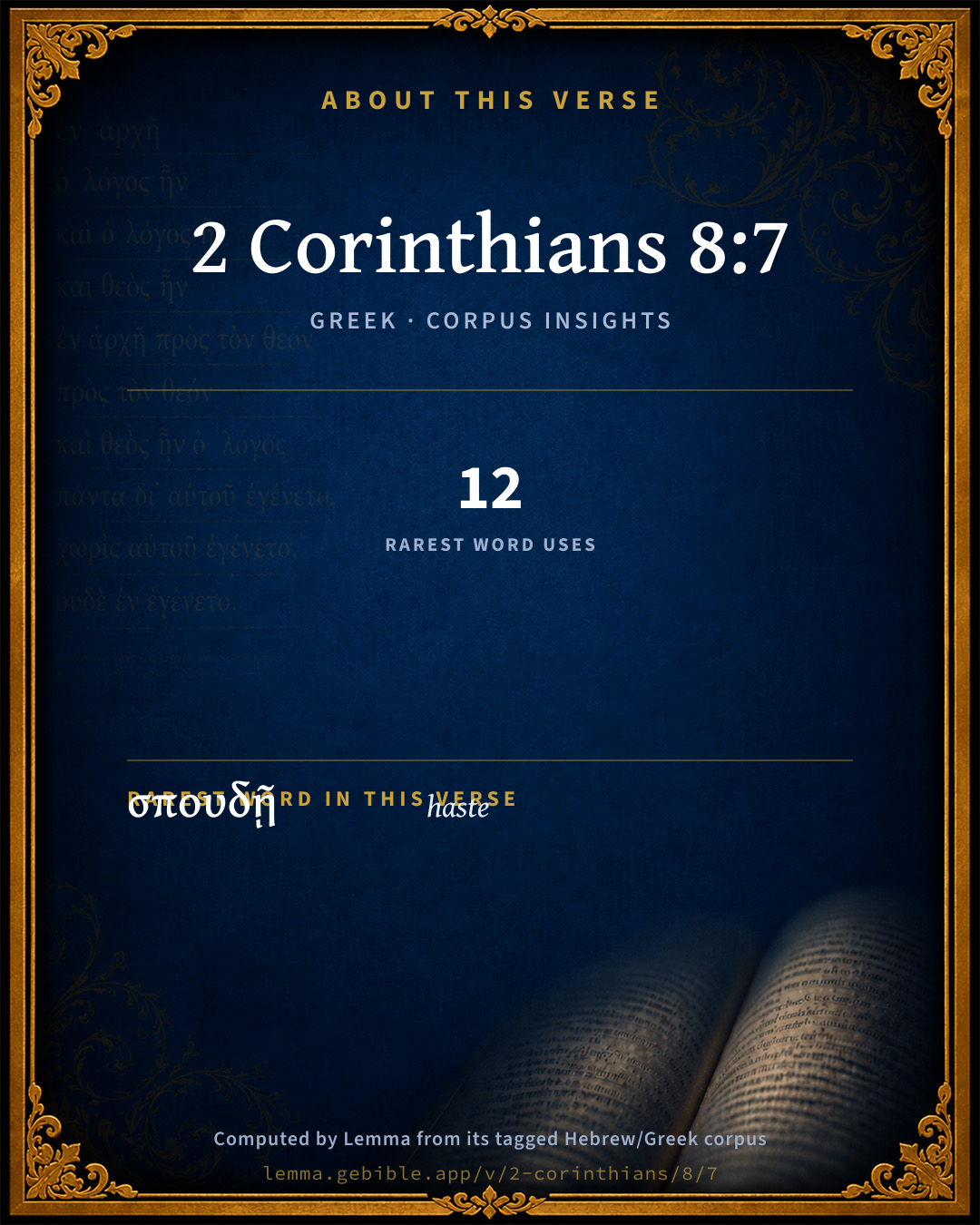
2 Corinthians 8:7

Greek (Tischendorf 8th ed.) 2 Corinthians 8:7 appears in the Greek New Testament. The text above is from the Tischendorf 8th edition. Each word links to its Strong’s number and a concise gloss. Click any word for its full Thayer’s Greek Lexicon entry.

Download image
Cite this verse

2 Corinthians 8:7 (World English Bible). Public Domain. Lemma interlinear Bible study tool, https://lemma.gebible.app/v/2-corinthians/8/7.

Show BibTeX & RIS
BibTeX
RIS
English Translation
But as you abound in everything, in faith, utterance, knowledge, all earnestness, and in your love to us, see that you also abound in this grace.
World English Bible · Public Domain
Download a study sheet

One document with this verse’s original text, its word-by-word gloss line, the meaning frame, cross-references with their text, attributed commentary, and full source and license credits — printable, and it pastes into notes with its structure intact.

This verse Autodidact and up

Study sheet (.html) Plain text (.txt)

A passage Seminary Student

Up to 50 verses in one chapter. A passage sheet keeps up to 6 commentary sources and 12 cross-references per verse, in the order this page ranks them, and says so on the sheet whenever that leaves anything out. Ask for a single verse and you get the Autodidact verse sheet above.

Everything on this page stays free to read, with no account — the sheet is a download of what is already on screen, not access to it.

Want to remove ads? Support Godless Engineer
Compare translations 3

The same verse in 3 English versions, stacked beneath the original-language interlinear above. Click any original word for its lexicon entry.

Each is an independent rendering of the whole verse — the interlinear is not word-aligned to these translations.

Highlighted words mark where these versions differ — a whole-verse word diff, not a word-by-word alignment.

  • World English Bible Public Domain
    But as you abound in everything, in faith, utterance, knowledge, all earnestness, and in your love to us, see that you also abound in this grace.
  • King James Version Public Domain
    Therefore, as ye abound in every thing, in faith, and utterance, and knowledge, and in all diligence, and in your love to us, see that ye abound in this grace also.
  • unfoldingWord Literal Text CC BY-SA 4.0
    But even as you abound in everything, in faith and in speech and in knowledge and in all earnestness and in the love from us in you, so also you should abound in this act of grace.

unfoldingWord Literal Text — © unfoldingWord, licensed CC BY-SA 4.0. Word-aligned USFM3 via Door43 (git.door43.org/unfoldingWord/en_ult).

Versions to compare (up to 4)

3 of 4 selected

Show all 19 translations

Every available English version of this verse, each an independent rendering of the whole verse.

  • World English Bible Public Domain
    But as you abound in everything, in faith, utterance, knowledge, all earnestness, and in your love to us, see that you also abound in this grace.
  • Berean Standard Bible Public Domain
    But just as you excel in everything—in faith, in speech, in knowledge, in complete earnestness, and in the love we inspired in you—see that you also excel in this grace of giving.
  • Majority Standard Bible Public Domain
    But just as you excel in everything—in faith, in speech, in knowledge, in complete earnestness, and in your love for us—see that you also excel in this grace of giving.
  • King James Version Public Domain
    Therefore, as ye abound in every thing, in faith, and utterance, and knowledge, and in all diligence, and in your love to us, see that ye abound in this grace also.
  • American Standard Version (1901) Public Domain
    But as ye abound in everything, `in' faith, and utterance, and knowledge, and `in' all earnestness, and `in' your love to us, `see' that ye abound in this grace also.
  • Revised Version (1885) Public Domain
    But as ye abound in everything, in faith, and utterance, and knowledge, and in all earnestness, and in your love to us, see that ye abound in this grace also.
  • Geneva Bible (1599) Public Domain
    Therefore, as yee abound in euery thing, in faith and woorde, and knowledge, and in all diligence, and in your loue towardes vs, euen so see that yee abound in this grace also.
  • Douay-Rheims (1899) Public Domain
    That as in all things you abound in faith, and word, and knowledge, and all carefulness; moreover also in your charity towards us, so in this grace also you may abound.
  • Young's Literal Translation Public Domain
    but even as in every thing ye do abound, in faith, and word, and knowledge, and all diligence, and in your love to us, that also in this grace ye may abound;
  • Literal Standard Version CC BY-SA 4.0
    but even as in everything you abound, in faith, and word, and knowledge, and all diligence, and in your love to us, that also in this grace you may abound;
  • Unlocked Literal Bible CC BY-SA 4.0
    But you abound in everything—in faith, in speech, in knowledge, in all diligence, and in your love for us. So also make sure that you excel in this act of grace.
  • unfoldingWord Literal Text CC BY-SA 4.0
    But even as you abound in everything, in faith and in speech and in knowledge and in all earnestness and in the love from us in you, so also you should abound in this act of grace.
  • Darby Bible Public Domain
    but even as ye abound in every way, in faith, and word, and knowledge, and all diligence, and in love from you to us, that ye may abound in this grace also.
  • World Messianic Bible Public Domain
    But as you abound in everything—in faith, utterance, knowledge, all earnestness, and in your love to us—see that you also abound in this grace.
  • Webster's Bible Public Domain
    Therefore, as ye abound in every thing, in faith and utterance, and knowledge, and in all diligence, and in your love to us, see that ye abound in this grace also.
  • Free Bible Version CC BY-SA 4.0
    Since you have an abundance of everything—your trust in God, your eloquence, your spiritual knowledge, your complete dedication, and in your love for us—make sure that your abundance also extends to this gracious ministry of giving.
  • Bible in Basic English Public Domain
    And that as you are full of every good thing, of faith, of the word, of knowledge, of a ready mind, and of love to us, so you may be full of this grace in the same way.
  • Text-Critical English NT CC BY 4.0
    But just as you abound in everything—in faith, in speech, in knowledge, in complete earnestness, and in your love for us—make sure you abound in this gracious gift as well.
  • Tyndale New Testament (1534) Public Domain
    Now therfore as ye are ryche in all parties in fayth in worde in knowledge in all fervetnes and in love which ye have to vs: even so se that ye be plenteons in this benivolence.

Literal Standard Version (2020), Covenant Press — licensed CC BY-SA 4.0. Text via the HelloAO Bible API (eBible.org). Unlocked Literal Bible (unfoldingWord) — licensed CC BY-SA 4.0. Text via the HelloAO Bible API (eBible.org). unfoldingWord Literal Text — © unfoldingWord, licensed CC BY-SA 4.0. Word-aligned USFM3 via Door43 (git.door43.org/unfoldingWord/en_ult). Free Bible Version, Dr. Jonathan Gallagher — licensed CC BY-SA 4.0. Text via the HelloAO Bible API (eBible.org).

Word by word

More ways to search: Search by grammar → Find every occurrence → Compare this word →

Practice this passage: Drill this verse → Learn its vocabulary →

σπουδῇ
spoudḗ
G4710
“haste”
Noun, Dative, Singular, Feminine
Part of Speech
Noun
Case
Dative
Number
Singular
Gender
Feminine
Full Thayer's Definition

Origin: from G4692

TDNT: 16:19,1

1. haste, with haste 2. earnestness, diligence a. earnestness in accomplishing, promoting, or striving after anything b. to give all diligence, interest one's self most earnestly
  1. ἀλλ’ allá G235 “but” Conjunction
  2. ὥσπερ hṓsper G5618 “even as” Adverb
  3. ἐν en G1722 “in” Preposition
  4. παντὶ pâs G3956 “all” Adjective, Dative, Singular, Neuter
  5. περισσεύετε perisseúō G4052 “to abound” Verb, Present, Active, Indicative, 2nd person, Plural
  6. πίστει pístis G4102 “faith” Noun, Dative, Singular, Feminine
  7. καὶ kaí G2532 “and” Conjunction
  8. λόγῳ lógos G3056 “word” Noun, Dative, Singular, Masculine
  9. καὶ kaí G2532 “and” Conjunction
  10. γνώσει gnōsis G1108 “knowledge” Noun, Dative, Singular, Feminine
  11. καὶ kaí G2532 “and” Conjunction
  12. πάσῃ pâs G3956 “all” Adjective, Dative, Singular, Feminine
  13. καὶ kaí G2532 “and” Conjunction
  14. τῇ ho G3588 “the” Article, Dative, Singular, Feminine
  15. ἐξ ek G1537 “from” Preposition
  16. ὑμῶν hymeîs G5210 “you” Personal pronoun, 2nd person, Genitive, Plural
  17. ἐν en G1722 “in” Preposition
  18. ἡμῖν hēmeîs G2249 “we” Personal pronoun, 1st person, Dative, Plural
  19. ἀγάπῃ agápē G26 “brotherly love” Noun, Dative, Singular, Feminine
  20. ἵνα hína G2443 “that” Conjunction
  21. καὶ kaí G2532 “and” Conjunction
  22. ἐν en G1722 “in” Preposition
  23. ταύτῃ hoûtos G3778 “this” Demonstrative pronoun, Dative, Singular, Feminine
  24. τῇ ho G3588 “the” Article, Dative, Singular, Feminine
  25. χάριτι cháris G5485 “grace” Noun, Dative, Singular, Feminine
  26. περισσεύητε perisseúō G4052 “to abound” Verb, Present, Active, Subjunctive, 2nd person, Plural

About this verse

These counts appear in no published source. They are computed here, from the morphology-tagged text and Lemma’s own curated glosses. What Lemma adds →

27
words
18
distinct lemmas
Pauline Epistles
section

Notable vocabulary

The rarest word here is σπουδῇ haste G4710 — appearing just 12 times in the whole Greek New Testament.

Shared distinctive vocabulary

σπουδῇ haste G4710 occurs in 12 verses of the Greek New Testament. Also found in:

Repetition

Words recur within this verse:

  • παντὶ all G3956 ×2
  • περισσεύετε to abound G4052 ×2
  • καὶ and G2532 ×5
  • ἐν in G1722 ×3
  • τῇ the G3588 ×2

Cross-references

23

Topical passages linked to 2 Corinthians 8:7 in the Treasury of Scripture Knowledge — connected by theme and wording, ordered by reader-vote popularity; previews shown in the World English Bible.

  • 2 Corinthians 9:8 And God is able to make all grace abound to you, that you, always having all sufficiency in everything, may abound to every good work.
  • 2 Thessalonians 1:3 We are bound to always give thanks to God for you, brothers, even as it is appropriate, because your faith grows exceedingly, and the love of each and every one of you towards one another abounds;
  • 2 Peter 1:5–8 Yes, and for this very cause adding on your part all diligence, in your faith supply moral excellence; and in moral excellence, knowledge;
  • Philippians 1:9 This I pray, that your love may abound yet more and more in knowledge and all discernment;
  • 1 Corinthians 1:5 that in everything you were enriched in him, in all speech and all knowledge;
  • 1 Corinthians 8:1–2 Now concerning things sacrificed to idols: We know that we all have knowledge. Knowledge puffs up, but love builds up.
  • 1 Corinthians 13:2 If I have the gift of prophecy, and know all mysteries and all knowledge; and if I have all faith, so as to remove mountains, but don't have love, I am nothing.
  • 2 Corinthians 8:6 So we urged Titus, that as he made a beginning before, so he would also complete in you this grace.
  • 1 Corinthians 4:7 For who makes you different? And what do you have that you didn't receive? But if you did receive it, why do you boast as if you had not received it?
  • Romans 15:14 I myself am also persuaded about you, my brothers, that you yourselves are full of goodness, filled with all knowledge, able also to admonish others.
  • 1 Corinthians 12:13 For in one Spirit we were all baptized into one body, whether Jews or Greeks, whether bond or free; and were all given to drink into one Spirit.
  • 1 Corinthians 13:8 Love never fails. But where there are prophecies, they will be done away with. Where there are various languages, they will cease. Where there is knowledge, it will be done away with.
  • Ephesians 4:29 Let no corrupt speech proceed out of your mouth, but such as is good for building up as the need may be, that it may give grace to those who hear.
  • 2 Timothy 2:1 You therefore, my child, be strengthened in the grace that is in Christ Jesus.
  • 1 Peter 1:22 Seeing you have purified your souls in your obedience to the truth through the Spirit in sincere brotherly affection, love one another from the heart fervently:
  • 2 Peter 3:18 But grow in the grace and knowledge of our Lord and Savior Jesus Christ. To him be the glory both now and forever. Amen.
  • 1 Corinthians 14:12 So also you, since you are zealous for spiritual gifts, seek that you may abound to the building up of the assembly.
  • 2 Corinthians 7:7 and not by his coming only, but also by the comfort with which he was comforted in you, while he told us of your longing, your mourning, and your zeal for me; so that I rejoiced still more.
  • 2 Corinthians 9:14 while they themselves also, with supplication on your behalf, yearn for you by reason of the exceeding grace of God in you.
  • 1 Thessalonians 4:9–10 But concerning brotherly love, you have no need that one write to you. For you yourselves are taught by God to love one another,
  • Hebrews 12:28 Therefore, receiving a Kingdom that can't be shaken, let us have grace, through which we serve God acceptably, with reverence and awe,
  • Philippians 1:11 being filled with the fruits of righteousness, which are through Jesus Christ, to the glory and praise of God.
  • Revelation 3:17 Because you say, 'I am rich, and have gotten riches, and have need of nothing;' and don't know that you are the wretched one, miserable, poor, blind, and naked;

Cross-references courtesy of OpenBible.info (CC BY 4.0).

Where the printed editions differ

2 variants

Places in this verse where the major printed Greek editions disagree on the wording in a way that affects the translation — a comparison of editions, not a manuscript-by-manuscript collation. The editions are the modern critical texts (Nestlé-Aland 28/27, SBL, Westcott-Hort, Tregelles, Tyndale House) and the traditional texts behind the KJV (the Textus Receptus and the Byzantine/Majority text). It is not a claim about which reading is original.

  1. Different wording
    ἡμῶν

    “of us”

    In NA28NA27SBLWH Not in TynTregTRByz

    ὑμῶν (humōn) 'of you' occurs in traditional manuscripts (Tyn+Treg+TR+Byz) instead of ἡμῶν (hēmōn) 'of us' in older manuscripts (NA28+NA27+SBL+WH)

  2. Different wording
    ὑμῖν

    “you”

    In NA28NA27SBLWH Not in TynTregTRByz

    ἡμῖν (hēmin) 'us' occurs in traditional manuscripts (Tyn+Treg+TR+Byz) instead of ὑμῖν (humin) 'you' in older manuscripts (NA28+NA27+SBL+WH)

Textual data: Translators Amalgamated Greek New Testament (STEPBible TAGNT) · CC BY 4.0.

Commentary

Notes on 2 Corinthians 8:7 from classic Christian and Jewish commentators (each source and its license shown beneath its notes). The classic Christian expositions comment on the surrounding passage and are grouped to its opening verse, so a note may address several verses; the Jewish commentaries on the Tanakh (Rashi and others) are per-verse, so they appear only where the commentator wrote on this verse.

Lemma curates 59 commentaries, every one of them public domain or Creative Commons licensed, each selected and text-cleaned for this edition rather than reprinted as found. About our sources →

Matthew Henry's Commentary

In these verses the apostle uses several cogent arguments to stir up the Corinthians to this good work of charity.

I. He urges upon them the consideration of their eminence in other gifts and graces, and would have them excel in this of charity also, Co2 8:7. Great address and much holy art are here used by the apostle. When he would persuade the Corinthians to this good thing, he commends them for other good things that were found in them. Most people love to be complimented, especially when we ask a gift of them for ourselves or others; and it is a justice we owe to those in whom God's grace shines to give them their due commendation. Observe here, What it was that the Corinthians abounded in. Faith is mentioned first, for that is the root; and, as without faith it is impossible to please God (Heb 11:6), so those who abound in faith will abound in other graces and good works also; and this will work and show itself by love. To their faith was added utterance, which is an excellent gift, and redounds much to the glory of God and the good of the church. Many have faith who want utterance. But these Corinthians excelled most churches in spiritual gifts, and particularly in utterance; and yet this was not in them, as in too many, both the effect and evidence of ignorance; for with their utterance there appeared knowledge, abundance of knowledge. They had a treasury of things new and old, and in their utterance they brought out of this treasury. They abounded also in all diligence. Those who have great knowledge and ready utterance are not always the most diligent Christians. Great talkers are not always the best doers; but these Corinthians were diligent to do, as well as know and talk, well. And further, they had abundant love to their minister; and were not like too many, who, having gifts of their own, are but too apt to slight their ministers, and neglect them. Now to all these good things the apostle desires them to add this grace also, to abound in charity to the poor; that, where so much good was found, there should be found yet more good. Before the apostle proceeds to another argument he takes care to prevent any misapprehensions of his design to impose on them, or to bind heavy burdens upon them by his authority; and tells them (Co2 8:8) he does not speak by commandment, or in a way of authority. I give my advice, Co2 8:10. He took occasion from the forwardness of others to propose what would be expedient for them, and would prove the sincerity of their love, or be the genuine effect and evidence thereof. Note, A great difference should be made between plain and positive duty, and the improvement of a present opportunity of doing or getting good. Many a thing which is good for us to do, yet can not be said to be, by express and indispensable commandment, our duty at this or that time.

II. Another argument is taken from the consideration of the grace of our Lord Jesus Christ. The best arguments for Christian duties are those that are taken from the love of Christ, that constraineth us. The example of the churches of Macedonia was such as the Corinthians should imitate; but the example of our Lord Jesus Christ should have much greater influence. And you know, saith the apostle, the grace of our Lord Jesus Christ (Co2 8:9), that though he was rich, as being God, equal in power and glory with the Father, rich in all the glory and blessedness of the upper world, yet for your sakes he became poor; not only did become man for us, but he became poor also. He was born in poor circumstances, lived a poor life, and died in poverty; and this was for our sakes, that we thereby might be made rich, rich in the love and favour of God, rich in the blessings and promises of the new covenant, rich in the hopes of eternal life, being heirs of the kingdom. This is a good reason why we should be charitable to the poor out of what we have, because we ourselves live upon the charity of the Lord Jesus Christ.

III. Another argument is taken from their good purposes, and their forwardness to begin this good work. As to this he tells them, 1. It was expedient for them to perform what they purposed, and finish what they had begun, Co2 8:10, Co2 8:11. What else did their good purposes and good beginnings signify? Good purposes, indeed, are good things; they are like buds and blossoms, pleasant to behold, and give hopes of good fruit; but they are lost, and signify nothing, without performances. So good beginnings are amiable; but we shall lose the benefit unless there be perseverance, and we bring forth fruit to perfection. Seeing therefore the Corinthians had shown a readiness to will, he would have them be careful also in the performance, according to their ability. For, 2. This would be acceptable to God. This willing mind is accepted (Co2 8:12), when accompanied with sincere endeavours. When men purpose that which is good, and endeavour, according to their ability, to perform also, God will accept of what they have, or can do, and not reject them for what they have not, and what is not in their power to do: and this is true as to other things besides the work of charity. But let us note here that this scripture will by no means justify those who think good meanings are enough, or that good purposes, and the profession of a willing mind, are sufficient to save them. It is accepted, indeed, where there is a performance as far as we are able, and when Providence hinders the performance, as in David's case concerning building a house for the Lord, 2 Sa. 7.

IV. Another argument is taken from the discrimination which the divine Providence makes in the distribution of the things of this world, and the mutability of human affairs, Co2 8:13-15. The force of the arguing seems to be this: - Providence gives to some more of the good things of this world, and to some less, and that with this design, that those who have a greater abundance may supply those who are in want, that there may be room for charity. And further, considering the mutability of human affairs, and how soon there may be an alteration, so that those who now have an abundance may stand in need of being supplied themselves in their wants, this should induce them to be charitable while they are able. It is the will of God that, by our mutually supplying one another, there should be some sort of equality; not an absolute equality indeed, or such a levelling as would destroy property, for in such a case there could be no exercise of charity. But as in works of charity there should be an equitable proportion observed, that the burden should not lie too heavy on some, while others are wholly eased, so all should think themselves concerned to supply those who are in want. This is illustrated by the instance of gathering and distributing manna in the wilderness, concerning which (as we may read, Ex. 16) it was the duty of every family, and all in the family, to gather what they could, which, when it was gathered, was put into some common receptacle for each family, whence the master of the family distributed to every one as he had occasion, to some more than they were able, through age and infirmity, to gather up; to others less than they gathered, because they did not need so much: and thus he that had gathered much (more than he had occasion for) had nothing over, when a communication was made to him that had gathered little, who by this method had no lack. Note, Such is the condition of men in this world that we mutually depend on one another, and should help one another. Those who have ever so much of this world have no more than food and raiment; and those who have but a little of this world seldom want these; nor, indeed, should those who have abundance suffer others to want, but be ready to afford supply.

Matthew Henry's Commentary on the Whole Bible (1708–1710) — public domain (CC PDM 1.0). Text via the HelloAO Bible API.

The Biblical Illustrator

Joseph S. Exell

2Co_8:7-8

Therefore, as ye abound in everything.

The grace of liberality

I. WHY we ought to give a portion of our substance to the lord. It is a duty clearly enjoined in Scripture. The practice of giving to the Lord began very early, for we read that Cain brought of the fruit of the ground an offering to the Lord, and that Abel also brought of the firstlings of his flock and the fat thereof. And why is this duty enjoined in Scripture? There are three reasons for this.

1. To remind us of our dependence on God as our Creator and bountiful benefactor.

2. To remind us of our obligation to God as our Redeemer.

3. To promote our spiritual welfare. We are naturally selfish, and wish to retain in our own possession whatever gifts God has conferred upon us.

II. What or how much we should give. Whatever we may think of the tenth or of the fifth, or of the early Christian examples, one thing is certain, that if our giving is to be acceptable to God it must cost us something. The measure with too many is what they can give without self-denial, or without in any way affecting their comforts or luxuries. This tenet giving in the Scriptural sense. Let us take the Divine measure, as God hath prospered us, and use it faithfully with the hand of love.

III. When we should give. Is there any Scriptural rule or suggestion on this point? (1Co_16:2). Some people profess to despise system in religious matters, and look upon it as savouring of legality. In worldly affairs system is called the soul of business and the secret of success. If, then, we recognise its value in everything else, why despise it in giving to the Lord?

IV. How or in what spirit we should give. (T. Moir, M. A.)

Christian liberality

Consider the duty of consecrating a portion of our substance to purposes of benevolence.

I. The reason of the duty.

1. It is the natural issue of the spirit of benevolence. God is love, and he that is begotten of Him in His own image must have a loving heart. Love delights to give--it is its nature to give; it needs no specific commandment--it is a commandment unto itself.

2. To the same result are we led, I remark further, by a regard for Gods glory.

3. This brings us to mention, as another incentive to Christian liberality, the love of Gods truth.

4. I add here another motive--it is that of gratitude.

5. It is a further plea for the duty before us that it benefits those who perform it. A bountiful spirit leads to temporal advantage. It favours industry, for he who delights in giving liberally will the more readily toil that he may have something to give. For a like reason it is conducive to economy. Selfishness more or less deranges our powers, and, among other harms, it puts the judgment in peril. Benevolence restores the balance of the mind. Many a man has become a bankrupt who, if the sweet spirit of charity had ruled him, raising him above grovelling aims, presenting things in their true relative importance, and allaying the fever of financial ambition, would have gone in comfortable solvency to his grave. Habits of beneficence secure, besides, the goodwill of men. But of far greater consequence is the influence of Christian liberality on our spiritual well-being. It is a precious means of grace.

II. From the reason of the duty before us we pass now to the manner of performing it.

1. We should give intelligently.

2. We should give cheerfully.

3. Of great importance is it that we give frequently.

4. We should give systematically.

III. We advert, in the last place, to the measure of our benevolence. The language of our text is, see that ye abound in this grace. What a man can do, and what abounding is, must depend on three conditions, jointly considered--his capital, his income, and his necessary expenses. (A. D. Smith, D. D.)

To prove the sincerity of your love.--

The test of love

Note--

I. That love is the essence of real religion. What we see is like the fruit of the vine, but there is a root. The gracious principle, though hidden, lives, grows, and operates. Observe--

1. Love Divine enkindles it.

2. The state (if the world expands it.

3. The Divine glory inflames it.

II. That the genuine character of Christian love is tested by circumstances. These circumstances are like balances to the coin, a storm to the ship, the fire to metal, or a battle to the soldier. E.g., there is--

1. The necessity of self-denial and bearing the cross. Remember Pauls conversion and subsequent life. We cannot serve God and mammon.

2. The rival claims of the world and the worship of God. There are earthly claims. Must not be allowed to stand in opposition, nor to monopolise that which belongs to God.

3. The requirement of means for the extension of the Redeemers kingdom.

Conclusion--

1. Let us fairly prove the state of our hearts.

2. Let us carefully test all our performances.

3. Let us contemplate the decisions of the judgment day. (Congregational Pulpit.)

Love to Christ proved

I. The claim of Christ to our love. It is founded--

1. On His Divine excellence; and the relation of all that excellence to us in the character of our Saviour.

2. On His deeds of benevolence and mercy, His mediatorial work and office.

3. By the personal benefits we have derived and are daily deriving from Him.

4. It is discerned in the provision He has made for our everlasting happiness and perfection.

II. The nature of the love He claims from us.

1. It must be supreme.

2. It must be constant.

3. It must be practical. Let us not love in word only, but in deed and in truth.

III. How Christ tries the love of His people.

1. By the doctrines and precepts of His Word. Proud reason finds it hard to bow to some truths.

2. By the circumstances of His cause in the world.

3. By the condition of some of His people. Many of them are in want and sickness and mental distress.

4. Our love to Christ is tried by the special circumstances of our own lot.

IV. The marks which prove our love false and inadequate. We can have no true love to Christ--

1. If we have not committed our souls to Him.

2. If we are cherishing secret sin.

3. If our attachment to any earthly object causes us to violate His commands.

4. If we are unwilling to deny ourselves for His honour or the service of His cause.

5. If we are unwilling to depart from this life that we may be for ever with Him. (The Evangelist.)

The Biblical Illustrator, edited by Joseph S. Exell (c. 1880s–1900s) — public domain. Text from a community e-Sword module.

Tyndale Open Study Notes

Tyndale Open Resources

8:7 This is the key verse in Paul’s exposition on Christian giving (8:1–9:15). The Corinthians had a reputation for spiritual gifts (1 Cor 1:5-7; 14:12). Now, they must be leaders in this gracious act of giving, which is a hallmark of true spirituality (cp. 1 Cor 13:1-13). God had been lavish in his goodness to the Corinthians, so they should be generous to the Jewish believers in their need (2 Cor 9:13). This would be recognized as a sign of unity in Christ.

Tyndale Open Study Notes — © Tyndale Open Resources, licensed CC BY-SA 4.0. Text via the HelloAO Bible API.

Bengel's Gnomon

Johann Albrecht Bengel

2Co 8:7. Ἀλλʼ ὥσπερ, but as) He says, but. The things which Paul had formerly done with the Corinthians by means of Titus, had the force of an injunction, ἐπιταγὴ, 2Co 7:15. Comp. 1Co 5:7. He now acts differently: therefore the word that presently after depends on, I speak, in the following verse.—ὥσπερ, as) The Spirit leads to abundance in all respects.—γνώσει, in knowledge) This is mentioned appositely: comp. ch. 2Co 6:6, note. Its conjugate γνώμην occurs presently at 2Co 8:10: comp. 1Co 7:25, note.—καὶ πάσῃ σπουδῇ) and in all diligence. σπουδῇ here comprehends ‘faith,’ and ‘utterance’ (of the heart and of the mouth), ‘knowledge,’ etc. And the genus or whole is often subjoined to the species or one or more parts, by introducing the connecting link, and all; ch. 2Co 10:5; Mat 3:5; Mat 23:27; Mar 7:3; Luk 11:42; Luk 13:28; Luk 21:29; Act 7:14; Act 15:17; Act 22:5; Eph 1:21; Eph 4:31; Eph 5:3; Heb 13:24, Jas 3:16; Rev 7:16; Rev 21:8; Rev 22:15.—καὶ τῇ—ἀγάπῃ, and in love) He subjoins to the genus [σπουδὴ] the species [ἀγάπη] which is most connected with the matter in hand [viz. that they should contribute to their brethren in need].—ἐξ, from) He does not say, in your love toward us, but he says, in love from you in us [in the love which is on your part, and is treasured up in us], because the Corinthians were in the heart of Paul, ch. 2Co 7:3. He pleads their love as an argument: he does not add, that they should give the more on account of Paul, who had preached to them the Gospel gratuitously.—ἵνα, that) This word depends on λέγω, I speak, elegantly subjoined [2Co 8:8].

Bengel's Gnomon of the New Testament — English translation (T&T Clark, Edinburgh, 1860) — public domain. Text from a community e-Sword module.

Meyer's Critical & Exegetical Commentary

Heinrich August Wilhelm Meyer

2Co_8:7. Ἀλλʼ] is not equivalent to οὖν (Beza and others, also Flatt), nor to agedum (Emmerling), but is the Latin at, breaking off the preceding statement, like the German doch. Hermann, ad Viger. p. 812, aptly says: Saepe indicat, satis argumentorum allatum esse. Comp. Baeumlein, Partik. p. 15. Olshausen has a more far-fetched idea, that it is corrective: yea rather. And Billroth imports quite arbitrarily: When I entreated Titus, I knew beforehand that this time also you would not deceive me, but that, as you are distinguished in all that is good, so also you would zealously further this collection; and Rückert also (similarly Calvin): I have entreated Titus, etc.; yet let it not happen that he should need first to encourage you (?), yea rather, etc. According to Hofmann, ἀλλά forms the transition to the οὐ κατʼ ἐπιταγὴν λέγω which follows in 2Co_8:8; but this supposes a very involved construction (comp. afterwards on ἵνα κ.τ.λ.).

ὥσπερ ἐν παντὶ κ.τ.λ.] as you in every relation are abundant (excellitis) through faith (strength, fervour, and efficacy of faith), and discourse (aptitude in speaking), and knowledge (see regarding both on 1Co_1:5), and every diligence (studium ad agendas res bonas, Grotius), and your love to us, so should you abound in showing this kindness. If πίστει κ.τ.λ. be taken as a specification of ἐν παντί (Luther, Grotius, and most), the meaning is more uncertain, since ἐν is not repeated. Comp. 2Co_6:4; 1Co_1:5; it comes in again only before ταύτῃ τ. χάρ. Grotius aptly remarks: non ignoravit P. artem rhetorum, movere laudando. Amidst the general praise, however, he wisely here also leaves the distingue personas to the feeling of the reader.

τῇ ἐξ ὑμῶν ἐν ὑμῖν ἀγάπῃ] Paul here conceives the active love as something issuing from the disposition of the person loving, and adhering to the person loved. Thus he felt the love of the Corinthians to him in his heart; comp. 2Co_7:3. This view alone suits the context, inasmuch as the other points mentioned are points purely subjective, belonging to the readers, and serving to recommend them; hence we are not to understand it as the love dwelling in the apostle, but owing its origin to the readers (Hofmann). Calvin aptly remarks: Caritatem erga se commemorat, ut personae quoque suae respectu illis addat animos. On the form of the expression, comp. Winer, p. 181 f. [E. T. 241].

ἵνα καὶ ἐν ταύτῃ τῇ χάριτι περισσ.] A periphrasis for the imperative, to be explained by supplying a verb of summoning, on which ἵνα depends in the conception of the speakers. See Buttmann, p. 208 [E. T. 241]; Fritzsche, ad Matth. p. 840, ad Marc. p. 179. In the old Greek ὅπως is used in the very same way (ἵνα late and seldom, as in Epictetus, Dissert, iv. 1. 142). See Matthiae, p. 1187; Viger. ed. Herm. pp. 435, 791 f.; Hartung, Partikell. II. p. 148. According to Grotius and Bengel, whom Hofmann follows, the connecting of ἵνα κ.τ.λ. with the following οὐ κατʼ ἐπιταγὴν λέγω would yield no unsuitable sense (in opposition to Rückert); but the construction of the passage in 2Co_8:7-8, so as to form one period, would be a construction assumed without sufficient ground, ill-arranged and ambiguous, and would not accord with the apostles way of beginning a new sentence by οὐ … λέγω in order to guard against an incorrect judgment of the previous one (2Co_7:3; 1Co_4:14. Comp. 2Co_5:12).

In καὶ ἐν ταύτῃ τῇ χάριτι, ταύτῃ has the emphasis (it was otherwise in 2Co_8:6); also in this showing of kindness, as in other works of beneficence,which was embraced in ἐν παντί.

2Co_8:7-15. Encouragement to associate with their other Christian excellences distinction also in this work of love, which he says not in the form of a command, but to test their lovefor they knew indeed the pattern of love in Christand by way of advice (w. 79). For this is serviceable for them, inasmuch as they had already made the beginning. Now, however, they were not to fail of completing their work, namely, according to their means; for it was not intended that others should be at ease while they were in want, but that a relation of equality should be established (2Co_8:10-15).

Meyer — Critical and Exegetical Commentary on the New Testament — English translation by Peter Christie, edited by Frederick Crombie (T&T Clark, 1880) — public domain. Text from a community e-Sword module.

Jamieson, Fausset & Brown

Robert Jamieson, A. R. Fausset & David Brown

in faith-- (Co2 1:24).

utterance--(See on Co1 1:5). Not as ALFORD, "doctrine" or "word."

knowledge-- (Co1 8:1).

diligence--in everything that is good.

your love to us--literally, "love from you (that is, on your part) in us" (that is, which has us for its object; which is felt in the case of us).

Jamieson, Fausset & Brown — Commentary Critical and Explanatory on the Whole Bible (1871) — public domain (CC PDM 1.0). Text via the HelloAO Bible API.

Adam Clarke's Commentary

Verse 7. As ye abound in every thing] See the note on 1Co 1:5. In faith, crediting the whole testimony of God; in utterance, λογω, in doctrine, knowing what to teach: knowledge of God's will, and prudence to direct you in teaching and doing it; in diligence, to amend all that is wrong among you, and to do what is right; and in love to us, whom now ye prize as the apostles of the Lord, and your pastors in him.

Abound in this grace also.] Be as eminent for your charitable disposition as ye are for your faith, doctrine, knowledge, diligence, and love.

Adam Clarke's Commentary on the Bible (1810–1826) — public domain. Text from a community e-Sword/MySword module.

John Calvin's Commentaries

7. But as He had already been very careful to avoid giving offense, inasmuch as he said, that Titus had entreated them, not so much from his own inclination, as in consideration of the charge given him by the Macedonians. Now, however, he goes a step farther, by admonishing them, that they must not even wait for the message of the Macedonians being communicated to them; and that too, by commending their other virtues. “You ought not merely to associate yourselves as partners with the Macedonians, who require that; but surpass them in this respect, too, as you do in others.”

He makes a distinction between utterance and faith, because it. is impossible that any one should have faith, and that, too, in an eminent degree, without being at the same time much exercised in the word of God. Knowledge I understand to mean, practice and skill, or prudence. He makes mention of their love to himself, that he may encourage them also from regard to himself personally, and in the mean time he gives up, with a view to the public advantage of the brethren, the personal affection with which they regarded him. Now in this way he lays a restraint upon himself in everything, that he may not seem to accuse them when exhorting them.

John Calvin's Commentaries (1540-1563) — public domain. Text from the Calvin Translation Society English edition (1840s-50s) via the Christian Classics Ethereal Library (ccel.org). Calvin's coverage is partial (roughly two-thirds of the Bible); uncommented books and verses are honest gaps, never fabricated. The 19th-century editor's footnotes and remarks are omitted so the notes are faithfully Calvin's own voice.

Ellicott's Commentary for English Readers

(7) Therefore, as ye abound in every thing.—Literally, But, as ye abound, marking the transition from narrative to exhortation. He opens, as was his manner, with words of praise, and dexterously combines the gifts of “utterance and knowledge,” which he had acknowledged before (1Co_1:5), with the “earnestness and love” of which he had spoken in this very Epistle (2Co_7:12).

And in your love to us.—Some MSS. give the reading “our love for you,” but that in the text has abundant authority, and gives a far better meaning. The English expresses the general meaning, but there is a subtle delicacy in the Greek: “the love which, flowing from you, rests in us as its object.” The other reading would convey the sense of “the love which, flowing from us—i.e., from our teaching and influence—now dwells in you, and shows itself in act.” In any case, he is praising them for a quality which is actually theirs.

A Bible Commentary for English Readers, edited by Charles John Ellicott (1878–1897) — public domain. Text from a community e-Sword module.

The Cambridge Bible for Schools and Colleges

gen. ed. J. J. S. Perowne

7. as ye abound] Cf. 1Co_1:5.

in all diligence] See note on ch. 2Co_7:11.

your love to us] Some copies read our love to you.

this grace also] The word here, as in the last verse, seems to bear more the signification known to us in the phrase ‘Christian graces’ than in most places in which it occurs. The passage should perhaps run see that ye also abound (literally exceed, see note on ch. 2Co_7:4) in this grace, i.e. act of favour or kindness (see last verse). We may observe that faith and utterance and the like were of little avail without love. See 1Co_8:1; 1Co_8:13; 2Pe_1:5-7.

The Cambridge Bible for Schools and Colleges (gen. ed. J. J. S. Perowne; Cambridge University Press, 1878–1918) — public domain. Text from a community e-Sword module.

John Gill's Exposition

Therefore as ye abound in everything,.... In all gifts and every grace, in the use and exercise of them, insomuch that they were enriched in everything, and wanted nothing; see Co1 1:5, that is here expressed in general, is explained by particulars following:

in faith: both in the doctrine of faith, which they had received and professed, held fast to, and abode by; yea, they abounded in the knowledge of it, zeal for it, and thankfulness to God on account of it; and in the grace of faith, not an historical one, nor the faith of miracles, but that which is peculiar to God's elect, is the gift of his grace and the work of his Spirit, which has Christ for its object, and works by love; in this they abounded, inasmuch as they had a large measure of it, grew in it, were full of it, and were much in the exercise thereof:

in utterance, or "speech": meaning either the gift of speaking with tongues, which many in this church had; or the gift; of understanding and explaining the word of God with much freedom; or a liberty of mind and speech to declare their faith in Christ, and make an ingenuous confession of it to others:

in knowledge; of God and of Christ, and of the truths of the Gospel:

and in all diligence: their ministers were diligent in preaching the Gospel, the people in hearing the word, and attending on ordinances, and both studiously careful to keep up the discipline of the church; and very industrious to discharge the several duties of religion, and to assist one another, both in things temporal and spiritual:

and in your love to us: the apostles and ministers of the word, whom they loved, esteemed, and honoured for their works' sake: and since they were so eminent for these graces, and the exercise of them, the apostle exhorts them to liberality to the poor saints;

see that ye abound in this grace also; for as faith, utterance, knowledge, diligence, and love to Christ's ministers are graces; so also is kindness shown to Christ's poor members, it is a gift of God's grace, cannot be rightly exercised without the assistance of his grace, has for its objects men who have received the grace of God, and will be rewarded with a reward of grace; persons eminent for the several graces of the Spirit of God, and the exercise of them, it may be not only desired, but expected from them, that they should abound in the exercise of beneficence to the poor. This is another argument exciting to that good work.

John Gill's Exposition of the Whole Bible (1746–1763) — public domain (CC PDM 1.0). Text via the HelloAO Bible API.

Trapp's Complete Commentary

John Trapp

7 Therefore, as ye abound in every thing, in faith, and utterance, and knowledge, and in all diligence, and in your love to us, see that ye abound in this grace also.

Ver. 7. As he abound in faith] He purposely commendeth them, that he may the better insinuated into them. Ministers may profitably praise their people in some cases, that they may the sooner win them to duty; for there is no so sweet hearing (saith Xenophon) as a man’s own commendation, ηδιστον ακουσμα επαινος.

John Trapp, A Commentary or Exposition upon All the Books of the Old and New Testament (1647–1656) — public domain. Text from a community e-Sword module.

Albert Barnes' Notes on the Bible

Therefore as ye abound in everything - see the note, 1Co 1:5. Paul never hesitated to commend Christians where it could be done with truth; and the fact that they were eminent in some of the Christian duties and graces, he makes the ground of the exhortation that they would abound in all. From those who had so many eminent characteristics of true religion he had a right to expect much; and he therefore exhorts them to manifest a symmetry of Christian character.

In faith - In the full belief of the truth and obligation of the gospel.

And utterance - In the ability to instruct others; perhaps referring to their power of speaking foreign languages; 1 Cor. 14.

And knowledge - The knowledge of God, and of his truth.

And in all diligence - Diligence or readiness in the discharge of every duty. Of this, Paul had full evidence in their readiness to comply with his commands in the case of discipline to which so frequent reference is made in this Epistle.

And in your love to us - Manifested by the readiness with which you received our commands; see 2Co 7:4, 2Co 7:6-7, 2Co 7:11, 2Co 7:16.

See that ye abound in this grace also - The idea here is, that eminence in spiritual endowments of any kind, or in any of the traits of the Christian character should lead to great benevolence, and that the character is not complete unless benevolence be manifested toward every good object that may be presented.

Albert Barnes' Notes on the Bible (1834–1885) — public domain. Text from a community e-Sword/MySword module.

Matthew Poole's English Annotations

Though the apostle made little use of oratory in his ordinary discourses and epistles, yet he knew how to use it when it might be of probable advantage for the ends which he aimed at, viz. the glory of God, and the good of the souls that were under his care. He did not turn divinity into mere words and rhetorical flourishes; yet he made use of these sometimes, as a waiting maid to divinity. Being therefore to press upon these Corinthians this great duty of charity, he insinuateth himself into them, by telling them, that they abounded in all other spiritual habits:

Faith, by which they had both steadily assented to the truth of gospel propositions, and also received Christ.

Utterance, by which they were enabled either to speak with tongues, or to God in prayer. For to men by prophecy and exhortation.

Knowledge, both of things Divine and human. And in love to the ministers of the gospel, which, if it did not appear in all, yet it did in many of them. And from hence he fetcheth an argument to press them to be complete in this habit of grace. The force of the apostle’s argument lies, in the duty of all Christians to strive after perfection, and that natural desire, which is in all ingenuous people, to be perfect in that good of which they have a taste in less perfect degrees.

Matthew Poole's English Annotations on the Holy Bible (1683–1685) — public domain. Text from a community e-Sword/MySword module.

Whedon's Commentary on the Bible

Daniel D. Whedon

7. Abound… faith… utterance… knowledge—The gifts of the Corinthians, so fully commemorated in the first epistle, (1Co_12:8-9,) were an ample reason why they should not fail in the noble gift of generous liberality.

Daniel D. Whedon (gen. ed.), Commentary on the Old and New Testaments (1874–1909) — public domain. Text from a community e-Sword module.

The Pulpit Commentary

Therefore; rather, but. In the following verses to ver. 15 he tells them his wishes about this collection. He desires them to show generosity among their other graces (ver. 7), not by way of command, but that they may emulate others and show their love (ver. 8) by following the example of Christ (ver. 9). And by acting thus they would prove the sincerity of their former promises (vers. 10, 11), especially as he did not wish them to give more than they could justly spare by way of reciprocity (vers. 12-15). As ye abound in every thing, in faith, etc. Perhaps "by faith," etc., "St. Paul," says Grotius, "knew the art of the orators to move by praising." This method of conciliating attention is technically called proparaitesis. The praise was, of course, sincere, though, no doubt, it was expressed with the generosity of love. (see 1Co_1:5) And in your love to us. The Greek is more emphatic," and by the love from you in us;" i.e. by the love which streams from you, and which I feel in myself. In this grace also; namely, the grace of Christian liberality.

Vers. 7-15.

Appeal to the Corinthians.

A wise use had been made by the apostle of the example of the Macedonians. He had not appealed to pride, vanity, or any selfish feeling, but had simply presented a remarkable case of Christian philanthropy. Robertson very properly remarks, "Had the apostle said, "Be not beaten by those Macedonians;" had he called natural prejudices into play a Corinthian to yield to a Macedonian! then all the evil passions of our nature had been stimulated." Emulation is a true principle, and may be a religious principle. The danger lies, not in the thing itself, but in its abuses, and particularly in the encouragement which it may afford to false rivalry and jealousy. In a large measure, the spirit and conduct of others make the social atmosphere we breathe, nor can we live in the world without contact with it. Goodness assumes its most attractive forms in noble examples, and, except for these, our own ideals, if they existed at all, would be very imperfect. Consistently, then, with his purpose of stimulating the Corinthians to seek a high degree of Christian excellence, the apostle sets before them in most vivid colours the liberality of the Macedonian Churches. Titus had begun, and he would have him "finish in them the same grace also." Men are channels of Divine influence to our souls, and, as such, should be acknowledged in their work. St. Paul saw God"s blessing on the labours of his young friend, and he would not deprive him of the honour of completing the task. He stood out of his way, encouraged his efforts, and lent him a fatherly hand in furtherance of his undertaking. This sympathy with young men is one of his characteristic qualities, and it is worthy of warm admiration. Many an elderly officer in the Church might heed it to great advantage. Titus should have all the credit. Let the brethren at Corinth heartily second his exertions in behalf of the poor saints at Jerusalem. If they abounded "in everything, in faith, and utterance, and knowledge, and in all diligence," and in their love for the apostle, let them "abound in this grace also." The quality being pure, quantity was a favourite idea which he never lost an opportunity to urge. "Abound" and "abundant" flow freely from his pen. "Not by commandment" was this written. Free hearts, joyous impulses, could alone be recognized in this enterprise of humanity. This was the value of example, it was a sympathetic influence; and hence his reference to "the forwardness of others," which would test the "sincerity of their love." What a great truth is taught here, and that too so incidentally as to escape the attention of all save those who make the cultivation of discernment a constant duty! Noble examples are Divine tests; they prove, as we have said, the depth and activity of our sympathies, and in this respect supply the means of a discipline otherwise lacking. "Forwardness of others;" study its meaning. God commissions the leaders. Vast enterprises are never born of masses, but of individuals; apostles first, and then Churches; Bunyan, and two centuries of literature for the poor and illiterate; Watts and the sacred poets following; Raikes and Wesley; Martyn and Judson; successors multiplied because of their "forwardness." Having dwelt on the example of the Macedonians, the transition is easy to the Divine Exemplar. A single verse reminds them of "the grace of our Lord Jesus Christ," the surrender of his eternal glory, the riches of his Godhead"s state, the extent of the abnegation, the earthly poverty assumed, and all for their sakes, that "through his poverty" they "might be rich." The supreme consideration must be kept in full view. Of the Macedonians he had spoken; of the "great trial of affliction," of their "deep poverty," and how it abounded "unto the riches of their liberality." Whence came this power? A new heart had been given to poverty, so that now, though its means were meagre, its social position unhonoured, its claims to influence set at nought, yet it had achieved wonders such as had never been thought possible. Macedonia had stretched out her arms of blessing to distant Jerusalem, and Gentiles and Jews long alienated were now one in the holiest of brotherhoods. It was due to the grace of Christ. It was his Spirit reproducing itself in the lives of believers. And therefore he had cited their conduct; but most of all let them remember the one great sacrifice of the incarnate Christ. Years subsequently we have in another Epistle (Php 2) a similar train of thought. Age was upon him then, and life was drawing to a tragical close at Rome. Yet then, as now, then and now as throughout his ministry, the grace of the Lord Jesus was the one thought that inspired all other thoughts. It is still "advice." "Advice" is better than "commandment." They had begun the work of the collection, complete the task; they had a "readiness to will," let the effort be consummated. And, again, an important principle is brought to their notice. Was not "advice" sufficient? Would not an opinion be strong enough without a command? Yea, indeed, for a year ago the Corinthians had made a start in this matter. A willing mind is the first thing; grace begins here, and if this willing mind gives all it can, it is accepted of God, according to what "a man hath, and not according to that he hath not." Mark the solicitude of the apostle as to the education of this sentiment of giving. He cannot think of it as a thing to which they must be constrained, and, accordingly, he acknowledges the largest freedom, only it must be Christian freedom. Motive must have free play. Conscience must advance into affection, or conscience is stunted. Sensibility must be self-impelled. Nor must any conclude that he wished to oppress them that others might be relieved, "but only to establish between Jewish and Gentile Churches a reciprocity of aid in time of need" (Dr. Farrar). To establish an "equality" was his object. Do not mistake his meaning. Political, social, natural equality was utterly foreign to his thought and purpose. No revolutionist, no anarchist, no leveller, was he in any sense, in any degree, but simply the advocate of such an equality as should be produced by the sentiment of Christian liberality in the distribution of gifts. That equalizing influence was not to proceed from an arbitrary law nor from force work of any sort. It was to be spontaneous, each man a judge for himself, and the superabundance in one place was to supply the deficiency at another place, so as to secure an abundance for all. Reference is made to the manna in the wilderness. If one gathered more manna than the allotted supply, it was sent to those who had not collected enough, so that the necessities of all were met. This was the law of Judaism as between Hebrew and Hebrew, and the spirit of this law, fifteen centuries afterwards, reappears in a letter to the Corinthians. History in one portion of the world and among one people becomes prophecy in another portion and among another people. Prophecy, in turn, becomes a new history. And today, A.D. 1884, thousands in Europe and America are acting on this equalizing sentiment in the use of their property. L.

The Pulpit Commentary (1880–1919), ed. H.D.M. Spence-Jones & Joseph S. Exell — public domain. Text from a community e-Sword module.

Kretzmann's Popular Commentary

Paul E. Kretzmann

A proof of their love for Christ:

v. 7. Therefore, as ye abound in everything, in faith, and utterance, and knowledge, and in all diligence, and in your love to us, see that ye abound in this grace also.

v. 8. I speak not by commandment, but by occasion of the forwardness of others, and to prove the sincerity of your love.

v. 9. For ye know the grace of our Lord Jesus Christ, that, though he was rich, yet for our sakes he became poor, that yet through His poverty might be rich.

v. 10. And here in I give my advice; for this is expedient for you, who have begun before, not only to do, but also to be forward a year ago.

The previous argument is here expanded and connected with one that is still more impressive: But rather that, as you excel in everything, in faith and utterance and knowledge and all diligence and the love from you to us, you excel also in this gift of grace. All these gifts were found in rich measure among the Corinthians: Faith, not saving faith as much as that heroism of faith which is sometimes vouchsafed by God, 1Co 12:9; utterance, the ability to expound and apply the Gospel-message; knowledge of divine things, which should be used for the purpose of edification; all diligence and earnestness not to stand behind anyone else in the carrying out of God’s mill: love toward their teacher, of which he had had abundant proof. It is a very skillful argument which Paul employs in enumerating all these excellencies, and then stating that they surely would not want to be found deficient in this one gift of Christian liberality.

And lest they feel offended even at this way of putting the matter, Paul hastens to add: Not by way of commandment I speak, but as testing through the diligence of others the genuineness of your love. In the matter of Christian sanctification, Paul might have given definite instructions, 1Co 14:37. But he refrains from doing so in the instance of this collection, lest he spoil the joy of their voluntary giving. Through the earnestness and zeal of others, that is, of the Macedonian congregations, he wanted to test their love. For he knew that the zeal of the Macedonians ought to stimulate the Corinthians to a similar display of ardor, and thus it should be proved whether their love was genuine. If they permitted poorer brethren to overshadow their efforts in the matter of this collection, it would be fairly well established that their love toward the apostle, and above all toward Christ, was not of the right kind.

This introduces the weightiest argument of all: For you know the grace of our Lord Jesus Christ, that for our sakes He became poor, though He was rich, in order that you through His poverty might be made rich. With this fact the Corinthians were familiar, since it was one of the basic doctrines taught by the apostle, just as it is repeated in all Gospel-preaching in a manifold variation. The grace of the Lord Jesus Christ the apostle reminds them of, the free kindness and favor, whose only reason and motive is His eternal love for sinful mankind. This grace was revealed and put into execution in such a way that he for their sakes, for the sake of all men, became poor, subjected Himself to the deepest poverty, and that although He was rich. The rich Lord of heaven, the Possessor of the fullness of divine glory and of the abundance of all treasures, became poor, denied Himself the use and enjoyment of even ordinary prosperity, and lived all His life in the depths of poverty. But incidentally He poured out upon us the full measure of the spiritual riches in heavenly places, giving us all the more of spiritual treasures as He lacked earthly treasures. With such an example of supreme self-sacrifice before their eyes at all times, what could the Corinthians, what can the Christians of all time, do but strive with all the spiritual power at their command to emulate the great example and to follow in the footsteps of their great Lord?

Instead of commanding, therefore, the apostle writes: And my opinion I give in this matter, for this is profitable for you, inasmuch as, not only in doing, but also in intending to do, you were the first to make a beginning last gear. The apostle, in this case, deliberately chose not to give definite and detailed instructions, because his advice at this time would be better, more expedient, would serve his purposes with more profit. For as much as a year ago, when Paul had first laid the matter of a collection for Jerusalem before them, they had intimated their willingness. They had so much of a start of the Macedonians not only in carrying out the plan, but also in the original purpose. In such a case, then, where people are fully willing to do the right thing, they derive greater moral advantage from a word of counsel than from any injunction. Here is a hint in pastoral tact for ministers and church boards as well as for parishioners in general.

Paul E. Kretzmann, Popular Commentary of the Bible (1921–1924) — public domain. Text from a community e-Sword module.

McGarvey & Pendleton's Commentaries

J. W. McGarvey

But as ye abound in everything, in faith, and utterance, and knowledge, and in all earnestness, and in your love to us, see that ye abound in this grace also .

J. W. McGarvey (with Philip Y. Pendleton), Commentaries on the New Testament (The Fourfold Gospel, 1914; Acts; and the epistles) — public domain. Text from a community e-Sword/MySword module.

The People's New Testament

B. W. Johnson

7. As ye abound in everything. Instead of Macedonia setting the example to Corinth, the latter ought to have led. Their church was rich in gifts. See 1 Cor. 1:5.

B. W. Johnson's The People's New Testament with Notes (1889–1891) — public domain. Electronic text from the Christian Classics Ethereal Library (CCEL) ThML edition.

Cambridge Greek Testament for Schools and Colleges

7. Perhaps ἐξ ἡμῶν ἐν ὑμῖν (B 30, 31, Arm.) rather than ἐξ ὑμῶν ἐν ἡμῖν (אCDFGKLP, Latt. Aeth.).

7. ἀλλʼ ὥσπερ ἐν παντὶ περισσεύετε. Nay, as ye abound in everything. There is no parenthesis. The ἀλλά indicates that there is something further to be said. ‘All this is true, but, what is more, as ye abound in everything.’ Comp. 2Co 7:11, and see notes.

σπουδῇ. Earnestness. Comp. 1Co 1:5, where much the same gifts are mentioned, and Eph 1:8; Eph 5:9. See Ellicott on Eph 1:8.

τῇ ἐξ ἡμῶν ἐν ὑμῖν. The reading is doubtful: see critical note. Our choice lies between ‘the love which was inspired by us and finds a home in you,’ and ‘the love which proceeds from you and finds a home in us.’ ‘The love which unites your hearts with ours’ is meant. For the ἐκ comp. 2Co 7:9.

ἴνα καὶ ἐν ταύτῃ τῇ χάριτι περισσεύητε. The construction of ἴνα is ambiguous. It may be coordinate with ἴνα in 2Co 8:6. The Apostle exhorted Titus for two ends; (1) that as Titus had begun, so he should complete; (2) that as you abound in everything, so you may abound in Christian charity. Or we may suppose the ellipse of some such verb as βλέπετε, or θέλω, or παρακαλῶ. Comp. Eph 5:33. Winer, p. 396. There is emphasis on ταύτῃ: ‘in this grace also.’ Comp. 2Pe 1:5-7. Were the Corinthians stingy? Comp. 2Co 11:8-9, 2Co 12:13; 1Co 9:11-12.

Cambridge Greek Testament for Schools and Colleges (Cambridge University Press, 1896; 21 vols, various authors incl. Carr, Maclear, Plummer, Farrar, Lumby, Moule, M. R. James, Simcox) — public domain. Text from a community e-Sword module.

Alford’s Greek Testament

Henry Alford

7-15.] Exhortations and inducements to perform this act of charity.

7.] ἀλλά marks the transition to an exhortation, as in reff. It at the same time implies, as Herm. ad Viger. p. 812 (in Meyer), ‘satis argumentorum allatum esse.’

πίστει, see ch. 1:24.

λόγῳ κ. γνώσει see ref. and for γν., 1Co 8:1.

πάσῃ σπουδῇ, because σπουδή may be manifold even in a good sense. Grot. well explains it, ‘stadium ad agendas res bonas.’

τῇ ἐξ ὑμ. ἐν ἡμ. ἀγ.] your love to us;—the love which, arising from you, has us for its object: see reff. According to the reading, ἐξ ἡμῶν ἐν ὑμ., the only meaning agreeing with the context is, ‘the love (to God and man) which, arising from our teaching, is planted in you.’

ἵνα καὶ κ.τ.λ.] the sense is imperative,—κελεύω, or βούλομαι,—(or βλέπετε, see 1Co 16:10,)—being omitted. So Soph. Œd. Col. 156, ἀλλʼ ἵνα τῷδʼ ἐν ἀφθέγκτῳ, μὴ προσπέσῃς νάπει. See Hartung, Partikellehre, ii. 148, 9.

ταύτῃ is emphatic here, although ταύτην is not in ver. 6: ‘this grace also;’—other graces having been enumerated.

Grotius remarks, ‘non ignoravit Paulus artem rhetorum, movere laudando.’

Henry Alford, The Greek Testament (1849–1861) — public domain. Text from a community e-Sword module.

Lesson kit

Teaching starters — assembled from the data on this page, not authored interpretation. Every prompt links to the verse data it draws on. Edit before teaching.

2 Corinthians, in the Pauline Epistles, opens this verse with 27 words (18 distinct Greek lemmas). Its most distinctive word is spoudḗ (“haste”). A historical commentator’s framing appears above. Read the whole chapter for the surrounding context.

Discussion questions

  1. What does “haste” (spoudḗ) contribute to the verse as a whole?
  2. How does Mark 6:25, which shares the word «haste», read alongside this verse?
  3. What does the repetition of “all” (2× in this one verse) do in this verse?
  4. These translations render this verse differently; the difference is in the English rendering, not the original. What questions does that raise?
  5. Compare how Matthew Henry's Commentary and The Biblical Illustrator read this verse. Where do they agree or differ?

Things to notice

Reading settings

Reading text

Shown beneath each verse's original-language words.

Old Testament
Old Testament edition

Read the OT as the Masoretic Hebrew (MT) or the Greek Septuagint (LXX).

English shown for the Greek Septuagint (in the Hebrew ↔ Greek comparison).

Comparing translations? Open the Compare panel on any verse page to stack up to four side by side.