
Proverbs 1:9

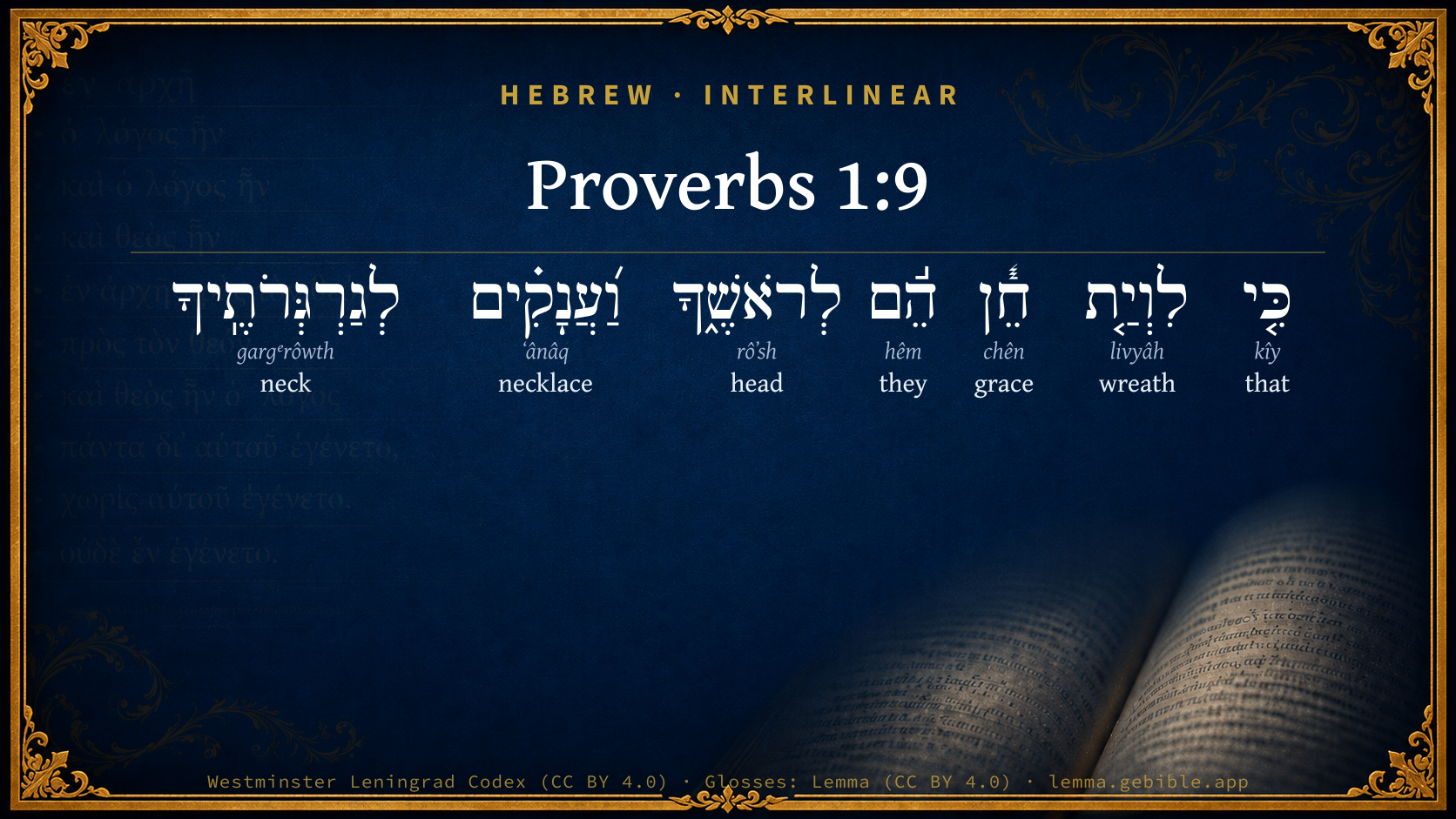
Hebrew (Westminster Leningrad Codex) Proverbs 1:9 appears in the Hebrew Old Testament. The text above is from the Westminster Leningrad Codex. Each word links to its Strong’s number, a concise gloss, and parsing drawn from the Open Scriptures Hebrew Bible morphology. Click any word for its full Brown-Driver-Briggs (BDB) entry.
Download image
Cite this verse

Proverbs 1:9 (World English Bible). Public Domain. Lemma interlinear Bible study tool, https://lemma.gebible.app/v/proverbs/1/9.

Show BibTeX & RIS
BibTeX
RIS
English Translation
For they will be a garland to grace your head, And chains around your neck.
World English Bible · Public Domain
Highlights
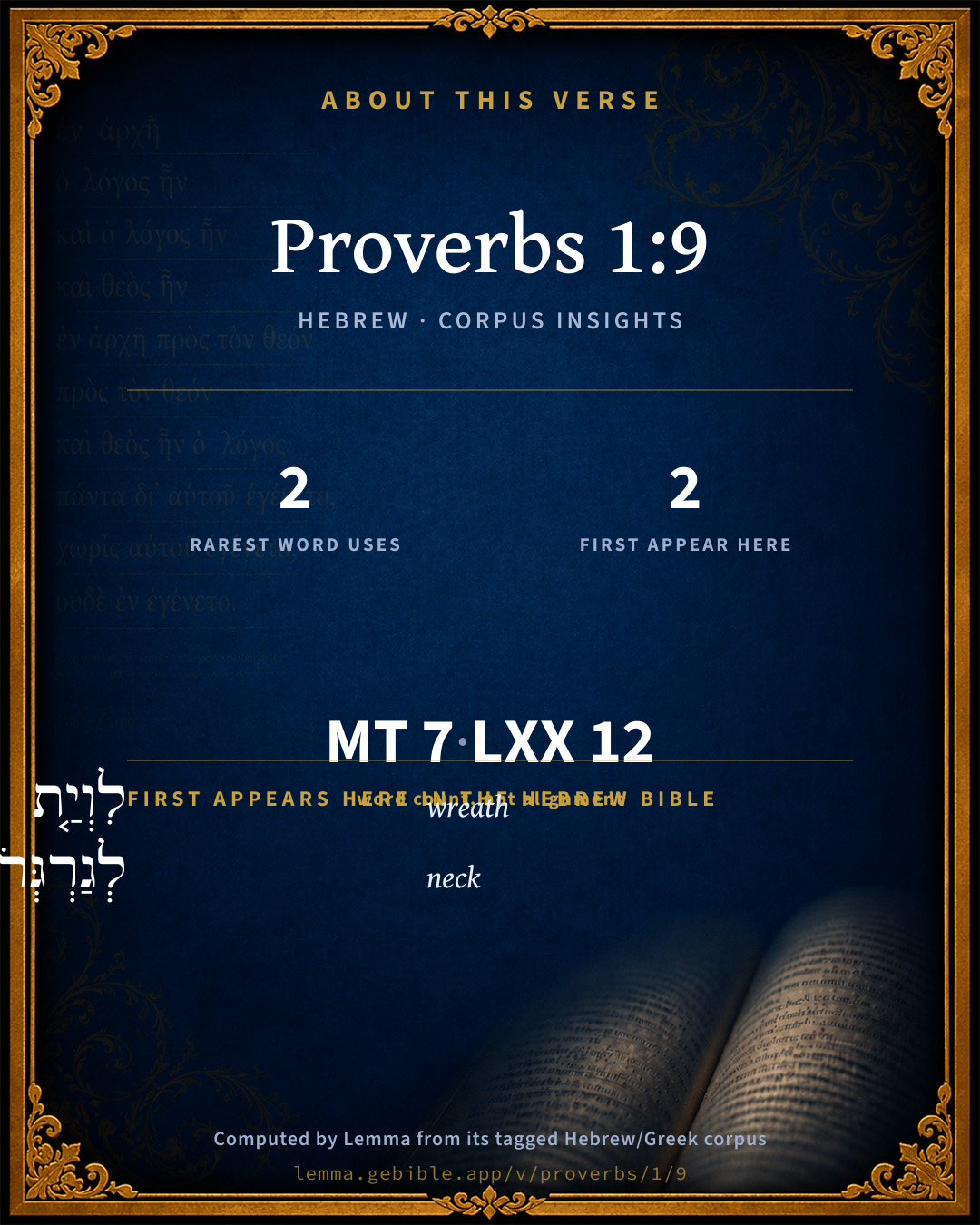
  • 2 first appearances in the Hebrew Bible
Full analysis ↓
Download a study sheet

One document with this verse’s original text, its word-by-word gloss line, the meaning frame, cross-references with their text, attributed commentary, and full source and license credits — printable, and it pastes into notes with its structure intact.

This verse Autodidact and up

Study sheet (.html) Plain text (.txt)

A passage Seminary Student

Up to 50 verses in one chapter. A passage sheet keeps up to 6 commentary sources and 12 cross-references per verse, in the order this page ranks them, and says so on the sheet whenever that leaves anything out. Ask for a single verse and you get the Autodidact verse sheet above.

Everything on this page stays free to read, with no account — the sheet is a download of what is already on screen, not access to it.

Want to remove ads? Support Godless Engineer
Compare translations 3

The same verse in 3 English versions, stacked beneath the original-language interlinear above. Click any original word for its lexicon entry.

Each is an independent rendering of the whole verse — the interlinear is not word-aligned to these translations.

Highlighted words mark where these versions differ — a whole-verse word diff, not a word-by-word alignment.

  • World English Bible Public Domain
    For they will be a garland to grace your head, And chains around your neck.
  • King James Version Public Domain
    For they shall be an ornament of grace unto thy head, and chains about thy neck.
  • unfoldingWord Literal Text CC BY-SA 4.0
    for they a garland of grace for your head and pendants for your neck.

unfoldingWord Literal Text — © unfoldingWord, licensed CC BY-SA 4.0. Word-aligned USFM3 via Door43 (git.door43.org/unfoldingWord/en_ult).

Versions to compare (up to 4)

3 of 4 selected

Show all 18 translations

Every available English version of this verse, each an independent rendering of the whole verse.

  • World English Bible Public Domain
    For they will be a garland to grace your head, And chains around your neck.
  • Berean Standard Bible Public Domain
    For they are a garland of grace on your head and a pendant around your neck.
  • Majority Standard Bible Public Domain
    For they are a garland of grace on your head and a pendant around your neck.
  • King James Version Public Domain
    For they shall be an ornament of grace unto thy head, and chains about thy neck.
  • American Standard Version (1901) Public Domain
    For they shall be a chaplet of grace unto thy head, And chains about thy neck.
  • Revised Version (1885) Public Domain
    For they shall be a chaplet of grace unto thy head, and chains about thy neck.
  • Geneva Bible (1599) Public Domain
    For they shalbe a comely ornament vnto thine head, and as chaines for thy necke.
  • Douay-Rheims (1899) Public Domain
    That grace may be added to thy head, and a chain of gold to thy neck.
  • Young's Literal Translation Public Domain
    For a graceful wreath `are' they to thy head, And chains to thy neck.
  • Literal Standard Version CC BY-SA 4.0
    For they [are] a graceful wreath to your head, || And chains to your neck.
  • Unlocked Literal Bible CC BY-SA 4.0
    they will be a graceful wreath for your head and pendants hanging from your neck.
  • unfoldingWord Literal Text CC BY-SA 4.0
    for they a garland of grace for your head and pendants for your neck.
  • Darby Bible Public Domain
    for they shall be a garland of grace unto thy head, and chains about thy neck.
  • World Messianic Bible Public Domain
    for they will be a garland to grace your head, and chains around your neck.
  • Webster's Bible Public Domain
    For they shalt be an ornament of grace to thy head, and chains about thy neck.
  • Free Bible Version CC BY-SA 4.0
    They are a wreath of grace to decorate your head; they are pendants for your neck.
  • Bible in Basic English Public Domain
    For they will be a crown of grace for your head, and chain-ornaments about your neck.
  • JPS Tanakh (1917) Public Domain
    For they shall be a chaplet of grace unto thy head, and chains about thy neck.

Literal Standard Version (2020), Covenant Press — licensed CC BY-SA 4.0. Text via the HelloAO Bible API (eBible.org). Unlocked Literal Bible (unfoldingWord) — licensed CC BY-SA 4.0. Text via the HelloAO Bible API (eBible.org). unfoldingWord Literal Text — © unfoldingWord, licensed CC BY-SA 4.0. Word-aligned USFM3 via Door43 (git.door43.org/unfoldingWord/en_ult). Free Bible Version, Dr. Jonathan Gallagher — licensed CC BY-SA 4.0. Text via the HelloAO Bible API (eBible.org).

Word by word

More ways to search: Search by grammar → Find every occurrence → Compare this word →

Practice this passage: Drill this verse → Learn its vocabulary →

About this verse

These counts appear in no published source. They are computed here, from the morphology-tagged text and Lemma’s own curated glosses. What Lemma adds →

7
words
7
distinct lemmas
Wisdom
section

Notable vocabulary

The rarest word here is לִוְיַ֤ת wreath H3880 — appearing just 2 times in the whole Hebrew Bible.

First appearance in Scripture

These words make their first canonical appearance in the Hebrew Bible here:

  • לִוְיַ֤ת wreath H3880
  • לְגַרְגְּרֹתֶֽיךָ neck H1621

Shared distinctive vocabulary

לִוְיַ֤ת wreath H3880 occurs in 2 verses of the Hebrew Bible. Also found in:

Grammatical profile

  • 5 nouns
  • 1 pronoun
  • 1 conjunction

Hebrew & Septuagint length

In English translation the verse runs 15 words from the Hebrew and 19 from the Septuagint (LXX English) — closely comparable.

A rough comparison of the two English renderings, which tokenize alike — not a word-level alignment.

Word counts can differ between the Hebrew and the Greek without any difference in meaning — e.g. the Hebrew direct-object marker אֵת has no separate Greek word, and Greek often adds the article ὁ.

In the original languages it is 7 Hebrew tokens and 12 Greek tokens — but the two are counted differently (Hebrew bundles its prefixes and suffixes into one token; the Greek is in lemma form), so that isn’t a like-for-like length.

Cross-references

13

Topical passages linked to Proverbs 1:9 in the Treasury of Scripture Knowledge — connected by theme and wording, ordered by reader-vote popularity; previews shown in the World English Bible.

  • Proverbs 4:9 She will give to your head a garland of grace. She will deliver a crown of splendor to you."
  • Daniel 5:29 Then commanded Belshazzar, and they clothed Daniel with purple, and put a chain of gold about his neck, and made proclamation concerning him, that he should be the third ruler in the kingdom.
  • Genesis 41:42 Pharaoh took off his signet ring from his hand, and put it on Joseph's hand, and arrayed him in robes of fine linen, and put a gold chain about his neck,
  • Proverbs 3:22 So they will be life to your soul, And grace for your neck.
  • Proverbs 6:20–21 My son, keep your father's commandment, And don't forsake your mother's teaching.
  • Isaiah 3:19 the earrings, the bracelets, the veils,
  • Ezekiel 16:11 I decked you with ornaments, and I put bracelets on your hands, and a chain on your neck.
  • Song of Solomon 1:10 Your cheeks are beautiful with earrings, Your neck with strings of jewels.
  • Song of Solomon 4:9 You have ravished my heart, my sister, my bride. You have ravished my heart with one of your eyes, With one chain of your neck.
  • Daniel 5:7 The king cried aloud to bring in the enchanters, the Chaldeans, and the soothsayers. The king spoke and said to the wise men of Babylon, Whoever shall read this writing, and show me the interpretation of it, shall be clothed with purple, and have a chain of gold about his neck, and shall be the third ruler in the kingdom.
  • Daniel 5:16 But I have heard of you, that you can give interpretations, and dissolve doubts; now if you can read the writing, and make known to me the interpretation of it, you shall be clothed with purple, and have a chain of gold about your neck, and shall be the third ruler in the kingdom.
  • 1 Timothy 2:9–10 In the same way, that women also adorn themselves in decent clothing, with modesty and propriety; not just with braided hair, gold, pearls, or expensive clothing;
  • 1 Peter 3:3–4 Let your beauty be not just the outward adorning of braiding the hair, and of wearing jewels of gold, or of putting on fine clothing;

Cross-references courtesy of OpenBible.info (CC BY 4.0).

Hebrew and Greek witnesses Masoretic Hebrew ↔ Greek Septuagint

The same verse in the two great witnesses to the Old Testament, shown verse-for-verse.

These are two independent witnesses, not word-aligned to each other, and the Septuagint is shown in lemma (dictionary) form.

Hebrew Proverbs 1:9 Masoretic · Westminster Leningrad Codex

כִּ֤י לִוְיַ֤ת חֵ֓ן הֵ֬ם לְרֹאשֶׁ֑ךָ וַ֝עֲנָקִ֗ים לְגַרְגְּרֹתֶֽיךָ

For they will be a garland to grace your head, And chains around your neck.

World English Bible · Public Domain

Greek LXX Proverbs 1:9 Septuagint · lemma form

στέφανος γάρ χάρις δέχομαι σός κορυφή καί κλοιός χρύσεος περί σός τράχηλος

For you shall receive for your head a crown of graces, and a chain of gold round your neck.

LXX2012 (modern English Septuagint) · Public Domain

On this verse, The Cambridge Bible for Schools and Colleges discusses the Septuagint’s reading. Read the note in Commentary ↓

Hebrew: Westminster Leningrad Codex (CC BY 4.0). Greek: Septuagint (public domain); English from LXX2012 (modern English Septuagint) (Public Domain). How the Septuagint differs from the Hebrew →

Commentary

Notes on Proverbs 1:9 from classic Christian and Jewish commentators (each source and its license shown beneath its notes). The classic Christian expositions comment on the surrounding passage and are grouped to its opening verse, so a note may address several verses; the Jewish commentaries on the Tanakh (Rashi and others) are per-verse, so they appear only where the commentator wrote on this verse.

Lemma curates 59 commentaries, every one of them public domain or Creative Commons licensed, each selected and text-cleaned for this edition rather than reprinted as found. About our sources →

Jamieson, Fausset & Brown

Robert Jamieson, A. R. Fausset & David Brown

On the figures of Pro 1:9, compare Gen 41:42; Sol 1:10; Sol 4:9.

Jamieson, Fausset & Brown — Commentary Critical and Explanatory on the Whole Bible (1871) — public domain (CC PDM 1.0). Text via the HelloAO Bible API.

Trapp's Complete Commentary

John Trapp

Pro 1:9 For they [shall be] an ornament of grace unto thy head, and chains about thy neck.

Ver. 9. For they shall be an ornament.] "A man’s wisdom maketh his face to shine." {Ecc 8:1} Tum pietate gravem, &c. {a} Oυ το χρυσος ουτε αδαμας ουτως αστραπτει. {b} Neither gold nor precious stone so glittereth, saith Plato, as the prudent mind of a pious person. Nothing so beautifies as grace doth. Moses and Joseph were "fair to God," {Act 7:20} and favoured of all men. A crown of gold, a chain of pearl, are no such ornaments as are here commended.

{a} Virgil.

{b} Plato.

John Trapp, A Commentary or Exposition upon All the Books of the Old and New Testament (1647–1656) — public domain. Text from a community e-Sword module.

The Biblical Illustrator

Joseph S. Exell

Pro_1:9

For they shall be an ornament of grace unto thy head.

Filial love an ornament of beauty

It seems an instinct of humanity to put ornaments upon the person. It does not rank high among the exercises of the human faculties, yet it is quite above the reach of all inferior creatures. Ornaments on the fallen, like many other innocent things, become the occasions of sin, but they are not in their own nature evil. To deck with external beauty that which is morally corrupt within is a cheat which men practise on themselves and others, but adornment of the person, modest in measure and adopted instinctively by an innate sense of propriety, is conducive to virtue and consistent with Scripture. Moral qualities are the true adornments of a human being. All the graces of the Spirit are lovely: but here the foremost of relative duties, a childs reverential regard for a parent, is recommended as an ornament of surpassing beauty. Love, obey, cherish, reverence your parents. This is in Gods sight of great price. These ornaments will not be out of date when time has run its course. The moral laws of God have avenging sanctions even in the powers of nature. Godliness is profitable unto all things. The first commandment is fruitful even in this life, and the second is like it--like it in its holy character, like it in its glad results. Honour thy father and thy mother, this is an ornament of solid gold. Unlike the watering of superficial accomplishments, the more rudely it is rubbed the more brightly it glows. (William Arnot, D.D.)

The Biblical Illustrator, edited by Joseph S. Exell (c. 1880s–1900s) — public domain. Text from a community e-Sword module.

Tyndale Open Study Notes

Tyndale Open Resources

1:9 crown you . . . chain of honor: Ornaments often represent wisdom and its rewards (see also 3:22; 4:9). This imagery inspires readers to pursue wisdom with diligence.

Tyndale Open Study Notes — © Tyndale Open Resources, licensed CC BY-SA 4.0. Text via the HelloAO Bible API.

Geneva Bible (1599)

Geneva Bible translators

Hebrew, increase of grace.

Geneva Bible (1599) marginal notes — public domain. Text via Bolls.life.

Adam Clarke's Commentary

Verse 9. An ornament of grace unto thy head, and chains] That is, filial respect and obedience will be as ornamental to thee as crowns, diadems, and golden chains and pearls are to others.

Political dignity has been distinguished in many nations by a chain of gold about the neck. Solomon seems here to intimate, if we follow the metaphor, that the surest way of coming to distinguished eminence, in civil matters, is to act according to the principles of true wisdom, proceeding from the fear of God.

Adam Clarke's Commentary on the Bible (1810–1826) — public domain. Text from a community e-Sword/MySword module.

Ellicott's Commentary for English Readers

(9) Ornament of grace.—Given by Wisdom. (Comp. Pro_4:9.)

Chains about thy neck.—The reward of Joseph (Gen_41:42) and of Daniel (Dan_5:29).

A Bible Commentary for English Readers, edited by Charles John Ellicott (1878–1897) — public domain. Text from a community e-Sword module.

The Cambridge Bible for Schools and Colleges

gen. ed. J. J. S. Perowne

9. ornament] Rather, chaplet, R.V. στέφανον, LXX. See Pro_4:9, where the same phrase chaplet of grace occurs, with crown of glory, as its equivalent in the parallel clause of the verse.

chains] not of bondage, but of honour and ornament. Gen_41:42; Dan_5:29; Son_4:9; Jdg_8:26.

The Cambridge Bible for Schools and Colleges (gen. ed. J. J. S. Perowne; Cambridge University Press, 1878–1918) — public domain. Text from a community e-Sword module.

John Gill's Exposition

For they shall be an ornament of grace unto thy head,.... The instructions and laws of parents being attended unto and obeyed by children, render them more lovely and amiable than any beautiful ornament whatever that can be put upon their heads;

and chains about thy neck; be that unto them as chains of gold are to the neck, beautify and adorn them; so good works, done in obedience to God and parents, are ornaments of great price, and preferable to any outward adorning whatever; see Ti1 2:9. The allusions are unto, and the metaphors taken from, those things which are most pleasing and acceptable to children, as fine top knots and golden chains.

John Gill's Exposition of the Whole Bible (1746–1763) — public domain (CC PDM 1.0). Text via the HelloAO Bible API.

Albert Barnes' Notes on the Bible

To the Israelite’s mind no signs or badges of joy or glory were higher in worth than the garland around the head, the gold chain around the neck, worn by kings and the favorites of kings Gen 41:42; Dan 5:29.

Albert Barnes' Notes on the Bible (1834–1885) — public domain. Text from a community e-Sword/MySword module.

Matthew Poole's English Annotations

This will make thee amiable and honourable in the sight of God and of men; whereas the forsaking of those good counsels will make thee contemptible.

Matthew Poole's English Annotations on the Holy Bible (1683–1685) — public domain. Text from a community e-Sword/MySword module.

Whedon's Commentary on the Bible

Daniel D. Whedon

9. They shall be an ornament of grace — As a graceful garland around thy head, and as chains, or necklaces, around thy neck. That is, this reverence for and obedience to thy parents shall be thy highest and most honourable ornament, better than any gay attire, of which the young are usually so fond. Compare Pro_3:3; Pro_6:21; Pro_4:9; Gen_41:42; Dan_5:29; Son_4:9. Chains worn about the neck were an ornament common to both men and women. Thus Pharaoh is said to have put a chain of gold about Joseph’s neck, (Gen_41:42,) and Belshazzar did the same to Daniel. Dan_5:29. They are mentioned as part of the Midianitish spoil, Num_31:50. In some cases they were badges of honour or of office.

Daniel D. Whedon (gen. ed.), Commentary on the Old and New Testaments (1874–1909) — public domain. Text from a community e-Sword module.

The Pulpit Commentary

For they (shall be) an ornament of grace unto thy head. The sentiment here expressed is put forward as an inducement to youth to observe obedience towards the instruction of the father and the law of the mother, and the meaning is that, just as in popular opinion ornaments and jewels are supposed to set off the personal form, so obedience towards parents in the ways of virtue embellishes the moral character (Bayne, Cartwright, Holden). An ornament of grace ; Hebrew, he tywli (livyath khen); literally, a wreath or garland of grace. We meet with the same expression in Pro_4:9, "She i.e. wisdom shall give to thine head an ornament of grace." The Hebrew hywli ( liv"yah) is derived from the root hwl (lavah), "to wind a roll" (Delitzsch) or "to be joined closely with" (Gesenius), and hence signifies an ornament that is twisted, and so a wreath or garland. Gejerus and Schultens translate the phrase by corolla gratiosa, i.e. "a crown full of grace," and so meaning conferring or producing grace, just as the expression, "the chastisement of our peace", (Isa_53:5) means the chastisement bringing or procuring our peace. So again a "precious stone," in Pro_17:8, margin, "a stone of grace," is one conferring gracefulness. The marginal reading, "an adding" (additamentum, Vatablus), conveys, though obscurely, the same idea; and this sense is again reproduced in the Vulgate, ut addatur gratia capiti suo ("in order that grace may be added to thy head"). The LXX reads, stefanov caritwn . And chains about thy neck. Chains; properly, necklaces ; (anakim), plural of qn (anak), "a cellar or necklace;" the kloiov cruseov , or "golden collar," of the LXX, and torques (i.e. twisted neckchain) of the Vulgate. There is a very apposite parallel to this verse in Pro_6:20, 21 (cf. Pro_3:3; see also Jud_1:8:26) The gold chain round the neck was a mark of distinction, and was conferred on Joseph by Pharaoh when investing him with authority and dignity, (Gen_41:42) and on Daniel by Belshazzar in the same way. (Dan_5:29; see Son_4:9) The mere adornment of the person with gold and pearls, without the further adornment of the moral character with Christian graces, is deprecated both by St. Paul and St. Peter. (see 1Ti_2:9, 1Ti_2:10, and 1Pe_3:3, 1Pe_3:4) Neck, troGrG (gar"g"roth) only occurs in the plural (Gesenius). (See Pro_3:3, 22 6:21)

The Pulpit Commentary (1880–1919), ed. H.D.M. Spence-Jones & Joseph S. Exell — public domain. Text from a community e-Sword module.

Rashi

Rabbi Shlomo Yitzchaki (Rashi)

a wreath of grace They are a wreath of grace for your head; i.e., the instruction and the discipline will be a wreath of grace for your head, and they shall be like the rings of a golden ornament.

for your neck Heb. לגרגרתיך. Since the trachea is composed of many rings, he refers to the neck in the plural form.

Rashi on the Tanakh — English translations: “The Judaica Press complete Tanach with Rashi, translated by A. J. Rosenberg” (CC BY 4.0); “Pentateuch with Rashi's commentary by M. Rosenbaum and A.M. Silbermann, 1929-1934” (public domain); “The Metsudah Tanach series, Lakewood, N.J” (CC BY 4.0); and “The Book of Joshua, Metsudah Publications, 1997” (CC BY 4.0). Text via Sefaria.

Lesson kit

Teaching starters — assembled from the data on this page, not authored interpretation. Every prompt links to the verse data it draws on. Edit before teaching.

Proverbs, in the Wisdom, opens this verse with 7 words (7 distinct Hebrew lemmas). Its most distinctive word is livyâh (“wreath”). A historical commentator’s framing appears above. Read the whole chapter for the surrounding context.

Discussion questions

  1. How does “wreath” (livyâh) shape what this verse is saying?
  2. 2 words make their first appearance in Scripture here. What does this debut establish?
  3. How does Proverbs 4:9, which shares the word «wreath», read alongside this verse?
  4. These translations render this verse differently. What is at stake in choosing one wording over another?
  5. Compare how Jamieson, Fausset & Brown and Trapp's Complete Commentary read this verse. Where do they agree or differ?

Things to notice

Reading settings

Reading text

Shown beneath each verse's original-language words.

Old Testament
Old Testament edition

Read the OT as the Masoretic Hebrew (MT) or the Greek Septuagint (LXX).

English shown for the Greek Septuagint (in the Hebrew ↔ Greek comparison).

Comparing translations? Open the Compare panel on any verse page to stack up to four side by side.