
Romans 5:20

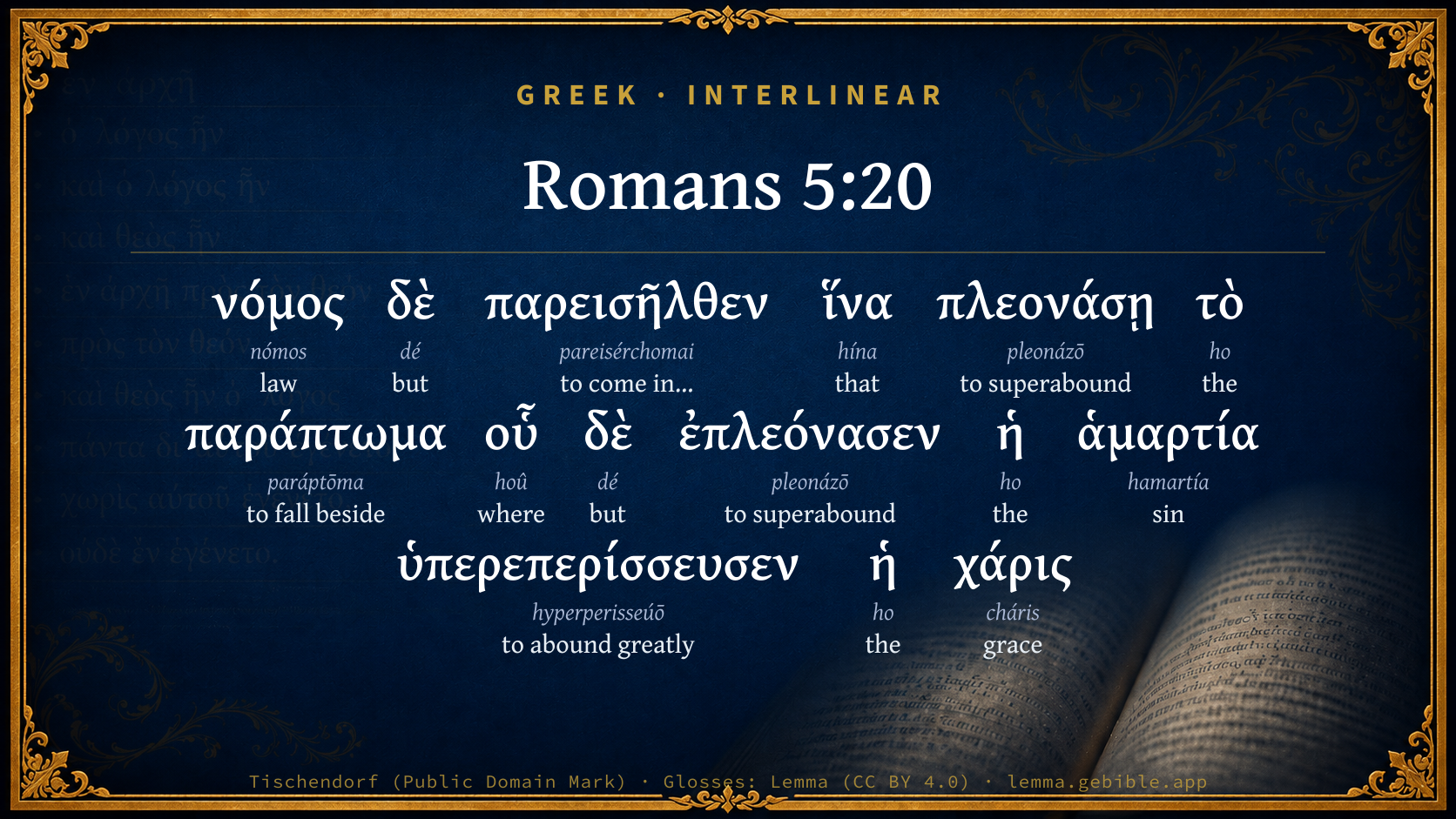
Greek (Tischendorf 8th ed.) Romans 5:20 appears in the Greek New Testament. The text above is from the Tischendorf 8th edition. Each word links to its Strong’s number and a concise gloss. Click any word for its full Thayer’s Greek Lexicon entry.
Download image
Cite this verse

Romans 5:20 (World English Bible). Public Domain. Lemma interlinear Bible study tool, https://lemma.gebible.app/v/romans/5/20.

Show BibTeX & RIS
BibTeX
RIS
English Translation
The law came in besides, that the trespass might abound; but where sin abounded, grace did abound more exceedingly;
World English Bible · Public Domain
Highlights
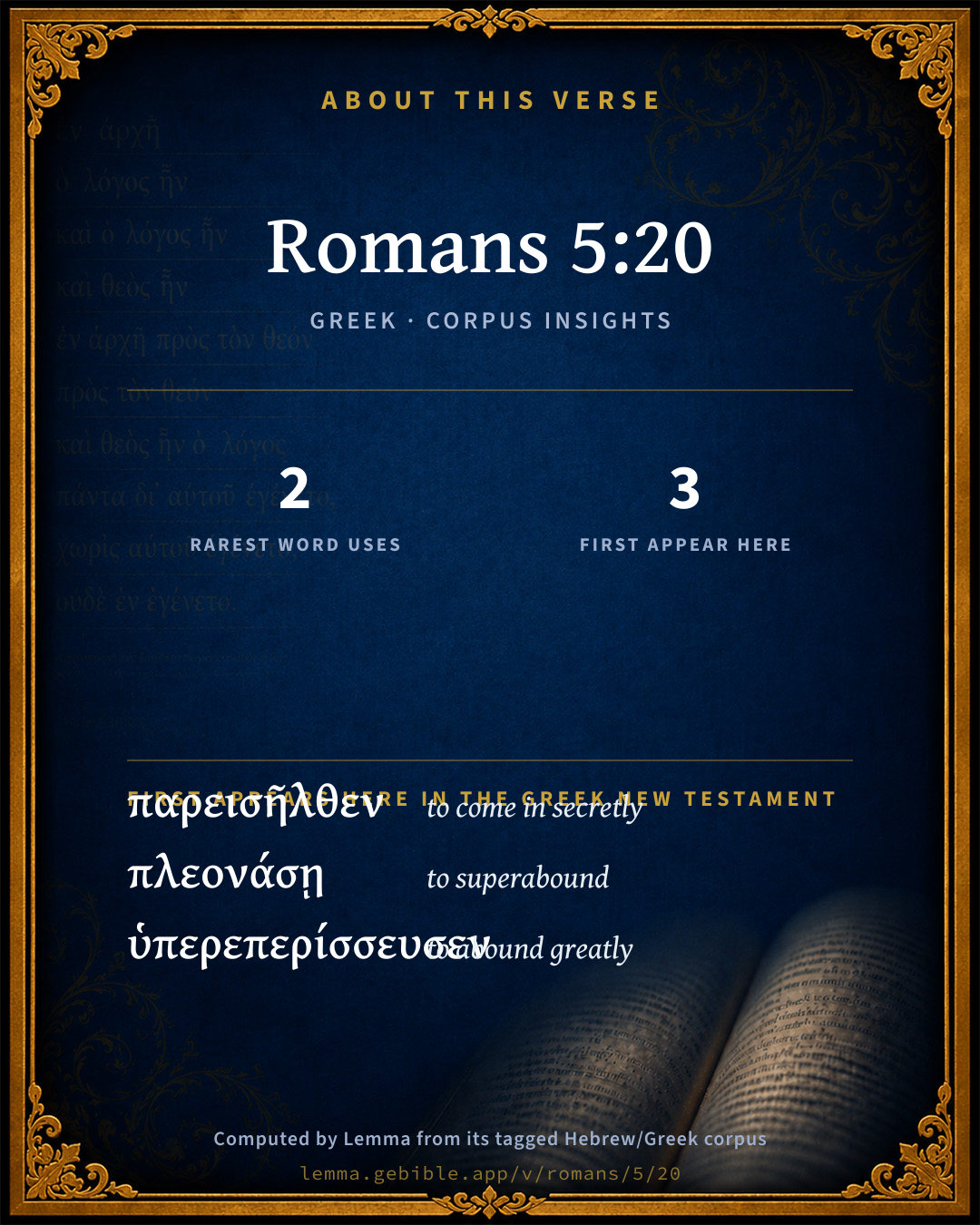
  • 3 first appearances in the Greek New Testament
Full analysis ↓
Download a study sheet

One document with this verse’s original text, its word-by-word gloss line, the meaning frame, cross-references with their text, attributed commentary, and full source and license credits — printable, and it pastes into notes with its structure intact.

This verse Autodidact and up

Study sheet (.html) Plain text (.txt)

A passage Seminary Student

Up to 50 verses in one chapter. A passage sheet keeps up to 6 commentary sources and 12 cross-references per verse, in the order this page ranks them, and says so on the sheet whenever that leaves anything out. Ask for a single verse and you get the Autodidact verse sheet above.

Everything on this page stays free to read, with no account — the sheet is a download of what is already on screen, not access to it.

Want to remove ads? Support Godless Engineer
Compare translations 3

The same verse in 3 English versions, stacked beneath the original-language interlinear above. Click any original word for its lexicon entry.

Each is an independent rendering of the whole verse — the interlinear is not word-aligned to these translations.

Highlighted words mark where these versions differ — a whole-verse word diff, not a word-by-word alignment.

  • World English Bible Public Domain
    The law came in besides, that the trespass might abound; but where sin abounded, grace did abound more exceedingly;
  • King James Version Public Domain
    Moreover the law entered, that the offence might abound. But where sin abounded, grace did much more abound:
  • unfoldingWord Literal Text CC BY-SA 4.0
    Now the law slipped in so that the trespass might increase. But where the sin increased, the grace abounded even more

unfoldingWord Literal Text — © unfoldingWord, licensed CC BY-SA 4.0. Word-aligned USFM3 via Door43 (git.door43.org/unfoldingWord/en_ult).

Versions to compare (up to 4)

3 of 4 selected

Show all 19 translations

Every available English version of this verse, each an independent rendering of the whole verse.

  • World English Bible Public Domain
    The law came in besides, that the trespass might abound; but where sin abounded, grace did abound more exceedingly;
  • Berean Standard Bible Public Domain
    The law came in so that the trespass would increase; but where sin increased, grace increased all the more,
  • Majority Standard Bible Public Domain
    The law came in so that the trespass would increase; but where sin increased, grace increased all the more,
  • King James Version Public Domain
    Moreover the law entered, that the offence might abound. But where sin abounded, grace did much more abound:
  • American Standard Version (1901) Public Domain
    And the law came in besides, that the trespass might abound; but where sin abounded, grace did abound more exceedingly:
  • Revised Version (1885) Public Domain
    And the law came in beside, that the trespass might abound; but where sin abounded, grace did abound more exceedingly:
  • Geneva Bible (1599) Public Domain
    Moreouer the Law entred thereupon that the offence shoulde abound: neuerthelesse, where sinne abounded, there grace abounded much more:
  • Douay-Rheims (1899) Public Domain
    Now the law entered in, that sin might abound. And where sin abounded, grace did more abound.
  • Young's Literal Translation Public Domain
    And law came in, that the offence might abound, and where the sin did abound, the grace did overabound,
  • Literal Standard Version CC BY-SA 4.0
    And law came in, that the offense might abound, and where sin abounded, grace hyper-abounded,
  • Unlocked Literal Bible CC BY-SA 4.0
    But the law came in to increase the trespass. But where sin abounded, grace abounded even more.
  • unfoldingWord Literal Text CC BY-SA 4.0
    Now the law slipped in so that the trespass might increase. But where the sin increased, the grace abounded even more
  • Darby Bible Public Domain
    But law came in, in order that the offence might abound; but where sin abounded grace has overabounded,
  • World Messianic Bible Public Domain
    The law came in that the trespass might abound; but where sin abounded, grace abounded more exceedingly,
  • Webster's Bible Public Domain
    Moreover the law entered, that the offense might abound. But where sin abounded, grace did much more abound:
  • Free Bible Version CC BY-SA 4.0
    When the law was introduced, sin became even more obvious. But while sin became much more obvious, grace became even more obvious!
  • Bible in Basic English Public Domain
    And the law came in addition, to make wrongdoing worse; but where there was much sin, there was much more grace:
  • Text-Critical English NT CC BY 4.0
    Now the law came in so that the trespass might abound. But where sin abounded, grace abounded all the more,
  • Tyndale New Testament (1534) Public Domain
    But the lawe in the meane tyme entred in that synne shuld encreace. Neverthelater where aboundaunce of synne was there was more plenteousnes of grace.

Literal Standard Version (2020), Covenant Press — licensed CC BY-SA 4.0. Text via the HelloAO Bible API (eBible.org). Unlocked Literal Bible (unfoldingWord) — licensed CC BY-SA 4.0. Text via the HelloAO Bible API (eBible.org). unfoldingWord Literal Text — © unfoldingWord, licensed CC BY-SA 4.0. Word-aligned USFM3 via Door43 (git.door43.org/unfoldingWord/en_ult). Free Bible Version, Dr. Jonathan Gallagher — licensed CC BY-SA 4.0. Text via the HelloAO Bible API (eBible.org).

Word by word

More ways to search: Search by grammar → Find every occurrence → Compare this word →

Practice this passage: Drill this verse → Learn its vocabulary →

παρεισῆλθεν
pareisérchomai
G3922
“to come in secretly”
Verb, Aorist, Active, Indicative, 3rd person, Singular
Part of Speech
Verb
Tense
Aorist
Voice
Active
Mood
Indicative
Person
3rd person
Number
Singular
Full Thayer's Definition

Origin: from G3844 and G1525

TDNT: 13:22,3

1. to come in secretly or by stealth, or creep or steal in 2. to enter in addition, come in besides
  1. νόμος nómos G3551 “law” Noun, Nominative, Singular, Masculine
  2. δὲ dé G1161 “but” Conjunction
  3. ἵνα hína G2443 “that” Conjunction
  4. πλεονάσῃ pleonázō G4121 “to superabound” Verb, Aorist, Active, Subjunctive, 3rd person, Singular
  5. τὸ ho G3588 “the” Article, Nominative, Singular, Neuter
  6. παράπτωμα paráptōma G3900 “to fall beside” Noun, Nominative, Singular, Neuter
  7. οὗ hoû G3757 “where” Adverb
  8. δὲ dé G1161 “but” Conjunction
  9. ἐπλεόνασεν pleonázō G4121 “to superabound” Verb, Aorist, Active, Indicative, 3rd person, Singular
  10. ἡ ho G3588 “the” Article, Nominative, Singular, Feminine
  11. ἁμαρτία hamartía G266 “sin” Noun, Nominative, Singular, Feminine
  12. ὑπερεπερίσσευσεν hyperperisseúō G5248 “to abound greatly” Verb, Aorist, Active, Indicative, 3rd person, Singular
  13. ἡ ho G3588 “the” Article, Nominative, Singular, Feminine
  14. χάρις cháris G5485 “grace” Noun, Nominative, Singular, Feminine

About this verse

These counts appear in no published source. They are computed here, from the morphology-tagged text and Lemma’s own curated glosses. What Lemma adds →

15
words
11
distinct lemmas
Pauline Epistles
section

Notable vocabulary

The rarest word here is παρεισῆλθεν to come in secretly G3922 — appearing just 2 times in the whole Greek New Testament.

First appearance in Scripture

These words make their first canonical appearance in the Greek New Testament here:

  • παρεισῆλθεν to come in secretly G3922
  • πλεονάσῃ to superabound G4121
  • ὑπερεπερίσσευσεν to abound greatly G5248

Shared distinctive vocabulary

παρεισῆλθεν to come in secretly G3922 occurs in 2 verses of the Greek New Testament. Also found in:
Repetition

Words recur within this verse:

  • πλεονάσῃ to superabound G4121 ×2
  • τὸ the G3588 ×3
  • δὲ but G1161 ×2

Cross-references

26

Topical passages linked to Romans 5:20 in the Treasury of Scripture Knowledge — connected by theme and wording, ordered by reader-vote popularity; previews shown in the World English Bible.

  • Romans 6:1 What shall we say then? Shall we continue in sin, that grace may abound?
  • Titus 3:3–7 For we were also once foolish, disobedient, deceived, serving various lusts and pleasures, living in malice and envy, hateful, and hating one another.
  • Psalms 25:11 For your name's sake, Yahweh, Pardon my iniquity, for it is great.
  • Romans 6:14 For sin will not have dominion over you. For you are not under law, but under grace.
  • Galatians 3:19–25 What then is the law? It was added because of transgressions, until the seed should come to whom the promise has been made. It was ordained through angels by the hand of a mediator.
  • Romans 4:15 For the law works wrath, for where there is no law, neither is there disobedience.
  • Luke 7:47 Therefore I tell you, her sins, which are many, are forgiven, for she loved much. But to whom little is forgiven, the same loves little."
  • Romans 3:19–20 Now we know that whatever things the law says, it speaks to those who are under the law, that every mouth may be closed, and all the world may be brought under the judgment of God.
  • Ephesians 2:1–5 You were made alive when you were dead in transgressions and sins,
  • Isaiah 1:18 "Come now, and let us reason together," says Yahweh: "Though your sins be as scarlet, they shall be as white as snow. Though they be red like crimson, they shall be as wool.
  • Micah 7:18–19 Who is a God like you, who pardons iniquity, And passes over the disobedience of the remnant of his heritage? He doesn't retain his anger forever, Because he delights in loving kindness.
  • John 10:10 The thief only comes to steal, kill, and destroy. I came that they may have life, and may have it abundantly.
  • 2 Corinthians 3:7–9 But if the service of death, written engraved on stones, came with glory, so that the children of Israel could not look steadfastly on the face of Moses for the glory of his face; which was passing away:
  • Ephesians 1:6–8 to the praise of the glory of his grace, by which he freely bestowed favor on us in the Beloved,
  • 2 Chronicles 33:9–13 Manasseh seduced Judah and the inhabitants of Jerusalem, so that they did evil more than did the nations whom Yahweh destroyed before the children of Israel.
  • Isaiah 43:24–25 You have bought me no sweet cane with money, neither have you filled me with the fat of your sacrifices; but you have burdened me with your sins, you have wearied me with your iniquities.
  • Ezekiel 16:60–63 Nevertheless I will remember my covenant with you in the days of your youth, and I will establish to you an everlasting covenant.
  • Ezekiel 36:25–32 I will sprinkle clean water on you, and you shall be clean: from all your filthiness, and from all your idols, will I cleanse you.
  • Matthew 9:13 But you go and learn what this means: 'I desire mercy, and not sacrifice,' for I came not to call the righteous, but sinners to repentance."
  • John 15:22 If I had not come and spoken to them, they would not have had sin; but now they have no excuse for their sin.
  • Jeremiah 3:8–14 I saw, when, for this very cause that backsliding Israel had committed adultery, I had put her away and given her a bill of divorce, yet treacherous Judah, her sister, didn't fear; but she also went and played the prostitute.
  • Ezekiel 16:52 You also, bear you your own shame, in that you have given judgment for your sisters; through your sins that you have committed more abominable than they, they are more righteous that you: yes, be also confounded, and bear your shame, in that you have justified your sisters.
  • Luke 23:39–43 One of the criminals who was hanged insulted him, saying, "If you are the Christ, save yourself and us!"
  • Romans 7:5–13 For when we were in the flesh, the sinful passions which were through the law, worked in our members to bring forth fruit to death.
  • 1 Corinthians 6:9–11 Or don't you know that the unrighteous will not inherit the Kingdom of God? Don't be deceived. Neither the sexually immoral, nor idolaters, nor adulterers, nor male prostitutes, nor homosexuals,
  • 1 Timothy 1:13–16 although I was before a blasphemer, a persecutor, and insolent. However, I obtained mercy, because I did it ignorantly in unbelief.

Cross-references courtesy of OpenBible.info (CC BY 4.0).

Commentary

Notes on Romans 5:20 from classic Christian and Jewish commentators (each source and its license shown beneath its notes). The classic Christian expositions comment on the surrounding passage and are grouped to its opening verse, so a note may address several verses; the Jewish commentaries on the Tanakh (Rashi and others) are per-verse, so they appear only where the commentator wrote on this verse.

Lemma curates 59 commentaries, every one of them public domain or Creative Commons licensed, each selected and text-cleaned for this edition rather than reprinted as found. About our sources →

The Biblical Illustrator

Joseph S. Exell

Rom_5:20-21

The law entered that the offence might abound.

But where sin abounded, grace did much more abound.

The offence abounding through the law

The wise physician often gives medicine to bring the disease from within to the surface, and make it abound, so to speak, with the view of driving away the disorder, and so enabling health to reign in the system of his patient. The skilful surgeon, by diet and hot water fomentations, develops the abscess in order that he may be able to effectually remove it. In like manner God in His infinite love and wisdom allowed the law to enter that the offence might abound, with the ultimate purpose that as sin hath reigned unto death, even so might grace reign through righteousness unto eternal life by Jesus Christ our Lord.

Law developing sin

1. The apostle begins the present argument in Rom_5:12, breaking off for the time; and instead of completing the comparison, turning aside to show the universal and lamentable effects of sin. St. Paul was sufficiently acquainted with the continent of Divine truth to be able to wander without losing sight of the cardinal points. To put a man unacquainted with a country half a mile from the main road would make his safe return somewhat doubtful. Many are in this state in respect of gospel truths. But Paul could venture to take a by-road to reach a by-purpose, and then return safely to the place whence he started.

2. At the close of Rom_5:14 he comes again in contact with his main purpose, that the reader might not lose sight of it, and to show that he knew exactly his whereabouts--who is the figure of Him that was to come. But instead of going on to prove their resemblance, he again digresses to show first their unlikeness.

3. In Rom_5:18 he again returns to his chief purpose, namely, to show that the first Adam and the second were in one respect similar. The offence stands alone. There was but one offence from Adam to Moses, for there was no law to be transgressed, i.e., no covenant. God made a covenant with Adam as the representative of mankind; but that covenant was broken. Man, therefore, had no covenant to break in the period indicated. God gave His law to the sea, to the birds, etc., without saying a word to them: they were too small for Him to enter into covenant with them. But man was created on so large a scale that God could not legislate for him without covenanting with him. The offence, in the apostles sense here, was not possible to man in the absence of a covenant. Mankind from Adam to Moses were daily adding to the mass of their corruption, but the offence continued to remain one and the same all through. However, in the time of Moses we find mankind again brought under a covenant--the law entered that the offence might abound.

I. The giving of the law occasioned the development of sin.

1. Sin always revives in the presence of law (Rom_7:9). The pure and fiery light of the commandment awakes it, excites it, and draws out its energies.

(1) Sin in Israel had been sleeping during the Egyptian bondage and deliverance; and the trials encountered during the journey to Sinai only made sin dream fitfully and say an occasional angry word between wakefulness and sleep, just enough to show that it only wanted opportunity to rouse itself. But when the nation arrived at Sinai they received the most marvellous exhibition of the Divine glory. It might have been thought that sin had received such a deep wound that it would never again be able to raise its head. But no; they made a calf in those days. Wonderful! But it was only the necessary consequence of the giving of the law.

(2) Sin is still the same. Man is not conscious of his enmity to God when the commandment does not shine upon his conscience. His enmity is like the match in his waistcoat pocket. There is fire in it, but it is asleep. It only needs to be brought into contact with something harder than itself to become a flame. So the young mans guilty heart is full of the fire of enmity, but it is asleep. When he comes to rub against Gods law, sin takes occasion by the commandment to develop itself.

2. The entrance of the law occasioned the development of sin, because man cannot be developed without developing his sin. This principle manifests itself everywhere. When tares have been sown mixed with wheat, all the influences which promote the increase of the wheat promote the growth of the tares. Look at the young babe. Well, if the little one is to be developed, his sin must be developed with him. As true as he will be a three-feet man, he will be a three-feet sinner at the same time. The internal enemies of many a country would not be nearly as formidable were it not for the educational advantages they have enjoyed. The danger and the horribleness of their deeds increase in the same proportion as their knowledge. In the face of that, were it not better to keep all knowledge from them? No! that is not the method of the Divine government. The voices of nature, providence, and inspiration teach the contrary. Humanity must be developed, though that be impossible without developing its sin. And inasmuch as the law entered to develop man, it of necessity therefore occasioned the development of his sin likewise.

II. The law entered for the purpose of developing sin. It entered in order--

1. To develop sin in its heinousness and frightfulness, so that the evil of its nature as it strikes against God and militates against man might be made patent to all. There is deceitfulness in sin. It wears a garment so attractive that no creature is free from the danger of being bewitched by it. It deceived even the angels. It captivated our first parents. Sin was having fair weather before the law entered. The earth was sitting quietly under its heavy and torpid authority. But at last there dawned the day of its visitation. In the presence of Gods holy law the splendour of its raiment begins to fade; its horrible look makes many refuse it their loyalty any longer. The entrance of sin supposes the entrance of all the dispensation of the Old Testament, which terminated in the advent and death of Christ. And there, on the Cross, was finished the work of stripping sin of all its robes. Thenceforth it stood in all the nakedness of its shame before an astonished universe.

2. To develop its strength, and accomplish its destruction. God is not afraid of sin. By the time of the Incarnation sin had been completely developed. Corrupt religion could not before, and can never again, produce such a court as that of the high priest in Jerusalem. There is no hope that paganism will ever again produce such a faithful representative of itself as Pontius Pilate. Hell will never again see the day when it can steel and whet a tool so dangerous as Iscariot. All the hosts of sin are on the field in the memorable struggle with the Prince of Life, so that the foe can never complain that all his forces were not on the spot (Col_2:14-15). Sin still continues the war, but it only shoots like a coward; shoots and runs at the same time. Let us therefore take heart; let us arm ourselves with all the armour of God that we may pursue and help to drive it out of the world; There is a complete victory over sin to everyone that believeth in Christ. (Evan Phillips.)

Law and grace

I. The design of the law.

1. Not to occasion sin.

2. But to develop--

(1) Its extent.

(2) Its guilt.

(3) Its misery.

II. The relation of the law to grace.

1. It prepares the way for its manifestation.

2. It sets forth its transcendent excellency.

3. It disposes the sinner to receive it by making him conscious of his need.

III. The superabounding of grace.

1. It surpasses the extent of human guilt.

2. Relieves its misery.

3. Secures more happiness to man and more glory to God. (J. Lyth, D. D.)

Law and grace

There is no point upon which men make greater mistakes than upon the relation between the law and the gospel. Some men put the law instead of the gospel; others put the gospel instead of the law; some modify both, and preach neither; and others entirely abrogate the law, by bringing in the gospel. Many think that the law is the gospel, and who teach that men by good works may be saved. On the other hand, many teach that the gospel is a law, by obedience to which men are meritoriously saved. A certain class maintain that the law and the gospel are mixed, and that partly by the law, and partly by grace, men are saved. Consider the text--

I. As concerning the world.

1. The object of God in sending the law was that the offence might abound. There was sin in the world long before; and where that law has never been heard, there is sin,--because, though men cannot sin against the law which they have never seen, yet they can all rebel against the light of nature, against the dictates of conscience, and against that traditional remembrance of right and wrong (Rom_1:20). The law makes offences abound, because--

(1) It tells us that many things are sins which we should never have thought to be so if it had not been for the additional light. What man by the light of conscience would keep holy the Sabbath day? Moreover, if in the term law we comprehend the ceremonial ritual, we can plainly see that many things, in appearance quite indifferent, were by it constituted sins--the eating of animals that do not chew the cud and divide the hoof, the wearing of linsey woolsey, and all seem to have no sin in them, but the law made them into sins, and so maple the offence to abound.

(2) Law has a tendency to make men rebel. Human nature rises against restraint. I had not known lust except the law had said, Thou shalt not covet. So evil are we, that we conceive at once the desire to commit an act, simply because it is forbidden (Rom_7:7-8; Rom_7:11). The law is not faulty, but sin uses it as an occasion of offence, and rebels when it ought to obey. Augustine says, The law is not in fault, but our evil and wicked nature; even as a heap of lime is still and quiet, until water be poured thereon, but then it begins to smoke and burn, not from the fault of the water, but from the nature and kind of the lime which will not endure it.

(3) The law increases the sinfulness of sin, by removing all excuse of ignorance. Until men know the law, their crimes have at least a palliation of partial ignorance, but when the code is spread before them, their offences become greater, since they are committed against light and knowledge. The more light the greater guilt--the law affords that light, and so causes us to become double offenders. But does it not seem very harsh that God should give us a law which will not justify, but indirectly cause our condemnation to be greater? But there is a gracious purpose even here. Natural men dream that by a strict performance of duty they shall obtain favour; but the law never came to save men. It came on purpose to make the evidence complete that salvation by works is impossible, and thus to drive the elect of God to rely wholly on the finished salvation of the gospel.

2. The superabundance of grace.

(1) Grace excels sin in the numbers it brings beneath its sway. It is written that in all things Jesus shall have the preeminence: and why is this to be left out? Can we think that Satan will have more followers than Jesus? Oh, no; for while it is written that the redeemed are a multitude that no man can number; it is not recorded that the lost are beyond numeration. Think for a moment of the army of infant souls who are now in heaven.

(2) Grace doth much more abound, because a time shall come when the world shall be all full of grace; whereas there has never been a period when it was wholly given up to sin.

(3) Hath the world lost its possessions by sin, it has gained far more by grace? True, we have been expelled from Eden, but we have through Jesus a fairer habitation. Did we lose natural life and subject ourselves to painful death by sin? Has not grace revealed an immortality for the sake of which we are too glad to die? Jesus has clothed us with a Divine righteousness, far exceeding the robes of created innocence.

II. As Concerning the human heart.

1. The law causes the offence to abound--

(1) By discovering sin to the soul. When once the Holy Ghost applies the law to the conscience, secret sins are dragged to light, little sins are magnified to their true size, and things apparently harmless become exceedingly sinful. John Bunyan says that the Interpreter took Christian by the hand and led him into a very large parlour that was full of dust, because never swept; in which after he had reviewed it a little while, the Interpreter called for a man to sweep. Now, when he began to sweep, the dust began so abundantly to fly about, that Christian had almost therewith been choked. Then said the Interpreter to a damsel that stood by, Bring hither water, and sprinkle the room; the which when she had done, it was swept and cleansed with pleasure. Then said Christian, What means this? The Interpreter answered, This parlour is the heart of man. The dust is his original sin and inward corruptions. He that began to sweep at first, is the law; but she that brought the water, and did sprinkle it, is the gospel. Now whereas thou sawest, that as soon as the first began to sweep, the dust did so fly about, that the room could not by him be cleansed, but that thou wast almost choked therewith; this is to show thee that the law, instead of cleansing the heart (by its working) from sin, doth revive (Rom_7:9), put strength into (1Co_15:56) and increase it in the soul (verse 20), even as it doth discover and forbid it, for it doth not give power to subdue. Again, as thou sawest the damsel sprinkle the room with water, upon which it was cleansed with pleasure; this is to show thee that when the gospel comes in the sweet and precious influences thereof to the heart, so is sin vanquished, and the soul made clean, through the faith of it, and consequently fit for the King of glory to inhabit.

(2) By showing us how very black we are. Some of us know that we are sinners. It is very easy to say it, but it does not appear exceedingly sinful till the law comes. How many do we find who are saying, There may be a little amiss at the top, but I am very good-hearted at bottom. If you saw some fruit on the top of a basket that was not quite good, would you buy the basket because they told you, Aye, but they are good at the bottom? No; you would say, They are sure to be the best at the top, and if they are bad there, they are sure to be rotten below.

(3) By discovering to us the depravity of our nature. We are all prepared to charge the serpent with our guilt, or to insinuate that we go astray, from the force of ill example--but the Holy Spirit dissipates these dreams by bringing the law into the heart. Then the fountains of the great deep are broken up, the chambers of imagery are opened, the innate evil of the very essence of fallen man is discovered.

(4) By bringing home the sentence of condemnation. It mounts the judgment seat, puts on the black cap, and pronounces the sentence of death.

(5) By discovering the powerlessness occasioned by sin. It not only condemns but it actually kills. He who once thought that he could repent and believe at pleasure, finds in himself no power to do either the one or the other.

2. Grace excels sin--

(1) In its measure and efficacy. Though your sins are many, mercy hath many pardons.

(2) Sin shows us its parent, and tells us our heart is the father of it, but grace surpasseth sin there, and shows the Author of grace--the King of kings.

(3) Just as sin makes us sick, and downcast, and sad, so does grace make us far more joyful and free. Sin unfits us for heaven. Grace makes us fit companions for seraphs and the just made perfect. (C. H. Spurgeon.)

The triumphs of sin and of grace

1. The triumphs of sin.

1. As they regard the material world. Sin has altered its character--defaced its beauty--tarnished its splendour. Disorder has been introduced, and various evils have been realised.

2. As they regard the moral nature of man. If the evil were merely external, it would be comparatively immaterial, but it is internal. The whole man is infected with the leprosy of sin. His members are not consecrated to God, but to iniquity. His understanding is enveloped in dense darkness. His reason is proud, and unyielding to God. His affections are perverted, cold, and sensual. His will is stubborn and intractable. All his powers, passions, capacities, and emotions, have been affected by sin.

3. As they regard death and the grave. What fearful desolations they effect! They dim the lustre of the eye, extinguish the light of genius, tarnish the bloom of beauty, wither the arm of vigour, and reduce the frame of man to dust.

4. As they regard the remote and awful consequences of iniquity. The loss of the soul, banishment from God, the utter withdrawal of His favour, the agony of conscience, the society of devils and wicked spirits, and the consciousness that this degradation, ruin, and misery, will endure unmitigated forever.

II. The superior and more. Splendid triumphs of Divine grace.

1. In the full and spontaneous forgiveness which it bestows. It removes the oppressive burden of sin--it speaks peace to the conscience; and whatever might have been his offences, it assures the justified individual that his sins have been all forgiven.

2. In the character of those operations which it secures. It not merely justifies the person, but renovates the nature, implants new principles, induces new feelings, inspires love to prayer, and communicates that strength and consolation which we require while residents in this world.

3. In the inheritance which it assigns. Rest from labour, tranquillity after agitation and alarm, freedom from temptation, advancement to ineffable dignity--the possession of a glorious and an enduring kingdom, and the promise of an unfading and immortal crown.

4. In the complete and glorious resurrection of the body for which it provides.

5. In the eventual number of the redeemed. They shall embrace every age, country, condition, class. A number, which no man can enumerate, shall be rescued from sin, delivered from the grave, and advanced to the bliss and glory of heaven.

Conclusion: This subject should--

1. Tend to correct many errors with regard to the doctrine of election: the fact of the fall, the extent of Divine mercy, the number of the saved.

2. Induce us to institute art inquiry whether we have ever realised the power of that grace which so gloriously triumphs.

3. Inspire us as regards the future, and induce us to make greater exertions to secure and extend the triumphs of Divine mercy. (J. Leifchild, D. D.)

Sin abounding, and grace superabounding

These glowing words fitly crown the parallel the apostle traces. From its triumphal climax he surveys the expanded triumphs of grace and sin in a reign, or conquered dominion, on which the common sun never sets, and which the Sun of Righteousness ever floods with glory; an empire which, like the mystic ladder, first establishes its footing on earth, and finally loses itself in the glories of heaven. We will range our exposition under the following heads:

I. Historical.

1. The curtain is uplifted, and the background scenery represents visions of paradisial beauty. And now for the characters; for all the worlds a stage. First eaters primeval man, fresh from his Makers hand; and then woman, his ministering angel. Slinking stealthily from behind, next enters the serpent. The lights pale, and visions grow dark and dim, as the next actor, Sin, enters like a disastrous eclipse; and it entered not alone--it entered trailing its grim shadow after it, Death entered by sin. The plot thickens. Moreover, the law entered, that men might know their duty, and in the light of that their guilt, and in the light of both their doom, and in the light of all seek the remedy. As the result--Sin is seen to abound: it enters and re-enters, rolling its thunderous clouds across the stage; for in the fierce light of the law its magnitude and intensity are clearly seen, and sin takes occasion from that very law to riot and multiply itself the more. But by this time another actor has entered on the stage; the seed of the woman appears, with the ransom flowing from his side, the serpent squirming under his heel.

2. In the second long act, covering the Old Testament period, the shadows seem to deepen, and the confusion to become more confounded.

3. In the third brief, but grand act, the Deliverer steps on the stage, takes the room of the sinner, and sublimely dies, rises, ascends to glory, and sends forth His twelve champions for the spiritual conquest of the world.

4. During the next, or fourth act, the mingling elements of light and darkness, good and evil, life and death, have been in fierce, hot strife; life and light evermore rising triumphant over sin and death.

5. In the fifth, and last, grand act, Satan shall fall from his usurped dominion, and the kingdoms of this world shall have become the kingdoms of our God, etc.

II. Doctrinal. The text is the culminating point of a passage which, like all that precedes, has for its objects the vindication and illustration of justification by faith. If this Divine method of salvation can be shown to have primeval precedent in the Edenic Dispensation, and to root and ramify its fundamental principles in the Divine administration of our world and in the moral and social constitution of man, no stronger argument for the great doctrine could well be adduced. This is just what our apostle does. He traces a parallel between the First Adam and the Second. Both being representative, each is shown to stand out in his unity as the one, in relation to the many. The two Adams present strong points of parallelism. By one we fell, and by one we rise. The points of contrast are these: Adams sin brought temporal death; but Christ brings eternal life. Again, Adam had nothing directly to do with our actual sins, but Christs atonement, besides neutralising the effects of Adams sin, neutralises also the effects of our innumerable actual transgressions, in the cases of all who believe. Finally, those who do believe, not only rise to the position they would have had under a sinless Adam, but to one immeasurably higher, even to a very royalty of bliss.

III. Expositional. Taking the causes as they occur, consider:--

1. Moreover the law entered,--a term triply compound--means to enter in by, or alongside of, or immediately upon; and thus conveys the idea that if sin entered, if death entered here comes another entrance upon the back of these--that of immutable Moral Law. Adam, from the moment he sinned, ceased to be our representative; and at that same moment, therefore, the paradisial dispensation ceased. But not so Eternal Law. It therefore stepped prominently into view, after the special paradisial arrangements had passed away. And it was highly desirable that it should, that men might see their own portrait, and read their own ruin, and be thereby led, as by a schoolmaster, to seek for the remedy. Being now a broken law, it had to be arrayed in its terrors, as well as expanded in its intrinsic loveliness, Hence its successive promulgations, which culminated at Sinai, and ran on through the Mosaic Economy in parallel lines of wrath and love, till He came who has reconciled all these contrarieties, and put away sin by the sacrifice of Himself.

2. The result of this exhibition was that the offence did abound. In the pure mirror of the law sin was first seen to abound; and then, by kicking against the laws restraints, sin rebelliously took occasion more and more to abound. With what fearful rapidity it did, may be read in the awful fact that human crime sprung to its climactic stage in the first generation. The first human birth in our world was that of a murderer, the second that of his victim. What then? Was the law to blame for that? Far be it! The law must be proclaimed; and in numberless instances it did put an arrest on sin, and guided primeval men into its ways of pleasantness, and its paths of peace. But those who would not be guided, wrested it to their ruin. Our apostle meets that objection in Rom_7:12-13.

3. Mark the sin-neutralising energy of Divine grace:--Where sin abounded, grace did much more abound.

(1) It is an undoubted fact, for Paul here declares it without qualification, limitation, or reserve.

(2) It is a continuous fact; for it belongs to the present as truly and fully as ever it did to the past.

(3) It is an evangelical fact; for it implies that the only cure for sin is grace. It is not the fear of hell that will make a bad man good.

(4) It is a worldwide fact. Confront me with a sinner. In agony he asks, Is there any mercy for me? I tell you yes, for does not Paul say, where sin abounds, grace superabounds?

4. Sin is said to reign, and that unto death. It not only abounds, it tyrannises. Was there ever despot like sin? Was there ever taskmaster like Satan, plying his drudges with a whip of scorpions, and ever saying to them, as Pharaoh did to the Hebrews, get you to your burdens? Was there ever bondage like that of the drunkard, like that of the sensualist? And sin reigns unto death,--or as in a previous verse, death reigns. The fear of death, we read, keeps many all their life long subject to bondage. Well is he described as the king of terrors, the most universal and relentless of all devastating conquerors. One stronger than he has grappled with him; and the last enemy, death, shall be destroyed.

5. In direct antagonism to sins usurped dominion, grace reigns; and unto eternal life. The antithesis is perfect. We may not say that grace tyrannises, for its reign is essential liberty; but it dominates and is destined to final triumph. Love shall be the conqueror, as sure as God is love.

6. Observe on what principle grace reigns: not through mere arbitrary choice, as if God could act in caprice; not through mere absolute sovereignty, as if God were personified despotism; not through mere blind indulgence, as if God were too facile to be firm, too fond to be inflexibly wise and good; but through righteousness; or on some wise, safe, and righteous ground on which mercy might flow freely, but not licentiously and destructively. And how is this secured?

7. By Jesus Christ our Lord, by His merits and world-embracing propitiation, on the ground of which God can be just, while the justifier of the ungodly who believe in Jesus.

IV. Practical. Too many, alas, who need no proof that sin abounds, still urge. But has God any superabounding grace for me? Let Jesus reply: Look unto Me and be ye saved, all ye ends of the earth. He gave Himself a ransom for all; then He is a ransom for thee. A propitiation for the sins of the whole world, He has expiated thine. But I have sinned grievously. What! too grievously for the blood of Jesus Christ, Gods Son, which cleanseth from all sin? You never did a worse sin than to vent an insinuation like that. Do you still want more witness? Pray what sort do you desiderate? A voice from heaven? Here are voices without number. Turn to Rev_22:17. Or is it earthly testimony you want? Think of the once scoffing and profligate Rochester, of the once God-defiant adventurer, John Newton, of the once profanely boisterous Bunyan. Or is it the testimony of the redeemed in heaven you want to hear? Open the Apocalypse at random, and thereby turn aside the heavenly veil, and your eyes will see them casting their crowns at the Deliverers feet, and your ear will catch the refrain--Unto Him that loveth us! Worthy the Lamb! etc. (T. Guthrie, D. D.)

Abounding sin; overabounding grace

1. The law entered that the offence might abound. The sin was already there. Deep in the constitution of humanity the poison was already working, and God would have it developed in full manifestation. The driving of evil out to the surface, where all can see it in the broad daylight, is, as in some deadly forms of fever, the first step towards the cure. But Paul had not ventured to entertain the thought unless he had known, as no man, save perhaps Luther, has ever known, the superabounding, the overmastering power of grace.

2. The problem of problems is, how can a righteous and loving God endure and perpetuate a world like this while a breath would abolish its sin and misery forever. But it lives on. The life of a human spirit is an awful endowment. By no act of ours it comes to us. And the influences which mould it are but partially under our control. There is a man who was educated to be a jail bird from his infancy. He never had his eye upon the form of a nobler life. You cannot say that there are no seeds of great thoughts and virtues in him. He would be torn limb from limb before he would betray his comrade. But his chance in life has been a poor one. His whole life is a battle with society. Society masters him, chains him, and will infallibly crush him at last. And yet that man must drag on his burden; and passionately as he may long to die, it is Gods will that he shall bear the burden of that life through eternity. He may mend his life; Gods mercy puts that within his reach; but if he will not mend it, he shall bear it forever.

3. How many myriads are there who, were the choice offered to them, would answer, Let me die and have done with it forever. Annihilation has been the supreme hope of many a creed. And why? Because Sin reigneth unto death everywhere. Life is good: the world is fair. The storms, deserts, and earthquakes, would have no terror for man if there were not wilder storms and barer deserts within. But self haunts him as a spectre. The things that I would, those I do not; the things that I would not, those I do; and the doing these things is death. Here, then, are men by millions, living by no will of their own, fighting a losing battle through life; or refusing to fight it, and giving it up in despair, grovelling with the beasts, cursing with the fiends, filling the world with woe. Doubtless there are lights as well as shadows in the picture. But looking at the broad world, the shadow masters the sunlight. Take one days honest service with a city missionary, and judge for yourselves. There is the struggle for life everywhere; but Death, if want, disease, and misery are his lictors, everywhere wins. Death is the broad term which covers the whole work of sin. Death is but the culmination of a process. The sinner carries his torment with him--a life poisoned at the springs, a life which God will not suffer him to lay down.

4. And Paul has the daring sentence, The law, sent of God, entered that the offence might abound. Many, startled, try to soften the words. God hath sent the law to correct, but its result was the increase of sin, is the sense to which they would modify it. But the words will not bear it, and the argument refuses to adopt it. God sent the law that the offence might abound. Not sin--that is, the sinful thought and purpose--but the offence, the act and manifestation of sin. The poison there, it should not lurk there; it should be pressed into full development. The Mosaic law, say cautious commentators, with all its minute regulations, difficult and impossible to fulfil, which made men despair of legal obedience, and prepared them to receive the righteousness which is by faith. I think the larger view the true one. All law, in a sin-loving, God-hating world, has for its first fruit the insurrection of human passion and self-will. Every declaration of the character and the will of God to sinners seems at first but to madden the spirit and blacken the tone of their transgression. Sin by the commandment becomes exceeding sinful. It is true of all dispensations, even the highest. When men saw the Father in the Son they hated Him; and the hatred of the generation to which the revelation was made, broke out in the most damning crime in the history of the universe. The revelation reproved, and by reproving maddened the sinner. Only when the grace with which the revelation was charged penetrated the hard crust of their natures could men begin to understand the counsel developed in our text. Every manifestation of light at first seems but to reveal darkness. Every manifestation of God at first seems but to deepen and darken sin. The great revelation developed the great transgression, and through that, grace has reigned, through righteousness, unto eternal life, by Jesus Christ our Lord. Let us consider as follows:--

I. Grace. Grace is love in a certain relation--the love of a Redeemer working to its ends. It represents the whole sum of the forces by which the love that would redeem aims at the accomplishment of its hope. Its incarnation is Christ. Christ is the gift of grace. Grace is the manifestation and action of that fatherly love which could not rest in its native glory and blessedness, while one prodigal was wandering, while one tear was wept, one groan uttered in the universe, which its suffering and sacrifice might spare. Ye know the grace of the Lord Jesus, but the measure of it One only knows. That grace is the reigning conqueror of sin. That triumphs where law fails.

II. The relation between grace and sin.

1. Sin is the condition of its manifestation. No sin, no grace. Through a lost world Christ is to win His most glorious Crown. Grace and sin are the twin antagonists; opposed as light and darkness. If one reigns the other is destroyed; and God suffers sin to be born because He knows that grace can conquer it.

2. There is a glory which no fiat of Omnipotence even can create, which grace, by the conquest of sin, can win and wear through eternity. No sin, no grace, and, in the highest sense, no glory. The joy of the prodigal come home, the joy of the father in his return; these are the glorious joys of earth, of heaven.

III. The relation between grace and righteousness. Grace must reign through righteousness, if it reign at all. Imputed righteousness, some cry; inherent righteousness, others. Neither the one nor the other, I venture to think. The apostle has a broader meaning, which covers both. Inherent righteousness is a vain show, if it be not rooted in the perfect righteousness; while imputed righteousness is a mere fiction, if no image of itself be generated in the soul. The broad principle here may be thus expressed:--

1. The righteous soul alone is blessed. To some, grace may suggest a kindly remission of penalty. That were feasible enough if a mans worse torment and curse were not himself. The problem to be solved is within; there the fountain of bitter waters has to be healed. And it is there that grace reigns through righteousness. An inward harmony, healing, quickening is its promise; it presents to him a righteousness which is a mans righteousness, and yet is Gods; a righteousness not awfully, hopelessly above him; a righteousness which, while his sad worn heart drinks in, the love which streams from Calvary enters and enshrines itself in his heart.

2. The righteousness which is by grace has a glory and blessedness all its own. Grace reigns through righteousness; it is a joyous, glorious reign. The work of grace is to shrine righteousness in mans heart of hearts; to teach him not to obey it only, not to honour it only, but to love it. Loving Christ, it is Gods own righteousness which man loves and holds. Through love, he has a joy in all righteous thoughts and righteous deeds, which is part of his joy in Christ his Saviour.

IV. The complete and final end of God. Unto eternal life. Death is simply isolation. The cutting the body off from free communion with its world. And what is life? The opposite of isolation. It is the faculty of communion with all things. The souls death is the paralysis of its faculty to all that a soul was made to commune with, till it becomes without truth, righteousness, and holiness, without God and without hope, because without life. The souls quickening is the rekindling of the energy of its powers, the reoccupation of the glorious range of its faculty to commune with, to possess, and to enjoy all that God has made a soul to live for, all whereby a soul may live eternally. The work of grace is as the baptism of a new life for man. Conclusion: Lord, are there few that be saved? The Lord gives no answer but the text. This we know, that the end which God foresees shall repair all the waste, and repay all the sorrow with which sin has filled the world. How wide, how vast, how glorious this work of overabounding grace, which of us may dare to guess? But strive thou to enter in at the straight gate. The end for which the Redeemer is waiting, the issue for which heaven is hoping, depend in their measure upon you. You can frustrate, you can forward the great consummation. (J. Baldwin Brown, B. A.)

Abounding sin and superabounding grace

I. Sin abounds. This appears--

1. From its extensive prevalence. It is not a local evil, like many natural evils; but it is an universal mischief. This the apostle has shown in chaps, 1 and

2. However men may differ in their customs, wherever you go, sin reigns.

2. From the immense number of sins that are constantly committed. If we include, as we ought, our sins of omission, and our sins of thought, who can enumerate his errors (Gen_6:5). From the first dawn of reason, through infancy, childhood, youth, and riper years, even to the end of human life, we are offending against God (Psa_40:12).

3. From the eagerness with which men sin. How are our iniquities cultivated by art! they become, as it were, a trade. Men sin as with a cart rope, with both hands earnestly, and what plans are formed for the execution of it.

4. In some seasons and places iniquity unusually abounds; and persons arrive at a certain pitch of wickedness, beyond which God will not suffer them to go. Thus it was with Sodom and Gomorrah, etc.

5. Consider all the aboundings of sin in the aggravations of it. Thus, no doubt, Judas, with the knowledge he possessed, was far more criminal than Pilate. Religious education tends greatly to aggravate the sins of those who continue in them; and when sins are committed against the special goodness and mercy of God, they are also greatly aggravated.

6. Sin will appear to abound, if you advert to the calamitous effects which it has produced. God would not suffer His creatures to endure so much misery if He were not greatly displeased with their sins. The earth is cursed for mans sake.

7. The prudence of man in framing human laws is another proof of the same truth. Why are bonds and oaths necessary in our affairs? Why must we have locks, and bolts, and bars, to our habitations? Why must we have judges and magistrates, prisons and gibbets? The reason is, that sin so much abounds.

8. Recollect also the numerous and painful diseases which invade the human frame.

II. Grace superabounds. Grace signifies the free favour of God towards sinful and undeserving creatures; and it stands opposed in Scripture to the merit or wages of works performed (Eph_2:8-9; Rom_6:23). Grace abounds--

1. In the whole business of salvation, from first to last. It originated in the heart of God, who, pitied us in our low estate; and devised a plan of salvation; to us perfectly easy, to Himself highly honourable. It was God who, unasked, presented to the world that unspeakable gift. Grace is admirably displayed in the glorious person and the perfect work of the Son of God. Ye know the grace of our Lord Jesus Christ, etc.

2. In the gospel of Christ, which, on that account, is itself called The grace of God (Tit_2:11-12).

3. In the free and full justification of the sinner who believes (1Ti_1:14). But it is not only said that grace abounds, but that it much more abounds. We derive more from Christ than we lost in Adam.

Conclusion:

1. Let us diligently study the doctrine Of grace.

2. Let us be concerned, above all things, to be partakers of this grace.

3. What a source is here of consolation, even for the chief of sinners.

4. What abundant cause is here for praise--ardent, constant praise!

5. This subject furnishes us with a mighty incentive to holiness. (G. Burder.)

Good triumphing over evil

In the widest sense sin always implies: law; opportunity of knowing law; capacity to obey or transgress law; and an actual deviation from law. The last is the idea to be attached to it here. Grace means the religion of Christ in the heart as the life of heavenly love; and the system of Christ in the world as a system of Divine mercy. I attach the latter idea to it here.

I. In this chapter there are several things stated about sin and grace.

1. That they are actually in our world. Sin is a dark fact everywhere seen--a force turning men in the wrong direction. Grace is here too, as a corrective and restoring force. Human actions here result from two opposite principles. You cannot trace all history to sin, nor can you trace all to grace. In both you find a solution of all its phenomena. It is a fact that sin is in this world--sin is not in heaven. It is a fact that grace is in this world--grace is not in hell.

2. That they come into our world through the agency of man. Sin came by Adam; grace by the second Adam. There was a time when sin was not. All was holy. There was a time when there was no grace--the world needed none.

3. That they exercise an immense influence upon the race.

(1) The sin of Adam made many sinners, the grace of Christ made many righteous.

(2) The sin of Adam brought condemnation upon the race; the grace of Christ has brought justification to many.

(3) The sin of Adam leads to death; the grace of Christ to eternal life.

(4) The influence of grace far transcends that of sin.

II. Where sin abounded, grace did and will much more abound.

1. In relation to the individual. Take the case of one of the most corrupt sons of Adam, a Manasseh, or a Saul; and if grace take possession of his mind, you may say grace will much more abound there.

(1) The influence of grace there will be of a higher kind.

(a) Life-giving. Anything can destroy.

(b) Justifying. One sin condemns.

(2) The influence of grace there will be of a mightier kind. Sin can never attain a mastery over every part of human nature. It can never carry with it the conscience. The conscience will be ever against it. But grace carries with it conscience. Take Paul as an illustration.

2. In relation to the aggregate race. It must be confessed that up to the present moment sin has had the sway. But consider--that it is highly probable that the generations of those that have appeared on earth, will be far outnumbered by those that are yet to come. The following things suggest this.

(1) The gradual method of Gods procedure--creation, civilisation, redemption, are all gradual.

(2) The state of past generations.

(3) The representations of Scripture.

(4) The omnipotency that is on the side of grace.

3. Throughout the universe of God.

(1) It will spread new and brighter views of Gods character through the universe.

(2) Enhance the moral force that binds to holiness in the universe. (D. Thomas, D. D.)

Grace abounding

During the Indian mutiny, a number of British soldiers with their wives and children were besieged in Lucknow by thirty thousand rebels under Nana Sabib. The food and ammunition were nearly exhausted. General Havelock was their only hope, but he had to march through fifty miles of the enemys country in order to reach them. Death stared upon them on every hand. Jessie Brown, the wife of a Scotch corporal, lay on the ground weak and famishing; but suddenly she sprang up, and cried, Hark! there is the Scotch battle cry; thank God! No one heard that cry but Jessie Brown, and many of the garrison thought she was suffering from brain fever. In a short time, she again cried, Hear it now, then; the Campbells are coming! They listened, and at last the shrill music of the bagpipes fell on their ears. The whole garrison fell on their faces before God, and never before was there such a thanksgiving service in Lucknow. Ere long, the plumes of the Scotchmen were seen playing in the breeze, Havelock and Outram reached the city gates, their gallant heroes marched in to rescue their countrymen, and in less than ten minutes Lucknow was a-ring with Hallelujahs. But, friends, what was the relief of Lucknow compared with the relief of humanity? Nothing, and less than nothing. We were rescued, not from Lucknow, but from the city of condemnation. We were rescued, not by Havelock, but by the only-begotten Son of God. We were rescued, not from the fangs of Nana Sahib and his monsters, but from the fangs of Satan and his black phalanx. We were rescued, not from physical bondage, but from the most terrible soul bondage. The ancient prophets, like the Scotchwoman in Lucknow, testified that they could hear the approaching footsteps of a Deliverer, but the world was slow to believe them. These poor prophets have fevered brains--they are deceived by hallucinations, said the silly world. But when every star of hope was about to die--Hark! the sound of music was heard from afar. Whence did the sound proceed? It was the music of angel choristers over the fair fields of Ephratah. And one night, the great Deliverer reached our world, He broke the iron band of the besiegers, He opened the massive gates, and He re-opened the way from the city of condemnation to the city of eternal glory. Let us fall on our faces, like the garrison of Lucknow before us, to thank God for His wondrous grace. Where sin abounded, grace did much more abound. (J. Ossian Davies.)

The reign of grace

The righteous Lord sits upon that throne, but His face has no frown upon it--His voice has no terror in it. On whatever part of that throne you cast your eye, you see it inscribed with grace in all its variety of application to your circumstances. There is grace to blot out your trespasses, though they be red like crimson. There is grace to purify your hearts, though they be full of all uncleanness. There is grace to subdue your enemies, though they come upon you as a flood. There is grace to console you amidst all your sorrows, though they be great, and multiplied, and protracted. There is grace to guide you through life, to cheer you at death, and to carry you to heaven; and as surely as God sits upon that throne of grace, so surely will He listen to the prayers that you proffer at His footstool, and uphold the character which He Himself has enstamped upon it, by freely tendering and imparting to you whatsoever you ask in sincerity and faith. (A. Thomson, D. D.)

That as sin hath reigned unto death, even so might grace reign.

Observe--

I. How the apostle collects in one picture the subjects of his argument.

1. Sin.

2. Death.

3. Grace.

4. Righteousness.

5. Life.

II. How he groups them.

1. Grace exalted in the midst.

2. Sin and death hath conquered foes on the left.

3. Righteousness and life, the trophies of victory, on the right.

III. How the name of Adam is forgotten and buried, but the name of Jesus shall flourish forever. (J. Lyth, D. D.)

The reign of sin and of grace

I. The reign of sin.

1. Its origin.

2. Extent.

3. Terror.

4. Consummation in death.

II. The reign of grace.

1. Its nature.

2. Means.

3. Consummation in eternal life. (J. Lyth, D. D.)

The reign of sin and of grace

I. Sins reign is--

1. An usurpation--God is the only rightful ruler.

2. Rebellion--opposition to God and His authority.

3. Unnatural--contrary to mens better judgment and sense of right.

4. Despotic--compelling men even unwillingly to obey it.

5. Tyrannical and oppressive--the source of present suffering.

6. Cruel and destructive--ends in eternal death.

7. Deceitful and seductive--promises ease and gratification.

8. Resistless--all human attempts to terminate it in vain.

9. Powerfully supported--justice and a broken law its strength (1Co_15:56).

II. The reign of grace.

1. Grace exercises a power corresponding with that of sin.

(1) Mighty.

(2) Extensive.

(3) Supported by law.

2. It not merely acts, but reigns.

(1) In the world, therefore, men are salvable.

(2) In each believer, therefore, a believer is actually saved. (T. Robinson, D. D.)

Reigning grace

Consider--

I. Grace in its reigning acts.

1. Come with me to the valley of vision. See, strewn there, the dried bones of the house of Israel. O death! we come this day to see thee cast from thy throne. But who shall do it? Come forth, ye ministers of Christ, and see what ye can do. Here are souls spiritually dead. Behold, Chrysostom speaks, and now Whitfield, Esaias, Jeremy, Ezekiel, Daniel. Alas! eloquence, and wisdom, and zeal, cannot wake the soul of the spiritually dead. But hearken, the voice Divine exclaims, Grace, arise and quicken these dead souls, and behold, grace stands before you in the form of incarnate God, and I hear Him say, Thus saith the Lord, ye dry bones live. It is done, and in the place of a charnel house now stands a great host full of life, and who shall soon be clothed with glory. Grace reigns unto eternal life.

2. Behold another scene. The man is alive; but no sooner is he quickened than he feels the terrible bondage of sin. He has been a drunkard, a swearer, and all else that is vile; but now he feels that this mode of life will surely end in eternal death, and he therefore longs to escape. But see how he is bound with chains, and held in bondage by seven devils. Ye who understand how to reform mankind, come and ply your arts upon him and see what ye can do. But grace speaks the word, and says, Get thee hence, Satan, let the man be free; and free he is, no more to be a slave. Now he hates the things which once he loved. His nature is changed. Grace reigns unto eternal life.

3. Come with me to another scene. There in the prison house of conviction sits a miserable wretch. Ask him why, and his answer is, I have sinned; within me there is an accusing conscience, the foretaste of the wrath to come. Come, ye sons of mirth, and see what ye can do for this poor prisoner. Come, ye that are masters of the art of consolation, see what ye can do. In vain even the minister himself, knowing the blessings of the gospel, sets before the man the riches of Christs love. But now grace comes bearing in his hand the Cross, crying, Look hither, and when the prisoner lifts his eyes he sees a Saviour bleeding on the tree, and in a moment a smile takes the place of his sorrow. Rise, saith grace, thou art free; shake thyself from the dust. Oh! grace Divine, thou art indeed triumphant, where despair itself had triumphed.

4. And now the sinner, set free both from the chains of his old lusts and of his old despairings, journeys to the palace of justice, and there, enthroned on light, he beholds a glorious King. He trembles; when lo, reigning grace who sits smiling upon a throne of love, stretcheth out its sceptre and says, Live, live. At that sound the sinner revives; he looks up, and ere he has fully seen the wondrous vision, he hears another voice--Thy sins which are many are all forgiven thee. And now the sinner, bowing low before the throne of mercy, begins to kiss its feet with rapture, and mercy cries, Go and rejoice, for thou art my son who was lost, but art found; who was dead, but is alive again.

5. The man has now become a forgiven one--a saint; but grace has not ceased to reign, nor has he ceased to need its reign. Tis after sin is forgiven that the battle begins. There has never such a fight been seen on earth as that man must wage who hopes to enter into the kingdom of heaven. Young Christian, dost thou tremble? Remember Elijah and his servant. More are they that are for us than all they that be against us. The soldier of Christ shalt stand, for underneath him are the everlasting arms; he shall tread upon his enemies and shall destroy them.

6. The man, being kept in temptation, has a work to do for his Lord, and there is no case where grace reigns more powerfully than in the use which God makes of such infirm creatures as His servants are. Do you see Peter afraid of a little maid? Wait awhile. Some six or seven weeks have passed, and there is a great crowd in the streets. Who is to preach to them? Grace--to thine honour let it be told--thou didst not select John who stood at the foot of the Cross, nor Zelotes--no, Peter who denied his Master, must come forth to own Him afresh. Perhaps his heart whispers to him, Simon, son of Jonas, what doest thou here? The cock crows, Simon; what doest thou here? But that day, three thousand baptisms tell how grace can reign in the feeblest instrumentality.

7. Come to another spot, and see how grace can reign where you little think it would ever live at all. The sea is agitated with a great storm, and Jonah has just been thrown into the sea. A fish has swallowed him; and yet he lives. Grace is there preserving his life; she speaks to Leviathan--he comes up upon the dry land, and vomits forth the prophet. Have you ever been in a strait and a trouble so difficult that you imagined there was no deliverance? If you ever have, I turn you to your own history as an illustration of how grace can reign in redeeming you out of the most terrible trials. I shall need to give you but one other picture, grace reigning in the hour of death, and triumphing in the moment of our entrance into heaven. When you come to die, grace shall bear you up in the midst of Jordan, and you shall say, I feel the bottom, and it is good. When the cold waters shall chill your blood, grace shall warm your heart. When the light of earth is being shut out from you forever, grace shall lift the curtains of heaven, and give you visions of eternity; and when at last the spirit leaps from time into eternal space, then grace shall be with you to conduct you to your Fathers house.

II. Grace sitting on its throne.

1. The throne is placed on the eternal hills of Gods immutable purpose and decree. The throne itself, standing upon those lofty hills, has for its pedestal Divine fidelity. The thrones of monarchs rock and reel, but this is settled and abideth forever. The throne of many a dynasty has been cemented by blood, and so is this, but with the precious blood of the Son of God. Nay, as if this did not suffice, this throne is settled by the eternal oath. God swears by Himself because He can swear by no greater, that by two immutable things wherein it was impossible for God to lie, we might have strong consolation who have fled for refuge to Christ.

2. And now look upward. The steps are the Divine openings of Providence as He gradually develops His mighty scheme. And see on either side two lions ready to guard and protect it. That very justice which once seemed to stand in the way of grace is one of the lions which guard the throne; and that very holiness which seemed once to put a barrier between thy soul and bliss, now stands there as a mighty one to guard the throne of sovereign grace.

3. Now look upward. I see upon that throne a Lamb that has been slain. The eyes of grace are the suns of the spiritual universe; the hands of grace scatter lavish bounties throughout all the Church of the firstborn.

4. See above the throne, and above Him that sits thereon, the crown. Was ever such a crown? Nay, tis not one, tis many; there are many crowns and many jewels in each of the many crowns. And whence came these crowns of grace? They have been won in fields of fight, and been given by grateful hearts. (C. H. Spurgeon.)

Life instead of death

Sometimes the condition of a Church and community is like that of famine-stricken Leyden, when it was besieged by Philips popish army. Within the beleaguered town death reigned. Its brave defenders were starving by thousands. Succour was waiting for them in the Dutch fleet, which could not reach the city. But the heroic Hollanders sluiced the dykes and let in the sea, and as the rescuing fleet swept in, they flung the loaves of bread to the overjoyed crowds which thronged the canals of Leyden. Then pouring into the great Protestant cathedral, they made its arches ring with thanksgiving unto God, their Deliverer. Brethren, let us sluice the dykes of pride, and selfishness, and unbelief. The waters of salvation will flow in. Where death reigned life shall enter. (T. L. Cuyler, D. D.)

Jesus Christ our Lord

I. Jesus. Hoshea is, in Hebrew, a Saviour. To this word the Jews added the first syllable of the name Jehovah, making the whole Kenosha, or Joshua, or, in its Greek form, Jesus; and by this addition the name came to mean a Saviour appointed, given, sent by God.

1. Now what does Jesus save us from?

(1) From hell. Now hell is chiefly the condition of those who have come to hate God. It is not merely a place--though, no doubt, all bad people meet together at last in one particular locality; but it is more especially a condition of heart and mind. But, you say, who is it that hates God? Let us consider. Christ is the representative and exact likeness of God. Now, when He was on earth, He went about doing good. But for all that did men, as a rule, like Him? No! and in hating Christ, they hated God. It is possible then to come into that most terrible condition of hating God. But the Lord Jesus Christ saves us from such a fate, for He wins our hearts for God, and makes us love what God loves, and hate what God hates.

(2) From sin. Picture to yourselves a boy who has broken one of his fathers commands, and is expecting to be severely punished. Suppose the boy to say, All that I care about is to escape the punishment. I dont mind grieving my father nor setting a bad example. You would not have a very high opinion of such a boy. A good son would be grieved at having done wrong, and would desire to be kept from doing wrong again. And so it is with the Christian. He is chiefly anxious about being kept from sinning.

(3) From death. Though death triumphs for a time, Jesus at last wrests the prey from his grasp, by raising the dead out of their graves.

2. Consider what it cost Jesus to become the Saviour. I have heard of a soldier who saw that an arrow was being aimed at the heart of his friend, and that his friend could be saved only if he threw himself in the way. Well, he did throw himself in the way; he shielded his friend--but it was at the cost of his own life. It was necessary that Jesus, in order to become the Saviour of His people, should interpose Himself between them and their danger; should receive the shaft in His own breast; and die that they might live.

3. Jesus is able to save to the uttermost. You may have all the will to help your neighbour, and yet not have the power. A man once caught another who was falling over a precipice, and held him; but he was not strong enough to hold him long, so at last he was obliged to let go, and the other was dashed to pieces on the rocks below. He had the will; he had not the power. But Christ has both. He is mighty to save; and you may be sure that He can save you, if only you will let Him.

II. Christ. Jesus refers to the person, Christ to the office. Christ is the Greek word for Messiah, and means anointed. In the old days prophets, priests, and kings were anointed for the purpose of showing that they were set apart for a particular office, and that God would give them fitness for it.

1. Now, Jesus is our Prophet. A prophet is one who not merely foretells future things, but one who forth tells, i.e., explains to man what God and the will of God are. Jesus does this partly by His word, partly by Himself. Jesus is a perfect likeness of His Father. Have you ever stamped a seal upon hot wax? You know how the seal and the impression exactly correspond. So Jesus and God exactly correspond.

2. Priest. In Jewish times the High Priest stood in the place of the whole people. Now these priests were the types or shadows of the great High Priest who was coming; and when Jesus had accomplished His work and entered into heaven, there ever to make intercession for us, their office was done away with--they were no longer wanted. So now there is no one to stand between us and God, but Christ Himself. Nor do we want anyone else. He is sufficient.

3. King, not only of His people, but also of the whole world. And Jesus obtained His kingdom by His obedience unto death, even the death of the Cross. He had to carry the Cross before He received the crown. Time is given to people to obey, but if they persist in refusing to accept His authority, a terrible punishment is in store for them (Psa_2:1-12).

III. Our Lord. The world says, We will not have this man to reign over us: but Christians say, We are glad and thankful to obey His rule. Now, why do Christians say this? Because--

1. He is what He is. Men are proud to serve a great monarch; the more so if he is a good man. But what must it be to serve the King of kings and Lord of lords? and not only to serve Him, but to be admitted to His friendship?

2. He has done so much for them, and they love Him. Some years ago a poor black woman was put up for auction at a slave market. She was very much afraid of being given over into the hands of some cruel master, when a good man who was passing by, and who hated slavery with all his heart, happened to hear her sad story, and purchased her himself. But as soon as he had purchased her he set her free. The woman had not expected this, and she was transported with joy, but she could not be persuaded to leave her benefactor. For she said, He redeemed me! he redeemed me! And after she had served him faithfully for many years, still, when she was spoken to about her loving service, she could only give as the explanation of it, He redeemed me! he redeemed me! Because Christ redeemed us with His blood, we are delighted to be allowed to enter His service, and work for Him. We love Him, because He first loved us.

3. The service of Christ is true happiness. I never yet found a truly happy man who was not a real Christian. Gay, jovial, laughing, joking people, who were not Christians, I have met with in abundance; but I have lived long enough to know that an uneasy and restless heart may lie under a bright face. (G. Calthrop, M. A.)

.

The Biblical Illustrator, edited by Joseph S. Exell (c. 1880s–1900s) — public domain. Text from a community e-Sword module.

Tyndale Open Study Notes

Tyndale Open Resources

5:20 Many Jews believed that the giving of the law to Israel reversed or mitigated the negative effects of Adam’s sin, but Paul says that God’s law magnified and illuminated their sins.

Tyndale Open Study Notes — © Tyndale Open Resources, licensed CC BY-SA 4.0. Text via the HelloAO Bible API.

Bengel's Gnomon

Johann Albrecht Bengel

Rom 5:20. Νόμος, law) the omission of the article tends to increase the sublimity [elevation of tone].—παρεισῆλθε) came in stealthily by Moses, Rom 5:14. The Antithetic word is, entered, Rom 5:12; Sin therefore is more ancient than the law.—πλεονάσῃ, might abound) ch. Rom 7:7, etc. Sin is not reckoned in the absence of the law; but when the law came in stealthily, sin appeared as abounding; but, before the law, the fall of Adam should be held as the cause of death.—τὸ παράπτωμα, the offence) supply καὶ ἡ ἁμαρτία and sin. All the sins of mankind, compared with the sin of Adam, are as it were offshoots; it is the root. Ἁμαρτία, sin, in the singular number, is considered as a plague most widely spread; and it also comprehends all actual παραπτώματα, offences, Rom 5:16.—ἡ ἁμαρτία [the] sin) or in other words, the offence and sin; for there is a difference between them;[54] see notes on Rom 5:14; the sin, in the singular number, Joh 1:29.—ὑπερεπερίσσευσε, superabounded [did much more abound] A third party conquering the conqueror of the conquered is superior to both: sin conquered man: grace conquers sin; therefore the power of grace is greatest.

[54] The latter being the result of the former.—ED.

Bengel's Gnomon of the New Testament — English translation (T&T Clark, Edinburgh, 1860) — public domain. Text from a community e-Sword module.

Meyer's Critical & Exegetical Commentary

Heinrich August Wilhelm Meyer

Rom_5:20-21. The comparison between Adam and Christ is closed. But in the middle between the two stood the law! How therefore could Paul leave unnoticed the relation of the law to both, the relation of this essential intervening element in the divine plan of salvation, the continuity of which was not to be hindered by the law, but, on the contrary, advanced to its blissful goal? The mention of it presented itself necessarily to him, especially after the utterance already contained in Rom_5:13, even without our thinking of an opponents objection,[1350] or, at least, of persons who fancied that they must themselves furnish something in order to secure for themselves eternal life (Hofmann); but it cannot be regarded as the proper goal of the entire discussion (Th. Schott), which would not at all correspond to so succinct an indication.

παρεισῆλθεν] there came in alongside (of the ἁμαρτία, which had already come in, Rom_5:12) into the world. See Vigerus, ed. Herm. p. 651; and van Hengel in loc[1351] Comp Philo in Loesner, p. 252, especially de temul. p. 263 C, where παρεισελθεῖν ἐῶσα means juxta se intrare sinens. On the idea comp Gal_3:19. The notion of secrecy (Vulgate: subintravit, comp Erasmus, Annot., Send.) is not implied in παρά in itself, but would require to be suggested by the context, as in Gal_2:4; Pol. i. 7, 3; i. 8, 4; ii. 55, 3 (where λάθρᾳ stands along with it); comp παρεισάγω, παρεισδύω, παρεισφέρω κ.τ.λ[1356], which likewise receive the idea of secrecy only from the context. But this is not at all the case here, because this idea would be at variance with the solemn giving of the law (Gal_3:19; Act_7:33), and the reverence of the Apostle for it (Rom_7:12 ff.) Reiche, Rothe, Tholuck, Rückert, and Philippi import the idea that the law is designated as an accessory institution, or its coming in as of subordinate importance in comparison with that of sin (Hofmann), as an element not making an epoch (Weiss, Dietzsch). It was not such, Gal_4:24, nor is this sense implied in the word itself. Linguistically incorrect (for παρεισέρχ. does not mean coming in between, but coming in alongside) is the view of others: that it came in the middle between Adam (according to Theodoret and Reithmayr, Abraham) and Christ (Calvin, Grotius, Estius, Baumgarten-Crusius, Usteri, Ewald, Bisping and others). Nor does παρεισῆλθεν mean: it came in in opposition thereto, i.e. in opposition to sin (Mehring). Such a reference must necessarily have been implied, as in Gal_2:4, in the context, but would be out of place here on account of the following ἵνα Κ.Τ.Λ[1357], which Mehring inappropriately takes as painful irony. Finally that παρά means obiter, ad tempus (Chrysostom, Theophylact, Cornelius à Lapide) is a pure fancy.

ἵνα πλεονάσῃ τὸ παράπτ.] in order that the transgression might be increased. The παράπτωμα can only be intended in the sense in which the reader must have understood it in virtue of the preceding text, Rom_5:15 ff., therefore of the Adamite transgression. This was the concrete destructive evil, which existed in the world as the beginning of sin and the cause of universal death. By the law, however, it was not to be abolished or annulled, but on the contrary (observe the prefixing of πλεονάσῃ) it was to be increased, i.e. to obtain accession in more and more παραπτώμασι. If therefore τὸ παράπτωμα is not to be taken collectively (Fritzsche, de Wette, van Hengel and others) just as little is ἵνα πλεονάσῃ to be rationalised so that it may be interpreted logice, of greater acknowledgment of sin (Grotius, Wolf, Nielsen, Baur), or of the consciousness of sin (J. Müller), since the corresponding ὑπερεπερίσσ. cannot be so taken; nor so, that ἵνα is to be explained as ecbatic (Chrysostom, and several Fathers quoted by Suicer, Thes. I. p. 1454, Koppe, Reiche), which is never correct, and is not justified by the groundless fear of a blasphemous and un-Pauline idea (Reiche). Comp Gal_3:19; 1Co_15:56; and generally on Rom_1:24. Augustine (in Ps. cii. c. 15) rightly says by way of describing the intervening aim referred to: non crudeliter hoc fecit Deus, sed consilio medicinae;.… augetur morbus, crescit malitia, quaeritur medicus et totum sanatur.

παράπτωμα and ἁμαρτία are not certainly distinguished as Tittmann, Synon. p. 47, defines; nor yet, as Reiche thinks, simply thus, that both words indicate the same idea only under different figures (this would be true of παράπτωμα and ἁμαρτήμα); but in this way, that τὸ παράπτωμα invariably indicates only the concrete sin, the sinful deed; while ἡ ἁμαρτία may have as well the concrete (as always when it stands in the plural, comp on Eph_2:1) as the abstract sense. It has the latter sense in our passage, and it appears purposely chosen. For if the Adamite transgression, which was present in the world of men as a fact and with its baneful effect, received accession through the law, so that this evil actually existing in humanity since the fall increased, the sum total of sin in abstracto, which was among men, was thereby enlarged; the dominion of sin became greater, both extensively and intensively (comp Lipsius, Rechtfertigungsl. p. 73). Therefore the discourse progresses thus: οὗ δὲ ἐπλέονασεν ἡ ἁμαρτία, and then ἐβασίλ. ἡ ἁμαρτία.

οὗ] where, local, of the domain, where etc. This field is generally the world of men, in which, however, the increase in sin here meant came from the people of the law, from Israel; but without the sphere of the οὗ being limited to the latter, since immediately, in Rom_5:21, he brings forward the universal point of view as it prevails throughout the section (in opposition to Hofmann). The temporal rendering: when (Grotius, de Wette, Fritzsche, Stölting) is likewise linguistically correct (time being represented under the aspect of space, comp ἀφʼ οὗ and the like), but less in harmony with the analogous passages, Rom_4:15; 2Co_3:17 (οὗ.… ἐκεῖ).

ὑπερεπερίσσ.] it became over-great, supra modum redundavit. The ἐπλεόνασεν had to be surpassed. Comp 2Co_7:4; 1Ti_1:14; Mar_7:37; 2Th_1:3. But that it had surpassed itself (Hofmann), is a definite reference gratuitously introduced. The two correlative verbs are related simply as comparative and superlative.

ἵνα ὥσπερ κ.τ.λ[1363]] in order that, just as (formerly) sin reigned in virtue of death, so also (divine) grace should reign by means of righteousness unto eternal life through Jesus Christ our Lord. This is the whole blessed aim of the ὑπερεπερίσσ. ἡ χάρις. Rothe incorrectly desires to treat ΟὟ ΔῈ.… ΧΆΡΙς as a parenthesis. This proposition is in fact so essential, that it is the necessary premiss for the opening up of that most blessed prospect. See moreover Dietzsch.

ἘΝ Τῷ ΘΑΝΆΤῼ] not unto death (Luther, Beza, Calvin, and many others), nor yet in death as the sphere of its rule (Tholuck, Philippi), but instrumentally, corresponding to the antithesis διὰ δικαιοσύνης εἰς ζωὴν αἰώνιον (which belong together). Sin has brought death into the world with it, and subjected all to death (Rom_5:12), ἘΦʼ ᾯ ΠΆΝΤΕς ἭΜΑΡΤΟΝ; thus sin exercised its dominion in virtue of death. This dominion however has given way to the dominion of grace, whose rule does not indeed abolish death, which having once entered into the world with sin has become the common lot of all, in itself, but accomplishes its object all the more blissfully, in that it confers a righteousness redounding to everlasting life.[1364] And grace exercises this bliss-bringing rule through the merit of its personal Mediator (πρόξενος, Chrysostom) Christ, who has earned it for men through His expiatory death. The full triumphant conclusion, διὰ Ἰησοῦ Χριστοῦ τοῦ κυρίουη ̔μῶν (Comp Rom_7:25; 1Co_15:57 al[1366]) belongs to the entire thought ἡ χάρις βασιλεύσῃ.… ζ. αἰώνιον, upon which it impresses the seal. Here, also, the δικαιοσύνη is the righteousness of faith (not of life).

[1350] So even Cyril and Grotius; compare Mangold. The latter finds here a proof of the preponderantly Jewish-Christian character of the readers. But with as little right as it might be found in Galatians 3.

[1351] n loc. refers to the note of the commentator or editor named on the particular passage.

[1356] .τ.λ. καὶ τὰ λοιπά.

[1357] .τ.λ. καὶ τὰ λοιπά.

[1363] .τ.λ. καὶ τὰ λοιπά.

[1364] The pregnant sense, which Hofmann, on ver. 14, attributes to the βασιλεύειν, and seeks to apply analogically here also (comp. Dietzsch), is here least of all appropriate.

[1366] l. and others; and other passages; and other editions.

Meyer — Critical and Exegetical Commentary on the New Testament — English translation by Peter Christie, edited by Frederick Crombie (T&T Clark, 1880) — public domain. Text from a community e-Sword module.

Expositor's Greek Testament

ed. W. Robertson Nicoll

Rom 5:20 f. “The comparison between Adam and Christ is closed. But in the middle, between the two, stood the law” (Meyer). Paul must refer to it in such a way as to indicate the place it holds in the order of Providence, and especially to show that it does not frustrate, but further, the end contemplated in, the work of Christ. παρεισῆλθεν : see Rom 5:12 above. Sin entered into the world; the Law entered into the situation thus created as an accessory or subordinate thing; it has not the decisive signficance in history which the objective power of sin has. Words in which the same prepositions have a similar force are παρεισάγω , 2Pe 2:1 ; παρεισδύνω , Jud 1:4 ; παρεισφέρω , 2Pe 1:5 : cf. Gal 2:4 . There is often in such words, though not necessarily, the idea of stealth or secrecy: we might render “the law slipped in”. ἵνα πλεονάσῃ τὸ παράπτωμα : the purpose expressed by ἵνα is God’s: Winer, p. 575. The offence is multiplied because the law, encountering the flesh, evokes its natural antagonism to God, and so stimulates it into disobedience. Cf. Gal 3:19 ff., and the development of this idea in chap. Rom 7:7 ff. As the offence multiplied, the need of redemption, and the sense of that need were intensified. οὗ δὲ ἐπλεόνασεν ἡ ἁμαρτία : ἁμαρτία seems used here, not παράπτωμα , because more proper to express the sum total of evil, made up of repeated acts of disobedience to the law. “Sin” bulked larger, as “offence” was added to “offence”. οὗ might seem to refer to Israel only, for it was there that the law had its seat; but there is something analogous to this law and its effects everywhere; and everywhere as the need of redemption becomes more pressing grace rises in higher power to meet it. ὑπερεπερίσσευσεν : “the ἐπλεόνασεν had to be surpassed” (Meyer). Cf. 2Co 7:4 . Paul is excessively fond of compounds with ὑπέρ . The purpose of this abounding manifestation of grace is, “that as sin reigned in death, so also should grace reign through righteousness unto eternal life through Jesus Christ our Lord”. ἐν τῷ θανάτῳ : it is more natural to oppose this to ζωὴ αἰώνιος , and regard death as “a province which sin had won, and in which it exercised its dominion” (Gifford), than to make it parallel (with Meyer) to διὰ δικαιοσύνης , and render “in virtue of death” ( dat instr. ). Grace has not yet attained to its full sovereignty; it comes to this sovereignty as it imparts to men the gift of God’s righteousness ( διὰ δικαιοσύνης ); its goal, its limit which is yet no limit, is eternal life. Some, however, construe εἰς ζωὴν αἰώνιον with διὰ δικαιοσύνης : through a righteousness which ends in eternal life: cf. εἰς δικαίωσιν ζωῆς , Rom 5:18 . διὰ Ἰ . Χ . τοῦ κυρίου ἡμῶν : this full rhetorical close has almost the value of a doxology.

The Expositor's Greek Testament, edited by W. Robertson Nicoll (1897–1910) — public domain. Text from a community e-Sword module.

Hodge's Commentary on Romans, Ephesians & First Corinthians

Charles Hodge

Rom_5:20

Moreover, the law entered that the offense might abound, etc. Paul having shown that our justification was effected without the intervention of either the moral or Mosaic law, was naturally led to state the design and effect of the renewed revelation of the one, and the super induction of the other. The law stands here for the whole of the Old Testament economy, including the clear revelation of the moral law, and all the institutions connected with the former dispensation. The main design and result of this dispensation, considered as law, that is, apart from the evangelical import of many of its parts, was ἵνα τὸ παράπτωμα πλεονάσῄ, that the offense might abound. The offense το παράπτωμὰ is in the context used of the specific offense of Adam. But it is hard to see how the entrance of the law made the offense of Adam to abound, unless the idea is, that its dire effects were rendered more abundant. It is more probable that the apostle uses the word in a collective sense; compare Gal_3:19. Agreeably to this view, the meaning of the clause is, that the great design of the law (in reference to justification) is to produce the knowledge and conviction of sin. Taking the word in its usual sense, the meaning is, that the result of the introduction of the law was the increase of sin. This result is to be attributed partly to the fact, that by enlarging the knowledge of the rule of duty, responsibility was proportionably increased, according to Rom_4:15, and partly to the consideration that the enmity of the heart is awakened by its operation, and transgressions actually multiplied, agreeably to Rom_7:8. Both views of the passage express an important truth, as the conviction of sin and its incidental increase are alike the result of the operation of the law. It seems, however, more in accordance with the apostles object, and with the general, although not uniform force of the particle (ἵνα) rendered that, to consider the clause as expressing the design, rather than the result simply of the giving of the law. The word παρεισῆλθεν does not mean simply entered, nor entered between, that is, came between Adam and Christ. This is indeed historically true, but it is not the meaning of the word, and therefore not the idea which the apostle intended to express. Nor does the word mean here, as in Gal_2:4, entered surreptitiously, crept in unawares, for this is not true. It rather means entered thereto, i.e., as the same idea is expressed in Gal_3:19, it was added. It was superinduced on a plan already laid, and for a subordinate, although necessary purpose. It was not intended to give life, but to prepare men to receive Christ as the only source of righteousness and salvation.

But where sin abounded, grace did much more abound. That is, great as is the prevalence of sin, as seen and felt in the light of Gods holy law, yet over all this evil the grace of the gospel has abounded. The gospel or the grace of God has proved itself much more efficacious in the production of good, than sin in the production of evil. This idea is illustrated in the following verse. The words ou[ and e)kei~ have a local force. Where, i.e., in the sphere in which sin abounded, there, in the same sphere, grace superabounded; ὑπερεπερισσεύειν is superlative, and not comparative, and περισσεύειν is stronger than πλεονάζειν, as περισσόν is more than πλέον. The fact, therefore, of the triumph of grace over sin, is expressed in the clearest manner.

Charles Hodge — Commentary on Romans (1835), First Corinthians (1857), and Ephesians (1856) — public domain. Text from a community e-Sword module.

Geneva Bible (1599)

Geneva Bible translators

A preventing of an objection: why then did the Law of Moses enter thereupon? that men might be so much the more guilty, and the benefit of God in Christ Jesus be so much the more glorious.

Grace was poured so plentifully from heaven, that it did not only countervail sin, but above measure passed it.

Beside that disease which all men were infected withall by being defiled with one man’s sin, the Law entered.

Geneva Bible (1599) marginal notes — public domain. Text via Bolls.life.

Jamieson, Fausset & Brown

Robert Jamieson, A. R. Fausset & David Brown

Moreover the law--"The law, however." The Jew might say, If the whole purposes of God towards men center in Adam and Christ, where does "the law" come in, and what was the use of it? Answer: It

entered--But the word expresses an important idea besides "entering." It signifies, "entered incidentally," or "parenthetically." (In Gal 2:4 the same word is rendered, "came in privily.") The meaning is, that the promulgation of the law at Sinai was no primary or essential feature of the divine plan, but it was "added" (Gal 3:19) for a subordinate purpose--the more fully to reveal the evil occasioned by Adam, and the need and glory of the remedy by Christ.

that the offence might abound--or, "be multiplied." But what offense? Throughout all this section "the offense" (four times repeated besides here) has one definite meaning, namely, "the one first offense of Adam"; and this, in our judgment, is its meaning here also: "All our multitudinous breaches of the law are nothing but that one first offense, lodged mysteriously in the bosom of every child of Adam as an offending principal, and multiplying itself into myriads of particular offenses in the life of each." What was one act of disobedience in the head has been converted into a vital and virulent principle of disobedience in all the members of the human family, whose every act of wilful rebellion proclaims itself the child of the original transgression.

But where sin abounded--or, "was multiplied."

grace did much more abound--rather, "did exceedingly abound," or "superabound." The comparison here is between the multiplication of one offense into countless transgressions, and such an overflow of grace as more than meets that appalling case.

Jamieson, Fausset & Brown — Commentary Critical and Explanatory on the Whole Bible (1871) — public domain (CC PDM 1.0). Text via the HelloAO Bible API.

Adam Clarke's Commentary

Verse 20. The law entered that (ινα) the offence might abound.] After considering various opinions concerning the true meaning of this verse, (see under Ro 5:12,) I am induced to prefer my own, as being the most simple. By law I understand the Mosaic law. By entering in, παρεισηλθεν, or, rather, coming in privily, see Ga 2:4, (the only place where it occurs besides,) I understand the temporary or limited use of that law, which was, as far as its rites and ceremonies are considered, confined to the Jewish people, and to them only till the Messiah should come; but considered as the moral law, or rule of conscience and life, it has in its spirit and power been slipped in-introduced into every conscience, that sin might abound-that the true nature, deformity, and extent of sin might appear; for by the law is the knowledge of sin: for how can the finer deviations from a straight line be ascertained, without the application of a known straight edge? Without this rule of right, sin can only be known in a sort of general way; the innumerable deviations from positive rectitude can only be known by the application of the righteous statutes of which the law is composed. And it was necessary that this law should be given, that the true nature of sin might be seen, and that men might be the better prepared to receive the Gospel; finding that this law worketh only wrath, i.e. denounces punishment, forasmuch as all have sinned. Now, it is wisely ordered of God, that wherever the Gospel goes there the law goes also; entering every where, that sin may be seen to abound, and that men may be led to despair of salvation in any other way or on any terms but those proposed in the Gospel of Christ. Thus the sinner becomes a true penitent, and is glad, seeing the curse of the law hanging over his soul, to flee for refuge to the hope set before him in the Gospel. On the meaning of ινα, in various places, see Chrysost. vol. iii. p. 241. See also Hammond on the word in his notes on the New Testament.

But where sin abounded] Whether in the world, or in the heart of the individual, being discovered by this most pure and righteous law, grace did much more abound: not only pardon for all that is past is offered by the Gospel, so that all the transgressions for which the soul is condemned to death by the law, are freely and fully forgiven; but also the Holy Spirit, in the abundance of his gifts and graces, is communicated, so as to prepare the receiver for an exceeding and eternal weight of glory. Thus the grace of the Gospel not only redeems from death, and restores to life, but brings the soul into such a relationship with God, and into such a participation of eternal glory, as we have no authority to believe ever would have been the portion even of Adam himself, had he even eternally retained his innocence. Thus, where sin abounded, grace doth much more abound.

Adam Clarke's Commentary on the Bible (1810–1826) — public domain. Text from a community e-Sword/MySword module.

John Calvin's Commentaries

20. But the law intervened, etc. This subject depends on what he had said before — that there was sin before the law was published. This being the case, then follows immediately this question — For what purpose was the law given? It was therefore necessary to solve this difficulty; but as a longer digression was not suitable, he deferred the subject and handled it in another place: and now by the way he only says, that the law entered, that sin might abound; for he describes not here the whole office and use of the law, but only touches on one part, which served his present purpose. He indeed teaches us, that it was needful that men’s ruin should be more fully discovered to them, in order that a passage might be opened for the favor of God. They were indeed shipwrecked before the law was given; as however they seemed to themselves to swim, while in their destruction, they were thrust down into the deep, that their deliverance might appear more evident, when they thence emerge beyond all human expectation. Nor was it unreasonable, that the law should be partly introduced for this end — that it might again condemn men already condemned; for nothing is more reasonable than that men should, through all means be brought, nay, forced, by being proved guilty, to know their own evils.

That offense might abound, etc. It is well known how some, following Augustine, usually explain this passage, — that lust is irritated the more, while it is checked by the restraints of the law; for it is man’s nature to strive for what is forbidden. But I understand no other increase to be intended here than that of knowledge and of obstinacy; for sin is set by the law before the eyes of man, that he may be continually forced to see that condemnation is prepared for him. Thus sin disturbs the conscience, which, when cast behind them, men forget. And farther, he who before only passed over the bounds of justice, becomes now, when the law is introduced, a despiser of God’s authority, since the will of God is made known to him, which he now wantonly tramples under feet. It hence follows, that sin is increased by the law, since now the authority of the lawgiver is despised and his majesty degraded.

Grace has superabounded. After sin has held men sunk in ruin, grace then comes to their help: for he teaches us, that the abundance of grace becomes for this reason more illustrious. — that while sin is overflowing, it pours itself forth so exuberantly, that it not only overcomes the flood of sin, but wholly absorbs it. And we may hence learn, that our condemnation is not set before us in the law, that we may abide in it; but that having fully known our misery, we may be led to Christ, who is sent to be a physician to the sick, a deliverer to the captives, a comforter to the afflicted, a defender to the oppressed. (Isaiah 61:1.)

John Calvin's Commentaries (1540-1563) — public domain. Text from the Calvin Translation Society English edition (1840s-50s) via the Christian Classics Ethereal Library (ccel.org). Calvin's coverage is partial (roughly two-thirds of the Bible); uncommented books and verses are honest gaps, never fabricated. The 19th-century editor's footnotes and remarks are omitted so the notes are faithfully Calvin's own voice.

Ellicott's Commentary for English Readers

(20) Entered.—A graphic metaphorical expression: “Came in to the side of” the sin already existing; “took its place,” as it were, “by the side of” sin, and joined forces with it, thus greatly adding to its extent and power.

Abound.—This word should be reserved for the last of the three places in this verse in which it appears in the Authorised version. The original in the other two places is different, and has the force of “Might be multiplied,” or “increased”—i.e., made more and made worse.

(20, 21) The Apostle had already (Rom_5:13-14) alluded to the intervention of the Law. Now he returns to the topic, and in order to complete his historical view of the origin of sin through Adam, and its atonement through Christ, he considers what was its effect upon the former, and how that effect was met and neutralised by the latter. Mankind had already been led into sin by Adam. The Law came in to make matters still worse. It substituted conscious sin for unconscious, and so heightened its guilt. But all this is more than retrieved by grace.

A Bible Commentary for English Readers, edited by Charles John Ellicott (1878–1897) — public domain. Text from a community e-Sword module.

The Cambridge Bible for Schools and Colleges

gen. ed. J. J. S. Perowne

20. Moreover] More simply, But, or (better) Now. In this verse and 21 a new consideration comes in, almost independent of the chain of reasoning, but meant to illustrate the surpassing “abundance” of grace (Rom_5:15-17).

the law] Lit. Law; but probably the reference is definite, as implied by the mention of Moses in Rom_5:14. See note on Rom_5:13, on the peculiar position of the Mosaic law.

entered] Lit. entered by the side; as if an afterthought in the great plan.—Cp. Gal_3:19.

that the offence might abound] Q. d., “that the disease might be brought to the surface.” This bringing out of latent sinfulness was a real mercy. Cp. Rom_7:13. Obviously St Paul does not mean that this was the only, or chief, aim of the holy Law; but that in view of the question in hand (justification of sinners for Another’s sake,) such was its function. It was to bring out the fact that men were not only guilty “in Adam,” but personally sinful.

the offence] Man’s offences, regarded as a single whole. Just below we have “the sin;” the principle of which “the offence” was the expression.

sin] Lit. the sin. So just below, the grace. The reference is to sin and grace in their special aspects here.

much more abound] These words represent one compound verb in the Gr., and that verb is strengthened by the compounded preposition, and is itself a stronger word than that just used for “the abundance” of sin: where the sin multiplied, there the grace superabounded. On the thought here, see notes on Rom_5:16.

The Cambridge Bible for Schools and Colleges (gen. ed. J. J. S. Perowne; Cambridge University Press, 1878–1918) — public domain. Text from a community e-Sword module.

John Gill's Exposition

Moreover, the law entered,.... By "the law" is meant, not the law of nature, much less the law of sin; rather the ceremonial law, which came in over and above the moral law; it entered but for a time; by which sin abounded, and appeared very sinful; and through it the grace of God much more abounded, in the sacrifice of Christ prefigured by it: but the moral law, as it came by Moses, is here intended; which entered with great pomp and solemnity on Mount Sinai; and intervened, or came between Adam's sin and Christ's sacrifice; and also came in besides, or over and above the promise of life by Christ; and may moreover be said to enter into the conscience of a sinner, with the power and energy of the Spirit of God: and the end of its entrance is,

that the offence might abound; meaning either the sin of Adam, he had been speaking of under that name, that that itself, and the imputation of it to his posterity, and also the pollution of human nature by it, together with all the aggravating circumstances of it, might appear more manifest; or sin in general, any and all actual transgressions, which abound through the law's discovering the evil nature of them, and so taking away all excuse, or pretext of ignorance: by prohibiting them, whereby the corrupt nature of man becomes more eager after them; and by accusing, threatening, terrifying, and condemning, on account of them: one view of the apostle in this, doubtless, is to show, that there can be no justification by the law:

but where sin abounded, grace did much more abound: sin has abounded in human nature, in all the individuals of it; and grace has superabounded in the same nature, being assumed by the Son of God, and united to him, who has appeared in it "full of grace and truth", Joh 1:14, sin has abounded in all the powers and faculties of the soul, in the understanding, will, and affections, of an unregenerate man; but in regeneration, the grace of God much more abounds in the same powers and faculties, enlightening the understanding, subduing the will, and influencing the affections with love to divine things: sin abounded in the Gentile world, before the preaching of the Gospel in it; but afterwards grace did superabound in the conversion of multitudes in it from idols, to serve the living God; and where sin has abounded in particular persons to a very great height, grace has exceeded it, as in Manasseh, Mary Magdalene, Saul, and others.

John Gill's Exposition of the Whole Bible (1746–1763) — public domain (CC PDM 1.0). Text via the HelloAO Bible API.

Trapp's Complete Commentary

John Trapp

20 Moreover the law entered, that the offence might abound. But where sin abounded, grace did much more abound:

Ver. 20. But where sin abounded] But then where sin that abounded in the life, it abounds in the conscience in grief and detestation of it, as the greatest evil. Bonner objected to Mr Philpot, martyr, that he found written in his book, In me Ioanne Philpotto ubi abundavit peccatum, superabundavit et gratia. In me John Philpot, where sin abounds, even grace superabounds. This he said was an arrogant speech. Novum crimen, C. Caesar. Fresh sin, Gaius Caesar. (Acts and Mon.)

That the offence might abound] Either by accident, through man’s corruption, and not of God’s intention, Rom 7:13. Or if ινα be taken causally, it must be interpreted by Gal 3:19. God gave the law after the promise, to advance the promise. The law was added because of transgression, sc. that hereby guilt and danger being discovered, we might acknowledge the riches of free grace and mercy.

John Trapp, A Commentary or Exposition upon All the Books of the Old and New Testament (1647–1656) — public domain. Text from a community e-Sword module.

Albert Barnes' Notes on the Bible

Moreover - But. What is said in this verse and the following, seems designed to meet the Jew, who might pretend that the Law of Moses was intended to meet the evils of sin introduced by Adam, and therefore that the scheme defended by the apostle was unnecessary. He therefore shows them that the effect of the Law of Moses was to increase rather than to diminish the sins which had been introduced into the world. And if such was the fact, it could not be pled that it was adapted to overcome the acknowledged evils of the apostasy.

The law - The Mosaic laws and institutions. The word seems to be used here to denote all the laws which were given in the Old Testament.

Entered - This word usually means to enter secretly or surreptitiously. But it appears to be used here simply in the sense that the Law came in, or was given. It came in addition to, or it supervened the state before Moses, when people were living without a revelation.

That sin ... - The word “that” ἵνα hina in this place does not mean that it was the design of giving the Law that sin might abound or be increased, but that such was in fact the effect. It had this tendency, not to restrain or subdue sin, but to excite and increase it. That the word has this sense may be seen in the lexicons. The way in which the Law produces this effect is stated more fully by the apostle in Rom 7:7-11. The Law expresses the duty of man; it is spiritual and holy; it is opposed to the guilty passions and pleasures of the world; and it thus excites opposition, provokes to anger, and is the occasion by which sin is called into exercise, and shows itself in the heart. All law, where there is a disposition to do wrong, has this tendency. A command given to a child that is disposed to indulge his passions, only tends to excite anger and opposition. If the heart was holy, and there was a disposition to do right, law would have no such tendency. See this subject further illustrated in the notes at Rom 7:7-11.

The offence - The offence which had been introduced by Adam, that is, sin. Compare Rom 5:15.

Might abound - Might increase; that is, would be more apparent, more violent, more extensive. The introduction of the Mosaic Law, instead of diminishing the sins of people, only increases them.

But where sin abounded - Alike in all dispensations - before the Law, and under the Law. In all conditions of the human family before the gospel, it was the characteristic that sin was prevalent.

Grace - Favor; mercy.

Did much more abound - Superabounded. The word is used no where else in the New Testament, except in 2Co 7:4. It means that the pardoning mercy of the gospel greatly triumphed over sin, even over the sins of the Jews, though those sins were greatly aggravated by the light which they enjoyed under the advantages of divine revelation.

Albert Barnes' Notes on the Bible (1834–1885) — public domain. Text from a community e-Sword/MySword module.

Haydock's Catholic Bible Commentary

Now the law entered in. Not that the law was designed for that end; but the word that, as in many other places, so here expresseth only the consequence that followed, when sinners occasionally became more guilty by the knowledge of the law, and the precepts given. St. John Chrysostom takes notice that it is not said the law was given, but only that it entered in, as it were by the by, and only for a certain time, till our happy redemption, reconciliation, and justification by Jesus Christ. (Witham) --- That sin might abound. Not as if the law were given purposely for sin to abound; but that it so happened, through man’s perversity, taking occasion of sinning more, from the prohibition of sin. (Challoner) --- Where sin abounded. Grace abounded in the elect; for the apostle does not say that grace abounded in every place where sin abounded; but he says indefinitely where, that is, in many places where sin abounded, grace hath abounded also. (Estius) --- The Jews and Gentiles having become sensible of their weakness and misery, the Almighty, in his mercy, sent his only Son to enrich both the one and the other with his graces. The Gentiles were in the more deplorable case, and received the greatest abundance of grace; as may be seen from the great number of conversion wrought amongst them in so short a time in every part of the world. (Calmet) --- In the Greek it is Greek: pareiselthe, entered in by stealth, as it were, and for a time, till the preaching of the gospel. (Menochius)

George Leo Haydock (1774–1849), Haydock's Catholic Family Bible and Commentary, 1859 edition — public domain. Excludes Psalms (Douay-Rheims chapter numbering differs from Protestant) and Deuterocanonical books (Catholic canon only).

Matthew Poole's English Annotations

Here he shows the reason why the law was given; although (as it is in Rom 5:13) before that time sin was in the world, it was

that the offence might abound; either strictly, the offence of that one man, or rather largely, the offence of every man. The particle ινα (rendered that), is to be taken either causally, and so it is interpreted by Gal 3:19, where it is said, the law was added because of transgressions, that thereby the guilt and punishment of sin being more fully discovered, the riches of God’s free grace and mercy might be the more admired; or else eventually, it so falls out by accident, or by reason of man’s corruption, that sin is thereby increased or augmented.

The law is holy, just, and good, ,{ as Rom 7:12} how then doth that increase sin? Either as it irritates the sinner, Rom 3:20; and Rom 7:8,11, or makes manifest the sin, Rom 7:7,13; thereby sin is known to be, as indeed it is, out of measure sinful.

But where sin abounded, grace did much more abound: this is added by way of correction, to mitigate the former assertion, and it lays down a second end of giving the law; the former was the increase and manifestation of sin, the latter is the abounding or superabounding of God’s grace. There is this difference to be observed; that the first end is universal, for in all men, both good and bad, the law worketh the increase and knowledge of sin; but tho other is particular, and peculiar to the elect: to them only the grace of God is superabundant after that they have abounded in sin, and by how much the greater is their guilt, by so much the greater is the grace of God in the free forgiveness thereof.

Matthew Poole's English Annotations on the Holy Bible (1683–1685) — public domain. Text from a community e-Sword/MySword module.

Whedon's Commentary on the Bible

Daniel D. Whedon

20. The law entered—Subordinately, yet indispensably, to impose upon the evil deeds of men their guilt and responsibility as sins, so as to render Christ and grace necessary.

Abound—Multiply in number. The more the law took the shape of special enactments, as in the Mosaic covenant, the more offences multiplied.

Sin abounded—Sin multiplied, but grace abounded.

Daniel D. Whedon (gen. ed.), Commentary on the Old and New Testaments (1874–1909) — public domain. Text from a community e-Sword module.

The Pulpit Commentary

Vers. 20, 21. Moreover Law entered (rather, came in besides), that the trespass might abound. But where sin abounded, grace did much more abound (or, did abound exceedingly): that as sin reigned in death, even so might grace reign through righteousness unto eternal life through Jesus Christ our Lord. Here nomov (though without the article; see under ver. 13) refers to the Mosaic Law, the purpose of which in the economy of redemption is thus intimated, so as to complete the view. It was God"s purpose from the first that grace should in the end triumph over sin; but in the mean time law came in. (cf. proseteyh in the cognate passage, Gal_3:19) For what end? Not in itself to accomplish the purpose, not to interfere with its accomplishment, but as an intervening dispensation to prepare for its accomplishment, by convincing of sin, and making it exceeding sinful, and so establishing the need of, and exciting a craving for, redemption. This intervening preparatory office of the Mosaic Law is set forth more at length in Gal_3:19-26; and the working of the principle of law to this end in the human consciousness is analyzed in Ro 7 of this Epistle.

Grace abounding

This passage seems to trace the course of two mighty rivers. The one has its source in the Law; the stream is sin and trespass. As it proceeds it is distinguished by abundance (and is said to reign, to dominate the landscape), and it flows at last into the black ocean of death. The other has its source in Divine grace; the stream is righteousness. And it becomes even more abundant than the other; it flows irresistibly, victoriously, until it is lost in the sea of life eternal There is a well-known spot in Switzerland, where the Rhone, after issuing from the Lake of Geneva, is joined by the turbid, tawny waters of the Arve, which, after flowing for some distance side by side with the blue waters from the lake, speedily stain and spoil them. The verses before us reverse this scene, for they represent the stream of righteousness as overpowering and purifying the river of sin; where sin abounded, grace did abound more exceedingly.

I THE ABUNDANCE OF SIN. Sin, in the course of ages, multiplied, abounded, exceeded, overflowed. We have many instances of this in the early history of our race. The abundance of iniquity occasioned the Deluge. The exceeding vileness of Sodom occasioned the overthrow of the cities of the plain. The sins of Israel occasioned the Captivity. As for the Gentile world, the apostle, at the opening of this Epistle, exhibits the crimes, vices, and horrible sins of the nations in such an appalling manner that we do not wonder at his denunciation of the wrath of God against those who do such things. Yet, as Christians, we feel that there is nothing which so amazingly displays the exceeding sinfulness of sin as the crucifixion and death of our Lord Jesus Christ. The sin of humanity culminated when it brought the holy Saviour to the cross. The greatness of the ransom paid proved the awful nature of the captivity from which men could only at such a price be delivered. In explaining the abundance of sin, it is necessary to refer to the many and various forms which sin assumes; to the reproductive power with which, as a principle of action, it is endowed; to its widespread dominion; to its lengthened sway over mankind.

II THE SUPERABUNDANCE OF GRACE. Mighty as is sin, the grace of God is mightier still. It is as a breeze which overflows the pestilential air of a city; as the tide of the ocean, which enters a vast harbour and overflows and sweeps away accumulated pollutions. Its victorious superabundance must be explained by referring to its omnipotent Author and Bestower, God; to its Divine channel, Christ, the Mediator; to its appointed means, the gospel, at once the wisdom and the power of God; and to its Agent, the Holy Spirit of God. If we look at sin alone, it appears invincible, beyond all human power to deal with; but when we regard the Divine provision of grace, we can understand how even sin may be vanquished and utterly overcome.

Vers. 20, 21. The economy of law.

A return to the mention of the Mosaic Law, and its part in the great economy of the world"s history. Its immediate, remoter, and ultimate effects.

I IMMEDIATE EFFECT.

1. A side-economy: among one people, for disciplinary purposes.

2. "That the trespass might abound," i.e. that men might be compelled to the consciousness of that which wrought in them unconsciously. Working thus two-foldly as revelation, and as repression. In the latter way, obviously to the intensifying of the consciousness of sin, as when a torrent is dammed. The former has an analogue in the growing knowledge of the Christian life, and the increased arduousness of Christian effort which is consequent upon it. So the moral law, the ceremonial, the prophets, and John Baptist. The climax of its effect towards sin in the crucifixion of Christ, in which man"s wickedness, driven to desperation by the holy law of the life of Christ, showed its utmost evil. Truly, "the Law came in, that the trespass might abound.

II REMOTER EFFECT. "Grace did abound more exceedingly.

1. The very economy of law was an economy of mercy, in all its parts: so the "This do, and live," which in some sense was verified even to their imperfect doings; and so the double significance of their sacrifices, revealing indeed their guilt, but prophetic of expiation.

2. The climax of sin, wrought through the Law, was a climax of grace: the death of him who must die to take away sin. "More exceedingly?" Ah, yes!

III ULTIMATE EFFECT. Extension of effects, to all the world: and they? A contrast once again.

1. "Sin reigned in death the dread sign of its sovereignty. Seen everywhere the dark sign-manual stamped on all the world.

2. "That even so might grace reign," etc.

(1) Grace. God"s favour shown in spite of sin.

(2) Through righteousness. The favour being shown through Christ, and through the justification which is by him. God"s favour at once the originating cause, and the realized effect, of the "righteousness.

(3) Unto eternal life. The everlasting sign of the sovereignty of love, as contrasted with that death which was the sign of the sovereignty of sin.

This, then, the paean which shall resound through all the ages is swallowed up in victory!" Shall we have part in that immortal song? T.F.L.

The Pulpit Commentary (1880–1919), ed. H.D.M. Spence-Jones & Joseph S. Exell — public domain. Text from a community e-Sword module.

John Wesley's Explanatory Notes

The law came in between - The offense and the free gift. That the offense might abound - That is, the consequence (not the design) of the law's coming in was, not the taking away of sin, but the increase of it. Yet where sin abounded, grace did much more abound - Not only in the remission of that sin which Adam brought on us, but of all our own; not only in remission of sins, but infusion of holiness; not only in deliverance from death, but admission to everlasting life, a far more noble and excellent life than that which we lost by Adam's fall.

John Wesley, Explanatory Notes Upon the Whole Bible (1754–1765) — public domain. Text via the GEBible commentary corpus.

Burkitt's Expository Notes on the New Testament

William Burkitt

The law entered that sin might abound; That is, before the law was written, we became obnoxious to death by one man’s disobedience, without much sense of it; but after the law was given by Moses, sin did more clearly and conspicuously appear to be sin: Its odiousness and ugliness was more manifest to the conscience of the sinner.

As the sinner has abounded in sin, in a way of commission, so sin doth by the discovery of the law abound in the sinner’s apprehension, in the sight and sense of it, upon the conscience of the sinner.

Nevertheless, As sin abounds, grace doth much more abound. As the exceeding sinfulness of sin is manifested by the law, so the superabounding grace and pardoning mercy of God is rendered gloriously conspicuous in and by the gospel: That as the power of sin appeared in making us liable to temporal and eternal death, so might the power of grace appear in beginning in us a spiritual life here, and bringing us the eternal life in glory hereafter.

In short, when the apostle says that the law entered, that sin might abound, he doth not mean to make it abound, by encouraging the sinner to the commission of it, but by impression the conviction of it upon the conscience of the sinner. A man without the law looks upon himself as a small sinner; but after he has viewed his sins in the glass of the law, he sees himself a great and mountainous sinner: As a star which a child thinks to be no bigger than a spark; but a man that views it through an instrument, computes it to be bigger than the globe of the earth.

Lord, help us to see our sins in the glass of thy law, yea, in the glass of thy Son’s blood; and then we shall be sensible what and infinite and immense evil sin is; namely, the stain and blemish of our natures, the discase and deformity of our minds, the highest infelicity of the creature, and the boldest affront that can be given to the majesty of the great and glorious God.

Learn from the whole, That the riches, the abounding riches, the superabounding riches of God’s pardoning grace do thus shine forth:

1. In the nature of the mercy, which is the richest and sweetest of all mercies. No mercy sweeter than a pardon to a condemned sinner, no pardon like God’s pardon to a sinner condemned at his bar.

2. In the peculiarity of the mercy. Remission is not a common, but a crowning favour; it never was, never shall be extended to fallen angels; and, it is to be feared, that the far greater part of mankind refuse the terms and conditions upon which pardoning grace and mercy is offered and tendered to them.

3. In the method in which pardoning mercy is dispensed; namely, through the blood of Christ, that all-sufficient sacrifice and satisfaction; by which method, God has more commended his love to us, than if he had pardoned us without a satisfaction; for then he had only displayed his mercy: but now he has delcared his justice, yea, caused mercy and justice to meet and kiss each other, to meet and triumph together.

4. The superabounding riches of pardoning mercy appear in the latitude and extent of that act of grace. Lord, who can understand his errors! yet the blood of thy Son cleanseth from all sin, small and great, secret and open, old and new, original and actual; all pardoned, without exception.

Oh how well might the Psalmist say, With the Lord there is mercy, and with him there is plenteous redemption, Psa 130:7

Lastly, the riches of pardoning grace do shine forth, as in the peculiarity, so in the perpetuity of remission. As grace pardons all sin, without exception, so the pardons it bestows are without revocation: The pardoned soul shall never come into conemnation; As far as the east is from the west, so far hath he removed our transgressions from us, Psa 103:12 As the east and west are the two opposite points of heaven, which can never come together; so neither shall the pardoned sinner and his sins ever meet anymore. God is said to cast them behind his back: that is, he will never behold them more, so as to charge them upon the pardoned sinner, in order to his condemnation.

May our faith then, both in life and death, triumph in the assurance of this blessed truth; That where sin abounded, grace did much more abound; and as sin hath reigned unto death, even so hath grace reigned through righteousness unto eternal life by Jesus Christ our Lord, who lives forever in heaven, to apply, by his prevailing intercession, what he impetrated and obtained for us here on earth, by his meritorious satisfaction.

To this Jesus, who is the faithful witness, and first begotten of the dead, and the prince of the kings of the earth, who hath loved us and washed us from our sin in his own blood, and hath made us kings and priests unto God; unto him be glory and dominion forever and ever.- Amen.

William Burkitt's Expository Notes on the New Testament (1700–1703) — public domain. Text from a community e-Sword module.

Godbey's Commentary on the New Testament

William B. Godbey

20. “The law came that sin may abound.” The law is perfectly pure and holy and could not have any affinity with sin. Yet when the law is disobeyed it awfully augments the guilt of sin. “But where sin did abound, there did grace much more abound.” Not only does Christ repair all the evil wrought by the Fall, but to those who are true to Him, He makes all things work together for good.” So all of our enemies are transformed into vehicles of blessing. This paragraph is replete with fundamental theology, setting forth the utter and universal ruin of the Fall and the complete, glorious and superabundant restitution of the redemptive scheme.

William B. Godbey, Commentary on the New Testament (1896–1900) — public domain. Text from a community e-Sword module.

McGarvey & Pendleton's Commentaries

J. W. McGarvey

And the law came in besides, that the trespass might abound; but where sin abounded, grace did abound more exceedingly :

J. W. McGarvey (with Philip Y. Pendleton), Commentaries on the New Testament (The Fourfold Gospel, 1914; Acts; and the epistles) — public domain. Text from a community e-Sword/MySword module.

The People's New Testament

B. W. Johnson

20, 21. Moreover law entered. Not the law, but law. The reference is not only to the law of Moses, but to all divine law, the law written on the hearts of the Gentiles. The effect of its entrance was that offences abounded. Law was continually broken. The reference here is not to Adam's sin, but to the personal sins of each man. Grace did much more abound. The grace of the gospel offers a free pardon to all who have broken law if they will come to God through Christ.

B. W. Johnson's The People's New Testament with Notes (1889–1891) — public domain. Electronic text from the Christian Classics Ethereal Library (CCEL) ThML edition.

unfoldingWord translationNotes

Door43 World Missions Community

the law came in

Here Paul speaks of the law as if it were a person. AT: "God gave his law to Moses" (See: Personification)

sin abounded

"sin increased"

grace abounded even more

Here "grace" refers to God's undeserved blessings. AT: "God continued to act even more kindly toward them, in a way that they did not deserve" (See: Assumed Knowledge and Implicit Information)

as sin ruled in death

Here Paul speaks of "sin" as if it were a king that ruled. AT: "as sin resulted in death" (See: Personification and Metaphor)

even so grace might rule through righteousness for everlasting life through Jesus Christ our Lord

Paul speaks of "grace" here as if it were a king that ruled. AT: "grace gave people everlasting life through the righteousness of Jesus Christ our Lord" (See: Personification and Metaphor)

so grace might rule through righteousness

Paul speaks of "grace" here as if it were a king that ruled. The word "righteousness" refers to God's ability to make people right with him. AT: "so God might give his free gift to people to make them right with him" (See: Personification and Assumed Knowledge and Implicit Information)

our Lord

Paul includes himself, his readers, and all believers. (See: Inclusive "We")

translationWords

law

trespass

sin

grace

die

righteous

eternity

unfoldingWord translationNotes — © Distant Shores Media and the Door43 World Missions Community, licensed CC BY-SA 4.0. Source: git.door43.org/Door43/en_tn.

Cambridge Greek Testament for Schools and Colleges

20. νόμος δὲ κ.τ.λ. The effect of law, whether the inner law or the law of Moses, was to multiply the fall, i.e. to occasion in each the fall which had taken place in Adam (cf. ch. 7), so that each became a sinner by his own act in rejecting knowledge; cf. ‘every man is the Adam of his own soul.’

παρεισῆλθεν. The force of the compound is that law came in as an additional element in man’s experience, not as it were on the direct line of natural development but as an extra imported element, both the inner light and the outer law being especial gifts of GOD.

ἵνα πλεονάσῃ. Cf. Rom 3:19, Rom 7:7 ff., esp. 13, 14. We cannot avoid taking ἵνα as final. The knowledge of GOD’s will was necessary for man’s moral development; it was necessary to make what was sin to be realised as sin (Rom 3:20).

οὗ δὲ κ.τ.λ. The resources of GOD’s favour were abundantly equal to this multiplied demand upon it.

ὑπερεπερίσσευσεν, ‘became still more abundant.’

Cambridge Greek Testament for Schools and Colleges (Cambridge University Press, 1896; 21 vols, various authors incl. Carr, Maclear, Plummer, Farrar, Lumby, Moule, M. R. James, Simcox) — public domain. Text from a community e-Sword module.

Alford’s Greek Testament

Henry Alford

20.] How the law (of Moses) came in, in the divine economy. But (i.e. the two things spoken of ver. 19 did not simply and immediately happen) the law (of Moses: not law, in the abstract, nor ‘the law of nature,’ as Dr. Peile,—nor even the law of God in its general sense, as often in ch. 1 2;—but here strictly the law of Moses, as necessitated by vv. 13, 14 in this same argument) came in besides (besides the fact of the many being made sinners, and as a transition point to the other result: formed a third term, besides these two, in the summary of God’s dealings with man: compare προσετέθη, Gal 3:19: not πρὸς καιρὸν ἐδόθη, Theophyl.: not, came in between Christ and Adam (the fact, but not the interpretation) as Theodoret and Calv.:—not = εἰσῆλθεν merely),—in order that (τελικῶς, its design,—not merely ἐκβατικῶς, its result, as Chrys., al.; here, and every where else. So of ver. 21) the trespass (created by the law; for where no law, no transgression, ch. 4:15:—not merely the knowledge of sin, but actual transgression) might be multiplied (in actual fact: not ‘be abundantly exhibited,’ or any such evasive sense). No possible objection can be taken to this statement by those who view the Law as a preparation for Christ. If it was so, then the effect of the Law, the creating and multiplying transgression, was an end in the divine purposes, to bring out the necessity of One who should deliver from sin and bring in righteousness. “Those who weaken this telic ἵνα into ‘so that,’ in order to guard the Apostle from what seems to them a doctrine unworthy of God, overlook equally his firm standing on the acknowledged ground of historic fact and actuality, as the humility with which here, as ever (ch. 11:33, 34), he bows before the mystery of the οἰκονομία τοῦ θεοῦ.” Umbreit. But (this terrible end, the multiplying of transgression, was not, however, God’s ultimate end: He had a further and gracious one) where (‘when,’ De Wette, after Grot., al.: but Tholuck justly remarks that instances of this meaning of οὗ in prose are wanting. In verse it seems to occur, Eur. Iph. Aul. 96, but even there may be rendered ‘in the case where’) sin (the generic of the specific παράπτωμα) was multiplied, (God’s) grace did beyond measure abound (not ‘did much more abound,’ as E. V.: for words compounded with ὑπέρ have a superlative, not a comparative signification, e.g. ref. ὑπερλίαν ὑπερνικάω, ὑπερυψόω κ.τ.λ.,—and Paul often uses these compounds. The E. V. has likewise destroyed the force of the comparison by rendering the different words πλεονάζω and περισσεύω both by one word ‘abound’).

Henry Alford, The Greek Testament (1849–1861) — public domain. Text from a community e-Sword module.

International Critical Commentary

20. παρεισῆλθεν: ‘come in to the side of a state of things already existing.’ St. Paul regarded Law as a ‘parenthesis’ in the Divine plan: it did not begin until Moses, and it ended with Christ (cp. 4:13-16; 10:4). Here however he has in view only its late beginning: it is a sort of ‘after-thought’ (see the Paraphrase).

‘Why did he not say the Law was given, but the Law entered by the way? It was to show that the need of it was temporary and not absolute or claiming precedence’ (πρόσκαιρον αὐτοῦ δεικνὺς τὴν χρείαν οὖσαν, καὶ οὐ κυρίαν οὐδὲ προηγουμένην) Chrys.

ἵνα πλεονάσῃ. For the force of ἵνα comp. εἰς τὸ εἶναι αὐτοὺς ἀναπολογήτους 1:20: the multiplication of transgression is not the first and direct object of law, but its second and contingent object: law only multiplies trangression because it is broken and so converts into deliberate sin acts which would not have had that character if they had not been so expressly forbidden.

Τὸ δὲ ἵνα ἐνταῦθα οὐκ αἰτιολογίας πάλιν ἀλλʼ ἐκβάσεώς ἐστιν. Οὐ γὰρ διὰ τοῦτο ἐδόθη ἱνα πλεονάσῃ, ἀλλʼ ἐδόθη μὲν ὥστε μειῶσαι καὶ ἀνελεῖν τὸ παράπτωμα· ἐξέβη δὲ τοὐναντίον, οὐ παρὰ τὴν τοῦ νόμου φύσιν, ἀλλὰ παρὰ τὴν τῶν δεξαμένων ῥαθυμίαν (Chrys.): a note which shows that the ancients were quite aware of the ecbatic sense of ἵνα (see on 11:11).

πλεονάσῃ, as Va. remarks, might be transitive, but is more probably intransitive, because of ἐπλεόνασεν ἡ ἁμαρτ. which follows.

τὸ παράπτωμα: seems expressly chosen in order to remind us that all sins done in defiance of a definite command are as such repetitions of the sin of Adam.

International Critical Commentary — older volumes (1896–1929), various authors — public domain. Text from a community e-Sword module.

Vincent's Word Studies in the New Testament

Marvin R. Vincent

The law entered [παρεισηλθεν] Rev., literally, came in beside, giving the force of para beside. Very significant. Now that the parallel between Adam and Christ is closed, the question arises as to the position and office of the law. How did it stand related to Adam and Christ ? Paul replies that it came in alongside of the sin. "It was taken up into the divine plan or arrangement, and made an occasion for the abounding of grace in the opening of the new way to justification and life" [δωιγητ] .

Might abound [πλεοναση] . Not primarily of the greater consciousness and acknowledgment of sin, but of the increase of actual transgression. The other thought, however, may be included. See ch. Rom 7:7, 8, 9, 11.

Did much more abound [υπερεπερισσευσεν] . Lit., abounded over and above. Only here and 2Co 7:4. Compare uJperepleonase abounded exceedingly, 1Ti 1:14; uJperperisswv beyond measure, Mr 7:37; uJperauxanei; groweth exceedingly, 2Th 1:3.

Marvin R. Vincent, Word Studies in the New Testament (1887–1900) — public domain. Text from a community e-Sword/MySword module.

Godet's Commentaries

Frédéric Louis Godet

Vv. 20, 21. “Now the law was added, that the offence might abound. But where sin abounded, grace superabounded more: that as sin hath reigned unto death, even so might grace reign through righteousness unto eternal life by Jesus Christ our Lord.”—Νόμος (the) law, undoubtedly denotes the Mosaic law; but as positive law in general (regard being had to the absence of the article), we might almost translate: a law.

The Jews attributed a particularly important part to this institution in the history of mankind; they claim to make it the means of education and salvation of the whole world (Rom 2:17-20). Paul shows that it plays only a secondary part. It was added during the era of sin and death to prepare for the era of justification and life. It is from want of a more exactly corresponding term that we translate παρεισῆλθεν by was added. It should be: came alongside of. Compounded of the word εἰσέρχεσθαι, to enter, to appear on the stage (Rom 5:12), and the preposition παρά, by the side of, it applies to an actor who does not occupy the front of the stage, and who appears there only to play an accessory part. It is a mistake, therefore, to ascribe to this verb the notion attached to it by the Vulgate, when it translates subintravit, came in, as it were stealthily, a meaning which, besides, is incompatible with the solemn promulgation of the law. Calvin finds in this verb the notion of an intermediate which took its place between Adam and Christ, and Chrysostom, that of a passing appearance. But παρά signifies neither between nor in passing. The true meaning of the word is: by the side of, and this is also the meaning which best suits the passage. The Mosaic economy was, as it were, a side economy, an institution parallel to the economy of sin; as Philippi says, “it is a particular economy by the side of the great general economy.” It might be compared to a canal flowing by the side of the river which feeds it.

And why this special economy? That the offence might abound. If, instead of the word παράπτωμα, offence, fall, the apostle had said παράβασις, transgression, the thought would be easily understood. For he has himself said (Rom 4:15): “Where no law is, there is no transgression;” that is to say, in that case sin does not present itself as the violation of a positive command. The sense would consequently be this: The law was given to Israel that in this particular field of fallen humanity sin might take a graver and more pronounced character; that of transgression, and so manifest completely its malign nature; a process which should be the means of its cure. But this sense would require the use of the term παράβασις (transgression). The term chosen: παράπτωμα, offence, has a wider meaning (see on Rom 5:15). The word, indeed, denotes every particular act of sin committed under the law or without the law. This meaning is, on the other hand, more restricted than that of the word ἁμαρτια, sin, which comprehends, besides, the external acts, the corrupt inward disposition. The apostle therefore did not mean to say that the law was given to increase sin itself. Not only would the word ἁμαρτία have been required in this sense, but this thought would also be incompatible with divine holiness. Neither do I think the expression can be explained exactly by the passage, Rom 7:10-13, which refers to the use made of the law by sin; while Paul is here speaking of its providential object. The meaning rather is: that the law by multiplying prescriptions also gives rise to much more frequent occasions of offence. Now, each of these particular offences requiring to be expiated either by a sacrifice or a penalty, human guilt is thus more clearly manifested, and condemnation (apart from the intervention of grace) better founded. Man does not thereby necessarily become worse than he was; he only shows what he is already. Yet, if we went no further, we should still fail to apprehend the full thought of the apostle. Throughout the whole of this passage (Rom 5:15; Rom 5:17-18) the term τὸ παράπτωμα, the offence, has a sort of technical meaning: the offence of Adam. Is it not natural to take the word here in this definite acceptation? The meaning is therefore as follows: By the law it has come about that the offence of the first man has multiplied, or in a sense reproduced itself among his descendants in a multitude of particular acts of sin, like a seed which reappears in a harvest of fruits like itself. Those acts of sin are the offences of many, spoken of in Rom 5:16, and which are the object of individual justification. And the end of the law in making the manifestation of sin abound in Israel in this concrete form was to prove the inward malady, and to pave the way for its cure. How? The sequel will explain.

In connection with what precedes, the οὗ (δέ) (but) where, cannot have the general meaning of wherever..., as if the saying which follows were a maxim of universal application. The connection between the first and second part of the verse requires that the word where be taken in a strictly local and limited sense: where, that is to say, in the domain where the law has done its work, and made the offence abound in Israel. Against this view, Meyer urges the general character of the whole passage, and especially that of Rom 5:21, and, like Schott and many others, he refers the words: where..., to the whole world. This objection ignores the fact stated in Rom 5:21, that the experiment made in Israel was intended to profit the whole world. As to the temporal meaning given to the word where by Grotius, De Wette, etc., at the time when, it would suit the idea perhaps. But this use of οὗ is without example in the New Testament, and cannot even be demonstrated with certainty in the classics (ἀφ᾿ οὗ is different). The sense is therefore that given by Abélard in the words: in eodem populo quo...

As the law gave more frequent occasion in Israel of proving individual guiltiness, by that very means it gave occasion to grace to manifest itself in a manner more abundant and extraordinary (Rom 2:4). Among the manifestations of mercy referred to by these last words of our verse: grace superabounded, we cannot but suppose that the apostle places foremost the great expiatory act on which all the sins of Israel converged (Heb 9:15). As in the expression: sin abounded, he naturally thinks of the greatest crime of the Jewish people, that in which was concentrated their whole spirit of revolt, the murder of their Messiah, their deicide, the catastrophe of their history; so in the following words there is presented to the rapt view of the apostle the advantage which divine mercy has taken of this crime, by making it immediately the instrument of salvation for Israel themselves and all mankind. The word where might thus receive a yet stricter application than that which we have been giving to it till now. Golgotha, that theatre where human sin displayed itself as nowhere else, was at the same time the place of the most extraordinary manifestation of divine grace. The term ὑπερεπερίσσευσε, superabounded over, is explained by Hofmann in the sense of: grace abounded beyond itself; it, as it were, surpassed itself. This meaning is far-fetched. It would be better to refer the ὑπέρ, over, to the sin which was, as it were, submerged under this flood of pardon. But if Paul had meant to state this relation, he would certainly have repeated the same verb as he had just used in speaking of sin. It seems most natural to me to take this ὑπέρ, over, as expressing the superlative of the verbal idea: Grace overflowed beyond all measure, to infinity. Philippi accurately observes that πλέον in πλεονάζειν is a comparative (the more): while ὑπέρ (in ὑπερπερισσεύειν) expresses not only a more, but a superlative of abundance.

Frédéric Louis Godet — Commentaries on Luke, John, Romans, and 1 Corinthians — English translation (T&T Clark, Edinburgh, 1870s–1890s) — public domain. Text from a community e-Sword module.

Lesson kit

Teaching starters — assembled from the data on this page, not authored interpretation. Every prompt links to the verse data it draws on. Edit before teaching.

Romans, in the Pauline Epistles, opens this verse with 15 words (11 distinct Greek lemmas). Its most distinctive word is pareisérchomai (“to come in secretly”). A historical commentator’s framing appears above. Read the whole chapter for the surrounding context.

Discussion questions

  1. The word pareisérchomai carries the sense “to come in secretly.” How does it shape the verse?
  2. 3 words make their first appearance in Scripture here. What does this debut establish?
  3. How does Galatians 2:4, which shares the word «to come in secretly», read alongside this verse?
  4. What does the repetition of “to superabound” (2× in this one verse) do in this verse?
  5. These translations render this verse differently. What is at stake in choosing one wording over another?
  6. Compare how The Biblical Illustrator and Tyndale Open Study Notes read this verse. Where do they agree or differ?

Things to notice

  • 3 words make their first canonical appearance in Scripture here.
  • These translations choose different wording for 15 words in this verse.
  • “to superabound” occurs 2× in this single verse.
  • 11 distinct Greek lemmas span 15 words in this verse.

Reading settings

Reading text

Shown beneath each verse's original-language words.

Old Testament
Old Testament edition

Read the OT as the Masoretic Hebrew (MT) or the Greek Septuagint (LXX).

English shown for the Greek Septuagint (in the Hebrew ↔ Greek comparison).

Comparing translations? Open the Compare panel on any verse page to stack up to four side by side.