Galatians 6:18

Greek (Tischendorf 8th ed.) Galatians 6:18 appears in the Greek New Testament. The text above is from the Tischendorf 8th edition. Each word links to its Strong’s number and a concise gloss. Click any word for its full Thayer’s Greek Lexicon entry.
Download image
Cite this verse

Galatians 6:18 (World English Bible). Public Domain. Lemma interlinear Bible study tool, https://lemma.gebible.app/v/galatians/6/18.

Show BibTeX & RIS
BibTeX
RIS
English Translation
The grace of our Lord Jesus Christ be with your spirit, brothers. Amen.
World English Bible · Public Domain
Download a study sheet

One document with this verse’s original text, its word-by-word gloss line, the meaning frame, cross-references with their text, attributed commentary, and full source and license credits — printable, and it pastes into notes with its structure intact.

This verse Autodidact and up

Study sheet (.html) Plain text (.txt)

A passage Seminary Student

Up to 50 verses in one chapter. A passage sheet keeps up to 6 commentary sources and 12 cross-references per verse, in the order this page ranks them, and says so on the sheet whenever that leaves anything out. Ask for a single verse and you get the Autodidact verse sheet above.

Everything on this page stays free to read, with no account — the sheet is a download of what is already on screen, not access to it.

Want to remove ads? Support Godless Engineer
Compare translations 3

The same verse in 3 English versions, stacked beneath the original-language interlinear above. Click any original word for its lexicon entry.

Each is an independent rendering of the whole verse — the interlinear is not word-aligned to these translations.

Highlighted words mark where these versions differ — a whole-verse word diff, not a word-by-word alignment.

  • World English Bible Public Domain
    The grace of our Lord Jesus Christ be with your spirit, brothers. Amen.
  • King James Version Public Domain
    Brethren, the grace of our Lord Jesus Christ be with your spirit. Amen.
  • unfoldingWord Literal Text CC BY-SA 4.0
    The grace of our Lord Jesus Christ with your spirit, brothers. Amen.

unfoldingWord Literal Text — © unfoldingWord, licensed CC BY-SA 4.0. Word-aligned USFM3 via Door43 (git.door43.org/unfoldingWord/en_ult).

Versions to compare (up to 4)

3 of 4 selected

Show all 19 translations

Every available English version of this verse, each an independent rendering of the whole verse.

  • World English Bible Public Domain
    The grace of our Lord Jesus Christ be with your spirit, brothers. Amen.
  • Berean Standard Bible Public Domain
    The grace of our Lord Jesus Christ be with your spirit, brothers. Amen.
  • Majority Standard Bible Public Domain
    The grace of our Lord Jesus Christ be with your spirit, brothers. Amen.
  • King James Version Public Domain
    Brethren, the grace of our Lord Jesus Christ be with your spirit. Amen.
  • American Standard Version (1901) Public Domain
    The grace of our Lord Jesus Christ be with your spirit, brethren. Amen.
  • Revised Version (1885) Public Domain
    The grace of our Lord Jesus Christ be with your spirit, brethren. Amen.
  • Geneva Bible (1599) Public Domain
    Brethren, the grace of our Lord Iesus Christ be with your spirit, Amen. Vnto the Galatians written from Rome.
  • Douay-Rheims (1899) Public Domain
    The grace of our Lord Jesus Christ be with your spirit, brethren. Amen.
  • Young's Literal Translation Public Domain
    The grace of our Lord Jesus Christ `is' with your spirit, brethren! Amen.
  • Literal Standard Version CC BY-SA 4.0
    The grace of our Lord Jesus Christ [is] with your spirit, brothers! Amen.
  • Unlocked Literal Bible CC BY-SA 4.0
    May the grace of our Lord Jesus Christ be with your spirit, brothers. Amen.
  • unfoldingWord Literal Text CC BY-SA 4.0
    The grace of our Lord Jesus Christ with your spirit, brothers. Amen.
  • Darby Bible Public Domain
    The grace of our Lord Jesus Christ [be] with your spirit, brethren. Amen.
  • World Messianic Bible Public Domain
    The grace of our Lord Yeshua the Messiah be with your spirit, brothers. Amen.
  • Webster's Bible Public Domain
    Brethren, the grace of our Lord Jesus Christ be with your spirit. Amen.
  • Free Bible Version CC BY-SA 4.0
    My brothers and sisters, may the grace of our Lord Jesus Christ be with your spirit. Amen.
  • Bible in Basic English Public Domain
    The grace of our Lord Jesus Christ be with your spirit, brothers. So be it.
  • Text-Critical English NT CC BY 4.0
    The grace of our Lord Jesus Christ be with your spirit, brothers. Amen.
  • Tyndale New Testament (1534) Public Domain
    Brethren the grace of oure Lorde Iesu Christe be with youre sprete. Amen. ‘Vnto the Galathyans written from Rome.’

Literal Standard Version (2020), Covenant Press — licensed CC BY-SA 4.0. Text via the HelloAO Bible API (eBible.org). Unlocked Literal Bible (unfoldingWord) — licensed CC BY-SA 4.0. Text via the HelloAO Bible API (eBible.org). unfoldingWord Literal Text — © unfoldingWord, licensed CC BY-SA 4.0. Word-aligned USFM3 via Door43 (git.door43.org/unfoldingWord/en_ult). Free Bible Version, Dr. Jonathan Gallagher — licensed CC BY-SA 4.0. Text via the HelloAO Bible API (eBible.org).

Word by word

More ways to search: Search by grammar → Find every occurrence → Compare this word →

Practice this passage: Drill this verse → Learn its vocabulary →

ἀμήν
amḗn
G281
“amen”
Hebrew transliteration
Part of Speech
Hebrew transliteration
Full Thayer's Definition

Origin: of hebrew origin H543

TDNT: 06:35,5

1. firm a. metaph. faithful 2. verily, amen a. at the beginning of a discourse - surely, truly, of a truth b. at the end - so it is, so be it, may it be fulfilled. It was a custom, which passed over from the synagogues to the Christian assemblies, that when he who had read or discoursed, had offered up solemn prayer to God, the others responded Amen, and thus made the substance of what was uttered their own. The word "amen" is a most remarkable word. It was transliterateddirectly from the Hebrew into the Greek of the New Testament, theninto Latin and into English and many other languages, so that it ispractically a universal word. It has been called the best known wordin human speech. The word is directly related -- in fact, almostidentical -- to the Hebrew word for "believe" (amam), or faithful.Thus, it came to mean "sure" or "truly", an expression of absolutetrust and confidence. -- HMM
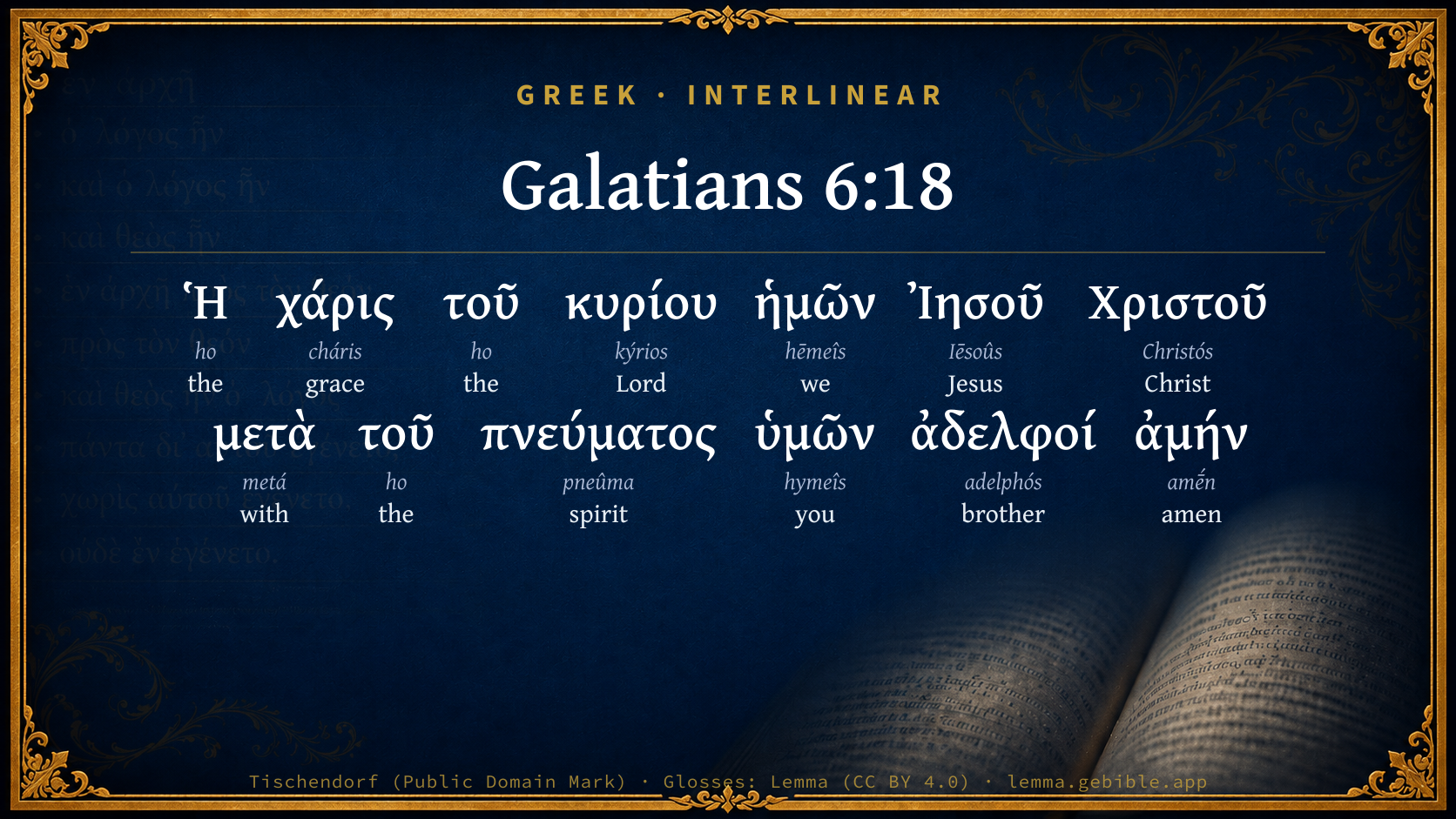
  1. Ἡ ho G3588 “the” Article, Nominative, Singular, Feminine
  2. χάρις cháris G5485 “grace” Noun, Nominative, Singular, Feminine
  3. τοῦ ho G3588 “the” Article, Genitive, Singular, Masculine
  4. κυρίου kýrios G2962 “Lord” Noun, Genitive, Singular, Masculine
  5. ἡμῶν hēmeîs G2249 “we” Personal pronoun, 1st person, Genitive, Plural
  6. Ἰησοῦ Iēsoûs G2424 “Jesus” Noun, Genitive, Singular, Masculine
  7. Χριστοῦ Christós G5547 “Christ” Noun, Genitive, Singular, Masculine
  8. μετὰ metá G3326 “with” Preposition
  9. τοῦ ho G3588 “the” Article, Genitive, Singular, Neuter
  10. πνεύματος pneûma G4151 “spirit” Noun, Genitive, Singular, Neuter
  11. ὑμῶν hymeîs G5210 “you” Personal pronoun, 2nd person, Genitive, Plural
  12. ἀδελφοί adelphós G80 “brother” Noun, Vocative, Plural, Masculine

About this verse

These counts appear in no published source. They are computed here, from the morphology-tagged text and Lemma’s own curated glosses. What Lemma adds →

13
words
11
distinct lemmas
Pauline Epistles
section

Repetition

A word recurs within this verse:

Cross-references

5

Topical passages linked to Galatians 6:18 in the Treasury of Scripture Knowledge — connected by theme and wording, ordered by reader-vote popularity; previews shown in the World English Bible.

  • Romans 16:20 And the God of peace will quickly crush Satan under your feet. The grace of our Lord Jesus Christ be with you.
  • 2 Timothy 4:22 The Lord Jesus Christ be with your spirit. Grace be with you. Amen.
  • 2 Corinthians 13:14 The grace of the Lord Jesus Christ, the love of God, and the communion of the Holy Spirit, be with you all. Amen.
  • Philemon 1:25 The grace of our Lord Jesus Christ be with your spirit. Amen.
  • Revelation 22:21 The grace of the Lord Jesus Christ be with all the saints. Amen.

Cross-references courtesy of OpenBible.info (CC BY 4.0).

Where the printed editions differ

1 variant

Places in this verse where the major printed Greek editions disagree on the wording in a way that affects the translation — a comparison of editions, not a manuscript-by-manuscript collation. The editions are the modern critical texts (Nestlé-Aland 28/27, SBL, Westcott-Hort, Tregelles, Tyndale House) and the traditional texts behind the KJV (the Textus Receptus and the Byzantine/Majority text). It is not a claim about which reading is original.

  1. Extra text
    πρός Γαλάτας ἐγράφη ἀπό Ῥώμης.¶

    “to Galatians it was written from Rome.”

    In TR Not in NA28NA27TynSBLWHTregByz

    πρός Γαλάτας ἐγράφη ἀπό Ῥώμης.¶ (pros Galatas egraphē apo Rhōmēs) 'to Galatians it was written from Rome.' is only in traditional manuscripts (TR)

Textual data: Translators Amalgamated Greek New Testament (STEPBible TAGNT) · CC BY 4.0.

Commentary

Notes on Galatians 6:18 from classic Christian and Jewish commentators (each source and its license shown beneath its notes). The classic Christian expositions comment on the surrounding passage and are grouped to its opening verse, so a note may address several verses; the Jewish commentaries on the Tanakh (Rashi and others) are per-verse, so they appear only where the commentator wrote on this verse.

Lemma curates 59 commentaries, every one of them public domain or Creative Commons licensed, each selected and text-cleaned for this edition rather than reprinted as found. About our sources →

The Biblical Illustrator

Joseph S. Exell

Gal_6:18

Brethren, the grace of our Lord Jesus Christ be with your spirit.

Amen.

The apostolic benediction

By this last word he seals all that precedes it. He says not merely with you as elsewhere; but, with your spirit, thus withdrawing them from carnal things, and displaying throughout the beneficence of God, and reminding them of the grace which they enjoyed, whereby he was able to recall them from all their Judaizing errors. For to have received the Spirit came not of the laws penury, but of the righteousness which is by faith, and to preserve it when obtained came not from circumcision but from grace. Farther, he concludes his exhortation with a prayer, and makes mention of grace and the Spirit on this account, namely, both as addressing himself to the brethren, and as supplicating God that they might continue to enjoy these blessings, thus providing for them a twofold security. For this very thing, namely, both prayer and complete teaching, became to them as a double wall. For teaching, reminding them of what benefits they enjoyed, they rather kept them in the doctrine of the Church, and prayer, invoking grace, and exhorting to an enduring constancy, permitted not the Spirit to depart from them. And He abiding in them, all the error of such doctrines as they held was shaken off like dust, in Christ Jesus our Lord. (Chrysostom.)

The blessing of Christs grace

Dwell as we will on the brighter side of things, life is very hard, and men and women are hard on one another, and we ourselves are growing hard, and that is the worst of all. We need something to soften, in no enfeebling way, the hardness of life, and of men, and of our own heart. And most of the blessings we seek of our own will, weaken our souls; and in the weakening, make us harder in the future. But the grace of our Lord Jesus Christ, if we could win it and take it, softens all things by making us stronger towards goodness and truth and righteousness and love. What is it? What is His grace?

I. Whatever this grace is, it does not come from one who is ignorant of all we need.

1. He has known to the full the weight of human suffering, and the blessing of His grace that is with us is brought home to us by that knowledge. He can comfort because He knows. He has known what temptation is, and can feel with the agony of our resistance, and through that with our weakness. He has not known remorse or the loss of good, but, through His infinite pain in contact with sin, and His infinite pity for those enthralled by it, He can understand our unhappiness in guilt. By knowledge of sorrow He can bring blessing to sorrow.

2. Nor has He known joy less. In early life, as boy and youth, He knew all our simple and pure joys. In manhood, when He first went out to the world, we have often traced the joy of enthusiasm in His work. In later days these only lived in memory, but another joy took their place--the mighty joy of universal love, the joy of giving up all things for all men--that wonderful and mystic joy which we faintly realize whenever out of the depths of personal suffering we rise into the glorious life of self-surrender because we love.

II. Christs fitness to give comes not only of knowledge of our need, but also of His victory over all that is evil and weak in our need. It is the Victor who can give grace and strength to those whom the same foes attack. In order to conquer, win His grace who has conquered, and who will give it to you.

1. Kindness, the goodwill of love. The first meaning of the invocation in the text is: The loving kindness which belonged to Christ, which formed part of His character, be with you, and form part of yours. Filial tenderness. Penetrating love and insight. Nay, more than this: to be perfect, it ought to reach, through frank forgiveness, those who injure us; through interest in the interests, ideas, and movements of human progress, those who are beyond our own circle, in our nation, nay, even in the world; and finally all men, those even who are our bitterest foes, through desire that they should have good and be good.

2. The kind of beauty we express by the word charm. The beautiful charm of Christ be with you all--the charm of harmony of character, the musical subordination and accord of all the qualities and powers of His nature, so that the whole impression made was one of exquisite and various order in lovely and living movement. Sensitiveness to the feelings of others, and to all that is beautiful. An eye to see traces of the Divine loveliness everywhere; faith to believe in it; power to draw it forth. Conclusion: Pray for this grace. It will make you at one with all that is tender, pitiful, dear, and sweet in human lovingkindness, and with all that is sensitive and delicate and graceful in manner and speech, and will create in you an harmonious soul. It will make you at one with moral good, just and true and pure. It will take all that is living in humanity, all that is fair, all that is moral, and link them to and complete them by uniting them to the love of God, and to Gods love for all men; so that to human love and moral love and imaginative love will be added the spiritual love which gathers them all into perfection. (Stopford A. Brooke, M. A.)

The apostles farewell wish

The apostle concludes the Epistle with his ordinary farewell wish; wherein, having designated them by the name of brethren, he wishes that Gods grace and favour, with all spiritual benefits flowing from it, and purchased and conveyed to them through Jesus Christ, might reside, both in the effects and sense of it, in their spirits and whole soul; and he affixes his Amen, as an evidence of fervency, and confidence in his wish, and as a confirmation of the whole doctrine delivered by him in this Epistle.

1. The more of prejudice a minister apprehends to exist in a people or person against himself and his doctrine, the more ought he to endeavour by affectionate insinuations, and by frequent and seasonable reiterations of loving force, to root out those prejudices.

2. The main thing in people for which ministers ought to care, is the spirit and inward man, as that for which God mainly calls (Pro_23:26), and being kept right, will command the outward man and keep it right also (Pro_4:23). (James Fergusson.)

Parting words

This is his last farewell. He ends the Epistle with the same words wherewith he began. As if he said: I have taught you Christ purely, I have entreated you, I have chidden you, and I have let pass nothing which I thought profitable for you. I can say no more, but that I heartily pray that our Lord Jesus Christ would bless and increase my labour, and govern you with His Holy Spirit for ever. (Luther.)

Grace

I. Grace is the sum of all other blessings.

II. Grace is obtained through Christ.

III. Grace is the greatest happiness we can desire for others. (J. Lyth. , D. D.)

Grace for all

I. Grace is needed by all.

II. Grace is provided for all.

III. Grace is offered to all.

IV. Grace is supplicated for all.

V. Grace may be enjoyed by all. (J. Lyth, D. D.)

The grace of Christ

It is of little moment whether by this grace we understand that free love and favour which He always bears in His heart to all that believe in His name, or all that kindness--all those heavenly and spiritual blessings--in the communication of which He manifests this love, this free favour. In any case, to possess His grace is an inconceivable blessing. To be the objects of the kind regards of one so excellent, so amiable, so kind, so wise, so faithful, who can estimate the value of this? It was the apostles wish that the Galatian Christians might every day enjoy new proofs of this unaltered, unalterable lore. He does not pray simply that the grace of our Lord Jesus Christ may be with them, but that it may be with their spirit. The leading object of the whole Epistle is to withdraw them more from external things, and fix them on things spiritual; and such a prayer is a most appropriate conclusion. (John Brown, D. D.)

Grace through Christ alone

Here is the concluding wish of Paul for the Galatians, and it is quite in harmony with the teaching of the Epistle. In opposition to all that the false teachers would have the teachers believe respecting righteousness through the sacrifices of the law and obedience to its precepts, Paul had set before them Christ crucified as the sole foundation of all their hopes for eternity, and proved to them that by faith, and by faith alone, all the benefits of Christs death are to be obtained and appropriated. And now he concludes with the affectionate wish that they might constantly and richly experience in their own souls the truth of the gospel, through the grace of our Lord Jesus Christ dwelling in their hearts. May every true believer, both with respect to himself and to the whole Church of Christ, say with the apostle, Amen! (John Venn, M. A.)

It is much to be observed that in the original the word Brethren stands at the end of the sentence in a very unusual and emphatic position. After all the severity and strength of the Epistle, he concludes with this word of tenderness and affection. (Bishop Moberly.)

After all his sorrow, amazement, censure, and despondency, he parts with them in kindness; after all the pain they had cost him, yet were they dear to him; and ere he lifts his hand from the parchment, it writes as a parting love-token--Brethren. (John Eadie, D. D.)

The benediction

As the apostle began with grace (chap. 1:3), so he ends with grace, to teach us--

I. That our salvation is placed in it alone for the beginning, progress, and accomplishment thereof. For--

1. Election is of grace (Rom_11:5).

2. Vocation (2Ti_1:9).

3. Justification (Rom_4:24).

4. Glorification (Rom_6:23).

II. That Christ is to have all the glory of this grace.

III. That all our salutations and greetings, adieus and farewells, ought to be founded in the grace of Christ.

The conclusion: It is an epitome of the Epistle.

I. Christ the Lord of the house is opposed to Moses who was but a servant.

II. The grace of Christ is opposed to the merit of works.

III. The spirit, the true seat of grace, is opposed to the flesh in which the false apostles gloried so much.

IV. brethren denotes the affection which is opposed to the lordly carriage of the false apostles and to the strife which they endeavoured to foment. (R. Cudworth.)

The Biblical Illustrator, edited by Joseph S. Exell (c. 1880s–1900s) — public domain. Text from a community e-Sword module.

Tyndale Open Study Notes

Tyndale Open Resources

6:18 Paul prayed at the end as at the beginning (1:3-4). More than law, the Galatians needed the grace of our Lord Jesus Christ to be with their spirit.

Tyndale Open Study Notes — © Tyndale Open Resources, licensed CC BY-SA 4.0. Text via the HelloAO Bible API.

Bengel's Gnomon

Johann Albrecht Bengel

Gal 6:18. Ἡ χάριζ, grace) This is in consonance with the whole epistle.—μετὰ τοῦ πνεύματος ὑμῶν, with your spirit) having vanquished the flesh, Gal 6:1; comp. 1Th 5:23; 2Ti 4:22; Phm 1:25.—ἀδελφοὶ, brethren) The severity of the whole epistle is thus softened; comp. Gal 1:6, note.[69]

[69] Bengel, J. A. (1860). Vol. 4: Gnomon of the New Testament (M. E. Bengel & J. C. F. Steudel, Ed.) (J. Bryce, Trans.) (1–59). Edinburgh: T&T Clark.

Bengel's Gnomon of the New Testament — English translation (T&T Clark, Edinburgh, 1860) — public domain. Text from a community e-Sword module.

Meyer's Critical & Exegetical Commentary

Heinrich August Wilhelm Meyer

Gal_6:18. Ἡ χάρις τοῦ κυρίου κ.τ.λ.] See on Gal_1:6.

μετὰ τοῦ πνεύματος ὑμῶν] sc. εἴη. A special design, on account of which Paul did not write merely μεθʼ ὑμῶν (1Co_16:23; Col_4:18; 1Th_5:28), or μετὰ πάντων ὑμῶν (2Co_13:13; Php_4:23; 2Th_3:18; Tit_3:15), is indeed assumed by many expositors (that Paul desired once more to indicate that salvation does not come from the σάρξ; Chrysostom, Theophylact, Beza, and others; also Rückert, Usteri, Schott, Olshausen), but cannot be made good; especially as also in Phm_1:25 (and 2Ti_4:22), instead of the persons simply, we find that with greater significance and fervour the spirit of the persons (so also at the close of the Epistle of Barnabas) is named, because it is on the πνεῦμα of man (the higher principle of life with the νοῦς; see on Luk_1:46; Rom_1:4; Rom_8:10; 2Co_2:13, et al.) that the grace of Christ works (Rom_8:10; Rom_8:16), when the Spirit of Christ takes up His abode in the human spirit and so confers His χαρίσματα. Paul might also have written μετὰ τῶν ψυχῶν ὑμ. (comp. 2Co_12:15; 1Pe_1:9; 1Pe_1:22; 1Pe_2:11; 1Pe_2:25); but even in that case the gracious operation of Christ would have to be conceived as issuing from the seat of self-consciousness (the πνεῦμα of man).

ἀδελφοί] The epistle, in great part so severe, ends with a mode of address which still breathes unaltered love (1Co_16:24).

Meyer — Critical and Exegetical Commentary on the New Testament — English translation by Peter Christie, edited by Frederick Crombie (T&T Clark, 1880) — public domain. Text from a community e-Sword module.

Expositor's Greek Testament

ed. W. Robertson Nicoll

Gal 6:18 . μετὰ τ . πνεύματος . This form of the final blessing occurs also in 2Ti 4:22 and Phm 1:25 , but not elsewhere: it was probably suggested here by the stress laid on the life of the Spirit in the Epistle.

The subscription ἀπὸ Ῥώμης is neither genuine nor correct. Its absence in the oldest MSS. stamps it as an addition of later date. The Epistle was evidently written before the Roman captivity (see Introduction, pp. 144 7).

The Expositor's Greek Testament, edited by W. Robertson Nicoll (1897–1910) — public domain. Text from a community e-Sword module.

Geneva Bible (1599)

Geneva Bible translators

Taking his farewell of them, he wisheth them grace, and the Spirit against the deceits of the false apostles, who labored to beat those outward things into their brains.

With your minds and hearts.

Geneva Bible (1599) marginal notes — public domain. Text via Bolls.life.

Jamieson, Fausset & Brown

Robert Jamieson, A. R. Fausset & David Brown

Brethren--Place it, as Greek, "last" in the sentence, before the "Amen." After much rebuke and monition, he bids them farewell with the loving expression of brotherhood as his last parting word (see on Gal 1:6).

be with your spirit--which, I trust, will keep down the flesh (Th1 5:23; Ti2 4:22; Plm 1:25).

Next: Ephesians Introduction

Jamieson, Fausset & Brown — Commentary Critical and Explanatory on the Whole Bible (1871) — public domain (CC PDM 1.0). Text via the HelloAO Bible API.

Adam Clarke's Commentary

Verse 18. The grace] Favour, benevolence, and continual influence of the Lord Jesus, be with your spirit - may it live in your heart, enlighten and change your souls, and be conspicuous in your life!

Amen.] So let it be; and the prayer which I offer up for you on earth, may it be registered in heaven!

Unto the Galatians, written from Rome.] This, or the major part of it, is wanting in the best and most ancient MSS. Written from Rome is wanting in ACDEFG, and others. Claudius Antissiodor, has εγραφη απ' Εφεσου· Written from Ephesus. Some add, by the hands of Paul, others, by Titus. The SYRIAC has, The end of the Epistle to the Galatians, which was written from the city of Rome. The AETHIOPIC, To the Galatians. The COPTIC, Written from Rome. The VULGATE, nothing. The ARABIC, Written from the city of Rome by Titus and Luke.

Little respect is to be paid to these subscriptions. The epistle was written by Paul himself, not Titus, Luke nor Tychicus; and there is no evidence that it was written from Rome, but rather from Corinth or Ephesus. See the preface, page 385.

THE great similarity between the Epistle to the Romans and that to the Galatians has been remarked by many; and indeed it is so obvious, that the same mode of interpretation may be safely pursued in the elucidation of both; as not only the great subject, but the phraseology, in many respects, is the same. The design of the apostle is to show that God has called the Gentiles to equal privileges with the Jews, pulling down the partition wall that had separated them and the Gentiles, calling all to believe in Christ Jesus, and forming out of the believers of both people one holy and pure Church, of which, equally, himself was the head; none of either people having any preference to another, except what he might derive from his personal sanctity and superior usefulness. The calling of the Gentiles to this state of salvation was the mystery which had been hidden from all ages, and concerning which the apostle has entered into such a laborious discussion in the Epistle to the Romans; justifying the reprobation as well as the election of the Jews, and vindicating both the justice and mercy of God in the election of the Gentiles. The same subjects are referred to in this epistle, but not in that detail of argumentation as in the former. In both, the national privileges of the Jews are a frequent subject of consideration; and, as these national privileges were intended to point out spiritual advantages, the terms which express them are used frequently in both these senses with no change; and it requires an attentive mind, and a proper knowledge of the analogy of faith, to discern when and where they are to be restricted exclusively to one or the other meaning, as well as where the one is intended to shadow forth the other; and where it is used as expressing what they ought to be, according to the spirit and tenor of their original calling.

Multitudes of interpreters of different sects and parties have strangely mistaken both epistles, by not attending to these most necessary, and to the unprejudiced, most obvious, distinctions and principles. Expressions which point out national privileges have been used by them to point out those which were spiritual; and merely temporal advantages or disadvantages have been used in the sense of eternal blessings or miseries. Hence, what has been spoken of the Jews in their national capacity has been applied to the Church of God in respect to its future destiny; and thus, out of the temporal election and reprobation of the Jews, the doctrine of the irrespective and eternal election of a small part of mankind, and the unconditional and eternal reprobation of the far greater part of the human race, has been formed. The contentions produced by these misapprehensions among Christians have been uncharitable and destructive. In snatching at the shadow of religion in a great variety of metaphors and figures, the substance of Christianity has been lost: and the man who endeavours to draw the contending parties to a consistent and rational interpretation of those expressions, by showing the grand nature and design of these epistles, becomes a prey to the zealots of both parties! Where is truth in the mean time? It is fallen in the streets, and equity is gone backwards; for the most sinister designs and most heterodox opinions have been attributed to those who, regarding the words of God only, have refused to swim with either torrent; and, without even consulting their own peculiar creed, have sought to find out the meaning of the inspired writers, and with simplicity of heart, and purity of conscience, to lay that meaning before mankind.

The Israelites were denominated a peculiar treasure unto God, above all people; a kingdom of priests, and a holy nation, Ex 19:5-6. A holy people whom he had chosen to be a special people unto himself, above all the people who were upon the face of the earth, De 7:6. This was their calling, this was their profession, and this was their denomination; but how far they fell practically short of this character their history most painfully proves. Yet still they were called a holy people, because called to holiness, (Le 11:44; Le 19:2; Le 20:7,) and separated from the impure and degrading idolatries of the neighbouring nations.

Under the New Testament, all those who believe in Christ Jesus are called to holiness - to have their fruit unto holiness, that their end may be eternal life; and hence they are called saints or holy persons. And the same epithets are applied to them as to the Israelites of old; they are lively stones, built up a spiritual house, a holy priesthood, to offer up spiritual sacrifices acceptable to God through Christ; they are also called a chosen generation, a royal priesthood, a holy nation, a peculiar people, that should show forth the praises of him who had called them from darkness into his marvellous light, 1Pe 2:5; 1Pe 2:9. All this they were called to, all this was their profession, and to have all these excellences was their indisputable privilege.

As they professed to be what God had called them to be, they are often denominated by their profession; and this denomination is given frequently to those who, in experience and practice, fall far short of the blessings and privileges of the Gospel. The Church of Corinth, which was in many respects the most imperfect, as well as the most impure, of all the apostolic Churches, is nevertheless denominated the Church of God, sanctified in Christ Jesus, and called to be saints, 1Co 1:2. That there were many saints in the Corinthian Church, and many sanctified in Christ Jesus both in it and in the Churches of Galatia, the slightest perusal of the epistles to those Churches will prove: but that there were many, and in the Galatian Churches the majority, of a different character, none can doubt; yet they are all indiscriminately called the Churches of God, saints, c. And, even in those early times, saint appears to have been as general an appellative for a person professing faith in Christ Jesus, as the term Christian is at the present day, which is given to all who profess the Christian religion and yet these terms, taken in their strict and proper sense, signify, a holy person, and one who has the Spirit and mind of Christ.

In my notes on the Epistle to the Romans I have entered at large into a discussion of the subjects to which I have referred in these observations; and, to set the subject in a clear point of view, I have made a copious extract from Dr. Taylor's Key to that epistle; and I have stated, that a consistent exposition of that epistle cannot be given but upon that plan. I am still of the same opinion. It is by attending to the above distinctions, which are most obvious to all unprejudiced persons, that we plainly see that the doctrines of eternal, unconditional reprobation and election, and the impossibility of falling finally from the grace of God, have no foundation in the Epistle to the Romans. Dr. Taylor has shown that the phrases and expressions on which these doctrines are founded refer to national privileges, and those exclusive advantages which the Jews, as God's peculiar people, enjoyed during the time in which that peculiarity was designed to last; and that it is doing violence to the sense in which those expressions are generally used, to apply them to the support of such doctrines. In reference to this, I have quoted Dr. Taylor; and those illustrations of his which I have adopted, I have adopted on this ground, taking care never to pledge myself to any peculiar or heterodox opinions, by whomsoever held; and, where I thought an expression might be misunderstood, I took care to guard it by a note or observation.

Now I say that it is in this sense I understand the quotations I have made, and in this sense alone these quotations ought to be understood; and my whole work sufficiently shows that neither Dr. Taylor's nor any person's peculiar theological system makes any part of mine; that, on the doctrine of the fall of man or original sin, the doctrine of the eternal deity of Jesus Christ, the doctrine of justification by faith in the atoning blood, and the doctrine of the inspiration and regenerating influence of the Holy Ghost, I stand on the pure orthodox creed, diametrically opposite to that of the Arians and Socinians. Yet this most distinguishing difference cannot blind me against the excellences I find in any of their works, nor can I meanly borrow from Dr. Taylor, or any other author, without acknowledging my obligation; nor could I suppress a name, however obnoxious that might be, as associated with any heterodox system, when I could mention it with deference and respect. Let this be my apology for quoting Dr. Taylor, and for the frequent use I have made of his industry and learning in my exposition of the Epistle to the Romans. If I have quoted, to illustrate the sacred writings, passages almost innumerable from Greek and Roman heathens; from Jewish Talmudists and rabbinical expositors; from the Koran; from Mohammedan writers, both Arabic and Persian; and from Brahminical polytheists; and these illustrations have been well received by the Christian public; surely I may have liberty to use, in the same way, the works of a very learned man, and a most conscientious believer in the books of Divine revelation, however erroneous he may appear to be in certain doctrines which I myself deem of vital importance to the creed of an experimental Christian. Let it not be said that, by thus largely quoting from his work, I tacitly recommend an Arian creed, or any part of that system of theology peculiar to him and his party; I no more do so than the Indian matron who, while she gives the nourishing farina of the cassava to her household, recommends them to drink the poisonous juice which she has previously expressed from it.

After this declaration, it will be as disingenuous as unchristian for either friends or foes to attribute to me opinions which I never held, or an indifference to those doctrines which (I speak as a fool) stand in no work of the kind, in any language, so fully explained, fortified, and demonstrated, as they do in that before the reader. On such a mode of judgment and condemnation as that to which some resort in matters of this kind, I might have long ago been reputed a Pagan or a Mohammedan, because I have quoted heathen writers and the Koran. And, by the same mode of argumentation, St. Paul might be convicted of having abandoned his Jewish creed and Christian faith, because he had quoted the heathen poets Aratus and Cleanthes. The man is entitled to my pity who refuses to take advantage of useful discoveries in the philosophical researches of Dr. Priestley, because Dr. Priestley, as a theologian, was not sound in the faith.

I have made that use of Dr. Taylor which I have done of others; and have reason to thank God that his Key, passing through several wards of a lock which appeared to me inextricable, has enabled me to bring forth and exhibit, in a fair and luminous point of view, objects and meanings in the Epistle to the Romans which, without this assistance, I had perhaps been unable to discover.

I may add, farther, that I have made that use of Dr. Taylor which himself has recommended to his readers: some of his censors will perhaps scarcely believe that the four following articles constitute the charge with which this learned man commences his theological lectures: -

I. "I do solemnly charge you, in the name of the God of truth,

and of our Lord Jesus Christ, who is the way, the truth, and

the life, and before whose judgment seat you must in no long

time appear, that, in all your studies and inquiries of a

religious nature, present or future, you do constantly,

carefully, impartially, and conscientiously attend to

evidence, as it lies in the Holy Scriptures, or in the

nature of things and the dictates of reason, cautiously

guarding against the sallies of imagination, and the fallacy

of ill-grounded conjecture.

II. "That you admit, embrace, or assent to no principle or

sentiment, by me taught or advanced, but only so far as it

shall appear to you to be justified by proper evidence from

revelation, or the reason of things.

III. "That if at any time hereafter any principle or sentiment by

me taught or advanced, or by you admitted or embraced,

shall, upon impartial and faithful examination, appear to

you to be dubious or false, you either suspect or totally

reject such principle or sentiment.

IV. "That you keep your mind always open to evidence; that you

labour to banish from your breast all prejudice,

prepossession, and party zeal; that you study to live in

peace and love with all your fellow Christians; and that you

steadily assert for yourself, and freely allow to others, the

unalienable rights of judgment and conscience." - Taylor's

Scheme of Scripture Divinity, preface, page vi.

Thus I have done with Dr. Taylor's works; and thus I desire every intelligent reader to do with my own.

When I was a child I had for a lesson the following words: Despise not advice, even from the meanest; the cackling of geese once preserved the Roman state. And since I became a man, I have learned wisdom from that saying: Blessed are ye who sow beside ALL WATERS; that send forth thither the feet of the OX and the ASS. May He, who is the way, the truth, and the life, lead the reader into all truth, and bring him to life everlasting! Amen.

Finished the correction for a new edition, Dec. 14th, 1831. - A. C.

Adam Clarke's Commentary on the Bible (1810–1826) — public domain. Text from a community e-Sword/MySword module.

John Calvin's Commentaries

18. The grace of our Lord Jesus Christ be with your spirit. His prayer is not only that God may bestow upon them his grace in large measure, but that they may have a proper feeling of it in their hearts. Then only is it truly enjoyed by us, when it comes to our spirit. We ought therefore to entreat that God would prepare in our souls a habitation for his grace. Amen.

END OF THE COMMENTARIES ON THE EPISTLE TO THE GALATIANS.

John Calvin's Commentaries (1540-1563) — public domain. Text from the Calvin Translation Society English edition (1840s-50s) via the Christian Classics Ethereal Library (ccel.org). Calvin's coverage is partial (roughly two-thirds of the Bible); uncommented books and verses are honest gaps, never fabricated. The 19th-century editor's footnotes and remarks are omitted so the notes are faithfully Calvin's own voice.

Ellicott's Commentary for English Readers

(18) With your spirit.—The grace of God works especially on the “spirit,” or highest part, of man.

[The subscription, as it stands in our Bibles, appears for the first time in MSS. dating from about the beginning of the ninth century, though before this the Epistle had been described as written from Rome by Theodoret, Euthalius, and Jerome. We have seen that the choice really lies between Ephesus and Macedonia, or Corinth, and that the probability seems to be somewhat in favour of the latter.]

A Bible Commentary for English Readers, edited by Charles John Ellicott (1878–1897) — public domain. Text from a community e-Sword module.

The Cambridge Bible for Schools and Colleges

gen. ed. J. J. S. Perowne

18. The Epistle commenced with expostulation and rebuke. It closes with benediction. Grace is the key-note of the Apostle’s argument. Grace—the Grace of the Lord Jesus Christ—the blessing he invokes on their behalf. It is the farewell prayer of a brother for his ‘brethren’, and it breathes the spirit of His Divine Master, of Whom we read, ‘And it came to pass, while He blessed them, He was parted from them’.

¶ Unto the Galatians … Rome] The Subscription in the earliest MSS. is simply, ‘To Galatians’. The additional words ‘written from Rome’ appear first in a correction of the Vatican MS. of uncertain date, and in two of the later Uncials. It has been shewn in the Introduction that the statement, which rests on no sufficient authority, is clearly incorrect.

The Cambridge Bible for Schools and Colleges (gen. ed. J. J. S. Perowne; Cambridge University Press, 1878–1918) — public domain. Text from a community e-Sword module.

Trapp's Complete Commentary

John Trapp

18 Brethren, the grace of our Lord Jesus Christ be with your spirit. Amen. To the Galatians written from Rome.

Ver. 18. Be with your spirit] Spirituals are specially to be desired for ourselves and ours. Caetera aut aderunt, aut non oberunt. Other things we shall either have, or not want, but be as well without them.

John Trapp, A Commentary or Exposition upon All the Books of the Old and New Testament (1647–1656) — public domain. Text from a community e-Sword module.

Albert Barnes' Notes on the Bible

Brethren, the grace ... - See the note at Rom 16:20.

Albert Barnes' Notes on the Bible (1834–1885) — public domain. Text from a community e-Sword/MySword module.

Matthew Poole's English Annotations

The apostle closeth this Epistle with this prayer, as he generally concludeth all his Epistles, with wishing them grace,

the grace of our Lord Jesus Christ; under which he comprehendeth all the effects of the free love of God upon believers’ souls, for the sake, and in and through the merits, of the Lord Jesus Christ: this he prayeth that they might feel in their hearts, and that it might be in their spirits, to quicken, strengthen, comfort, and establish them, according to the different manifestations of the Spirit of grace.

It hath been said before, that we are not to look upon these dates of apostolical Epistles as part of holy writ, for in some of them there are manifest mistakes; but most think that this Epistle was written from Rome, while Paul was a prisoner there, who are in part guided to it from Gal 6:17, thinking that it was written at a time when Paul was there suffering imprisonment. But of this there is no certainty.

Matthew Poole's English Annotations on the Holy Bible (1683–1685) — public domain. Text from a community e-Sword/MySword module.

Whedon's Commentary on the Bible

Daniel D. Whedon

18. Brethren—In the Greek this word is the last of the verse and of the epistle. “So,” says Bengel, “he softens with the final word the severity of the whole epistle.” He would part with them as brethren; whether they truly remained brethren, history does not reveal.

Daniel D. Whedon (gen. ed.), Commentary on the Old and New Testaments (1874–1909) — public domain. Text from a community e-Sword module.

The Pulpit Commentary

Brethren, the grace of our Lord Jesus Christ be with your spirit. Amen (hJ cariv tou Kuriou hJmwn jIhsou Cristou metamatov uJmwn ajdelfoi jAmhn); the grace of our Lord Jesus Christ be with your spirit, brethren. Amen. "The grace of Jesus Christ" denotes his Saviour"s loving-kindness, not only effectual in making a guilty soul acceptable to God through his atonement, but also in purifying it from sin, enduring it with spiritual strength, and securing its final salvation. The pre-eatery imperative "be," which, of course, is to be supplied, clothes a friendly wish in the pious form of a prayer. "With," the meta which, in the Septuagint, represents the Hebrew im, meaning "present to help," is illustrated by Gen_21:22; Rth_2:4; Jud_1:6:12; Mat_1:23 Mat_28:9; Joh_3:2 Joh_16:32. "With your spirit," here, as Php_4:23; Phm_1:25; 2Ti_4:22, replaces the "with you," which is the form in which the farewell greeting is commonly couched; as in 1Co_16:23; Eph_6:24, etc. There is no polemical reference whatever in the substitution; rather it is an affectionate amplification or intensification of the kindly wish or blessing, the outcome of affectionate yearning, after the stern rebukes which he had felt himself compelled to address to them. It expresses his desire that Christ"s grace might be very near to them near to the most intimate and most controlling part of their nature. The singular "spirit" is conjoined with the plural pronoun "your," as in Rom_8:16; 1Co_6:19 ("your body") 1Th_5:23, "your spirit and soul and body." The word "brethren" is added last of all, as it were in caressing affectionateness, as in Phm_1:7. The final "Amen" seals the true earnestness and the devotional spirit of the benediction.

His parting word.

grace of our Lord Jesus Christ be with your spirit, brethren. Amen." The Epistle began with a salutation of grace and peace; it ends with grace.

I THE BLESSING. "Grace," which is at once the beginning, middle, and end of Paul"s theology; and the beginning, middle, and end of Christian life.

II THE TOKEN OF PARTING TENDERNESS. "Brethren." It comes last in the sentence, as if, after all his grave censures, he would remember they were still brethren in Christ. His spirit softens as his pen traces the closing words of the Epistle, and the sweet "Amen" seals everything with the token of his deep sincerity and his tender interest in their welfare.

The Pulpit Commentary (1880–1919), ed. H.D.M. Spence-Jones & Joseph S. Exell — public domain. Text from a community e-Sword module.

Luther on Galatians

Martin Luther

VERSE 18. Brethren, the grace of our Lord Jesus Christ be with your spirit. Amen.

This is the Apostle’s farewell. He ends his Epistle as he began it by wishing the Galatians the grace of God. We can hear him say: "I have presented Christ to you, I have pleaded with you, I have reproved you, I have overlooked nothing that I thought might be of benefit to you. All I can do now is to pray that our Lord Jesus Christ would bless my Epistle and grant you the guidance of the Holy Ghost."

The Lord Jesus Christ, our Savior, who gave me the strength and the grace to explain this Epistle and granted you the grace to hear it, preserve and strengthen us in faith unto the day of our redemption. To Him, the Father and the Son and the Holy Spirit, be glory, world without end. Amen.

Martin Luther — Commentary on the Epistle to the Galatians (1535), English translation by Theodore Graebner (Zondervan, 1939) — public domain (U.S. copyright not renewed). Text from a community e-Sword module.

Burkitt's Expository Notes on the New Testament

William Burkitt

Here our apostle closes his epistle with his accustomed valediction, most affectionately praying that the grace and favour of Christ, in the sweet effects of it, and in the sensible apprehension of it, might remain in their souls, to enlighten, sanctify, comfort, and quicken them more and more, that from thence they may derive and draw abiding consolation both in life and death. Amen.

William Burkitt's Expository Notes on the New Testament (1700–1703) — public domain. Text from a community e-Sword module.

McGarvey & Pendleton's Commentaries

J. W. McGarvey

The grace of our Lord Jesus Christ be with your spirit, brethren. Amen. [The Epistle closes with a fraternal benediction, but the word of grace rests on the spirit of the Galatians, and not on their bodies. Blessing was to be found in rectitude of spirit, and not in fleshly righteousness ceremonially obtained through ordinances. We have no word of history which reveals to us the immediate effect of Paul's Epistle; but the fact that it was preserved argues that it was well received. Considering the vigor and power of it, it could not have been otherwise than effective. We may say, then, that it, with 2 Corinthians and Romans, were three blows which staggered Judaism, and restrained it, till smitten by the hand of God himself at the destruction of Jerusalem, A. D. 70, it ceased to trouble the church till its forms were again revived in the days of the great apostasy.]

J. W. McGarvey (with Philip Y. Pendleton), Commentaries on the New Testament (The Fourfold Gospel, 1914; Acts; and the epistles) — public domain. Text from a community e-Sword/MySword module.

The People's New Testament

B. W. Johnson

18. Brethren. This is his parting benediction. It rests not upon the flesh against which he had warned them, but upon the highest part of their being, the spirit.

B. W. Johnson's The People's New Testament with Notes (1889–1891) — public domain. Electronic text from the Christian Classics Ethereal Library (CCEL) ThML edition.

Cambridge Greek Testament for Schools and Colleges

18. VALEDICTION

ἡ χάρις. Though ἡ χάρις is found at, or near, the close of each of St Paul’s Epistles, it is still true that “Hoc congruit cum tota epistola” (Bengel).

τοῦ κυρίου [ἡμῶν] (see Gal 6:14) Ἰησοῦ Χριστοῦ. The full phrase occurs in Rom 16:20 (W.H. marg.); 1Th 5:28; 2Th 3:18 only. Compare also the note on Col 4:18.

μετὰ τοῦ πνεύματος ὑμῶν, Php 4:23; Phm 1:25[174] note; cf. 2Ti 4:22. St Paul’s usual phrases are μεθʼ ὑμῶν, μετὰ πάντων ὑμῶν. The mention of πνεῦμα seems in our Epistle to be a final reminder that their true life lies elsewhere than in the σάρξ and things pertaining thereto.

[174] Is affixed to a word it means that all the passages are mentioned where that word occurs in the New Testament.

ἀδελφοί, Gal 1:11 note. Here only in the valediction. Ita mollitur totius epistolae severitas (Bengel). Similarly St Paul closes 1 Cor. with an expression of love for all his readers, in Christ Jesus. Thus our verse suggests even 2Co 13:13, the grace of the Lord Jesus [Christ], and the love of God the Father of all believers, and the fellowship given by the Holy Spirit.

The absence of any personal greetings is doubtless due to the same cause as their absence in Eph., viz. the fact that both Epistles are circular letters to several towns.

ἀμήν. Genuine at the end of an epistle elsewhere in Rom. only. Here it is due to the solemn earnestness with which he pleads. His final word is a prayer.

Cambridge Greek Testament for Schools and Colleges (Cambridge University Press, 1896; 21 vols, various authors incl. Carr, Maclear, Plummer, Farrar, Lumby, Moule, M. R. James, Simcox) — public domain. Text from a community e-Sword module.

Alford’s Greek Testament

Henry Alford

18.] The Apostolic blessing. No special intention need be suspected in πνεύματος (ἀπάγων αὐτοὺς τῶν σαρκικῶν, Chrys.), as the same expression occurs at the end of other Epistles (reff.). I should rather regard it as a deep expression of his Christian love, which is further carried on by ἀδελφοί, the last word,—parting from them, after an Epistle of such rebuke and warning, in the fulness of brotherhood in Christ.

Henry Alford, The Greek Testament (1849–1861) — public domain. Text from a community e-Sword module.

International Critical Commentary

18. Ἡ χάρις τοῦ κυρίου ἡμῶν Ἰησοῦ Χριστοῦ μετὰ τοῦ πνεύματος ὑμῶν, ἀδελφοί· ἀμήν. “The grace of our Lord Jesus Christ be with your spirit, brethren. Amen.” The concluding benedictions of all the letters ascribed to the apostle Paul are alike in that they include the invocation of grace, which, except in Colossians and the pastoral epistles, is specifically called “the grace of the Lord Jesus Christ.” Php 4:23 and Phm 1:25 are like Galatians in using μετὰ τοῦ πνεύματος ὑμῶν instead of the usual μεθʼ ὑμῶν. Ephesians only includes the invocation of peace, which is regularly found in the opening salutations of the apostle’s letters. On the wholly exceptional form of 2 Cor., see p. 509. The expression “the grace of our Lord Jesus Christ” is to be taken at its full value; for, while the apostle closely associates the love of God manifest in Christ and the love of Christ (Rom 8:35, Rom 8:39), he expressly ascribes to Christ in his earthly career a love for men and grace towards them (2:20, 2Co 8:9, etc.), and conceiving of Jesus as still living and in relation to men (1Th 1:10, Rom 8:34, etc.) ascribes to him as thus living a gracious attitude towards men, manifest on the one hand in spiritual fellowship with them (2:20) and, on the other hand, in intercession for them (Rom 8:34). The phrase μετὰ τοῦ πνεύματος ὑμῶν shows that it is the former that is here in mind. The sentence is, therefore, a prayer that the Galatians may have the indwelling gracious presence of the Lord Jesus Christ. By the addition of ἀδελφοί (cf. on 1:11) at the end of this letter, in which there is much of reproof and much strenuous exhortation, the apostle expresses his continued affection for the Galatians. Though the term itself is frequent in Paul’s letters, in no other case does he add it to a concluding benediction. The addition of ἀμήν (cf. on 1:5), appended to a doxology in 1:5, Rom 11:36, Rom 16:27, Eph 3:21, Php 4:20, etc., and in Rom 15:33 to a benediction (it is apparently a scribal addition in Rom 16:24, 1Co 16:24, 1Th 3:13, Phm 1:25), still further emphasises the strength and depth of the feeling with which the apostle brings to a close this remarkable letter. Though it was probably dictated rapidly, and was certainly composed under the stress of deep emotion, the six brief chapters of which it consists constitute one of the most important documents of early Christianity and one of the noblest pleas ever written for Christian liberty and spiritual religion.

Ws. Weiss, Bernhard, Die paulinischen Briefe und der Hebräerbrief im berichtigten Text. Leipzig, 1896.

Cf. Confer, compare.

Lxx The Old Testament in Greek according to the Septuagint. Quotations are from the edition of H. B. Swete. 3 vols. Cambridge, 1887-94.

Sief. Sieffert, F. Galatien und seine ersten Christengemeinden, in Zeitschrift für nistorische Theologie., vol. XLI, 1871.

* The passages cited for the meaning “to overtake” (as of one pursuing a fugitive) by Meyer, do not show it. Xen. Cyr. 5. 19; 7.7; Theophr. H. pl. 8. 1:3; Polyb. 31. 23:8; Diod. Sic. 17. 73 all show the meaning “to get the start of,” “to outdistance” (used of the pursued, not of the pursuer) quite the opposite of “overtake.” In Strabo 16. 4:15 fin. the meaning is “to seize beforehand” or possibly “to anticipate,” as in 1Co 11:21.

Ell. Ellicott, Charles John, A Critical and Grammatical Commentary on St. Paul’s Epistle to the Galatians. London, 1854. Various subsequent editions.

Ltft. Lightfoot, Joseph Barber, Saint Paul’s Epistle to the Galatians. London, 1865. 2d ed., revised, 1866. Various later editions.

Th. Thayer, Joseph Henry, A Greek English Lexicon of the New Testament. New York, 1886. Rev. edition, 1889.

Kühner-Gerth Kühner, Raphael, Ausführliche Grammatik der griechischen Sprache. Dritte Auflage in neuer Bearbeitung, besorgt von Bernhard Gerth. 2 vols. Leipzig, 1898, 1904.

Butt. Buttmann, A., A Grammar of the New Testament Greek. E. T. by J. H. Thayer. Andover, 1873.

B Burton, Ernest De Witt, Syntax of the Moods and Tenses in New Testament Greek. Third edition. Chicago, 1898.

WH. Westcott, B. F., and Hort, F. J. A., The New Testament in the original Greek. London, 1881. Vol. I, Text; vol. II, Introduction and Appendix.

אԠא. Codex Sinaiticus. Fourth century. In Imperial Library, Petrograd. Edited by Tischendorf, 1862; photographic reproduction by H. and K. Lake, Oxford, 1911.

A A. Codex Alexandrinus. Fifth century. In British Museum, London. Edited by Woide, 1786; N. T. portion by Cowper, 1860; Hansell, 1864; in photographic facsimile, by E. Maunde Thompson, 1879; and again in photographic simile by F. G. Kenyon in 1909.

C C. Codex Ephrœmi Rescriptus. Fifth century. In National Library, Paris. As its name implies, it is a palimpsest, the text of the Syrian Father Ephrem being written over the original biblical text. New Testament portion edited by Tischendorf, 1843. Contains Gal 1:21, ἔπειτα to the end, except that certain leaves are damaged on the edge, causing the loss of a few words. So e. g. ξῆλος or ξῆλοι, Gal 5:20.

D D. Codex Claromontanus. Sixth century. In National Library, Paris. Greek-Latin. Edited by Tischendorf, 1852.

K K. Codex Mosquensis. Ninth century. In Moscow.

L G. Codex Bærnerianus. Ninth century. In Royal Library, Dresden. Greek-Latin. Edited by Matthæi, 1791; photographic reproduction issued by the Hiersemann publishing house, Leipzig, 1909.

P P. Codex Porphyrianus. Ninth century. In Imperial Library, Petrograd. Published by Tischendorf in Mon. Sac. Ined. Bd. V, 1865.

Euthal. Euthalius. 459. See Lightfoot, Joseph Barber, Saint Paul’s Epistle to the Galatians. London, 1865. 2d ed., revised, 1866. Various later editions., p. 230, and Dictionary of Christian Biography, Literature, Sects, and Doctrines. Edited by Wm. Smith and Henry Wace. 4 vols. London 1877-87.

Thdrt. Theodoretus. † ca. 458. See Lightfoot, Joseph Barber, Saint Paul’s Epistle to the Galatians. London, 1865. 2d ed., revised, 1866. Various later editions., p. 230; Dictionary of Christian Biography, Literature, Sects, and Doctrines. Edited by Wm. Smith and Henry Wace. 4 vols. London 1877-87.

Dam. Joannes Damascenus. † ca. 756. See Sanday, Wm., and Headlam, A. C.. A Critical and Exegetical Commentary on the Epistle to the Romans. Edinburgh and New York, 1895. , p. c.; Dictionary of Christian Biography, Literature, Sects, and Doctrines. Edited by Wm. Smith and Henry Wace. 4 vols. London 1877-87.

B B. Codex Vaticanus. Fourth century. In Vatican Library, Rome. Photographic facsimile by Cozza-Luzi, 1889; and a second issued by the Hoepli publishing house, 1904.

F F. Codex Augiensis. Ninth century. In Trinity College, Cambridge. Greek-Latin. Edited by Scrivener, 1859. Closely related to Codex Bærnerianus. See Gregory, Textkritik des Neuen Testaments, vol. II, Leipzig, 1902, pp. 113 f.

Vg. Vulgate, text of the Latin Bible.

Tert. Tertullian. † ca. 223. See Dictionary of Christian Biography, Literature, Sects, and Doctrines. Edited by Wm. Smith and Henry Wace. 4 vols. London 1877-87.

Victorin. C. Marius Victorinus. Ca. 360 a.d. See Lightfoot, Joseph Barber, Saint Paul’s Epistle to the Galatians. London, 1865. 2d ed., revised, 1866. Various later editions., p. 231; Dictionary of Christian Biography, Literature, Sects, and Doctrines. Edited by Wm. Smith and Henry Wace. 4 vols. London 1877-87.;

Hier. Eusebius Hieronymus (Jerome). † 420. See Lightfoot, Joseph Barber, Saint Paul’s Epistle to the Galatians. London, 1865. 2d ed., revised, 1866. Various later editions., p. 232, and Dictionary of Christian Biography, Literature, Sects, and Doctrines. Edited by Wm. Smith and Henry Wace. 4 vols. London 1877-87.

Aug. Aurelius Augustinus. Ca. 394. See Lightfoot, Joseph Barber, Saint Paul’s Epistle to the Galatians. London, 1865. 2d ed., revised, 1866. Various later editions., p. 232; Dictionary of Christian Biography, Literature, Sects, and Doctrines. Edited by Wm. Smith and Henry Wace. 4 vols. London 1877-87.

Ambrst. Ambrosiaster. Ca. 305 a.d. See Lightfoot, Joseph Barber, Saint Paul’s Epistle to the Galatians. London, 1865. 2d ed., revised, 1866. Various later editions., p. 232; Dictionary of Christian Biography, Literature, Sects, and Doctrines. Edited by Wm. Smith and Henry Wace. 4 vols. London 1877-87.

Tdf. Tischendorf, Constantin, Novum Testamentum Grœce. Editio octava crit. maj. Leipzig, 1869-72.

M. and M. Moulton, J. H., and Milligan, G., Vocabulary of the Greek New Testament. 1914-.

Patr. Ap. Apostolic Fathers.

L.&S. Liddell, H. G., and Scott, R., Greek English Lexicon. Seventh edition revised. New York, 1882.

* συνοδηγὸν ἔχω τὸ πολὺ πῦρ τὸ ἐν τῇ ψυχῇ μου καιόμενον· ταῦτά με ἀδικεῖ, ταῦτά με ὀδυνᾷ ὁ φρεναπάτης ὁ πρὸ τοῦ μέγα φρονῶν, καὶ ὀ τὴν κύπριν οὐ φάμενος εἶναι τοῦ ἐρᾶν μοι αἰτίαν (or ποιήτριαν or μεταιτίαν), οὐκ (or ἄν) ἤνεγκε λίαν τὴν (or πάντων) τυχοῦσαν ἀδικίαν.

Bl.-D. Blass, F., Grammatik des neutestamentlichen Griechisch. Göttingen, 1896. Vierte völlig neugearbeitete Auflage, besorgt von Albert De Brunner, 1913.

† φρενοβλαβής, exceptionally among such compounds of φρήν is passive, “injured in understanding, insane.”

Mey. Meyer, Heinrich August Wilhelm, Kritisch-exegetisches Handbuch über den Brief an die Galater. Göttingen, 1841, in Kritisch-exegetischer Kommentar über das Neue Testament, 1832-59. E. T., with bibliography, by Venables and Dickson. Edinburgh, 1873-85. Various later editions. See also under Sieffert, F. Galatien und seine ersten Christengemeinden, in Zeitschrift für nistorische Theologie., vol. XLI, 1871.

Weizs. Weizsäcker, C., Das apostolische Zeitalter. Zweite Aufl. Freiburg, i. B. 1892. Das Neue Testament, übersetzt von C. Weizsäcker.

Bous. Bousset, Wilhelm, in Die Schriften des Neuen Testaments. Göttingen, 1907. 2te Aufl., 1908.

Did. Διδαχὴ τῶν δώδεκα Ἀποστόλων. Various editions.

Wies. Wieseler, Karl, Commentar über den Brief Pauli an die Galater. Göttingen, 1859.

Cremer Cremer, H., Biblisch-theologisches Wörterbuch der neutestamentlichen Gräcität. Zehnte völlig durchgearbeitete Auflage herausgegeben von Julius Kögel. Gotha, 1911-15.

* It is probably only accidental coincidence that in these other Pauline instances of μὴ πλανᾶσθε the error against which he warns his readers is substantially the same as here, viz., overvaluation of the material side of life, with danger of the loss of eternal life.

31 31 (Tischendorf, Constantin, Novum Testamentum Grœce. 37) the so-called Leicester Codex. Fifteenth century. At Leicester, England. Described by J. Rendel Harris in The Origin of the Leicester Codex of the New Testament, London, 1887.

33 33 (Tischendorf, Constantin, Novum Testamentum Grœce. 17). Ninth or tenth century. In National Library, Paris. Called by Eichhorn “the queen of the cursives.” Cited by Tischendorf in Galatians more frequently than any other cursive. Contains the Prophets as well as Gospels, Acts, Cath. Epp. and Paul.

Chrys. Joannes Chrysostomus. † 407. See Lightfoot, Joseph Barber, Saint Paul’s Epistle to the Galatians. London, 1865. 2d ed., revised, 1866. Various later editions., p. 228.

Moff. Moffatt, Jas., Introduction to the Literature of the New Testament. Edinburgh and New York, 1911.

Introd. Introduction.

AV. The Holy Bible. Authorised Version of 1611.

Luth.

Luther, Martin, In Epistolam Pauli ad Galatas Commentarius. Leipzig, 1519. German edition, 1525. and Sanday, Wm., and Headlam, A. C.. A Critical and Exegetical Commentary on the Epistle to the Romans. Edinburgh and New York, 1895. , p. ciii.

——, In Epistolam S. Pauli ad Galatas Commentarius ex Prœlectione D. M. Lutheri collectus. Wittenberg, 1535. (Not a revised edition of the preceding, but a distinct and larger work. See preface to the edition of J. C. Irmischer, Erlangen, 1843, 1844.) Many other editions and translations. For characterisation, see Sanday, Wm., and Headlam, A. C.. A Critical and Exegetical Commentary on the Epistle to the Romans. Edinburgh and New York, 1895. , p. ciii.

Calv.

Calvin, J., Commentarii in quatuor Pauli Epistolas (Gal. Eph. Phil. Col.). Geneva, 1548.

——, In omnes Pauli Apostoli Epistolas Commentarii. Geneva, 1565. Various later editions and translations.

Beng. Bengel, Johann Albrecht, in Gnomon Novi Testamenti. Tübingen, 1742. See Sanday, Wm., and Headlam, A. C.. A Critical and Exegetical Commentary on the Epistle to the Romans. Edinburgh and New York, 1895. , p. ciii.

Mcion. Marcion. See Dictionary of Christian Biography, Literature, Sects, and Doctrines. Edited by Wm. Smith and Henry Wace. 4 vols. London 1877-87.

* Ellicott’s assertion: “The use of the present may be fairly explained on the ground that St. Paul includes in the idea not merely their conformity to the rite (which strictly becomes a past act). but their endeavour thereby to draw others into the same state, which is a present and continuing act,” ascribing to the present passive the ideas expressed by an aorist passive and a present active, is manifestly incorrect. In the passage cited by Ell. and at greater length by Ltft. ad loc., from Act. Petr. et Paul., § 63, the present περιτεμνόμενοι does seem to have something of the force of a perfect. But arguments drawn from the usage of this book, considerably later than Paul, are hardly strong enough to overthrow the clear evidence of Galatians itself. The οἱ ῤέοντες quoted by Ltft. from Plato, Theœt. 181A, is a nickname, which our participle quite certainly is not.

* Euthalius (Zacagnius, Collect. Monum. Vet. I 561; Gallandi Bibl. Patr. X 260) and after him Photius, Amphiloch. Quest. 183 (Migne 151), and a ms. of the eleventh century (Montfaucon, Bibl. bibl. I 195) express the opinion that the statement, 6:15 οὔτε περιτομή τι ἔστιν οὔτε ἀκροβυστία ἀλλὰ καινὴ κτίσις, is a quotation from an apocryphal writing ascribed to Moses. Georgius Snycellus (Chron. Ed. Dind. I 48), whose statement, however, is probably based, like the others, upon that of Euthalius, specifies an apocalypse of Moses as the source of the quotation. The fact that the same epigrammatic saying recurs in very similar form (cf. above) in 5:6, 1Co 7:19 is not unfavourable to the view that this is a quotation. But, on the other hand, an apocryphon entitled “Apocalypse of Moses” is not otherwise known. The statement of the others (Euthalius, etc.) is general and vague. The extant so-called “Assumption of Moses” does not contain the sentence. But even though the passage should actually have been found in the text of some apocryphon of Moses as extant in Euthalius’s day, that alone would by no means make clear what was the relation between this and the Pauline writing. Certainly the evidence as above displayed is not strong enough to prove that this is a quotation.

* Raphelius, Annot. Philol. in N. T., II, p. 460 f., says: Videtur Paulus respicere ad morem illorum, qui, quod stigmata sacra gestarent, Deo sacri erant, quosque propterea nefas erat tangere, si modo ille mos Galatis notus fuit. Caussam certe hanc affert, cur nemo sibi molestias exhibere debeat, quod stigmata Domini Jesu portet. Mentionem hujus moris facit Herodotus (lib. 2. cap. 113). Erat in littore ad ostium Nili Herculis templum, quod nunc quoque est: ἐς το ἢν καταφυγὠν οἰκέτης ὅτεῳ ἀνθρώπων ἐπιβάληται στίγματα ἱρά, ἑωντὸν διδοὺς τῷ θεῷ, ούκ ἕξεστι τούτου ἅψασθαι. ὁ νόμος οὗτος διατελέει ἐὼν ὅμοιος τὸ μέχρι ἐμοῦ ἀπʼ ἀρχῆς. τοῦ ὦν δὴ Ἀλεξάνδρου ἀπιστέαται θεράποντες πυθόμενοι τὸν περὶ τὸ ἰρὸν ἔχοντα νόμον, ἱκέται δὲ ἐζόμενοι τοῦ θεοῦ κατηγόρεον τοῦ Ἀλεξάνδρου, βουλόμενοι βλάπτειν αὐτον … Ceterum, quod Paulus dicit στίγματα βαστάζειν, Lucianus una voce στιγματοφορεῖν effert, citatus in Lexico Graeco. Varius autem erat usus stigmatum. Nam et servi in fronte iis notabantur, apud Romanos quidem fugitivi poenae causa, apud Thraces vero, ut domini eorum noscerentur, et milites in manibus, cum militiae adscriberentur.… Chrysostomus comparat cum vulneribus in bello acceptis. Sed ad scopum Pauli propius accedere videtur, quod ex Herodoto citavimus. Vult enim ipse sacrosanctus et inviolabilis haberi, propterea quod stigmata Domini Jesu in corpore suo gestet. Quanquam quocunque Paulum respexisse dicas, certum tamen est, stigmatum nomine ipsum intelligere vibices ac cicatrices ex plagis illis, lapidationibus et verberibus, quorum meminit 2Co 11:23 seqq. Quae signa erant manifesta, ipsum illorum similem non esse, qui circumcisionem urgebant, ne ob crucem Christi persecutionem paterentur (v. 12).

* Μή με δίωκε ὅδε· ανοχ παπιπετ[ου] μετουβανες· βαστάζω τὴν ταφὴν τοῦ Ὀσίρεως καὶ ὑπάγω κατα[στ]ῆσαι αὐτὴν ε[ἰ]ς Ἀβιδος, καταστῆσαι εἰς ταστας καὶ καταθέσθαι εἰς [αλ]χας· ἐάν μοι ὁ δεῖνα κόπους παράσχῃ, προς (τ) ρέψω αυτὴν αὐτῷ. De.BS. p. 354.

International Critical Commentary — older volumes (1896–1929), various authors — public domain. Text from a community e-Sword module.

Vincent's Word Studies in the New Testament

Marvin R. Vincent

The grace, etc. The same form of benediction occurs Phl 1:25. Brethren. Rev. rightly puts the word at the end of the verse. The position is unusual. It would seem as if Paul intended to close this severe letter with an assurance that the "foolish Galatians" were still his brethren : They are addressed as "brethren," ch. Gal 4:12; Gal 5:11; Gal 6:1. Comp. 1Co 16:24. ===Eph1

CHAPTER I

"The first chapter has, so to speak, a liturgical, psalmodic character, being, as it were, a glowing song in praise of the transcendent riches of the grace of God in Christ, and the glory of the Christian calling" (Schaff).

Marvin R. Vincent, Word Studies in the New Testament (1887–1900) — public domain. Text from a community e-Sword/MySword module.

Lesson kit

Teaching starters — assembled from the data on this page, not authored interpretation. Every prompt links to the verse data it draws on. Edit before teaching.

Galatians, in the Pauline Epistles, opens this verse with 13 words (11 distinct Greek lemmas). Its most distinctive word is amḗn (“amen”). A historical commentator’s framing appears above. Read the whole chapter for the surrounding context.

Discussion questions

  1. How does “amen” (amḗn) shape what this verse is saying?
  2. How does Romans 16:20, which shares this passage’s theme, read alongside this verse?
  3. What does the repetition of “the” (3× in this one verse) do in this verse?
  4. These translations render this verse differently; the difference is in the English rendering, not the original. What questions does that raise?
  5. Compare how The Biblical Illustrator and Tyndale Open Study Notes read this verse. Where do they agree or differ?

Things to notice

Reading settings

Reading text

Shown beneath each verse's original-language words.

Old Testament
Old Testament edition

Read the OT as the Masoretic Hebrew (MT) or the Greek Septuagint (LXX).

English shown for the Greek Septuagint (in the Hebrew ↔ Greek comparison).

Comparing translations? Open the Compare panel on any verse page to stack up to four side by side.