Exodus 33:17

Hebrew (Westminster Leningrad Codex) Exodus 33:17 appears in the Hebrew Old Testament. The text above is from the Westminster Leningrad Codex. Each word links to its Strong’s number, a concise gloss, and parsing drawn from the Open Scriptures Hebrew Bible morphology. Click any word for its full Brown-Driver-Briggs (BDB) entry.
Download image
Cite this verse

Exodus 33:17 (World English Bible). Public Domain. Lemma interlinear Bible study tool, https://lemma.gebible.app/v/exodus/33/17.

Show BibTeX & RIS
BibTeX
RIS
English Translation
Yahweh said to Moses, "I will do this thing also that you have spoken; for you have found favor in my sight, and I know you by name."
World English Bible · Public Domain
Download a study sheet

One document with this verse’s original text, its word-by-word gloss line, the meaning frame, cross-references with their text, attributed commentary, and full source and license credits — printable, and it pastes into notes with its structure intact.

This verse Autodidact and up

Study sheet (.html) Plain text (.txt)

A passage Seminary Student

Up to 50 verses in one chapter. A passage sheet keeps up to 6 commentary sources and 12 cross-references per verse, in the order this page ranks them, and says so on the sheet whenever that leaves anything out. Ask for a single verse and you get the Autodidact verse sheet above.

Everything on this page stays free to read, with no account — the sheet is a download of what is already on screen, not access to it.

Want to remove ads? Support Godless Engineer
Compare translations 3

The same verse in 3 English versions, stacked beneath the original-language interlinear above. Click any original word for its lexicon entry.

Each is an independent rendering of the whole verse — the interlinear is not word-aligned to these translations.

Highlighted words mark where these versions differ — a whole-verse word diff, not a word-by-word alignment.

  • World English Bible Public Domain
    Yahweh said to Moses, "I will do this thing also that you have spoken; for you have found favor in my sight, and I know you by name."
  • King James Version Public Domain
    And the LORD said unto Moses, I will do this thing also that thou hast spoken: for thou hast found grace in my sight, and I know thee by name.
  • unfoldingWord Literal Text CC BY-SA 4.0
    And Yahweh said to Moses, “I will also do this thing that you have spoken, for you have found favor in my eyes, and I know you by name.”

unfoldingWord Literal Text — © unfoldingWord, licensed CC BY-SA 4.0. Word-aligned USFM3 via Door43 (git.door43.org/unfoldingWord/en_ult).

Versions to compare (up to 4)

3 of 4 selected

Show all 18 translations

Every available English version of this verse, each an independent rendering of the whole verse.

  • World English Bible Public Domain
    Yahweh said to Moses, "I will do this thing also that you have spoken; for you have found favor in my sight, and I know you by name."
  • Berean Standard Bible Public Domain
    So the LORD said to Moses, “I will do this very thing you have asked, for you have found favor in My sight, and I know you by name.”
  • Majority Standard Bible Public Domain
    So the LORD said to Moses, “I will do this very thing you have asked, for you have found favor in My sight, and I know you by name.”
  • King James Version Public Domain
    And the LORD said unto Moses, I will do this thing also that thou hast spoken: for thou hast found grace in my sight, and I know thee by name.
  • American Standard Version (1901) Public Domain
    And Jehovah said unto Moses, I will do this thing also that thou hast spoken; for thou hast found favor in my sight, and I know thee by name.
  • Revised Version (1885) Public Domain
    And the LORD said unto Moses, I will do this thing also that thou hast spoken: for thou hast found grace in my sight, and I know thee by name.
  • Geneva Bible (1599) Public Domain
    And the Lord sayde vnto Moses, I will doe this also that thou hast saide: for thou hast founde grace in my sight, and I knowe thee by name.
  • Douay-Rheims (1899) Public Domain
    And the Lord said to Moses: This word also, which thou hast spoken, will I do: for thou hast found grace before me, and thee I have known by name.
  • Young's Literal Translation Public Domain
    And Jehovah saith unto Moses, `Even this thing which thou hast spoken I do; for thou hast found grace in Mine eyes, and I know thee by name.'
  • Literal Standard Version CC BY-SA 4.0
    And YHWH says to Moses, “Even this thing which you have spoken I do; for you have found grace in My eyes, and I know you by name.”
  • Unlocked Literal Bible CC BY-SA 4.0
    Yahweh said to Moses, “I will also do this thing that you have requested, for you have found favor in my eyes, and I know you by name.”
  • unfoldingWord Literal Text CC BY-SA 4.0
    And Yahweh said to Moses, “I will also do this thing that you have spoken, for you have found favor in my eyes, and I know you by name.”
  • Darby Bible Public Domain
    And Jehovah said to Moses, I will do this thing also that thou hast said; for thou hast found grace in mine eyes, and I know thee by name.
  • World Messianic Bible Public Domain
    The LORD said to Moses, “I will do this thing also that you have spoken; for you have found favor in my sight, and I know you by name.”
  • Webster's Bible Public Domain
    And the LORD said to Moses, I will do this thing also that thou hast spoken: for thou hast found grace in my sight, and I know thee by name.
  • Free Bible Version CC BY-SA 4.0
    The Lord told Moses, “I promise to do what you've asked, because I'm happy with you and I know you personally.”
  • Bible in Basic English Public Domain
    And the Lord said to Moses, I will do as you say: for you have grace in my eyes, and I have knowledge of you by your name.
  • JPS Tanakh (1917) Public Domain
    And the LORD said unto Moses: 'I will do this thing also that thou hast spoken, for thou hast found grace in My sight, and I know thee by name.'

Literal Standard Version (2020), Covenant Press — licensed CC BY-SA 4.0. Text via the HelloAO Bible API (eBible.org). Unlocked Literal Bible (unfoldingWord) — licensed CC BY-SA 4.0. Text via the HelloAO Bible API (eBible.org). unfoldingWord Literal Text — © unfoldingWord, licensed CC BY-SA 4.0. Word-aligned USFM3 via Door43 (git.door43.org/unfoldingWord/en_ult). Free Bible Version, Dr. Jonathan Gallagher — licensed CC BY-SA 4.0. Text via the HelloAO Bible API (eBible.org).

Word by word

More ways to search: Search by grammar → Find every occurrence → Compare this word →

Practice this passage: Drill this verse → Learn its vocabulary →

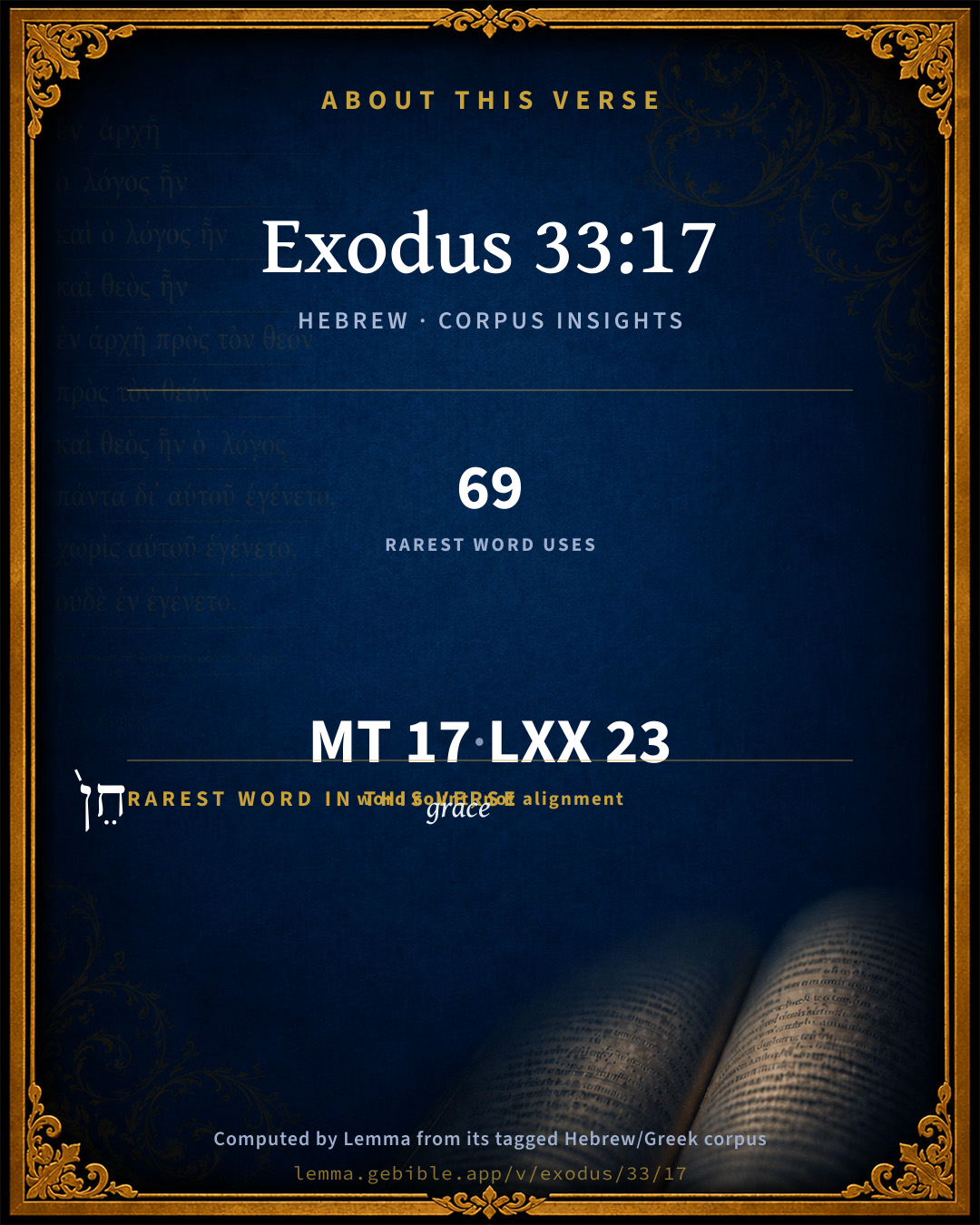
חֵן֙
chên
H2580
“grace”
Noun, Common, Masculine, Singular, Absolute
Part of Speech
Noun
Type
Common
Gender
Masculine
Number
Singular
State
Absolute
Full BDB Definition

Origin: from H2603

TWOT: TWOT- 694a

favour, grace, charm - favour, grace, elegance - favour, acceptance
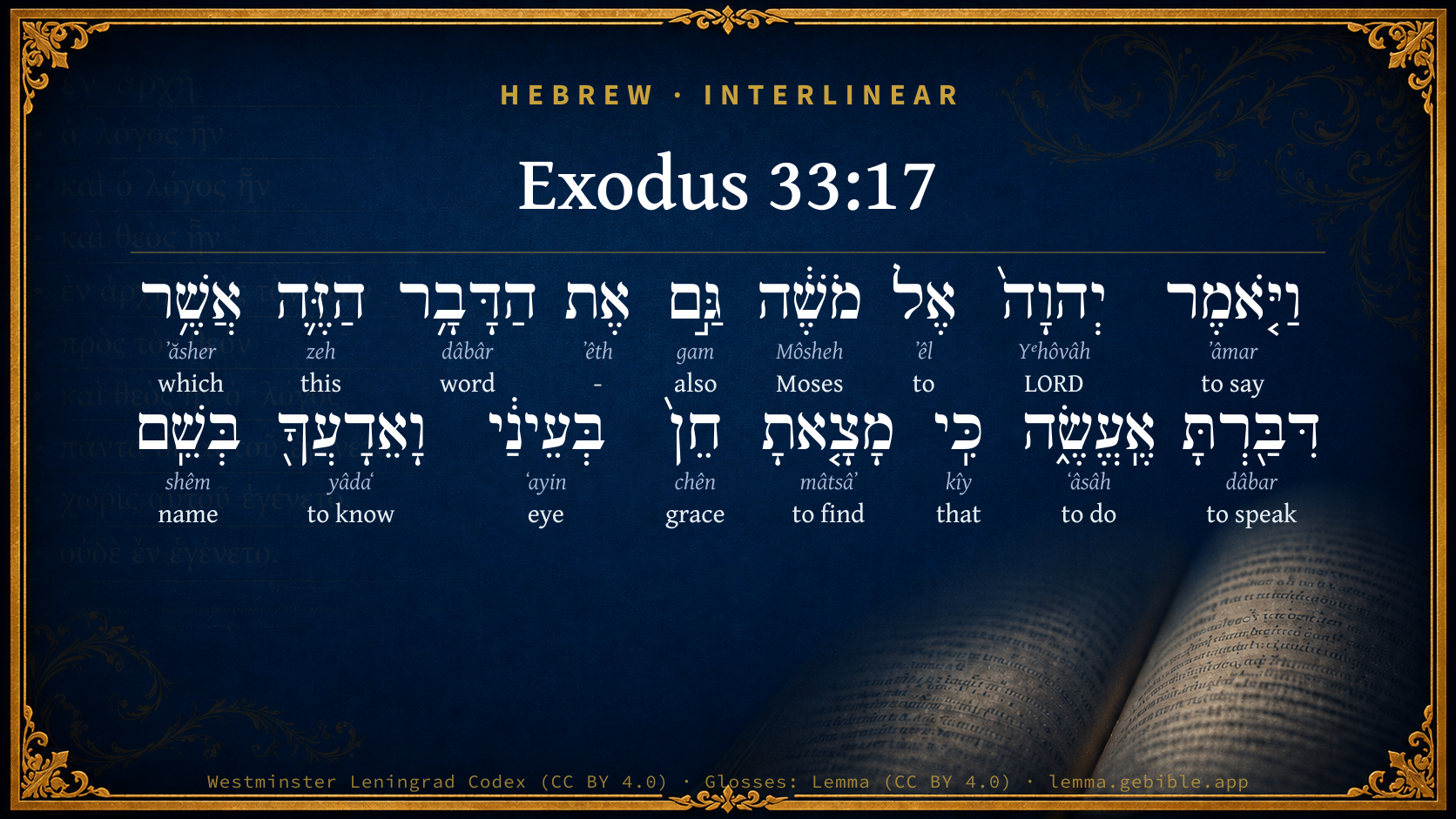
  1. וַיֹּ֤אמֶר ʼâmar H559 “and · to say” Conjunction + Verb, Qal, Sequential Imperfect, 3rd Person, Masculine, Singular
  2. יְהוָה֙ Yᵉhôvâh H3068 “LORD” Noun, Proper
  3. אֶל ʼêl H413 “to” Preposition
  4. מֹשֶׁ֔ה Môsheh H4872 “Moses” Noun, Proper
  5. גַּ֣ם gam H1571 “also” Particle, Accusative
  6. אֶת ʼêth H853 “-” Particle, Direct Object
  7. הַדָּבָ֥ר dâbâr H1697 “the · word” Particle, Definite Article + Noun, Common, Masculine, Singular, Absolute
  8. הַזֶּ֛ה zeh H2088 “the · this” Particle, Definite Article + Pronoun, Demonstrative, Masculine, Singular
  9. אֲשֶׁ֥ר ʼăsher H834 “which” Particle, Relative
  10. דִּבַּ֖רְתָּ dâbar H1696 “to speak” Verb, Piel, Perfect, 2nd Person, Masculine, Singular
  11. אֶֽעֱשֶׂ֑ה ʻâsâh H6213 “to do” Verb, Qal, Imperfect, 1st Person, Common, Singular
  12. כִּֽי kîy H3588 “that” Conjunction
  13. מָצָ֤אתָ mâtsâʼ H4672 “to find” Verb, Qal, Perfect, 2nd Person, Masculine, Singular
  14. בְּעֵינַ֔י ʻayin H5869 “in/at · eyes · my” Preposition + Noun, Common, Both, Dual, Construct + Suffix, Personal, 1st Person, Common, Singular
  15. וָאֵדָעֲךָ֖ yâdaʻ H3045 “and · to know · you” Conjunction + Verb, Qal, Sequential Imperfect, 1st Person, Common, Singular + Suffix, Personal, 2nd Person, Masculine, Singular
  16. בְּשֵֽׁם shêm H8034 “in/at · name” Preposition + Noun, Common, Masculine, Singular, Absolute

About this verse

These counts appear in no published source. They are computed here, from the morphology-tagged text and Lemma’s own curated glosses. What Lemma adds →

17
words
17
distinct lemmas
Pentateuch
section

Grammatical profile

  • 5 verbs
  • 6 nouns
  • 1 pronoun
  • 1 preposition
  • 1 conjunction
  • 3 particles

Verb forms

  • וַיֹּ֤אמֶר Qal · Sequential Imperfect
  • דִּבַּ֖רְתָּ Piel · Perfect
  • אֶֽעֱשֶׂ֑ה Qal · Imperfect
  • מָצָ֤אתָ Qal · Perfect
  • וָאֵדָעֲךָ֖ Qal · Sequential Imperfect

Hebrew & Septuagint length

In English translation the verse runs 28 words from the Hebrew and 31 from the Septuagint (LXX English) — closely comparable.

A rough comparison of the two English renderings, which tokenize alike — not a word-level alignment.

Word counts can differ between the Hebrew and the Greek without any difference in meaning — e.g. the Hebrew direct-object marker אֵת has no separate Greek word, and Greek often adds the article ὁ.

In the original languages it is 17 Hebrew tokens and 23 Greek tokens — but the two are counted differently (Hebrew bundles its prefixes and suffixes into one token; the Greek is in lemma form), so that isn’t a like-for-like length.

Cross-references

9

Topical passages linked to Exodus 33:17 in the Treasury of Scripture Knowledge — connected by theme and wording, ordered by reader-vote popularity; previews shown in the World English Bible.

  • Isaiah 65:24 It shall happen that, before they call, I will answer; and while they are yet speaking, I will hear.
  • 1 John 5:14–15 This is the boldness which we have toward him, that, if we ask anything according to his will, he listens to us.
  • Exodus 33:12 Moses said to Yahweh, "Behold, you tell me, 'Bring up this people:' and you haven't let me know whom you will send with me. Yet you have said, 'I know you by name, and you have also found favor in my sight.'
  • Genesis 19:21 He said to him, "Behold, I have granted your request concerning this thing also, that I will not overthrow the city of which you have spoken.
  • Genesis 6:8 But Noah found favor in Yahweh's eyes.
  • John 16:23 "In that day you will ask me no questions. Most assuredly I tell you, whatever you may ask of the Father in my name, he will give it to you.
  • James 5:16 Confess your offenses to one another, and pray one for another, that you may be healed. The effective, earnest prayer of a righteous man is powerfully effective.
  • Genesis 18:32 He said, "Oh don't let the Lord be angry, and I will speak yet but this once. What if ten are found there?" He said, "I will not destroy it for the ten's sake."
  • Genesis 19:19 See now, your servant has found favor in your sight, and you have magnified your loving kindness, which you have shown to me in saving my life. I can't escape to the mountain, lest evil overtake me, and I die.

Cross-references courtesy of OpenBible.info (CC BY 4.0).

Hebrew and Greek witnesses Masoretic Hebrew ↔ Greek Septuagint

The same verse in the two great witnesses to the Old Testament, shown verse-for-verse.

These are two independent witnesses, not word-aligned to each other, and the Septuagint is shown in lemma (dictionary) form.

Hebrew Exodus 33:17 Masoretic · Westminster Leningrad Codex

וַיֹּ֤אמֶר יְהוָה֙ אֶל מֹשֶׁ֔ה גַּ֣ם אֶת הַדָּבָ֥ר הַזֶּ֛ה אֲשֶׁ֥ר דִּבַּ֖רְתָּ אֶֽעֱשֶׂ֑ה כִּֽי מָצָ֤אתָ חֵן֙ בְּעֵינַ֔י וָאֵדָעֲךָ֖ בְּשֵֽׁם

Yahweh said to Moses, "I will do this thing also that you have spoken; for you have found favor in my sight, and I know you by name."

World English Bible · Public Domain

Greek LXX Exodus 33:17 Septuagint · lemma form

καί εἶπον κύριος πρός μωυσῆς καί οὗτος σύ ὁ λόγος ὅς εἶπον ποιέω εὑρίσκω γάρ χάρις ἐνώπιον ἐγώ καί οἶδα σύ παρά πᾶς

And the Lord said to Moses, I will also do for you this thing, which you have spoken; for you have found grace before me, and I know you above all.

LXX2012 (modern English Septuagint) · Public Domain

Hebrew: Westminster Leningrad Codex (CC BY 4.0). Greek: Septuagint (public domain); English from LXX2012 (modern English Septuagint) (Public Domain). How the Septuagint differs from the Hebrew →

Targum (Aramaic paraphrase)

2

The Targum is the ancient Jewish Aramaic paraphrase of the Hebrew Scriptures — an interpretive translation, not the Hebrew text itself. Onkelos (literal) and Pseudo-Jonathan (expansive) render the Torah, and Jonathan the Prophets. Coverage is partial: where no permissively-licensed English translation exists for a verse, only the Aramaic is shown. This is verse-level text, not a word-by-word alignment to the Hebrew.

  1. Targum Onkelos Torah (Genesis–Deuteronomy)
    וַאֲמַר יְיָ לְמשֶׁה אַף יָת פִּתְגָמָא הָדֵין דִי מַלֶלְתָּא אֶעְבֵּד אֲרֵי אַשְׁכַּחְתָּ רַחֲמִין קֳדָמַי וְרַבִּיתָךְ בְּשׁוּם:

    (no public-domain English translation for this verse)

    Targum Onkelos — Aramaic: “Onkelos Genesis” (public domain); “Onkelos Exodus” (public domain); “Onkelos Leviticus” (public domain); “Onkelos Numbers” (public domain); “Onkelos Deuteronomy” (public domain). English: “Sefaria Community Translation” (CC0 1.0 (public-domain dedication)); “J.W. Etheridge. The Targums of Onkelos and Jonathan Ben Uzziel on the Pentateuch. London: Longmans, Green, 1862” (public domain). Text via Sefaria.

  2. Targum Pseudo-Jonathan Torah (Genesis–Deuteronomy)
    וַאֲמַר יְיָ לְמשֶׁה אוּף יַת פִּתְגָמָא הָדֵין דְּמַלֵּילְתָּא אֶעֱבַד אֲרוּם אַשְׁכַּחְתָּא רַחֲמִין קֳדָמַי וּמַנֵּית יָתָךְ בְּשׁוּם טַב

    And the Lord said to Mosheh, This thing also which thou hast spoken of, will I do; for thou hast found mercy before Me, and I have ordained thee with a goodly name.

    Targum Pseudo-Jonathan — Aramaic: “Targum Jonathan on Genesis” (public domain); “Targum Jonathan on Exodus” (public domain); “Targum Jonathan on Leviticus” (public domain); “Targum Jonathan on Numbers” (public domain); “Targum Jonathan on Deuteronomy” (public domain). English: “The Targum of Jonathan ben Uzziel, trans. J. W. Etheridge, London, 1862” (public domain). Text via Sefaria.

Commentary

Notes on Exodus 33:17 from classic Christian and Jewish commentators (each source and its license shown beneath its notes). The classic Christian expositions comment on the surrounding passage and are grouped to its opening verse, so a note may address several verses; the Jewish commentaries on the Tanakh (Rashi and others) are per-verse, so they appear only where the commentator wrote on this verse.

Lemma curates 59 commentaries, every one of them public domain or Creative Commons licensed, each selected and text-cleaned for this edition rather than reprinted as found. About our sources →

Trapp's Complete Commentary

John Trapp

Exo 33:17 And the LORD said unto Moses, I will do this thing also that thou hast spoken: for thou hast found grace in my sight, and I know thee by name.

Ver. 17. I know thee by name.] As princes do their favourites, who easily forget others, as Saul did David. {1Sa 17:55}

John Trapp, A Commentary or Exposition upon All the Books of the Old and New Testament (1647–1656) — public domain. Text from a community e-Sword module.

Joseph Benson's Commentary

Exo 33:17. I will do this thing also that thou hast spoken — See the power of prayer! See the riches of God’s goodness! See, in type, the prevalency of Christ’s intercession, which he ever lives to make for all those that come to God by him! and the ground of that prevalency is purely in his own merit; it is because thou hast found grace in my sight — And now God is perfectly reconciled to them, and his presence in the pillar of cloud returns to them.

Joseph Benson's Commentary on the Old and New Testaments (1811–1818) — public domain. Text from a community e-Sword module.

Tyndale Open Study Notes

Tyndale Open Resources

33:17 The Lord reaffirmed his agreement to go with them and his personal appointment of Moses.

Tyndale Open Study Notes — © Tyndale Open Resources, licensed CC BY-SA 4.0. Text via the HelloAO Bible API.

Adam Clarke's Commentary

Verse 17. I will do this thing also] My presence shall go with thee, and I will keep thee separate from all the people of the earth. Both these promises have been remarkably fulfilled. God continued miraculously with them till he brought them into the promised land; and from the day in which he brought them out of Egypt to the present day, he has kept them a distinct, unmixed people! Who can account for this on any principle but that of a continual especial providence, and a constant Divine interference? The Jews have ever been a people fond of money; had they been mingled with the people of the earth among whom they have been scattered, their secular interests would have been greatly promoted by it; and they who have sacrificed every thing besides to their love of money, on this point have been incorruptible! They chose in every part of their dispersions rather to be a poor, despised, persecuted people, and continue separate from all the people of the earth, than to enjoy ease and affluence by becoming mixed with the nations. For what great purposes must God be preserving this people! for it does not appear that any moral principle binds them together-they seem lost to this; and yet in opposition to their interests, for which in other respects they would sacrifice every thing, they are still kept distinct from all the people of the earth: for this an especial providence alone can account.

Adam Clarke's Commentary on the Bible (1810–1826) — public domain. Text from a community e-Sword/MySword module.

Ellicott's Commentary for English Readers

(17) I will do this thing also that thou hast spoken.—At length the promise is unambiguously given. Moses is rewarded for his importunity. God’s people have found grace in His sight. He will “go up” with them, and so “separate them,” or distinguish them, from “all the people that are on the face of the earth.” Now at last Moses is satisfied.

A Bible Commentary for English Readers, edited by Charles John Ellicott (1878–1897) — public domain. Text from a community e-Sword module.

The Cambridge Bible for Schools and Colleges

gen. ed. J. J. S. Perowne

17. this thing also] i.e., as the text stands, accompany you personally to Canaan (v. 16): but, if vv. 14–16 (see on v. 14) stood originally after Exo_34:9, give Moses a knowledge of His ‘ways’ (v. 13). In either case, the new paragraph would begin better at v. 18.

and I know thee by name] See on v. 12.

The Cambridge Bible for Schools and Colleges (gen. ed. J. J. S. Perowne; Cambridge University Press, 1878–1918) — public domain. Text from a community e-Sword module.

John Gill's Exposition

And the Lord said unto Moses, I will do this thing also that thou hast spoken,.... Or asked for, namely, go with them himself in this amazing and distinguished manner, in the pillar of the cloud and fire; this he would do as well as show him his way and his works, and indeed all this he did by granting that:

for thou hast found grace in my sight, and I know thee by name; he owns the truth of the thing, on which Moses had formed his plan, and by granting his request gave a fresh proof and evidence of it; and what can be a greater blessing than to partake of the special grace, favour, and good will of God, and to be particularly and personally known to him, with such a knowledge as has connected with it the strongest affection and highest esteem?

John Gill's Exposition of the Whole Bible (1746–1763) — public domain (CC PDM 1.0). Text via the HelloAO Bible API.

Albert Barnes' Notes on the Bible

Compare Exo 33:13. His petition for the nation, and his own claims as a mediator, are now granted to the full.

Albert Barnes' Notes on the Bible (1834–1885) — public domain. Text from a community e-Sword/MySword module.

The Pulpit Commentary

I will do this thing also. "I will extend my favour to thy people also, and distinguish them, as well as thee, by going up with them. I will do this for thy sake, because thou hast found grace in my sight." Moses" petition is at last fully granted the threat of withdrawal cancelled the promise of Divine guidance and protection renewed I know thee by name. It is a supreme favour for God to know us by name. It marks "a specifically personal relation to God" (Keil). The expression is perhaps taken from the phraseology of Oriental Courts, where not one in a hundred of the courtiers is known to the monarch by name.

The Pulpit Commentary (1880–1919), ed. H.D.M. Spence-Jones & Joseph S. Exell — public domain. Text from a community e-Sword module.

John Wesley's Explanatory Notes

I will do this thing also that thou hast spoken - See the power of prayer! See the riches of God's goodness! See in type the prevalency of Christ's intercession, which he ever lives to make for all those that come to God by him! And the ground of that prevalency, is purely in his own merit, it is because thou hast found grace in my sight. And now God is perfectly reconciled to them, and his presence in the pillar of cloud returns to them.

John Wesley, Explanatory Notes Upon the Whole Bible (1754–1765) — public domain. Text via the GEBible commentary corpus.

unfoldingWord translationNotes

Door43 World Missions Community

General Information:

When Yahweh uses the word "you" in this verse, it is singular and refers to Moses. (See: Forms of You)

you have found favor in my eyes

Here "found favor" is an idiom that means that God is pleased with Moses. Here "eyes" are a metonym for sight, and sight is a metaphor representing his evaluation. See how you translated this in Exodus 33:12. AT: "I am pleased with you" or "I approve of you" (See: Idiom and Metonymy and Metaphor)

I know you by name

To know someone by name is to know them well. See how you translated this in Exodus 33:12. AT: "I know you well" (See: Idiom)

translationWords

Yahweh

Moses

favor

name

glory

unfoldingWord translationNotes — © Distant Shores Media and the Door43 World Missions Community, licensed CC BY-SA 4.0. Source: git.door43.org/Door43/en_tn.

Rashi

Rabbi Shlomo Yitzchaki (Rashi)

גם את הדבר הזה THIS THING ALSO — that My Shechinah shall not rest henceforth upon the other nations of the world, אעשה I WILL DO. And thus He did, for the prophetical words of Balaam (the heathen prophet) were not uttered by reason of the Shechinah resting upon him, but, as Scripture describes it, (Numbers 24:4) “[he saw the vision of the Almighty] fallen, but with eyes uncovered” (i. e. whilst fallen into a sleep his mental eyes were open and he saw in a dream what the Almighty was to reveal unto him) in a state of mind similar to that described by Job (Job 4:12) “a word was by stealth conveyed (יגנב) to me” — they (the heathen prophets) used to hear God’s message through a medium.

Rashi on the Tanakh — English translations: “The Judaica Press complete Tanach with Rashi, translated by A. J. Rosenberg” (CC BY 4.0); “Pentateuch with Rashi's commentary by M. Rosenbaum and A.M. Silbermann, 1929-1934” (public domain); “The Metsudah Tanach series, Lakewood, N.J” (CC BY 4.0); and “The Book of Joshua, Metsudah Publications, 1997” (CC BY 4.0). Text via Sefaria.

Ramban (Nachmanides)

Rabbi Moshe ben Nachman (Ramban / Nachmanides)

I WILL DO THIS THING ALSO THAT THOU HAST SPOKEN. Perhaps this manifestation of G-d’s good-will was at the end of the second [period of] forty days, in accordance with the opinion of our Rabbis, forty days according to the opinion of our Rabbis.” Rashi, quoted there, holds that there were three such periods. when the Holy One, blessed be He, became completely appeased with him, and He said to him, Hew thee two Tablets of stone like unto the first.

Ramban (Nachmanides) on the Tanakh — English translation: “Commentary on the Torah by Ramban (Nachmanides). Translated and annotated by Charles B. Chavel. New York, Shilo Pub. House, 1971-1976” (CC BY 4.0). Text via Sefaria.

Lesson kit

Teaching starters — assembled from the data on this page, not authored interpretation. Every prompt links to the verse data it draws on. Edit before teaching.

Exodus, in the Pentateuch, opens this verse with 17 words (17 distinct Hebrew lemmas). Its most distinctive word is chên (“grace”). A historical commentator’s framing appears above. Read the whole chapter for the surrounding context.

Discussion questions

  1. How does “grace” (chên) shape what this verse is saying?
  2. Isaiah 65:24 shares this passage’s theme. How do the two illuminate each other?
  3. These translations render this verse differently. What is at stake in choosing one wording over another?
  4. The verb «וַיֹּ֤אמֶר» is Qal Sequential Imperfect. How does its form color the action?
  5. Reading how Trapp's Complete Commentary and Joseph Benson's Commentary read this verse, where do the two commentators agree and where do they part?

Things to notice

Reading settings

Reading text

Shown beneath each verse's original-language words.

Old Testament
Old Testament edition

Read the OT as the Masoretic Hebrew (MT) or the Greek Septuagint (LXX).

English shown for the Greek Septuagint (in the Hebrew ↔ Greek comparison).

Comparing translations? Open the Compare panel on any verse page to stack up to four side by side.