
2 Corinthians 1:15

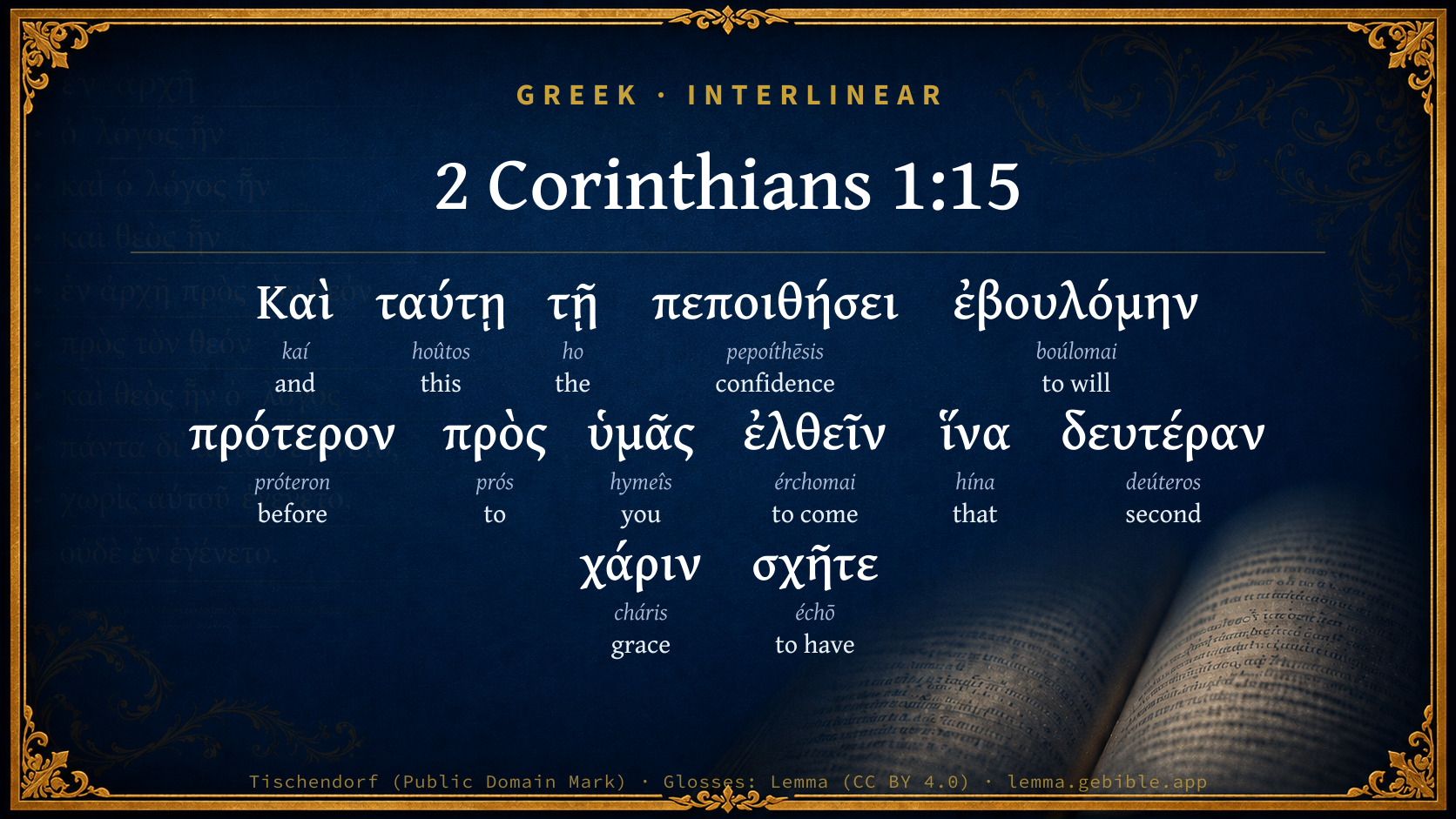
Greek (Tischendorf 8th ed.) 2 Corinthians 1:15 appears in the Greek New Testament. The text above is from the Tischendorf 8th edition. Each word links to its Strong’s number and a concise gloss. Click any word for its full Thayer’s Greek Lexicon entry.
Download image
Cite this verse

2 Corinthians 1:15 (World English Bible). Public Domain. Lemma interlinear Bible study tool, https://lemma.gebible.app/v/2-corinthians/1/15.

Show BibTeX & RIS
BibTeX
RIS
English Translation
In this confidence, I was determined to come first to you, that you might have a second benefit;
World English Bible · Public Domain
Highlights
  • 1 first appearance in the Greek New Testament
Full analysis ↓
Download a study sheet

One document with this verse’s original text, its word-by-word gloss line, the meaning frame, cross-references with their text, attributed commentary, and full source and license credits — printable, and it pastes into notes with its structure intact.

This verse Autodidact and up

Study sheet (.html) Plain text (.txt)

A passage Seminary Student

Up to 50 verses in one chapter. A passage sheet keeps up to 6 commentary sources and 12 cross-references per verse, in the order this page ranks them, and says so on the sheet whenever that leaves anything out. Ask for a single verse and you get the Autodidact verse sheet above.

Everything on this page stays free to read, with no account — the sheet is a download of what is already on screen, not access to it.

Want to remove ads? Support Godless Engineer
Compare translations 3

The same verse in 3 English versions, stacked beneath the original-language interlinear above. Click any original word for its lexicon entry.

Each is an independent rendering of the whole verse — the interlinear is not word-aligned to these translations.

Highlighted words mark where these versions differ — a whole-verse word diff, not a word-by-word alignment.

  • World English Bible Public Domain
    In this confidence, I was determined to come first to you, that you might have a second benefit;
  • King James Version Public Domain
    And in this confidence I was minded to come unto you before, that ye might have a second benefit;
  • unfoldingWord Literal Text CC BY-SA 4.0
    And with this confidence, I was intending to come to you before so that you might have a second grace,

unfoldingWord Literal Text — © unfoldingWord, licensed CC BY-SA 4.0. Word-aligned USFM3 via Door43 (git.door43.org/unfoldingWord/en_ult).

Versions to compare (up to 4)

3 of 4 selected

Show all 19 translations

Every available English version of this verse, each an independent rendering of the whole verse.

  • World English Bible Public Domain
    In this confidence, I was determined to come first to you, that you might have a second benefit;
  • Berean Standard Bible Public Domain
    Confident of this, I planned to visit you first, so that you might receive a double blessing.
  • Majority Standard Bible Public Domain
    Confident of this, I planned to visit you first, so that you might receive a double blessing.
  • King James Version Public Domain
    And in this confidence I was minded to come unto you before, that ye might have a second benefit;
  • American Standard Version (1901) Public Domain
    And in this confidence I was minded to come first unto you, that ye might have a second benefit;
  • Revised Version (1885) Public Domain
    And in this confidence I was minded to come before unto you, that ye might have a second benefit;
  • Geneva Bible (1599) Public Domain
    And in this confidence was I minded first to come vnto you, that ye might haue had a double grace,
  • Douay-Rheims (1899) Public Domain
    And in this confidence I had a mind to come to you before, that you might have a second grace:
  • Young's Literal Translation Public Domain
    and in this confidence I was purposing to come unto you before, that a second favour ye might have,
  • Literal Standard Version CC BY-SA 4.0
    and in this confidence I was intending to come to you before, that you might have a second favor,
  • Unlocked Literal Bible CC BY-SA 4.0
    Because I was confident about this, I wanted to come to you first, so that you might receive the benefit of two visits.
  • unfoldingWord Literal Text CC BY-SA 4.0
    And with this confidence, I was intending to come to you before so that you might have a second grace,
  • Darby Bible Public Domain
    And with this confidence I purposed to come to you previously, that ye might have a second favour;
  • World Messianic Bible Public Domain
    In this confidence, I was determined to come first to you, that you might have a second benefit,
  • Webster's Bible Public Domain
    And in this confidence I purposed to come to you before, that ye might have a second benefit;
  • Free Bible Version CC BY-SA 4.0
    Because I was so sure of your confidence in me I planned to come and visit you first. That way you could have benefited twice,
  • Bible in Basic English Public Domain
    And being certain of this, it was my purpose to come to you before, so that you might have a second grace;
  • Text-Critical English NT CC BY 4.0
    Because I was confident of this, I intended to come to you first, so that you would be blessed by a second visit.
  • Tyndale New Testament (1534) Public Domain
    And in this confidence was I mynded the other tyme to have come vnto you that ye myght have had yet one pleasure moare:

Literal Standard Version (2020), Covenant Press — licensed CC BY-SA 4.0. Text via the HelloAO Bible API (eBible.org). Unlocked Literal Bible (unfoldingWord) — licensed CC BY-SA 4.0. Text via the HelloAO Bible API (eBible.org). unfoldingWord Literal Text — © unfoldingWord, licensed CC BY-SA 4.0. Word-aligned USFM3 via Door43 (git.door43.org/unfoldingWord/en_ult). Free Bible Version, Dr. Jonathan Gallagher — licensed CC BY-SA 4.0. Text via the HelloAO Bible API (eBible.org).

Word by word

More ways to search: Search by grammar → Find every occurrence → Compare this word →

Practice this passage: Drill this verse → Learn its vocabulary →

About this verse

These counts appear in no published source. They are computed here, from the morphology-tagged text and Lemma’s own curated glosses. What Lemma adds →

13
words
13
distinct lemmas
Pauline Epistles
section

Notable vocabulary

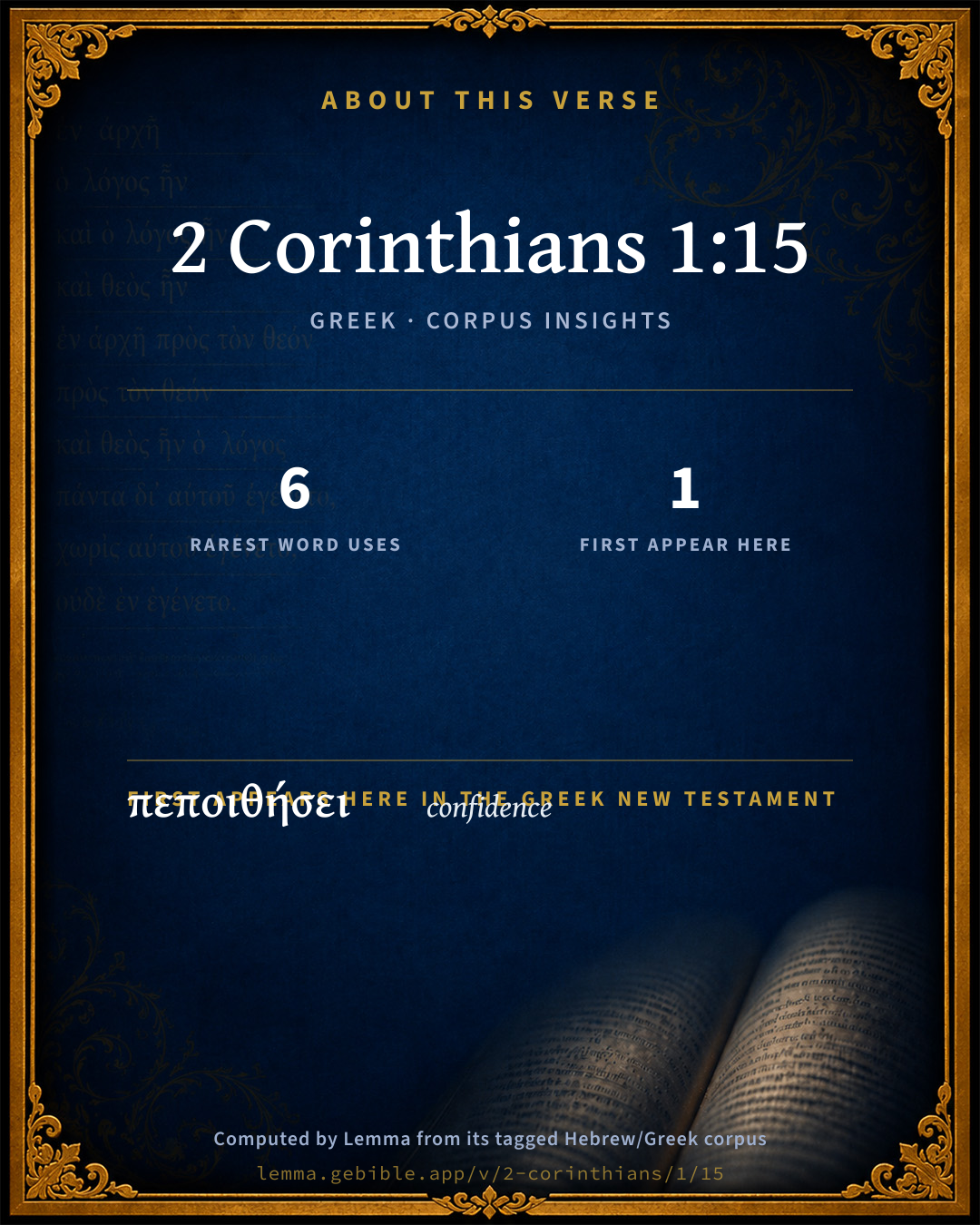
The rarest word here is πεποιθήσει confidence G4006 — appearing just 6 times in the whole Greek New Testament.

First appearance in Scripture

This word makes its first canonical appearance in the Greek New Testament here:

  • πεποιθήσει confidence G4006

Shared distinctive vocabulary

πεποιθήσει confidence G4006 occurs in 6 verses of the Greek New Testament. Also found in:
Cross-references

6

Topical passages linked to 2 Corinthians 1:15 in the Treasury of Scripture Knowledge — connected by theme and wording, ordered by reader-vote popularity; previews shown in the World English Bible.

  • Romans 1:11 For I long to see you, that I may impart to you some spiritual gift, to the end that you may be established;
  • Romans 15:29 I know that, when I come to you, I will come in the fullness of the blessing of the Gospel of Christ.
  • 1 Corinthians 4:19 But I will come to you shortly, if the Lord is willing. And I will know, not the word of those who are puffed up, but the power.
  • 1 Corinthians 11:34 But if anyone is hungry, let him eat at home, lest your coming together be for judgment. The rest I will set in order whenever I come.
  • 2 Corinthians 6:1 Working together, we entreat also that you not receive the grace of God in vain,
  • Philippians 1:25–26 Having this confidence, I know that I will remain, yes, and remain with you all, for your progress and joy in the faith,

Cross-references courtesy of OpenBible.info (CC BY 4.0).

Where the printed editions differ

1 variant

Places in this verse where the major printed Greek editions disagree on the wording in a way that affects the translation — a comparison of editions, not a manuscript-by-manuscript collation. The editions are the modern critical texts (Nestlé-Aland 28/27, SBL, Westcott-Hort, Tregelles, Tyndale House) and the traditional texts behind the KJV (the Textus Receptus and the Byzantine/Majority text). It is not a claim about which reading is original.

  1. Different wording
    χάριν

    “grace”

    In NA28NA27TynSBLTregTRByz Not in WH

    χαρὰν (charan) 'joy' occurs in a few manuscripts (WH) instead of χάριν (charin) 'grace' in older manuscripts (NA28+NA27+Tyn+SBL+Treg+TR+Byz)

Textual data: Translators Amalgamated Greek New Testament (STEPBible TAGNT) · CC BY 4.0.

Commentary

Notes on 2 Corinthians 1:15 from classic Christian and Jewish commentators (each source and its license shown beneath its notes). The classic Christian expositions comment on the surrounding passage and are grouped to its opening verse, so a note may address several verses; the Jewish commentaries on the Tanakh (Rashi and others) are per-verse, so they appear only where the commentator wrote on this verse.

Lemma curates 59 commentaries, every one of them public domain or Creative Commons licensed, each selected and text-cleaned for this edition rather than reprinted as found. About our sources →

Matthew Henry's Commentary

The apostle here vindicates himself from the imputation of levity and inconstancy, in that he did not hold his purpose of coming to them at Corinth. His adversaries there sought all occasions to blemish his character, and reflect upon his conduct; and, it seemed, they took hold of this handle to reproach his person and discredit his ministry. Now, for his justification,

I. He avers the sincerity of his intention (Co2 1:15-17), and he does this in confidence of their good opinion of him, and that they would believe him, when he assured them he was minded, or did really intend, to come to them, and that with the design, not that he might receive, but that they might receive a second benefit, that is, a further advantage by his ministry. He tells them that he had not herein used lightness (Co2 1:17), that, as he aimed not at any secular advantage to himself (for his purpose was not according to the flesh, that is, with carnal views and aims), so it was not a rash and inconsiderate resolution that he had taken up, for he had laid his measures thus of passing by them to Macedonia, and coming again to them from Macedonia in his way to Judea (Co2 1:16), and therefore they might conclude that it was for some weighty reasons that he had altered his purpose; and that with him there was not yea yea, and nay nay, Co2 1:17. He was not to be accused of levity and inconstancy, nor a contradiction between his words and intentions. Note, Good men should be careful to preserve the reputation of sincerity and constancy; they should not resolve but upon mature deliberation, and they will not change their resolves but for weighty reasons.

II. He would not have the Corinthians to infer that his gospel was false or uncertain, nor that it was contradictory in itself, nor unto truth, Co2 1:18, Co2 1:19. For if it had been so, that he had been fickle in his purposes, or even false in the promises he made of coming to them (which he was not justly to be accused of, and so some understand his expression, Co2 1:18, Our word towards you was not yea and nay), yet it would not follow that the gospel preached not only by him, but also by others in full agreement with him, was either false or doubtful. For God is true, and the Son of God, Jesus Christ, is true. The true God, and eternal life. Jesus Christ, whom the apostle preached, is not yea and nay, but in him was yea (Co2 1:19), nothing but infallible truth. And the promises of God in Christ are not yea and nay, but yea and amen, Co2 1:20. There is an inviolable constancy and unquestionable sincerity and certainty in all the parts of the gospel of Christ. If in the promises that the ministers of the gospel make as common men, and about their own affairs, they see cause sometimes to vary from them, yet the promises of the gospel covenant, which they preach, stand firm and inviolable. Bad men are false; good men are fickle; but God is true, neither fickle nor false. The apostle, having mentioned the stability of the divine promises, makes a digression to illustrate this great and sweet truth, that all the promises of God are yea and amen. For, 1. They are the promises of the God of truth (Co2 1:20), of him that cannot lie, whose truth as well as mercy endureth for ever. 2. They are made in Christ Jesus (Co2 1:20), the Amen, the true and faithful witness; he hath purchased and ratified the covenant of promises, and is the surety of the covenant, Heb 7:22. 3. They are confirmed by the Holy Spirit. He does establish Christians in the faith of the gospel; he has anointed them with his sanctifying grace, which in scripture is often compared to oil; he has sealed them, for their security and confirmation; and he is given as an earnest in their hearts, Co2 1:21, Co2 1:22. An earnest secures the promise, and is part of the payment. The illumination of the Spirit is an earnest of everlasting life; and the comforts of the Spirit are an earnest of everlasting joy. Note, The veracity of God, the mediation of Christ, and the operation of the Spirit, are all engaged that the promises shall be sure to all the seed, and the accomplishment of them shall be to the glory of God (Co2 1:20) for the glory of his rich and sovereign grace, and never-failing truth and faithfulness.

III. The apostle gives a good reason why he did not come to Corinth, as was expected, Co2 1:23. It was that he might spare them. They ought therefore to own his kindness and tenderness. He knew there were things amiss among them, and such as deserved censure, but was desirous to show tenderness. He assures them that this is the true reason, after this very solemn manner: I call God for a record upon my soul - a way of speaking not justifiable where used in trivial matters; but this was very justifiable in the apostle, for his necessary vindication, and for the credit and usefulness of his ministry, which was struck at by his opposers. He adds, to prevent mistakes, that he did not pretend to have any dominion over their faith, Co2 1:24. Christ only is the Lord of our faith; he is the author and finisher of our faith, Heb 12:2. He reveals to us what we must believe. Paul, and Apollos, and the rest of the apostles, were but ministers by whom they believed (Co1 3:5), and so the helpers of their joy, even the joy of faith. For by faith we stand firmly, and live safely and comfortably. Our strength and ability are owing to faith, and our comfort and joy must flow from faith.

Matthew Henry's Commentary on the Whole Bible (1708–1710) — public domain (CC PDM 1.0). Text via the HelloAO Bible API.

Joseph Benson's Commentary

2Co 1:15-16. And in this confidence — That is, being confident of this, namely, of our mutual affection to, and esteem for, each other; I was minded — Εβουλομην, I purposed; to come unto you before — Or first, as προτερον seems here to signify. “As soon as the apostle was informed, by some of the family of Chloe, that dissensions had arisen among the Corinthian brethren, he determined to go to Corinth first; that is, before he went into Macedonia. His intention was to go straightway to Corinth by sea, because he wished to be there soon, in the expectation that his presence among the Corinthians would put an end to their divisions, either in the way of persuasion or of punishment. Wherefore, to prepare the Corinthians for his coming, he notified his resolution to them by Timothy and Erastus; but after their departure, having great success in preaching, and the messengers from Corinth arriving with a letter from the sincere part of the church, the apostle judged it prudent to delay his visit to Corinth, to give them who had sinned time to repent. And therefore, instead of going straightway to Corinth, by sea, he resolved to go by the way of Macedonia. This alteration of his purpose he signified to the Corinthians in his first epistle, 1Co 16:5-7.” That you might have a second benefit — So our translators have rendered δευτεραν χαριν; that is, a further confirmation and edification in gifts and graces, wherewith ye were enriched by my first coming to you. And to pass by you into Macedonia — To make you a short visit in my way thither; and then, having despatched my business in the churches there, to come again to you from Macedonia, and make a longer stay; and of you to be brought (sent) forward toward Judea — When I shall go thither to deliver the money raised by the contribution of the Gentile Christians, for the relief of their distressed Jewish brethren.

Joseph Benson's Commentary on the Old and New Testaments (1811–1818) — public domain. Text from a community e-Sword module.

Whedon's Commentary on the Bible

Daniel D. Whedon

PART FIRST.

PAUL’S MAINTENANCE OF HIS APOSTLESHIP, 2Co_1:15 to 2Co_11:17.

I. DEFENCE OF HIS IMPUGNED CHANGE OF PLAN OF TRAVEL, 2Co_1:15 to 2Co_2:17.

1. His change of plan was not of fickle will, but of divine motive, 2Co_1:15-22.

15. This confidence—Of our mutual boast of each other. Before, qualifies minded, and should be placed before it. This purpose was before his first epistle, and was a subordinate part of his plan, as stated Act_19:21.

A second benefit—A double benefit, by a double visit, as described next verse.

Daniel D. Whedon (gen. ed.), Commentary on the Old and New Testaments (1874–1909) — public domain. Text from a community e-Sword module.

The Expositor's Bible

Chapter 3

THE CHURCHS ONE FOUNDATION.- 2Co_1:15-20 (R.V)

THE emphatic words in the first sentence are "in this confidence." All the Apostles plans for visiting Corinth, both in general and in their details, depended upon the maintenance of a good understanding between himself and the Church; and the very prominence here given to this condition is a tacit accusation of those whose conduct had destroyed his confidence. When he intimated his intention of visiting them, according to the program of vv. 15 and 16 {2Co_1:15-16}, he had felt sure of a friendly welcome, and of the cordial recognition of his apostolic authority; it was only when that assurance was taken away from him by news of what was being said and done at Corinth, that he had changed his plan. He had originally intended to go from Ephesus to Corinth, then from Corinth north into Macedonia, then back to Corinth again, and thence, with the assistance of the Corinthians, or their convoy for part of the way, to Jerusalem. Had this purpose been carried out, he would of course have been twice in Corinth, and it is to this that most scholars refer the words "a second benefit," or rather "grace." This reference, indeed, is not quite certain; and it cannot be proved, though it is made more probable, by using προτερον and δευτεραν to interpret each other. It remains possible that when Paul said, "I was minded to come before unto you, that ye might have a second benefit," he was thinking of his original visit as the first, and of this purposed one as the second, "grace." This reading of his words has commended itself to scholars like Calvin, Bengel, and Heinrici. Whichever of these interpretations be correct, the Apostle had abandoned his purpose of going from Ephesus to Macedonia via Corinth, and had intimated in the First Epistle {1Co_16:1-24} his intention of reaching Corinth via Macedonia. This change of purpose is not sufficient to explain what follows. Unless there had been at Corinth a great deal of bad feeling, it would have passed without remark, as a thing which had no doubt good reasons, though the Corinthians were ignorant of them; at the very most, it would have called forth expressions of disappointment and regret. They would have been sorry that the benefit (χάρις), the token of Divine favor which was always bestowed when the Apostle came "in the fullness of the blessing of Christ," and "longing to impart some spiritual gift," had been delayed; but they would have acquiesced as in any other natural disappointment. But this was not what took place. They used the Apostles change of purpose to assail his character. They charged him with "lightness," with worthless levity. They called him a weathercock, a Yes and No man, who said now one thing and now the opposite, who said both at once and with equal emphasis, who had his own interests in view in his fickleness, and whose word, to speak plainly, could never be depended upon.

The responsibility for the change of plan has already, in the emphatic ταύτῃ τῇ πεποιθήσει, been indirectly transferred to his accusers; but the Apostle stoops to answer them quite straightforwardly. His answer is indeed a challenge: "When I cherished that first wish to visit you, was I-dare you say I was-guilty of the levity with which you charge me? Or-to enlarge the question, and, seeing that my whole character is attacked, to bring my character as a whole into the discussion-the things that I purpose, do I purpose according to the flesh, that with me there should be the yea yea and the nay nay?" Am I, he seems to say, in my character and conduct, like a shifty, unprincipled politician-a man who has no convictions, or no conscience about his convictions-a man who is guided, not by any higher spirit dwelling in him, but solely by considerations of selfish interest? Do I say things out of mere compliment, not meaning them? When I make promises, or announce intentions, is it always with the tacit reservation that they may be cancelled if they turn out inconvenient? Do you suppose that I purposely represent myself (ἴνα ᾗ παρ΄ έμοί) as a man who affirms and denies, makes promises and breaks them, has Yes yes and No no dwelling side by side in his soul? You know me far better than to suppose any such thing. All my communications with you have been inconsistent with such a view of my character. As God is faithful, our word to you is not Yes and No. It is not incoherent, or equivocal, or self-contradictory. It is entirely truthful and self-consistent.

In this eighteenth verse the Apostles mind is reaching out already to what he is going to make his real defence, and ὁ λόγος ἡμῶν ("our word") therefore carries a double weight. It covers at once whatever he had said to them about the proposed journey, and whatever he had said in his evangelistic ministry at Corinth. It is this latter sense of it that is continued in ver. 19 {2Co_1:19}: "For the Son of God, Christ Jesus, who was preached among you by us, by me and Silvanus and Timotheus, was not Yes and No, but in him Yes has found place. For how many soever are the promises of God, in Him is the Yes." Let us notice first the argumentative force of this. Paul is engaged in vindicating his character, and especially in maintaining his truthfulness and sincerity. How does he do so here? His unspoken assumption is that character is determined by the main interest of life; that the work to which a man gives his soul will react upon the soul, changing it into its own likeness. As the dyers hand is subdued to the element it works in, so was the whole being of Paul-such is the argument-subdued to the element in which he wrought, conformed to it, impregnated by it. And what was that element? It was the Gospel concerning Gods Son, Jesus Christ. Was there any dubiety about what that was? any equivocal mixture of Yes and No there? Far from it. Paul was so certain of what it was that he repeatedly and solemnly anathematized man or angel who should venture to qualify, let alone deny it. There is no mixture of Yes and No in Christ. As the Apostle says elsewhere, {Rom_15:8} Jesus Christ was a minister of the circumcision "in the interest of the truth of God, with a view to the confirmation of the promises." However many the promises might be, in Him a mighty affirmation, a mighty fulfillment, was given of every one. The ministry of the Gospel has this, then, as its very subject, its constant preoccupation, its highest glory-the absolute faithfulness of God. Who would venture to assert that Paul, or that anybody, could catch the trick of equivocation in such a service? Who does not see that such service must needs create true men?

To this argument there is, for the natural man, a ready answer. It by no means follows, he will say, that because the Gospel is devoid of ambiguity or inconsistency, equivocation and insincerity must be unknown to its preachers. A man may proclaim the true Gospel and in his other dealings be far from a true man. Experience justifies this reply; and yet it does not invalidate Pauls argument. That argument is good for the case in which it is applied. It might be repeated by a hypocrite, but no hypocrite could ever have invented it. It bears, indeed, a striking because an unintentional testimony to the height at which Paul habitually lived, and to his unqualified identification of himself with his apostolic calling. If a man has ten interests in life, more or less divergent, he may have as many inconsistencies in his behavior; but if he has said with St. Paul, "This one thing I do," and if the one thing which absorbs his very soul is an unceasing testimony to the truth and faithfulness of God, then it is utterly incredible that he should be a false and faithless man. The work which claims him for its own with this absolute authority will seal him with its own greatness, its own simplicity and truth. He will not use levity. The things which he purposes, he will not purpose according to the flesh. He will not be guided by considerations perpetually varying, except in the point of being all alike selfish. He will not be a Yes and No man, whom nobody can trust.

The argumentative force of the passage being admitted, its doctrinal import deserves attention. The Gospel-which is identified with Gods Son, Jesus Christ-is here described as a mighty affirmation. It is not Yes and No, a message full of inconsistencies, or ambiguities, a proclamation the sense of which no one can ever be sure he has grasped. In it (εν αυτω means "in Christ") the everlasting Yea has found place. The perfect tense (γεγονεν) means that this grand affirmation has come to us, and is with us, for good and all. What it was and continued to be in Pauls time, it is to this day. It is in this positive, definite, unmistakable character that the strength of the Gospel lies. What a man cannot know, cannot seize, cannot tell, he cannot preach. The refutation of popular errors, even in theology, is not gospel; the criticism of traditional theories, even about Scripture, is not gospel; the intellectual "economy," with which a clever man in a dubious position uses language about the Bible or its doctrines which to the simple means Yes, and to the subtle qualifies the Yes enormously, is not gospel. There is no strength in any of these things. Dealing in them does not make character simple, sincere, massive, Christian. When they stamp themselves on the soul, the result is not one to which we could make the appeal which Paul makes here. If we have any gospel at all, it is because there are things which stand for us above all doubts, truths so sure that we cannot question them, so absolute that we cannot qualify them, so much our life that to tamper with them is to touch our very heart. Nobody has any right to preach who has not mighty affirmations to make concerning Gods Son, Jesus Christ-affirmations in which there is no ambiguity, and which no questioning can reach.

In the Apostles mind a particular turn is given to this thought by its connection with the Old Testament. In Christ, he says, the Yes has been realized; for how many soever are the promises of God, in Him is the Yes. The mode of expression is rather peculiar, but the meaning is quite plain. Is there a single word of good, Paul asks, that God has ever spoken concerning man? Then that word is reaffirmed, it is confirmed, it is fulfilled in Jesus Christ. It is no longer a word, but an actual gift to men, which they may take hold of and possess. Of course when Paul says "how many soever are the promises," he is thinking, of the Old Testament. It was there the promises stood in Gods name; and hence he tells us in this passage that Christ is the fulfillment of the Old Testament; in Him God has kept His word given to the fathers. All that the holy men of old were bidden to hope for, as the Spirit spoke through them in many parts and in many ways, is given to the world at last: he who has Gods Son, Jesus Christ, has all God has promised, and all He can give.

There are two opposite ways of looking at the Old Testament with which this apostolic teaching is inconsistent, and which, by anticipation, it condemns.

There is the opinion of those who say that Gods promises to His people in the Old Testament have not been fulfilled, and never will be. That is the opinion held by many among the modern Jews, who have renounced all that was most characteristic in the religion of their fathers, and attenuated it into the merest deistical film of a creed. It is the opinion also of many who study the Bible as a piece of literary antiquity, but get to no perception of the life which is in it, or of the organic connection between the Old Testament and the New. What the Apostle says of his countrymen in his own time is true of both these classes-when they read the Scriptures there is a veil upon their hearts. The Old Testament promises have been fulfilled, every one of them. Let a man be taught what they mean, not as dead letters in an ancient scroll, but as present words of the living God; and then let him look to Jesus Christ, the Son of God, and see whether there is not in Him the mighty, the perpetual confirmation of them all. We smile sometimes at what seems the whimsical way in which the early Christians, who had not yet a New Testament, found Christ everywhere in the Old; but though it may be possible to err in detail in this pursuit, it is not possible to err on the whole. The Old Testament is gathered up, every living word of it, in Him; we are misunderstanding it if we take it otherwise.

The opinion just described is a species of rationalism. There is another opinion, which, while agreeing with the rationalistic one that many of Gods promises in the Old Testament have not yet been fulfilled, believes that their fulfillment is still to be awaited. If one might do so without offence, I should call this a species of fanaticism. It is the error of those who take the Jewish nation as such to be the subject of prophecy, and hope for its restoration to Palestine, for a revived Jerusalem, a new Davidic monarchy, even a reign of Christ over such an earthly kingdom. All this, if we may take the Apostles word for it, is beside the mark. Equally with rationalism it loses the spirit of Gods word in the letter. The promises have been fulfilled already, and we are not to look for another fulfillment. Those who have seen Christ have seen all that God is going to do-and it is quite adequate-to make His word good. He who has welcomed Christ knows that not one good word of all that God has spoken has failed. God has never, by the promises of the Old Testament, or by the instincts of human nature, put a hope or a prayer into mans heart that is not answered and satisfied abundantly in His Son.

But leaving the reference to the Old Testament on one side, it is well worth while for us to consider the practical meaning of the truth, that all Gods promises are Yea in Christ. Gods promises are His declarations of what He is willing to do for men; and in the very nature of the case they are at once the inspiration and the limit of our prayers. We are encouraged to ask all that God promises, and we must stop there. Christ Himself then is the measure of prayer to man; we can ask all that is in Him; we dare not ask anything that lies outside of Him. How the consideration of this should expand our prayers in some directions, and contract them in others! We can ask God to give us Christs purity, Christs simplicity, Christs meekness and gentleness, Christs faithfulness and obedience, Christs victory over the world. Have we ever measured these things? Have we ever put them into our prayers with any glimmering consciousness of their dimensions, any sense of the vastness of our request? Nay, we can ask Christs glory, His Resurrection Life of splendor and incorruption-the image of the heavenly. God has promised us all these things, and far more: but has He always promised what we ask? Can we fix our eyes on His Son, as He lived our life in this world, and remembering that this, so far as this world is concerned, is the measure of promise, ask without any qualification that our course here may be free from every trouble? Had Christ no sorrow? Did He never meet with ingratitude? Was he never misunderstood? Was He never hungry, thirsty, weary? If all Gods promises are summed up in Him-if He is everything that God has to give-can we go boldly to the throne of grace, and pray to be exempted from what He had to bear, or to be richly provided with indulgences which He never knew? What if all unanswered prayers might be defined as prayers for things not included in the promises-prayers that we might get what Christ did not get, or be spared what He was not spared? The spirit of this passage, however, does not urge so much the definiteness as the compass and the certainty of the promises of God. They are so many that Paul could never enumerate them, and all of them are sure in Christ. And when our eyes are once opened on Him, does not He Himself become as it were inevitably the substance of our prayers? Is not our whole hearts desire, Oh that I might win Him! Oh that He might live in me, and make me what He is! Oh that that Man might arise in me, that the man I am may cease to be! Do we not feel that if God would give us His Son, all would be ours that we could take or He could give?

It is in this mood-with the consciousness, I mean, that in Jesus Christ the sure promises of God are inconceivably rich and good-that the Apostle adds: "wherefore also through Him is the Amen." It is not easy to put a prayer into words, whether of petition or thanksgiving, for men are not much in the habit of speaking to God: but it is easy to say Amen. That is the part of the Church when Gods Son, Jesus Christ, is proclaimed, clothed in His Gospel. Apart from the Gospel, we do not know God, or what He will do, or will not do, for sinful men; but as we listen to the proclamation of His mercy and His faithfulness, as our eyes are opened to see in His Son all He has promised to do for us, nay, in a sense, all He has already done, our grateful hearts break forth in one grand responsive Amen! So let it be! we cry. Unless God had first prompted us by sending His Son, we could never have found it in our hearts to present such requests to Him; but through Christ we are enabled to present them, though it should be at first with only a look at Him, and an appropriating Amen. It is the very nature of prayer, indeed, to be the answer to promise. Amen is all, at bottom, that God leaves for us to say.

The solemn acceptance of a mercy so great-an acceptance as joyful as it is solemn, since the Amen is one rising out of thankful hearts-rebounds to the glory of God. This is the final cause of redemption, and however it may be lost sight of in theologies which make man their center, it is always magnified in the New Testament. The Apostle rejoiced that his ministry and that of his friends (δι ημων) contributes to this glory; and the whole connection of thought in the passage throws a light on a great Bible word. Gods glory is identified here with the recognition and appropriation by men of His goodness and faithfulness in Jesus Christ. He is glorified when it dawns on human souls that He has spoken good concerning them beyond their utmost imaginings, and when that good is seen to be indubitably safe and sure in His Son. The Amen in which such souls welcome His mercy is the equivalent of the Old Testament word, "Salvation is of the Lord." It is expanded in an apostolic doxology: "Of Him, and through Him, and to Him are all things: to Him be glory forever."

William Robertson Nicoll, ed., The Expositor's Bible (London: Hodder & Stoughton, 1887–1910) — public domain. 65 of 66 books (1 Corinthians is not separately keyed, as that volume carries no machine-parseable verse references); section-level commentary keyed to the opening verse. Introductory and overview sections not keyed to a specific passage are excluded.

Tyndale Open Study Notes

Tyndale Open Resources

1:15–2:2 Paul had changed his travel plan. In 1 Cor 16:5, he expressed the hope of visiting Corinth after passing through Macedonia. Then he evidently promised to visit Corinth earlier (perhaps in his “severe letter,” 2 Cor 7:8)—on his way north. Now he would have to go back to the original plan, and that earlier visit, bringing a double blessing, would not be happening after all.

Tyndale Open Study Notes — © Tyndale Open Resources, licensed CC BY-SA 4.0. Text via the HelloAO Bible API.

Bengel's Gnomon

Johann Albrecht Bengel

2Co 1:15. Τάντῃ, in this) of which 2Co 1:12 treats at the beginning.—πρότερον, before) We have frequent mention of this intention in the former epistle; it is construed with I was minded.—δευτέραν χάριν, a second benefit) They had had their first benefit [exhibited by Divine help; 2Co 1:12] at the first visit of Paul: comp. thy first love, Rev 2:4. He had designed a second benefit for them at his second visit. Grace is in itself one; but in being had [in the having of it], there is a first, second grace, etc.: comp. Joh 1:16. [Of His fulness have all we received, and grace for grace.]

Bengel's Gnomon of the New Testament — English translation (T&T Clark, Edinburgh, 1860) — public domain. Text from a community e-Sword module.

Meyer's Critical & Exegetical Commentary

Heinrich August Wilhelm Meyer

2Co_1:15-16. Καὶ ταύτῃ τῇ πεποιθ.] and by means of this confidence, viz. ὅτι ἕως τέλους ἐπιγν. κ.τ.λ. in 2Co_1:13-14. πεποίθησις (2Co_3:4, 2Co_8:22, 2Co_10:2; Eph_3:12; Php_3:4; Joseph. Bell. i. 3. 1) is later Greek. See Eustathius, ad Od. iii. p. 114, 41; Thom. Mag. p. 717; Lobeck, ad Phryn. p. 294 f.

ἐβουλόμην] Paul entertained the plan for his journey, set down in 2Co_1:16, before the composition of our first Epistle, and he had communicated it to the Corinthians (whether in the first now lost letter, or otherwise, we know not). But before or during the composition of our first Epistle he altered this plan (as we know from 1Co_16:5) to this extent, that he was not now to go first to Corinth, then to Macedonia, and from thence back to Corinth again (2Co_1:16), but through Macedonia to Corinth. The plan of travel, 1Co_16:5, was accordingly not the first (Baur; comp. Lange, apost. Zeitalt. I. p. 200 f.), but the one already altered, which alteration was ascribed to the apostle as indecision. This is intelligible enough from the antagonistic irritation of their minds, and does not require us to presuppose an expression in the alleged intermediate Epistle (Klöpper, p. 21 f.). Chrysostom, Theodoret, and Oecumenius make the apostle say: I had, when I wrote to you 1Co_16:5, the unexpressed intention to arrive still earlier than I promised, and to reach you even sooner (immediately on the journey towards Macedonia). Quite a mistaken view, since such a mere thought would not have been known to his opponents, and no excuse for his fickleness could therefore have been engrafted on i.

πρότερον] belongs to πρὸς ὑμᾶς ἐλθεῖν:[130] I intended to come to you first of all,not, as I afterwards altered my plan, to the Macedonians first, and then from them to you. Beza, Grotius, Bengel, and others, including Rosenmüller and Rückert, connect πρότ. and ἐβουλ., which, however, on the one hand is opposed to the sense (for Paul cannot say, I intended formerly to come to you, since his intention is still the same), and on the other would not accord with ἵνα δευτ. χάρ. ἔχ.; for not the προτερον ἐβουλόμην, but the πρότερον πρὸς ὑμᾶς ἐλθεῖν, was to bring in its train a δευτέρα χάρις.

ἵνα δευτέραν χάριν ἔχητε] δευτέραυ corresponds ingeniously to the πρότερον: in order that you might have a second benefit of grace. By χάριν is meant a divine bestowal of grace, with which Paul knew his coming to be connected for the church; for to whatever place he came in his official capacity, he came as the imparter of divine χάρις, Rom_1:11; comp. Rom_15:29. Chrysostom, Oecumenius, and others, including Kypke, Emmerling, Flatt, and Bleek (in the Stud. u. Krit. 1830, p. 622), hold that χάρις is equivalent to χάρα (and hence this is actually the reading of B L, some min., and Theodoret). Certainly χάρις also means pleasure, joy, and is, as in Tob_7:16, the opposite of λύπη (Eur. Hel. 661, and more frequently in Pindar; see Duncan, Lex., ed. Rost, p. 1191; also in Plato, Ast, Lex. III. p. 538), but never in the N. T. This sense, besides, would be unsuitable to the apostles delicate and modest style of expression elsewhere. Nor, again, is a benefit on the part of the apostle meant (Grotius, Rosenmüller, Schrader, Billroth, comp. also Hofmann), because the expression is only in keeping with his affection and humility (comp. 1Co_15:10) if a divine display of grace is meant. The comparison with 1Co_16:3 is therefore not to the point, because there a χάρις is named, of which the readers were givers. But what does he mean by δευτέραν χάριν? Many answer with Estius: ut ex secundo meo adventu secundam acciperetis gratiam, qui dudum accepistis primam, quando primum istuc veniens ad fidem vos converti. Comp. Pelagius, Calvin, Wolf, Mosheim, Bengel, Emmerling. But against this it may be urged: (1) historically, that Paul certainly had been already twice in Corinth before our two Epistles (see Introd. § 2); and (2) from the connection, that the δευτέρα χάρις in this sense can by no means appear as an aim conditioned by the πρότερον; for even a later coming would have had a δευτέρα χάρις in this sense as its result. This second reason is decisive, even if, with Schott, Erörterung, etc., p. 58 ff., and Anger, rat. temp. p. 72 f., we were to set aside the former by the supposition: apostolum intra annum illum cum dimidio, quem, quum primum Corinthi esset, ibi transegit, per breve aliquod temporis spatium in regiones vicinas discessisse; sic enim si res se habuit, Paulus, etsi bis ad Corinthios venerat, ita ut in secunda, quam iis misit, epistola adventum tertium polliceri posset: tamen, quoniam per totum illud intervallum Corinthi potissimum docuerat, simile beneficium, quod in itinere seriore in eos collocaturus erat, jure secundum appellavit, Anger, l.c. p. 73. The right solution results from 2Co_1:16, which is appended by the epexegetical καί, viz., that the δευτέρα χάρις appears as setting in through the πάλιν ἀπὸ Μακεδ. ἐλθεῖν πρὸς ὑμᾶς. Paul had intended on his projected journey to visit Corinth twice, and had therefore proposed to himself to come to the Corinthians first of all (not first to the Macedonians), in order that they in this event might have a second χάρις on his return from Macedonia (the first χάρις they were to have on his journey thither). From this it is at once obvious: (1) how superfluous is the linguistically incorrect supposition that δευτέραν is here equivalent to διπλῆν, as Bleek and Neander, following Chrysostom and Theodoret,[131] take it; (2) how erroneous is the opinion of Rückert, that ἵνα δευτ. χάριν ἔχητε is put in a wrong place, and should properly only come behind ἐλθεῖν πρὸς ὑμᾶς, 2Co_1:16. No; according to the epexegetical ͅκαί, 2Co_1:16, διʼ ὑμῶν ἀπελθεῖν εἰς Μακεδ. serves to give exact and clear information as parallel to the πρότερον πρὸς ὑμᾶς ἐλθεῖν, and then καὶ πάλιν ἀπὸ Μακ. ἐλθεῖν πρὸς ὑμᾶς as parallel to the ἵνα δευτέρ. χάριν ἔχητε. Comp. Baur, I. p. 338, ed. 2.

[130] The position of πρότερον, immediately after ἐβουλ. (Lachmann, Tischendorf, Rückert), which has preponderating evidence, and is therefore to be preferred, makes no difference in this respect.

[131] In other respects Theodoret, Bleek, and Neander, as also Billroth, Olshausen, and Rückert, agree in thinking that δευτέραν refers to the repeated visit to Corinth which had been intended after returning from Macedonia. But Chrys., quite against the context, explains the double joy as καὶ τὴν διὰ τῶν γραμμάτων καὶ τὴν διὰ τῆς παρουσίας. So also Erasmus, Vatablus, and others.

Meyer — Critical and Exegetical Commentary on the New Testament — English translation by Peter Christie, edited by Frederick Crombie (T&T Clark, 1880) — public domain. Text from a community e-Sword module.

Expositor's Greek Testament

ed. W. Robertson Nicoll

2Co 1:15-22 . HIS CHANGE OF PLAN WAS NOT DUE TO FICKLENESS. καὶ ταύτῃ τῇ πεποιθήσει ἐβουλόμην κ . τ . λ .: and in this confidence ( sc. , that they would acknowledge his sincerity) I was minded to come before ( sc. , before he went to Macedonia) unto you, that ye might have a second benefit . The circumstances seem to have been as follows. While St. Paul was at Ephesus (Act 19 ) his intention had been to cross the Ægean to Corinth, thence to visit Macedonia, and then to come back to Corinth on his way to Judæa with the contributions which he had gathered ( cf. 1Co 16:3-4 ). The Corinthians would thus have enjoyed a “second benefit” ( cf. Rom 1:11 ; Rom 15:29 ), inasmuch as he would have visited them both on his way to Macedonia, and on his return journey. This project he had communicated to them, probably in the letter which is lost (1Co 5:9 ). But he received bad news from Corinth (1Co 1:11 ), and he wrote 1 Cor. in reply. In this letter (1Co 16:5 ) he incidentally mentioned that he had changed his plans, and that he now proposed to travel from Ephesus to Corinth viâ Macedonia, the route which he adopted in the sequel (Act 20:1 ff., chap. 2Co 2:12 , 2Co 7:5 ). When the Corinthians heard of this, they began to reproach him with fickleness of purpose (chap. 2Co 1:17 ), and the charge came to his ears. We have his defence in the verses (15 22) before us.

The Expositor's Greek Testament, edited by W. Robertson Nicoll (1897–1910) — public domain. Text from a community e-Sword module.

Geneva Bible (1599)

Geneva Bible translators

Another benefit.

Geneva Bible (1599) marginal notes — public domain. Text via Bolls.life.

Jamieson, Fausset & Brown

Robert Jamieson, A. R. Fausset & David Brown

in this confidence--of my character for sincerity being "acknowledged" by you (Co2 1:12-14).

was minded--I was intending.

before--"to come unto you before" visiting Macedonia (where he now was). Compare Note, see on Co1 16:5; also see on Co1 4:18, which, combined with the words here, implies that the insinuation of some at Corinth, that he would not come at all, rested on the fact of his having thus disappointed them. His change of intention, and ultimate resolution of going through Macedonia first, took place before his sending Timothy from Ephesus into Macedonia, and therefore (Co1 4:17) before his writing the first Epistle. Compare Act 19:21-22 (the order there is "Macedonia and Achaia," not Achaia, Macedonia); Act 20:1-2.

that ye might have a second benefit--one in going to, the other in returning from, Macedonia. The "benefit" of his visits consisted in the grace and spiritual gifts which he was the means of imparting (Rom 1:11-12).

Jamieson, Fausset & Brown — Commentary Critical and Explanatory on the Whole Bible (1871) — public domain (CC PDM 1.0). Text via the HelloAO Bible API.

Adam Clarke's Commentary

Verse 15. And in this confidence] Under the conviction or persuasion that this is the case; that ye exult in us, as we do in you;

I was minded] I had purposed to come to you before, as he had intimated, 1Co 16:5; for he had intended to call on them in his way from Macedonia, but this purpose he did not fulfil; and he gives the reason, 2Co 1:23.

A second benefit] He had been with them once, and they had received an especial blessing in having the seed of life sown among them by the preaching of the Gospel; and he had purposed to visit them again that they might have a second blessing, in having that seed watered. Instead of χαριν, grace or benefit, several MSS. read χαραν joy, pleasure; but the word grace or benefit, seems to express the apostle's meaning best.

Adam Clarke's Commentary on the Bible (1810–1826) — public domain. Text from a community e-Sword/MySword module.

John Calvin's Commentaries

15. In this confidence. After having given them reason to expect that he would come, he had subsequently changed his intention. This was made an occasion of calumny against him, as appears from the excuse that he brings forward. When he says that it was from relying on this confidence that he formed the purpose of coming to them, he indirectly throws the blame upon the Corinthians, inasmuch as they had, by their ingratitude, hindered, to some extent, his coming to them, by depriving him of that confidence.

That ye might have a second benefit The first benefit had been this — that he had devoted himself for the entire period of a year and six months (Acts 18:11) to the work of gaining them to the Lord; the second was their being confirmed, by means of his coming to them, in the faith which they had once received, and being stirred up by his sacred admonitions to make farther progress. Of this latter benefit the Corinthians had deprived themselves, inasmuch as they had not allowed the apostle to come to them. They were paying, therefore, the penalty of their own fault, and they had no ground for imputing any blame to Paul. If any one, however, prefers, with Chrysostom, to take χάριν (benefit) as used instead of καράν, (joy,) I do not much object to it. The former interpretation, however, is more simple.

John Calvin's Commentaries (1540-1563) — public domain. Text from the Calvin Translation Society English edition (1840s-50s) via the Christian Classics Ethereal Library (ccel.org). Calvin's coverage is partial (roughly two-thirds of the Bible); uncommented books and verses are honest gaps, never fabricated. The 19th-century editor's footnotes and remarks are omitted so the notes are faithfully Calvin's own voice.

Ellicott's Commentary for English Readers

(15) And in this confidence.—What has been said hitherto paves the way for the explanation of his apparent change of purpose which he is anxious to give, though he will not formally plead at the bar of the tribunal of those who accused or suspected him. It was because he trusted that they would judge him rightly that he had done that which had led some to judge him wrongly. His plan had been at first to go straight by sea from Ephesus to Corinth, then to pass on to Macedonia, thence to return to Corinth, and thence set sail for Jerusalem. When he wrote 1Co_16:5-6, he had already modified his plan by deciding to go to Macedonia first. His original scheme had shown his wish to see as much of the Corinthians as possible. They were to have two visits (“a second favour”), and not one only. Had he shown less regard, he asks, in the change with which he had been taunted?

A Bible Commentary for English Readers, edited by Charles John Ellicott (1878–1897) — public domain. Text from a community e-Sword module.

The Cambridge Bible for Schools and Colleges

gen. ed. J. J. S. Perowne

15–24. St Paul’s reason for putting off his coming

15. And in this confidence] It was the conviction of this community of interest which made St Paul desire to visit Corinth. It was (see 2Co_1:23) the consciousness that all his converts did not realize it which made him anxious to try the effect of a letter first. See ch. 2Co_2:3, 2Co_7:8-12.

I was minded to come unto you before] i.e. before going to Macedonia.

that you might have a second benefit] Lit. grace. These words would be more intelligible had they been placed at the end of the next verse. By the ‘second benefit’ is meant the effects of the visit which the Apostle hoped to have paid to the Corinthians after his return from Macedonia. It has been explained, (1) of the favour of the Apostle’s presence, (2) of the outpouring of God’s grace or favour which St Paul, as an Apostle of Christ, had the privilege of imparting. See Rom_1:11. Tyndale, who is followed by Cranmer and the Geneva Version, renders one pleasure more. Wiclif, the (Rhemish a) secunde grace.

The Cambridge Bible for Schools and Colleges (gen. ed. J. J. S. Perowne; Cambridge University Press, 1878–1918) — public domain. Text from a community e-Sword module.

John Gill's Exposition

And in this confidence I was minded,.... Being fully persuaded of your affection for me, as having been instrumental in the conversion of many of you, and of your esteem of me as a faithful and upright minister of the word, and of your being my rejoicing in the day of Christ, I was desirous, and had determined, and so promised,

to come to you before; when I sent my first epistle to you, or before now, or before I went into Macedonia; and what I now say was the sincere intention of my mind; I thought really to have done what I had such an inclination to: and my view in it was,

that you might have a second benefit; the meaning of which according to some is, first by his letter to them, and then by his presence with them; or as others, one benefit when he should pass by them to Macedonia, and a second, when he should return to them from thence, according to the following verse; or rather, as the first benefit which they received from him, and under his ministry, was their conversion, so this second benefit may design their edification, and establishment in the faith, their growth in grace, and improvement in spiritual knowledge.

John Gill's Exposition of the Whole Bible (1746–1763) — public domain (CC PDM 1.0). Text via the HelloAO Bible API.

Trapp's Complete Commentary

John Trapp

15 And in this confidence I was minded to come unto you before, that ye might have a second benefit;

Ver. 15. A second benefit] Gr. "grace," not converting only, but confirming also. All is but enough.

John Trapp, A Commentary or Exposition upon All the Books of the Old and New Testament (1647–1656) — public domain. Text from a community e-Sword module.

Albert Barnes' Notes on the Bible

And in his confidence - In this confidence of my integrity, and that you had this favorable opinion of me, and appreciated the principles of my conduct. I did not doubt that you would receive me kindly, and would give me again the tokens of your affection and regard. In this Paul shows that however some of them might regard him, yet that he had no doubt that the majority of the church there would receive him kindly.

I was minded - I willed (ἐβουλόμην eboulomēn); it was my intention.

To come unto you before - Tyndale renders this: “the other time.” Paul refers doubtless to the time when he wrote his former Epistle, and when it was his serious purpose, as it was his earnest wish, to visit them again; see 1Co 16:5. In this purpose he had been disappointed, and he now proceeds to state the reasons why he had not visited them as he had purposed, and to show that it did not arise from any fickleness of mind. His purpose had been at first to pass through Corinth on his way to Macedonia, and to remain some time with them; see 2CO 1:16. Compare 1Co 16:5-6. This purpose he had now changed; and instead of passing through Corinth on his way to Macedonia, he had gone to Macedonia by the way of Troas 2Co 2:12; and the Corinthians having, as it would seem, become acquainted with this fact, had charged him with insincerity in the promise, or fickleness in regard to his plans. Probably it had been said by some of his enemies that he had never intended to visit them.

That ye might have a second benefit - Margin, grace. The word used here χάρις charis is that which is commonly rendered grace, and means probably favor, kindness, good-will, beneficence; and especially favor to the undeserving. Here it is evidently used in the sense of gratification, or pleasure. And the idea is, that they had been formerly gratified and benefitted by his residence among them; he had been the means of conferring important favors on them, and he was desirous of being again with them, in order to gratify them by his presence, and that he might be the means of imparting to them other favors. Paul presumed that his presence with them would be to them a source of pleasure, and that his coming would do them good. It is the language of a man who felt assured that he enjoyed, after all, the confidence of the mass of the church there, and that they would regard his being with them as a favor. He had been with them formerly almost two years. His residence there had been pleasant to them and to him; and had been the occasion of important benefits to them. He did not doubt that it would be so again. Tyndale renders this: “that ye might have had a double pleasure.” It may be remarked here that several mss. instead of χάριν charin, “grace,” read χαράν charan, “joy.”

Albert Barnes' Notes on the Bible (1834–1885) — public domain. Text from a community e-Sword/MySword module.

Matthew Poole's English Annotations

Being confident that my presence with you would be matter of rejoicing both to you and also to me, I purposed: to come unto you before I went into Macedonia, visiting you shortly in my journey thither, that so you might have, a second longer visit in kindness to you. We find, Act 16:9, that Paul received his first call into Macedonia in a vision; we read again of his passing through Macedonia to go to Jerusalem: the apostle seemeth to speak here of the latter.

Matthew Poole's English Annotations on the Holy Bible (1683–1685) — public domain. Text from a community e-Sword/MySword module.

The Pulpit Commentary

Vers. 15-22. His change of purpose in visiting Corinth.

In this confidence. In reliance on the mutual respect and affection which exists between us. I was minded. The stress is partly on the tense: "my original desire was." When speaking of matters purely personal, St. Paul generally reverts to the first person. To come unto you before. I meant to visit you, first on my way to Macedonia, and again on my return from Macedonia, as explained in the next verse. A second benefit; rather, a second grace. There is another reading, caran, joy, and the word cariv itself sometimes has this sense, (as in RAPC Tob 7:18) but not in the New Testament. Here, again, there is no boastfulness. St. Paul, filled as he was with the power of the Holy Spirit, was able to impart to his converts some spiritual gifts, (Rom_1:11) and this was the chief reason why his visits were so eagerly desired, and why his change of plan had caused such bitter disappointment to the Corinthians. The importance of the Church of Corinth, its central position, and its unsettled state made it desirable that he should give them as much as possible of his personal supervision.

Vers. 15-22.

Possessions of a genuine Christian.

in this confidence," etc. These verses may he regarded as indicating what every genuine disciple of Christ that is, every Christly man possesses now and here.

I HE POSSESSES MORAL STABILITY. Paul is here writing on the defensive; indeed, the whole tone of his letter is apologetic. Because he did not visit the Corinthians according to his first promise, they perhaps pronounced him fickle, vacillating, untrue to his word. Against this he protests. "And in this confidence I was minded to come unto you before, that ye might have a second benefit; and to pass by you into Macedonia, and to come again out of Macedonia unto you, and of you to be brought on my way toward Judaea." Here he admits his intention and his promise, but in reply says emphatically, "When I therefore was thus minded, did I use lightness?" etc. He claims stability, and the stability which he claims is possessed by all true Christians.

1. A stability of purpose. "As God is true, our word toward you was not yea and nay." What we said we meant; there was no equivocation, no "yea" and "nay" in the same breath. In defending his veracity:

(1) He makes an asseveration. "As God is true," or as God is faithful, we meant to perform what we promised.

(2) He indicates an incongruity. "For the Son of God, Jesus Christ, who was preached among you by us, even by me and Silvanus and Timotheus, was not yea and nay, but in him was yea. For all the promises of God in him are yea," etc. He means to say that the gospel which he had preached to them necessarily bound him to faithfulness. Christ, in whom he lived and for whom he laboured, was the grand Reality, the "Amen," the Truth. The idea of a man in Christ being unveracious, untruthful, was preposterous. An untruthful man cannot be a Christian. This the apostle means and declares.

2. A stability of character. "Now he which stablisheth us with you in Christ, and hath anointed us, is God." The stability he claims for himself he accedes to all the Christians at Corinth. How blessed to have the heart fixed, their character "in Christ" established, "rooted and grounded in love"!

II HE POSSESSES DIVINE CONSECRATION. He that "hath anointed us is God." Among the Jews in olden times, kings, priests, and prophets were set apart to their offices by anointing them with oil; hence here the word "anointed" means they were consecrated by God to a Christly life and labour. A truly Christian man is divinely consecrated, not to a mere office, but to the noblest character and the sublimest mission. As such he has God"s seal on him, "who hath also sealed us.

III HE POSSESSES A PLEDGE OF THE HIGHEST PROGRESS. "Given the earnest of the Spirit in our hearts." "Let us," says F.W. Robertson, "distinguish between an earnest and a pledge. A pledge is something different in kind given in assurance of something else, as when Judah gave his staff and ring in pledge for a lamb which he promised should be given afterwards. But an earnest is part of that thing which is eventually to be given, as when the grapes were brought from Canaan, or as when a purchase is made and part of the money is paid down at once." There is no finality in the life of goodness; it passes on from "strength to strength," from "glory to glory." In every step, after the first, up the celestial mountains, the scenes widen and brighten, and the breezes become more balmy and invigorating as we advance. He who has the Christly life within has already Paradise in germ.

The Pulpit Commentary (1880–1919), ed. H.D.M. Spence-Jones & Joseph S. Exell — public domain. Text from a community e-Sword module.

John Wesley's Explanatory Notes

In this confidence - That is, being confident of this.

John Wesley, Explanatory Notes Upon the Whole Bible (1754–1765) — public domain. Text via the GEBible commentary corpus.

Kretzmann's Popular Commentary

Paul E. Kretzmann

No fickleness can be charged to the apostle:

v. 15. And in this confidence I was minded to come unto you before, that ye might have a second benefit;

v. 16. and to pass by you into Macedonia, and to come again out of Macedonia unto you, and of you to be brought on my way toward Judea.

v. 17. When I, therefore, was thus minded, did I use lightness? or the things that I purpose, do I purpose according to the flesh, that with me there should be yea, yea, and nay, nay?

v. 18. But as God is true, our word toward you was not yea and nay.

v. 19. But the Son of God, Jesus Christ, who was preached among you by us, even by me and Silvanus and Timotheus, was not yea and nay, but in Him was yea.

v. 20. For all the promises of God in Him are yea, and in Him Amen, unto the glory of God by us.

Because Paul had changed his original plan as to his visit to Corinth, some of his personal enemies in that city were trying to represent him as an unreliable person. But he has his defense ready: And in this confidence it was my will first to come to you. In the assurance of their ready acknowledgment of his unblamable conduct, and that the Corinthians, in proper gratitude, considered him a cause of their glorying, Paul’s plan had been to journey to Macedonia over Corinth, to stop off there first, in order that they might again, for the second time, have the benefit and the blessing of his presence and instruction. This plan had been abandoned even when he wrote the first letter, 1Co 16:5. On his return from Macedonia he had planned to come to Corinth once more, and to make the journey to Judea from there, accompanied by a delegation from their congregation. He confesses to a change of his plans, but that fact does not argue for fickleness of purpose.

This charge St. Paul rejects with solemn emphasis: When now I had this intention, did I make use of levity? Or did I make my proposition, my plan, according to the flesh, as the unregenerate people make plans and promises, that with me yes and no amount to about the same thing? Are my plans made like those of a man of the world to be changed at my own caprice, affirmative today, negative tomorrow? The insinuation of his enemies was that Paul either did not reflect sufficiently upon his plan and the way in which he might carry it out, or he had changed it without valid reasons and therefore had little regard to the binding quality of promises. But Paul contends that his adversaries are in the wrong when they impute such a fickle behavior to him. Inconstancy is indeed the characteristic of the carnal, selfish person, and he cannot be relied upon. But in his own case this deduction is false, as Paul solemnly states: But as God is faithful, our word toward you is not yes and no. As surely as God is faithful and true, all the words and instructions which he made use of in the case of the Corinthians were reliable. This wider protestation is purposely used by the apostle; for if he actually were unreliable in such small matters as promises, his personal affairs, then he might be untrustworthy in the greater matters of his word to them, in every form of teaching. On the other hand, as he solemnly asseverates, his every word to them was sincere, even to the matter of his promise to come to them before journeying to Macedonia.

The danger being that the Corinthians might be influenced to believe him unreliable in his promises and then extend this supposition to his doctrine, causes Paul to emphasize the truth and the reliability of the Gospel-doctrine as taught by him: For God’s Son, Christ Jesus, who was preached among you through us, through me and Silvanus and Timotheus, was not yes and no, but yes is in Him. Jesus Christ, the Son of God, the content of all apostolic and evangelical preaching, is not an uncertain foundation, an unreliable base. Right and wrong, truth and falsehood, certainty and unreliability, are not found in Him at the same time; He is not a reed shaken by the wind, but a rock that remains unmoved, though assailed by the fiercest attacks of the portals of hell. This Gospel-message had been brought to the Corinthians by Paul, Silvanus, and Timothy, to mention only three of their teachers, and they all, in spite of the difference in talents, had preached the same Jesus, in the same way, without contradiction. In Him we have the positive benefits of divine wisdom, of righteousness, of sanctification, of salvation and glorification. In Jesus the divine and eternal yes has come into being as a true human being; Christianity is the only positive, certain religion. For, as Paul continues his comforting assurance: However numerous may be the promises of God, in Him is the yes, wherefore also through Him the Amen to God for glory through us. Jesus Christ in His own person is the embodiment and fulfillment of all the promises of God to mankind; He either fulfilled them personally or secured their fulfillment through His servants. And because Christ is thus the consummation of all the divine promises, therefore He is also the Amen, therefore all our prayers in His name are fitly closed with this confession of our trust in the willingness of God to give us all the spiritual blessings which we need throughout our lives. To the positive fulfillment of all the promises of God for the redemption of fallen mankind the believers give their joyful assent by their confession at the end of all creeds and prayers. And thus the Gospel-promises redound to the glory and praise of God out of the mouth of the believers, until the whole world rings with hymns in His honor.

Paul E. Kretzmann, Popular Commentary of the Bible (1921–1924) — public domain. Text from a community e-Sword module.

Burkitt's Expository Notes on the New Testament

William Burkitt

Observe here, 1. The apostle’s steady purpose, and fixed resolution, to come and spend some time amongst the Corinthians: I was minded to come unto you. Where a faithful minister has good hopes and confidence of doing good amongst a people, there is great encouragement for coming to them, and abiding with them. When the ministers of Christ find that God has farther converting work, or edifying work, for them to do in a particular place amongst his people, they will not, they must not, yea, they dare not, forsake them for outward advantages.

Observe, 2. the end of St. Paul’s purpose and resolution to come unto them: That they might have a second benefit. The first benefit was their conversion, the second benefit was their confirmation; confirmation in the faith, and reformation both in life and manners.

It is not sufficient that by our ministry we plant a church, and gather a people out of the world, by external and visible profession; but there is farther need of daily industry, and continual care to water what we have planted, to cultivate and dress that corner of our Lord’s vineyard which is under our particular inspection and care.

O that our people had hearts to cry out, and say, Lord! not the first time only, but the second, yea, all my life, make me partaker of this benefit.

William Burkitt's Expository Notes on the New Testament (1700–1703) — public domain. Text from a community e-Sword module.

McGarvey & Pendleton's Commentaries

J. W. McGarvey

And in this confidence [i. e., that you gloried in me and I in you, and that we mutually loved each other] I was minded to come first unto you, that ye might have a second benefit [this word implies the spiritual gifts which he bestowed on his visits--comp. Rom_1:11 ; Rom_15:29 ];

J. W. McGarvey (with Philip Y. Pendleton), Commentaries on the New Testament (The Fourfold Gospel, 1914; Acts; and the epistles) — public domain. Text from a community e-Sword/MySword module.

The People's New Testament

B. W. Johnson

15–24. In this confidence. Of their acknowledgment of his apostleship and rejoicing in him. I was minded to come unto you before. Before going to Macedonia, sailing straight across from Ephesus to Corinth. That you might have a second benefit. Two visits, one as Paul went to Macedonia, and one on his return. All this is explained in verse 16.

B. W. Johnson's The People's New Testament with Notes (1889–1891) — public domain. Electronic text from the Christian Classics Ethereal Library (CCEL) ThML edition.

unfoldingWord translationNotes

Door43 World Missions Community

Connecting Statement:

Paul explains his sincere expectation with pure motives to come see the believers in Corinth after his first letter.

General Information:

Paul wrote at least 3 letters to the Corinthians. Only 2 letters to Corinth are recorded in the Bible.

Because I was confident about this

The word "this" refers to Paul's previous comments about the Corinthians.

you might receive the benefit of two visits

"you might benefit from me visiting you twice"

send me on my way to Judea

"assist me on my way to Judea"

translationWords

confidence

receive

Macedonia

Judea

unfoldingWord translationNotes — © Distant Shores Media and the Door43 World Missions Community, licensed CC BY-SA 4.0. Source: git.door43.org/Door43/en_tn.

Cambridge Greek Testament for Schools and Colleges

15–24. The rest of this chapter and part of the next are taken up with the Apostle’s defence of himself against a charge of ‘lightness’ (ἐλαφρία), i.e. of not caring for the Corinthians or for his engagements to them. That he is disproving a charge of faithlessness, in having failed to visit them after promising that he would do so, is perhaps not correct. He tells them here that, at the very time when they were suspecting him of neglecting them and treating them lightly, he was intending to pay them a double visit. There is nothing to show that he had promised two visits, or that, until they read this letter, they had ever heard of his project of paying them two visits, although they had heard of his purpose of paying them one.

15. For χάριν (אACD) we should perhaps read χαράν (א3BLP), and we should read σχῆτε (אBC) rather than ἔχητε (AD).

15. ταύτῃ τῇ πεποιθήσει. Stronger than ἐλπίζω (2Co 1:13). The word is of late origin (Hatch, Biblical Greek, p. 13) and is exclusively Pauline in the N.T. (2Co 3:4, 2Co 8:22, 2Co 10:2; Eph 3:12; Php 3:4). Comp. 2Co 1:9, 2Co 2:3, 2Co 10:7.

ἐβουλόμην. I was wishing (Act 25:22; Act 28:18; Phm 1:13). He does not say, ‘I promised.’ It is possible to take πρότερον with ἐβουλόμην: ‘I was formerly desirous.’ But it goes better with what follows: to come first unto you, viz. before going to Macedonia, where he is when he writes this letter. To this ‘first’ (πρότερον) the δευτέραν χαράν refers: that ye might have a second joy; the first on his way to Macedonia, the second on his way back. The reading χάριν may be correct; the two words being sometimes confused in MSS., as in 3Jn 1:4. An Apostle’s visit would bring grace (Rom 1:11; Rom 15:29) and produce joy (Php 1:25). In explaining δεντέραν we must not count the first long visit, during which S. Paul founded the Corinthian Church, or the second short visit, in which ἐν λύπῃ (2Co 2:1) he spoke sharply about some of the disorders. This second visit may be regarded as certain (Lightfoot, Biblical Essays, p. 274); but it is not alluded to here. The language here is simple and intelligible, if we interpret it of the Apostle’s intended double visit to Corinth, before and after the visit to Macedonia. For other instances in which he tells his readers of intended visits, which he has not been able to carry out, comp. 1Th 2:18; Rom 1:13; Rom 15:22. See also Act 16:6. Atto of Vercelli understands the first grace of the Apostle’s letter, the second of his visit, Epistola ejus imago fuit; praesentia corporis, veritas.

Cambridge Greek Testament for Schools and Colleges (Cambridge University Press, 1896; 21 vols, various authors incl. Carr, Maclear, Plummer, Farrar, Lumby, Moule, M. R. James, Simcox) — public domain. Text from a community e-Sword module.

Alford’s Greek Testament

Henry Alford

15-24.] His defence of himself against the charge of fickleness of purpose for not having come to them.

15.] ταύτῃ τῇ πεπ., i.e. of my character being known to you as that of an earnest and sincere man.

πρότερον belongs to ἐλθεῖν, not to ἐβουλόμην. πρότερον, viz. before he visited Macedonia, where he now was.

ἵνα δευτέραν χάριν σχῆτε] that you might have a second benefit (effusion of the divine χάρις by my presence: not = χαράν as Chrys., see var. read.).

δευτέραν second, because there would thus have been opportunity for two visits, one in going towards Macedonia, the other in returning. This is the interpretation of De Wette, Bleek, and Wieseler, and I believe the only one which the words will bear. The other, according to which δευτέραν χάριν would mean ‘a second benefit,’ by my visiting you for the second time, is in my view unnatural, and would hardly have justified the use of δευτέραν at all. For come when he would, the χάρις of the second visit would be the δευτέρα χάρις, and the conferring a δευτέρα χάρις would have been of no signification in the present connexion, which is to state a purpose of paying them two visits in one and the same journey. The first of these he characterizes by πρότερον … ἐλθεῖν,—the second by δευτέρα χάρις, implying also the first. So that I do not believe this passage to be relevant to the question respecting the number of visits which Paul had made to Corinth previously to writing these Epistles. See on that question, Prolegg. to 1 Cor. § v.

Henry Alford, The Greek Testament (1849–1861) — public domain. Text from a community e-Sword module.

International Critical Commentary

15. καὶ ταύτῃ τῇ πεποιθήσει. Placed first with great emphasis. It looks back to vv. 13, 14, and repeats the ἐλπίζω in a more confident form. With the dative comp. those in 1Co 8:7; Gal 6:12; Rom 11:31. The noun is late Greek (Hatch, Biblical Greek, p. 13), and occurs in LXX only once, in Rabshakeh’s taunt, 2Ki 18:19. In N.T., no one uses it but St Paul; four times in 2 Cor. (here, 3:4, 8:22, 10:2), and Eph 3:12; Php 3:4. He is also fond of πέποιθα and πεποιθὼς, which are rare elsewhere in N.T. He has glanced at the Last Day when all secrets shall be revealed, and his confidence in the Corinthians and in his own sincerity is unshaken. He is not conscious of any reason why he should have felt shy of paying them a visit. Their salvation is the only thing which he has tried to gain: nihil aliud vestrum quaesivimus, quam salutem (Pseudo-Primasius).

The changes from 1 pers. plur. to 1 pers. sing. and vice versa are here very rapid: γράφομεν … ἐλπίζω (13), ἐσμέν (14), ἐβουλόμην (15). Such things are found in secular correspondence. Bachmann quotes a letter from Dinon, an official personage, to Harimuthes (Hibeh Pap. 44); ἐγράψαμέν σοι πρότερον…ὁρῶντες δέ σε καταρυθμοῦντα ὠίμην δεῖν καὶ νῦν ἐπιστεῖλαί σοι… ἀπόστειλον πρὸς ἡμᾶς.

ἐβουλόμην πρότερον πρὸς ὑμᾶς ἐλθεῖν. ‘I was wishing to come first to you, i.e. before going to Macedonia. He is speaking of the time before his relations with the Corinthians became so strained; when he was on as good terms with them as he is now, he had this desire. Authorities vary as to the position of πρότερον, but the above order is almost certainly right, and almost certainly it is to be taken with ἐλθεῖν rather than ἐβουλόμην: it deprives it of force to translate ‘I was formerly desiring.’* And πρότερον does not mean ‘sooner than I was able to come,’ but ‘before going to Macedonia,’ It is uncertain whether he communicated to the Corinthians this desire to visit them twice; he does not say ‘I promised,’ or ‘I said,’ or ‘I wrote to you,’ but simply that at one time he was wishing to pay them a double visit, and no doubt intended to do this. He may be merely giving evidence of his devotion to them. He had promised one visit (see on 1Co 16:6), but we do not know that he had promised two. He had been hindered more than once in paying an intended visit to the Thessalonians (1Th 2:18), and often in paying one to the Romans (Rom 15:22, where τὰ πολλά means ‘these many times’). Bachmann contends for the view that in vv. 15-17 St Paul is telling the Corinthians of a plan for visiting them of which they had hitherto known nothing (p. 66). For ἐβουλόμην, see Lightfoot on Phm 1:13.

ἵνα δευτέραν χαράν σχῆτε. We are again in uncertainty. To what does this ‘second joy’ refer? Various suggestions are made. The first long visit in which he converted the Corinthians was the first joy; the projected visit would be a second joy. Those who do not believe in a second visit, short and painful, can adopt this suggestion easily. Those who do believe in the painful visit must suppose that it does not count when χαρά is under consideration. To make 1 Cor. the first joy or grace (Chrys., Atto) is very unsatisfactory. The best interpretation is that St Paul is referring to the two visits which he had wished to pay instead of only the one promised in 1Co 16:5, the second of which would be a second joy to them. The objection that he has not yet mentioned two visits is not a serious one. He is dictating, he has the two visits in his mind, and he mentions them in the same breath. There is no difficulty, either, if χάριν be adopted as the right reading: the visit of an Apostle might confer some χάρισμα πνευματικόν and be ἐν πληρώματι εὐλογίας Χριστοῦ (Rom 1:11, Rom 15:29).

πρότερον after έβουλόμην (A B C D E F G M P 17, Latt. Syrr. Arm. Goth.) rather than after ἐλθεῖν (k, Copt., Thdrt.); א* omits. πρὸς ὑμᾶς ἐλθεῖν(א A B C M P, Arm., Chrys.) rather than ἐλθεῖν πρὸς ὑμ (D E F G K L, Latt. Copt. Goth., Thdrt.). (χαράν א3 B L P, Thdrt.) is perhaps better than χάριν (א* A C D E F G K, Latt.). As in 3Jn 1:4, a copyist may have substituted a more spiritual word: in N.T., χάρις is far more frequent than χαρά Chrys. adopts χάρις, but explains it as χαρά: Thdrt. adopts χαρά, but explains it as human χάρις, which in N.T. is not probable, although in the Κοινή examples of χάρις = ‘courtesy’ are found. σχῆτε (א B C P, Thdrt.) rather than ἔχητε (A D E F G K L): confusion between Σ and E would be easy.

International Critical Commentary — older volumes (1896–1929), various authors — public domain. Text from a community e-Sword module.

Lesson kit

Teaching starters — assembled from the data on this page, not authored interpretation. Every prompt links to the verse data it draws on. Edit before teaching.

2 Corinthians, in the Pauline Epistles, opens this verse with 13 words (13 distinct Greek lemmas). Its most distinctive word is pepoíthēsis (“confidence”). A historical commentator’s framing appears above. Read the whole chapter for the surrounding context.

Discussion questions

  1. How does “confidence” (pepoíthēsis) shape what this verse is saying?
  2. This is the first place “confidence” appears in Scripture (first appears here). What does its debut here establish?
  3. How does 2 Corinthians 3:4, which shares the word «confidence», read alongside this verse?
  4. These translations render this verse differently; the difference is in the English rendering, not the original. What questions does that raise?
  5. Compare how Matthew Henry's Commentary and Joseph Benson's Commentary read this verse. Where do they agree or differ?

Things to notice

  • 1 word makes its first canonical appearance in Scripture here.
  • These translations choose different wording for 7 words in this verse.
  • 13 distinct Greek lemmas span 13 words in this verse.

Reading settings

Reading text

Shown beneath each verse's original-language words.

Old Testament
Old Testament edition

Read the OT as the Masoretic Hebrew (MT) or the Greek Septuagint (LXX).

English shown for the Greek Septuagint (in the Hebrew ↔ Greek comparison).

Comparing translations? Open the Compare panel on any verse page to stack up to four side by side.