Romans 6:15

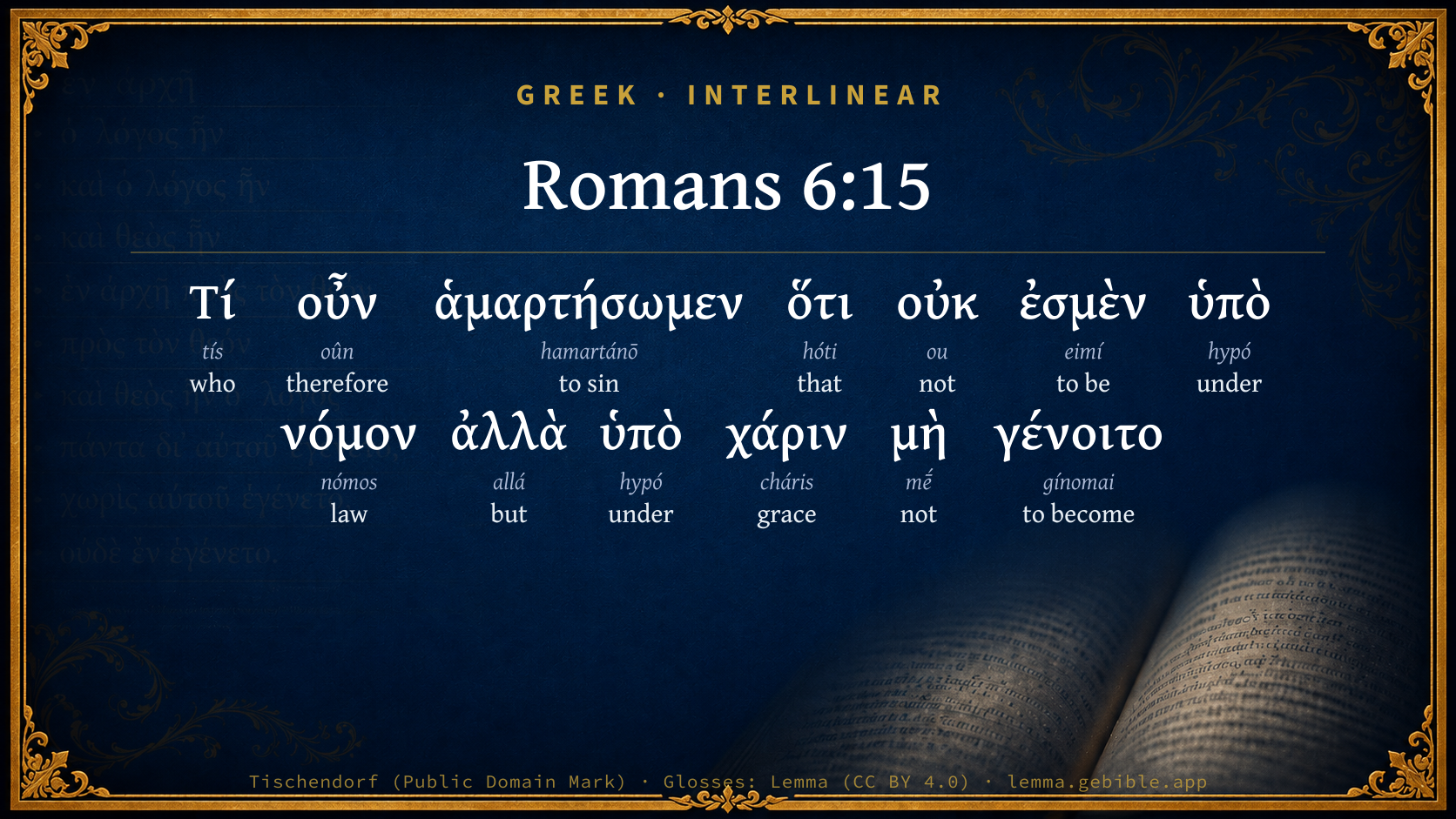
Greek (Tischendorf 8th ed.) Romans 6:15 appears in the Greek New Testament. The text above is from the Tischendorf 8th edition. Each word links to its Strong’s number and a concise gloss. Click any word for its full Thayer’s Greek Lexicon entry.
Download image
Cite this verse

Romans 6:15 (World English Bible). Public Domain. Lemma interlinear Bible study tool, https://lemma.gebible.app/v/romans/6/15.

Show BibTeX & RIS
BibTeX
RIS
English Translation
What then? Shall we sin, because we are not under law, but under grace? May it never be!
World English Bible · Public Domain
Download a study sheet

One document with this verse’s original text, its word-by-word gloss line, the meaning frame, cross-references with their text, attributed commentary, and full source and license credits — printable, and it pastes into notes with its structure intact.

This verse Autodidact and up

Study sheet (.html) Plain text (.txt)

A passage Seminary Student

Up to 50 verses in one chapter. A passage sheet keeps up to 6 commentary sources and 12 cross-references per verse, in the order this page ranks them, and says so on the sheet whenever that leaves anything out. Ask for a single verse and you get the Autodidact verse sheet above.

Everything on this page stays free to read, with no account — the sheet is a download of what is already on screen, not access to it.

Want to remove ads? Support Godless Engineer
Compare translations 3

The same verse in 3 English versions, stacked beneath the original-language interlinear above. Click any original word for its lexicon entry.

Each is an independent rendering of the whole verse — the interlinear is not word-aligned to these translations.

Highlighted words mark where these versions differ — a whole-verse word diff, not a word-by-word alignment.

  • World English Bible Public Domain
    What then? Shall we sin, because we are not under law, but under grace? May it never be!
  • King James Version Public Domain
    What then? shall we sin, because we are not under the law, but under grace? God forbid.
  • unfoldingWord Literal Text CC BY-SA 4.0
    What then? Should we sin because we are not under law, but under grace? May it never be!

unfoldingWord Literal Text — © unfoldingWord, licensed CC BY-SA 4.0. Word-aligned USFM3 via Door43 (git.door43.org/unfoldingWord/en_ult).

Versions to compare (up to 4)

3 of 4 selected

Show all 19 translations

Every available English version of this verse, each an independent rendering of the whole verse.

  • World English Bible Public Domain
    What then? Shall we sin, because we are not under law, but under grace? May it never be!
  • Berean Standard Bible Public Domain
    What then? Shall we sin because we are not under law, but under grace? Certainly not!
  • Majority Standard Bible Public Domain
    What then? Shall we sin because we are not under law, but under grace? Certainly not!
  • King James Version Public Domain
    What then? shall we sin, because we are not under the law, but under grace? God forbid.
  • American Standard Version (1901) Public Domain
    What then? shall we sin, because we are not under law, but under grace? God forbid.
  • Revised Version (1885) Public Domain
    What then? shall we sin, because we are not under law, but under grace? God forbid.
  • Geneva Bible (1599) Public Domain
    What then? shall we sinne, because we are not vnder the Law, but vnder grace? God forbid.
  • Douay-Rheims (1899) Public Domain
    What then? Shall we sin, because we are not under the law, but under grace? God forbid.
  • Young's Literal Translation Public Domain
    What then? shall we sin because we are not under law but under grace? let it not be!
  • Literal Standard Version CC BY-SA 4.0
    What then? Will we sin because we are not under law but under grace? Let it not be!
  • Unlocked Literal Bible CC BY-SA 4.0
    What then? Shall we sin because we are not under law, but under grace? May it never be.
  • unfoldingWord Literal Text CC BY-SA 4.0
    What then? Should we sin because we are not under law, but under grace? May it never be!
  • Darby Bible Public Domain
    What then? should we sin because we are not under law but under grace? Far be the thought.
  • World Messianic Bible Public Domain
    What then? Shall we sin because we are not under law but under grace? May it never be!
  • Webster's Bible Public Domain
    What then? shall we sin, because we are not under the law, but under grace? By no means.
  • Free Bible Version CC BY-SA 4.0
    So then, should we sin because we're not under law, but under grace? Of course not!
  • Bible in Basic English Public Domain
    What then? are we to go on in sin because we are not under law but under grace? Let it not be so.
  • Text-Critical English NT CC BY 4.0
    What then? Should we sin because we are not under law but under grace? Certainly not!
  • Tyndale New Testament (1534) Public Domain
    What then? Shall we synne because we are not vnder the lawe: but vnder grace? God forbyd.

Literal Standard Version (2020), Covenant Press — licensed CC BY-SA 4.0. Text via the HelloAO Bible API (eBible.org). Unlocked Literal Bible (unfoldingWord) — licensed CC BY-SA 4.0. Text via the HelloAO Bible API (eBible.org). unfoldingWord Literal Text — © unfoldingWord, licensed CC BY-SA 4.0. Word-aligned USFM3 via Door43 (git.door43.org/unfoldingWord/en_ult). Free Bible Version, Dr. Jonathan Gallagher — licensed CC BY-SA 4.0. Text via the HelloAO Bible API (eBible.org).

Word by word

More ways to search: Search by grammar → Find every occurrence → Compare this word →

Practice this passage: Drill this verse → Learn its vocabulary →

ἁμαρτήσωμεν
hamartánō
G264
“to sin”
Verb, Aorist, Active, Subjunctive, 1st person, Plural
Part of Speech
Verb
Tense
Aorist
Voice
Active
Mood
Subjunctive
Person
1st person
Number
Plural
Full Thayer's Definition

Origin: perhaps from G1 (as a negative particle) and the base of G3313

TDNT: 05:27,4

1. to be without a share in 2. to miss the mark 3. to err, be mistaken 4. to miss or wander from the path of uprightness and honour, to do or go wrong 5. to wander from the law of God, violate God's law, sin
  1. Τί tís G5101 “who” Interrogative pronoun, Nominative, Singular, Neuter
  2. οὖν oûn G3767 “therefore” Conjunction
  3. ὅτι hóti G3754 “that” Conjunction
  4. οὐκ ou G3756 “not” Particle, Negative
  5. ἐσμὲν eimí G1510 “to be” Verb, Present, Active, Indicative, 1st person, Plural
  6. ὑπὸ hypó G5259 “under” Preposition
  7. νόμον nómos G3551 “law” Noun, Accusative, Singular, Masculine
  8. ἀλλὰ allá G235 “but” Conjunction
  9. ὑπὸ hypó G5259 “under” Preposition
  10. χάριν cháris G5485 “grace” Noun, Accusative, Singular, Feminine
  11. μὴ mḗ G3361 “not” Particle, Negative
  12. γένοιτο gínomai G1096 “to become” Verb, Aorist, Middle deponent, Optative, 3rd person, Singular

About this verse

These counts appear in no published source. They are computed here, from the morphology-tagged text and Lemma’s own curated glosses. What Lemma adds →

13
words
12
distinct lemmas
Pauline Epistles
section

Shared distinctive vocabulary

ἁμαρτήσωμεν to sin G264 occurs in 37 verses of the Greek New Testament. Also found in:

Repetition

A word recurs within this verse:

  • ὑπὸ under G5259 ×2

Cross-references

8

Topical passages linked to Romans 6:15 in the Treasury of Scripture Knowledge — connected by theme and wording, ordered by reader-vote popularity; previews shown in the World English Bible.

  • Titus 2:11–14 For the grace of God has appeared, bringing salvation to all men,
  • Ephesians 2:8–10 for by grace you have been saved through faith, and that not of yourselves; it is the gift of God,
  • Romans 6:1–2 What shall we say then? Shall we continue in sin, that grace may abound?
  • 2 Corinthians 7:1 Having therefore these promises, beloved, let us cleanse ourselves from all defilement of flesh and spirit, perfecting holiness in the fear of God.
  • Jude 1:4 For there are certain men who crept in secretly, even those who were long ago written about for this condemnation: ungodly men, turning the grace of our God into lasciviousness, and denying our only Master, God, and Lord, Jesus Christ.
  • 1 Corinthians 9:20–21 To the Jews I became as a Jew, that I might gain Jews; to those who are under the law, as under the law, that I might gain those who are under the law;
  • Galatians 2:17–18 But if, while we sought to be justified in Christ, we ourselves also were found sinners, is Christ a servant of sin? Certainly not!
  • Romans 3:9 What then? Are we better than they? No, in no way. For we previously charged both Jews and Greeks, that they are all under sin.

Cross-references courtesy of OpenBible.info (CC BY 4.0).

Commentary

Notes on Romans 6:15 from classic Christian and Jewish commentators (each source and its license shown beneath its notes). The classic Christian expositions comment on the surrounding passage and are grouped to its opening verse, so a note may address several verses; the Jewish commentaries on the Tanakh (Rashi and others) are per-verse, so they appear only where the commentator wrote on this verse.

Lemma curates 59 commentaries, every one of them public domain or Creative Commons licensed, each selected and text-cleaned for this edition rather than reprinted as found. About our sources →

The Biblical Illustrator

Joseph S. Exell

Rom_6:15

What then?

Shall we sin, because we are not under the law, but under grace?

The doctrines of grace do not lead to sin

1. Grace is the soul of the gospel: without it the gospel is dead. Grace is the music of the gospel; without it the gospel is silent as to all comfort. From the A to the Z in the heavenly alphabet everything in salvation is all of free favour, nothing of merit. By grace are ye saved through faith, etc.

2. No sooner is this doctrine set forth, however, than men begin to cavil at it; it is so humbling to human pride. God alone is exalted in the sovereignty of His mercy; this is not pleasant to the great minds of our philosophers and the broad phylacteries of our moralists. Straightway comes the objection that such doctrine must lead to licentiousness.

3. Now I admit that some turned the grace of God into lasciviousness; but cannot every truth be perverted? Is there not an almost infinite ingenuity in wicked men for making evil out of good? But let us act like rational men. We do not find fault with ropes because men have hanged themselves; nor do we destroy the wares of Sheffield because edged tools are the murderers instruments.

4. Looking back in history I see upon its pages a refutation of the oft-repeated calumny. Who were the men that held these doctrines most firmly? Men like Owen, Charnock, Manton, Howe, and Cromwell. What kind of men were these? Every historian will tell you that the greatest fault was that they were too precise for their generation, so that they were called Puritans. And if we are ever to see a godly England we must have a gospelised England. The gospel of the grace of God promotes real holiness.

I. The salvation which it beings is salvation from the power of sin. What we mean by salvation is deliverance from the love of habit and desire of sin. Now if that boon is the gift of Divine grace, in what way will it produce sin? The worse men are the more gladly would we see them embracing this truth, for they most need it.

II. Its principle of love has been found to possess very great power over men. In the infancy of history nations dream that crime can be put down by severity, but experience corrects the error. Our forefathers dreaded forgery, and made it a capital offence. Yet the constant use of the gallows was never sufficient to stamp out the crime. But some offences have almost ceased when the penalty has been lightened.

1. Love makes sin infamous. If one should rob another it would be sufficiently bad; but suppose a man robbed a friend who had helped him often when he was in need, everyone would say that his crime was most disgraceful.

2. Love has a great constraining power towards the highest form of virtue. Deeds to which a man could not be compelled on the ground of law, men have cheerfully done because of love. Would our brave seamen man the lifeboat to obey an Act of Parliament? Remember Rom_5:7-8. Goodness wins the heart, and one is ready to die for the kind and generous. Look how men have thrown away their lives for great leaders. The wounded French soldier, when the surgeon, searching for the bullet cut deeply, cried out, A little lower and you will touch the Emperor. Love to Jesus creates a heroism of which law knows nothing. All Church history is a proof of this.

3. Love, too, has often changed the most unworthy. We have often heard of the soldier who had been flogged and imprisoned, and yet would get drunk and misbehave himself. At last the commanding officer said, I have tried almost everything, I will try one thing more. You seem incorrigible, but I will freely forgive you. The man was greatly moved by this, and became a good soldier. A man woke up one morning from his drunken sleep and saw his only child getting his breakfast. Coming to his senses he said to her, Millie, why do you stay with me? She answered, Because you are my father, and I love you. He looked at himself, and saw what a ragged, good-for-nothing creature he was, and he answered her, Millie, do you really love me? The child cried, Yes, father, and I will never leave you, because when mother died she said, Millie, stick to your father, and always pray for him, and one of these days he will give up drink and be a good father to you; so I will never leave you. Is it wonderful that Millies father became a Christian? According to our moralists she should have said, You are a horrible wretch f I have stuck to you long enough; I must now leave you, or else I shall be encouraging other fathers to get drunk. Under such dealing I fear Millies father would have drank himself into perdition. But the power of love made a better man of him. Hear another story. There lived in Cheapside one who feared God and attended the secret meetings of the saints; and near him there dwelt a poor cobbler, whose wants were often relieved by the merchant; but the man, from hope of reward, laid an information against his kind friend on the score of religion. This accusation would have brought the merchant to death by burning if he had not found a means of escape. Returning, the injured man behaved more liberally than ever. The cobbler, however, avoided him, but one day was obliged to meet him, and the Christian man asked him gently, Why do you shun me? I know all that you did to injure me, but I never had an angry thought against you. Let us be friends. Do you marvel that they clasped hands and that ere long the poor man was found at the Lollards meeting? The Lord knows that bad as men are the key of their hearts hangs on the nail of love.

III. Its operations are connected with a special revelation of the evil of sin. Iniquity is made to be exceeding bitter before or when it is forgiven. A burnt child dreads the fire. By the operations of grace we are made weary of sin; we loathe both it and its imaginary pleasures. It is a thing accursed, even as Amalek was to Israel.

IV. It makes a man a new creature in Christ Jesus. His ignorance is removed, his affections are changed, his understanding is enlightened, his will is subdued, his desires are refined, his life is changed--in fact, he is as one newborn, to whom all things have become new. All beings live according to their nature, and the regenerated man works out the holy instincts of his renewed mind. A new heart makes all the difference. Given a new nature, and then all the propensities run in a different way.

V. It provides cleansing through atonement. The blood of Jesus sanctifies as well as pardons. The sinner learns that his free pardon cost the life of his best Friend. What! live in the sin which slew Jesus? Impossible! Thus you see that the gifts of free grace, when handed down by a pierced hand, are never likely to suggest self-indulgence in sin, but the very reverse.

VI. It secures daily helps from Gods Holy Spirit. Who deigns to dwell in every man whom God has saved by His grace.

1. He leads believers to be much in prayer, and what a power for holiness is found in this.

2. The renewed man is also quickened in conscience; so that things which heretofore did not strike him as sinful are seen in a clearer light, and are consequently condemned.

3. The good Spirit leads us into high and hallowed intercourse with God, and I defy a man to live upon the mount with God and then come down to transgress like men of the world. Thou art of another race; thy speech betrayeth thee. The perfume of the ivory palaces will be about thee, and men will know that thou hast been in other haunts than theirs.

VII. It elevates the entire man.

1. What do men most think about? Bread and butter, house rent, and clothes, and are as children playing with little sand heaps on the seashore; but the believer in free grace walks among hills and mountains, and his mental stature rises with his surroundings, and he becomes a thoughtful being, communing with sublimities. The man has now obtained a different view of himself. He says, I am one of Gods chosen, joint heir with Jesus Christ, and as such I cannot be godless, nor live for the common objects of life.

2. He rises in the object of his pursuit. He feels that he is born for Divine purposes, and he feels that God has loved him that His love may flow forth to others. Gods choice of any one man has a bearing upon all the rest. We are each one as a lamp kindled that we may shine in the dark and light up other lamps.

3. New hopes come crowding on him. His immortal spirit enjoys glimpses of the endless. As God has loved him in time he believes that the like love will bless him in eternity. Conclusion: A profligate son had been a grief to his father; he had robbed and disgraced him, and at last brought his grey hairs in sorrow to the grave. He attended his fathers funeral and stayed to hear the will read, having fully made up his mind that he was cut off with a shilling; and he meant to make it very unpleasant for the rest of the family. To his great astonishment the will ran something like this: As for my son Richard, though he has wasted my substance and grieved my heart, I would have him know that I consider him still to be my own dear child, and, in token of my undying love, I leave him the same share as the rest of his brothers. He left the room mastered by the surprising love of his father. Said he to the executor, You surely did not read correctly? Yes, I did: there it stands. Then I feel ready to curse myself that I ever grieved my dear old father. Oh, that I could fetch him back again! Love was born in that base heart by an unexpected display of love. May not your case be similar? Our Lord Jesus Christ is dead, but He has left it in His will that the chief of sinners are objects of His choicest mercy. (C. H. Spurgeon.)

The Biblical Illustrator, edited by Joseph S. Exell (c. 1880s–1900s) — public domain. Text from a community e-Sword module.

Joseph Benson's Commentary

Rom 6:15-18. What then are we to infer? Shall we sin — Go on in our transgressions; because we are not under the law — Under the law of Moses, or any mere legal dispensation which forbids sin, but gives no strength against it; but under grace — A dispensation perfectly the reverse, offering pardon to the most guilty, holiness to the most depraved, and strength to the most weak and helpless! God forbid — That we should draw any inference so odious and destructive. Know ye not — Is it necessary to inform you; that to whom ye yield — Greek, παριστανετε, present yourselves servants to obey his commands, his servants ye are whom ye obey — Not his whose name you may bear, without practically acknowledging his authority; but his to whom ye are in fact obedient, to whom you are subject, and whose will you do. “By the expression, ye present yourselves servants, the apostle taught the Romans, that grace does not destroy human liberty. It was still in their own power to choose whether they would present themselves slaves to sin, or servants to righteousness.” Whether of sin unto death — Which will bring you to eternal death; or of obedience — To God and his gospel; unto righteousness — True and evangelical, and which will certainly be rewarded with eternal life. But God be thanked that ye were — That is, although, or whereas, you were once the servants of sin — A bondage this now passed and gone; ye have now obeyed — Not in profession alone, but from the heart, that form of doctrine which was delivered to you — Greek, εις ον παρεδοθητε τυπον διδαχης, literally, the model of doctrine into which, as into a mould, you were delivered; for the word τυπος, rendered form, among other things, signifies a mould, into which melted metals are poured to receive the form of the mould: and the apostle here represents the gospel doctrine as a mould, into which the Roman believers were delivered, in order to their being formed anew, and conformed to the gospel in all its doctrines, precepts, and promises: and he thanks God, that from the heart, that is, most willingly and sincerely, they had yielded to the forming efficacy of that doctrine, and were made new creatures both in principle and practice. The allusion is not only beautiful, but conveys a very instructive admonition: intimating, that our minds made all pliant and ductile, should be conformed to the nature and design of the gospel, as liquid metals take the figure of the mould into which they are cast. Being then made free from sin — Set at liberty from its power and dominion; ye became servants of righteousness — At once enabled and obliged to lead a life of true piety and exemplary goodness. The word ελευθερωθεντες, here rendered being made free, is the word by which the act of giving a slave his liberty was signified, called by the Romans emancipation.

Joseph Benson's Commentary on the Old and New Testaments (1811–1818) — public domain. Text from a community e-Sword module.

Tyndale Open Study Notes

Tyndale Open Resources

6:15 set us free from the law: The law of Moses was the governing power of the old covenant era. Believers now live under the governing power of Christ himself.

Tyndale Open Study Notes — © Tyndale Open Resources, licensed CC BY-SA 4.0. Text via the HelloAO Bible API.

Bengel's Gnomon

Johann Albrecht Bengel

Rom 6:15. Ὑπὸ, under) ch. Rom 7:2; Rom 7:14.

Bengel's Gnomon of the New Testament — English translation (T&T Clark, Edinburgh, 1860) — public domain. Text from a community e-Sword module.

Meyer's Critical & Exegetical Commentary

Heinrich August Wilhelm Meyer

Rom_6:15. Τί οὖν] sc[1454] ἐστι; what is then the state of the case? Comp Rom_3:9. Shall this Christian position of ours be misused for sinning?

With the reading ἁμαρτήσομεν the sense would be purely future: shall we sin? will this case occur with us? But with the proper reading ἁμαρτήσωμεν Paul asks: Are we to sin? deliberative subjunctive as in Rom_6:1. To the ἐπιμένωμ. τ. ἁμαρτ. in Rom_6:1 our ἁμαρτήσωμεν stands related as a climax; not merely the state of perseverance in sin, but every sinful action is to be abhorred; the former from the pre-Christian time, the latter in the Christian state of grace.

ὅτι οὐκ ἐσμὲν ὑπὸ νόμον κ.τ.λ[1456]] emphatic repetition. Bornemann, a[1457] Xen. Mem. iv. 3, 17, Schol. in Luc. p. xxxix.

[1454] c. scilicet.

[1456] .τ.λ. καὶ τὰ λοιπά.

[1457] d refers to the note of the commentator or editor named on the particular passage.

Rom_6:15-23. This οὐκ εἶναι ὑπὸ νόμον, ἀλλʼ ὑπὸ χάριν does not therefore give us freedom to sin. From the οὐ χάρ.… χάριν, namely, the inference of freedom to sin might very easily he drawn by immoral Christians (comp Rom_6:1), which would be exactly the reverse of what the Apostle wished to establish by that proposition (ἁμ. ὑμ. οὐ. κυρ. Rom_6:14). Paul therefore proposes to himself this possible inference and negatives it (Rom_6:15), and then gives in Rom_6:16 ff. its refutation. Accordingly Rom_6:15-23 form only an ethico-polemical preliminary to the positive illustration of the proposition, ye are not under the law, but under grace, which begins in ch. 7.

Meyer — Critical and Exegetical Commentary on the New Testament — English translation by Peter Christie, edited by Frederick Crombie (T&T Clark, 1880) — public domain. Text from a community e-Sword module.

Expositor's Greek Testament

ed. W. Robertson Nicoll

Rom 6:15 . ἁμαρτήσωμεν ; deliberative: are we to sin because our life is not ruled by statutes, but inspired by the sense of what we owe to that free pardoning mercy of God? Are we to sin because God justifies the ungodly at the Cross?

The Expositor's Greek Testament, edited by W. Robertson Nicoll (1897–1910) — public domain. Text from a community e-Sword module.

International Critical Commentary

15-23. The next two sections (6:15-23; 7:1-6) might be described summarily as a description of the Christian’s release, what it is and what it is not. The receiving of Christian Baptism was a great dividing-line across a man’s career. In it he entered into a wholly new relation of self-identification with Christ which was fraught with momentous consequences looking both backwards and forwards. From his sin-stained past he was cut off as it were by death: towards the future he turned radiant with the quickening influence of a new life. St. Paul now more fully expounds the nature of the change. He does so by the help of two illustrations, one from the state of slavery, the other from the state of wedlock. Each state implied certain ties, like those by which the convert to Christianity was bound before his conversion. But the cessation of these ties does not carry with it the cessation of all ties; it only means the substitution of new ties for the old. So is it with the slave, who is emancipated from one service only to enter upon another. So is it with the wife who, when released by the death of one husband, is free to marry again. In the remaining verses of this chapter St. Paul deals with the case of Slavery. Emancipation from Sin is but the prelude to a new service of Righteousness.

15. The Apostle once more reverts to the point raised at the beginning of the chapter, but with the variation that the incentive to sin is no longer the seeming good which Sin works by calling down grace, but the freedom of the state of grace as opposed to the strictness of the Law. St. Paul’s reply in effect is that Christian freedom consists not in freedom to sin but in freedom from sin.

ἁμαρτήσωμεν: from a late aor. ἡμάρτησα, found in LXX (Veitch, Irreg. Verbs, p. 49). Chrys. codd. Theodrt. and others, with minuscules, read ἀμαρτήσομεν.

International Critical Commentary — older volumes (1896–1929), various authors — public domain. Text from a community e-Sword module.

Godet's Commentaries

Frédéric Louis Godet

Fourteenth Passage (6:15-23). The Power of the new Principle of Sanctification to deliver from Sin.

The new principle had just been laid down. The apostle had found it in the object of justifying faith. But could a principle so spiritual, apart from every external and positive rule, take hold of the will with power enough to rule it thoroughly? To this natural objection, formulated in Rom 6:15, St. Paul answers as follows: by the acceptance of grace a new master has been substituted for the former, sin (Rom 6:16-19); and the believer feels himself obliged to serve this new master with the more fidelity because he rewards his servants by communicating life to them, whereas the former master pays his by giving them death (Rom 6:20-23). Thus it is proved that the new principle is clothed with sufficient, though purely internal authority, to control the believer’s entire life.

Vv. 15: “What then? should we sin, because we are not under the law, but under grace? Let it not be so!”

The question of Rom 6:15 is not a repetition of that in Rom 6:1. The discussion has advanced. The principle of holiness inherent in salvation by grace has been demonstrated. The apostle only asks himself whether it will have the power necessary to rule man without the assistance of a law? This is the point at which the question τι οὖν, what then, resumes the discussion. Thus is explained the difference of style between the question of Rom 6:1 and that of Rom 6:15. In the former, Paul asked: Should we continue in sin? Here he says simply: should we sin, ἁμαρτήσωμεν. There is no doubt that the Received reading: shall we sin, ἁμαρτήσομεν, should be rejected, for it is not found in a single majuscule. The aorist subjunctive ἁμαρτήσωμεν does not denote, as the present would do, the permanent state, but the isolated act, which is perfectly suitable here. The question is no longer, as in Rom 6:1, whether the justified believer will be able to continue the life of sin which he formerly led. The answer has been given in Rom 6:1-14. But the matter in question is whether the new dominion will be strong enough to banish sin in every particular case. Hence the form of the aorist subjunctive: should we commit an act of sin? Could we act thus voluntarily in a single instance? And, in point of fact, a believer will not easily say: By grace I shall remain without any change what I have been till now. But he will find himself only too easily regarding some particular leniency toward sin as admissible, on account of the freeness of pardon. The gradation between the question of Rom 6:1 and that of Rom 6:15 makes itself also felt in the form of the motive alleged in favor of unfaithfulness. The apostle does not say now: “that grace may abound,” words which could only come from a heart yet a stranger to the experiences of faith; but he says here: “because we are under grace.” The snare is less gross in this form. Vinet one day said to the writer of these lines: “There is a subtle poison which insinuates itself into the heart even of the best Christian; it is the temptation to say: Let us sin, not that grace may abound, but because it abounds.” Here there is no longer an odious calculation, but a convenient let alone.

Where would be the need of holding that the apostle, to explain this question, has in view an objection raised by legal Jewish-Christianity? The question arises of itself as soon as the gospel comes in contact with the heart of man. What proves clearly that the apostle is not thinking here of a Jewish-Christian scruple, is the fact that in his reply he does not make the least allusion to man’s former subjection to the law, but solely to the yoke which sin laid upon him from the beginning. And the literal translation of our verse is not: “For ye are no more under the law,” but: “For ye are no more under law, but under grace.” It is understood, of course, that when he speaks of law he is thinking of the Mosaic dispensation, just as, when speaking of grace, he is thinking of the revelation of the gospel. But he does not mention the institutions as such; he designates them only by their moral character.

Frédéric Louis Godet — Commentaries on Luke, John, Romans, and 1 Corinthians — English translation (T&T Clark, Edinburgh, 1870s–1890s) — public domain. Text from a community e-Sword module.

Hodge's Commentary on Romans, Ephesians & First Corinthians

Charles Hodge

Rom_6:15

What then? shall we sin, because we are not under the law, but under grace? God forbid. Because works are not the ground of our justification; because we are justified freely by his grace, are we at liberty to sin without fear and without restraint? Does the doctrine of gratuitous salvation give a license to the unrestrained indulgence of all evil? Such has been the objection to the doctrines of grace in all ages. And the fact that this objection was made to Pauls teachings, proves that his doctrine is the same with that against which the same objection is still urged. As the further consideration of this difficulty is resumed in the following chapter, the apostle here contents himself with a simple negation, and a reference to the constraining influence under which the freely pardoned sinner is brought, which renders it as impossible for him to serve sin, as it is for the slave of one man to be obedient to another man. The slave must serve his own master.

Charles Hodge — Commentary on Romans (1835), First Corinthians (1857), and Ephesians (1856) — public domain. Text from a community e-Sword module.

Geneva Bible (1599)

Geneva Bible translators

To be under the law and under sin, signifiy all one, in respect of them which are not sanctified, as on the contrary side, to be under grace and righteousness, agree to them that are regenerate. Now these are contraries, so that one cannot agree with the other: Therefore let righteousness expel sin.

Geneva Bible (1599) marginal notes — public domain. Text via Bolls.life.

Jamieson, Fausset & Brown

Robert Jamieson, A. R. Fausset & David Brown

What then? . . . Know ye not--it is a dictate of common sense.

Jamieson, Fausset & Brown — Commentary Critical and Explanatory on the Whole Bible (1871) — public domain (CC PDM 1.0). Text via the HelloAO Bible API.

Adam Clarke's Commentary

Verse 15. Shall we sin because we are not under the law] Shall we abuse our high and holy calling because we are not under that law which makes no provision for pardon, but are under that Gospel which has opened the fountain to wash away all sin and defilement? Shall we sin because grace abounds? Shall we do evil that good may come of it? This be far from us!

Adam Clarke's Commentary on the Bible (1810–1826) — public domain. Text from a community e-Sword/MySword module.

John Calvin's Commentaries

15. What then? As the wisdom of the flesh is ever clamorous against the mysteries of God, it was necessary for the Apostle to subjoin what might anticipate an objection: for since the law is the rule of life, and has been given to guide men, we think that when it is removed all discipline immediately falls to the ground, that restraints are taken away, in a word, that there remains no distinction or difference between good and evil. But we are much deceived if we think, that the righteousness which God approves of in his law is abolished, when the law is abrogated; for the abrogation is by no means to be applied to the precepts which teach the right way of living, as Christ confirms and sanctions these and does not abrogate them; but the right view is, that nothing is taken away but the curse, to which all men without grace are subject. But though Paul does not distinctly express this, yet he indirectly intimates it.

John Calvin's Commentaries (1540-1563) — public domain. Text from the Calvin Translation Society English edition (1840s-50s) via the Christian Classics Ethereal Library (ccel.org). Calvin's coverage is partial (roughly two-thirds of the Bible); uncommented books and verses are honest gaps, never fabricated. The 19th-century editor's footnotes and remarks are omitted so the notes are faithfully Calvin's own voice.

Ellicott's Commentary for English Readers

(15) The Apostle returns to a difficulty very similar to that which presented itself at the beginning of the chapter. The answer is couched under a slightly different metaphor. It is no longer death to the one, life to the other, but freedom from the one, service to the other. These are correlative terms. Freedom from sin implies service to God, just as freedom from God means service to sin. The same idea of service and freedom will be found worked out in Joh_8:32-34; Joh_8:36, and in Gal_5:1.

(15-23) Free forgiveness! What does that mean? Freedom to sin? Far from it. That were to return into the old slavery. To yield to sin is to be the servant or slave of sin with its consequence—death. On the other hand, obedience and righteousness go together. Happily you have escaped from sin, and taken service with righteousness. Service, I say, using a plain human figure to suit your imperfect and carnal apprehension of spiritual things. Exchange the service of uncleanness for that of righteousness. I appeal to your own experience. You found that sin brought you no pay from your master but death. Now you are started upon a road that leads to sanctification and eternal life. This will be given you, not as wages, but as the free gift of God in Christ.

A Bible Commentary for English Readers, edited by Charles John Ellicott (1878–1897) — public domain. Text from a community e-Sword module.

The Cambridge Bible for Schools and Colleges

gen. ed. J. J. S. Perowne

15–23. The same subject. Illustration from slavery

15. What then?] This takes up the question of Rom_6:1, and introduces the explicit answer, for which the passages between have fully prepared us. The form of the question here, as there, helps further to fix the reference of Rom_6:14 to justification. Sin was there said to have “no dominion” over the believer, in such a sense as to give (momentary) colour to such a question; therefore we now are shewn that the “dominion” there referred to was one of claim, not of influence.

The Cambridge Bible for Schools and Colleges (gen. ed. J. J. S. Perowne; Cambridge University Press, 1878–1918) — public domain. Text from a community e-Sword module.

John Gill's Exposition

What then? shall we sin,.... Does it follow from hence, that therefore we may sin, and go on and continue in it,

because we are not under the law, but under grace? here the apostle meets with an objection of the adversary, saying, that if men are not under the law, and are free from all obligation to it, then they may live as they list; nor can they be chargeable with sin, or that be objected to them; since where there is no law, there is no transgression, and sin is not imputed where there is no law; and if they are under grace, or in the love and favour of God, from which there is no separation, then they cannot be damned, do what they will: but this objection proceeds upon a mistaken sense of the phrase, "under the law"; for believers, though they are not under the law as the ministry of Moses, yet they are under it, as it is in the hands of Christ; and though not under its curse, yet under obligation to obedience to it, from principles of love and grace; and a transgression of it is sin in them, as in others; and which is taken notice of by God, and visited with stripes in a: fatherly way, though his loving kindness is not removed: and to argue from the unchangeableness of God's grace, or the doctrines of it, as encouraging licentiousness, is greatly to abuse the grace of God, and manifestly betrays such persons to be ignorant of it and its influence; since nothing more powerfully engages to a love of holiness, and hatred of sin; wherefore the apostle, answers to this objection in his usual way,

God forbid; signifying his abhorrence of everything of this kind.

John Gill's Exposition of the Whole Bible (1746–1763) — public domain (CC PDM 1.0). Text via the HelloAO Bible API.

Trapp's Complete Commentary

John Trapp

15 What then? shall we sin, because we are not under the law, but under grace? God forbid.

Ver. 15. Shall we sin, because, &c.] Some Antinomian libertines would persuade men that God is never displeased with his people, though they fall into adultery, or the like sin, no, not with a fatherly displeasure; that God never chastiseth his people for any sin, no, not with a fatherly chastisement; that God seeth no sin in his elect; that the very being of their sin is abolished out of God’s sight; that they cannot sin, or if they do, it is not they, but "sin that dwelleth in them," &c. What is this but to "turn the grace of God into wantonness," which there hence becometh the savour of death to death unto them; like as Moses’ rod, cast on the ground, turned to a serpent; or as dead men’s bodies, when the marrow melteth, do bring forth serpents? Corruptio optimi pessima.

John Trapp, A Commentary or Exposition upon All the Books of the Old and New Testament (1647–1656) — public domain. Text from a community e-Sword module.

Albert Barnes' Notes on the Bible

What then? shall we sin ... - The apostle proceeds to notice an objection which might be suggested. “If Christians are not under the law, which forbids all sin, but are under grace, which pardons sin, will it not follow that they will feel themselves released from obligation to be holy? Will they not commit sin freely, since the system of grace is one which contemplates pardon, and which will lead them to believe that they may be forgiven to any extent?” This Consequence has been drawn by many professing Christians; and it was well therefore, for the apostle to guard against it.

God forbid - Note, Rom 3:4.

Albert Barnes' Notes on the Bible (1834–1885) — public domain. Text from a community e-Sword/MySword module.

Matthew Poole's English Annotations

What then? doth it follow from hence that we are lawless, and may live as we list?

God forbid: q.d. No, by no means, the premises afford no such conclusion; though we are not under the curse and rigour of the law, yet we are under its directions and discipline: the gospel allows of sin no more than the law. The apostle is careful, both here and elsewhere, to prevent licentiousness, or the abuse of Christian liberty: see Gal 5:13; 1Pe 2:16; see Rom 6:1, and See Poole on "Rom 6:1".

Matthew Poole's English Annotations on the Holy Bible (1683–1685) — public domain. Text from a community e-Sword/MySword module.

Whedon's Commentary on the Bible

Daniel D. Whedon

15. Shall we sin—Shall we make the very grace that redeems us from sin the occasion for sin?

Daniel D. Whedon (gen. ed.), Commentary on the Old and New Testaments (1874–1909) — public domain. Text from a community e-Sword module.

The Pulpit Commentary

What then? shall we sin, because we are not under law, but under grace! (Does being under grace mean that we may allow ourselves in sin without being under sin"s thraldom?) God forbid. Know ye not, that to whom ye yield yourselves servants to obey (literally, unto obedience), his servants ye are to whom ye obey; whether of sin unto death, or of obedience unto righteousness? This is not a truism, as it would seem to be if it only meant, "whoso servants ye become, his servants ye are." "Ye yield yourselves" (paristanete , cf. ver. 13) denotes acts of yielding. "Ye are" (este) denotes condition. The meaning is that by our conduct we show which master we are under; and we cannot serve two Mat_6:24 Luk_16:13; of. Joh_8:34, "Whosoever committeth sin is the servant of sin;" and 1Jn_3:7, "He that doeth righteousness is righteous"). The two incompatible services are here said to be of sin and of obedience, with their respective tendencies or results, death and righteousness. A more exact antithesis to the first clause would have been "of righteousness unto life;" life being the proper antithesis of death, and righteousness being afterwards said, in vers. 18 and 19, to be what we ought to be in bondage to. But though the sentence seems thus defective in form, its meaning is plain. Upakohv means here specifically obedience to God, not obedience to any master as in ver. 16; and though in English "servants of obedience," as though obedience were a master, is an awkward phrase, yet we might properly say, "servants of duty," in opposition to "servants of sin;" and this is what is meant. It may be that the apostle purposely avoided here speaking of believers being slaves of righteousness in the sense in which they had been slaves of sin, because subjection to righteousness is not properly slavery, but willing obedience. He uses the expression, indeed, afterwards (ver. 18), but adds at once, anyrwpinon legw , etc. (see note on this last expression). Death, "unto" which the service of sin is here said to be, cannot be mere natural death, to which all are subject. Meyer (with Chrysostom, Theophylact, and other ancients) takes it to mean eternal death, as the final result of bondage to sin; dikaiosunh , antithetically correlative, being regarded as applying to the time of final perfection of the faithful in the world to come righteousness which is awarded to them in the judgment. " Seeing, however, that the word dikaiosunh is used throughout the Epistle to denote what is attainable in this present life, and that yanatov is often used to express a state of spiritual death, which men may be in at any time, (see additional note on ver. 12; and cf. Rom_7:9, Rom_7:10, Rom_7:13, 24 8:6, 13Jo 5:24 1Jn_3:14) it is at least a question whether the final doom of the last judgment is here at all exclusively in the apostle"s view.

Vers. 15-23. The two services and their rewards.

In the closing part of the fifth chapter, and throughout this chapter, the apostle is contrasting the operation of two great principles. The one is the principle of sin; the other is the principle of righteousness. He compares them to two kings reigning in the world, controlling men"s lives, and influencing men in certain directions and to certain actions. Sin reigns unto death. That has been its operation all through human history. But a new power has entered to dispute its influence. That power is the free grace of God, exhibited in Christ, God"s Son. That power operates in righteousness. It provides a righteousness for men by the blood of Christ. It produces a righteousness in men. "Where sin abounded, grace did much more abound: that as sin hath reigned unto death, even so might grace reign through righteousness unto eternal life by Jesus Christ our Lord." And now in these immediate verses St. Paul is making an appeal to his readers. He has set before them the two great principles. He has contrasted them in their operation and their results. Now he makes the matter personal. He enforces his appeal by the question of the sixteenth verse, "Know ye not, that to whom ye yield yourselves servants to obey, his servants ye are to whom ye obey; whether of sic unto death, or of obedience unto righteousness?" And then he says, "As ye have yielded your members servants to uncleanness and to iniquity unto iniquity; even so now yield your members servants to righteousness unto holiness" (ver. 19).

I EVERY LIFE IS A SERVICE OF SOME SORT.

1. Some are servants of the love of money. Of money and how to make it they are always thinking; for the sake of it they will go through many risks and toils and hardships. Their first question about everything is, "Will it pay?" and all their money-grasping does not pay them in the end. They may have much goods laid up for many years; they may have good securities for their investments; but they have made no provision for their immortal souls; they have laid up no treasure that will be of use to them beyond the grave. That is a poor service for a being who must soon go into the presence of the eternal God.

2. Some are servants of the love of dress. Even in our Lord"s time, he found it necessary to warn his hearers against thinking too much about their dress. Even Christian people, who profess to be the servants of Christ, are too frequently the servants of fashion. There is sometimes more attention given to the dress of our neighbours or of ourselves in the house of God than there is to the voice of our Creator and our Saviour, or than there is to the question whether we have the ornament of a meek and quiet spirit, or the spotless robe of Christ"s righteousness. It is said that St. Bernard of Clairvaux, who rebuked princes, and fired all Europe with a new crusade, all the while living himself in utter poverty, used to ask himself every day the stern question, "Bernarde, ad quid venisti?Bernard, wherefore art thou here?" So it would be well if we would ask ourselves more frequently what is the purpose of our lives.

3. Others, again, are the servants of ambition. To be higher than their fellow-men, to be fawned upon and flattered, to receive the homage of the poor and the favour of the rich, to be talked about in the gossip of society, that is the object for which many persons live. Yet, when attained, it brings no lasting peace or contentment to the mind. The praise of men, moreover, is a very fickle and uncertain thing. The hero of today will be forgotten tomorrow. Earthly fame has ever been"Like a snow-flake on the river, A moment seen, then lost for ever.

Such are some of the services to which men devote their thoughts, their time, their energies. How vain and profitless are they all! When the hour of death draws nigh, let any one who has spent his life in the service of any of these masters ask them to help him in the death-struggle, to give him hope for the future: will they be able to give him any assistance? They cannot even keep his poor mortal body from the dust; much less can they give life to the soul. They have already helped to produce death in the soul. They have dragged him downwards to the earth. And so it is that, when the soul must go from this world into the unseen, it is earthly still. There is no fitness for heaven in it at all. The pleasures and possessions of the world, innocent in themselves, become positively harmful to many. They become sinful to them, because they keep the soul away from God.

II THE SERVICE OF SIN AND ITS RESULTS. Even what we call the more innocent service of the world results in death at last. The death of the body is accompanied by the death of the soul. Much more is this true of all kinds of positive sin. The apostle seeks to point out here the result of being the servant of sin. "His servants ye are to whom ye obey, wether of sin unto death, or of obedience unto righteousness" (ver. 16); "The end of those things is death" (ver. 21); The wages of sin is death (ver. 23). Even in this life there is a clear connection between sin and death. The service of sin is a fatal service. Take, for instance, those who are the servants of the craving for intoxicating drink. A special committee of the British Medical Association brought in a report at the meeting of 1887 on the relation of alcohol to disease, which stated that, after careful and prolonged examination of the subject from a scientific point of view, they came to the conclusion that every man who indulged in alcohol beyond the most moderate amounts shortened his life by at least ten years. The President of the United States, General Harrison, has testified that of a class of sixteen young men who graduated with him, almost all had gone to early graves through intemperate habits. Even in this world the sin of intemperance leads to death. But it brings a more lasting and more terrible death than this. The besotted mind, the darkened intellect, is but a beginning of blackness of darkness in the future. "No drunkard shall enter into the kingdom of heaven." When drink becomes the master, how terrible are the results for time and for eternity! In like manner it is true of all other sinful services, that they lead to death. "He that soweth to the flesh, shall of the flesh reap corruption;" "The wages of sin is death.

III THE SERVICE OF CHRIST. "Being then made free from sin, ye became the servants of righteousness" (ver. 18); "But now, being made free from sin, and become servants to God, ye have your fruit unto holiness, and the end everlasting life" (ver. 22). This is the only service that leads to everlasting life. It is the only service which is not slavery. It is the only service which men never regret entering into. It is the only service which can be called an unmixed good, the only service that brings perfect peace to heart and mind and conscience. It is an easy service, for it is a service of love. Instead of growing weaker by our efforts in the service of Christ, as we do by our efforts to serve sin, we grow stronger; for the true Christian is a better man, a stronger man spiritually, every day he lives. It is the only service that has a hope beyond the grave. It was because Christ saw us perishing in the service of sin, guilty, lost, and helpless, that he came to save us. He calls us now to believe on him, to follow him, and he promises to all who do so the gift of everlasting life. "The gift of God is eternal life through Jesus Christ our Lord." "How long to Streams of false delight Will ye in crowds repair? How long your strength and substance waste On trifles light as air?

Over the triple doorways of the Cathedral of Milan there are three inscriptions spanning the beautiful arches. Over one is carved a beautiful wreath of roses, and underneath is the legend, "All that which pleases is but for a moment." Over the other is sculptured a cross, and there are the words, "All that which troubles us is but for a moment." But underneath the great central entrance to the main aisle is the inscription, "That only is important which is eternal." If we would only realize these three truths, we should not let the world or its pleasures keep us from Christ, we should not let trifles trouble us, we should not hesitate long about making our choice. Choose ye this day whom ye will serve. C.H.I.

Vers. 15-23. Servants to obey.

A slight but suggestive difference between the question of ver. 15 and that with which the chapter opens. "Shall we continue in sin," the apostle had asked, "that grace may abound?" And he had flung away such a thought by the presentation of the believer"s new life as a life pledged to God through Christ. In vers. 12-14 also he had insisted on the consistent fulfilment of the pledge. But now he supposes another and more subtle question Shall we, not "continue" in sin, but sin, once and again, as we may please, presuming on the easily procured pardon of a gracious God? Alas! how this question insinuates itself into the Christian consciousness: how readily we condone our carelessness by thoughts of the restoring mercy of God! But we are grievously wrong if we think to ourselves that sin and obedience may be played with. We have the dread power to choose our master; but he is a master, and our choice in either case commits us to a course, and. to a consequence. The train may be turned on to this line or that, but the line must be followed, and the destinations are wide as the poles apart. Let us look at these three thoughts A choice, a course, a consequence.

I A CHOICE. The false doctrine of law in the necessarian scheme of morals so many weights upon the scale. But man"s will is not a dead scale, determined by weights; it is a living thing, and unless its peculiar life be taken into account all calculations must be wrong. True, if we know the causes, we can predict the result, And certain teachers have said These are the causes: man"s own susceptible nature, and the divers influences which play upon it. Therefore, given the temperament and the influences, we can predict the result. Very plausible. True, if these are the only causes, the result may thus be known. But the cause of causes is the will itself. This is the great factor in the problem. And, after all, when the most scientific calculations have been made, this self-determining power in man may defy all your calculations to predict a right result. Let us not attempt to prove this freedom by elaborate arguments; we need but appeal to each one"s consciousness. "I know that I am free; I have power of choice; when I have willed, I know that I might have willed otherwise." This must be each one"s true confession. Just as surely as we know that we exist, by the same intuition, which is deeper and truer than all reasoning, do we know that we can yield ourselves to any one of all the manifold motives that are playing upon our will. Does not the history of the Fall illustrate this freedom? For what is the essential truth of that history, but that man had it in his power, either to obey God or to gratify himself, and that he chose self-gratification rather than obedience? But the results were not by any means so transient as the choice itself might seem to be. In the highest sense, freedom was gone. There still remained freedom of choice among the various objects of self-gratification, but there was no longer the power to serve God as before. A great gulf was fixed between man and God. And in this consists what is called the total depravity of man: totally separated from God, and without the power to return. And certain, moreover, to drift from bad to worse. But under the redeeming influences with which God visits the heart of man, and more especially in view of the great redeeming fact with which God has visited the world, this total depravity becomes in some sense neutralized, man"s enfeebled will receives new power, and it is once more possible for him to place his choice on God. The freedom of true duty is once more within his reach; from the depths he may yet climb back to God. So, then, taking men as they now are, and especially taking them as we find them in contact with the redeeming truths of the gospel of Christ, we see that each has his alternative choice between godliness and ungodliness, truth and falseness: the right and good, and the wrong and bad, or, in the words of St. Paul, between obedience and sin. "Ye yield yourselves:" the supreme fact of every one"s life is wrapped up in those words. From childhood upwards good and bad influences contend for the mastery. God and sin ask for our service, and we cannot but "yield ourselves" to the one or the other. We make our choice, whether consciously and with full deliberatenes of purpose, or well-nigh unconsciously and with careless neglect. We choose sin, and thereby" set the seal on our own death; or we choose God, and thereby rise to newness of life. But in either case our own choice determines our course, and the course to which we commit ourselves works out its inevitable consequence.

II A COURSE. Let us now consider the course to which our choice in either case commits us.

1. In the one case we become servants, or slaves, of sin. Our Lord"s words. (Joh_8:32-36) Man may refuse to bow to sin; but when he does bow, sin holds him fast. Nay, he may yet rise from his thraldom and be free; but every yielding is the taking on of a new chain, and every continuance in sin is the rivetting of the chain. The slave of sin? Oh, it is no fiction! The man who yields to sin is led captive by a master stronger than himself. So with the inebriate, the man of passion, the miser. Yes; dragged in chains. And yet it is a "free" man, forsooth, who has thus sold himself to serve sin!

2. In the other case we become servants, or slaves, of obedience. The same law works, whatever the material of its working. Hence the degrading slavery of the servant of sin is but the dark side of the result of that same law which, in its brighter results, is the safeguard and glory of our righteousness. But is not the result slavery still? Ah! let us ask, what is slavery? Mere service intent, earnest, unremitting service is not. Service is slavery when it is forced. Contrast the service of a Crusader, and that of a captive among the Moors. It is slavery also when, even if not forced, it is degrading and low. Contrast slave-trader, and pure, virtuous man enthralled. So Epictetus. The service of sin, then, is slavery because it is degrading and base; whereas, to yield obedience to God, and thenceforth to serve him with unremitting ardour and with the enthusiasm of lofty joy, that is not slavery, that is freedom of the highest kind. (so Joh_8:36) Yes; this the secret of liberty: the "spirit of a son". (Gal_4:6, Gal_4:7)

III A CONSEQUENCE. But now let us consider the consequence to which such a course of conduct in either case must lead.

1. "Sin unto death. " Yes, towards this inevitable result the service of sin must tend. A fixity of corrupt character. Recovery of freedom possible now; not always. Death the death of man"s best nature, this the doom which the service of sin ensures. The victims of Circe: so the slaves of sin. But no wizardry can undo that death!

2. "Obedience unto righteousness. " A fixity again. This the process of all true moral life. So was it to have been with the first man; so was it with the second ("yet learned he obedience"). So, doubtless, with the angels. And so with us: we are fighting towards the crown which Paul desired, (Php_3:12 2Ti_4:7, 2Ti_4:8) the crown of a consummate righteousness, or, in other words, (Rev_2:10) "the crown of life.

Such the two consequences of the two courses, to one or other of which each man, by his free choice, commits himself. But whereas death is the wages of sin, the eternal life is God"s free gift.

And to all of us, in words of hope, the voice from heaven says, "Fight the good fight of faith; lay hold on eternal life! T.F.L.

Not masters, but servants.

The knowledge of a truth is not synonymous with its practical recognition in our daily life. "Know ye not? " calls plain attention to the consequences of behaviour. It is the business of Scripture and preaching to emphasize the importance of our personal acts. We are not really masters in any condition. The curbed or uncurbed steed of our desires is working in some service, be it of sin or of God.

I THE ALTERNATIVE. "We yield to the motions either of "sin unto death" or of "obedience unto righteousness." No middle course is possible. Though the notorious transgressor may do a kind action, and the distinguished saint disappointingly err, yet the distinction is real. Characters are only of two sorts; they verge to good or evil. It is not for others, but ourselves, to estimate our position and tendency. Men are deluded by the imaginary difficulty of drawing a boundary-line because of the way in which apparently the good shades off into evil. In the one service or the other we are actually enlisted.

II THE FREEDOM OF CHOICE. There is the option of the two careers; we are not compelled to either. Motives, longing, circumstances, do not amount to constraint. The apostle pictures men as voluntarily yielding themselves, presenting themselves to the chosen employer. This does not mean that men willingly elect sin as such. The moral bent, the image of God, is shown in their use of terms to hide the viciousness of actions; "a gay life" instead of debauchery; "embellishing a story" instead of a perversion of the truth. Milton describes sin as leaping from the head of the arch-fiend, a form that struck the rebel host at first with horror, "but familiar grown she pleased." That is the death of the soul when evil is deliberately selected: "Evil, be thou my good." And the freedom of choice does not imply the absence of obligations to serve God. To delay is to adhere to sin.

III THE SERVICE OF SIN A DISOBEDIENCE TO GOD. The statement of the alternative, by its sharp antithesis of "sin" and "obedience," indicates the essential nature of sin. Disobedience is the wanting our own way in opposition to some command of a rightful authority. God"s government being moral, to elect a course of life which violates his laws is to give one"s self to the service of God"s enemy. As compliance with some small order evinces the loyalty of the soldiers; so with us, like our first parents, it may be a so-called trifling matter which tests our disposition. To sin is to disobey a physical, moral, or religious commandment, and this transgression is not merely an individual concern; it affects the Ruler of the universe. Treason is the worst crime against the state, and no man can be allowed to become a centre of infection to the body politic. The disobedience may be in thought, affection, or will, apart from any outward act. Human laws can rarely take note of the inner man; but it is the perfection of Divine laws to regard the heart of the agent.

IV THE HAPPY RESULT OF OBEDIENCE. Obedience to "the highest we know" is justified by its consequences, "righteousness" and "life." Men are often afraid lest, by keeping the commandments, they may be debarred from gain and enjoyment; yet is it obedience which augments true power and satisfaction. The laws of God were framed and written upon the heart of man to secure his well-being; to break them is to mar the working of the beautiful machine. If conscience warn you of danger, only folly will silence the monitory voice and darken the beacon-light. Note the work of Christ in removing hard thoughts of the Lawgiver, and exhibiting the beauty of a blamelessly obedient life. He manifested the goal of obedience to be peace, joy, triumph. Our obedience is not the life of despotism, where to reason is illegal; nor of slavery, where is work without a recompense; nor of penance, where merit is sought by righteous deeds as a title to heaven; but Christian obedience is rendered as the joyous intelligent outcome of salvation through Christ, bringing us righteousness and life. Persevering obedience begets a habit of virtue, and surrounds us with a holy environment, wherein it is easier to do right than wrong. Conscience as the approving faculty ministers constant delight. This, at least, is the ideal, to which we may increasingly conform. Compare the lines, spoken by Adam to Michael, in the "Paradise Lost"Henceforth I learn that to obey is best, And love, with fear, the only God, etc.; and the angel"s reply"This having learnt, thou hast attained the sum Of wisdom: hope no higher," etc. S.R.A.

The Pulpit Commentary (1880–1919), ed. H.D.M. Spence-Jones & Joseph S. Exell — public domain. Text from a community e-Sword module.

Scofield Reference Notes

C. I. Scofield

What then

The old relation to the law and sin, and the new relation to Christ and life are illustrated by the effect of death upon servitude Rom 6:16-23 and marriage Rom 7:1-6.

(1) The old servitude was nominally to the law, but, since the law had no delivering power, the real master continued to be sin in the nature. The end was death. The law could not give life, and "sin" (here personified as the old self) is in itself deathful. But death in another form, ie., crucifixion with Christ, has intervened to free the servant from his double bondage to sin (Rom 6:6; Rom 6:7), and to the law Rom 7:4; Rom 7:6

(2) This effect of death is further illustrated by widowhood. Death dissolves the marriage relation Rom 7:1-3. As natural death frees a wife from the law of her husband, so crucifixion with Christ sets the believer free from the law. (See Scofield "Gal 3:24")

The Scofield Reference Bible (1917 edition), notes by C. I. Scofield — public domain. Text from a community e-Sword module.

Kretzmann's Popular Commentary

Paul E. Kretzmann

The Service of Righteousness.

The impelling power of this service:

v. 15. What then? Shall we sin because we are not under the Law, but under grace? God forbid!

v. 16. Know ye not that to whom ye yield yourselves servants to obey, his servants ye are to whom ye obey, whether of sin unto death or of obedience unto righteousness?

v. 17. but God be thanked that ye were the servants of sin, but ye have obeyed from the heart that form of doctrine which was delivered you.

v. 18. Being, then, made free from sin, ye became the servants of righteousness.

The apostle finds it necessary once more to obviate a possible misunderstanding, a false conclusion which might be made from the statement that we are under grace. What then? What is the situation? How do matters stand? Shall we sin since we are not under the Law, but under grace, because the rule of the Law does not extend over us, but only the pleasant reign of grace? Are we to commit sin because our life is not governed by statutes in the Old Testament sense of the term, but inspired by the sense of what we owe to the free pardoning mercy of God? Shall we transgress the holy will of God because we are given the assurance that God justifies the ungodly through the merits of Christ? And again comes the apostle’s horrified: By no means! And he substantiates his emphatic rejection of the idea: Do you not know that you are slaves unto obedience to him to whom you offer yourselves as slaves, whether it be as slaves of sin unto death or as servants of obedience unto righteousness? If a person voluntarily places himself under the dominion of another and of his own free will yields him his obedience, he enters into slavery; he no longer has liberty to do as he pleases, but is obliged to do what his lord demands of him; and he is bound to this lord, he cannot leave him at his own pleasure. This general rule Paul now applies in the case of sinners and in the case of believers. He that has yielded himself to the service of sin is the slave of sin; he is under its power, in its bondage. He may hate his master, his reason and conscience may argue and protest against it, but the subjection is continued and absolute. And the end of this slavery is death, spiritual and eternal death: Rom 6:23; Joh 8:34. On the other hand, if a person becomes the servant of obedience to God unto righteousness, if he gives to God that obedience which is due to Him and should properly be rendered by all men. if he performs in all things what the obedience of God demands of him, then the result will be a righteousness of life, a conformity to the will, to the image of God: the habit of an upright life, approved by God.

The apostle feels certain, he assumes in the case of all his readers, that they have entered into the obedience of God and are living in that state of righteousness which is well pleasing to the Lord. And therefore his heart overflows with a doxology: Thanks be to God that you were the servants of sin, that that condition of shameful slavery is past forever, but have now given full obedience from the heart to the form of doctrine which was delivered to you, or rather, unto which you were delivered, to emphasize the fact that there was no merit on their part. In conversion the believers renounce the bondage of sin. and they give full and free obedience, they yield themselves in voluntary and sincere submission to the type of doctrine to which they have been delivered, to the evangelical truth in that form as it appeared in the preaching of Paul, the form which the preaching in the Christian Church should exhibit at all times. The obedience to the Christian doctrine is nothing but faith, for faith is obedience to the Gospel and therefore to Christ. And this voluntary obedience of faith is a gift of God, for which all thanks and praise must be given to God, and to Him alone. And now the apostle draws the conclusion from the preceding: But being set free, being emancipated from sin, you have become servants to righteousness. Sin was a despotic master, a slave-driver. But by the grace of God the believers are set free from sin’s galling tyranny and at the same time made subject to righteousness, servants of righteousness. They are now committed to righteousness, their whole life is devoted to righteousness, the righteousness of life becomes, as it were, their second nature. And this subjection of the Christians to God and to the obedience of faith, which results in true sanctification, is the essence of true spiritual liberty. Joh 8:36.

Paul E. Kretzmann, Popular Commentary of the Bible (1921–1924) — public domain. Text from a community e-Sword module.

Burkitt's Expository Notes on the New Testament

William Burkitt

Here the apostle starts an objection, which some licentious person might be ready to make: "If we are not under the law which condemns sin, but under the covenant of grace which allows the pardon, and promises the forgiveness of sin, why may we not then go on in sin, and continue in sin, forbidden by the law, seeing we are not under the law?" The apostle rejects such a suggestion with his usual note of detestation, God forbid.

From hence we may learn, That it is an high abuse of the covenant of grace, to suppose or imagine, that it countenances any licentiousness, or allows any liberty to sin. The design of the new covenant is to recover from sin, not to encourage any to continue in sin.

Learn , 2. That such doctrines and inferences are to be abhorred, which from the grace of God, in mitigating the law, would infer an utter abrogation of the law, denying that it hath a directive regulation power over a believer. True, we are delivered from the curse and condemnatory sentence of the law, from the severity and rigorous exactions of the law: But to refuse obedience to the law, under pretence of Christain liberty; to sin because we are not under the law, but under grace; is a turning the grace of God into wantonness, and to use our Christian liberty as an occasion to the flesh.

William Burkitt's Expository Notes on the New Testament (1700–1703) — public domain. Text from a community e-Sword module.

Godbey's Commentary on the New Testament

William B. Godbey

15. “What then? May we sin because we are not under law, but under grace? It could not be so.” This is one of Satan’s heretical phases of sanctification, persuading people that when they are free from the law, they can violate it with impunity. Ever and anon he catches a lot of fanatics on that hook. Well does Paul settle the question summarily by a positive negation. Such a conclusion is preposterously false, from the simple fact that this glorious freedom actually identifies you with the Lawgiver, making you a subordinate in the divine administration, helping God in the maintenance of law and order throughout the universe. Hence the gross incompatibility of the slightest disharmony with the law on your part. The children of the King are free from the law; yet they are the paragon exemplars of legal obedience, conservatism and loyalty. When your will is lost in God’s will, you enjoy the very freedom of God Himself, who is perfectly free to do everything good and nothing bad. This is the very climax of perfect liberty.

William B. Godbey, Commentary on the New Testament (1896–1900) — public domain. Text from a community e-Sword module.

McGarvey & Pendleton's Commentaries

J. W. McGarvey

What then? shall we sin, because we are not under law, but under grace? God forbid . [In the last section Paul showed that sin was not justified, even though it causes God's goodness to abound. In this section he shows that freedom from the law does not justify freedom in sinning. As usual, he presents the proposition, denies its validity, and expands his denial in what follows.]

J. W. McGarvey (with Philip Y. Pendleton), Commentaries on the New Testament (The Fourfold Gospel, 1914; Acts; and the epistles) — public domain. Text from a community e-Sword/MySword module.

The People's New Testament

B. W. Johnson

15–23. Shall we sin, because we are not under law, but under grace? This is the old question referred to in verse 1. The caviller in Paul's time, as well as in our time, objected that grace, forgiveness of sin, was an encouragement to sin. Paul shows, with much emphasis, that this is a false charge, since grace, forgiveness, implied that the sinner had died to sin. It is those who have been freed from the dominion of sin who are delivered from its penalties.

B. W. Johnson's The People's New Testament with Notes (1889–1891) — public domain. Electronic text from the Christian Classics Ethereal Library (CCEL) ThML edition.

unfoldingWord translationNotes

Door43 World Missions Community

What then? Shall we sin because we are not under law, but under grace? May it never be

Paul is using a question to emphasize that living under grace is not a reason to sin. AT: "However, just because we are bound to grace instead of the law of Moses certainly does not mean we are allowed to sin" (See: Rhetorical Question)

May it never be

"We would never want that to happen!" or "May God help me not to do that!" This expression shows an extremely strong desire that this does not take place. You may have a similar expression in your language that you could use here. See how you translated it in Romans 3:31.

Do you not know that the one to whom you present yourselves as slaves is the one to which you are obedient, the one you must obey?

Paul uses a question to scold anyone who may think God's grace is a reason to keep sinning. You can translate this as a strong statement. AT: "You should know that you are slaves to the master you choose to obey!" (See: Rhetorical Question)

whether you are slaves to sin ... or slaves to obedience

Here, Paul speaks of "sin" and "obedience" as if they were masters that a slave would obey. AT: "whether you are like slaves to sin ... or like slaves to obedience" or "You are either a slave to sin ... or you are a slave to obedience" (See: Personification)

which leads to death ... which leads to righteousness

"which results in death ... which results in righteousness"

translationWords

sin

law

grace

servant

obey

die

righteous

unfoldingWord translationNotes — © Distant Shores Media and the Door43 World Missions Community, licensed CC BY-SA 4.0. Source: git.door43.org/Door43/en_tn.

Cambridge Greek Testament for Schools and Colleges

15–23. These verses, starting from the contrast just stated, describe the same conditions as in Rom 6:1-14 but from a slightly different point of view; there the two states of man have been described; here the two activities of the human will. What demand is made upon us as self-determining agents by this new condition of things? The answer is—a twofold demand; first to apprehend our true position, secondly to act upon, it with, the full purpose of will. The release from law is not a licence to sin but an obligation to free service.

τί οὖν; as τί οὖν ἐροῦμεν; Rom 6:1.

ἁμαρτήσωμεν, are we to commit sin, i.e. by definite acts? As sin may not be used to multiply grace, so it cannot be even used because grace has taken the place of positive law. The question is really raised whether the Christian has any law to which his life must conform, and, if he Has, what kind of law?

Cambridge Greek Testament for Schools and Colleges (Cambridge University Press, 1896; 21 vols, various authors incl. Carr, Maclear, Plummer, Farrar, Lumby, Moule, M. R. James, Simcox) — public domain. Text from a community e-Sword module.

Alford’s Greek Testament

Henry Alford

15-23.] The being under grace (free from the condemnation of sin) and not under the law, is no encouragement to sin: for (vv. 16-19) we have renounced the service of sin, and have become the servants of righteousness: and (vv. 20-23) the consequences of the service of sin are terrible and fatal, whereas those of the service of righteousness are blessed and glorious.

15.] τί οὖν (sc. ἐστίν); = τί οὖν ἐροῦμεν; ver. 1.

ἁμαρτήσωμεν] Must we imagine that we may sin? may we sin?—the aor. because he is speaking of committing acts of sin [not of a habit of living in sin, although that would be induced by such acts]: on the deliberative subjunctive, see ver. 1.

This question is not, any more than that of ver. 1, put into the mouth of an objector, but is part of the Apostle’s own discourse, arising out of what has preceded, and answered by him in the following verses.

Henry Alford, The Greek Testament (1849–1861) — public domain. Text from a community e-Sword module.

Lesson kit

Teaching starters — assembled from the data on this page, not authored interpretation. Every prompt links to the verse data it draws on. Edit before teaching.

Romans, in the Pauline Epistles, opens this verse with 13 words (12 distinct Greek lemmas). Its most distinctive word is hamartánō (“to sin”). A historical commentator’s framing appears above. Read the whole chapter for the surrounding context.

Discussion questions

  1. How does “to sin” (hamartánō) shape what this verse is saying?
  2. Matthew 18:15 shares the word «to sin» with this verse. How do the two illuminate each other?
  3. “under” occurs 2× in this one verse. What is the effect of the repetition?
  4. The translations on this page render this verse differently — a whole-verse word diff, not a word-by-word alignment. What might account for the different wordings?
  5. Reading how The Biblical Illustrator and Joseph Benson's Commentary read this verse, where do the two commentators agree and where do they part?

Things to notice

  • These translations choose different wording for 6 words in this verse.
  • “under” occurs 2× in this single verse.
  • 12 distinct Greek lemmas span 13 words in this verse.

Reading settings

Reading text

Shown beneath each verse's original-language words.

Old Testament
Old Testament edition

Read the OT as the Masoretic Hebrew (MT) or the Greek Septuagint (LXX).

English shown for the Greek Septuagint (in the Hebrew ↔ Greek comparison).

Comparing translations? Open the Compare panel on any verse page to stack up to four side by side.