2 Corinthians 9:15

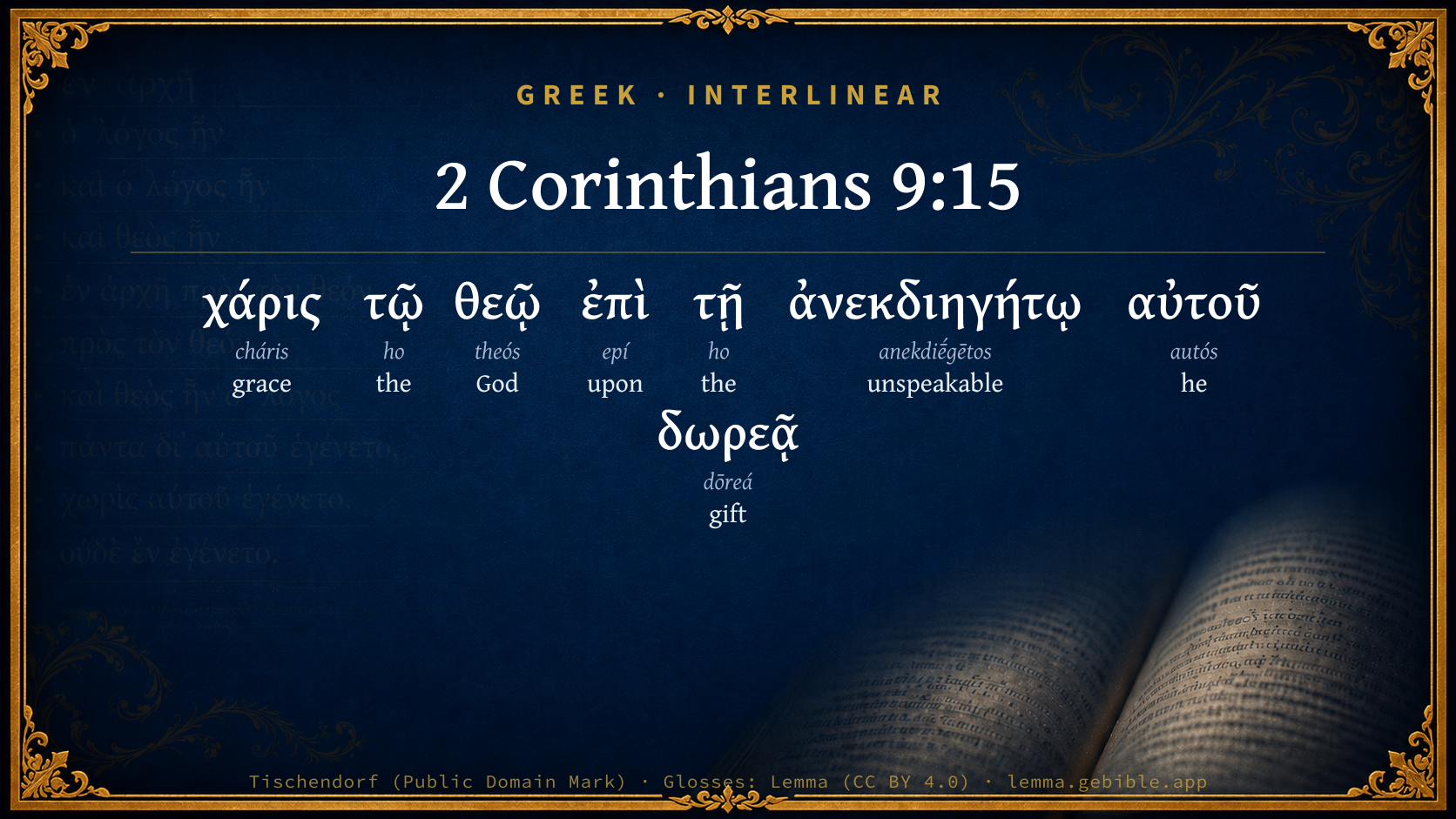
Greek (Tischendorf 8th ed.) 2 Corinthians 9:15 appears in the Greek New Testament. The text above is from the Tischendorf 8th edition. Each word links to its Strong’s number and a concise gloss. Click any word for its full Thayer’s Greek Lexicon entry.
Download image
Cite this verse

2 Corinthians 9:15 (World English Bible). Public Domain. Lemma interlinear Bible study tool, https://lemma.gebible.app/v/2-corinthians/9/15.

Show BibTeX & RIS
BibTeX
RIS
English Translation
Now thanks be to God for his unspeakable gift!
World English Bible · Public Domain
Highlights
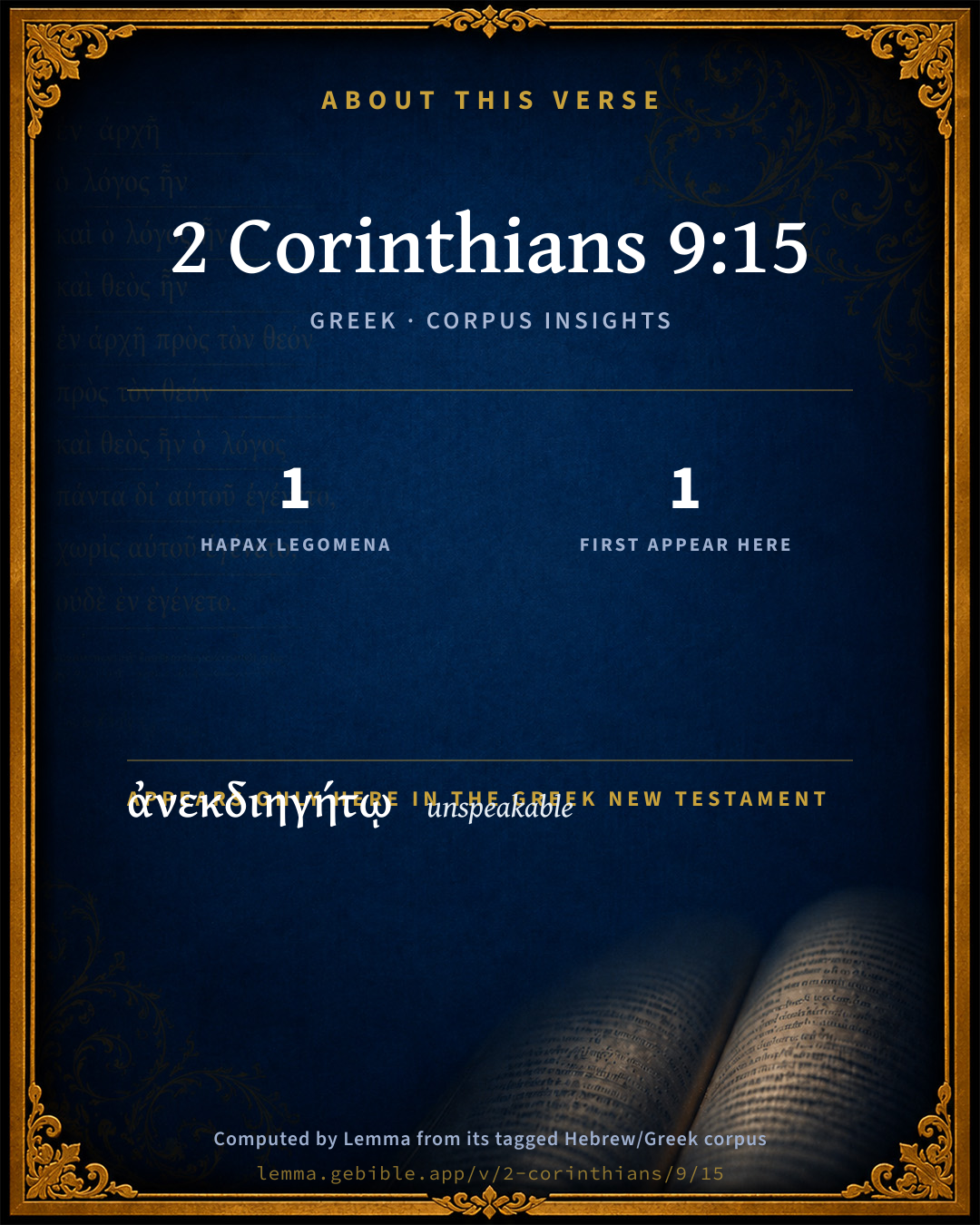
  • 1 hapax legomenon — only here in the Greek New Testament
  • 1 first appearance in the Greek New Testament
Full analysis ↓
Download a study sheet

One document with this verse’s original text, its word-by-word gloss line, the meaning frame, cross-references with their text, attributed commentary, and full source and license credits — printable, and it pastes into notes with its structure intact.

This verse Autodidact and up

Study sheet (.html) Plain text (.txt)

A passage Seminary Student

Up to 50 verses in one chapter. A passage sheet keeps up to 6 commentary sources and 12 cross-references per verse, in the order this page ranks them, and says so on the sheet whenever that leaves anything out. Ask for a single verse and you get the Autodidact verse sheet above.

Everything on this page stays free to read, with no account — the sheet is a download of what is already on screen, not access to it.

Want to remove ads? Support Godless Engineer
Compare translations 3

The same verse in 3 English versions, stacked beneath the original-language interlinear above. Click any original word for its lexicon entry.

Each is an independent rendering of the whole verse — the interlinear is not word-aligned to these translations.

Highlighted words mark where these versions differ — a whole-verse word diff, not a word-by-word alignment.

  • World English Bible Public Domain
    Now thanks be to God for his unspeakable gift!
  • King James Version Public Domain
    Thanks be unto God for his unspeakable gift.
  • unfoldingWord Literal Text CC BY-SA 4.0
    Thanks to God for his indescribable gift!

unfoldingWord Literal Text — © unfoldingWord, licensed CC BY-SA 4.0. Word-aligned USFM3 via Door43 (git.door43.org/unfoldingWord/en_ult).

Versions to compare (up to 4)

3 of 4 selected

Show all 19 translations

Every available English version of this verse, each an independent rendering of the whole verse.

  • World English Bible Public Domain
    Now thanks be to God for his unspeakable gift!
  • Berean Standard Bible Public Domain
    Thanks be to God for His indescribable gift!
  • Majority Standard Bible Public Domain
    Thanks be to God for His indescribable gift!
  • King James Version Public Domain
    Thanks be unto God for his unspeakable gift.
  • American Standard Version (1901) Public Domain
    Thanks be to God for his unspeakable gift.
  • Revised Version (1885) Public Domain
    Thanks be to God for his unspeakable gift.
  • Geneva Bible (1599) Public Domain
    Thankes therefore bee vnto God for his vnspeakeable gift.
  • Douay-Rheims (1899) Public Domain
    Thanks be to God for his unspeakable gift.
  • Young's Literal Translation Public Domain
    thanks also to God for His unspeakable gift!
  • Literal Standard Version CC BY-SA 4.0
    thanks also to God for His unspeakable gift!
  • Unlocked Literal Bible CC BY-SA 4.0
    May thanks be to God for his inexpressible gift!
  • unfoldingWord Literal Text CC BY-SA 4.0
    Thanks to God for his indescribable gift!
  • Darby Bible Public Domain
    Thanks [be] to God for his unspeakable free gift.
  • World Messianic Bible Public Domain
    Now thanks be to God for his unspeakable gift!
  • Webster's Bible Public Domain
    Thanks be to God for his unspeakable gift.
  • Free Bible Version CC BY-SA 4.0
    Thank God for his gift that is far greater than words can express!
  • Bible in Basic English Public Domain
    Praise be to God for what he has given, which words have no power to say.
  • Text-Critical English NT CC BY 4.0
    Thanks be to God for his indescribable gift!
  • Tyndale New Testament (1534) Public Domain
    Thankes be vnto God for his vn speakeable gyft.

Literal Standard Version (2020), Covenant Press — licensed CC BY-SA 4.0. Text via the HelloAO Bible API (eBible.org). Unlocked Literal Bible (unfoldingWord) — licensed CC BY-SA 4.0. Text via the HelloAO Bible API (eBible.org). unfoldingWord Literal Text — © unfoldingWord, licensed CC BY-SA 4.0. Word-aligned USFM3 via Door43 (git.door43.org/unfoldingWord/en_ult). Free Bible Version, Dr. Jonathan Gallagher — licensed CC BY-SA 4.0. Text via the HelloAO Bible API (eBible.org).

Word by word

More ways to search: Search by grammar → Find every occurrence → Compare this word →

Practice this passage: Drill this verse → Learn its vocabulary →

About this verse

These counts appear in no published source. They are computed here, from the morphology-tagged text and Lemma’s own curated glosses. What Lemma adds →

8
words
7
distinct lemmas
Pauline Epistles
section

Notable vocabulary

1 hapax legomenon — a word that appears only here in the entire Greek New Testament:

  • ἀνεκδιηγήτῳ unspeakable G411

First appearance in Scripture

This word makes its first canonical appearance in the Greek New Testament here:

  • ἀνεκδιηγήτῳ unspeakable G411

Shared distinctive vocabulary

δωρεᾷ gift G1431 occurs in 11 verses of the Greek New Testament. Also found in:

Repetition

A word recurs within this verse:

Cross-references

21

Topical passages linked to 2 Corinthians 9:15 in the Treasury of Scripture Knowledge — connected by theme and wording, ordered by reader-vote popularity; previews shown in the World English Bible.

  • 2 Corinthians 2:14 Now thanks be to God, who always leads us in triumph in Christ, and reveals through us the sweet aroma of his knowledge in every place.
  • John 3:16 For God so loved the world, that he gave his one and only Son, that whoever believes in him should not perish, but have eternal life.
  • Ephesians 5:20 giving thanks always concerning all things in the name of our Lord Jesus Christ, to God, even the Father;
  • Romans 8:32 He who didn't spare his own Son, but delivered him up for us all, how would he not also with him freely give us all things?
  • James 1:17 Every good gift and every perfect gift is from above, coming down from the Father of lights, with whom can be no variation, nor turning shadow.
  • 1 Corinthians 15:57 But thanks be to God, who gives us the victory through our Lord Jesus Christ.
  • Revelation 4:9 When the living creatures give glory, honor, and thanks to him who sits on the throne, to him who lives forever and ever,
  • Romans 6:23 For the wages of sin is death, but the free gift of God is eternal life in Christ Jesus our Lord.
  • 1 John 5:11–12 The testimony is this, that God gave to us eternal life, and this life is in his Son.
  • John 1:16 From his fullness we all received grace upon grace.
  • Psalms 30:12 To the end that my heart may sing praise to you, and not be silent. Yahweh my God, I will give thanks to you forever!
  • Romans 5:15 But the free gift isn't like the trespass. For if by the trespass of the one the many died, much more did the grace of God, and the gift by the grace of the one man, Jesus Christ, abound to the many.
  • 1 Chronicles 16:8 Oh give thanks to Yahweh, call on his name; Make known his doings among the peoples.
  • Isaiah 49:6 yes, he says, It is too light a thing that you should be my servant to raise up the tribes of Jacob, and to restore the preserved of Israel: I will also give you for a light to the Gentiles, that you may be my salvation to the end of the earth.
  • 2 Corinthians 9:11 you being enriched in everything to all liberality, which works through us thanksgiving to God.
  • Psalms 92:1 It is a good thing to give thanks to Yahweh, To sing praises to your name, Most High;
  • Isaiah 9:6 For to us a child is born, to us a son is given; and the government shall be on his shoulder: and his name shall be called Wonderful, Counselor, Mighty God, Everlasting Father, Prince of Peace.
  • 1 John 4:9–10 By this was God's love revealed in us, that God has sent his one and only Son into the world that we might live through him.
  • Psalms 30:4 Sing praise to Yahweh, you saints of his. Give thanks to his holy name.
  • Luke 2:14 "Glory to God in the highest, On earth peace, good will toward men."
  • 1 Chronicles 16:35 Say you, Save us, God of our salvation, Gather us together and deliver us from the nations, To give thanks to your holy name, To triumph in your praise.

Cross-references courtesy of OpenBible.info (CC BY 4.0).

Commentary

Notes on 2 Corinthians 9:15 from classic Christian and Jewish commentators (each source and its license shown beneath its notes). The classic Christian expositions comment on the surrounding passage and are grouped to its opening verse, so a note may address several verses; the Jewish commentaries on the Tanakh (Rashi and others) are per-verse, so they appear only where the commentator wrote on this verse.

Lemma curates 59 commentaries, every one of them public domain or Creative Commons licensed, each selected and text-cleaned for this edition rather than reprinted as found. About our sources →

Albert Barnes' Notes on the Bible

Thanks be unto God - Whitby supposes that this refers to the charitable disposition which they had manifested, and that the sense is, that God was to be adored for the liberal spirit which they were disposed to manifest, and the aid which they were disposed to render to others. But this, it is believed, falls far below the design of the apostle. The reference is rather to the inexpressible gift which God had granted to them in bestowing his Son to die for them; and this is one of the most striking instances which occur in the New Testament, showing that the mind of Paul was full of this subject; and that wherever he began, he was sure to end with a reference to the Redeemer. The invaluable gift of a Saviour was so familiar to his mind, and he was so accustomed to dwell on that in his private thoughts, that the mind naturally and easily glanced on that whenever anything occurred that by the remotest allusion would suggest it. The idea is, “Your benefactions are indeed valuable; and for them, for the disposition which you have manifested, and for all the good which you will be enabled thus to accomplish, we are bound to give thanks to God. All this will excite the gratitude of those who shall be benefitted. But how small is all this compared with the great gift which God has imparted in bestowing a Saviour! That is unspeakable. No words can express it, no language convey an adequate description of the value of the gift, and of the mercies which result from it.”

His unspeakable gift - The word used here ἀνεκδιηγήτῳ anekdiēgētō means, what cannot be related, unutterable. It occurs nowhere else in the New Testament. The idea is, that no words can properly express the greatness of the gift thus bestowed on man. It is higher than the mind can conceive; higher than language can express. On this verse we may observe:

(1) That the Saviour is a gift to mankind. So he is uniformly represented; see Joh 3:16; Gal 1:4; Gal 2:20; Eph 1:22; 1Ti 2:6; Tit 2:14. Man had no claim on God. He could not compel him to provide a plan of salvation; and the whole arrangement - the selection of the Saviour, the sending him into the world, and all the benefits resulting from his work, are all an undeserved gift to man.

(2) This is a gift unspeakably great, whose value no language can express, no heart fully conceive. It is so because:

Of his own greatness and glory; Because of the inexpressible love which he evinced; Because of the unutterable sufferings which he endured; Because of the inexpressibly great benefits which result from his work. No language can do justice to this work in either of these respects; no heart in this world fully conceives the obligation which rests upon man in virtue of his work.

(3) Thanks should be rendered to God for this. We owe him our highest praises for this. This appears:

(a) Because it was mere benevolence in God. We had no claim; we could not compel him to grant us a Saviour. The gift might have been withheld, and his throne would have been spotless, We owe no thanks where we have a claim; where we deserve nothing, then he who benefits us has a claim on our thanks.

(b) Because of the benefits which we have received from him. Who can express this? All our peace and hope; all our comfort and joy in this life; all our prospect of pardon and salvation; all the offers of eternal glory are to be traced to him. Man has no prospect of being happy when he dies but in virtue of the “unspeakable gift” of God. And when he thinks of his sins, which may now be freely pardoned; when he thinks of an agitated and troubled conscience, which may now be at peace; when he thinks of his soul, which may now be unspeakably and eternally happy; when he thinks of the hell from which he is delivered, and of the heaven to whose eternal glories he may now be raised up by the gift of a Saviour, his heart should overflow with gratitude, and the language should be continually on his lips and in his heart, “thanks be unto God for His unspeakable gift.” Every other mercy should seem small compared with this; and every manifestation of right feeling in the heart should lead us to contemplate the source of it, and to feel, as Paul did, that all is to be traced to the unspeakable gift of God.

Remarks

1. This chapter, with the preceding, derives special importance from the fact that it contains the most extended discussion of the principles of Christian charity which occurs in the Bible. No one can doubt that it was intended by the Redeemer that his people should be distinguished for benevolence. It was important, therefore, that there should be some portion of the New Testament where the principles on which charity should be exercised, and the motives by which Christians should be induced to give, should be fully stated. Such a discussion we have in these chapters; and they therefore demand the profound and prayerful attention of all who love the Lord Jesus.

2. We have here a striking specimen of the manner in which the Bible is written. Instead of abstract statements and systematic arrangement, the principles of religion are brought out in connection with a case that actually occurred. But it follows that it is important to study the Bible attentively, and to be familiar with every part of it. In some part of the Scriptures, statements of the principles which should guide us in given circumstances will be found; and Christians should, therefore, be familiar with every part of the Bible.

3. These chapters are of special importance to the ministers of religion, and to all whose duty it is to press upon their fellow Christians the duty of giving liberally to the objects of benevolence. The principles on which it should be done are fully developed here. The motives which it is lawful to urge are urged here by Paul. It may be added, also, that the chapters are worthy of our profound study on account of the admirable tact and address which Paul evinces in inducing others to give. Well he knew human nature. Well he knew the motives which would influence others to give. And well he knew exactly how to shape his arguments and adapt his reasoning to the circumstances of those whom he addressed.

4. The summary of the motives presented in this chapter contains still the most important argument which can be urged to produce liberality. We cannot but admire the felicity of Paul in this address - a felicity not the result of craft and cunning, but resulting from his amiable feelings, and the love which he bore to the Corinthians and to the cause of benevolence. He reminds them of the high opinion which he had of them, and of the honorable mention which he had been induced to make of them 2Co 9:1-2; he reminds them of the painful result to his own feelings and theirs if the collection should in any way fail, and it should appear that his confidence in them had been misplaced 2Co 9:3-5; he refers them to the abundant reward which they might anticipate as the result of liberal benefactions, and of the fact that God loved those who gave cheerfully 2Co 9:6-7; he reminds them of the abundant grace of God, who was able to supply all their needs and to give them the means to contribute liberally to meet the needs of the poor 2Co 9:8; he reminds them of the joy which their liberality would occasion, and of the abundant thanksgiving to God which would result from it 2Co 9:12-13; and he refers them to the unspeakable gift of God, Jesus Christ, as an example, and an argument, and us urging the highest claims in them, 2Co 9:15. “Who,” says Doddridge, “could withstand the force of such oratory?” No doubt it was effectual in that case, and it should be in all others.

5. May the motives here urged by the apostle be effectual to persuade us all to liberal efforts to do good! Assuredly there is no less occasion for Christian liberality now than there was in the time of Paul. There are still multitudes of the poor who need the kind and efficient aid of Christians. And the whole world now is a field in which Christian beneficence may be abundantly displayed, and every land may, and should experience the benefits of the charity to which the gospel prompts, and which it enjoins. Happy are they who are influenced by the principles of the gospel to do good to all people! Happy they who have any opportunity to illustrate the power of Christian principle in this; any ability to alleviate the needs of one sufferer, or to do anything in sending that gospel to benighted nations which alone can save the soul from eternal death!

6. Let us especially thank God for his unspeakable gift, Jesus Christ. Let us remember that to him we owe every opportunity to do good: that it was because he came that there is any possibility of benefiting a dying world; and that all who profess to love him are bound to imitate his example and to show their sense of their obligation to God for giving a Saviour. How poor and worthless are all our gifts compared with the great gift of God; how slight our expressions of compassion, even at the best, for our fellow-men, compared with the compassion which he has shown for us! When God has given his Son to die for us, what should we not be willing to give that we may show our gratitude, and that we may benefit a dying world.

Albert Barnes' Notes on the Bible (1834–1885) — public domain. Text from a community e-Sword/MySword module.

Joseph Benson's Commentary

2Co 9:15. Thanks be to God for his unspeakable gift — By this gift, for which the apostle so fervently thanks God, Dr. Whitby understands the charitable disposition that was in the Corinthians, Macedonians, and other sincere Christians, “by which God was glorified, the gospel adorned, the poor saints refreshed, and themselves fitted for an exceeding great reward.” The text, understood in this sense, is a clear proof that every good affection in the human heart is to be ascribed to a divine influence. But, as Macknight justly observes, “it may be doubted whether the apostle would call that gift unspeakable. So grand an epithet may, with more propriety, be applied to Christ. Besides the happy effects of a cordial friendship established between the [believing] Jews and Gentiles, now united in one faith, worship, and church, being the object of the apostle’s present thoughts, it was natural for him to break forth in a thanksgiving to God for Christ, the author of that happy union, and of all the blessings which mankind enjoy. And as these blessings are so many and so great, that they cannot be fully declared in human language, Christ, the author of them all, may well be called God’s unspeakable gift.”

Joseph Benson's Commentary on the Old and New Testaments (1811–1818) — public domain. Text from a community e-Sword module.

MacLaren's Expositions of Holy Scripture

Alexander MacLaren

2 Corinthians

GOD’S UNSPEAKABLE GIFT

2Co 9:15

It seems strange that there should ever have been any doubt as to what gift it is which evokes this burst of thanksgiving. There is but one of God’s many mercies which is worthy of being thus singled out. There is one blazing central sun which shines out amidst all the galaxy of lights which fill the heavens. There is one gift of God which, beyond all others, merits the designation of ‘unspeakable.’ The gift of Christ draws all other divine gifts after it. ‘How should He not with Him also freely give us all things.’

The connection in which this abrupt jet of praise stands is very remarkable. The Apostle has been dwelling on the Christian obligation of giving bountifully and cheerfully, and on the great law that a glad giver is ‘enriched’ and not impoverished thereby, whilst the recipients, for their part, are blessed by having thankfulness evoked towards the givers. And that contemplation of the happy interchange of benefit and thanks between men leads the fervid Apostle to the thoughts which were always ready to spring to his lips--of God as the great pattern of giving and of the gratitude to Him which should fill all our souls. The expression here ‘unspeakable’ is what I wish chiefly to fix upon now. It means literally that which cannot be fully declared. Language fails because thought fails.

I. The gift comes from unspeakable love.

God _so_ loved the world that He gave His only begotten Son. The love is the cause of the gift: the gift is the expression of the love. John’s Gospel says that the Son which is in the bosom of the Father has _declared_ Him. Paul here uses a related word for _unspeakable_ which might be rendered ‘that which cannot be fully declared.’ The declaration of the Father partly consists in this, that He is declared to be undeclarable, the proclamation of His name consists partly in this that it is proclaimed to be a name that cannot be proclaimed. Language fails when it is applied to the expression of human emotion; no tongue can ever fully serve the heart. Whether there be any thoughts too great for words or no, there are emotions too great. Language is ever ‘weaker than our grief’ and not seldom weaker than our love. It is but the surface water that can be run off through the narrow channel of speech: the central deep remains. If it be so with human affection, how much more must it be so with God’s love? With lowly condescension He uses all sweet images drawn from earthly relationships, to help us in understanding His. Every dear name is pressed into the service--father, mother, husband, wife, brother, friend, and after all are exhausted, the love which clothed itself in them all in turn, and used them all to give some faint hint of its own perfection, remains unspoken. We know human love, its limitations, its changes, its extravagances, its shortcomings, and cannot but feel how unworthy it is to mirror for us that perfection in God which we venture to name by a name so soiled. The analogies between what we call love in man and love in God must be supplemented by the differences between them, if we are ever to approach a worthy conception of the unspeakable love that underlies the unspeakable gift.

II. The gift involves unspeakable sacrifice.

Human love desires to give its most precious treasures to its object and is then most blessed: divine love cannot come short of human in this most characteristic of its manifestations. Surely the copy is not to surpass the original, nor the mirror to flash more brightly than the sun which, at the brightest, it but reflects. In such a matter we can but stammer when we try to find words. As our text warns us, we are trying to utter the unutterable when we seek to speak of God’s giving up for us; but however such a thought may seem to be forbidden by other aspects of the divine nature, it seems to be involved in the great truth that ‘God is love.’ Since He is, His blessedness too, must be in imparting, and in parting with what He gives. A humble worshipper in Jewish times loved enough to say that he would not offer unto God an offering that cost him nothing, and that loving height of self-surrender was at the highest, but a lowly imitation of the love to which it looked up. When Paul in the Epistle to the Romans says, ‘He that spared not His own Son but delivered Him up for us all,’ he is obviously alluding to, and all but quoting, the divine words to Abraham, ‘Seeing thou hast not withheld thy son, thine only son, from Me,’ and the allusion permits us to parallel what God did when He sent His Son with what Abraham did when, with wrung heart, but with submission, he bound and laid Isaac on the altar and stretched forth his hand with the knife in it to slay him. Such a representation contradicts the vulgar conceptions of a passionless, self-sufficing, icy deity, but reflection on the facts of our own experience and on the blessed secrets of our own love, leads us to believe that some shadow of loss passed across the infinite and eternal completeness of the divine nature when ‘God sent forth His Son made of a woman.’ And may we not go further and say that when Jesus on the Cross cried from out of the darkness of eclipse, ‘My God! My God! Why hast Thou forsaken me?’ there was something in the heavens corresponding to the darkness that covered the earth and something in the Father’s heart that answered the Son’s. But our text warns us that such matters are not for our handling in speech, and are best dealt with, not as matters of possibly erring speculation, but as materials for lowly thanks unto God for His unspeakable gift.

But whatever may be true about the love of the Father who sent, there can be no doubt about the love of the Son who came. No man helps his fellows in suffering but at the cost of his own suffering. Sympathy means _fellow-feeling_, and the one indispensable condition of all rescue work of any sort is that the rescuer must bear on his own shoulders the sins or sorrows that he is able to bear away. Heartless help is no help. It does not matter whether he who ‘stands and says, "Be ye clothed and fed,"‘ gives or does not give ‘the things necessary,’ he will be but a ‘miserable comforter’ if he has not in heart and feeling entered into the sorrows and pains which he seeks to alleviate. We need not dwell on the familiar truths concerning Him who was a ‘man of sorrows and acquainted with grief.’ All through His life He was in contact with evil, and for Him the contact was like that of a naked hand pressed upon hot iron. The sins and woes of the world made His path through it like that of bare feet on sharp flints. If He had never died it would still have been true that ‘He was wounded for our transgressions and bruised for our iniquities.’ On the Cross He completed the libation which had continued throughout His life and ‘poured out His soul unto death’ as He had been pouring it out all through His life. We have no measure by which we can estimate the inevitable sufferings in such a world as ours of such a spirit as Christ’s. We may know something of the solitude of uncongenial society; of the pain of seeing miseries that we cannot comfort, of the horrors of dwelling amidst impurities that we cannot cleanse, and of longings to escape from them all to some nest in the wilderness, but all these are but the feeblest shadows of the incarnate sorrows whose name among men was Jesus. Nothing is more pathetic than the way in which our Lord kept all these sorrows close locked within His own heart, so that scarcely ever did they come to light. Once He did permit a glimpse into that hidden chamber when He said, ‘O faithless generation, how long shall I be with you, how long shall I suffer you?’ But for the most part His sorrow was unspoken because it was ‘unspeakable.’ Once beneath the quivering olives in the moonlight of Gethsemane, He made a pitiful appeal for the little help which three drowsy men could give Him, when He cried, ‘My soul is exceeding sorrowful, even unto death. Tarry ye here and watch with Me,’ but for the most part the silence at which His judges ‘marvelled greatly,’ and raged as much as they marvelled, was unbroken, and as ‘a sheep before her shearers is dumb,’ so ‘He opened not His mouth.’ The sacrifice of His death was, for the most part, silent like the sacrifice of His life. Should it not call forth from us floods of praise and thanks to God for His unspeakable gift?

III. The gift brings with it unspeakable results.

In Christ are hid ‘all the treasures of wisdom and knowledge.’ When God gave us Him, He gave us a storehouse in which are contained treasures of truth which can never be fully comprehended, and which, even if comprehended, can never be exhausted. The mystery of the Divine Name revealed in Jesus, the mystery of His person, are themes on which the Christian world has been nourished ever since, and which are as full of food, not for the understanding only, but far more for the heart and the will, to-day as ever they were. The world may think that it has left the teaching of Jesus behind, but in reality the teaching is far ahead, and the world’s practise is but slowly creeping towards its imperfect attainment. The Gospel is the guide of the race, and each generation gathers something more from it, and progresses in the measure in which it follows Christ; and as for the race, so for the individual. Each of Christ’s scholars finds his own gift, and in the measure of his faithfulness to what he has found makes ever new discoveries in the unsearchable riches of Christ. After all have fed full there still remain abundant baskets full to be taken up.

He who has sounded the depths of Jesus most completely is ever the first to acknowledge that he has been but as a child ‘gathering pebbles on the beach while the great ocean lies unsounded before him.’ No single soul, and no multitude of souls, can exhaust Jesus; neither our individual experiences, nor the experiences of a believing world can fully realise the endless wealth laid up in Him. He is the Alpha and the Omega of all our speech, the first letter and the last of our alphabet, between which lie all the rest.

The gift is completed in consequences yet unspeakable. Even the first blessings which the humblest faith receives from the pierced hands have more in them than words can tell. Who has ever spoken adequately and in full correspondence with reality what it is to have God’s pardoning love flowing in upon the soul? Many singers have sung sweet psalms and hymns and spiritual songs on which generations of devout souls have fed, but none of them has spoken the deepest blessedness of a Christian life, or the calm raptures of communion with God. It is easy to utter the words ‘forgiveness, reconciliation, acceptance, fellowship, eternal life’; the syllables can be spoken, but who knows or can utter the depths of the meanings? After all human words the half has not been told us, and as every soul carries within itself unrevealable emotions, and is a mystery after all revelation, so the things which God’s gift brings to a soul are after all speech unspeakable, and the words ‘cannot be uttered’ which they who are caught up into the third heavens hear.

Then we may extend our thoughts to the future form of Christian experience. ‘It doth not yet appear what we should be.’ All our conceptions of a future existence must necessarily be inadequate. Nothing but experience can reveal them to us, and our experience there will be capable of indefinite expansion, and through eternity there will be endless growth in the appropriation of the unspeakable gift.

For us the only recompense that we can make for the unspeakable gift is to receive it with ‘thanks unto God’ and the yielding up of our hearts to Him. God pours this love upon us freely, without stint. It is unspeakable in the depths of its source, in the manner of its manifestation, in the glory of its issues. It is like some great stream, rising in the trackless mountains, broad and deep, and leading on to a sunlit ocean. We stand on the bank; let us trust ourselves to its broad bosom. It will bear us safe. And let us take heed that we receive not the gift of God _in vain_.

Alexander MacLaren, Expositions of Holy Scripture (1904–1910) — public domain. Text from a community e-Sword module.

Bengel's Gnomon

Johann Albrecht Bengel

2Co 9:15. Χάρις, thanks) This is the meaning: God has given us τὴν δωρεὰν, the gift, abundance of good things both internal and external, which both is in itself inexpressible, and bears fruits of a corresponding description; comp. 2Co 9:8, etc. (where there is an expression [an attempt to express the abundance of the gift], but its words are not adequate so as to satisfy Paul’s mind), and ch. 2Co 8:9; 2Co 8:1, and the full expression of these fruits, by reason of the copiousness of the topics, has rendered the language itself at the end of the preceding chapter somewhat perplexed. The modus[59] is added, thanks be to God.

[59] See Append. “Modalis Sermo.” Here, the modus accompanying the simple naked proposition is thanksgiving.—ED.

Bengel's Gnomon of the New Testament — English translation (T&T Clark, Edinburgh, 1860) — public domain. Text from a community e-Sword module.

Meyer's Critical & Exegetical Commentary

Heinrich August Wilhelm Meyer

2Co_9:15. At the close we have an exclamation of gratitude springing out of deep piety (comp. Rom_9:5; Rom_11:33 ff.; 1Co_15:57; Gal_1:5; 1Ti_1:17), without any special purpose (such as to awaken humility, Beza; comp. Chrysostom), but issuing out of the fuller craving of the heart, without being intended (as Hofmann holds) to impress the duty of willingly contributing gifts which are so small in comparison.

The δωρεά is consequence and evidence of the χάρις, 2Co_9:14. Comp. Rom_5:15; Rom_5:17.

ἐπὶ τῇ ἀνεκδιηγ. αὐτοῦ δωρεᾷ] on account of his undescribable gift. What is meant by this is indicated to the Christian consciousness by ἀνεκδιηγ. (comp. Rom_11:33; Eph_3:18 f.), namely, the whole wonderful and inexpressibly blissful work of redemption. It is for this, and not simply for the grace imparted to the Gentiles (Hofmann), that Paul gives thanks, because it is the gracious foundation of such fellowship in love, and of its blissful working. Others[297] understand it of the previously discussed happy result of the work of collection (Calvin, Estius, Bengel, Billroth, Rückert, Osiander; comp. Ewald, who takes χάρις κ.τ.λ. as the quoted closing words of the prayer of gratitude on the part of the church at Jerusalem itself); but in that case ἈΝΕΚΔΙΉΓΗΤΟς appears to be much too strong an epithet, whereas it is quite suitable to the highest of all Gods gifts, the δωρεὰ κατʼ ἐξοχήν. Comp. Rom_5:15; Heb_6:4.

On ἈΝΕΚΔΙΗΓΉΤῼ, comp. Arrian, Anab. p 310: τὴν ἀνεκδιήγητον τόλμαν.

[297] To these belongs Grotius also, who in his acute way remarks: Paulus in gratiarum actionem se illis in Judaea fratribus adjungit, et quasi Amen illis accinit. Chrysostom and Theophylact quote both explanations, but incline more to that which we have adopted.

Meyer — Critical and Exegetical Commentary on the New Testament — English translation by Peter Christie, edited by Frederick Crombie (T&T Clark, 1880) — public domain. Text from a community e-Sword module.

Expositor's Greek Testament

ed. W. Robertson Nicoll

2Co 9:15 . χαρὶς τῷ Θεῷ κ . τ . λ .: thanks be to God for His unspeakable gift . δωρεά is always in the N.T. (see reff., etc.) used of the gifts of God, not of men; and the “unspeakable” gift ( cf. Rom 11:33 , Eph 3:20 ) for which the Apostle bursts out here into a characteristic doxology is the gift of Christ Himself (Joh 3:16 ) and of salvation in Him, thankful appreciation of which had borne such fruit in Christian lives.

III. The Vindication of his Apostolic Authority. It would appear that while Titus had brought favourable news as to the loyalty with which the Corinthians had received St. Paul’s message of reproof in the matter of the incestuous person (2Co 7:9-11 ), he had also brought distressing intelligence as to the depreciation of the Apostle’s authority by certain active Judaisers at Corinth. The case is so serious that it requires immediate attention, and the third (and last) section of the latter is occupied with St. Paul’s reply in vindication of his claims. See Introd. , p. 22.

The Expositor's Greek Testament, edited by W. Robertson Nicoll (1897–1910) — public domain. Text from a community e-Sword module.

International Critical Commentary

15. Χάρις τῷ θεῷ. This glorious picture causes him to burst out into an expression of deep thankfulness to God. He sees in it an earnest of that unity of Christendom for which he has laboured so perseveringly; ‘neither Jew nor Greek,’ but ‘all one in Christ Jesus’ (Gal 3:28; 1Co 12:13; Col 3:11.) The Jewish Christians thank God for the goodness of their Gentile brethren, and to this thanksgiving the Apostle utters a deep Amen in the brief but profound doxology contained in this verse. It is based on hope rather than on fact, and on the more remote rather than on the immediate and obvious results of his pleading. His intense thankfulness is not so much for the relief of the sufferings of the Jewish Christians in Palestine, as for the effect on Christendom of their being relieved by Gentile Christians in Europe. “It will disarm suspicion; it will be a practical proof of the reality and power of the Gospel, it will strengthen the sense of brotherhood, it will turn distant strangers into earnest, eager friends, who pray for their benefactors and long for a sight of their face” (McFadyen, 2 Corinthians, p. 375). We may compare the interjected thanksgiving 1Co 15:57, and the similar expressions of praise Gal 1:5; Rom 9:5, Rom 9:11:33; 1Ti 1:17.

τῇ ἀνεκδιηγῆτῳ αὐτοῦ δωρεᾷ. ‘For His ineffable gift;’ it is one which is incapable of expression by speech. The epithet is found nowhere else in LXX or N.T. Clement of Rome uses it, apparently of laws of nature; “the inscrutable (ἀνεξιχνίαστα, Rom 11:33) depths of the abysses and the unutterable statutes (ἀνεκδιήγητα κρίματα) of the nether regions” (Cor. 20:5). It is also found in Arrian; τὴν ἀνεκδιήγητον τόλμαν (Exp. Alex. p. 310). Cf. ἀνεκλάλητος (1Pe 1:8) of joy in Christ, and ἀλάλητος (Rom 8:26) of the groanings of the Spirit in intercession. All three words are rare. It is rash to say that so strong a word could not be used by St Paul of anything less than God’s supreme gift in sending His Son for man’s redemption. A thanksgiving for that has only a very far-fetched connexion with the context. On the other hand, the thought of the complete realization of his highest hopes for the unity of Christendom as the natural fruit of mutual goodwill between Gentile and Jewish Christians is quite sufficient to account for this outburst of fervour. Chrysostom remarks; “If God’s gift is indescribable, what madness it must be to raise curious questions about His Being. When what He bestows is ineffable, what must He be Himself.” Of the two explanations as to what the gift was for which St Paul was so intensely thankful, Chrysostom inclines to the less probable, that it was the gift of His Son for man’s salvation.

δωρεᾷ. Here, as elsewhere in N.T., the word is used of a Divine boon (Rom 5:15, Rom 5:17; Eph 3:7, Eph 3:4:7; Heb 6:4; etc.); the more freq. δῶρον is used of offerings to God (Mat 5:23, Mat 5:24, Mat 5:15:5, Mat 5:23:18, Mat 5:19; etc.) and gifts to men (Rev 11:10).

א3 C2 D2 and 3 E K L P, Syrr. Copt. Arm. insert δέ after χάρις א * B C * D * F G 17, Latt. Goth. omit. Connecting particles are often inserted by scribes and translators for smoothness, and the δέ is probably not genuine. If we omit it, the sentence is an exclamation of thankfulness, closing the subject; and thus we have an intelligible conclusion to ch. 9. But if the δέ is genuine, the sentence looks as if it were unfinished, and the want of connexion between 9:15 and 10:1 becomes glaring. This would be a point in favour of the theory that 1-9. is a letter of which the original conclusion has been lost, and which has been joined to another letter of which the original beginning has been lost. Kennedy, Hermathena, XII. xxix., 1903, p. 365.

Here the second main division of the Epistle ends. The whole of it (8., 9.) is taken up with the subject of the collection for the poor at Jerusalem. On the interesting question whether the remaining four chapters are part of the same letter, or belonged originally to the severe letter which the Apostle wrote after 1 Corinthians and before 2 Cor. 1-9., see the Introduction, § IV. 5, and the note on 7:8. Here it may suffice to quote the words of two recent commentators, both of whom think that the latter hypothesis is hardly necessary.

“The most cursory reader cannot fail to perceive an abrupt difference in tone, as he passes from ch. 8 f. to ch. 10. The former chapters were complimentary and affectionate; this and the following chapters are heated, polemical, and in part ironical. There, the Corinthians were his beloved ‘brethren,’ of whom he was proud, and of whose generosity he was not afraid to boast; here, there are enemies in the camp—enemies who have been challenging his authority, and detracting from his credit, and who will therefore have to be summarily dealt with. They will have to be convinced, by its impact on themselves, that Paul’s authority is a very real thing, and that he is just as capable of exercising it before their eyes as he is by means of correspondence’ (McFadyen, p. 376).

The other commentator allows that there is an “abrupt change of tone and subject at 10:1, where there is no manifest connexion with what goes before, and after a peaceable discussion of the fruits to be expected from the collection, we are suddenly plunged in a piece of vehement polemical writing against adversaries, the quarrel with whom has already been adjusted in the earlier chapters” (Menzies, p. xxxv).

It is very difficult to see how 8. and 9. “prepare for the polemic against the Judaistic opponents” in 10-13. Is asking for money a good preparation for an incisive attack?

* Halmel insists that the omission of ταύτης and addition of εἰς τοὺς αγίους in 9:1 (as in 8:4) proves that in ix. I we begin a different and independent appeal. The inference is not strong: εἰς τοὐς ἁγἰους takes the place of ταύτης.

C C (Fifth century). Codex Ephraemi, a Palimpsest; now at Paris, very defective. Of 2 Corinthians all from 10:8 onwards is wanting.

אԠא (Fourth century). Codex Sinaiticus; now at Petrograd, the only uncial MS. containing the whole N.T.

B B (Fourth century). Codex Vaticanus.

17 17. (Evan. 33, Act_13. Ninth century). Now at paris. “The queen of the cursives” and the best for the Pauline Epistles; more than any other it preserves Pre-Syrian readings and agrees with B D L.

D D (Sixth century). Codex Claromontanus; now at Paris. A Graeco-Latin MS. The Latin (d) is akin to the Old Latin. Many subsequent hands (sixth to ninth centuries) have corrected the MS.

F F (Late ninth century). Codex Augiensis (from Reichenau); now at Trinity College, Cambridge.

G G (Late ninth century). Codex Boernerianus; at Dresden. Interlined with the Latin (in minluscules). The Greek text is almost the same as that of F, but the Latin (g) shows Old Latin elements.

K K (Ninth century). Codex Mosquensis; now at Moscow.

L L (Ninth century). Codex Angelicus; now in the Angelica Library at Rome.

P P (Ninth century). Codex Porfirianus Chiovensis, formerly possessed by Bishop Porfiri of Kiev, and now at Petrograd.

f d The Latin companion of F

E E (Ninth century). At Petrograd. A copy of D, and unimportant

d d The Latin companion of D

e d The Latin companion of E

* Possibly only the two colleagues are meant. Titus was going of his own initiative (8:17). Without 8:16-24, these verses (3-5) would be rather obscure.

* information respecting the commentator is to be found in the volume on the First Epistle, pp. lxvi f.

g d The Latin companion of G

67 67. (Eleventh century). At Vienna. Has valuable marginal readings (67 * *) akin to B and M; these readings must have been copied from an ancient MS., but not from the Codex Ruber itself.

* Deissmann (Bib. St. p. 144) proposes to read λογίαν here in instead ofεὐλογίαν There is no authority for it.

† Wie eine Segensgabe nicht wie eine Habsuchisgabe (Schmiedel).

* Ἀρέσκει δʼ αὐτοῖς καὶ λιτῶς βιοῦν, καθάπερ Διογένης, ὃς ἔφασκε θεῶν μὲν ἴδιον εἶναι μηδενὸς δεῖσθαι, τῶν δὲ θεοῖς ὁμοίων τὸ ὀλίγων χρῄζειν (Diog. Laert. vi. 105).

* Some understand δἰ ἡμῶν as meaning, ‘through us weak mortals’; but it probably means no more than ‘through us who have to administer the bounty.’

* This use, however, was not prculiar to the Jews. Papyri of 165-160 b.c. show that it was common in Egypt, esp. of the services in the Serapeum (Deissmann, Bib. st. p. 140).

* There is evidence that it did take place. Forty years later Clement of Rome, in addressing the Corinthians (2:1), praises them as ἥδιον διδόντες ἢ λαμβάνοντες, which he would hardly have done had the historic collection been a failure at Corinth.

International Critical Commentary — older volumes (1896–1929), various authors — public domain. Text from a community e-Sword module.

Geneva Bible (1599)

Geneva Bible translators

Lest by his great commendation and praise, the Corinthians should be puffed up, he shutteth up this exhortation, with this exclamation.

Geneva Bible (1599) marginal notes — public domain. Text via Bolls.life.

Jamieson, Fausset & Brown

Robert Jamieson, A. R. Fausset & David Brown

his unspeakable gift--the gift of His own Son, which includes all other inferior gifts (Co2 8:9; Rom 8:32). If we have received from God "His unspeakable gift," what great thing is it, if we give a few perishing gifts for His sake?

Next: 2 Corinthians Chapter 10

Jamieson, Fausset & Brown — Commentary Critical and Explanatory on the Whole Bible (1871) — public domain (CC PDM 1.0). Text via the HelloAO Bible API.

Adam Clarke's Commentary

Verse 15. Thanks be unto God for his unspeakable gift.] Some contend that Christ only is here intended; others, that the almsgiving is meant.

After all the difference of commentators and preachers, it is most evident that the ανεκδιηγητος δωρεα, unspeakable gift, is precisely the same with the υπερβαλλουση χαρις, superabounding grace or benefit, of the preceding verse. If therefore Jesus Christ, the gift of God's unbounded love to man, be the meaning of the unspeakable gift in this verse, he is also intended by the superabounding grace in the preceding. But it is most evident that it is the work of Christ in them, and not Christ himself, which is intended in the 14th verse 2Co 9:14; and consequently, that it is the same work, not the operator, which is referred to in this last verse.

A FEW farther observations may be necessary on the conclusion of this chapter.

1. JESUS CHRIST, the gift of God's love to mankind, is an unspeakable blessing; no man can conceive, much less declare, how great this gift is; for these things the angels desire to look into. Therefore he may be well called the unspeakable gift, as he is the highest God ever gave or can give to man; though this is not the meaning of the last verse.

2. The conversion of a soul from darkness to light, from sin to holiness, from Satan to God, is not less inconceivable. It is called a new creation, and creative energy cannot be comprehended. To have the grace of God to rule the heart, subduing all things to itself and filling the soul with the Divine nature, is an unspeakable blessing; and the energy that produced it is an unspeakable gift. I conclude, therefore, that it is the work of Christ in the soul, and not Christ himself, that the apostle terms the superabounding or exceeding great grace, and the unspeakable gift; and Dr. Whitby's paraphrase may be safely admitted as giving the true sense of the passage. "Thanks be unto God for his unspeakable gift: i.e. this admirable charity (proceeding from the work of Christ in the soul) by which God is so much glorified, the Gospel receives such credit, others are so much benefited, and you will be by God so plentifully rewarded." This is the sober sense of the passage; and no other meaning can comport with it. The passage itself is a grand proof that every good disposition in the soul of man comes from God; and it explodes the notion of natural good, i.e. good which God does not work, which is absurd; for no effect can exist without a cause; and God being the fountain of good, all that can be called good must come immediately from himself. See Jas 1:17.

3. Most men can see the hand of God in the dispensations of his justice, and yet these very seldom appear. How is it that they cannot equally see his hand in the dispensations of his mercy, which are great, striking, and unremitting? Our afflictions we scarcely ever forget; our mercies we scarcely ever remember! Our hearts are alive to complaint, but dead to gratitude. We have had ten thousand mercies for one judgment, and yet our complaints to our thanksgivings have been ten thousand to one! How is it that God endures this, and bears with us? Ask his own eternal clemency; and ask the Mediator before the throne. The mystery of our preservation and salvation can be there alone explained.

Adam Clarke's Commentary on the Bible (1810–1826) — public domain. Text from a community e-Sword/MySword module.

Ellicott's Commentary for English Readers

(15) Thanks be unto God for his unspeakable gift.—So the section on the collection for the saints comes to its close. We are left to conjecture to what gift the Apostle refers: whether to the love of God as manifested in Christ, or to the spirit of love poured into men’s hearts. The use of the word in the Acts (Act_2:38; Act_8:20; Act_10:45; Act_11:17) is in favour of referring it to the gift of the Holy Ghost; that of Rom_5:15; Rom_5:17, to the gift of pardon or righteousness. Probably it did not enter into his thoughts to subject the jubilant utterance of praise to a minute analysis.

At this stage there was manifestly another pause, of greater or less length, in the act of dictating. Fresh thoughts of a different kind are working in his mind, and rousing feelings of a very different kind from those which had been just expressed. At last he again breaks silence and begins anew.

A Bible Commentary for English Readers, edited by Charles John Ellicott (1878–1897) — public domain. Text from a community e-Sword module.

The Cambridge Bible for Schools and Colleges

gen. ed. J. J. S. Perowne

15. Thanks] The word is the same which is elsewhere translated grace.

for his unspeakable gift] This, as Dean Alford suggests (after Chrysostom), can be none other than Jesus Christ Himself. No other gift could correspond to the word ‘unspeakable,’ which suggests (like Rom_11:33; Eph_3:18-19) the idea of God. And in Jesus Christ ‘dwelleth all the fulness of the Godhead bodily’ (Col_2:9). From Him all gifts of nature or grace proceed. And what the gift is which is above all others, we learn from such passages as Rom_5:15; Rom_6:23; Heb_6:4. So Bengel. “Deus nobis dedit abundantiam bonorum internorum et externorum, quae et ipsa est inenarrabilis, et fructus habet consimiles.” See also Rom_8:32.

The Cambridge Bible for Schools and Colleges (gen. ed. J. J. S. Perowne; Cambridge University Press, 1878–1918) — public domain. Text from a community e-Sword module.

John Gill's Exposition

Thanks be unto God for his unspeakable gift. Meaning either the goodness of God, both to the giver and receiver; for that the one gave so liberally, and the other received so largely, was from the grace of God, who so powerfully inclines the hearts of his children to do good, and offer so willingly of what he has given them, and who so wonderfully provides for the supply of the poor and needy; or else that exceeding grace of God which was so eminently, largely, and freely bestowed on the Corinthians in their effectual calling; or, as some think, Christ himself, who is to be sure "the unspeakable gift" of God; who, though his Son, his own Son, his only begotten Son, the Son of his love, his Son and heir, yet he gave him to be a covenant to the people, the head of his church, the Saviour of sinners, and to be a sacrifice in their room and stead: none can tell how great this gift is, which is so suitable and seasonable, so large and comprehensive, nor declare the love both of the Father and the Son, expressed in it. Thankful we should be for it; and our thankfulness should be shown by highly prizing and valuing this gift; by laying the whole stress of our salvation on Christ; by ascribing all the glory of it to him; by giving up ourselves to him, and to his interest; by walking worthy of him in all well pleasing, and by communicating to the support of his cause, and the supply of his poor ministers and members. And thus the apostle tacitly suggests one of the strongest arguments that can be used, to stir up the saints to generosity and liberality, taken from the wonderful grace of God in the gift of his Son; for if he of his free grace, and unmerited love, has given his Son to, and for his people, and with him all things freely, both the riches of grace and glory, then they ought freely and bountifully to communicate temporal good things to the poor members of Christ, for whom God and Christ have an equal love, as for themselves.

Next: 2 Corinthians Chapter 10

John Gill's Exposition of the Whole Bible (1746–1763) — public domain (CC PDM 1.0). Text via the HelloAO Bible API.

Trapp's Complete Commentary

John Trapp

15 Thanks be unto God for his unspeakable gift.

Ver. 15. For his unspeakable gift] That is, for Christ, (saith Theophylact, whom Piscator followeth) who is called the gift, by an excellence, Joh 4:10, and the benefit, 1Ti 6:2.

John Trapp, A Commentary or Exposition upon All the Books of the Old and New Testament (1647–1656) — public domain. Text from a community e-Sword module.

Haydock's Catholic Bible Commentary

For his unspeakable gift. Such is the conclusion, which the apostle puts to the subject upon alms-deeds. In the following chapter he proceeds to a new subject; but first thanks the Almighty, that he has enriched the Corinthians with so charitable a disposition. St. John Chrysostom, Theo., and some other commentators think, that by the expression, his unspeakable gift, is meant the incarnation of Christ. The fruit of alms-deeds is the increase of grace in all justice and good works to life everlasting; God granting these blessings for a reward and recompense of charitable works, which therefore are called the seed, (ver. 10. above) or meritorious cause of these spiritual fruits.

[1] In omnem simplicitatem, Greek aploteta, upon which St. John Chrysostom says, Greek: om. k., aploteta ten dapsileian kalei, a plentiful abundance.

====================

George Leo Haydock (1774–1849), Haydock's Catholic Family Bible and Commentary, 1859 edition — public domain. Excludes Psalms (Douay-Rheims chapter numbering differs from Protestant) and Deuterocanonical books (Catholic canon only).

Matthew Poole's English Annotations

Interpreters are not agreed what the apostle here meaneth by God’s

unspeakable gift. Some by it understand Christ, who is the gift of God, and the Fountain of all grace; and to this the epithet unspeakable doth best agree. Others understand the gospel, by which the hearts of men are subdued, effectually disposed, and inclined to obey the will of God. Others think it is to be understood of thai habit of brotherly love, which from the Spirit of Christ, by the gospel, was wrought in the hearts of these Corinthians. If the last be meant, (to which the most incline), the apostle declareth his firm persuasion of them, that they would obey him in this thing, and giveth God thanks for giving them such a heart. Seeing the contribution was not yet made, though a year before they had declared their readiness to it, I should rather incline to interpret it concerning Christ; and that the apostle concludeth this whole discourse about contributing to the relief of these poor members of Christ, with a general doxology, or blessing of God for Jesus Christ, who is the Author and Finisher of all grace, without such a particular reference to the preceding discourse; yet hereby hinting to them, that without the influence of his grace they would, they could do nothing.

Matthew Poole's English Annotations on the Holy Bible (1683–1685) — public domain. Text from a community e-Sword/MySword module.

Whedon's Commentary on the Bible

Daniel D. Whedon

15. Thanks—St. Paul, like a master chorister, gives the first keynote to the anthem of thanksgiving to God which he has, with such a glow, been describing.

Gift—The gift of that spirit of Christian charity that thus pours from one Church upon another. The two Churches were far apart, and different in race and language, but they were one in their unspeakable gift of Christian love.

Daniel D. Whedon (gen. ed.), Commentary on the Old and New Testaments (1874–1909) — public domain. Text from a community e-Sword module.

The Pulpit Commentary

Thanks be unto God. Nothing ever seems so much to disburden the full heart of St. Paul after deep emotion as an utterance of thanksgiving (Rom_7:25 Rom_9:5 Rom_11:33; 1Co_15:57; Gal_1:5; 1Ti_1:17) The thanksgiving here is like a great sigh of relief. The subject of it is perfectly general. It is not a mere "Amen" uttered, as it were, by St. Paul at the end of the thanksgivings of the saints at Jerusalem which he has been presupposing; but an offering of thanks to God for the issues of grace in general, all summed up in one act of "inestimable love" (Joh_3:16; Rom_6:23 Rom_11:33; Eph_3:19)

The unspeakable gift.

The gifts of the Corinthians to their poor brethren in Judaea were welcomed, acknowledged, approved. But every Christian duty and service led the mind of the apostle up to Christ himself. Earthly gifts suggested to his mind that Gift which is heavenly and supreme.

I GOD"S GIFT TO MAN.

1. The Lord Christ is emphatically the Gift of God. He was sent by the Father, and his mission was a proof of the Father"s interest and love. All gifts beside are pale and poor, by reason of the splendour and the beauty of this.

2. The Lord Christ is the unspeakable Gift of God; i.e. so rich and wonderful as not to be capable of a full description. Observe:

(1) Its intrinsic value. Could God himself give a more precious treasure than the Son of his love? He is "the Pearl of great price.

(2) Its adaptation to the needs of those to whom it is given. Christ is the Gift of bread to the hungry, of water to the thirsty, of freedom to the slave. Spiritual good was what man needed; and it was what came to man by Christ.

(3) Its infinite train of blessing. We are told that "all things" are placed at the disposal of those from whom God has not withheld his Son. And this doctrine is one which experience supports. The innumerable blessings which have come into the world with the gospel are a proof that the language of Scripture is not exaggerated.

II MAN"S GRATITUDE TO GOD.

1. It is often wickedly withheld. Our Lord was despised and rejected ofmen when he was upon earth; and there are still multitudes who are insensible to his preciousness, and who take no part in the grateful praises of his Church.

2. It is offered by appreciative hearts. They who have gratefully acceptedthe boon, who have tasted and seen that the Lord is good, they are forward to acknowledge the liberality and the loving kindness of the great Giver above.

3. It is openly and joyfully expressed by those who feel it. Hymns ofgrateful praise; a loving witness to the world of the Divine pity and kindness; gifts to his cause, which are accepted as offered to himself; deeds of cheerful and holy obedience; such are the means by which the redeemed and spiritually enriched may show forth their gratitude for the Gift which is unspeakable. T.

The Gift of gifts.

Undoubtedly the gift of the Lord Jesus Christ. Paid has been speaking of the lesser gifts of saints. Now he rises to God"s supreme Gift. Consider

I THE GIVER. God. Who could give Christ but God? We must not forget that God gave Christ. Many do, and form the erroneous notion that, whilst Christ is their friend, God is their enemy. Redemption is of the whole Deity. God so loved the world," etc. Note: the Giver was a God

(1) unworshipped

(2) unserved,

(3) unloved,

(4) grievously sinned against,

(5) defied in the very act of giving.

It was whilst we were yet sinners that Christ came to redeem us. "Herein is love, not that we loved God, but that he loved us, and sent his Son to be the Propitiation for our sins". (1Jn_4:10)

II THE GIFT.

1. A gift.

(1) A free gift. Nothing was given in exchange. Men had nothing to give.

(2) A voluntary gift. Prompted by Divine compassion and love.

(3) An undeserved gift. Men deserved condemnation, not Christ.

(4) A continuous gift. Christ is not ours merely for a time.

He is ours forever and ever. He is the saint"s everlasting inheritance.

2. An unspeakable gift.

(1) In value. The most costly of gifts. The pearl of great price. The treasure discovered in the fields of heaven. Who can estimate the value of such a gift as this? If God had given a thousand worlds or all the angelic hosts, he would have given less.

(2) In splendour. Consider the graces, powers, and infinite excellences of Christ. His presence made heaven glorious.

(3) In efficacy. This gift fully met our need. How fully we yet know not, for now we are looking through a darkened glass. All our known wants are supplied by the Redeemer, and the vast catalogue of wants as yet unknown to us. Through him we are pardoned, cleansed, sanctified, adopted, and through him we shall at last be brought into the great home above.

III THE RECIPIENTS OF THE GIFT.

1. Human beings. Christ was given to the human race, not to the angelic, nor to the merely animal. How greatly honoured is mankind I If Christ was given to men, what a future must be before those who receive this gift!

2. Fallen human beings. Man, "made a little lower than the angels," soon fell much lower, and then the gift came. A marvellous return for man"s apostasy! When the cry of humanity was for sternest punishment, Heaven"s response was "Jesus of Nazareth." Well may we exclaim, "Oh the depth of the riches both of the wisdom and the knowledge of God! how unsearchable are his judgments, and his ways past tracing out!". (Rom_11:33)

IV APPROPRIATE GRATITUDE. Paul cries, "Thanks be to God;" and well he may. How can we thank God enough for such a gift as this? What would be our state if this gift had not been bestowed?

Love so amazing, so Divine, Demands my soul, my life, my all.

Throughout eternity we shall praise God for the gift unspeakable. Now let us praise him with:

1. Lip. Tell out our gratitude. Suppressed praise is indecent. We should desire all the world to know how thankful we are.

2. Heart. The tongue in this matter must be moved by the spirit, or it will not make sweet music in the ear of God. The gift came from the heart of God: let our thanksgiving come from the heart also.

3. Active service. What are we willing to do to show our gratitude? Paul was so subdued by the "unspeakable gift" that he loved to call himself the slave of Jesus Christ;" and he counted no toil too severe to show his thankfulness.

4. Life. Our whole being and existence should constitute a psalm. This is the true "psalm of life." Every power should be pressed into the service. As this gift is ever the supreme blessing in our life, we should ever be praising God for it.

Terrible thought! The unspeakable Gift may be rejected! What unspeakable folly, what unspeakable guilt, what unspeakable condemnation, must follow! H.

The unspeakable Gift.

This can refer to none other than the Lord Jesus Christ, who himself said, in such a striking way to the woman of Samaria, "If thou knewest the gift of God, and who it is that saith to thee, Give me to drink; thou wouldest have asked of him, and he would have given thee living water". (Joh_4:10) In Jesus Christ "dwells all the fulness of the Godhead bodily." And "God so loved the world, that he gave his only begotten Son". (comp. Rom_5:15 Rom_6:23; Heb_6:4)

I CHRIST IS A GIFT. This is but reminding us that salvation is altogether of grace. We in no sense can be said to have purchased Christ. Nor did any merit of ours attract him. Nor by any power of ours did we win him. God pitied us in our lost estate, and gave his Son. A priceless Gift indeed, seeing that it includes:

1. Pardon.

2. Peace.

3. Eternal life.

II CHRIST IS GOD"S GIFT. This reminds us that salvation is a Divine work. We read of the "grace of God" and the "gift by grace." And "when there was no eye to pity and no arm to save, his own arm brought salvation." Salvation is said to be of God to show us:

1. It is not some human scheme. This is the essential difference between Christ"s salvation and all other salvations. They are human devices philosophies or religions; this is Divine intervention, arrangement, and revelation; God"s power directly working in God"s way. It is indeed God himself saving men. To trust in any merely human redemption schemes is like hoping to save a drowning man with a rope that is too short.

2. To give us right views of God. Man"s usual thought of God is that of an offended King or stern Judge. But the unspeakable Gift reveals the higher truth that God is love, and the gift being that of a Son unfolds the sublime fact that God is Father. So we know God through his gift.

III CHRIST IS AN UNSPEAKABLY PRECIOUS GIFT. This reminds us that salvation is priceless. It is beyond all possibility that we could speak worthily

(1) all the glory of Christ himself;

(2) all the sorrow Christ went through;

(3) all the needs which Jesus can meet; or

(4) all the love that Jesus feels.

The apostle felt overwhelmed with the thought of it, and spoke of the "love of Christ, which passeth knowledge.

IV CHRIST IS A GIFT OFFERED FOR OUR ACCEPTANCE. It suffices no man to know that this Gift has come; nor to know that others have received it to the joy and rejoicing of their hearts. No man can offer worthy heart thanksgiving for this Gift until he has personally accepted it, sufficiently proved it, and can speak for himself of the pricelessness of it. The law is this: "He that hath the Son hath life." And he can "thank God for his unspeakable Gift. R.T.

The Pulpit Commentary (1880–1919), ed. H.D.M. Spence-Jones & Joseph S. Exell — public domain. Text from a community e-Sword module.

John Wesley's Explanatory Notes

His unspeakable gift - His outward and inward blessings, the number and excellence of which cannot be uttered.

John Wesley, Explanatory Notes Upon the Whole Bible (1754–1765) — public domain. Text via the GEBible commentary corpus.

Burkitt's Expository Notes on the New Testament

William Burkitt

Here the apostle concludes his discourse upon this great argument, with a doxology, praising and blessing God for putting it into their hearts, in so liberal a manner, to relieve the necessities of the saints, by which so much glory did redound to God, and so much honour to the Christian religion. This he calls, not barely an admirable, but an unspeakable gift; because a gift by which God was so much glorified, the gospel adorned, the poor saints so much comforted, and they themselves so plentifully rewared:- Thanks be to God for his unspeakable gift.

But if the Corinthians’ charity was an unspeakable gift, the gift of God to a lost world to whom this title of unspeakable doth best agree; who is the author and finisher of all grace, and particularly of this noble grace of charity in the hearts of his people; for he sends his Holy Spirit, and pours into their hearts his most excellent grace of charity, the very bond of peace, and of all virtues, without which, whosoever liveth, is counted dead before him.

Eternal thanks then be to Christ for this admirable gift of charity, and thanks be to God for the unspeakable gift of Christ. Amen.

William Burkitt's Expository Notes on the New Testament (1700–1703) — public domain. Text from a community e-Sword module.

McGarvey & Pendleton's Commentaries

J. W. McGarvey

Thanks be to God for his unspeakable gift . [Of course, the Christ himself is God's great gift to man, but the personality of Christ is not in the trend of Paul's argument. The thought that fills his mind is that the Corinthians, by their liberality, are showing themselves truly changed and converted by the gospel of Christ, and that this gospel, modifying and softening the Jewish mind, is preparing it to step over the middle wall of partition, and receive the Gentiles as part of the family of God. For the unspeakable gift, therefore, of a gospel which works such blessed changes in the bigoted, stubborn and selfish hearts of men, Paul gives thanks. The thanksgiving, therefore, is proximately for the gospel and ultimately for Christ, the author of the gospel.]

J. W. McGarvey (with Philip Y. Pendleton), Commentaries on the New Testament (The Fourfold Gospel, 1914; Acts; and the epistles) — public domain. Text from a community e-Sword/MySword module.

The People's New Testament

B. W. Johnson

15. Thanks be unto God for his unspeakable gift. The Corinthians were asked to give; they were cited to the example of Christ (8:9); but now Paul bursts out in thanksgiving to God for his gift, which language cannot describe—Jesus Christ and his gospel. It was that gift which broken down the old enmity and bound together Jew and Gentile in love, so that Jewish Christians would pray, thank God for, and long for Gentile Christians like those that Corinth.

B. W. Johnson's The People's New Testament with Notes (1889–1891) — public domain. Electronic text from the Christian Classics Ethereal Library (CCEL) ThML edition.

Cambridge Greek Testament for Schools and Colleges

15. After χάρις א2C2D2KLP, Syrr. Copt. Arm. add δέ. אBCDG, Latt. omit The δέ spoils the abrupt transition, which is effective.

2Co 9:1-5. DIRECTIONS CONTINUED

15. Χάρις τῷ θεῷ. The thought of this mutual goodwill between Jewish and Gentile converts, as an earnest of the love which unites all Christians (κοινωνία εἰς πάντας), fills the Apostle’s heart with thankfulness, to which he gives immediate and abrupt (see critical note) expression. One who had had so much experience of the bitter antagonism between Jews and Gentiles in the Church, might well overflow with gratitude, and speak of this blessed result as an ‘indescribable boon.’ The Jews in Palestine will be thankful for the Corinthians’ bounty, and he is thankful for God’s bounty in bringing all this to pass: Paulus in gratiarum actione se illis in Judaea fratribus adjungit, et quasi Amen illis accinit (Grotius).

ἀνεκδιηγήτῳ. The word occurs nowhere else in Biblical Greek. Clement of Rome uses it of the ineffable mysteries of nature (1 Cor. xx. 5). It is found also in Arrian; τὴν ἀνεκδιήγητον τόλμαν (Exp. Al. p. 310). To say that so strong an epithet would not be used by the Apostle of any less boon than man’s redemption is unsound reasoning. A thanksgiving for redemption would here have very little point. Calvin gives the right connexion; tandem, quasi voti compos, ad laudem Deo canendam evehitur: quo suam fiduciam quasi re jam confecta testari voluit.

This thanksgiving concludes the second main portion of the letter. Comp. the conclusion of the first portion (2Co 7:16) and the thanksgivings at the end of important divisions of other Epistles (1Co 15:57; Rom 11:33-36; 1Ti 1:17).

It is hardly necessary to do more than mention the suspicion of some critics that this ninth chapter is an interpolation from some letter, of which the rest has been lost. The transition from 2Co 8:24 to 2Co 9:1 is said to be not obvious, and the two chapters, if read together, are said to involve needless repetition. Others, to avoid these supposed difficulties, regard 8 as an interpolation. But the connexion of 8 with 1–7 is manifest; and the trifling difficulties about the addition of 9 vanish when we remember the delicate position in which the Apostle was placed. He had to recognize what the Corinthians had already done, and yet to intimate that very little had been done and that a very great deal was wanted from them. Hence the variations and half-repetitions in 9 when compared with 8. But the two chapters are quite harmonious; comp. 2Co 8:6; 2Co 8:11 with 2Co 9:3-5. And they mutually explain one another; comp. 2Co 8:16-22 with 2Co 9:3-5. The hypothesis of a piece of one letter being inserted in the middle of another is intrinsically so improbable that it ought not to be accepted without very strong evidence. That a letter mutilated at the end should get united to one mutilated at the beginning is less improbable. See above on 2Co 6:14.

Cambridge Greek Testament for Schools and Colleges (Cambridge University Press, 1896; 21 vols, various authors incl. Carr, Maclear, Plummer, Farrar, Lumby, Moule, M. R. James, Simcox) — public domain. Text from a community e-Sword module.

Alford’s Greek Testament

Henry Alford

15.] Having entered, in the three last verses, deeply into the thankful spirit which would be produced in these recipients of the bounty of the Corinthians, he concludes with an ascription, in the spirit also of a thankful recipient, of unfeigned thanks to Him, who hath enriched us by the gift of His only Son, which brings with it that of all things else (Rom 8:32), and is, in all its wonders of grace and riches of mercy, truly ineffable, ἀνεκδιήγητος. It is impossible to apply such a term, so emphatically placed as here, to any gift short of that one. And the ascription, as coming from Paul’s fervent spirit, is very natural in this connexion. This interpretation is preferred by Chrys. Hom. xx. p. 579 f. (δωρεὰν δὲ ἐνταῦθα λέγει καὶ τὰ τοσαῦτα ἀγαθὰ τὰ διὰ τῆς ἐλεημοσύνης γινόμενα καὶ τοῖς λαμβάνουσι καὶ τοῖς παρέχουσιν· ἢ τὰ ἀπόῤῥητα ἀγαθὰ τὰ διὰ τῆς παρουσίας αὐτοῦ τῇ οἰκουμένῃ πάσῃ μετὰ πολλῆς δωρηθέντα τῆς φιλοτιμίας· ὃ καὶ μάλιστὰ ἐστιν ὑποπτεῦσαι. ἵνα γὰρ καὶ καταστείλῃ, καὶ δαψιλεστέρους ἐργάσηται, ὧν ἔτυχον παρὰ τοῦ θεοῦ, τούτων αὐτούς ἀναμιμνήσκει. καὶ γὰρ μέγιστον τοῦτο εἰς προτροπὴν ἀρετῆς ἁπάσης· διὸ καὶ ἐνταῦθα τὸν λόγον κατέκλεισεν), and Thl. who, after beginning as Chrys., proceeds: ἡ καὶ τῶν ἀγαθῶν ἀναμιμνήσκει ὧν ἠξιώθημεν διὰ τῆς σαρκώσεως τοῦ χριστοῦ, ὡσανεὶ τοιαῦτα λέγων Μηδὲν μέγα νομίσητε ὑμεῖς ποιεῖν· ἀνεκδιήγητα γάρ εἰσι τὰ ἀγαθὰ ἃ ἐλάβομεν παρὰ θεοῦ· καὶ εἰ ὀλίγα καὶ φθαρτὰ δῶμεν, τί μέγα;) It is also given by Bengel (“Deus nobis dedit abundantiam bonorum internorum et externorum, quæ et ipsa est inenarrabilis, et fructus habet consimiles”), Meyer, al. The other explanation (see Chrys. above) is that of Calv., Grot., Est., al.

Henry Alford, The Greek Testament (1849–1861) — public domain. Text from a community e-Sword module.

Vincent's Word Studies in the New Testament

Marvin R. Vincent

Thanks, etc. These abrupt thanksgivings are common in Paul 's writings. See Rom 9:5; Rom 11:33; 1Co 14:57; Gal 1:5; Eph 3:20.

Unspeakable [ανεκδιηγητω] . Lit., not to be told throughout. Only here in the New Testament.

Marvin R. Vincent, Word Studies in the New Testament (1887–1900) — public domain. Text from a community e-Sword/MySword module.

Lesson kit

Teaching starters — assembled from the data on this page, not authored interpretation. Every prompt links to the verse data it draws on. Edit before teaching.

2 Corinthians, in the Pauline Epistles, opens this verse with 8 words (7 distinct Greek lemmas). Its most distinctive word is anekdiḗgētos (“unspeakable”). A historical commentator’s framing appears above. Read the whole chapter for the surrounding context.

Discussion questions

  1. The word anekdiḗgētos carries the sense “unspeakable.” How does it shape the verse?
  2. 1 word here appears nowhere else in the Greek New Testament. Why might the author reach for such rare wording?
  3. This is the first place “unspeakable” appears in Scripture (first appears here). What does its debut here establish?
  4. How does John 4:10, which shares the word «gift», read alongside this verse?
  5. What does the repetition of “the” (2× in this one verse) do in this verse?
  6. These translations render this verse differently; the difference is in the English rendering, not the original. What questions does that raise?
  7. Compare how Albert Barnes' Notes on the Bible and Joseph Benson's Commentary read this verse. Where do they agree or differ?

Things to notice

  • 1 word in this verse appears nowhere else in the Greek New Testament.
  • 1 word makes its first canonical appearance in Scripture here.
  • These translations choose different wording for 3 words in this verse.
  • “the” occurs 2× in this single verse.
  • 7 distinct Greek lemmas span 8 words in this verse.

Reading settings

Reading text

Shown beneath each verse's original-language words.

Old Testament
Old Testament edition

Read the OT as the Masoretic Hebrew (MT) or the Greek Septuagint (LXX).

English shown for the Greek Septuagint (in the Hebrew ↔ Greek comparison).

Comparing translations? Open the Compare panel on any verse page to stack up to four side by side.