2 Corinthians 8:19

Greek (Tischendorf 8th ed.) 2 Corinthians 8:19 appears in the Greek New Testament. The text above is from the Tischendorf 8th edition. Each word links to its Strong’s number and a concise gloss. Click any word for its full Thayer’s Greek Lexicon entry.
Download image
Cite this verse

2 Corinthians 8:19 (World English Bible). Public Domain. Lemma interlinear Bible study tool, https://lemma.gebible.app/v/2-corinthians/8/19.

Show BibTeX & RIS
BibTeX
RIS
English Translation
Not only so, but who was also appointed by the assemblies to travel with us in this grace, which is served by us to the glory of the Lord himself, and to show our readiness.
World English Bible · Public Domain
Download a study sheet

One document with this verse’s original text, its word-by-word gloss line, the meaning frame, cross-references with their text, attributed commentary, and full source and license credits — printable, and it pastes into notes with its structure intact.

This verse Autodidact and up

Study sheet (.html) Plain text (.txt)

A passage Seminary Student

Up to 50 verses in one chapter. A passage sheet keeps up to 6 commentary sources and 12 cross-references per verse, in the order this page ranks them, and says so on the sheet whenever that leaves anything out. Ask for a single verse and you get the Autodidact verse sheet above.

Everything on this page stays free to read, with no account — the sheet is a download of what is already on screen, not access to it.

Want to remove ads? Support Godless Engineer
Compare translations 3

The same verse in 3 English versions, stacked beneath the original-language interlinear above. Click any original word for its lexicon entry.

Each is an independent rendering of the whole verse — the interlinear is not word-aligned to these translations.

Highlighted words mark where these versions differ — a whole-verse word diff, not a word-by-word alignment.

  • World English Bible Public Domain
    Not only so, but who was also appointed by the assemblies to travel with us in this grace, which is served by us to the glory of the Lord himself, and to show our readiness.
  • King James Version Public Domain
    And not that only, but who was also chosen of the churches to travel with us with this grace, which is administered by us to the glory of the same Lord, and declaration of your ready mind:
  • unfoldingWord Literal Text CC BY-SA 4.0
    And not only this, but he also was chosen by the churches as our traveling companion, along with this grace that is being administered by us to the glory of the Lord, and our readiness;

unfoldingWord Literal Text — © unfoldingWord, licensed CC BY-SA 4.0. Word-aligned USFM3 via Door43 (git.door43.org/unfoldingWord/en_ult).

Versions to compare (up to 4)

3 of 4 selected

Show all 19 translations

Every available English version of this verse, each an independent rendering of the whole verse.

  • World English Bible Public Domain
    Not only so, but who was also appointed by the assemblies to travel with us in this grace, which is served by us to the glory of the Lord himself, and to show our readiness.
  • Berean Standard Bible Public Domain
    More than that, this brother was chosen by the churches to accompany us with the offering—the gracious gift we administer to honor the Lord Himself and to show our eagerness to help.
  • Majority Standard Bible Public Domain
    More than that, this brother was chosen by the churches to accompany us with the gracious gift we administer to honor the Lord Himself and to show our eagerness to help.
  • King James Version Public Domain
    And not that only, but who was also chosen of the churches to travel with us with this grace, which is administered by us to the glory of the same Lord, and declaration of your ready mind:
  • American Standard Version (1901) Public Domain
    and not only so, but who was also appointed by the churches to travel with us in `the matter of' this grace, which is ministered by us to the glory of the Lord, and `to show' our readiness:
  • Revised Version (1885) Public Domain
    and not only so, but who was also appointed by the churches to travel with us in the matter of this grace, which is ministered by us to the glory of the Lord, and to shew our readiness:
  • Geneva Bible (1599) Public Domain
    (And not so onely, but is also chosen of the Churches to be a fellowe in our iourney, concerning this grace that is ministred by vs vnto the glorie of the same Lord, and declaration of your prompt minde)
  • Douay-Rheims (1899) Public Domain
    And not that only, but he was also ordained by the churches companion of our travels, for this grace, which is administered by us, to the glory of the Lord, and our determined will:
  • Young's Literal Translation Public Domain
    and not only so, but who was also appointed by vote by the assemblies, our fellow-traveller, with this favour that is ministered by us, unto the glory of the same Lord, and your willing mind;
  • Literal Standard Version CC BY-SA 4.0
    and not only so, but who was also appointed by vote by the assemblies, our fellow-traveler, with this favor that is ministered by us, to the glory of the same Lord, and your willing mind;
  • Unlocked Literal Bible CC BY-SA 4.0
    Not only this, but he also was selected by the churches to travel with us in our carrying out this act of grace. This is for the honor of the Lord himself and for our eagerness to help.
  • unfoldingWord Literal Text CC BY-SA 4.0
    And not only this, but he also was chosen by the churches as our traveling companion, along with this grace that is being administered by us to the glory of the Lord, and our readiness;
  • Darby Bible Public Domain
    and not only [so], but [is] also chosen by the assemblies as our fellow-traveller with this grace, ministered by us to the glory of the Lord himself, and [a witness of] our readiness;
  • World Messianic Bible Public Domain
    Not only so, but he was also appointed by the assemblies to travel with us in this grace, which is served by us to the glory of the Lord himself, and to show our readiness.
  • Webster's Bible Public Domain
    And not that only, but who was also chosen by the churches to travel with us with this grace, which is administered by us to the glory of the same Lord, and declaration of your ready mind:
  • Free Bible Version CC BY-SA 4.0
    He was also appointed by the churches to go with us as we deliver this gracious offering we're carrying. We do this to honor the Lord and to show our eagerness to help others.
  • Bible in Basic English Public Domain
    And not only so, but he was marked out by the churches to go with us in the grace of this giving which we have undertaken to the glory of the Lord and to make clear that our mind was ready:
  • Text-Critical English NT CC BY 4.0
    And not only that, but he has also been appointed by the churches to travel with us as we administer this gracious gift for the glory of the Lord himself and to show our eager willingness to help.
  • Tyndale New Testament (1534) Public Domain
    and not so only but is also chosen of the congregacions to be a felowe with vs in oure iorney concerninge this benivolence that is ministred by vs vnto the prayse of the lorde and to stere vp youre prompt mynde.

Literal Standard Version (2020), Covenant Press — licensed CC BY-SA 4.0. Text via the HelloAO Bible API (eBible.org). Unlocked Literal Bible (unfoldingWord) — licensed CC BY-SA 4.0. Text via the HelloAO Bible API (eBible.org). unfoldingWord Literal Text — © unfoldingWord, licensed CC BY-SA 4.0. Word-aligned USFM3 via Door43 (git.door43.org/unfoldingWord/en_ult). Free Bible Version, Dr. Jonathan Gallagher — licensed CC BY-SA 4.0. Text via the HelloAO Bible API (eBible.org).

Word by word

More ways to search: Search by grammar → Find every occurrence → Compare this word →

Practice this passage: Drill this verse → Learn its vocabulary →

χειροτονηθεὶς
cheirotonéō
G5500
“to elect”
Verb, Aorist, Passive, Participle, Nominative, Singular, Masculine
Part of Speech
Verb
Tense
Aorist
Voice
Passive
Mood
Participle
Case
Nominative
Number
Singular
Gender
Masculine
Full Thayer's Definition

Origin: from a comparative of G5495 and teino (to stretch)

TDNT: 16:17,1

1. to vote by stretching out the hand 2. to create or appoint by vote: one to have charge of some office or duty 3. to elect, create, appoint
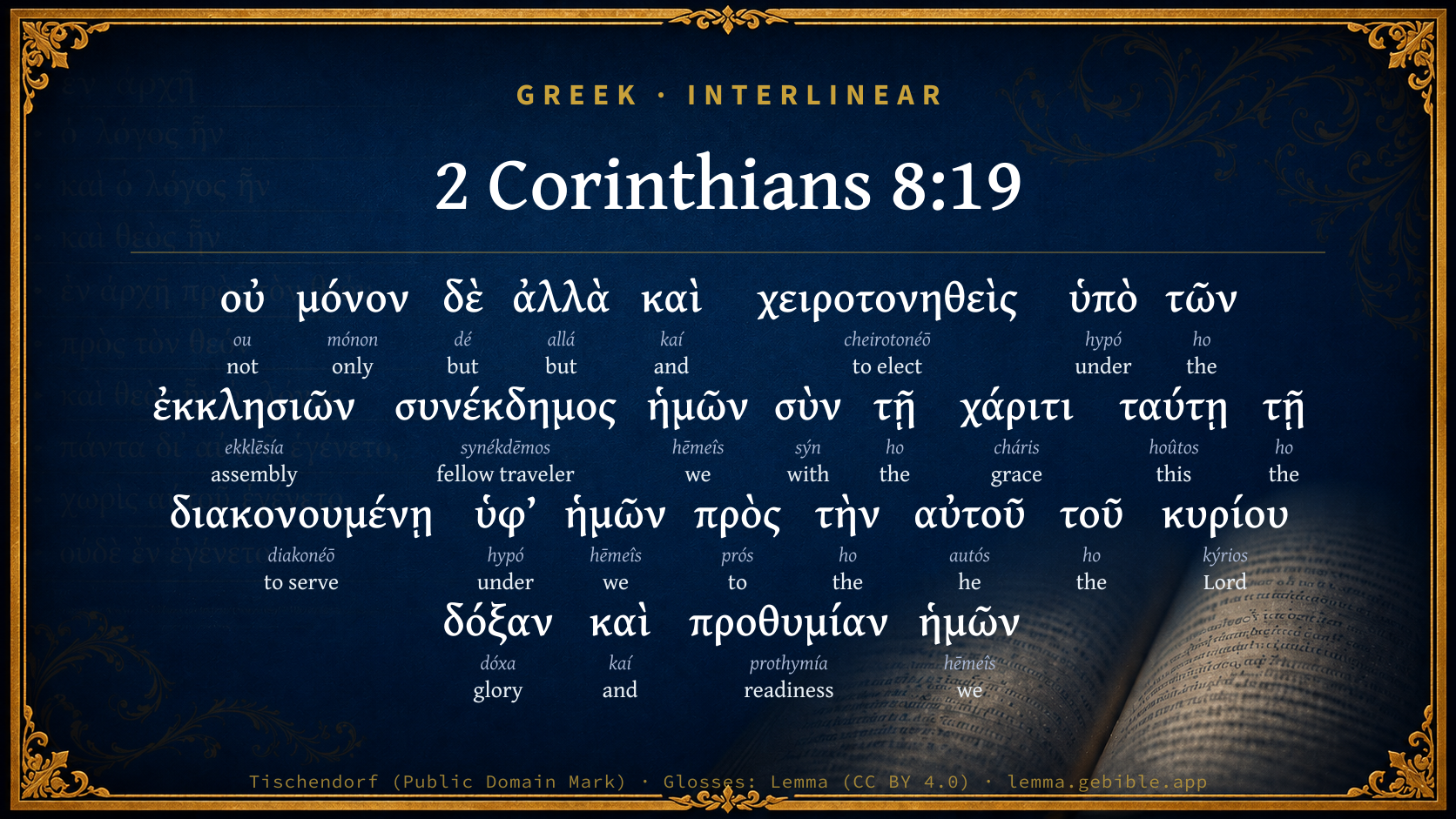
  1. οὐ ou G3756 “not” Particle, Negative
  2. μόνον mónon G3440 “only” Adverb
  3. δὲ dé G1161 “but” Conjunction
  4. ἀλλὰ allá G235 “but” Conjunction
  5. καὶ kaí G2532 “and” Conjunction
  6. ὑπὸ hypó G5259 “under” Preposition
  7. τῶν ho G3588 “the” Article, Genitive, Plural, Feminine
  8. ἐκκλησιῶν ekklēsía G1577 “assembly” Noun, Genitive, Plural, Feminine
  9. συνέκδημος synékdēmos G4898 “fellow traveler” Noun, Nominative, Singular, Masculine
  10. ἡμῶν hēmeîs G2249 “we” Personal pronoun, 1st person, Genitive, Plural
  11. σὺν sýn G4862 “with” Preposition
  12. τῇ ho G3588 “the” Article, Dative, Singular, Feminine
  13. χάριτι cháris G5485 “grace” Noun, Dative, Singular, Feminine
  14. ταύτῃ hoûtos G3778 “this” Demonstrative pronoun, Dative, Singular, Feminine
  15. τῇ ho G3588 “the” Article, Dative, Singular, Feminine
  16. διακονουμένῃ diakonéō G1247 “to serve” Verb, Present, Passive, Participle, Dative, Singular, Feminine
  17. ὑφ’ hypó G5259 “under” Preposition
  18. ἡμῶν hēmeîs G2249 “we” Personal pronoun, 1st person, Genitive, Plural
  19. πρὸς prós G4314 “to” Preposition
  20. τὴν ho G3588 “the” Article, Accusative, Singular, Feminine
  21. αὐτοῦ autós G846 “he” Personal pronoun, Genitive, Singular, Masculine
  22. τοῦ ho G3588 “the” Article, Genitive, Singular, Masculine
  23. κυρίου kýrios G2962 “Lord” Noun, Genitive, Singular, Masculine
  24. δόξαν dóxa G1391 “glory” Noun, Accusative, Singular, Feminine
  25. καὶ kaí G2532 “and” Conjunction
  26. προθυμίαν prothymía G4288 “readiness” Noun, Accusative, Singular, Feminine
  27. ἡμῶν hēmeîs G2249 “we” Personal pronoun, 1st person, Genitive, Plural

About this verse

These counts appear in no published source. They are computed here, from the morphology-tagged text and Lemma’s own curated glosses. What Lemma adds →

28
words
20
distinct lemmas
Pauline Epistles
section

Notable vocabulary

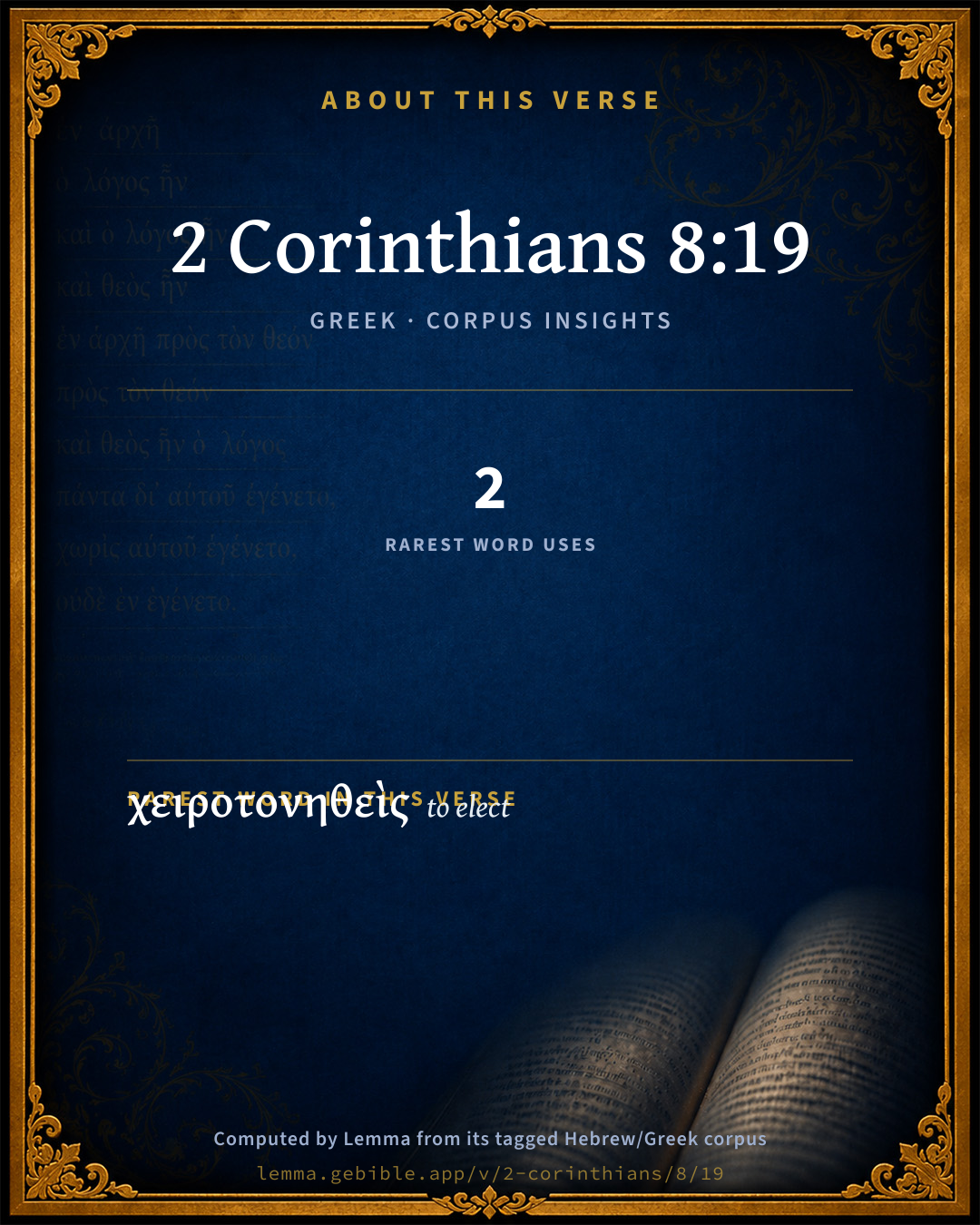
The rarest word here is χειροτονηθεὶς to elect G5500 — appearing just 2 times in the whole Greek New Testament.

Shared distinctive vocabulary

χειροτονηθεὶς to elect G5500 occurs in 2 verses of the Greek New Testament. Also found in:

Repetition

Words recur within this verse:

Cross-references

11

Topical passages linked to 2 Corinthians 8:19 in the Treasury of Scripture Knowledge — connected by theme and wording, ordered by reader-vote popularity; previews shown in the World English Bible.

  • 1 Corinthians 16:3–4 When I arrive, I will send whoever you approve with letters to carry your gracious gift to Jerusalem.
  • 2 Corinthians 4:15 For all things are for your sakes, that the grace, being multiplied through the many, may cause the thanksgiving to abound to the glory of God.
  • 2 Corinthians 9:8 And God is able to make all grace abound to you, that you, always having all sufficiency in everything, may abound to every good work.
  • Acts 15:22 Then it seemed good to the apostles and the elders, with the whole assembly, to choose men out of their company, and send them to Antioch with Paul and Barnabas: Judas called Barsabbas, and Silas, chief men among the brothers.
  • Acts 15:25 it seemed good to us, having come to one accord, to choose out men and send them to you with our beloved Barnabas and Paul,
  • 2 Corinthians 8:1–4 Moreover, brothers, we make known to you the grace of God which has been given in the assemblies of Macedonia;
  • 2 Corinthians 8:6–7 So we urged Titus, that as he made a beginning before, so he would also complete in you this grace.
  • 2 Corinthians 9:12–14 For this service of giving that you perform not only makes up for lack among the saints, but abounds also through many givings of thanks to God;
  • Philippians 4:18–19 But I have all things, and abound. I am filled, having received from Epaphroditus the things that came from you, a sweet-smelling fragrance, an acceptable and well-pleasing sacrifice to God.
  • 1 Peter 4:10–11 According as each has received a gift, be ministering it among yourselves, as good stewards of the grace of God in its various forms.
  • Acts 6:3–6 Therefore select from among you, brothers, seven men of good report, full of the Holy Spirit and of wisdom, whom we may appoint over this business.

Cross-references courtesy of OpenBible.info (CC BY 4.0).

Where the printed editions differ

1 variant

Places in this verse where the major printed Greek editions disagree on the wording in a way that affects the translation — a comparison of editions, not a manuscript-by-manuscript collation. The editions are the modern critical texts (Nestlé-Aland 28/27, SBL, Westcott-Hort, Tregelles, Tyndale House) and the traditional texts behind the KJV (the Textus Receptus and the Byzantine/Majority text). It is not a claim about which reading is original.

  1. Different wording
    ἡμῶν.

    “of us.”

    In NA28NA27TynSBLWHTregByz Not in TR

    ὑμῶν (humōn) 'of you' occurs in traditional manuscripts (TR) instead of ἡμῶν. (hēmōn) 'of us.' in older manuscripts (NA28+NA27+Tyn+SBL+WH+Treg+Byz)

Textual data: Translators Amalgamated Greek New Testament (STEPBible TAGNT) · CC BY 4.0.

Commentary

Notes on 2 Corinthians 8:19 from classic Christian and Jewish commentators (each source and its license shown beneath its notes). The classic Christian expositions comment on the surrounding passage and are grouped to its opening verse, so a note may address several verses; the Jewish commentaries on the Tanakh (Rashi and others) are per-verse, so they appear only where the commentator wrote on this verse.

Lemma curates 59 commentaries, every one of them public domain or Creative Commons licensed, each selected and text-cleaned for this edition rather than reprinted as found. About our sources →

Bengel's Gnomon

Johann Albrecht Bengel

2Co 8:19. Χειροτονηθεὶς [chosen] appointed) This participle is not construed with, he went unto you, 2Co 8:17: for that construction would interrupt the connection, 2Co 8:18; 2Co 8:20, συνεπέμψαμεν—στελλόμενοι, we sent along with—avoiding. Therefore ὃς, who, is to be supplied, taken from οὗ, of whom, whose, in the preceding verse. The churches had given this companion to Paul, whithersoever he might go. Hence they are called the apostles, or messengers of the churches, 2Co 8:23: and Paul declares, that this office here also has respect to the present business. From this it is evident, that the rights of the churches are mutual [reciprocal].—συνέκδημος, the companion of our travels. Those, who read with Wolfius, συνέκδημος ὑμῶν, refer to it by mistake the various reading of the pronoun at the end of the verse.[49]—ΣῪΝ, with) construed with συνέκδημος, the companion of our travels. They carried along with them the gift of the Macedonians to Jerusalem.—πρὸς, to) construed with χειροτονηθεὶς, chosen, appointed.—αὐτοῦ τοῦ Κυριοῦ, of the [same] Lord Himself) viz. Christ, 2Co 8:21.—καὶ προθυμίαν ἡμῶν, our ready mind) The proofs for reading ἡμῶν are by far the most numerous, and ὙΜῶΝ has crept into a few copies, by an obvious exchange of the Greek pronoun, which was more readily made on account of the alliteration of the Υ in ὙΜῶΝ with ΠΡΟΘΥΜΊΑΝ. The churches had charged the brother of whom he is here speaking, the companion of Paul, with their own gift, not with a view to the readiness of the Corinthians, which had less relation to the churches, but with a view to produce readiness on the part of Paul and of that brother, i.e. lest for fear of that blame, of which he afterwards speaks, their willingness to undertake and finish the business might be lessened.

[49] Therefore both the margin of the 2d, as well as of the larger Ed. and the Germ. Ver., prefer the reading ἡμῶν.—E. B.

At the end of the verse ἡμῶν is the reading of all the best Uncial MSS., BCG, etc., Vulg., etc. Rec. Text has ὑμῶν with but slight authority.—ED.

Bengel's Gnomon of the New Testament — English translation (T&T Clark, Edinburgh, 1860) — public domain. Text from a community e-Sword module.

Meyer's Critical & Exegetical Commentary

Heinrich August Wilhelm Meyer

2Co_8:19. As στελλόμενοι in 2Co_8:20 is connected with συνεπέμψαμεν in 2Co_8:18, 2Co_8:19 is a parenthesis (Beza, Lachmann) in which Paul generali testimonio subjungit speciale, quod praesenti negotio congruit, Calvi.

οὐ μόνον δέ] sc. ἐπαινούμενος (or ἐπαινός, praised, or ἔνδοξος, or the like) ἐστι ἐν τῷ εὐαγγ. διὰ πασ. τῶν ἐκκλησ.[280] Comp. Rom_9:10; Rom_5:3; Rom_5:11; Rom_8:23.

ἀλλὰ καὶ χειροτονηθεὶς κ.τ.λ.] but also having been chosen by the (collecting) churches as our travelling companion, etc. The χειροτ. ὑπὸ τ. ἐκκλ. contains a point so important in its bearing that we may not take it parenthetically, thereby breaking up the flow of the discourse. So Hofmann, assigning the incorrect reason, moreover, that the perfect participle must have been used. The perfect might be used; but the aorist expresses the act done, whereby the person concerned became ἀπόστολος of the churches in this case (2Co_8:23), and so Paul has conceived of it here.

The ἐκκλησίαι here meant are, according to 2Co_8:1 ff., the Macedonian.

χειροτον.] suffragiis designates. How this election was conducted, we do not know. Perhaps by the presbyters as representatives of the churches, and on the proposal of the apostle. Comp. on Act_14:23.

ἐν τῇ χάριτι κ.τ.λ.] a more precise definition of the συνέκδ. ἡμῶν. It does not, however, simply mean: in the bringing over (Billroth; this arbitrary limitation was produced by the reading σύν), but in general: in matters of this χάρις, i.e. in the prosecution, in the whole bringing about, of this kindness (this work of love), which is ministered by us, is effected through our ministry (comp. 2Co_3:3).

πρὸς τὴν τοῦ Κυρίου δόξαν κ.τ.λ.] is connected by most (including Theodoret, Beza, Grotius, Estius, Billroth, de Wette, Ewald, Neander) with τῇ διακον. ὑφ. ἡμ. But since in this way πρός (which is not, with Ewald, to be taken as according to, comp. 2Co_1:20) would have to combine two quite different relations: in order to promote Christs honour and to prove our good-will; and since, moreover, the latter element would be self-evident, tame, and superfluous,we ought rather, with Chrysostom (who, however, reads ὑμῶν instead of ἡμῶν), to construe with χειροτονηθεὶς κ.τ.λ.: elected, etc., in order to further Christs honour and our good-will. The election of this brother had as its object, that by his co-operation in this matter Christ should be honoured[281] and our desire and love for the work should not be lessened ob metum reprehensionis illius, de qua mox loquitur (Bengel), but should be maintained and advanced by freedom from such hindering anxiety, and by a fellow-worker thus authorized. The connection with χειροτονηθεὶς κ.τ.λ., which Hofmann, attaching it also to συνεκδ. ἡμῶν, declares to be impossible (why?), places the election, which had primarily a business motive, under the higher ethical point of view.

[280] Buttmann, neut. Gr. p. 252 [E. T. 292], takes it differently: who stands in repute, not only on this account (ἐν τῷ εὐαγγ., i.e. as a preacher of the gospel), but also as one elected by the churches. But from the general ἐν τῷ εὐαγγ. to χειροτονηθ. there is no logical climax, as respects the specifying of a reason for the ἔπαινος; whereas the predication ascends from the universal praise of the man to his being elected by the churchesso as to assign a ground for the συνεπέμψαμεν. Besides, his being elected was not the ground, but a consequence of his general repute, although it was the special ground for Pauls sending him to Corinth.

[281] Rückert, though following likewise our mode of connection, holds that to the δίξα κυρίου this companionship could only have contributed negatively, in so far as it was a precaution against any suspicion falling on the apostle, which suspicionaccording to a mode of view also Paulinewould have been transferred to Christ. Why, then, not positively also? The brother had in fact been chosen as a travelling associate co-operating in the work of collection, so that by his election the work might be prosecuted more extensively and more successfully. And thus the choice of this brother served positively to glorify Christ; hence also πρὸς … δόξαν is not to be held, with de Wette, as rather unsuitable.

Meyer — Critical and Exegetical Commentary on the New Testament — English translation by Peter Christie, edited by Frederick Crombie (T&T Clark, 1880) — public domain. Text from a community e-Sword module.

Expositor's Greek Testament

ed. W. Robertson Nicoll

2Co 8:19 . οὐ μόνον δὲ ἀλλὰ κ . τ . λ .: and not only so, but who was also appointed ( χειροτονεῖν is, strictly, to vote by a show of hands, and hence it came to mean “to elect”) by the Churches, i.e. , all the local congregations interested, as our fellow traveller in the matter of this grace (reading ἐν ; see crit. note), sc. , this contribution of money (see 2Co 8:6-7 , 1Co 16:3 ), which is being ministered by us to exhibit the glory of the Lord ( cf. 2Co 4:15 ), and our readiness . The MS. evidence requires us to read ἡμῶν , but it must be confessed that ἡμῶν is rather what we should expect, especially as προθυμία in 2Co 8:11 and in 2Co 9:2 is applied to the Corinthians and not to St. Paul; a plausible conjecture would be κατὰ προθυμίαν ἡμῶν for καὶ προθ . ἡμ ., but the words give an intelligible sense as they stand (see Gal 2:10 ).

The Expositor's Greek Testament, edited by W. Robertson Nicoll (1897–1910) — public domain. Text from a community e-Sword module.

Cambridge Greek Testament for Schools and Colleges

19. ἐν τῇ χάριτι (BCP, f Vulg. Copt. Arm. Aeth.) rather than σὺν τ. χ. (אDFGKL, d Syrr.); and προθ. ἡμῶν (אBCDG &c.) rather than προθ. ὑμῶν (F). Comp. 2Co 7:12.

19. This verse is rather parenthetical, so that in construction 2Co 8:20 fits on to 2Co 8:18; and there should be at most a semicolon at the end of 2Co 8:18 and of 2Co 8:19.

οὐ μόνον δέ. See critical note. And not only so (i.e. his praise was in all the Churches), but who was also appointed by the Churches to travel with us in this work of grace which is being ministered by us, to show the glory of the Lord and our readiness.

χειροτονηθείς. The verb has a long history: (1) ‘to elect by show of hands’; (2) ‘to. elect’ in any way; (3) ‘to appoint,’ whether by election or not: elsewhere in the N.T. Act 14:23 only. See Smith’s D. of Chr. Ant. II. p. 1501.

συνέκδημος. ‘As our fellow-traveller’ (Act 19:29): φίλους τε καὶ συνεκδήμους ἐποιησάμην (Joseph. Vita 14). Comp. ἐκδημεῖν (2 Corinthians 8 :2Co 5:6-8).

Cambridge Greek Testament for Schools and Colleges (Cambridge University Press, 1896; 21 vols, various authors incl. Carr, Maclear, Plummer, Farrar, Lumby, Moule, M. R. James, Simcox) — public domain. Text from a community e-Sword module.

Geneva Bible (1599)

Geneva Bible translators

These alms which are bestowed for the relief of the Church of Jerusalem.

Geneva Bible (1599) marginal notes — public domain. Text via Bolls.life.

Jamieson, Fausset & Brown

Robert Jamieson, A. R. Fausset & David Brown

not that only--not only praised in all the churches.

chosen--by vote: so the Greek.

of the churches--therefore these companions of Paul are called "messengers of the churches" (Co2 8:23).

to travel--to Jerusalem.

with this grace--Greek, "in the case of this grace," or "gift."

to the glory of the same Lord--The oldest manuscripts omit "same."

declaration of your ready mind--The oldest manuscripts read, "our," not your. This and the previous clause, "to the glory of the same Lord," do not follow "administered by us," but "chosen of the churches to travel," &c. The union of the brother with Paul in this affair of the collection was done to guard against suspicions injurious "to the glory" of the Lord. It was also done in order to produce a "readiness" on the part of Paul and the brother to undertake the office which each, by himself, would have been less ready to undertake, for fear of suspicions arising (Co2 8:20) as to their appropriation of any of the money.

Jamieson, Fausset & Brown — Commentary Critical and Explanatory on the Whole Bible (1871) — public domain (CC PDM 1.0). Text via the HelloAO Bible API.

Adam Clarke's Commentary

Verse 19. Chosen of the Churches to travel with us] χειροτονηθεις. Appointed by a show of hands; from χειρ the hand, and τεινω, to extend. This appointment, by the suffrage of the Churches, seems to refer more to St. Luke than any one else; unless we suppose he refers to the transaction, Ac 15:40; Ac 15:41, and then it would appear that Silas is the person intended.

With this grace] Liberal contribution. See on 2Co 8:1.

Your ready mind.] Your willingness to relieve them. But, instead of υμων, your, ημων, our, is the reading of almost all the best MSS. and all the versions. This is, doubtless, the reading.

Adam Clarke's Commentary on the Bible (1810–1826) — public domain. Text from a community e-Sword/MySword module.

John Calvin's Commentaries

19. Which is administered by us. By commending his ministry, he still farther encourages the Corinthians. He says, that it tends to promote the glory of God, and their kindness of disposition. Hence it comes, that these two things are conjoined — the glory of God and their liberality, and that the latter cannot be given up without the former being proportionally diminished. There is, in addition to this, the labor of those distinguished men, which it were very inconsistent to reject, or allow to pass unimproved.

John Calvin's Commentaries (1540-1563) — public domain. Text from the Calvin Translation Society English edition (1840s-50s) via the Christian Classics Ethereal Library (ccel.org). Calvin's coverage is partial (roughly two-thirds of the Bible); uncommented books and verses are honest gaps, never fabricated. The 19th-century editor's footnotes and remarks are omitted so the notes are faithfully Calvin's own voice.

Ellicott's Commentary for English Readers

(19) Who was also chosen of the churches.—The word, as in Act_14:23, implies a definite appointment, in this case, obviously, by popular election—on the part of the Macedonian churches. This falls in, it need hardly be said, with the facts of the case as indicated by the use of the first person plural in Act_20:5, and through the rest of the book.

With this grace.—The word is used, as in 2Co_8:4; 2Co_8:6-7, as we familiarly use the word “charity,” for the liberality which was the result of the grace.

To the glory of the same Lord.—Better, if we keep the Received text, of the Lord Himself; but the better MSS. give, of the Lord, only. There is no need of inserting the word “declaration of”; in relation to the glory of the Lord and to your readiness gives a perfectly intelligible sense.

A Bible Commentary for English Readers, edited by Charles John Ellicott (1878–1897) — public domain. Text from a community e-Sword module.

The Cambridge Bible for Schools and Colleges

gen. ed. J. J. S. Perowne

19. and not that only] i.e. not only is he praised throughout all the Churches.

but who was also chosen of the churches] i.e. chosen by the Churches. See note on 1Co_14:24, ch. 2Co_1:16, 2Co_2:6; 2Co_2:12 of this Epistle, and Heb_12:5, &c. The word here used signifies chosen by show of hands. So also in Act_14:23. Voting by show of hands was the custom among the Greeks as among ourselves. See Xenophon, Anabasis, Book III. ii. 33. For the choosing by the Churches see 1Co_16:3-4 and note.

to the glory of the same Lord] The word ‘same’ is omitted by many MSS. and editors.

and declaration of your ready mind] Nearly all the MSS. and versions read ‘our.’ (To the glorie of the Lord and to our ordeyned wil. Wiclif.) The words ‘and declaration of’ are not in the Greek.

The Cambridge Bible for Schools and Colleges (gen. ed. J. J. S. Perowne; Cambridge University Press, 1878–1918) — public domain. Text from a community e-Sword module.

John Gill's Exposition

Avoiding this, that no man should blame us,.... There is an allusion in these words to mariners, who, when sensible of danger, steer their course another way, in order to shun a rock and secure themselves. So the apostles being aware of the censorious spirits of some persons, and to prevent all suspicion of their converting any part of what they had collected to their own private use, sent Titus with it, a man of known probity and integrity; and he not by himself only, but another brother with him, one who had obtained a good report as a minister of the Gospel in all the churches: and, besides, was appointed not by the apostles, but by the churches themselves, to this service. This shows the good conduct, and great prudence of the apostle, and his care and solicitude that the ministry be not blamed; he knew he had many enemies, and how subject such are to suspicion and jealousy, when persons are intrusted with much, which was the case here; for it is added,

in this abundance which is administered by us: which designs the very large contributions which were made by the churches, through the means of the apostle's moving, exciting, and encouraging them thereunto; and which were committed to their care and trust, and at their entreaty they had accepted of.

John Gill's Exposition of the Whole Bible (1746–1763) — public domain (CC PDM 1.0). Text via the HelloAO Bible API.

Trapp's Complete Commentary

John Trapp

19 And not that only, but who was also chosen of the churches to travel with us with this grace, which is administered by us to the glory of the same Lord, and declaration of your ready mind:

Ver. 19. Chosen of the Churches] This compared with Act 13:1-2, it may seem the apostle meaneth not Luke, but Barnabas; though others think Timothy. (Danae in 1Ti 6:12)

John Trapp, A Commentary or Exposition upon All the Books of the Old and New Testament (1647–1656) — public domain. Text from a community e-Sword module.

Albert Barnes' Notes on the Bible

And not that only - Not only is he esteemed on account of other services which he has rendered by his preaching and writings; but he has had a new mark of the confidence of the churches in being appointed to convey the collection to Jerusalem.

Chosen of the churches - Chosen by the churches. Many concurred in the choice, showing that they had entire confidence in him. Paul had been unwilling to have charge of this contribution alone (1Co 16:3-4; compare 2Co 8:20), and he had procured the appointment of some one to undertake it. Probably he expected that the church at Corinth would concur in this appointment.

With this grace - Margin, “Gift;” see 2Co 8:1. The word here refers to the alms, or the collection which had been made.

Which is administered by us - That is, which is undertaken by us. Paul had been the instrument of procuring it.

To the glory of the same Lord - The Lord of us all. The design was to promote the glory of the Lord by showing the influence of religion in producing true benevolence.

And declaration of your ready mind - That is, to afford you an opportunity of evincing your readiness to do good to others, and to promote their welfare.

Albert Barnes' Notes on the Bible (1834–1885) — public domain. Text from a community e-Sword/MySword module.

Matthew Poole's English Annotations

And that he was chosen by the churches to go along with Paul and Titus, to carry the charity of other churches to the distressed Christians in Judea; which charity is here again called grace, for the reason before mentioned, 2Co 8:1. He declares that their end in this administration, was the glory of God, and the proof and

declaration of these Corinthians’ sincerity of brotherly love, and

ready mind to yield obedience to the will of God declared to them.

Matthew Poole's English Annotations on the Holy Bible (1683–1685) — public domain. Text from a community e-Sword/MySword module.

Whedon's Commentary on the Bible

Daniel D. Whedon

19. Chosen of the Churches—The brother is not now merely nominated by St. Paul and sent by his authority. Were that the case, cavillers might insinuate a plot. But he is named by Paul as by the Macedonian Churches elected. Luke’s position with those Churches we have indicated in our note on Act_16:10.

To travel with us—To carry the benefactions from Corinth to Jerusalem.

With this grace—The charitable contribution.

To the glory—Depends not upon administered but upon chosen. The brother was for this mission chosen, literally, to subserve the glory of the same Lord, and… your ready mind.

Daniel D. Whedon (gen. ed.), Commentary on the Old and New Testaments (1874–1909) — public domain. Text from a community e-Sword module.

The Pulpit Commentary

Chosen. The word (literally, chosen by show of hands) implies a popular vote. (comp. 1Co_16:3, 1Co_16:4) This brother Was not only widely known and valued, but also specially selected for this task. To travel with us. "As our fellow traveller." The word occurs in Act_19:29. With this grace. The better reading is "in:" "in this matter of kindness." To the glory of the same Lord. The word "same" should be omitted. And declaration of your ready mind. The best reading is "our," and the clause should be rendered, to further the glory of the Lord and our readiness.

The Pulpit Commentary (1880–1919), ed. H.D.M. Spence-Jones & Joseph S. Exell — public domain. Text from a community e-Sword module.

John Wesley's Explanatory Notes

He was appointed by the churches - Of Macedonia. With this gift - Which they were carrying from Macedonia to Jerusalem. For the declaration of our ready mind - That of Paul and his fellow-traveler, ready to be the servants of all.

John Wesley, Explanatory Notes Upon the Whole Bible (1754–1765) — public domain. Text via the GEBible commentary corpus.

McGarvey & Pendleton's Commentaries

J. W. McGarvey

and not only so, but who was also appointed by the churches to travel with us in the matter of this grace, which is ministered by us to the glory of the Lord, and to show our readiness [Paul is commending those whom he sent to gather the collections. Luke's primary commendation is his general character revealed in his love for the gospel facts; his further qualification is his appointment by the churches in Macedonia to assist in this very work. He had resided in Macedonia for some six years, or since Paul had first come to Philippi, and so was well known and fully trusted by the Macedonians. He was appointed that the glory of Christ might not be tarnished by any suspicion that the money was raised for selfish purposes, and that Paul's zeal to raise the money might not be regarded with evil surmises]:

J. W. McGarvey (with Philip Y. Pendleton), Commentaries on the New Testament (The Fourfold Gospel, 1914; Acts; and the epistles) — public domain. Text from a community e-Sword/MySword module.

The People's New Testament

B. W. Johnson

19. Chosen of the churches. Paul desired, for the reasons given in verses 20 and 21, that the churches should send along messengers in charge of their gifts.

B. W. Johnson's The People's New Testament with Notes (1889–1891) — public domain. Electronic text from the Christian Classics Ethereal Library (CCEL) ThML edition.

Alford’s Greek Testament

Henry Alford

19.] parenthetical (see on ver. 20) adding to his general commendation a particular qualification for this office.

οὐ μόν. δέ,—and not only so (i.e. praised in all the churches), but who was also appointed (‘suffragiis designatus,’ see ref. and note; and Stanley here) by the churches (of Macedonia? see ver. 1) as our fellow-traveller (to Jerusalem, from what follows) in (the matter of) this charity which is being ministered by us,—in order to subserve the glory of the Lord and our readiness (this clause refers not to διακον. ὑφʼ ἡμ. as usually interpreted, but to the fact related, the union of this brother with Paul in the matter of the alms, which was done to avoid suspicions detrimental to Christ’s glory, and to the zeal of the Apostle):

Henry Alford, The Greek Testament (1849–1861) — public domain. Text from a community e-Sword module.

International Critical Commentary

19. οὐ μόνον δὲ ἀλλὰ κ.τ.λ. ‘And not only [is he praised through all the Churches], but he was also appointed by the Churches to be our fellow-traveller in this work of grace which is being administered by us to promote the glory of the Lord Himself and our readiness.’ There are some doubtful points here. (1) To which word does πρὸς τὴν κ.τ.λ. belong? To χειροτονηθείς or to διακονουμένῃ? Was this brother appointed to promote the glory, etc.? Or is the fund being administered for this purpose? The latter seems more suitable, and is adopted in Vulg. (2) Has πρός the same sense in reference to προθυμἱαν ἡμῶν as to τήν … δόξαν? Both AV and RV make a change of meaning, which is somewhat violent, but not impossible in a dictated letter. Yet no change is necessary. We may render πρός either ‘to show’ or ‘to promote’ in both cases. ‘To show the glory and our readiness’ is simple enough; but ‘to promote the glory and our readiness’ makes good sense and may be right, if the clause be taken with χειρονηθείς. The appointment of this efficient colleague tended to increase the glory of God and the Apostle’s readiness. His enthusiasm was made still greater when the prospects of success were increased by giving Titus such a helper. The constr. of χειροτονηθείς. is irregular; we want ἐχειροτονήθη. Cf. θλιβόμενοι (7:5), and στελλόμενοι (v. 20). Blass, § 79. 10. Χειροτονέω is an interesting verb exhibiting three marked stages in its history; (1) ‘elect by show of hands’; (2) ‘elect’ in any way; (3) ‘appoint,’ whether by election or not. Elsewhere in N.T. Act 14:23 only. It is certain that the verb is used by contemporary writers for appointment without election; and the substantive also. Josephus has the verb of God’s appointing David to be king (Ant. vi. xiii.9) and of Jonathan being appointed high priest by Alexander (Ant. xiii. ii. 2). Philo uses χειροτονία of Pharaoh’s appointment of Joseph to be governor of Egypt. (De Josepho, § 21, Mang. p. 58). Similar usage is found in inscriptions. Neither here nor in Acts does it mean the imposition of hands in ordination, ἐπἰθεσις τῶν χειρῶν, or the stretching out of the hands previous to imposition, which is a much later use. In Act 14:23 the ordination of the presbyters is implied in προσευξάμενοι, not in χειστονή σαντες. In Acts Vulg. has constituo, here ordino; AV has ‘ordain’ in Acts and ‘choose’ here; RV has ‘appoint’ in both.

συνέκδημος. ‘To go abroad with us,’ ‘to be our companion in travel,’ a subordinate, not a colleague, like Barnabas. Here and Act 19:20 only. Vulg. has comes perigrinationis here and comites without perigrinationis in Acts, where συνεκδήμους is used of Aristarchus and Gaius. Hence some think that it refers to Aristarchus here (Redlich, S. Paul and his Companions, p. 217).

ἐν τῇ χάριτι (B C P, f Vulg. Copt. Arm. Aeth.) rather than σὺν τῇ κ. (א D F G K L, d e g, Syrr.). B C D * G L, Latt. Copt. omit αὐτοῦ before τοῦ κυρὶαν. F and a few cursives, followed by T. R., have ὑμῶν after προθυμίαν, an obvious correction, to agree with v. 11 and 9:2, where the προθυμία is in the Corinthians. Baljon conjectures κατὰ προθ. ἡμῶν.

International Critical Commentary — older volumes (1896–1929), various authors — public domain. Text from a community e-Sword module.

Vincent's Word Studies in the New Testament

Marvin R. Vincent

With this grace [εν τη χαριτι ταυτη] . An obscure rendering, not much bettered by Rev. Grace is ambiguous. The reference is, of course, to the contribution as a work of love; cariv being used in the sense of benefaction or bounty. Paul says that the brother was appointed as his fellow - traveller in the matter of this bounty; in the prosecution of this kindly act. For appointed, see on Act 14:23; Act 10:41.

Marvin R. Vincent, Word Studies in the New Testament (1887–1900) — public domain. Text from a community e-Sword/MySword module.

Lesson kit

Teaching starters — assembled from the data on this page, not authored interpretation. Every prompt links to the verse data it draws on. Edit before teaching.

2 Corinthians, in the Pauline Epistles, opens this verse with 28 words (20 distinct Greek lemmas). Its most distinctive word is cheirotonéō (“to elect”). A historical commentator’s framing appears above. Read the whole chapter for the surrounding context.

Discussion questions

  1. What does “to elect” (cheirotonéō) contribute to the verse as a whole?
  2. Acts 14:23 shares the word «to elect» with this verse. How do the two illuminate each other?
  3. “under” occurs 2× in this one verse. What is the effect of the repetition?
  4. The translations on this page render this verse differently — a whole-verse word diff, not a word-by-word alignment. What might account for the different wordings?
  5. Reading how Bengel's Gnomon and Meyer's Critical & Exegetical Commentary read this verse, where do the two commentators agree and where do they part?

Things to notice

Reading settings

Reading text

Shown beneath each verse's original-language words.

Old Testament
Old Testament edition

Read the OT as the Masoretic Hebrew (MT) or the Greek Septuagint (LXX).

English shown for the Greek Septuagint (in the Hebrew ↔ Greek comparison).

Comparing translations? Open the Compare panel on any verse page to stack up to four side by side.