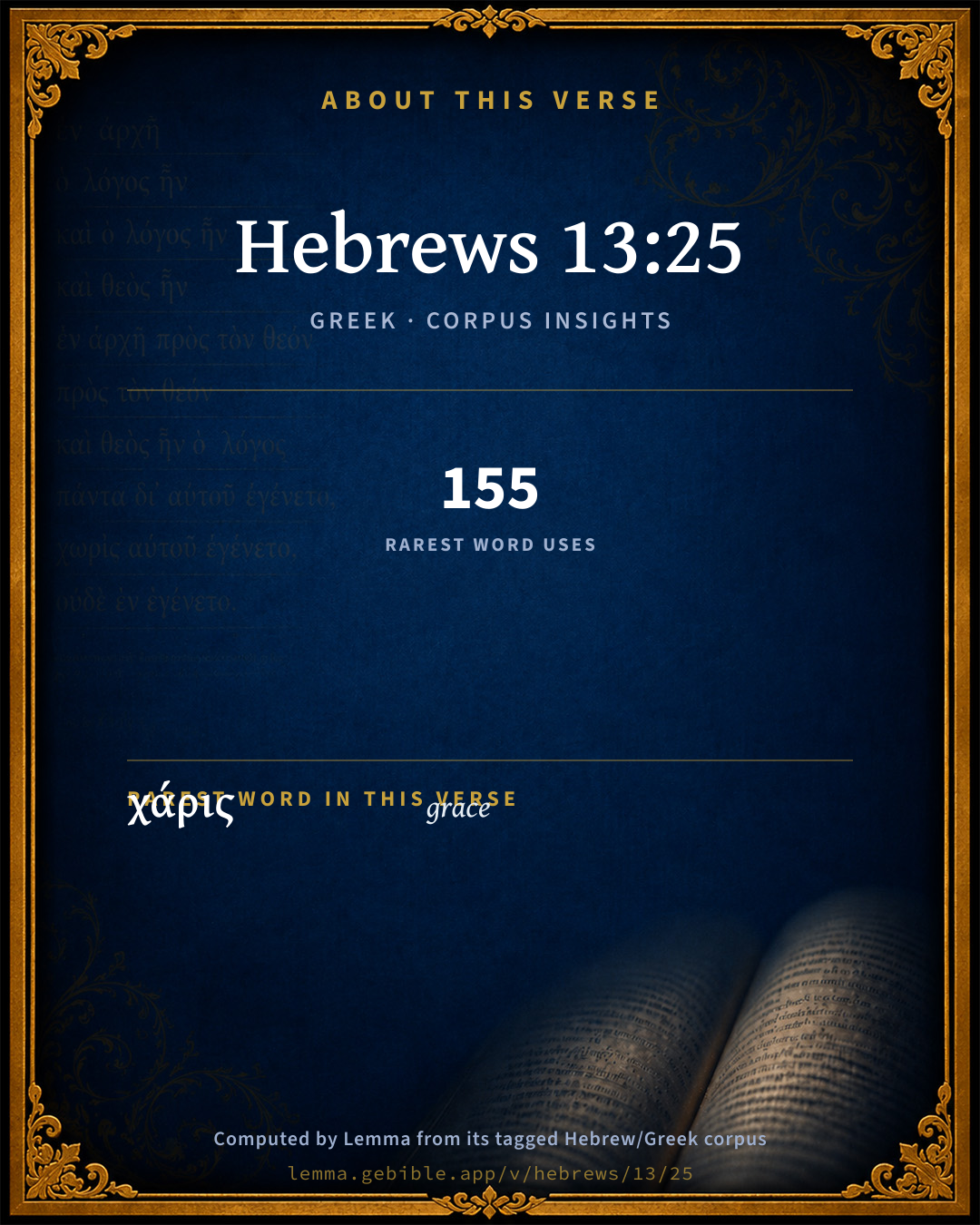
Hebrews 13:25

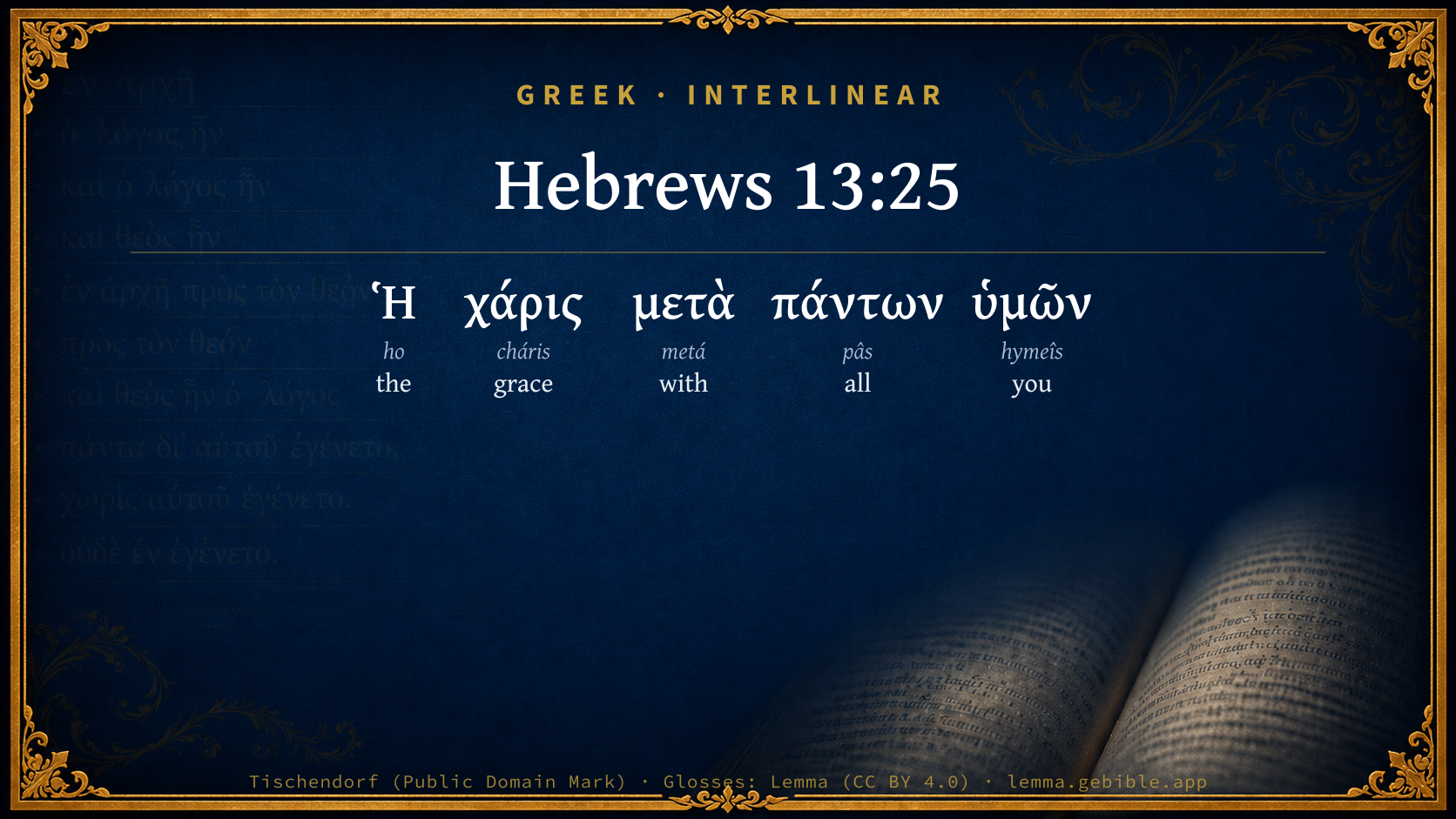
Greek (Tischendorf 8th ed.) Hebrews 13:25 appears in the Greek New Testament. The text above is from the Tischendorf 8th edition. Each word links to its Strong’s number and a concise gloss. Click any word for its full Thayer’s Greek Lexicon entry.
Download image
Cite this verse

Hebrews 13:25 (World English Bible). Public Domain. Lemma interlinear Bible study tool, https://lemma.gebible.app/v/hebrews/13/25.

Show BibTeX & RIS
BibTeX
RIS
English Translation
Grace be with you all. Amen.
World English Bible · Public Domain
Download a study sheet

One document with this verse’s original text, its word-by-word gloss line, the meaning frame, cross-references with their text, attributed commentary, and full source and license credits — printable, and it pastes into notes with its structure intact.

This verse Autodidact and up

Study sheet (.html) Plain text (.txt)

A passage Seminary Student

Up to 50 verses in one chapter. A passage sheet keeps up to 6 commentary sources and 12 cross-references per verse, in the order this page ranks them, and says so on the sheet whenever that leaves anything out. Ask for a single verse and you get the Autodidact verse sheet above.

Everything on this page stays free to read, with no account — the sheet is a download of what is already on screen, not access to it.

Want to remove ads? Support Godless Engineer
Compare translations 3

The same verse in 3 English versions, stacked beneath the original-language interlinear above. Click any original word for its lexicon entry.

Each is an independent rendering of the whole verse — the interlinear is not word-aligned to these translations.

Highlighted words mark where these versions differ — a whole-verse word diff, not a word-by-word alignment.

  • World English Bible Public Domain
    Grace be with you all. Amen.
  • King James Version Public Domain
    Grace be with you all. Amen.
  • unfoldingWord Literal Text CC BY-SA 4.0
    Grace with all of you.

unfoldingWord Literal Text — © unfoldingWord, licensed CC BY-SA 4.0. Word-aligned USFM3 via Door43 (git.door43.org/unfoldingWord/en_ult).

Versions to compare (up to 4)

3 of 4 selected

Show all 19 translations

Every available English version of this verse, each an independent rendering of the whole verse.

  • World English Bible Public Domain
    Grace be with you all. Amen.
  • Berean Standard Bible Public Domain
    Grace be with all of you.
  • Majority Standard Bible Public Domain
    Grace be with all of you. Amen.
  • King James Version Public Domain
    Grace be with you all. Amen.
  • American Standard Version (1901) Public Domain
    Grace be with you all. Amen.
  • Revised Version (1885) Public Domain
    Grace be with you all. Amen.
  • Geneva Bible (1599) Public Domain
    Grace be with you all, Amen. Written to the Hebrewes from Italie, and sent by Timotheus.
  • Douay-Rheims (1899) Public Domain
    Grace be with you all. Amen.
  • Young's Literal Translation Public Domain
    the grace `is' with you all! Amen.
  • Literal Standard Version CC BY-SA 4.0
    The grace [is] with you all! Amen.
  • Unlocked Literal Bible CC BY-SA 4.0
    May grace be with you all.
  • unfoldingWord Literal Text CC BY-SA 4.0
    Grace with all of you.
  • Darby Bible Public Domain
    Grace [be] with you all. Amen.
  • World Messianic Bible Public Domain
    Grace be with you all. Amen.
  • Webster's Bible Public Domain
    Grace be with you all. Amen.
  • Free Bible Version CC BY-SA 4.0
    May God's grace be with all of you. Amen.
  • Bible in Basic English Public Domain
    May grace be with you all.
  • Text-Critical English NT CC BY 4.0
    Grace be with you all. Amen.
  • Tyndale New Testament (1534) Public Domain
    Grace be with you all. Amen. ‘Sent from Italy by Timotheus.’

Literal Standard Version (2020), Covenant Press — licensed CC BY-SA 4.0. Text via the HelloAO Bible API (eBible.org). Unlocked Literal Bible (unfoldingWord) — licensed CC BY-SA 4.0. Text via the HelloAO Bible API (eBible.org). unfoldingWord Literal Text — © unfoldingWord, licensed CC BY-SA 4.0. Word-aligned USFM3 via Door43 (git.door43.org/unfoldingWord/en_ult). Free Bible Version, Dr. Jonathan Gallagher — licensed CC BY-SA 4.0. Text via the HelloAO Bible API (eBible.org).

Word by word

More ways to search: Search by grammar → Find every occurrence → Compare this word →

Practice this passage: Drill this verse → Learn its vocabulary →

χάρις
cháris
G5485
“grace”
Noun, Nominative, Singular, Feminine
Part of Speech
Noun
Case
Nominative
Number
Singular
Gender
Feminine
Full Thayer's Definition

Origin: from G5463

TDNT: 15:12,1

1. grace a. that which affords joy, pleasure, delight, sweetness, charm, loveliness: grace of speech 2. good will, loving-kindness, favour a. of the merciful kindness by which God, exerting his holy influence upon souls, turns them to Christ, keeps, strengthens, increases them in Christian faith, knowledge, affection, and kindles them to the exercise of the Christian virtues 3. what is due to grace a. the spiritual condition of one governed by the power of divine grace b. the token or proof of grace, benefit 1. a gift of grace 2. benefit, bounty 4. thanks, (for benefits, services, favours), recompense, reward
  1. Ἡ ho G3588 “the” Article, Nominative, Singular, Feminine
  2. μετὰ metá G3326 “with” Preposition
  3. πάντων pâs G3956 “all” Adjective, Genitive, Plural, Masculine
  4. ὑμῶν hymeîs G5210 “you” Personal pronoun, 2nd person, Genitive, Plural

About this verse

These counts appear in no published source. They are computed here, from the morphology-tagged text and Lemma’s own curated glosses. What Lemma adds →

5
words
5
distinct lemmas
General Epistles
section

Cross-references

8

Topical passages linked to Hebrews 13:25 in the Treasury of Scripture Knowledge — connected by theme and wording, ordered by reader-vote popularity; previews shown in the World English Bible.

  • Colossians 4:18 The salutation of me, Paul, with my own hand: remember my bonds. Grace be with you. Amen.
  • Romans 16:20 And the God of peace will quickly crush Satan under your feet. The grace of our Lord Jesus Christ be with you.
  • Ephesians 6:24 Grace be with all those who love our Lord Jesus Christ with incorruptible love. Amen.
  • 2 Timothy 4:22 The Lord Jesus Christ be with your spirit. Grace be with you. Amen.
  • Titus 3:15 All who are with me greet you. Greet those who love us in faith. Grace be with you all. Amen.
  • Revelation 22:21 The grace of the Lord Jesus Christ be with all the saints. Amen.
  • Romans 1:7 to all who are in Rome, beloved of God, called to be saints: Grace to you and peace from God our Father and the Lord Jesus Christ.
  • Romans 16:23 Gaius, my host and host of the whole assembly, greets you. Erastus, the treasurer of the city, greets you, as does Quartus, the brother.

Cross-references courtesy of OpenBible.info (CC BY 4.0).

Where the printed editions differ

2 variants

Places in this verse where the major printed Greek editions disagree on the wording in a way that affects the translation — a comparison of editions, not a manuscript-by-manuscript collation. The editions are the modern critical texts (Nestlé-Aland 28/27, SBL, Westcott-Hort, Tregelles, Tyndale House) and the traditional texts behind the KJV (the Textus Receptus and the Byzantine/Majority text). It is not a claim about which reading is original.

  1. Extra text
    ἀμήν.

    “Amen.”

    In TynTregTRByz Not in NA28NA27SBLWH
  2. Extra text
    πρός Ἑβραίους ἐγράφη ἀπό τῆς Ἰταλίας διά Τιμοθέου.

    “to Hebrews it was written from <the> Italy through Timothy.”

    In TR Not in NA28NA27TynSBLWHTregByz

    ἀμήν. πρός Ἑβραίους ἐγράφη ἀπό τῆς Ἰταλίας διά Τιμοθέου.¶ (amēn pros Hebraious egraphē apo tēs Italias dia Timotheou) 'Amen. to Hebrews it was written from Italy through Timothy.' is only in traditional manuscripts (TR)

Textual data: Translators Amalgamated Greek New Testament (STEPBible TAGNT) · CC BY 4.0.

Commentary

Notes on Hebrews 13:25 from classic Christian and Jewish commentators (each source and its license shown beneath its notes). The classic Christian expositions comment on the surrounding passage and are grouped to its opening verse, so a note may address several verses; the Jewish commentaries on the Tanakh (Rashi and others) are per-verse, so they appear only where the commentator wrote on this verse.

Lemma curates 59 commentaries, every one of them public domain or Creative Commons licensed, each selected and text-cleaned for this edition rather than reprinted as found. About our sources →

Bengel's Gnomon

Johann Albrecht Bengel

Heb 13:25. Ἡ χάρις, grace) A small clause peculiar to Paul.

Bengel's Gnomon of the New Testament — English translation (T&T Clark, Edinburgh, 1860) — public domain. Text from a community e-Sword module.

Meyer's Critical & Exegetical Commentary

Heinrich August Wilhelm Meyer

Heb_13:25. Concluding wish of blessing, entirely in accord with that of Tit_3:15.

Meyer — Critical and Exegetical Commentary on the New Testament — English translation by Peter Christie, edited by Frederick Crombie (T&T Clark, 1880) — public domain. Text from a community e-Sword module.

Jamieson, Fausset & Brown

Robert Jamieson, A. R. Fausset & David Brown

Paul's characteristic salutation in every one of his other thirteen Epistles, as he says himself, Co1 16:21, Co1 16:23; Col 4:18; Th2 3:17. It is found in no Epistle written by any other apostle in Paul's lifetime. It is used in Rev 22:21, written subsequently, and in CLEMENT OF ROME. Being known to be his badge, it is not used by others in his lifetime. The Greek here is, "The grace (namely, of our Lord Jesus Christ) be with you all."

Next: James Introduction

Jamieson, Fausset & Brown — Commentary Critical and Explanatory on the Whole Bible (1871) — public domain (CC PDM 1.0). Text via the HelloAO Bible API.

Adam Clarke's Commentary

Verse 25. Grace be with you all.] May the Divine favour ever rest upon you and among you; and may you receive, from that source of all good, whatsoever is calculated to make you wise, holy, useful, and happy! And may you be enabled to persevere in the truth to the end of your lives! Amen. May it be so! May God seal the prayer by giving the blessings!

THE subscriptions to this epistle are, as in other cases, various and contradictory.

The VERSIONS are as follow:-

The Epistle to the Hebrews was written from Roman Italy, and sent by the hand of Timothy. - SYRIAC.

VULGATE nothing, in the present printed copies.

It was written from Italy by Timothy: with the assistance of God, disposing every thing right, the fourteen epistles of the blessed Paul are completed, according to the copy from which they have been transcribed. May the Lord extend his benedictions to us. Amen. - ARABIC.

The Epistle to the Hebrews is completed. The end. - AETHIOPIC.

Written in Italy, and sent by Timothy. - COPTIC.

The MANUSCRIPTS, and ancient editions taken from MSS., are not more to be relied on.

To the Hebrews, written from Rome. - CODEX ALEXANDRINUS.

The epistles of Saint Paul the apostle are finished. - COLOPHON, at the end of this epistle; in one of the first printed Bibles; and in an ancient MS. of the Vulgate in my own collection.

The end of the Epistle to the Hebrews. - GREEK TEXT of the COMPLUTENSIAN EDITION.

The Epistle of the blessed Paul to the Hebrews is finished. - LATIN TEXT of ditto.

To the Hebrews. - The Epistle of Paul the apostle to the Hebrews. - The Epistle to the Hebrews, written from Italy. - From Athens. - From Italy by Timothy. - Written in the Hebrew tongue, c. - Various MSS.

Written to the Hebrews from Italy by Timothy. - COMMON GREEK TEXT.

That it was neither written from Athens, nor in the Hebrew tongue, is more than probable and that it was not sent by Timothy, is evident from Heb 13:23. For the author, time, place, and people to whom sent, see the INTRODUCTION.

I. On the term "conscience," as frequently occurring in this epistle, I beg leave to make a few observations.

Conscience is defined by some to be "that judgment which the rational soul passes on all her actions;" and is said to be a faculty of the soul itself, and consequently natural to it. Others state that it is a ray of Divine light. Milton calls it "God's umpire;" and Dr. Young calls it a "god in man." To me it seems to be no other than a faculty capable of receiving light and conviction from the Spirit of God; and answers the end in spiritual matters to the soul, that the eye does to the body in the process of vision. The eye is not light in itself, nor is it capable of discerning any object, but by the instrumentality of solar or artificial light; but it has organs properly adapted to the reception of the rays of light, and the various images of the objects which they exhibit. When these are present to an eye the organs of which are perfect, then there is a discernment of those objects which are within the sphere of vision; but when the light is absent, there is no perception of the shape, dimensions, size, or colour of any object, howsoever entire or perfect the optic nerve and the different humours may be.

In the same manner (comparing spiritual things with natural) the Spirit of God enlightens that eye of the soul which we call conscience; it penetrates it with its effulgence; and (speaking as human language will permit on the subject) it has powers properly adapted to the reception of the Spirit's emanations, which, when received, exhibit a real view of the situation, state, c., of the soul, as it stands in reference to God and eternity. Thus the Scripture says, "The Spirit itself bears witness with our spirit," c., i.e. it shines into the conscience, and reflects throughout the soul a conviction, proportioned to the degree of light communicated, of condemnation or acquittance, according to the end of its coming.

The late Mr. J. Wesley's definition of conscience, taken in a Christian sense, is nearly the same with the above: "It is," says he, "that faculty of the soul which, by the assistance of the grace of God, sees at one and the same time, 1. Our own tempers and lives the real nature and quality of our thoughts, words and actions. 2. The rule whereby we are to be directed. And 3. The agreement or disagreement therewith. To express this a little more largely: Conscience implies, first, the faculty a man has of knowing himself of discerning, both in general and in particular, his temper, words, thoughts, and actions: but this is not possible for him to do, without the assistance of the Spirit of God; otherwise self-love, and indeed every other irregular passion, would disguise and wholly conceal him from himself. It implies, secondly, a knowledge of the rule whereby he is to be directed in every particular, which is no other than the written word of God. Conscience implies, thirdly, a knowledge that all his thoughts, and words, and actions are conformable to that rule. In all these offices of conscience, the unction of the holy One is indispensably needful. Without this, neither could we clearly discern our lives and tempers, nor could we judge of the rule whereby we are to walk, nor of our conformity or disconformity to it. A good conscience is a Divine consciousness of walking in all things according to the written word of God. It seems, indeed, that there can be no conscience that has not a regard to God. I doubt whether the words right and wrong, according to the Christian system, do not imply, in the very idea of them, agreement and disagreement to the will and word of God. And if so, there is no such thing as conscience in a Christian, if we leave God out of the question." Sermon on Conscience, page 332.

Some of the Greek fathers seem to consider it as an especial gift of God; a principle implanted immediately by himself. So Chrysostom, on Psa 7., speaking of conscience, says: φυσικον γαρ εστι, και παρα του θεου ημιν παρα την αρχην εντεθεν. It is a natural thing, but is planted in us by our God from our birth, In his homily on Isa 6:2, he explains himself more particularly: θειον γαρ εστι, και παρα, θεου ταις ημετεραις ενιδρυμενον φυχαις. It is a Divine principle, and is by God himself implanted in our souls. It is allowed on all hands that it is a recorder and judge of human actions, which cannot be corrupted, or be induced to bear a false testimony. Every sense of the body, and every faculty of the mind, may be weakened, obstructed, or impaired, but conscience; all other powers may be deceived or imposed on, but conscience. "No man," says Chrysostom, "can flee from the judgment of his own conscience, which cannot be shunned. It cannot be corrupted; it cannot be terrified; it cannot be flattered or bribed; nor can its testimony be obscured by any lapse of time." Epist. ad Olymp. This strongly argues its Divine nature; and, while the Spirit of God strives with man, conscience has its full influence, and is ever alert in the performance of its office. Cicero, in his oration for Milo, describes the power of conscience well in a few words: Magna est vis conscientiae in utramque partem, ut neque timeant qui nihil commiserint, et poenam semper ante oculos versari putent qui peccarint. "Great is the power of conscience in both cases; they fear nothing who know they have committed no evil; on the contrary, they who have sinned live in continual dread of punishment." One of our poets has said, "'Tis conscience that makes cowards of us all." And had we been sure that Shakespeare was a scholar, we might have supposed that he had borrowed the thought from Menander.

'ο συνιστορων αυτω τι, καν η θρασυτατος,

'η συνεσις αυτον δειλοτατον ειναι ποιει.

If a man be conscious of any crime, although he

were the most undaunted of mankind,

His conscience makes him the most timid of mortals.

Apud Stobaeum, Serm. xxiv., p. 192.

Conscience is sometimes said to be good, bad, tender, seared, c.: good, if it acquit or approve bad, if it condemn or disapprove; tender, if it be alarmed at the least approach of evil, and severe in scrutinizing the actions of the mind or body; and seared, if it feel little alarm, c., on the commission of sin. But these epithets can scarcely belong to it if the common definition of it be admitted for how can it be said there is a "tender light," a "dark or hardened light," a "bad god," c., c.? But on the other definition these terms are easily understood, and are exceedingly proper e. g. "a good conscience" is one to which the Spirit of God has brought intelligence of the pardon of all the sins of the soul, and its reconciliation to God through the blood of Christ and this good conscience retained, implies God's continued approbation of such a person's conduct; see Ac 23:1; Heb 13:1; Heb 1:5; Heb 1:19; and here, Heb 13:18. "A bad or evil conscience"' supposes a charge of guilt brought against the soul by the Holy Spirit, for the breach of the Divine laws; and which he makes known to it by conscience, as a medium of conveying his own light to the mind; see Heb 10:22; Heb 13:1; Heb 4:2; Tit 1:3. "A tender conscience" implies one fully irradiated by the light of the Holy Ghost, which enables the soul to view the good as good, and the evil as evil, in every important respect; which leads it to abominate the latter, and cleave to the former; and, if at any time it act in the smallest measure opposite to these views, it is severe in its reprehensions, and bitter in its regret. "A darkened or hardened conscience" means one that has little or none of this Divine light; consequently, the soul feels little or no self-reprehension for acts of transgression, but runs on in sin, and is not aware of the destruction that awaits it, heedless of counsel, and regardless of reproof. This state of the soul St. Paul calls by the name of a "seared conscience," or one cauterized by repeated applications of sin, and resistings of the Holy Ghost; so that, being grieved and quenched, he has withdrawn his light and influence from it.

The word conscience itself ascertains the above explication with its deductions, being compounded of con, together, or with, and scio, to know, because it knows or convinces by or together with the Spirit of God. The Greek word συνειδησις, which is the only word used for conscience through the whole New Testament, has the very same meaning, being compounded of συν, together or with, and ειδω, to know. This is the same as συνειδος, which is the word generally used among ecclesiastical writers.

From the above view of the subject I think we are warranted in drawing the following inferences: -

1. All men have what is called conscience; and conscience plainly supposes the light or Spirit of God. 2. The Spirit of God is given to enlighten, convince, strengthen, and bring men back to God. 3. Therefore all men may be saved who attend to and coincide with the light and convictions communicated; for the God of the Christians does not give men his Spirit to enlighten, c., merely to leave them without excuse but that it may direct, strengthen, and lead them to himself, that they may be finally saved. 4. That this spirit comes from the grace of God is demonstrable from hence: it is a " good and perfect gift," and St. James says all such come from the Father of lights. Again, it cannot be merited, for as it implies the influence of the Holy Spirit, it must be of an infinite value; yet it is GIVEN; that then which is not merited and yet is given must be of grace; not ineffectual grace, there is no such principle in the Godhead.

Thus it appears all men are partakers of the grace of God, for all acknowledge that conscience is common to all; and this is but a recipient faculty, and necessarily implies the spirit of grace given by Jesus Christ, not that the world might be thereby condemned, but that it might be saved. Nevertheless, multitudes, who are partakers of this heavenly gift, sin against it, lose it, and perish everlastingly, not through the deficiency of the gift, but through the abuse of it. I conclude that conscience is not a power of the soul, acting by or of itself; but a recipient faculty, in which that true light that lighteth every man that cometh into the world has its especial operation.

II. In this chapter the apostle inculcates the duty of hospitality, particularly in respect to entertaining strangers; i.e. persons of whom we know nothing, but that they are now in a state of distress, and require the necessaries of life. Some, says the apostle, have entertained angels without knowing them; and some, we may say, have entertained great men, kings, and emperors, without knowing them. By exercising this virtue many have gained; few have ever lost.

God, in many parts of his own word, is represented as the stranger's friend; and there is scarcely a duty in life which he inculcates in stronger terms than that of hospitality to strangers. The heathen highly applauded this virtue; and among them the person of a stranger was sacred, and supposed to be under the particular protection of Jove, Homer gives the sentiment in all its beauty when he puts the following words into the mouth of Eumaeus, when he addressed Ulysses, who appeared a forlorn stranger, and, being kindly received by him, implored in his behalf a Divine blessing: -

ζευς τοι δοιη, ξεινε, και αθανατοι θεοι αλλοι

οττι μαλιστ εθελεις, οτι με προφρων υπεδεξο.

τον δ' απαμειβομενος προσεφης, ευμαιε συβωτα.

ξειν, ου μοι θεμις εστ, ουδ ει κακιων σεθεν ελθοι,

ξεινον ατιμησαι. προς θαπ διος εισιν απαντες

ξεινοι τε, πτωχοι τε. δοσις δ' αλιγη τε φιλη τε

γιγνεται ημετερη. ODYSS., lib. xiv., v. 53.

My gentle host, Jove grant thee, and the gods

All grant thee, for this deed thy best desire!

To whom the herd Eumaeus thus replied;

My guest, it were unjust to treat with scorn

The stranger, though a poorer should arrive

Than even thou; for all the poor that are,

And all the strangers, are the care of Jove.

Little, and with good will, is all that lies

Within my scope. COWPER.

The Scriptures which more particularly recommend this duty are the following: He doth execute the judgment of the fatherless and widow, and loveth the stranger, in giving him food and raiment. Love ye, therefore, the stranger; for ye were strangers in the land of Egypt; Heb 10:18; Heb 10:19. I was a stranger, and ye took me in. Come, ye blessed of my Father, Mt 25:35. Given to hospitality; Ro 12:13. Neglect not to entertain strangers; Heb 13:2.

"The entertaining of unknown strangers," says Dr. Owen, "which was so great a virtue in ancient times, is almost driven out of the world by the wickedness of it. The false practices of some, with wicked designs, under the habit and pretence of strangers, on the one hand, and pretences for sordid covetousness on the other, have banished it from the earth. And there are enough who are called Christians who never once thought it to be their duty." But it is vain to inculcate the duty where the spirit of it is not found; and we shall never find the spirit of it in any heart where the love of God and man does not rule.

Benevolent wishes of Be ye warmed and Be ye clothed are frequent enough; these cost nothing, and therefore can be readily used by the most parsimonious.

But to draw out a man's soul to the hungry, to draw out his warmest affections, while he is drawing out, in order to divide with the destitute, the contents of his purse, belongs to the man of genuine feeling; and this can scarcely be expected where the compassionate mind that was in Christ does not rule. One bountiful meal to the poor may often be a preventive of death; for there are times in which a man may be brought so low for want of proper nourishment that, if he get not a timely supply, after-help comes in vain, nature being too far exhausted ever to recover itself, though the vital spark may linger long. One wholesome meal in time may be the means of enabling nature to contend successfully with after privations; and he who has afforded this meal to the destitute has saved a life. "But most who go about seeking relief are idle persons and impostors, and it would be sinful to relieve them." When you know the applicant to be such, then refuse his suit; but if you have nothing but suspicion, which suspicion generally arises from an uncharitable and unfeeling heart, then beware how you indulge it. If, through such suspicion, a man should lose his life, God will require his blood at your hand.

Reader, permit me to relate an anecdote which I have heard from that most eminent man of God, the reverend John Wesley; it may put thee in mind to entertain strangers. "At Epworth, in Lincolnshire, where (says he) I was born, a poor woman came to a house in the market-place and begged a morsel of bread, saying, I am very hungry. The master of the house called her a lazy jade, and bade her be gone. She went forward, called at another house, and asked for a little small-beer, saying, I am very thirsty. Here she was refused, and told to go to the workhouse. She struggled on to a third door and begged a little water, saying, I am faint. The owner drove her away, saying, He would encourage no common beggars. It was winter, and the snow lay upon the ground. The boys, seeing a poor ragged creature driven away from door to door, began to throw snow-balls at her. She went to a little distance, sat down on the ground, lifted up her eyes to heaven, reclined on the earth, and expired!" Here was a stranger; had the first to whom she applied relieved her with a morsel of bread, he would have saved her life, and not been guilty of blood. As the case stood, the woman was murdered; and those three householders will stand arraigned at the bar of God for her death. Reader, fear to send any person empty away. If you know him to be an impostor, why then give him nothing. But if you only suspect it, let not your suspicion be the rule of your conduct; give something, however little; because that little may be sufficient to preserve him, if in real want, from present death. If you know him not to be a knave, to you he may be an angel. God may have sent him to exercise your charity, and try your faith. It can never be a matter of regret to you that you gave an alms for God's sake, though you should afterwards find that the person to whom you gave it was both a hypocrite and impostor. Better to be imposed on by ninety-nine hypocrites out of a hundred applicants, than send one, like the poor Epworth woman, empty away.

Finished correcting this epistle for a new edition, Dec. 30, 1831 - A. C.

Adam Clarke's Commentary on the Bible (1810–1826) — public domain. Text from a community e-Sword/MySword module.

Ellicott's Commentary for English Readers

(25) Grace be with you all.—This brief closing benediction is also found in Tit_3:15, and, with the omission of “all,” in Col_4:18; 1Ti_6:21; 2Ti_4:22.

[As in the other Epistles the subscription is destitute of authority, not being found (in the form given above) in any MS. of the Epistle earlier than the ninth century. No ancient MS. contains more than the simple notice, “To the Hebrews,” except the Alexandrian, which adds “written from Rome.” The mention of Rome or Italy is, no doubt, due to Heb_13:24. It is possible also that Heb_13:23 is the only authority for the reference to Timothy as the bearer of the Epistle: for an ancient interpretation understands that verse to speak, not of the release of Timothy from captivity, but of his departure on some official mission.]

[The works chiefly used have been the commentaries on the Epistle by Bleek, Dolitzsch, Hofmann, Lünemann, Kurtz, Bengel, Ewald, Alford, Wordsworth, McCaul, and Biesenthal; Westcott On the Canon; Lightfoot’s Clement; Bleek’s Einleitung in das N. T. (by Mangold); Ewald’s Geschichte; Davidson’s two Introductions to the New Testament; Reuss’s History of Christian Theology; Riehm’s special work on the Doctrinal System of this Epistle; Stanley’s Sermons and Essays; the Commentaries on the Psalms by Delitzsch, Perowne, Jennings and Lowe; and Carpzov’s Sacrae Exercitationes.]

A Bible Commentary for English Readers, edited by Charles John Ellicott (1878–1897) — public domain. Text from a community e-Sword module.

The Cambridge Bible for Schools and Colleges

gen. ed. J. J. S. Perowne

25. Grace be with you all. Amen] This is one of the shorter forms of final conclusion found in Col_4:18; 1Ti_6:21; 2Ti_4:22; Tit_3:15.

The superscription “Written to the Hebrews from Italy by Timothy” is wholly without authority, though found in K and some versions. It contradicts the obvious inference suggested by Heb_13:23-24. We have no clue to the bearer of the Epistle, or the local community for which it was primarily intended, or the effect which it produced. But it would scarcely be possible to suppose that such a composition did not have a powerful influence in checking all tendency to retrograde into Judaism from the deeper and far more inestimable blessings of the New Covenant. The Manuscripts א and C have only “To the Hebrews.” A has “It was written to the Hebrews from Rome.”

The Cambridge Bible for Schools and Colleges (gen. ed. J. J. S. Perowne; Cambridge University Press, 1878–1918) — public domain. Text from a community e-Sword module.

John Gill's Exposition

Grace be with you all, Amen. Which is the apostle's usual salutation in all his epistles, Th2 3:17 in which he wishes renewed discoveries of the love and favour of God; fresh communications of grace from Christ; an abundant supply of the spirit of grace; an increase of internal grace and external gifts; and a continuance of the Gospel of the grace of God. Of "Amen"; see Gill on Heb 13:21. The subscription of this epistle is,

written to the Hebrews from Italy by Timothy; in the Alexandrian copy it is, "written to the Hebrews from Rome"; which is very probable, since the Italian brethren send their salutations in it; and the words, "by Timothy", are left out; nor is it likely that it should, since it is clear, from Heb_13:23 that he was absent from the apostle; and if he had sent it by him, what need was there to inform them that he was set at liberty?

Next: James Introduction

John Gill's Exposition of the Whole Bible (1746–1763) — public domain (CC PDM 1.0). Text via the HelloAO Bible API.

Trapp's Complete Commentary

John Trapp

25 Grace be with you all. Amen. Written to the Hebrews from Italy, by Timothy.>>

Ver. 25. Grace be with you] {See Trapp on "Phm 1:25"}

John Trapp, A Commentary or Exposition upon All the Books of the Old and New Testament (1647–1656) — public domain. Text from a community e-Sword module.

Albert Barnes' Notes on the Bible

Grace be with you all - notes, Rom 16:20, Rom 16:24.

The subscription at the close of the Epistle “written to the Hebrews from Italy by Timothy,” like the other subscriptions, is of no authority; see notes at the end of 1 Cor. It is demonstrably erroneous here, for it is expressly said by the author of the Epistle that at the time he wrote it, Timothy was absent; Heb 13:23. In regard to the time and place of writing it, see the Introduction, section 4.

At the close of this exposition, it is not improper to refer the reader to the remarks on its design at the end of the introduction, section 6. Having passed through the exposition, we may see more clearly the importance of the views there presented. There is no book of the New Testament more important than this, and of course none whose want would be more perceptible in the canon of the Scriptures. Every reader of the Old Testament needs such a guide as this Epistle, written by some one who had an intimate acquaintance from childhood with the Jewish system; who had all the advantages of the most able and faithful instruction, and who was under the influence of inspiration, to make us acquainted with the true nature of those institutions Nothing was more important than to settle the principles in regard to the nature of the Jewish economy; to show what was typical, and how those institutions were the means of introducing a far more perfect system - the system of the Christian religion.

If we have right feelings, we shall have sincere gratitude to God that he caused the Christian religion to be prefigured by a system in itself so magnificent and grand as that of the Jewish, and higher gratitude for that sublime system of religion of which the Jewish, with all its splendor, was only the shadow. There was much that was beautiful, cheering, and sublime in the Jewish system. There was much that was grand and awful in the giving of the Law, and much that was imposing in its ceremonies. In its palmy and pure days, it was incomparably the purest and noblest system of religion then on earth. It taught the knowledge of the one true God; inculcated a pure system of morals; preserved the record of the truth on the earth, and held up constantly before man the hope of a better system still in days to come. But it was expensive, burdensome, precise in its prescriptions, and wearisome in its ceremonies; Act 15:10. It was adapted to one people - a people who occupied a small territory, and who could conveniently assemble at the central place of their worship three times in a year. It was not a system adapted to the whole world, nor was it designed for the whole world. When the Saviour came, therefore, to introduce whom was the design of the Jewish economy, it ceased as a matter of course. The Jewish altars were soon thrown down; the temple was razed to the ground, and the city of their solemnities was destroyed. The religion of the Hebrews passed away to be revived no more in its splendor and power, and it has never lived since, except as an empty form.

This Epistle teaches us why it passed away, and why it can never he restored. It is the true key with which to unlock the Old Testament; and with these views, we may remark in conclusion, that he who would understand the Bible thoroughly should make himself familiar with this Epistle; that the canon of Scripture would be incomplete without it; and that, to one who wishes to understand the Revelation which God has given, there is no portion of the volume whose loss would be a more irreparable calamity than that of the Epistle to the Hebrews.

Albert Barnes' Notes on the Bible (1834–1885) — public domain. Text from a community e-Sword/MySword module.

Matthew Poole's English Annotations

He closeth all with his wonted gracious valediction, wherewith he shutteth up all his Epistles, as he testifieth, 2Th 3:17,18. He, like an apostle influenced by the Divine Spirit, admiring grace vouchsafed to himself, and heartily and fervently wishing it down upon all to whom he writeth, even all the spiritual fruits of God’s grace and love in Jesus Christ, from election to salvation. And he sealeth up his desire, prayer, and declaration of this, upon them

all who were the true subjects of it, with his

Amen. Even so let the whole earth be filled with the glory of thy grace, O Trinity of relations in Unity of essence, from henceforth and for ever. Amen.

Written to the Hebrews from Italy by Timothy.

Matthew Poole's English Annotations on the Holy Bible (1683–1685) — public domain. Text from a community e-Sword/MySword module.

Whedon's Commentary on the Bible

Daniel D. Whedon

25. Grace… all—Here, as said in our Introduction to this epistle, we have St. Paul’s own appointed sign-manual given to authenticate his own epistle. This was declared by him to be the “token” of his hand in the second one of his written epistles extant. 2Th_3:17-18 : “The salutation of Paul with mine own hand, which is the TOKEN in every epistle: so I write, The grace of our Lord Jesus Christ be with you all. Amen.” In every one of Paul’s fourteen epistles is this token found. 1Th_5:28; 2Th_3:18; Gal_6:18; 1Co_16:23; 2Co_13:14; Rom_16:24; Col_4:18; Phm_1:25; Eph_6:24; Php_4:23; 1Ti_6:21; 2Ti_4:22; Tit_3:15. This seems to be a declaration by the author himself that he is no other than Paul.

Daniel D. Whedon (gen. ed.), Commentary on the Old and New Testaments (1874–1909) — public domain. Text from a community e-Sword module.

John Wesley's Explanatory Notes

- Grace be with you all - St. Paul's usual benediction. God apply it to our hearts!

John Wesley, Explanatory Notes Upon the Whole Bible (1754–1765) — public domain. Text via the GEBible commentary corpus.

Cambridge Greek Testament for Schools and Colleges

25. Ἡ χάρις μετὰ πάντων ὑμῶν. This is one of the shorter forms of final conclusion found in Col 4:18; 1Ti 6:21; 2Ti 4:22; Tit 3:15.

The superscription “Written to the Hebrews from Italy by Timothy” is wholly without authority, though found in K and some versions. It contradicts the obvious inference suggested by Heb 13:23-24. We have no clue to the bearer of the Epistle, or the local community for which it was primarily intended, or the effect which it produced. But it would scarcely be possible to suppose that such a composition did not have a powerful influence in checking all tendency to retrograde into Judaism from the deeper and far more inestimable blessings of the New Covenant. The Manuscripts א and C have only “To the Hebrews.” A has “It was written to the Hebrews from Rome.”

Cambridge Greek Testament for Schools and Colleges (Cambridge University Press, 1896; 21 vols, various authors incl. Carr, Maclear, Plummer, Farrar, Lumby, Moule, M. R. James, Simcox) — public domain. Text from a community e-Sword module.

Alford’s Greek Testament

Henry Alford

25.] Grace (the grace, viz. of God. “Non exprimit, cujus gratiam ac favorem, unde omnis felicitas oritur, illis optet, quippe rem Christianis notissimam, Dei nimirum, Patris nostri, et Jesu Christi, Domini nostri.” Schlichting. Where ἡ χάρις is not put thus barely, as in the similar places of St. Paul, it is always filled up by τοῦ κυρίου (ἡμῶν) Ἰησοῦ (χριστοῦ), e. g. (Rom 16:24) 1Co 16:23: 2Co 13:13 al. fr.) be with all of you (πάντων first, carrying the emphasis. ὑμῶν πάντων would express more the totality of the church: πάντων ὑμῶν, every individual). Amen.

Henry Alford, The Greek Testament (1849–1861) — public domain. Text from a community e-Sword module.

Lesson kit

Teaching starters — assembled from the data on this page, not authored interpretation. Every prompt links to the verse data it draws on. Edit before teaching.

Hebrews, in the General Epistles, opens this verse with 5 words (5 distinct Greek lemmas). Its most distinctive word is cháris (“grace”). A historical commentator’s framing appears above. Read the whole chapter for the surrounding context.

Discussion questions

  1. The word cháris carries the sense “grace.” How does it shape the verse?
  2. How does Colossians 4:18, which shares this passage’s theme, read alongside this verse?
  3. The translations on this page render this verse differently — a whole-verse word diff, not a word-by-word alignment. What might account for the different wordings?
  4. Compare how Bengel's Gnomon and Meyer's Critical & Exegetical Commentary read this verse. Where do they agree or differ?

Things to notice

Reading settings

Reading text

Shown beneath each verse's original-language words.

Old Testament
Old Testament edition

Read the OT as the Masoretic Hebrew (MT) or the Greek Septuagint (LXX).

English shown for the Greek Septuagint (in the Hebrew ↔ Greek comparison).

Comparing translations? Open the Compare panel on any verse page to stack up to four side by side.