
2 John 1:3

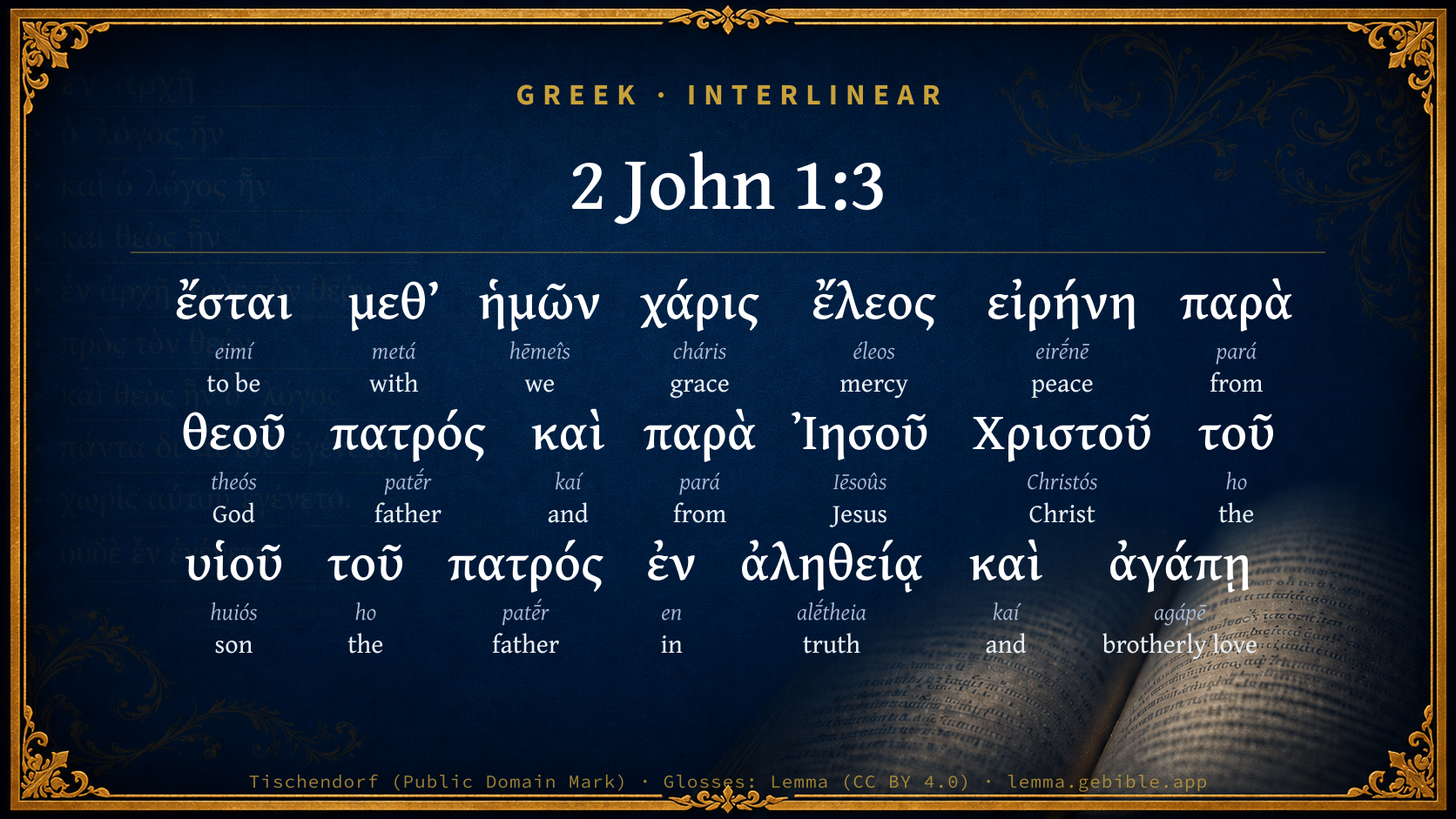
Greek (Tischendorf 8th ed.) 2 John 1:3 appears in the Greek New Testament. The text above is from the Tischendorf 8th edition. Each word links to its Strong’s number and a concise gloss. Click any word for its full Thayer’s Greek Lexicon entry.
Download image
Cite this verse

2 John 1:3 (World English Bible). Public Domain. Lemma interlinear Bible study tool, https://lemma.gebible.app/v/2-john/1/3.

Show BibTeX & RIS
BibTeX
RIS
English Translation
Grace, mercy, and peace will be with us, from God the Father, and from the Lord Jesus Christ, the Son of the Father, in truth and love.
World English Bible · Public Domain
Download a study sheet

One document with this verse’s original text, its word-by-word gloss line, the meaning frame, cross-references with their text, attributed commentary, and full source and license credits — printable, and it pastes into notes with its structure intact.

This verse Autodidact and up

Study sheet (.html) Plain text (.txt)

A passage Seminary Student

Up to 50 verses in one chapter. A passage sheet keeps up to 6 commentary sources and 12 cross-references per verse, in the order this page ranks them, and says so on the sheet whenever that leaves anything out. Ask for a single verse and you get the Autodidact verse sheet above.

Everything on this page stays free to read, with no account — the sheet is a download of what is already on screen, not access to it.

Want to remove ads? Support Godless Engineer
Compare translations 3

The same verse in 3 English versions, stacked beneath the original-language interlinear above. Click any original word for its lexicon entry.

Each is an independent rendering of the whole verse — the interlinear is not word-aligned to these translations.

Highlighted words mark where these versions differ — a whole-verse word diff, not a word-by-word alignment.

  • World English Bible Public Domain
    Grace, mercy, and peace will be with us, from God the Father, and from the Lord Jesus Christ, the Son of the Father, in truth and love.
  • King James Version Public Domain
    Grace be with you, mercy, and peace, from God the Father, and from the Lord Jesus Christ, the Son of the Father, in truth and love.
  • unfoldingWord Literal Text CC BY-SA 4.0
    Grace, mercy, peace will be with us from God the Father and from Jesus Christ, the Son of the Father, in truth and love.

unfoldingWord Literal Text — © unfoldingWord, licensed CC BY-SA 4.0. Word-aligned USFM3 via Door43 (git.door43.org/unfoldingWord/en_ult).

Versions to compare (up to 4)

3 of 4 selected

Show all 19 translations

Every available English version of this verse, each an independent rendering of the whole verse.

  • World English Bible Public Domain
    Grace, mercy, and peace will be with us, from God the Father, and from the Lord Jesus Christ, the Son of the Father, in truth and love.
  • Berean Standard Bible Public Domain
    Grace, mercy, and peace from God the Father and from Jesus Christ, the Son of the Father, will be with us in truth and love.
  • Majority Standard Bible Public Domain
    Grace, mercy, and peace from God the Father and from the Lord Jesus Christ, the Son of the Father, will be with us in truth and love.
  • King James Version Public Domain
    Grace be with you, mercy, and peace, from God the Father, and from the Lord Jesus Christ, the Son of the Father, in truth and love.
  • American Standard Version (1901) Public Domain
    Grace, mercy, peace shall be with us, from God the Father, and from Jesus Christ, the Son of the Father, in truth and love.
  • Revised Version (1885) Public Domain
    Grace, mercy, peace shall be with us, from God the Father, and from Jesus Christ, the Son of the Father, in truth and love.
  • Geneva Bible (1599) Public Domain
    Grace be with you, mercie and peace from God the Father, and from the Lord Iesus Christ the Sonne of the Father, with trueth and loue.
  • Douay-Rheims (1899) Public Domain
    Grace be with you, mercy, and peace from God the Father, and from Christ Jesus the Son of the Father; in truth and charity.
  • Young's Literal Translation Public Domain
    there shall be with you grace, kindness, peace, from God the Father, and from the Lord Jesus Christ, the Son of the Father, in truth and love.
  • Literal Standard Version CC BY-SA 4.0
    there will be with you grace, mercy, [and] peace from God the Father, and from the Lord Jesus Christ, the Son of the Father, in truth and love.
  • Unlocked Literal Bible CC BY-SA 4.0
    Grace, mercy, and peace will be with us from God the Father and from Jesus Christ, the Son of the Father, in truth and love.
  • unfoldingWord Literal Text CC BY-SA 4.0
    Grace, mercy, peace will be with us from God the Father and from Jesus Christ, the Son of the Father, in truth and love.
  • Darby Bible Public Domain
    Grace shall be with you, mercy, peace from God [the] Father, and from [the] Lord Jesus Christ, the Son of the Father, in truth and love.
  • World Messianic Bible Public Domain
    Grace, mercy, and peace will be with us, from God the Father and from the Lord Yeshua the Messiah, the Son of the Father, in truth and love.
  • Webster's Bible Public Domain
    Grace be with you, mercy, and peace from God the Father, and from the Lord Jesus Christ, the Son of the Father, in truth and love.
  • Free Bible Version CC BY-SA 4.0
    May grace, mercy and peace continue to be with us, from God the Father and from Jesus Christ, the Son of the Father, in truth and in love.
  • Bible in Basic English Public Domain
    May grace, mercy, and peace be with us from God the Father, and from Jesus Christ, the Son of the Father, in all true love.
  • Text-Critical English NT CC BY 4.0
    Grace, mercy, and peace will be with us from God the Father and from the Lord Jesus Christ, the Son of the Father, in truth and love.
  • Tyndale New Testament (1534) Public Domain
    With you be grace mercy and peace from God the father and from the Lorde Iesus Christ the sonne of the father in trueth and love.

Literal Standard Version (2020), Covenant Press — licensed CC BY-SA 4.0. Text via the HelloAO Bible API (eBible.org). Unlocked Literal Bible (unfoldingWord) — licensed CC BY-SA 4.0. Text via the HelloAO Bible API (eBible.org). unfoldingWord Literal Text — © unfoldingWord, licensed CC BY-SA 4.0. Word-aligned USFM3 via Door43 (git.door43.org/unfoldingWord/en_ult). Free Bible Version, Dr. Jonathan Gallagher — licensed CC BY-SA 4.0. Text via the HelloAO Bible API (eBible.org).

Word by word

More ways to search: Search by grammar → Find every occurrence → Compare this word →

Practice this passage: Drill this verse → Learn its vocabulary →

ἔλεος
éleos
G1656
“mercy”
Noun, Nominative, Singular, Neuter
Part of Speech
Noun
Case
Nominative
Number
Singular
Gender
Neuter
Full Thayer's Definition

Origin: of uncertain affinity

TDNT: 09:57,2

1. mercy: kindness or good will towards the miserable and the afflicted, joined with a desire to help them a. of men towards men: to exercise the virtue of mercy, show one's self merciful b. of God towards men: in general providence; the mercy and clemency of God in providing and offering to men salvation by Christ c. the mercy of Christ, whereby at his return to judgment he will bless true Christians with eternal life
  1. ἔσται eimí G1510 “to be” Verb, Future, Middle deponent, Indicative, 3rd person, Singular
  2. μεθ’ metá G3326 “with” Preposition
  3. ἡμῶν hēmeîs G2249 “we” Personal pronoun, 1st person, Genitive, Plural
  4. χάρις cháris G5485 “grace” Noun, Nominative, Singular, Feminine
  5. εἰρήνη eirḗnē G1515 “peace” Noun, Nominative, Singular, Feminine
  6. παρὰ pará G3844 “from” Preposition
  7. θεοῦ theós G2316 “God” Noun, Genitive, Singular, Masculine
  8. πατρός patḗr G3962 “father” Noun, Genitive, Singular, Masculine
  9. καὶ kaí G2532 “and” Conjunction
  10. παρὰ pará G3844 “from” Preposition
  11. Ἰησοῦ Iēsoûs G2424 “Jesus” Noun, Genitive, Singular, Masculine
  12. Χριστοῦ Christós G5547 “Christ” Noun, Genitive, Singular, Masculine
  13. τοῦ ho G3588 “the” Article, Genitive, Singular, Masculine
  14. υἱοῦ huiós G5207 “son” Noun, Genitive, Singular, Masculine
  15. τοῦ ho G3588 “the” Article, Genitive, Singular, Masculine
  16. πατρός patḗr G3962 “father” Noun, Genitive, Singular, Masculine
  17. ἐν en G1722 “in” Preposition
  18. ἀληθείᾳ alḗtheia G225 “truth” Noun, Dative, Singular, Feminine
  19. καὶ kaí G2532 “and” Conjunction
  20. ἀγάπῃ agápē G26 “brotherly love” Noun, Dative, Singular, Feminine

About this verse

These counts appear in no published source. They are computed here, from the morphology-tagged text and Lemma’s own curated glosses. What Lemma adds →

21
words
17
distinct lemmas
General Epistles
section

Shared distinctive vocabulary

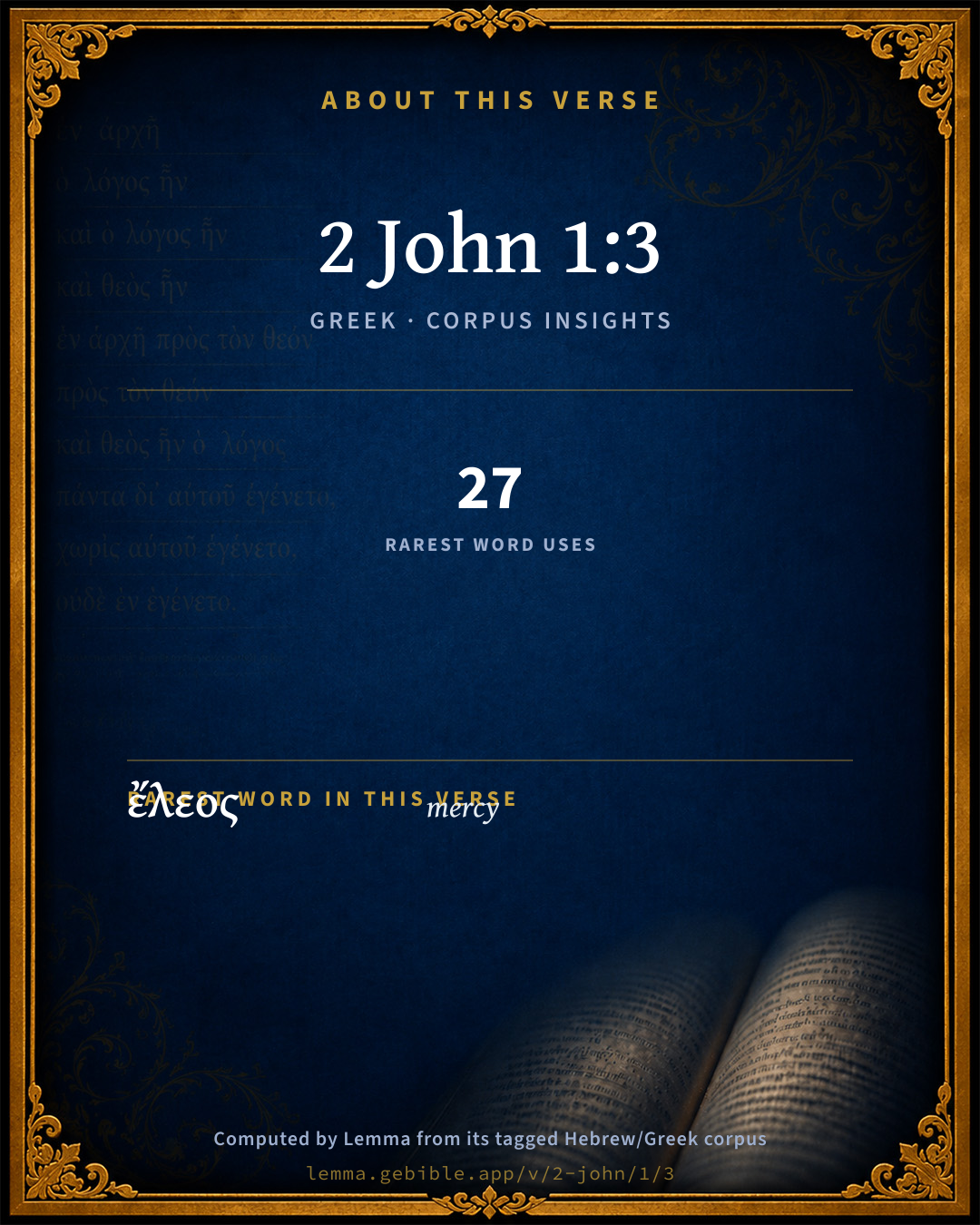
ἔλεος mercy G1656 occurs in 26 verses of the Greek New Testament. Also found in:
Repetition

Words recur within this verse:

  • πατρός father G3962 ×2
  • παρὰ from G3844 ×2
  • καὶ and G2532 ×2
  • τοῦ the G3588 ×2

Cross-references

9

Topical passages linked to 2 John 1:3 in the Treasury of Scripture Knowledge — connected by theme and wording, ordered by reader-vote popularity; previews shown in the World English Bible.

  • Romans 1:7 to all who are in Rome, beloved of God, called to be saints: Grace to you and peace from God our Father and the Lord Jesus Christ.
  • 1 John 4:10 In this is love, not that we loved God, but that he loved us, and sent his Son as the atoning sacrifice for our sins.
  • 1 Timothy 1:2 to Timothy, my true child in faith: Grace, mercy, and peace, from God our Father and Christ Jesus our Lord.
  • 1 Timothy 1:14 The grace of our Lord abounded exceedingly with faith and love which is in Christ Jesus.
  • Galatians 5:6 For in Christ Jesus neither circumcision amounts to anything, nor uncircumcision, but faith working through love.
  • 2 Timothy 1:13 Hold the pattern of sound words which you have heard from me, in faith and love which is in Christ Jesus.
  • 2 John 1:1 The elder, to the chosen lady and her children, whom I love in truth; and not I only, but also all those who know the truth;
  • 1 John 2:23–24 Whoever denies the Son, the same doesn't have the Father. He who confesses the Son has the Father also.
  • Zechariah 8:19 Thus says Yahweh of Hosts: "The fasts of the fourth fifth, seventh, and tenth months shall be for the house of Judah joy and gladness, and cheerful feasts. Therefore love truth and peace."

Cross-references courtesy of OpenBible.info (CC BY 4.0).

Where the printed editions differ

1 variant

Places in this verse where the major printed Greek editions disagree on the wording in a way that affects the translation — a comparison of editions, not a manuscript-by-manuscript collation. The editions are the modern critical texts (Nestlé-Aland 28/27, SBL, Westcott-Hort, Tregelles, Tyndale House) and the traditional texts behind the KJV (the Textus Receptus and the Byzantine/Majority text). It is not a claim about which reading is original.

  1. Extra text
    κυρίου

    “Lord”

    In TRByz Not in NA28NA27TynSBLWHTreg

    κυρίου (kuriou) 'Lord' is only in traditional manuscripts (TR+Byz)

Textual data: Translators Amalgamated Greek New Testament (STEPBible TAGNT) · CC BY 4.0.

Commentary

Notes on 2 John 1:3 from classic Christian and Jewish commentators (each source and its license shown beneath its notes). The classic Christian expositions comment on the surrounding passage and are grouped to its opening verse, so a note may address several verses; the Jewish commentaries on the Tanakh (Rashi and others) are per-verse, so they appear only where the commentator wrote on this verse.

Lemma curates 59 commentaries, every one of them public domain or Creative Commons licensed, each selected and text-cleaned for this edition rather than reprinted as found. About our sources →

The Cambridge Bible for Schools and Colleges

gen. ed. J. J. S. Perowne

3. Grace be with you, mercy, and peace] Rather, as R. V., Grace, mercy, and peace shall be with us. It is not so much a prayer or a blessing, as the confident assurance of a blessing; and the Apostle includes himself within its scope. This triplet of heavenly gifts occurs, and in the same order, in the salutations to Timothy (both Epistles) and Titus. The more common form is ‘grace and peace’. In Judges 2 we have another combination; ‘mercy, peace, and love’. In secular letters we have simply ‘greeting’ (χαίρειν) instead of these Christian blessings. ‘Grace’ is the favour of God towards sinners (see on Joh_1:14); ‘mercy’ is the compassion of God for the misery of sinners; ‘peace’ is the result when the guilt and misery of sin are removed. ‘Grace’ is rare in the writings of S. John; elsewhere only Joh_1:14; Joh_1:16-17; Rev_1:4; Rev_22:21.

from God the Father] Literally, ‘from the presence of, or from the hand of (παρά) God the Father’: see on Joh_1:6; Joh_16:27 : the more usual expression is simply ‘from’ (ἀπό), as in Rom_1:7; 1Co_1:3; 2Co_1:2, &c.

and from the Lord Jesus Christ the Son of the Father] Omit ‘the Lord’ with AB and the Vulgate; the title of ‘Lord’ for Jesus Christ, though found in the Gospel and in the Revelation, does not occur in S. John’s Epistles. The repetition of the preposition marks the separate Personality of Christ; whose Divine Sonship is emphasized with an unusual fulness of expression, perhaps in anticipation of the errors condemned in 2Jn_1:7; 2Jn_1:10.

in truth and love] These two words, so characteristic of S. John (see on 1Jn_1:8; 1Jn_2:8; 1Jn_3:1), are key-notes of this short Epistle, in which ‘truth’ occurs five times, and ‘love’ twice as a substantive and twice as a verb. ‘Commandment’ is a third such word.

The Cambridge Bible for Schools and Colleges (gen. ed. J. J. S. Perowne; Cambridge University Press, 1878–1918) — public domain. Text from a community e-Sword module.

The Biblical Illustrator

Joseph S. Exell

2Jn_1:3

Grace be with you, mercy, peace.

Grace, mercy, and peace

Grace in Scripture comprehends all the senses that it bears, separately and apart, in our common dialects. When you say of a royal person, How gracious he is; when you say of a beautiful woman, What grace there is in her; when you speak of a man not having the grace to return a benefit that has been done to him; you indicate some aspect of that grace which the Source of all good bestows upon men; which becomes in them a comeliness answering to His from whom it is derived; which awakens the reaction that we call gratitude or thanksgiving. And this grace being manifested towards creatures who have need of daily forgiveness is inseparable from mercy, which, like it, proceeds from the nature of the being who shows it, and becomes an element in the nature of the being to whom it is showed--the merciful obtaining mercy. And this grace or mercy flowing forth towards creatures who have been alienated from their Creator, who have been at war with Him--and, being at war with Him, have been, necessarily, at war with each other and themselves--becomes peace or atonement. But that the grace, because it is royal, free, and undeserved, may not be supposed to be capricious; that the mercy may not be taken as dependent on the mercy which it calls forth; that the peace may not be judged by the results which it produces here, where oftentimes the proclamation of it is the signal of fresh fighting; they are declared to come from God the Father and from Jesus Christ the Son of the Father, in truth and love; these being the essential Godhead; these dwelling absolutely in the Father; shining forth to all in the life of the Son; while the Spirit in whom they are eternally united imparts them to the family in heaven and earth. (F. D. Maurice, M. A.)

Grace first

Our poverty wants grace, our guilt wants mercy, our misery wants peace. Let us ever keep the apostles order. Do not let us put peace, our feeling of peace, first. The emotionalists is a topsy turvy theology. Apostles do not say peace and grace, but grace and peace. (Bp. Wm. Alexander.)

The common salutation

In this short letter John does not grudge space for a salutation. It is the common salutation or benediction that might be pronounced on any Christian, whether having little more than a decent profession, or distinguished, as this lady was, by works truly good. What familiarity has made words of course to us were not words of course or empty form to John, although he must have repeated and heard them oftener than any of us. That is one thought: we should linger over the words till they get a firm grip on our hearts, till we feel their Divine meaning. And another thought is this: each individual needs the whole of this benediction. Do we not often lose ourselves in the mass? Grace, mercy, peace: the blessings stand in their due order, the first leading to the second, and the second securing the third. There is a fourth word, indeed, which includes all the three, the greatest word in any language--love. John reaches to it at the end of his sentence. But it could not have been used instead of grace and mercy. For grace expresses the Divine favour viewed as undeserved. It is the fountain of every good and perfect gift coming down from the Father of lights to us who have no claim on Him, who have nothing of our own to call forth love. Mercy, again, is more than simple grace; it is sovereign love pitying and pardoning sinners, those who positively deserve ill from God. Then peace comes in its place and order. If that peace with God, a clear and substantial reality in a crucified and interceding Mediator, then all other peace. The Elder is careful to make prominent the source from whence the supreme blessing comes. It is from God indeed, but from God in His new covenant relation to man--from God the Father. God was now for them not less the Creator, the Lawgiver, the Judge, but He was, in Christ, also and above all the Father. And from the Lord Jesus Christ. Here there is no distracting perplexity, there is only fulness and rest, when the heart, rather than the head, is engaged about grace, mercy, and peace. In Johns mind the holy mystery of the Trinity was, while none the less sublime, more a fact than a mystery, for he had beheld the Lord Jesus Christ manifesting the glory of the Father, full of grace and truth, and bearing away the sin of the world. This benediction is distinguished by the words being added, In truth and love. (A. M. Symington, D. D.)

Grace, mercy, and peace

Grace, mercy, and peace stand related to each other in a very interesting manner. The apostle starts, as it were, from the fountain-head, and slowly traces the course of the blessing down to its lodgment in the heart of man. Grace, referring solely to the Divine attitude and thought; mercy, the manifestation of grace in act, referring to the workings of that great Godhead in its relation to humanity; and peace, which is the issue in the soul of the fluttering down upon it of the mercy which is the activity of the grace. Grace from God the Father and from the Lord Jesus Christ, the Son of the Father. These two, blended and yet separate, to either of whom a Christian man has a distinct relation, these two are the sources, equally, of the whole of the grace. The Scriptural idea of grace is love that stoops and that pardons and that communicates. The first thing, then, that strikes me in it, is how it exults in that great thought that there is no reason whatsoever for Gods love except Gods will. The very foundation and notion of the word grace is a free, undeserved, unsolicited, self-prompted, and altogether gratuitous bestowment, a love that is its own reason. Gods love is like an artesian well; whensoever you strike up comes, self-impelled, gushing into light because there is such a central store of it beneath everything, the bright and flashing waters. Grace is love that is not drawn out, but that bursts out, self-originated, undeserved. And then let me remind you that there lies in this great word the preaching that Gods love, though it be not turned away by, is made tender by our sin. Grace is love extended to a person that might reasonably expect, because he deserves, something very different. Then, if we turn for a moment from that deep fountain to the stream, we get other blessed thoughts. The love, the grace, breaks into mercy. As grace is love which forgives, so mercy is love which pities and helps. Gods grace softens itself into mercy, and all His dealings with us men must be on the footing that we are not only sinful, but that we are weak and wretched, and so fit subjects for a compassion which is the strangest paradox of a perfect and Divine heart. The mercy of God is the outcome of His grace. And as is the fountain and the stream, so is the great lake into which it spreads itself when it is received into a human heart. Peace comes, the all-sufficient summing up of everything that God can give, and that men can need, from His loving-kindness and from their needs. The world is too wide to be narrowed to any single aspect of the various discords and disharmonies which trouble men. Peace with God; peace in this anarchic kingdom within me, where conscience and will, hopes and fears, duty and passion, sorrows and joys, cares and confidence, are ever fighting one another; where we are torn asunder by conflicting aims and rival claims, and wherever any part of our nature asserting itself against another leads to intestine warfare and troubles the poor soul. All that is harmonised and quieted down, and made concordant and co-operative to one great end, when the grace and the mercy have flowed silently into our spirits and harmonised aims and desires. There is peace that comes from submission; tranquillity of spirit, which is the crown and reward of obedience; repose, which is the very smile upon the face of faith, and all these things are given unto us along with the grace and mercy of our God. And as the man that possesses this is at peace with God and at peace with himself, so he may bear in his heart that singular blessing of a perfect tranquillity and quiet amidst the distractions of duty, of sorrows, of losses, and of cares. And now one word as to what this great text tells us are the conditions for a Christian man, of preserving, vivid and full, these great gifts, Grace, mercy, and peace be unto you, or, as the Revised Version more accurately reads, shall be with us in truth and love. Truth and love are, as it were, the space within which the river flows, if I may so say, the banks of the stream. Or, to get away from the metaphor, these are set forth as being the conditions abiding in which, for our parts, we shall receive this benediction--In truth and in love. To abide in the truth is to keep our selves conscientiously and habitually under the influence of the gospel of Jesus Christ, and of the Christ who is Himself the Truth. They who, keeping in Him, realising His presence, believing His word, founding their thinking about the unseen, about their relations to God, about sin and forgiveness, about righteousness and duty, and about a thousand other things, upon Christ and the revelation that He makes, these are those who shall receive Grace, mercy, and peace. (A. Maclaren, D. D.)

The Biblical Illustrator, edited by Joseph S. Exell (c. 1880s–1900s) — public domain. Text from a community e-Sword module.

Joseph Benson's Commentary

2Jn 1:3. Grace be with you, &c. — See on Rom 1:7. Grace takes away the guilt and power of sin, and renews our fallen nature; mercy relieves our misery; peace implies our abiding in grace and mercy. It includes the testimony of God’s Spirit and of our own conscience, both that we are his children, and that all our ways are acceptable to him. This is the very foretaste of heaven, where it is perfected: in truth and love — Truth embraced by a lively faith, and love to God, his children, and all mankind, flowing from discoveries of his favour.

Joseph Benson's Commentary on the Old and New Testaments (1811–1818) — public domain. Text from a community e-Sword module.

The Expositor's Bible

Chapter 20

2 John

THEOLOGY AND LIFE IN KYRIAS LETTER

2Jn_1:3

Of old God addressed men in tones that were, so to speak, distant. Sometimes He spoke with the stern precision of law or ritual; sometimes in the dark and lofty utterances of prophets; sometimes through the subtle voices of history, which lend themselves to different interpretations. But in the New Testament He whom no man hath seen at any time, "interpreted" {Joh_1:18} Himself with a sweet familiarity. It is of a piece with the dispensation of condescendence, that the mysteries of the kingdom of heaven should come to us in such large measure through epistles. For a letter is just the result of taking up ones pen to converse with one who is absent, a familiar talk with a friend.

Of the epistles in our New Testament, a few are addressed to individuals. The effect of three of these letters upon the Church, and even upon the world, has been great. The Epistles to Timothy and Titus, according to the most prevalent interpretation of them, have been felt in the outward organisation of the Church. The Epistle to Philemon, with its eager tenderness, its softness as of a womans heart, its chivalrous courtesy, has told in another direction. With all its freedom from the rashness of social revolution; its almost painful abstinence (as abolitionists have sometimes confessed to feeling) from actual invective against slavery in the abstract; that letter is yet pervaded by thoughts whose issue can only be worked out by the liberty of the slave. The word emancipation may not be pronounced, but it hovers upon the Apostles lips.

The second Epistle is, in our judgment, a letter to an individual. Certainly we are unable to find in its whole contents any probable allusion to a Church personified as a lady. It is, as we read it, addressed to Kyria, an Ephesian lady, or one who lived in the circle of Ephesian influence. It was sent by the Apostle during an absence from Ephesus. That absence might have been for the purpose of one of the visitations of the Churches of Asia Minor, which (as we are told by ancient Church writers) the Apostle was in the habit of holding. Possibly, however, in the case of a writer so brief and so reserved in the expression of personal sentiment as St. John, the gush and sunshine of anticipated joy at the close of this note might tempt us to think of a rift in some sky that had been long darkened; of the close of some protracted separation, soon to be forgotten in a happy meeting. "Having many things to write unto you, I would not do so by means of paper and ink; but I hope to come unto you, and to speak face to face that our joy may be fulfilled." (2Jn_1:12) The expression might not seem unsuitable for a return from exile. Several touches of language and feeling in the letter point to the conclusion that Kyria was a widow. There is no mention of her husband, the father of her children. In the case of a writer who uses the names of God with such subtle and tender suitability, the association of Kyrias "children walking in truth" with "even as we received commandment from the Father," may well point to Him who was for them the Father of the fatherless. We need not with some expositors draw the sad conclusion that St. John affectionately hints that there were others of the family who could not be included in this joyful message. But it would seem highly probable from the language used that there were several sons, and also that Kyria had no daughters. Over these sons who had lost one earthly parent, the Apostle rejoices with the heart of a father in God. He bursts out with his eureka, the eureka not of a philosopher, but of a saint. "I rejoiced exceedingly that I found (ευρηκα 2Jn_1:4) certain of the number of thy children walking in truth."

While we may not trace in this little Epistle the same fountain of wide spreading influence as in others to which we have referred; while we feel that, like its author, its work is deep and silent rather than commanding, reflection will also lead us to the conclusion that it is worthy of the Apostle who was looked upon as one of the "pillars" of the faith.

1. Let us reflect that this letter is addressed by the aged Apostle to a widow, and concerns her family.

It is significant that Kyria was, in all probability, a widow of Ephesus.

Too many of us have more or less acquaintance with one department of French literature. A Parisian widow is too often the questionable heroine of some shameful romance, to have read which is enough to taint the virginity of the young imagination. Ephesus was the Paris of Ionia. Petronius was the Daudet or Zola of his day. An Ephesian widow is the heroine of one of the most cynically corrupt of his stories.

But "where sin abounded, grace did more than abound." Strange that first in an epistle to a Bishop of the Church of Ephesus, St. Paul should have presented us with that picture of a Christian widow-"she that is a widow, indeed, and desolate, who hath her hope set on God, and continueth in prayer night and day"-yet who, if she has the devotion, the almost entire absorption in God, of Anna, the daughter of Phanuel, leaves upon the track of her daily road to heaven the trophies of Dorcas -"having brought up children well, used hospitality to strangers, washed the saints feet, relieved the afflicted, diligently followed every good work." Such widows are the leaders of the long procession of women, veiled or unveiled, with vows or, without them, who have ministered to Jesus through the ages. Christ has a beautiful art of turning the affliction of His daughters into the consolation of suffering. When lifes fairest hopes are disappointed by falsehood, by cruel circumstances, by death; the broken heart is soothed by the love of Christ, the only love which is proof against death and change. The consolation thus received is the most unselfish of gifts. It overflows, and is lavishly poured out upon the sick and weary. With St. Pauls picture of a widow of this kind, contrast another by the same hand which hangs close beside it. The younger Ephesian widow, such as Petronius described, was known by St. Paul also. If any count the Apostle as a fanatic, destitute of all knowledge of the world because he lived above it, let them look at those lines, which are full of such caustic power, as they hit off the characteristics of certain idle and wanton affecters of a sorrow which they never felt. {1Ti_5:6-13} What a distance between such widows and Kyria, "beloved for the truths sake which abideth in us!" {2Jn_1:2}

But the short letter of St. John is addressed to Kyrias family, as well as to herself.

"The elder to the excellent Kyria and her children." {3Jn_1:1}

There is one question which we naturally ask about every school and form of religion. It is the question which a great English Professor of Divinity used to ask his pupils to put in a homely form about every religious scheme and mode of utterance -"will it wash well?" Is it an influence which seems to be productive and lasting? Does it abide through time and trials? Is it capable of being passed on to another generation? Are plans, services, organisations, preachings, classes, vital or showy? Are they fads to meet fancies, or works to supply wants? Is that which we hold such sober, solid truth, that wise piety can say of it, half in benediction, half in prophecy -"the truth which abideth in us; yea, and with us it shall be forever"?

2. We turn to the contents of the Epistle.

We shall be better able to appreciate the value of these, if we consider the state of Christian literature at that tithe.

What had Christians to read and carry about with them? The excellent work of the Bible Society was physically impossible for long. centuries to come. No doubt the LXX version of the Old Testament was widely spread. In every great city of the Roman Empire there was a vast population of Jews. Many of these were baptised into the Church, and carried into it with them their passionate belief in the Old Testament. The Christians of the time and place to which we refer could, probably, with little trouble, if not read, yet hear the Old Covenant and able expositions of it. But they had not copies of the entire New Testament. Indeed, if all the New Testament was then written, it certainly was not collected into one volume, nor constituted one supreme authority. "Many barbarous nations," says a very ancient Father, "believe in Christ without written record, having salvation impressed through the Spirit in their hearts, and diligently preserving the old tradition." Possibly a Church or single believer had one synoptical Gospel. At Ephesus Christians had doubtless been catechised in, and were deeply imbued with, St. Johns view of the Person, work, and teaching of our Lord. This had now been moulded into shape, and definitely committed to writing in that glorious Gospel, the Churchs Holy of Holies, St. Johns Gospel. For them and for their contemporaries there was a living realisation of the Gospel. They had heard it from eyewitnesses. They had passed into the wonderland of God. The earth on which Jesus trod had blossomed into miracle. The air was haunted by the echoes of His voice. They had, probably, also a certain number of the Epistles of St. Paul. The Christians of Ephesus would have a special interest in their own Epistle to the Ephesians, and in the two which were written to their first Bishop, Timothy. They had also (whether written or not) impressed upon their memories by their weekly Eucharist, the liturgical Canon of consecration according to the Ephesian usage-from which, and not the Roman, the Spanish and Gallican seem to be derived. The Ephesian Christians had also the first Epistle of St. John, which in some form accompanied the Gospel, and is, indeed, a picture of spiritual life drawn from it. But let us remember that the Epistle is not of a character to be very quickly or readily learned by heart. Its subtle, latent links of connection do not present many grappling hooks for the memory to fasten itself to. Copies also must have been comparatively few.

Now let us see how the second Epistle may well have been related to the first.

Supremely, and above all else, the first Epistle contained three warnings, very necessary for those times.

(1) There was a danger of losing the true Christ, the Word made Flesh, Who for the forgiveness of our sins did shed out of His most precious side both water and blood -in a false, because shadowy and ideal Christ.

(2) There was danger of losing true love, and therefore spiritual life, with truth.

(3) With the true Christ and true love there was a danger of losing the true commandment-love of God and of the brethren.

Now in the second Epistle these very three warnings were written on a leaflet in a form more calculated for circulation and for remembrance.

(1) Against the peril of faith, of losing the true Christ. "Many deceivers are gone out into the world-they who confess not Jesus Christ coming in flesh. This is the deceiver and the antichrist." With the true Christ, the true doctrine of Christ would also vanish, and with it all living hold upon God. Progress was the watchword; but it was in reality regress. "Everyone who abideth not in the doctrine of Christ hath not God."

(2) Against the peril of losing love. "I beseech thee, Kyria that we love one another."

(3) Against the peril of losing the true commandment (the great spiritual principle of charity), or the true commandments (that principle in the details of life). "And this is love, that we walk after His commandments. This is the commandment, that even as ye heard from the beginning ye should walk in it."

Here then were the chief practical elements of the first Epistle contracted into a brief and easily remembered shape.

Easily remembered, too, was the stern, practical prohibition of the intimacies of hospitality with those who came to the home of the Christian, in the capacity of emissaries of the antichrist above indicated. "Receive him not into your house, and good speed salute him not with."

Many are offended with this. No doubt Christianity is the religion of love-"the epiphany of the sweet naturedness and philanthropy of God." We very often look upon heresy or unbelief with the tolerance of curiosity rather than of love. At all events, the Gospel has its intolerance as well as tolerance. St. John certainly had this. It is not a true conception of art which invests him with the mawkish sweetness of perpetual youth. There is a sense in which he was a son of Thunder to the last. He who believes and knows must formulate a dogma. A dogma frozen by formality, or soured by hate, or narrowed by stupidity, makes a bigot. In reading the Church History of the first four centuries we are often tempted to ask, why all this subtlety, this theology spinning, this dogma hammering? The answer stands out clear above the mists of controversy. Without all this the Church would have lost the conception of Christ, and thus finally Christ Himself. St. Johns denunciations have had a function in Christendom as well as his love.

3. There are two most precious indications of the highest Christian truth with which we may conclude.

We have prefixed to this Epistle that beautiful Apostolic salutation which is found in two only among the Epistles of St. Paul. After that simple, but exquisite expression of blessing merged in prophecy-"the truth which abideth in us-yes! and with us it shall be forever"-there comes another verse in the same key. "There shall be with us grace, mercy, peace, from God the Father, and from Jesus Christ the Son of the Father, in truth" of thought, "and love" of life.

This rush and reduplication of words is not very like the usual reserve and absence of emotional excitement in St. Johns style. Can it be that something (possibly the glorious death of martyrdom by which Timothy died) led St. John to use words which were probably familiar to Ephesian Christians?

However this may be, let us live by, and learn from, those lovely words. Our poverty wants grace, our guilt wants mercy, our misery wants peace: Let us ever keep the Apostles order. Do not let us put peace, our feeling of peace, first. The emotionalists is a topsy turvy theology. Apostles do not say "peace and grace," but "grace and peace."

Once more-in an age which substitutes an ideal something called the spirit of Christianity for Christ, let us hold fast to that which is the essence of the Gospel and the kernel of our three creeds. "To confess Jesus Christ coming in flesh." Couple with this a canon of the First Epistle-"confesseth Jesus Christ come in flesh." The second is the Incarnation fact with its abiding consequences; the first, the Incarnation principle ever living in a Person, Who will also be personally manifested. This is the substance of the Gospels; this the life of prayers, and sacraments; this the expectation of the saints.

William Robertson Nicoll, ed., The Expositor's Bible (London: Hodder & Stoughton, 1887–1910) — public domain. 65 of 66 books (1 Corinthians is not separately keyed, as that volume carries no machine-parseable verse references); section-level commentary keyed to the opening verse. Introductory and overview sections not keyed to a specific passage are excluded.

Tyndale Open Study Notes

Tyndale Open Resources

1:3 Grace, mercy, and peace are blessings of which John is confident for those who live in truth and love, and who demonstrate by their actions that they are God’s children.

Tyndale Open Study Notes — © Tyndale Open Resources, licensed CC BY-SA 4.0. Text via the HelloAO Bible API.

Bengel's Gnomon

Johann Albrecht Bengel

2Jn 1:3. Ἔσται, shall be) יהי. A prayer, together with an affirmation.—μεθʼ ὑμῶν, with you) See the App. Crit. Ed. ii. on this passage.[2] The Latin Version has vobiscum, with you: and this is properly consonant with the salutation. Comp. 3Jn 1:2.—χάρις, ἔλεος, εἰρήνη, grace, mercy, and peace) Grace removes guilt; mercy removes misery; peace expresses a continuance in grace and mercy.—εἰρήνη, peace) even under the assaults of temptation.—Κυρίου, Lord) This is the only passage in which the Epistles of St John contain the title of Lord, which is well adapted to a salutation.[3] He usually calls Him the Son of God.—ἐν ἀληθείᾳ καὶ ἀγάπῃ, in truth and love) Respecting the former he speaks in 2Jn 1:4; respecting the latter, in 2Jn 1:5. St Paul is accustomed to use the appellations, faith and love, for truth and faith are synonymous: and the Hebrew אמת is constantly translated in the Septuagint by either word. Comp. 3Jn 1:3, the truth that is in thee.

[2] B (according to Lachm., not so Tisch.) Vulg. Elzev. Rec. Text, have ἔσται μεθʼ ὑμῶν. But A and later Syr. omit the words. Stephens’ Rec. Text has ἡμῶν.—E.

[3] But the margin of both Ed., even in this passage, prefers the omission of the word Κυρίου; and the Germ. Vers. omits it altogether.—E. B.

AB Vulg. Theb. Syr. omit it. Rec. Text supports it, with Memph. and later Syr. alone of the oldest authorities.—E.

Bengel's Gnomon of the New Testament — English translation (T&T Clark, Edinburgh, 1860) — public domain. Text from a community e-Sword module.

Meyer's Critical & Exegetical Commentary

Heinrich August Wilhelm Meyer

2Jn_1:3. The formula of greeting. It agrees substantially with that which is found in most of the N. T. Epistles; the prefixed ἔσται μεθʼ ἡμῶν (ὑμῶν), however, is peculiar; the future indicates the wish as a certain expectation, which is based on the immediately preceding statement (Düsterdieck). If we take the reading ἡμῶν (see the critical notes), the apostle includes himself along with the readers of the Epistle, which indeed does not elsewhere occur in the salutatory formulae; μετά = with.

χάρις, ἔλεος, εἰρήνη] just as in 1 and 2 Tim. and Tit_1:4.[7]

παρὰ Θεοῦ πατρός] Instead of παρά, ἀπό is elsewhere regularly used in this connection, as א reads here also; on the difference of the two prepositions, see Winer, p. 326; VII. p. 342.

To Θεοῦ πατρός, ἡμῶν is always added by Paul, except in the Pastoral Epistles. God is here called πατήρ, first of all in His relation to Christ, but also with the consciousness that in Christ He is the Father of believers also.

καὶ παρὰ Ἰησ. Χρ. τοῦ υἱοῦ τοῦ πατρός] similarly in the other Epistles of the N. T., only that here the sonship of Christ is specially indicated; the repetition of the preposition brings out the independence of the Son along with the Father.

The last addition: ἐν ἀληθείᾳ καὶ ἀγάπῃ, is peculiar to John; the ἀλ. and ἀγάπη are the two vital elements (Baumgarten-Crusius: fundamental features) of the believer, in which the divine manifestations of grace, mercy, and peace have to work (Düsterdieck): the words contain an indication of the contents of the whole Epistle (Ebrard); a Lapide erroneously supplies: ut perseveretis vel ut crescatis. Grotius wrongly defines the relationship when he says: per cognitionem veri et dilectionem mutuam, nam per haec in nos Dei beneficia provocamus, conservamus, augemus; in the first place, ἐν is not = per; and, in the second place, our conduct is not the cause of the divine ΧΆΡΙς Κ.Τ.Λ., but the relationship is the converse.

[7] The explanation of these words given on 1Ti_1:2 is regarded as unsatisfactory by Düsterdieck, although it is in substantial agreement with his own, only that it is not expressly stated that χάρις means grace, ἔλεος mercy, and εἰρήνη peace,which is surely self-evident,but only the relation of the three ideas to one another, which is often erroneously interpreted, is pointed out.

Meyer — Critical and Exegetical Commentary on the New Testament — English translation by Peter Christie, edited by Frederick Crombie (T&T Clark, 1880) — public domain. Text from a community e-Sword module.

Expositor's Greek Testament

ed. W. Robertson Nicoll

2Jn 1:3 . ἔσται μεθʼ ἡμῶν , not a wish (1Pe 1:2 ; 2Pe 1:2 ) but a confident assurance. χάρις the well-spring in the heart of God; ἔλεος , its outpourings; εἰρήνη , its blessed effect. They are evangelical blessings: (1) not merely “from God” but “from God the Father and from Jesus Christ the Son of the Father” who has interpreted Him and brought Him near, made Him accessible; (2) not merely “in Truth,” enlightening the intellect, but “in love,” engaging the heart.

Observe the high tribute which the Elder pays to Kyria: (1) He testifies to the esteem in which she is held; (2) he recognises her as a fellow-worker as though she were a fellow-apostle the three-fold “us,” not “you”; (3) he is about to speak of the danger from heretical teaching, but he has no fear of her being led astray: “You and I are secure from the deceiver. The Truth abideth in us; with us it shall be for ever; yea, there shall be with us grace, mercy, peace.”

The Expositor's Greek Testament, edited by W. Robertson Nicoll (1897–1910) — public domain. Text from a community e-Sword module.

Cambridge Greek Testament for Schools and Colleges

3. Omit Κυρίου before Ἰησοῦ with [867][868] against [869][870][871]. [872] omits ἔσται μεθ ̓ ἡμῶν.

[867] 5th century. Brought by Cyril Lucar, Patriarch of Constantinople, from Alexandria, and afterwards presented by him to Charles I. in 1628. In the British Museum. All three Epistles.

[868] 4th century. Brought to Rome about 1460. It is entered in the earliest catalogue of the Vatican Library, 1475. All three Epistles.

[869] 4th century. Discovered by Tischendorf in 1859 at the monastery of S. Catherine on Mount Sinai, and now at Petersburg. All three Epistles.

[870] 9th century. All three Epistles.

[871] 9th century. All three Epistles.

[872] 5th century. Brought by Cyril Lucar, Patriarch of Constantinople, from Alexandria, and afterwards presented by him to Charles I. in 1628. In the British Museum. All three Epistles.

3. ἔσται μεθʼ ἡμῶν χ. ἔλ. εἰρ. Yea, there shall be with us grace, mercy, and peace. The preceding μεθʼ ἡμῶν ἔσται has probably produced this very unusual mode of greeting. It is not so much a prayer or a blessing, as the confident assurance of a blessing; and the Apostle includes himself within its scope. This triplet of heavenly gifts occurs, and in the same order, in the salutations to Timothy (both Epistles) and Titus. The more common form is χάρις ὑμῖν καὶ εἰρήνη. In Jud 1:2 we have another combination ἔλεος ὑμῖν καὶ εἰρήνη καὶ ἀγάπη. In secular letters we have simply ‘greeting’ (χαίρειν) instead of these Christian blessings. Χάρις is the favour of God towards sinners (see on Joh 1:14); ἔλεος is the compassion of God for the misery of sinners; εἰρήνη is the result when the guilt and misery of sin are removed. Χάρις is rare in the writings of S. John; elsewhere only Joh 1:14; Joh 1:16-17; Rev 1:4; Rev 22:21: ἔλεος occurs here only.

παρὰ … παρὰ … The repetition of the preposition marks the separate Personality of the Father and the Son. The doctrinal fulness of statement is perhaps in anticipation of the errors condemned in 2Jn 1:7; 2Jn 1:10. For παρά see on Joh 1:6; Joh 16:27: it means ‘from the presence of’ or ‘from the hand of’. In S. Paul’s Epistles we usually have ἀπό (Rom 1:7; 1Co 1:3; 2Co 1:2; &c.); and [930] has ἀπό here.

[930] 4th century. Discovered by Tischendorf in 1859 at the monastery of S. Catherine on Mount Sinai, and now at Petersburg. All three Epistles.

ἐν ἀληθείᾳ καἰ ἀγάπῃ. These two words, so characteristic of S. John (see on 1Jn 1:8; 1Jn 2:8; 1Jn 3:1), are key-notes of this short Epistle, in which ‘truth’ occurs five times, and ‘love’ twice as a substantive and twice as a verb. Ἐντολή is a third such word.

Cambridge Greek Testament for Schools and Colleges (Cambridge University Press, 1896; 21 vols, various authors incl. Carr, Maclear, Plummer, Farrar, Lumby, Moule, M. R. James, Simcox) — public domain. Text from a community e-Sword module.

Vincent's Word Studies in the New Testament

Marvin R. Vincent

Grace be with you, mercy and peace [εσται μεθ ημων χαρις ελεος ειρηνη] . The verb is in the future tense : shall be. In the Pauline Epistles the salutations contain no verb. In 1 and 2 Peter and Jude, plhqunqeih be multiplied, is used. Grace [χαρις] is of rare occurrence in John's writings (Joh 1:14, 16, 17; Rev 1:4; Rev 22:21); and the kindred carizomai to favor, be kind, forgive, and carisma gift, are not found at all. See on Luk 1:30. Mercy [ελεος] , only here in John. See on Luk 1:50. The pre - Christian definitions of the word include the element of grief experienced on account of the unworthy suffering of another. So Aristotle. The Latin misericordia (miser "wretched," cor "the heart ") carries the same idea. So Cicero defines it, the sorrow arising from the wretchedness of another suffering wrongfully. Strictly speaking, the word as applied to God, cannot include either of these elements, since grief cannot be ascribed to Him, and suffering is the legitimate result of sin. The sentiment in God assumes the character of pitying love. Mercy is kindness and goodwill toward the miserable and afflicted, joined with a desire to relieve them. Trench observes :" In the Divine mind, and in the order of our salvation as conceived therein, the mercy precedes the grace. God so loved the world with a pitying love (herein was the mercy), that He gave His only - begotten Son (herein the grace), that the world through Him might be saved. But in the order of the manifestation of God 's purposes of salvation, the grace must go before the mercy and make way for it. It is true that the same persons are the subjects of both, being at once the guilty and the miserable; yet the righteousness of God, which it is quite as necessary should be maintained as His love, demands that the guilt should be done away before the misery can be assuaged; only the forgiven may be blessed. He must pardon before He can heal.... From this it follows that in each of the apostolic salutations where these words occur, grace precedes mercy " (" Synonyms of the New Testament ").

With you. The best texts read with us.

From God - from Jesus Christ [παρα θεου - παρα ιησου χριστου] . Note the repeated preposition, bringing out the twofold relation to the Father and Son. In the Pauline salutations ajpo from, is invariably used with God, and never repeated with Jesus Christ. On the use of para from, see on Joh 6:46; 1Jo 1:5.

God the Father. The more common expression is "God our Father."

The Son of the Father. The phrase occurs nowhere else. Compare Joh 1:18; 1Jo 2:22, 23; 1Jo 1:3.

In truth and in love. The combination is not found elsewhere. The words indicate the contents of the whole Epistle.

Marvin R. Vincent, Word Studies in the New Testament (1887–1900) — public domain. Text from a community e-Sword/MySword module.

Geneva Bible (1599)

Geneva Bible translators

With true knowledge, which hath always love joined with it, and following it.

Geneva Bible (1599) marginal notes — public domain. Text via Bolls.life.

Jamieson, Fausset & Brown

Robert Jamieson, A. R. Fausset & David Brown

Grace be with you--One of the oldest manuscripts and several versions have "us" for you. The Greek is literally, "Grace shall be with us," that is, with both you and me. A prayer, however, is implied besides a confident affirmation.

grace . . . mercy . . . peace--"Grace" covers the sins of men; "mercy," their miseries. Grace must first do away with man's guilt before his misery can be relieved by mercy. Therefore grace stands before mercy. Peace is the result of both, and therefore stands third in order. Casting all our care on the Lord, with thanksgiving, maintains this peace.

the Lord--The oldest manuscripts and most of the oldest versions omit "the Lord." John never elsewhere uses this title in his Epistles, but "the Son of God."

in truth and love--The element or sphere in which alone grace, mercy, and peace, have place. He mentions truth in Jo2 1:4; love, in Jo2 1:5. Paul uses FAITH and love; for faith and truth are close akin.

Jamieson, Fausset & Brown — Commentary Critical and Explanatory on the Whole Bible (1871) — public domain (CC PDM 1.0). Text via the HelloAO Bible API.

Adam Clarke's Commentary

Verse 3. Grace be with you] This is addressed to her, her household, and probably that part of the Church which was more immediately under her care.

The Son of the Father] The apostle still keeps in view the miraculous conception of Christ; a thing which the Gnostics absolutely denied; a doctrine which is at the ground work of our salvation.

Adam Clarke's Commentary on the Bible (1810–1826) — public domain. Text from a community e-Sword/MySword module.

John Gill's Exposition

Grace be with you, mercy and peace,.... This form of salutation, or wish and prayer for the blessings mentioned,

from God the Father, and from the Lord Jesus Christ, is the same used by other apostles; see Ti1 1:2 and See Gill on Rom 1:7. Only it is added here with respect to Christ, that he is

the Son of the Father in truth and love; which is mentioned by the apostle to confirm the deity of Christ, which is plainly implied in wishing for the above things equally from him, as from the Father; and to oppose and confront some heretics of those times, who denied the true and proper sonship of Christ; and therefore he calls him, "the Son of the Father", the only begotten of the Father; and that "in truth", or truly and properly, and not in a figurative and metaphorical sense, as magistrates are called the sons of God, and children of the most High, by reason of their office; but so is not Christ, he is God's own Son, in a true, proper, and natural sense: and he is so "in love"; he is his well beloved Son, his dear Son, the Son of his love; as he cannot otherwise be; since he is not only the image of him, but of the same nature, and has the same perfections with him.

John Gill's Exposition of the Whole Bible (1746–1763) — public domain (CC PDM 1.0). Text via the HelloAO Bible API.

Trapp's Complete Commentary

John Trapp

3 Grace be with you, mercy, and peace, from God the Father, and from the Lord Jesus Christ, the Son of the Father, in truth and love.

Ver. 3. Grace be with you, &c.] This blessing belongs not only to the lady and her children, but to all that rightly read and hear the words of this Epistle, Rev 1:13.

John Trapp, A Commentary or Exposition upon All the Books of the Old and New Testament (1647–1656) — public domain. Text from a community e-Sword module.

Albert Barnes' Notes on the Bible

Grace be unto you ... - See the notes at Rom 1:7. This salutation does not differ from those commonly employed by the sacred writers, except in the emphasis which is placed on the fact that the Lord Jesus Christ is “the Son of the Father.” This is much in the style of John, in all of whose writings he dwells much on the fact that the Lord Jesus is the Son of God, and on the importance of recognizing that fact in order to the possession of true religion. Compare 1Jo 2:22-23; 1Jo 4:15; 1Jo 5:1-2, 1Jo 5:10-12, 1Jo 5:20.

In truth and love - This phrase is not to be connected with the expression “the Son of the Father,” as if it meant that he was his Son “in truth and love,” but is rather to be connected with the “grace, mercy, and peace” referred to, as a prayer that they might be manifested to this family in promoting truth and love.

Albert Barnes' Notes on the Bible (1834–1885) — public domain. Text from a community e-Sword/MySword module.

Matthew Poole's English Annotations

Such salutations see explained where they have formerly occurred.

Matthew Poole's English Annotations on the Holy Bible (1683–1685) — public domain. Text from a community e-Sword/MySword module.

Whedon's Commentary on the Bible

Daniel D. Whedon

3. Grace… mercy… peace—See notes on Rom_1:7; 2Co_1:2; 1Ti_1:2.

And from the Son—The Son is here mentioned with great distinctness because the question in vital debate was as to his real personality.

In truth—The truth of Christ’s real and divine nature.

Love—The vital communion of believers based on a real Christ. The truth recurs again in 2Jn_1:4, and the love in 2Jn_1:5.

Daniel D. Whedon (gen. ed.), Commentary on the Old and New Testaments (1874–1909) — public domain. Text from a community e-Sword module.

The Pulpit Commentary

In truth and love. Love, as we have seen in the First Epistle, is another of the words which is characteristic of St. John, "the apostle of love;" it also occurs repeatedly in this short letter. Truth and love are noble and natural companions. They must not be severed on earth any more than in heaven. In the Godhead the two are essentially united: "God is Light" and "God is Love." In human society they ought to be united: truth without love becomes cold, stern, and even cruel; love without truth becomes unstable and capricious.

The Pulpit Commentary (1880–1919), ed. H.D.M. Spence-Jones & Joseph S. Exell — public domain. Text from a community e-Sword module.

John Wesley's Explanatory Notes

Grace takes away guilt; mercy, misery: peace implies the abiding in grace and mercy. It includes the testimony of God's Spirit, both that we are his children, and that all our ways are acceptable to him. This is the very foretaste of heaven itself, where it is perfected. In truth and love - Or, faith and love, as St. Paul speaks. Faith and truth are here synonymous terms.

John Wesley, Explanatory Notes Upon the Whole Bible (1754–1765) — public domain. Text via the GEBible commentary corpus.

The People's New Testament

B. W. Johnson

3. Grace be with you. The usual benediction of the saints. The Lord Jesus Christ. The Revision omits Lord, a word which occurs nowhere else in John's Epistles.

B. W. Johnson's The People's New Testament with Notes (1889–1891) — public domain. Electronic text from the Christian Classics Ethereal Library (CCEL) ThML edition.

International Critical Commentary

3. ἔσται μεθʼ ἡμῶν]The taking up of the language of the preceding verse is thoroughly in accord with the writer’s habit. Compare the repetition of ἀλήθεια in the preceding verse. The wish expressed in ordinary salutations here “passes into assurance.” Perhaps in view of their circumstances the need of assurance was specially felt by writer and recipients as well.

χάρις, ἔλεος, εἰρήνη] This exact form of salutation is found elsewhere in the Epistles to Timothy. It is a natural expansion of the commoner χάρις καὶ εἰρήνη which in some sense combines the Greek and Hebrew forms of salutation; and it fits in well with the general tone of later Epistles. Neither ἔλεος nor the cognate verb occurs elsewhere in the Johannine writings. Cf. Jud 1:2, ἔλεος ὑμῖν καὶ εἰρήνη καὶ ἀγάπη πληθυνθείη: Polycarp, ad Phil. ἔλεος ὑμῖν καὶ εἰρήνη, and the Letter of the Smyrnaeans, ἔλεος καὶ εἰρήνη καὶ ἀγάπη… πληθυνθείη.

παρὰ Ἰησοῦ κ.τ.λ.] The whole phrase brings into prominence the views on which the author throughout lays most stress—the Fatherhood of God, as revealed by one who being His Son can reveal the Father, and who as man (Ἰησοῦ) can make Him known to men. Cf. Joh 20:31, ἵνα πιστεύητε ὅτι Ἰησοῦς ἐστιν ὁ Χριστὸς ὁ υἱὸς τοῦ θεοῦ. The words used contain implicitly the author’s creed.

ἐν ἀληθείᾳ καὶ ἀγάπῃ] The two vital elements of the Christian Faith, the possession of the highest knowledge and its expression in action. They are the keynotes of the Epistle.

εσται μεθ ημων] om. A | εσται] + δε15. 36 | ημων א B L P al. sat. mu. cat. am. sah. boh-ed. syrbodl aeth. Thphylcom Oeccom] υμων K al. plu. vg. (et. fu. demid. harl. tol.) arm. boh-codd. (εστ. μεθ υμ. post αγαπη arm. boh.) syrp. An obvious correction to the more usual 2nd pers. of salutations | χαρις] χαρα Ib 260 (440): + υμων και Ic 116, 486, 356 (-) | ειρηνη] pr. και Ia 200f (83) | παρα אc A B L P al. pler.] απο א* 11. 18. 19. 32. 40. 57. 68. 98. 105. 126 cscr. A natural correction to the more common usage of salutations; cf. Ro., 1, 2 Co. Gal. Eph. Ph. Col., 2 Th., 1, 2, Ti. Philem. Apoc. Clement. Polycarp has παρά | (θεου… και 1:0) om. sah. | θεου (? ver. 3)] om. Ia δ254 (?) Ic 486 (-) | πατρος (? 1:0)] pr. και Ia 256 (24) | παρα 2:0] om. א* 99 fscr am. | ιησου χριστου] pr. κῡ א K L P al. pler. cat. tol. cop. syr. arm. Thphyl. Oec.: χῡ ιῡ H257 (33) Ia δ203ff. 192 (808) | του 1:0] om. H δ6 (Ψ) Ic 114 (335) | του 2:0] pr. αυτου א* | αγαπη και αληθεια Ia 506 (60) | και αγαπη] αγαπητη H δ6 (Ψ) | αγαπη] pr. εν Ia δ203 (808): ερανη Ib 365 (214).

International Critical Commentary — older volumes (1896–1929), various authors — public domain. Text from a community e-Sword module.

Westcott on Hebrews & the Epistles of John

Brooke Foss Westcott

3. ἔσται pel ἡμών...] There shall be with us... This unique form of salutation seems to have been determined by the preceding clause (μεθ᾽ ἡμῶν ἔσται): ‘with us truth shall be ...yes, there shall be with us...’ The Wish passes into assurance. In the Epistles of St Paul no verb is expressed in the salutation (6.9. 1 Thess. i. I, χάρις ὑμῖν καὶ εἰρήνη. In 1, 2 Peter, Jude πληθυνθείη is added (1 Pet. i. 1 χάρις ὑμῖν καὶ εἰρήνη πληθ.).

ped ἡμῶν] Ὁ. 2. The readers are identified with the writer.

xap. ἔλ. elp.] The succession ‘grace, mercy, peace’ marks the order from the first motion of God to the final satisfaction of man. ‘Mercy’ defines as it were the manifestation of the divine ‘grace’ and prepares for the restoration of ‘peace’ to man’s disordered life.

The same combination occurs in salutations in 1 Tim. i. 2; 2 Tim. i. 2 (Ign. ad Smyrn. 12). Χάρις καὶ εἰρήνη is found in Apoc. i. 4; 1 Pet. i. 2; 2 Pet. i. 2, and in all the other Epistles of St Paul. In St Jude 2 the salutation is ἔλεος καὶ εἰρήνη καὶ ἀγάπη. (Comp. Mart. Pol. Incr.)

χάρις ἔλεος...) The word χάρις occurs elsewhere in St John only in 3 John 4; John i. 14, 16, 17; Apoc. iL 4; xxii. 21; and the absence of the

cognate forms(yapi{opat, ydpiopa)from .

his writings is worthy of notice. "Ἔλεος is not found elsewhere in his writings nor yet ἐλεεῖν.

In regard to the divine action ‘grace’ points to the absolute free-

deceivers are gone out (went out) into the world, even they that confess not Jesus Christ coming in flesh: this ἐδ the deceiver and the antichrist.

(+an old commandment syr hl).

Brooke Foss Westcott (1825–1901), The Epistle to the Hebrews (1889) and The Epistles of St John (1883) — public domain (pre-1929). Text recovered from Internet Archive / Google Books OCR scans. Westcott’s Gospel of John commentary is not included (its OCR lost the chapter running-heads required for reliable verse-keying). Some Greek quoted in the Hebrews volume is imperfectly rendered by the OCR.

Lesson kit

Teaching starters — assembled from the data on this page, not authored interpretation. Every prompt links to the verse data it draws on. Edit before teaching.

2 John, in the General Epistles, opens this verse with 21 words (17 distinct Greek lemmas). Its most distinctive word is éleos (“mercy”). A historical commentator’s framing appears above. Read the whole chapter for the surrounding context.

Discussion questions

  1. The word éleos carries the sense “mercy.” How does it shape the verse?
  2. How does Matthew 9:13, which shares the word «mercy», read alongside this verse?
  3. What does the repetition of “father” (2× in this one verse) do in this verse?
  4. These translations render this verse differently; the difference is in the English rendering, not the original. What questions does that raise?
  5. Compare how The Cambridge Bible for Schools and Colleges and The Biblical Illustrator read this verse. Where do they agree or differ?

Things to notice

  • These translations choose different wording for 4 words in this verse.
  • “father” occurs 2× in this single verse.
  • 17 distinct Greek lemmas span 21 words in this verse.

Reading settings

Reading text

Shown beneath each verse's original-language words.

Old Testament
Old Testament edition

Read the OT as the Masoretic Hebrew (MT) or the Greek Septuagint (LXX).

English shown for the Greek Septuagint (in the Hebrew ↔ Greek comparison).

Comparing translations? Open the Compare panel on any verse page to stack up to four side by side.