

Ruth 2:13

Hebrew (Westminster Leningrad Codex) Ruth 2:13 appears in the Hebrew Old Testament. The text above is from the Westminster Leningrad Codex. Each word links to its Strong’s number, a concise gloss, and parsing drawn from the Open Scriptures Hebrew Bible morphology. Click any word for its full Brown-Driver-Briggs (BDB) entry.
Download image
Cite this verse

Ruth 2:13 (World English Bible). Public Domain. Lemma interlinear Bible study tool, https://lemma.gebible.app/v/ruth/2/13.

Show BibTeX & RIS
BibTeX
RIS
English Translation
Then she said, Let me find favor in your sight, my lord, because you have comforted me, and because you have spoken kindly to your handmaid, though I am not as one of your handmaidens.
World English Bible · Public Domain
Download a study sheet

One document with this verse’s original text, its word-by-word gloss line, the meaning frame, cross-references with their text, attributed commentary, and full source and license credits — printable, and it pastes into notes with its structure intact.

This verse Autodidact and up

Study sheet (.html) Plain text (.txt)

A passage Seminary Student

Up to 50 verses in one chapter. A passage sheet keeps up to 6 commentary sources and 12 cross-references per verse, in the order this page ranks them, and says so on the sheet whenever that leaves anything out. Ask for a single verse and you get the Autodidact verse sheet above.

Everything on this page stays free to read, with no account — the sheet is a download of what is already on screen, not access to it.

Want to remove ads? Support Godless Engineer
Compare translations 3

The same verse in 3 English versions, stacked beneath the original-language interlinear above. Click any original word for its lexicon entry.

Each is an independent rendering of the whole verse — the interlinear is not word-aligned to these translations.

Highlighted words mark where these versions differ — a whole-verse word diff, not a word-by-word alignment.

  • World English Bible Public Domain
    Then she said, Let me find favor in your sight, my lord, because you have comforted me, and because you have spoken kindly to your handmaid, though I am not as one of your handmaidens.
  • King James Version Public Domain
    Then she said, Let me find favor in thy sight, my lord; for that thou hast comforted me, and for that thou hast spoken friendly unto thine handmaid, though I be not like unto one of thine handmaidens.
  • unfoldingWord Literal Text CC BY-SA 4.0
    Then she said, “May I find favor in your eyes, my lord, since you have comforted me, and since you have spoken to the heart of your female servant. But as for me, I am not even like one of your female servants.”

unfoldingWord Literal Text — © unfoldingWord, licensed CC BY-SA 4.0. Word-aligned USFM3 via Door43 (git.door43.org/unfoldingWord/en_ult).

Versions to compare (up to 4)

3 of 4 selected

Show all 18 translations

Every available English version of this verse, each an independent rendering of the whole verse.

  • World English Bible Public Domain
    Then she said, Let me find favor in your sight, my lord, because you have comforted me, and because you have spoken kindly to your handmaid, though I am not as one of your handmaidens.
  • Berean Standard Bible Public Domain
    “My lord,” she said, “may I continue to find favor in your eyes, for you have comforted and spoken kindly to your maidservant, though I am not like one of your servant girls.”
  • Majority Standard Bible Public Domain
    “My lord,” she said, “may I continue to find favor in your eyes, for you have comforted and spoken kindly to your maidservant, though I am not like one of your servant girls.”
  • King James Version Public Domain
    Then she said, Let me find favor in thy sight, my lord; for that thou hast comforted me, and for that thou hast spoken friendly unto thine handmaid, though I be not like unto one of thine handmaidens.
  • American Standard Version (1901) Public Domain
    Then she said, Let me find favor in thy sight, my lord, for that thou hast comforted me, and for that thou hast spoken kindly unto thy handmaid, though I be not as one of thy handmaidens.
  • Revised Version (1885) Public Domain
    Then she said, Let me find grace in thy sight, my lord; for that thou hast comforted me, and for that thou hast spoken kindly unto thine handmaid, though I be not as one of thine handmaidens.
  • Geneva Bible (1599) Public Domain
    Then she saide, Let me finde fauour in thy sight, my lord: for thou hast comforted mee, and spoken comfortably vnto thy mayde, though I be not like to one of thy maydes.
  • Douay-Rheims (1899) Public Domain
    And she said: I have found grace in thy eyes, my lord, who hast comforted me and hast spoken to the heart of thy handmaid, who am not like to one of thy maids.
  • Young's Literal Translation Public Domain
    And she saith, `Let me find grace in thine eyes, my lord, because thou hast comforted me, and because thou hast spoken unto the heart of thy maid-servant, and I -- I am not as one of thy maid-servants.'
  • Literal Standard Version CC BY-SA 4.0
    And she says, “Let me find grace in your eyes, my lord, because you have comforted me, and because you have spoken to the heart of your maidservant, and I am not as one of your maidservants.”
  • Unlocked Literal Bible CC BY-SA 4.0
    Then she said, “Let me find favor in your eyes, my master, for you have comforted me, and you have spoken kindly to me, though I am not one of your female servants.”
  • unfoldingWord Literal Text CC BY-SA 4.0
    Then she said, “May I find favor in your eyes, my lord, since you have comforted me, and since you have spoken to the heart of your female servant. But as for me, I am not even like one of your female servants.”
  • Darby Bible Public Domain
    And she said, Let me find favour in thine eyes, my lord; for that thou hast comforted me, and for that thou hast spoken kindly to thy handmaid, though I am not like one of thy handmaidens.
  • World Messianic Bible Public Domain
    Then she said, “Let me find favor in your sight, my lord, because you have comforted me, and because you have spoken kindly to your servant, though I am not as one of your servants.”
  • Webster's Bible Public Domain
    Then she said, Let me find favor in thy sight, my lord; for that thou hast comforted me, and for that thou hast spoken kindly to thy handmaid, though I am not like to one of thy handmaidens.
  • Free Bible Version CC BY-SA 4.0
    “Thank you for being so good to me, sir,” she replied. “You have reassured me by speaking to me kindly. I'm not even one of your servants.”
  • Bible in Basic English Public Domain
    Then she said, May I have grace in your eyes, my lord, for you have given me comfort, and you have said kind words to your servant, though I am not like one of your servants.
  • JPS Tanakh (1917) Public Domain
    Then she said: 'Let me find favour in thy sight, my LORD; for that thou hast comforted me, and for that thou hast spoken to the heart of thy handmaid, though I be not as one of thy handmaidens.'

Literal Standard Version (2020), Covenant Press — licensed CC BY-SA 4.0. Text via the HelloAO Bible API (eBible.org). Unlocked Literal Bible (unfoldingWord) — licensed CC BY-SA 4.0. Text via the HelloAO Bible API (eBible.org). unfoldingWord Literal Text — © unfoldingWord, licensed CC BY-SA 4.0. Word-aligned USFM3 via Door43 (git.door43.org/unfoldingWord/en_ult). Free Bible Version, Dr. Jonathan Gallagher — licensed CC BY-SA 4.0. Text via the HelloAO Bible API (eBible.org).

Word by word

More ways to search: Search by grammar → Find every occurrence → Compare this word →

Practice this passage: Drill this verse → Learn its vocabulary →

שִׁפְחָתֶ֑ךָ
shiphchâh
H8198
“maid · your”
Noun, Common, Feminine, Singular, Construct + Suffix, Personal, 2nd Person, Masculine, Singular
Part of Speech
Noun
Type
Common
Gender
Feminine
Number
Singular
State
Construct
Full BDB Definition

Origin: from the same as H8207 ">H8207 )

TWOT: None

maid, maid-servant, slavegirl - maid, maid-servant (as belonging to a mistress) - of address, speaker, humility (figuratively)
  1. וַ֠תֹּאמֶר ʼâmar H559 “and · to say” Conjunction + Verb, Qal, Sequential Imperfect, 3rd Person, Feminine, Singular
  2. אֶמְצָא mâtsâʼ H4672 “to find” Verb, Qal, Imperfect, 1st Person, Common, Singular
  3. חֵ֨ן chên H2580 “grace” Noun, Common, Masculine, Singular, Absolute
  4. בְּעֵינֶ֤יךָ ʻayin H5869 “in/at · eyes · your” Preposition + Noun, Common, Both, Dual, Construct + Suffix, Personal, 2nd Person, Masculine, Singular
  5. אֲדֹנִי֙ ʼâdôwn H113 “lord · my” Noun, Common, Masculine, Singular, Construct + Suffix, Personal, 1st Person, Common, Singular
  6. כִּ֣י kîy H3588 “that” Conjunction
  7. נִֽחַמְתָּ֔נִי nâcham H5162 “to comfort · me” Verb, Piel, Perfect, 2nd Person, Masculine, Singular + Suffix, Personal, 1st Person, Common, Singular
  8. וְכִ֥י kîy H3588 “and · that” Conjunction + Conjunction
  9. דִבַּ֖רְתָּ dâbar H1696 “to speak” Verb, Piel, Perfect, 2nd Person, Masculine, Singular
  10. עַל ʻal H5921 “upon” Preposition
  11. לֵ֣ב lêb H3820 “heart of” Noun, Common, Masculine, Singular, Construct
  12. וְאָנֹכִי֙ ʼânôkîy H595 “and · I” Conjunction + Pronoun, Personal, 1st Person, Common, Singular
  13. לֹ֣א lôʼ H3808 “not” Particle, Negative
  14. אֶֽהְיֶ֔ה hâyâh H1961 “to be” Verb, Qal, Imperfect, 1st Person, Common, Singular
  15. כְּאַחַ֖ת ʼechâd H259 “like/as · one” Preposition + Adjective, Cardinal number, Feminine, Singular, Construct
  16. שִׁפְחֹתֶֽיךָ shiphchâh H8198 “maids · your” Noun, Common, Feminine, Plural, Construct + Suffix, Personal, 2nd Person, Masculine, Singular

About this verse

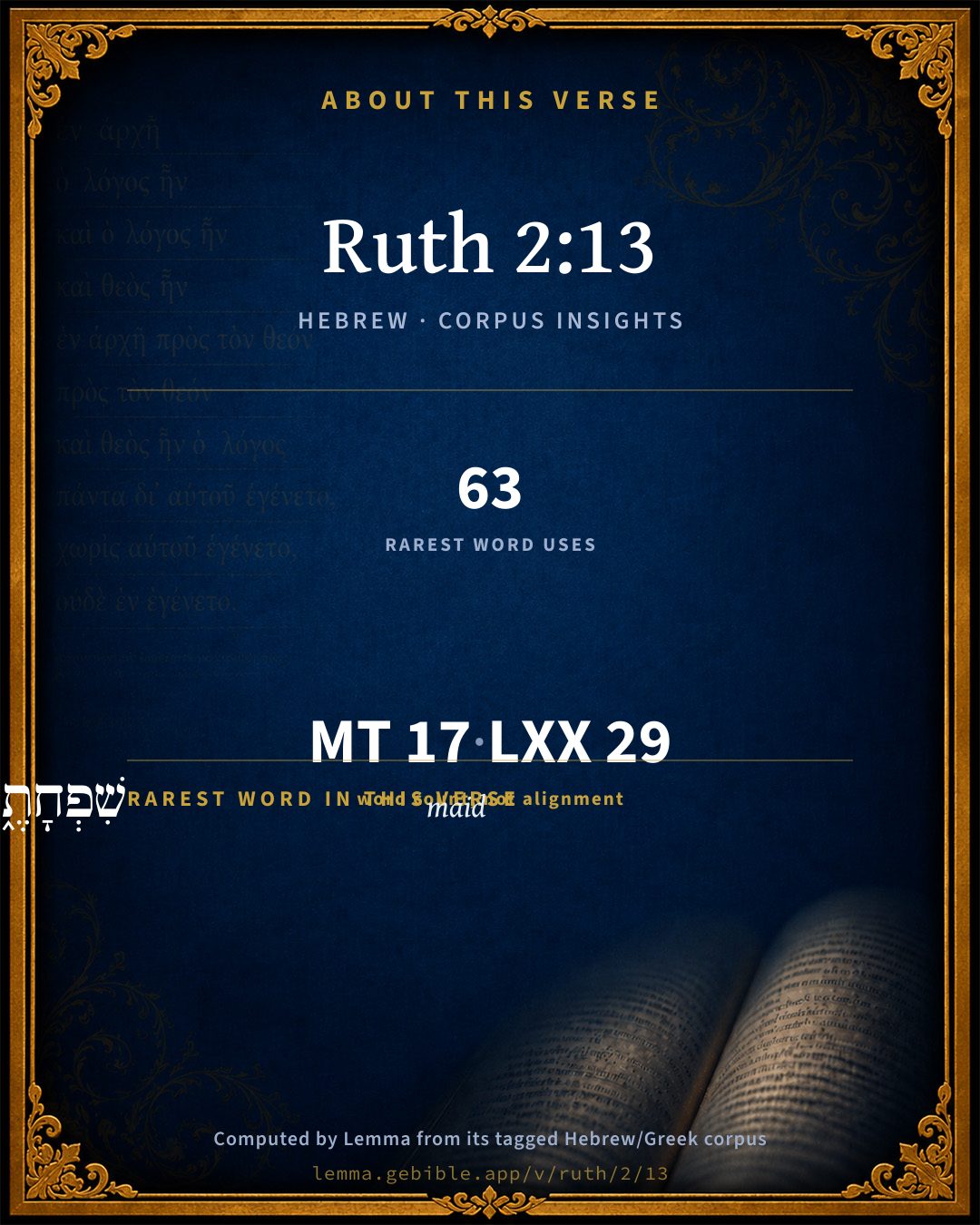
These counts appear in no published source. They are computed here, from the morphology-tagged text and Lemma’s own curated glosses. What Lemma adds →

17
words
15
distinct lemmas
Historical
section

Grammatical profile

  • 5 verbs
  • 6 nouns
  • 1 adjective
  • 1 pronoun
  • 1 preposition
  • 2 conjunctions
  • 1 particle

Verb forms

  • וַ֠תֹּאמֶר Qal · Sequential Imperfect
  • אֶמְצָא Qal · Imperfect
  • נִֽחַמְתָּ֔נִי Piel · Perfect
  • דִבַּ֖רְתָּ Piel · Perfect
  • אֶֽהְיֶ֔ה Qal · Imperfect

Repetition

Words recur within this verse — often emphatic in Hebrew:

  • שִׁפְחָתֶ֑ךָ maid H8198 ×2
  • כִּ֣י that H3588 ×2

Hebrew & Septuagint length

In English translation the verse runs 35 words from the Hebrew and 36 from the Septuagint (LXX English) — closely comparable.

A rough comparison of the two English renderings, which tokenize alike — not a word-level alignment.

Word counts can differ between the Hebrew and the Greek without any difference in meaning — e.g. the Hebrew direct-object marker אֵת has no separate Greek word, and Greek often adds the article ὁ.

In the original languages it is 17 Hebrew tokens and 29 Greek tokens — but the two are counted differently (Hebrew bundles its prefixes and suffixes into one token; the Greek is in lemma form), so that isn’t a like-for-like length.

Cross-references

11

Topical passages linked to Ruth 2:13 in the Treasury of Scripture Knowledge — connected by theme and wording, ordered by reader-vote popularity; previews shown in the World English Bible.

  • 1 Samuel 1:18 She said, Let your handmaid find favor in your sight. So the woman went her way, and ate; and her facial expression wasn't sad any more.
  • Genesis 33:8 Esau said, "What do you mean by all this company which I met?" Jacob said, "To find favor in the sight of my lord."
  • Genesis 34:3 His soul joined to Dinah, the daughter of Jacob, and he loved the young lady, and spoke kindly to the young lady.
  • Philippians 2:3 doing nothing through rivalry or through conceit, but in humility, each counting others better than himself;
  • Genesis 33:10 Jacob said, "Please, no, if I have now found favor in your sight, then receive my present at my hand, because I have seen your face, as one sees the face of God, and you were pleased with me.
  • Genesis 33:15 Esau said, "Let me now leave with you some of the folk who are with me." He said, "Why? Let me find favor in the sight of my lord."
  • Genesis 43:14 May God Almighty give you mercy before the man, that he may release to you your other brother and Benjamin. If I am bereaved of my children, I am bereaved."
  • 1 Samuel 25:41 She arose, and bowed herself with her face to the earth, and said, Behold, your handmaid is a servant to wash the feet of the servants of my lord.
  • 2 Samuel 16:4 Then said the king to Ziba, Behold, all that pertains to Mephibosheth is yours. Ziba said, I do obeisance; let me find favor in your sight, my lord, O king.
  • Judges 19:3 Her husband arose, and went after her, to speak kindly to her, to bring her again, having his servant with him, and a couple of donkeys: and she brought him into her father's house; and when the father of the young lady saw him, he rejoiced to meet him.
  • Proverbs 15:33 The fear of Yahweh teaches wisdom. Before honor is humility.

Cross-references courtesy of OpenBible.info (CC BY 4.0).

Hebrew and Greek witnesses Masoretic Hebrew ↔ Greek Septuagint

The same verse in the two great witnesses to the Old Testament, shown verse-for-verse.

These are two independent witnesses, not word-aligned to each other, and the Septuagint is shown in lemma (dictionary) form.

Hebrew Ruth 2:13 Masoretic · Westminster Leningrad Codex

וַ֠תֹּאמֶר אֶמְצָא חֵ֨ן בְּעֵינֶ֤יךָ אֲדֹנִי֙ כִּ֣י נִֽחַמְתָּ֔נִי וְכִ֥י דִבַּ֖רְתָּ עַל לֵ֣ב שִׁפְחָתֶ֑ךָ וְאָנֹכִי֙ לֹ֣א אֶֽהְיֶ֔ה כְּאַחַ֖ת שִׁפְחֹתֶֽיךָ

Then she said, Let me find favor in your sight, my lord, because you have comforted me, and because you have spoken kindly to your handmaid, though I am not as one of your handmaidens.

World English Bible · Public Domain

Greek LXX Ruth 2:13 Septuagint · lemma form

ὁ δέ εἶπον εὑρίσκω χάρις ἐν ὀφθαλμός σύ κύριος ὅτι παρακαλέω ἐγώ καί ὅτι λαλέω ἐπί καρδία ὁ δούλη σύ καί ἰδού ἐγώ εἰμί ὡς εἷς ὁ παιδίσκος σύ

And she said, Let me find grace in your sight, my lord, because you have comforted me, and because you have spoken kindly to your handmaid, and behold, I shall be as one of your servants.

LXX2012 (modern English Septuagint) · Public Domain

On this verse, The Preacher's Complete Homiletical Commentary discusses the Septuagint’s reading. Read the note in Commentary ↓

Hebrew: Westminster Leningrad Codex (CC BY 4.0). Greek: Septuagint (public domain); English from LXX2012 (modern English Septuagint) (Public Domain). How the Septuagint differs from the Hebrew →

Commentary

Notes on Ruth 2:13 from classic Christian and Jewish commentators (each source and its license shown beneath its notes). The classic Christian expositions comment on the surrounding passage and are grouped to its opening verse, so a note may address several verses; the Jewish commentaries on the Tanakh (Rashi and others) are per-verse, so they appear only where the commentator wrote on this verse.

Lemma curates 59 commentaries, every one of them public domain or Creative Commons licensed, each selected and text-cleaned for this edition rather than reprinted as found. About our sources →

Trapp's Complete Commentary

John Trapp

Rth 2:13 Then she said, Let me find favour in thy sight, my lord; for that thou hast comforted me, and for that thou hast spoken friendly unto thine handmaid, though I be not like unto one of thine handmaidens.

Ver. 13. Let me find favour in thy sight, {a} my lord.] May I be so happy as still to continue high in thy love and favour, though I be never so unworthy. See 2Sa 16:4. {See Trapp on "2Sa 16:4"}

For that thou hast comforted me,] viz., By thy praising me, praying for me, and speaking kindly unto me.

“Oργης νοσουσης εισιν ιατροι λογοι.” - Aeschylus.

Comfortable words "do good like a medicine."

To thine handmaid.] He had called her "daughter": she thinks not the better of herself for that; she is his "handmaid" still, yea, she addeth, "Though I be not like one of thy handmaidens."

{a} Habeas me tibi commendatam.

John Trapp, A Commentary or Exposition upon All the Books of the Old and New Testament (1647–1656) — public domain. Text from a community e-Sword module.

The Biblical Illustrator

Joseph S. Exell

Rth_2:13

Let me find favour in thy sight, my lord; for that thou hast comforted me.

Good from encouraging words

Is there not a useful suggestion in all this to persons in places of authority and influence? There is sometimes a grievous fault in withholding praise from others. At the fountain-head of some of our greatest rivers a slight touch of the hand or foot would be sufficient to determine the course in which they should ever afterwards flow. And, in like manner, a kind word spoken to another at a moment when the heart is ready to faint may be the means of dispelling the chill of despondency, of stimulating the efforts of an honest industry, of confirming good resolutions, and of helping to fix the future destiny of a brother. Some persons are far too much afraid of the effect of a little generous and well-timed praise. They would keep all their flowers in an ice-house. Letting in a little sunshine upon them at times would not be amiss. Let masters and parents and teachers try the experiment of what an encouraging word or look can sometimes do. Let it be distinctly seen by those whom they can influence that they are on the side of whatever is virtuous in effort, noble in aim, and heavenward in aspiration. (A. Thomson, D. D.)

The Biblical Illustrator, edited by Joseph S. Exell (c. 1880s–1900s) — public domain. Text from a community e-Sword module.

Joseph Benson's Commentary

Rth 2:13. She said, Let me find favour — Or, I find favour, &c. For it is evidently an acknowledgment of the kindness she had already received, and not a petition for a further kindness. Though I be not like, &c. — That is, though I have not deserved it, being a person more mean, obscure, and necessitous, than one of thy handmaidens — A stranger, and one born of heathen parents, and not of the holy and honourable people of Israel, as they are.

Joseph Benson's Commentary on the Old and New Testaments (1811–1818) — public domain. Text from a community e-Sword module.

The Preacher's Complete Homiletical Commentary

Joseph S. Exell (gen. ed.)

CRITICAL AND EXEGETICAL NOTES.—Let me find favour. I find favour (Le Clerc, Bertheau). This trans. not in accordance with the modesty of humility, which Ruth manifests in the following words (Keil). Lange and Keil take it as optative, and translate, “May I find favour.” The sense rather is as in Psa_41:11. (By this I know that) I am finding favour, because Thou comfortest me, etc. (Speaker’s Com.). She had found favour in his sight already. The words are to be translated as expressing this, and not a further desire. So Gill and others. Spoken friendly. Lit. to the heart. Trans. kindly (Gen_24:3; Gen_50:21); comfortably, (2Sa_19:7), etc. (Speaker’s Com.). Be not like unto. Lit. be not as—that is, not on a par with them (Wordsworth). But what am I saying when I call myself thy maiden? I am not worthy to be compared to the least of thy maidens (Carpzov). The LXX. leaves out the negative particle, and trans., “I shall be as one of thy handmaidens.” So the Syriac, which reads, “And she said to him, Because I have found mercy in thine eyes, my lord, and thou hast consoled me and comforted me, I will be as one of thine handmaids.” So the Arabic, with some variations. Boaz had placed her among his handmaids (Rth_2:9), and goes on to treat her as such (Rth_2:14). Nothing could be more delicate or appropriate than the language of the Syr. trans., or more in accordance with Eastern ways of speech.

Rth_2:14. At mealtime. Lit. at the time of food (Wright). The time of the noontide lunch. The principal meal was taken after the labours of the day were over (Steele and Terry). Bread, provisions generally. Vinegar, Heb. chomets. a cooling and refreshing drink made of sour wine mingled with oil; still used in the East (Keil, Wordsworth, Rosen., etc.). A kind of acid sauce (A. Clarke). Used because of the heat of the season (Jarci, Aben Ezra). The Midrash gives an allegorical sense to this, as meaning the chastisement and affliction of the Messiah. Dip thy morsel in the vinegar. Cf. Christ’s words when He gave the sop to Judas (Joh_13:26). The Arabs to this day dip the bread and hand together (Dr. Shaw). It is truly incredible how the biscuit, eaten with vinegar and oil, strengthens the weary and exhausted system, and restores its powers (Heberer). The drink of the Roman soldiers, called posca. consisted of water and vinegar (Lange). Sat beside the reapers. From this we may not infer the two sexes ordinarily took their meals together (Steele and Terry). Parched corn. Made of the best ears, when they are not too ripe. Roasted in a pan or on an iron plate (Robinson). The green ears become half charred by the roasting, and there was a pleasant mingling of milky wheat and a fresh crust flavour as we chewed the parched corn (Tristram). And was sufficed [satisfied] and left [over]. Was obliged to leave some, which it seems (Rth_2:18) she carried home to her mother-in-law (Gill).

Rth_2:13

Theme.—THE HEART REALIZING A MINISTRY OF LOVE

“Virtue is bold, and goodness never fearful.”—Shakespeare.

“Low at Thy feet I lie, my Saviour and my God,

Low at Thy feet I lie, nor feel the chastening rod;

Who lose their all to find the Spirit here,

Have found this freedom from all further fear,

Safe at Thy feet.”—B.

Let me find favour in thy sight, my lord; for that [or, I am finding, etc., because] thou hast comforted, etc.

A thankful heart will seek the continuance even of undeserved favours. Ruth did not wonder more at the kindness of Boaz (Rth_2:10), than show herself ready to respond to it. The text is not so much a request as an acknowledgment;—she had found favour in his sight already [see Crit. and Exeg. Notes],—and should be so translated.

See here,

I. The secret of all true and effective ministries.

(1) He had “spoken to the heart” [so the Heb., LXX.]. The hidden springs of sensibility had been opened, and here is the response. So when the Jews comforted Mary and Martha (Joh_11:19), the Syriac translates, “they spake with their heart.” All other speech ineffective in comparison with this, especially so when speaking on such tender and momentous subjects as the soul’s refuge, “the wings of the Almighty.”

(2) He had spoken kindly in praising her virtues and in praying for her. Kind words generally, if not always, unlock the human heart.

(3) He had comforted her in deed as well as in speech. What wonder that she says, or seems to say, “I know by this that I am finding favour in thy sight”!

See here,

II. A beautiful instance of the heart becoming conscious of this ministry of love. The meaning of his kindness dawns upon her, and is dawning, as she recounts the manner of its manifestation. [Trans. (I see that,) I am finding favour in thy sight, because thou comfortest me (Speaker’s Com.)] So there is a special moment in the history of every Christian, when the heart begins to realize the Divine love. His comforts and His tenderness to us are seen, and shine out the more conspicuously as tokens of His regard.

Note. She was not one of his handmaids, and yet she realizes that he is treating her as such. Gives her a position among them, etc. So the Apostle sees himself as one born out of due season, not meet to be called an apostle, and yet raised to these privileges, etc. (1Co_15:8-10). So the prodigal finds himself placed among the children, and possessing a goodly heritage [comp. Jer_3:19 with Luk_15:21-23]. So with all who are truly called and chosen of God. They see themselves the recipients of mercies and comforts, as unexpected as they are gracious; and exalted to a position and privileges not only dignified, but prophetic of still livelier favours yet to come. “Beloved, now are we the sons of God,” etc.

See here,

III. An instance of the heart responding to these tokens of goodwill. Ruth evidently felt that this was her one opportunity, and acts as though she felt it. Had not been forward in making known her claims, but, on the other hand, is not backward in responding to his kindness.

(1) She exalts her benefactor. She calls him “my lord,” and so magnifies his mercy.

(2) She is not unduly exalted herself. Rather she feels her own humble position the more, and deprecates her own unworthiness: “I am not like unto one of thine handmaidens.” So the centurion did not think himself worthy that Christ should come under his roof. To the humble, every mercy comes as the voice of undeserved kindness, which encourages without puffing up (Macartney).

So in spiritual things. The soul’s response to “Seek ye my face” is, “Thy face, Lord, will I seek.” While it magnifies the Divine mercy, and enlarges upon the tokens of the Divine love, it is ready like Ruth to humble itself in the dust at the Master’s feet.

LESSONS.—

(1) It is lawful to give honourable titles to men, such as befit their place [cf. Gen_23:6; Num_12:11; 1Sa_1:15; 1Ki_18:7; 2Ki_8:12].

(2) The more humble men of wealth show themselves, the more honour they get (Bernard). Those stars seem to us the greatest, and shine the brightest, which are set the lowest (Fuller).

(3) Comfortable words do good like a medicine (Trapp). They do more, they bring out that which is good in the recipient. So here, the more generously Ruth is dealt with, the more unassuming does she become. So with the saints at last (Matthew 25): “Lord, when saw we Thee an hungred?” etc.

E. Price on this:—

Theme.—THE OUTWARD PROOF OF THE DIVINE REGARD

He predisposes influential men to give us their affection.

Note the steps of the process:—

1. We are rendered acceptable to them, finding “favour” with them.

2. We are solaced amidst the providential movements around us. They comfort the heart.

3. We are addressed by the assuring words of sympathy.

They express the affection borne to us, and hence

(4) we are astonished at the Lord’s wonderful condescension to our unworthiness.

Infer. Humility bears direct proportion to our sense of the Divine favour.

Whenever a Ruth trusts in God, a Boaz is sure to appear.

“To the humble mind of Ruth the words of Boaz were the first sunbeam that broke through the grief and tears of many weeks. Hitherto she had tasted only parting sorrow. Now, for the first time, she is addressed about the God of Israel and His grace. The full import of his words her humble heart does not presume to appropriate. But the kindness of the speaker’s voice is for her like the sound of a bubbling spring in the desert to the thirsty. A word of love comes on a loving heart like hers, long afflicted by sorrow, like morning dews on a thirsty field.”—Cassel (in Lange).

“Oh that ministers had this faculty of speech! not to tickle the ears, teach the heads, or please the brains of the people, but that their sermons might soak and sink to the root of their hearts. But though this may be endeavoured by them, it cannot be performed of them without God’s special assistance. We may leave our words at the outward porch of men’s ears; but His Spirit must conduct and lodge them in the closet of their hearts.”—Fuller.

“Pleasant words are like an honeycomb, sweet to the soul. Those words which at once indicate friendship and nourish piety are doubly pleasant. Boaz had not only expressed his affection and esteem to Ruth, but raised her views to the Lord God of Israel, from whom he encouraged her to expect her reward. His words were no less valued by her than his gifts. Words are cheap to ourselves, and they may be very precious to those to whom they are addressed, especially to those who need our sympathy.”—Lawson.

“A little word in kindness spoken,

A motion, or a tear,

Has often healed the heart that’s broken,

And made a friend sincere.”

Whittier.

“There are occasions when speech is golden rather than silence, and when an encouraging word would be of more real value than the richest material gift.… Some persons are far too much afraid of the effect of a little generous and well-timed praise. They would keep all their flowers in an ice house. Letting in a little sunshine upon them at times would not be amiss. How lavish was the wise and large-hearted Paul with his words of commendation, whenever they could be honestly spoken or written!”—Dr. A. Thomson.

“Opportunity is the flower of time, and as the stalk may remain when the flower is cut off, so time may remain with us when opportunity is gone.”—Bond.

“Augustine being asked what was the first article in the Christian religion, replied, ‘Humility;’ and what the second, ‘Humility;’ and what the third, ‘Humility.’ ”—Dic. of Illustrations.

“ ‘Lord, when did we do all this?’ So completely is their mind and memory filled with His goodness, that there is no standing-place there for any recollection of their own acts of love to Him. So abounding and immeasurable appears His love to them, that less than nothing, in the comparison, seems every act of theirs for Him in return. Like Ruth, they can praise Him for the comfort He has bestowed upon them, for the gracious and friendly way in which He has spoken to them; but all this only increases their sense of their own unworthiness of such mercy.”—Tyng.

“The train of our adorable Immanuel is so august, so glorious by His communicated grace, that the poor believer cannot easily be brought to consider himself amongst the happy number. All the holy angels, all the glorified saints, day and night attend upon His pleasure; ten thousand times ten thousand stand before Him, and thousands of thousands fly at His command. The patriarchs and prophets, the apostles and evangelists, the noble army of martyrs, and all the spirits of just men made perfect, swell His brilliant train; and how can I, who am so black and swarthy, so wretched and sinful, be numbered amongst company so honourable? Whence is it to me that my Lord should regard me with favour, and permit me to approach Thy sacred presence, and encourage me to feed on the bounties of Thy grace?”—Macgowan.

Rth_2:14

Theme.—PROVISION FOR THE STRANGER AT THE GATE

“That best portion of a good man’s life;

His little, nameless, unremembered acts

Of kindness and of love.”—Wordsworth.

“A poor man, served by thee, shall make thee rich;

A sick man, helped by thee, shall make thee strong;

Thou shalt be served thyself by every sense

Of service which thou renderest.”—Mrs. E. B. Browning.

God has from the beginning made the cause of the poor man His own (Baldwin Brown). Rich men, if good men, are to be His almoners. To such Christ says, “The poor ye have always with you.” See how natural kindness is to such! one deed of love leading to another and a better almost unconsciously. That of Boaz like an open fountain when it has once begun to flow (Dr. Thomson). From kind actions he goes on to comforting words, and from comforting words to kind actions once again. Wonderful how Providence does open the heart to strangers! Joseph was so affected by the treatment he received as such in Egypt, that he called one of his sons by a name expressive of what he felt (Toller). Boaz, in his treatment of Ruth, a beautiful illustration of the way Christ receives such.

I. He invites her to come and partake of the meal provided for his servants. Not meet to give the children’s bread unto dogs (Mat_7:6; Mar_7:27); and yet, from the voice calling Adam in the garden, to the Spirit and the bride saying “Come,” in the Apocalypse, the Word of God is full of invitations to wandering, weary men.

II. He seats her in honour among his reapers. So the Saviour calls the Gentiles to be co-heirs with His own people; puts the alien among His children; exalts Saul the persecutor to be the chiefest among the apostles; gives His saints at last an inheritance among the angels of God.

III. He reaches forth his own hand to provide for her wants. So the Saviour sent not a servant, but came Himself, to provide for man’s need. “He saw there was no man, and wondered that there was no intercessor” (Isa_59:16), “Therefore,” He says, “mine own arm brought salvation” (Isa_63:5).

IV. He satisfies these wants completely. There was plain fare, but it was sufficient. Nature is content with a little, and hunger hunteth not after delicacies (Trapp). So in the spiritual realm, every real want of man is provided for by the gospel of Jesus Christ.

Spurgeon on this (condensed):—

Theme.—MEALTIME IN THE CORNFIELD: A HARVEST SERMON

I. God’s reapers have their mealtimes. A good master will not muzzle the ox that treadeth out the corn. Christ’s reapers not only have a blessed reward at last; they have also plenteous comforts by the way. They have

(1) mealtimes, when they come together to listen to the word preached. Where the doctrines of grace are plainly and boldly delivered in connection with the other truths of revelation; where the cross is lifted up, where the work of the Spirit is not forgotten, there is sure to be food for the children of God. Our hearers must have their portion of meat in due season. There must be something for all—milk for babes, etc.

(2) Mealtimes in our private readings and meditations. Meditation is digestion, and the finest wheat is to be found in secret prayer. The shepherd of Salisbury Plain said, when his wallet was empty, his Bible was meat to him.

(3) One mealtime that is specially ordained—in the supper of our Lord. In keeping the Master’s command there is great reward. Like poor Mephibosheth, we are made to sit at David’s table. The prodigal eats the meat of children.

(4) Mealtimes which God gives us at seasons when perhaps we little expect them. In the street, in the middle of business; when dull and earth-bound; suddenly. In the morning, as if the dew was visiting the flowers; in the evening, etc.

(5) Mealtimes at certain seasons when we may expect them. The Eastern reaper has a set time. So in affliction we may expect them; after toil we may look for them; and again, before a trial. Elijah must be entertained beneath a juniper tree, for he is to go forty days in the strength of that meat. After trouble or arduous service.

II. To these meals the gleaner is affectionately invited. The poor trembling stranger, who has no right to be in the field, except the right of charity, is called to the meals of the strong-handed, full-assured reaper.

(1) The gleaner is invited to come. “At mealtimes come thou hither.” None should be kept away from the place of feasting, the house of God, by personal character, or poverty, or physical infirmities. A poor deaf woman, asked why she was always there, replied, “that God was pleased to give her many a sweet thought upon the text while she sat in His house.”

(2) Again, not only to come, but to eat. Whatever the sweet and comfortable word, the broken and the contrite spirit is invited to partake of it. You are saying, “I have no right;” but He gives you the invitation. “You are unworthy;” but He bids you come. Further, Ruth was not only invited to eat the bread, but to dip her morsel in the vinegar—a sauce which the Orientals used with their bread. So the Lord’s reapers have not merely doctrines, but the holy unction which is the essence of doctrines—not merely truths, but the hallowing and ravishing delight which accompanies the truths.

III. Boaz reached her the parched corn. Christ does this to believers

(1) when He inspires their faith;

(2) when He sheds abroad the love of God in their hearts;

(3) when He gives us close communion with Himself;

(4) when He gives us the infallible witness that we are born of God. Philip de Morny was wont to say that the Holy Spirit had made his salvation as clear to him as ever a problem proved to a demonstration in Euclid could be.

IV. She did eat, and was sufficed, and left. Sooner or later every penitent shall become a satisfied believer—head, heart, hope, desire, conscience, judgment, memory, imagination, all filled.

E. Price on this:—

Theme.—THE COMMON MEAL

It should be characterized by the following particulars:—

It should indicate the Divine hand in providing it.

It should minister to the calm contentment of our hearts.

It should indicate a self-respect before men.

It should prepare for the next duties in life.

Hence conclude—

If God provide for a Ruth, the daily bread will not only come to the hand, but satisfy all the longings of the heart.

“One fact I think I have everywhere observed: the farther one moves from the high road and the busy marts of men, the more people are shut in by the mountains, isolated and confined to the simplest wants of life, the more they draw their maintenance from simple, humble, and unchangeable pursuits; so much the better, the more obliging, the more friendly, unselfish, and hospitable are they.”—Goethe.

“You have seen the stagnant pool, overgrown with weeds, into which the rain falls and the showers descend, but which gives out no fertilizing stream to water the barren earth around. There is the image of an avaricious and selfish life—a life stagnant and noxious in the sight of God and man. And you have seen the mountain lake, clear as crystal, into which the brooks run and the streamlets flow, but which sends them forth again a broad river to refresh and make glad the earth. There is the image of a life responding to the law of Christian usefulness, counting itself as steward only for a while, and not as owner of all that it possesses.”—B.

“Wherefore doth the Lord make your cup run over, but that other men’s lips might taste the liquor? The showers that fall upon the highest mountains should glide into the lowest valleys.”—Secker.

“The precept of love was given also in the moral law. That law contains ten commandments, but they may all be reduced to this, ‘Love the Lord thy God with all thy heart, and thy neighbour as thyself.’ … If we go farther back still, we shall find the ancient commandment in existence; for the law of love is as old as human nature itself. ‘God created man in His own image’—gave him a spiritual nature, possessed of the powers of thought, will, conscience, imagination, and the faculty of goodness or love. Two things should be noticed with regard to the last of these. First, the faculty of love belongs to him as man—is part of his nature. Treat the flower rightly, plant it where the sun-rays play, and it will grow and become beautiful, and will fill the surrounding atmosphere with its fragrance, for it is made to give itself away; and if man had been true to himself, if he had avoided sin, and lived in all his faculties, his good-will and love would have gone forth to his fellows as naturally as perfume from the flower. Second, the sense or feeling that love is right, that it is a duty; and that to hate others, or even to be indifferent to them, is wrong. This is the Divine testimony in man’s conscience, the ‘old commandment’ of the gospel and of the law in another form—a silent commandment which makes itself heard and felt without the use of words.”—Thomas Jones.

“The very essence of charity is disinterested goodness; and although we may like it the better for its returns of benefit, we must obey its impulses from delight itself. Where we fail in this, our charity fails, although our deeds of beneficence still be abounding.”—Anon.

“The rich man’s superfluity was ordained to relieve the poor man’s necessity. A lady, on giving sixpence to a beggar, accosted him thus: ‘I have now given you more than God ever gave me.’ To whom he replied, ‘No, madam; God hath given you all your abundance.’ ‘That is your mistake,’ said she, ‘for He hath but lent it me that I might bestow it on such as you.’ ”—Secker.

“Men resemble the gods in nothing so much as in doing good to their fellow-creatures.”—Cicero.

“Seneca the heathen inculcates a principle worthy the credence of every Christian: I believe I truly enjoy no more of the world’s affluence than what I willingly distribute to the necessitous.’ Without your mercy the poor cannot live on earth, and without God’s mercy you shall not live in heaven.”—Secker.

“This also is given to pious souls by God, that being devoted to Him, He often secretly, and even without their becoming aware of it, impels them to this or that good action.”—Starke.

“Is not this the very way in which our rich Kinsman deals with those whom He loves and saves?… He calls poor fainting sinners to come without doubt or fear, and take their place among the company of the redeemed; for everything is there provided which they can need—abounding grace for abounding sin. He ministers Himself to their secret wants. He reaches forth with His own hand the parched corn of His sacrifice for them. And in this secret, personal, divine ministration, they eat and are sufficed.”—Tyng (condensed).

“ ‘Oh! but,’ says one, ‘how can it be? I am a stranger.’ Yes, a stranger; but Jesus Christ loves the stranger. ‘A publican, a sinner;’ but He is ‘the Friend of publicans and sinners.’ ‘An outcast;’ but He ‘gathereth together the outcasts of Israel.’ ‘A stray sheep;’ but the shepherd ‘leaves the ninety and nine,’ to seek it. ‘A lost piece of money,’ but He ‘sweeps the house’ to find it. ‘A prodigal son;’ but He sets the bells a-ringing when He knows that thou wilt return. Come, Ruth! Come, trembling gleaner! Jesus invites thee; accept the invitation. ‘At meal-time come thou hither, and eat of the bread, and dip thy morsel in the vinegar.”—Spurgeon.

“We must not look upon this as being some sour stuff. No doubt there are crabbed souls in the Church, who always dip their morsel in the sourest imaginable vinegar, and with a grim liberality invite others to share a little comfortable misery with them; but the vinegar in my text is altogether another thing. This was either a compound of various sweets expressed from fruits, or else it was that weak kind of wine mingled with water which is still commonly used in the harvest-fields of Italy and the warmer parts of the world—a drink not exceedingly strong, but excellently cooling, and good enough to impart a relish to the reapers’ food.”—Ibid.

“You may suspect some danger nigh when your delights are overflowing. If you see a ship taking in great quantities of provision, it is bound for a distant port. And when God gives you extraordinary seasons of communion with Jesus, you may look for long leagues of tempestuous sea. Sweet cordials prepare for stern conflicts. Times of refreshing also occur after trouble or arduous service. Christ was tempted of the devil, and afterwards angels came and ministered unto Him. Jacob wrestled with God, and then afterwards, at Mahanaim, hosts of angels met him. Abraham wars with the kings, and returns from their slaughter; then it is that Melchisedec refreshes him with bread and wine. After conflict, content; after battle, banquet. When thou hast waited on thy Lord, then thou shalt sit down, and thy Master will gird Himself and wait upon thee.”—Ibid.

The Preacher's Complete Homiletical Commentary (gen. ed. Joseph S. Exell; Funk & Wagnalls, c. 1892) — public domain (pre-1929). A full-Bible homiletical/sermon-outline anthology covering 65 of 66 books (2 John is absent from the source module). Text from a community e-Sword module.

Tyndale Open Study Notes

Tyndale Open Resources

2:13 your workers (literally your maidservants): By her use of this term, Ruth placed herself lower on the social scale than Boaz’s servants.

Tyndale Open Study Notes — © Tyndale Open Resources, licensed CC BY-SA 4.0. Text via the HelloAO Bible API.

Adam Clarke's Commentary

Verse 13. Not like unto one of thine hand-maidens.] I am as unworthy of thy regards as any of thine own maidservants, and yet thou showest me distinguished kindness.

Adam Clarke's Commentary on the Bible (1810–1826) — public domain. Text from a community e-Sword/MySword module.

Ellicott's Commentary for English Readers

(13) Friendly.—Literally, unto the heart. The same phrase is rendered comfortably (Isa_40:2).

A Bible Commentary for English Readers, edited by Charles John Ellicott (1878–1897) — public domain. Text from a community e-Sword module.

The Cambridge Bible for Schools and Colleges

gen. ed. J. J. S. Perowne

13. comforted … spoken kindly unto] The same words in Isa_40:1-2. See on Jdg_19:3.

though I be not] As a stranger Ruth is not like one of his handmaidens; she has no right to expect such friendly treatment.

The Cambridge Bible for Schools and Colleges (gen. ed. J. J. S. Perowne; Cambridge University Press, 1878–1918) — public domain. Text from a community e-Sword module.

John Gill's Exposition

Then she said, let me find favour in thy sight, my lord,.... Or rather, since she had found favour in his sight already: the words are to be considered, not as a wish for it, but as acknowledging it, and expressing her faith and confidence, that she should for time to come find favour in his sight, and have other instances of it; for so the words may be rendered, "I shall find favour" (z), for which she gives the following reasons:

for that thou hast comforted me, and for that thou hast spoken friendly unto thine handmaid; had spoken in her commendation, and wished her all happiness here and hereafter; said kind and comfortable words to her, to her very heart, as in Isa 40:2 which were cheering, refreshing, and reviving to her:

though I be not like unto one of thine handmaidens; not worthy to be one of them, or to be ranked with them, being meaner than the meanest of them, a poor widow, and a Moabitish woman; the Septuagint and Syriac versions leave out the negative particle, and read, "I shall be as one of thine handmaids".

(z) "inveniam gratiam", Pagninus, Montanus.

John Gill's Exposition of the Whole Bible (1746–1763) — public domain (CC PDM 1.0). Text via the HelloAO Bible API.

Haydock's Catholic Bible Commentary

Heart. This has the same meaning as the former part of the sentence. (Calmet) See Osee ii. 14. (Haydock) --- Maids, but more lowly and mean. (Menochius)

George Leo Haydock (1774–1849), Haydock's Catholic Family Bible and Commentary, 1859 edition — public domain. Excludes Psalms (Douay-Rheims chapter numbering differs from Protestant) and Deuterocanonical books (Catholic canon only).

Matthew Poole's English Annotations

Let me find favour in thy sight; I humbly implore the continuance of thy good opinion of me, though I do not deserve it.

Not like unto one of thy handmaidens; a person more mean, and necessitous, and obscure, being a stranger, and one born of heathenish parents, and not of the holy and honourable people of Israel, as they are.

Matthew Poole's English Annotations on the Holy Bible (1683–1685) — public domain. Text from a community e-Sword/MySword module.

Whedon's Commentary on the Bible

Daniel D. Whedon

13. Thou hast comforted me — “To the humble mind of Ruth the words of Boaz were the first sunbeam that broke through the grief and tears of many weeks. Hitherto she had tasted only parting sorrow. Now, for the first time, she is addressed about the God of Israel and his grace. The full import of his words her humble heart does not presume to appropriate. But the kindliness of the speaker’s voice is for her like the sound of a bubbling spring in the desert to the thirsty. A word of love comes on a loving heart like hers, long afflicted by sorrow, like morning dews on a thirsty field.” — Cassel.

Though I be not like unto one of thine handmaidens — Though I be a stranger from a foreign land, and have done thee no service as these maidens who assist thy reapers, yet thou speakest to my heart words of comfort.

Daniel D. Whedon (gen. ed.), Commentary on the Old and New Testaments (1874–1909) — public domain. Text from a community e-Sword module.

The Pulpit Commentary

May I continue to find favor, sir, in thine eyes, for indeed thou hast comforted me, and cheered the heart of thine handmaid, and yet I have not the position of one of thy maidens. To be one of his maidens was, in her estimation, to be in a most desirable condition. She could not aspire to that. But as he had spoken so graciously to her heart, and soothed its sorrows, she trusted he would still befriend her. axma, should not be rendered, with the Vulgate, "I have found" (inveni); nor, with Tremellius and Junius, "I find" (in, ohio); but, with Piscator, optatively, "may I find" (inveniam), that is, "may I still find, may I continue to find. So Luther, Coverdale, and Michaelis. The courtesy-expression, rendered in King James"s version "my lord" (ynidoa Mein-Herr or Men-sieur), is used, as Carpzov remarks, in "humility and civility."

The Pulpit Commentary (1880–1919), ed. H.D.M. Spence-Jones & Joseph S. Exell — public domain. Text from a community e-Sword module.

John Wesley's Explanatory Notes

Tho' I be not - I humbly implore the continuance of thy good opinion of me, though I do not deserve it, being a person more mean, necessitous, and, obscure, a stranger, and one born of heathen parents, and not of the holy and honourable people of Israel, as they are.

John Wesley, Explanatory Notes Upon the Whole Bible (1754–1765) — public domain. Text via the GEBible commentary corpus.

Keil & Delitzsch

C. F. Keil & F. Delitzsch

Ruth replied with true humility, "May I find favour in thine eyes; for thou hast comforted me, and spoken to the heart of thy maiden (see Jdg 19:3), though I am not like one of thy maidens," i.e., though I stand in no such near relation to thee, as to have been able to earn thy favour. In this last clause she restricts the expression "thy maiden." Carpzov has rightly pointed this out: "But what am I saying when I call myself thy maiden? since I am not worthy to be compared to the least of thy maidens." The word אמצא is to be taken in an optative sense, as expressive of the wish that Boaz might continue towards her the kindness he had already expressed. To take it as a present, "I find favour" (Clericus and Bertheau), does not tally with the modesty and humility shown by Ruth in the following words.

Keil & Delitzsch — Biblical Commentary on the Old Testament (1861–1891) — public domain (CC PDM 1.0). Text via the HelloAO Bible API. (Old Testament only.)

unfoldingWord translationNotes

Door43 World Missions Community

Let me find favor in your eyes

Here "find favor" is an idiom that means be approved of or that he is pleased with her. Here "eyes" are a metonym for sight, and sight is a metaphor representing his evaluation. AT: "Please accept me" (See: Idiom and Metonymy and Metaphor)

I am not one of your female servants

Possible meanings are 1) Ruth was not one of Boaz's female servants or 2) Ruth did not think her marriage to Naomi's son granted her any privilege in Bethlehem.

translationWords

lord

servant

unfoldingWord translationNotes — © Distant Shores Media and the Door43 World Missions Community, licensed CC BY-SA 4.0. Source: git.door43.org/Door43/en_tn.

Rashi

Rabbi Shlomo Yitzchaki (Rashi)

but I am not as one of your handmaids I am not as worthy as one of your handmaids.

Rashi on the Tanakh — English translations: “The Judaica Press complete Tanach with Rashi, translated by A. J. Rosenberg” (CC BY 4.0); “Pentateuch with Rashi's commentary by M. Rosenbaum and A.M. Silbermann, 1929-1934” (public domain); “The Metsudah Tanach series, Lakewood, N.J” (CC BY 4.0); and “The Book of Joshua, Metsudah Publications, 1997” (CC BY 4.0). Text via Sefaria.

Ibn Ezra

Rabbi Abraham ibn Ezra

And I should not be. I am not worthy to be like one of your maidservants.

Ibn Ezra on the Tanakh — English translations: “Sefaria Community Translation” (CC0 1.0 (public-domain dedication)); “Yalkut, Sifsei Chachomim Chumash, Metsudah Publications, 2009” (CC BY 4.0); and “Commentary of Ibn Ezra on Isaiah - trans. by M. Friedlander, 1873” (public domain). Text via Sefaria.

Lesson kit

Teaching starters — assembled from the data on this page, not authored interpretation. Every prompt links to the verse data it draws on. Edit before teaching.

Ruth, in the Historical, opens this verse with 17 words (15 distinct Hebrew lemmas). Its most distinctive word is shiphchâh (“maid”). A historical commentator’s framing appears above. Read the whole chapter for the surrounding context.

Discussion questions

  1. How does “maid” (shiphchâh) shape what this verse is saying?
  2. How does 1 Samuel 1:18, which shares this passage’s theme, read alongside this verse?
  3. What does the repetition of “maid” (2× in this one verse) do in this verse?
  4. The translations on this page render this verse differently — a whole-verse word diff, not a word-by-word alignment. What might account for the different wordings?
  5. «וַ֠תֹּאמֶר» is a Qal Sequential Imperfect verb. How does that grammatical form shape the action described?
  6. Compare how Trapp's Complete Commentary and The Biblical Illustrator read this verse. Where do they agree or differ?

Things to notice

Reading settings

Reading text

Shown beneath each verse's original-language words.

Old Testament
Old Testament edition

Read the OT as the Masoretic Hebrew (MT) or the Greek Septuagint (LXX).

English shown for the Greek Septuagint (in the Hebrew ↔ Greek comparison).

Comparing translations? Open the Compare panel on any verse page to stack up to four side by side.