2 Timothy 4:22

Greek (Tischendorf 8th ed.) 2 Timothy 4:22 appears in the Greek New Testament. The text above is from the Tischendorf 8th edition. Each word links to its Strong’s number and a concise gloss. Click any word for its full Thayer’s Greek Lexicon entry.
Download image
Cite this verse

2 Timothy 4:22 (World English Bible). Public Domain. Lemma interlinear Bible study tool, https://lemma.gebible.app/v/2-timothy/4/22.

Show BibTeX & RIS
BibTeX
RIS
English Translation
The Lord Jesus Christ be with your spirit. Grace be with you. Amen.
World English Bible · Public Domain
Download a study sheet

One document with this verse’s original text, its word-by-word gloss line, the meaning frame, cross-references with their text, attributed commentary, and full source and license credits — printable, and it pastes into notes with its structure intact.

This verse Autodidact and up

Study sheet (.html) Plain text (.txt)

A passage Seminary Student

Up to 50 verses in one chapter. A passage sheet keeps up to 6 commentary sources and 12 cross-references per verse, in the order this page ranks them, and says so on the sheet whenever that leaves anything out. Ask for a single verse and you get the Autodidact verse sheet above.

Everything on this page stays free to read, with no account — the sheet is a download of what is already on screen, not access to it.

Want to remove ads? Support Godless Engineer
Compare translations 3

The same verse in 3 English versions, stacked beneath the original-language interlinear above. Click any original word for its lexicon entry.

Each is an independent rendering of the whole verse — the interlinear is not word-aligned to these translations.

Highlighted words mark where these versions differ — a whole-verse word diff, not a word-by-word alignment.

  • World English Bible Public Domain
    The Lord Jesus Christ be with your spirit. Grace be with you. Amen.
  • King James Version Public Domain
    The Lord Jesus Christ be with thy spirit. Grace be with you. Amen.
  • unfoldingWord Literal Text CC BY-SA 4.0
    The Lord with your spirit. Grace with you.

unfoldingWord Literal Text — © unfoldingWord, licensed CC BY-SA 4.0. Word-aligned USFM3 via Door43 (git.door43.org/unfoldingWord/en_ult).

Versions to compare (up to 4)

3 of 4 selected

Show all 19 translations

Every available English version of this verse, each an independent rendering of the whole verse.

  • World English Bible Public Domain
    The Lord Jesus Christ be with your spirit. Grace be with you. Amen.
  • Berean Standard Bible Public Domain
    The Lord be with your spirit. Grace be with you all.
  • Majority Standard Bible Public Domain
    The Lord Jesus Christ be with your spirit. Grace be with you all. Amen.
  • King James Version Public Domain
    The Lord Jesus Christ be with thy spirit. Grace be with you. Amen.
  • American Standard Version (1901) Public Domain
    The Lord be with thy spirit. Grace be with you.
  • Revised Version (1885) Public Domain
    The Lord be with thy spirit. Grace be with you.
  • Geneva Bible (1599) Public Domain
    The Lord Iesus Christ be with thy spirit. Grace be with you, Amen. The second Epistle written from Rome vnto Timotheus, the first Bishop elected of the Church of Ephesus, when Paul was presented the second time before the Emperour Nero.
  • Douay-Rheims (1899) Public Domain
    The Lord Jesus Christ be with thy spirit. Grace be with you. Amen.
  • Young's Literal Translation Public Domain
    The Lord Jesus Christ `is' with thy spirit; the grace `is' with you! Amen.
  • Literal Standard Version CC BY-SA 4.0
    The Lord Jesus Christ [is] with your spirit. The grace [is] with you! Amen.
  • Unlocked Literal Bible CC BY-SA 4.0
    May the Lord be with your spirit. May grace be with you.
  • unfoldingWord Literal Text CC BY-SA 4.0
    The Lord with your spirit. Grace with you.
  • Darby Bible Public Domain
    The Lord Jesus Christ [be] with your spirit. Grace [be] with you.
  • World Messianic Bible Public Domain
    The Lord Yeshua the Messiah be with your spirit. Grace be with you. Amen.
  • Webster's Bible Public Domain
    The Lord Jesus Christ be with thy spirit. Grace be with you. Amen.
  • Free Bible Version CC BY-SA 4.0
    The Lord be with you. May his grace be with you all.
  • Bible in Basic English Public Domain
    The Lord be with your spirit. Grace be with you.
  • Text-Critical English NT CC BY 4.0
    The Lord Jesus Christ be with yoʋr spirit. Grace be with you. Amen.
  • Tyndale New Testament (1534) Public Domain
    The Lorde Iesus Christ be with thy sprete. Grace be with you. Amen. ‘The seconde pistle written from Rome vnto Timothe when Paul was presented the seconde tyme vp before the Emperoure Nero.’

Literal Standard Version (2020), Covenant Press — licensed CC BY-SA 4.0. Text via the HelloAO Bible API (eBible.org). Unlocked Literal Bible (unfoldingWord) — licensed CC BY-SA 4.0. Text via the HelloAO Bible API (eBible.org). unfoldingWord Literal Text — © unfoldingWord, licensed CC BY-SA 4.0. Word-aligned USFM3 via Door43 (git.door43.org/unfoldingWord/en_ult). Free Bible Version, Dr. Jonathan Gallagher — licensed CC BY-SA 4.0. Text via the HelloAO Bible API (eBible.org).

Word by word

More ways to search: Search by grammar → Find every occurrence → Compare this word →

Practice this passage: Drill this verse → Learn its vocabulary →

χάρις
cháris
G5485
“grace”
Noun, Nominative, Singular, Feminine
Part of Speech
Noun
Case
Nominative
Number
Singular
Gender
Feminine
Full Thayer's Definition

Origin: from G5463

TDNT: 15:12,1

1. grace a. that which affords joy, pleasure, delight, sweetness, charm, loveliness: grace of speech 2. good will, loving-kindness, favour a. of the merciful kindness by which God, exerting his holy influence upon souls, turns them to Christ, keeps, strengthens, increases them in Christian faith, knowledge, affection, and kindles them to the exercise of the Christian virtues 3. what is due to grace a. the spiritual condition of one governed by the power of divine grace b. the token or proof of grace, benefit 1. a gift of grace 2. benefit, bounty 4. thanks, (for benefits, services, favours), recompense, reward
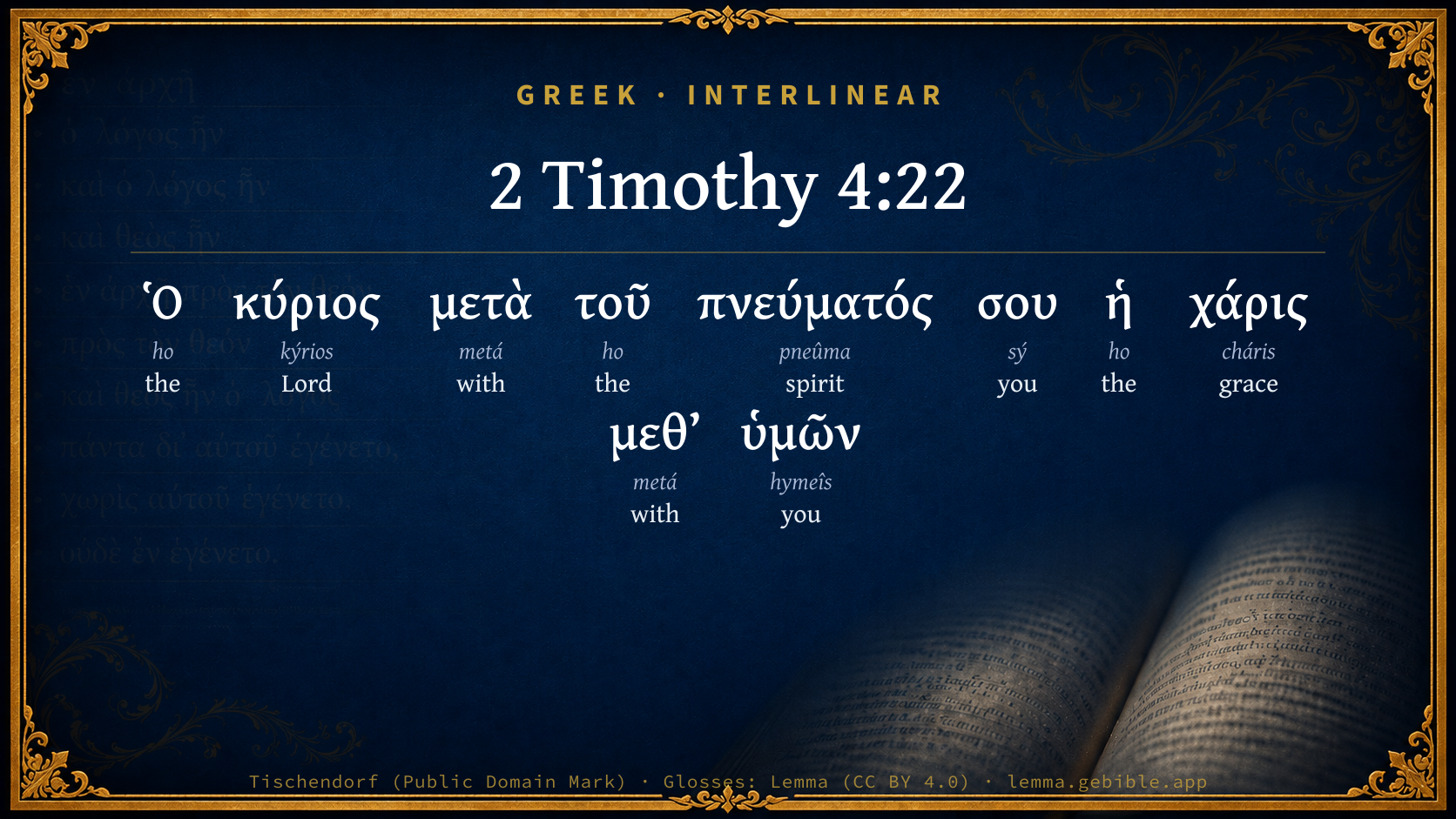
  1. Ὁ ho G3588 “the” Article, Nominative, Singular, Masculine
  2. κύριος kýrios G2962 “Lord” Noun, Nominative, Singular, Masculine
  3. μετὰ metá G3326 “with” Preposition
  4. τοῦ ho G3588 “the” Article, Genitive, Singular, Neuter
  5. πνεύματός pneûma G4151 “spirit” Noun, Genitive, Singular, Neuter
  6. σου sý G4771 “you” Personal pronoun, 2nd person, Genitive, Singular
  7. ἡ ho G3588 “the” Article, Nominative, Singular, Feminine
  8. μεθ’ metá G3326 “with” Preposition
  9. ὑμῶν hymeîs G5210 “you” Personal pronoun, 2nd person, Genitive, Plural

About this verse

These counts appear in no published source. They are computed here, from the morphology-tagged text and Lemma’s own curated glosses. What Lemma adds →

10
words
7
distinct lemmas
Pauline Epistles
section

Repetition

Words recur within this verse:

Cross-references

12

Topical passages linked to 2 Timothy 4:22 in the Treasury of Scripture Knowledge — connected by theme and wording, ordered by reader-vote popularity; previews shown in the World English Bible.

  • Philemon 1:25 The grace of our Lord Jesus Christ be with your spirit. Amen.
  • Galatians 6:18 The grace of our Lord Jesus Christ be with your spirit, brothers. Amen.
  • Colossians 4:18 The salutation of me, Paul, with my own hand: remember my bonds. Grace be with you. Amen.
  • Romans 1:7 to all who are in Rome, beloved of God, called to be saints: Grace to you and peace from God our Father and the Lord Jesus Christ.
  • Ephesians 6:24 Grace be with all those who love our Lord Jesus Christ with incorruptible love. Amen.
  • 1 Peter 5:14 Greet one another with a kiss of love. Peace be to you all who are in Christ Jesus. Amen.
  • Revelation 22:21 The grace of the Lord Jesus Christ be with all the saints. Amen.
  • Matthew 28:20 teaching them to observe all things that I commanded you. Behold, I am with you always, even to the end of the age." Amen.
  • Romans 16:20 And the God of peace will quickly crush Satan under your feet. The grace of our Lord Jesus Christ be with you.
  • 1 Corinthians 16:23 The grace of the Lord Jesus Christ be with you.
  • 2 Corinthians 13:14 The grace of the Lord Jesus Christ, the love of God, and the communion of the Holy Spirit, be with you all. Amen.
  • 1 Timothy 6:21 which some professing have erred concerning the faith. Grace be with you. Amen.

Cross-references courtesy of OpenBible.info (CC BY 4.0).

Where the printed editions differ

3 variants

Places in this verse where the major printed Greek editions disagree on the wording in a way that affects the translation — a comparison of editions, not a manuscript-by-manuscript collation. The editions are the modern critical texts (Nestlé-Aland 28/27, SBL, Westcott-Hort, Tregelles, Tyndale House) and the traditional texts behind the KJV (the Textus Receptus and the Byzantine/Majority text). It is not a claim about which reading is original.

  1. Extra text
    Ἰησοῦς Χριστὸς

    “Jesus Christ”

    In TRByz Not in NA28NA27TynSBLWHTreg

    Ἰησοῦς Χριστὸς (Iēsous Christos) 'Jesus Christ' is only in traditional manuscripts (TR+Byz)

  2. Extra text
    ἀμήν.

    “Amen.”

    In TRByz Not in NA28NA27TynSBLWHTreg
  3. Extra text
    πρός Τιμόθεον δευτέρᾳ τῆς Ἐφεσίων ἐκκλησίας πρῶτον ἐπίσκοπον χειροτονηθέντα ἐγράφη ἀπό Ῥώμης ὅτε ἐκ δευτέρου παρέστη Παῦλος τῷ Καίσαρί Νέρωνι

    “to Timothy second [epistle] of the Ephesian church first overseer having been chosen It was written from Rome when from second time stood Paul <the> before Caesar Nero”

    In TR Not in NA28NA27TynSBLWHTregByz

    ἀμήν. πρός Τιμόθεον δευτέρᾳ τῆς Ἐφεσίων ἐκκλησίας πρῶτον ἐπίσκοπον χειροτονηθέντα ἐγράφη ἀπό Ῥώμης ὅτε ἐκ δευτέρου παρέστη Παῦλος τῷ Καίσαρί Νέρωνι¶ (amēn pros Timotheon deutera tēs Ephesiōn ekklēsias prōton episkopon cheirotonēthenta egraphē apo Rhōmēs hote ek deuterou parestē Paulos tō Kaisari Nerōni) 'Amen. to Timothy second [epistle] of the Ephesian church first overseer having been chosen It was written from Rome when from second time stood Paul before Caesar Nero' is only in traditional manuscripts (TR)

Textual data: Translators Amalgamated Greek New Testament (STEPBible TAGNT) · CC BY 4.0.

Commentary

Notes on 2 Timothy 4:22 from classic Christian and Jewish commentators (each source and its license shown beneath its notes). The classic Christian expositions comment on the surrounding passage and are grouped to its opening verse, so a note may address several verses; the Jewish commentaries on the Tanakh (Rashi and others) are per-verse, so they appear only where the commentator wrote on this verse.

Lemma curates 59 commentaries, every one of them public domain or Creative Commons licensed, each selected and text-cleaned for this edition rather than reprinted as found. About our sources →

The Cambridge Bible for Schools and Colleges

gen. ed. J. J. S. Perowne

22. The closing benediction is peculiar being twofold, first ‘with thy spirit’ and then ‘with you,’ i.e. ‘thee and thine.’

The Lord Jesus Christ] The ms. authority is in favour of ‘The Lord’ alone. Observe how often this one brief name of his Saviour and Master has fallen from his pen in these closing paragraphs, taking the place of the full special title Christ Jesus (see 1Ti_1:1) used through the Pastorals; five times in the last fifteen verses, 2Ti_4:8; 2Ti_4:14; 2Ti_4:17-18; 2Ti_4:22, is the ‘Master’s’ presence and aid claimed and acknowledged by one whose highest title of honour as an Apostle had been ‘the Lord’s servant,’ ‘the Master’s bond-slave.’ We are reminded of pious George Herbert, who at his induction to his sacred charge at Bemerton made his resolve and prayer that his humble and charitable life might so win upon others as to bring glory, he said, ‘to my Jesus whom I have this day taken to be my Master and Governor; and I am so proud of this service that I will always observe and obey and do His will; and always call Him Jesus my Master, and I will always contemn my birth, or any title or dignity that can be conferred upon me, when I shall compare them with my title of being a priest and serving at the altar of Jesus my Master’; and who could in his last hours of suffering answer his wife’s anxious enquiry with the reassuring certainties of that Master’s presence; ‘he had passed a conflict with his last enemy and had overcome him by the merits of his Master Jesus.’ Walton, Life of George Herbert.

The subscription has no sufficient authority; see note on subscription to 1st Epistle, p. 152. But its statements are in this case more nearly correct. See, as to Timothy’s charge at Ephesus, Introduction, p. 66. For St Paul’s appearances before Nero see note above, ch. 2Ti_4:16; and Introduction, p. 44.

The oldest ms. authority gives for subscription only second epistle to timothy.

The Cambridge Bible for Schools and Colleges (gen. ed. J. J. S. Perowne; Cambridge University Press, 1878–1918) — public domain. Text from a community e-Sword module.

The Biblical Illustrator

Joseph S. Exell

2Ti_4:22

The Lord Jesus Christ be with thy spirit.

The highest wish of true friendship

I. Man has a spiritual nature. Spirit is something that is unlike matter--indivisible, self-active, self-conscious, religious. That man has a spirit is--

1. A fact most demonstrable.

2. A fact most practically ignored.

3. A fact the most distinguishing--marking us off from all mundane existences.

II. Mans spiritual nature needs the companionship of Christ.

1. Christ alone can centralise its affections.

2. Christ alone can enlist unbounded reliance.

III. Companionship with Christ is an attainable blessing. (Homilist.)

Christ with us

I. Let us inquire in what sense the Lord Jesus Christ is with His people. We cannot hope to enjoy His bodily presence. It was expedient that He should go away; and still it is expedient that He should remain away. Yet in His spiritual presence He can be with us.

II. He is with us when, as the universal ruler, He governs all things for our good. But the prayer of Paul for Timothy is, The Lord Jesus Christ be with thy spirit. What we need is a consciousness of Christs presence--the enjoyment of fellowship with Him. As the eagle soars towards the sun, so he soars towards God. The spirit of man needs God; especially God manifest in the flesh. It is only as He is with us--filling us with all the fulness of God, that our spirits find rest. Then we are assured of reconciliation, forgiveness, and eternal blessedness.

III. The requirements of our earthly state cause us to need the presence of Christ. We are exposed to temptation; how shall we resist it unless He help us?

IV. Have you ever thought of the great and manifold blessings which the presence of Christ brings to us? No visitor brings such gifts.

1. How largely He increases our store of knowledge! What glorious revelations He makes of His own beauty and worth, shining before us, like the sun, in the brightness of His own light!

2. Then, among the blessed results of Christs presence, and not the least, is assimilation to His image. (W. Walters.)

The presence of Christ with His people desirable

All who desire the ministry, which Christ has established amongst them, to be useful, and wise, and successful, ought frequently to pray, The Lord Jesus Christ be with thy spirit. Nor is it less important in respect to their own individual piety, their growth in grace, and their preparation to go into eternity, that the Lord Jesus Christ be with their own spirits. This will appear:

I. From a consideration of the inquiry. In no other way, except by the presence of Jesus, can we arrive at a purifying and sanctifying knowledge of the Word of God.

II. The importance of praying, the Lord Jesus be with our spirits, will be manifest from the necessity of His presence in our devotions. This alone can cause our prayers to go up before God as a sweet savour.

III. The importance of praying for the presence of Christ is manifest from its influence on our intercourse with the impenitent. Do we desire to set an example such as Christ set, and to have such an influence as He shed around Him, and to cause the mite of our moral power to fall into the current of that which our God, and the Lamb, and all the saints, have poured forth on an ungodly world? And shall we not desire that the Lord Jesus Christ would be with our spirits?

IV. What can we do in our intercourse with the Church without the presence of Christ?

V. What can we do in sickness without the presence of Christ? Conclusion:

1. From the subject we learn the reason why so many are fluctuating in their religious characters. It is because the Lord Jesus Christ is not with their spirits.

2. The subject shows why there is so little effort for the salvation of the impenitent amongst us. It is because the Lord Jesus Christ is not enough with our spirits.

3. The subject explains some facts, which we have long witnessed but have not understood.

(1) It explains why so many, who have named the name of Christ, do not appear to be Christians.

(2) It explains why so many, who occasionally appear to be Christians, are generally without any evidence of piety--The Lord Jesus Christ is not with their spirit.

(3) It explains why so many are changing their religious views and feelings, while they do not appear to wish to abandon religion itself--The Lord Jesus Christ is not with them.

(4) It shows why the impenitent have so little respect for the Christian character amongst us--The Lord Jesus is not with us, as a Church.

(5) It shows why, when so many persons in the Church and around it profess to be full of faith and love, there are few or none converted.

(6) It shows what is necessary to a genuine revival of religion--That the Lord Jesus be with us.

(7) It shows that all who are not labouring for one, seeking for one, and praying for one, are without Christ--He is not with them. (J. Foot, D. D.)

Grace be with you.

Continual grace

The acts of breathing which I performed yesterday will not keep me alive to-day; I must continue to breathe afresh every moment, or animal life ceases. In like manner yesterdays grace and spiritual strength must be renewed, and the Holy Spirit must continue to breathe on my soul, from moment to moment, in order to my enjoying the consolations, and to my working the works of God. (Toplady.)

.

The Biblical Illustrator, edited by Joseph S. Exell (c. 1880s–1900s) — public domain. Text from a community e-Sword module.

Tyndale Open Study Notes

Tyndale Open Resources

4:22 The precise phrasing here is unique, perhaps to emphasize what had already been said in 1:6-8; 2:1 (cp. Gal 6:18; Phil 4:23; Phlm 1:25). • with all of you: This letter would be read publicly.

Tyndale Open Study Notes — © Tyndale Open Resources, licensed CC BY-SA 4.0. Text via the HelloAO Bible API.

Bengel's Gnomon

Johann Albrecht Bengel

2Ti 4:22. Μεθʼ ὑμῶν) with you, 2Ti 4:19.[20]

[20] Bengel, J. A. (1860). Vol. 4: Gnomon of the New Testament (M. E. Bengel & J. C. F. Steudel, Ed.) (J. Bryce, Trans.) (289–316). Edinburgh: T&T Clark.

Bengel's Gnomon of the New Testament — English translation (T&T Clark, Edinburgh, 1860) — public domain. Text from a community e-Sword module.

Meyer's Critical & Exegetical Commentary

Heinrich August Wilhelm Meyer

2Ti_4:22. Benediction. This is peculiar in its nature. Only at the end of the First Epistle to the Corinthians do we find, as here, a double benediction, and there it runs differently. For ὁ κύριος … and ἡ χάρις … the form elsewhere is always ἡ χάρις τοῦ κυρίου.

μετὰ τοῦ πνεύματός σου] comp. Gal_6:18; Phm_1:25.

ἡ χάρις μεθʼ ὑμῶν] comp. 1Ti_6:21.

Meyer — Critical and Exegetical Commentary on the New Testament — English translation by Peter Christie, edited by Frederick Crombie (T&T Clark, 1880) — public domain. Text from a community e-Sword module.

Expositor's Greek Testament

ed. W. Robertson Nicoll

2Ti 4:22 . μετὰ τοῦ πνεύματός σου : This expression, with ὑμῶν for σου , occurs in Gal 6:18 , Phm 1:25 ; but in both those places it is “The grace of our Lord Jesus Christ be with,” etc. Here a very close personal association between the Lord and Timothy is prayed for. Dean Bernard compares the conclusion of the Epistle of Barnabas, ὁ κύριος τῆς δόξης καὶ πάσης χάριτος μετὰ τοῦ πνεύματος ὑμῶν .

μεθʼ ὑμῶν : See note on 1Ti 6:21 .

The Expositor's Greek Testament, edited by W. Robertson Nicoll (1897–1910) — public domain. Text from a community e-Sword module.

Jamieson, Fausset & Brown

Robert Jamieson, A. R. Fausset & David Brown

Grace be with you--plural in oldest manuscripts, "with YOU," that is, thee and the members of the Ephesian and neighboring churches.

Next: Titus Introduction

Jamieson, Fausset & Brown — Commentary Critical and Explanatory on the Whole Bible (1871) — public domain (CC PDM 1.0). Text via the HelloAO Bible API.

Adam Clarke's Commentary

Verse 22. The Lord Jesus Christ be with thy spirit.] This is a prayer addressed to Christ by one of the most eminent of his apostles; another proof of the untruth of the assertion, that prayer is never offered to Christ in the New Testament. He prays that Christ may be with his spirit, enlightening, strengthening, and confirming it to the end.

Grace be with you.] These words show that the epistle was addressed to the whole Church, and that it is not to be considered of a private nature.

Amen.] Omitted by ACFG and some others. See the note on this word at the end of the preceding epistle. The principal subscriptions, both in the versions and MSS., are the following: -

The Second Epistle to Timothy was written from Rome. - SYRIAC.

To the man Timothy. - AETHIOPIC,

Nothing in the VULGATE.

End of the epistle; it was written from the city of Rome when Timothy had been constituted bishop over Ephesus; and when Paul had stood the second time in the presence of Nero Caesar, the Roman emperor. Praise to the Lord of glory, perpetual, perennial, and eternal! Amen, Amen, Amen. - ARABIC.

The Second Epistle to Timothy is ended, who was the first bishop of the Church of Ephesus. It was written from Rome when Paul had stood the second time before Nero, the Roman emperor. - PHILOXENIAN SYRIAC.

Written from Rome, and sent by Onesimus. - COPTIC.

The MSS. are also various: -

The Second Epistle to Timothy is finished; that to Titus begins.

The second to Timothy, written from Laodicea. - CODEX ALEXANDRINUS.

The Second Epistle of Paul the Apostle to Timothy, ordained the first bishop of the Church of the Ephesians, was written from Rome when Paul was brought the second time before Nero Caesar. - COMMON GREEK TEXT.

There are other slighter differences in the MSS., but they are unworthy of note.

That the epistle was written from Rome, about the year 65 or 66, and a little before St. Paul's martyrdom, is the general opinion of learned men. See the preface.

The reader has already been apprized that this is most probably the last epistle the apostle ever wrote; and it is impossible to see him in a more advantageous point of view than he now appears, standing on the verge of eternity, full of God, and strongly anticipating an eternity of glory. For farther observations, see the conclusion of the first epistle.

ON 2Ti 4:16 I have mentioned the apologies of the primitive fathers, or their vindications of Christianity against the aspersions and calumnies of the Gentiles. Several of these writings are still extant; of the whole I shall here give a short account in chronological order.

1. QUADRATUS. St. Jerome relates that this man was contemporary with the apostles, and one also of their disciples. There is only a fragment of his apology extant; it is preserved by Eusebius, in Hist. Eccles, lib. iv. c. 3, and was addressed to the Emperor Adrian about A. D. 126, on whom it is said to have had a good effect.

2. ARISTIDES, according to Eusebius, was an Athenian philosopher, and contemporary with Quadratus; he wrote his apology for the Christians about the same time, (A. D. 126,) and addressed it to the same emperor. St. Jerome gives some remarkable particulars of him in his book Of Illustrious Men. "He was," says he, "a most eloquent philosopher, and after his conversion he continued to wear his former habit." His apology was extant in the days of St. Jerome, but is now utterly lost.

3. JUSTIN MARTYR flourished about A. D. 140, and presented his first apology for Christianity to the Emperor Antoninus Pius and the Roman senate, about A. D. 150; and his second apology was presented to Marcus Antoninus about A. D. 162 or 166. These two very important apologies are come down to us nearly entire, and are exceedingly useful and important.

4. ATHENAGORAS wrote his apology for the Christians about the year 178. He is said to have sat down to write AGAINST the Christians; and that he might the better confute them he read over the Scriptures, and was so thoroughly converted by what he read, that he immediately wrote an apology FOR them, instead of an invective against them. This piece is still extant.

5. TERTULLIAN, who flourished about A. D. 200, was the earliest, and one of the chief of the Latin fathers: he was born in Carthage, and was a presbyter of the Church in that city. His apology was written about A. D. 198, or, according to some, 200. It appears to have been addressed to the governors of provinces, and is allowed to be a work of extraordinary eminence, and a master piece of its kind. It is still extant.

6. MARCUS MINUCIUS FELIX flourished towards the end of the reign of Septimius Severus, about A. D. 210. His apology for the Christian religion is written in the form of a dialogue between Caecilius Natalis, a heathen, and Octavius Januarius, a Christian, in which Minucius sits as judge. "This work," says Dr. Lardner, "is a monument of the author's ingenuity, learning, and eloquence; and the conversion of a man of his great natural and acquired abilities to the Christian religion, and his public and courageous defence of it, notwithstanding the many worldly temptations to the contrary, which he must have met with at that time, as they give an advantageous idea of his virtue, so they likewise afford a very agreeable argument in favour of the truth of our religion." WORKS, vol. ii., p. 367.

To the above, who are properly the Christian apologists for the first 200 years, several add Tatian's book against the Gentiles; Clemens Alexandrinus' Exhortation to the Gentiles; Origen's eight books against Celsus; Cyprian Of the Vanity of Idols; Arnobius' seven books against the Gentiles; the Institutions of Lactantius, and Julius Fermicus Maturnus Of the Errors of Profane Religion. All these works contain much important information, and are well worthy the attention of the studious reader. The principal part of these writings I have analyzed in my Succession of Sacred Literature, and to this they who cannot conveniently consult the originals may refer.

As the word apology generally signifies now an excuse for a fault, or "something spoken rather in extenuation of guilt than to prove innocence," it is seldom used in its primitive sense; and for some hundreds of years no defence of Christianity has borne this title till that by the late bishop of Llandaff, entitled, An Apology for the BIBLE, in a Series of Letters addressed to THOMAS PAINE. This is a very masterly work, and a complete refutation of Paine's "Age of Reason," and of any thing that has yet appeared, or can appear, under the same form. Ever since the days of St. Paul, God has raised up able apologists for the truth of Christianity, when it has been attacked by the most powerful partisans of the kingdom of darkness; and each attack and apology has been a new triumph for the religion of Christ.

Finished correcting for a new edition, Dec. 23, 1831.

Adam Clarke's Commentary on the Bible (1810–1826) — public domain. Text from a community e-Sword/MySword module.

Trapp's Complete Commentary

John Trapp

22 The Lord Jesus Christ be with thy spirit. Grace be with you. Amen. The second epistle unto Timotheus, ordained the first bishop of the church of the Ephesians, was written from Rome, when Paul was brought before Nero the second time.>>

Ver. 22. Grace be with you] God’s blessing be with you always, Amen. Even now toward the offering of a burnt sacrifice, said that martyr (Lau. Saunders) in a letter to certain friends.

John Trapp, A Commentary or Exposition upon All the Books of the Old and New Testament (1647–1656) — public domain. Text from a community e-Sword module.

Albert Barnes' Notes on the Bible

The Lord Jesus Christ be with thy spirit; - see Gal 6:18; Rom 15:20. The subscription to this Epistle was not added by Paul himself, nor is there any evidence that it was by an inspired man, and it is of no authority. There is not the slightest evidence that Timothy was “ordained the first bishop of the church of the Ephesians,” or that he was a “bishop” there at all. There is no reason to believe that he was even a “pastor” there, in the technical sense; see the notes on 1Ti 1:3. Compare the remarks on the subscriptions to the Epistle to the Romans, 1 Corinthians, and especially Titus.

Albert Barnes' Notes on the Bible (1834–1885) — public domain. Text from a community e-Sword/MySword module.

Haydock's Catholic Bible Commentary

The Lord Jesus Christ be with thy spirit. Grace be with you. These words are a fervent prayer, with which St. Paul divers times concludes his epistles; such is the prayer of the priest, when he turns about at mass, with Dominus vobiscum, the people answering, et cum Spiritu tuo. (Witham)

George Leo Haydock (1774–1849), Haydock's Catholic Family Bible and Commentary, 1859 edition — public domain. Excludes Psalms (Douay-Rheims chapter numbering differs from Protestant) and Deuterocanonical books (Catholic canon only).

Matthew Poole's English Annotations

The Lord Jesus Christ be with thy spirit; se the like, Gal 6:18; Phm 1:25.

Grace be with you; the free grace of God, it its various emanations, suited to all your necessities, be with you. Amen.

(The second epistle unto Timotheus, ordained the first Bishop of the church of the Ephesians, was written from Rome, when Paul was brought before Nero the second time.)

Matthew Poole's English Annotations on the Holy Bible (1683–1685) — public domain. Text from a community e-Sword/MySword module.

The Pulpit Commentary

The Lord for the Lord Jesus Christ, A.V and T.R. The Lord be with thy spirit, etc. The manuscripts vary. The salutation as it stands in the R.T. is like the versicles, "The Lord be with you. A. And with thy spirit." It is a peculiarity of the salutation here that it is double one to Timothy personally, metamatov sou; the other to the Church, hJ cariv meq uJmwn. 1Co_16:24 exhibits another variety. Grace. (1Ti_6:21, note) The R.T. omits the "amen" at the end, as in 1Ti_6:21. Thus doses our last authentic account of this great apostle; these are, perhaps, the last words of him who wrought a greater change in the condition of mankind by his speech than any man that ever lived. All honour be to his blessed memory!

The Pulpit Commentary (1880–1919), ed. H.D.M. Spence-Jones & Joseph S. Exell — public domain. Text from a community e-Sword module.

Fairbairn on Ezekiel, Jonah & the Pastoral Epistles

Patrick Fairbairn

Ver. 22. The Lord be with thy spirit. (This is the shortest and probably the correct reading, that of א, F, G; some authorities add Jesus after Lord, and others Jesus Christ.) Grace be with you.

Patrick Fairbairn — An Exposition of Ezekiel (1851), Jonah (1849), and The Pastoral Epistles (1874) — public domain. Text from a community e-Sword module.

Burkitt's Expository Notes on the New Testament

William Burkitt

The apostle concludes this, like his other epistles, with an apostolical benediction, The Lord Jesus Christ be with thy spirit; as if he had said, "Be not sad at my departure; for, though I must leave thee, yet the Lord will uphold thee by his grace, and be present with thee by the influence of the Holy Spirit." The inward presence of Christ with the spirits of his people, directing their spirits in thinking, judging, choosing, and refusing is a sweet privilege, and greatly to be desired. Happy they who have the spirit of Christ perpetually present with them, who so live, that Christ may delight to dwell by his Spirit in them.

Grace be with you, that is, with all of you; he doth not say, riches be with you, or honours be with you, or the favour of man be with you, but grace, and the favour of God be with you. God’s special favour and distinguishing grace is to be sought by all persons, above and before all things. -

Lastly, Our apostle ratifies and seals up all with that concluding particle, Amen; teaching us, That whatever we should pray for, should be rightly understood, firmly believed and earnestly desired, and heartily consented to: they sin in prayer who understand not what they pray for, and who do not earnestly desire what they pray for; for in testimony of our desires to be heard, we say, Amen.

William Burkitt's Expository Notes on the New Testament (1700–1703) — public domain. Text from a community e-Sword module.

Cambridge Greek Testament for Schools and Colleges

22. ὁ κύριος. The rec. text adds Ἰησοῦς Χριστός with אcD2EKLP, the Latin, Syriac and Bohairic versions. א*G 17, which we have seen to be a strong combination in this Ep., omit these words as in text.

The rec. text adds at end ἀμήν with אcD2EKLP and most versions; it is omitted by א*ACG 17 f g.

The subscription printed in the received text is: πρὸς Τιμόθεον δευτέρα, τῆς Ἐφεσίων ἐκκλησίας πρῶτον ἐπίσκοπον χειροτονηθέντα, ἐγράφη ἀπὸ Ῥώμης, ὅτε ἐκ δευτέρου παρέστη Παῦλος τῷ Καίσαρι Νέρωνι. This is found substantially in KL and many other MSS. אC 17 have simply πρὸς Τιμόθεον, D2E have πρ. Τιμοθ. βʹ ἐπληρώθη, G has ἐτελέσθη πρ. Τιμ. βʹ, P has πρ. Τιμ. βʼ ἐγράφει ἀπὸ Ῥώμης. A has πρ. Τ. βʹ ἐγράφη ἀπὸ Λαοδικείας. See Introd. p. xxxii.

22. BENEDICTION

22. ὁ κύριος μετὰ τοῦ πνεύματός σου. This is a personal benediction addressed to Timothy, as the Apostle’s last word, and it is followed by the σημεῖον ἐν πάσῃ ἐπιστολῇ, viz. ἡ χάρις μεθʼ ὑμῶν,, on which see the note on 1Ti 6:21. The form of this personal blessing, however, is not quite like anything elsewhere found at the end of St Paul’s Epistles (cp. Rom 15:33). The nearest parallel to it is perhaps the conclusion of the so-called Epistle of Barnabas, ὁ κύριος τῆς δόξης. καὶ πάσης χάριτος μετὰ τοῦ πνεύματος ὑμῶν. It is worth while to compare the words with Gal 6:18 and Phm 1:25; there the presence of ‘the grace of the Lord,’ here the presence of ‘the Lord of grace,’ is invoked.

Cambridge Greek Testament for Schools and Colleges (Cambridge University Press, 1896; 21 vols, various authors incl. Carr, Maclear, Plummer, Farrar, Lumby, Moule, M. R. James, Simcox) — public domain. Text from a community e-Sword module.

Alford’s Greek Testament

Henry Alford

22.] Concluding blessing. The Lord [Jesus Christ] be with thy spirit (reff.): (the) grace (of God) be with you (the members of the church where Timotheus was: see Prolegg.).

Henry Alford, The Greek Testament (1849–1861) — public domain. Text from a community e-Sword module.

International Critical Commentary

22. Probably an autograph blessing, cf. 2Th 3:17; and indeed the whole paragraph, 9-22, so full of human personal feeling, may well have been written with his own hand.

μεθʼ ὑμῶν] so I 6:21, Tit 3:15; v. Introd., p. xxxiii. Thdt., who read μεθʼ ἡμῶν, ends his comment with the prayer, “And may it be our lot, too, to gain that grace through the intercessions of him who wrote and him who received this letter; and may we see them in their everlasting habitations, not from afar, as the rich man saw Lazarus, but dwelling side by side with them and enrolled under their leadership.”

Nägeli Das Wortschatz des Apostel’s Paulus, von T. Nägeli, 1905.

M.M. The Vocabulary of the Greek Testament, by J. H. Moulton and G. Milligan, 1914-

OGIS. Orientis Grœci Inscriptiones Selectœ, ed. W. Dittenberger, 1903-1905.

Pap. Oxyr. The Oxyrhynchus Papyri, ed. Grenfell and Hunt, vols. i.-xv., London, 1898-

J. Th. St. The Journal of Theological Studies, London, 1910-

Zahn, Einleitung in das Neue Testament, von Theodor Zahn, 1897-1899.

S.-H. The Epistle to the Romans, by Sanday and Headlam, in the I.C.C.

Lock, W. (1924). A critical and exegetical commentary on the Pastoral epistles (I & II Timothy and Titus) (111). Edinburgh: T. & T. Clark.

International Critical Commentary — older volumes (1896–1929), various authors — public domain. Text from a community e-Sword module.

Vincent's Word Studies in the New Testament

Marvin R. Vincent

Comp. ajkaireisqai to have leisure or opportunity, Mr 6:31; 1Co 16:12 : eujkairia opportunity, Mt 26:16 : eukairov seasonable, convenient, Mr 6:21; Heb 4:16.

Out of season [ακαιρως] . N. T. o. LXX once, Sir. 35 4. Comp. ajkaireisqai to lack opportunity, Phi 4:10. Timothy is not advised to disregard opportuneness, but to discharge his duty to those with whom he deals, whether it be welcome or not.

Reprove [ελεγξον] . Rather, convict of their errors. See on 1Ti 5:20 and Joh 3:20. In Paul, 1Co 14:24; Eph 5:11, 13. Comp. ejlegmon conviction, chapter 2Ti 3:16.

Rebuke [επιτιμησον] . In Pastorals only here. o P. Mostly in the Synoptic Gospels, where it is frequent. It has two meanings : rebuke, as Mt 8:26; Luk 17:3, and charge, as Mt 12:16; Mt 16:20, commonly followed by ina that or legwn saying (Mt 20:31; Mr 1:25; Mr 3:12; Mr 8:30; Luk 4:35), but see Luk 9:21. The word implies a sharp, severe rebuke, with, possibly, a suggestion in some cases of impending penalty [τιμη] ; charge on pain of. This might go to justify the rendering of Holtzmann and von Soden, threaten. To charge on pain of penalty for disobedience implies a menace, in this case of future judgment.

Exhort [παρακαλεσον] . See on consolation, Luk 6:24; comfort, Acts 931. Tischendorf changes the order of the three imperatives, reading elegxon, parakaleson, ejpitimhson. In that case there is a climax : first convict of error, then, exhort to forsake error, finally threaten with the penalty of persistence in error.

With all long - suffering and doctrine [εν παση μακροθυμια] . Pash, every possible exhibition of long, suffering, etc. For doctrine Rend. teaching. The combination is Suggestive. Long - suffering is to be maintained against the temptations to anger presented by the obstinacy and perverseness of certain hearers; and such are to be met, not merely with rebuke, but also with sound and reasonable instruction in the truth. So Calvin : "Those who are strong only in fervor and sharpness, but are not fortified with solid doctrine, weary themselves in their vigorous efforts, make a great noise, rave,... make no headway because they build without foundation." Men will not be won to the truth by scolding's. They should understand what they hear, and learn by perceive why they are rebuked " (Bahnsen). Didach teaching, only here and Tit 1:9 in Pastorals. The usual sword is didaskalia. Paul uses both.

2Ti 4:8For [γαρ] . Ground for the preceding exhortations in the future opposition to sound teaching.

Endure [ανεξονται] . Only here in Pastorals. Mostly in Paul. Comp. Act 18:14; 2Co 11:4; Heb 13:22.

Sound doctrine [της υγιαινουσης διδασκαλιας] . Or healthful teaching. The A. V. overlooks the article which is important. The teaching plays a prominent part in these Epistles, and signifies more than teaching in general. See on 1Ti 1:10.

Shall they heap to themselves teachers [εαυτοις επισωρευ σουσιν διδασκαλους] . A vigorous and graphic statement. Episwreuein to heap up, N. T. o. Comp. seswreumena laden, chapter 2Ti 3:6. The word is ironical; shall invite teachers enmasse. 144 In periods of unsettled faith, skepticism, and mere curious speculation in matters of religion, teachers of all kinds swarm like the flies in Egypt. The demand creates the supply. The hearers invite and shape their own preachers. If the people desire a calf to worship, a ministerial calf - maker is readily found. "The master of superstition is the people, and in all superstition wise men follow fools" (Bacon, Ess. 17).

Having itching ears [κνηθομενοι την ακοην] . Or, being tickled in their hearing. Knhqein to tickle, N. T. o. o LXX Knhqomenoi itching. Hesychius explains, "hearing for mere gratification." Clement of Alexandria describes certain teachers as "scratching and tickling, in no human way, the ears of those who eagerly desire to be scratched" (Strom. 5). Seneca says : "Some come to hear, not to learn, just as we go to the theater, for pleasure, to delight our ears with the speaking or the voice or the plays" (Ep. 108). Akoh, A. verse ears, in N. T. a report, as Mt 4:24; Mt 14:1; 24. xxiv. 6 : in the plural, ears (never ear in singular), as Mr 7:35; Luk 7:1 : hearing, either the act, as Act 28:26; Rom 10:17, or the sense, 1Co 12:17, here, and verse 4.

Marvin R. Vincent, Word Studies in the New Testament (1887–1900) — public domain. Text from a community e-Sword/MySword module.

Lesson kit

Teaching starters — assembled from the data on this page, not authored interpretation. Every prompt links to the verse data it draws on. Edit before teaching.

2 Timothy, in the Pauline Epistles, opens this verse with 10 words (7 distinct Greek lemmas). Its most distinctive word is cháris (“grace”). A historical commentator’s framing appears above. Read the whole chapter for the surrounding context.

Discussion questions

  1. The word cháris carries the sense “grace.” How does it shape the verse?
  2. Philemon 1:25 shares this passage’s theme. How do the two illuminate each other?
  3. “the” occurs 3× in this one verse. What is the effect of the repetition?
  4. These translations render this verse differently; the difference is in the English rendering, not the original. What questions does that raise?
  5. Reading how The Cambridge Bible for Schools and Colleges and The Biblical Illustrator read this verse, where do the two commentators agree and where do they part?

Things to notice

  • These translations choose different wording for 3 words in this verse.
  • “the” occurs 3× in this single verse.
  • 7 distinct Greek lemmas span 10 words in this verse.

Reading settings

Reading text

Shown beneath each verse's original-language words.

Old Testament
Old Testament edition

Read the OT as the Masoretic Hebrew (MT) or the Greek Septuagint (LXX).

English shown for the Greek Septuagint (in the Hebrew ↔ Greek comparison).

Comparing translations? Open the Compare panel on any verse page to stack up to four side by side.