1 Samuel 16:22

Hebrew (Westminster Leningrad Codex) 1 Samuel 16:22 appears in the Hebrew Old Testament. The text above is from the Westminster Leningrad Codex. Each word links to its Strong’s number, a concise gloss, and parsing drawn from the Open Scriptures Hebrew Bible morphology. Click any word for its full Brown-Driver-Briggs (BDB) entry.
Download image
Cite this verse

1 Samuel 16:22 (World English Bible). Public Domain. Lemma interlinear Bible study tool, https://lemma.gebible.app/v/1-samuel/16/22.

Show BibTeX & RIS
BibTeX
RIS
English Translation
Saul sent to Jesse, saying, Please let David stand before me; for he has found favor in my sight.
World English Bible · Public Domain
Download a study sheet

One document with this verse’s original text, its word-by-word gloss line, the meaning frame, cross-references with their text, attributed commentary, and full source and license credits — printable, and it pastes into notes with its structure intact.

This verse Autodidact and up

Study sheet (.html) Plain text (.txt)

A passage Seminary Student

Up to 50 verses in one chapter. A passage sheet keeps up to 6 commentary sources and 12 cross-references per verse, in the order this page ranks them, and says so on the sheet whenever that leaves anything out. Ask for a single verse and you get the Autodidact verse sheet above.

Everything on this page stays free to read, with no account — the sheet is a download of what is already on screen, not access to it.

Want to remove ads? Support Godless Engineer
Compare translations 3

The same verse in 3 English versions, stacked beneath the original-language interlinear above. Click any original word for its lexicon entry.

Each is an independent rendering of the whole verse — the interlinear is not word-aligned to these translations.

Highlighted words mark where these versions differ — a whole-verse word diff, not a word-by-word alignment.

  • World English Bible Public Domain
    Saul sent to Jesse, saying, Please let David stand before me; for he has found favor in my sight.
  • King James Version Public Domain
    And Saul sent to Jesse, saying, Let David, I pray thee, stand before me; for he hath found favor in my sight.
  • unfoldingWord Literal Text CC BY-SA 4.0
    And Saul sent to Jesse, saying, “Please let David stand to my face, for he has found favor in my eyes.”

unfoldingWord Literal Text — © unfoldingWord, licensed CC BY-SA 4.0. Word-aligned USFM3 via Door43 (git.door43.org/unfoldingWord/en_ult).

Versions to compare (up to 4)

3 of 4 selected

Show all 18 translations

Every available English version of this verse, each an independent rendering of the whole verse.

  • World English Bible Public Domain
    Saul sent to Jesse, saying, Please let David stand before me; for he has found favor in my sight.
  • Berean Standard Bible Public Domain
    Then Saul sent word to Jesse, saying, “Let David remain in my service, for I am pleased with him.”
  • Majority Standard Bible Public Domain
    Then Saul sent word to Jesse, saying, “Let David remain in my service, for I am pleased with him.”
  • King James Version Public Domain
    And Saul sent to Jesse, saying, Let David, I pray thee, stand before me; for he hath found favor in my sight.
  • American Standard Version (1901) Public Domain
    And Saul sent to Jesse, saying, Let David, I pray thee, stand before me; for he hath found favor in my sight.
  • Revised Version (1885) Public Domain
    And Saul sent to Jesse, saying, Let David, I pray thee, stand before me; for he hath found favour in my sight.
  • Geneva Bible (1599) Public Domain
    And Saul sent to Ishai, saying, Let Dauid nowe remaine with me: for he hath found fauour in my sight.
  • Douay-Rheims (1899) Public Domain
    And Saul sent to Isai, saying: Let David stand before me: for he hath found favour in my sight.
  • Young's Literal Translation Public Domain
    And Saul sendeth unto Jesse, saying, `Let David, I pray thee, stand before me, for he hath found grace in mine eyes.'
  • Literal Standard Version CC BY-SA 4.0
    And Saul sends to Jesse, saying, “Please let David stand before me, for he has found grace in my eyes.”
  • Unlocked Literal Bible CC BY-SA 4.0
    Saul sent to Jesse, saying, “Let David stand before me, for he has found favor in my eyes.”
  • unfoldingWord Literal Text CC BY-SA 4.0
    And Saul sent to Jesse, saying, “Please let David stand to my face, for he has found favor in my eyes.”
  • Darby Bible Public Domain
    And Saul sent to Jesse, saying, Let David, I pray thee, stand before me; for he has found favour in my sight.
  • World Messianic Bible Public Domain
    Saul sent to Jesse, saying, “Please let David stand before me, for he has found favor in my sight.”
  • Webster's Bible Public Domain
    And Saul sent to Jesse, saying, Let David, I pray thee, stand before me; for he hath found favor in my sight.
  • Free Bible Version CC BY-SA 4.0
    Saul sent a message to Jesse, saying, “Please allow David to continue working for me because I am pleased with him.”
  • Bible in Basic English Public Domain
    And Saul sent to Jesse saying, Let David be with me, for he is pleasing to me.
  • JPS Tanakh (1917) Public Domain
    And Saul sent to Jesse, saying: 'Let David, I pray thee, stand before me; for he hath found favour in my sight.'

Literal Standard Version (2020), Covenant Press — licensed CC BY-SA 4.0. Text via the HelloAO Bible API (eBible.org). Unlocked Literal Bible (unfoldingWord) — licensed CC BY-SA 4.0. Text via the HelloAO Bible API (eBible.org). unfoldingWord Literal Text — © unfoldingWord, licensed CC BY-SA 4.0. Word-aligned USFM3 via Door43 (git.door43.org/unfoldingWord/en_ult). Free Bible Version, Dr. Jonathan Gallagher — licensed CC BY-SA 4.0. Text via the HelloAO Bible API (eBible.org).

Word by word

More ways to search: Search by grammar → Find every occurrence → Compare this word →

Practice this passage: Drill this verse → Learn its vocabulary →

יִשַׁ֖י
Yishay
H3448
“Jesse”
Noun, Proper
Part of Speech
Noun
Type
Proper
Full BDB Definition

Origin: from the same as H3426

TWOT: 926

Jesse = "I possess" - son of Boaz and the father of king David
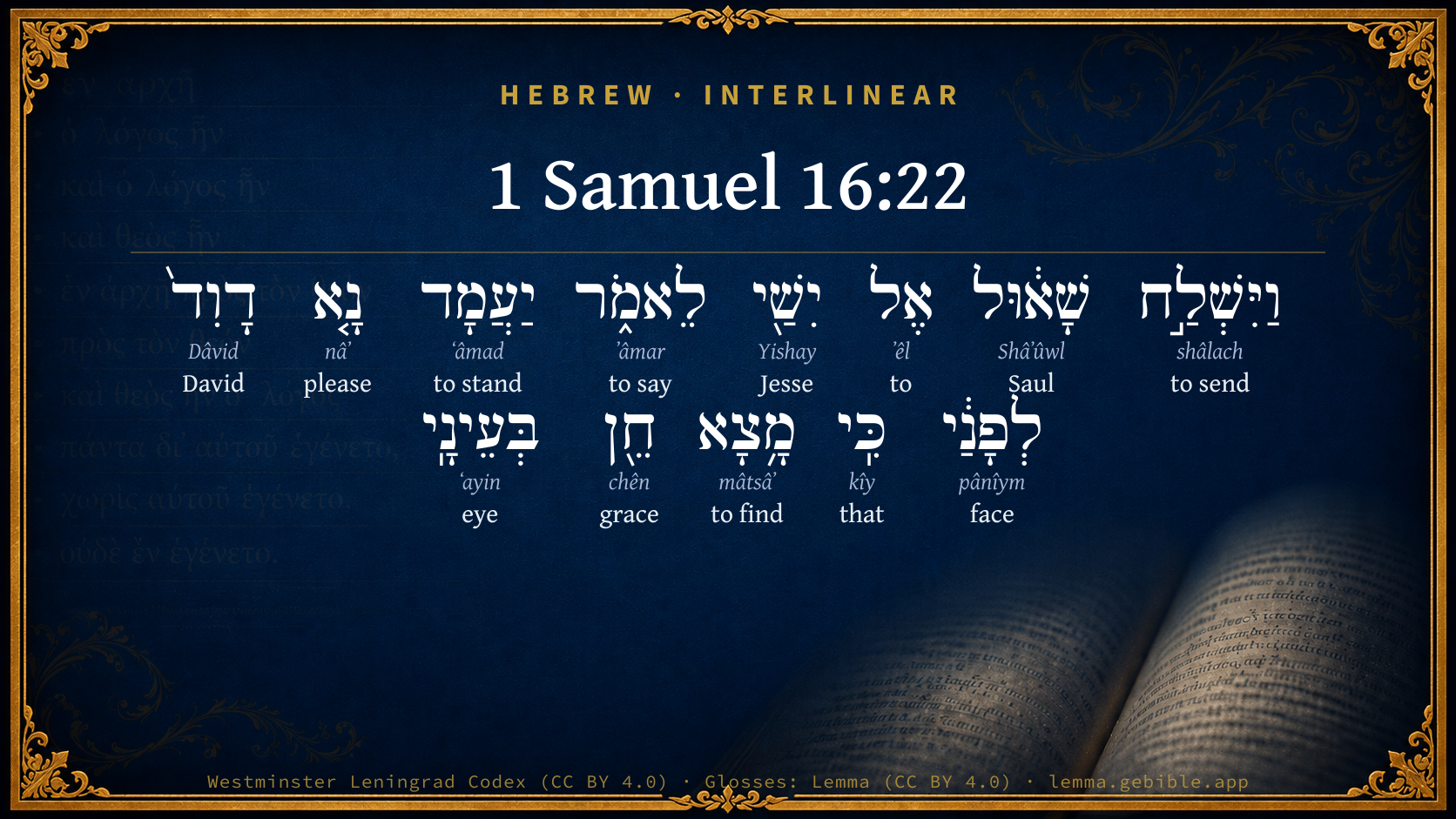
  1. וַיִּשְׁלַ֣ח shâlach H7971 “and · to send” Conjunction + Verb, Qal, Sequential Imperfect, 3rd Person, Masculine, Singular
  2. שָׁא֔וּל Shâʼûwl H7586 “Saul” Noun, Proper
  3. אֶל ʼêl H413 “to” Preposition
  4. לֵאמֹ֑ר ʼâmar H559 “to say” Preposition + Verb, Qal, Infinitive Construct
  5. יַעֲמָד ʻâmad H5975 “to stand” Verb, Qal, Jussive, 3rd Person, Masculine, Singular
  6. נָ֤א nâʼ H4994 “please” Particle, Exhortation
  7. דָוִד֙ Dâvid H1732 “David” Noun, Proper
  8. לְפָנַ֔י pânîym H6440 “to/for · face(s) · my” Preposition + Noun, Common, Both, Plural, Construct + Suffix, Personal, 1st Person, Common, Singular
  9. כִּֽי kîy H3588 “that” Conjunction
  10. מָ֥צָא mâtsâʼ H4672 “to find” Verb, Qal, Perfect, 3rd Person, Masculine, Singular
  11. חֵ֖ן chên H2580 “grace” Noun, Common, Masculine, Singular, Absolute
  12. בְּעֵינָֽי ʻayin H5869 “in/at · eyes · my” Preposition + Noun, Common, Both, Dual, Construct + Suffix, Personal, 1st Person, Common, Singular

About this verse

These counts appear in no published source. They are computed here, from the morphology-tagged text and Lemma’s own curated glosses. What Lemma adds →

13
words
13
distinct lemmas
Historical
section

Shared distinctive vocabulary

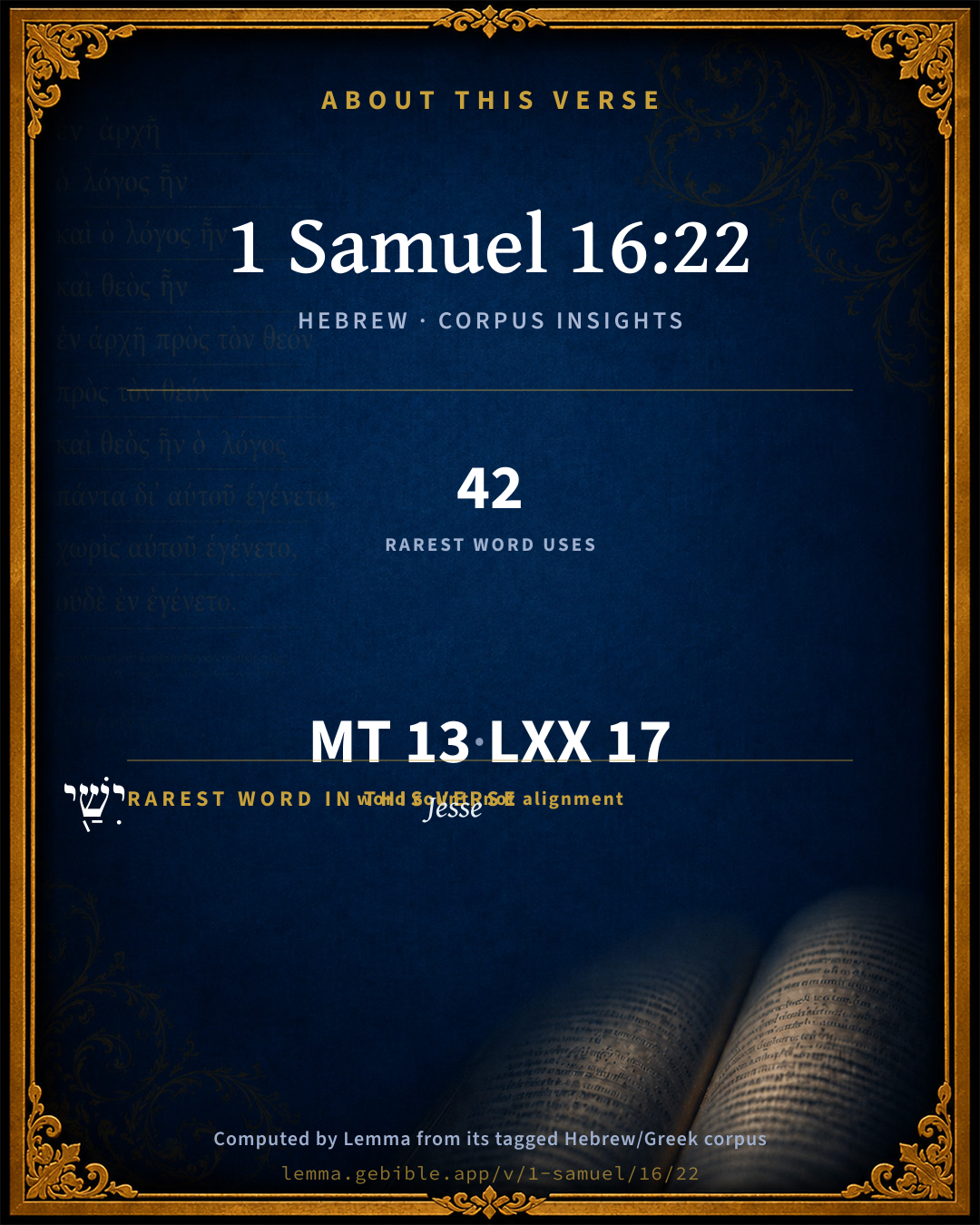
יִשַׁ֖י Jesse H3448 occurs in 39 verses of the Hebrew Bible. Also found in:

Grammatical profile

  • 4 verbs
  • 6 nouns
  • 1 preposition
  • 1 conjunction
  • 1 particle

Verb forms

  • וַיִּשְׁלַ֣ח Qal · Sequential Imperfect
  • לֵאמֹ֑ר Qal · Infinitive Construct
  • יַעֲמָד Qal · Jussive
  • מָ֥צָא Qal · Perfect

Hebrew & Septuagint length

In English translation the verse runs 19 words from the Hebrew and 22 from the Septuagint (LXX English) — closely comparable.

A rough comparison of the two English renderings, which tokenize alike — not a word-level alignment.

Word counts can differ between the Hebrew and the Greek without any difference in meaning — e.g. the Hebrew direct-object marker אֵת has no separate Greek word, and Greek often adds the article ὁ.

In the original languages it is 13 Hebrew tokens and 17 Greek tokens — but the two are counted differently (Hebrew bundles its prefixes and suffixes into one token; the Greek is in lemma form), so that isn’t a like-for-like length.

Hebrew and Greek witnesses Masoretic Hebrew ↔ Greek Septuagint

The same verse in the two great witnesses to the Old Testament, shown verse-for-verse.

These are two independent witnesses, not word-aligned to each other, and the Septuagint is shown in lemma (dictionary) form.

Hebrew 1 Samuel 16:22 Masoretic · Westminster Leningrad Codex

וַיִּשְׁלַ֣ח שָׁא֔וּל אֶל יִשַׁ֖י לֵאמֹ֑ר יַעֲמָד נָ֤א דָוִד֙ לְפָנַ֔י כִּֽי מָ֥צָא חֵ֖ן בְּעֵינָֽי

Saul sent to Jesse, saying, Please let David stand before me; for he has found favor in my sight.

World English Bible · Public Domain

Greek LXX 1 Samuel 16:22 Septuagint · lemma form

καί ἀποστέλλω σαούλ πρός ιεσσαι λέγω παραἵστημι δή δαυίδ ἐνώπιον ἐγώ ὅτι εὑρίσκω χάρις ἐν ὀφθαλμός ἐγώ

And Saul sent to Jessae, saying, Let David, I pray you, stand before me, for he has found grace in my eyes.

LXX2012 (modern English Septuagint) · Public Domain

Hebrew: Westminster Leningrad Codex (CC BY 4.0). Greek: Septuagint (public domain); English from LXX2012 (modern English Septuagint) (Public Domain). How the Septuagint differs from the Hebrew →

Targum (Aramaic paraphrase)

1

The Targum is the ancient Jewish Aramaic paraphrase of the Hebrew Scriptures — an interpretive translation, not the Hebrew text itself. Onkelos (literal) and Pseudo-Jonathan (expansive) render the Torah, and Jonathan the Prophets. Coverage is partial: where no permissively-licensed English translation exists for a verse, only the Aramaic is shown. This is verse-level text, not a word-by-word alignment to the Hebrew.

  1. Targum Jonathan Prophets (Joshua–Malachi)
    וּשְׁלַח שָׁאוּל לְוַת יִשַׁי לְמֵימָר יְשַׁמֵשׁ כְּעַן דָוִד קֳדָמַי אֲרֵי אַשְׁכַּח רַחֲמִין קֳדָמַי:

    (no public-domain English translation for this verse)

    Targum Jonathan — Aramaic: “Mikraot Gedolot” (public domain). English: “Sefaria Community Translation” (CC0 1.0 (public-domain dedication)); “London "Chaldee Paraphrase," 1871” (public domain). Text via Sefaria.

Commentary

Notes on 1 Samuel 16:22 from classic Christian and Jewish commentators (each source and its license shown beneath its notes). The classic Christian expositions comment on the surrounding passage and are grouped to its opening verse, so a note may address several verses; the Jewish commentaries on the Tanakh (Rashi and others) are per-verse, so they appear only where the commentator wrote on this verse.

Lemma curates 59 commentaries, every one of them public domain or Creative Commons licensed, each selected and text-cleaned for this edition rather than reprinted as found. About our sources →

Trapp's Complete Commentary

John Trapp

1Sa 16:22 And Saul sent to Jesse, saying, Let David, I pray thee, stand before me; for he hath found favour in my sight.

Ver. 22. Let David, I pray thee.] This kindness lasted not long; for David was sent home again shortly after, and loves his hook the better since he saw the court. {a}

{a} Magis caulam quam aulam diligebat. - A. Lapide.

John Trapp, A Commentary or Exposition upon All the Books of the Old and New Testament (1647–1656) — public domain. Text from a community e-Sword module.

Tyndale Open Study Notes

Tyndale Open Resources

16:22 David’s father, Jesse (16:18), arranged for David to continue serving Saul while still fulfilling his shepherding duties at home (see 17:14-15).

Tyndale Open Study Notes — © Tyndale Open Resources, licensed CC BY-SA 4.0. Text via the HelloAO Bible API.

The Cambridge Bible for Schools and Colleges

gen. ed. J. J. S. Perowne

22. Let David … stand before me] Thus David entered upon the first stage of special education for his office. In Saul’s court he was placed in a position which gave opportunity for the development of his powers, and for gaining the esteem and love of the people.

The Cambridge Bible for Schools and Colleges (gen. ed. J. J. S. Perowne; Cambridge University Press, 1878–1918) — public domain. Text from a community e-Sword module.

John Gill's Exposition

And Saul sent to Jesse, saying, let David, I pray thee, stand before me,.... Continue in his service; which was great condescension in him, and great respect shown to Jesse, not to detain his son without his leave, and to ask it as a favour of him:

for he hath found favour in my sight: was very acceptable to him which must be very pleasing to Jesse to hear; especially if he was in any fear that Saul had an ill design upon him, when he first sent for him.

John Gill's Exposition of the Whole Bible (1746–1763) — public domain (CC PDM 1.0). Text via the HelloAO Bible API.

Haydock's Catholic Bible Commentary

Sight. He had sent him back, as people of a melancholy temper are often hard to please; (Menochius) and before David married Michol, he did not remain with the king, but only came when his presence was deemed necessary. (Calmet)

George Leo Haydock (1774–1849), Haydock's Catholic Family Bible and Commentary, 1859 edition — public domain. Excludes Psalms (Douay-Rheims chapter numbering differs from Protestant) and Deuterocanonical books (Catholic canon only).

unfoldingWord translationNotes

Door43 World Missions Community

Let David stand before me

Here "stand before me" is an idiom that means to continue in Saul's service. AT: "Let David stay in my service" (See: Idiom)

he has found favor in my eyes

Here "eyes" are a metonym for sight, and "my sight" represents how Saul judges or evaluates David. AT: "he has found favor in my judgment" or "I am pleased with him" (See: Metonymy and Metaphor)

harmful spirit

Here "harmful spirit" may refer to either a "spirit that causes trouble" or an "evil spirit." See how you translated this in 1 Samuel 16:14.

was upon Saul

"troubled Saul"

Saul would be refreshed and well

This can be stated in active form. AT: "the music would refresh Saul and make him well" (See: Active or Passive)

translationWords

Saul (OT)

Jesse

David

favor

God

harp

unfoldingWord translationNotes — © Distant Shores Media and the Door43 World Missions Community, licensed CC BY-SA 4.0. Source: git.door43.org/Door43/en_tn.

Lesson kit

Teaching starters — assembled from the data on this page, not authored interpretation. Every prompt links to the verse data it draws on. Edit before teaching.

1 Samuel, in the Historical, opens this verse with 13 words (13 distinct Hebrew lemmas). Its most distinctive word is Yishay (“Jesse”). A historical commentator’s framing appears above. Read the whole chapter for the surrounding context.

Discussion questions

  1. How does “Jesse” (Yishay) shape what this verse is saying?
  2. How does Ruth 4:17, which shares the word «Jesse», read alongside this verse?
  3. These translations render this verse differently; the difference is in the English rendering, not the original. What questions does that raise?
  4. «וַיִּשְׁלַ֣ח» is a Qal Sequential Imperfect verb. How does that grammatical form shape the action described?
  5. Compare how Trapp's Complete Commentary and Tyndale Open Study Notes read this verse. Where do they agree or differ?

Things to notice

Reading settings

Reading text

Shown beneath each verse's original-language words.

Old Testament
Old Testament edition

Read the OT as the Masoretic Hebrew (MT) or the Greek Septuagint (LXX).

English shown for the Greek Septuagint (in the Hebrew ↔ Greek comparison).

Comparing translations? Open the Compare panel on any verse page to stack up to four side by side.