
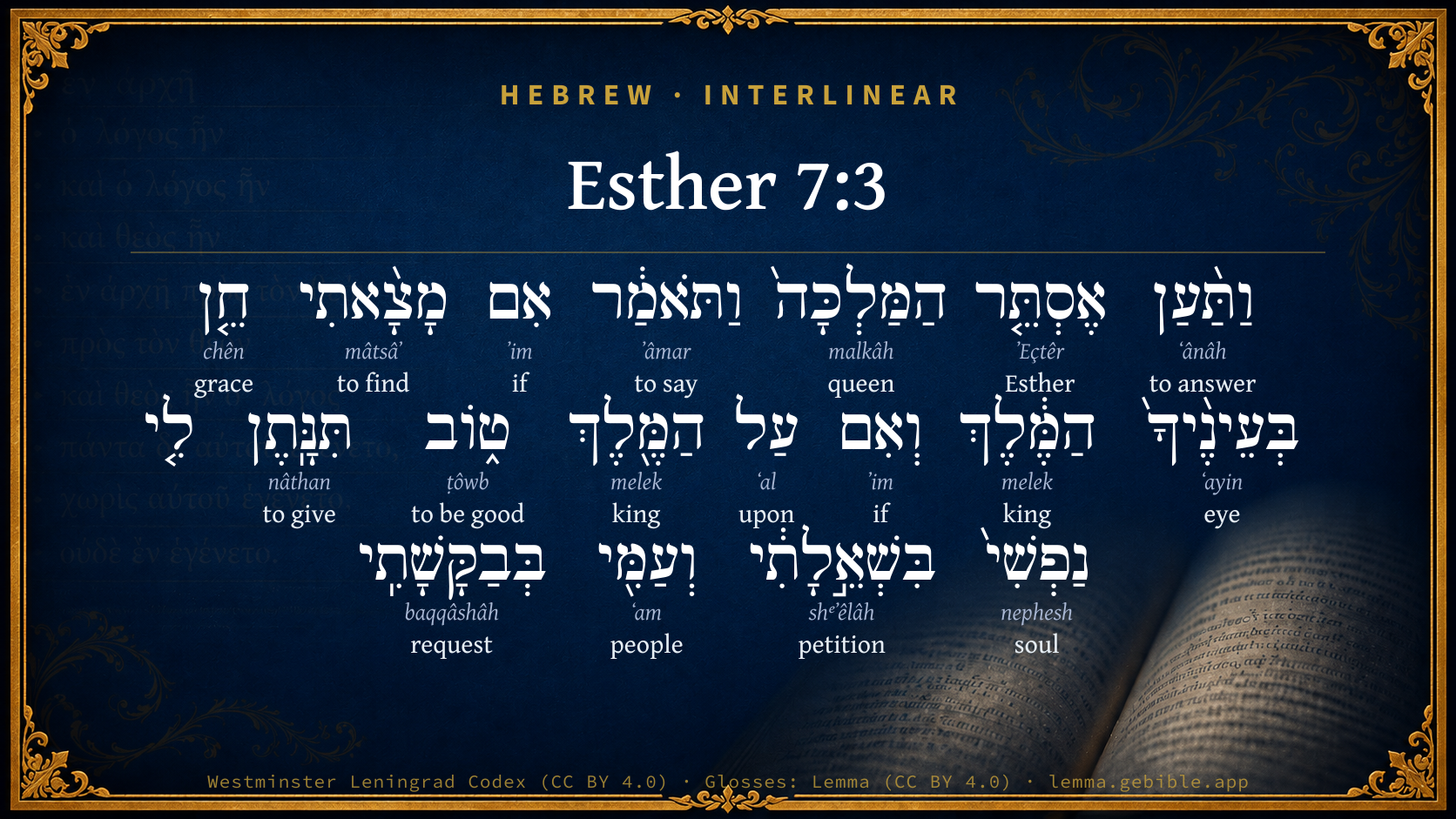
Esther 7:3

Hebrew (Westminster Leningrad Codex) Esther 7:3 appears in the Hebrew Old Testament. The text above is from the Westminster Leningrad Codex. Each word links to its Strong’s number, a concise gloss, and parsing drawn from the Open Scriptures Hebrew Bible morphology. Click any word for its full Brown-Driver-Briggs (BDB) entry.
Download image
Cite this verse

Esther 7:3 (World English Bible). Public Domain. Lemma interlinear Bible study tool, https://lemma.gebible.app/v/esther/7/3.

Show BibTeX & RIS
BibTeX
RIS
English Translation
Then Esther the queen answered, If I have found favor in your sight, O king, and if it please the king, let my life be given me at my petition, and my people at my request:
World English Bible · Public Domain
Download a study sheet

One document with this verse’s original text, its word-by-word gloss line, the meaning frame, cross-references with their text, attributed commentary, and full source and license credits — printable, and it pastes into notes with its structure intact.

This verse Autodidact and up

Study sheet (.html) Plain text (.txt)

A passage Seminary Student

Up to 50 verses in one chapter. A passage sheet keeps up to 6 commentary sources and 12 cross-references per verse, in the order this page ranks them, and says so on the sheet whenever that leaves anything out. Ask for a single verse and you get the Autodidact verse sheet above.

Everything on this page stays free to read, with no account — the sheet is a download of what is already on screen, not access to it.

Want to remove ads? Support Godless Engineer
Compare translations 3

The same verse in 3 English versions, stacked beneath the original-language interlinear above. Click any original word for its lexicon entry.

Each is an independent rendering of the whole verse — the interlinear is not word-aligned to these translations.

Highlighted words mark where these versions differ — a whole-verse word diff, not a word-by-word alignment.

  • World English Bible Public Domain
    Then Esther the queen answered, If I have found favor in your sight, O king, and if it please the king, let my life be given me at my petition, and my people at my request:
  • King James Version Public Domain
    Then Esther the queen answered and said, If I have found favour in thy sight, O king, and if it please the king, let my life be given me at my petition, and my people at my request:
  • unfoldingWord Literal Text CC BY-SA 4.0
    And Esther the queen answered and said, “If I have found favor in your eyes, O king, and if it is good to the king, let my life be given to me at my petition and my people at my request.

unfoldingWord Literal Text — © unfoldingWord, licensed CC BY-SA 4.0. Word-aligned USFM3 via Door43 (git.door43.org/unfoldingWord/en_ult).

Versions to compare (up to 4)

3 of 4 selected

Show all 18 translations

Every available English version of this verse, each an independent rendering of the whole verse.

  • World English Bible Public Domain
    Then Esther the queen answered, If I have found favor in your sight, O king, and if it please the king, let my life be given me at my petition, and my people at my request:
  • Berean Standard Bible Public Domain
    Queen Esther replied, “If I have found favor in your sight, O king, and if it pleases the king, grant me my life as my petition, and the lives of my people as my request.
  • Majority Standard Bible Public Domain
    Queen Esther replied, “If I have found favor in your sight, O king, and if it pleases the king, grant me my life as my petition, and the lives of my people as my request.
  • King James Version Public Domain
    Then Esther the queen answered and said, If I have found favour in thy sight, O king, and if it please the king, let my life be given me at my petition, and my people at my request:
  • American Standard Version (1901) Public Domain
    Then Esther the queen answered and said, If I have found favor in thy sight, O king, and if it please the king, let my life be given me at my petition, and my people at my request:
  • Revised Version (1885) Public Domain
    Then Esther the queen answered and said, If I have found favour in thy sight, O king, and if it please the king, let my life be given me at my petition, and my people at my request:
  • Geneva Bible (1599) Public Domain
    And Ester the Queene answered, and said, If I haue found fauour in thy sight, O King, and if it please the King, let my life be giuen me at my petition, and my people at my request.
  • Douay-Rheims (1899) Public Domain
    Then she answered: If I have found Favour in thy sight, O king, and if it please thee, give me my life for which I ask, and my people for which I request.
  • Young's Literal Translation Public Domain
    And Esther the queen answereth and saith, `If I have found grace in thine eyes, O king, and if to the king `it be' good, let my life be given to me at my petition, and my people at my request;
  • Literal Standard Version CC BY-SA 4.0
    And Esther the queen answers and says, “If I have found grace in your eyes, O king, and if to the king [it be] good, let my life be given to me at my petition, and my people at my request;
  • Unlocked Literal Bible CC BY-SA 4.0
    Then Queen Esther replied, “If I have found favor in your eyes, king, and if it pleases you, let my life be given to me—this is my petition, and I request this also for my people.
  • unfoldingWord Literal Text CC BY-SA 4.0
    And Esther the queen answered and said, “If I have found favor in your eyes, O king, and if it is good to the king, let my life be given to me at my petition and my people at my request.
  • Darby Bible Public Domain
    And Esther the queen answered and said, If I have found grace in thy sight, O king, and if it please the king, let my life be given me at my petition, and my people at my request;
  • World Messianic Bible Public Domain
    Then Esther the queen answered, “If I have found favor in your sight, O king, and if it pleases the king, let my life be given me at my petition, and my people at my request.
  • Webster's Bible Public Domain
    Then Esther the queen answered and said, If I have found favor in thy sight, O king, and if it shall please the king, let my life be given me at my petition, and my people at my request:
  • Free Bible Version CC BY-SA 4.0
    Queen Esther answered, “If the king looks on me favorably, and if it please Your Majesty to grant me my life, that is my request; and the lives of my people, that is what I ask.
  • Bible in Basic English Public Domain
    Then Esther the queen, answering, said, If I have your approval, O king, and if it is the king's pleasure, let my life be given to me in answer to my prayer, and my people at my request:
  • JPS Tanakh (1917) Public Domain
    Then Esther the queen answered and said: 'If I have found favour in thy sight, O king, and if it please the king, let my life be given me at my petition, and my people at my request;

Literal Standard Version (2020), Covenant Press — licensed CC BY-SA 4.0. Text via the HelloAO Bible API (eBible.org). Unlocked Literal Bible (unfoldingWord) — licensed CC BY-SA 4.0. Text via the HelloAO Bible API (eBible.org). unfoldingWord Literal Text — © unfoldingWord, licensed CC BY-SA 4.0. Word-aligned USFM3 via Door43 (git.door43.org/unfoldingWord/en_ult). Free Bible Version, Dr. Jonathan Gallagher — licensed CC BY-SA 4.0. Text via the HelloAO Bible API (eBible.org).

Word by word

More ways to search: Search by grammar → Find every occurrence → Compare this word →

Practice this passage: Drill this verse → Learn its vocabulary →

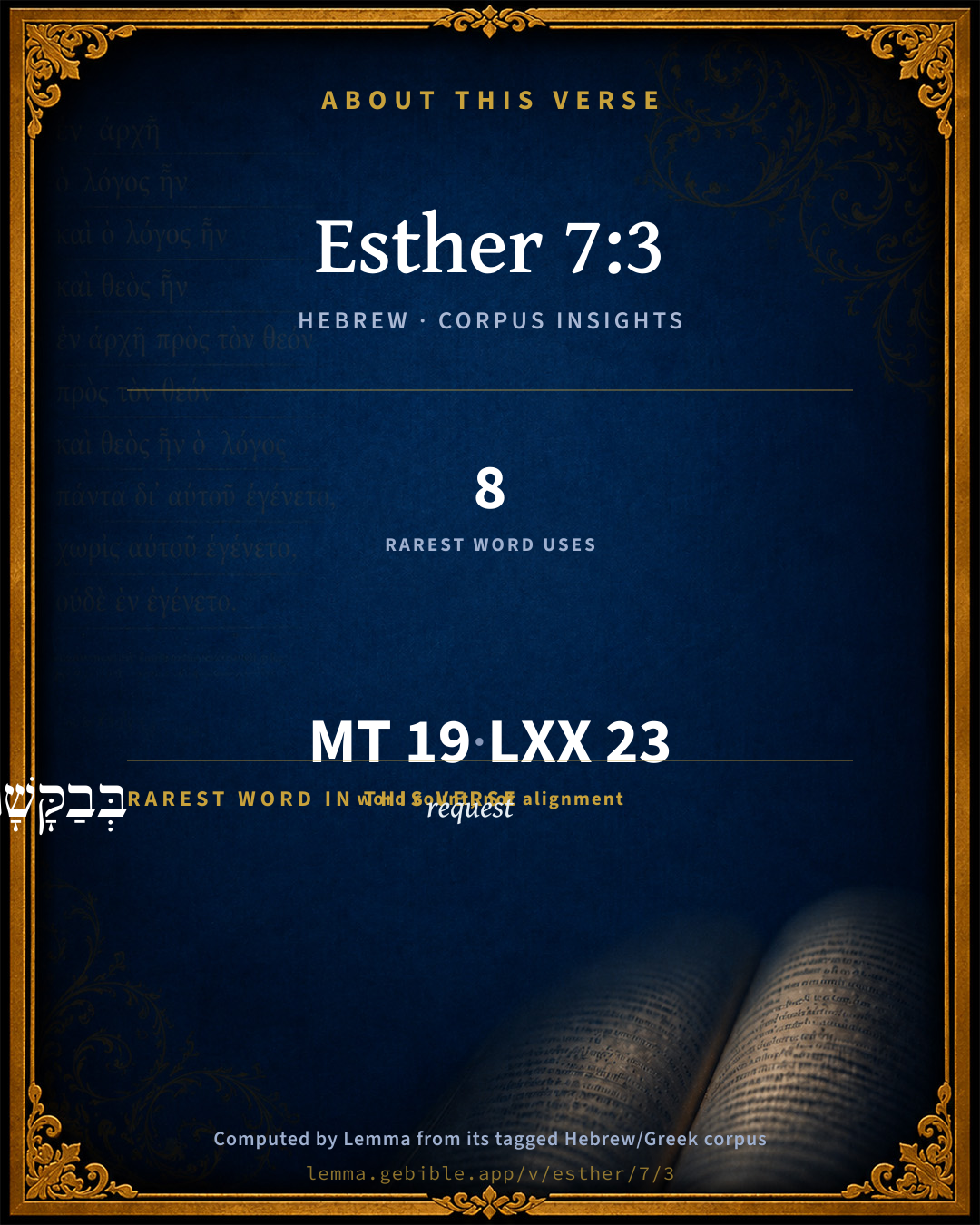
בְּבַקָּשָׁתִֽי
baqqâshâh
H1246
“in/at · request · my”
Preposition + Noun, Common, Feminine, Singular, Construct + Suffix, Personal, 1st Person, Common, Singular
Part of Speech
Preposition + Noun
Type
Common
Gender
Feminine
Number
Singular
State
Construct
Full BDB Definition

Origin: from H1245

TWOT: 276a

request, entreaty, petition
  1. וַתַּ֨עַן ʻânâh H6030 “and · to answer” Conjunction + Verb, Qal, Sequential Imperfect, 3rd Person, Feminine, Singular
  2. אֶסְתֵּ֤ר ʼEçtêr H635 “Esther” Noun, Proper
  3. הַמַּלְכָּה֙ malkâh H4436 “the · queen” Particle, Definite Article + Noun, Common, Feminine, Singular, Absolute
  4. וַתֹּאמַ֔ר ʼâmar H559 “and · to say” Conjunction + Verb, Qal, Sequential Imperfect, 3rd Person, Feminine, Singular
  5. אִם ʼim H518 “if” Conjunction
  6. מָצָ֨אתִי mâtsâʼ H4672 “to find” Verb, Qal, Perfect, 1st Person, Common, Singular
  7. חֵ֤ן chên H2580 “grace” Noun, Common, Masculine, Singular, Absolute
  8. בְּעֵינֶ֨יךָ֙ ʻayin H5869 “in/at · eyes · your” Preposition + Noun, Common, Both, Dual, Construct + Suffix, Personal, 2nd Person, Masculine, Singular
  9. הַמֶּ֔לֶךְ melek H4428 “the · king” Particle, Definite Article + Noun, Common, Masculine, Singular, Absolute
  10. וְאִם ʼim H518 “and · if” Conjunction + Conjunction
  11. עַל ʻal H5921 “upon” Preposition
  12. הַמֶּ֖לֶךְ melek H4428 “the · king” Particle, Definite Article + Noun, Common, Masculine, Singular, Absolute
  13. ט֑וֹב ṭôwb H2895 “good” Adjective, Adjective, Masculine, Singular, Absolute
  14. תִּנָּֽתֶן nâthan H5414 “to give” Verb, Niphal, Imperfect, 3rd Person, Feminine, Singular
  15. נַפְשִׁי֙ nephesh H5315 “soul · my” Noun, Common, Both, Singular, Construct + Suffix, Personal, 1st Person, Common, Singular
  16. בִּשְׁאֵ֣לָתִ֔י shᵉʼêlâh H7596 “in/at · petition · my” Preposition + Noun, Common, Feminine, Singular, Construct + Suffix, Personal, 1st Person, Common, Singular
  17. וְעַמִּ֖י ʻam H5971 “and · people · my” Conjunction + Noun, Common, Masculine, Singular, Construct + Suffix, Personal, 1st Person, Common, Singular

About this verse

These counts appear in no published source. They are computed here, from the morphology-tagged text and Lemma’s own curated glosses. What Lemma adds →

19
words
16
distinct lemmas
Historical
section

Notable vocabulary

The rarest word here is בְּבַקָּשָׁתִֽי request H1246 — appearing just 8 times in the whole Hebrew Bible.

Shared distinctive vocabulary

בְּבַקָּשָׁתִֽי request H1246 occurs in 8 verses of the Hebrew Bible. Also found in:

Grammatical profile

  • 4 verbs
  • 10 nouns
  • 1 adjective
  • 2 prepositions
  • 2 conjunctions

Verb forms

  • וַתַּ֨עַן Qal · Sequential Imperfect
  • וַתֹּאמַ֔ר Qal · Sequential Imperfect
  • מָצָ֨אתִי Qal · Perfect
  • תִּנָּֽתֶן Niphal · Imperfect

Repetition

Words recur within this verse — often emphatic in Hebrew:

  • הַמֶּ֔לֶךְ king H4428 ×2
  • אִם if H518 ×2

Hebrew & Septuagint length

In English translation the verse runs 36 words from the Hebrew and 30 from the Septuagint (LXX English) — closely comparable.

A rough comparison of the two English renderings, which tokenize alike — not a word-level alignment.

Word counts can differ between the Hebrew and the Greek without any difference in meaning — e.g. the Hebrew direct-object marker אֵת has no separate Greek word, and Greek often adds the article ὁ.

In the original languages it is 19 Hebrew tokens and 23 Greek tokens — but the two are counted differently (Hebrew bundles its prefixes and suffixes into one token; the Greek is in lemma form), so that isn’t a like-for-like length.

Cross-references

8

Topical passages linked to Esther 7:3 in the Treasury of Scripture Knowledge — connected by theme and wording, ordered by reader-vote popularity; previews shown in the World English Bible.

  • Jeremiah 38:26 then you shall tell them, I presented my supplication before the king, that he would not cause me to return to Jonathan's house, to die there.
  • Job 2:4 Satan answered Yahweh, and said, "Skin for skin. Yes, all that a man has will he give for his life.
  • Esther 7:7 The king arose in his wrath from the banquet of wine [and went] into the palace garden: and Haman stood up to make request for his life to Esther the queen; for he saw that there was evil determined against him by the king.
  • Psalms 122:6–9 Pray for the peace of Jerusalem. Those who love you will prosper.
  • 1 Kings 20:31 His servants said to him, See now, we have heard that the kings of the house of Israel are merciful kings: let us, we pray you, put sackcloth on our loins, and ropes on our heads, and go out to the king of Israel: peradventure he will save your life.
  • 2 Kings 1:13 Again he sent the captain of a third fifty with his fifty. The third captain of fifty went up, and came and fell on his knees before Elijah, and begged him, and said to him, man of God, please let my life, and the life of these fifty your servants, be precious in your sight.
  • Esther 4:8 Also he gave him the copy of the writing of the decree that was given out in Shushan to destroy them, to show it to Esther, and to declare it to her, and to charge her that she should go in to the king, to make supplication to him, and to make request before him, for her people.
  • Esther 5:8 if I have found favor in the sight of the king, and if it please the king to grant my petition, and to perform my request, let the king and Haman come to the banquet that I shall prepare for them, and I will do tomorrow as the king has said.

Cross-references courtesy of OpenBible.info (CC BY 4.0).

Hebrew and Greek witnesses Masoretic Hebrew ↔ Greek Septuagint

The same verse in the two great witnesses to the Old Testament, shown verse-for-verse.

These are two independent witnesses, not word-aligned to each other, and the Septuagint is shown in lemma (dictionary) form.

Hebrew Esther 7:3 Masoretic · Westminster Leningrad Codex

וַתַּ֨עַן אֶסְתֵּ֤ר הַמַּלְכָּה֙ וַתֹּאמַ֔ר אִם מָצָ֨אתִי חֵ֤ן בְּעֵינֶ֨יךָ֙ הַמֶּ֔לֶךְ וְאִם עַל הַמֶּ֖לֶךְ ט֑וֹב תִּנָּֽתֶן לִ֤י נַפְשִׁי֙ בִּשְׁאֵ֣לָתִ֔י וְעַמִּ֖י בְּבַקָּשָׁתִֽי

Then Esther the queen answered, If I have found favor in your sight, O king, and if it please the king, let my life be given me at my petition, and my people at my request:

World English Bible · Public Domain

Greek LXX Esther 7:3 Septuagint · lemma form

καί ἀποκρίνω εἶπον εἰ εὑρίσκω χάρις ἐνώπιον ὁ βασιλεύς δίδωμι ὁ ψυχή ἐγώ ὁ αἴτημα ἐγώ καί ὁ λαός ἐγώ ὁ ἀξίωμα ἐγώ

And she answered and said, If I have found favor in the sight of the king, let my life be granted to my petition, and my people to my request.

LXX2012 (modern English Septuagint) · Public Domain

Hebrew: Westminster Leningrad Codex (CC BY 4.0). Greek: Septuagint (public domain); English from LXX2012 (modern English Septuagint) (Public Domain). How the Septuagint differs from the Hebrew →

Commentary

Notes on Esther 7:3 from classic Christian and Jewish commentators (each source and its license shown beneath its notes). The classic Christian expositions comment on the surrounding passage and are grouped to its opening verse, so a note may address several verses; the Jewish commentaries on the Tanakh (Rashi and others) are per-verse, so they appear only where the commentator wrote on this verse.

Lemma curates 59 commentaries, every one of them public domain or Creative Commons licensed, each selected and text-cleaned for this edition rather than reprinted as found. About our sources →

Trapp's Complete Commentary

John Trapp

Est 7:3 Then Esther the queen answered and said, If I have found favour in thy sight, O king, and if it please the king, let my life be given me at my petition, and my people at my request:

Ver. 3. Then Esther the queen, &c.] See Est 5:7-8. As Abigail her family, and the woman of Abel the city, so doth Esther by her wisdom and humility deliver herself and her people, ducem sequens lucem fidei, a leader leading the light of faith, as one saith of her.

Let my life be given me at my petition] Heb. my soul. See how discreetly she marshalleth her words; setting these two great requests in the head of her petition, which is simplex et non fucata, plain and downright. Truth is like our first parents, most beautiful when naked. Our words in prayer must be neque lecta, neque neglecta, neither curious nor careless; but as the words of petitioners, plain and full and direct to the point. Esther reckoneth herself here among the rest of her poor countrymen, free among the dead, free of that company, and begs for her life and theirs together; because hers was even bound up in theirs. Mortis habet vices quae trahitur vita genuitibus; to live after their death would be a lifeless life; and hence her importunity for both together, since they were in her heart, ad commoriendum et convivendum, if they died she could not live. Good blood will not belie itself. Esther had not showed her kindred and people till now that she must appear for them. See the like in Moses, Heb 11:25; in Nicodemus, that night-bird; Joh 7:51, he speaks boldly, and silences the whole company; Joh 19:39, he boldly beggeth the body of Jesus; neither could he any longer conceal himself. Surely, as Solomon by trial found out the true harlot mother, so doth God by hard times discover the affections of his people. Then, as Joseph could not refrain tears, so nor they the exercise of their faith and charity.

John Trapp, A Commentary or Exposition upon All the Books of the Old and New Testament (1647–1656) — public domain. Text from a community e-Sword module.

Joseph Benson's Commentary

Est 7:3. Then Esther the queen answered and said, &c. — Esther, at length, surprises the king with a petition, not for wealth, or honour, or the preferment of some of her friends to some high post, which the king expected, but for the preservation of herself and her countrymen from death and destruction. O king, let my life be given me at my petition — It is my humble and only request, that thou wouldst not give me up to the malice of that man that designs to take away my life, and will certainly do it, if thou do not prevent it. And my people — That is, the lives of my people, of the Jews, of whom I am descended. Even a stranger, a criminal, shall be permitted to petition for his life. But that a friend, a wife, a queen, should have occasion to make such a request, was very affecting!

Joseph Benson's Commentary on the Old and New Testaments (1811–1818) — public domain. Text from a community e-Sword module.

Tyndale Open Study Notes

Tyndale Open Resources

7:3-4 my life and the lives of my people: The statement that someone wanted to kill the queen and her family must have surprised and shocked the king. • my people and I have been sold: Esther carefully referred to the huge price Haman had paid the king to approve the decree (3:8-11). She also used the exact terminology of Haman’s decree when she said that its purpose was to kill, slaughter, and annihilate (cp. 3:13). • If we had merely been sold as slaves, I could remain quiet: Esther humbly justifies her request as due to the severity of the attack on her and her people.

Tyndale Open Study Notes — © Tyndale Open Resources, licensed CC BY-SA 4.0. Text via the HelloAO Bible API.

Adam Clarke's Commentary

Verse 3. Let my life be given me] This was very artfully, as well as very honestly, managed; and was highly calculated to work on the feelings of the king. What! is the life of the queen, whom I most tenderly love, in any kind of danger?

Adam Clarke's Commentary on the Bible (1810–1826) — public domain. Text from a community e-Sword/MySword module.

John Gill's Exposition

Then Esther the queen answered and said,.... Not rolling herself at the king's knees, as Severus (f) writes; but rather, as the former Targum, lifting up her eyes to heaven, and perhaps putting up a secret ejaculation for direction and success:

if I have found favour in thy sight, O king; as she certainly had heretofore, and even now:

and if it please the king, let my life be given me at my petition; not riches, nor honour, nor any place or post at court, or in any of the king's dominions for any friend of her's, was her petition; but for her own life, that that might not be taken away, which was included in the grant the king had made to Haman, though ignorantly, to slay all the Jews, she being one of them:

and my people at my request; that is, the lives of her people also, that was her request; her own life and her people's were all she had to ask.

(f) Hist. Sacr. l. 2.

John Gill's Exposition of the Whole Bible (1746–1763) — public domain (CC PDM 1.0). Text via the HelloAO Bible API.

Haydock's Catholic Bible Commentary

People. She was more concerned for these than for half of the kingdom. Hence all fasted and prayed, and Esther obtained their deliverance. (Worthington)

George Leo Haydock (1774–1849), Haydock's Catholic Family Bible and Commentary, 1859 edition — public domain. Excludes Psalms (Douay-Rheims chapter numbering differs from Protestant) and Deuterocanonical books (Catholic canon only).

Matthew Poole's English Annotations

It is my humble and only request, that thou wouldst not give me up to the malice of that man that designs to take away my life, and will certainly do it, if thou dost not prevent it.

And my people; and the lives (which is easily supplied out of the foregoing branch) of my people the Jews, of whom I am descended.

Matthew Poole's English Annotations on the Holy Bible (1683–1685) — public domain. Text from a community e-Sword/MySword module.

Whedon's Commentary on the Bible

Daniel D. Whedon

3. My life… my people — Esther has had time to carefully prepare her words, and her earnest language rises to the emotionality of poetic parallelisms. We may throw her address into the following form: —

If I have found favour in thine eyes,

O king, And if to the king it seem good,

Let my life be given me at my petition,

And my people at my request.

For we are sold —

I and my people —

To be destroyed, to be slain, and to perish.

If, now, for slaves and for bondwomen we were sold I had been silent,

For the enemy is not to be compared with the injury of the king.

Daniel D. Whedon (gen. ed.), Commentary on the Old and New Testaments (1874–1909) — public domain. Text from a community e-Sword module.

The Pulpit Commentary

Let my life be given me, etc. First of all, I ask at the king"s hands my own life, which is threatened; (Est_4:13) secondly, I ask the life of my people, in whose sentence it is that I am involved. Some rhetorical skill is shown in separating the two, so as to make them correspond to the two clauses of the king"s address "What is thy petition?" and "What is thy request?

HOMILETICS.

Ver. 3.

Spare our life!

Was ever so unexpected a request presented as this? When the king in his capricious favour offered his consort whatsoever she desired, even to the half of his kingdom, she asked what might have been naturally enough implored from the royal clemency by some wretched malefactor condemned to expiate his crimes by death. Give us, me and my people, our life! How strange a boon to beg! A queen high in favour, at a royal banquet, to ask that her life should be spared, and her kindred delivered from an unjust and violent end in fact, a massacre! Thus were the eyes of the king opened to the infamy of his minister, and thus was Esther made the agent in the redemption of Israel. In this petition we have an example of the request which, as suppliant sinners, we are bound to offer before the throne of grace. It implies

I A SENSE OF DANGER. It is something to be alive to this. Esther had only lately come to know of the peril in which she and her countrymen and countrywomen stood. Awake to the impending danger, she was emboldened to urge her plea. So with us. A worse enemy than Haman has plotted against the children of men. A worse fate than massacre awaits those who fall into the snare of the foe. The word of God comes to us as a word of warning, urging us to "flee from the wrath to come." Bondage is bad, but death is worse. And "the wages of sin is death.

II A HOPE OF DELIVERANCE. Esther had her fears; she had gone in, saying, "If I perish, I perish!" Yet she was encouraged by the gracious demeanour and the generous promise of the king. Therefore she said, If I have found favour in thy sight, O king, and if it please the king." We have no need of such "ifs" in our approach and our prayer to the King of heaven. He "delighteth in mercy." "If we confess our sins, he is faithful and just to forgive us our sins, and to cleanse us from all unrighteousness." Our hope in Divine mercy is well founded; for it is founded both upon Divine promises and upon the "unspeakable gift," which is both the means and the pledge of the gift of pardon and the gift of life.

III A DESIRE FOR THE SALVATION OF OTHERS. Esther was not so selfish as to ask that she and her kinsman, Mordecai, might be spared; her desire was that the whole nation of the Jews might be delivered. Similar was the attitude of Paul, who said, "My heart"s desire and prayer to God for Israel is, that they may be saved!" When we seek salvation through Christ we cannot seek it for ourselves alone; we shall pray for our households, for our nation, for our race.

Thy light, that on our souls hath shone Leads us in hope to thee: Let us not feel its rays alone Alone thy people be.

O bring our dearest friends to God; Remember those we love; Fit them on earth for thine abode, Fit them for joys above.

HOMILIES BY P.C. BARKER

Vers. 3, 4.

The effectual prayer of a true priestess.

From the darker side of human nature and its painful suggestions we are glad to come out to the light and air of its more hopeful aspects. We are able to do this now without presumption or incaution. A brittle thread of hope for the very despondent is still a welcome sight to the eyes of those who look on. The plaintive prayer of the oppressed is touching not least to those who may happen to overhear. And the signs of a deep sorrow sinking almost to abject submission, rather than bearing the marks of a healthy resignation, will not fail to wake betimes our tenderest sympathy. These are the more inviting conditions under which the scene now presents itself to us. King Ahasuerus is present, on the grandeur of his throne, and with the dread authority of his golden sceptre. But it is not he who is the central figure. Esther is the central figure. Haman also is there, the would-be destroyer of a scattered nation of people, whose head is already bowed in the clay of punishment. But the eye shuns him, and flees past him to the vista which shows that same people reviving their hope and lifting again the head. And in the background of this scene there is one specially hopeful sign. It is not much that can be said at any time to the honour of Ahasuerus, yet we feel somewhat propitiated towards him when we remember that the arbitrary, imperious monarch has waited, and has even asked three times, for the prayer which Esther is now at last about to offer before him. Upon her he is bending a gracious eye, and to her he is lending an attentive ear. Esther has become awhile the priestess of her people. Let us consider her appearance in this character. We have from her lips

I A PRAYER, THE SUBJECT OF WHICH WAS LIFE. The prayer asked for life. It asked the least, for anything less would be of no worth without this being secured first. It asked the least, but what signified everything beside. Esther"s prayer told its tale, and told it all, but told it most simply. No general phrases, no hasty sentences; each word had been weighed, not indeed to produce an artificial, but a transparent effect. The skill in it was the skill of sincerity and profound earnestness alone. There was art in it, but the art of artlessness, not of artfulness. This prayer for just life and breath for herself and the congregation of her people breathes a tone of wonderful humility, and has an extraordinary promise of content in it. The voice of it surely must have faltered through falling tears, or been choked in sobs, when, in the name of all that venerable nation, so long lifted above all nations of the earth, Esther adds that if it had been only a question of bondage, and of selling into such bondage of every man and woman of them, it was not her voice that should have been heard to deprecate, nor her lips that should have been parted in prayer to prevent it. But, she says, the case was one of greater, even of supreme extremity. They were sold to death. They were sold, in the words of the opportunely-quoted "decree," "to be destroyed, to be slain, and to perish." Many drops of big tears had those words been to an unumbered multitude of sensitive and high-spirited people; but now were they not for the first time like drops of molten lead to the hearing of Haman? For him they were hot with terror, heavy with doom, while their effect upon Ahasuerus was electric. Who does not feel that a prayer for life must be respectfully listened to, at least?

II A PRAYER THAT RESTED ON SACRIFICE. Esther does not purport to bring an outer sacrifice. A most real and precious sacrifice she does in fact bring. She was herself the sacrifice, and she knew it full well. Though with modesty, and as mute as could be under the circumstances, she does in a veiled manner utter the fact, and claim the plea. She pleads, as she had been taught and urged by Mordecai to plead, that she had been raised up by Providence for this hour, and "to this end" had been placed where of late she was found. There are many outer forms of sacrifice, but the principle at work here, and but thinly concealed, is the leading principle invoked in them all. So Esther makes this the plea: If I have found favour in thy sight, O king, and if it please the king." And "if she had found favour," was it not the result of a most real intrinsic sacrifice of self?

III A PRAYER WHICH HAD FOR ITS CHIEFEST BURDEN INTERCESSION. Esther was as "merciful" a priestess as she was a skilful one. She lets not go of the argument, the plea, the sacrifice which was found in herself; and she keeps this well in the foreground. But our ear can hear well that her prayer is really intercession. It is "my people" she has ever in sight, ever "deep graven on her heart." Her people"s name is kept close linked with her own. She had no thought of permitting them to get separated from her. They and she had the prospect of being about to share and share alike the "decree," and she takes care to pray and pray alike. This was necessary with all the old high priests under the law. Only of Christ was it not true, who "needed not to offer a sacrifice first for his own sins, and then for the people"s." But this is the language of Esther: "Let my life and my people be given me: for we are sold, I and my people.

IV A PRAYER WHICH IN MANY RESPECTS IS A SUBLIME TYPE OF THE SOUL"S PRAYER TO GOD. Within the four corners of Esther"s prayer there are some amazing analogies with the prayer of man to God, of the sinner trembling between fear and hope to the Saviour, of the helpless creature stricken with the sense of unparalleled need to the Possessor and Spirit of life. Esther"s prayer is indeed horror to our ears to hear, and grates on every highest sensibility of our nature, when (though no fault to her) we think of it as addressed to a fellow-creature. But we may now put this out of sight. The postulates of prayer are here

1. In the praying disposition of the suppliant. Here are the deep feeling, thejust estimate of the critical character of the occasion, the overwhelming sense of the prize of life. There are also to be noticed the natural selection of simplest language, the choice of briefest arguments, and all these held in hand with a self-command almost inconceivable another touch of a true analogy. All these are the things which characterise heavenward prayer where intense spiritual importunity exists.

2. In the absolute ownership, the omnipotent power, the sovereign sceptre of the being addressed. These do belong to him whom man addresses in prayer when he prays heavenward. And when these two postulates of prayer meet, rare indeed are the exceptions to that result which in one blessed word we call mercy. B.

The Pulpit Commentary (1880–1919), ed. H.D.M. Spence-Jones & Joseph S. Exell — public domain. Text from a community e-Sword module.

John Wesley's Explanatory Notes

My life - It is my only request, that thou wouldst not give me up to the malice of that man who designs to take away my life. Even a stranger, a criminal, shall be permitted to petition for his life. But that a friend, a wife, a queen, should have occasion to make such a petition, was very affecting.

John Wesley, Explanatory Notes Upon the Whole Bible (1754–1765) — public domain. Text via the GEBible commentary corpus.

unfoldingWord translationNotes

Door43 World Missions Community

If I have found favor in your eyes, king

"Find favor" here is an idiom that means to be approved of or that he is pleased with her. "In your eyes" is a metaphor representing his evaluation. AT: "If you evaluate me and approve" or "If you are pleased with me" (See: Idiom and Metaphor)

let my life be given to me

The metaphor "giving life" represents rescuing a person from being killed. This statement can be expressed in active form. AT: "save my life" (See: Metaphor and Active or Passive)

this is my petition

The abstract noun "petition" can be expressed with the verb "ask for." AT: "this is what I ask for" (See: Abstract Nouns)

For we have been sold

The metaphor "being sold" represents being betrayed. This can be stated in active form. AT: "For someone has betrayed us" or "For someone has put us in danger of our enemies" (See: Metaphor and Active or Passive)

to be destroyed, killed, and annihilated

Here all three words have the same meaning and are used for emphasis. This can be stated in active form. AT: "for our enemies to destroy, kill, and annihilate us" (See: Doublet and Active or Passive)

Where is this person to be found who has filled his heart to do such a thing

To fill one's heart to do something is an idiom meaning to dare to do something. This can be stated in active form. AT: "Where is the one who has dared to so such a thing" (See: Idiom and Active or Passive)

translationWords

favor

life

people group

servant

just

Ahasuerus

Esther

unfoldingWord translationNotes — © Distant Shores Media and the Door43 World Missions Community, licensed CC BY-SA 4.0. Source: git.door43.org/Door43/en_tn.

Rashi

Rabbi Shlomo Yitzchaki (Rashi)

may my life be given me that I should not be slain on the thirteenth of Adar, for you have issued an edict of massacre upon my people and my kindred.

and my people shall be given me in my request, that they should not be slain. Now if you ask, “What does it concern you?” (below 8:6): “For how can I see, etc.?”

Rashi on the Tanakh — English translations: “The Judaica Press complete Tanach with Rashi, translated by A. J. Rosenberg” (CC BY 4.0); “Pentateuch with Rashi's commentary by M. Rosenbaum and A.M. Silbermann, 1929-1934” (public domain); “The Metsudah Tanach series, Lakewood, N.J” (CC BY 4.0); and “The Book of Joshua, Metsudah Publications, 1997” (CC BY 4.0). Text via Sefaria.

Lesson kit

Teaching starters — assembled from the data on this page, not authored interpretation. Every prompt links to the verse data it draws on. Edit before teaching.

Esther, in the Historical, opens this verse with 19 words (16 distinct Hebrew lemmas). Its most distinctive word is baqqâshâh (“request”). A historical commentator’s framing appears above. Read the whole chapter for the surrounding context.

Discussion questions

  1. What does “request” (baqqâshâh) contribute to the verse as a whole?
  2. How does Ezra 7:6, which shares the word «request», read alongside this verse?
  3. What does the repetition of “king” (2× in this one verse) do in this verse?
  4. These translations render this verse differently; the difference is in the English rendering, not the original. What questions does that raise?
  5. «וַתַּ֨עַן» is a Qal Sequential Imperfect verb. How does that grammatical form shape the action described?
  6. Compare how Trapp's Complete Commentary and Joseph Benson's Commentary read this verse. Where do they agree or differ?

Things to notice

Reading settings

Reading text

Shown beneath each verse's original-language words.

Old Testament
Old Testament edition

Read the OT as the Masoretic Hebrew (MT) or the Greek Septuagint (LXX).

English shown for the Greek Septuagint (in the Hebrew ↔ Greek comparison).

Comparing translations? Open the Compare panel on any verse page to stack up to four side by side.