

2 Corinthians 12:9
Greek (Tischendorf 8th ed.) 2 Corinthians 12:9 appears in the Greek New Testament. The text above is from the Tischendorf 8th edition. Each word links to its Strong’s number and a concise gloss. Click any word for its full Thayer’s Greek Lexicon entry.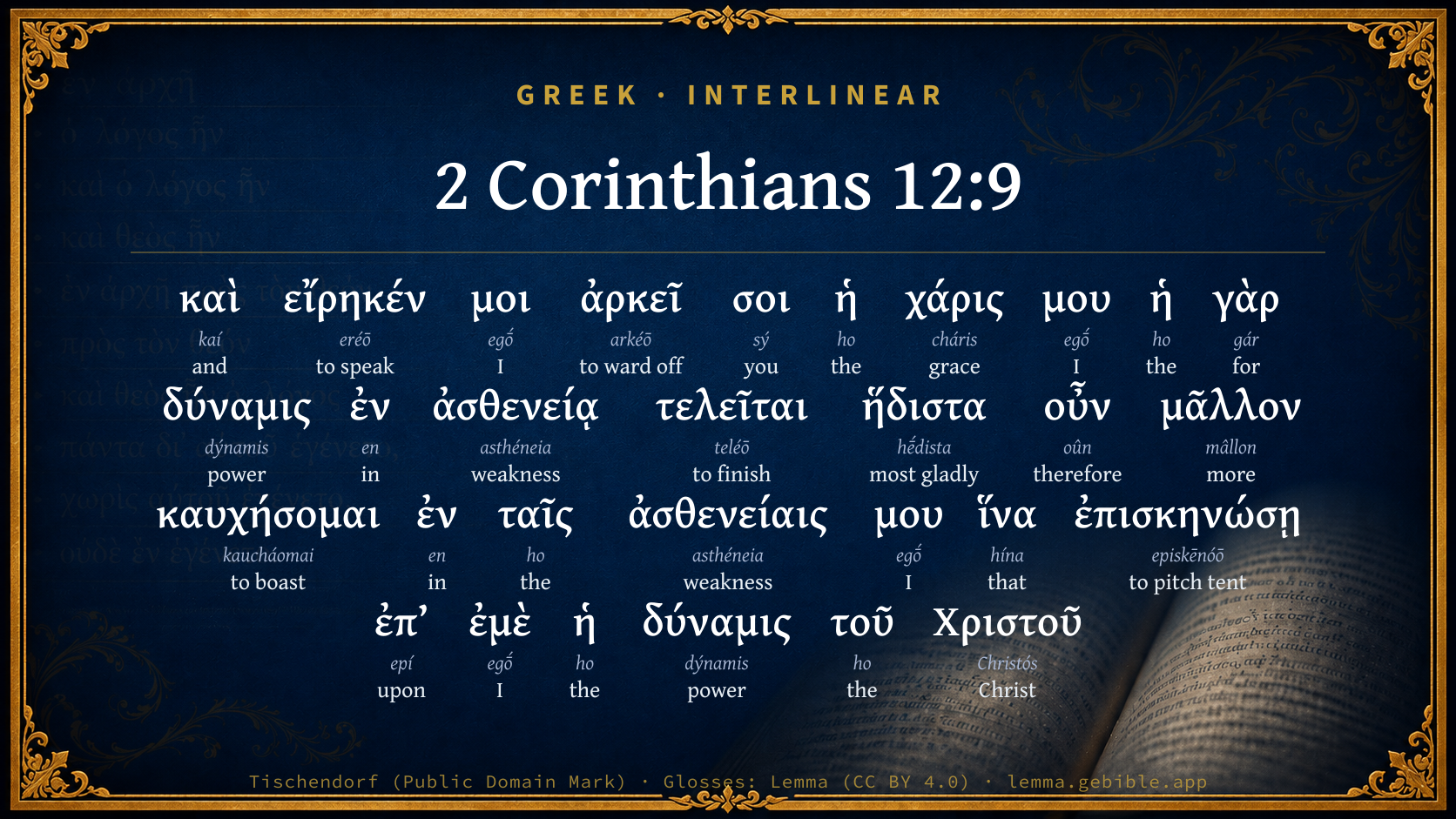
He has said to me, "My grace is sufficient for you, for my power is made perfect in weakness." Most gladly therefore I will rather glory in my weaknesses, that the power of Christ may rest on me.
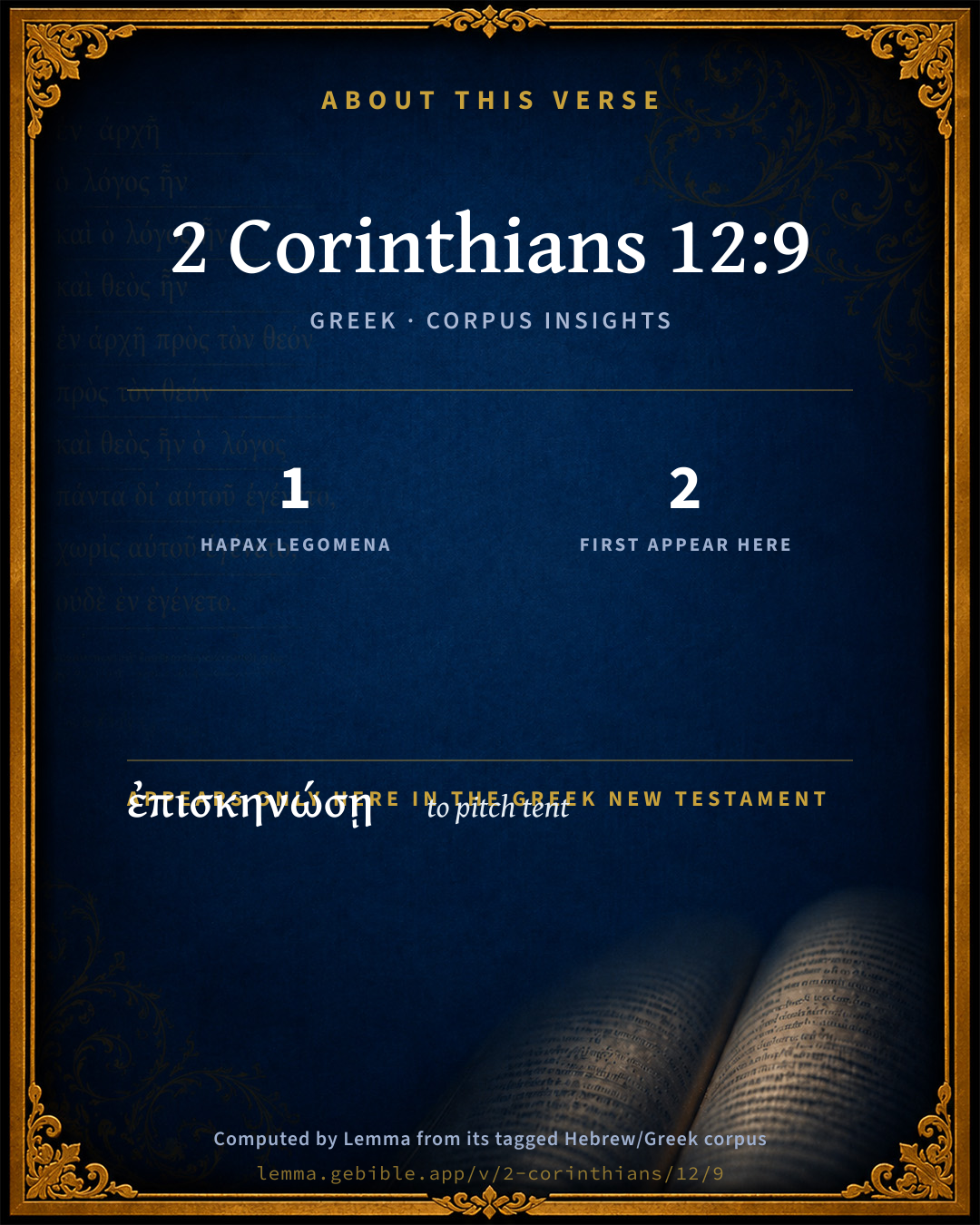
- 1 hapax legomenon — only here in the Greek New Testament
- 2 first appearances in the Greek New Testament
Download a study sheet
One document with this verse’s original text, its word-by-word gloss line, the meaning frame, cross-references with their text, attributed commentary, and full source and license credits — printable, and it pastes into notes with its structure intact.
This verse Autodidact and up
A passage Seminary Student
Up to 50 verses in one chapter. A passage sheet keeps up to 6 commentary sources and 12 cross-references per verse, in the order this page ranks them, and says so on the sheet whenever that leaves anything out. Ask for a single verse and you get the Autodidact verse sheet above.
Everything on this page stays free to read, with no account — the sheet is a download of what is already on screen, not access to it.
Compare translations 3
The same verse in 3 English versions, stacked beneath the original-language interlinear above. Click any original word for its lexicon entry.
Each is an independent rendering of the whole verse — the interlinear is not word-aligned to these translations.
Highlighted words mark where these versions differ — a whole-verse word diff, not a word-by-word alignment.
-
World English Bible Public Domain
He has said to me, "My grace is sufficient for you, for my power is made perfect in weakness." Most gladly therefore I will rather glory in my weaknesses, that the power of Christ may rest on me.
-
King James Version Public Domain
And he said unto me, My grace is sufficient for thee: for my strength is made perfect in weakness. Most gladly therefore will I rather glory in my infirmities, that the power of Christ may rest upon me.
-
unfoldingWord Literal Text CC BY-SA 4.0
But he has said to me, “My grace is enough for you, for my power is being made perfect in weakness.” So I will most gladly boast even more in my weaknesses so that the power of Christ might reside upon me.
unfoldingWord Literal Text — © unfoldingWord, licensed CC BY-SA 4.0. Word-aligned USFM3 via Door43 (git.door43.org/unfoldingWord/en_ult).
Show all 19 translations
Every available English version of this verse, each an independent rendering of the whole verse.
-
World English Bible Public Domain
He has said to me, "My grace is sufficient for you, for my power is made perfect in weakness." Most gladly therefore I will rather glory in my weaknesses, that the power of Christ may rest on me.
-
Berean Standard Bible Public Domain
But He said to me, “My grace is sufficient for you, for My power is perfected in weakness.” Therefore I will boast all the more gladly in my weaknesses, so that the power of Christ may rest on me.
-
Majority Standard Bible Public Domain
But He said to me, “My grace is sufficient for you, for My power is perfected in weakness.” Therefore I will boast all the more gladly in my weaknesses, so that the power of Christ may rest on me.
-
King James Version Public Domain
And he said unto me, My grace is sufficient for thee: for my strength is made perfect in weakness. Most gladly therefore will I rather glory in my infirmities, that the power of Christ may rest upon me.
-
American Standard Version (1901) Public Domain
And he hath said unto me, My grace is sufficient for thee: for `my' power is made perfect in weakness. Most gladly therefore will I rather glory in my weaknesses, that the power of Christ may rest upon me.
-
Revised Version (1885) Public Domain
And he hath said unto me, My grace is sufficient for thee: for my power is made perfect in weakness. Most gladly therefore will I rather glory in my weaknesses, that the power of Christ may rest upon me.
-
Geneva Bible (1599) Public Domain
And he said vnto me, My grace is sufficient for thee: for my power is made perfect through weakenesse. Very gladly therefore will I reioyce rather in mine infirmities, that the power of Christ may dwell in me.
-
Douay-Rheims (1899) Public Domain
And he said to me: My grace is sufficient for thee; for power is made perfect in infirmity. Gladly therefore will I glory in my infirmities, that the power of Christ may dwell in me.
-
Young's Literal Translation Public Domain
and He said to me, `Sufficient for thee is My grace, for My power in infirmity is perfected;' most gladly, therefore, will I rather boast in my infirmities, that the power of the Christ may rest on me:
-
Literal Standard Version CC BY-SA 4.0
and He said to me, “My grace is sufficient for you, for My power is perfected in weakness”; most gladly, therefore, will I rather boast in my weaknesses, that the power of the Christ may rest on me:
-
Unlocked Literal Bible CC BY-SA 4.0
But he said to me, “My grace is enough for you, for power is made perfect in weakness.” So I would much rather boast about my weakness, so that the power of Christ might reside on me.
-
unfoldingWord Literal Text CC BY-SA 4.0
But he has said to me, “My grace is enough for you, for my power is being made perfect in weakness.” So I will most gladly boast even more in my weaknesses so that the power of Christ might reside upon me.
-
Darby Bible Public Domain
And he said to me, My grace suffices thee; for [my] power is perfected in weakness. Most gladly therefore will I rather boast in my weaknesses, that the power of the Christ may dwell upon me.
-
World Messianic Bible Public Domain
He has said to me, “My grace is sufficient for you, for my power is made perfect in weakness.” Most gladly therefore I will rather glory in my weaknesses, that the power of Messiah may rest on me.
-
Webster's Bible Public Domain
And he said to me, My grace is sufficient for thee: for my strength is made perfect in weakness. Most gladly therefore will I rather glory in my infirmities, that the power of Christ may rest upon me.
-
Free Bible Version CC BY-SA 4.0
But he told me, “My grace is all you will need, for my power is effective in weakness.” That's why I happily boast about my weaknesses, so that Christ's power may reside in me.
-
Bible in Basic English Public Domain
And he said to me, My grace is enough for you, for my power is made complete in what is feeble. Most gladly, then, will I take pride in my feeble body, so that the power of Christ may be on me.
-
Text-Critical English NT CC BY 4.0
But he said to me, “My grace is sufficient for yoʋ, for my power is made perfect in weakness.” Therefore I will boast all the more gladly about my weaknesses, so that the power of Christ may rest upon me.
-
Tyndale New Testament (1534) Public Domain
And he sayde vnto me: my grace is sufficient for the. For my strength is made perfact thorow weaknes. Very gladly therfore will I reioyce of my weaknes that the strength of Christ maye dwell in me
Literal Standard Version (2020), Covenant Press — licensed CC BY-SA 4.0. Text via the HelloAO Bible API (eBible.org). Unlocked Literal Bible (unfoldingWord) — licensed CC BY-SA 4.0. Text via the HelloAO Bible API (eBible.org). unfoldingWord Literal Text — © unfoldingWord, licensed CC BY-SA 4.0. Word-aligned USFM3 via Door43 (git.door43.org/unfoldingWord/en_ult). Free Bible Version, Dr. Jonathan Gallagher — licensed CC BY-SA 4.0. Text via the HelloAO Bible API (eBible.org).
Word by word
More ways to search: Search by grammar → Find every occurrence → Compare this word →
Practice this passage: Drill this verse → Learn its vocabulary →
- Appears 1× in the Greek New Testament
- First appears here
- Part of Speech
- Verb
- Tense
- Aorist
- Voice
- Active
- Mood
- Subjunctive
- Person
- 3rd person
- Number
- Singular
Full Thayer's Definition
- καὶ kaí G2532 “and” Conjunction
- εἴρηκέν eréō G2046 “to speak” Verb, Perfect, Active, Indicative, 3rd person, Singular, Attic form
- μοι egṓ G1473 “I” Personal pronoun, 1st person, Dative, Singular
- ἀρκεῖ arkéō G714 “to ward off” Verb, Present, Active, Indicative, 3rd person, Singular
- σοι sý G4771 “you” Personal pronoun, 2nd person, Dative, Singular
- ἡ ho G3588 “the” Article, Nominative, Singular, Feminine
- χάρις cháris G5485 “grace” Noun, Nominative, Singular, Feminine
- μου egṓ G1473 “I” Personal pronoun, 1st person, Genitive, Singular
- ἡ ho G3588 “the” Article, Nominative, Singular, Feminine
- γὰρ gár G1063 “for” Conjunction
- δύναμις dýnamis G1411 “power” Noun, Nominative, Singular, Feminine
- ἐν en G1722 “in” Preposition
- ἀσθενείᾳ asthéneia G769 “weakness” Noun, Dative, Singular, Feminine
- τελεῖται teléō G5055 “to finish” Verb, Present, Passive, Indicative, 3rd person, Singular
- ἥδιστα hḗdista G2236 “most gladly” Adverb, Superlative
- οὖν oûn G3767 “therefore” Conjunction
- μᾶλλον mâllon G3123 “more” Adverb
- καυχήσομαι kaucháomai G2744 “to boast” Verb, Future, Middle deponent, Indicative, 1st person, Singular
- ἐν en G1722 “in” Preposition
- ταῖς ho G3588 “the” Article, Dative, Plural, Feminine
- ἀσθενείαις asthéneia G769 “weakness” Noun, Dative, Plural, Feminine
- μου egṓ G1473 “I” Personal pronoun, 1st person, Genitive, Singular
- ἵνα hína G2443 “that” Conjunction
- ἐπισκηνώσῃ episkēnóō G1981 “to pitch tent” Verb, Aorist, Active, Subjunctive, 3rd person, Singular
- ἐπ’ epí G1909 “upon” Preposition
- ἐμὲ egṓ G1473 “I” Personal pronoun, 1st person, Accusative, Singular
- ἡ ho G3588 “the” Article, Nominative, Singular, Feminine
- δύναμις dýnamis G1411 “power” Noun, Nominative, Singular, Feminine
- τοῦ ho G3588 “the” Article, Genitive, Singular, Masculine
- Χριστοῦ Christós G5547 “Christ” Noun, Genitive, Singular, Masculine
About this verse
These counts appear in no published source. They are computed here, from the morphology-tagged text and Lemma’s own curated glosses. What Lemma adds →
- 30
- words
- 20
- distinct lemmas
- Pauline Epistles
- section
Notable vocabulary
1 hapax legomenon — a word that appears only here in the entire Greek New Testament:
- ἐπισκηνώσῃ to pitch tent G1981
First appearance in Scripture
These words make their first canonical appearance in the Greek New Testament here:
Shared distinctive vocabulary
ἥδιστα most gladly G2236 occurs in 2 verses of the Greek New Testament. Also found in:
Cross-references
36Topical passages linked to 2 Corinthians 12:9 in the Treasury of Scripture Knowledge — connected by theme and wording, ordered by reader-vote popularity; previews shown in the World English Bible.
- Philippians 4:13 I can do all things through Christ, who strengthens me.
- 2 Corinthians 12:10 Therefore I take pleasure in weaknesses, in injuries, in necessities, in persecutions, in distresses, for Christ's sake. For when I am weak, then am I strong.
- Isaiah 40:29–31 He gives power to the faint; and to him who has no might he increases strength.
- Ephesians 3:16 that he would grant you, according to the riches of his glory, that you may be strengthened with power through his Spirit in the inward man;
- Joshua 1:9 Haven't I commanded you? Be strong and of good courage; don't be afraid, neither be dismayed: for Yahweh your God is with you wherever you go.
- Isaiah 43:2 When you pass through the waters, I will be with you; and through the rivers, they shall not overflow you: when you walk through the fire, you shall not be burned, neither shall the flame kindle on you.
- 1 Corinthians 10:13 No temptation has taken you except what is common to man. God is faithful, who will not allow you to be tempted above what you are able, but will with the temptation also make the way of escape, that you may be able to endure it.
- Hebrews 4:16 Let us therefore draw near with boldness to the throne of grace, that we may receive mercy, and may find grace for help in time of need.
- 2 Corinthians 3:5–6 not that we are sufficient of ourselves, to account anything as from ourselves; but our sufficiency is from God;
- 1 Corinthians 15:10 But by the grace of God I am what I am. His grace which was bestowed on me was not futile, but I worked more than all of them; yet not I, but the grace of God which was with me.
- 2 Corinthians 12:5 On behalf of such a one I will boast, but on my own behalf I will not boast, except in my weaknesses.
- 1 Corinthians 2:5 that your faith wouldn't stand in the wisdom of men, but in the power of God.
- Isaiah 35:3–4 Strengthen you the weak hands, and confirm the feeble knees.
- Colossians 1:11 strengthened with all power, according to the might of his glory, for all endurance and perseverance with joy;
- 1 Peter 4:13–14 But because you are partakers of Christ's sufferings, rejoice; that at the revelation of his glory also you may rejoice with exceeding joy.
- Luke 21:15 for I will give you a mouth and wisdom which all your adversaries will not be able to withstand or to contradict.
- Exodus 4:10–15 Moses said to Yahweh, "Oh, Lord, I am not eloquent, neither before now, nor since you have spoken to your servant; for I am slow of speech, and of a slow tongue."
- 2 Corinthians 11:30 If I must boast, I will boast of the things that concern my weakness.
- 1 Timothy 1:14 The grace of our Lord abounded exceedingly with faith and love which is in Christ Jesus.
- Matthew 10:19–20 But when they deliver you up, don't be anxious how or what you will say, for it will be given you in that hour what you will say.
- Hebrews 11:34 quenched the power of fire, escaped the edge of the sword, from weakness were made strong, grew mighty in war, and turned to flight armies of aliens.
- Zephaniah 3:17 Yahweh, your God, is in the midst of you, a mighty one who will save. He will rejoice over you with joy. He will rest in his love. He will rejoice over you with singing.
- Deuteronomy 33:25–27 Your bars shall be iron and brass; As your days, so shall your strength be.
- Colossians 1:28–29 whom we proclaim, admonishing every man and teaching every man in all wisdom, that we may present every man perfect in Christ Jesus;
- Psalms 8:2 From the lips of babes and infants you have established strength, Because of your adversaries, that you might silence the enemy and the avenger.
- Daniel 10:16–19 Behold, one in the likeness of the sons of men touched my lips: then I opened my mouth, and spoke and said to him who stood before me, my lord, by reason of the vision my sorrows are turned on me, and I retain no strength.
- Matthew 5:11–12 "Blessed are you when people reproach you, persecute you, and say all kinds of evil against you falsely, for my sake.
- Matthew 28:20 teaching them to observe all things that I commanded you. Behold, I am with you always, even to the end of the age." Amen.
- Jeremiah 1:6–9 Then said I, Ah, Lord Yahweh! behold, I don't know how to speak; for I am a child.
- Matthew 28:18 Jesus came to them and spoke to them, saying, "All authority has been given to me in heaven and on earth.
- Isaiah 4:5–6 Yahweh will create over the whole habitation of Mount Zion, and over her assemblies, a cloud and smoke by day, and the shining of a flaming fire by night; for over all the glory will be a canopy.
- Isaiah 41:13–16 For I, Yahweh your God, will hold your right hand, saying to you, Don't be afraid; I will help you.
- Exodus 3:11–12 Moses said to God, "Who am I, that I should go to Pharaoh, and that I should bring forth the children of Israel out of Egypt?"
- Isaiah 11:2 The Spirit of Yahweh shall rest on him, the spirit of wisdom and understanding, the spirit of counsel and might, the spirit of knowledge and of the fear of Yahweh.
- 2 Corinthians 12:15 I will most gladly spend and be spent for your souls. If I love you more abundantly, am I loved the less?
- 2 Kings 2:15 When the sons of the prophets who were at Jericho over against him saw him, they said, The spirit of Elijah does rest on Elisha. They came to meet him, and bowed themselves to the ground before him.
Cross-references courtesy of OpenBible.info (CC BY 4.0).
Where the printed editions differ
1 variantPlaces in this verse where the major printed Greek editions disagree on the wording in a way that affects the translation — a comparison of editions, not a manuscript-by-manuscript collation. The editions are the modern critical texts (Nestlé-Aland 28/27, SBL, Westcott-Hort, Tregelles, Tyndale House) and the traditional texts behind the KJV (the Textus Receptus and the Byzantine/Majority text). It is not a claim about which reading is original.
-
Extra text
μου
“of mine”
In TRByz Not in NA28NA27TynSBLWHTregμου (mou) 'of mine' is only in traditional manuscripts (TR+Byz)
Textual data: Translators Amalgamated Greek New Testament (STEPBible TAGNT) · CC BY 4.0.
Lesson kit
Teaching starters — assembled from the data on this page, not authored interpretation. Every prompt links to the verse data it draws on. Edit before teaching.
2 Corinthians, in the Pauline Epistles, opens this verse with 30 words (20 distinct Greek lemmas). Its most distinctive word is episkēnóō (“to pitch tent”). A historical commentator’s framing appears above. Read the whole chapter for the surrounding context.
Discussion questions
- What does “to pitch tent” (episkēnóō) contribute to the verse as a whole?
- This verse holds 1 word here found nowhere else in the Greek New Testament. What might the rare word draw attention to?
- 2 words here appear for the first time in Scripture. What is being introduced at this debut?
- 2 Corinthians 12:15 shares the word «most gladly» with this verse. How do the two illuminate each other?
- “power” occurs 2× in this one verse. What is the effect of the repetition?
- These translations render this verse differently; the difference is in the English rendering, not the original. What questions does that raise?
- Reading how Bengel's Gnomon and Expositor's Greek Testament read this verse, where do the two commentators agree and where do they part?
Things to notice
- 1 word in this verse appears nowhere else in the Greek New Testament.
- 2 words make their first canonical appearance in Scripture here.
- These translations choose different wording for 19 words in this verse.
- “power” occurs 2× in this single verse.
- 20 distinct Greek lemmas span 30 words in this verse.
Commentary
Notes on 2 Corinthians 12:9 from classic Christian and Jewish commentators (each source and its license shown beneath its notes). The classic Christian expositions comment on the surrounding passage and are grouped to its opening verse, so a note may address several verses; the Jewish commentaries on the Tanakh (Rashi and others) are per-verse, so they appear only where the commentator wrote on this verse.
Lemma curates 59 commentaries, every one of them public domain or Creative Commons licensed, each selected and text-cleaned for this edition rather than reprinted as found. About our sources →
Bengel's Gnomon
Johann Albrecht Bengel
Bengel's Gnomon of the New Testament — English translation (T&T Clark, Edinburgh, 1860) — public domain. Text from a community e-Sword module.
Expositor's Greek Testament
ed. W. Robertson Nicoll
The Expositor's Greek Testament, edited by W. Robertson Nicoll (1897–1910) — public domain. Text from a community e-Sword module.
Geneva Bible (1599)
Geneva Bible translators
Geneva Bible (1599) marginal notes — public domain. Text via Bolls.life.
Jamieson, Fausset & Brown
Robert Jamieson, A. R. Fausset & David Brown
Jamieson, Fausset & Brown — Commentary Critical and Explanatory on the Whole Bible (1871) — public domain (CC PDM 1.0). Text via the HelloAO Bible API.
Adam Clarke's Commentary
Adam Clarke's Commentary on the Bible (1810–1826) — public domain. Text from a community e-Sword/MySword module.
John Calvin's Commentaries
John Calvin's Commentaries (1540-1563) — public domain. Text from the Calvin Translation Society English edition (1840s-50s) via the Christian Classics Ethereal Library (ccel.org). Calvin's coverage is partial (roughly two-thirds of the Bible); uncommented books and verses are honest gaps, never fabricated. The 19th-century editor's footnotes and remarks are omitted so the notes are faithfully Calvin's own voice.
Ellicott's Commentary for English Readers
A Bible Commentary for English Readers, edited by Charles John Ellicott (1878–1897) — public domain. Text from a community e-Sword module.
The Cambridge Bible for Schools and Colleges
gen. ed. J. J. S. Perowne
The Cambridge Bible for Schools and Colleges (gen. ed. J. J. S. Perowne; Cambridge University Press, 1878–1918) — public domain. Text from a community e-Sword module.
John Gill's Exposition
John Gill's Exposition of the Whole Bible (1746–1763) — public domain (CC PDM 1.0). Text via the HelloAO Bible API.
Trapp's Complete Commentary
John Trapp
John Trapp, A Commentary or Exposition upon All the Books of the Old and New Testament (1647–1656) — public domain. Text from a community e-Sword module.
Albert Barnes' Notes on the Bible
Albert Barnes' Notes on the Bible (1834–1885) — public domain. Text from a community e-Sword/MySword module.
Matthew Poole's English Annotations
Matthew Poole's English Annotations on the Holy Bible (1683–1685) — public domain. Text from a community e-Sword/MySword module.
Whedon's Commentary on the Bible
Daniel D. Whedon
Daniel D. Whedon (gen. ed.), Commentary on the Old and New Testaments (1874–1909) — public domain. Text from a community e-Sword module.
The Pulpit Commentary
The Pulpit Commentary (1880–1919), ed. H.D.M. Spence-Jones & Joseph S. Exell — public domain. Text from a community e-Sword module.
John Wesley's Explanatory Notes
John Wesley, Explanatory Notes Upon the Whole Bible (1754–1765) — public domain. Text via the GEBible commentary corpus.
Scofield Reference Notes
C. I. Scofield
The Scofield Reference Bible (1917 edition), notes by C. I. Scofield — public domain. Text from a community e-Sword module.
Burkitt's Expository Notes on the New Testament
William Burkitt
William Burkitt's Expository Notes on the New Testament (1700–1703) — public domain. Text from a community e-Sword module.
McGarvey & Pendleton's Commentaries
J. W. McGarvey
J. W. McGarvey (with Philip Y. Pendleton), Commentaries on the New Testament (The Fourfold Gospel, 1914; Acts; and the epistles) — public domain. Text from a community e-Sword/MySword module.
The People's New Testament
B. W. Johnson
B. W. Johnson's The People's New Testament with Notes (1889–1891) — public domain. Electronic text from the Christian Classics Ethereal Library (CCEL) ThML edition.
Cambridge Greek Testament for Schools and Colleges
Cambridge Greek Testament for Schools and Colleges (Cambridge University Press, 1896; 21 vols, various authors incl. Carr, Maclear, Plummer, Farrar, Lumby, Moule, M. R. James, Simcox) — public domain. Text from a community e-Sword module.
Alford’s Greek Testament
Henry Alford
Henry Alford, The Greek Testament (1849–1861) — public domain. Text from a community e-Sword module.
International Critical Commentary
International Critical Commentary — older volumes (1896–1929), various authors — public domain. Text from a community e-Sword module.
Vincent's Word Studies in the New Testament
Marvin R. Vincent
Marvin R. Vincent, Word Studies in the New Testament (1887–1900) — public domain. Text from a community e-Sword/MySword module.