Ephesians 6:24

Greek (Tischendorf 8th ed.) Ephesians 6:24 appears in the Greek New Testament. The text above is from the Tischendorf 8th edition. Each word links to its Strong’s number and a concise gloss. Click any word for its full Thayer’s Greek Lexicon entry.
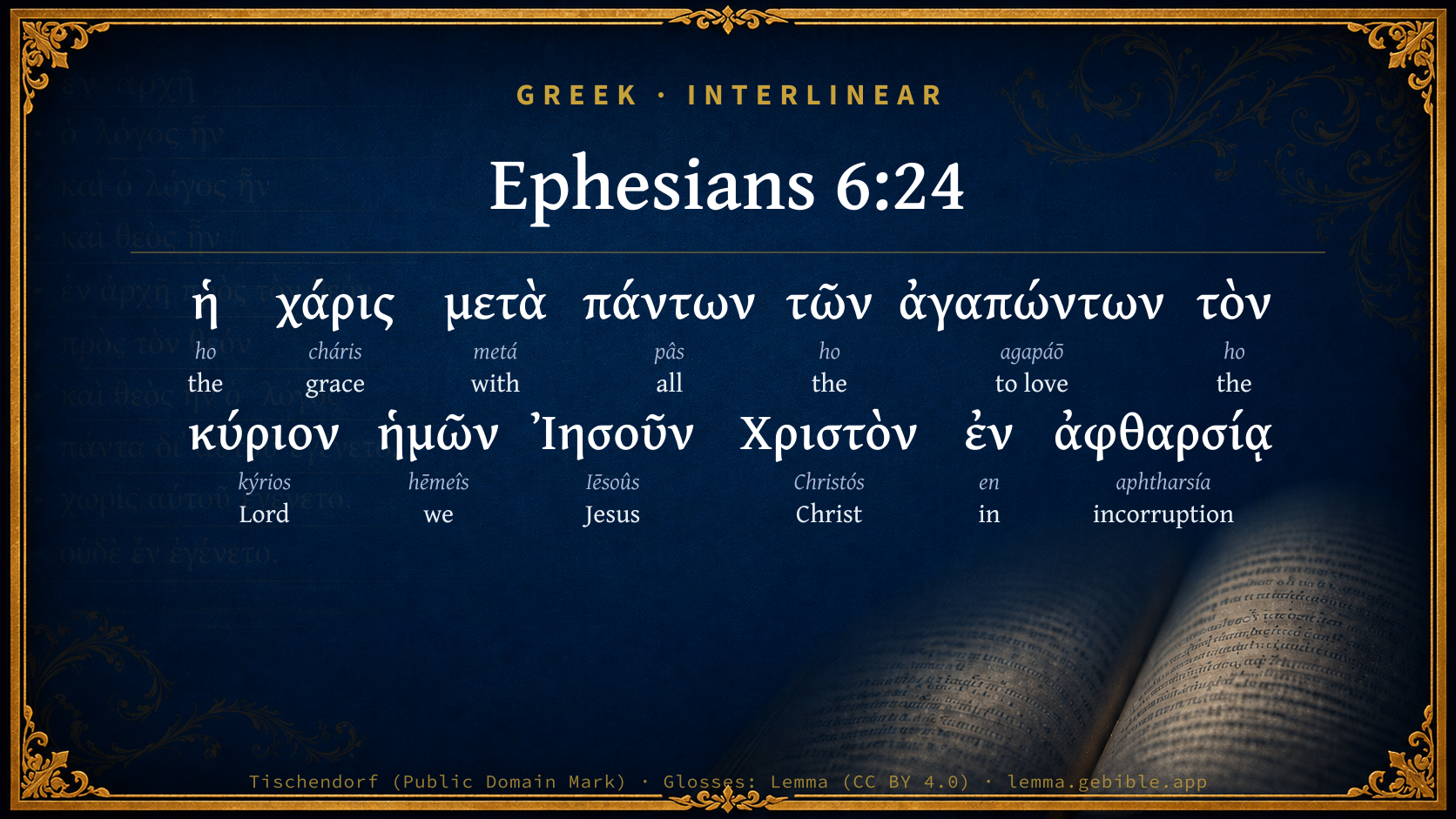
Download image
Cite this verse

Ephesians 6:24 (World English Bible). Public Domain. Lemma interlinear Bible study tool, https://lemma.gebible.app/v/ephesians/6/24.

Show BibTeX & RIS
BibTeX
RIS
English Translation
Grace be with all those who love our Lord Jesus Christ with incorruptible love. Amen.
World English Bible · Public Domain
Download a study sheet

One document with this verse’s original text, its word-by-word gloss line, the meaning frame, cross-references with their text, attributed commentary, and full source and license credits — printable, and it pastes into notes with its structure intact.

This verse Autodidact and up

Study sheet (.html) Plain text (.txt)

A passage Seminary Student

Up to 50 verses in one chapter. A passage sheet keeps up to 6 commentary sources and 12 cross-references per verse, in the order this page ranks them, and says so on the sheet whenever that leaves anything out. Ask for a single verse and you get the Autodidact verse sheet above.

Everything on this page stays free to read, with no account — the sheet is a download of what is already on screen, not access to it.

Want to remove ads? Support Godless Engineer
Compare translations 3

The same verse in 3 English versions, stacked beneath the original-language interlinear above. Click any original word for its lexicon entry.

Each is an independent rendering of the whole verse — the interlinear is not word-aligned to these translations.

Highlighted words mark where these versions differ — a whole-verse word diff, not a word-by-word alignment.

  • World English Bible Public Domain
    Grace be with all those who love our Lord Jesus Christ with incorruptible love. Amen.
  • King James Version Public Domain
    Grace be with all them that love our Lord Jesus Christ in sincerity. Amen.
  • unfoldingWord Literal Text CC BY-SA 4.0
    Grace with all the ones loving our Lord Jesus Christ with incorruptibility.

unfoldingWord Literal Text — © unfoldingWord, licensed CC BY-SA 4.0. Word-aligned USFM3 via Door43 (git.door43.org/unfoldingWord/en_ult).

Versions to compare (up to 4)

3 of 4 selected

Show all 19 translations

Every available English version of this verse, each an independent rendering of the whole verse.

  • World English Bible Public Domain
    Grace be with all those who love our Lord Jesus Christ with incorruptible love. Amen.
  • Berean Standard Bible Public Domain
    Grace to all who love our Lord Jesus Christ with an undying love.
  • Majority Standard Bible Public Domain
    Grace to all who love our Lord Jesus Christ with an undying love. Amen.
  • King James Version Public Domain
    Grace be with all them that love our Lord Jesus Christ in sincerity. Amen.
  • American Standard Version (1901) Public Domain
    Grace be with all them that love our Lord Jesus Christ with `a love' incorruptible.
  • Revised Version (1885) Public Domain
    Grace be with all them that love our Lord Jesus Christ in uncorruptness.
  • Geneva Bible (1599) Public Domain
    Grace be with all them which loue our Lord Iesus Christ, to their immortalitie, Amen. Written from Rome vnto the Ephesians, and sent by Tychicus.
  • Douay-Rheims (1899) Public Domain
    Grace be with all them that love our Lord Jesus Christ in incorruption. Amen.
  • Young's Literal Translation Public Domain
    The grace with all those loving our Lord Jesus Christ -- undecayingly! Amen.
  • Literal Standard Version CC BY-SA 4.0
    The grace with all those loving our Lord Jesus Christ—undecayingly! Amen.
  • Unlocked Literal Bible CC BY-SA 4.0
    Grace be to all those who love our Lord Jesus Christ with an incorruptible love.
  • unfoldingWord Literal Text CC BY-SA 4.0
    Grace with all the ones loving our Lord Jesus Christ with incorruptibility.
  • Darby Bible Public Domain
    Grace with all them that love our Lord Jesus Christ in incorruption.
  • World Messianic Bible Public Domain
    Grace be with all those who love our Lord Yeshua the Messiah with incorruptible love. Amen.
  • Webster's Bible Public Domain
    Grace be with all them that love our Lord Jesus Christ in sincerity. Amen.
  • Free Bible Version CC BY-SA 4.0
    Grace to all those who eternally love our Lord Jesus.
  • Bible in Basic English Public Domain
    Grace be with all those who have true love for our Lord Jesus Christ.
  • Text-Critical English NT CC BY 4.0
    Grace be with all who love our Lord Jesus Christ with an undying love. Amen.
  • Tyndale New Testament (1534) Public Domain
    Grace be with all them which love oure lorde Iesus Christ in puernes. Amen. ‘Sent from Rome vnto the Ephesyans by Tichicus.’

Literal Standard Version (2020), Covenant Press — licensed CC BY-SA 4.0. Text via the HelloAO Bible API (eBible.org). Unlocked Literal Bible (unfoldingWord) — licensed CC BY-SA 4.0. Text via the HelloAO Bible API (eBible.org). unfoldingWord Literal Text — © unfoldingWord, licensed CC BY-SA 4.0. Word-aligned USFM3 via Door43 (git.door43.org/unfoldingWord/en_ult). Free Bible Version, Dr. Jonathan Gallagher — licensed CC BY-SA 4.0. Text via the HelloAO Bible API (eBible.org).

Word by word

More ways to search: Search by grammar → Find every occurrence → Compare this word →

Practice this passage: Drill this verse → Learn its vocabulary →

About this verse

These counts appear in no published source. They are computed here, from the morphology-tagged text and Lemma’s own curated glosses. What Lemma adds →

13
words
11
distinct lemmas
Pauline Epistles
section

Notable vocabulary

The rarest word here is ἀφθαρσίᾳ incorruption G861 — appearing just 8 times in the whole Greek New Testament.

Shared distinctive vocabulary

ἀφθαρσίᾳ incorruption G861 occurs in 8 verses of the Greek New Testament. Also found in:

Repetition

A word recurs within this verse:

Cross-references

13

Topical passages linked to Ephesians 6:24 in the Treasury of Scripture Knowledge — connected by theme and wording, ordered by reader-vote popularity; previews shown in the World English Bible.

  • Matthew 22:37 Jesus said to him, "'You shall love the Lord your God with all your heart, and with all your soul, and with all your mind.'
  • Matthew 6:13 Bring us not into temptation, but deliver us from the evil one. For yours is the Kingdom, the power, and the glory forever. Amen.'
  • 1 Corinthians 16:22–23 If any man doesn't love the Lord Jesus Christ, let him be accursed. Come, Lord!
  • 2 Corinthians 8:12 For if the readiness is there, it is acceptable according to what you have, not according to what you don't have.
  • 2 Corinthians 13:14 The grace of the Lord Jesus Christ, the love of God, and the communion of the Holy Spirit, be with you all. Amen.
  • 2 Timothy 4:22 The Lord Jesus Christ be with your spirit. Grace be with you. Amen.
  • Titus 2:7 in all things showing yourself an example of good works; in your teaching showing integrity, seriousness, incorruptibility,
  • Titus 3:15 All who are with me greet you. Greet those who love us in faith. Grace be with you all. Amen.
  • Matthew 28:20 teaching them to observe all things that I commanded you. Behold, I am with you always, even to the end of the age." Amen.
  • John 21:15–17 So when they had eaten their breakfast, Jesus said to Simon Peter, "Simon, son of Jonah, do you love me more than these?" He said to him, "Yes, Lord; you know that I have affection for you." He said to him, "Feed my lambs."
  • 2 Corinthians 8:8 I speak not by way of commandment, but as proving through the earnestness of others the sincerity also of your love.
  • Colossians 4:18 The salutation of me, Paul, with my own hand: remember my bonds. Grace be with you. Amen.
  • Hebrews 13:25 Grace be with you all. Amen.

Cross-references courtesy of OpenBible.info (CC BY 4.0).

Where the printed editions differ

1 variant

Places in this verse where the major printed Greek editions disagree on the wording in a way that affects the translation — a comparison of editions, not a manuscript-by-manuscript collation. The editions are the modern critical texts (Nestlé-Aland 28/27, SBL, Westcott-Hort, Tregelles, Tyndale House) and the traditional texts behind the KJV (the Textus Receptus and the Byzantine/Majority text). It is not a claim about which reading is original.

  1. Extra text
    ἀμήν πρός Εφέσιους ἐγράφη ἀπό Ῥώμης διά τυχικοῦ.¶

    “Amen. to Ephesian it was written from Rome through Tychicus.”

    In TR Not in NA28NA27TynSBLWHTregByz

    ἀμήν πρός Εφέσιους ἐγράφη ἀπό Ῥώμης διά τυχικοῦ.¶ (amēn pros Ephesious egraphē apo Rhōmēs dia tuchikou) 'Amen. to Ephesian it was written from Rome through Tychicus.' is only in traditional manuscripts (TR)

Textual data: Translators Amalgamated Greek New Testament (STEPBible TAGNT) · CC BY 4.0.

Commentary

Notes on Ephesians 6:24 from classic Christian and Jewish commentators (each source and its license shown beneath its notes). The classic Christian expositions comment on the surrounding passage and are grouped to its opening verse, so a note may address several verses; the Jewish commentaries on the Tanakh (Rashi and others) are per-verse, so they appear only where the commentator wrote on this verse.

Lemma curates 59 commentaries, every one of them public domain or Creative Commons licensed, each selected and text-cleaned for this edition rather than reprinted as found. About our sources →

The Biblical Illustrator

Joseph S. Exell

Eph_6:24

Grace be with all them that love our Lord Jesus Christ in sincerity.

Grace and love

Everything you need to make you good, wise, humble, lovely, useful, and happy, is comprehended in the grace of our Lord Jesus Christ. If you care for yourself and your immediate friends only, and not for others also, is it not that you have too little of the grace of Jesus Christ? Or if you show a self-loving partiality for your own Church, and a prejudice against other Churches, would not more of the grace of the Lord Jesus enlarge your heart, and correct the one-sidedness of your character? If you carry yourself haughtily towards anyone, is not that a sign that your own spirit is strong, and the grace of Christ weak in you? Do not your impatience, irritability, and anger, give evidence of your deficiency in grace? If you are fretful or downcast under suffering, would not more of the grace of Jesus produce in you an exactly contrary condition? If you surrender your tongue to foolish talking, does it not argue an absence of the dignity and wisdom which are in the grace of our Lord Jesus Christ? If you fall into any vice or sin whatsoever, would not a greater measure of His grace restrain you? It is clear, therefore, that the grace of Christ is precisely what you want, to make you everything that you should be. It is everything that can relate you happily to God and advantageously to man. One word expresses the whole circle of your wants. For that one word, Grace, stands for the law of the Spirit of life in Christ Jesus. It is the virtue of His all-perfect humanity operating within you, the one thing that roots, grows, and opens in us every excellence and charm of spirit and character. (J. Pulsford.)

Love for Christ

1.Love for Christ is the common life of all true Christians. In whatever else they differ from each other, in their creeds, in their modes of worship, in some of their conceptions of how the Divine life in man is originated, how it should be disciplined, and how it is manifested, they are alike in this: they all love the Lord Jesus Christ. The controversies and divisions of Christendom have gone a long way towards destroying the unity of the Church; but in love for Christ all Christians are one.

2. And love for Christ is immortal. The religious passion which is created by sensuous excitements, whether these excitements are addressed to the eye or to the ear, whether they heat the blood or intoxicate the imagination, is transitory. It has in it the elements of corruption. But true love for Christ is rooted in all that is deepest and divinest in human nature. It is immortal, for it belongs to that immortal life which comes to us by the inspiration of the Spirit of God. It will not decay with the decay of physical vigour. It will triumph over death; and will reveal the fulness of its strength, and the intensity of its fervour in those endless ages which we hope to spend with Christ in glory. (R. W. Dale, LL. D.)

Benediction to those who love Jesus

I. Consider on what accounts Christ is entitled to our love.

1. He is a Divine Person.

2. His mediatorial offices entitle Him to our love. A sense of our wants adds worth to an object suited to relieve them. Jesus is such a Saviour as we need.

3. Christ is an object of our love on account of His kindness to us.

II. Sincerity is an essential qualification of our love to Christ.

1. Our love to Christ must be real, not pretended.

2. Our love to Christ must be universal; it must respect His whole character.

3. Sincere love to Christ is supreme.

4. Sincere love is persevering.

5. True love to Christ is active. Not a cold and indolent opinion of Him; but such a sensible regard to Him as interests the heart, and influences the life.

III. How sincere love to Christ will discover itself.

1. It will make us careful to please Him.

2. This holy principle will be accompanied with humility.

3. If we love Christ, we will follow His steps, and walk as He walked.

4. Our love to Him will animate us to promote His interest, and oppose His enemies.

5. This principle will express itself in a devout attendance on His ordinances, especially the Holy Communion, the Sacrament of His love.

6. Love to Christ will make us long for His reappearing.

IV. The benediction connected with this temper. It is called grace--a term of large and glorious import. It comprehends all the blessings which the gospel reveals to the sons of men, and promises to the faithful in Christ.

1. One great privilege contained in this grace is justification before God.

2. Another privilege is the presence of the Divine Spirit.

3. They who love Christ have free access to the throne of grace, and a promise that they shall be heard and accepted there.

4. They who love Christ in sincerity will receive the gift of a happy immortality. (J. Lathrop, D. D.)

Christian catholicity

I. The characters described.

1. The object of their love The Lord Jesus Christ.

(1) Lord, Said to be Lord of all.

(2) Jesus. This signifies Saviour, and it was given to Him on account of His mission and work.

(3) Christ. Signifies Anointed. The anointed Saviour. The Christ predicted, promised, expected, at length revealed.

2. The nature of their love--Love our Lord Jesus Christ in sincerity. Here is the affection and the kind of affection. Now, love to Christ--

(1) Is always the result of faith in His love to us.

(2) Love to Christ is always an evident emotion.

(3) Is sincere. It may be rendered uncorrupted, without alloy.

It means real, in opposition to pretended love--intense, in opposition to languid--constant, in opposition to vacillating.

II. The affectionate prayer expressed.

1. All the saints of the Lord Jesus require this grace. None independent of it.

2. The grace is provided for all the disciples of Jesus. Out of His fulness have we all, etc.

3. We should seek sincerely in prayer that all may possess it. And that for the following reasons:--

(1) All who love, etc., are loved of God and chosen of Him.

(2) They are all our brethren and sisters in Christ.

(3) We are in circumstances of common need and dependence.

(4) We have all one Spirit.

(5) We are destined to one common inheritance.

Application:

1. We see the true nature of apostolical Christianity. A religion of love.

2. We perceive the unhappy influences of sectarianism. (J. Burns, D. D.)

The power of love

This is the climax of a most noble Epistle; and there is no letter of Paul that came from the very centre of Divine love with more richness, power, and brilliancy, and in which he deduces more clearly and more numerously the evidences and fruits of a truly Christian life, than in this one to the Ephesians. The conception of a Christ-like life, its fruitions, its trials and victories, is not more grandly set forth anywhere. The last note of this symphony is, Grace be upon all who love the Lord Jesus Christ in sincerity--as if loving the Lord Jesus Christ was at once the consummation which all duties lead toward, and the source or inspiration from which all duties spring, so that it comprehended all the details which he had been passing through; and as if it were a resumption or resume of the whole of what he had said before.

1. This love to Christ, as a great soul-force, accomplishes that which is indispensable to the whole ripening of the human soul--namely, whatever unites it in vital sympathy to God. The human soul, without personal union with God, is sunless and summerless, and can never blossom nor ripen. To bring this lower order in creation up to a Divine union, so that it shall make the leap from the animal to the spiritual sphere, from the lower to the higher condition, is the one problem of history. It cannot be done by reason, although reason is largely subordinated, and is auxiliary. But the reason, dominant, can never bring the soul into vital union with God. Neither can this be done by conscience. Conscience has power: but not the power to create sympathy. No man will be joined to God by conscience; contrariwise, men will, more likely, by mere conscience, which excites fear, be driven away from God. It cannot, either, be done by awe and reverence, which are adjuncts, but which, while they give toning and shadow to the higher feelings, give them no solar heat. They tend to lower and humble the soul; not to inspire and elevate it. They have their place among other feelings. Neither have they found God, nor have they ever led a soul to find Him--still less to join Him. Love, as a disposition, as a constant mood, has a welding power which can bring the soul to God, and fix it there. Finding Him, it can bring the soul into communion with Him, so that there shall be a personal connection between the Divine nature and the human nature. Love, then, is the one interpreter between God and man.

2. Love, also, is the one facile harmonizer of the internal discords of the human soul. It induces an atmosphere in us in which all feelings find their summer and so their ripeness.

3. Love is the only experience which keeps the soul always in a relation of sympathy and of harmony with ones fellows; and so it is the truest principle of society. If society ever rises out of its lower passions and entanglements into a pure and joyous condition, it will be by the inspiration of a Divine love. This alone will enable it to convert knowledge to benefit.

4. Love is almost the only prophetic power of the soul. It is the chief principle that inspires hope of immortality. No man ever loved his wife, and buried her, saying, with any composure, There is no immortality for her. No man ever bore his child to the grave, though it were one that he could carry in the palm of his hand, that everything in his nature did not rise up, and say, Let me find it again. No man ever proudly loved a heroic father, and consented that that father should go to extinction. The flame of love, once shining, no one can endure to believe will ever go out. Love, therefore, teaches the soul to long for, and to believe in, a better land. If you think that in this diverse but brief exposition of the power of love, I have transcended good reason, listen and see whether I have equalled the declarations of Scripture on the same subject. If you think I have been extravagant, is not the apostle more extravagant? (1Co_13:1-13.) Upon all, then, who have learned this sacred secret; upon all who have been scholars to Christianity and to the Lord Jesus Christ, and have learned to love Christ in perpetuity, permanently--upon all these, grace, from God the Father, the Son, and the Holy Ghost, and grace from all Christian men, in godly fellowship. Grace be with all them that love our Lord Jesus Christ in sincerity! Grace be upon all theologians that tend to create love; upon all services that tend to inspire love; upon all organizations that tend to promote love. No grace upon anything else. That which does not touch love does not touch anything religious which is worth our consideration--certainly not worth our suffering for. Violent attacks are made on men, in order to change them; but that is not the best way to change them, nor to bring them into a redeeming spirit of love. Little wilt be done in this world to change men by controversy. We must make that chief in us, and in the Church, which we believe to be chief in Christianity--namely, the spirit of love. We must intensify this feeling. If we would return toward it, we must reform by it. We must produce an atmosphere, we must create a public sentiment, such that churches will feel the superiority of love over organization, and ordinance, and doctrine. (H. W. Beecher.)

Love to Christ

Test your love to Christ by the love you have to some dear friend, and you will find the proofs of it--if ye love Him in sincerity.

1. If a man be very dear to me, I love to be with him. It is not enough that I behold the window where he sometimes appears; I want to see him. What are ordinances but the lattices--the windows through which Christ makes Himself known, and is seen by His saints and disciples? You read the Word of God; it is Gods appointed way of finding Him. You hear the Word of God; it is Gods appointed medium for seeing Him. You bend the knee in prayer; it is Gods appointed medium for meeting Him. Then I would say, you love the Lord Jesus Christ in sincerity, because nothing short of Himself will ever satisfy your souls.

2. If by any unkindness to a dear friend we have caused him to withdraw from us, so that we see his face no more for a time, we search after him, and we cannot rest till we have found him. My dear hearers, see the Church of God, as discovered in the fifth chapter of that precious book--the Song of Solomon of Solomon. I opened to my Beloved; but my Beloved had withdrawn Himself, and was gone; my soul failed when He spake; I sought Him, but I could not find Him; I called Him, but He gave me no answer. But she went on seeking Him till she found Him. She did not give over her search, till she was enabled to say, in the third verse of the next chapter--My Beloved is mine: He feedeth among the lilies. True love cannot rest till it has found. We go to our family devotions, we seek the Lord in secret prayer, we mingle with the saints of God, but we cannot find rest till we have found Him.

3. Observe again: if I have a dear and beloved friend, I love his likeness. Although it maybe but a poor and feeble likeness, with many failures in it, yet there may be something about it which reminds me of him; and I love it because I love him. So do I love the saints of God. It is but a poor likeness--a faint resemblance; yet I see Christ in it. I see something of His meekness, tenderness, and love in it: and though it be but a poor picture, it reminds me of Him; and I love it for His sake. It is the true principle of brotherly love.

4. I am conscious of this principle too; that if I have a dear and beloved friend, I am concerned that others shall love him, and speak and think well of him; and that their hearts should be drawn out towards him. And so it is with the children of God. Observe in the first of John, that no sooner had Andrew heard the mighty call, than he searched after Simon; and no sooner had Philip heard it, than he searched after Nathanael. It marks out a principle, and exhibits the truth of what I am now speaking of. Ye parents that hear me, could ye but see in your dear child the breaking down of its proud heart, the humiliation of spirit, and withdrawment to prayer; could ye but see that beloved friend bow before God, it would be more to you than a thousand worlds. (J. H. Evans, M. A.)

An apostolic conclusion

This apostolic conclusion is a reminder of--

I. That peace which comes down from Gods heaven alone upon our earth, into our hearts.

II. That love, which is pure, holy, Divine.

III. That faith, which, inseparable from love, living and active through it, born of God, alone is pleasing to God, alone gives to God His glory, alone exalts the soul to Him.

IV. That grace, through which, first and alone, there comes to us all true, eternal, blessed good, continuing ours out of pure mercy and unto eternity. (Passavant.)

Sincerity defined

In the palmy days of Roman prosperity, when her merchants lived in their marble palaces on the banks of the Tiber, there was a sort of emulation in the grandeur and artistic adornment of their dwellings. Good sculptors were eagerly sought after and employed. But tricks were sometimes practised then as now; thus, if the sculptor came upon a flaw in the marble, or chipped a piece out by accident, he had a carefully prepared wax with which he filled in the chink, and so carefully fixed it as to be imperceptible. In process of time, however, heat or damp would affect the wax, and reveal its presence there. The consequence was, that when new contracts were made for commissioned works of art, a clause was added to the effect that they were to be sine cera, or without cement. Hence we have here a word picture of great moral significance. (J. Tesseyman.)

Devotion with selfishness

God is in the hypocrites mouth, but the world is in his heart, which he expects to gain through his good reputation. I have read of one that offered his Prince a great sum of money to have leave once or twice a day to come into his presence and only say, God save your majesty! The prince, wondering at this large offer for so small a favour, asked him what advantage this would afford him. O sire, saith he, this, though I have nothing else at your hands, will get me a name in the country for one who is a great favourite at court, and such an opinion will help me to more at the years end than it costs me for the purchase. Thus some, by the name they get for great saints, advance their worldly interests, which lie at the bottom of all their profession. (W. Gurnall, M. A.)

A service of love

A century ago, in the north of Europe, stood an old cathedral, upon one of the arches of which was a sculptured face of wondrous beauty. It was long hidden, until one day the suns light striking through a slanted window revealed its matchless features. And ever after, year by year, upon the days when for a brief hour it was thus illuminated, crowds came and waited, eager to catch but a glimpse of that face. It had a strange history. When the cathedral was being built an old man, broken with the weight of years and care, came and besought the architect to let him work upon it. Out of pity for his age, but fearfullest his failing sight and trembling touch might mar some fair design, the master set him to work in the shadows of the vaulted roof. One day they found the old man asleep in death, the tools of his craft laid in order beside him, the cunning of his right hand gone, the face upturned to this other marvellous face which he had wrought--the face of one whom he had loved and lost in early manhood. And when the artists and sculptors and workmen from all parts of the cathedral came and looked upon that face, they said, This is the grandest work of all; love wrought this! (St. Louis Christian Advocate.)

The Biblical Illustrator, edited by Joseph S. Exell (c. 1880s–1900s) — public domain. Text from a community e-Sword module.

MacLaren's Expositions of Holy Scripture

Alexander MacLaren

EPHESIANS

THE WIDE RANGE OF GOD’S GRACE

Eph 6:24

In turning to the great words which I have read as a text, I ask you to mark their width and their simplicity. They are wide; they follow a very comprehensive benediction, with which, so to speak, they are concentric. But they sweep a wider circle. The former verse says, ‘Peace be to the brethren.’ But beyond the brethren in these Asiatic churches {as a kind of circular letter to whom this epistle was probably sent} there rises before the mind of the Apostle a great multitude, in every nation, and they share in his love, and in the promise and the prayer of my text. Mark its simplicity: everything is brought down to its most general expression. All the qualifications for receiving the divine gift are gathered up in one-love. All the variety of the divine gifts is summed up in that one comprehensive expression-’grace.’

I. So then, note, first, the comprehensive designation of the recipients of grace.

They are ‘all who love our Lord Jesus Christ in incorruption.’ Little need be said explanatory of the force of this general expression. We usually find that where Scripture reduces the whole qualification for the reception of the divine gift, and the conditions which unite to Jesus Christ, to one, it is faith, not love, that is chosen. But here the Apostle takes the process at the second stage, and instead of emphasising the faith which is the first step, he dwells upon the love which is its uniform consequence. This love rests upon the faith in Jesus Christ our Lord.

Then note the solemn fulness of the designations of the object of this faith-born love. ‘Jesus Christ our Lord’-the name of His humanity; the name of His office; the designation of His dominion. He is Jesus the Man. Jesus is the Christ, the Fulfiller of all prophecy; the flower of all previous revelation; the Anointed of God with the fulness of His Divine Spirit as Prophet, Priest, and King. Jesus Christ is the Lord-which, at the lowest, expresses sovereignty, and if regard be had to the Apostolic usage, expresses something more, even participation in Deity. And it is this whole Christ, the Jesus, the Christ, the Lord; the love to whom, built upon the faith in Him in all these aspects and characteristics, constitutes the true unity of the true Church.

That Church is not built upon a creed, but it is built upon a whole Christ, and not a maimed one. And so we must have a love which answers to all those sides of that great revealed character, and is warm with human love to Jesus; and is trustful with confiding love to the Christ; and is lowly with obedient love to the Lord. And I venture to go a step further, and say,-and is devout with adoring love to the eternal Son of the Father. This is the Apostle’s definition of what makes a Christian: Faith that grasps the whole Christ and love that therefore flows to Him. It binds all who possess it into one great unity. As against a spurious liberalism which calls them Christians who lay hold of a fragment of the one entire and perfect chrysolite, we must insist that a Christian is one who knows Jesus, who knows Christ, who knows the Lord, and who loves Him in all these aspects. Only we must remember, too, that many a time a man’s heart outruns his creed, and that many a soul glows with truer, deeper, more saving devotion and trust to a Christ whom the intellect imperfectly apprehends, than are realised by unloving hearts that are associated with clearer heads. Orchids grow in rich men’s greenhouses, fastened to a bit of stick, and they spread a fairer blossom that lasts longer than many a plant that is rooted in a more fertile soil. Let us be thankful for the blessed inconsistencies which knit some to the Christ who is more to them than they know.

There is also here laid down for us the great principle, as against all narrowness and all externalism, and all so-called ecclesiasticism, that to be joined to Jesus Christ is the one condition which brings a man into the blessed unity of the Church. Now it seems to me that, however they may be to be lamented on other grounds, and they are to be lamented on many, the existence of diverse Churches does not necessarily interfere with this deep-seated and central unity. There is a great deal said to-day about the reunion of Christendom, by which is meant the destruction of existing communions and the formation of a wider one. I do not believe, and I suppose you do not, that our existing ecclesiastical organisations are the final form of the Church of the living God. But let us remember that the two things are by no means contradictory, the belief in, and the realising of, the essential unity of the Church, and the existence of diverse communions. You will see on the side of many a Cumberland hill a great stretch of limestone with clefts a foot or two deep in it-there are flowers in the clefts, by the bye-but go down a couple of yards and the divisions have all disappeared, and the base-rock stretches continuously. The separations are superficial; the unity is fundamental. Do not let us play into the hands of people whose only notion of unity is that of a mechanical juxtaposition held together by some formula or orders; but let us recognise that the true unity is in the presence of Jesus Christ in the midst, and in the common grasp of Him by us all.

There is a well-known hymn which was originally intended as a High Church manifesto, which thrusts at us Nonconformists when it sings:

‘We are not divided,

All one body we.’

And oddly enough, but significantly too, it has found its way into all our Nonconformist hymn-books, and we, ‘the sects,’ are singing it, with perhaps a nobler conception of what the oneness of the body, and the unity of the Church is, than the writer of the words had. ‘We are not divided,’ though we be organised apart. ‘All one body we,’ for we all partake of that one bread, and the unifying principle is a common love to the one Jesus Christ our Lord.

II. Mark the impartial sweep of the divine gifts.

My text is a benediction, or a prayer; but it is also a prophecy, or a statement, of the inevitable and uniform results of love to Jesus Christ. The grace will follow that love, necessarily and certainly, and the lovers will get the gift of God because their love has brought them into living contact with Jesus Christ; and His life will flow over into theirs. I need not remind you that the word ‘grace’ in Scripture means, first of all, the condescending love of God to inferiors, to sinners, to those who deserved something else; and, secondly, the whole fulness of blessing and gift that follow upon that love. And, says Paul, these great gifts from heaven, the one gift in which all are comprised, will surely follow the opening of the heart in love to Jesus Christ.

Ah, brethren! God’s grace makes uncommonly short work of ecclesiastical distinctions. The great river flows through territories that upon men’s maps are painted in different colours, and of which the inhabitants speak in different tongues. The Rhine laves the pine-trees of Switzerland, and the vines of Germany, and the willows of Holland; and God’s grace flows through all places where the men that love Him do dwell. It rises, as it were, right over the barriers that they have built between each other. The little pools on the sea-shore are separate when the tide is out, but when it comes up it fills all the pot-holes that the pebbles have made, and unifies them in one great flashing, dancing mass; and so God’s grace comes to all that love Him, and confirms their unity.

Surely that is the true test of a living Church. ‘When Barnabas came, and saw the grace of God, he was glad.’ It was not what he had expected, but he was open to conviction. The Church where he saw it had been very irregularly constituted; it had no orders and no sacraments, and had been set a-going by the spontaneous efforts of private Christians, and he came to look into the facts. He asked for nothing more when he saw that the converts had the life within them. And so we, with all our faults-and God forbid that I should seem to minimise these-with all our faults, we poor Nonconformists, left to the uncovenanted mercies, have our share of that gift of grace as truly, and, if our love be deeper, more abundantly, than the Churches that are blessed with orders and sacraments, and an ‘unbroken historical continuity.’ And when we are unchurched for our lack of these, let us fall back upon St. Augustine’s ‘Where Christ is, there the Church is’; and believe that to us, even to us also, the promise is fulfilled, ‘Lo! I am with you always, even to the end of the world.’

III. Lastly, note the width to which our sympathies should go.

The Apostle sends out his desires and prayers so as to encircle the same area as the grace of God covers and as His love enfolds. And we are bound to do the same.

I am not going to talk about organic unity. The age for making new denominations is, I suppose, about over. I do not think that any sane man would contemplate starting a new Church nowadays. The rebound from the iron rigidity of a mechanical unity that took place at the Reformation naturally led to the multiplication of communities, each of which laid hold of something that to it seemed important. The folly of ecclesiastical rulers who insisted upon non-essentials lays the guilt of the schism at their doors, and not at the doors of the minority who could not, in conscience, accept that which never should have been insisted upon as a condition. But whilst we must all feel that power is lost, and much evil ensues from the isolation, such as it is, of the various Churches, yet we must remember that re-union is a slow process; that an atmosphere springs up round each body which is a very subtle, but none the less a very powerful, force, and that it will take a very, very long time to overcome the difficulties and to bring about any reconstruction on a large scale. But why should there be three Presbyterian Churches in Scotland, with the same creed, confessions of faith, and ecclesiastical constitution? Why should there be half a dozen Methodist bodies in England, of whom substantially the same thing may be said? Will it always pass the wit of man for Congregationalists and Baptists to be one body, without the sacrifice of conviction upon either side? Surely no! You young men may see these fair days; men like me can only hope that they will come and do a little, such as may be possible in a brief space, to help them on.

Putting aside, then, all these larger questions, I want, in a sentence or two, to insist with you upon the duty that lies on us all, and which every one of us may bear a share in discharging. There ought to be a far deeper consciousness of our fundamental unity. They talk a great deal about ‘the rivalries of jarring sects.’ I believe that is such an enormous exaggeration that it is an untruth. There is rivalry, but you know as well as I do that, shabby and shameful as it is, it is a kind of commercial rivalry between contiguous places of worship, be they chapels or churches, be they buildings belonging to the same or to different denominations. I, for my part, after a pretty long experience now, have seen so little of that said bitter rivalry between the Nonconformist sects, as sects, that to me it is all but non-existent. And I believe the most of us ministers, going about amongst the various communities, could say the same thing. But in the face of a cultivated England laughing at your creed of Jesus, the Christ, the Lord; and in the face of a strange and puerile recrudescence of sacerdotalism and sacramentarianism, which shoves a priest and a rite into the place where Christ should stand, it becomes us Nonconformists who believe that we know a more excellent way to stand shoulder to shoulder, and show that the unities that bind us are far more than the diversities that separate.

It becomes us, too, to further conjoint action in social matters. Thank God we are beginning to stir in that direction in Manchester-not before it was time. And I beseech you professing Christians, of all Evangelical communions, to help in bringing Christian motives and principles to bear on the discussion of social and municipal and economical conditions in this great city of ours.

And there surely ought to be more concert than we have had in aggressive work; that we should a little more take account of each other’s action in regulating our own; and that we should not have the scandal, which we too often have allowed to exist, of overlapping one another in such a fashion as that rivalry and mere trade competition is almost inevitable.

These are very humble, prosaic suggestions, but they would go a long way, if they were observed, to sweeten our own tempers, and to make visible to the world our true unity. Let us all seek to widen our sympathies as widely as Christ’s grace flows; to count none strangers whom He counts friends; to discipline ourselves to feel that we are girded with that electric chain which makes all who grasp it one, and sends the same keen thrill through them all. If a circle were a mile in diameter, and its circumference were dotted with many separate points, how much nearer each of these would be if it were moved inwards, on a straight line, closer to the centre, so as to make a circle a foot across. The nearer we come to the One Lord, in love, communion, and likeness, the nearer shall we be to one another.

Alexander MacLaren, Expositions of Holy Scripture (1904–1910) — public domain. Text from a community e-Sword module.

Bengel's Gnomon

Johann Albrecht Bengel

Eph 6:24. Πάντων, with all) whether Jews or Gentiles, in all Asia, etc.—[108] ἐν ἀφθαρσίᾳ in incorruption, sincerity) construed with grace, viz. let it be: comp. Eph 3:13, μὴ ἐκκακεῖν, not to faint, which is a proof of sincerity (ἀφθαρσία, incorruption). Add 2Ti 1:10. We have its opposite, Eph 4:22.—ἀφθαρσία implies health without any blemish, and its continuance flowing from it. This is in consonance with the whole sum of the epistle; and thence ἀφθαρσία redounds to the love of believers towards Jesus Christ

[108] Τῶν ἀγαπώντων, that love) See of how great importance is that love, 1Co 16:22.—V. g.

[109] Bengel, J. A. (1860). Vol. 4: Gnomon of the New Testament (M. E. Bengel & J. C. F. Steudel, Ed.) (J. Bryce, Trans.) (61–118). Edinburgh: T&T Clark.

Bengel's Gnomon of the New Testament — English translation (T&T Clark, Edinburgh, 1860) — public domain. Text from a community e-Sword module.

Meyer's Critical & Exegetical Commentary

Heinrich August Wilhelm Meyer

Eph_6:24. While Paul has in Eph_6:23 expressed his wish of blessing for the readers (τοῖς ἀδελφοῖς), he now annexes thereto a further such general wish, namely, for all who love Christ imperishably, just as at 1Co_16:22 he takes up into the closing wish an ἀνάθεμα upon all those who do not love Christ.

ἡ χάρις] the grace κατʼ ἐξοχήν, i.e. the grace of God in Christ. Comp. Col_4:18; 1Ti_6:21; 2Ti_4:22; Tit_3:15. In the conclusion of other Epistles: the grace of Christ, Rom_16:20; Rom_16:24; 1Co_16:23; 2Co_13:13; Gal_6:18; Php_4:23; 1Th_5:28; 2Th_3:18; Phil. 25.

ἐν ἀφθαρσίᾳ] belongs neither to Ἰησοῦν Χριστόν (Wetstein: Christum immortalem et gloriosum, non humilem, etc.; see also Reiners in Wolf and Semler), nor to ἡ χάρις (favor immortalis, Castalio, Drusius; comp. Piscator and Michaelis, who take ἐν as equivalent to σύν, while the latter supposes a reference to deniers of the resurrection!), nor yet to the sit to be supplied after ἡ χάρις, as is held, after Beza (who, however, took ἐν for εἰς) and Bengel, recently by Matthies (that grace with all … may be in eternity; comp. Baumgarten-Crusius), Harless (according to whom ἐν denotes the element in which the χάρις manifests itself, and ἀφθαρσ. is all imperishable being, whether appearing in this life or in eternity), Bleek, and Olshausen, which last supposes a breviloquentia for ἵνα ζωὴν ἔχωσιν ἐν ἀφθαρσίᾳ, i.e. ζωὴν αἰώνιον. But, in opposition to Matthies, it may be urged that the purely temporal notion eternity (εἰς τὸν αἰῶνα) is foisted upon the word imperishableness; and in opposition to Harless, that the abstract notion imperishableness is transmuted into the concrete notion of imperishable being, which is not the meaning of ἀφθαρσ., even in 2Ti_1:10 (but imperishableness in abstracto), and that ἐν ἀφθαρσίᾳ, instead of adding, in accordance with its emphatic position, a very weighty and important element, would express something which is self-evident, namely, that according to the wish of the apostle the grace might display itself not ἐν φθαρτοῖς (1Pe_1:18), but ἐν ἀφθάρτοις; the breviloquentia, lastly, assumed by Olshausen is, although ἀφθαρσ. in itself might be equivalent to ζωὴ αἰώνιος (see Grimm, Handb. p. 60), a pure invention, the sense of which Paul would have expressed by εἰς ἀφθαρσίαν. The right connection is the usual one, namely, with ἀγαπώντων. And in accordance with this, we have to explain it: who love the Lord in imperishableness, i.e. so that their love does not pass away, in which case ἐν expresses the manner. Comp. the concluding wish Tit_3:15, where ἐν πίστει is in like manner to be combined with φιλοῦντας. Others, following the same connection, have understood the sinceritas either of the love itself (Pelagius, Anselm, Calvin, Calovius, and others) or of the disposition and the life in general (Chrysostom, Theodoret, Theophylact, Erasmus, Flacius, Estius, Zeger, Grotius: significatur is, qui nulla vi, nullis precibus, nullis illecebris se corrumpi, i.e. a recto abduci, patitur, and others, including Wieseler), but against this Beza has already with reason urged the linguistic usage; for uncorruptedness is not ἀφθαρσία (not even in Wis_6:18-19), but ἀφθορία (Tit_2:7) and ἀδιαφθορία (Wetstein, II. p. 373). On ἀφθαρσία, imperishableness (at 1Co_15:42; 1Co_15:52, it is in accordance with the context specially incorruptibility), comp. Plut. Arist. 6; Rom_2:7; 1Co_9:25; 1Ti_1:17; 2Ti_1:10; Wis_2:23; Wis_6:18 f.; 4Ma_9:22; 4Ma_17:12.

Meyer — Critical and Exegetical Commentary on the New Testament — English translation by Peter Christie, edited by Frederick Crombie (T&T Clark, 1880) — public domain. Text from a community e-Sword module.

Expositor's Greek Testament

ed. W. Robertson Nicoll

Eph 6:24 . ἡ χάρις μετὰ πάντων τῶν ἀγαπώντων τὸν Κύριον ἡμῶν Ἰησοῦν Χριστὸν ἐν ἀφθαρσίᾳ . [ ἀμήν ]: Grace be with all them that love our Lord Jesus Christ in uncorruptness . As in Colossians, the three Pastoral Epistles, and also in Hebrews, we have here ἡ χάρις , “ the grace,” the grace beside which there is none other, the grace of God in Christ of which Christians have experience. In the closing benedictions of Cor., Gal., Philip., Thess., Philem. (as also in Rev.), we have the fuller form ἡ χάρις τοῦ Κυρίου Ἰησοῦ Χριστοῦ , or ἡ χάρις τοῦ Κυρίου ἡμῶν Ἰησοῦ Χριστοῦ ; also in Romans according to the TR, the verse, however, being deleted by the best critics. The former benediction was for the brethren , probably those in the Asiatic Churches. This second benediction is of widest scope for all those who love Christ. The difficulty is with the unusual expression ἐν ἀφθαρσίᾳ , both as to its sense and its connection. The noun ἀφθαρσία is used in Plutarch of τὸ θεῖομ ( Arist. , c. 6), in Philo of the κόσμος ( De incorr. Mundi , § 11), in the LXX and the Apocr. of immortality ( Wis 2:23 ; Wis 6:19 ; 4Ma 17:12 ). In the NT it is found, in addition to the present passage, in Rom 2:7 of the “incorruption” which goes with the glory and honour of the future; in 1Co 15:42 ; 1Co 15:50 ; 1Co 15:53-54 , of the “incorruption” of the resurrection-body; in 2Ti 1:10 , of the life and “incorruption” brought to light by Christ. The occurrence in Tit 2:10 must be discounted in view of the adverse diplomatic evidence. The Pauline use, therefore, is in favour of the idea of “incorruption,” “imperishableness,” the quality of the changeless and undecaying ; and that as belonging to the future in contrast with the present condition of things. There is nothing, therefore, to bear out the sense of sincerity adopted by Chrys., the AV, the Bish.; cf. Tynd., “in pureness”; Cov. Test., “sincerely”; Cov. Cran., “unfeignedly”. This would be expressed by ἀφθορία or some similar term ( cf. Tit 2:7 ). Nor can it be simply identified with all imperishable being in this life or in the other (Bleek, Olsh., Matthies, etc.); nor yet again with ἐν ἀφθάρτοις on the analogy of ἐν ʼπουρανίοις , as if it described the sphere of the ἀγάπη . There remains the qualitative sense of “imperishableness” (Mey., Ell., Alf., Abb., and most), which best suits linguistic use, the sense of the adj. ἄφθαρτος ( cf. Rom 1:23 ; 1Co 9:25 ; 1Co 15:52 ; 1Ti 1:17 ; 1Pe 1:4 ; 1Pe 1:23 ; 1Pe 3:4 ), and the application here in connection with the grace of love. The ἐν , therefore, is not to be loosely dealt with, as if = εἰς (Beza, as if it meant the same as εἰς τὸν αἰῶνα ), or διά (Theophy.), or ὑπέρ (Chrys.), or even μετά (Theodor.); but has its proper force of the element of manner in which the love is cherished. Further, the simplest and most obvious connection is with the ἀγαπώντων , as it is taken by most, including Chrys., Theod., and the other Greek commentators. Some, however, connect the phrase with ἡ χάρις , as = “grace be with all in eternity ” (Bez., Beng., Matthies), or, “ in all imperishable being ” (Harl.), or as a short way of saying “grace be with all that they may have eternal life” (Olsh.). This construction, though strongly advocated recently by Von Soden, fails to give a clear and satisfactory sense, or one wholly accordant with the use of ἀφθαρσία ; while there is against it also the fact that the defined noun and the defining phrase would be further apart than is usual in benedictions. Still less reason is there to connect the phrase immediately with τὸν Κύριον ἡμῶν Ἰησοῦν Χριστόν as if it described Christ as immortal (Wetst., etc.) a construction both linguistically and grammatically (in the absence of τὸν before ἐν ἀφθαρσίᾳ ) questionable. The phrase, therefore, defines the way in which they love, or the element in which their love has its being. It is a love that “knows neither change, diminution, nor decay” (Ell.). The closing ἀμήν added by the TR is found in [895] 3 [896] [897] [898] [899] , most cursives, Syr., Boh., etc.; but not in [900] [901] [902] [903] [904] , 17, Arm., etc. It is omitted by LTTrWHRV.

[895] Codex Sinaiticus (sæc. iv.), now at St. Petersburg, published in facsimile type by its discoverer, Tischendorf, in 1862.

[896] Codex Claromontanus (sæc. vi.), a Græco-Latin MS. at Paris, edited by Tischendorf in 1852.

[897] Codex Mosquensis (sæc. ix.), edited by Matthæi in 1782.

[898] Codex Porphyrianus (sæc. ix.), at St. Petersburg, collated by Tischendorf. Its text is deficient for chap. Eph 2:13-16 .

[899] Codex Angelicus (sæc. ix.), at Rome, collated by Tischendorf and others.

[900] Codex Vaticanus (sæc. iv.), published in photographic facsimile in 1889 under the care of the Abbate Cozza-Luzi.

[901] Autograph of the original scribe of א .

[902] Autograph of the original scribe of א .

[903] Codex Alexandrinus (sæc. v.), at the British Museum, published in photographic facsimile by Sir E. M. Thompson (1879).

[904] Codex Boernerianus (sæc. ix.), a Græco-Latin MS., at Dresden, edited by Matthæi in 1791. Written by an Irish scribe, it once formed part of the same volume as Codex Sangallensis ( δ ) of the Gospels. The Latin text, g, is based on the O.L. translation.

The subscription πρὸς Ἐφεσίους ἐγράφη ἀπὸ Ῥώμης διὰ Τυχικοῦ is omitted by LTWH; while Treg. gives simply πρὸς Ἐφεσίους . Like the subscriptions appended to Rom., Phil., and 2 Tim., it chronicles a view of the Epistle that is easier to reconcile with fact than is the case with others (1 and 2 Thess., Tit., and espec. 1 Cor., Gal., 1 Tim.). In the oldest MSS. it is simply πρὸς Ἐφεσίους . In the Versions, later MSS., and some of the Fathers it takes various longer forms. The form represented in the TR and the AV is not older than Euthalius, Deacon of Alexandria and Bishop of Sulca, who flourished perhaps in the middle of the fifth century.

The Expositor's Greek Testament, edited by W. Robertson Nicoll (1897–1910) — public domain. Text from a community e-Sword module.

Hodge's Commentary on Romans, Ephesians & First Corinthians

Charles Hodge

Eph_6:24

True to the last, as a needle to the pole, the apostle turns to Christ, and implores the divine favor on all who love our Lord Jesus Christ in sincerity. The words ἐν ἀφθαρσίᾳ rendered in sincerity, are so understood by Erasmus and Calvin, and by many others. There is however a great diversity of opinion as to their true meaning. Ἀφθαρσίᾳ signifies incorruption, as in 1Co_15:53, 1Co_15:54, δεῖ γὰρ τὸ φθαρτὸν τοῦτο ἐνδύσασθαι ἀφθαρσίαν, for this corruptible must put on incorruption. Hence it means immortality as in Rom_2:7; 2Ti_1:10. Some connect these words with Ἰησοῦν Χριστόν, Christ in immortality, i.e. Christ glorified. Others connect them with χάρις and give ἐν the force of εἰς grace unto immortality, or to eternity; everlasting grace. Others adopting the same construction, render the passage, grace with immortality, i.e. eternal life. The only natural construction is with ἀγαπώντων; then the meaning is either that expressed in our Version, Who love our Lord Jesus Christ in sincerity; or, with constancy; that is, with a deathless or immortal love. In either case the general idea is the same. The divine favor rests on those to whom the Lord Jesus is the supreme object of love. In 1Co_16:22, Paul says, If any man love not our Lord Jesus Christ, let him be Anathema Maranatha. These passages, though so dissimilar, both teach that love to Christ is the indispensable condition of salvation. There must be an adequate reason for this. Want of love for Christ must deserve final perdition, and love to him must include preparation for heaven. This of necessity supposes Christ to be God. Want of love to him must imply enmity to God. It is all a delusion for anyone to think he can love the Infinite Spirit as manifested in nature, or in the Scriptures, if he does not recognize and love the same God in the clearest revelation of his character, in his most definite personal manifestation, and in his most intimate relation to us, as partaking our nature, loving us, and giving himself for us. Love to Christ includes adoring admiration of his person, desire for his presence, zeal for his glory, and devotion to his service. It need not be ecstatic, but it must be controlling.

Charles Hodge — Commentary on Romans (1835), First Corinthians (1857), and Ephesians (1856) — public domain. Text from a community e-Sword module.

Geneva Bible (1599)

Geneva Bible translators

To life everlasting.

Geneva Bible (1599) marginal notes — public domain. Text via Bolls.life.

Jamieson, Fausset & Brown

Robert Jamieson, A. R. Fausset & David Brown

Contrast the malediction on all who love Him not (Co1 16:22).

in sincerity--Greek, "in incorruption," that is, not as English Version, but "with an immortal (constant) love" [WAHL]. Compare "that which is not corruptible" (Pe1 3:4). Not a fleeting, earthly love, but a spiritual and eternal one [ALFORD]. Contrast Col 2:22, worldly things "which perish with the using." Compare Co1 9:25, "corruptible . . . incorruptible crown." "Purely," "holily" [ESTIUS], without the corruption of sin (See on Co1 3:17; Pe2 1:4; Jde 1:10). Where the Lord Jesus has a true believer, there I have a brother [BISHOP M'IKWAINE]. He who is good enough for Christ, is good enough for me [R. HALL]. The differences of opinion among real Christians are comparatively small, and show that they are not following one another like silly sheep, each trusting the one before him. Their agreement in the main, while showing their independence as witnesses by differing in non-essentials, can only be accounted for by their being all in the right direction (Act 15:8-9; Co1 1:2; Co1 12:3).

Next: Philippians Introduction

Jamieson, Fausset & Brown — Commentary Critical and Explanatory on the Whole Bible (1871) — public domain (CC PDM 1.0). Text via the HelloAO Bible API.

Adam Clarke's Commentary

Verse 24. Grace be with all them] May the Divine favour, and all the benedictions flowing from it, be with all them who love our Lord Jesus Christ, who has so loved us as to give his life to redeem ours, and to save us unto life eternal.

In sincerity.] εν αφθαρσια· In incorruptibility. Those who show the genuineness of their love, by walking before him in holiness of life. Many profess to love our Lord Jesus who are corrupt in all their ways; on these the grace or favour of God cannot rest; they profess to know him, but in works deny him. Such can neither expect favour here, nor hereafter.

Amen.] This is wanting in ABFG, and some others. It is, however, more likely to be a genuine subscription here than most others of its kind. The apostle might have sealed his most earnest wish by this word, which means not so much, so be it! or may it be so! but rather implies the faithfulness of him who had given the promises, and whose prerogative it was to give effect to the prayers which his own Spirit had inspired.

The principal subscriptions to this epistle are the following: To the Ephesians. The Epistle to the Ephesians is finished. To the Ephesians, written from Rome. To the Ephesians, written from Rome by Tychicus. (This is the subscription which we have followed; and it is that of the larger number of modern MSS. and editions.) The Epistle to the Ephesians, written from Rome, and sent by Tychicus - SYRIAC. To the Ephesians. - AETHIOPIC. VULGATE, no subscription. The end of this epistle, which was written from Rome by Tychicus. Praise be to God for ever. Amen. - ARABIC. Written at Rome, and sent by Tychicus. - COPTIC. The SAHIDIC is defective. The Epistle to the Ephesians is ended, which was written at Rome by Tychicus. - Philoxenian SYRIAC.

We have had already occasion to observe that the subscriptions to the sacred books were not written by the authors themselves, but were added in a much later age, and generally by unskilful hands. They are consequently not much to be depended on, and never should be quoted as a part of the Divine oracles.

1. IT may be supposed that on the principal subject of this concluding chapter, the armour of God, I should have been much more diffuse. I answer, my constant aim is just to say enough, and no more, on any point. Whether I attain this, in general, or not, I can still say it is what I have desired. As to the Christian armour, it does not appear to me that the apostle has couched such a profusion of mystical meaning in it as to require a huge volume to explain. I believe the Ephesians did not understand it so; nor did the primitive Church of God. Men of rich imaginations may write large volumes on such subjects; but when they come to be fairly examined, they will be found not to be explanations of the text, on which they professedly treat, but immense bodies of divinity, in which the peculiar creed of the writer, both with respect to doctrine and discipline, is amply set forth. Mr. Gurnal's Christian Armour contains a great many excellences; but surely it does not require such a volume to explain the five verses of this chapter, in which the apostle speaks of the spiritual armour. The grand design of the apostle was to show that truth, righteousness, obedience to the Gospel, faith in our Lord Jesus Christ, a well grounded hope of salvation, a thorough knowledge of the word of God, and a continual dependence on and application to him by prayer, were essentially necessary to every soul who desired to walk uprightly in this life, and finally to attain everlasting blessedness. This is the obvious meaning of the apostle; in this sense it was understood by the Ephesians, and by the primitive Church; we may amplify it as we please.

2. In two or three places, in the preceding notes, I have referred to a piece on a very remarkable rule relative to the Greek article, to be introduced at the end. From the labours of several learned men this subject has acquired considerable importance, and has excited no small interest among Biblical critics. The late benevolent, learned, and excellent Mr. Granville Sharp was, I believe, the first who brought this subject fairly before the public; he was followed by the Rev. Dr. Wordsworth, a learned and intelligent clergyman of the Established Church.

The Rev. Dr. Middleton, late bishop of Calcutta, has presented the subject in all its force and excellence, fortified by innumerable proofs, and a great variety of critical disquisition. The principal design of these writers was to exhibit a new and substantial mode of proving the Divinity of our Lord and Saviour. Their works are before the public, and within the reach of all who are capable of judging of this mode of proof.

The piece which I now subjoin is the result of the researches of one of my literary friends, H. S. Boyd, Esq., author of Translations from Chrysostom, c., who has read the Greek writers, both sacred and profane, with peculiar attention and has collected a vast number of additional examples, both from prose and poetic writers, for the confirmation and illustration of the rule in question, and in support of the great doctrine of the Godhead of Christ.

The critical reader, who has entered into this subject, will be glad to see such a number of pointed examples brought within his reach, which at once serve the purpose both of philology and divinity. The learned author has transmitted them to me for the purpose of insertion in this place; but want of room has obliged me to omit several of his quotations.*

* Since Dr. Clarke wrote this paragraph, the Essay on the Greek Article has undergone a careful revision by the author, and several additions have been made to it, which will, it is hoped, be valuable to the critical reader. It is now introduced in a separate form from the Commentary. - THE PUBLISHERS

I would not wish the reader to suppose that these are the only proofs of the grand doctrine of the Godhead of Christ; they are not: the Holy Scripture, in its plain, obvious meaning, independently of such criticism, affords the most luminous and convincing proofs of the doctrine in question; but this is no sufficient reason that we should reject any additional light which may come to us in the way of Divine Providence.

Finished the correction for a new edition, Dec. 15th, 1831.

Adam Clarke's Commentary on the Bible (1810–1826) — public domain. Text from a community e-Sword/MySword module.

John Calvin's Commentaries

24. Grace be with all. The meaning is, “May God continue to bestow his favor on all who love Jesus Christ with a pure conscience!” The Greek word, which I follow Erasmus in translating sincerity, (ἐν ἀφθαρσίᾳ,) signifies literally uncorruptedness, which deserves attention on account of the beauty of the metaphor. Paul intended to state indirectly, that, when the heart of man is free from all hypocrisy, it will be free from all corruption. This prayer conveys to us the instruction, that the only way of enjoying the light of the Divine countenance is to love sincerely God’s own Son, in whom his love toward us has been declared and confirmed. But let there be no hypocrisy; for most men, while they are not unwilling to make some professions of religion, entertain exceedingly low notions of Christ, and worship him with pretended homage. I wish there were not so many instances in the present day to prove that Paul’s admonition, to love our Lord Jesus Christ in sincerity is as necessary as ever.

END OF THE COMMENTARIES ON THE EPISTLE TO THE EPHESIANS.

John Calvin's Commentaries (1540-1563) — public domain. Text from the Calvin Translation Society English edition (1840s-50s) via the Christian Classics Ethereal Library (ccel.org). Calvin's coverage is partial (roughly two-thirds of the Bible); uncommented books and verses are honest gaps, never fabricated. The 19th-century editor's footnotes and remarks are omitted so the notes are faithfully Calvin's own voice.

Ellicott's Commentary for English Readers

(24) Grace be with all them . . .—The salutation, “Grace be with you,” in various forms, is, as St. Paul himself says in 2Th_3:17, “the token,” or characteristic signature, in every one of his Epistles, written with his own hand. It may be noted that it is not found in the Epistles of St. James, St. Peter, St. Jude and St. John, and that it is found in the Epistle to the Hebrews. Here, however, it is at once general and conditional, “to all them who love the Lord Jesus Christ.” So in 1Co_16:22, “If any man love not the Lord Jesus Christ, let him be anathema.”

In sincerity.—The original is far stronger, “in incorruptibility,” a word usually applied to the immortality of heaven (as in Rom_2:7; 1Co_15:42; 1Co_15:50; 1Co_15:53-54; 2Ti_1:10); only here and in Tit_2:7, applied to human character on earth. Here it evidently means “with a love immortal and imperishable,” incapable either of corruption or of decay, a foretaste of the eternal communion in heaven.

A Bible Commentary for English Readers, edited by Charles John Ellicott (1878–1897) — public domain. Text from a community e-Sword module.

The Cambridge Bible for Schools and Colleges

gen. ed. J. J. S. Perowne

24. Grace] Lit., “the grace.” So in the closing benedictions of Col., 1 Tim., 2 Tim., Tit., Heb. In Rom., Cor., Gal., Phil., Thess., Philem., Rev., the benedictions are in the full form (or nearly so), “the grace of our Lord Jesus Christ.” The shorter form is very probably the epitome of the larger; “the grace” is His grace. On the word “grace,” see note on Eph_1:2. It is nothing less than God Himself in action, in His Son, by His Spirit, in the salvation of man.

with all them that love, &c.] In this short clause, at once so broad and so deep in its reference, so exclusive from one point of view, so inclusive from another, we find the last expression of those great ideas of the Epistle, the local Universality and spiritual Unity of the true, the truly believing and loving, Church. All who answer this description are, as a fact, in contact with the Fountain of Grace, and on all of them the Apostle invokes “grace for grace” (Joh_1:16), the successive and growing supplies of the gift of God.

“Our Lord Jesus Christ”:—the full name and style of the Object of love is given. In this lies the needful warning that the Object must be no creature of the individual’s, or of the community’s, thought, but the Redeemer and King of history and revelation.

in sincerity] Lit., (as R.V.,) in uncorruptness. The word is the same as that in Rom_2:7 (A.V., “immortality”); 1Co_15:42; 1Co_15:50; 1Co_15:53-54 (A.V., “incorruption”); 2Ti_1:10 (A.V., “immortality”). The cognate adjective occurs Rom_1:23; 1Co_9:25; 1Co_15:52; 1Pe_1:4; 1Pe_1:23 (A.V., in each case, “incorruptible” and so, practically, 1Pe_3:4); and 1Ti_1:17 (A.V., “immortal”)[41]. Thus the word tends always towards the spiritual and eternal, as towards that which is in its own nature free from elements of decay. “In spiritual reality” would thus represent a part, but only a part, of the idea of the present phrase. The whole idea is far greater in its scope. The “love of our Lord Jesus Christ” in question here is a love living and moving “in” the sphere and air, so to speak, of that which cannot die, and cannot let die. God Himself is its “environment,” as He lives and works in the regenerate soul. It is a love which comes from, exists by, and leads to, the unseen and eternal. “Thus only,” in Alford’s words, “is the word worthy to stand as the crown and climax of this glorious Epistle.”

[41] The Genevan English Version (1557) renders the words in the text here, “to their immortalitie.” The preposition (“to”) cannot stand, but the noun conveys part of the true meaning.

Amen] See note on Eph_3:21, above.—The evidence for the omission of the word here is considerable, though not overwhelming. The early Versions; and the Fathers (in quotation), retain it, almost without exception in both cases. Some very important MSS. omit it.—What reader will not supply it from his own spirit?

The Subscription

Written from Rome, &c.] Lit., (The Epistle) to (the) Ephesians was written from Rome, by means of Tychicus.—It may safely be assumed that no such Subscription appeared in the original MS. of the Epistle, and the question of various forms has, accordingly, an antiquarian interest only. In the oldest Gr. MSS. the form is the same as that of the Title (see note there); To (the) Ephesians. Old, but later, MSS., along with some early Versions and some Fathers, read, exactly or nearly, as the A.V. Among other forms we find, (Here) ends (the Epistle) to (the) Ephesians, (and) begins (that) to (the) Colossians (sic), or, that to (the) Philippians.

The Subscriptions (to St Paul’s Epistles) in their longer form (as in the A.V.) are ascribed to Euthalius, a bishop of the fifth century, and thus to a date later than that of the earliest known MSS. (See Scrivener’s Introduction to the Criticism of the N. T., ed. 1883, p. 62.)

The Subscription here is obviously true to fact, (assuming the rightness of the words “at Ephesus,” Eph_1:1). In this it resembles those appended to Rom., Phil., 2 Tim. Other Subscriptions are either (1 Cor.; Galat.; 1 Tim.) contradictory to the contents of the respective Epistles, or (Thess.; Titus) difficult to be reconciled with them.

Additional Note (see p. 54)

The Rev. C. T. Wilson, M.A., of Jerusalem, has favoured the Editor with the following remarks:

“The word ἀρραβὼν occurs in the colloquial Arabic of Palestine, in the form arraboon, and is frequently used … for the sum of money paid in advance to a tradesman or artizan to seal a bargain. It is also used to signify a sum deposited as a pledge for the fulfilment of a bargain. When engaging a muleteer, it is usual to take a small sum from him as a pledge that he will be forthcoming at the appointed time. The arraboon is forfeited if he fails.”

The Cambridge Bible for Schools and Colleges (gen. ed. J. J. S. Perowne; Cambridge University Press, 1878–1918) — public domain. Text from a community e-Sword module.

John Gill's Exposition

Grace be with all them that love our Lord Jesus Christ,.... Christ is the object of love, and a lovely object he is: he is to be loved because of the loveliness of his person, and the transcendent excellencies that are in him; because of his suitableness and fulness as a Saviour; and because of his great love shown to his church and people; and because of the relations he stands in to them, and the communion they have with him: love to Christ is a grace of the Spirit, and is in all believers; and though it is imperfect, and sometimes cold, it will abide for ever; it ought to be universal and superlative; all of Christ is to be loved, and he is to be loved above all: and it shows itself in a value for his Gospel, and the truths of it; in an esteem of his ordinances, and a regard to his commands; in parting with all for Christ, when called for; and in bearing all for his sake; in a well pleasedness in his company and presence, and in a concern for his absence, and in an uneasiness until he is enjoyed again: it should be fervent, and constant, and cordial, and, as here said,

in sincerity; from the heart, and with all the heart, and without hypocrisy; not in word only, but in deed and in truth; which appears when he is loved, as before observed: and the apostle wishes "grace" to all such sincere and hearty lovers of him; by which may be meant a fresh discovery of the free grace, love, and favour of God in Christ to them; and a fresh supply of grace from the fulness of it in Christ; and a larger measure of the grace of the Spirit to carry on the good work begun in them; as well as a continuation of the Gospel of the grace of God with them, and an increase of spiritual gifts. Grace may be connected with the word translated "sincerity", and be rendered "grace with incorruption": or incorruptible grace, as true grace is an incorruptible seed; or "grace with immortality": and so the apostle wishes not only for grace here, but for eternal happiness and glory hereafter; and then closes the epistle with an Amen, as a confirmation and asseveration of the truth of the doctrines contained in it, and as expressive of his earnest desire that the several petitions in it might be granted, and of his faith and confidence that they would be fulfilled.

The subscription,

written from Rome to the Ephesians by Tychicus, seems to be right; for that this epistle is written to the Ephesians, the inscription shows; and that it was written when the apostle was at Rome, appears from Eph 3:1; and that it was sent by Tychicus, seems very likely from Eph 6:21.

Next: Philippians Introduction

John Gill's Exposition of the Whole Bible (1746–1763) — public domain (CC PDM 1.0). Text via the HelloAO Bible API.

Trapp's Complete Commentary

John Trapp

24 Grace be with all them that love our Lord Jesus Christ in sincerity. Amen. To the Ephesians written from Rome, by Tychicus.

Ver. 24. In sincerity] εν αφθαρσια. Or "immortality," opposite to that Anathema Maranatha, 1Co 16:23.

John Trapp, A Commentary or Exposition upon All the Books of the Old and New Testament (1647–1656) — public domain. Text from a community e-Sword module.

Albert Barnes' Notes on the Bible

Grace be, ... - note, Rom 16:20.

That love our Lord Jesus Christ - see the notes on 1Co 16:22.

In sincerity - Margin, “with incorruption.” With a pure heart; without dissembling; without hypocrisy. There could not be a more appropriate close of the Epistle than such a wish; there will be nothing more needful for us when we come to the close of life than the consciousness that we love the Lord Jesus Christ in sincerity. To writer and reader may this be equally the inestimable consolation then! Better, far better then will be the evidence of such sincere love, than all the wealth which toil can gain, all the honors which the world can bestow - than the most splendid mansion, or the widest fame. The subscription to this Epistle, like those affixed to the other epistles, is of no authority, but in this instance there is every reason to believe that it is correct. Compare notes at the end of the Epistle to the Romans and 1 Corinthians.

Albert Barnes' Notes on the Bible (1834–1885) — public domain. Text from a community e-Sword/MySword module.

Haydock's Catholic Bible Commentary

Who love our Lord Jesus Christ. Literally, "in incorruption;" with purity of heart and mind. (Witham)

====================

George Leo Haydock (1774–1849), Haydock's Catholic Family Bible and Commentary, 1859 edition — public domain. Excludes Psalms (Douay-Rheims chapter numbering differs from Protestant) and Deuterocanonical books (Catholic canon only).

Matthew Poole's English Annotations

This is more extensive than the former, he prays here for all true believers every where.

In sincerity; or, with incorruption, i.e. so as that nothing can draw them off from the love of Christ, and so it implies constancy as well as sincerity.

Written from Rome unto the Ephesians by Tychicus.

Matthew Poole's English Annotations on the Holy Bible (1683–1685) — public domain. Text from a community e-Sword/MySword module.

Whedon's Commentary on the Bible

Daniel D. Whedon

24. Grace—A benedictory and valedictory prayer concerning all saints, Eph_6:18. In remembering each other let us remember the holy all.

In sincerity—Rather, in incorruption. The Greek term αφθαρσια is the incorruption in 1Co_15:42, of our resurrection bodies, by which, unlike our mortal bodies, they change not, putrefy not, disintegrate not, but remain in endless life, bloom, and power. And thus this sublime epistle, this lofty manifesto of Christ’s ambassador in a chain, ends worthily of itself in immortality; the immortality of the love of Christ its glorious theme indeed!

Daniel D. Whedon (gen. ed.), Commentary on the Old and New Testaments (1874–1909) — public domain. Text from a community e-Sword module.

The Pulpit Commentary

Grace he with all them that love our Lord Jesus Christ in incorruptibility. As grace was the first word, so it is the last, (comp. Eph_1:2) not as denoting anything essentially different from the blessings invoked in the preceding verse, but for variety, and in order that the favorite word may be, both here and before, in the place of prominence. The expression is peculiar love the Lord Jesus Christ ejn ajkaqarsia. The word denotes, especially in Paul"s usage, what is unfading and-permanent. The love that marks genuine Christians is not a passing gleam, like the morning cloud and the early dew, but an abiding emotion. Nowhere can we have a more vivid idea of this incorruptible love than in the closing verses of Romans 8., "I am persuaded that neither death nor life," etc.

The notes of a true Christian.

This benediction differs from the benedictions with which all other Epistles of St. Paul close in one respect, viz, while on every other occasion the second person is used, here the blessing is described in the third person. Elsewhere we read, "Grace be to you," etc. Here and here only we read, "Grace be with all them," etc. This variation is in keeping with the catholic character of tire whole Epistle, which is much concerned with the unity of the Church. It is a rebuke to the narrowness of Christians who care only for the prosperity of their own community, and even labor to win adherents from other Christian denominations or regard the prosperity of neighboring congregations with the jealousy of a tradesman for a rival shop-keeper. How miserably low, narrow, worldly and unchrist-like is the competitive Christianity of our day! St. Paul prays for a blessing on all true Christians. In doing so he describes the essential character of such men: they "love our Lord Jesus Christ in uncorruptness." The question has been so much abused and misunderstood that it is quite as important to point out what is not requisite as what is requisite.

I WHAT THINGS ARE NOT REQUISITE IN MEN IN ORDER THAT THEY MAY BE REGARDED AS TRUE CHRISTIANS.

1. External badges of unity. We need not speak the same shibboleth, practice the same external habits, etc. The test is internal.

2. Agreement in theological opinion. Men may love the Lord Jesus Christ while they differ profoundly on many points of doctrine.

3. Uniformity of ritual. Love may express itself in various voices, from the shouting hallelujahs of a crowd of street revivalists to the elaborate anthem of a cathedral choir. If the love is there we have all that is essential.

4. Unity of Church order. Equal love for Christ may be found in Churches that observe the greatest variety of discipline. The proud bigotry of orthodoxy will have to be greatly humbled when many a despised sectary proves his right to a higher place in the marriage feast because he has possessed a warmer love for his Lord.

II WHAT IS REQUISITE IN ALL PEOPLE WHO ARE TO BE REGARDED AS TRUE CHRISTIANS. To "leave our Lord Jesus Christ in uncorruptness.

1. The first essential is personal attachment to Christ. Our assent to a creed, diligent performance of devotional exercises, and connection with a Church fellowship count just for nothing if we are not in living relation to Christ. What think ye of Jesus? How does your soul"s affection regard him? These are the primary questions.

2. This attachment is to be one of love. A cold devotion of conscientious but heartless duty will not suffice. Happily, Christ does inspire love in his disciples by his wonderful loveableness, his love to them, his great sacrifice of himself.

3. This love must be uncorrupted. A corrupted love is one that is lowered by selfish thoughts. If we only love for what we are to receive our love is, of course, worthless. If, therefore, we only turn to Christ in selfish anxiety to be delivered from trouble to secure certain benefits, if this be the secret of our apparent warmth of devotion, the thing is a mockery. They love in uncorruptness who love purely, unreservedly, simply. The idea also implies a permanence of devotion. It is not a mere passing emotion, stirred, perhaps by a sentimental hymn, but a deep, strong affection that outlasts time and persists through all our varying moods, and shows itself in action, and, when occasion requires, in sacrifice. W.F.A.

The Pulpit Commentary (1880–1919), ed. H.D.M. Spence-Jones & Joseph S. Exell — public domain. Text from a community e-Sword module.

John Wesley's Explanatory Notes

In sincerity - Or in incorruption; without corrupting his genuine gospel, without any mixture of corrupt affections. And that with continuance, till grace issue in glory.

John Wesley, Explanatory Notes Upon the Whole Bible (1754–1765) — public domain. Text via the GEBible commentary corpus.

Burkitt's Expository Notes on the New Testament

William Burkitt

Still our apostle goes on praying: he began and closes his epistle with prayer; and the blessings prayed for are grace and peace; peace in the former verse comprehending all temporal felicity; and grace in this comprehending the special favour and loving kindness of God: this he prays may be the portion of all those that love our Lord Jesus Christ in sincerity, or incorruption, as the word signifies; that is not for time only, but for eternity; not in show and appearance only, but in reality.

Sincere love to our Lord Jesus Christ is a sure character and undoubted mark of such a person as has found grace in God’s sight, and is very high in the divine favour. Grace be with all them that love our Lord Jesus Christ; he doth not say with a seraphim’s, but with a sincere, love.

Quest. But when, and how, may a person know that he loves Christ in great sincerity?

Ans.If Christ be enthroned in thy heart as a chief commander; if he be esteemed by thee as thy chiefest excellency, and thy choicest treasure; if he be thy chiefest delight and joy; and if he be thy chiefest refuge, unto which thou fliest in all dangers and distresses; thou mayest conclude thy supreme love is placed upon him, that thou lovest him in sincerity.

And the more thou lovest him, the more lovely wilt thou be unto him, and the more will thy heart be let out in desires after him, and in fervent longings for the full fruition and final enjoyment of him; for those whom we love we long to be with. Come then, Lord! down to me, Or take me up to thee.

William Burkitt's Expository Notes on the New Testament (1700–1703) — public domain. Text from a community e-Sword module.

Godbey's Commentary on the New Testament

William B. Godbey

ARGUMENT 26

REGENERATION AND SANCTIFICATION

24. “Grace be with all who love our Lord Jesus Christ with Divine love in purity.” Here we have agape, the definition of God himself. (1Jn 4:18.) “God is love;” i.e., love is the Divine nature. It evanesced from humanity in the fall, and never gets back till the Holy Ghost pours it from his own heart into ours in regeneration. So this Divine love is the new heavenly nature imparted to us in regeneration. We receive it into a depraved heart, as we have no other sort. This heart must be thoroughly purified in the subsequent work of entire sanctification. Why does not God take the old life of sin out of us before he imparts the new life of grace? Why did not the Indians evacuate California before the Americans came and settled this beautiful country? From the simple fact that they loved California, and wanted to stay in it, and did stay until they were driven out by the new inhabitants. Even so the devil loves the human heart, and only evacuates it at the point of the bayonet. If the Holy Ghost did not come in, Satan would never go out. When he comes in, he always brings his new life with him. Hence, we see regeneration must precede sanctification. This verse is a good text, beautifully revealing this great double salvation in a nutshell.

William B. Godbey, Commentary on the New Testament (1896–1900) — public domain. Text from a community e-Sword module.

Cambridge Greek Testament for Schools and Colleges

24. πάντων τῶν ἀγαπώντων. This phrase is unique in St Paul, 1Co 16:22 εἴ τις οὐ φιλεῖ τὸν κύριον is a solitary and partial parallel. Our love for God and His claim on our love are referred to from time to time and so is Christ’s love for us, but our love for our Lord is only mentioned in the Epistles besides these two passages in 1Pe 1:8. It is fitting however that the boundless vision of His love for us which St Paul unfolded in Eph 3:19 should find this answering echo at the close. In St John’s Gospel our Lord speaks of it in Joh 14:15; Joh 14:21; Joh 14:23, Joh 15:9 f., Joh 16:27, Joh 21:15 f.

ἐν ἀφθαρσίᾳ. ‘In incorruptibility,’ i.e. ‘in a condition over which death has no more dominion,’ ‘the condition without spot or wrinkle or any such thing’ into which the Christ has raised His Bride, Eph 5:27. This, and not primarily freedom from moral corruption, is, as Robinson has shown, the fundamental meaning of the phrase. It is less important to determine whether it is with Bengel to be connected directly with ἡ χάρις or according to most commentators with ἀγαπώντων. It characterizes both the blessing and the blessed. It describes the sphere in which the blessing and the blessed meet. It translates the vague image of endless duration εἰς τοὺς αἰῶνας τῶν αἰώνων into a vision of life at once present and eternal.

Cambridge Greek Testament for Schools and Colleges (Cambridge University Press, 1896; 21 vols, various authors incl. Carr, Maclear, Plummer, Farrar, Lumby, Moule, M. R. James, Simcox) — public domain. Text from a community e-Sword module.

Alford’s Greek Testament

Henry Alford

24.] Double Apostolic blessing; addressed (23) to the brethren, and (24) to all real lovers of the Lord Jesus Christ.

24.] General benediction on all who love Christ: corresponding, as Mey. suggests, with the malediction on all who love Him not, 1Co 16:22. May the grace (viz. of God, which comes by Christ) be with all who love our Lord Jesus Christ in incorruptibility (i.e. whose love is incorruptible. The method of exegesis of this difficult expression will be, to endeavour to find some clue to the idea in the Apostle’s mind. He speaks, in Col 2:22, of worldly things which are εἰς φθορὰν τῇ ἀποχρήσει·—ἄφθαρτος is with him an epithet of God (Rom 1:23. 1Ti 1:17): the dead are raised ἄφθαρτοι (1Co 15:52): the Christian’s crown is ἄφθαρτος (1Co 9:25). ἀφθαρσία is always elsewhere in N. T. (reff.) the incorruptibility of future immortality. If we seek elsewhere in the Epistles for an illustration of the term as applied to inward qualities, we find a close parallel in 1Pe 3:4; where the ornament of women is to be ὁ κρυπτὸς τῆς καρδίας ἄνθρωπος ἐν τῷ ἀφθάρτῳ τοῦ πραέος κ. ἡσυχίου πνεύματος—the contrast being between the φθαρτά, ἀργύριον καὶ χρυσίον, and the incorruptible graces of the renewed spiritual man. I believe we are thus led to the meaning here;—that the love spoken of is ἐν ἀφθαρσία;—in, as its sphere and element and condition, incorruptibility—not a fleeting earthly love, but a spiritual and eternal one. And thus only is the word worthy to stand as the crown and climax of this glorious Epistle: whereas in the ordinary (E. V.) rendering, ‘sincerity,’—besides that (as Mey.) this would not be ἀφθαρσία but ἀφθορία (Tit 2:7) or ἀδιαφθορία (see Wetst. on Tit. l. c.), the Epistle ends with an anti-climax, by lowering the high standard which it has lifted up throughout to an apparent indifferentism, and admitting to the apostolic blessing all those, however otherwise wrong, who are only not hypocrites in their love of Christ. As to the many interpretations,—that ἐν is for ὑπέρ (Chr. 2nd alt.), διὰ (Thl.), μετά (Thdrt.), εἰς (Beza), σύν (Piscator)—that ἐν ἀφθαρσίᾳ is to be taken with χάρις (Harl., Bengel, Stier), that ἐν ἀφθ. means ‘in immortality,’ as the sphere of the ἀγάπη, cf. ἐν τοῖς ἐπουρανίοις, ch. 1:3,—that it is to be joined with Ἰησοῦ χριστοῦ (‘Christum immortalem et gloriosum, non humilem,’ Wetst.), that it is short for ἵνα ζωὴν ἔχωσιν ἐν ἀφθαρσίᾳ (Olsh.), &c. &c. (see more in Mey.), none of them seem so satisfactory as that assigned above).

Henry Alford, The Greek Testament (1849–1861) — public domain. Text from a community e-Sword module.

International Critical Commentary

24. Ἡ χάρις μετὰ πάντων τῶν ἀγαπώντων τὸν Κύριον ἡμῶν Ἰησοῦν χριστὸν ἐν ἀφθαρσίᾳ.

ἀφθαρσία elsewhere means the incorruptibility of future immortality; see, for example, Rom 2:7; 2Ti 1:10. The adjective ἄφθαρτος has a corresponding meaning. God is ἄφθαρτος, Rom 1:23; 1Ti 1:17; the dead are raised ἄφθαρτοι, 1Co 15:52; the Christian’s crown is ἄφθαρτος. So 1Pe 3:4, the ornament of women is to be ἐν τῷ ἀφθάρτῳ τοῦ πραέος καὶ ἡσυχίου πνεύματος. The word, then, does not point merely to time but to character, and that suits very well here as an attribute of love. It is more than “sincerity” (ἀφθορία, Tit 2:7); it is “imperishableness, incorruptibility.” It is a “spiritual, eternal love, and thus only is the word worthy to stand as the crown and climax of this glorious Epistle,” Alford. Some connect the word with χάρις. Soden defends the connexion on the following grounds: first, that if connected with ἀγαπώντων, ἐν ἀφθ. must express a character of the ἀγάπη, in which case ἀγαπᾶν ἐν ἀφθ. would be an unsuitable form of expression for ἀγαπᾶν ἐν ἀάπῃ ἀφθάρτῳ and, secondly, that ἀφθαρσία almost always contains a point of contrast with the transitory nature which belongs to the creature in this world; it belongs to the sphere of heavenly existence, serving to designate eternal life as the highest blessing of salvation; and this is the gift of χάρις, which culminates in the bestowal of it. Bengel, who connects ἀφθ. with χάρις, remarks, however, well: “Congruit cum tota summa epistolae: et inde redundat etiam ἀφθαρσία in amorem fidelium erga Jesum Christum.” The writer, in fact, returns to the fundamental thought of 1:3-14.

There is no analogy for the connexion with τὸν Κύριον ἡμῶν, adopted by some expositors.

Ἀμήν is added in אc D K L P most MSS., Amiat.**, Syr. (both), Boh., not in א* A B G 17, Arm., Amiat.*

Alf Alford.

Ell Ellicott.

WH Westcott and Hort.

Treg. Tregelles.

Arm Armenian.

Tisch. Tischendorf.

Boh Bohairic. Cited by Tisch. as “Coptic,” by Tregelles as “Memphitic,” by WH. as “me.”

Syr-Pesh The Peshitto Syriac.

Harcl The Harclean Syriac.

International Critical Commentary — older volumes (1896–1929), various authors — public domain. Text from a community e-Sword module.

Vincent's Word Studies in the New Testament

Marvin R. Vincent

In sincerity [εν αφθαρσια] . Rev., correctly, in incorruptness : who love Christ with an imperishable and incorruptible love.

Marvin R. Vincent, Word Studies in the New Testament (1887–1900) — public domain. Text from a community e-Sword/MySword module.

Lesson kit

Teaching starters — assembled from the data on this page, not authored interpretation. Every prompt links to the verse data it draws on. Edit before teaching.

Ephesians, in the Pauline Epistles, opens this verse with 13 words (11 distinct Greek lemmas). Its most distinctive word is aphtharsía (“incorruption”). A historical commentator’s framing appears above. Read the whole chapter for the surrounding context.

Discussion questions

  1. How does “incorruption” (aphtharsía) shape what this verse is saying?
  2. Romans 2:7 shares the word «incorruption» with this verse. How do the two illuminate each other?
  3. “the” occurs 3× in this one verse. What is the effect of the repetition?
  4. These translations render this verse differently. What is at stake in choosing one wording over another?
  5. Reading how The Biblical Illustrator and MacLaren's Expositions of Holy Scripture read this verse, where do the two commentators agree and where do they part?

Things to notice

Reading settings

Reading text

Shown beneath each verse's original-language words.

Old Testament
Old Testament edition

Read the OT as the Masoretic Hebrew (MT) or the Greek Septuagint (LXX).

English shown for the Greek Septuagint (in the Hebrew ↔ Greek comparison).

Comparing translations? Open the Compare panel on any verse page to stack up to four side by side.