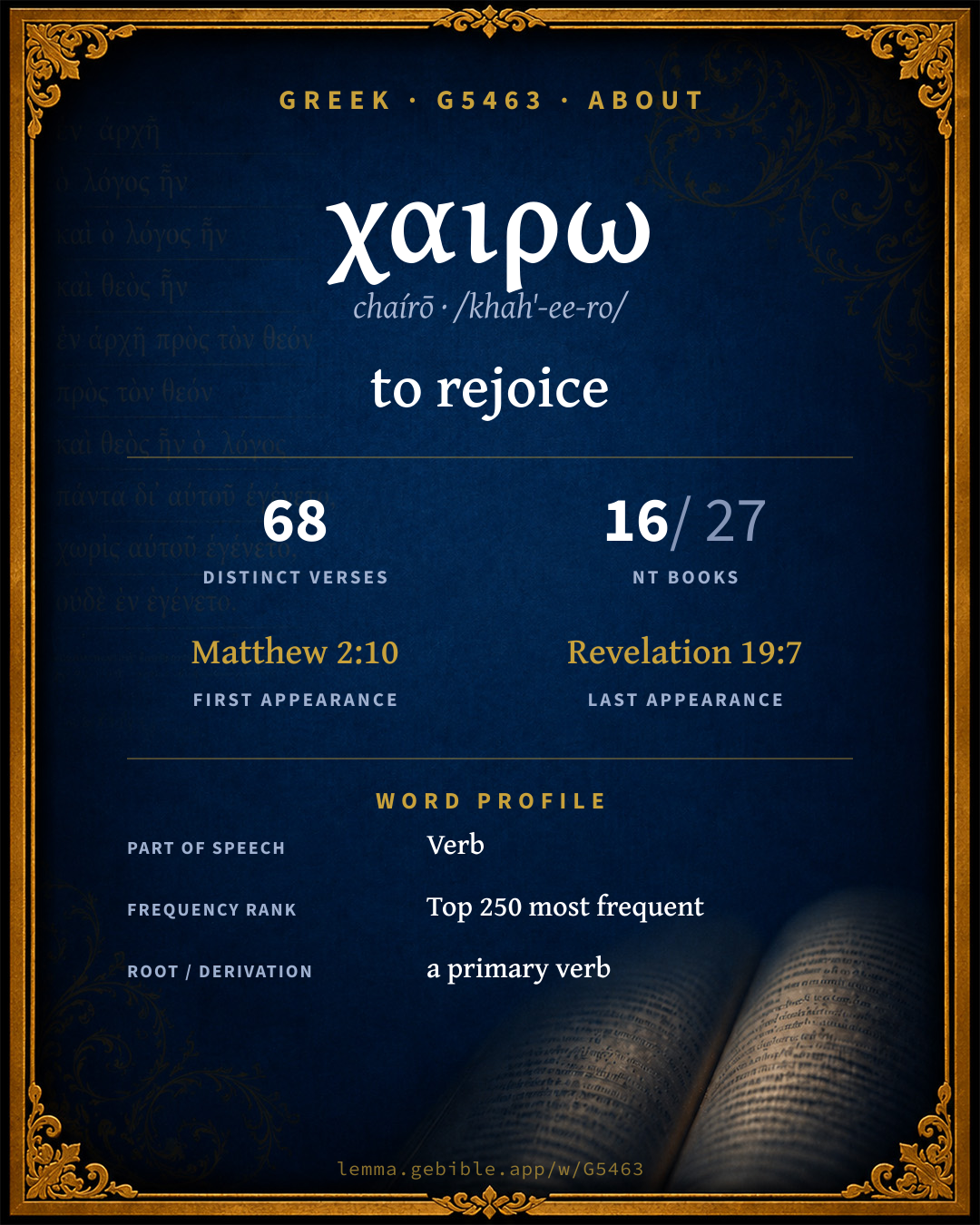
χαίρω
to rejoice
‘to rejoice’ is one of 5 main senses fuller range ↓
Full lexicon entry — Thayer's Greek Lexicon
From Thayer's Greek Lexicon
Where this word appears
See every Present-tense verb in the Greek New Testament →
Grammar key — what these labels mean
Part of speech
- Verb
- An action or state-of-being word.
Tense
- Present
- Ongoing or general action in present time (imperfective aspect).
- Aorist
- Action viewed as a simple whole, without regard to duration — often past (perfective aspect).
- Future
- Action expected in future time.
- Imperfect
- Continuous or repeated action in past time (“was writing”).
Voice
- Active
- The subject performs the action.
- Passive deponent
- Passive in form but active in meaning.
Mood
- Imperative
- Expresses a command or request.
- Indicative
- States a fact or asks a factual question (the mood of reality).
- Infinitive
- A verbal noun (“to write”), unmarked for person or number.
- Participle
- A verbal adjective (“writing,” “having written”).
- Subjunctive
- Expresses probability, purpose, or possibility (the mood of contingency).
Case
- Nominative
- The case of the subject (and the predicate nominative).
- Genitive
- The case of source, possession, or “of” — answers “whose / from what.”
Person
- 2nd person
- The one addressed (“you”).
- 1st person
- The speaker (“I / we”).
- 3rd person
- The one spoken about (“he / she / it / they”).
Gender
- Masculine
- Grammatically masculine.
Number
- Plural
- More than one.
- Singular
- One.
Grammatical forms 25 distinct
- Verb, Present, Active, Imperative, 2nd person, Plural 11 times (15%)
- Verb, Present, Active, Indicative, 1st person, Singular 8 times (11%)
- Verb, Present, Active, Infinitive 7 times (9%)
- Verb, Present, Active, Participle, Nominative, Plural, Masculine 6 times (8%)
- Verb, Aorist, Passive deponent, Indicative, 3rd person, Plural 5 times (7%)
- Verb, Present, Active, Imperative, 2nd person, Singular 5 times (7%)
- Verb, Present, Active, Participle, Nominative, Singular, Masculine 4 times (5%)
- Verb, Aorist, Passive deponent, Indicative, 1st person, Singular 3 times (4%)
+17 more forms (25 occurrences)
Parsed forms decoded from the imported morphology (Robinson–Tischendorf, public domain), counted across 74 parsed occurrences — not distinct verses.
Every verse where G5463 appears — 68 distinct verses across 16 books. Click any verse to open its interlinear word-by-word view. Verse text shown in the World English Bible for context — . Each verse’s Greek form is shown with its reference; the English is not keyword-highlighted, since the data carries no word-level English alignment. Use “Compare translations” on any verse to read it across multiple English versions. This concordance covers the Greek New Testament; Septuagint (Greek Old Testament) occurrences of this word are not indexed here.
Matthew 6 verses
- Matthew 2:10 ἐχάρησαν aor pass.dep ind 3pl When they saw the star, they rejoiced with exceedingly great joy.
- Matthew 5:12 χαίρετε pres act impv 2pl Rejoice, and be exceedingly glad, for great is your reward in heaven. For that is how they persecuted the prophets who were before you.
- Matthew 18:13 χαίρει pres act ind 3sg If he finds it, most assuredly I tell you, he rejoices over it more than over the ninety-nine which have not gone astray.
- Matthew 26:49 χαῖρε pres act impv 2sg Immediately he came to Jesus, and said, "Hail, Rabbi!" and kissed him.
- Matthew 27:29 χαῖρε pres act impv 2sg They braided a crown of thorns and put it on his head, and a reed in his right hand; and they kneeled down before him, and mocked him, saying, "Hail, King of the Jews!"
- Matthew 28:9 χαίρετε pres act impv 2pl As they went to tell his disciples, behold, Jesus met them, saying, "Rejoice!" They came and took hold of his feet, and worshiped him.
Mark 2 verses
Luke 11 verses
- Luke 1:14 χαρήσονται fut pass.dep ind 3pl You will have joy and gladness; and many will rejoice at his birth.
- Luke 1:28 χαῖρε pres act impv 2sg Having come in, the angel said to her, "Rejoice, you highly favored one! The Lord is with you. Blessed are you among women!"
- Luke 6:23 χάρητε aor pass.dep impv 2pl Rejoice in that day, and leap for joy, for behold, your reward is great in heaven, for their fathers did the same thing to the prophets.
- Luke 10:20 χαίρετε χαίρετε pres act impv 2pl pres act impv 2pl Nevertheless, don't rejoice in this, that the spirits are subject to you, but rejoice that your names are written in heaven."
- Luke 13:17 ἔχαιρεν impf act ind 3sg As he said these things, all his adversaries were disappointed, and all the multitude rejoiced for all the glorious things that were done by him.
- Luke 15:5 χαίρων pres act ptcp nom sg masc When he has found it, he carries it on his shoulders, rejoicing.
- Luke 15:32 χαρῆναι aor pass.dep inf But it was appropriate to celebrate and be glad, for this, your brother, was dead, and is alive again. He was lost, and is found.'"
- Luke 19:6 χαίρων pres act ptcp nom sg masc He hurried, came down, and received him joyfully.
- Luke 19:37 χαίροντες pres act ptcp nom pl masc As he was now getting near, at the descent of the Mount of Olives, the whole multitude of the disciples began to rejoice and praise God with a loud voice for all the mighty works which they had seen,
- Luke 22:5 ἐχάρησαν aor pass.dep ind 3pl They were glad, and agreed to give him money.
- Luke 23:8 ἐχάρη aor pass.dep ind 3sg Now when Herod saw Jesus, he was exceedingly glad, for he had wanted to see him for a long time, because he had heard many things about him. He hoped to see some miracle done by him.
John 9 verses
- John 3:29 χαίρει pres act ind 3sg He who has the bride is the bridegroom; but the friend of the bridegroom, who stands and hears him, rejoices greatly because of the bridegroom's voice. This, my joy, therefore is made full.
- John 4:36 χαίρῃ pres act subj 3sg He who reaps receives wages, and gathers fruit to eternal life; that both he who sows and he who reaps may rejoice together.
- John 8:56 ἐχάρη aor pass.dep ind 3sg Your father Abraham rejoiced to see my day. He saw it, and was glad."
- John 11:15 χαίρω pres act ind 1sg I am glad for your sakes that I was not there, so that you may believe. Nevertheless, let's go to him."
- John 14:28 ἐχάρητε aor pass.dep ind 2pl You heard how I told you, 'I go away, and I come to you.' If you loved me, you would have rejoiced, because I said 'I am going to my Father;' for the Father is greater than I.
- John 16:20 χαρήσεται fut pass.dep ind 3sg Most assuredly I tell you, that you will weep and lament, but the world will rejoice. You will be sorrowful, but your sorrow will be turned into joy.
- John 16:22 χαρήσεται fut pass.dep ind 3sg Therefore you now have sorrow, but I will see you again, and your heart will rejoice, and no one will take your joy away from you.
- John 19:3 χαῖρε pres act impv 2sg They kept saying, "Hail, King of the Jews!" and they kept slapping him.
- John 20:20 ἐχάρησαν aor pass.dep ind 3pl When he had said this, he showed them his hands and his side. The disciples therefore were glad when they saw the Lord.
Acts 7 verses
- Acts 5:41 χαίροντες pres act ptcp nom pl masc They therefore departed from the presence of the council, rejoicing that they were counted worthy to suffer dishonor for Jesus' name.
- Acts 8:39 χαίρων pres act ptcp nom sg masc When they came up out of the water, the Spirit of the Lord caught Philip away, and the eunuch didn't see him any more, for he went on his way rejoicing.
- Acts 11:23 ἐχάρη aor pass.dep ind 3sg who, when he had come, and had seen the grace of God, was glad. He exhorted them all, that with purpose of heart they should remain near to the Lord.
- Acts 13:48 ἔχαιρον impf act ind 3pl As the Gentiles heard this, they were glad, and glorified the word of God. As many as were appointed to eternal life believed.
- Acts 15:23 χαίρειν pres act inf They wrote these things by their hand: "The apostles, the elders, and the brothers, to the brothers who are of the Gentiles in Antioch, Syria, and Cilicia: greetings.
- Acts 15:31 ἐχάρησαν aor pass.dep ind 3pl When they had read it, they rejoiced over the encouragement.
- Acts 23:26 χαίρειν pres act inf "Claudius Lysias to the most excellent governor Felix: Greetings.
Romans 3 verses
- Romans 12:12 χαίροντες pres act ptcp nom pl masc rejoicing in hope; enduring in troubles; continuing steadfastly in prayer;
- Romans 12:15 χαίρειν χαιρόντων pres act inf pres act ptcp gen pl masc Rejoice with those who rejoice. Weep with those who weep.
- Romans 16:19 χαίρω pres act ind 1sg For your obedience has become known to all. I rejoice therefore over you. But I desire to have you wise in that which is good, but innocent in that which is evil.
1 Corinthians 3 verses
- 1 Corinthians 7:30 χαίροντες χαίροντες pres act ptcp nom pl masc pres act ptcp nom pl masc and those who weep, as though they didn't weep; and those who rejoice, as though they didn't rejoice; and those who buy, as though they didn't possess;
- 1 Corinthians 13:6 χαίρει pres act ind 3sg doesn't rejoice in unrighteousness, but rejoices with the truth;
- 1 Corinthians 16:17 χαίρω pres act ind 1sg I rejoice at the coming of Stephanas, Fortunatus, and Achaicus; for that which was lacking on your part, they supplied.
2 Corinthians 8 verses
- 2 Corinthians 2:3 χαίρειν pres act inf And I wrote this very thing to you, so that, when I came, I wouldn't have sorrow from them of whom I ought to rejoice; having confidence in you all, that my joy would be shared by all of you.
- 2 Corinthians 6:10 χαίροντες pres act ptcp nom pl masc as sorrowful, yet always rejoicing; as poor, yet making many rich; as having nothing, and yet possessing all things.
- 2 Corinthians 7:7 χαρῆναι aor pass.dep inf and not by his coming only, but also by the comfort with which he was comforted in you, while he told us of your longing, your mourning, and your zeal for me; so that I rejoiced still more.
- 2 Corinthians 7:9 χαίρω pres act ind 1sg I now rejoice, not that you were made sorry, but that you were made sorry to repentance. For you were made sorry in a godly way, that you might suffer loss by us in nothing.
- 2 Corinthians 7:13 ἐχάρημεν aor pass.dep ind 1pl Therefore we have been comforted. In our comfort we rejoiced the more exceedingly for the joy of Titus, because his spirit has been refreshed by you all.
- 2 Corinthians 7:16 χαίρω pres act ind 1sg I rejoice that in everything I am of good courage concerning you.
- 2 Corinthians 13:9 χαίρομεν pres act ind 1pl For we rejoice when we are weak and you are strong. And this we also pray for, even your perfecting.
- 2 Corinthians 13:11 χαίρετε pres act impv 2pl Finally, brothers, rejoice. Be perfected, be comforted, be of the same mind, live in peace, and the God of love and peace will be with you.
Philippians 7 verses
- Philippians 1:18 χαίρω χαρήσομαι pres act ind 1sg fut pass.dep ind 1sg What does it matter? Only that in every way, whether in pretense or in truth, Christ is proclaimed. I rejoice in this, yes, and will rejoice.
- Philippians 2:17 χαίρω pres act ind 1sg Yes, and if I am poured out on the sacrifice and service of your faith, I rejoice, and rejoice with you all.
- Philippians 2:18 χαίρετε pres act impv 2pl In the same way, you also rejoice, and rejoice with me.
- Philippians 2:28 χαρῆτε aor pass.dep subj 2pl I have sent him therefore the more diligently, that, when you see him again, you may rejoice, and that I may be the less sorrowful.
- Philippians 3:1 χαίρετε pres act impv 2pl Finally, my brothers, rejoice in the Lord. To write the same things to you, to me indeed is not tiresome, but for you it is safe.
- Philippians 4:4 Χαίρετε χαίρετε pres act impv 2pl pres act impv 2pl Rejoice in the Lord always! Again I will say, Rejoice!
- Philippians 4:10 Ἐχάρην aor pass.dep ind 1sg But I rejoice in the Lord greatly, that now at length you have revived your thought for me; in which you did indeed take thought, but you lacked opportunity.
Colossians 2 verses
- Colossians 1:24 χαίρω pres act ind 1sg Now I rejoice in my sufferings for your sake, and fill up on my part that which is lacking of the afflictions of Christ in my flesh for his body's sake, which is the assembly;
- Colossians 2:5 χαίρων pres act ptcp nom sg masc For though I am absent in the flesh, yet am I with you in the spirit, rejoicing and seeing your order, and the steadfastness of your faith in Christ.
1 Thessalonians 2 verses
James 1 verse
1 Peter 1 verse
2 John 3 verses
- 2 John 1:4 Ἐχάρην aor pass.dep ind 1sg I rejoice greatly that I have found some of your children walking in truth, even as we have been commanded by the Father.
- 2 John 1:10 χαίρειν pres act inf If anyone comes to you, and doesn't bring this teaching, don't receive him into your house, and don't welcome him,
- 2 John 1:11 χαίρειν pres act inf for he who welcomes him participates in his evil works.
3 John 1 verse
Revelation 2 verses
- Revelation 11:10 χαίρουσιν pres act ind 3pl Those who dwell on the earth rejoice over them, and they will be glad. They will give gifts to one another, because these two prophets tormented those who dwell on the earth.
- Revelation 19:7 χαίρωμεν pres act subj 1pl Let us rejoice and be exceedingly glad, and let us give the glory to him. For the marriage of the Lamb has come, and his wife has made herself ready."
About this entry
At a glance — auto-summarized from this page’s data, not written by a person. Every figure links to its source below. This summary describes the numbers; it doesn’t interpret them.
“to rejoice” is the headline sense of the Greek verb χαιρω (chaírō). Catalogued under 5 senses, its meaning is not single-sense. The Greek New Testament uses it across 68 verses — moderately common. First canonically at Matthew 2:10, it enters the text early. It shares a root with χαρα and χαρις. The sections below give every sense, occurrence, and version rendering.
Gloss history
Strong's 1890 vs modern scholarship

About this word
Strong's G5463 catalogs a Greek word from the Greek New Testament.
These counts are not copied from any lexicon or concordance. They are computed here, from the morphology-tagged Greek New Testament. What Lemma adds →
- 68
- distinct verses
- The word appears in 68 distinct verses.
- 16 / 27
- NT books
- The word appears in 16 of 27 New Testament books.
- #231
- by frequency
- Top 250 most frequent Greek words (rank 231 of 5,347 Greek words by occurrence).
View all 68 occurrences in the concordance →
Most concentrated in
- Luke 11 verses 16%
- John 9 verses 13%
- 2 Corinthians 8 verses 12%
By section of the New Testament
By traditional corpus
Conventional, traditional groupings — biblical authorship is debated, so this is a traditional corpus grouping, not an authorship claim. Some books belong to more than one corpus (Luke is in both the Gospels and the Lukan corpus, and so on), so these shares overlap and need not total 100%. Each figure is a share of the word’s 68 distinct verses.
- Gospels 28 verses · 41%
- Pauline corpus 25 verses · 37%
- Lukan (Luke–Acts) 18 verses · 26%
- Johannine 15 verses · 22%
- General (Catholic) Epistles 6 verses · 9%
- Revelation 2 verses · 3%
How translations render this word
Counts come from each version’s own published word-to-Strong’s tagging or interlinear alignment — an approximate guide to how each version renders this word, not a word-level alignment the data otherwise carries. Because each total is that version’s own tagged count, the per-version totals vary from one another and need not match the appearance or distinct-verse counts above. These counts may also differ from a printed concordance because Lemma counts each distinctly tagged rendering and does not collapse phrase taggings into a single head-word total. This is a fixed set of word-tagged versions (KJV, ASV, BSB, ULT) and does not change with the reading translation you choose elsewhere. Each version’s license is shown beside its name below (and on Sources).
- King James Version: Rejoice 12×, Hail 5×, Rejoicing 5×
- American Standard Version: Rejoice 19×, Greeting 5×, Hail 5×
- Berean Standard Bible: Rejoice 13×, Greetings 6×, I rejoice 6×
- unfoldingWord Literal Text: Rejoice 24×, Rejoicing 10×, I rejoice 7×
King James Version Public Domain
Renders G5463 across 77 tagged occurrences — most commonly:
Plus other, less common renderings. Plus 26 renderings that appear only once — usually multi-word phrases or single function words the recovered tagging swept in, not distinct renderings.
American Standard Version Public Domain
Renders G5463 across 76 tagged occurrences — most commonly:
Plus other, less common renderings. Plus 21 renderings that appear only once — usually multi-word phrases or single function words the recovered tagging swept in, not distinct renderings.
Berean Standard Bible Public Domain
Renders G5463 across 71 tagged occurrences — most commonly:
Plus 24 renderings that appear only once — usually multi-word phrases or single function words the recovered tagging swept in, not distinct renderings. Not rendered by a distinct English word in 3 further occurrences.
unfoldingWord Literal Text CC BY-SA 4.0
Renders G5463 across 77 tagged occurrences — most commonly:
Plus 19 renderings that appear only once — usually multi-word phrases or single function words the recovered tagging swept in, not distinct renderings.
Senses in Thayer's
The 5 senses Thayer's distinguishes for this word, in lexicon order (not ranked by frequency or importance). The full entry — with sub-senses — is in the Lexicon Entry tab.
- to rejoice, be glad
- to rejoice exceedingly
- to be well, thrive
- in salutations, hail!
- at the beginning of letters: to give one greeting, salute
Word origin
Origin: a primary verb
A primary verb; to be full of cheer that is calmly happy or well off; impersonal especially as a salutation (on meeting or parting) be well : - farewell be glad God speed greeting hail joy (-fully) rejoice.
— Strong’s Exhaustive Concordance (1890), public domain.
Forms in the corpus
The 27 distinct written forms G5463 takes in the Greek New Testament, most frequent first — each parse links to that tense’s occurrences in the concordance.
Same root — word family
Other Thayer's entries built from the same root as G5463, grouped by Strong’s listed origin. These share a root / origin per the lexicon — not necessarily a shared meaning. Each links to that word’s own entry.
Derived from this word
Compare all same-root words → They share a root, not necessarily a meaning.
Septuagint usage
The same Greek word χαιρω appears 40 times in the Greek Old Testament (Septuagint), across 38 verses in 18 books.
- 40
- LXX occurrences
- Tagged occurrences of this Greek word in the Septuagint.
- 38
- verses
- Distinct Septuagint verses containing this word.
- 18 / 39
- OT books
- The word appears in 18 of the 39 Old Testament books.
Sample Septuagint occurrences
- Genesis 45:16 χαίρω
- Exodus 4:14 χαίρω
- 1 Samuel 19:5 χαίρω
- 1 Kings 2:46 χαίρω
- 2 Kings 11:14 χαίρω
- Esther 8:15 χαίρω
- Psalms 95:12 χαίρω
- Proverbs 2:14 χαίρω
- Isaiah 13:3 χαίρω
- Jeremiah 7:34 χαίρω
- Lamentations 1:21 χαίρω
- Ezekiel 7:12 χαίρω
Septuagint occurrences (same lexeme)
Every verse where the same Strong’s number (G5463) appears in the Greek Septuagint. Verse text shown in the World English Bible for context; the Greek form is the matched word — the English is not keyword-highlighted.
- Genesis 45:16 χαίρω The report of it was heard in Pharaoh's house, saying, "Joseph's brothers have come." It pleased Pharaoh well, and his servants.
- Exodus 4:14 χαίρω The anger of Yahweh was kindled against Moses, and he said, "What about Aaron, your brother, the Levite? I know that he can speak well. Also, behold, he comes forth to meet you. When he sees you, he will be glad in his heart.
- Exodus 4:31 χαίρω The people believed, and when they heard that Yahweh had visited the children of Israel, and that he had seen their affliction, then they bowed their heads and worshiped.
- 1 Samuel 19:5 χαίρω for he put his life in his hand, and struck the Philistine, and Yahweh worked a great victory for all Israel: you saw it, and did rejoice; why then will you sin against innocent blood, to kill David without a cause?
- 1 Kings 2:46 χαίρω So the king commanded Benaiah the son of Jehoiada; and he went out, and fell on him, so that he died. The kingdom was established in the hand of Solomon.
- 1 Kings 5:21 χαίρω
- 1 Kings 8:66 χαίρω On the eighth day he sent the people away; and they blessed the king, and went to their tents joyful and glad of heart for all the goodness that Yahweh had shown to David his servant, and to Israel his people.
- 2 Kings 11:14 χαίρω and she looked, and, behold, the king stood by the pillar, as the manner was, and the captains and the trumpets by the king; and all the people of the land rejoiced, and blew trumpets. Then Athaliah tore her clothes, and cried, Treason! treason!
- 2 Kings 11:20 χαίρω So all the people of the land rejoiced, and the city was quiet. Athaliah they had slain with the sword at the king's house.
- 2 Kings 20:13 χαίρω Hezekiah listened to them, and shown them all the house of his precious things, the silver, and the gold, and the spices, and the precious oil, and the house of his armor, and all that was found in his treasures: there was nothing in his house, nor in all his dominion, that Hezekiah didn't show them.
- Esther 8:15 χαίρω Mordecai went forth from the presence of the king in royal clothing of blue and white, and with a great crown of gold, and with a robe of fine linen and purple: and the city of Shushan shouted and was glad.
- Psalms 95:12 χαίρω
- Proverbs 2:14 χαίρω Who rejoice to do evil, And delight in the perverseness of evil;
- Proverbs 6:16 χαίρω There are six things which Yahweh hates; Yes, seven which are an abomination to him:
- Proverbs 17:19 χαίρω He who loves disobedience loves strife. One who builds a high gate seeks destruction.
- Proverbs 23:25 χαίρω Let your father and your mother be glad! Let her who bore you rejoice!
- Proverbs 24:19 χαίρω Don't fret yourself because of evildoers; Neither be envious of the wicked:
- Isaiah 13:3 χαίρω I have commanded my consecrated ones, yes, I have called my mighty men for my anger, even my proudly exulting ones.
- Isaiah 39:2 χαίρω Hezekiah was glad of them, and shown them the house of his precious things, the silver, and the gold, and the spices, and the precious oil, and all the house of his armor, and all that was found in his treasures: there was nothing in his house, nor in all his dominion, that Hezekiah didn't show them.
- Isaiah 48:22 χαίρω There is no peace, says Yahweh, to the wicked.
- Isaiah 57:21 χαίρω There is no peace, says my God, to the wicked.
- Isaiah 66:10 χαίρω Rejoice you with Jerusalem, and be glad for her, all you who love her: rejoice for joy with her, all you who mourn over her;
- Isaiah 66:14 χαίρω You shall see [it], and your heart shall rejoice, and your bones shall flourish like the tender grass: and the hand of Yahweh shall be known toward his servants; and he will have indignation against his enemies.
- Jeremiah 7:34 χαίρω Then will I cause to cease from the cities of Judah, and from the streets of Jerusalem, the voice of mirth and the voice of gladness, the voice of the bridegroom and the voice of the bride; for the land shall become a waste.
- Jeremiah 38:13 χαίρω So they drew up Jeremiah with the cords, and took him up out of the dungeon: and Jeremiah remained in the court of the guard.
- Lamentations 1:21 χαίρω They have heard that I sigh; there is none to comfort me; All my enemies have heard of my trouble; they are glad that you have done it: You will bring the day that you have proclaimed, and they shall be like me.
- Lamentations 4:21 χαίρω Rejoice and be glad, daughter of Edom, that dwell in the land of Uz: The cup shall pass through to you also; you shall be drunken, and shall make yourself naked.
- Ezekiel 7:12 χαίρω The time is come, the day draws near: don't let the buyer rejoice, nor the seller mourn; for wrath is on all the multitude of it.
- Hosea 9:1 χαίρω Don't rejoice, Israel, to jubilation like the nations; For you were unfaithful to your God. You love the wages of a prostitute at every grain threshing floor.
- Joel 2:21 χαίρω Land, don't be afraid. Be glad and rejoice, for Yahweh has done great things.
- Joel 2:23 χαίρω "Be glad then, you children of Zion, And rejoice in Yahweh, your God; For he gives you the former rain in just measure, And he causes the rain to come down for you, The former rain and the latter rain, As before.
- Jonah 4:6 χαίρω Yahweh God prepared a vine, and made it to come up over Jonah, that it might be a shade over his head, to deliver him from his discomfort. So Jonah was exceedingly glad because of the vine.
- Habakkuk 1:15 χαίρω He takes up all of them with the hook. He catches them in his net, and gathers them in his dragnet. Therefore he rejoices and is glad.
- Habakkuk 3:18 χαίρω Yet I will rejoice in Yahweh. I will be joyful in the God of my salvation!
- Zephaniah 3:14 χαίρω Sing, daughter of Zion! Shout, Israel! Be glad and rejoice with all your heart, daughter of Jerusalem.
- Zechariah 4:10 χαίρω Indeed, who despises the day of small things? For these seven shall rejoice, and shall see the plumb line in the hand of Zerubbabel. These are the eyes of Yahweh, which run back and forth through the whole earth."
- Zechariah 9:9 χαίρω Rejoice greatly, daughter of Zion! Shout, daughter of Jerusalem! Behold, your king comes to you! He is righteous, and having salvation; Lowly, and riding on a donkey, Even on a colt, the foal of a donkey.
- Zechariah 10:7 χαίρω Ephraim will be like a mighty man, And their heart will rejoice as through wine; Yes, their children will see it, and rejoice. Their heart will be glad in Yahweh.
These are occurrences of the same Greek lexeme (G5463) in the Septuagint — not a translation of any one Hebrew word. The store carries no word-level Hebrew↔Greek alignment, so no Hebrew original is asserted here. Counts come from the recovered LXX Strong's tagging — high-frequency vocabulary is well covered, while rare or late forms may be untagged — so they reflect tagged occurrences and may slightly undercount.