
2 Samuel 15:25

Hebrew (Westminster Leningrad Codex) 2 Samuel 15:25 appears in the Hebrew Old Testament. The text above is from the Westminster Leningrad Codex. Each word links to its Strong’s number, a concise gloss, and parsing drawn from the Open Scriptures Hebrew Bible morphology. Click any word for its full Brown-Driver-Briggs (BDB) entry.
Download image
Cite this verse

2 Samuel 15:25 (World English Bible). Public Domain. Lemma interlinear Bible study tool, https://lemma.gebible.app/v/2-samuel/15/25.

Show BibTeX & RIS
BibTeX
RIS
English Translation
The king said to Zadok, Carry back the ark of God into the city: if I shall find favor in the eyes of Yahweh, he will bring me again, and show me both it, and his habitation:
World English Bible · Public Domain
Download a study sheet

One document with this verse’s original text, its word-by-word gloss line, the meaning frame, cross-references with their text, attributed commentary, and full source and license credits — printable, and it pastes into notes with its structure intact.

This verse Autodidact and up

Study sheet (.html) Plain text (.txt)

A passage Seminary Student

Up to 50 verses in one chapter. A passage sheet keeps up to 6 commentary sources and 12 cross-references per verse, in the order this page ranks them, and says so on the sheet whenever that leaves anything out. Ask for a single verse and you get the Autodidact verse sheet above.

Everything on this page stays free to read, with no account — the sheet is a download of what is already on screen, not access to it.

Want to remove ads? Support Godless Engineer
Compare translations 3

The same verse in 3 English versions, stacked beneath the original-language interlinear above. Click any original word for its lexicon entry.

Each is an independent rendering of the whole verse — the interlinear is not word-aligned to these translations.

Highlighted words mark where these versions differ — a whole-verse word diff, not a word-by-word alignment.

  • World English Bible Public Domain
    The king said to Zadok, Carry back the ark of God into the city: if I shall find favor in the eyes of Yahweh, he will bring me again, and show me both it, and his habitation:
  • King James Version Public Domain
    And the king said unto Zadok, Carry back the ark of God into the city: if I shall find favor in the eyes of the LORD, he will bring me again, and show me both it, and his habitation:
  • unfoldingWord Literal Text CC BY-SA 4.0
    And the king said to Zadok, “Bring back the Box of God the city. If I find favor in the eyes of Yahweh, then he will bring me back, and he will make me see it and his habitation.

unfoldingWord Literal Text — © unfoldingWord, licensed CC BY-SA 4.0. Word-aligned USFM3 via Door43 (git.door43.org/unfoldingWord/en_ult).

Versions to compare (up to 4)

3 of 4 selected

Show all 18 translations

Every available English version of this verse, each an independent rendering of the whole verse.

  • World English Bible Public Domain
    The king said to Zadok, Carry back the ark of God into the city: if I shall find favor in the eyes of Yahweh, he will bring me again, and show me both it, and his habitation:
  • Berean Standard Bible Public Domain
    Then the king said to Zadok, “Return the ark of God to the city. If I find favor in the eyes of the LORD, He will bring me back and let me see both it and His dwelling place again.
  • Majority Standard Bible Public Domain
    Then the king said to Zadok, “Return the ark of God to the city. If I find favor in the eyes of the LORD, He will bring me back and let me see both it and His dwelling place again.
  • King James Version Public Domain
    And the king said unto Zadok, Carry back the ark of God into the city: if I shall find favor in the eyes of the LORD, he will bring me again, and show me both it, and his habitation:
  • American Standard Version (1901) Public Domain
    And the king said unto Zadok, Carry back the ark of God into the city: if I shall find favor in the eyes of Jehovah, he will bring me again, and show me both it, and his habitation:
  • Revised Version (1885) Public Domain
    And the king said unto Zadok, Carry back the ark of God into the city: if I shall find favour in the eyes of the LORD, he will bring me again, and shew me both it, and his habitation:
  • Geneva Bible (1599) Public Domain
    Then the King said vnto Zadok, Carie the Arke of God againe into the citie: if I shall finde fauour in the eyes of the Lord, he will bring me againe, and shewe me both it, and the Tabernacle thereof.
  • Douay-Rheims (1899) Public Domain
    And the king said to Sadoc: Carry back the ark of God into the city: if I shall find grace in the sight of the Lord, he will bring me again, and he will shew me it, and his tabernacle.
  • Young's Literal Translation Public Domain
    And the king saith to Zadok, `Take back the ark of God to the city; if I find grace in the eyes of Jehovah, then He hath brought me back, and shewn me it and His habitation;
  • Literal Standard Version CC BY-SA 4.0
    And the king says to Zadok, “Take back the Ark of God to the city; if I find grace in the eyes of YHWH, then He has brought me back, and shown me it and His habitation;
  • Unlocked Literal Bible CC BY-SA 4.0
    The king said to Zadok, “Carry the ark of God back into the city. If I find favor in the eyes of Yahweh, he will bring me back here and show me again the ark and the place where he lives.
  • unfoldingWord Literal Text CC BY-SA 4.0
    And the king said to Zadok, “Bring back the Box of God the city. If I find favor in the eyes of Yahweh, then he will bring me back, and he will make me see it and his habitation.
  • Darby Bible Public Domain
    And the king said to Zadok, Carry back the ark of God into the city. If I shall find favour in the eyes of Jehovah, he will bring me again, and shew me it, and its habitation.
  • World Messianic Bible Public Domain
    The king said to Zadok, “Carry God’s ark back into the city. If I find favor in the LORD’s eyes, he will bring me again, and show me both it and his habitation;
  • Webster's Bible Public Domain
    And the king said to Zadok, Carry back the ark of God into the city: if I shall find favor in the eyes of the LORD, he will bring me again, and show me both it, and his habitation:
  • Free Bible Version CC BY-SA 4.0
    Then the king told Zadok, “Take the Ark of God back to the city. If I find the Lord approves of me, he will bring me back and let me see both the Ark and his Tent again.
  • Bible in Basic English Public Domain
    And the king said to Zadok, Take the ark of God back into the town: if I have grace in the eyes of the Lord, he will let me come back and see it and his House again:
  • JPS Tanakh (1917) Public Domain
    And the king said unto Zadok: 'Carry back the ark of God into the city; if I shall find favour in the eyes of the LORD, He will bring me back, and show me both it, and His habitation;

Literal Standard Version (2020), Covenant Press — licensed CC BY-SA 4.0. Text via the HelloAO Bible API (eBible.org). Unlocked Literal Bible (unfoldingWord) — licensed CC BY-SA 4.0. Text via the HelloAO Bible API (eBible.org). unfoldingWord Literal Text — © unfoldingWord, licensed CC BY-SA 4.0. Word-aligned USFM3 via Door43 (git.door43.org/unfoldingWord/en_ult). Free Bible Version, Dr. Jonathan Gallagher — licensed CC BY-SA 4.0. Text via the HelloAO Bible API (eBible.org).

Word by word

More ways to search: Search by grammar → Find every occurrence → Compare this word →

Practice this passage: Drill this verse → Learn its vocabulary →

נָוֵֽהוּ
nâveh
H5116
“habitation · his”
Noun, Common, Both, Singular, Construct + Suffix, Personal, 3rd Person, Masculine, Singular
Part of Speech
Noun
Type
Common
Gender
Both
Number
Singular
State
Construct
Full BDB Definition

Origin: from H5115

TWOT: 1322a , 1322b , 1322c

abode, habitation, abode of shepherds or flocks, pasture (noun masculine) - abode (of sheep) - abode (of shepherds) - meadow - habitation - dwelling, abiding (adjective)
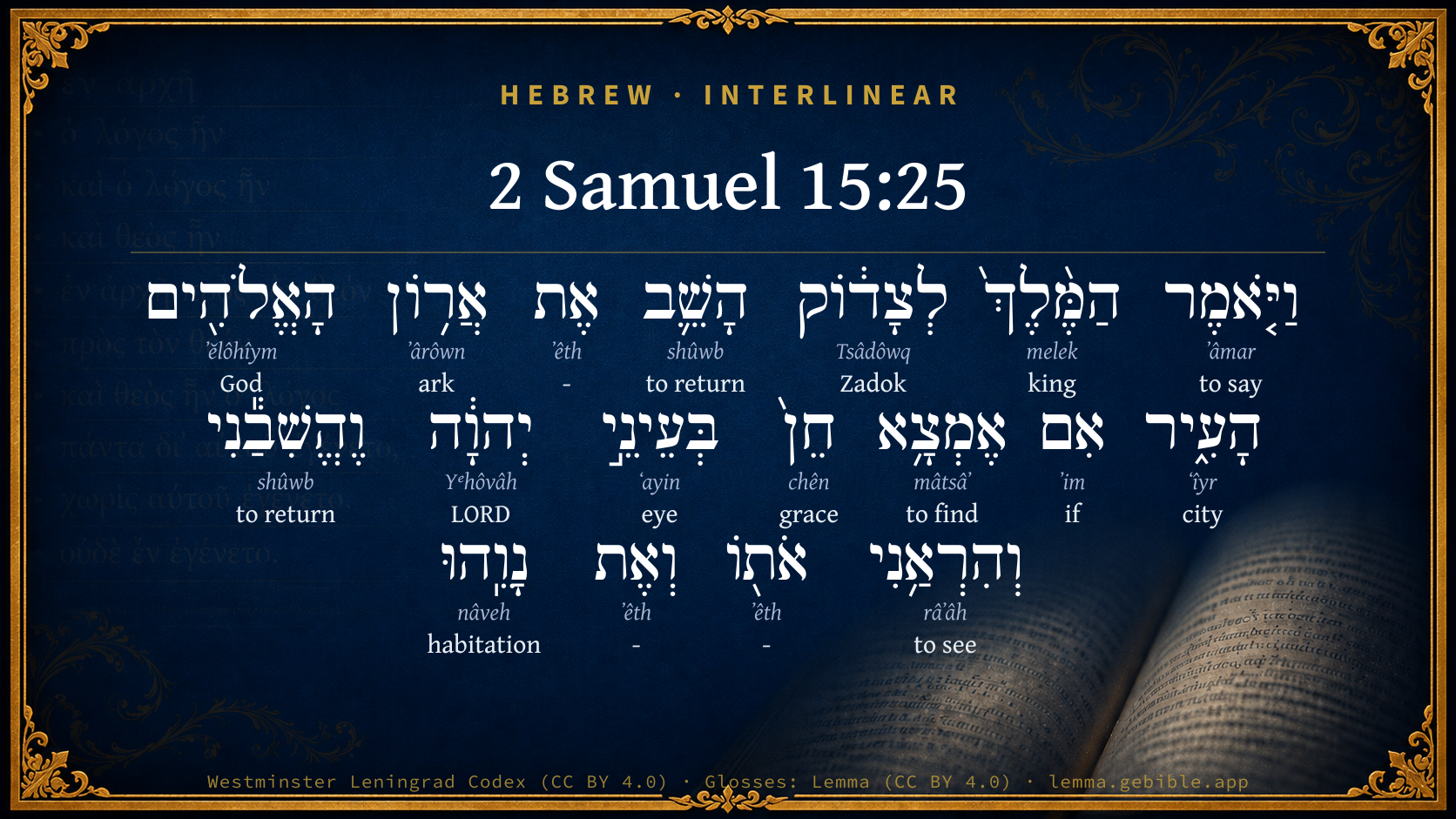
  1. וַיֹּ֤אמֶר ʼâmar H559 “and · to say” Conjunction + Verb, Qal, Sequential Imperfect, 3rd Person, Masculine, Singular
  2. הַמֶּ֨לֶךְ֙ melek H4428 “the · king” Particle, Definite Article + Noun, Common, Masculine, Singular, Absolute
  3. לְצָד֔וֹק Tsâdôwq H6659 “to/for · Zadok” Preposition + Noun, Proper
  4. הָשֵׁ֛ב shûwb H7725 “return” Verb, Hiphil, Imperative, 2nd Person, Masculine, Singular
  5. אֶת ʼêth H853 “-” Particle, Direct Object
  6. אֲר֥וֹן ʼârôwn H727 “ark of” Noun, Common, Both, Singular, Construct
  7. הָאֱלֹהִ֖ים ʼĕlôhîym H430 “the · God(s)” Particle, Definite Article + Noun, Common, Masculine, Plural, Absolute
  8. הָעִ֑יר ʻîyr H5892 “the · city” Particle, Definite Article + Noun, Common, Feminine, Singular, Absolute
  9. אִם ʼim H518 “if” Conjunction
  10. אֶמְצָ֥א mâtsâʼ H4672 “to find” Verb, Qal, Imperfect, 1st Person, Common, Singular
  11. חֵן֙ chên H2580 “grace” Noun, Common, Masculine, Singular, Absolute
  12. בְּעֵינֵ֣י ʻayin H5869 “in/at · eyes of” Preposition + Noun, Common, Both, Dual, Construct
  13. יְהוָ֔ה Yᵉhôvâh H3068 “LORD” Noun, Proper
  14. וֶהֱשִׁבַ֕נִי shûwb H7725 “and · to return · me” Conjunction + Verb, Hiphil, Perfect, 3rd Person, Masculine, Singular + Suffix, Personal, 1st Person, Common, Singular
  15. וְהִרְאַ֥נִי râʼâh H7200 “and · to see · me” Conjunction + Verb, Hiphil, Perfect, 3rd Person, Masculine, Singular + Suffix, Personal, 1st Person, Common, Singular
  16. אֹת֖וֹ ʼêth H853 “- · him” Particle, Direct Object + Suffix, Personal, 3rd Person, Masculine, Singular
  17. וְאֶת ʼêth H853 “and · -” Conjunction + Particle, Direct Object

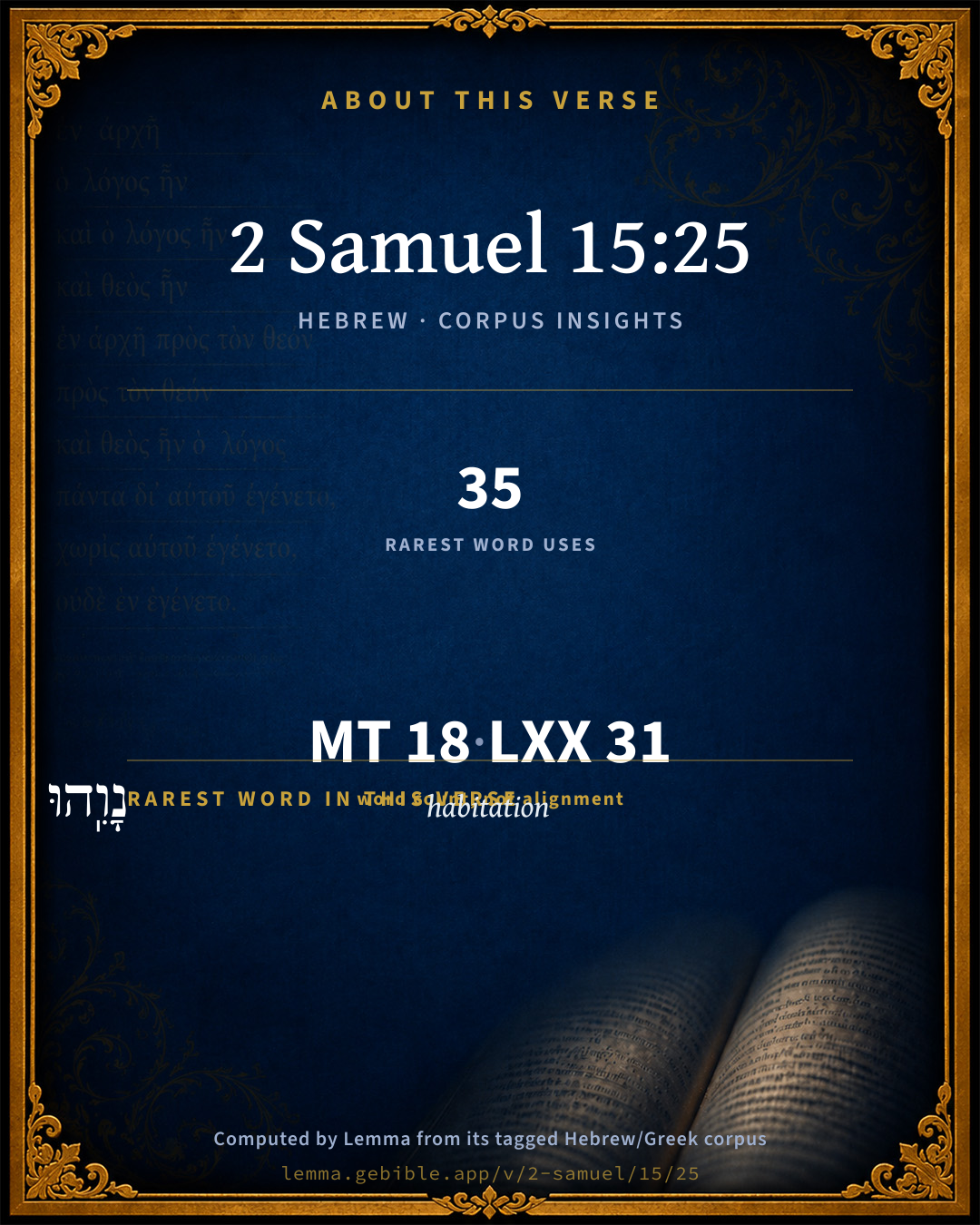
About this verse

These counts appear in no published source. They are computed here, from the morphology-tagged text and Lemma’s own curated glosses. What Lemma adds →

18
words
15
distinct lemmas
Historical
section

Shared distinctive vocabulary

נָוֵֽהוּ habitation H5116 occurs in 34 verses of the Hebrew Bible. Also found in:

Grammatical profile

  • 5 verbs
  • 9 nouns
  • 1 conjunction
  • 3 particles

Verb forms

  • וַיֹּ֤אמֶר Qal · Sequential Imperfect
  • הָשֵׁ֛ב Hiphil · Imperative
  • אֶמְצָ֥א Qal · Imperfect
  • וֶהֱשִׁבַ֕נִי Hiphil · Perfect
  • וְהִרְאַ֥נִי Hiphil · Perfect

Repetition

A word recurs within this verse — often emphatic in Hebrew:

  • הָשֵׁ֛ב to return H7725 ×2

Hebrew & Septuagint length

In English translation the verse runs 37 words from the Hebrew and 41 from the Septuagint (LXX English) — closely comparable.

A rough comparison of the two English renderings, which tokenize alike — not a word-level alignment.

Word counts can differ between the Hebrew and the Greek without any difference in meaning — e.g. the Hebrew direct-object marker אֵת has no separate Greek word, and Greek often adds the article ὁ.

In the original languages it is 18 Hebrew tokens and 31 Greek tokens — but the two are counted differently (Hebrew bundles its prefixes and suffixes into one token; the Greek is in lemma form), so that isn’t a like-for-like length.

Cross-references

17

Topical passages linked to 2 Samuel 15:25 in the Treasury of Scripture Knowledge — connected by theme and wording, ordered by reader-vote popularity; previews shown in the World English Bible.

  • Jeremiah 25:30 Therefore prophesy you against them all these words, and tell them, Yahweh will roar from on high, and utter his voice from his holy habitation; he will mightily roar against his fold; he will give a shout, as those who tread [the grapes], against all the inhabitants of the earth.
  • Psalms 26:8 Yahweh, I love the habitation of your house, The place where your glory dwells.
  • Psalms 84:10 For a day in your courts is better than a thousand. I would rather be a doorkeeper in the house of my God, Than to dwell in the tents of wickedness.
  • Exodus 15:13 "You, in your loving kindness, have led the people that you have redeemed. You have guided them in your strength to your holy habitation.
  • Psalms 43:3–4 Oh, send out your light and your truth. Let them lead me. Let them bring me to your holy hill, To your tents.
  • 1 Samuel 4:3–11 When the people were come into the camp, the elders of Israel said, Why has Yahweh struck us today before the Philistines? Let us get the ark of the covenant of Yahweh out of Shiloh to us, that it may come among us, and save us out of the hand of our enemies.
  • 2 Samuel 6:17 They brought in the ark of Yahweh, and set it in its place, in the midst of the tent that David had pitched for it; and David offered burnt offerings and peace-offerings before Yahweh.
  • 2 Samuel 7:2 that the king said to Nathan the prophet, See now, I dwell in a house of cedar, but the ark of God dwells within curtains.
  • 2 Samuel 12:10–11 Now therefore the sword will never depart from your house, because you have despised me, and have taken the wife of Uriah the Hittite to be your wife.'
  • Psalms 27:4–5 One thing I have asked of Yahweh, that I will seek after, That I may dwell in the house of Yahweh all the days of my life, To see Yahweh's beauty, And to inquire in his temple.
  • Psalms 42:1–2 As the deer pants for the water brooks, So my soul pants after you, God.
  • Psalms 63:1–2 God, you are my God. I will earnestly seek you. My soul thirsts for you, My flesh longs for you, In a dry and weary land, where there is no water.
  • Psalms 84:1–3 How lovely are your dwellings, Yahweh of Hosts!
  • Psalms 122:1 I was glad when they said to me, "Let's go to Yahweh's house!"
  • Psalms 122:9 For the sake of the house of Yahweh our God, I will seek your good.
  • Isaiah 38:22 Hezekiah also had said, What is the sign that I shall go up to the house of Yahweh?
  • Jeremiah 7:4 Don't you trust in lying words, saying, The temple of Yahweh, the temple of Yahweh, the temple of Yahweh, are these.

Cross-references courtesy of OpenBible.info (CC BY 4.0).

Hebrew and Greek witnesses Masoretic Hebrew ↔ Greek Septuagint

The same verse in the two great witnesses to the Old Testament, shown verse-for-verse.

These are two independent witnesses, not word-aligned to each other, and the Septuagint is shown in lemma (dictionary) form.

Hebrew 2 Samuel 15:25 Masoretic · Westminster Leningrad Codex

וַיֹּ֤אמֶר הַמֶּ֨לֶךְ֙ לְצָד֔וֹק הָשֵׁ֛ב אֶת אֲר֥וֹן הָאֱלֹהִ֖ים הָעִ֑יר אִם אֶמְצָ֥א חֵן֙ בְּעֵינֵ֣י יְהוָ֔ה וֶהֱשִׁבַ֕נִי וְהִרְאַ֥נִי אֹת֖וֹ וְאֶת נָוֵֽהוּ

The king said to Zadok, Carry back the ark of God into the city: if I shall find favor in the eyes of Yahweh, he will bring me again, and show me both it, and his habitation:

World English Bible · Public Domain

Greek LXX 2 Samuel 15:25 Septuagint · lemma form

καί εἶπον ὁ βασιλεύς ὁ σαδωκ ἀποστρέφω ὁ κιβωτός ὁ θεός εἰς ὁ πόλις ἐάν εὑρίσκω χάρις ἐν ὀφθαλμός κύριος καί ἐπιστρέφω ἐγώ καί δεικνύω ἐγώ αὐτός καί ὁ εὐπρέπεια αὐτός

And the king said to Sadoc, Carry back the ark of God into the city: if I should find favor in the eyes of the Lord, then will he bring me back, and he will show me it and its beauty.

LXX2012 (modern English Septuagint) · Public Domain

Hebrew: Westminster Leningrad Codex (CC BY 4.0). Greek: Septuagint (public domain); English from LXX2012 (modern English Septuagint) (Public Domain). How the Septuagint differs from the Hebrew →

Targum (Aramaic paraphrase)

1

The Targum is the ancient Jewish Aramaic paraphrase of the Hebrew Scriptures — an interpretive translation, not the Hebrew text itself. Onkelos (literal) and Pseudo-Jonathan (expansive) render the Torah, and Jonathan the Prophets. Coverage is partial: where no permissively-licensed English translation exists for a verse, only the Aramaic is shown. This is verse-level text, not a word-by-word alignment to the Hebrew.

  1. Targum Jonathan Prophets (Joshua–Malachi)
    וַאֲמַר מַלְכָּא לְצָדוֹק אֲתֵיב יַת אֲרוֹנָא דַייָ לְקַרְתָּא אִם אַשְׁכַּח רַחֲמִין קֳדָם יְיָ וִיתִיבִינַנִי וְיַחְזִינַנִי קֳדָמוֹהִי וְאֶפְלַח קֳדָמוֹהִי בְּבֵית מַקְדְשֵׁיהּ:

    (no public-domain English translation for this verse)

    Targum Jonathan — Aramaic: “Mikraot Gedolot” (public domain). English: “Sefaria Community Translation” (CC0 1.0 (public-domain dedication)); “London "Chaldee Paraphrase," 1871” (public domain). Text via Sefaria.

Commentary

Notes on 2 Samuel 15:25 from classic Christian and Jewish commentators (each source and its license shown beneath its notes). The classic Christian expositions comment on the surrounding passage and are grouped to its opening verse, so a note may address several verses; the Jewish commentaries on the Tanakh (Rashi and others) are per-verse, so they appear only where the commentator wrote on this verse.

Lemma curates 59 commentaries, every one of them public domain or Creative Commons licensed, each selected and text-cleaned for this edition rather than reprinted as found. About our sources →

Trapp's Complete Commentary

John Trapp

2Sa 15:25 And the king said unto Zadok, Carry back the ark of God into the city: if I shall find favour in the eyes of the LORD, he will bring me again, and shew me [both] it, and his habitation:

Ver. 25. Carry back the ark.] He believed that in his banishment God would be unto him as "a little sanctuary," {Eze 11:16} and not withdraw from him his powerful presence and assistance.

If I shall find favour in the eyes of the Lord, &c.] This was a piece of David’s piety, thus patiently and peaceably to submit to God’s holy will and pleasure; well content to be wholly at his disposal. So did David Pareus when forced to flee out of Heidelberg, not long before it was taken by the Spaniard. Hear him in his "Heidelberga Vale."

“ Sic est, Sancte Deus, sio fert tua sancta voluntas:

Ergo silens oris comprimo labra mei.

Quin me redde meis si vis; si reddere nolis,

En adsum, quo me pergere eunque voles. ”

Of Mr Robert Bolton {a} also, that most eminent preacher, it is reported, that dying and desiring to be dissolved, he was told that it was indeed better for him to be dissolved, but the Church of God could not miss him, nor the benefit of his ministry: he sweetly replied in these very words of David, If I shall find favour, &c.; but if otherwise, lo here I am, let him do what seemeth good in his eyes. The like equanimity was in Ferdinand II, emperor.

{a} Life of Mr Bolton, by Mr Bagshaw.

John Trapp, A Commentary or Exposition upon All the Books of the Old and New Testament (1647–1656) — public domain. Text from a community e-Sword module.

The Biblical Illustrator

Joseph S. Exell

2Sa_15:25-26

And the king said unto Zadok, Carry back the ark of God unto the city.

Davids dependence

Taking Davids conduct as an example to ourselves, we have brought before us the following truths:--

I.

true Godliness engages the souls supreme attention, even in time of trial.

1. It draws the thoughts away from self. Dwelling on sorrow increases its bitterness. It grows with observation. We concentrate our mind upon a thing until it becomes far larger than it really is.

2. It fills the void in the heart with consolation. Of all subjects religion is the most powerful thing in the world to occupy the attention, and in its presence every temporal affair sinks into the meanest insignificance.

II.--true Godliness places Gods honour ever before selfish ease. When David left the city in flight, Zadok, the High Priest, brought the ark of God to follow the King.

1. David rejected mere outward symbols and signs. The symbolism of the temple had its proper place and use. It was to accomplish a great, and mighty, and mysterious purpose. But if religion has its public representation and form, it has also its private and individual functions as well.

2. God could help him just as welt without the help of priest, or tabernacle, or service as He could with. Time and place are nothing to God. The tears of the prisoner are as precious to him as the orison of a pope. David was very well content to leave himself in the hands of God without any extraneous help.

III. True religion identifies mans interests with gods purposes. We learn practically that the part for us to perform is,

(1) Passive trust and resignation to the divine will, and

(2) Constant faith in Gods dealing. David did not for one moment doubt. His trust was unshaken amid all his trouble. If I find favour in His eyes, He will bring me again, but if not, let Him do to me as seemeth good unto Him. I am content to leave it in His hands. (David Howell, D. D.)

David and the ark

I. His spiritual mindedness. He looked beyond the outward symbols to Him who had appointed the use of those symbols as a means of good. Carry back, he says, the ark of God into the city. He felt that it alone could do nothing for him in his banishment. Here was spirituality of mind, brought, it may be, into livelier exercise by trial, but evidently forming a part of Davids character. And it would be well for us to inquire, How far are we of the same mind with the sweet psalmist of Israel?

II. The simplicity of Davids faith. If I shall find favour in the eyes of the Lord, He will bring me again and show me both it and His habitation. Here was an unwavering confidence in the power of God to bring good out of evil; and a conviction that if the Lord saw fit He would do so. And here we may mark the peculiar and proper office of faith. It leads to effort; it encourages in duty while it prevents a departure from the way of Gods commandments. We beseech you to cultivate more of this spirit, which appeared so conspicuously in the man after Gods own heart; view every turn in your history as appointed by the Lord, and seek to have continually a lively apprehension of His overruling providence.

III. Davids humble resignation to the divine will. That Christian is much to be envied, who, happen what may, can exclaim with sincerity of heart, It is the Lord, let Him do what seemeth Him good; I desire to acquiesce in the Divine appointments, because I know in whom I have believed; I know, that though deep are the water-floods that roll over me, the wisdom of God is deeper than them all. Let us keep in mind, that the sources from whence we look for comfort may become the fruitful springs of bitter anguish. Let us not forget that the most secure of all our earthly comforts are in reality insecure. (S. Bridge, M. A.)

Acquiescence in the will of God.

I. His estimation of divine means and ordinances. The ark and the tabernacle were much mere to him than his throne and his palace. And therefore he only mentions these. Carry back, says he, the ark of God--if I shall find favour in the eyes of the Lord, he will bring me again--he will bring me again, ands show me both it and his habitation--the ark and the tabernacle. Not that he undervalued the privilege of a safe return. Religion is not founded on the destruction of humanity. We are not required to contemn the good things of nature and providence.

II. His faith in divine providence. David views his defeat or his success, his exile or his return, as suspended entirely on the will of God. He does not balance probabilities. Not that he acted the part of an enthusiast, and despised the use of means. This appears obviously from the measures he devised, especially his employing the counsel of Hushai. David knew it was easy for him to take wisdom from the wise, and courage from the brave; and to confound all his devices. He knelt also that it was equally easy for God to turn again his captivity.

III. He professes a full acquiescence in the disposal of the Almighty. But if he thus say, I have no delight in thee: behold, here am I, let him do to me as seemeth good to him. Here are no imprecations of vengeance against seditious subjects, and a rebellious son; no bitter complaints of instruments; no charging God foolishly; no teaching God knowledge. He falls down at his feet wishing to be raised up, but willing to remain. He mourns, but he does not murmur. What helped to produce this disposition in David? There were two things in himself.

(1) The one was--a sense of his own unworthiness. A consciousness of our desert is necessary to our submission under the afflictive dispensations of Providence.

(2) The other was--his ignorance. For while the former convinced him that he had no right to choose, this persuaded him that he had no ability.

There were also two things in God which aided this acquiescence.

(1) First, his sovereignty. Has he not a right to do what he wilt with his own?

(2) Secondly, his goodness. The authority of God awes us, But it is something else that produces the cheerfulness of submission. It is the principle which actuates him--which is love; it is the end he has in view--which is our profit: It is a belief that, however things may be determined, with regard to our feelings--they shall all work together for our good. Let us be followers of David in this holy resignation of ourselves to the pleasure of God.

1. It will be very advantageous to yourselves. Now this acquiescence in the will of God is the preparation of the Gospel of peace, with which you are to be shod: Thus prepared, you may travel on through the wilderness. To vary and enlarge the metaphor--impatience turns the rod into a scorpion. While the yoke presses the neck, patience lines it with down; and enables the man to say, It is good for me to bear it.

2. Nothing can be more honourable to religion. To surrender ourselves to the Divine disposal is the purest act of obedience: to subdue our unruly passions is the greatest instance of heroism. It ennobles the possessor. It renders him a striking character. (W. Jay.)

When Gods will is ours

That is the perfection of a mans nature when his will fits on to Gods like one of Euclids triangles super-imposed upon another, and line for line coincides. When his will allows a free passage to the will of God, without resistance, as light travels through transparent glass; when his will responds to the touch of Gods finger upon the keys, like the telegraphic needle to the operators hand; then man has attained all that God and religion can do for him, all that his nature is capable of. (A. Maclaren, D. D.)

The trial-bearing force of spiritual religion

In this chapter David and Absalom appear as the embodiments and representatives of two opposite principles of action:-love of power, and love of God. In Absalom you have the one, and in David the rather. The love of power is an element in our spiritual constitution, implanted for benevolent purposes; and when properly directed, like all other native principles, subserves the most important ends. Like fire or water, as a servant it is a great blessing, but as a master, a great curse. When it grows into a passion, ascends the throne, and grasps the sceptre, it puts down conscience, and turns the man into a ruthless tyrant; ever ready to violate all the laws and trample on all the rights of his species. It has gained this power now in the breast of Absalom; and four evils of character are here developed as the consequence:--

1. Filial rebellion. Inspired by this ambitious impulse, Absalom now east off the authority of David, not only as his sovereign, but as his parent.

2. Mean-spiritedness. In order to gain his ends see what mean manoeuvres he adopts; he rises early in the morning, he goes beside the way of the gate, where men resorted to have their social disputes settled by the judgment of the king; and here he clandestinely endeavours to undermine his fathers authority with the people, and to insinuate himself into their affections. Oh! the weakness of the people to be thus cajoled. Yet it has ever been so. Let a prince shake the people by the hand, as Absalom did, and they will forget their own self-respect, their grievances, and even his tyrannies, and follow him. The people must have a higher moral education before they can obtain a better govermnent.

3. Religious hypocrisy. Under the pretence of paying a vow which he had promised to render unto the Lord in Hebron. I pray thee, let me go and pay my vow, &c. (2Sa_15:7-9.) Wicked men have often sought and won their wicked ends in the holy name of religion.

4. Underhanded cunning. And Absalom sent spies throughout all tribes of Israel, &c. (2Sa_15:10-12.) In striking and glorious contrast with this, we have the principle of love of God, or spiritual religion, developed in the character of David, before us.

I. Spiritual religion engages the supreme attention of the soul under trial. Two facts will illustrate this.

1. That whatever subject has the most power to draw away the mind from itself, will always be effective in supporting it under trials. The depressing influence of a trial depends greatly upon the amount of attention which the man gives to it.

2. Of all subjects, religion has the most power to draw sway the mind from itself. David felt more interest in the ark now than he felt in the loss of his throne, the wreck of his kingdom, the peril of his life. And so the good man ever feels in his religion.

II. That spiritual religion recognizes Gods superintendence under trial.

1. He regarded it as personal. If I shall find favour.

2. He regarded it as being sovereign. If I shall find favour in the eyes of the Lord, He will bring me again.

3. He regarded it as being adequate. If it is agreeable to His rains, He will bring me again. He has the power to do so. All that is required is His will.

III. That spiritual religion identifies mans will with Gods, under trial. But if He thus say, I have no delight in thee; behold, here am I, let Him do to me as seemeth Him good. A thorough surrender of oar being and will to God is the first duty of all intelligences, and the necessary condition of all true progress in power and blessedness. (Homilist.)

Meek submission to Divine chastisement

Before corn can be ripened it needeth all kinds of weather. The husbandman is glad of showers as well as sunshine; rainy weather is troublesome, but sometimes the season requireth it. Even so the various conditions of mans life are needful to ripen him for the life to come. Sorrows and joys, depressions and exhilarations, have all their part to play in the completion of the Christian character. Were one grief of a believers career omitted it may be he would never be prepared for heaven: the slightest change might mar the ultimate result. It is our wisdom to believe in the infallible prudence which arranges all the details of a believing life. (C. H. Spurgeon.)

Faith in troublous times

Not when the sun shines, but when the tempest blows and the wind howls about his ears, a man gathers his cloak round him, and cleaves fast to his supporter. The midnight sea lies all black; but when it is cut into by the oar, or divided and churned by the paddle, it flashes up into phosphorescence. And so it is from the tumults and agitations of mans spirit that there is struck out the light of mans faith. There is the bit of flint and the steel that comes hammering against it; and it is the contact of these two that brings out the spark. (A. Maclaren, D. D.)

The Biblical Illustrator, edited by Joseph S. Exell (c. 1880s–1900s) — public domain. Text from a community e-Sword module.

Joseph Benson's Commentary

2Sa 15:25-26. The king said unto Zadok, Carry back the ark — This he ordered, 1st, Through his care of and reverence for the ark, which, though it might be carried out to a certain place, yet, he might justly think, ought not to be taken about from place to place, he knew not whither. And, 2d, Lest, if he had carried it about with him everywhere, he should seem to trust in that which was but the token of God’s presence, more than he did in God himself, who had preserved him in the persecution of Saul, when he had not the ark with him. But was he not exposing the priests to the violence of the usurper, by thus sending them back to Jerusalem; especially as they had just given such evidence of their fidelity to their king? To this it may be answered, that David hoped the sacredness of their character would be a security to them against all violence. If I find favour in the eyes of the Lord, &c. — If he shall be pleased to pardon the sins for which he is now justly, although so severely, chastising me. He will bring me again, and show me both it and his habitation — Will restore me to the enjoyment of the privileges of his house, and the ordinances of his worship, which I shall consider one of the greatest evidences of the return of his favour, and one of the greatest blessings his goodness can confer upon me, even greater than the being restored to my palace and throne. But if he say, I have no delight in thee — I will not receive thee into my favour, nor restore thee to thy throne and city, and to the enjoyment of my ordinances. Here I am — Ready to obey him, and to submit to his will and pleasure concerning me. David saw plainly that God, according to his threatening, had raised up this evil to him out of his own house, and was punishing him for his sins, and he receives the chastisement with resignation. “I imagine,” says Dr. Delaney, “I now hear him taking up the same lamentation which Alphonsus the Wise, king of Arragon, afterward did upon a like occasion: ‘I wonder not so much at my people’s ingratitude to me, as at my own to God.’ Hence, in this spirit of humiliation, David would not presume to have the ark, the symbol of the divine presence borne before him in that war: that was an honour of which he deemed himself utterly unworthy. And, therefore, referring himself and his affairs to the disposal of the Divine Providence, he remanded Zadok and Abiathar back to the city with the ark.” Let him do with me as seemeth him good — I have nothing to object; it is all well that God doth. Thus ought we cheerfully to acquiesce in the will of God, whatever befalls us. And that we may not complain of what is, let us see God’s hand in all events. And that we may not be afraid of what shall be, let us see all events in God’s hand.

Joseph Benson's Commentary on the Old and New Testaments (1811–1818) — public domain. Text from a community e-Sword module.

Tyndale Open Study Notes

Tyndale Open Resources

15:25 take the Ark of God back: People fleeing invasion normally took their idols to avoid having the items fall into an enemy’s hands. The capture of a god could be interpreted by rebel elements to mean that the gods had abandoned the ruling dynasty. However, the Ark was not a mere idol or talisman (cp. 1 Sam 4:3-11; 5:6–6:9). It was the central object in the sanctuary and represented the presence of the Lord, the God of Israel (see Exod 40:34-35). David intentionally permitted the Ark to fall into Absalom’s hands, trusting God’s grace and promises (2 Sam 15:26; see 7:8-16) whether or not the Ark was with him.

Tyndale Open Study Notes — © Tyndale Open Resources, licensed CC BY-SA 4.0. Text via the HelloAO Bible API.

Geneva Bible (1599)

Geneva Bible translators

Or, his tabernacle.

Geneva Bible (1599) marginal notes — public domain. Text via Bolls.life.

Adam Clarke's Commentary

Verse 25. Carry back the ark] David shows here great confidence in God, and great humility. The ark was too precious to be exposed to the dangers of his migrations; he knew that God would restore him if he delighted in him, and he was not willing to carry off from the city of God that without which the public worship could not be carried on. He felt, therefore, more for this public worship and the honour of God, than he did for his own personal safety.

Adam Clarke's Commentary on the Bible (1810–1826) — public domain. Text from a community e-Sword/MySword module.

The Cambridge Bible for Schools and Colleges

gen. ed. J. J. S. Perowne

25. his habitation] Jerusalem, and in particular the tent where the Ark was kept, was “the habitation” (Exo_15:13), the earthly “dwelling-place,” of Jehovah (1Ki_8:13), so far as that could be said of any special locality (1Ki_8:27). For the thought cp. Psa_43:3.

The Cambridge Bible for Schools and Colleges (gen. ed. J. J. S. Perowne; Cambridge University Press, 1878–1918) — public domain. Text from a community e-Sword module.

John Gill's Exposition

And the king said unto Zadok, carry back the ark of God into the city,.... The reason of which is not easy to account for, since being carried back it would fall into the hands of the conspirators; and now the priests were with it to take care of it, and there might be occasion to inquire at it before the Lord; but David thought it being a sacred thing would not be violated by Absalom and his men, and that it would be safest in its own habitation or tabernacle, which David had built for it; for, that the reason of it should be, what Procopius Gazaeus suggests, cannot be given into, that he could not bear to carry about him the law, which accused of adulteries and murders:

if I shall find favour in the eyes of the Lord: if he will appear for me, be on my side, and deliver me from those who have risen up against me:

he will bring me again: to Jerusalem, and to his palace there:

and show me both it and his habitation; the ark, and the tabernacle he had erected for it, Sa2 6:17.

John Gill's Exposition of the Whole Bible (1746–1763) — public domain (CC PDM 1.0). Text via the HelloAO Bible API.

Haydock's Catholic Bible Commentary

City. Abiathar had consulted the Lord for David, and received no answer; whence the king concluded that he had not suffered enough. (Menochius) --- David displays a faith which could hardly have been expected of the carnal Jews. He confesses that God will reward the virtuous, and punish the wicked, independently of the ark, the symbol of his presence, and of which he deemed himself unworthy. (Calmet)

George Leo Haydock (1774–1849), Haydock's Catholic Family Bible and Commentary, 1859 edition — public domain. Excludes Psalms (Douay-Rheims chapter numbering differs from Protestant) and Deuterocanonical books (Catholic canon only).

Matthew Poole's English Annotations

Carry back the ark of God into the city; partly, out of care and reverence to the ark, which though sometimes it was and might be carried out to a certain place; yet he might justly think unfit to carry it from place to place he knew not whither, and to expose it to all the hazards and inconveniences to which he himself was likely to exposed; partly, out of respect to the priests, whom, by this means, he thought he should expose to the rage of Absalom, as he had before exposed them to Saul’s fury on another occasion 1Sa 22; and partly, that by this, means he might have the better opportunity to search out and to counterwork Absalom’s plots; which was so necessary, not only for himself, but for the defence and maintenance of the ark, and all God’s ordinances, and of the true religion.

His habitation, i.e. the tabernacle which David had lately built for it, 2Sa 6:17, in which the ark, and God, by means thereof, ordinarily dwelt. And hereby he insinuates another reason of his returning the ark to Jerusalem, be cause there was the tabernacle made for the receipt of it.

Matthew Poole's English Annotations on the Holy Bible (1683–1685) — public domain. Text from a community e-Sword/MySword module.

The Pulpit Commentary

Vers. 25, 26.

David"s resignation to the will of God.

David"s character shone most brightly amid the darkness of adversity in the early struggles and perils, and in these later ones. In these verses we see his superiority to a superstitious dependence on the presence of the ark as ensuring the presence and aid of God. He was thus much in advance of the Israelites, elders and people alike, in the days of Eli. (1Sa_4:3-5) We take the verses, however, as evidencing David"s profound submission to the will of God, and illustrating the nature and excellence of godly resignation.

I TO WHAT HE WAS RESIGNED. To whatever might be the will of God. To the enjoyment of the Divine favour, or the experience of the Divine displeasure. In particular:

1. To defeat or victory in the contest with his unnatural son; and, as results of one or the other:

2. To the permanent loss or the regaining of his throne.

3. To exile from Jerusalem or return to it.

4. To banishment from the ark and house of God or restoration to Them. this is specially referred to in ver. 25:5. To death or life.

II THE NATURE OF HIS RESIGNATION.

1. It was not insensibility or indifference. How much he felt the position in which he was placed is evident from his language here, and his tears and other signs of mourning referred to in ver. 30. Those who do not feel their troubles cannot cherish resignation to them. Troubles which do not trouble require no exercise of submission. Resignation may be most eminently displayed by those who are most susceptible of suffering.

2. It was not a stoical submission to the inevitable. This is better than vain struggles and useless murmurs, but is not godly resignation.

3. Nor did it involve abandonment of all prayer and effort to secure what was felt to be desirable. David, while surrendering himself to the disposal of the Most High, carefully planned and laboured, and was prepared to fight, that he might obtain the victory. Christian resignation is not fatalism.

4. It was trustful, loving submission to whatever might prove to be the willof God. David recognized the hand of God in his adversities, saw that the issue of events would be according to the Divine appointment, and on this account was prepared to acquiesce in it. "Let him do to me as seemeth good unto him.

III MOTIVES TO SUCH RESIGNATION.

1. The rightful sovereignty of God. He does rule over all, whether we will or no; and the recognition of his right to rule will much aid in producing willing submission to his will. "You know, my dear," said a poor man to his wife, when they were mourning the loss of a peculiarly interesting and affectionate child, "this family is God"s garden, and he has a right to come into it and pluck any flower that pleases him best.

2. His omnipotence. "Humble yourselves under the mighty hand of God". (1Pe_5:6) Because he is almighty, his will must be accomplished; resistance is futile. At the same time, he is almighty to support, to bring good out of evil, and to "exalt in due time". (1Pe_5:6)

3. His wisdom and goodness. Which assure us that he does not act according to arbitrary choice, but that what "seemeth good unto him" is really good; so that in submitting to him we are acquiescing in our own ultimate well being.

4. Our sinfulness and unworthiness. David was doubtless aided in resigning himself to the will of God by the memory of his heinous sins (Jud_1:10:15; Neh_9:33; Lam_1:18 Lam_3:39; Dan_9:14; Mic_7:9) We deserve more suffering than is inflicted upon us; we merit no good. thing; the more readily, therefore, should we resign ourselves to whatever may be appointed for us.

5. The blessings enjoyed by us or assured to us. The memory of past enjoyments, which tends to embitter present griefs, should nevertheless awaken a gratitude which tends to reconcile us to them. "Shall we receive good at the hand of God, and shall we not receive evil?". (Job_2:10) The mercies still remaining to us, duly appreciated and acknowledged, will have a similar beneficial effect. The way in which God has led us through past difficulties should strengthen confidence in him, and render us willing to trust him with our future. Specially, if we are Christians indeed, let us keep in mind:

(1) The relation in which we stand towards God, as his children, redeemed, reconciled, renewed; and the childlike spirit which becomes us.

(2) The unspeakable blessings which as Christians we enjoy. Pardon, peace with God, access to him, assurance of his fatherly pity and love, the indwelling of the Holy Spirit, with his special guidance, support, and consolation.

(3) The promises made to us of all needful good (Psa_84:11; Mat_6:33) the cooperation of all things for our good; (Rom_8:28) the Divine care, sympathy, and support (Psa_55:22; Heb_13:5, Heb_13:6) and final deliverance from all affliction, and enjoyment of eternal glory glory far outweighing all present trouble, and prepared for and increased through its right endurance. (Rom_8:18; 2Co_4:17, 2Co_4:18)

1. The cross of Christ illustrates and enhances all other motives. The love of God in Christ assures us in the darkest hours that he is love, and his ways are love. The sufferings of Jesus as our atoning Saviour make sure to us all spiritual and eternal blessings. His greater sufferings are adapted to reconcile us to our so much lesser ones. In his resignation we have the

2. brightest and most powerful example, and reasons for imitation of it. As our fellow Sufferer we know that he can, and are assured that he does, sympathize with us; and that he is the better able to succour us.

3. The benefits which flow from resignation.

(1) "The peace of God", (Php_4:7) and with it strength to endure: power also to do whatever may be possible towards deliverance.

(2) Evidence to our own consciousness that we are the children of God.

(3) Good influence over others. Proof to them of the worth of religion.

In conclusion, let us lay to heart that in any case we must suffer affliction. The only question is how and with what results? Shall we suffer in faith and hope and. submission, and thus secure Divine approval, support, and blessing? or shall we suffer impatiently and rebelliously, thus adding to our sufferings, and gaining no blessing from them? "Woe unto him that striveth with his Maker!". G.W. (Isa_45:9)

The Pulpit Commentary (1880–1919), ed. H.D.M. Spence-Jones & Joseph S. Exell — public domain. Text from a community e-Sword module.

John Wesley's Explanatory Notes

Carry back - Out of care and reverence to the ark, which though it might be carried our to a certain place; yet he might justly think unfit to carry it from place to place he knew not whither, and out of respect to the priests, whom, by this means, he thought he should expose to the rage of Absalom, as he had before exposed them to Saul's fury. Habitation - That is, the tabernacle which David had lately built for it, chap. vi, 17, in which the ark, and God, by means hereof, ordinarily dwelt.

John Wesley, Explanatory Notes Upon the Whole Bible (1754–1765) — public domain. Text via the GEBible commentary corpus.

Lesson kit

Teaching starters — assembled from the data on this page, not authored interpretation. Every prompt links to the verse data it draws on. Edit before teaching.

2 Samuel, in the Historical, opens this verse with 18 words (15 distinct Hebrew lemmas). Its most distinctive word is nâveh (“habitation”). A historical commentator’s framing appears above. Read the whole chapter for the surrounding context.

Discussion questions

  1. The word nâveh carries the sense “habitation.” How does it shape the verse?
  2. Exodus 15:13 shares the word «habitation» with this verse. How do the two illuminate each other?
  3. “to return” occurs 2× in this one verse. What is the effect of the repetition?
  4. These translations render this verse differently; the difference is in the English rendering, not the original. What questions does that raise?
  5. The verb «וַיֹּ֤אמֶר» is Qal Sequential Imperfect. How does its form color the action?
  6. Reading how Trapp's Complete Commentary and The Biblical Illustrator read this verse, where do the two commentators agree and where do they part?

Things to notice

Reading settings

Reading text

Shown beneath each verse's original-language words.

Old Testament
Old Testament edition

Read the OT as the Masoretic Hebrew (MT) or the Greek Septuagint (LXX).

English shown for the Greek Septuagint (in the Hebrew ↔ Greek comparison).

Comparing translations? Open the Compare panel on any verse page to stack up to four side by side.