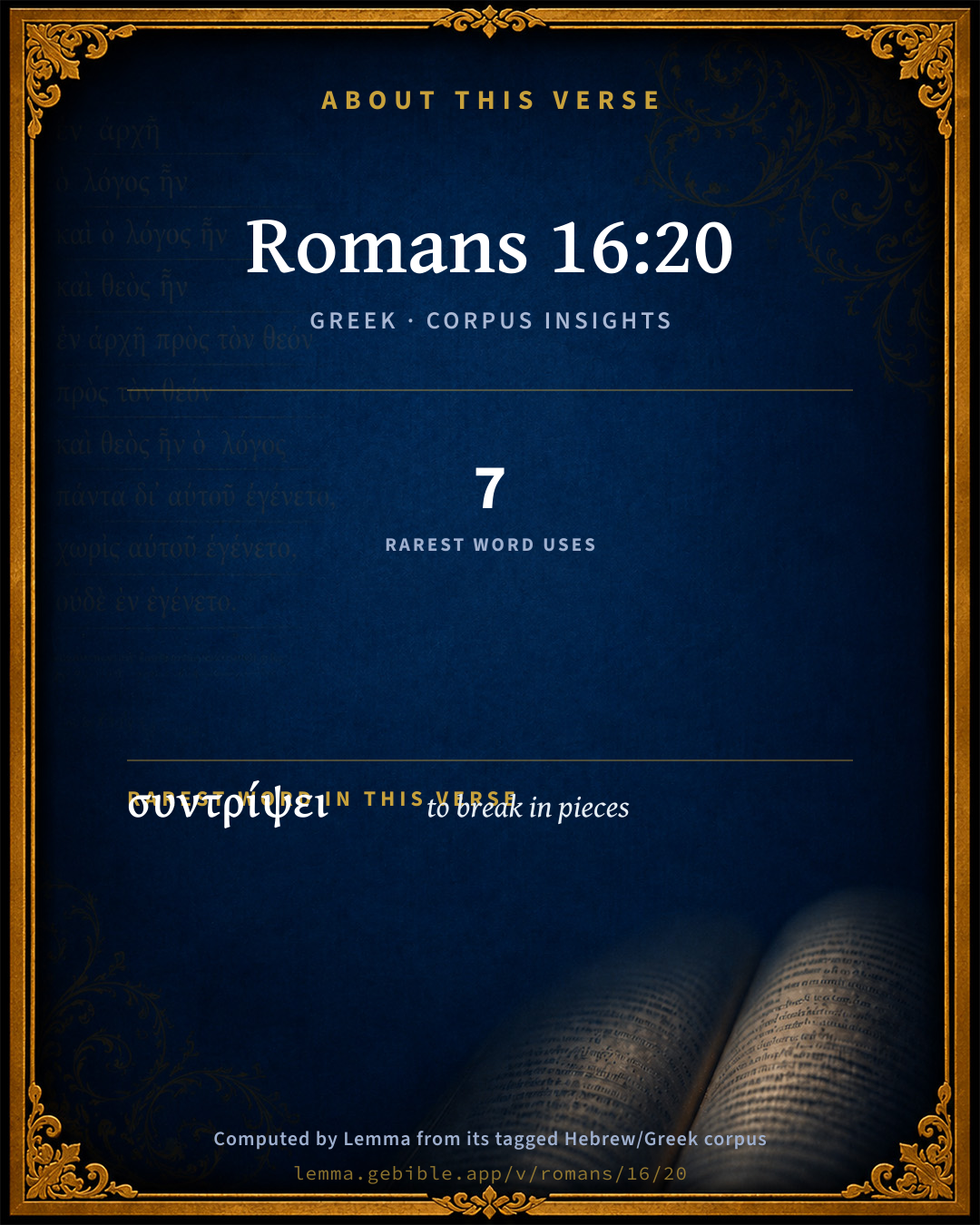
Romans 16:20

Greek (Tischendorf 8th ed.) Romans 16:20 appears in the Greek New Testament. The text above is from the Tischendorf 8th edition. Each word links to its Strong’s number and a concise gloss. Click any word for its full Thayer’s Greek Lexicon entry.
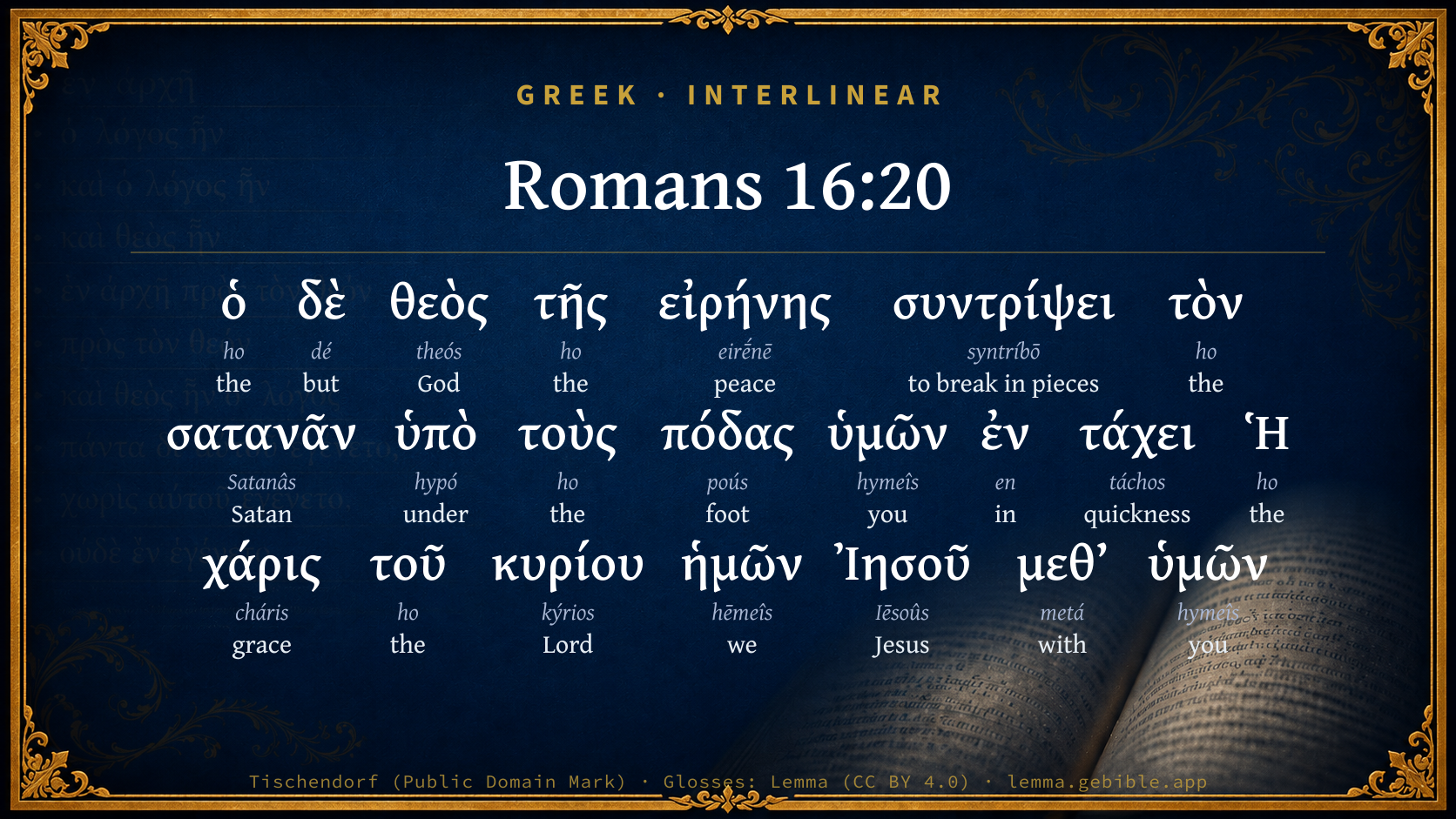
Download image
Cite this verse

Romans 16:20 (World English Bible). Public Domain. Lemma interlinear Bible study tool, https://lemma.gebible.app/v/romans/16/20.

Show BibTeX & RIS
BibTeX
RIS
English Translation
And the God of peace will quickly crush Satan under your feet. The grace of our Lord Jesus Christ be with you.
World English Bible · Public Domain
Download a study sheet

One document with this verse’s original text, its word-by-word gloss line, the meaning frame, cross-references with their text, attributed commentary, and full source and license credits — printable, and it pastes into notes with its structure intact.

This verse Autodidact and up

Study sheet (.html) Plain text (.txt)

A passage Seminary Student

Up to 50 verses in one chapter. A passage sheet keeps up to 6 commentary sources and 12 cross-references per verse, in the order this page ranks them, and says so on the sheet whenever that leaves anything out. Ask for a single verse and you get the Autodidact verse sheet above.

Everything on this page stays free to read, with no account — the sheet is a download of what is already on screen, not access to it.

Want to remove ads? Support Godless Engineer
Compare translations 3

The same verse in 3 English versions, stacked beneath the original-language interlinear above. Click any original word for its lexicon entry.

Each is an independent rendering of the whole verse — the interlinear is not word-aligned to these translations.

Highlighted words mark where these versions differ — a whole-verse word diff, not a word-by-word alignment.

  • World English Bible Public Domain
    And the God of peace will quickly crush Satan under your feet. The grace of our Lord Jesus Christ be with you.
  • King James Version Public Domain
    And the God of peace shall bruise Satan under your feet shortly. The grace of our Lord Jesus Christ be with you. Amen.
  • unfoldingWord Literal Text CC BY-SA 4.0
    Now the God of peace will crush Satan under your feet with haste. The grace of our Lord Jesus Christ with you.

unfoldingWord Literal Text — © unfoldingWord, licensed CC BY-SA 4.0. Word-aligned USFM3 via Door43 (git.door43.org/unfoldingWord/en_ult).

Versions to compare (up to 4)

3 of 4 selected

Show all 19 translations

Every available English version of this verse, each an independent rendering of the whole verse.

  • World English Bible Public Domain
    And the God of peace will quickly crush Satan under your feet. The grace of our Lord Jesus Christ be with you.
  • Berean Standard Bible Public Domain
    The God of peace will soon crush Satan under your feet. The grace of our Lord Jesus Christ be with you.
  • Majority Standard Bible Public Domain
    The God of peace will soon crush Satan under your feet. The grace of our Lord Jesus Christ be with you.
  • King James Version Public Domain
    And the God of peace shall bruise Satan under your feet shortly. The grace of our Lord Jesus Christ be with you. Amen.
  • American Standard Version (1901) Public Domain
    And the God of peace shall bruise Satan under your feet shortly. The grace of our Lord Jesus Christ be with you.
  • Revised Version (1885) Public Domain
    And the God of peace shall bruise Satan under your feet shortly. The grace of our Lord Jesus Christ be with you.
  • Geneva Bible (1599) Public Domain
    The God of peace shall treade Satan vnder your feete shortly. The grace of our Lord Iesus Christ be with you.
  • Douay-Rheims (1899) Public Domain
    And the God of peace crush Satan under your feet speedily. The grace of our Lord Jesus Christ be with you.
  • Young's Literal Translation Public Domain
    and the God of the peace shall bruise the Adversary under your feet quickly; the grace of our Lord Jesus Christ `be' with you. Amen!
  • Literal Standard Version CC BY-SA 4.0
    and the God of peace will bruise Satan under your feet quickly; the grace of our Lord Jesus Christ [be] with you. Amen!
  • Unlocked Literal Bible CC BY-SA 4.0
    The God of peace will soon crush Satan under your feet. May the grace of our Lord Jesus Christ be with you.
  • unfoldingWord Literal Text CC BY-SA 4.0
    Now the God of peace will crush Satan under your feet with haste. The grace of our Lord Jesus Christ with you.
  • Darby Bible Public Domain
    But the God of peace shall bruise Satan under your feet shortly. The grace of our Lord Jesus Christ [be] with you.
  • World Messianic Bible Public Domain
    And the God of peace will quickly crush Satan under your feet. The grace of our Lord Yeshua the Messiah be with you.
  • Webster's Bible Public Domain
    And the God of peace will soon bruise Satan under your feet. The grace of our Lord Jesus Christ be with you. Amen.
  • Free Bible Version CC BY-SA 4.0
    The God of peace will soon break the power of Satan and make him subject to you. May the grace of our Lord Jesus Christ be with you.
  • Bible in Basic English Public Domain
    And the God of peace will be crushing Satan under your feet before long. The grace of our Lord Jesus Christ be with you.
  • Text-Critical English NT CC BY 4.0
    The God of peace will soon crush Satan under your feet. The grace of our Lord Jesus Christ be with you.
  • Tyndale New Testament (1534) Public Domain
    The God of peace treade Satan vnder youre fete shortly. The grace of oure Lorde Iesu Christ be with you.

Literal Standard Version (2020), Covenant Press — licensed CC BY-SA 4.0. Text via the HelloAO Bible API (eBible.org). Unlocked Literal Bible (unfoldingWord) — licensed CC BY-SA 4.0. Text via the HelloAO Bible API (eBible.org). unfoldingWord Literal Text — © unfoldingWord, licensed CC BY-SA 4.0. Word-aligned USFM3 via Door43 (git.door43.org/unfoldingWord/en_ult). Free Bible Version, Dr. Jonathan Gallagher — licensed CC BY-SA 4.0. Text via the HelloAO Bible API (eBible.org).

Word by word

More ways to search: Search by grammar → Find every occurrence → Compare this word →

Practice this passage: Drill this verse → Learn its vocabulary →

συντρίψει
syntríbō
G4937
“to break in pieces”
Verb, Future, Active, Indicative, 3rd person, Singular
Part of Speech
Verb
Tense
Future
Voice
Active
Mood
Indicative
Person
3rd person
Number
Singular
Full Thayer's Definition

Origin: from G4862 and the base of G5147

TDNT: 22:19,1

1. break, to break in pieces, shiver 2. to tread down a. to put Satan under foot and (as a conqueror) trample on him b. to break down, crush 1. to tear one's body and shatter one's strength
  1. ὁ ho G3588 “the” Article, Nominative, Singular, Masculine
  2. δὲ dé G1161 “but” Conjunction
  3. θεὸς theós G2316 “God” Noun, Nominative, Singular, Masculine
  4. τῆς ho G3588 “the” Article, Genitive, Singular, Feminine
  5. εἰρήνης eirḗnē G1515 “peace” Noun, Genitive, Singular, Feminine
  6. τὸν ho G3588 “the” Article, Accusative, Singular, Masculine
  7. σατανᾶν Satanâs G4567 “Satan” Noun, Accusative, Singular, Masculine
  8. ὑπὸ hypó G5259 “under” Preposition
  9. τοὺς ho G3588 “the” Article, Accusative, Plural, Masculine
  10. πόδας poús G4228 “foot” Noun, Accusative, Plural, Masculine
  11. ὑμῶν hymeîs G5210 “you” Personal pronoun, 2nd person, Genitive, Plural
  12. ἐν en G1722 “in” Preposition
  13. τάχει táchos G5034 “quickness” Noun, Dative, Singular, Neuter
  14. Ἡ ho G3588 “the” Article, Nominative, Singular, Feminine
  15. χάρις cháris G5485 “grace” Noun, Nominative, Singular, Feminine
  16. τοῦ ho G3588 “the” Article, Genitive, Singular, Masculine
  17. κυρίου kýrios G2962 “Lord” Noun, Genitive, Singular, Masculine
  18. ἡμῶν hēmeîs G2249 “we” Personal pronoun, 1st person, Genitive, Plural
  19. Ἰησοῦ Iēsoûs G2424 “Jesus” Noun, Genitive, Singular, Masculine
  20. μεθ’ metá G3326 “with” Preposition
  21. ὑμῶν hymeîs G5210 “you” Personal pronoun, 2nd person, Genitive, Plural

About this verse

These counts appear in no published source. They are computed here, from the morphology-tagged text and Lemma’s own curated glosses. What Lemma adds →

22
words
16
distinct lemmas
Pauline Epistles
section

Notable vocabulary

The rarest word here is συντρίψει to break in pieces G4937 — appearing just 7 times in the whole Greek New Testament.

Shared distinctive vocabulary

συντρίψει to break in pieces G4937 occurs in 7 verses of the Greek New Testament. Also found in:

Repetition

Words recur within this verse:

Cross-references

22

Topical passages linked to Romans 16:20 in the Treasury of Scripture Knowledge — connected by theme and wording, ordered by reader-vote popularity; previews shown in the World English Bible.

  • Luke 10:19 Behold, I give you authority to tread on serpents and scorpions, and over all the power of the enemy. Nothing will in any way hurt you.
  • 1 John 3:8 He who sins is of the devil, for the devil has been sinning from the beginning. To this end the Son of God was revealed, that he might destroy the works of the devil.
  • Genesis 3:15 I will put enmity between you and the woman, and between your offspring and her offspring. He will bruise your head, and you will bruise his heel."
  • Zechariah 10:5 They shall be as mighty men, Treading down muddy streets in the battle; And they shall fight, because Yahweh is with them; And the riders on horses will be confounded.
  • Malachi 4:3 You shall tread down the wicked; for they will be ashes under the soles of your feet in the day that I make," says Yahweh of Hosts.
  • Revelation 12:10 I heard a loud voice in heaven, saying, "Now is come the salvation, the power, and the Kingdom of our God, and the authority of his Christ; for the accuser of our brothers has been thrown down, who accuses them before our God day and night.
  • Hebrews 2:14–15 Since then the children have shared in flesh and blood, he also himself in like manner partook of the same, that through death he might bring to nothing him who had the power of death, that is, the devil,
  • Romans 15:33 Now the God of peace be with you all. Amen.
  • Revelation 22:21 The grace of the Lord Jesus Christ be with all the saints. Amen.
  • 1 Thessalonians 5:28 The grace of our Lord Jesus Christ be with you. Amen.
  • Romans 8:37 No, in all these things, we are more than conquerors through him who loved us.
  • Isaiah 25:8–12 He has swallowed up death forever; and the Lord Yahweh will wipe away tears from off all faces; and the reproach of his people will he take away from off all the earth: for Yahweh has spoken it.
  • 2 Corinthians 13:14 The grace of the Lord Jesus Christ, the love of God, and the communion of the Holy Spirit, be with you all. Amen.
  • Galatians 6:18 The grace of our Lord Jesus Christ be with your spirit, brothers. Amen.
  • Philippians 4:23 The grace of the Lord Jesus Christ be with you all. Amen.
  • 2 Thessalonians 3:18 The grace of our Lord Jesus Christ be with you all. Amen.
  • Revelation 20:1–3 I saw an angel coming down out of heaven, having the key of the abyss and a great chain in his hand.
  • Job 40:12 Look on everyone who is proud, and humble him. Crush the wicked in their place.
  • 1 Corinthians 16:23 The grace of the Lord Jesus Christ be with you.
  • 2 Timothy 4:22 The Lord Jesus Christ be with your spirit. Grace be with you. Amen.
  • Philemon 1:25 The grace of our Lord Jesus Christ be with your spirit. Amen.
  • Isaiah 63:3 I have trodden the winepress alone; and of the peoples there was no man with me: yes, I trod them in my anger, and trampled them in my wrath; and their lifeblood is sprinkled on my garments, and I have stained all my clothing.

Cross-references courtesy of OpenBible.info (CC BY 4.0).

Where the printed editions differ

1 variant

Places in this verse where the major printed Greek editions disagree on the wording in a way that affects the translation — a comparison of editions, not a manuscript-by-manuscript collation. The editions are the modern critical texts (Nestlé-Aland 28/27, SBL, Westcott-Hort, Tregelles, Tyndale House) and the traditional texts behind the KJV (the Textus Receptus and the Byzantine/Majority text). It is not a claim about which reading is original.

  1. Extra text
    Χριστοῦ

    “Christ”

    In SBLTregTRByz Not in NA28NA27TynWH

    Χριστοῦ (Christou) 'Christ' is only in traditional manuscripts (SBL+Treg+TR+Byz)

Textual data: Translators Amalgamated Greek New Testament (STEPBible TAGNT) · CC BY 4.0.

Commentary

Notes on Romans 16:20 from classic Christian and Jewish commentators (each source and its license shown beneath its notes). The classic Christian expositions comment on the surrounding passage and are grouped to its opening verse, so a note may address several verses; the Jewish commentaries on the Tanakh (Rashi and others) are per-verse, so they appear only where the commentator wrote on this verse.

Lemma curates 59 commentaries, every one of them public domain or Creative Commons licensed, each selected and text-cleaned for this edition rather than reprinted as found. About our sources →

The Biblical Illustrator

Joseph S. Exell

Rom_16:20

And the God of peace shall bruise Satan under your feet shortly.

Satan bruised by the God of peace

There were two victories to be obtained over Satan. By the first, his head was to be bruised under the feet of Christ; and by the second, the rest of his body will be bruised under the feet of believers. Of the second of these victories, Paul here speaks. In the first prediction, God speaks as the Lord of Hosts, the God of war--I will put enmity. The war continues till the bruising of Satans head has taken place and his empire is overthrown, and when it is subverted, peace is made, and God is the God of peace. As, then, the Seed of the woman has bruised the head of the serpent, so His people will, through Christ, likewise bruise Satan. The apostle says not we shall bruise him under our feet, but God shall do it; yet he says not He shall bruise him under His own feet, but under yours. The victory shall be ours though wrought by Him; and He shall do it shortly. Some understand this of the final victory that all the Lords people will obtain at last over Satan and all his emissaries. But though they will not be free from the attacks of this subtle adversary as long as they are in the body, yet from the phrase speedily, or shortly, as well as from the immediate reference to the power of God in the Church, it appears rather to refer to a present victory. It is consistent with Gods wisdom to permit Satan to try His people; but when they are sufficiently tried, they are delivered from the temptation. So it was with the Son of God Himself. Satan was for a time permitted to harass Him, but at last he was dismissed. In like manner, Churches and individual Christians are all to be tried in various ways; but if they abide the trial they shall be delivered from the temptation, and, in the most emphatic and extensive sense, they shall all at last bruise Satan under their feet. They shall obtain a complete victory over him in the day of the appearing of their Almighty Lord, who will then cast him into the lake of fire and brimstone. On that day the full import of this expression will be seen. (R. Haldane.)

Victory over the disturber of peace

Consider:--

I. How satan disturbs the church. By divisions, etc. (Rom_16:17).

II. The certainty of our deliverance. By the God of peace.

III. The signal manner in which he will effect it. He will bruise, etc. (J. Lyth, D.D.)

The wonderful conquest

Earth is the scene of a great moral struggle between truth and error, right and wrong, God and Satan. This fact invests our planet with an interest which perhaps attaches to no other portion of the universe. The text prophesies a conquest, in every aspect wonderful on account of--

I. The gigantic foe that is overcome. Satan.

1. The word means first an accuser, a calumniator, and then an enemy. The Bible represents him as the introducer of evil into the universe, the leader of all the hosts of wickedness, in hell and on earth; at once the instigator and the strength of all opposition to the cause of virtue and the well-being of humanity.

2. To crush him is to destroy the root of the upas, to dry up the fountain of sin and misery. He shall be bruised; his purposes thwarted, his influence destroyed, his powers paralysed; the crushed victim of his own gigantic follies and stupendous wickedness. What a blessed event in the history of the universe this will be

III. The character of the glorious conqueror. God of Peace. How sublimely strange--not the God of vengeance, the God of war. Note--

1. That God has the consciousness of a sufficiency of power for the work. There can be no peace of mind to one who has the faintest suspicion of his own insufficiency. Anxious doubt would fill the spirit with agitation. Mighty as Satan is, he is feebleness itself in the grasp of Omnipotence.

2. That God is free from all malevolent emotions in the work. Where anger, revenge, etc., exist, there can be no peace. They agitate the heart. God crushes Satan from impulses the most benevolent.

3. That God has a consciousness of rectitude in the work. Whenever a being has misgivings as to the rightness of a course of action, he cannot be in the enjoyment of peace. God feels He has aright to crush Satan the usurper, etc.

III. On account of the creatures from whom the conquest is achieved. Satan is under the feet of angels. They tower in virtue, blessedness, and dignity, in spheres above his influence. It is over men he has control. God will put him under mens feet.

1. Completely. Under your feet, indicating entire subjection. He will rise no more.

2. Speedily. Shortly. The conquest is not far off--(l) In the individual history of good men. At death, by Gods grace, they obtain the entire mastery over Satan. Death will be shortly with all of us.

(2) In the general history of this world. Satan has been ruling the world for ages, still a period shall come when he shall be put under its feet. Though this period may be many ages distant, still in a sense it is close at hand--

(a) To us. We die, and the intervening period is as nothing. Only as the few hours of a refreshing sleep.

(b) To God. One day is with the Lord as a thousand years, etc. Let us, then, take heart. (D. Thomas, D.D.)

Satan under the control of God

We looked into the Botanical Gardens at Rome, and saw a leopard walking to and fro upon the terrace. He appeared to be quite loose, but we were morally certain that he was chained in some way. We saw no chain, but we were as much at ease as if we could, because we were sure there must be one somewhere. So is it with Satan, affliction, temptation or trial--there is a Divine restraint upon them; whether we see it or not, the tether is there. Let us trust and not be afraid. God will take in the enemy a link or two if he becomes too malicious. Dread not the foe, but bless God for the chain. (C. H. Spurgeon.)

The Biblical Illustrator, edited by Joseph S. Exell (c. 1880s–1900s) — public domain. Text from a community e-Sword module.

The Preacher's Complete Homiletical Commentary

Joseph S. Exell (gen. ed.)

CRITICAL NOTES

Rom_16:20.—Here is St. Paul’s own superscription, written with his own hand in all his epistles. The Author of peace is the Giver of victory. συντρίψει, selected with special regard to Gen_3:15.

MAIN HOMILETICS OF THE PARAGRAPH.—Rom_16:20.

The peace-destroyer’s destruction.—From the visible enemy who threatens, the apostle’s eye turns to the invisible world, where he discovers, on the one side the more formidable enemy of whom his earthly adversaries are the instruments, and on the other the all-powerful ally on whose succour the Church can reckon in this struggle. The expression “God of peace” is designedly chosen to describe God as one who, if the Church fulfil its task well in these circumstances, will take care to overthrow the designs of its adversaries and preserve harmony among the faithful. No wonder that the Christian’s energies are paralysed if he only considers the smallness of his own resources and the greatness of the powers with which he has to cope; but his heart may be strengthened by the reflection that he has a powerful Friend on whom he may rely, and whose help he may successfully invoke. The Christian may be inspired by the thought that the valour of God is his defence. He may well rise superior to difficulty, remembering that victory is finally certain, for God fights on his side. The work is now going forward under the direction of God. Shortly the finishing stroke will be given. Satan will be a bruised foe under the feet of the triumphant saints.

I. The peace-maker.—The endearing character under which God is presented before us in this passage is that of the peace-maker. The God of peace—the author, originator, and maker of peace. Peace-maker! Delightful to be able to introduce harmony into a world of disorder, to cause a holy calm to reign in a realm which had presented the scene of wild chaos. Among the Saviour’s greatest material works is that by which he calmed the troubled waters of the storm-tossed lake. If he be great who introduces harmony into the disorder of material things, what shall be affirmed of the greatness of Him who introduces order where moral discord prevailed, who gives peace to troubled natures? Jesus Himself says, “Blessed are the peace-makers.” The highest type of man is the peace-maker. Christ as the peace-maker is endeared to troubled hearts. God is by pre-eminence the God of peace. He gave Christ to be a peace-maker. It was God that first made this planet beautiful by the gentle sway of peace. When sin touched with its spoiling hand the calm sea of this world’s peace, it was God’s mercy that floated over the troubled waters the words of hope. When the world attained its highest and darkest reach of moral confusion, it was God that brought into the world the gospel method whereby spiritual unrest was to be removed and peace flow into the hearts of mankind. The character of the peace-maker is ennobled by the thought that God is the offended being, and yet He proposes conditions of peace and makes possible a way of peace. He secures the method of peace at infinite cost. He spared not His Son.

II. The peace-destroyer.—By how much the character of the peace-maker is ennobled, in the same proportion may the character of the peace-destroyer sink in our estimation. It is Godlike to create. It is devil-like to destroy. Destructionists should always bring forward good reasons for the methods they pursue. Our natures would rise in rebellion and in wrath against the wretched and powerful being who should disturb the harmonies of the celestial spheres. But a worse catastrophe has happened. Satan with his tainting hand has touched our humanity, and lost spirits are seen wandering, through a dismal planet, from the Source of life, from the Spring of eternal strength and happiness. The devil destroyed the world’s moral peace when he first entered the garden of peace, and ever since he has been working in the same direction. Satan has destroyed the peace of hearts, the peace of individuals, the peace of Churches, and the peace of nations.

“There is a land of peace,

Good angels know it well;

Glad songs that never cease

Within its portals swell;

Around its glorious throne

Ten thousand saints adore

Christ, with the Father—one,

And Spirit evermore.”

Into that land of peace no ruthless disturber can ever enter.

III. The peace-destroyer’s destruction at the hand of the peace-maker.—In order to perpetuate harmony it is necessary to banish that, or at least to eliminate the power of that, which has been the cause of discord. To preserve the harmony of a kingdom it may be needful to banish the rebels. The peace of the family can be preserved by the exclusion of the quarrelsome member, or by its reformation. The peace of God’s human family is always endangered by the presence of Satan. He appears to be beyond reform. We do not limit the power of the Infinite. But as that power did not prevent Satan’s fatal meddling, so we have no reason to suppose that God’s power will turn the prince of darkness into a veritable angel of light. Satan must be bruised, and so bruised as to be able to do no further moral mischief. He has been bruised in part by Christ’s victorious achievements. Bruised, but not effectually rendered harmless. He is being bruised by the dispensation of the Holy Spirit and by the instrumentality of God’s Church. God will finish the work in righteousness, and Satan will be effectually bruised beneath the feet of God’s people. Satan will be powerless, and over his slain form the Church will ride in triumph. Let us, then, not fear for God’s truth. Relying on God’s promises, we are not to fear the wiles of our great adversary. We must battle and not be dismayed. We must pray and wait in hope for the period of final extinction of Satan as a harmful foe.

IV. The peace-maker’s “due time” we cannot measure.—God’s “shortly” is not to be measured by our minutes. The little child with its inadequate notions of time cannot measure the “shortly” of a wise father. How can the children of time, whose day is but as a butterfly existence, measure the day of Him who is from everlasting to everlasting? We are sometimes disposed to ask, Has the Eternal been so taken up with the consideration and the management of other and higher worlds that He has forgotten us in our low estate—forgotten that His children are well-nigh overwhelmed by the triumphant progress of sin and misery—forgotten that the world has been long groaning beneath the oppression of the evil one—forgotten that the lovers of the truth are comparatively few and their efforts seemingly uninfluential—forgotten that many anxious souls are waiting for the fulfilment of the promise that shortly God will bruise Satan under their feet? But when we get away from the contracting influences of the present world, when we breathe the enlarging atmosphere of God’s broad realm of infinite thoughts, we may get to understand that our “shortly” is a word that impatience utters in moments of defeat and perplexity—that God’s “shortly” may be a word uttered by a Being possessed of infinite wisdom and power, and who can wait, to use a human word, through the slow-moving centuries of time. Where is the mind sufficiently large that can sweep with rapid glance through all that space—if of space or of any notion of limitation we may speak in this connection—that must be comprehended in the “shortly” of Him who fills the boundless realm of eternity? A season must be allowed in which the efficacy of the Saviour’s mediatorial mission shall be vindicated—in which the glory of the Church as a militant force must be evidenced. A great work has to be done before God’s “shortly” can be consummated. We must consider God’s “shortly” in the light of eternity and by the side of those comprehensive plans which must be entertained by the infinite mind.

V. Human peace-makers will share in the final triumph.—The limbs of the Church will not always be fettered; the feet of God’s saints will not always be fastened in the stocks; the iron of oppression will not always eat into their souls. With firm and joyous tread they will victoriously walk over their crushed adversary. Under our feet for ever will be the enemy of our souls. Peaceful millennial reign! blessed sabbatic repose! when

“Sin, my worst enemy before,

Shall vex mine eyes and ears no more;

Mine inward foes shall all be slain,

Nor Satan break my peace again.”

Rom_16:20. Satan bruised.

I.—

1. A reference to Gen_3:15 : apostle points to certainty of Christ’s victory as guarantee of ours.

2. An echo of promise in Psalms 91 of victory over all antagonists—pestilence, terror, flying arrow, destruction. “Thou shalt tread upon the lion,” on “the adder.” Power to conquer sins known and hidden.

3. An echo of Luk_10:19. All these are gathered into the promise of the text. Christ’s heel being on the head, we have only to keep down a little fragment of the writhing body, a little bit of vertebræ. If we try in His strength, we shall come off more than conquerors.

II. What strenuous effort is needed to keep down a snake’s head, a desperate life-and-death struggle! Incongruous epithet at first sight, “the God of peace.” Why not “God of strength?” Our victory only possible by possessing the peace of God. The reason we fall so easily is because we lack that sense of rest in God. That peace of God, and the God who gives that peace, will help us to overcome.

III. “The peace of God” (see Php_4:7) will keep us as a garrison keeps a fortress. The Christian’s armour the gospel of peace (Eph_6:15).

IV. Ask God for His peace; then in the fiercest struggle we shall have quiet hearts,—peace amid endless agitation; repose in tempest; quiet spirit in the battle.

V. All will come by communion with Christ; His conquest our inspiration. “Shortly?” Yes; by simple obedience and loving fellowship swift victory comes. If not, not His fault, but ours. On eternity’s dial seventy years but a moment. The longest life-struggle but a little while; then the far-exceeding weight of glory. Thy Master conquered; keep near Him, scorning short-lived temptations, calm in such brief struggles; then “under our feet for ever the enemies of our souls.”—Alexander Maclaren, D.D.

SUGGESTIVE COMMENTS ON Rom_16:20

Conquest of Satan ensured.—The conquest of Satan is ensured by this: When we are at peace with God, the devils themselves are subject to us. When God was in Christ reconciling the world, He was in Christ “destroying him that had the power of death” (Heb_2:14), and bringing Satan under the feet of the Mediator and the feet of His members. This was the intent of God in the first promise of a Mediator, to destroy him who had infected mankind and brought death into the world. The bruising his head was the design of Christ’s mission (Gen_3:15), that the great incendiary who had broken the league and set afoot the rebellion might feel the greater smart of it. And ever since it is by the gospel of peace and the shield of faith that we are only able to “quench the fiery darts of the devil,” and make his attempts fruitless (Eph_6:15-16), by the reconciliation God hath wrought and published by the gospel. God, as a “God of peace,” “shall tread him under the feet” of believers (Rom_16:20). Unless He had been a God of peace, we had never been delivered from that jailor who held us by the right of God’s justice. And since we are delivered, God, as a God of peace, will perfect the victory, and make him cease for ever from bruising the heel of the spiritual seed. As God hath given peace in Christ, so He will give the victory in Christ. Peace cannot be perfect till it be undisturbed by invading enemies and subtle adversaries endeavouring to raise a new enmity. Our Saviour spoiled him of his power upon the cross, and took away the right he had to detain any believer prisoner by satisfying that justice and reconciling that God who first ordered their commitment. He answers his accusations as He is an “advocate” at the right hand of God; and at the last, when death comes to be destroyed, and no more to enter into the world, the whole design of the devil for ever falls to the ground. Since we are at peace with God, while we are here the devil himself shall serve us; and the messenger of Satan shall be a means to quell the pride of a believing Paul by the sufficiency of the grace of God, while he fills the heart of an unbelieving Judas with poison and treason against his Master.—Charnock.

Satan not to be feared.—And as good angels shall not, so it is certain likewise that evil angels shall not; good angels will not, and bad angels shall not. Saith He, “I will build My Church upon this rock”—that is, “this faith and confession that Christ is the Son of God, and a heart and life answerable”—“and the gates of hell shall not prevail against it” (Mat_16:18). They may assault it, but they shall not prevail. My brethren, this devil whom you fear, and who tempteth you, as Jesus Christ hath under His feet, so He will have him under your feet too one day; do but stay awhile, He shall tread down Satan under your feet shortly (Rom_16:20) You need fear nothing, therefore, either in heaven or in earth.—Goodwin.

The Reconciler the Subduer.—All corrupters of divine truth and troublers of the Church’s peace are no better than devils. Our Saviour thought the name Satan a title merited by Peter, when he breathed out an advice, as an axe at the root of the gospel, the death of Christ, the foundation of all gospel truth; and the apostle concludes them under the same character which hinder the superstructure, and would mix their chaff with his wheat. “Get thee behind Me, Satan” (Mat_16:23). It is not, “Get thee behind Me, Simon,” or, “Get thee behind Me, Peter”; but, “Get thée behind Me, Satan: thou art an offence to Me.” Thou dost oppose thyself to the wisdom and grace and authority of God, to the redemption of man, and to the good of the world.

1. As the Holy Ghost is the Spirit of truth, so is Satan the spirit of falsehood; as the Holy Ghost inspires believers with truth, so doth the devil corrupt unbelievers with error. Let us cleave to the truth of the gospel, that we may not be counted by God as part of the corporation of fallen angels, and not be barely reckoned as enemies of God, but in league with the greatest enemy to His glory in the world.

2. The Reconciler of the world will be the Subduer of Satan. The God of peace sent the Prince of peace to be the restorer of His rights, and the hammer to beat in pieces the usurper of them. As a God of truth, He will make good His promise; as a God of peace, He will perfect the design His wisdom hath laid and begun to act. In the subduing Satan, He will be the conqueror of His instruments. He saith not, God shall bruise your troublers and heretics, but Satan. The fall of a general proves the rout of the army. Since God, as a God of peace, hath delivered His own, He will perfect the victory, and make them cease from bruising the heel of His spiritual seed.

3. Divine evangelical truth shall be victorious. No weapon formed against it shall prosper; the head of the wicked shall fall as low as the feet of the godly. The devil never yet blustered in the world but he met at last with a disappointment. His fall hath been like lightning, sudden, certain, vanishing.

4. Faith must look back as far as the foundation-promise, “The God of peace shall bruise,” etc. The apostle seems to allude to the first promise—a promise that hath vigour to nourish the Church in all ages of the world. It is the standing cordial; out of the womb of this promise all the rest have taken their birth. The promises of the Old Testament were designed for those under the New, and full performance of them is to be expected, and will be enjoyed by them. It is a mighty strengthening to faith to trace the footsteps of God’s truth and wisdom from the threatening against the serpent in Eden to the bruise he received on Calvary and the triumph over him upon Mount Olivet.

5. We are to confide in the promise of God, but leave the season of its accomplishment to His wisdom. He will bruise Satan under your feet, therefore do not doubt it; and shortly, therefore wait for it. Shortly it will be done, that is, quickly, when you think it may be a great way off; or shortly, that is, seasonably, when Satan’s rage is hottest. God is the best judge of the seasons of distributing His own mercies, and darting out His own glory. It is enough to encourage our waiting, that it will be, and that it will be shortly; but we must not measure God’s shortly by our minutes.—Charnock.

The Preacher's Complete Homiletical Commentary (gen. ed. Joseph S. Exell; Funk & Wagnalls, c. 1892) — public domain (pre-1929). A full-Bible homiletical/sermon-outline anthology covering 65 of 66 books (2 John is absent from the source module). Text from a community e-Sword module.

MacLaren's Expositions of Holy Scripture

Alexander MacLaren

Romans

A CRUSHED SNAKE

Rom 16:20.

There are three other Scriptural sayings which may have been floating in the Apostle’s mind when he penned this triumphant assurance. ‘Thou shalt bruise his head’; the great first Evangel-we are to be endowed with Christ’s power; ‘The lion and the adder thou shalt trample under foot’-all the strength that was given to ancient saints is ours; ‘Behold! I give you power to tread on serpents and scorpions, and over all the power of the enemy’-the charter of the seventy is the perennial gift to the Church. Echoing all these great words, Paul promises the Roman Christians that ‘the God of peace shall bruise Satan under your feet shortly.’ Now, when any special characteristic is thus ascribed to God, as when He is called ‘the God of patience’ or ‘the God of hope,’ in the preceding chapter, the characteristic selected has some bearing on the prayer or promise following. For example, this same designation, ‘the God of peace,’ united with the other, ‘that brought again from the dead the Lord Jesus, that great Shepherd of the sheep,’ is laid as the foundation of the prayer for the perfecting of the readers of the Epistle to the Hebrews in every good work. It is, then, because of that great name that the Apostle is sure, and would have his Roman brethren to be sure, that Satan shall shortly be bruised under their feet. No doubt there may have been some reference in Paul’s mind to what he had just said about those who caused divisions in the Church; but, if there is such reference, it is of secondary importance. Paul is gazing on all the great things in God which make Him the God of peace, and in them all he sees ground for the confident hope that His power will be exerted to crush all the sin that breaks His children’s peace.

Now the first thought suggested by these words is the solemn glimpse given of the struggle that goes on in every Christian soul.

Two antagonists are at hand-grips in every one of us. On the one hand, the ‘God of peace,’ on the other, ‘Satan.’ If you believe in the personality of the One, do not part with the belief in the personality of the other. If you believe that a divine power and Spirit is ready to help and strengthen you, do not think so lightly of the enemies that are arrayed against you as to falter in the belief that there is a great personal Power, rooted in evil, who is warring against each of us. Ah, brethren! we live far too much on the surface, and we neither go down deep enough to the dark source of the Evil, nor rise high enough to the radiant Fountain of the Good. It is a shallow life that strikes that antagonism of God and Satan out of itself. And though the belief in a personal tempter has got to be very unfashionable nowadays, I am going to venture to say that you may measure accurately the vitality and depth of a man’s religion by the emphasis with which he grasps the thought of that great antagonism. There is a star of light, and there is a star of darkness; and they revolve, as it were, round one centre.

But whilst, on the one hand, our Christianity is made shallow in proportion as we ignore this solemn reality, on the other hand, it is sometimes paralysed and perverted by our misunderstanding of it. For, notice, ‘the God of peace shall bruise Satan under your feet.’ Yes, it is God that bruises, but He uses our feet to do it. It is God from whom the power comes, but the power works through us, and we are neither merely the field, nor merely the prize, of the conflict between these two, but we ourselves have to put all our pith into the task of keeping down the flat, speckled head that has the poison gland in it. ‘The God of peace’-blessed be His Name-’shall bruise Satan under your feet,’ but it will need the tension of your muscles, and the downward force of your heel, if the wriggling reptile is to be kept under.

Turn, now, to the other thought that is here, the promise and pledge of victory in the name, the God of peace. I have already referred to two similar designations of God in the previous chapter, and if we take them in union with this one in our text, what a wonderfully beautiful and strengthening threefold view of that divine nature do we get! ‘The God of patience and consolation’ is the first of the linked three. It heads the list, and blessed is it that it does, because, after all, sorrow makes up a very large proportion of the experience of us all, and what most men seem to themselves to need most is a God that will bear their sorrows with them and help them to bear, and a God that will comfort them. But, supposing that He has been made known thus as the source of endurance and the God of all consolation, He becomes ‘the God of hope,’ for a dark background flings up a light foreground, and a comforted sorrow patiently endured is mighty to produce a radiant hope. The rising of the muddy waters of the Nile makes the heavy crops of ‘corn in Egypt.’ So the name ‘the God of hope’ fitly follows the name ‘the God of patience and consolation.’

Then we come to the name in my text, built perhaps on the other two, or at least reminiscent of them, and recalling them, ‘the God of peace,’ who, through patience and consolation, through hope, and through many another gift, breathes the benediction of His own great tranquillity and unruffled calm over our agitated, distracted, sinful hearts. In connection with one of those previous designations to which I have referred, the Apostle has a prayer very different in form from this, but identical in substance, when he says ‘the God of hope fill you with all joy and peace in believing.’ Is not that closely allied to the promise of my text, ‘The God of peace shall bruise Satan under your feet shortly’ ? Is there any surer way of ‘bruising Satan’ under a man’s feet than filling him ‘with joy and peace in believing’ ? What can the Devil do to that man? If his soul is saturated, and his capacities filled, with that pure honey of divine joy, will he have any taste for the coarse dainties, the leeks and the garlic, that the Devil offers him? Is there any surer way of delivering a man from the temptations of his own baser nature, and the solicitations of this busy intrusive world round about him, than to make him satisfied with the goodness of the Lord, and conscious in his daily experience of ‘all joy and peace’ ? Fill the vessel with wine, and there is no room for baser liquors or for poison. I suppose that the way by which you and I, dear friends, will most effectually conquer any temptations, is by falling back on the superior sweetness of divine joys. When we live upon manna we do not crave onions. So He ‘will bruise Satan under your feet’ by giving that which will arm your hearts against all his temptations and all his weapons. Blessed be God for the way of conquest, which is the possession of a supremer good!

But then, notice how beautifully too this name, ‘the God of peace,’ comes in to suggest that even in the strife there may be tranquillity. I remember in an old church in Italy a painting of an Archangel with his foot on the dragon’s neck, and his sword thrust through its scaly armour. It is perhaps the feebleness of the artist’s hand, but I think rather it is the clearness of his insight, which has led him to represent the victorious angel, in the moment in which he is slaying the dragon, as with a smile on his face, and not the least trace of effort in the arm, which is so easily smiting the fatal blow. Perhaps if the painter could have used his brush better he would have put more expression into the attitude and the face, but I think it is better as it is. We, too, may achieve a conquest over the dragon which, although it requires effort, does not disturb peace. There is a possibility of bruising that slippery head under my foot, and yet not having to strain myself in the process. We may have ‘peace subsisting at the heart of endless agitation.’ Do you remember how the Apostle, in another place, gives us the same beautiful-though at first sight contradictory-combination when he says, ‘The peace of God shall garrison your heart’ ?

‘My soul! there is a country

Far, far beyond the stars,

Where stands an armed sentry,

All skilful in the wars.’

And her name is Peace, as the poet goes on to tell us. Ah, brethren! if we lived nearer the Lord, we should find it more possible to ‘fight the good fight of faith,’ and yet to have ‘our feet shod with the preparedness of the gospel of peace.’

‘The God of peace shall bruise Satan under your feet’; and in bruising He will give you His peace to do it, and His peace in doing it, and in still greater measure after doing it. For every struggle of the Christian soul adds something to the subsequent depth of its tranquillity. And so the name of the God of peace is our pledge of victory in, and of deepened peace after, our warfare with sin and temptation.

Lastly, note the swiftness with which Paul expects that this process shall he accomplished.

I dare say that he was thinking about the coming of the Lord, when all the fighting and struggle would be over, and that when he said ‘God shall bruise him under your feet shortly,’ there lay in the back of his mind the thought, ‘the Lord is at hand.’ But be that as it may, there is another way of looking at the words. They are not in the least like our experience, are they? ‘Shortly!’-and here am I, a Christian man for the last half century perhaps; and have I got much further on in my course? Have I brought the sin that used to trouble me much down, and is my character much more noble, Christ-like, than it was long years ago? Would other people say that it is? Instead of ‘shortly’ we ought to put ‘slowly’ for the most of us. But, dear friend, the ideal is swift conquest, and it is our fault and our loss, if the reality is sadly different.

There are a great many evils that, unless they are conquered suddenly, have very small chance of ever being conquered at all. You never heard of a man being cured of his love of intoxicating drink, for instance, by a gradual process. The serpent’s life is not crushed out of it by gradual pressure, but by one vigorous stamp of a nervous heel.

But if my experience as a Christian man does not enable me to set to my seal that this text is true, the text itself will tell me why. It is ‘the God of peace’ that is going to ‘bruise Satan.’ Do you keep yourself in touch with Him, dear friend? And do you let His powers come uninterruptedly and continuously into your spirit and life? It is sheer folly and self-delusion to wonder that the medicine does not work as quickly as was promised, if you do not take the medicine. The slow process by which, at the best, many Christian people ‘bruise Satan under their feet,’ during which he hurts their heels more than they hurt his head, is mainly due to their breaking the closeness and the continuity of their communion with God in Jesus Christ.

But, after all, it is Heaven’s chronology that we have to do with here. ‘Shortly,’ and it will be ‘shortly,’ if we reckon by heavenly scales of duration. Weeping may endure for a night, but joy cometh in the morning. ‘The Lord will help her, and that right early.’ ‘The Lord is at hand.’ When we get yonder, ah! how all the long years of fighting will have dwindled down, and we shall say ‘the Lord did help me, and that right early,’ and though there may have been more than threescore years and ten of fighting, that, while we were in the thick of it, did not seem to come to much, we shall then look back and say: ‘Yes, Lord, it was but for a moment, and it has brought me to the undying day of Eternal Peace.’

Alexander MacLaren, Expositions of Holy Scripture (1904–1910) — public domain. Text from a community e-Sword module.

Tyndale Open Study Notes

Tyndale Open Resources

16:20 The God of peace will soon crush Satan under your feet: Paul alludes to the curse that God pronounced upon the serpent after he had deceived Adam and Eve in the Garden of Eden (Gen 3:15). Christ, the offspring of Eve, will soon crush Satan under the feet of the church (cp. Matt 16:18-19).

Tyndale Open Study Notes — © Tyndale Open Resources, licensed CC BY-SA 4.0. Text via the HelloAO Bible API.

Bengel's Gnomon

Johann Albrecht Bengel

Rom 16:20. Δὲ, but) [not and, as Engl. Ver. has it)] The power of God, not your prudence, will bring it to pass.—τῆς εἰρήνης, of peace) an antithesis to seditious, Rom 16:17, see 1Co 14:33.—συντρίψει) the future, shall bruise Satan, when he shall bruise His apostles [viz. those breeders of divisions, Rom 16:17-18.]—τὸν Σατανᾶν, Satan) the sower of strifes. Once in the course of this whole epistle he names the enemy, and nine times altogether in all his epistles, he calls him Satan; six times, the devil. Scripture indeed treats of God and Christ directly; of Satan and Antichrist indirectly.—ὑπό τοὺς πόδας, under your feet) Eph 6:15. Every victory achieved by faith is the cause of new grief to Satan.—ἐν τάχει) speedily, which refers to the beginnings of bruising [Satan, viz.] in the case of sudden danger [a sudden assault by him.]—ἀμήν) The transcribers very often added this word to prayers, although here almost all the copies are without it. Baumgarten however defends it.[171]

[171] Rec. Text has it in opposition to ABCD(Λ)G Vulg. and almost all versions.—ED.

Bengel's Gnomon of the New Testament — English translation (T&T Clark, Edinburgh, 1860) — public domain. Text from a community e-Sword module.

Meyer's Critical & Exegetical Commentary

Heinrich August Wilhelm Meyer

Rom_16:20. Encouraging promise; hence συντρίψει is not with Flatt to be taken as optative, contrary to linguistic usage, nor is the erroneous gloss of the reading συντρίψαι (A, 67**, Theodoret, Oec., Jer., Ambros., Rup.) to be approved.

Paul regards the sectaries, because they are servants not of Christ, but of their belly (Rom_16:18), as organs of Satan (comp. 2Co_11:15); hence his figurative expression of the thought, founded on Gen_3:15 : The God of peace will grant you (when the authors of division appear amongst you) shortly the complete victory over them.

As Θεὸς τῆς εἰρήνης (pacificus) God appears in contrast to those ποιοῦντες τὰς διχοστασίας (Rom_16:17). Comp. on Rom_15:33.

The bruising of Satan and treading him under feet takes place in Gods power; hence ὁ Θεὸς κ.τ.λ. Comp. 1Ma_3:22 (and Grimm in loc.), Rom_4:10, et al.

ἡ Χάρις κ.τ.λ.] The grace of our Lord, etc.; therewith, as with the usual concluding blessing of his epistles, Paul would close. But he has as yet delivered no special greetings from those around him at Corinth, whether it be that they are now for the first time entrusted to him, or that he now for the first time observes that he has not yet mentioned them in what precedes (as after Rom_16:16). This induces him now further to add Rom_16:21-23 after the conclusion already written down in Rom_16:20; then to repeat the above blessing in Rom_16:24; and finally, after recalling anew all which he had delivered to the Romans, in a full outburst of deeply moved piety to make the doxology, Rom_16:25-27, the final close of the entire letter.

Meyer — Critical and Exegetical Commentary on the New Testament — English translation by Peter Christie, edited by Frederick Crombie (T&T Clark, 1880) — public domain. Text from a community e-Sword module.

Expositor's Greek Testament

ed. W. Robertson Nicoll

Rom 16:20 . ὁ δὲ θεὸς τῆς εἰρήνης : used here with special reference to αἱ διχοστασίαι . Cf. 1Co 14:33 . συντρίψει τὸν Σατανᾶν : divisions in the Church are Satan’s work, and the suppression of them by the God of peace is a victory over Satan. Cf. 2Co 11:14 f. There is an allusion to Gen 3:15 , though it is doubtful whether Paul found anything there answering to συντρίψει . The LXX has τηρήσει . ἐν τάχει : cf. Eze 29:5 ; Deu 28:20 . The false teachers may come and cause dissension, but it will not be long till peace is restored. ἡ χάρις κ . τ . λ . This benediction can hardly be supposed to belong only to Rom 16:17-20 . It rather suggests that some copies of the epistle ended here; possibly that Rom 16:1-20 (for there is another benediction at Rom 15:33 ) were originally an independent epistle.

The Expositor's Greek Testament, edited by W. Robertson Nicoll (1897–1910) — public domain. Text from a community e-Sword module.

Cambridge Greek Testament for Schools and Colleges

20. ὁ δὲ θεὸς τῆς εἰρήνης. The GOD who gives us our peace which these men are breaking up; cf. Rom 15:33 and Rom 15:5 n.

τὸν Σατανᾶν. Cf. 2Co 2:5-11; 2Co 11:14. One special work of ‘the Satan’ is to set men at variance; cf. 1Th 2:18 and cf. Gen 3:15?.

ἡ χάρις κ.τ.λ. There is no parallel to the position of these words before more greetings. For the whole question see Add. Note, p. 233.

NOTE ON TEXT

1. Rom 16:20. The Benediction.

The case is stated by S. H. thus:

“אABC Orig.-lat. have a benediction at Rom 16:21 only.

DEFG have one at Rom 16:24 only.

L Vulg. clem. Chrys. and the mass of later authorities have it in both places.

P has it at Rom 16:21 and after Rom 16:27.

The correct text therefore has it at Rom 16:21, and there only; it was afterwards moved to a place after 24 [presumably as in any case the more natural place] which was in some MSS very probably the end of the Epistle [e.g. FG], and in later MSS, by a natural conflation, appears in both.”

Zahn holds that both benedictions are original, the slightly different form of the second (+ Χριστοῦ and πάντων) justifying the repetition.

Cambridge Greek Testament for Schools and Colleges (Cambridge University Press, 1896; 21 vols, various authors incl. Carr, Maclear, Plummer, Farrar, Lumby, Moule, M. R. James, Simcox) — public domain. Text from a community e-Sword module.

Godet's Commentaries

Frédéric Louis Godet

Vv. 20. “Now, the God of peace shall bruise Satan under your feet quickly. The grace of our Lord Jesus Christ be with you.”

From the visible enemy who threatens, the apostle’s eye turns to thine visible world, where he discovers on the one side the more formidable enemy of whom his earthly adversaries are the instruments, and on the other, the all-powerful ally on whose succor the church can reckon in this struggle. The connection between Rom 16:19-20 may find its explanation in Rom 16:13-15 of 2 Corinthians 11, where the apostle thus expresses himself in regard to Judaizing disturbers: “Such are false apostles, deceitful workers, transforming themselves into apostles of Christ; and no marvel, for Satan himself is transformed into an angel of light. Therefore it is no great thing if his ministers also be transformed as the ministers of righteousness. Their end shall be according to their works.”

The expression: God of peace, is designedly chosen to describe God as one who, if the church fulfils its task well in these circumstances, will take care to overthrow the designs of its adversaries, and preserve harmony among the faithful.

The term συντρίψει, shall bruise, is evidently an allusion to the ancient promise, Gen 3:15, which—strange to say—is referred to nowhere else in the N. T.

The words ἐν τάχει are ordinarily translated by soon, which would signify: “at a time near this when I write you.” It is because of this translation that Schultz and many others find here the idea of Christ’s near return. But the word ταχύς and its derivatives do not denote the imminence, the nearness of the event. They denote the celerity with which it is accomplished. The ταχέες πόδες, in Homer, are feet which move quickly and not soon; a tachygraph is a man who writes quickly and not near one. The Greek has the word εὐθύς (straight, who goes right to his end) and its derivatives to express imminence. Paul means, therefore, not that the victory will be near, but that it will be speedily gained, once the conflict is begun. When the believer fights with the armor of God (Ephesians 6), the conflict is never long.

Victory will result from two factors, the one divine (God shall bruise), the other human (under your feet). God communicates strength; but it passes through the man who accepts and uses it.

To this warning there is attached in the T. R. and in the Alexs. a prayer of benediction, with this difference, that in the former this prayer is repeated word for word in Rom 16:24. The Greco-Lats. place it only in Rom 16:24. Of these three forms, that of the Alex. is the most probable; for it easily explains the other two. The Greco-Lats. have transposed this prayer, putting it after the salutations, Rom 16:21-23, to conform to the ordinary usage of the apostle; the Byz. text has combined the two forms. What confirms this supposition is, that the Greco-Lats. in general omit the doxology at the end of our chapter; now, they could not close the Epistle to the Romans with the words: “and Quartus our brother.” They were therefore obliged to transfer thither the prayer of Rom 16:20. Regarded here as authentic, this prayer is the counterpart of that which we find 1Co 16:23. It forms the general conclusion of the Epistle; for it has nothing sufficiently special to be applied only to the preceding warning. But why the salutations which still follow, Rom 16:21-23, and the final doxology, Rom 16:25-27? This is what we shall have to explain.

Frédéric Louis Godet — Commentaries on Luke, John, Romans, and 1 Corinthians — English translation (T&T Clark, Edinburgh, 1870s–1890s) — public domain. Text from a community e-Sword module.

Hodge's Commentary on Romans, Ephesians & First Corinthians

Charles Hodge

Rom_16:20

And the God of Peace shall bruise Satan under your feet shortly. The grace of our Lord Jesus Christ be with you. Amen. As the evils produced by the false teachers were divisions and scandals, the apostle, in giving them the assurance of the effectual aid of God, calls him the God of peace, i.e. God who is the author of peace in the comprehensive scriptural sense of that term. Shall bruise is not a prayer, but a consolatory declaration that Satan should be trodden under foot. As Satan is constantly represented as working in the children of disobedience, the evil done by them is sometimes referred to him as the instigator, and sometimes to the immediate agents who are his willing instruments. The grace of our Lord Jesus Christ be with you. This is a prayer for the favor and aid of Christ, and of course is an act of worship, and a recognition of the Saviors divinity.

Charles Hodge — Commentary on Romans (1835), First Corinthians (1857), and Ephesians (1856) — public domain. Text from a community e-Sword module.

Geneva Bible (1599)

Geneva Bible translators

We must fight, with a certain hope of victory.

Geneva Bible (1599) marginal notes — public domain. Text via Bolls.life.

Jamieson, Fausset & Brown

Robert Jamieson, A. R. Fausset & David Brown

And the God of peace shall bruise Satan under your feet shortly--The apostle encourages the Romans to persevere in resisting the wiles of the devil with the assurance that, as good soldiers of Jesus Christ, they are "shortly" to receive their discharge, and have the satisfaction of "putting their feet upon the neck" of that formidable enemy--symbol familiar, probably, in all languages to express not only the completeness of the defeat, but the abject humiliation of the conquered foe. (See Jos 10:24; Sa2 22:41; Eze 21:29; Psa 91:13). Though the apostle here styles Him who is thus to bruise Satan, the God of peace," with special reference to the "divisions" (Rom 16:17) by which the church at Rome was in danger of being disturbed, this sublime appellation of God has here a wider sense, pointing to the whole "purpose for which the Son of God was manifested, to destroy the works of the devil" (Jo1 3:8); and indeed this assurance is but a reproduction of the first great promise, that the Seed of the woman should bruise the Serpent's head (Gen 3:15).

The grace of our Lord Jesus Christ be with you. Amen--The "Amen" here has no manuscript authority. What comes after this, where one would have expected the epistle to close, has its parallel in Phi 4:20, &c., and being in fact common in epistolary writings, is simply a mark of genuineness.

Jamieson, Fausset & Brown — Commentary Critical and Explanatory on the Whole Bible (1871) — public domain (CC PDM 1.0). Text via the HelloAO Bible API.

Adam Clarke's Commentary

Verse 20. The God of peace] Who neither sends nor favours such disturbers of the tranquillity of his Church.

Shall bruise Satan] Shall give you the dominion over the great adversary of your souls, and over all his agents who, through his influence, endeavour to destroy your peace and subvert your minds.

Several critics suppose that the word Satan is a sort of collective term here, by which all opposers and adversaries are meant; and especially those false teachers to whom he refers above.

The grace of our Lord] That you may be truly wise simple, obedient, and steady in the truth, may the favour or gracious influence of our Lord Jesus Christ be with you! without which you cannot be preserved from evil, nor do any thing that is good.

Here the apostle appears to have intended to conclude his epistle; but afterwards he added a postscript, if not two, as we shall see below. Several ancient MSS. omit the whole of this clause, probably thinking that it had been borrowed from Ro 16:24; but on the ground that the apostle might have added a postscript or two, not having immediate opportunity to send the epistle there is no need for this supposition.

Adam Clarke's Commentary on the Bible (1810–1826) — public domain. Text from a community e-Sword/MySword module.

John Calvin's Commentaries

20. What follows, God shall bruise Satan, etc., is a promise to confirm them, rather than a prayer. He indeed exhorts them to fight manfully against Satan, and promises that they should shortly be victorious. He was indeed once conquered by Christ, but not in such a way but that he renews the war continually. He then promises ultimate defeat, which does not appear in the midst of the contest. At the same time he does not speak only of the last day, when Satan shall be completely bruised; but as Satan was then confounding all things, raging, as it were, with loose or broken reins, he promises that the Lord would shortly subdue him, and cause him to be trodden, as it were, under foot. Immediately a prayer follows, — that the grace of Christ would be with them, that is, that they might enjoy all the blessings which had been procured for them by Christ.

John Calvin's Commentaries (1540-1563) — public domain. Text from the Calvin Translation Society English edition (1840s-50s) via the Christian Classics Ethereal Library (ccel.org). Calvin's coverage is partial (roughly two-thirds of the Bible); uncommented books and verses are honest gaps, never fabricated. The 19th-century editor's footnotes and remarks are omitted so the notes are faithfully Calvin's own voice.

Ellicott's Commentary for English Readers

(20) The God of peace.—We can well understand how the Apostle, in the midst of “fightings without and fears within,” should look forward with joyous confidence to the time when both for him and his readers all this turmoil and conflict would give way to “peace.” The reference seems to be to his near expectation of the Messiah’s return, and with it the final victory of the faith. The Romans have not begun to feel the bitterness of divisions as yet; he foresees a time when they will do so. but beyond that he foresees a further time when all will be hushed and quelled, and the Great Adversary himself for ever overthrown.

Bruise.—With reference to Gen_3:15.

The grace. . . .—The more correct reading of the benediction is simply. The grace of our Lord Jesus be with you, the other words being omitted. The four principal Græco-Latin Codices omit the benediction here altogether and insert it in Rom_16:24, where it also appears in the Received text, though wanting in MSS. of the best type.

A Bible Commentary for English Readers, edited by Charles John Ellicott (1878–1897) — public domain. Text from a community e-Sword module.

The Cambridge Bible for Schools and Colleges

gen. ed. J. J. S. Perowne

20. the God of peace] See on Rom_15:33. Here the sacred Title seems to refer to the miseries of the strife (“divisions and offences”) attendant on false doctrine. The God of Peace would be with those who, by clinging to the holy Truth once delivered, held fast to true unity.

shall bruise Satan, &c.] The very first promise of Redemption (Gen_3:15,) is doubtless here referred to.—The “Enemy who soweth tares” had been already “bruised” by the Redeemer, in His triumphant work; and that victory would be, in due time, realized in the personal (“under your feet,”) triumph over sin and death, and final deliverance from all trial, of each of His followers.

shortly] In the eternal “Day,” so near at hand, (Rom_13:11-12,) when all “enemies shall be made the footstool” of Messiah, and of His saints through Him.

The grace of our Lord Jesus Christ, &c.] It may be that St Paul was about to close the Epistle here. If so, we may suppose that the request of the Christians round him to add their greetings gave him occasion to add the few remaining sentences. But may not this benediction be specially connected with the immediate context? Q. d., “You have a battle to fight against the assaults of error. It will soon be over; and meantime may your Lord’s grace be with you in the strife.”—The “Amen” should be omitted.

The Cambridge Bible for Schools and Colleges (gen. ed. J. J. S. Perowne; Cambridge University Press, 1878–1918) — public domain. Text from a community e-Sword module.

John Gill's Exposition

Timotheus my work fellow,.... Now follow the salutations of the friends and companions of the apostle: we may imagine that when this epistle was just concluding, that these his friends being about him, one said, pray send my Christian salutation to our dear friends at Rome, so said a second, and likewise a third, and so on, and Timotheus he began. This is the same person with Timothy, a disciple the apostle met with at Derbe, whose father was a Greek, and his mother a Jewess, and a believer in Christ. This same man he circumcised because of the Jews, and took him along with him, and was his companion in his travels, and very assisting to him in the work of the ministry, in spreading the Gospel, and promoting the interest of Jesus Christ; and therefore he here calls him his "work fellow"; he wrote two epistles to him afterwards when at a distance front him, in which he often calls him his son, his dear and well beloved son, having a great affection for him, because as a son with a father he served with him in the Gospel of Christ:

and Lucius, and Jason, and Sosipater my kinsmen salute you. This Lucius was either Lucius of Cyrene, who was one of the prophets in the church at Antioch, Act 13:1, though indeed he is never said to travel with the apostle, or to be at Corinth, from whence this epistle was written; or rather, therefore, as others think, Luke the evangelist, who was a constant companion of the apostle, and was at Corinth with him at this time, as appears from Act 20:5; Jason no doubt is he of Thessalonica, that received Paul and Silas into his house, and when an uproar was made concerning them, was brought before the rulers of the city, and gave security for them, Act 17:5. This is a Jewish name, and he himself was a Jew, as is clear from his being a kinsman of the apostle's; his name was "Jeshua" or "Jesus"; so we read of one Jason, the brother of Onias the high priest of the Jews,

"But after the death of Seleucus, when Antiochus, called Epiphanes, took the kingdom,

Jason the brother of Onias laboured underhand to be high priest,'' (2 Maccabees 4:7)

and whose name, as Josephus (a) relates, was Jesus, but he chose to be called Jason, very likely because that was a name among the Greeks, whose fashions he was fond of. Sosipater was Sopater of Berea, who, with others, accompanied the apostle into Asia, Act 20:4; he also was a Jew, and his Jewish name, as Grotius conjectures, might be Abisha, or rather Abishua, the name of the son of Phinehas the high priest, Ch1 6:4. Mention is also made of one of this name, Sosipater, in

"12. Howbeit Dositheus and

Sosipater, who were of Maccabeus' captains, went forth, and slew those that Timotheus had left in the fortress, above ten thousand men. 24. Moreover Timotheus himself fell into the hands of Dositheus and

Sosipater, whom he besought with much craft to let him go with his life, because he had many of the Jews' parents, and the brethren of some of them, who, if they put him to death, should not be regarded.'' (2 Maccabees 12:12,24)

These three last were Paul's kinsmen after the flesh, as well as in the spirit; being of the same nation, and perhaps of the same tribe, and it may be of the same family; they are all three mentioned among the severity disciples: Lucius is said to be bishop of Laodicea in Syria, Jason of Tarsus, and Sosipater of Iconium; See Gill on Luk 10:1.

(a) Antiqu. l. 12. c. 5. sect. 1.

John Gill's Exposition of the Whole Bible (1746–1763) — public domain (CC PDM 1.0). Text via the HelloAO Bible API.

Trapp's Complete Commentary

John Trapp

20 And the God of peace shall bruise Satan under your feet shortly. The grace of our Lord Jesus Christ be with you. Amen.

Ver. 20. Shall bruise Satan] Sincerity of a little grace shall be rewarded with abundance of greater graces. Christ our champion hath already won the field, and will shortly set our feet upon the necks of our spiritual enemies. The broken horns of Satan shall be the trumpets of our triumph, and the cornets of our joy.

John Trapp, A Commentary or Exposition upon All the Books of the Old and New Testament (1647–1656) — public domain. Text from a community e-Sword module.

Albert Barnes' Notes on the Bible

And the God of peace - The God who promotes peace; Rom 15:33.

Will bruise - The “language” here refers to the prediction in Gen 3:15. It here means to “subdue, to gain the victory over.” It denotes Paul’s confidence that they “would” gain the victory, and would be able to overcome all the arts of those who were endeavoring to sow discord and contention among them.

Satan - The word “Satan” is Hebrew, meaning originally “an accuser, a calumniator,” and then “an enemy.” It is given to the prince of evil spirits from this enmity to God and human beings. He is here regarded as the “author” of all attempts to promote discord in the church, by whomsoever those attempts were made. Hence, they who attempt to produce divisions are called “his ministers;” 2Co 11:15. God would disappoint their malignant purposes, and promote the prevalence of peace.

The grace - The favor; the mercy, etc. The Lord Jesus is the Prince of peace (Isa 9:6; compare Luk 2:14; Joh 14:27), and this expression is “a prayer” to him, or an earnest wish expressed, that the design of his coming might be accomplished in promoting the prevalence of order and peace; compare 1Co 16:23; Rev 22:21.

Albert Barnes' Notes on the Bible (1834–1885) — public domain. Text from a community e-Sword/MySword module.

Matthew Poole's English Annotations

And, &c.: q.d. And to encourage you to be watchful, I dare promise you shall be successful.

The God of peace; so he is called, Rom 15:33.

Shall bruise Satan under your feet: the word signifies to bruise by treading: it imports the conquest that the Lord gives his people over Satan and all his wicked instruments, that divide, seduce, or oppress his people; the promise is that they shall overcome him and them; they shall deal by Satan and his agents, as Joshua and his captains did by those five kings, Jos 10:24; see Rev 22:11. This promise plainly bears upon the first grand promise, in Gen 3:15, that Jesus Christ, the Seed of the woman, should bruise the head of the serpent; for it is by virtue of his bruising the head of Satan, that he is subdued and brought under our feet. The seed of the woman, in their own persons, as well as in their representative, shall bruise the serpent’s head.

Shortly, or suddenly; though now he rage, yet ere long he shall be thrown down. Some refer this to the day of judgment: others, to the time of Constantine, who overthrew idolatry; and that it is not only a promise, but a prophecy also of the conversion of the Roman empire. There are that think that the apostle doth comfort here the believing Romans, by telling them, that the dissensions raised amongst them by means of Satan’s malice and subtlety, should be shortly quenched and reconciled; and that it was effected partly by this Epistle, and partly by the apostle’s labours afterwards amongst them.

The grace of our Lord Jesus Christ be with you: as he began this Epistle with wishing them grace and peace, so he ends it. He had said, Rom 15:33,

The God of peace be with you; and here he saith: The grace of our Lord Jesus Christ be with you. He was once and again shutting up his Epistle, but having more room and time, he makes some short additions and supplements, as it is usual with those that write epistles. This salutation he was wont in the end of every Epistle to write with his own hand, 2Th 3:17. It is repeated, Rom 16:24. Hereby he intimates the necessity of the grace of Christ, therefore he prayeth for it again and again. See Poole on "Rom 1:7".

Matthew Poole's English Annotations on the Holy Bible (1683–1685) — public domain. Text from a community e-Sword/MySword module.

Whedon's Commentary on the Bible

Daniel D. Whedon

20. And—Assuming that you thus do.

God of peace—Who is opposed to these producers of divisions and offences.

Bruise Satan—Allusion to Gen_3:15. The great promise of God against Satan, given for all the world, shall soon find its accomplishment in your case.

Amen—Omitted by the best authorities. The words seem to be addressed to the little company of saluted brethren—the Church within the Church—as a sort of benedictory dismissal. And similarly, also, Rom_16:24 is a benedictory parting with both saluted and saluters.

Salutation from Paul’s Companions, 21-24.

Daniel D. Whedon (gen. ed.), Commentary on the Old and New Testaments (1874–1909) — public domain. Text from a community e-Sword module.

The Pulpit Commentary

Vers. 20-27. The object and the strength of a Christian Church.

With these two important thoughts St. Paul closes his Epistle.

I THE CHURCH"S OBJECT. The Epistle ends with an ascription of glory to God (vers. 25-27). This was the great end the apostle had in view in writing his Epistle. And he would have his readers remember that this, too, is the great end for which a Church of Christ exists. "Man"s chief end is to glorify God and enjoy him for ever." We should glorify the love of the Father. This is the potent influence to draw men"s hearts from sin. "God so loved the world;" "Behold, what manner of love the Father hath bestowed upon us! We should glorify the saving power of Jesus Christ the Son. This gives the sinner confidence to come to him. "Believe on the Lord Jesus Christ, and thou shalt be saved;" "I give unto them eternal life; and they shall never perish." We should glorify the sanctifying power of the Holy Spirit. Ye shall receive power after that the Holy Ghost is come upon you;" "When he, the Spirit of truth is come, he shall guide you into all truth.

II THE CHURCH"S STRENGTH. "The God of peace shall bruise Satan under your feet shortly" (ver. 20); "Now to him that is of power to stablish you" (ver. 25). The Church"s strength is not necessarily in its numbers. Gideon"s army was at one time too numerous. "The People that are with thee are too many". (Jud_1:7:2, 4) Nor in its wealth. Wealth has often been the weakness rather than the strength of the Christian Church. Our strength is in having God in the midst of us, and in our living near to him.

This truth is wonderfully verified in the history of the little Church of the Vandois. Through seven centuries of almost incessant persecution, that faithful and primitive little band sometimes not exceeding a thousand in number withstood the attacks of popes and princes, defied and defeated mighty armies, "out of weakness were made strong." Their strength was unquestionably in the presence of God with them, and in their unfaltering fidelity to the truth of the gospel. "God hath chosen the weak things of the world to confound the things which are mighty. C.H.I.

The Pulpit Commentary (1880–1919), ed. H.D.M. Spence-Jones & Joseph S. Exell — public domain. Text from a community e-Sword module.

John Wesley's Explanatory Notes

And the God of peace - The Author and Lover of it, giving a blessing to your discretion. Shall bruise Satan under your feet - Shall defeat all the artifices of that sower of tares, and unite you more and more together in love.

John Wesley, Explanatory Notes Upon the Whole Bible (1754–1765) — public domain. Text via the GEBible commentary corpus.

Burkitt's Expository Notes on the New Testament

William Burkitt

These words may be considered either relatively, or absolutely;

if relatively, or with relation to the context, then by Satan is to be understood seducers and false teachers, whom he had warned the Romans of in the preceding verses: Mark them which cause divisions, &c.

Learn hence, 1. That all corrupters of divine truths, and troublers of the church’s peace, are Satan’s instruments: God shall bruise Satan, that is, Satan in his instruments, under your feet.

Learn, 2. That divine evangelical truth shall be finally victorious: no weapon formed against it shall prosper; the head of error shall fall low at last at the feet of truth. Seducers may bluster for a time, but shall be bruised at last; the God of peace shall bruise Satan shortly.

Consider the words absolutely, and we have a victory proclaimed; the author of that victory declared, the God of peace; the enemy conquered, Satan; the conquest, or manner of conquering, by bruising; the time of the conquest, no presently, but shortly; The God of peace shall bruise Satan under your feet shortly.

Learn, 1. That the reconciler of the world shall be the subduer of Satan: in subduing Satan, and in him all that belong unto him; as the fall of the general puts the whole army to the rout.

Learn, 2. That Almighty God, in his own time, will make believers complete conquerors over Satan, and all their spiritual enemies.

Note, That it is by virtue of Christ’s conquest over Satan, that believers become conquerors; for the promise here refers to the original promise, Gen 3:15, That Christ, the seed of the woman, shall bruise the serpent’s head. So then it is by virtue of the act of Jesus Christ, bruising the serpent’s head, yea, breaking it, that Satan is bruised under our feet. As Christ bruised him under his own feet, so in his own time will he bruise him under our feet. The personal, as well as the representative seed of the woman, shall bruise the serpent’s head.

Remember, poor tempted Christian, for thy comfort, the God of peace will tread Satan under our feet shortly; thou shalt set thy foot on the neck of thy enemy; and when once thy foot is over the threshold of glory, thou shalt cast back a smiling look, and say, "Now Satan, do thy worst; through grace I am where thou shalt never come."

William Burkitt's Expository Notes on the New Testament (1700–1703) — public domain. Text from a community e-Sword module.

Godbey's Commentary on the New Testament

William B. Godbey

20. “The God of peace will quickly crush Satan beneath your feet.” Paul was a prophet, here giving a cheering prediction of coming victory. “The grace of our Lord Jesus be with you.” This benediction is short but sweet.

William B. Godbey, Commentary on the New Testament (1896–1900) — public domain. Text from a community e-Sword module.

McGarvey & Pendleton's Commentaries

J. W. McGarvey

And the God of peace shall bruise Satan under your feet shortly . [Bruise is equivalent to "crush." (See Gen_3:15 ; 2Co_11:12-15 ) If the Roman Christians hearkened to the apostle as to these open, material, visible enemies, they would quickly gain a victory over the supreme spiritual and invisible leader who inspired them. Thus the God of peace (not of division) would triumph over the prince of all strife. Life's battle is brief, and the Christian soldier who is steadfast soon gains the victory and is honorably discharged.] The grace of our Lord Jesus Christ be with you . [The apostle ends the personal section of his salutations with a blessing, after which he presents in another division the salutations of other friends.]

J. W. McGarvey (with Philip Y. Pendleton), Commentaries on the New Testament (The Fourfold Gospel, 1914; Acts; and the epistles) — public domain. Text from a community e-Sword/MySword module.

The People's New Testament

B. W. Johnson

20. The God of peace shall bruise Satan. Shall give you the victory.

B. W. Johnson's The People's New Testament with Notes (1889–1891) — public domain. Electronic text from the Christian Classics Ethereal Library (CCEL) ThML edition.

Alford’s Greek Testament

Henry Alford

20.] ἐπειδὴ γὰρ εἶπε τοὺς τὰς διχοστασίας κ. τὰ σκάνδαλα ποιοῦντας, εἶπεν εἰρήνης θεόν, ἵνα θαρσήσωσι περὶ τῆς τούτων ἀπαλλαγῆς. Chrys. Hom. xxxii. p. 755: and so most Commentators. De W. prefers taking ὁ θ. τῆς εἰρ. more generally as ‘the God of salvation;’ and the usage of the expression (see reff.) seems to favour this.

συντρ. τ. σατ. is a similitude from Gen 3:15.

συντρίψει, not as Stuart, ‘for optative,’ nor does it express any wish, but a prophetic assurance and encouragement in bearing up against all adversaries, that it would not be long before the great Adversary himself would be bruised under their feet.

ἡ χάρις κ.τ.λ.] It appears as if the Epistle was intended to conclude with this usual benediction, but the Apostle found occasion to add more. This he does also in other Epistles: see 1Co 16:23, 1Co 16:24; similarly Php 4:20, and vv. 21-23 after the doxology,—2Th 3:16, 2Th 3:17, 1Ti 6:16, 1Ti 6:17 ff.:—2Ti 4:18, 2Ti 4:19 ff.

Henry Alford, The Greek Testament (1849–1861) — public domain. Text from a community e-Sword module.

International Critical Commentary

20. ὁ δὲ Θεὸς τῆς εἰρήνης. See on 15:13. It is the ‘God of peace’ who will thus overthrow Satan, because the effect of these divisions is to break up the peace of the Church.

συντρίψει: ‘will throw him under your feet, that you may trample upon him.’

τὸν Σατανᾶν. In 2Co 11:14 St. Paul writes ‘for even Satan fashioneth himself into an angel of light. It is no great thing therefore if his ministers also fashion themselves as ministers of righteousness.’ The ministers of Satan are looked upon as impersonating Satan himself, and therefore if the Church keeps at peace it will trample Satan and his wiles under foot.

ἡ χάρις κ.τ.λ. St. Paul closes this warning with a salutation as at the end of an Epistle.

There is very considerable divergence in different authorities as to the benedictions which they insert in these concluding verses.

(1) The TR. reads in ver. 20 ἡ χάρις τοῦ Κυρίου ἡμῶν Ἰησοῦ [Χριστοῦ] μεθʼ ὑμῶν.

This is supported by א A B C L P, &c., Vulg. &c., Orig.-lat.

It is omitted by D E F G Sedul.

(2) In ver. 24 it reads ἡ χάρις τοῦ Κυρίου ἡμῶν Ἰ. Χ. μετὰ πάντων ὑμῶν. ὰμήν.

This is omitted by א A B C, Vulg. codd. (am. fuld. harl.) Boh. Aeth. Orig.-lat.

It is inserted by D E F G L;, &c., Vulg. Harcl. Chrys. &c. Of these F G L omit vv. 25-27, and therefore make these words the end of the Epistle.

(3) A third and smaller group puts these words at the end of ver. 27: P. 17, 80, Pesh. Arm. Ambrstr.

Analyzing these readings we find:

א A B C, Orig.-lat. have a benediction at ver. 21 only.

D E F G have one at ver. 24 only.

L, Vulg. clem., Chrys., and the mass of later authorities have it in both places.

P has it at ver. 21, and after ver. 27.

The correct text clearly has a benediction at ver. 21 and there only; it was afterwards moved to a place after ver. 24, which was very probably in some MSS. the end of the Epistle, and in later MSS., by a natural conflation, appears in both. See the Introduction, § 9.

GREETINGS OF ST. PAUL’S COMPANIONS

16:21-23. All my companions—Timothy, Lucius, Jason, and Sosipater—greet you. I Tertius, the amanuensis, also give you Christian greeting. So too do Gaius, and Erastus, treasurer of Corinth, and Quartus.

International Critical Commentary — older volumes (1896–1929), various authors — public domain. Text from a community e-Sword module.

Vincent's Word Studies in the New Testament

Marvin R. Vincent

Shall bruise [συντριψει] . See on Mr 5:4; Luk 9:39.

Marvin R. Vincent, Word Studies in the New Testament (1887–1900) — public domain. Text from a community e-Sword/MySword module.

Lesson kit

Teaching starters — assembled from the data on this page, not authored interpretation. Every prompt links to the verse data it draws on. Edit before teaching.

Romans, in the Pauline Epistles, opens this verse with 22 words (16 distinct Greek lemmas). Its most distinctive word is syntríbō (“to break in pieces”). A historical commentator’s framing appears above. Read the whole chapter for the surrounding context.

Discussion questions

  1. The word syntríbō carries the sense “to break in pieces.” How does it shape the verse?
  2. How does Matthew 12:20, which shares the word «to break in pieces», read alongside this verse?
  3. What does the repetition of “the” (6× in this one verse) do in this verse?
  4. These translations render this verse differently; the difference is in the English rendering, not the original. What questions does that raise?
  5. Compare how The Biblical Illustrator and The Preacher's Complete Homiletical Commentary read this verse. Where do they agree or differ?

Things to notice

Reading settings

Reading text

Shown beneath each verse's original-language words.

Old Testament
Old Testament edition

Read the OT as the Masoretic Hebrew (MT) or the Greek Septuagint (LXX).

English shown for the Greek Septuagint (in the Hebrew ↔ Greek comparison).

Comparing translations? Open the Compare panel on any verse page to stack up to four side by side.