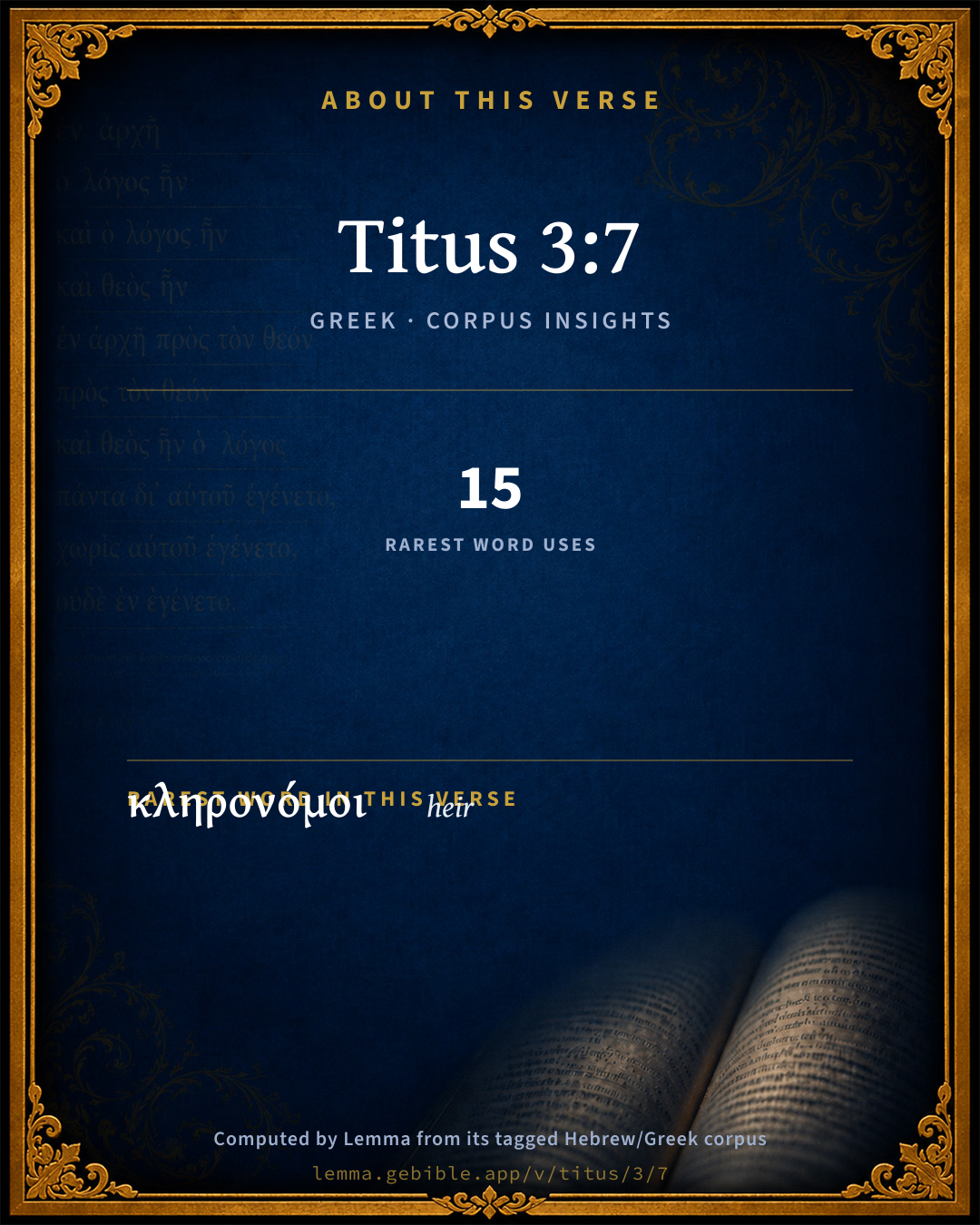
Titus 3:7

Greek (Tischendorf 8th ed.) Titus 3:7 appears in the Greek New Testament. The text above is from the Tischendorf 8th edition. Each word links to its Strong’s number and a concise gloss. Click any word for its full Thayer’s Greek Lexicon entry.
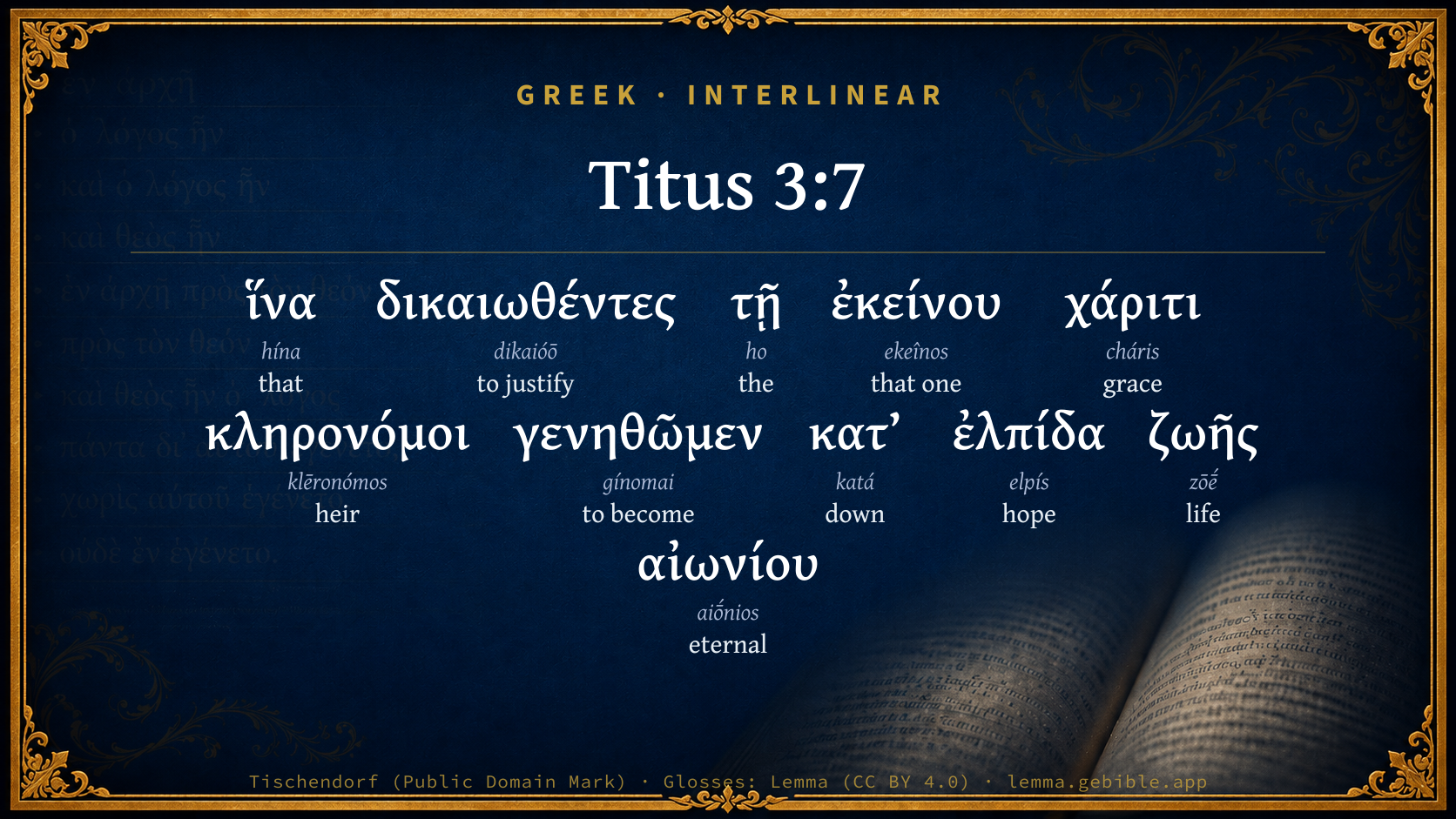
Download image
Cite this verse

Titus 3:7 (World English Bible). Public Domain. Lemma interlinear Bible study tool, https://lemma.gebible.app/v/titus/3/7.

Show BibTeX & RIS
BibTeX
RIS
English Translation
that, being justified by his grace, we might be made heirs according to the hope of eternal life.
World English Bible · Public Domain
Download a study sheet

One document with this verse’s original text, its word-by-word gloss line, the meaning frame, cross-references with their text, attributed commentary, and full source and license credits — printable, and it pastes into notes with its structure intact.

This verse Autodidact and up

Study sheet (.html) Plain text (.txt)

A passage Seminary Student

Up to 50 verses in one chapter. A passage sheet keeps up to 6 commentary sources and 12 cross-references per verse, in the order this page ranks them, and says so on the sheet whenever that leaves anything out. Ask for a single verse and you get the Autodidact verse sheet above.

Everything on this page stays free to read, with no account — the sheet is a download of what is already on screen, not access to it.

Want to remove ads? Support Godless Engineer
Compare translations 3

The same verse in 3 English versions, stacked beneath the original-language interlinear above. Click any original word for its lexicon entry.

Each is an independent rendering of the whole verse — the interlinear is not word-aligned to these translations.

Highlighted words mark where these versions differ — a whole-verse word diff, not a word-by-word alignment.

  • World English Bible Public Domain
    that, being justified by his grace, we might be made heirs according to the hope of eternal life.
  • King James Version Public Domain
    That being justified by his grace, we should be made heirs according to the hope of eternal life.
  • unfoldingWord Literal Text CC BY-SA 4.0
    so that having been justified by the grace of that one, we might become heirs according to certain hope of eternal life.

unfoldingWord Literal Text — © unfoldingWord, licensed CC BY-SA 4.0. Word-aligned USFM3 via Door43 (git.door43.org/unfoldingWord/en_ult).

Versions to compare (up to 4)

3 of 4 selected

Show all 19 translations

Every available English version of this verse, each an independent rendering of the whole verse.

  • World English Bible Public Domain
    that, being justified by his grace, we might be made heirs according to the hope of eternal life.
  • Berean Standard Bible Public Domain
    so that, having been justified by His grace, we would become heirs with the hope of eternal life.
  • Majority Standard Bible Public Domain
    so that, having been justified by His grace, we would become heirs with the hope of eternal life.
  • King James Version Public Domain
    That being justified by his grace, we should be made heirs according to the hope of eternal life.
  • American Standard Version (1901) Public Domain
    that, being justified by his grace, we might be made heirs according to the hope of eternal life.
  • Revised Version (1885) Public Domain
    that, being justified by his grace, we might be made heirs according to the hope of eternal life.
  • Geneva Bible (1599) Public Domain
    That we, being iustified by his grace, should be made heires according to the hope of eternall life.
  • Douay-Rheims (1899) Public Domain
    That, being justified by his grace, we may be heirs, according to hope of life everlasting.
  • Young's Literal Translation Public Domain
    that having been declared righteous by His grace, heirs we may become according to the hope of life age-during.
  • Literal Standard Version CC BY-SA 4.0
    that having been declared righteous by His grace, we may become heirs according to the hope of continuous life.
  • Unlocked Literal Bible CC BY-SA 4.0
    so that having been justified by his grace, we might become heirs with the certain hope of eternal life.
  • unfoldingWord Literal Text CC BY-SA 4.0
    so that having been justified by the grace of that one, we might become heirs according to certain hope of eternal life.
  • Darby Bible Public Domain
    that, having been justified by *his* grace, we should become heirs according to [the] hope of eternal life.
  • World Messianic Bible Public Domain
    that being justified by his grace, we might be made heirs according to the hope of eternal life.
  • Webster's Bible Public Domain
    That being justified by his grace, we should be made heirs according to the hope of eternal life.
  • Free Bible Version CC BY-SA 4.0
    Now that we are set right by his grace we have become heirs having the hope of eternal life.
  • Bible in Basic English Public Domain
    So that, having been given righteousness through grace, we might have a part in the heritage, the hope of eternal life.
  • Text-Critical English NT CC BY 4.0
    so that, having been justified by his grace, we might become heirs according to the hope of eternal life.
  • Tyndale New Testament (1534) Public Domain
    that we once iustified by his grace shuld be heyres of eternall lyfe thorowe hope

Literal Standard Version (2020), Covenant Press — licensed CC BY-SA 4.0. Text via the HelloAO Bible API (eBible.org). Unlocked Literal Bible (unfoldingWord) — licensed CC BY-SA 4.0. Text via the HelloAO Bible API (eBible.org). unfoldingWord Literal Text — © unfoldingWord, licensed CC BY-SA 4.0. Word-aligned USFM3 via Door43 (git.door43.org/unfoldingWord/en_ult). Free Bible Version, Dr. Jonathan Gallagher — licensed CC BY-SA 4.0. Text via the HelloAO Bible API (eBible.org).

Word by word

More ways to search: Search by grammar → Find every occurrence → Compare this word →

Practice this passage: Drill this verse → Learn its vocabulary →

κληρονόμοι
klēronómos
G2818
“heir”
Noun, Nominative, Plural, Masculine
Part of Speech
Noun
Case
Nominative
Number
Plural
Gender
Masculine
Full Thayer's Definition

Origin: from G2819 and the base of G3551 (in its original sense of partitioning, i.e. [reflexively] getting by apportionment)

TDNT: 15:47,4

1. one who receives by lot, an heir a. an heir b. in Messianic usage, one who receives his allotted possession by right of sonship 2. one who has acquired or obtained the portion allotted to him
  1. ἵνα hína G2443 “that” Conjunction
  2. δικαιωθέντες dikaióō G1344 “to justify” Verb, Aorist, Passive, Participle, Nominative, Plural, Masculine
  3. τῇ ho G3588 “the” Article, Dative, Singular, Feminine
  4. ἐκείνου ekeînos G1565 “that one” Demonstrative pronoun, Genitive, Singular, Masculine
  5. χάριτι cháris G5485 “grace” Noun, Dative, Singular, Feminine
  6. γενηθῶμεν gínomai G1096 “to become” Verb, Aorist, Passive deponent, Subjunctive, 1st person, Plural
  7. κατ’ katá G2596 “down” Preposition
  8. ἐλπίδα elpís G1680 “hope” Noun, Accusative, Singular, Feminine
  9. ζωῆς zōḗ G2222 “life” Noun, Genitive, Singular, Feminine
  10. αἰωνίου aiṓnios G166 “eternal” Adjective, Genitive, Singular, Feminine

About this verse

These counts appear in no published source. They are computed here, from the morphology-tagged text and Lemma’s own curated glosses. What Lemma adds →

11
words
11
distinct lemmas
Pauline Epistles
section

Notable vocabulary

The rarest word here is κληρονόμοι heir G2818 — appearing just 15 times in the whole Greek New Testament.

Shared distinctive vocabulary

κληρονόμοι heir G2818 occurs in 14 verses of the Greek New Testament. Also found in:

Cross-references

21

Topical passages linked to Titus 3:7 in the Treasury of Scripture Knowledge — connected by theme and wording, ordered by reader-vote popularity; previews shown in the World English Bible.

  • Romans 8:17 and if children, then heirs; heirs of God, and joint-heirs with Christ; if indeed we suffer with him, that we may also be glorified with him.
  • Titus 2:11 For the grace of God has appeared, bringing salvation to all men,
  • Romans 3:24 being justified freely by his grace through the redemption that is in Christ Jesus;
  • 1 Corinthians 6:11 Such were some of you, but you were washed. But you were sanctified. But you were justified in the name of the Lord Jesus, and in the Spirit of our God.
  • Titus 1:2 in hope of eternal life, which God, who can't lie, promised before eternal times;
  • James 2:5 Listen, my beloved brothers. Didn't God choose those who are poor in this world to be rich in faith, and heirs of the Kingdom which he promised to those who love him?
  • Romans 8:23–24 Not only so, but ourselves also, who have the first fruits of the Spirit, even we ourselves groan within ourselves, waiting for adoption, the redemption of our body.
  • Romans 11:6 And if by grace, then it is no longer of works; otherwise grace is no longer grace. But if it is of works, it is no longer grace; otherwise work is no longer work.
  • Romans 3:28 We maintain therefore that a man is justified by faith apart from the works of the law.
  • Romans 4:16 For this cause it is of faith, that it may be according to grace, to the end that the promise may be sure to all the seed, not to that only which is of the law, but to that also which is of the faith of Abraham, who is the father of us all.
  • Romans 5:1–2 Being therefore justified by faith, we have peace with God through our Lord Jesus Christ;
  • Galatians 2:16 yet knowing that a man is not justified by the works of the law but through the faith of Jesus Christ, even we believed in Christ Jesus, that we might be justified by faith in Christ, and not by the works of the law, because no flesh will be justified by the works of the law.
  • Galatians 3:29 If you are Christ's, then you are Abraham's seed and heirs according to promise.
  • Romans 4:4 Now to him who works, the reward is not counted as grace, but as debt.
  • Romans 5:15–21 But the free gift isn't like the trespass. For if by the trespass of the one the many died, much more did the grace of God, and the gift by the grace of the one man, Jesus Christ, abound to the many.
  • Galatians 4:7 So you are no longer a bondservant, but a son; and if a son, then an heir of God through Christ.
  • Hebrews 6:17 In this way God, being determined to show more abundantly to the heirs of the promise the immutability of his counsel, interposed with an oath;
  • Hebrews 11:7 By faith, Noah, being warned about things not yet seen, moved with godly fear, prepared an ark for the saving of his house, through which he condemned the world, and became heir of the righteousness which is according to faith.
  • Hebrews 11:9 By faith, he lived as an alien in the land of promise, as in a land not his own, dwelling in tents, with Isaac and Jacob, the heirs with him of the same promise.
  • Titus 2:13 looking for the blessed hope and appearing of the glory of our great God and Savior, Jesus Christ;
  • 1 Peter 3:7 You husbands, in like manner, live with your wives according to knowledge, giving honor to the woman, as to the weaker vessel, as being also joint heirs of the grace of life; that your prayers may not be hindered.

Cross-references courtesy of OpenBible.info (CC BY 4.0).

Commentary

Notes on Titus 3:7 from classic Christian and Jewish commentators (each source and its license shown beneath its notes). The classic Christian expositions comment on the surrounding passage and are grouped to its opening verse, so a note may address several verses; the Jewish commentaries on the Tanakh (Rashi and others) are per-verse, so they appear only where the commentator wrote on this verse.

Lemma curates 59 commentaries, every one of them public domain or Creative Commons licensed, each selected and text-cleaned for this edition rather than reprinted as found. About our sources →

Whedon's Commentary on the Bible

Daniel D. Whedon

7. That—In order that. Commentators differ as to whether it depends upon shed or upon saved. By the former (Huther, Wiesinger, and Alford) the Holy Spirit is shed upon us in order to our heirship, etc. But that is tracing the grand result described in this verse to too special a point in the process described in Tit_3:4-6. Make that depend upon saved, and Tit_3:7 describes the divine outcome of the whole process. We, then, are saved, by means described in Tit_3:5-6, in order that we might be heirs of hope and glory.

Being justified—As Alford notes, this may be rendered having been justified, and so be referred back to our first pardon. Or, better, we may identify it with the “justifieth” of Rom_8:33, by which God continuously exonerates the faithful believer from charges of guilt and condemnation.

Heirs—What kind of heirs? Heirs (as divinely defined in the following clause) according to the hope not of a mere temporal patrimony, but of eternal life.

Daniel D. Whedon (gen. ed.), Commentary on the Old and New Testaments (1874–1909) — public domain. Text from a community e-Sword module.

Tyndale Open Study Notes

Tyndale Open Resources

3:7 The first half of this verse sums up 3:4-6. The second half supplies the purpose for what God did. • made us right in his sight: See Rom 3:20-28; Gal 2:16-17. • inherit eternal life: The Spirit (Titus 3:5) is often linked with our status as heirs (see Rom 8:15-17; 1 Cor 6:9-11; Gal 4:6-7; Eph 1:13-14).

Tyndale Open Study Notes — © Tyndale Open Resources, licensed CC BY-SA 4.0. Text via the HelloAO Bible API.

Bengel's Gnomon

Johann Albrecht Bengel

Tit 3:7. Ἵνα, that) This depends on He saved.—δικαιωθέντες, being justified) For formerly we were without righteousness, Tit 3:5.—ἐκείνου, His) God’s, Tit 3:4-5. ἐκεῖνος, He, or that person, points often to something remote. That which is more remote (as expressed by ἐκεῖνος) is estimated from the position of the words, not exactly from the thought itself. The grace of God is an ordinary phrase; and it is of that grace that the kindness and love to men have appeared, to which all things are here attributed. God is supremely good, we are exceedingly evil.—χάριτι, by grace) An antithesis to works.—κατʼ ἐλπίδα, according to the hope) which we did not formerly possess. [This hope truly softens the mind, 1Pe 3:9.—V. g.]—ζωῆς, of life) Construed with heirs.

Bengel's Gnomon of the New Testament — English translation (T&T Clark, Edinburgh, 1860) — public domain. Text from a community e-Sword module.

Meyer's Critical & Exegetical Commentary

Heinrich August Wilhelm Meyer

Tit_3:7. Ἵνα declares the purpose, not the consequence. It is doubtful whether it belongs to ἐξέχεεν (Heydenreich, Wiesinger, van Oosterzee, Plitt, Hofmann) or to ἔσωσεν as defined by διὰ τοῦ λουτροῦ … τοῦ σωτῆρος ἡμῶν (Bengel, de Wette, and others). The thought is substantially the same with both constructions, since the σωτηρία is necessarily brought about by the outpouring of the Spirit. Still the structure of the sentence is in favour of the reference to ἐξέχεεν. Wiesinger rightly considers the other view to be unnecessarily harsh, ignoring the explanatory relation of Tit_3:6-7 to Tit_3:5, and depriving ἐξέχεεν of its necessary definition.

δικαιωθέντες] not found righteous (Matthies), still less sanctified, but justified, i.e. acquitted of the guilt, and with it, of the punishment. Hofmann rightly says that this justification means the same thing as in Rom_3:24; that it does not mean the change of our conduct towards God, but of our relations to Him.1[18]

Τῇ ἘΚΕΊΝΟΥ ΧΆΡΙΤΙ] does not belong to what follows, but to what precedes. Justification is an act of grace. Ἐκείνου does not refer to God as the subject of ἘΞΈΧΕΕΝ (van Oosterzee, Plitt, and formerly in this commentary), but to ἸΗΣΟῦ ΧΡΙΣΤΟῦ (Hofmann), according to the usage of the N. T., for which see Act_3:13; Joh_7:45. Comp. Winer, p. 148 [E. T. p. 196]; Buttmann, p. 91. Heydenreich and Wiesinger are wrong in referring it to ΠΝΕΎΜΑΤΟς; for, on the one hand, this would involve the wrong conception that justification is a work of the Spirit; and, on the other hand, there is no mention in the N. T. of a ΧΆΡΙς ΤΟῦ ΠΝΕΎΜΑΤΟς.

Τῇ ΧΆΡΙΤΙ points us back to ΟὐΚ ἘΞ ἜΡΓΩΝ; Chrysostom: ΠΆΛΙΝ ΧΆΡΙΤΙ, ΟὐΚ ὈΦΕΙΛῇ.

ΚΛΗΡΟΝΌΜΟΙ ΓΕΝΗΘῶΜΕΝ [ΓΕΝΏΜΕΘΑ] ΚΑΤʼ ἘΛΠΊΔΑ ΖΩῆς ΑἸΩΝΊΟΥ] ΚΑΤʼ ἘΛΠΊΔΑ cannot, as Heydenreich thinks probable, be construed with ΖΩῆς ΑἸΩΝΊΟΥ as one conception, so as to be equivalent to ΖΩῆς ΑἸΩΝΊΟΥ ἘΛΠΙΖΟΜΈΝΗς. On the other hand, it is also unsuitable to take ΚΑΤʼ ἘΛΠ. Ζ. ΑἸΩΝ. together: in accordance with the hope of eternal life (Matthies), because in that case ΚΛΗΡ. would not be defined. ΚΑΤʼ ἘΛΠΊΔΑ should rather be joined with ΚΛΗΡ. ΓΕΝΗΘ., and then the genit. ΖΩῆς ΑἸΩΝΊΟΥ belongs to the latter. Chrysostom has two interpretations: ΚΑΤʼ ἘΛΠΊΔΑ, ΤΟΥΤΈΣΤΙ· ΚΑΘῺς ἨΛΠΊΣΑΜΕΝ, ΟὝΤΩς ἈΠΟΛΑΎΣΟΜΕΝ, Ἢ, ὍΤΙ ἬΔΗ ΚΑῚ ΚΛΗΡΟΝΌΜΟΙ ἘΣΤΈ. According to the former view, the words would have to be translated: in order that we, in proportion to our hope (i.e. as we hope), may become heirs of eternal life; according to the latter, it would be: that we, according to hope, might become heirs of eternal life. The latter view is the correct one. The apostle is speaking not of the future, but of the present condition of believers. They are heirs of eternal life; but they are so in hope, not yet in actual possession; for ζωὴ αἰώνιος in its full meaning is something future, Rom_6:22-23.

ΚΑΤʼ ἘΛΠΊΔΑ stands here as Τῇ ἘΛΠΊΔΙ in Rom_8:24; see Meyer on the passage.[19]

[18] 1 The apostle says nothing here regarding the relation of justification to the ἀνακαίνωσις wrought by the Holy Spirit. It is wrong at any rate to regard the latter as the ground of the former, so that God justifies man because he is renewed. Nor, on the other hand, can the renewing be regarded as a later consequence of the justification, in the sense that God imparts to man the Holy Spirit after man has been justified. The two things are very closely connected. Justification is to be regarded as the ground of renewing, while renewing is the actual completion of justification. God justifies man so as to renew him, to make him His child born of the Spirit.

[19] This passage, vv. 47, is substantially different from that in Tit_2:11-14. While in the latter the chief point is the paedagogic aim of the work of redemption, and the apostle accordingly is thinking how Christians are pledged to a holy life, in the former the chief point is the undeserved love of God made manifest in the work of redemption. Hence in this passage also much emphasis is laid on the idea of regeneration, which is granted to the Christian by the gift of the Holy Spirit.

Meyer — Critical and Exegetical Commentary on the New Testament — English translation by Peter Christie, edited by Frederick Crombie (T&T Clark, 1880) — public domain. Text from a community e-Sword module.

Expositor's Greek Testament

ed. W. Robertson Nicoll

Tit 3:7 . ἵνα , κ . τ . λ .: It is not quite certain, whether this expresses the object of ἐξέχεεν or of ἔσωσεν . The former connexion brings out best the climax of the passage. κληρονόμοι marks the highest point to which man can attain in this life. See reff. The two preceding stages are marked by λουτρὸν παλινγενεσίας and ἀνακαίνωσις , while δικαιωθέντες … χάριτι is an expression in theological language of the simpler κατὰ τὸ αὐτοῦ ἔλεος ἔσωσεν ἡμᾶς . The grace by which man is justified is usually spoken of as that of God the Father, Rom 3:24 ; and so ἐκείνου , not αὐτοῦ , is used as referring to the remoter antecedent.

κληρονόμοι : According to the analogy of the other passages where it occurs, this word is best taken absolutely; or, if the notion must be completed, we may understand θεοῦ . The term would not need any elucidation to one of St. Paul’s company. It is also an argument against connecting κληρ . ζωῆς αἰωνίου (R.V.m) that ἔλπις ζωῆς αἰωνίου occurs in Tit 1:2 ; and Gal 3:29 , κατʼ ἐπαγγελίαν κληρ ., is parallel.

The Expositor's Greek Testament, edited by W. Robertson Nicoll (1897–1910) — public domain. Text from a community e-Sword module.

Jamieson, Fausset & Brown

Robert Jamieson, A. R. Fausset & David Brown

That, &c.--the purpose which He aimed at in having "saved us" (Tit 3:5), namely, "That being (having been) justified (accounted righteous through faith at our 'regeneration,' and made righteous by the daily 'renewing of the Holy Ghost') by His grace (as opposed to works, Tit 3:5) we should be made heirs."

his grace--Greek, "the grace of the former," that is, God (Tit 3:4; Rom 5:15).

heirs-- (Gal 3:29).

according to the hope of eternal life-- Tit 1:2, and also the position of the Greek words, confirm English Version, that is, agreeably to the hope of eternal life; the eternal inheritance fully satisfying the hope. BENGEL and ELLICOTT explain it, "heirs of eternal life, in the way of hope," that is, not yet in actual possession. Such a blessed hope, which once was not possessed, will lead a Christian to practice holiness and meekness toward others, the lesson especially needed by the Cretans.

Jamieson, Fausset & Brown — Commentary Critical and Explanatory on the Whole Bible (1871) — public domain (CC PDM 1.0). Text via the HelloAO Bible API.

Adam Clarke's Commentary

Verse 7. That, being justified by his grace] Being freed from sin; for the term justification is to be taken here as implying the whole work of the grace of Christ on the heart, in order to its preparation for eternal glory.

Should be made heirs] The Gospel not only gave them the hope of an endless state of glory for their souls, but also of the resurrection and final glorification of their bodies; and they who were children of God were to be made heirs of his glory. See note on Ga 4:6-7.

Adam Clarke's Commentary on the Bible (1810–1826) — public domain. Text from a community e-Sword/MySword module.

John Calvin's Commentaries

7 That being justified by his grace If we understand “regeneration” in its strict and ordinary meaning, it might be thought that the Apostle employs the word “justified” instead of “regenerated;” and this is sometimes the meaning of it, but very seldom; yet there is no necessity which constrains us to depart from its strict and more natural signification. The design of Paul is, to ascribe to the grace of God all that we are, and all that we have, so that we may not exalt ourselves proudly against others. Thus he now extols the mercy of God, by ascribing to it entirely the cause of our salvation. But because he had spoken of the vices of unbelievers, it would have been improper to leave out the grace of regeneration, which is the medicine for curing them.

Still this does not prevent him from returning immediately to praise divine mercy; and he even mingles both blessings together — that our sins have been freely pardoned, and that we have been renewed so as to obey God. This, at least, is evident, that Paul maintains that “justification,” is the free gift of God; and the only question is, what he means by the word justified. The contest seems to demand that its meaning shall be extended further than to the imputation of righteousness; and in this larger sense it is seldom (as I have said) employed by Paul; yet there is nothing that hinders the meaning of it from being limited to the forgiveness of sins.

When he says, by his grace, this applies both to Christ and to the Father, and we ought not to contend for either of these expositions, because it will always hold good, that, by the grace of God, we have obtained righteousness through Christ.

Heirs according to the hope of eternal life This clause is added by way of exposition. He had said that we have been saved through the mercy of God. But our salvation is as yet hidden; and therefore he now says that we are heirs of life, not because we have arrived at the present possession of it, but because hope brings to us full and complete certainly of it. The meaning may be thus summed up. “Having been dead, we were restored to life through the grace of Christ, when God the: Father bestowed on us his Spirit, by whose power we have been purified. and renewed. Our salvation consists in this; but, because we are still in the world, we do not yet enjoy ‘eternal life,’ but only obtain it by ‘hoping.’”

John Calvin's Commentaries (1540-1563) — public domain. Text from the Calvin Translation Society English edition (1840s-50s) via the Christian Classics Ethereal Library (ccel.org). Calvin's coverage is partial (roughly two-thirds of the Bible); uncommented books and verses are honest gaps, never fabricated. The 19th-century editor's footnotes and remarks are omitted so the notes are faithfully Calvin's own voice.

Ellicott's Commentary for English Readers

(7) That being justified by his grace, we should be made heirs according to the hope of eternal life.—Here appears the glorious design of God’s salvation. We were in a hopeless and lost state, from which God’s love for man saved us by the laver of regeneration and renovation; and this was the end for which He saved us—that we should be heirs of eternal life. “Being justified,” that is, freed from the future punishment and consequences of sin, and received into the favour and friendship of God, which favour and friendship had been, through sin, forfeited. “By His grace,” by the favour and kindness of God the Father are we restored to His love and friendship. “Heirs,” see Rom_8:17, where this thought of our heirship of heaven is enlarged. “According to the hope of eternal life;” this life eternal is still for us in the future, though ever present in respect of hope; children of God we indeed are, and sharers in many a good gift of our Father, but eternal life, that glorious inheritance, is still in the far future, and as yet can only be enjoyed by us in hope, but it is a sure hope—eternal life—the hope of which is the mainspring of all Christian work and activity—though it includes it, of course, is something far more than merely endless existence. A veil, impenetrable to mortal eye, hangs between us and the many mansions of the Father’s house. “It doth not yet appear what we shall be;” we only know that then, we, in company with an innumerable host of blessed beings, shall share in the beatific vision; we only know that then “we shall ever be with the Lord;” and that with this thought and with these words are we to comfort one another. (See 1Th_4:17-18.)

A Bible Commentary for English Readers, edited by Charles John Ellicott (1878–1897) — public domain. Text from a community e-Sword module.

The Cambridge Bible for Schools and Colleges

gen. ed. J. J. S. Perowne

7. being justified … be made heirs] The word ‘justifying’ and ‘justification’ occur 25 times in the great group of Epistles, written 10 years before this to the Romans, Corinthians, Galatians, whose subject is ‘Christ the Redeemer,’ ‘Christ for us.’ It has not been used in the next great group written five years before this, to the Ephesians, Colossians and Philippians, whose subject is ‘Christ the Life,’ ‘Christ in us,’ ‘Christ our Sanctification.’ ‘Righteousness,’ however, that right relation between God and man, the restoration to which is justification, occurs seven times against 50 times in the former group. So in Eph_5:26 (already quoted as parallel in form and sense to our present passage), ‘the cleansing’ is the justifying, and the ‘sanctifying’ follows, as here ‘being heirs’ follows. This verse then, in its two clauses, repeats, with reference to God the Son, what in Tit_3:5 was said with reference to God the Father as to the twofold saving mercy; just as in the former ‘Gospel’ passage, Tit_2:11-14, ‘renunciation’ and ‘obedience’ are both spoken of, first as the work of God the Father’s grace (11, 12), and then as the result of God the Son’s gift of Himself (14). The justification by God the Father’s grace—the regeneration—effected potentially once for all by Christ through His death, resurrection and outpouring of the Holy Spirit, and appropriated individually by Faith (expressed or implied) in Baptism, is to be followed by a ‘life of heirship’ or ‘sanctification’; so the Latin translation of Theod. Mops. ‘ut heredes efficiamur,’ and the comment, ‘at segregavit nos in ditissimam quam nobis bonorum praestitit fruitionem,’—the third of the Baptismal Blessings, ‘inheritors of the kingdom of heaven,’ with a right and title to receive now ‘the fruits of the Spirit.’

according to the hope of eternal life] (1) In A.V. and R.V. it is implied that these words are to be taken together and ‘made heirs’ left absolute; then this last clause finds an eloquent expansion in Eph_5:27 (see above), and ‘glorification’ crowns ‘sanctification,’ as sanctification followed justification. (2) The R.V. margin gives ‘heirs, according to hope, of eternal life.’ in this case ‘eternal life’ must most fittingly be interpreted as usually in St John, and 1Ti_4:8; 1Ti_6:12; 1Ti_6:19, ‘the spiritual life that is and is to come;’ ‘according to hope,’ will be as Eph_4:4, ‘called in one hope of your calling,’ and 1Ti_1:1, ‘Christ Jesus our hope,’ where this life’s state of salvation must be included in the object of hope; and ‘justification’ and ‘sanctification’ will be the only two objects named of the Spirit’s outpouring. But the phrase in Tit_1:2, as there interpreted, favours (1).

The Cambridge Bible for Schools and Colleges (gen. ed. J. J. S. Perowne; Cambridge University Press, 1878–1918) — public domain. Text from a community e-Sword module.

John Gill's Exposition

That being justified by his grace,.... This is another way and means, as well as regeneration, by which God saves his people; for he saves no unjustified ones; no unrighteous persons shall inherit the kingdom of heaven; such as are without the wedding garment, and robe of Christ's righteousness, shall be cast into outer darkness: whom God saves, he justifies by the righteousness of his Son; and whomsoever he justifies, them he saves. The justification here spoken of is a declarative one, which takes place in regeneration; and which that is in order to, as here expressed, "that being justified": regeneration does not justify any, but makes the justified to appear to be such; justification is an act of God's gracious will conceived in his mind from eternity, by which he wills not to impute sin to his people, but to Christ their surety; and that they should be accounted righteous through the righteousness of his Son; in which act of his will the whole essence of justification in his sight lies: this was pronounced on Christ, as their head and representative at his resurrection, when he, as such, was justified, acquitted, and discharged, and they in him; and this is declared in the conscience of a sinner, by the Spirit of God, at his regeneration, when he passes from death to life; and this declaration is here intended, and which is the same with justification by faith; and is here said to be by the grace of God, as justification in every view is, and stands opposed to works of righteousness done by men, by which no man can be justified in the sight of God; in what sense justification is by the free grace of God; see Gill on Rom 3:24.

We should be made heirs according to the hope of eternal life; or "according to hope we should be made heirs of eternal life". Eternal life is an inheritance, and so is not acquired by labour and industry, nor purchased, but is a free gift; it is a bequest of God the Father to his children, of his own free good will and pleasure; and it belongs only to children; they only are heirs, and they become such by adopting grace; neither regeneration, nor justification, make them the children of God, and heirs of the grace of life, but make them appear to be so: God, by his gracious act of adoption puts them among the children, and gives them the goodly heritage; and this adoption lies in eternal predestination in Christ, in whom the inheritance is obtained on that account, Eph 1:5. Regeneration shows them to be the adopted ones, and gives them the nature of children, and a meetness for the inheritance; and justification gives them a right unto it, upon the foot of justice, and opens a way for their enjoyment of it, consistent with the justice and holiness of God; see Gal 4:4, wherefore such as are washed with the washing of regeneration, and are renewed in the spirit of their minds, and justified by the grace of God; these are manifestly heirs of eternal life, of salvation, of a kingdom and glory, of all things, even of God himself, who is their portion, and exceeding great reward; and such in regeneration are begotten to a lively hope of it, and by this they are saved, Rom 8:24. And thus the apostle makes regeneration by the free mercy of God, and justification by his grace, and special adoption, and heirship, with a good hope through grace, the way and means in which God saves his people, who were like others by nature, and brings them to the enjoyment of eternal happiness.

John Gill's Exposition of the Whole Bible (1746–1763) — public domain (CC PDM 1.0). Text via the HelloAO Bible API.

Trapp's Complete Commentary

John Trapp

7 That being justified by his grace, we should be made heirs according to the hope of eternal life.

Ver. 7. Be made heirs] Not purchasers; all is of free grace. Horreo quicquid de meo est, ut sim meus. Paul was a most constant preacher of grace. (Bernard. Augustine.)

John Trapp, A Commentary or Exposition upon All the Books of the Old and New Testament (1647–1656) — public domain. Text from a community e-Sword module.

Albert Barnes' Notes on the Bible

That being justified by his grace - Not by our own works, but by his favor or mercy; see the notes at Rom 3:24.

We should be made heirs - See the notes at Rom 8:15, Rom 8:17.

According to the hope of eternal life - In reference to the hope of eternal life; that is, we have that hope in virtue of our being adopted with the family of God, and being made heirs. He has received us as his children, and permits us to hope that we shall live with him forever.

Albert Barnes' Notes on the Bible (1834–1885) — public domain. Text from a community e-Sword/MySword module.

Haydock's Catholic Bible Commentary

This admirable, and I may say divine adoption, is the sole foundation of a Christian’s hope, as the eternal life of the blessed is the sole end of this adoption.

George Leo Haydock (1774–1849), Haydock's Catholic Family Bible and Commentary, 1859 edition — public domain. Excludes Psalms (Douay-Rheims chapter numbering differs from Protestant) and Deuterocanonical books (Catholic canon only).

Matthew Poole's English Annotations

That being justified by his grace; that, through the free love of God, having the guilt of our sins removed, and the righteousness of Christ reckoned to us for righteousness,

we should be made heirs; should, through adoption, be made children, then heirs; heirs of God, and joint-heirs with Christ, Rom 8:17.

According to the hope of eternal life: some think that the words should be read thus: That we, according to hope, should be made heirs of eternal life; because otherwise, the text hath no object to relate to heirs. But what should we be heirs of, but the kingdom mentioned Mat 25:34? Though it be true, we are no more than heirs according to hope, nor is any man otherwise an heir of an inheritance, as heir stands distinguished from an owner or proprietor.

Matthew Poole's English Annotations on the Holy Bible (1683–1685) — public domain. Text from a community e-Sword/MySword module.

The Pulpit Commentary

Might for should, A.V Being justified by his grace; showing very clearly that righteousness in man did not precede and cause the saving mercy of God, but that mercy went before and provided the justification which is altogether of grace, and which issues in the possession of eternal life. Heirs according to the hope of eternal life. This seems to be the right rendering rather than that in the margin, heirs, according to hope, of eternal life, making eternal life" depend upon "heirs." The passage in Tit_1:2, In hope of eternal life," is a very strong reason for taking the same construction here. The answer in the Church Catechism, Wherein I was made a member of Christ, a child of God, and an inheritor of the kingdom of heaven," follows very closely St. Paul"s teaching in the text. (see Rom_4:13, 14 8:17 Gal_3:29, Gal_4:7)

Vers. 7, 8. Justification; faith; works.

"That being justified by his grace, we should be made heirs," etc. There are three subjects in these verses of vital interest to man which require to be brought out into prominence and impressed with indelible force.

I THE MORAL RECTIFICATION OF THE SOUL. "Being justified by his grace, we should be made heirs according to the hope of eternal life." This means, I presume, not that being pronounced right, but that being made right. Forensic justification is an old theological fiction. Those who have held it and who still hold it have ideas of God incongruous and debased. They regard him as such a one as themselves. "To be justified" here means to be made right. There are three ideas here suggested in relation to this moral rectification of the soul.

1. All souls in their unrenewed state are unrighteous. We do not require any special revelation from God to give us this information. Man"s moral wrongness of soul is revealed in every page of human history, is developed in every scene of human life, and is a matter of painful consciousness to every man. We have all erred and strayed from the right like lost sheep.

2. Restoration to righteousness is the merciful work of God. "Being justified by his grace grace," his boundless, sovereign, unmerited love. Who but God can put a morally disordered soul right? To do this is to resuscitate the dead, to roll back the deep flowing tide of human sympathies into a new channel and a new direction, to arrest a wandering planet and plant it in a new orbit. He does it and he alone. He does it by the revelation of his Son, by the dispensations of life, the operations of conscience. "Lo, all these things worketh God oftentimes with man, to bring back his soul from the pit, to be enlightened with the light of the living.

3. There is the heirship of eternal good. "Being justified by his grace, we should be made heirs according to the hope of eternal life." Eternal life must mean something more than endless existence; for mere endless existence, under certain conditions, might be an object of dread rather than hope. It might mean perfect goodness. Goodness is eternal, for God is eternal Goodness is blessedness, for God is blessed. A virtuous hope is not hope for happiness, but a hope for perfect goodness. He whose soul is made morally right becomes an heir to all goodness. This heirship is not something added to this inner righteousness. It is in it as the plant is in the seed. Man"s heaven is in righteousness of soul and nowhere else. No man can be happy who is merely treated as righteous if he is not righteous. Such treatment, even by God himself, would only enhance his misery. To be treated as righteous if you are not righteous, is an outrage on justice and a revulsion to moral nature.

II THE ESSENTIAL FOUNDATION OF ALL TRUE FAITH. "And they which have believed in God might be careful to maintain good works. These things are good and profitable unto men." The basis of all true faith is faith in God. In him, not in it. In him, not in men"s representations of him. "He that cometh to God must believe that he is." To believe in him implies:

1. To believe in what he is in himself. The only absolute existence, without beginning, without succession, without end, who is in all and through all, the all-mighty, the all-wise, the all-good Creator and Sustainer of the universe. This faith in him is the most philosophic, the most universal, and the most blessed and ennobling faith.

2. To believe in what he is to us the Father, the Proprietor, and the Life. "Not willing that any should perish." This is the faith that is enjoined upon us everywhere in the Old Testament and the New; not faith in infallible propositions, in infinite personality; not faith in man"s ideas of God, but in God himself, as the Source of all life, the Fountain of all virtue, the Standard of all excellence. "Trust in him that liveth forever.

"Not in priesthoods, not on creed, Is the faith we need, O Lord; These, more fragile than the reed, Can no rest for souls afford.

Human systems, what are they? Dreams of erring men at best, Visions only of a day, Without substance, without rest.

Firmly fix it, Lord, on thee, Strike its roots deep in thy love; Growing ever may it be, Like the faith of these above.

Then though earthly things depart, And the heavens pass away, Strong in thee shall rest the heart, Without fainting or decay. ("Biblical Liturgy.")

III THE SUPREME PURPOSE OF A TRUE LIFE. "To maintain good works." What are good works?

1. Works that have right motives. Works that society may consider good, that Churches may chant as good, are utterly worthless unless they spring from supreme love to the Creator. "Though I give my body to be burned, if I have not love, I am nothing." "Love is the fulfilling of the Law.

2. Works that have a right standard. It is conceivable that man may have a right motive and yet his work be bad. Was it not something like this with Saul of Tarsus when he was persecuting the saints? We make two remarks in relation to these good works.

(1) The maintenance of these works requires strenuous and constant effort. "I will that thou affirm confidently, to the end that they which have believed in God may be careful to maintain good works." There are so many forces within and without us to check and frustrate the maintenance of good works, that we require to be constantly on our guard to see that our motives are right. It may be that good works flow from angelic natures as waters from a fountain, as sunbeams from the sun; but it is not so with us. Their light in us is the light of the lamp, and to be clear and useful there must be constant trimming and feeding with fresh oil; for the streams to be pure, the fountain must be kept clean. We must "watch and pray, lest we enter into temptation.

(2) The great work of the Christian ministry is to stimulate this effort. "I will that thou affirm confidently, to the end that they which have believed God may be careful to maintain good works." "This is a faithful saying, and these things I will that thou affirm constantly, that they which have believed in God," etc. In four other texts of Scripture we have "a faithful saying." The first is 1Ti_1:15, "That Jesus Christ came into the world to save sinners." The second is 1Ti_4:8, 1Ti_4:9, "This is a faithful saying, Godliness is profitable unto all things." The third is 2Ti_2:11-13, "It is a faithful saying, If we be dead with him, we shall also live with him." The fourth is our text, "This is a faithful saying." What? That God makes men morally right by his grace. This is an undoubted fact. That God is the essential Foundation of all true faith. Who can question this? Or that the supreme purpose of moral existence is to maintain "good works." Who will gainsay this? Or that all ministers of the gospel should faithfully and constantly exhort their hearers to maintain good works. These, indeed, are all faithful sayings, and should be practically realized by every man. D.T.

The Pulpit Commentary (1880–1919), ed. H.D.M. Spence-Jones & Joseph S. Exell — public domain. Text from a community e-Sword module.

Fairbairn on Ezekiel, Jonah & the Pastoral Epistles

Patrick Fairbairn

Ver. 7. In this verse we have the important practical design of the salvation-work described in the three preceding verses: in order that, being justified by His grace, we might become heirs according to the hope of eternal life. The expression by His grace (τῇ χάριτι ἐκείνου) must be connected with God the Father, since it is He always who is represented as conferring the grace which justifies the ungodly. Concurrently, however, with the Father’s procedure in respect to justification, there is an indispensable action of the Holy Spirit, uniting the sinner to Christ, and so establishing a vital bond between the guilty and the righteous. For, however gratuitous the act of justification is as bestowed on its objects, not only without any good deeds on their part, but in spite of many bad deeds, there is nothing arbitrary in it. It proceeds upon such a connection between the soul and Christ as secures for it a participation in His infinite worth and sufficiency, so that God is just even when He justifies the ungodly (Rom 3:26). When it is said, further, that this justification is effected that we might become κληρονόμοι γενηθῶμεν κατʼ ἐλπίδα ζωῆς αἰωνίου, the explanation may run, either heirs in respect to hope of eternal life—heirs of that life, yet meanwhile having it only in hope; or heirs in conformity with the hope of eternal life—of all that such a hope entitles to. Grammatically, the one explanation is as admissible as the other. But I think, with Alford, against Huther and Ellicott, that considering the expression used by the apostle at the commencement of this epistle, ἐπʼ ἐλπίδα ζωῆς αἰωνίου, it is more natural here to couple hope directly with eternal life, and regard the heirship spoken of as comprehending all that is conformable to, or is embraced in, the hope of eternal life. But the difference between the two modes of exposition is of a philological rather than a doctrinal kind: in substance the meaning is much the same either way; and to the popular apprehension, it will matter extremely little whether we say of the justified that he is heir of eternal life, as to hope, or that he is heir of whatever the hope of eternal life warrants him to look for. Niceties of this description in the interpretation of Scripture, if they may be noticed, should certainly not be dwelt upon.

A few practical advices to Titus now close the hortatory part of the epistle, followed up by some personal notices and salutations.

Patrick Fairbairn — An Exposition of Ezekiel (1851), Jonah (1849), and The Pastoral Epistles (1874) — public domain. Text from a community e-Sword module.

Scofield Reference Notes

C. I. Scofield

by his grace

Grace (in salvation). Heb 2:9; Rom 3:24 (See Scofield "Joh 1:17").

The Scofield Reference Bible (1917 edition), notes by C. I. Scofield — public domain. Text from a community e-Sword module.

The People's New Testament

B. W. Johnson

7. That being justified. Our sins all forgiven, that through God's grace, we might be accepted as his children.

B. W. Johnson's The People's New Testament with Notes (1889–1891) — public domain. Electronic text from the Christian Classics Ethereal Library (CCEL) ThML edition.

Cambridge Greek Testament for Schools and Colleges

7. γενηθῶμεν. This is the reading of א*ACD2*GP 17 &c.; the rec. text has γενώμεθα with אcD2cEKL and the majority of cursives.

7. ἵνα δικαιωθέντες τῇ ἐκείνου χάριτι, in order that, having been justified by His grace &c. The ἵνα has its full telic force; this heirship now spoken of is the final purpose of that rich outpouring of the Holy Spirit just described.

The mention of justification in such a context is characteristically Pauline; cp. Rom 3:24 δικαιούμενοι δωρεὰν τῇ αὐτοῦ χάριτι, a parallel which determines the reference (which grammar does not forbid) of ἐκείνου to God the Father.

κληρονόμοι γενηθῶμεν, we might be made heirs, sc. heirs of all the evangelical promises in Christ. κληρονόμοι is used thus absolutely by St Paul; cp. e.g. Rom 4:14; Rom 8:17; Gal 3:29.

κατʼ ἐλπίδα ζωῆς αἰωνίον, according to the hope of life eternal. See on ch. Tit 1:2 for this phrase. The heirship is κατʼ ἐλπίδα ζωῆς αἰωνίου, for if there were no such hope, then the heirship would be vain and disappointing; cp. Heb 9:15.

Cambridge Greek Testament for Schools and Colleges (Cambridge University Press, 1896; 21 vols, various authors incl. Carr, Maclear, Plummer, Farrar, Lumby, Moule, M. R. James, Simcox) — public domain. Text from a community e-Sword module.

Alford’s Greek Testament

Henry Alford

7.] in order that (this ἵνα, in the form of the sentence, may express the aim either of ἔσωσεν (Beng., De W., Huther, Ellic.) or of ἐξέχεεν: more naturally, I believe, of the latter (Wiesinger): and for these reasons, that ἔσωσεν seeming to have its full pregnant meaning as it stands, (1) does not require any further statement of aim and purpose: but ἐξέχεεν being a mere word of action, is more properly followed by a statement of a reason why the pouring out took place: and (2) that this statement of aim and purpose, if it applies to ἔσωσεν, has been already anticipated, if ἔσωσεν be understood as including what is generally known as σωτηρία.

Theologically, this statement of purpose is exact: the effusion of the Spirit has for its purpose the conviction of sin and manifestation of the righteousness of Christ, out of which two spring justifying faith) having been justified (the aor. part. here (expressed in English by ‘having been’) is not contemporaneous with the aor. subj. below. Ordinarily this would be so: but the theological consideration of the place of justification in the Christian life, illustrated by such passages as Rom 5:1, δικαιωθέντες οὖν ἐκ πίστεως εἰρήνην ἔχωμεν πρὸς τ. θεόν, κ.τ.λ., seems to determine here the aor. part. to be antecedent to γενήθωμεν) by His (ἐκείνου, referring to the more remote subject, must be used here not of our Lord, who has just been mentioned, but of the Father: and so, usually, χάρις θεοῦ (Act 9:23; Act 20:24, Act 20:32; Rom 5:15; 1Co 1:4, &c.) is the efficient cause of our justification in Christ) grace, we might be made (perhaps passive, see however on 1Th 1:5) heirs (see especially Gal 3:29) according to (in pursuance of, consistently with, so that the inheritance does not disappoint, but fully accomplishes and satisfies the hope; not ‘through’ (?) as Conyb., referring to Rom 8:24, Rom 8:25, where, however, the thought is entirely different) the hope of eternal life (I cannot consent, although considerable scholars (e.g. De W., Ellic.) have maintained the view, to join the gen. ζωῆς with κληρονόμοι, in the presence of the expression, in this very Epistle, ἐπʼ ἐλπίδι ζωῆς αἰωνίου, ch. 1:2. The objection brought against joining ἐλπίδα with ζωῆς here is that thus κληρονόμοι would stand alone. But it does thus stand alone in every place where St. Paul uses it in the spiritual sense; viz. Rom 4:14; Rom 8:17 bis (θεοῦ is a wholly different genitive): Gal 3:29; Gal 4:1, Gal 4:7: and therefore why not here? Chrys.’s two renderings, both of which Huther quotes for his view, will suit mine just as well: κατʼ ἐλπίδα, τουτέστι, καθὼς ἠλπίσαμεν, οὕτως ἀπολαύσομεν, ἢ ὅτι ἤδη καὶ κληρονόμοι ἐστέ. The former is the one to which I have inclined: the latter would mean, “we might be heirs, according to the hope”—i.e. in proportion as we have the hope, realize our heirship—“of eternal life”).

Henry Alford, The Greek Testament (1849–1861) — public domain. Text from a community e-Sword module.

International Critical Commentary

7. δικαιωθέντες] not “at the Judgment day” (which would make κατʼ ἔλπιδα meaningless), but “at the start of the Christian life,” as in Rom 3:4, Gal 3-5: “we at once might become heirs of life, yet with a further hope (cf. 2:13) that it will become fuller and eternal”; Cf. 1:2, Rom 8:17, Gal 4:6, Gal 4:7.

κληρονόμοι] like the Jews of Canaan; cf. Deu 9:6 (quoted on p. 154).

International Critical Commentary — older volumes (1896–1929), various authors — public domain. Text from a community e-Sword module.

Vincent's Word Studies in the New Testament

Marvin R. Vincent

Being justified [δικαιωθεντες] . In Pastorals only here and 1Ti 3:16 (note). See Intro. 6 Justification is conceived as taking place before the outpouring of the Spirit.

By his grace [τη εκεινου χαριτι] . By the grace of Jesus Christ. See Act 14:11; 2Co 8:9; 2Co 13:14; Rom 5:6; Gal 1:6. We should be made heirs [κληρονομοι γενηθωμεν] . Klhronomov heir only here in Pastorals. A favorite idea of Paul. See Rom 4:13; Rom 8:17; Gal 3:29. Heirship of eternal life is the result of justification. So, clearly, Rom. verse It is attested and confirmed by the Holy Spirit. 2Co 5:5; Eph 1:14.

According to the hope of eternal life [κατ ελπιδα ζωης αιωνιου] . Const. of eternal life with heirs, and rend. heirs of eternal life according to hope. Comp. Rom 4:18; Rom 5:2; Rom 8:24; Gal 5:5; Col 1:5, 27; Tit 1:2; 1Pe 1:3; 1Jo 3:2, 8.

Marvin R. Vincent, Word Studies in the New Testament (1887–1900) — public domain. Text from a community e-Sword/MySword module.

Lesson kit

Teaching starters — assembled from the data on this page, not authored interpretation. Every prompt links to the verse data it draws on. Edit before teaching.

Titus, in the Pauline Epistles, opens this verse with 11 words (11 distinct Greek lemmas). Its most distinctive word is klēronómos (“heir”). A historical commentator’s framing appears above. Read the whole chapter for the surrounding context.

Discussion questions

  1. The word klēronómos carries the sense “heir.” How does it shape the verse?
  2. How does Matthew 21:38, which shares the word «heir», read alongside this verse?
  3. These translations render this verse differently; the difference is in the English rendering, not the original. What questions does that raise?
  4. Compare how Whedon's Commentary on the Bible and Tyndale Open Study Notes read this verse. Where do they agree or differ?

Things to notice

Reading settings

Reading text

Shown beneath each verse's original-language words.

Old Testament
Old Testament edition

Read the OT as the Masoretic Hebrew (MT) or the Greek Septuagint (LXX).

English shown for the Greek Septuagint (in the Hebrew ↔ Greek comparison).

Comparing translations? Open the Compare panel on any verse page to stack up to four side by side.