Ephesians 2:7

Greek (Tischendorf 8th ed.) Ephesians 2:7 appears in the Greek New Testament. The text above is from the Tischendorf 8th edition. Each word links to its Strong’s number and a concise gloss. Click any word for its full Thayer’s Greek Lexicon entry.
Download image
Cite this verse

Ephesians 2:7 (World English Bible). Public Domain. Lemma interlinear Bible study tool, https://lemma.gebible.app/v/ephesians/2/7.

Show BibTeX & RIS
BibTeX
RIS
English Translation
that in the ages to come he might show the exceeding riches of his grace in kindness toward us in Christ Jesus;
World English Bible · Public Domain
Download a study sheet

One document with this verse’s original text, its word-by-word gloss line, the meaning frame, cross-references with their text, attributed commentary, and full source and license credits — printable, and it pastes into notes with its structure intact.

This verse Autodidact and up

Study sheet (.html) Plain text (.txt)

A passage Seminary Student

Up to 50 verses in one chapter. A passage sheet keeps up to 6 commentary sources and 12 cross-references per verse, in the order this page ranks them, and says so on the sheet whenever that leaves anything out. Ask for a single verse and you get the Autodidact verse sheet above.

Everything on this page stays free to read, with no account — the sheet is a download of what is already on screen, not access to it.

Want to remove ads? Support Godless Engineer
Compare translations 3

The same verse in 3 English versions, stacked beneath the original-language interlinear above. Click any original word for its lexicon entry.

Each is an independent rendering of the whole verse — the interlinear is not word-aligned to these translations.

Highlighted words mark where these versions differ — a whole-verse word diff, not a word-by-word alignment.

  • World English Bible Public Domain
    that in the ages to come he might show the exceeding riches of his grace in kindness toward us in Christ Jesus;
  • King James Version Public Domain
    That in the ages to come he might shew the exceeding riches of his grace in his kindness toward us through Christ Jesus.
  • unfoldingWord Literal Text CC BY-SA 4.0
    so that in the ages that are coming he might show the immeasurably great riches of his grace in his kindness to us in Christ Jesus.

unfoldingWord Literal Text — © unfoldingWord, licensed CC BY-SA 4.0. Word-aligned USFM3 via Door43 (git.door43.org/unfoldingWord/en_ult).

Versions to compare (up to 4)

3 of 4 selected

Show all 19 translations

Every available English version of this verse, each an independent rendering of the whole verse.

  • World English Bible Public Domain
    that in the ages to come he might show the exceeding riches of his grace in kindness toward us in Christ Jesus;
  • Berean Standard Bible Public Domain
    in order that in the coming ages He might display the surpassing riches of His grace, demonstrated by His kindness to us in Christ Jesus.
  • Majority Standard Bible Public Domain
    in order that in the coming ages He might display the surpassing riches of His grace, demonstrated by His kindness to us in Christ Jesus.
  • King James Version Public Domain
    That in the ages to come he might shew the exceeding riches of his grace in his kindness toward us through Christ Jesus.
  • American Standard Version (1901) Public Domain
    that in the ages to come he might show the exceeding riches of his grace in kindness toward us in Christ Jesus:
  • Revised Version (1885) Public Domain
    that in the ages to come he might shew the exceeding riches of his grace in kindness toward us in Christ Jesus:
  • Geneva Bible (1599) Public Domain
    That he might shewe in the ages to come the exceeding riches of his grace, through his kindnesse toward vs in Christ Iesus.
  • Douay-Rheims (1899) Public Domain
    That he might shew in the ages to come the abundant riches of his grace, in his bounty towards us in Christ Jesus.
  • Young's Literal Translation Public Domain
    that He might show, in the ages that are coming, the exceeding riches of His grace in kindness toward us in Christ Jesus,
  • Literal Standard Version CC BY-SA 4.0
    that He might show, in the ages that are coming, the exceeding riches of His grace in kindness toward us in Christ Jesus,
  • Unlocked Literal Bible CC BY-SA 4.0
    so that in the ages to come he might show to us the immeasurably great riches of his grace expressed in his kindness toward us in Christ Jesus.
  • unfoldingWord Literal Text CC BY-SA 4.0
    so that in the ages that are coming he might show the immeasurably great riches of his grace in his kindness to us in Christ Jesus.
  • Darby Bible Public Domain
    that he might display in the coming ages the surpassing riches of his grace in kindness towards us in Christ Jesus.
  • World Messianic Bible Public Domain
    that in the ages to come he might show the exceeding riches of his grace in kindness toward us in Messiah Yeshua;
  • Webster's Bible Public Domain
    That in the ages to come he might show the exceeding riches of his grace in his kindness towards us, through Christ Jesus.
  • Free Bible Version CC BY-SA 4.0
    so that in all eternity to come he could demonstrate the amazing extent of his grace in showing us kindness through Christ Jesus.
  • Bible in Basic English Public Domain
    That in the time to come he might make clear the full wealth of his grace in his mercy to us in Christ Jesus:
  • Text-Critical English NT CC BY 4.0
    so that in the ages to come he might show the surpassing riches of his grace through his kindness toward us in Christ Jesus.
  • Tyndale New Testament (1534) Public Domain
    for to shewe in tymes to come the excedynge ryches of his grace in kyndnes to vs warde in Christ Iesu.

Literal Standard Version (2020), Covenant Press — licensed CC BY-SA 4.0. Text via the HelloAO Bible API (eBible.org). Unlocked Literal Bible (unfoldingWord) — licensed CC BY-SA 4.0. Text via the HelloAO Bible API (eBible.org). unfoldingWord Literal Text — © unfoldingWord, licensed CC BY-SA 4.0. Word-aligned USFM3 via Door43 (git.door43.org/unfoldingWord/en_ult). Free Bible Version, Dr. Jonathan Gallagher — licensed CC BY-SA 4.0. Text via the HelloAO Bible API (eBible.org).

Word by word

More ways to search: Search by grammar → Find every occurrence → Compare this word →

Practice this passage: Drill this verse → Learn its vocabulary →

ὑπερβάλλον
hyperbállō
G5235
“to surpass”
Verb, Present, Active, Participle, Accusative, Singular, Neuter
Part of Speech
Verb
Tense
Present
Voice
Active
Mood
Participle
Case
Accusative
Number
Singular
Gender
Neuter
Full Thayer's Definition

Origin: from G5228 and G906

TDNT: 16:40,1

1. to surpass in throwing, to throw over or beyond any thing 2. to transcend, surpass, exceed, excel 3. excelling, exceeding
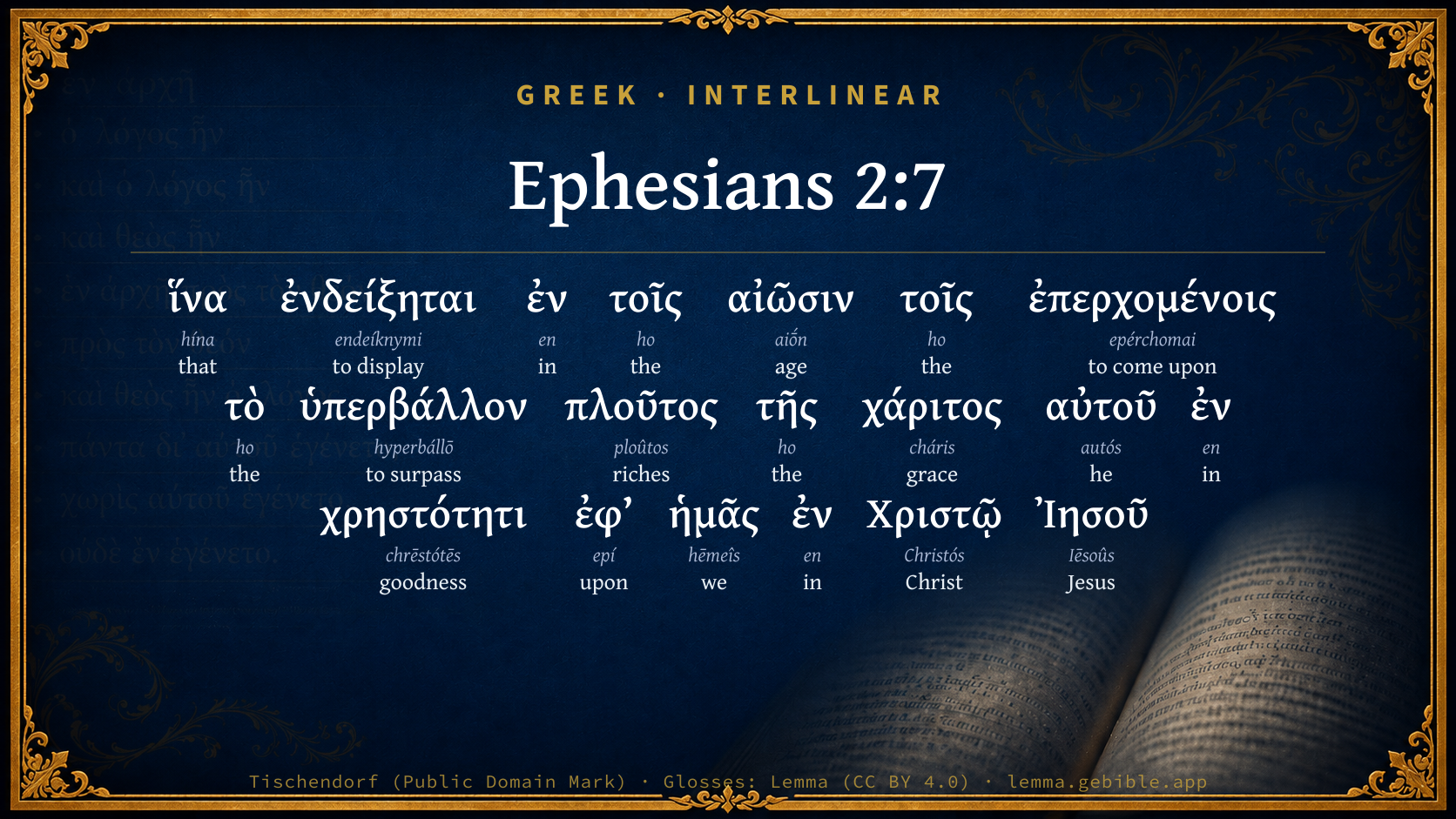
  1. ἵνα hína G2443 “that” Conjunction
  2. ἐνδείξηται endeíknymi G1731 “to display” Verb, Aorist, Middle, Subjunctive, 3rd person, Singular
  3. ἐν en G1722 “in” Preposition
  4. τοῖς ho G3588 “the” Article, Dative, Plural, Masculine
  5. αἰῶσιν aiṓn G165 “age” Noun, Dative, Plural, Masculine
  6. τοῖς ho G3588 “the” Article, Dative, Plural, Masculine
  7. ἐπερχομένοις epérchomai G1904 “to come upon” Verb, Present, Middle or Passive deponent, Participle, Dative, Plural, Masculine
  8. τὸ ho G3588 “the” Article, Accusative, Singular, Neuter
  9. πλοῦτος ploûtos G4149 “riches” Noun, Accusative, Singular, Neuter
  10. τῆς ho G3588 “the” Article, Genitive, Singular, Feminine
  11. χάριτος cháris G5485 “grace” Noun, Genitive, Singular, Feminine
  12. αὐτοῦ autós G846 “he” Personal pronoun, Genitive, Singular, Masculine
  13. ἐν en G1722 “in” Preposition
  14. χρηστότητι chrēstótēs G5544 “goodness” Noun, Dative, Singular, Feminine
  15. ἐφ’ epí G1909 “upon” Preposition
  16. ἡμᾶς hēmeîs G2249 “we” Personal pronoun, 1st person, Accusative, Plural
  17. ἐν en G1722 “in” Preposition
  18. Χριστῷ Christós G5547 “Christ” Noun, Dative, Singular, Masculine
  19. Ἰησοῦ Iēsoûs G2424 “Jesus” Noun, Dative, Singular, Masculine

About this verse

These counts appear in no published source. They are computed here, from the morphology-tagged text and Lemma’s own curated glosses. What Lemma adds →

20
words
15
distinct lemmas
Pauline Epistles
section

Notable vocabulary

The rarest word here is ὑπερβάλλον to surpass G5235 — appearing just 5 times in the whole Greek New Testament.

Shared distinctive vocabulary

ὑπερβάλλον to surpass G5235 occurs in 5 verses of the Greek New Testament. Also found in:

Repetition

Words recur within this verse:

Cross-references

11

Topical passages linked to Ephesians 2:7 in the Treasury of Scripture Knowledge — connected by theme and wording, ordered by reader-vote popularity; previews shown in the World English Bible.

  • 1 Timothy 1:16–17 However, for this cause I obtained mercy, that in me first, Jesus Christ might display all his patience, for an example of those who were going to believe in him for eternal life.
  • Titus 3:4 But when the kindness of God our Savior and his love toward mankind appeared,
  • Ephesians 2:4 But God, being rich in mercy, for his great love with which he loved us,
  • 2 Thessalonians 1:12 that the name of our Lord Jesus may be glorified in you, and you in him, according to the grace of our God and the Lord Jesus Christ.
  • Isaiah 60:15 Whereas you have been forsaken and hated, so that no man passed through you, I will make you an eternal excellency, a joy of many generations.
  • Revelation 5:9–14 They sang a new song, saying, "You are worthy to take the book, And to open its seals: For you were killed, And bought us for God with your blood, Out of every tribe, language, people, and nation,
  • Ephesians 3:5 which in other generations was not made known to the children of men, as it has now been revealed to his holy apostles and prophets in the Spirit;
  • Psalms 106:48 Blessed be Yahweh, the God of Israel, From everlasting even to everlasting! Let all the people say, "Amen." Praise Yah!
  • Psalms 41:13 Blessed be Yahweh, the God of Israel, From everlasting and to everlasting! Amen and amen.
  • Ephesians 3:21 to him be the glory in the assembly and in Christ Jesus to all generations forever and ever. Amen.
  • 1 Peter 1:12 To them it was revealed, that not to themselves, but to you, did they minister these things, which now have been announced to you through those who preached the Gospel to you by the Holy Spirit sent out from heaven; which things angels desire to look into.

Cross-references courtesy of OpenBible.info (CC BY 4.0).

Commentary

Notes on Ephesians 2:7 from classic Christian and Jewish commentators (each source and its license shown beneath its notes). The classic Christian expositions comment on the surrounding passage and are grouped to its opening verse, so a note may address several verses; the Jewish commentaries on the Tanakh (Rashi and others) are per-verse, so they appear only where the commentator wrote on this verse.

Lemma curates 59 commentaries, every one of them public domain or Creative Commons licensed, each selected and text-cleaned for this edition rather than reprinted as found. About our sources →

The Biblical Illustrator

Joseph S. Exell

Eph_2:7

That in the ages to come He might show the exceeding riches of His grace in His kindness toward us through Christ Jesus.

The riches of Gods grace

1. The end of all Gods grace and mercy towards believers in Christ, is for the manifestation of His glory, and praise of His name. This must teach us, that whatever good things God has bestowed upon us, we make God known by it.

2. All the saving graces of God are most worthy the consideration of all Christians in all ages. If we be Gods children, let us show it by bringing forth eternal and immortal fruit to His glory.

3. The special favour of God consists in the giving of Christ. (1Jn_4:9; Rom_5:6).

4. All Gods kindness, and the fruit thereof, must come to us through Christ.

(1) No room for presumption.

(2) No room for despair.

5. All our blessings are treasured up in Christ.

6. In all things Christ hath the preeminence.

7. From hence note the stability of all the blessings given to the faithful. (2Ti_1:12).

(1) This is full of comfort. If one had earthly treasure, we are glad when it is so bestowed that we may be sure of it, and so be free from care. Well, Christ is in heaven, our true treasure, where neither thief, nor moth, nor canker can come; this is our happiness, that He keeps our treasure; it is out of the reach of devils and men; were it in our own hand, we should soon betray it; if we are set in heaven with Christ, Christ may as soon be pulled out of heaven, as we disappointed of our inheritance. (Paul Bayne.)

Salvation by grace

Salvation is a term inclusive of all the benefits enjoyed by a penitent believing sinner through the mediation of Christ.

I. Illustrate it upon leading scriptural principles. The whole scheme of redemption is traced up to its source in the Divine benevolence--God so loved the world, etc. It means a principle of love, proving its reality by gifts; love to sinners, fraught with kindest volitions, costly blessings. This love was self-moved, not necessarily excited by any external cause. There was no excellence to provoke, but sin to prevent its exercise. Hence its freeness is made to appear distinctly--Not that we loved God, but that He loved us. Hence, too, the sovereignty of this love appears. He has placed mankind under a dispensation of forbearance.

II. Illustrate it by a reference to facts and doctrines belonging to Christian experience.

1. The declared depravity of human nature.

2. The doctrine of justification by faith.

3. The blessing of sanctification.

4. The prospects of the Christian eminently involve the grace of his salvation.

Let us observe from these remarks--

1. How completely the gospel meets the wants of sinners, their ignorance, their guilt, their pollution, their destitution. It represents God to be full of compassion, salvation to be an act of unqualified grace, while its proclamation is made to all, not excepting the most guilty.

2. How awful to abuse this grace.

3. How dreadful the character and prospects of unbelieving, ungodly men! They not only break the law of God, but despise the grace of His gospel. (Essex Congregational Remembrancer.)

Blessings in the ages to come

Two interpretations are given of this verse.

I. By ages to come, some understand the times that were to succeed the apostle to the end of, the world. And then the sense of the verse is--That God poured out the exceeding riches of His grace upon the apostles and churches of old to be encouraging examples to the end of the world. Which they are--

1. As to the characters of those whom He has saved. They were sinners. They were the chief of them. This is a faithful saying, and worthy of all acceptation, etc. (1Ti_1:15-16). They were all sorts. And such were some of you, etc. (1Co_6:11). Who will have all men to be saved, etc. (1Ti_2:4). For the Scripture saith, Whosoever believeth on Him shall not be ashamed, etc. (Rom_10:11, etc.).

2. As to the blessings given to them. They were sought out. Quickened, justified, adopted, sanctified, preserved, glorified.

3. As to the grace given them, suited to their trials. To Abraham, faith. Job, patience. To Daniel, integrity. Paul, zeal.

II. By ages to come, some understand future glory (Heb_6:5). Then the sense is--That God bestows various and inestimable blessings upon His people here, that they may see them more perfectly in glory (1Co_13:9-12). (H. Foster, M. A.)

Gods kindness to man

I. Describe Gods kindness to man in Christ.

1. In the assumption of our nature (Heb_2:16).

2. In His obedience and sufferings for us (1Pe_3:18).

3. In the resurrection of that nature (Rom_6:9),

4. In taking it up into glory (Psa_68:18).

5. In His intercession for us (Heb_7:25).

6. In finally bringing us to glory (Joh_17:24).

It is also further manifest that Gods kindness is experienced by the Christian in--

1. The personal remission of his sins (Eph_1:7).

2. In the donation of the Holy Ghost (Rom_8:16).

3. Uniting us to His person (Joh_17:21).

4. Bringing us into covenant relation with Himself (Gen_17:7).

5. Justification of our persons (Psa_32:1).

6. In the renewal of our nature (1Pe_1:3).

7. In adopting us into His family (1Jn_3:1).

8. In giving us victory over death (1Co_15:57).

9. In our final glorification (Psa_73:24).

II. The objects of this grace or kindness. As creatures.

1. Frail creatures (Isa_40:6).

2. As worthless worms (Job_25:6).

3. As less than nothing (Isa_40:17).

As fallen creatures.

1. As impotent creatures (Rom_5:6).

2. Impoverished creatures (Rev_3:17).

3. As enemies to God (Col_1:21).

4. As dead to all good (Eph_2:1).

5. As being Satans children (Joh_8:44).

III. How Gods kindness is shown in Christ Jesus.

1. It is in Christ meritoriously (Eph_1:3).

2. Gods kindness to us flows through His kindness to Christ (Eph_1:6).

3. Given to us through Christ (Rom_6:23).

4. Dispensed by Christ (Act_5:31).

5. As Christ includes all Gods kindnesses (Col_3:11).

IV. The reason for showing these riches.

1. Because Gods nature is love (1Jn_4:8).

2. To exalt man, His chief creature (Tit_3:4).

3. And for His own glory (Psa_106:8).

Inferences:

1. There is no cause of boasting in ourselves (Rom_3:27).

2. Meditate frequently on God s kindness and grace (Isa_63:7).

3. Prize that gospel that reveals this great kindness (Rom_1:16).

4. Pray truly to believe it (Mar_16:16). (T. B. Baker.)

The exceeding riches of grace

There is a story of Mithridates, a celebrated king in Asia, which illustrates this part of our subject very well. This king became interested in an old musician who had taken part in the music performed at a feast in the royal palace. On awaking one morning, this old man saw the tables in his house covered with vessels of silver and gold; a number of servants were standing by, who offered him rich garments to put on, and told him there was a horse standing at the door for his use, whenever he might wish to ride. The old man thought it was only a dream he was having. But the servants said it was no dream at all. It was a reality. What is the meaning of it? asked the astonished old man. It means this, said the servant, the king has determined to make you a rich man at once. And these things that you see are only a small part of what he has given you. So please use them as your own. At last he believed what they told him. Then he put on the purple robe, and mounted the horse; and as he rode along, he kept saying to himself, All these are mine! All these are mine! (D. L. Moody.)

Unappropriated riches

Men fail because they try to do too large a business on too small a capital. So with Christians; but God has grace enough and capital enough. What would you think of a man who had one million dollars in the bank, and only drew out a penny a day? That is like you and me; and the sinner is even blinder than we are. The throne of grace is established, and there we are to obtain all the grace we need. Sin is not so strong as the arm of God. He will help and deliver you, if you will come and procure the grace you need. (D. L. Moody.)

Good things to come

Rowland Hill tells a story of a rich max and a poor man of his congregation. The rich man came to Mr. Hill with a sum of money which he wished to give to the poor man, and asked Mr. Hill to give it to him as he thought best, either all at once or in small amounts. Mr. Hill sent the poor man a five pound note with the endorsement--More to follow. Every few months came the remittance, with the same message--More to follow. Now that is grace. More to follow--yes, thank God, there is more to follow. Oh, wondrous grace! (D. L. Moody.)

The ages to come

There is something very impressive and admirable in that long look ahead which distinguished the worthies of old. None ever lived so sympathetically in the present as they did. None ever lived so far away from the present, and so far ahead of it, as they did. They fed their Souls upon the visions of ages to come.

1. We need just such a forelooking. The condition of the human race as it now exists is not a theme for pleasurable meditation. To those who believe in the moral government of God and in the active administration of affairs in this world and in nature by the Divine mind, the actual condition of the race seems inexplicable.

2. The condition of the Church itself leads one to rebound from the present, and to seek comfort in looking into the ages to come.

3. Our knowledge of God in the present state of things, with all that has been done to winnow the wheat from the chaff, is exceedingly incomplete and unsatisfying.

4. The ages to come, will reveal a personal experience in us of which now we have but the very faintest trace in analogy. (H. W. Beecher.)

The believers future

We are quite certain that what we are cannot be the end of Gods design. When I see a block of marble half chiselled with just perhaps a hand peeping out from the rock, no man can make me believe that that is what the artist means it should be. And I know I am not what God would have me to be, because I feel yearnings and longings within myself to be infinitely better, infinitely holier and purer, than I am now. And so it is with you; you are not what God means you to be; you have only just begun to be what He wants you to be. He will go on with His chisel of affliction, using wisdom and the graving tool together, till by and by it shall appear what you shall be for; you shall be like Him, and you shall see Him as He is. Oh! what comfort this is for our faith, that from the fact of our vitality and the tact that God is at work with us, it is clear, and true and certain, that our latter end shall be increased. I do not think that any man yet has ever got an idea of what a man is to be. We are only the chalk crayon, rough drawings of men; yet when we come to be filled up in eternity, we shall be marvellous pictures, and our latter end indeed shall be greatly increased. (C. H. Spurgeon.)

Unexpected developments

We cannot at present form a conception of perfection in the elements which constitute character. You never can tell what the ripe is from looking at the green. If an unknown seed be brought to you, and you plant it in the ground, and it sprout, and grow for five years, only throwing out leaves, and for five years more, still only throwing out leaves, can you tell how its blossoms are going to look? You never saw them. The tree is a new one. You have seen the root, the leaves, and the bark, and you have cut into the wood; you know its habits for the first ten years; you know when its leaves appear in the spring, and when they fall off in the autumn; you know everything about it as far as it has gone during those ten years; but you cannot guess whether its blossoms are white or yellow. You cannot tell whether they will hang in racemes, or rise up in circles. You cannot tell whether they will stand out in spikes, or be pendant. You cannot tell whether they will be early or late. You cannot, if the shrub or tree be unknown, find out the prophecy of the blossoms. But at last the blossom comes out. Now tell me what that blossom is going to produce. Look at it. Is it going to put forth a pod, or is it going to be a fruit? Is it going to be a seed, or luscious food? You cannot tell from a blossom what the fruit is going to be, except by analogues; and I am now supposing a new plant of which there has been no congener within your knowledge, and that you are attempting, from a lower state, to conceive of the higher. Now, in regard to human beings, there is nothing in the unripe state of the mind which is a fair interpretation of what ripeness in it is going to be. You could never have told, except by seeing it, what the human reason was competent to do. Consider the force of reason, by which the whole physical universe is being now unbarred; by which the most distant orbs are being searched, weighed, analyzed; by which we are unwrapping the sun, and taking off coat after coat; by which we know more about the sun itself than oftentimes men do of the province in which they live on earth. What an education! What an outstretch of thought! What development of the reasoning, searching power of the mind! Who Could have suspected it in the days of barbarism? No man could then have told that. And who now can fortell what new development the human reason is capable of? As from the lower stages you could not suspect the higher, so from the present stages you cannot anticipate those which are yet to come. Now we think; but in the higher forms of thinking there is the intuition, the jump, as it were, the flash of thought, with which our present thinking is not to be compared. We call it intuition, we call it inspiration, we call it names; but names are not things. There is evidently the hint of a wondrous disclosure of power in the direction of reason in the ages to come. We do not see it here. We cannot know it. We can only know what is the perpetual suggestion of it. Says the apostle St. John: We are the sons of God; but it doth not yet appear what we shall be. (H. W. Beecher.)

How grace operates

The kindness of God in Christ Jesus is a phrase expressive of the manner in which grace operates. His grace is in His kindness. Grace may be shown among men in a very ungracious way, but Gods grace clothes itself in kindness, as well in the time as in the mode of its bestowment. What kindness in sending His grace so early to Ephesus, and in converting such men as now formed its Church! Oh! He is so kind in giving grace, and such grace, to so many men, and of such spiritual demerit and degradation; so kind as not only to forgive sin, but even to forget it (Heb_8:12); so kind, in short, us not only by His grace to quicken us, but in the riches of His grace to raise us up, and in its exceeding riches to enthrone us in the heavenly places in Christ! And all the grace in this kindness shown in the first century is a lesson even to the nineteenth century. What God did then, He can do now and will do now; and one reason why He did it then was to teach the men of the present age His ability and desire to repeat in them the same blessed process of salvation and life. (J. Eadie, D. D.)

Restraining grace

During the ministry of the Rev. Ralph Erskine at Dunfermline a man was executed for robbery, whom he repeatedly visited in prison, and whom he attended on the scaffold. Mr. Erskine addressed both the spectators and the criminal, and after concluding his speech he laid his hands on his breast, uttering these words--But for restraining grace I had been brought, by this corrupt heart, to the same condition with this unhappy man.

The Biblical Illustrator, edited by Joseph S. Exell (c. 1880s–1900s) — public domain. Text from a community e-Sword module.

Joseph Benson's Commentary

Eph 2:7-9. That in the ages to come — As if he had said, His great design in doing all this for us is, that in all succeeding ages, under the dispensation of the gospel, he might show — Might demonstrate and display, (as the word ενδειξηται implies,) for the instruction and encouragement of others; the exceeding riches of his grace — Manifested both to Jews and Gentiles; in his kindness — His benignity and bounty; toward us — In pardoning, adopting, regenerating, and finally saving us; through Christ Jesus — For we have received the whole blessing by him, and are partakers of it as connected with him, whom God hath appointed our head and Saviour, and taught us to regard as our great representative. For (to repeat the important truth before asserted) by grace are ye saved through faith — Grace, as signifying the free mercy, or unmerited goodness of God, without any respect to human worthiness, confers the glorious gift of salvation; and grace, in the other sense of the expression, namely, the influence of the Spirit, prepares us for the reception of the blessed gift, and conveys it to us; and faith in the Lord Jesus as our Redeemer and Saviour, our Governor and Judge, and in the truths and promises of his holy gospel, with an empty hand, and without any pretence to personal desert; faith, productive of unfeigned love and obedience, receives the heavenly blessing. And that not of yourselves — This refers to the whole preceding clause, and means, 1st, Your salvation is not of yourselves, is not of your own power, nor of your own merit; strictly speaking, you can neither save yourselves, nor deserve that God should save you; your salvation, in all its branches, present and eternal, is from God, to whom alone it belongs to enlighten, justify, sanctify, and glorify you, and it is from him as a free, undeserved gift. Just Song of Solomon , 2 d, Your faith, whereby you receive salvation, is not of yourselves, not of your own power, nor of your own merit; you can neither believe of yourselves, without supernatural light from the word and Spirit of truth, wisdom, and revelation; and divine grace inclining and enabling you to apply to and rely on Christ for salvation, and on the truths and promises of God through him; nor can you, by works done while you are yourselves in unbelief and unrenewed, deserve that God should give you faith. But your faith, as well as your salvation, is the gift of God; is of his operation, Col 2:12; from his light shining into your hearts, 2Co 4:6; and is from him as a free gift, asked indeed of him, and obtained from him, in and by prayer, but utterly unmerited on your part. “God, by the gracious influence of his Spirit, fixes our attention to the great objects of faith, subdues our prejudices against it, awakens holy affections in our souls, and, on the whole, enables us to believe, and to persevere in believing, till we receive the great end of our faith in the complete salvation of our souls.” — Doddridge. Not of works — Neither this faith, nor this salvation, is merited by, or is owing to, any works you ever performed, will or can perform, whether in obedience to the law of Moses, ceremonial or moral, or any other law whatever; much less is it merited by, or owing to, any works done previous to your conversion. Lest any man should boast — As if he had, by his own works of righteousness, procured salvation, and so should ascribe the glory of it to himself, rather than to God.

Joseph Benson's Commentary on the Old and New Testaments (1811–1818) — public domain. Text from a community e-Sword module.

MacLaren's Expositions of Holy Scripture

Alexander MacLaren

EPHESIANS

‘THE RICHES OF GRACE’

Eph 2:7

One very striking characteristic of this epistle is its frequent reference to God’s purposes, and what, for want of a better word, we must call His motives, in giving us Jesus Christ. The Apostle seems to rise even higher than his ordinary height, while he gazes up to the inaccessible light, and with calm certainty proclaims not only what God has done, but why He has done it. Through all the earlier portions of this letter, the things on earth are contemplated in the light of the things in heaven. The great work of redemption is illuminated by the thought of the will and meaning of God therein; for example, we read in Chapter i. that He ‘hath blessed us with all spiritual blessings in Christ, according as He hath chosen us in Him,’ and immediately after we read that He ‘has predestinated us unto the adoption of children by Jesus Christ according to the good pleasure of His will.’ Soon after, we hear that ‘He hath revealed to us the mystery of His will, according to His good pleasure which He purposed in Himself’; and that our predestination to an inheritance in Christ is ‘according to the purpose of Him who worketh all things after the counsel of His own will.’

Not only so, but the motive or reason for the divine action in the gift of Christ is brought out in a rich variety of expression as being ‘the praise of the glory of His grace’ {1-6}, or ‘that He might gather together in one all things in Christ’ {1-10}, or that ‘we should be to the praise of His glory’ {1-12}, or that ‘unto the principalities and powers in heavenly places might be known by the Church the manifold wisdom of God.’

In like manner our text follows a sublime statement of what has been bestowed upon men in Jesus, with an equally sublime insight into the divine purpose of thereby showing ‘the exceeding riches of His grace.’ Such heights are not for our unaided traversing; it is neither reverent nor safe to speculate, and still less to dogmatise, concerning the meaning of the divine acts, but here, at all events, we have, as I believe, not a man making unwarranted assertions about God’s purposes, but God Himself by a man, letting us see so far into the depths of Deity as to know the very deepest meaning of His very greatest acts, and when God speaks, it is neither reverent nor safe to refuse to listen.

I. The purpose of God in Christ is the display of His grace.

Of course we cannot speak of motives in the divine mind as in ours; they imply a previous state of indecision and an act of choice, from which comes the slow emerging of a resolve like that of the moon from the sea. A given end being considered by us desirable, we then cast about for means to secure it, which again implies limitation of power. Still we can speak of God’s motives, if only we understand, as this epistle puts it so profoundly, that His ‘is an eternal purpose which He purposed in Himself,’ which never began to be formed, and was not formed by reason of anything external.

With that caution Paul would have us think that God’s chiefest purpose in all the wondrous facts which make up the Gospel is the setting forth of Himself, and that the chiefest part of Himself, which He desires that all men should come to know, is the glory of His grace. Of course very many and various reasons for these acts may be alleged, but this is the deepest of them all. It has often been misunderstood and made into a very hard and horrible doctrine, which really means little else than all-mighty selfishness, but it is really a most blessed one; it is the proclamation in tenderest, most heart-melting fashion of the truth that God is Love, and therefore delights in imparting that which is His creatures’ life and blessedness; it bids us think that He, too, amidst the blessedness of His infinite Being, knows the joy of communicating which makes so large a part of the blessedness of our finite selves, and that He, too, is capable of being touched and gladdened by the joy of expression. As an artist in his noblest work paints or chisels simply for love of pouring out his soul, so, but in infinitely loftier fashion, the great Artist delights to manifest Himself, and in manifesting to communicate somewhat of Himself. Creation is divine self-revelation, and we might say, with all reverence, that God acts as birds sing, and fountains leap, and stars shine.

But our text leads us still farther into mysteries of glory, when it defines what it is in God that he most desires to set forth. It is the ‘exceeding riches of Grace,’ in which wonderful expression we note the Apostle’s passionate accumulation of epithets which he yet feels to be altogether inadequate to his theme. It would carry us too far to attempt to bring out the whole wealth contained in these words which glide so easily over unthinking lips, but we may lovingly dwell for a few moments upon them. Grace, in Paul’s language, means love lavished upon the undeserving and sinful, a love which is not drawn forth by the perception of any excellence in its objects, but wells up and out like a fountain, by reason of the impulse in its subject, and which in itself contains and bestows all good and blessing. There may be, as this very letter shows, other aspects of the divine nature which God is glad that man should know. His power and His wisdom have their noblest illustration in the work of Jesus, and are less conspicuously manifested in all His work; but His grace is shrined in Christ alone, and from Him flows forth into a thirsty world. That love, ‘unmerited and free,’ holds in solution power, wisdom and all the other physical or metaphysical perfections belonging to God with all their energies. It is the elixir in which they are all contained, the molten splendour into which have been dissolved gold and jewels and all precious things. When we look at Christ, we see the divinest thing in God, and that is His grace. The Christ who shows us and certifies to us the grace of God must surely be more than man. Men look at Him and see it; He shows us that grace because He was full of grace and truth.

But Paul is here not propounding theological dogmas, but pouring out a heart full of personal experience, and so adds yet other words to express what he himself has found in the Divine Grace, and speaks of its riches. He has learned fully to trust its fulness, and in his own daily life has had the witness of its inexhaustible abundance, which remains the same after all its gifts. It ‘operates unspent.’ That continually self-communicating love pours out in no narrower stream to its last recipient than to its first. All ‘eat and are filled,’ and after they are satisfied, twelve baskets full of fragments are taken up. These riches are exceeding; they surpass all human conception, all parallel, all human needs; they are properly transcendent.

This, then, is what God would have us know of Himself. So His love is at once the motive of His great message to us in Jesus Christ, and is the whole contents of the message, like some fountain, the force of whose pellucid waters cleanses the earth, and rushes into the sunshine, being at once the reason for the flow and that which flows. God reveals because He loves, and His love is that which He reveals.

II. The great manifestation of grace is God’s kindness to us in Christ.

All the revelation of God in Creation and Providence carries the same message, but it is often there hard to decipher, like some half-obliterated inscription in a strange tongue. In Jesus the writing is legible, continuous, and needs no elaborate commentary to make its meaning intelligible. But we may note that what the Apostle founds on here is not so much Christ in Himself, as that which men receive in Christ. As he puts it in another part of this epistle, it is ‘through the Church’ that ‘principalities and powers in heavenly places’ are made to ‘know the manifold wisdom of God.’ It is ‘His kindness towards us’ by which ‘to the ages to come,’ is made known the exceeding riches of grace, and that kindness can be best estimated by thinking what we were, namely, dead in trespasses and sins; what we are, namely, quickened together in Christ; raised up with Him, and with Him made to sit in heavenly places, as the immediately preceding clauses express it. All this marvellous transformation of conditions and of self is realised ‘in Christ Jesus.’ These three words recur over and over again in this profound epistle, and may be taken as its very keynote. It would carry us beyond all limits to deal with the various uses and profound meanings of this phrase in this letter, but we may at least point out how intimately and inseparably it is intertwined with the other aspect of our relations to Christ in which He is mainly regarded as dying for us, and may press upon you that these two are not, as they have sometimes been taken to be, antagonistic but complementary. We shall never understand the depths of the one Apostolic conception unless we bring it into closest connection with the other. Christ is for us only if we are in Christ; we are in Christ only because He died for us.

God’s kindness is all ‘in Christ Jesus’; in Him is the great channel through which His love comes to men, the river of God which is full of water. And that kindness is realised by us when we are ‘in Christ.’ Separated from Him we do not possess it; joined to Him as we may be by true faith in Him, it is ours, and with it all the blessings which it brings into our else empty and thirsting hearts. Now all this sets in strong light the dignity and work of Christian men; the profundity and clearness of their religious character is the great sign to the world of the love of God. The message of Christ to man lacks one chief evidence of its worth if they who profess to have received it do not, in their lives, show its value. The characters of Christian people are in every age the clearest and most effectual witnesses of the power of the Gospel. God’s honour is in their hands. The starry heavens are best seen by reflecting telescopes, which, in their field, mirror the brightness above.

III. The manifestation of God through men ‘in Christ’ is for all ages.

In our text the ages to come open up into a vista of undefined duration, and, just as in another place in this epistle, Paul regards the Church as witnessing to the principalities and powers in heavenly places, so here he regards it as the perennial evidence to all generations of the ever-flowing riches of God’s grace. Whatever may have been the Apostle’s earlier expectations of the speedy coming of the day of the Lord, here he obviously expects the world to last through a long stretch of undefined time, and for all its changing epochs to have an unchanging light. That standing witness, borne by men in Christ, of the grace which has been so kind to them, is not to be antiquated nor superseded, but is as valid to-day as when these words gushed from the heart of Paul. Eyes which cannot look upon the sun can see it as a golden glory, tinging the clouds which lie cradled around it. And as long as the world lasts, so long will Christian men be God’s witnesses to it.

There are then two questions of infinite importance to us-do we show in character and conduct the grace which we have received by reverently submitting ourselves to its transforming energy? We need to be very close to Him for ourselves if we would worthily witness to others of what we have found Him to be. We have but too sadly marred our witness, and have been like dim reflectors round a lamp which have received but little light from it, and have communicated even less than we have received. Do we see the grace that shines so brightly in Jesus Christ? God longs that we should so see; He calls us by all endearments and by loving threats to look to that Incarnation of Himself. And when we lift our eyes to behold, what is it that meets our gaze? Intolerable light? The blaze of the white throne? Power that crushes our puny might? No! the ‘exceeding riches of grace.’ The voice cries, ‘Behold your God!’ and what we see is, ‘In the midst of the throne a lamb as it had been slain.’

Alexander MacLaren, Expositions of Holy Scripture (1904–1910) — public domain. Text from a community e-Sword module.

The Expositor's Bible

Chapter 8

SAVED FOR AN END

Eph_2:7-10

The plan which God has formed for men in Christ is of great dimensions every way, -in its length no less than in its breadth and height. He "raised us up and seated us together (Gentiles with Jews) in the heavenly places in Christ Jesus, that in the ages which are coming on He might show the surpassing riches of His grace." All the races of mankind and all future ages are embraced in the redeeming purpose and are to share in its boundless wealth. Nor are the ages past excluded from its operations. God "afore prepared the good works in which He summons us to walk." The highway of the new life has been in building since time began.

Thus large and limitless is the range of "the purpose and grace given us in Christ Jesus before times eternal". {2Ti_1:9} But what strikes us most in this passage is the exuberance of the grace itself. Twice over the apostle exclaims, "By grace you are saved": once in Eph_2:5, in an eager, almost jealous parenthesis, where he hastens to assure the readers of their deliverance from the fearful condition just described (Eph_2:1-3, Eph_2:5). Again, deliberately and with full definition he states the same fact, in Eph 2:8: "For by grace you are saved, through faith; and this is not of yourselves, it is the gift of God. It does not come of works, to the end that none may boast."

These words place us on familiar ground. We recognise the Paul of Galatians and Romans, the dialect and accent of the apostle of salvation by faith. But scarcely anywhere do we find this wonder-working grace so affluently described. "God being rich in mercy, for the great love wherewith He loved us-the exceeding riches of His grace, shown in kindness toward us-the gift of God." "Mercy, love, kindness, grace, gift": what a constellation is here! These terms present the character of God in the gospel under the most delightful aspects, and in vivid contrast to the picture of our human state outlined in the beginning of the chapter.

"Mercy" denotes the Divine pitifulness towards feeble, suffering men, akin to those "compassions of God" to which the apostle repeatedly appeals. It is a constant attribute of God in the Old Testament, and fills much the same place there that grace does in the New. "Of mercy and judgment" do the Psalmists sing-of mercy most. Out of the thunder and smoke of Sinai He declared His name: "Jehovah, a God full of compassion and gracious, slow to anger, and plenteous in mercy and truth, keeping mercy for thousands." The dread of Gods justice, the sense of His dazzling holiness and almightiness threw His mercy into bright relief and gave to it an infinite preciousness. It is the contrast which brings in "mercy" here, in verse 4, by antithesis to "wrath" (Eph_2:3). These qualities are complementary. The sternest and strongest natures are the most compassionate. God is "rich in mercy." The wealth of His Being pours itself out in the exquisite tendernesses, the unwearied forbearance and forgiveness of His compassion towards men. The Judge of all the earth, whose hate of evil is the fire of hell, is gentler than the softesthearted mother, -rich in mercy as He is grand and terrible in wrath.

Gods mercy regards us as we are weak and miserable: His love regards us as we are, in spite of trespass and offence, His offspring, -objects of "much love" amid much displeasure, "even when we were dead through our trespasses." What does the story of the prodigal son mean but this? and what Christs great word to Nicodemus?-Grace {Joh_3:16} and kindness are loves executive. Grace is love in administration, love counteracting sin and seeking our salvation. Christ is the embodiment of grace; the cross its supreme expression; the gospel its message to mankind; and Paul himself its trophy and witness. The "overpassing riches" of grace is that affluence of wealth in which through Christ it "superabounded" to the apostolic age and has outdone the magnitude of sin, {Rom_5:20} in such measure that St. Paul sees future ages gazing with wonder at its benefactions to himself and his fellow-believers. Shown "in kindness toward us," he says, -in a condescending fatherliness, that forgets its anger and softens its old severity into comfort and endearment. Gods kindness is the touch of His hand, the accent of His voice, the cherishing breath of His Spirit. Finally, this generosity of the Divine grace, this infinite goodwill of God toward men, takes expression in the gift-the gift of Christ, the gift of righteousness, {Rom_5:15-18} the gift of eternal; {Rom_6:23} or-regarded, as it is here, in the light of experience and possession-the gift of salvation.

The opposition of "gift" and "debt," of gratuitous salvation through faith to salvation earned by works of law, belongs to the marrow of St. Pauls divinity. The teaching of the great evangelical epistles is condensed into the brief words of Eph_2:8-9. The reason here assigned for Gods dealing with men by way of gift and making them absolutely debtors-"lest any one should boast"-was forced upon the apostles mind by the stubborn pride of legalism; it is stated in terms identical with those of the earlier letters. Men will glory in their virtues before God; they flaunt the rags of their own righteousness, if any such pretext, even the slightest, remains to them. We sinners are a proud race, and our pride is oftentimes the worst of our sins. Therefore God humbles us by His compassion. He makes to us a free gift of. His righteousness, and excludes every contribution from our store of merit; for if we could supply anything, we should inevitably boast as though all were our own. We must be content to receive mercy, love, grace, kindness- everything, with out deserving the least fraction of the immense sum. How it strips our vanity; how it crushes us to the dust-"the weight of pardoning love!"

Concerning the office of faith in salvation we have already spoken in chapter 4. It is on the objective fact rather than the subjective means of salvation that the apostle lays stress in this passage. His readers do not seem to have realised sufficiently what God has given them and the greatness of the salvation already accomplished. They measured inadequately the power which had touched and changed their lives. {Eph_1:19} St. Paul has shown them the depth to which they were formerly sunk, and the height to which they have been raised (Eph_2:16). He can therefore assure them, and he does it with redoubled emphasis: "You are saved; By grace you are saved men!" Not "You will be saved"; nor, "You were saved"; nor, "You are in course of salvation,"- for salvation has many moods and tenses, -but, in the perfect passive tense, he asserts the glorious accomplished fact. With the same reassuring emphasis in Eph_1:7 he declared, "We have redemption in His blood, the forgiveness of our trespasses."

Here is St. Pauls doctrine, of Assurance. It was laid down by Christ Himself when He said: "He that believeth on the Son of God hath eternal life." This sublime confidence is the ruling note of St. Johns great epistle: "We know that we are in Him We know that we have passed out of death into life This is the victory that overcometh the world, even our faith." It was this confidence of present salvation that made the Church irresistible. With its foundation secure, the house of life can be steadily and calmly built up. Under the shelter of the full assurance of faith, in the sunshine of Gods love felt in the heart, all spiritual virtues bloom and flourish. But with a faith hesitant, distracted, that is sure of no doctrine in the creed and cannot plant a firm foot anywhere, nothing prospers in the soul or in the Church. Oh, for the clear accent, the ringing, joyous note of apostolic assurance! We want a faith not loud, but deep; a faith not born of sentiment and human sympathy, but that comes from the vision of the living God; a faith whose rock and corner-stone is neither the Church nor the Bible, but Christ Jesus Himself.

Greatly do we need, like the Asian disciples of Paul and John, to "assure our hearts" before God. With death confronting us, with the hideous evil of the world oppressing us; when the air is laden with the contagion of sin; when the faith of the strongest wears the cast of doubt; when the word of promise shines dimly through the haze of an all-encompassing scepticism and a hundred voices say, in mockery or grief, Where is now thy God? when the world proclaims us lost, our faith refuted, our gospel obsolete and useless, -then is the time for the Christian assurance to recover its first energy and to rise again in radiant strength from the heart of the Church, from the depths of its mystic life where it is hid with Christ in God.

"You are saved!" cries the apostle; not forgetting that his readers have their battle to fight, and many hazards yet to run. {Eph_6:10-13} But they hold the earnest of victory, the foretaste of life eternal. In spirit they sit with Christ in the heavenly places. Pain and death, temptation, persecution, the vicissitudes of earthly history, by these God means to perfect that Which He has begun in His saints-"if you continue in the faith, grounded and firm". {Col_1:23} That condition is expressed, or implied, in all assurance of final salvation. It is a condition which excites to watchfulness, but can never cause misgiving to a loyal heart. God is for us! He justifies us, and counts us His elect. Christ Jesus who died is risen and seated at the right hand of God, and there intercedes for us. Quis separabit?

This is the epistle of the Church and of humanity. It dwells on the grand, objective aspects of the truth, rather than upon its subjective experiences. It does not invite us to rest in the comforts and delights of grace, but to lift up our eyes and see whither Christ has translated us and what is the kingdom that we possess in Him. God "quickened us together with the Christ": He "raised us up, He made us to sit in the heavenly places in Christ Jesus." Henceforth "our citizenship is in heaven". {Php_3:20}

This is the inspiring thought of the third group of St. Paul s epistles; we heard it in the first note of his song of praise. {Eph_1:3} It supplies the principle from which St. Paul unfolds the beautiful conception of the Christian life contained in the third chapter of the companion letter to the Colossians: "Your life is hid with the Christ in God"; therefore "seek the things that are above, where He is." We live in two worlds at once. Heaven lies about us in this new mystic childhood of our spirit. There our names are written; thither our thoughts and hopes resort. Our treasure is there; our heart we have lodged there, with Christ in God. He is there, the lord of the Spirit, from whom we draw each moment the life that flows into His members. In the greatness of His love conquering sin and death, time and space, He is with us to the worlds end. May we not say that we, too, are with Him and shall be with Him always? So we reckon in the logic of our faith and at the height of our high calling, though the soul creeps and drudges upon the lower levels.

With Him we are gone up on high,

Since He is ours and we are His;

With Him we reign above the sky,

We walk upon our subject seas!

In his lofty flights of thought the apostle always has some practical and homely end in view. The earthly and heavenly, the mystical and the matter-of-fact were not distant and repugnant, but interfused in his mind. From the celestial heights of the life hidden with Christ in God (Eph_2:6), he brings us down in a moment and without any sense of discrepancy to the prosaic level of "good works" (Eph_2:10). The love which viewed us from eternity, the counsels of Him who works all things in all, enter into the humblest daily duties.

Grace, moreover, sets us great tasks. There should be something to show in deed and life for the wealth of kindness spent upon us, some visible and commensurate result of the vast preparations of the gospel plan. Of this result the apostle saw the earnest in the work of faith wrought by his Gentile Churches.

St. Paul was the last man in the world to undervalue human effort, or disparage good work of any sort. It is, in his view, the end aimed at in all that God bestows on His people, in all that He Himself works in them. Only let this end be sought in Gods way and order. Mans doings must be the fruit and not the root of his salvation. "Not of works," but "for good works" were believers chosen. "This little word for, " says Monod, "reconciles St. Paul and St. James better than all the commentators." God has not raised us up to sit idly in the heavenly places lost in contemplation, or to be the useless pensioners of grace. He sends us forth to "walk in the works, prepared for us,"-equipped to fight Christs battles, to fill His fields, to labour in the service of building His Church.

The "workmanship" of our Version suggests an idea foreign to the passage. The apostle is not thinking of the Divine art or skill displayed in mans creation; but of the simple fact that "God made man". {Gen_1:27} "We are His making, created in Christ Jesus." The "preparation" to which he refers in verse to leads us back to that primeval election of Gods sons in Christ for which we gave thanks at the outset. {Eph_1:3} There are not two creations, the second formed upon the ruin and failure of the first; but one grand design throughout. Redemption is creation reaffirmed. The new creation, as we call it, restores and consummates the old. When God raised His Son from the dead, He vindicated His original purpose in raising man from the dust a living soul. He has not forsaken the work of His hands nor forgone His original plan, which took account of all our wilfulness and sin. God in making us meant us to do good work in His world. From the worlds foundation down to the present moment He who worketh all in all has been working for this end -most of all in the revelation of His grace in Jesus Christ.

Far backward in the past, amid the secrets of creation, lay the beginnings of Gods grace to mankind. Far onward in the future shines its lustre revealed in the first Christian age. The apostle has gained some insight into those "times and seasons" which formerly were veiled from him. In his earliest letters, to the Thessalonians and Corinthians, St. Paul echoes our Lords warning, never out of season, that we should "watch, for the hour is at hand." Maranatha is his watchword: "Our Lord cometh; the time is short." Nor does that note cease to the end. But when in this epistle he writes of "the ages that are coming on," and of all the generations of the age of the Eph_3:21, there is manifestly some considerable period of duration before his eyes. He sees something of the extent of the worlds coming history, something of the magnitude of the field that the future will afford for the unfolding of Gods designs.

In those approaching aeons he foresees that the apostolic dispensation will play a conspicuous part. Unborn ages will be blessed in the blessing now descending upon Jews and Gentiles through Christ Jesus. So marvellous is the display of Gods kindness toward them, that all the future will pay homage to it. The overflowing wealth of blessing poured upon St. Paul and the first Churches had an end in view that reached beyond themselves, an end worthy of the Giver, worthy of the magnitude of His plans and of His measureless love. If all this was theirs-this fulness of God exceeding the utmost they had asked or thought-it is because God means to convey it through them to multitudes besides! There is no limit to the grace that God will impart to men and to Churches who thus reason, who receive His gifts in this generous and communicative spirit. The apostolic Church chants with Mary at the Annunciation: "For, behold, from henceforth all generations shall call me blessed!"

Never was any prediction better fulfilled. This spot of history shines with a light before which every other shows pale and commonplace. The companions of Jesus, the humble fraternities of the first Christian century, have been the object of reverent interest and intent research on the part of all centuries since. Their history is scrutinised from all sides with a zeal and industry which the most pressing subjects of the day hardly command. For we feel that these men hold the secret of the worlds life. The key to the treasures we all long for is in their hands. As time goes on and the stress of life deepens, men will turn with yet fonder hope to the age of Jesus Christ. "And many nations will say: Come, and let us go up to the mountain of the Lord, to the house of the God of Jacob. And He will teach us of His ways; and we will walks in His paths."

The stream will remember its fountain; the children of God will gather to their childhoods home. The world will hear the gospel in the recovered accents of its prophets and apostles.

William Robertson Nicoll, ed., The Expositor's Bible (London: Hodder & Stoughton, 1887–1910) — public domain. 65 of 66 books (1 Corinthians is not separately keyed, as that volume carries no machine-parseable verse references); section-level commentary keyed to the opening verse. Introductory and overview sections not keyed to a specific passage are excluded.

Tyndale Open Study Notes

Tyndale Open Resources

2:7 grace: See study note on 1:2.

Tyndale Open Study Notes — © Tyndale Open Resources, licensed CC BY-SA 4.0. Text via the HelloAO Bible API.

Bengel's Gnomon

Johann Albrecht Bengel

Eph 2:7. Ἐν τοῖς αἰῶσι τοῖς ἐπερχομένοις, in the ages to come) The plural, in opposition to the one bad age [τὸν αἰῶνα τούτου κόσμου], Eph 2:2, which blessed ages effectually succeed [upon which the blessed ages come unexpectedly with power]. This expression is in accordance with Paul’s idea regarding the last day, the approach of which he believed not to be immediate [2Th 2:2].—ὑπερβάλλοντα, the exceeding) Rom 5:20.

Bengel's Gnomon of the New Testament — English translation (T&T Clark, Edinburgh, 1860) — public domain. Text from a community e-Sword module.

Meyer's Critical & Exegetical Commentary

Heinrich August Wilhelm Meyer

Eph_2:7. Aim of God in connection with what is said, Eph_2:5-6.

ἵνα ἐνδείξηται] prefixed with emphasis: in ordernot to leave concealed and unknown, butto exhibit and make manifest, etc. Comp. Rom_9:23.

ἐν τοῖς αἰῶσι τοῖς ἐπερχ.] in the ages coming on, i.e. in the times after the Parousia, as being already on the approach (comp. LXX. Isa_44:7; Isa_45:11; Jdt_9:5; 3Ma_5:2; Luk_21:26; Jam_5:1; Hom. Od. xxiv. 142; Thuc. i. 126; Plat. Soph. p. 234 D; Aesch. Prom. 98: τὸ παρὸν τό τʼ ἐπερχόμενον, Pind. Ol. x. 11: ἕκαθεν γὰρ ἐπελθὼν ὁ μέλλων χρόνος). In the times from the Parousia (conceived as near at hand) onward, the manifestation designed by God of His grace towards believers was to take place, because not before, but only after the Parousia, would the making alive of the believers, etc., implicitly contained in the making alive of Christ, be actually accomplished in the subjects. Incorrect, seeing that the apostle was previously speaking, not of the spiritual, but of the real resurrection, etc., is the rendering of Morus: per omne vestrum tempus reliquum quum in hac vita tum in futura quoque, as well as that of Wolf (comp. Calvin, Piscator, Boyd, Estius, Calixtus, Michaelis, Zachariae, Meier, Matthies, Baumgarten-Crusius, Bleek): tempora inde ab apostolicis illis ad finem mundi secutura. Koppe brings out, ut aeternum duraturum argumentum extaret, which is quite mistaken, since, while it is true that the αἰῶνες οἱ ἐπερχόμενοι are eternal times, the words do not signify tempora aeternum futura. Respecting the plural τοῖς αἰῶσι, comp. on Eph_3:21. To infer from this that the setting in of the Messianic period will not be accomplished suddenly, but by way of successive development (Schenkel), is at variance with the whole N.T. The future αἰών sets in through the Parousia very suddenly and in an instant, Mat_24:27; 1Co_15:52, al. Hence we have not mentally to supply with ἐνδείξ. anything like: ever more completely (Flatt), or ever more effectively (Schenkel), which is sheer caprice.

The form τὸ πλοῦτος is here also decisively attested. See on Eph_1:7.

ἐν χρηστότητι ἐφʼ ἡμᾶς ἐν Χριστῷ Ἰησοῦ] is to be taken together, and the instrumental ἐν indicates by what God will manifest the exceeding great riches of His grace in the ages to come, by kindness towards us in Christ Jesus, i.e. by means of the fact that He shows Himself gracious towards us, of which the ground lies in Christ (not in us, see Eph_2:8). The article was not at all requisite before ἐφʼ ἡμᾶς, since χρηστότητι is anarthrous, and besides χρηστότης ἐφʼ ἡμᾶς, like χρηστὸν εἶναι ἐφʼ ἡμᾶς (Luk_6:35), can be closely joined together in thought. Comp. on Eph_1:15.

The χάρις is the source of the χρηστότης, which latter displays itself in forgiving (comp. Prayer of Manass. 11; Tit_3:4; Rom_2:4) and in benefiting, and therefore is the evidence of the former, the opposite of ἀποτομία, Rom_11:22. Comp. Tittmann, Synon. p. 195; van Hengel, ad Rom. II. p. 682.

Meyer — Critical and Exegetical Commentary on the New Testament — English translation by Peter Christie, edited by Frederick Crombie (T&T Clark, 1880) — public domain. Text from a community e-Sword module.

Expositor's Greek Testament

ed. W. Robertson Nicoll

Eph 2:7 . ἵνα ἐνδείξηται ἐν τοῖς αἰῶσιν τοῖς ἐπερχομένοις τὸν ὑπερβάλλοντα πλοῦτον τῆς χάριτος αὐτοῦ : that He might shew forth in the ages that are coming the exceeding riches of His grace . For the τὸν ὑπερβάλλοντα πλοῦτον of the TR the neuter form τὸ ὑπερβάλλον πλοῦτος is preferred by most editors (LTTrWHRV). The satisfaction of His love was God’s motive in quickening and raising them. The manifestation of His glory in its surpassing wealth is His final purpose in the same. The verb ἐνδείκνυσθαι occurs eleven times in the Pauline Epistles and Hebrews, and nowhere else in the NT. The active is very rare even in the classics, and is never found in the NT. Hence the ἐνδείξηται is to be taken as a simple active (not as = shew forth for Himself ), all the more by reason of the αὐτοῦ . What is meant by the τοῖς αἰῶσιν τοῖς ἐπερχομένοις ? Some give it the widest possible sense, e.g., per omne vestrum tempus reliquum quum in hac vita tum in futura quoque (Morus), “the successively arriving ages and generations from that time to the second coming of Christ” (Ell.). But it is rather another form of the αἰὼν ὁ μέλλων (Harl., Olsh., Mey., Haupt, etc.), the part. ἐπερχόμενος being used of the future ( e.g. , Jer. 47:11; Isa 41:4 ; Isa 41:22-23 ; Isa 42:23 ; Luk 21:26 ; Jas 5:1 , etc.), and the future being conceived of as made up of an undefined series of periods. In other cases reduplicated expressions, αἰῶνες τῶν αἰώνων , etc., are used to express the idea of eternity. God’s purpose, therefore, is that in the eternal future, the future which opens with Christ’s Parousia, and in all the continuing length of that future, the grace of His ways with those once dead in sins should be declared and understood in all the grandeur of its exceeding riches. ἐν χρηστότητι ἐφʼ ἡμᾶς : in kindness toward us . The ἐν is taken by some (Mey., etc.) as the instrumental ἐν , “by means of kindness”. It is more natural to give it the proper force of “in,” as defining the way in which the grace showed itself in its surpassing riches. It was in the form of kindness directed towards us. The χρηστότης , which means moral goodness in Rom 3:12 , has here the more usual sense of benignity ( cf. Rom 2:4 ; Rom 11:12 ; 2Co 6:6 ; Gal 5:22 ; Col 3:12 ; Tit 3:4 ). ἐν Χριστῷ Ἰησοῦ : in Christ Jesus . Again is Paul careful to remind his readers that all this grace and the manifestation of it in its riches have their ground and reason in Christ.

The Expositor's Greek Testament, edited by W. Robertson Nicoll (1897–1910) — public domain. Text from a community e-Sword module.

Hodge's Commentary on Romans, Ephesians & First Corinthians

Charles Hodge

Eph_2:7

Why has God done all this? Why from eternity has he chosen us to be holy before him in love? Why has he made us accepted in the Beloved? Why when dead in trespasses and sins hath he quickened us, raised us up and made us to sit together in heavenly places in Christ? The answer to these questions is given in this verse. It was, in order that, in the ages to come, he might show the exceeding riches of his grace in his kindness towards us, through Christ Jesus, ἵνα ἐνδείχηται τὸν πλοῦτον τῆς χάριτος ἐν χρηστότητι ἐφ ̓ ἡμᾶς. The manifestation of the grace of God, i.e. of his unmerited love, is declared to be the specific object of redemption. From this it follows that whatever clouds the grace of God, or clashes with the gratuitous nature of the blessings promised in the gospel, must be inconsistent with its nature and design. If the salvation of sinners be intended as an exhibition of the grace of God, it must of necessity be gratuitous.

The words, in the ages to come, ἐν τοῖς αἰῶσιν τοῖς ἐπερχομένοις, are by many understood to refer to the future generations in this world; secula, aetates seu tempora inde ab apostolicis illis ad finem mundi secuturas, as Wolf expresses it. Calvin, who understands the apostle to refer specially to the calling of the Gentiles in the preceding verses, gives the same explanation. Gentium vocatio mirabile est divinae bonitatis opus, quod filiis parentes et avi nepotibus tradere per manus debent, ut nunquam ex hominum animis silentio deleatur. As however there is nothing in the context to restrict the language of the apostle to the Gentiles, so there is nothing to limit the general expression ages to come to the present life. Others, restricting Eph_2:6 to the resurrection of the body, which is to take place at the second advent of Christ, understand the phrase in question to mean the world to come, or the period subsequent to Christs second coming. Then, when the saints are raised up in glory, and not before, will the kindness of God towards them be revealed. But the preceding verse does not refer exclusively to the final resurrection of the dead, and therefore this phrase does not designate the period subsequent to that event. It is better therefore to take it without limitation, for all future time

The simplest construction of the passage supposes that ἐν χρηστότητι is to be connected with ἐνδείχηται; ἐφ ̓ ἡμᾶς with χρηστότητι, and ἐν Χριστῷ with the words immediately preceding. Gods grace is manifested through his kindness towards us, and that kindness is exercised through Christ and for his sake. The ground of this goodness is not in us but in Christ, and hence its character as grace, or unmerited favor.

Charles Hodge — Commentary on Romans (1835), First Corinthians (1857), and Ephesians (1856) — public domain. Text from a community e-Sword module.

Jamieson, Fausset & Brown

Robert Jamieson, A. R. Fausset & David Brown

Greek, "That He might show forth (middle reflexive voice; for His own glory, Eph 1:6, Eph 1:12-14) in the ages which are coming on," that is, the blessed ages of the Gospel which supersede "the age (Greek, for 'course') of this world" (Eph 2:2), and the past "ages" from which the mystery was hidden (Col 1:26-27). These good ages, though beginning with the first preaching of the Gospel, and thenceforth continually succeeding one another, are not consummated till the Lord's coming again (compare Eph 1:21; Heb 6:5). The words, "coming on," do not exclude the time then present, but imply simply the ages following upon Christ's "raising them up together" spiritually (Eph 2:6).

kindness--"benignity."

through Christ--rather, as Greek, "in Christ"; the same expression as is so often repeated, to mark that all our blessings center "IN HIM."

Jamieson, Fausset & Brown — Commentary Critical and Explanatory on the Whole Bible (1871) — public domain (CC PDM 1.0). Text via the HelloAO Bible API.

Adam Clarke's Commentary

Verse 7. That in the ages to come] God has produced us an example, and one which shall be on record through all generations, that he quickens dead souls; that he forgives the sins of the most sinful, when they repent and believe in Christ Jesus. So that what God has done for the sinners at Ephesus will serve as an encouragement to all ages of the world; and on this evidence every preacher of the Gospel may boldly proclaim that Christ saves unto the uttermost all that come unto God through him. And thus the exceeding riches of his grace will appear in the provision he has made for the salvation of both Jews and Gentiles.

This observation of the apostle is of great use and importance; because we are authorized to state, in all the successive ages of the world, that he who saved the sinners at Ephesus is ever ready to save all who, like them, repent of their sins, and believe in Christ Jesus.

Adam Clarke's Commentary on the Bible (1810–1826) — public domain. Text from a community e-Sword/MySword module.

John Calvin's Commentaries

7. That in the ages to come. The final and true cause — the glory of God — is again mentioned, that the Ephesians, by making it the subject of earnest study, might be more fully assured of their salvation. He likewise adds, that it was the design of God to hallow, in all ages, the remembrance of so great goodness. This exhibits still more strongly the hateful character of those by whom the free calling of the Gentiles was attacked; for they were endeavoring instantly to crush that scheme which was destined to be remembered through all ages. But we, too, are instructed by it, that the mercy of God, who was pleased to admit our fathers into the number of his own people, deserves to be held in everlasting remembrance. The calling of the Gentiles is an astonishing work of divine goodness, which ought to be handed down by parents to children, and to their children’s children, that it may never be forgotten or unacknowledged by the sons of men.

The riches of his grace in his kindness. The love of God to us in Christ is here proved, or again declared, to have had its origin in mercy. That he might shew, says he, the exceeding riches of his grace. How? In his kindness towards us, as the tree is known by its fruit. Not only, therefore, does he declare, that the love of God was free, but likewise that God displayed in it the riches, — the extraordinary pre-eminent riches of his grace. It deserves notice, also, that the name of Christ is repeated; for no grace, no love, must be expected by us from God, except through his mediation.

John Calvin's Commentaries (1540-1563) — public domain. Text from the Calvin Translation Society English edition (1840s-50s) via the Christian Classics Ethereal Library (ccel.org). Calvin's coverage is partial (roughly two-thirds of the Bible); uncommented books and verses are honest gaps, never fabricated. The 19th-century editor's footnotes and remarks are omitted so the notes are faithfully Calvin's own voice.

Ellicott's Commentary for English Readers

(7) In the ages to come.—Properly, the ages which are coming on—the ages both of time and of eternity, looked upon in one great continuity. Here, again, the manifestation of the riches of God’s grace is looked upon as His special delight, and as His chosen way of manifesting His own self to His creatures.

In his kindness.—The word “kindness” (properly, facility, or readiness to serve another) is applied to that phase of God’s mercy in which it shows Him as “ready to receive, and most willing to pardon.” Thus we find it in Luk_6:35 used for His goodness “to the unthankful and evil”; in Rom_2:4 it is joined with “long-suffering and patience”; in Rom_11:22 opposed to abrupt “severity”; in Tit_3:4, connected with love to man, “philanthropy”; and it is also used in similar connections when attributed to man (1Co_13:4; 2Co_6:6; Gal_5:22; Col_3:12). Hence in this passage it is especially appropriate, because so much stress has been laid on the former sinfulness and godlessness of those to whom God’s mercy waited to be gracious. There is a similar appropriateness in the repetition of the name of our Lord “through Christ Jesus,” for this gentle patience and readiness to receive sinners was so marked a feature of His ministry that to the Pharisees it seemed an over-facility, weakly condoning sin. “Through Him,” therefore, the kindness of God was both shown and given.

A Bible Commentary for English Readers, edited by Charles John Ellicott (1878–1897) — public domain. Text from a community e-Sword module.

The Cambridge Bible for Schools and Colleges

gen. ed. J. J. S. Perowne

7. the ages to come] All future periods of development in His Kingdom. The phrase must not be restricted to the future history of the Church on earth; it is akin rather to the frequent formula for the eternal future, “unto the ages of the ages,” and cp. esp. Jude 25, “both now and unto all the ages”. “The King of the Ages” (1Ti_1:17) alone knows what great “dispensations” are included in the one Eternity.

shew] to other orders of being, angelic or other. Cp. Eph_3:10, and note.

exceeding riches] A phrase intensely Pauline. See on Eph_1:7.

through Christ Jesus] Lit., and better, in. Vital union with the Lord is the never silent key-note of the passage.

The Cambridge Bible for Schools and Colleges (gen. ed. J. J. S. Perowne; Cambridge University Press, 1878–1918) — public domain. Text from a community e-Sword module.

John Gill's Exposition

That in the ages to come,.... This is the end of God's permitting sin, in which men are morally dead; and of his suffering them to go on in sin, in a state of unregeneracy; and of his quickening them with Christ, and raising them up, and causing them to sit together with him: namely, that

he might show the exceeding riches of his grace: riches being added to grace, denote the valuableness of it, as well as its plenty and abundance; and also the freeness and liberality of God in giving it; and likewise the enriching nature of it: and these riches are exceeding; they exceed the riches of this world, in the immenseness of them, being unsearchable; and in the inexhaustibleness of them, for though such large treasures have been expended upon such numbers of persons, yet there is still the same quantity; and in the duration of them, they last forever; and in the profit and satisfaction they yield, when other riches fade away, are not profitable nor satisfying; and they exceed the conception, knowledge, and comprehension of men; and intend the utmost stretch of the grace of God: and which are evidently and remarkably displayed,

in his kindness towards us through Christ Jesus; in providing him as a Saviour for his people; in the mission of him into this world; in not sparing, but giving him up as a sacrifice to justice for their sins; and blessing them with all spiritual blessings in him: all which God designed to show forth, in the ages to come; meaning either the ages following to the end of time, in distinction from the ages that were past: hence it appears, that the world was not expected to be immediately at an end; and that the writings of the New Testament were to be continued, and the Gospel preached unto the end of time, in which the riches of divine grace are held forth to view; and that these ages to come, are seasons and days of grace; for a day of grace will never be over, as long as the Gospel of grace is preached; and that the instances of grace through Christ, and in the times of the apostles, are encouraging to men in ages succeeding; and that the same grace that was displayed then, is shown forth in these: or else the world to come is meant, which will take place at the end of this; and may lead us to observe, that there will be ages in the other world; and that God has not only prepared a great deal of grace and glory for his people, but he has appointed ages enough for them to enjoy it in; and that their riches lie in another world, and are in some measure hid; and that these are the produce of the grace of God; and that the exceeding riches of that will be then manifested, when it will also appear that God's giving grace to men, is not only with a view to his own glory, but is an act of kindness to them; and that eternal happiness will be heartily and freely bestowed upon them, and that through Jesus Christ their Lord: the Syriac version renders it, "that unto ages to come he might show", &c. that is, to men in ages to come; the sense is much the same.

John Gill's Exposition of the Whole Bible (1746–1763) — public domain (CC PDM 1.0). Text via the HelloAO Bible API.

Trapp's Complete Commentary

John Trapp

7 That in the ages to come he might shew the exceeding riches of his grace in his kindness toward us through Christ Jesus.

Ver. 7. In his kindness toward us] We come not to the knowledge of God but by his works. And even this way of knowing him we naturally abuse to idolatry.

John Trapp, A Commentary or Exposition upon All the Books of the Old and New Testament (1647–1656) — public domain. Text from a community e-Sword module.

Albert Barnes' Notes on the Bible

That in the ages to come - In all future times. The sense is, that the riches of divine grace, and the divine benignity, would be shown in the conversion of Christians and their salvation, to all future times. Such was his love to those who were lost, that it would be an everlasting monument of his mercy, a perpetual and unchanging proof that he was good. The sense is, we are raised up with Christ, and are made to partake of his honor and glory in order that others may forever be impressed wish a sense of the divine goodness and mercy to us.

The exceeding riches of his grace - The “abounding, overflowing” riches of grace; compare the notes, Eph 1:7. This is Paul’s favorite expression - an expression so beautiful and so full of meaning that it will bear often to be repeated. We may learn from this verse:

(1) That one object of the conversion and salvation of sinners, is to furnish a “proof” of the mercy and goodness of God.

(2) Another object is, that their conversion may be an “encouragement” to others. The fact that such sinners as the Ephesians had been, were pardoned and saved, affords encouragement also to others to come and lay hold on life. And so of all other sinners who are saved. Their conversion is a standing encouragement to all others to come in like manner; and now the history of the church for more than eighteen hundred years furnishes all the encouragement which we could desire.

(3) The conversion of “great” sinners is a special proof of the divine benignity. So Paul argues in the case before us; and so he often argued from his own case; compare the notes at 1Ti 1:16.

(4) Heaven, the home of the redeemed, will exhibit the most impressive proof of the goodness of God that the universe furnishes. There will be a countless host who were once polluted and lost; who were dead in sins; who were under the power of Satan, and who have been saved by the riches of the divine grace - a host now happy and pure, and free from sin, sorrow, and death - the living and eternal monuments of the grace of God.

Albert Barnes' Notes on the Bible (1834–1885) — public domain. Text from a community e-Sword/MySword module.

Matthew Poole's English Annotations

That in the ages to come; in all succeeding generations while the world continues.

He might show, &c.; as in an instance or specimen, 1Ti 1:16; q.d. God’s kindness to us believers in this age, since Christ’s coming, is such an instance of

the exceeding riches of his grace, as may be an encouragement to future generations to embrace the same Christ in whom we have believed.

Through Christ Jesus; by and through whom God conveys all saving benefits to us.

Matthew Poole's English Annotations on the Holy Bible (1683–1685) — public domain. Text from a community e-Sword/MySword module.

Whedon's Commentary on the Bible

Daniel D. Whedon

7. Ages to come—The rolling cycles of eternity. So long as the immortality of the redeemed shall endure, the riches of his grace will be shown, shown to what new worlds we know not. This will commence at the blessed period of the glorious summing up in Christ of Eph_1:10, (where see note,) and is brought to its consummation by the wonderful display of omnipotent power described in Eph_1:19, (where see note,) to a vivid view of which the apostle offers his continued and glowing prayer that the Ephesian eyes may be opened.

Daniel D. Whedon (gen. ed.), Commentary on the Old and New Testaments (1874–1909) — public domain. Text from a community e-Sword module.

The Pulpit Commentary

That in the ages to come he might show forth the riches of his grace. A special purpose served by God"s free grace bestowed on such persons as the Ephesians. It was intended as a lesson for future ages. "The ages to come" denotes eras to begin from that time, running on now, and to continue hereafter. It would be a profitable lesson for the people of these ages to think of the Ephesians, far as they were by nature from God, receiving his blessing so abundantly. From this they would learn how great are the riches of God"s grace. In kindness towards us in Christ Jesus. The particular channel in which the riches of his grace flows is kindness shown to us in Christ Jesus. Kindness in the matter of the blessing, forgiving us freely, and accepting and adopting us in him; kindness in the manner of the blessing, dealing with us as Jesus dealt with the woman that was a sinner, or with the thief on the cross, or with Peter after he had fallen, or with Saul of Tarsus; kindness in the extent of the blessing, providing amply for every want; kindness in the duration of the blessing for evermore. But again, the Medium or Mediator of blessing is specified Christ Jesus." It is not the kindness of providence, not the naturalbountifulness of God, but that kindness and bountifulness which are specially connected with the atoning work of Christ: "God was in Christ, reconciling the world unto himself.

The design of the dispensation of mercy.

The salvation of these Ephesians was to stand out as a remarkable monument of "the exceeding riches of God"s grace" to all succeeding generations. It was in this sense that the apostle regarded himself "as a pattern to them which should hereafter believe on him to life everlasting". (1Ti_1:16)

I IT WAS TO ENCOURAGE THE GREATEST SINNERS TO HOPE IN GOD"S MERCY THROUGH CHRIST. Sinners often, when pressed with the urgent calls of the gospel plead that they are too wicked to be reached by it. The examples of salvation in the Scriptures those of the Ephesians, the dying thief, Lydia, the Philippian jailor, the Apostle Paul himself are all designed to meet the difficulties that men interpose in the way of their receiving Christ, as if any worthiness could attach to the persons thus described. It is a great comfort that what God did then he does now and will do till the end of the world. His mercy and grace are not exhausted.

II IT IS IMPLIED THAT SALVATION IS NOT OF WORKS, BUT BY GRACE. This fact cuts up by the roots all theological systems which imply that man has any power to save himself.

III IT IS IMPLIED THAT THERE WILL BE A CHURCH ON EARTH THROUGH "ALL THE AGES TO COME," in spite of all the malignity, the ungodliness, the unbelief of men.

IV IT IS IMPLIED THAT THE SCRIPTURES ARE TO CONVEY THE RECORDS OF GOD"S GRACE DOWN TO THE LATEST GENERATIONS. We could not know of God"s gracious work at Ephesus but by the Scriptures. How much we ought to prize such records!

V THE HISTORY OF THE CHURCH SINCE THE DAYS OF THE APOSTLES proves how God has fulfilled the design involved in the dispensation of mercy. The stream of grace has flowed more or less freely and fully in every age.

VI MARK THE TRUE SUBJECT OF PREACHING. Not mere moral counsels, not mere philosophizings, but "the exceeding riches of his grace in his kindness to us in Jesus Christ." A noble text for the pulpit of all ages!

VII THE ULTIMATE DESIGN OF GOD IS TO MANIFEST HIS OWN GLORY. Not the mere glory of his power and wisdom, but of his abounding grace and mercy.

VIII IT IS IMPLIED IN THE TEXT THAT THE APOSTLE DID NOT EXPECT, AS SOME AFFIRM, THAT THE END OF THE WORLD WAS AT HAND. There were ages to come in which the exceeding riches of his grace could he shown forth in the salvation of sinners. T.C.

The Pulpit Commentary (1880–1919), ed. H.D.M. Spence-Jones & Joseph S. Exell — public domain. Text from a community e-Sword module.

John Wesley's Explanatory Notes

The ages to come - That is, all succeeding ages.

John Wesley, Explanatory Notes Upon the Whole Bible (1754–1765) — public domain. Text via the GEBible commentary corpus.

Burkitt's Expository Notes on the New Testament

William Burkitt

These words are expressive of the final cause, or special end, of that salvation which God propounded in his gracious workings upon the hearts of these Ephesians; namely, that in all present and succeeding ages, to the end of the world, he might give a convincing proof and example of the exceeding riches of his grace, for the encouragement of the greatest sinners to hope for mercy in and through our Lord Jesus Christ.

Learn hence, That the instances and examples of God’s mercy, grace, and goodness, love and kindness, towards lost sinners, in one age, are and ought to be an encouragement to future generations to hope in the same fountain of rich grace, for pardon of sin, and salvation by Christ.

O! when we consider that others as unworthy as ourselves (these Ephesians, for instance) have been admitted to the participation of such divine favours, Lord, what encouragement is it to us, and to others, to venture our salvation upon the same grace!

Verily, the primitive Christians were intended by God as patterns of grace to succeeding Christians; nay, God did not only design them as patterns, but as pledges, that he would go on as he had begun, in after-ages to magnify the riches of his grace, in the conversion of the vilest and worst of sinners.

William Burkitt's Expository Notes on the New Testament (1700–1703) — public domain. Text from a community e-Sword module.

Godbey's Commentary on the New Testament

William B. Godbey

ARGUMENT 7

RACE ALONE AND FAITH ALONE ANTITHETICAL

i.e., the truth of the one is the confirmation of the other. Like Siamese twins, they live and die together. The buncombe gospel of the popular Churches is alike destitute of both of these cardinal truths.

7. “...In order that he may shew forth in coming ages the excellent riches of his grace in goodness toward us in Christ Jesus.” Through the flight of eternal ages, while we soar from world to world amid the splendors of the boundless celestial empire, commingling with the bright unfallen intelligence’s from millions of immortal worlds, God will put us on commendatory exhibition as miracles of his grace and wonders of his love.

8. “For by grace ye have been saved, that not of yourselves, the gift of God;

9. “Not of works, in order that no one may boast.” O the transcendent clearness and boldness of apostolic preaching and Christian testimony, in contrast with the indefinite supposititious ambiguity of modern Church members! These Ephesian Christians were not simply indulging a hope to be saved when they died, but they already enjoyed the assurance of a personal salvation as a positive experience received through simple faith as the gift of God, utterly independent of their own works. While a truly justifying and sanctifying faith is always operative and fruitful of good works, we are neither justified nor sanctified by the works, but by the faith alone.

As our salvation throughout is the free and unmerited gift of God in Christ, it is essentially by grace alone on the Divine side, received and appropriated by faith alone, constituting the human counterpart of the gracious economy. When we surrender the doctrine of faith alone, we simultaneously, as a logical sequence, abnegate that of grace alone, and rob God of his glory. The Churches of the present day are full of legalism; i. e., salvation by works, which is Satan’s greased plank on which to slide the people into hell, as our works of righteousness are “filthy rags” in the sight of God, nothing but the work of his immaculate Son being competent to endure the severity of the Divine judgments. The modern maxim, “Church loyalty,” is delusive and dangerous, impressing the people that they will be saved if true to the human institutions of their poor, worldly Churches. Be loyal to God alone, and then you will be true to your Church and everything else that is right. Is faith the gift of God? Then, if he withholds it, I am hopelessly lost. “That not of yourselves, the gift of God.” In this Scripture “that” does not refer to faith (as the Greek positively reveals), but to salvation. Faith is not the gift of God in any practical sense, but the act of the creature. The simple solution is, God gives us all the power we need. to believe his word and trust his promises. Yet the act of believing is my own. I can believe, and be saved; or disbelieve, and be damned. (Mar 16:16.) The power by which we believe is the Spirit, whom the Father gives to all more freely than we give good gifts to our children, if we only ask him. (Luk 11:13.) If you have not the clear evidence of complete personal salvation, your faith is deficient. God gives you the power to believe in answer to your prayer. Hence, you have not prayed enough. Pray on till you reach believing ground, where you will be enabled to exercise faith for justification as a sinner, for sanctification as a Christian, and you will soon know assuredly that you enjoy the long-sought victory in your soul.

William B. Godbey, Commentary on the New Testament (1896–1900) — public domain. Text from a community e-Sword module.

The People's New Testament

B. W. Johnson

7. That in the ages to come. In all coming time. The exceeding riches of his grace. In saving, purifying and blessing his children.

B. W. Johnson's The People's New Testament with Notes (1889–1891) — public domain. Electronic text from the Christian Classics Ethereal Library (CCEL) ThML edition.

Cambridge Greek Testament for Schools and Colleges

7. ἵνα ἐνδείξηται, ‘to display as a trait of his own character.’

ἐν τοῖς αἰῶσιν τοῖς ἐπερχομένοις. Cf. Eph 1:21 τῷ μέλλοντι and Eph 3:21. ‘The ages that are coming on.’ There is a vista ahead to which no limit can be assigned. There is nothing to show that in St Paul’s view the earth would pass away before these ages could begin. With ἐπερχ. cf. Luk 21:26; Jas 5:1; Isa 41:4; Isa 41:22 f., Isa 42:23, Isa 44:7, Isa 45:11.

τὸ ὑπερβάλλον πλοῦτος. Cf. Eph 1:19.

ἐν χρηστότητι ἐφʼ ἡμᾶς. ‘By His kindness to us in Christ Jesus.’ Christ Jesus is the embodiment of God’s loving-kindness to us. χρηστότης, a fairly common word in the LXX. Psalms, used Rom 11:22, Tit 3:4 of the loving-kindness manifested in the salvation of men (cf. Hort on 1Pe 2:3). It is ‘grace’ or ‘mercy’ in action.

Cambridge Greek Testament for Schools and Colleges (Cambridge University Press, 1896; 21 vols, various authors incl. Carr, Maclear, Plummer, Farrar, Lumby, Moule, M. R. James, Simcox) — public domain. Text from a community e-Sword module.

Alford’s Greek Testament

Henry Alford

7.] that He might shew forth (see Rom 9:23: and for ἐνδείξηται, reff. The middle voice gives the reference which the English sentence itself implies, that the exhibition is for His own purpose, for His own glory (see ch. 1:6, 12, 14)—see note on Col 2:15. This meaning of præ se ferre is illustrated by Liddell and Scott sub voce: or far better by Palm and Rost, Lex.

Beware of the rendering ‘might give a specimen of, (Rückert, Eadie), which the word will not bear either here or in reff.) in the ages which are hereafter to come (what are they? the future periods of the Church’s earthly career,—or the ages of the glorified Church hereafter? The answer must be given by comparing this with the very similar expression in Col 1:26, Col 1:27, … τὸ μυστήριον τὸ ἀποκεκρυμμένον ἀπὸ τῶν αἰώνων κ. ἀπὸ τῶν γενεῶν, νυνὶ δὲ ἐφανερώθη τοῖς ἁγίοις αὐτοῦ, οἷς ἠθέλησεν ὁ θεὸς γνωρίσαι τίς ὁ πλοῦτος τῆς δόξης αὐτοῦ κ.τ.λ. Here it is manifest (1) that the αἰῶνες from which the mystery was hidden are the past ages of this world; (2) that those to whom, as here, God will make known the riches of His glory, are His saints, i.e. His church on earth. Therefore I conceive we are compelled to interpret analogously: viz. to understand the αἰῶνες ἐπερχόμενοι of the coming ages of the church, and the persons involved in them to be the future members of the church. Thus the meaning will be nearly as in ch. 1:12.

The supposed reference to the future state of glory seems not to agree with αἰῶνες, nor with ἐπερχόμενοι:—nor with the fact that the second coming and future kingdom of Christ are hardly ever alluded to in this Epistle) the exceeding riches of His grace in (of the material of which this display of His grace will consist, the department in which it will find its exercise) goodness (see especially Rom 2:4) towards us in (not ‘through,’ as E. V.) Christ Jesus (again and again he repeats this “in Christ Jesus:” HE is the great centre of the Epistle, towards whom all the rays of thought converge, and from whom all blessings flow; and this the Apostle will have his readers never forget).

Henry Alford, The Greek Testament (1849–1861) — public domain. Text from a community e-Sword module.

International Critical Commentary

7. ἵνα ἐνδείξηται. The middle does not mean “for His own glory,” nor does the language of the verse suggest the idea of showing as a sample or specimen. The verb seldom occurs in the active voice except as a legal expression, never in N.T. The middle involves no more than is already contained in αὐτοῦ, as the instances show: Rom 2:15, “show the work of the law written in their hearts”; 2Co 8:24, “showing the ἔνδειξις of your love and of our boasting”; 2Ti 4:14, “Alexander the coppersmith πολλά μοι κακὰ ἐνεδείξατο.” See also Tit 2:10, Tit 2:3:2; Heb 6:10, Heb 6:11. These instances also show that the word means, not “make known,” but “exhibit in fact or act.”

ἐν τοῖς αἰῶσι τοῖς ἐπερχομένοις. “In the coming ages.” It seems more suitable to the context, as well as to the use of parallel expressions, to understand this of the future life, ὁ αἰὼν ὁ μέλλων, in which the state described in the preceding words will be actually realised and made manifest. The present participle is not against this, for in Mar 10:30 we have ὁ αἰὼν ὁ ἐρχόμενος in this sense. The plural may at first sight seem against it, but is not really so; it only indicates that the apostle viewed the future age as involving stages of development in which the exceeding riches of God’s grace will be more and more clearly manifested, and that becomes actual, the knowledge of which is mentioned as the object of desire in 1:18. Compare the frequent expression εἰς τοὺς αἰῶνας τῶν αἰώνων, also Jud 1:25, εἰς πάντας τοὺς αἰῶνας; and the remarkable expression, 1Ti 1:17, τῷ βασιλεῖ τῶν αἰώνων. These αἰῶνες may be regarded as constituting a whole in contrast to the present life, and so be named in the singular ὁ αἰ. ὁ μέλλων.

τὸ ὑπερβάλλον πλοῦτος τῆς χάριτος αὐτοῦ. The neuter πλοῦτος is best supported here. In modern Greek the word is indifferently masculine or neuter.

ἐν χρηστότητι ἐφʼ ἡμᾶς. These words are to be so connected, not ὑπερβάλλον ἐφʼ ἡμᾶς. To exhibit χάρις in χρηστότης would be tautological. Nor is the absence of the article any objection, for χρηστότης implies, not merely an inherent quality, but one which involves in its idea exercise towards another, so that it requires to be completely defined by the expression of this object.

ἐν Χριστῷ Ἰησοῦ. The ground of this kindness shown towards us is in Christ, not in us. As Calvin remarks, “Notanda repetitio nominis Christi quia nihil gratiae neque amoris a Deo sperari vult, nisi ipso intercedente.”

International Critical Commentary — older volumes (1896–1929), various authors — public domain. Text from a community e-Sword module.

Vincent's Word Studies in the New Testament

Marvin R. Vincent

The ages to come (toiv aijwsin toiv ejpercomenoiv). Lit., the ages, those which are coming on. Which are successively arriving until Christ 's second coming.

He might show [ενδειξηται] . The middle voice denotes for His own glory. See on Col 1:6.

In kindness [εν χρηστοτητι] . See on easy, Mt 11:30. The grace of God is to be displayed in His actual benefits.

Marvin R. Vincent, Word Studies in the New Testament (1887–1900) — public domain. Text from a community e-Sword/MySword module.

Lesson kit

Teaching starters — assembled from the data on this page, not authored interpretation. Every prompt links to the verse data it draws on. Edit before teaching.

Ephesians, in the Pauline Epistles, opens this verse with 20 words (15 distinct Greek lemmas). Its most distinctive word is hyperbállō (“to surpass”). A historical commentator’s framing appears above. Read the whole chapter for the surrounding context.

Discussion questions

  1. How does “to surpass” (hyperbállō) shape what this verse is saying?
  2. How does 2 Corinthians 3:10, which shares the word «to surpass», read alongside this verse?
  3. What does the repetition of “the” (4× in this one verse) do in this verse?
  4. These translations render this verse differently; the difference is in the English rendering, not the original. What questions does that raise?
  5. Compare how The Biblical Illustrator and Joseph Benson's Commentary read this verse. Where do they agree or differ?

Things to notice

Reading settings

Reading text

Shown beneath each verse's original-language words.

Old Testament
Old Testament edition

Read the OT as the Masoretic Hebrew (MT) or the Greek Septuagint (LXX).

English shown for the Greek Septuagint (in the Hebrew ↔ Greek comparison).

Comparing translations? Open the Compare panel on any verse page to stack up to four side by side.