Philemon 1:25

Greek (Tischendorf 8th ed.) Philemon 1:25 appears in the Greek New Testament. The text above is from the Tischendorf 8th edition. Each word links to its Strong’s number and a concise gloss. Click any word for its full Thayer’s Greek Lexicon entry.
Download image
Cite this verse

Philemon 1:25 (World English Bible). Public Domain. Lemma interlinear Bible study tool, https://lemma.gebible.app/v/philemon/1/25.

Show BibTeX & RIS
BibTeX
RIS
English Translation
The grace of our Lord Jesus Christ be with your spirit. Amen.
World English Bible · Public Domain
Download a study sheet

One document with this verse’s original text, its word-by-word gloss line, the meaning frame, cross-references with their text, attributed commentary, and full source and license credits — printable, and it pastes into notes with its structure intact.

This verse Autodidact and up

Study sheet (.html) Plain text (.txt)

A passage Seminary Student

Up to 50 verses in one chapter. A passage sheet keeps up to 6 commentary sources and 12 cross-references per verse, in the order this page ranks them, and says so on the sheet whenever that leaves anything out. Ask for a single verse and you get the Autodidact verse sheet above.

Everything on this page stays free to read, with no account — the sheet is a download of what is already on screen, not access to it.

Want to remove ads? Support Godless Engineer
Compare translations 3

The same verse in 3 English versions, stacked beneath the original-language interlinear above. Click any original word for its lexicon entry.

Each is an independent rendering of the whole verse — the interlinear is not word-aligned to these translations.

Highlighted words mark where these versions differ — a whole-verse word diff, not a word-by-word alignment.

  • World English Bible Public Domain
    The grace of our Lord Jesus Christ be with your spirit. Amen.
  • King James Version Public Domain
    The grace of our Lord Jesus Christ be with your spirit. Amen.
  • unfoldingWord Literal Text CC BY-SA 4.0
    The grace of our Lord Jesus Christ with your spirit. Amen.

unfoldingWord Literal Text — © unfoldingWord, licensed CC BY-SA 4.0. Word-aligned USFM3 via Door43 (git.door43.org/unfoldingWord/en_ult).

Versions to compare (up to 4)

3 of 4 selected

Show all 19 translations

Every available English version of this verse, each an independent rendering of the whole verse.

  • World English Bible Public Domain
    The grace of our Lord Jesus Christ be with your spirit. Amen.
  • Berean Standard Bible Public Domain
    The grace of the Lord Jesus Christ be with your spirit.
  • Majority Standard Bible Public Domain
    The grace of our Lord Jesus Christ be with your spirit. Amen.
  • King James Version Public Domain
    The grace of our Lord Jesus Christ be with your spirit. Amen.
  • American Standard Version (1901) Public Domain
    The grace of our Lord Jesus Christ be with your spirit. Amen.
  • Revised Version (1885) Public Domain
    The grace of our Lord Jesus Christ be with your spirit. Amen.
  • Geneva Bible (1599) Public Domain
    The grace of our Lord Iesus Christ be with your spirit, Amen. Written from Rome to Philemon, and send by Onesimus a seruant.
  • Douay-Rheims (1899) Public Domain
    The grace of our Lord Jesus Christ be with your spirit. Amen.
  • Young's Literal Translation Public Domain
    The grace of our Lord Jesus Christ `is' with your spirit! Amen.
  • Literal Standard Version CC BY-SA 4.0
    The grace of our Lord Jesus Christ [is] with your spirit! Amen.
  • Unlocked Literal Bible CC BY-SA 4.0
    May the grace of our Lord Jesus Christ be with your spirit. Amen.
  • unfoldingWord Literal Text CC BY-SA 4.0
    The grace of our Lord Jesus Christ with your spirit. Amen.
  • Darby Bible Public Domain
    The grace of our Lord Jesus Christ [be] with your spirit.
  • World Messianic Bible Public Domain
    The grace of our Lord Yeshua the Messiah be with your spirit. Amen.
  • Webster's Bible Public Domain
    The grace of our Lord Jesus Christ be with your spirit. Amen.
  • Free Bible Version CC BY-SA 4.0
    May the grace of our Lord Jesus Christ be with all of you.
  • Bible in Basic English Public Domain
    The grace of our Lord Jesus Christ be with your spirit. So be it.
  • Text-Critical English NT CC BY 4.0
    The grace of our Lord Jesus Christ be with your spirit. Amen.
  • Tyndale New Testament (1534) Public Domain
    The grace of oure Lorde Iesu Christ be with youre spretes. Amen. ‘Sent from Rome by Onesimus a servaunt.’

Literal Standard Version (2020), Covenant Press — licensed CC BY-SA 4.0. Text via the HelloAO Bible API (eBible.org). Unlocked Literal Bible (unfoldingWord) — licensed CC BY-SA 4.0. Text via the HelloAO Bible API (eBible.org). unfoldingWord Literal Text — © unfoldingWord, licensed CC BY-SA 4.0. Word-aligned USFM3 via Door43 (git.door43.org/unfoldingWord/en_ult). Free Bible Version, Dr. Jonathan Gallagher — licensed CC BY-SA 4.0. Text via the HelloAO Bible API (eBible.org).

Word by word

More ways to search: Search by grammar → Find every occurrence → Compare this word →

Practice this passage: Drill this verse → Learn its vocabulary →

χάρις
cháris
G5485
“grace”
Noun, Nominative, Singular, Feminine
Part of Speech
Noun
Case
Nominative
Number
Singular
Gender
Feminine
Full Thayer's Definition

Origin: from G5463

TDNT: 15:12,1

1. grace a. that which affords joy, pleasure, delight, sweetness, charm, loveliness: grace of speech 2. good will, loving-kindness, favour a. of the merciful kindness by which God, exerting his holy influence upon souls, turns them to Christ, keeps, strengthens, increases them in Christian faith, knowledge, affection, and kindles them to the exercise of the Christian virtues 3. what is due to grace a. the spiritual condition of one governed by the power of divine grace b. the token or proof of grace, benefit 1. a gift of grace 2. benefit, bounty 4. thanks, (for benefits, services, favours), recompense, reward
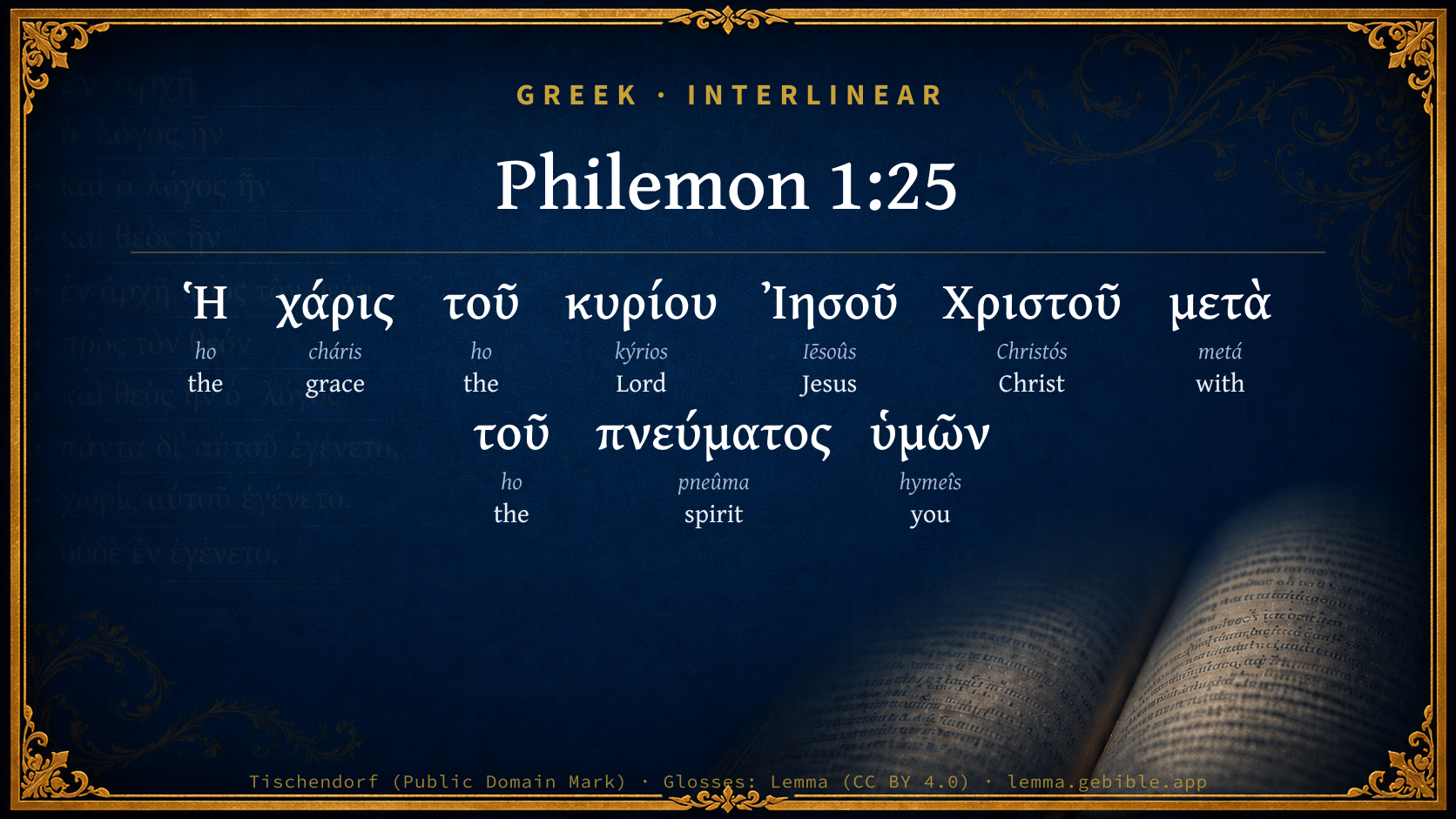
  1. Ἡ ho G3588 “the” Article, Nominative, Singular, Feminine
  2. τοῦ ho G3588 “the” Article, Genitive, Singular, Masculine
  3. κυρίου kýrios G2962 “Lord” Noun, Genitive, Singular, Masculine
  4. Ἰησοῦ Iēsoûs G2424 “Jesus” Noun, Genitive, Singular, Masculine
  5. Χριστοῦ Christós G5547 “Christ” Noun, Genitive, Singular, Masculine
  6. μετὰ metá G3326 “with” Preposition
  7. τοῦ ho G3588 “the” Article, Genitive, Singular, Neuter
  8. πνεύματος pneûma G4151 “spirit” Noun, Genitive, Singular, Neuter
  9. ὑμῶν hymeîs G5210 “you” Personal pronoun, 2nd person, Genitive, Plural

About this verse

These counts appear in no published source. They are computed here, from the morphology-tagged text and Lemma’s own curated glosses. What Lemma adds →

10
words
8
distinct lemmas
Pauline Epistles
section

Repetition

A word recurs within this verse:

Cross-references

4

Topical passages linked to Philemon 1:25 in the Treasury of Scripture Knowledge — connected by theme and wording, ordered by reader-vote popularity; previews shown in the World English Bible.

  • 2 Timothy 4:22 The Lord Jesus Christ be with your spirit. Grace be with you. Amen.
  • Romans 16:20 And the God of peace will quickly crush Satan under your feet. The grace of our Lord Jesus Christ be with you.
  • Galatians 6:18 The grace of our Lord Jesus Christ be with your spirit, brothers. Amen.
  • Romans 16:23 Gaius, my host and host of the whole assembly, greets you. Erastus, the treasurer of the city, greets you, as does Quartus, the brother.

Cross-references courtesy of OpenBible.info (CC BY 4.0).

Where the printed editions differ

3 variants

Places in this verse where the major printed Greek editions disagree on the wording in a way that affects the translation — a comparison of editions, not a manuscript-by-manuscript collation. The editions are the modern critical texts (Nestlé-Aland 28/27, SBL, Westcott-Hort, Tregelles, Tyndale House) and the traditional texts behind the KJV (the Textus Receptus and the Byzantine/Majority text). It is not a claim about which reading is original.

  1. Extra text
    ἡμῶν

    “of us”

    In TynTregTRByz Not in NA28NA27SBLWH

    ἡμῶν (hēmōn) 'of us' is only in traditional manuscripts (Tyn+Treg+TR+Byz)

  2. Extra text
    ἀμήν.

    “Amen.”

    In TynTRByz Not in NA28NA27SBLWHTreg
  3. Extra text
    Πρός Φιλήμονα ἐγράφη ἀπό Ῥώμης διά Ὀνησίμου οἰκέτου.¶

    “to To Philemon it was written from Rome through Onesimus servant.”

    In TR Not in NA28NA27TynSBLWHTregByz

    ἀμήν. Πρός Φιλήμονα ἐγράφη ἀπό Ῥώμης διά Ὀνησίμου οἰκέτου.¶ (amēn Pros Philēmona egraphē apo Rhōmēs dia Onēsimou oiketou) 'Amen. to To Philemon it was written from Rome through Onesimus servant.' is only in traditional manuscripts (TR)

Textual data: Translators Amalgamated Greek New Testament (STEPBible TAGNT) · CC BY 4.0.

Commentary

Notes on Philemon 1:25 from classic Christian and Jewish commentators (each source and its license shown beneath its notes). The classic Christian expositions comment on the surrounding passage and are grouped to its opening verse, so a note may address several verses; the Jewish commentaries on the Tanakh (Rashi and others) are per-verse, so they appear only where the commentator wrote on this verse.

Lemma curates 59 commentaries, every one of them public domain or Creative Commons licensed, each selected and text-cleaned for this edition rather than reprinted as found. About our sources →

The Cambridge Bible for Schools and Colleges

gen. ed. J. J. S. Perowne

25. The grace of our Lord Jesus Christ] So Rom_16:20; Rom_16:24; 1Co_16:23; 2Co_13:13; Gal_6:18 (where the whole formula is verbatim as here); Php_4:23; 1Th_5:28; 2Th_3:18; Rev_22:21. Cp. 2Ti_2:1.

“The grace” is in short the Lord Jesus Christ Himself, in His saving presence and power; Himself at once Gift and Giver. So the Epistle closes, as it began, “in Him.”

with your spirit] Not “spirits”; as if Philemon and his house had, in Christ, “one spirit,” one inner life.—See further, Appendix N.—The same phrase occurs Gal_6:18 and (in the true reading) Php_4:23; where see our note.

Amen] The word is probably to be retained here. So R.V. text. It is properly a Hebrew adverb, meaning “surely;” repeatedly used as here in the O. T. See e.g. Deu_27:15, &c.; Jer_11:5 (marg. A.V.).

The Subscription

Written from Rome, &c.] Lit., To Philemon it was written from Rome by means of (i.e., of course, “it was sent by hand of”) (the) domestic Onesimus. Obviously, the statement is true to fact. On the antiquity of this and similar Subscriptions see note on that appended to Colossians.

A few mss. (of cent. 8 at earliest) have, (The) Epistle of the holy Apostle Paul to Philemon and Apphia, owners of Onesimus, and to Archippus the (sic) deacon of the Church in Colossæ, was written from Rome by means of (the) domestic Onesimus.

N. Dr MACLAREN ON THE LAST WORDS OF THE EPISTLE TO PHILEMON. (Phm_1:25.)

In his excellent Expository Commentary on our two Epistles (3rd Edition, 1889) Dr Alexander Maclaren writes as follows:

“The parting benediction ends the letter. At the beginning of the Epistle, Paul invoked grace upon the household ‘from God our Father and the Lord Jesus Christ.’ Now he conceives of it as Christ’s gift. In Him all the stooping, bestowing love of God is gathered, that from Him it may be poured upon the world. That grace is not diffused, like stellar light, through some nebulous heaven, but concentrated in the Sun of Righteousness, who is the light of men. That fire is piled on a hearth, that from it warmth may ray out to all that are in the house.…

“The grace of Christ is the best bond of family life. Here it is prayed for on behalf of all the group, the husband, wife, child, and the friends in their home-Church. Like grains of sweet incense sprinkled on an altar-flame, and making fragrant that which was already holy, that grace sprinkled on the household fire will give it an odour of a sweet smell, grateful to men and acceptable to God.

“That wish is the purest expression of Christian friendship, of which the whole Letter is so exquisite an example. Written as it is about a common everyday matter, which could have been settled without a single religious reference, it is saturated with Christian thought and feeling. So it becomes an example how to blend Christian sentiment with ordinary affairs, and to carry a Christian atmosphere everywhere. Friendship and social intercourse will be all the nobler and happier, if pervaded by such a tone. Such words as these closing ones would be a sad contrast to much of the intercourse of professedly Christian men. But every Christian ought by his life to be, as it were, floating the grace of God to others sinking for want of it, to lay hold of; and all his speech should be of a piece with this benediction.

“A Christian’s life should be ‘an Epistle of Christ,’ written with His own hand, wherein dim eyes might read the transcript of His own gracious love; and through all his words and deeds should shine the image of his Master, even as it does through the delicate tendernesses and gracious pleadings of this pure pearl of a letter, which the slave, become a brother, bore to the responsive hearts in quiet Colossæ.”

The Cambridge Bible for Schools and Colleges (gen. ed. J. J. S. Perowne; Cambridge University Press, 1878–1918) — public domain. Text from a community e-Sword module.

The Biblical Illustrator

Joseph S. Exell

Phm_1:25

The grace of our Lord Jesus Christ

Grace the gift of Christ

1.

At the beginning of the Epistle Paul invoked grace upon the household from God our Father and the Lord Jesus Christ. Now he conceives of it as Christs gift. In Him all the stooping, bestowing love of God is gathered, that from Him it may be poured on the world. That grace is not diffused like stellar light through some nebulous heaven, but concentrated in the Sun of righteousness, who is the light of men. That fire is piled on a hearth that, from it, warmth may ray out to all that are in the house.

2. That grace has mans spirit for the field of its highest operation. Thither it can enter, and there it can abide, in union more close and communion more real and blessed than aught else can attain. The spirit which has the grace of Christ with it can never be utterly solitary or desolate.

3. The grace of Christ is the best bond of family life. Here it is prayed for on behalf of all the group, the husband, wife, child, and the friends in their home--church. Like grains of sweet incense cast on an altar flame, and making fragrant what was already holy, that grace sprinkled on the household fire will give it an odour of a Sweet smell, grateful to men and acceptable to God.

4. That wish is the purest expression of Christian friendship, of which the whole letter is so exquisite an example. Written as it is about a common, everyday matter, which could have been settled without a single religious reference, it is saturated with Christian thought and feeling. So it becomes an example of how to blend Christian sentiment with ordinary affairs, and to carry a Christian atmosphere everywhere. Every Christian ought by his life to be, as it were, floating the grace of God to others sinking for want of it to lay hold of, and all his speech should be of a piece with this benediction. (A. Maclaren, D. D.)

Grace to be most desired

I. First of all, we see here, that as in the entrance of the Epistle, and, as it were, at their first meeting, he wished unto him the Grace of Christ, so he doth in the farewell and departing, hereby teaching that nothing is better or more to be desired than His grace; that all our salutations and farewells should be grounded in His grace; this must be the beginning and the ending of all our talk and communication; and as he began with prayer, so he endeth with prayer. Thus ought our actions to be, that whatsoever we do in word or in deed, we should do all in the name of the Lord Jesus (Col_3:17). This bringeth good success to our works, and maketh that which we do to prosper.

II. When the Son of God is called Jesus, we observe again that He is a perfect and absolute Saviour; the alone Saviour, inasmuch as the work of our salvation and redemption is wholly and only wrought out by Him, and no part left unfinished and reserved for any creature in heaven or in earth.

III. The Son of God is called Christ, which signifieth as much as anointed.

IV. Let us consider the third title given to the Son of God. He is called our Lord; which teacheth us to acknowledge Him to be the Ruler and Governor of His Church, and of every particular member thereof. And if He be the Governor and Guide, woe unto them that will not be ruled and governed by Him.

V. Observe that the grace here asked for Philemon and others to whom the apostle wrote, is called the grace of Jesus Christ, to teach us that Gods graces and benefits come upon us through Him, and as nothing was made without Him that was made, so nothing is given without Him that is given. If, then, we would have right and interest in any of the blessings of God, we must labour to be in Christ and to have assurance that we are in Christ. (W. Attersoll.)

The apostolic benediction

1. Some explanation of the words of the text, The grace of our Lord Jesus Christ.

2. What we may learn from it.

(1) The grand foundation of a sinners hope.

(2) How to make a practical use of Christian doctrines.

(3) The simplicity of the faith and the fervency of the love of the primitive Church--the Church of the apostles time. (R. Cecil, M. A.)

The Christians prayer for his brethren in Christ

1. Breathes family affection--affection to all who love Christ--affection to them as brethren, for--

(1) They are born of the same Father.

(2) They are taught by the same preceptor.

(3) They are severed from the world and dedicated to God, body, soul, and spirit.

2. Invokes a family blessing--grace--the grace of Christ.

3. Describes family experience. If we have realised the text in our experience, then we have attained the climax of Christian attainments. (J. Dillon, D. D.)

Grace

1. The sum of all other blessings.

2. Obtained through Christ.

3. The greatest happiness we can desire for others. (J. Lyth, D. D.)

Grace

1. Its source.

2. Its fulness.

3. Its flow.

4. Its power. (J. Lyth, D. D.)

Grace

1. Is needed by all.

2. Is provided for all.

3. Is offered to all.

4. Is supplicated for all.

5. May be enjoyed by all. (J. Lyth, D. D.)

The grace of the Lord Jesus Christ

Very powerful was the impression which Lady Fanny Shirley on her sick bed made upon the surrounding attendants. Once, as a reigning beauty at Court, Chesterfield had addressed to her some of his most famous epigrams; since then she chose that better part which could never be taken from her. I am quite at a loss to explain how Lady Fanny is enabled to bear such a severity of suffering with so much tranquillity and so few symptoms of restlessness and murmuring, said her physician to Mr. Venn. Can you account for it, sir? Sir, answered Venn, that lady happily possesses what you and I ought daily to pray for, the grace of her Lord Jesus Christ, the love of God, and the fellowship of the Holy Ghost.

Grace

With a prayer for this grace Paul had opened the Epistle, and with a prayer for this grace he now will close. It is the most all-inclusive wish for good he can indite in so few words--the free and saving favour of the Lord, with all its holy and happy influences for soul and body, for time and for eternity. This grace sanctifies earths fellowships, and protects them from degeneracy and social corruption. It raises life above the entanglements of ennui and chagrin, of cynicism and despair. It weans the heart from the world, without permitting it to be soured. It lends dignity to suffering, and gilds the gloom of sorrow with radiant hope. To the apostle had been often verified the soul-sustaining words, My grace is sufficient for thee. As the day grows, the warmth increases and the shadows flee away; so, as grace is realised, the heart basks and suns itself in the glow of heavens love, and everything gets bathed in heavens own light. (A. H. Drysdale, M. A.)

Amen

This is set down in a word, and yet it containeth more than the prayer itself. For in prayer we testify our desire, by this we witness our faith. By this we observe that unto our requests and petitions in prayer must be joined faith and belief that God will grant the things craved. To pray without faith is not to pray at all. And to say amen in the end of our prayers, and yet to pray with doubting, and without believing, is to make a lie and to teach our tongues to deceive our hearts. For this is a great jar and discord when infidelity is in the heart and faith in the tongue; when inwardly we waver, and outwardly the mouth uttereth amen. Moreover, so often as we use public prayers they must be pronounced and delivered with that plainness, feeling, and zeal, as that the people, being thereby moved, and their faith and affections going with that which is delivered and prayed for, may answer amen unto that which is desired. This is it which the apostle teacheth (1Co_14:1-40).

The Biblical Illustrator, edited by Joseph S. Exell (c. 1880s–1900s) — public domain. Text from a community e-Sword module.

Meyer's Critical & Exegetical Commentary

Heinrich August Wilhelm Meyer

Phm_1:25. See on Gal_6:18.

Meyer — Critical and Exegetical Commentary on the New Testament — English translation by Peter Christie, edited by Frederick Crombie (T&T Clark, 1880) — public domain. Text from a community e-Sword module.

Expositor's Greek Testament

ed. W. Robertson Nicoll

Phm 1:25 . Ἡ χάρις : cf. Gal 6:18 , 2Ti 4:22 . ὑμῶν : the reference is both to those addressed by name in the opening of the Epistle, as well as to the members of the local Church, see Phm 1:2 . This final verse is a reiteration of the grace pronounced in Phm 1:3 .

The Expositor's Greek Testament, edited by W. Robertson Nicoll (1897–1910) — public domain. Text from a community e-Sword module.

Jamieson, Fausset & Brown

Robert Jamieson, A. R. Fausset & David Brown

be with your spirit-- (Gal 6:18; Ti2 4:22).

Next: Hebrews Introduction

Jamieson, Fausset & Brown — Commentary Critical and Explanatory on the Whole Bible (1871) — public domain (CC PDM 1.0). Text via the HelloAO Bible API.

Adam Clarke's Commentary

Verse 25. The grace of our Lord Jesus Christ be with your spirit] By using the plural, νμων, your, the apostle in effect directs or addresses the epistle, not only to Philemon, but to all the Church at his house.

Amen.] Is wanting as usual in the best MSS.

The subscriptions are also various, as in preceding cases.

VERSIONS:

The Epistle to Philemon was written at Rome, and sent by the hand of Onesimus. - SYRIAC.

Through the help of God the epistle is finished. It was written at Rome by the hand of Onesimus, servant to Philemon. - ARABIC.

To the man Philemon. - AETHIOPIC.

It was written at Rome, and sent by Onesimus. - COPTIC.

VULGATE, nothing.

The Epistle to Philemon, Apphia, and Archippus: the end of the Epistle to Philemon and Apphia, the master and mistress of Onesimus; and to Archippus, the deacon of the Church at Colosse: it was written from Rome by Onesimus, a servant. - PHILOXESIAN SYRIAC.

MANUSCRIPTS:

To Philemon. - To Philemon is finished. - To Philemon, written from Rome by Onesimus - Onesiphorus. - From Paul, by Onesimus, a servant. - From the presence of Paul and Timothy. - The Epistle of Paul the apostle to Philemon. - The common Greek text has, To Philemon, written from Rome by Onesimus, a servant.

As some have thought it strange that a private letter, of a particular business and friendship, should have got a place in the sacred canon, others have been industrious to find out the general uses which may be made of it. The following are those which seem to come most naturally from the text: -

1. In a religious point of view, all genuine Christian converts are on a level; Onesimus, the slave, on his conversion becomes the apostle's beloved son, and Philemon's brother.

2. Christianity makes no change in men's civil affairs; even a slave did not become a freeman by Christian baptism.

3. No servant should be either taken or retained from his own master, without the master's consent, Phlm 1:13; Phlm 1:14.

4. We should do good unto all men, and not be above helping the meanest slave when we have the opportunity.

5. Restitution is due where an injury has been done, unless the injured party freely forgive, Phm 1:18.

6. We should do all in our power to make up quarrels and differences, and reconcile those that are at variance.

7. We should be grateful to our benefactors, and be ready to compensate one good turn with another.

8. We should forgive the penitent who have offended us, and rejoice in the opportunity of being reconciled to them.

9. Authority is not always to be used; a prudent man who is possessed of it will rather use a mild and obliging manner, than have recourse to the authority of his office.

10. The ministers of the Gospel should learn to know the worth of an immortal soul, and be as ready to use their talents for the conversion of slaves and the ignoble as the great and opulent, and prize the converted slave as highly as the converted lord, showing no sinful respect of persons.

11. Christianity properly understood, and its doctrines properly applied, become the most powerful means of the melioration of men; the wicked and profligate, when brought under its influence, become useful members of society. It can transform a worthless slave into a pious, amiable, and useful man; and make him, not only happier and better in himself, but also a blessing to the community.

12. We should never despair of reclaiming the wicked. No man is out of the reach of God's mercy as long as he breathes. Pretending to say that such and such cases are hopeless, is only a colouring for our want of zeal, and a pretence to excuse our slothfulness.

13. The anxiety which the apostle showed for the welfare of Onesimus, in return for his affectionate services, could not fail to cherish good dispositions in the breast of Philemon. We do a man a great kindness when we even engage him in acts of mercy and benevolence.

14. From this epistle we learn what sort of man the apostle was in private life. He has here displayed qualities which are in the highest estimation among men; a noble spirit arising from a consciousness of his own dignity, consummate prudence, uncommon generosity, the warmest friendship, the most skilful address, and the greatest politeness, as well as purity of manners; qualities which are never found either in the enthusiast or impostor. See Macknight and Dodd.

There is extant an epistle of Pliny on the very same subject, directed to his friend Sabinianus in behalf of his manumitted slave who had offended him, and was consequently cast out of favour. Dr. Doddridge says that "that epistle, though penned by one who was allowed to excel in the epistolary style, and though it undoubtedly has many beauties, will be found by persons of taste much inferior to this animated composition of the Apostle Paul.

I have already introduced an epistle of Horace on a somewhat similar subject; but that of Pliny is so exactly parallel, and so truly excellent, that I am sure its insertion will gratify every intelligent reader, and I insert it the rather because the works of Pliny are in but few hands, and his epistles are known to very few except the learned.

C. PLINIUS SABINIANO suo, S.

Libertus tuus, cui succensere te dixeras, venit ad me, advolatusque pedibus meis, tanquam tuis, haesit. Flevit multum, multum rogavit, multum etiam tacuit: in summa, fecit mihi fidem poenitentiae. Vere credo emendatum, quia deliquisse se sentit. Irasceris scio; et irasceris merito, id quoque scio: sed tunc praecipua mansuetudinis laus, cum irae causa justissima est. Amasti hominem; et, spero, amabis: interim sufficit, ut exorari te sinas. Licebit rursus irasci, si meruerit: quod exoratus excusatius facies.

Remitte aliquid adolescentiae ipsius; remitte lachrymis; remitte indulgentiae tuae; ne torseris illum, ne torseris etiam te. Torqueris enim, cum tam lenis irasceris. Vereor, ne videar non rogare, sed cogere, si precibus ejus meas junxero. Jungam tamen tanto plenius et effusius, quanto ipsum acrius severiusque corripui, districte minatus nunquam me postea rogaturum. Hoc illi, quem terreri oportebat; tibi non idem. Nam fortasse iterum rogabo, impetrabo iterum: sit modo tale, ut togare me, ut praestare te deceat. Vale. - Epistolar. Iib. ix., Ep. 21.

"CAIUS PLINIUS to SABINIANUS his friend, health.

"Thy freed man, with whom thou didst inform me thou wert incensed, came to me and threw himself at my feet, and grasped them as if they had been thine. He wept much, earnestly entreated, and yet said more by his silence. In short, he fully convinced me that he is a penitent. I do verily believe him reformed, because he feels his guilt. Thou art incensed against him I know,, and I know that he has justly merited thy displeasure; but then, clemency has its chief praise when there is the greatest cause for irritation. Thou didst once love the man, and I hope thou wilt love him again. In the meantime permit thyself to be entreated in his behalf. Should he again merit thy displeasure thou wilt have the stronger excuse for indulging it, shouldst thou pardon him now. Consider his youth, consider his tears, consider thy own gentleness of disposition. Do not torment him, do not torment thyself; for, with thy mild disposition, thou must be tormented if thou suffer thyself to be angry. I fear, were I to join my prayers to his, that I should rather seem to compel than to supplicate. Yet I will unite them, and the more largely and earnestly too, as I have sharply and severely reproved him, solemnly threatening, should he offend again, never more to intercede for him. This I said to him, it being necessary that I should alarm him; but I do not say the same to thee, for probably I may entreat thee again, and command thee again, should there be a sufficient reason to induce me to request, and thee to concede. Farewell."

Nothing on the subject can be finer than this; but Paul has the advantage, because he had Christian motives to urge. If the energetic Roman had had these, we should have found it difficult to decide between his Latin and the apostle's Greek.

It may be now asked whether St. Paul's application in behalf of Onesimus was successful? We have no direct answer to this question, but we may fairly suppose that such pleading could not be in vain. Philemon was a Christian, and owed too much to his God and Saviour, and too much to the apostle, as the instrument of his salvation, not to concede a favour which it is congenial to the very spirit of Christianity to grant.

The application of Horace in behalf of Septimius was successful, and both Claudius Nero and Augustus took him into their warmest confidence. But this was only a common case of recommendation, and had no difficulties in the way. But did the heathen Sabinianus yield to the entreaties of his friend, and forgive his slave? He did; and we have the record of it in another very elegant letter, in which Pliny expresses his obligation to his friend for his prompt attention to his request. I will transcribe it, and give a translation for the farther satisfaction of the reader.

C. PLINIUS SABINIANO suo, S.

Bene fecisti quod libertum aliquando tibi carum, reducentibus epistolis meis, in domum, in animum recepisti. Juvabit hoc te: me certe juvat; primum quod te talem video, ut in ira regi possis: deinde quod tantum mihi tribuis, ut vel auctoritati meae pareas, vel precibus indulgeas. Igitur, et laudo, et gratias ago. Simul in posterum moneo, ut te erroribus tuorum, etsi non fuerit, qui deprecetur, placabilem praestes. Vale. - Epistolar. lib. ix., Ep. 24.

"CAIUS PLINIUS to his friend SABINIANUS, health.

"Thou hast done well, that, in compliance with my letter, thou hast received thy freed man both into thy house and into thy heart. This must be pleasing to thyself, and it is certainly pleasing to me; first, because I find thee to be a person capable of being governed in thy anger; and secondly, because thou showest so much regard for me, as either to yield this to my authority, or concede it to my entreaties. Therefore I both praise and return thee thanks. 'At the same time I admonish thee to be always ready to forgive the errors of thy servants, although there should be no one to intercede in their behalf. Farewell."

These letters contain such excellent lessons of instruction that it will be impossible to read them without profit. They are master pieces in their kind; and no Christian need be ashamed to be indebted to them, whether in regulating his own conduct in respect to forgiveness of injuries, or whether in interceding for them who have fallen under the displeasure of others. Reader, go thou and do likewise.

Finished correcting for a new edition, Dec. 23, 1831.

Adam Clarke's Commentary on the Bible (1810–1826) — public domain. Text from a community e-Sword/MySword module.

Trapp's Complete Commentary

John Trapp

25 The grace of our Lord Jesus Christ be with your spirit. Amen. Written from Rome to Philemon, by Onesimus a servant.>>

Ver. 25. The grace of our Lord] Say the world what it will, a grain of grace is worth a world of wealth. The blessings that come. out of Sion are better than any that come out of heaven and earth, Psa 134:3; for they outlast the days of heaven, and run parallel with the life of God and line of eternity. Pray for them therefore in the behalf of ourselves and others, as Paul constantly doth for grace, not with graceless Nero, but with the Lord Jesus Christ, one good cast of whose pleased countenance was better to David than his crown and sceptre, Psa 4:7-8.

John Trapp, A Commentary or Exposition upon All the Books of the Old and New Testament (1647–1656) — public domain. Text from a community e-Sword module.

Albert Barnes' Notes on the Bible

The grace of our Lord Jesus Christ ... - Notes, 2Ti 4:22.

The subscription to the Epistle is of no authority, but in this case is undoubtedly correct. Compare the remarks at the close of 1 Corinthians, and Titus.

Remarks On Philemon

Having now passed through with the exposition of this Epistle, it may be proper to copy, for comparison with it, one of the most beautiful specimens of epistolary composition to be found in profane literature, an epistle of Pliny, written on a similar occasion, and having a strong resemblance to this. As a matter of taste, it is of importance to show that the sacred writers do not fall behind the most favorable specimens of literary composition to be found in uninspired writings. The epistle of Pliny was directed to his friend Sabinianus, in behalf of his manumitted slave who had offended him, and who was consequently cast out of his favor. It is in the following words:

C. Plinius Sabiniano, S. (in Latin)

Libertus tuus, cui succensere te dixeras, venit a.d. me, advolutusque pedibus meis, tanquam tuis, haesit: flevit muitum, multum rogavit, maltum etiam tacuit: in summa, fecit mihi fidem poenitentiae Vere credo emendatum, quia deliquisse sentit. Irasceris scio; et irasceris merito, id quoque scio: sed tune praecipua mansuetudinis laus, cure irae causa justissima est. Amasti hominem; et spero amabis: interim sufficit ut exorari te sinas. Licebit rursus irasci, si meruerit; quod exoratus excusatius facies.

Remitte aliquid adolescentiae ipsius; remitte lachrymis; remitte indulgentiae tuae; ne torseris illum, ne torseris etiam te. Torqueris enim cum tam lenis irasceris. Vereor, ne videar non rogare, sed cogere, si precibus ejus meas junxero. Jungam tamen tanto plenius et effusius quanto ipsum acrius severiusque corripui, destricte minatus, nunquam me postea rogaturum. Hoc illi, quem terreri oportebat; tibi non idem. Nam fortasse iterum rogabo, impetrabo irerum: sit mode tale, ut rogare me, ut praestare te, deceat. Vale. Epistolar. Lib. ix. Eph. 21.

Caius Pliny to Sabinianus, health (English translation)

‘Thy freed man, with whom thou didst say thou wert incensed, came to me, and having thrown himself at my feet, grasped them as if they had been thine. He wept much; pleaded much; and yet pleaded more by his silence. In short, he fully convinced me that he was a penitent. I do sincerely believe that he is reformed, because he perceives that he has done wrong. I know that thou art incensed against him; and I know also that thou art justly so; but then clemency has its chief praise when there is the greatest cause for anger. Thou hast loved the man; and I hope that thou wilt love him again. In the meantime, it may suffice that thou dost suffer thyself to be entreated for him. It will be right for thee again to be offended if he deserves it: because, having allowed thyself to be entreated, you will do it with greater propriety.

‘Forgive something for his youth; forgive on account of his tears; forgive on account of thine own kindness: do not torment him; do not torment thyself - for thou wilt be tormented when thou, who art of so gentle a disposition, dost suffer thyself to be angry. I fear, if I should unite my prayers to his, that I should seem not to ask, but to compel. Yet I will write them, and the more largely and earnestly, too, as I have sharply and severely reproved him; solemnly threatening him, should he offend again, never more to intercede for him. This I said to him, because it was necessary to alarm him; but I will not say the same to thee. For perhaps I may again entreat thee, and again obtain, if now that shall be done which it is fit that I should ask and you concede. Farewell.”

Those who compare these two epistles, much as they may admire that of Pliny as a literary composition and as adapted to secure the end which he had in view, will coincide with the remark of Doddridge, that it is much inferior to the letter of Paul. There is less courtesy - though there is much; there is less that is touching and tender - though there is much force in the pleading; and there is much less that is affecting in the manner of the appeal than in the Epistle of the apostle.

The Epistle to Philemon, though the shortest that Paul wrote, and though pertaining to a private matter in which the church at large could not be expected to have any direct interest, is nevertheless a most interesting portion of the New Testament, and furnishes some invaluable lessons for the church.

1. It is a model of courtesy. It shows that the apostle was a man of refined sensibility, and had a delicate perception of what was due in friendship, and what was required by true politeness. There are turns of thought in this Epistle which no one would employ who was not thoroughly under the influence of true courtesy of feeling, and who had not an exquisite sense of what was proper in intercourse with a Christian gentleman.

2. The Epistle shows that he had great tact in argument, and great skill in selecting just such things as would be adapted to secure the end in view. It would be hardly possible to accumulate, even in a letter of fiction, more circumstances which would be fitted to accomplish the object which he contemplated, that he has introduced into this short letter, or to arrange them in a way better fitted to secure the desired result. If we remember the state of mind in which it is reasonable to suppose Philemon was in regard to this runaway servant, and the little probability that a man in his circumstances would receive him with kindness again, it is impossible not to admire the address with which Paul approaches him. It is not difficult to imagine in what state of mind Philemon may have been, or the obstacles which it was necessary to surmount in order to induce him to receive Onesimus again - and especially to receive him as a Christian brother.

If, as has been commonly supposed, Onesimus had been a slave; if he had run away from him; if he had been formerly intractable and disobedient; if he had wronged him by taking property with him that did not belong to him, or if he had owed him, and had run off without paying him, it is not difficult for any one to imagine how great was the difficulty to be overcome in his mind before the object of Paul could be accomplished. This will be felt to be especially so if we bear in remembrance the repugnance necessarily felt by a slaveholder to receive one who has been a slave as an equal in any respect, or to regard and treat such an one as a Christian brother on the same level with himself. Or if we suppose that Onesimus had been a voluntary servant in the employ of Philemon, and had failed to render the service which he had contracted to perform, or had embezzled property, or had gone off in debt, greatly irritating the mind of his master, the difficulty to be overcome before he received him again would be little less. In either case, it would be necessary to soothe his irritated feelings, and to inspire confidence in one who hitherto had evinced little claim to it, and to persuade him now to receive one who had shown that he was not to be trusted, as a Christian brother. If the Epistle be examined with reference to either of these suppositions, it will be found to be composed with the most finished tact and art.

3. This Epistle has been frequently appealed to by the friends and advocates of slavery as furnishing a support or apology for that institution. Indeed, it would seem to be regarded by the advocates of that system as so clear on the point, that all that they need to do is to name it as settling the whole matter in debate. The points which it is supposed by the advocates of that system to prove are two: first, that slavery is right - since it is assumed that Onesimus was a slave, and that Paul does not intimate to Philemon that the relation was contrary to the spirit of Christianity; and second, that it is our duty to send back a runaway slave to his master - since it is assumed that Paul did this in the case of Onesimus. - It cannot be denied that this view of the matter would be sustained by most of the commentaries on the Epistle, but it is time to inquire whether such an exposition is the true one, and whether this Epistle really gives countenance to slavery in respect to these points.

In order to this, it is important to know exactly what was the state of the case in reference to these points - for in interpreting the New Testament it should not be assumed that anything is in favor of slavery, nor should anything be admitted to be in favor of it without applying the most rigid principles of interpretation - any more than in the case of profaneness, adultery, or any other sin. As the result of the examination of the Epistle, we are now prepared to inquire what countenance the Epistle gives to slavery in these respects, and whether it can be fairly appealed to either in justification of the system, or in showing that it is a duty to return a runaway slave against his consent to his former master. To make out these points from the Epistle, it would be necessary to demonstrate that Onesimus was certainly a slave; that Paul so treats the subject as to show that he approved of the institution; that he sent back Onesimus against his own will; that he returned him because he supposed he had done wrong by escaping from servitude; and that he meant that he should continue to be regarded as a slave, and held as a slave, after his return to Philemon. Now, in regard to these points, I would make the following remarks in view of the exposition which has been given of the Epistle:

(1) There is no positive evidence that Onesimus was a slave at all; see the notes at Phm 1:16. Even if it should be admitted to be probable that he was, it would be necessary, in order that this Epistle should be adduced in favor of slavery, that that fact should be made out without any ground of doubt, or the argument is worthless. It is clear that the Epistle, under any circumstances, can be adduced in favor of slavery only so far as it is certain that Onesimus was a slave. But that is not certain. It cannot be made to be certain. It should not be taken for granted. Either of the suppositions that he was bound to service until he was of age by a parent or guardian, or that he had voluntarily bound himself to service for wages, will meet all that is necessarily implied in the Epistle.

(2) There is not the least evidence that Paul used any force or even persuasion to induce him to return to his master. It cannot be proved from the Epistle that he even advised him to return. It is certain that he did not compel him to do it - for Paul had no power to do this, and no guard or civil officer accompanied Onesimus to secure him if he had chosen to escape. Every one of the circumstances mentioned in the Epistle will be met by the supposition that Onesimus desired to return, but that there were circumstances which made him apprehensive that if he did, he would not be kindly received, and that, at his request, Paul wrote the Epistle to induce Philemon to receive him kindly. Nothing more can be proved; nothing more is necessary to be believed, in order to a fair interpretation of the Epistle. Nothing is more natural than the supposition that when Onesimus was truly converted, he would desire to return to Philemon if he had in any way done him wrong. But to make it proper to adduce this Epistle to show that it is a duty to return a runaway slave to his master, even on the supposition that Onesimus was a slave, it is necessary to prove either that Paul advised him to return, or that he compelled him to do it against his will. No one doubts that it would be right to help one who had escaped from slavery, if, on any proper account, he should wish to go back to his former master: if he felt that he had wronged him, or if he had a wife and children in the neighborhood, or if he was satisfied that he could be more happy in his service than he could be elsewhere. To this point, and this only, this Epistle goes.

(3) There is no evidence that Paul meant that Onesimus should return as a slave, or with a view to be retained and treated as a slave. Even supposing he had been so formerly, there is not the slightest intimation in the Epistle that when he sent him back to his master, he meant that he should throw himself into the chains of bondage again. Nor is there the slightest evidence that if he had supposed that this would be the result, he would have even consented that he should return to his master. No man can take this Epistle and prove from it that Paul would have sent him at all, if he had supposed that the effect would be that he would be reduced to slavery, and held in bondage. If such had been his expectation, he would never have written such a letter as this. The expression of such a desire would have found a place in the Epistle; or, at least, the Epistle would not have been so framed as almost of necessity to lead to a different result.

(4) There is very satisfactory evidence, besides this, that he did not mean that Onesimus should be regarded and treated by Philemon as a slave. It would be impossible for Philemon to comply with the wishes breathed forth in this letter, and meet exactly the desires of Paul in the case, and yet retain him as a slave, or regard him as property - as a “chattel “ - as a “thing.” For.

(a) if he had been formerly a slave; if this is the fair meaning of the word δοῦλος - doulos - then this is expressly declared. Thus, in Phm 1:16, he is commanded to receive him “not now as a servant” - οὐκέτι ὡς δοῦλον ouketi hōs doulon. If he had been a slave before, he did not wish that he should be received as such now, or regarded as such any longer. How could Philemon comply with the wish of the apostle, and yet regard Onesimus as a slave? The very attempt to do it would be directly in the face of the expressed desire of Paul, and every moment he held him as such he would be disregarding his wishes.

(b) He desired him to receive and treat him, in all respects, as a Christian brother - as one redeemed - as a man: - “Above a servant, a brother beloved.” How could he do this, and yet regard and treat him as a slave? Is it treating one as a Christian brother to hold him as property; to deprive him of freedom; to consider him an article of merchandise; to exact his labor without compensation? Would the man himself who makes another a slave suppose that he was treated as a Christian brother, if he were reduced to that condition? Would he feel that his son was so regarded if he was made a slave? There are no ways of reconciling these things. It is impossible for a master to regard His slave as, in the proper and full sense of the phrase, “a Christian brother.’ He may, indeed, esteem him highly as a Christian; he may treat him with kindness; he may show him many favors; but - he regards him also as his slave; and this fact makes a difference wide “as from the center thrice to the utmost pole” in his feelings toward him and other Christians. He is not on a level with them as a Christian. The notion of his being his slave mingles with all his feelings toward him, and gives a coloring to all his views of him. He cannot but feel, if he himself is under the influence of religion, that that slave, if he were treated in all respects as a Christian, would be as free as himself; would have a right to his time, and skill, and liberty; would be permitted to form his own plans, and to enjoy the avails of his own labor; and would be secure from the possibility of being sold.

(c) Suppose now that Paul, after a short interval, had actually come to the residence of Philemon, as he expected to Phm 1:22, and had found him regarding and treating Onesimus as a slave; would he have felt that Philemon had complied with his wishes? Did he ask this of him? Did he not request just the contrary? Phm 1:16. Would it not be natural for him to say to him that he had not received him as he wished him to? And how would Philemon reply to this?

(5) The principles laid down in this Epistle would lead to the universal abolition of slavery. If all those who are now slaves were to become Christians, and their masters were to treat them “not as slaves, but as brethren beloved,” the period would not be far distant when slavery would cease. This probably will be admitted by all. But a state of things which would be destroyed by the widest prevalence of Christianity, is not right at any time. Christianity, in its highest influences, interferes with nothing that is good, and would annihilate nothing which is not wrong. That which is true, and best for the welfare of man, will survive when the true religion spreads all over the world; and to say, as is commonly admitted even by the advocates of slavery, that Christianity will ultimately destroy the system, is to say that it is now wrong - for Christianity destroys nothing which is in itself right, and which is desirable for the highest good of man.

It will destroy intemperance, and idolatry, and superstition, and war - because they are evil and wrong - and only because they are so; and for the same reason, and that only, will it abolish slavery. When a man, therefore, admits that the gospel will ultimately destroy slavery, he at the same time admits that it is now an evil and a sin. The gospel is adapted and designed to put an end to the system. It did annihilate it in the Roman empire, and its tendency everywhere is to secure its final abolition. The system, therefore, is evil. It is opposed to the spirit of religion. It is destructive of the welfare of society. It is a violation of human rights. It is contrary to the will of God. The gospel everywhere teaches us to regard the slave “no longer as a slave, but as a brother;” and when this is secured, the system must speedily come to an end. For this, and for all its other anticipated influences, we should labor and pray that the gospel may be diffused as speedily as possible all over the world; that it may raise man everywhere from his degradation, and invest every human being with the dignity of a freeman; that it “may undo the heavy burden, break every yoke, and bid the oppressed go free.” Isa 58:6.

Albert Barnes' Notes on the Bible (1834–1885) — public domain. Text from a community e-Sword/MySword module.

Matthew Poole's English Annotations

See Poole on "Gal 6:18". See Poole on "Rom 16:24". See Poole on "1Co 16:23". See Poole on "Phi 4:23". See Poole on "2Th 3:18".

With your spirit is the same as with you. By the grace of our Lord Jesus Christ, he means the Spirit of Christ in all its gracious emanations: we have his meaning fully, 2Co 13:14;

The grace of our Lord Jesus Christ, and the love of God, and the communion of the Holy Ghost, be with you all. Amen is a particle of praying and affirming, by which he declareth his earnest desire it might be so, and also his faith that it should be so. Nor doth he pray for Philemon alone, (though the Epistle chiefly concerned him), but for all those who at Colosse had with him obtained like precious faith.

Written from Rome to Philemon, by Onesimus a servant.

Matthew Poole's English Annotations on the Holy Bible (1683–1685) — public domain. Text from a community e-Sword/MySword module.

Whedon's Commentary on the Bible

Daniel D. Whedon

25. Your—In the plural, indicating that the benediction included all in the greeting of Phm_1:1-3.

Spirit—More solemn than you simply, as it is with the spirit of man that the Spirit of God communes.

The superscription, though not written by Paul, is ancient, and, unlike some of the superscriptions, correct.

Daniel D. Whedon (gen. ed.), Commentary on the Old and New Testaments (1874–1909) — public domain. Text from a community e-Sword module.

The Pulpit Commentary

The grace. A omits amhn Theodoret has appended the following to his commentary: "It is fitting that those who have obtained the privilege of handing on the holy doctrine should so teach servants to submit themselves to their lords, that through all things Jesus Christ may be praised, to whom with the Father and the most Holy Spirit belong glory and greatness now and always and forever. Amen."

The Pulpit Commentary (1880–1919), ed. H.D.M. Spence-Jones & Joseph S. Exell — public domain. Text from a community e-Sword module.

Godbey's Commentary on the New Testament

William B. Godbey

25. “The grace of the Lord Jesus Christ be with your spirit.” This benediction is exceedingly beautiful for its brevity and comprehensibility. I recommend it to you all. The saints of God have a rich treasure in these beautiful apostolic benedictions found at the conclusion of every epistle.

In 1884, the last time I ever saw Bishop McTyeire, of precious memory (for he went to heaven that year), I heard him use this benediction in the dismission of the Kentucky Conference.

William B. Godbey, Commentary on the New Testament (1896–1900) — public domain. Text from a community e-Sword module.

Cambridge Greek Testament for Schools and Colleges

25. ἀμήν is added by Text. Rec. with אCDb.c, etc., but omitted by AD*.

Subscription. A is defective here. The simplest and apparently most original form is πρὸς Φιλήμονα אC 17, to which various additions are made in different authorities. The Text. Rec. has Πρὸς Φιλήμονα ἐγράφη ἀπὸ Ῥώμης διὰ Ὀνησίμου οἰκέτου with K 47 al. The longest forms may be seen in Nestle’s Greek Testament, 1901.

25. Final Benediction

ἡ χάρις. Col 4:18, note.

τοῦ κυρίου Ἰησοῦ Χριστοῦ. See notes on Textual Criticism.

μετὰ τοῦ πνεύματος ὑμῶν. Php 4:23; Gal 6:18†; cf. 2Ti 4:22. See Col 2:5, note.

The reversion once more (Phm 1:22) to ὑμῶν is due to the width of St Paul’s sympathy. On this verse Chrysostom writes Εὐχῇ τὴν ἐπιστολὴν κατέκλεισεν. Ἡ δὲ εὐχὴ μέγα μὲν ἀγαθὸν καὶ σωτήριον, καὶ τῶν ψυχῶν τῶν ἡμετέρων φυλακτήριον.

On the ἀμήν, and the Subscription, of the Text Rec., see notes on Textual Criticism.

Cambridge Greek Testament for Schools and Colleges (Cambridge University Press, 1896; 21 vols, various authors incl. Carr, Maclear, Plummer, Farrar, Lumby, Moule, M. R. James, Simcox) — public domain. Text from a community e-Sword module.

Alford’s Greek Testament

Henry Alford

25.] For this form of salutation, see reff. On all matters regarding the date and circumstances of writing the Epistle; see the Prolegomena.

Henry Alford, The Greek Testament (1849–1861) — public domain. Text from a community e-Sword module.

Vincent's Word Studies in the New Testament

Marvin R. Vincent

Grace - with your spirit. As in Gal 6:18, with the omission here of brother. See on 2Co 13:14.

Out of many private letters which must have been written by Paul, this alone has been preserved. Its place in the New Testament canon is vindicated, so far as its internal character is concerned, by its picture of Paul as a christian gentleman, and by its exhibition of Paul 's method of dealing with a great social evil.

Paul 's dealing with the institution of slavery displayed the profoundest christian sagacity. To have attacked the institution as such would have been worse than useless. To one who reads between the lines, Paul 's silence means more than any amount of denunciation; for with his silence goes his faith in the power of christian sentiment to settle finally the whole question. He knows that to bring slavery into contact with living Christianity is to kill slavery. He accepts the social condition as a fact, and even as a law. He sends Onesimus back to his legal owner. He does not bid Philemon emancipate him, but he puts the christian slave on his true footing of a christian brother beside his master. As to the institution, he knows that the recognition of the slave as free in Christ will carry with it, ultimately, the recognition of his civil freedom.

History vindicated him in the Roman empire itself. Under Constantine the effects of christian sentiment began to appear ill the Church and in legislation concerning slaves. Official freeing of slaves became common as an act of pious gratitude, and burial tablets often represent masters standing before the Good Shepherd, with a band of slaves liberated at death, and pleading for them at judgment. In A. D. 312 a law was passed declaring as homicide the poisoning or branding of slaves, and giving them to be torn by beasts. The advance of a healthier sentiment may be seen by comparing the law of Augustus, which forbade a master to emancipate more than one - fifth of his slaves, and which fixed one hundred males as a maximum for one time - and the unlimited permission to emancipate conceded by Constantine. Each new ruler enacted some measure which facilitated emancipation. Every obstacle was thrown by the law in the way of separating families. Under Justinian all presumptions were in favor of liberty. If a slave had several owners, one could emancipate him, and the others must accept compensation at a reduced valuation. The mutilated, and those who had served in the army with their masters' knowledge and consent, were liberated. All the old laws which limited the age at which a slave could be freed, and the number which could be emancipated, were abolished. A master's marriage with a slave freed all the children. Sick and useless slaves must be sent by their masters to the hospital.

Great and deserved praise has been bestowed on this letter. Bengel says : "A familiar and exceedingly courteous epistle concerning a private affair is inserted among the New Testament books, intended to afford a specimen of the highest wisdom as to how Christians should arrange civil affairs on loftier principles." Franke, quoted by Bengel, says : "The single epistle to Philem. very far surpasses all the wisdom of the world." Renan : "A true little chef - d'oeuvre of the art of letter - writing." Sabatier : "This short epistle gleams like a pearl of the most exquisite purity in the rich treasure of the New Testament." 214 ===Heb1

CHAPTER I

THEME OF THE EPISTLE. - God has given a revelation of salvation in two stages. The first was preparatory and transient, and is completed. The second, the revelation through Jesus Christ, is final. The readers who have accepted this second revelation are warned against returning to the economy of the first.

Marvin R. Vincent, Word Studies in the New Testament (1887–1900) — public domain. Text from a community e-Sword/MySword module.

Lightfoot's Colossians and Philemon

J. B. Lightfoot

25. Ἡ χάρις κ.τ.λ.] The same form of farewell as in Gal. vi. 18; comp. 2 Tim. iv. 22.

ὑμῶν] The persons whose names are mentioned in the opening salutation.

J. B. Lightfoot, St Paul's Epistles to the Colossians and Philemon: a revised text with introductions, notes and dissertations (London: Macmillan, 1875) — public domain. Electronic text from Project Gutenberg (ebook #50857). Covers Colossians and Philemon only (the verse-by-verse notes; introductions and dissertations are omitted); Lightfoot's companion Galatians and Philippians volumes are not included, as the available public-domain scans carry garbled Greek that cannot be faithfully reproduced.

Lesson kit

Teaching starters — assembled from the data on this page, not authored interpretation. Every prompt links to the verse data it draws on. Edit before teaching.

Philemon, in the Pauline Epistles, opens this verse with 10 words (8 distinct Greek lemmas). Its most distinctive word is cháris (“grace”). A historical commentator’s framing appears above. Read the whole chapter for the surrounding context.

Discussion questions

  1. The word cháris carries the sense “grace.” How does it shape the verse?
  2. 2 Timothy 4:22 shares this passage’s theme. How do the two illuminate each other?
  3. “the” occurs 3× in this one verse. What is the effect of the repetition?
  4. Reading how The Cambridge Bible for Schools and Colleges and The Biblical Illustrator read this verse, where do the two commentators agree and where do they part?

Things to notice

Reading settings

Reading text

Shown beneath each verse's original-language words.

Old Testament
Old Testament edition

Read the OT as the Masoretic Hebrew (MT) or the Greek Septuagint (LXX).

English shown for the Greek Septuagint (in the Hebrew ↔ Greek comparison).

Comparing translations? Open the Compare panel on any verse page to stack up to four side by side.