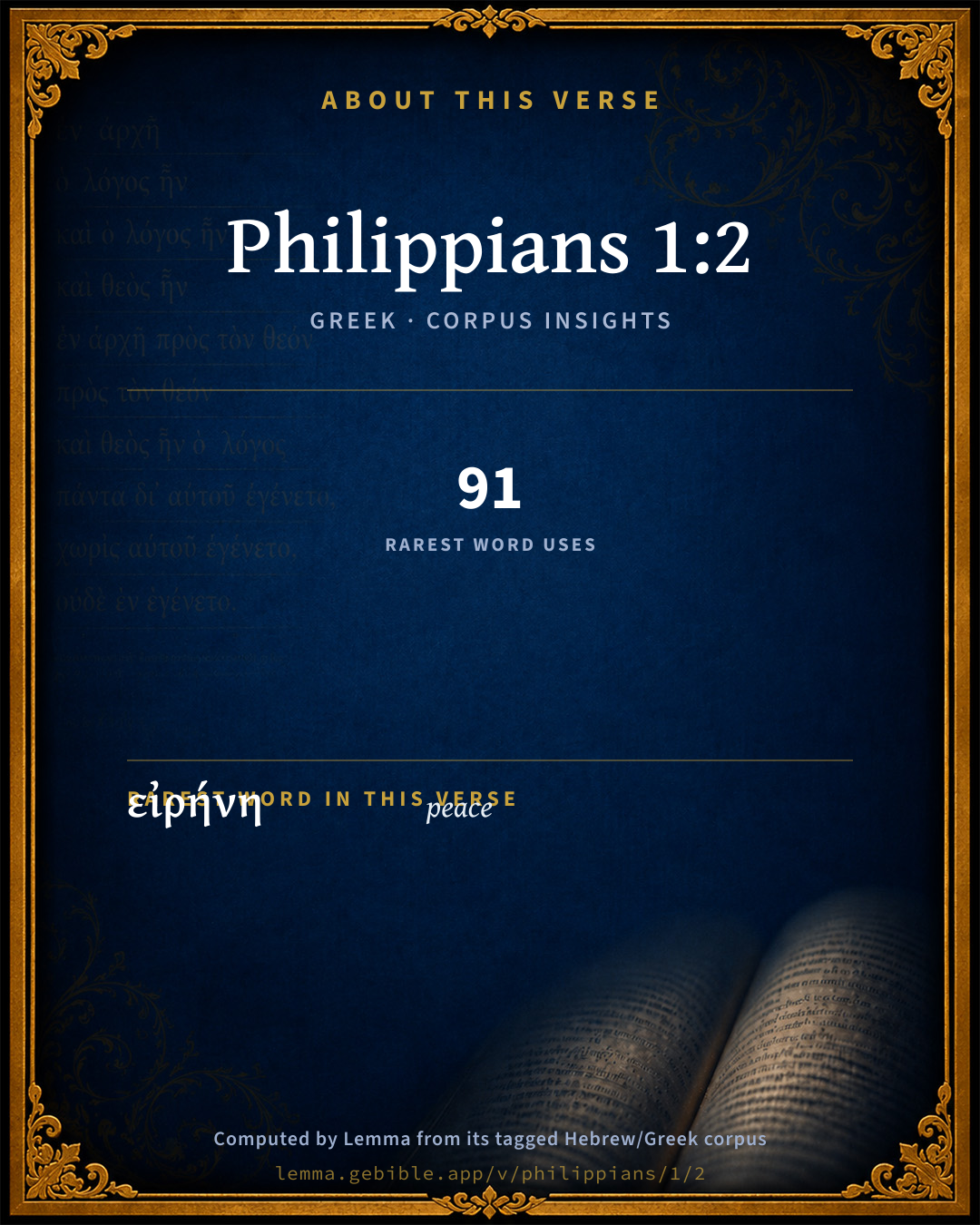
Philippians 1:2

Greek (Tischendorf 8th ed.) Philippians 1:2 appears in the Greek New Testament. The text above is from the Tischendorf 8th edition. Each word links to its Strong’s number and a concise gloss. Click any word for its full Thayer’s Greek Lexicon entry.
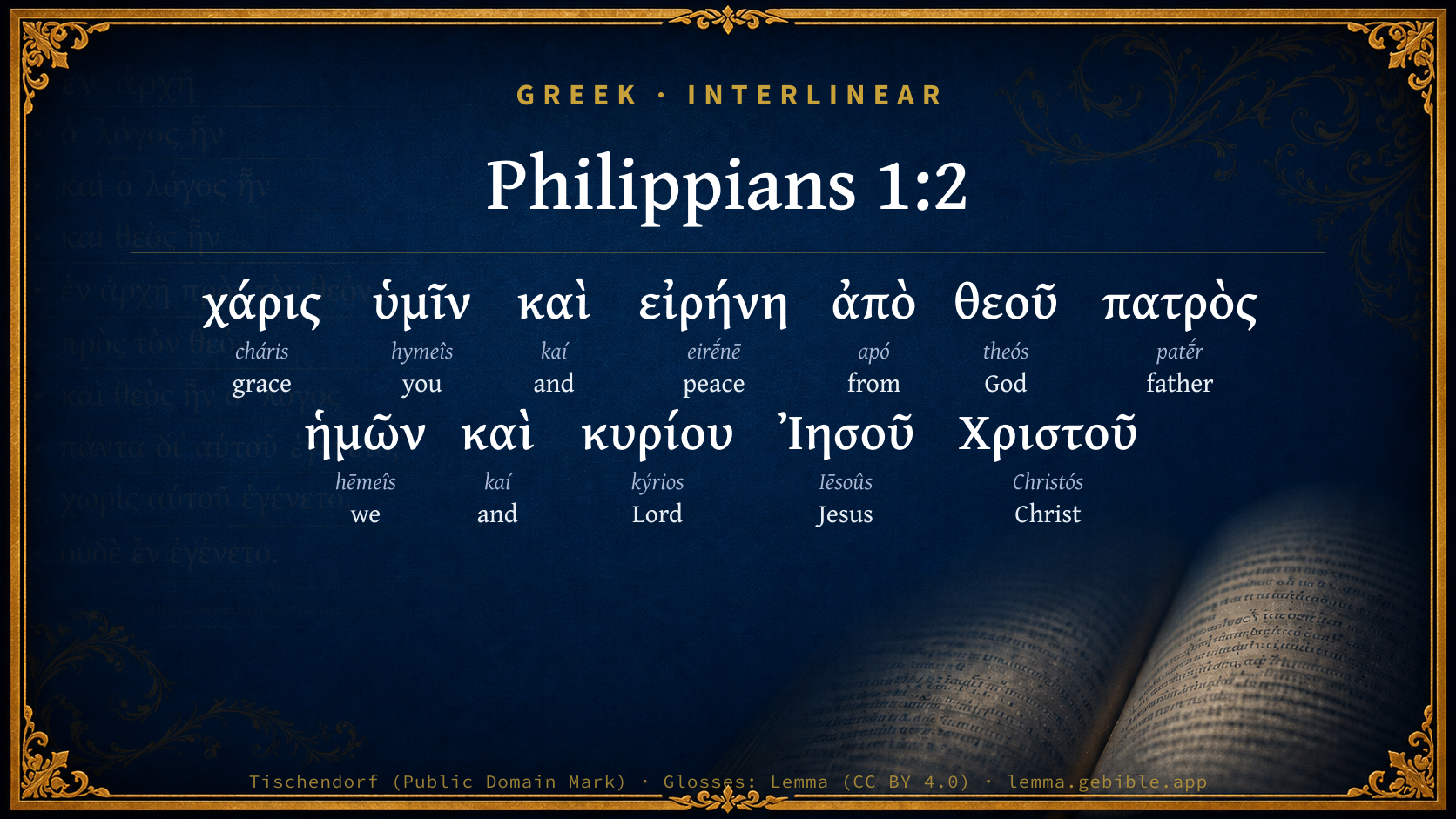
Download image
Cite this verse

Philippians 1:2 (World English Bible). Public Domain. Lemma interlinear Bible study tool, https://lemma.gebible.app/v/philippians/1/2.

Show BibTeX & RIS
BibTeX
RIS
English Translation
Grace to you, and peace from God, our Father, and the Lord Jesus Christ.
World English Bible · Public Domain
Download a study sheet

One document with this verse’s original text, its word-by-word gloss line, the meaning frame, cross-references with their text, attributed commentary, and full source and license credits — printable, and it pastes into notes with its structure intact.

This verse Autodidact and up

Study sheet (.html) Plain text (.txt)

A passage Seminary Student

Up to 50 verses in one chapter. A passage sheet keeps up to 6 commentary sources and 12 cross-references per verse, in the order this page ranks them, and says so on the sheet whenever that leaves anything out. Ask for a single verse and you get the Autodidact verse sheet above.

Everything on this page stays free to read, with no account — the sheet is a download of what is already on screen, not access to it.

Want to remove ads? Support Godless Engineer
Compare translations 3

The same verse in 3 English versions, stacked beneath the original-language interlinear above. Click any original word for its lexicon entry.

Each is an independent rendering of the whole verse — the interlinear is not word-aligned to these translations.

Highlighted words mark where these versions differ — a whole-verse word diff, not a word-by-word alignment.

  • World English Bible Public Domain
    Grace to you, and peace from God, our Father, and the Lord Jesus Christ.
  • King James Version Public Domain
    Grace be unto you, and peace, from God our Father, and from the Lord Jesus Christ.
  • unfoldingWord Literal Text CC BY-SA 4.0
    Grace to you and peace from God our Father and the Lord Jesus Christ.

unfoldingWord Literal Text — © unfoldingWord, licensed CC BY-SA 4.0. Word-aligned USFM3 via Door43 (git.door43.org/unfoldingWord/en_ult).

Versions to compare (up to 4)

3 of 4 selected

Show all 19 translations

Every available English version of this verse, each an independent rendering of the whole verse.

  • World English Bible Public Domain
    Grace to you, and peace from God, our Father, and the Lord Jesus Christ.
  • Berean Standard Bible Public Domain
    Grace and peace to you from God our Father and the Lord Jesus Christ.
  • Majority Standard Bible Public Domain
    Grace and peace to you from God our Father and the Lord Jesus Christ.
  • King James Version Public Domain
    Grace be unto you, and peace, from God our Father, and from the Lord Jesus Christ.
  • American Standard Version (1901) Public Domain
    Grace to you and peace from God our Father and the Lord Jesus Christ.
  • Revised Version (1885) Public Domain
    Grace to you and peace from God our Father and the Lord Jesus Christ.
  • Geneva Bible (1599) Public Domain
    Grace be with you, and peace from God our Father, and from the Lord Iesus Christ.
  • Douay-Rheims (1899) Public Domain
    Grace be unto you, and peace from God our Father, and from the Lord Jesus Christ.
  • Young's Literal Translation Public Domain
    Grace to you, and peace from God our Father, and the Lord Jesus Christ.
  • Literal Standard Version CC BY-SA 4.0
    Grace to you and peace from God our Father and the Lord Jesus Christ!
  • Unlocked Literal Bible CC BY-SA 4.0
    May grace be to you and peace from God our Father and the Lord Jesus Christ.
  • unfoldingWord Literal Text CC BY-SA 4.0
    Grace to you and peace from God our Father and the Lord Jesus Christ.
  • Darby Bible Public Domain
    grace to you, and peace from God our Father and [the] Lord Jesus Christ.
  • World Messianic Bible Public Domain
    Grace to you and peace from God our Father and the Lord Yeshua the Messiah.
  • Webster's Bible Public Domain
    Grace be to you, and peace, from God our Father and from the Lord Jesus Christ.
  • Free Bible Version CC BY-SA 4.0
    Grace to you and peace from God our Father and the Lord Jesus Christ.
  • Bible in Basic English Public Domain
    Grace to you and peace from God our Father and the Lord Jesus Christ.
  • Text-Critical English NT CC BY 4.0
    Grace to you and peace from God our Father and the Lord Jesus Christ.
  • Tyndale New Testament (1534) Public Domain
    Grace be with you and peace from God oure father and from the Lorde Iesus Christ.

Literal Standard Version (2020), Covenant Press — licensed CC BY-SA 4.0. Text via the HelloAO Bible API (eBible.org). Unlocked Literal Bible (unfoldingWord) — licensed CC BY-SA 4.0. Text via the HelloAO Bible API (eBible.org). unfoldingWord Literal Text — © unfoldingWord, licensed CC BY-SA 4.0. Word-aligned USFM3 via Door43 (git.door43.org/unfoldingWord/en_ult). Free Bible Version, Dr. Jonathan Gallagher — licensed CC BY-SA 4.0. Text via the HelloAO Bible API (eBible.org).

Word by word

More ways to search: Search by grammar → Find every occurrence → Compare this word →

Practice this passage: Drill this verse → Learn its vocabulary →

εἰρήνη
eirḗnē
G1515
“peace”
Noun, Nominative, Singular, Feminine
Part of Speech
Noun
Case
Nominative
Number
Singular
Gender
Feminine
Full Thayer's Definition

Origin: probably from a primary verb eiro (to join)

TDNT: 08:40,2

1. a state of national tranquillity a. exemption from the rage and havoc of war 2. peace between individuals, i.e. harmony, concord 3. security, safety, prosperity, felicity, (because peace and harmony make and keep things safe and prosperous) 4. of the Messiah's peace a. the way that leads to peace (salvation) 5. of Christianity, the tranquil state of a soul assured of its salvation through Christ, and so fearing nothing from God and content with its earthly lot, of whatsoever sort that is 6. the blessed state of devout and upright men after death
  1. χάρις cháris G5485 “grace” Noun, Nominative, Singular, Feminine
  2. ὑμῖν hymeîs G5210 “you” Personal pronoun, 2nd person, Dative, Plural
  3. καὶ kaí G2532 “and” Conjunction
  4. ἀπὸ apó G575 “from” Preposition
  5. θεοῦ theós G2316 “God” Noun, Genitive, Singular, Masculine
  6. πατρὸς patḗr G3962 “father” Noun, Genitive, Singular, Masculine
  7. ἡμῶν hēmeîs G2249 “we” Personal pronoun, 1st person, Genitive, Plural
  8. καὶ kaí G2532 “and” Conjunction
  9. κυρίου kýrios G2962 “Lord” Noun, Genitive, Singular, Masculine
  10. Ἰησοῦ Iēsoûs G2424 “Jesus” Noun, Genitive, Singular, Masculine
  11. Χριστοῦ Christós G5547 “Christ” Noun, Genitive, Singular, Masculine

About this verse

These counts appear in no published source. They are computed here, from the morphology-tagged text and Lemma’s own curated glosses. What Lemma adds →

12
words
11
distinct lemmas
Pauline Epistles
section

Repetition

A word recurs within this verse:

Cross-references

3

Topical passages linked to Philippians 1:2 in the Treasury of Scripture Knowledge — connected by theme and wording, ordered by reader-vote popularity; previews shown in the World English Bible.

  • Romans 1:7 to all who are in Rome, beloved of God, called to be saints: Grace to you and peace from God our Father and the Lord Jesus Christ.
  • 2 Corinthians 1:2 Grace to you and peace from God our Father and the Lord Jesus Christ.
  • 1 Peter 1:2 according to the foreknowledge of God the Father, in sanctification of the Spirit, that you may obey Jesus Christ and be sprinkled in his blood: Grace to you and peace be multiplied.

Cross-references courtesy of OpenBible.info (CC BY 4.0).

Commentary

Notes on Philippians 1:2 from classic Christian and Jewish commentators (each source and its license shown beneath its notes). The classic Christian expositions comment on the surrounding passage and are grouped to its opening verse, so a note may address several verses; the Jewish commentaries on the Tanakh (Rashi and others) are per-verse, so they appear only where the commentator wrote on this verse.

Lemma curates 59 commentaries, every one of them public domain or Creative Commons licensed, each selected and text-cleaned for this edition rather than reprinted as found. About our sources →

The Cambridge Bible for Schools and Colleges

gen. ed. J. J. S. Perowne

2. Grace be unto you, &c.] See, on the whole verse, the notes in this Series on Eph_1:2, where the wording is identical.—“Grace,” as a Scriptural term, demands careful study. In its true idea, kindness is always present, with the special thought of entire and marked absence of obligation in the exercise of it. It is essentially unmerited and free. See e. g. Rom_11:6. In its normal application, the word denotes the action of Divine kindness either in the judicial acceptance of the believer “not according to his works,” for Christ’s sake (e.g. Rom_3:24), or in the gift and continuance of new life and power to the believer (e.g. 1Co_15:10). And, as the action is never apart from the Agent, we may say that grace in the first reference is “God for us” (Rom_8:1), in the second, “God in us” (below, Php_2:13).—In the first reference grace is the antithesis to merit, in the second to nature.

our Father] in the new birth and life, which is coextensive with union with Christ the Son. See below, on Php_2:15.

The Cambridge Bible for Schools and Colleges (gen. ed. J. J. S. Perowne; Cambridge University Press, 1878–1918) — public domain. Text from a community e-Sword module.

Trapp's Complete Commentary

John Trapp

2 Grace be unto you, and peace, from God our Father, and from the Lord Jesus Christ.

Ver. 2. Grace be to you] {See Trapp on "1Co 1:2"} {See Trapp on "Eph 1:2"}

John Trapp, A Commentary or Exposition upon All the Books of the Old and New Testament (1647–1656) — public domain. Text from a community e-Sword module.

Matthew Poole's English Annotations

The evangelical salutation, as Rom 1:7; Eph 1:2; 2Pe 1:2; praying for the free and undeserved favour of God the Father to them, as the fountain, Jam 1:17 together with all inward and outward blessings, flowing thence through Christ the procurer of them.

Matthew Poole's English Annotations on the Holy Bible (1683–1685) — public domain. Text from a community e-Sword/MySword module.

Tyndale Open Study Notes

Tyndale Open Resources

1:2 Grace is undeserved blessing that comes from God; peace is well-being and contentedness rooted in the Good News and brought about by the Holy Spirit (see Gal 5:22). These qualities are gifts from God our Father and the Lord Jesus Christ (see Rom 5:1-2).

Tyndale Open Study Notes — © Tyndale Open Resources, licensed CC BY-SA 4.0. Text via the HelloAO Bible API.

Bengel's Gnomon

Johann Albrecht Bengel

Php 1:2. Εὐχαριστῶ, I give thanks) In this place we shall give a synopsis of the epistle. We have in it—

I. The Inscription, Php 1:1-2.

II. Thanksgiving and Prayers for the flourishing spiritual state of the Philippians, , Php 1:3-4; Php 1:9-10.

III. Paul mentions his present state, and good hope for the future, , Php 1:12-13; Php 1:18-19.

Whence he exhorts the Philippians:—

1. Since he is to continue to live, that they should walk worthily of the Gospel, , Php 1:25 to Php 2:16.

2. Although he should be put to death, that they should rejoice with him, , Php 1:17-18; and promises that he will very soon give them all information by Timothy, , Php 1:19-20; and in the meantime sends Epaphroditus, , Php 1:25-26.

IV. He Exhorts them to rejoice, Php 3:1, admonishing them to avoid false teachers of righteousness, and to follow the true, Php 3:2-3; and commending peace and harmony, Php 4:1-3. In like manner he exhorts them to joy, accompanied with gentleness and calmness of mind, Php 4:4-7, and to do all things that are excellent, Php 4:8-9.

V. He accepts warmly the Liberality of the Philippians, Php 4:10-20.

VI. The Conclusion, Php 4:21-23.

Ἐπὶ, upon) The mention, the remembrance is the occasion of thanksgiving.—πάσῃ, every) Paul’s heart was large: comp. the following verse, where it occurs thrice.

Bengel's Gnomon of the New Testament — English translation (T&T Clark, Edinburgh, 1860) — public domain. Text from a community e-Sword module.

Expositor's Greek Testament

ed. W. Robertson Nicoll

Phi 1:2 . Paul feels that the ordinary Greek salutation χαίρειν or the Eastern εἰρήνη σοι is too meagre for Christian intercourse. But closely connected with χαίρειν is his own great watchword χάρις , a word which, perhaps, above all others, shows the powerful remoulding of terms by Christian thought and feeling. χάρις for Paul is the central revelation of the fatherly heart of God in the redemption which Christ has accomplished for unworthy sinners. And its direct result is εἰρήνη , the harmony and health of that life which is reconciled to God through Jesus Christ; see an interesting discussion of the Apostolic greeting by F. Zimmer, Luthardt’s Zeitschr. , 1886, p. 443 ff. Of course ἀπό governs Κυρίου . The Socinian exegesis which makes Κ . depend on πατρός is impossible in view of Tit 1:4 (so Gw [26] ad loc. ). Κυρίου . The favourite designation of Jesus Christ in the early Church. See on chap. Phi 2:11 infr. Cf. the extraordinary frequency of the term δεσπότης as applied to God in Apostolic Fathers, etc. On the whole subject see Harnack, Dogmen-Geschichte , i., pp. 153 158.

[26] Gwynn.

The Expositor's Greek Testament, edited by W. Robertson Nicoll (1897–1910) — public domain. Text from a community e-Sword module.

Jamieson, Fausset & Brown

Robert Jamieson, A. R. Fausset & David Brown

Grace . . . peace--The very form of this salutation implies the union of Jew, Greek, and Roman. The Greek salutation was "joy" (chairein), akin to the Greek for "grace" (charis). The Roman was "health," the intermediate term between grace and peace. The Hebrew was "peace," including both temporal and spiritual prosperity. Grace must come first if we are to have true peace.

from . . . from--Omit the second "from": as in the Greek, "God our Father" and "the Lord Jesus Christ," are most closely connected.

Jamieson, Fausset & Brown — Commentary Critical and Explanatory on the Whole Bible (1871) — public domain (CC PDM 1.0). Text via the HelloAO Bible API.

Adam Clarke's Commentary

Verse 2. Grace be unto you] See Clarke on Ro 1:7.

Adam Clarke's Commentary on the Bible (1810–1826) — public domain. Text from a community e-Sword/MySword module.

Ellicott's Commentary for English Readers

[2. Statement of St. Paul’s condition at Rome (Php_1:12-26).

(1) THE RAPID PROGRESS OF THE GOSPEL through his bonds, and through the preaching of others, whether in strife or in goodwill (Php_1:12-18).

(2) HIS REJOICING THEREAT; his desire to depart and be with Christ, and his confidence, nevertheless, that he will abide in the flesh and see them again (Php_1:19-26).]

(12-18) In these verses St. Paul, evidently anxious that the Philippians should not “faint at his tribulations for them” (comp. Eph_3:13), points out that his imprisonment tended to further the gospel: first, directly, by the opportunity which it afforded him of preaching, and next, indirectly, by the stimulus which it gave to the preaching of others, whether “of envy and strife” or “of good will.”

A Bible Commentary for English Readers, edited by Charles John Ellicott (1878–1897) — public domain. Text from a community e-Sword module.

John Gill's Exposition

Grace be unto you,.... This form of salutation is used by the apostle in all his epistles; See Gill on Rom 1:7;

;

Philippians 1:3

phi 1:3

phi 1:3

phi 1:3I thank my God,.... After the inscription and salutation follows a thanksgiving, the object of which is God; to whom thanks is to be given at the remembrance of his name, and the perfections of his nature, and for all his mercies, temporal and spiritual. The apostle expresses his propriety and interest in him, calling him "my God"; thereby distinguishing him from all others, the nominal and fictitious gods of the Gentiles, and the idols and lusts of men's hearts; he was the God whom he served in the Gospel, by whom he was sent, and from whom he received all his possessions, and to whom he was accountable. He had a special, particular, covenant interest in him, had knowledge of it, and faith in it; and therefore could draw nigh to God with freedom, use confidence, plead promises, expect favours, and do all he did, whether in a way of prayer, or praise in faith, and therefore was acceptable unto God. This work of thanksgiving he was often employed in on account of these Philippians, even, says he,

upon every remembrance of you; that is, as often as I remember you, or make mention of you to God at the throne of grace, it being a customary thing with the apostle to mention by name the several churches, the care of which was upon him, in his prayers to God; see Rom 1:9; and so he used to mention this church; and whenever he did, it was with thankfulness. The Arabic version reads it, "for", or "concerning all your remembrance"; meaning of himself, and as if the sense was, that he gave thanks to God for their remembrance of him at all times, and particularly at that time, by sending him relief in his present circumstances. But the former sense is preferable.

John Gill's Exposition of the Whole Bible (1746–1763) — public domain (CC PDM 1.0). Text via the HelloAO Bible API.

Albert Barnes' Notes on the Bible

Grace be unto you ... - See the note at Rom 1:7.

Albert Barnes' Notes on the Bible (1834–1885) — public domain. Text from a community e-Sword/MySword module.

The Pulpit Commentary

Grace be unto you, and peace. This combination of the Greek and Hebrew salutations is the common form in St. Paul"s earlier Epistles; in the pastoral Epistles "mercy" is added. Grace is the favor of God, free and sovereign, which rests on the faithful Christian, and brings the gift of peace; which is, first, reconciliation with God and, secondly, the childlike confidence and trustful hope which result from faith in Christ"s atonement. From God our Father, and from the Lord Jesus Christ. God the Father is the first Author of our salvation; God the Son, the Word made flesh, brought the message of peace from heaven, and reconciled us to God.

The Pulpit Commentary (1880–1919), ed. H.D.M. Spence-Jones & Joseph S. Exell — public domain. Text from a community e-Sword module.

Burkitt's Expository Notes on the New Testament

William Burkitt

Grace from God the Father, or grace from God as a Father; intimating, that God bestows not his grace as a Creator, but as a Father, as a Father in Christ. And peace from our Lord Jesus Christ; he being the purchaser of our peace; he, upon whom was laid the chastisement of our peace, and in whom, and for whose sake, God becomes reconciled to us, and at peace with us.

Learn hence, 1. That such as have received most grace from God, do yet stand in need of further measures and fresh supplies of it: grace to pardon sin, and grace to subdue sin.

2. That peace, as well as grace, may and ought to be the subject of a Christian’s prayer and care, to obtain peace with God, peace with conscience, peace with one another, and, if it be possible, peace with all men.

William Burkitt's Expository Notes on the New Testament (1700–1703) — public domain. Text from a community e-Sword module.

The People's New Testament

B. W. Johnson

2. Grace. The usual apostolic benediction, such as we have found in preceding Epistles, is conferred.

B. W. Johnson's The People's New Testament with Notes (1889–1891) — public domain. Electronic text from the Christian Classics Ethereal Library (CCEL) ThML edition.

Cambridge Greek Testament for Schools and Colleges

2. χάρις ὑμῖν κτλ. Χάρις is a near equivalent to the English “favour,” with its alternative meanings of comeliness and goodwill, of pleasingness and pleasure. The latter is its far commoner direction in LXX. and N.T., the former in the Greek Apocrypha. Linguistically, the word seems to be connected first with the thought of brightness, then with that of beauty, and so passes into that of the kindly pleasure given by the sight of beauty. By usage in didactic passages in the N.T. it denotes specially the unbought favour of the Holy One towards the sinful and helpless, whether in pardon, in gift of Divine life, or in development of it. It is the antithesis to ἔργον and to the whole idea of merit and payment. Cp. esp. Rom 11:6. And in itself, as the act is never apart from the Agent, χάρις in our acceptance is God for us, in our new life and power it is God in us.

εἰρήνη. The word is probably cognate to εἴρω, to join. “Peace” is essentially a harmony, an adjustment. Here it denotes the enjoyment of harmony with God; His reconciled favour, resulting in the Christian’s and the Church’s inward rest and happiness.

θεοῦ. The Father; see the immediate context. Not that to St Paul the Father is more Divine than the Son, but that He is the FATHER, in whom Deity is as in the Fountain, while it is in the Son as in the Stream. Hence the frequent distinctive use of θεός where He is in view.—See Pearson, Exposition of the Creed, marginal p. 40.

κυρίου. Without the article, as frequently. Usage has given the word an adequate self-definition. Here the Lord Christ is equally with His Father the Giver of eternal blessing; a deep indication of the apostolic belief about Him.

Cambridge Greek Testament for Schools and Colleges (Cambridge University Press, 1896; 21 vols, various authors incl. Carr, Maclear, Plummer, Farrar, Lumby, Moule, M. R. James, Simcox) — public domain. Text from a community e-Sword module.

Alford’s Greek Testament

Henry Alford

2.] Address and greeting.

2.] See on Rom 1:7.

Henry Alford, The Greek Testament (1849–1861) — public domain. Text from a community e-Sword module.

International Critical Commentary

2. χάρις ὑμῖν καὶ εἰρήνη ἀπὸ Θεοῦ πατρὸς ἡμῶν καὶ κυρίου Ἰησοῦ Χριστοῦ: So in Rom., 1 and 2 Cor., Gal., and Eph. Col. omits καὶ κυρ ἸΧ. 1 Thess. has Χάρις ὑμῖν καὶ εἰρήνη. 2 Thess. omits ἡμῶν after πατρὸς. 1 and 2 Tim. add ἔλεος to χάρις and εἰρήνη and have Χτοῦ Ἰησοῦ τοῦ κυρίου ἡμῶν. Tit.: Χάρις καὶ εἰρήνη ἀπὸ θεοῦ πατρὸς καὶ Χτοῦ Ἰησοῦ τοῦ σωτῆρος ἡμῶν. Notice the combination of the Greek and Hebrew forms of salutation. Χάρις is primarily that which gives joy or pleasure (χαρά, χαίρειν). Its higher, Christian meaning is based on the emphasis of freeness in a gift or favor. It is the free, spontaneous, absolute lovingkindness of God towards men. Hence it often stands in contrast with the ideas of debt, law, works, sin. Sometimes the cause is put for the effect; so that it means the state of grace into which God’s freely-bestowed favor brings Christians (Rom 5:2; Gal 5:4), and consequently the capacity or ability due to that gracious state (Eph 4:7). It is this free favor of God, with all that follows it, that Paul in his salutation desires for his readers. Εἰρήνη is not tranquillity or repose, save as these are conceived as resulting from the cessation of hostility between God and man. Reconciliation is always at the basis of the Pauline conception of peace. Similarly Psa 29:11, 85:8; Isa 53:5. These terms, therefore, are not to be regarded as mere equivalents of the ordinary forms of salutation. They link themselves with these, and it is also true that Paul does not use them with any distinct dogmatic purpose; but it is inconceivable that he should have employed them without some consciousness of the peculiar sense which attaches to them throughout his letters. Thus Weiss justly says that “the fact that these terms connect themselves with the ordinary Greek and Hebrew greetings does not exclude the employment of ‘grace’ in its specifically Christian and Pauline sense in which it denotes the unmerited divine operation of love, which is the source and principle of all Christian salvation. Similarly, ‘peace’ is not to be understood primarily in the technical sense of Rom 5:1, as the first-fruit of justification; but we may be sure that, in Paul’s mind, the whole state of tranquillity and general well-being which was implied in ‘peace’ attached itself at the root to the fact of reconciliation with God.”

The fact that God and Christ appear on an equality in the salutation cannot be adduced as a positive proof of the divine nature of Christ, though it falls in with Paul’s words in ch. 2., and may be allowed to point to that doctrine which he elsewhere asserts. We cannot be too careful to distinguish between ideas which unconsciously underlie particular expressions, and the same ideas used with a definite and conscious dogmatic purpose. This Epistle especially has suffered from the overlooking of this distinction.

The Thanksgiving

2. His own condition and hopes (18-26).

International Critical Commentary — older volumes (1896–1929), various authors — public domain. Text from a community e-Sword module.

Vincent's Word Studies in the New Testament

Marvin R. Vincent

Grace - peace. The combination of the Greek and Oriental salutations spiritualized : grace expressing God 's love to man, and peace the condition resulting therefrom.

Marvin R. Vincent, Word Studies in the New Testament (1887–1900) — public domain. Text from a community e-Sword/MySword module.

Lesson kit

Teaching starters — assembled from the data on this page, not authored interpretation. Every prompt links to the verse data it draws on. Edit before teaching.

Philippians, in the Pauline Epistles, opens this verse with 12 words (11 distinct Greek lemmas). Its most distinctive word is eirḗnē (“peace”). A historical commentator’s framing appears above. Read the whole chapter for the surrounding context.

Discussion questions

  1. What does “peace” (eirḗnē) contribute to the verse as a whole?
  2. Romans 1:7 shares this passage’s theme. How do the two illuminate each other?
  3. “and” occurs 2× in this one verse. What is the effect of the repetition?
  4. Reading how The Cambridge Bible for Schools and Colleges and Trapp's Complete Commentary read this verse, where do the two commentators agree and where do they part?

Things to notice

Reading settings

Reading text

Shown beneath each verse's original-language words.

Old Testament
Old Testament edition

Read the OT as the Masoretic Hebrew (MT) or the Greek Septuagint (LXX).

English shown for the Greek Septuagint (in the Hebrew ↔ Greek comparison).

Comparing translations? Open the Compare panel on any verse page to stack up to four side by side.