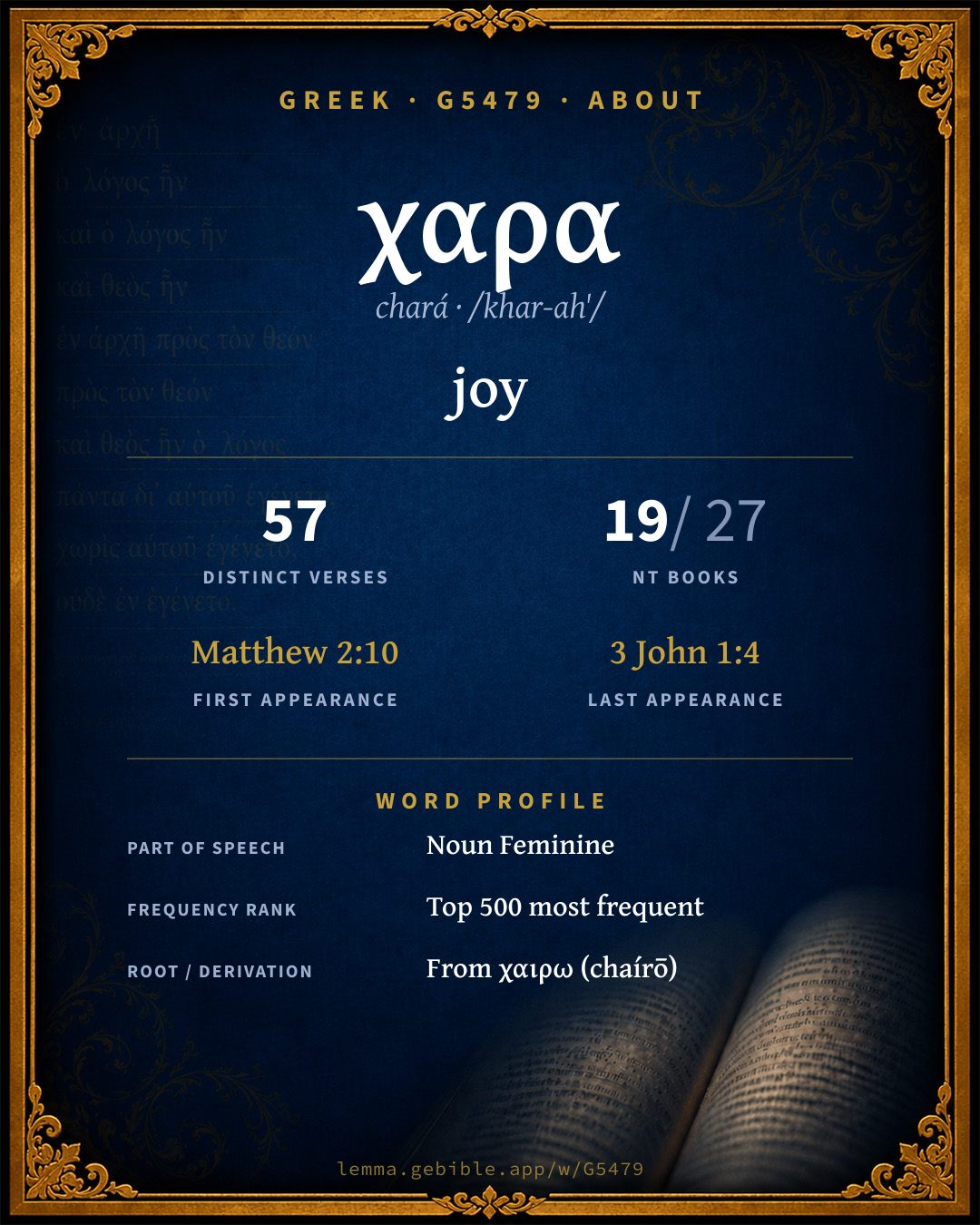
χαρά
joy
Full lexicon entry — Thayer's Greek Lexicon
From Thayer's Greek Lexicon
Where this word appears
See every Genitive-case word in the Greek New Testament →
Grammar key — what these labels mean
Part of speech
- Noun
- A naming word — a person, place, thing, or idea.
Case
- Genitive
- The case of source, possession, or “of” — answers “whose / from what.”
- Nominative
- The case of the subject (and the predicate nominative).
- Accusative
- The case of the direct object and of extent.
- Dative
- The case of the indirect object, means, or location — “to / for / with / in.”
Gender
- Feminine
- Grammatically feminine.
Number
- Singular
- One.
Grammatical forms
- Noun, Genitive, Singular, Feminine 22 times (37%)
- Noun, Nominative, Singular, Feminine 17 times (29%)
- Noun, Accusative, Singular, Feminine 14 times (24%)
- Noun, Dative, Singular, Feminine 6 times (10%)
Parsed forms decoded from the imported morphology (Robinson–Tischendorf, public domain), counted across 59 parsed occurrences — not distinct verses.
Every verse where G5479 appears — 57 distinct verses across 19 books. Click any verse to open its interlinear word-by-word view. Verse text shown in the World English Bible for context — . Each verse’s Greek form is shown with its reference; the English is not keyword-highlighted, since the data carries no word-level English alignment. Use “Compare translations” on any verse to read it across multiple English versions. This concordance covers the Greek New Testament; Septuagint (Greek Old Testament) occurrences of this word are not indexed here.
Matthew 6 verses
- Matthew 2:10 χαρὰν n acc sg fem When they saw the star, they rejoiced with exceedingly great joy.
- Matthew 13:20 χαρᾶς n gen sg fem What was sown on the rocky places, this is he who hears the word, and immediately with joy receives it;
- Matthew 13:44 χαρᾶς n gen sg fem "Again, the Kingdom of Heaven is like a treasure hidden in the field, which a man found, and hid. In his joy, he goes and sells all that he has, and buys that field.
- Matthew 25:21 χαρὰν n acc sg fem "His lord said to him, 'Well done, good and faithful servant. You have been faithful over a few things, I will set you over many things. Enter into the joy of your lord.'
- Matthew 25:23 χαρὰν n acc sg fem "His lord said to him, 'Well done, good and faithful servant. You have been faithful over a few things, I will set you over many things. Enter into the joy of your lord.'
- Matthew 28:8 χαρᾶς n gen sg fem They departed quickly from the tomb with fear and great joy, and ran to bring his disciples word.
Mark 1 verse
Luke 8 verses
- Luke 1:14 χαρά n nom sg fem You will have joy and gladness; and many will rejoice at his birth.
- Luke 2:10 χαρὰν n acc sg fem The angel said to them, "Don't be afraid, for behold, I bring you good news of great joy which will be to all the people.
- Luke 8:13 χαρᾶς n gen sg fem Those on the rock are they who, when they hear, receive the word with joy; but these have no root, who believe for a while, then fall away in time of temptation.
- Luke 10:17 χαρᾶς n gen sg fem The seventy returned with joy, saying, "Lord, even the demons are subject to us in your name!"
- Luke 15:7 χαρὰ n nom sg fem I tell you that even so there will be more joy in heaven over one sinner who repents, than over ninety-nine righteous people who need no repentance.
- Luke 15:10 χαρὰ n nom sg fem Even so, I tell you, there is joy in the presence of the angels of God over one sinner repenting."
- Luke 24:41 χαρᾶς n gen sg fem While they still didn't believe for joy, and wondered, he said to them, "Do you have anything here to eat?"
- Luke 24:52 χαρᾶς n gen sg fem They worshiped him, and returned to Jerusalem with great joy,
John 7 verses
- John 3:29 χαρᾷ χαρὰ n dat sg fem n nom sg fem He who has the bride is the bridegroom; but the friend of the bridegroom, who stands and hears him, rejoices greatly because of the bridegroom's voice. This, my joy, therefore is made full.
- John 15:11 χαρὰ χαρὰ n nom sg fem n nom sg fem I have spoken these things to you, that my joy may remain in you, and that your joy may be made full.
- John 16:20 χαρὰν n acc sg fem Most assuredly I tell you, that you will weep and lament, but the world will rejoice. You will be sorrowful, but your sorrow will be turned into joy.
- John 16:21 χαρὰν n acc sg fem A woman, when she gives birth, has sorrow, because her time has come. But when she has delivered the child, she doesn't remember the anguish any more, for the joy that a human being is born into the world.
- John 16:22 χαρὰν n acc sg fem Therefore you now have sorrow, but I will see you again, and your heart will rejoice, and no one will take your joy away from you.
- John 16:24 χαρὰ n nom sg fem Until now, you have asked nothing in my name. Ask, and you will receive, that your joy may be made full.
- John 17:13 χαρὰν n acc sg fem But now I come to you, and I say these things in the world, that they may have my joy made full in themselves.
Acts 4 verses
- Acts 8:8 χαρὰ n nom sg fem There was great joy in that city.
- Acts 12:14 χαρᾶς n gen sg fem When she recognized Peter's voice, she didn't open the gate for joy, but ran in, and reported that Peter was standing in front of the gate.
- Acts 13:52 χαρᾶς n gen sg fem The disciples were filled with joy with the Holy Spirit.
- Acts 15:3 χαρὰν n acc sg fem They, being sent on their way by the assembly, passed through both Phoenicia and Samaria, declaring the conversion of the Gentiles. They caused great joy to all the brothers.
Romans 3 verses
- Romans 14:17 χαρὰ n nom sg fem for the Kingdom of God is not eating and drinking, but righteousness, peace, and joy in the Holy Spirit.
- Romans 15:13 χαρᾶς n gen sg fem Now may the God of hope fill you with all joy and peace in believing, that you may abound in hope, in the power of the Holy Spirit.
- Romans 15:32 χαρᾷ n dat sg fem that I may come to you in joy through the will of God, and together with you, find rest.
2 Corinthians 5 verses
- 2 Corinthians 1:24 χαρᾶς n gen sg fem Not that we have lordship over your faith, but are fellow workers with you for your joy. For you stand firm in faith.
- 2 Corinthians 2:3 χαρὰ n nom sg fem And I wrote this very thing to you, so that, when I came, I wouldn't have sorrow from them of whom I ought to rejoice; having confidence in you all, that my joy would be shared by all of you.
- 2 Corinthians 7:4 χαρᾷ n dat sg fem Great is my boldness of speech toward you. Great is my boasting on your behalf. I am filled with comfort. I overflow with joy in all our affliction.
- 2 Corinthians 7:13 χαρᾷ n dat sg fem Therefore we have been comforted. In our comfort we rejoiced the more exceedingly for the joy of Titus, because his spirit has been refreshed by you all.
- 2 Corinthians 8:2 χαρᾶς n gen sg fem how that in much proof of affliction the abundance of their joy and their deep poverty abounded to the riches of their liberality.
Galatians 1 verse
Philippians 5 verses
- Philippians 1:4 χαρᾶς n gen sg fem always in every request of mine on behalf of you all making my requests with joy,
- Philippians 1:25 χαρὰν n acc sg fem Having this confidence, I know that I will remain, yes, and remain with you all, for your progress and joy in the faith,
- Philippians 2:2 χαρὰν n acc sg fem make my joy full, by being like-minded, having the same love, being of one accord, of one mind;
- Philippians 2:29 χαρᾶς n gen sg fem Receive him therefore in the Lord with all joy, and hold such in honor,
- Philippians 4:1 χαρὰ n nom sg fem Therefore, my brothers, beloved and longed for, my joy and crown, so stand firm in the Lord, my beloved.
Colossians 1 verse
1 Thessalonians 4 verses
- 1 Thessalonians 1:6 χαρᾶς n gen sg fem You became imitators of us, and of the Lord, having received the word in much affliction, with joy of the Holy Spirit,
- 1 Thessalonians 2:19 χαρὰ n nom sg fem For what is our hope, or joy, or crown of rejoicing? Isn't it even you, before our Lord Jesus at his coming?
- 1 Thessalonians 2:20 χαρά n nom sg fem For you are our glory and our joy.
- 1 Thessalonians 3:9 χαρᾷ n dat sg fem For what thanksgiving can we render again to God for you, for all the joy with which we rejoice for your sakes before our God;
2 Timothy 1 verse
Philemon 1 verse
Hebrews 4 verses
- Hebrews 10:34 χαρᾶς n gen sg fem For you both had compassion on me in my chains, and joyfully accepted the plundering of your possessions, knowing that you have for yourselves a better possession and an enduring one in the heavens.
- Hebrews 12:2 χαρᾶς n gen sg fem looking to Jesus, the author and perfecter of faith, who for the joy that was set before him endured the cross, despising shame, and has sat down at the right hand of the throne of God.
- Hebrews 12:11 χαρᾶς n gen sg fem All chastening seems for the present to be not joyous but grievous; yet afterward it yields the peaceful fruit of righteousness to those who have been exercised thereby.
- Hebrews 13:17 χαρᾶς n gen sg fem Obey your leaders and submit to them, for they watch on behalf of your souls, as those who will give account, that they may do this with joy, and not with groaning, for that would be unprofitable for you.
James 2 verses
1 Peter 1 verse
1 John 1 verse
2 John 1 verse
3 John 1 verse
About this entry
At a glance — auto-summarized from this page’s data, not written by a person. Every figure links to its source below. This summary describes the numbers; it doesn’t interpret them.
At its core, χαρα (chará) means “joy.” Scripture first uses it in Matthew 2:10. It turns up in 57 verses across 19 books, a moderately common footprint. It shares a root with χαιρω and χαρις. Dig into 57-verse concordance and the renderings breakdown below.
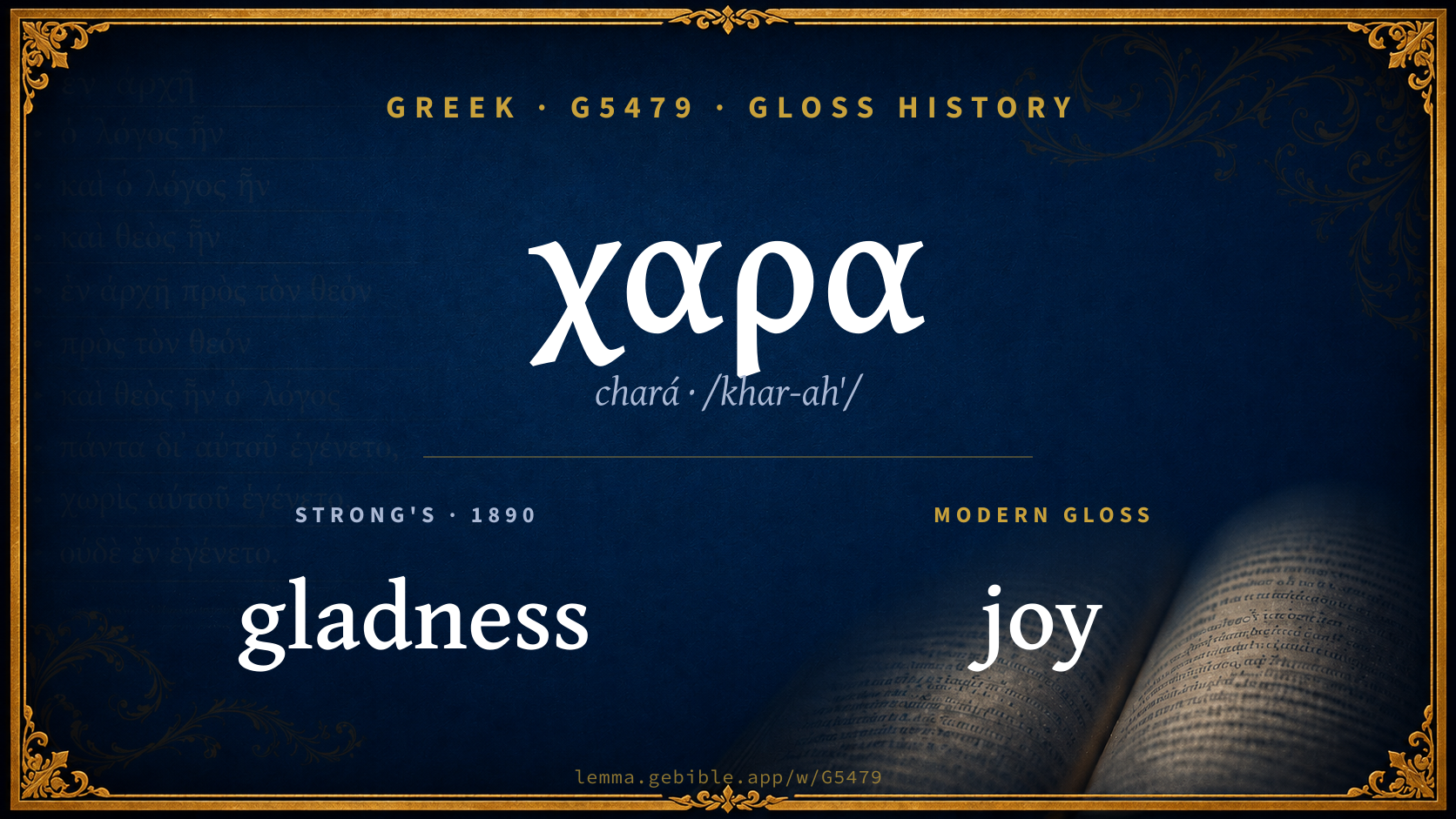
Gloss history
Strong's 1890 vs modern scholarship
About this word
Strong's G5479 catalogs a Greek word from the Greek New Testament.
These counts are not copied from any lexicon or concordance. They are computed here, from the morphology-tagged Greek New Testament. What Lemma adds →
- 57
- distinct verses
- The word appears in 57 distinct verses.
- 19 / 27
- NT books
- The word appears in 19 of 27 New Testament books.
- #275
- by frequency
- Top 500 most frequent Greek words (rank 275 of 5,347 Greek words by occurrence).
View all 57 occurrences in the concordance →
By section of the New Testament
By traditional corpus
Conventional, traditional groupings — biblical authorship is debated, so this is a traditional corpus grouping, not an authorship claim. Some books belong to more than one corpus (Luke is in both the Gospels and the Lukan corpus, and so on), so these shares overlap and need not total 100%. Each figure is a share of the word’s 57 distinct verses.
- Gospels 22 verses · 39%
- Pauline corpus 21 verses · 37%
- Lukan (Luke–Acts) 12 verses · 21%
- Johannine 10 verses · 18%
- General (Catholic) Epistles 6 verses · 11%
- Hebrews 4 verses · 7%
How translations render this word
Counts come from each version’s own published word-to-Strong’s tagging or interlinear alignment — an approximate guide to how each version renders this word, not a word-level alignment the data otherwise carries. Because each total is that version’s own tagged count, the per-version totals vary from one another and need not match the appearance or distinct-verse counts above. These counts may also differ from a printed concordance because Lemma counts each distinctly tagged rendering and does not collapse phrase taggings into a single head-word total. This is a fixed set of word-tagged versions (KJV, ASV, BSB, ULT) and does not change with the reading translation you choose elsewhere. Each version’s license is shown beside its name below (and on Sources).
- King James Version: Joy 51×, Gladness 3×
- American Standard Version: Joy 54×
- Berean Standard Bible: Joy 51×
- unfoldingWord Literal Text: Joy 59×, With 3×, Of 2×
King James Version Public Domain
Renders G5479 across 58 tagged occurrences — most commonly:
Plus 4 renderings that appear only once — usually multi-word phrases or single function words the recovered tagging swept in, not distinct renderings. Not rendered by a distinct English word in 1 further occurrence.
American Standard Version Public Domain
Renders G5479 across 60 tagged occurrences — most commonly:
Plus 6 renderings that appear only once — usually multi-word phrases or single function words the recovered tagging swept in, not distinct renderings.
Berean Standard Bible Public Domain
Renders G5479 across 55 tagged occurrences — most commonly:
Plus 4 renderings that appear only once — usually multi-word phrases or single function words the recovered tagging swept in, not distinct renderings. Not rendered by a distinct English word in 3 further occurrences.
unfoldingWord Literal Text CC BY-SA 4.0
Renders G5479 across 65 tagged occurrences — most commonly:
Plus 1 rendering that appears only once — usually multi-word phrases or single function words the recovered tagging swept in, not distinct renderings.
Senses in Thayer's
The 1 sense Thayer's distinguishes for this word, in lexicon order (not ranked by frequency or importance). The full entry — with sub-senses — is in the Lexicon Entry tab.
- joy, gladness
Word origin
Derived from χαιρω (chaírō) (G5463) — to rejoice.
From G5463 ; cheerfulness that is calm delight : - gladness X greatly (X be exceeding) joy (-ful -fully -fulness -ous).
— Strong’s Exhaustive Concordance (1890), public domain.
Forms in the corpus
The 6 distinct written forms G5479 takes in the Greek New Testament, most frequent first — each parse links to that case’s occurrences in the concordance.
| Form | Parsing | Example | Uses |
|---|---|---|---|
| χαρᾶς charâs | Noun, Genitive, Singular, Feminine | Matthew 13:20 | 22 |
| χαρὰ charà | Noun, Nominative, Singular, Feminine | Luke 15:7 | 14 |
| χαρὰν charàn | Noun, Accusative, Singular, Feminine | Matthew 2:10 | 13 |
| χαρᾷ charâ | Noun, Dative, Singular, Feminine | John 3:29 | 6 |
| χαρά chará | Noun, Nominative, Singular, Feminine | Luke 1:14 | 3 |
| χαράν charán | Noun, Accusative, Singular, Feminine | 3 John 1:4 | 1 |
Same root — word family
Other Thayer's entries built from the same root as G5479, grouped by Strong’s listed origin. These share a root / origin per the lexicon — not necessarily a shared meaning. Each links to that word’s own entry.
Derives from
Shares the same root
Compare all same-root words → They share a root, not necessarily a meaning.
Septuagint usage
The same Greek word χαρα appears 22 times in the Greek Old Testament (Septuagint), across 21 verses in 10 books.
- 22
- LXX occurrences
- Tagged occurrences of this Greek word in the Septuagint.
- 21
- verses
- Distinct Septuagint verses containing this word.
- 10 / 39
- OT books
- The word appears in 10 of the 39 Old Testament books.
Sample Septuagint occurrences
- 1 Chronicles 29:22 χαρά
- Esther 8:17 χαρά
- Psalms 20:7 χαρά
- Proverbs 14:13 χαρά
- Isaiah 39:2 χαρά
- Jeremiah 15:16 χαρά
- Lamentations 5:15 χαρά
- Joel 1:5 χαρά
- Jonah 4:6 χαρά
- Zechariah 8:19 χαρά
Septuagint occurrences (same lexeme)
Every verse where the same Strong’s number (G5479) appears in the Greek Septuagint. Verse text shown in the World English Bible for context; the Greek form is the matched word — the English is not keyword-highlighted.
- 1 Chronicles 29:22 χαρά and ate and drink before Yahweh on that day with great gladness. They made Solomon the son of David king the second time, and anointed him to Yahweh to be prince, and Zadok to be priest.
- Esther 8:17 χαρά In every province, and in every city, wherever the king's commandment and his decree came, the Jews had gladness and joy, a feast and a good day. Many from among the peoples of the land became Jews; for the fear of the Jews was fallen on them.
- Esther 9:17 χαρά [This was done] on the thirteenth day of the month Adar; and on the fourteenth day of the same they rested, and made it a day of feasting and gladness.
- Esther 9:18 χαρά But the Jews who were in Shushan assembled together on the thirteenth [day] of it, and on the fourteenth of it; and on the fifteenth [day] of the same they rested, and made it a day of feasting and gladness.
- Esther 9:22 χαρά as the days in which the Jews had rest from their enemies, and the month which was turned to them from sorrow to gladness, and from mourning into a good day; that they should make them days of feasting and gladness, and of sending portions one to another, and gifts to the needy.
- Psalms 20:7 χαρά Some trust in chariots, and some in horses, But we trust the name of Yahweh our God.
- Psalms 125:2 χαρά As the mountains surround Jerusalem, So Yahweh surrounds his people from this time forth and forevermore.
- Proverbs 14:13 χαρά Even in laughter the heart may be sorrowful, And mirth may end in heaviness.
- Proverbs 29:6 χαρά An evil man is snared by his sin, But the righteous can sing and be glad.
- Isaiah 39:2 χαρά Hezekiah was glad of them, and shown them the house of his precious things, the silver, and the gold, and the spices, and the precious oil, and all the house of his armor, and all that was found in his treasures: there was nothing in his house, nor in all his dominion, that Hezekiah didn't show them.
- Isaiah 55:12 χαρά For you shall go out with joy, and be led forth with peace: the mountains and the hills shall break forth before you into singing; and all the trees of the fields shall clap their hands.
- Isaiah 66:10 χαρά Rejoice you with Jerusalem, and be glad for her, all you who love her: rejoice for joy with her, all you who mourn over her;
- Jeremiah 15:16 χαρά Your words were found, and I ate them; and your words were to me a joy and the rejoicing of my heart: for I am called by your name, Yahweh, God of hosts.
- Jeremiah 16:9 χαρά For thus says Yahweh of Hosts, the God of Israel: Behold, I will cause to cease out of this place, before your eyes and in your days, the voice of mirth and the voice of gladness, the voice of the bridegroom and the voice of the bride.
- Jeremiah 25:10 χαρά Moreover I will take from them the voice of mirth and the voice of gladness, the voice of the bridegroom and the voice of the bride, the sound of the millstones, and the light of the lamp.
- Lamentations 5:15 χαρά The joy of our heart is ceased; Our dance is turned into mourning.
- Joel 1:5 χαρά Wake up, you drunkards, and weep! Wail, all you drinkers of wine, because of the sweet wine; For it is cut off from your mouth.
- Joel 1:12 χαρά The vine has dried up, and the fig tree withered; the pomegranate tree, the palm tree also, and the apple tree, Even all of the trees of the field are withered; For joy has withered away from the sons of men.
- Joel 1:16 χαρά Isn't the food cut off before our eyes; Joy and gladness from the house of our God?
- Jonah 4:6 χαρά Yahweh God prepared a vine, and made it to come up over Jonah, that it might be a shade over his head, to deliver him from his discomfort. So Jonah was exceedingly glad because of the vine.
- Zechariah 8:19 χαρά Thus says Yahweh of Hosts: "The fasts of the fourth fifth, seventh, and tenth months shall be for the house of Judah joy and gladness, and cheerful feasts. Therefore love truth and peace."
These are occurrences of the same Greek lexeme (G5479) in the Septuagint — not a translation of any one Hebrew word. The store carries no word-level Hebrew↔Greek alignment, so no Hebrew original is asserted here. Counts come from the recovered LXX Strong's tagging — high-frequency vocabulary is well covered, while rare or late forms may be untagged — so they reflect tagged occurrences and may slightly undercount.