
1 Peter 2:19

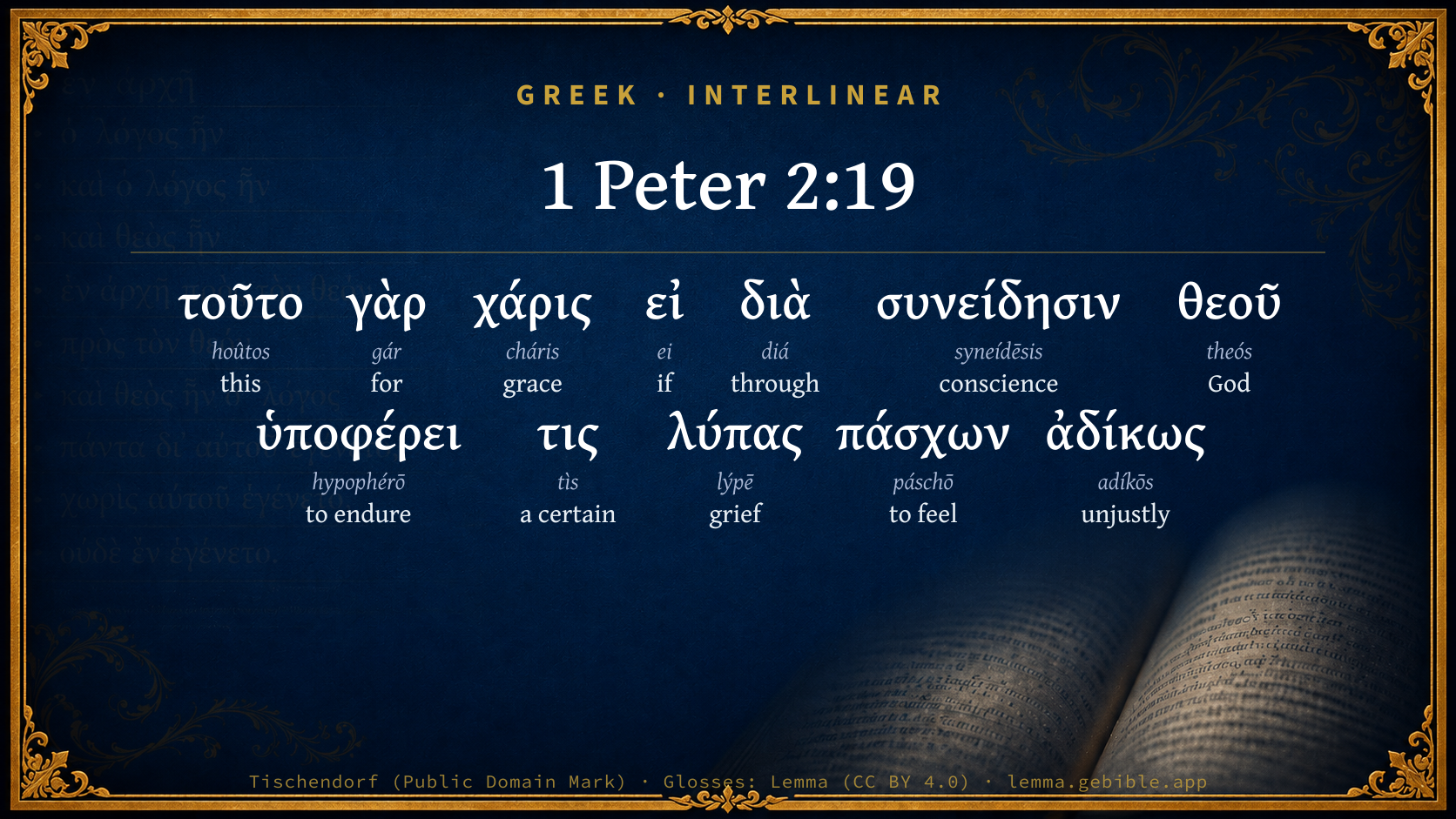
Greek (Tischendorf 8th ed.) 1 Peter 2:19 appears in the Greek New Testament. The text above is from the Tischendorf 8th edition. Each word links to its Strong’s number and a concise gloss. Click any word for its full Thayer’s Greek Lexicon entry.
Download image
Cite this verse

1 Peter 2:19 (World English Bible). Public Domain. Lemma interlinear Bible study tool, https://lemma.gebible.app/v/1-peter/2/19.

Show BibTeX & RIS
BibTeX
RIS
English Translation
For it is commendable if someone endures pain, suffering unjustly, because of conscience toward God.
World English Bible · Public Domain
Highlights
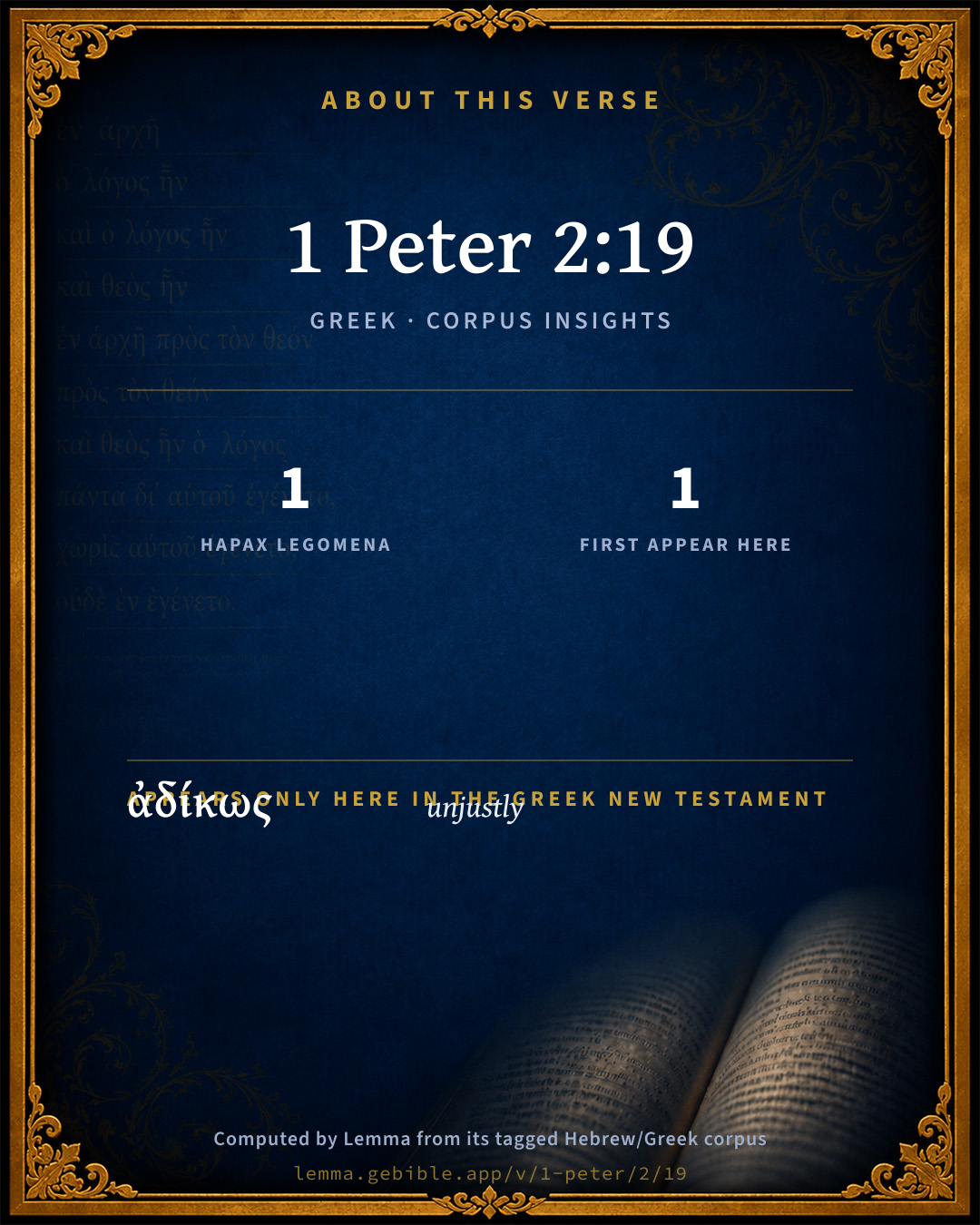
  • 1 hapax legomenon — only here in the Greek New Testament
  • 1 first appearance in the Greek New Testament
Full analysis ↓
Download a study sheet

One document with this verse’s original text, its word-by-word gloss line, the meaning frame, cross-references with their text, attributed commentary, and full source and license credits — printable, and it pastes into notes with its structure intact.

This verse Autodidact and up

Study sheet (.html) Plain text (.txt)

A passage Seminary Student

Up to 50 verses in one chapter. A passage sheet keeps up to 6 commentary sources and 12 cross-references per verse, in the order this page ranks them, and says so on the sheet whenever that leaves anything out. Ask for a single verse and you get the Autodidact verse sheet above.

Everything on this page stays free to read, with no account — the sheet is a download of what is already on screen, not access to it.

Want to remove ads? Support Godless Engineer
Compare translations 3

The same verse in 3 English versions, stacked beneath the original-language interlinear above. Click any original word for its lexicon entry.

Each is an independent rendering of the whole verse — the interlinear is not word-aligned to these translations.

Highlighted words mark where these versions differ — a whole-verse word diff, not a word-by-word alignment.

  • World English Bible Public Domain
    For it is commendable if someone endures pain, suffering unjustly, because of conscience toward God.
  • King James Version Public Domain
    For this is thankworthy, if a man for conscience toward God endure grief, suffering wrongfully.
  • unfoldingWord Literal Text CC BY-SA 4.0
    For this favor—if anyone endures sorrows, suffering unjustly because of consciousness of God.

unfoldingWord Literal Text — © unfoldingWord, licensed CC BY-SA 4.0. Word-aligned USFM3 via Door43 (git.door43.org/unfoldingWord/en_ult).

Versions to compare (up to 4)

3 of 4 selected

Show all 19 translations

Every available English version of this verse, each an independent rendering of the whole verse.

  • World English Bible Public Domain
    For it is commendable if someone endures pain, suffering unjustly, because of conscience toward God.
  • Berean Standard Bible Public Domain
    For if anyone endures the pain of unjust suffering because he is conscious of God, this is to be commended.
  • Majority Standard Bible Public Domain
    For if anyone endures the pain of unjust suffering because he is conscious of God, this is to be commended.
  • King James Version Public Domain
    For this is thankworthy, if a man for conscience toward God endure grief, suffering wrongfully.
  • American Standard Version (1901) Public Domain
    For this is acceptable, if for conscience toward God a man endureth griefs, suffering wrongfully.
  • Revised Version (1885) Public Domain
    For this is acceptable, if for conscience toward God a man endureth griefs, suffering wrongfully.
  • Geneva Bible (1599) Public Domain
    For this is thanke worthie, if a man for conscience toward God endure griefe, suffering wrongfully.
  • Douay-Rheims (1899) Public Domain
    For this is thankworthy, if for conscience towards God, a man endure sorrows, suffering wrongfully.
  • Young's Literal Translation Public Domain
    for this `is' gracious, if because of conscience toward God any one doth endure sorrows, suffering unrighteously;
  • Literal Standard Version CC BY-SA 4.0
    for this [is] grace: if anyone endures sorrows because of conscience toward God, suffering unrighteously;
  • Unlocked Literal Bible CC BY-SA 4.0
    For it is praiseworthy if anyone endures pain while suffering injustice because of his awareness of God.
  • unfoldingWord Literal Text CC BY-SA 4.0
    For this favor—if anyone endures sorrows, suffering unjustly because of consciousness of God.
  • Darby Bible Public Domain
    For this [is] acceptable, if one, for conscience sake towards God, endure griefs, suffering unjustly.
  • World Messianic Bible Public Domain
    For it is commendable if someone endures pain, suffering unjustly, because of conscience toward God.
  • Webster's Bible Public Domain
    For this is thank-worthy, if a man for conscience towards God endureth grief, suffering wrongfully.
  • Free Bible Version CC BY-SA 4.0
    For this is what grace is: to endure life's pain and unfair suffering, keeping your focus on God.
  • Bible in Basic English Public Domain
    For it is a sign of grace if a man, desiring to do right in the eyes of God, undergoes pain as punishment for something which he has not done.
  • Text-Critical English NT CC BY 4.0
    For there is favor upon anyone who endures pain while suffering unjustly for the sake of conscience toward God.
  • Tyndale New Testament (1534) Public Domain
    For it is thankeworthye yf a man for conscience towarde god endure grefe sufferinge wrongfully.

Literal Standard Version (2020), Covenant Press — licensed CC BY-SA 4.0. Text via the HelloAO Bible API (eBible.org). Unlocked Literal Bible (unfoldingWord) — licensed CC BY-SA 4.0. Text via the HelloAO Bible API (eBible.org). unfoldingWord Literal Text — © unfoldingWord, licensed CC BY-SA 4.0. Word-aligned USFM3 via Door43 (git.door43.org/unfoldingWord/en_ult). Free Bible Version, Dr. Jonathan Gallagher — licensed CC BY-SA 4.0. Text via the HelloAO Bible API (eBible.org).

Word by word

More ways to search: Search by grammar → Find every occurrence → Compare this word →

Practice this passage: Drill this verse → Learn its vocabulary →

About this verse

These counts appear in no published source. They are computed here, from the morphology-tagged text and Lemma’s own curated glosses. What Lemma adds →

12
words
12
distinct lemmas
General Epistles
section

Notable vocabulary

1 hapax legomenon — a word that appears only here in the entire Greek New Testament:

  • ἀδίκως unjustly G95

First appearance in Scripture

This word makes its first canonical appearance in the Greek New Testament here:

  • ἀδίκως unjustly G95

Shared distinctive vocabulary

ὑποφέρει to endure G5297 occurs in 3 verses of the Greek New Testament. Also found in:
Cross-references

14

Topical passages linked to 1 Peter 2:19 in the Treasury of Scripture Knowledge — connected by theme and wording, ordered by reader-vote popularity; previews shown in the World English Bible.

  • Matthew 5:10–12 Blessed are those who have been persecuted for righteousness' sake, For theirs is the Kingdom of Heaven.
  • 1 Peter 2:20 For what glory is it if, when you sin, you patiently endure beating? But if, when you do well, you patiently endure suffering, this is commendable with God.
  • 1 Peter 3:14–17 But even if you should suffer for righteousness' sake, you are blessed. "Don't fear what they fear, neither be troubled."
  • Luke 6:32 If you love those who love you, what credit is that to you? For even sinners love those who love them.
  • 1 Corinthians 15:10 But by the grace of God I am what I am. His grace which was bestowed on me was not futile, but I worked more than all of them; yet not I, but the grace of God which was with me.
  • John 15:21 But all these things will they do to you for my name's sake, because they don't know him who sent me.
  • Romans 13:5 Therefore you need to be in subjection, not only because of the wrath, but also for conscience' sake.
  • Psalms 119:86 All of your commandments are faithful. They persecute me wrongfully. Help me!
  • 2 Corinthians 1:12 For our boasting is this: the testimony of our conscience, that in holiness and sincerity of God, not in fleshly wisdom but in the grace of God we behaved ourselves in the world, and more abundantly toward you.
  • 2 Corinthians 8:1 Moreover, brothers, we make known to you the grace of God which has been given in the assemblies of Macedonia;
  • 2 Timothy 1:12 For this cause I suffer also these things. Yet I am not ashamed, for I know him whom I have believed, and I am persuaded that he is able to guard that which I have committed to him against that day.
  • Psalms 35:19 Don't let those who are my enemies wrongfully rejoice over me; Neither let them wink with the eye who hate me without a cause.
  • Psalms 38:19 But my enemies are vigorous and many. Those who hate me without reason are numerous.
  • Psalms 69:4 Those who hate me without a cause are more than the hairs of my head. Those who want to cut me off, being my enemies wrongfully, are mighty. I have to restore what I didn't take away.

Cross-references courtesy of OpenBible.info (CC BY 4.0).

Commentary

Notes on 1 Peter 2:19 from classic Christian and Jewish commentators (each source and its license shown beneath its notes). The classic Christian expositions comment on the surrounding passage and are grouped to its opening verse, so a note may address several verses; the Jewish commentaries on the Tanakh (Rashi and others) are per-verse, so they appear only where the commentator wrote on this verse.

Lemma curates 59 commentaries, every one of them public domain or Creative Commons licensed, each selected and text-cleaned for this edition rather than reprinted as found. About our sources →

Bengel's Gnomon

Johann Albrecht Bengel

1Pe 2:19. Χάρις [“thank-worthy”], favour) with God: 1Pe 2:20.—διὰ συνείδησιν Θεοῦ, for conscience toward God) On account of the consciousness of a mind which does things good and pleasing to God, even though they please no man (let the force of κλέος, which presently follows, be considered).[18]—ἀδίκως, unjustly) that is, suffering those things, which are unjustly inflicted. חנם, ἀδίκως, Septuagint, Pro 1:11; Pro 1:17.

[18] When a just man is not approved of by men, though doing what is good, and when he does not acquire, either before or afterwards, either their assent, support, or the intimation of a grateful mind, nay, rather experiences everything of an opposite kind, he may possibly be affected with no small chagrin and sorrow. But, if his conscience can only have God propitious, nothing but an unmixed feeling of delight remains.—V. g.

Bengel's Gnomon of the New Testament — English translation (T&T Clark, Edinburgh, 1860) — public domain. Text from a community e-Sword module.

Meyer's Critical & Exegetical Commentary

Heinrich August Wilhelm Meyer

1Pe_2:19. τοῦτο γὰρ χάρις, εἰ] The ground of the exhortation. τοῦτο refers to the clause beginning with εἰ.

χάρις has not the special meaning grace here, as if it were to be explained, either with the older commentators: gratiam concilians; or as if by it were to be understood the gift of grace (Steiger: it is to be regarded as grace, if one can suffer for the sake of God; so, too, Schott), or the condition of grace (Wiesinger: in the ὑπομένειν is manifested the actual condition of grace); for this expression is not parallel with κλέος, 1Pe_2:12 : and how can a summons be issued in a manner so direct, to the performance of a duty, by representing it either as a gift of grace or a proof of a state of grace? Besides, Wiesinger alters the term grace into sign of grace.

Some commentators, on account of 1Pe_2:20, explain χάρις as synonymous with κλέος, but without any linguistic justification; thus already Oecumenius (Calvin: idem valet nomen gratiae quod laudis; qui patienter ferunt injurias, ii laude digni sunt). In profane Greek χάρις denotes either the charm or the loveliness, or also the favour which one person has for another (to which are linked on the meanings, expressions of goodwill and thanks). Both senses are to be found in the Scriptures.[149] If the first signification be adopted, the enduring of the adversity of which Peter here speaks is characterized as something lovely; and so Cremer (see under ΧΆΡΙς, p. 576) seems to take it. But it is more natural to hold by the second sense, and to explain this is favour, as equal to this causes favour. Several interpreters explain χάρις as equal directly to delight, substituting for the substantive the adjective well-pleasing, and supplying ΠΑΡᾺ Τῷ ΘΕῷ from 1Pe_2:20. Thus Gerhard: hoc est Deo gratum et acceptum; de Wette: Favour with God, i.e. well-pleasing before God; so, too, Hofmann. But both of these are open to objection. Hofmann no doubt gives as the ground of his supplement: that the slave who lived up to the apostles injunction has to look for the approval of none. This is, however, surely an unjustifiable assertion. It is not clear why Peter did not add the words supplied if he had them in his mind; χάρις and ΚΛΈΟς in 1Pe_2:20 are thereforein consideration of 1Pe_2:12; 1Pe_2:15to be taken quite generally. The following clause indicates a good behaviour, by which the ΚΑΤΑΛΑΛΊΑ of the heathen is to be put to silence.

ΕἸ ΔΙᾺ ΣΥΝΕΊΔΗΣΙΝ ΘΕΟῦ ὙΠΟΦΈΡΕΙ Κ.Τ.Λ.] ΕἸ refers back to ΤΟῦΤΟ; ΔΙᾺ ΣΥΝΕΊΔΗΣΙΝ ΘΕΟῦ is placed first by way of emphasis. ΣΥΝΕΊΔΗΣΙς ΘΕΟῦ is neither Gods knowledge of us (Morus: quia Deus conscius est tuarum miseriarum; similarly Fronmüller: on account of the knowledge shared by God, since God knows all), nor is it conscientiousness before God (Stolz); but ΘΕΟῦ is the object. genit. (cf. 1Co_8:7; Heb_10:2), therefore the meaning is: the (duty-compelling) consciousness of God. Calov: quia conscius est, id Deum velle et Deo gratum esse; so, too, de Wette, Schott, etc. A metonymy does not require to be assumed (Grotius: per metonymiam objecti dicitur conscientia ejus, quod quis Deo debet). Steiger introduces what is foreign to it when he extends the idea so as to include the conscious knowledge of the divine recompense. In ΔΙᾺ ΣΥΝΕΙΔ. ΘΕΟῦ is expressed substantially the same thought as in Ὡς ΘΕΟῦ ΔΟῦΛΟΙ, 1Pe_2:16, and ΔΙᾺ Τ. ΚΎΡΙΟΝ, 1Pe_2:13; ΔΙᾺ ΤῊΝ ΣΥΝΕΊΔΗΣΙΝ without ΘΕΟῦ is to be found in Rom_13:5.

ὙΠΟΦΈΡΕΙ ΤΙς ΛΎΠΑς] ὙΠΟΦΈΡΕΙΝ: to bear the burden put on one; the opposite of succumbing under a burden, cf. 1Co_10:13, 2Ti_3:11; nevertheless, the apostle seems here to have in mind more the antithesis to being provoked to anger and stubbornness (Hofmann).

λύπαι here: outward afflictions.

ΠΆΣΧΩΝ ἈΔΊΚΩς] whilst (not although) he suffers wrong (from the master, i.e. undeserved on the part of the slave).

It is not suffering itself, but patient endurance in the midst of undeserved suffering, and that διὰ συνείδησιν Θεοῦ, which Peter calls a ΧΆΡΙς.

This thought, general in itself, is here applied to the relation of servant to master.

[149] Χάρις has the first meaning, Psa_45:3; Pro_1:9; Pro_10:32, etc.; also Sir_7:19, etc.; in the N. T. Luk_4:22; Col_4:6, etc. The second signification, Pro_22:1, etc.; in the N. T. Luk_1:30; Luk_2:52; Act_2:47, etc. Cf. besides Cremer and Wahl: Clavis libr. V. T. apocryphi.

Meyer — Critical and Exegetical Commentary on the New Testament — English translation by Peter Christie, edited by Frederick Crombie (T&T Clark, 1880) — public domain. Text from a community e-Sword module.

Expositor's Greek Testament

ed. W. Robertson Nicoll

1Pe 2:19 f. Summary application of the teaching of Jesus recorded in Luk 6:27-36 = Mat 5:39-48 . χάρις seems to be an abbreviation of the O.T. idiom to find favour ( תן ) with God cf. χάρις παρὰ θεῷ (20) taken from St. Luke’s version of the saying, εἰ ἀγαπᾶτε τοὺς ἀγαπῶντας ὑμᾶς , ποία ὑμῖν χάρις ἔστιν (Luk 6:32 ). Compare χάριτας = רצון that which is acceptable in Pro 10:32 . διὰ συνείδησιν θεοῦ (i.) because God is conscious of your condition ( θεοῦ subjective genitive), a reproduction of thy Father which seeth that which is hidden … (Mat 6:4 , etc.); so συνείδ . in definite philosophical sense of conscience is usually followed by possessive genitive OR (2.) because you are conscious of God ( θ . objective genitive), cf. σ . ἁμαρτίας , Heb 10:2 . The latter construction is preferable: the phrase interprets διὰ τὸν κύριον with the help of the Pauline expression διὰ τὴν ς . (Rom 13:5 ; 1Co 10:25 ) employed in the same context. πάσχων ἀδίκως , emphatic. Peter has to take account of the possibility which Jesus ignored, that Christians might deserve persecution; cf. 1Pe 2:20 ; 1Pe 2:25 . ποῖον κλέος , what praise rather than what kind of reputation ( κλ . neutral as in Thuc. 2:45) cf. ποία χάρις τίνα μισθόν , (only twice in Job in LXX) corresponds to ἔπαινος above: χάρις παρὰ θεῷ shows that the praise of the Master who reads the heart is intended. κολαφιζόμενοι , from description of the Passion, Mar 14:65 , ἤρξαντό τινες … κολαφίζειν αὐτόν , cf. Mat 5:39 , ὅστις σε ῥαπίζει . So also St. Paul recalls the parallel between Christ’s and the Chrstians’ sufferings (1Co 4:11 ) κολαφιζόμεθα . ἀγαθοποιοῦντες , opposed to ἁμαρτάνοντες , explains ἀδίκως (19). χάρις , see on 10. 1Pe 2:19 .

The Expositor's Greek Testament, edited by W. Robertson Nicoll (1897–1910) — public domain. Text from a community e-Sword module.

Geneva Bible (1599)

Geneva Bible translators

The taking away of an objection: Indeed the condition of servants is hard, especially if they have froward masters: but this their subjection shall be so much the more acceptable to God, if his will prevails more with servants, than the masters’ injuries.

Because he maketh a conscience of it to offered God, by whose good will and appointment, he knoweth this burden is laid upon him.

Geneva Bible (1599) marginal notes — public domain. Text via Bolls.life.

Jamieson, Fausset & Brown

Robert Jamieson, A. R. Fausset & David Brown

Reason for subjection even to froward masters.

thankworthy-- (Luk 6:33). A course out of the common, and especially praiseworthy in the eyes of God: not as Rome interprets, earning merit, and so a work of supererogation (compare Pe1 2:20).

for conscience toward God--literally, "consciousness of God": from a conscientious regard to God, more than to men.

endure--Greek, "patiently bear up under": as a superimposed burden [ALFORD].

grief--Greek, "griefs."

Jamieson, Fausset & Brown — Commentary Critical and Explanatory on the Whole Bible (1871) — public domain (CC PDM 1.0). Text via the HelloAO Bible API.

Adam Clarke's Commentary

Verse 19. For this is thankworthy] If, in a conscientious discharge of your duty, you suffer evil, this is in the sight of God thankworthy, pleasing, and proper; it shows that you prefer his authority to your own ease, peace, and emolument; it shows also, as Dr. Macknight has well observed, that they considered their obligation to relative duties not to depend on the character of the person to whom they were to be performed, nor on their performing the duties they owed to their servants, but on the unalterable relations of things established by God.

Adam Clarke's Commentary on the Bible (1810–1826) — public domain. Text from a community e-Sword/MySword module.

John Calvin's Commentaries

19 For this is thankworthy The word grace or favor, has the meaning of praise; for he means that no grace or praise shall be found before God, if we bear the punishment which we have by our faults deserved; but that they who patiently bear injuries and wrongs are worthy of praise and accepted by God. To testify that it was acceptable to God, when any one from conscience towards God persevered in doing his duty, though unjustly and unworthily treated, was at that time very necessary; for the condition of servants was very hard: they were counted no better than cattle. Such indignity might have driven them to despair; the only thing left for them was to look to God.

For conscience towards God means this, that one performs his duty, not from a regard to men, but to God. For, when a wife is submissive and obedient to her husband, in order to please him, she has her reward in this world, as Christ says of the ambitious, who looked to the praise of men, (Matthew 6:16.) The same view is to be taken of other cases: When a son obeys his father in order to secure his favor and bounty, he will have his reward from his father, not from God. It is, in short, a general truth, that what we do is approved by God, if our object be to serve him, and if we are not influenced by a regard to man alone. Moreover, he who considers that he has to do with God, must necessarily endeavor to overcome evil with good. For, God not only requires that we should be such to every one as he is to us, but also that we should be good to the unworthy and to such as persecute us.

John Calvin's Commentaries (1540-1563) — public domain. Text from the Calvin Translation Society English edition (1840s-50s) via the Christian Classics Ethereal Library (ccel.org). Calvin's coverage is partial (roughly two-thirds of the Bible); uncommented books and verses are honest gaps, never fabricated. The 19th-century editor's footnotes and remarks are omitted so the notes are faithfully Calvin's own voice.

Ellicott's Commentary for English Readers

(19) For this is thankworthy.—“This,” viz., what goes before, which is further explained in what follows. Quite literally it is, for this is grace, or else (for, like grâce in French, ‘the word has the double signification) this is thanks. The passage has some little importance in controversy, as some of the older Roman Catholic divines pressed it into the service of the supererogation theory. “This is grace,” they said, means “this deserves grace as its reward.” It is needless to point out how shallow a view of duty is implied in the thought that it was more than duty to be thus submissive. Still taking the first translation, others would interpret, “this is a mark of grace”—i.e., shows that you are Christians indeed; or, “this is a gift of grace”—i.e., a supernatural and heroic virtue, such as must have come from God, and not from you.” These two interpretations make good sense in themselves, but they seem not to suit the context (“what glory is it”) quite so well as our authorised rendering, and they ignore the sayings of our Lord, which must certainly have been in St. Peter’s mind, recorded in Luk_6:27-35, especially Luk_6:32-34, and again in Luk_17:9. The thought is that where duty is both obvious and easy (as is the case with good masters), people do not lavish gratitude for the performance of it. The best of masters hardly feels grateful to the best of servants for doing his duty, though he will be grateful for the spirit and manner in which it is done. Here the “thanks” are put quite generally, as in the first passage in St. Luke: “this is a matter for thanks.” It does not say as yet who is to pay the thanks, and we may naturally conclude that the master so served, and all who are cognisant of the service, are the persons meant.

For conscience toward God endure grief, suffering wrongfully.—This does not mean “if a man is afflicted for his religion’s sake.” Rather, the conscience towards God, or, perhaps, rather, consciousness of God, is thrown in to guard against any false theory that patience by itself is a thankworthy thing. However unjust the man’s treatment may be, and however little he may resent it in act, it is not thankworthy unless his resignation be grounded on consciousness of God’s presence. A resignation which comes from stolid want of feeling, or stoical fatalism, or from the sense that it is no good to seek redress—such resignation is sinfully defective. The two necessary qualifications, before patience can become in any sense meritorious, are (1) that the suffering should be undeserved, (2) that the man should recognise in it the hand of God.

A Bible Commentary for English Readers, edited by Charles John Ellicott (1878–1897) — public domain. Text from a community e-Sword module.

The Cambridge Bible for Schools and Colleges

gen. ed. J. J. S. Perowne

19. For this is thankworthy] The word charis, commonly translated “grace,” is here used in the sense, which attaches also to the Latin gratia, as in ago tibi gratias, and the French mille graces, of thanks or cause for thanks. So in Luk_6:32 the same word is used in “what thank have ye,” where the context shews that it is equivalent to a “reward,” and in that case, as in this, a reward from God. It is not unreasonable to suppose that St Peter’s choice of the term was determined by the use of it which St Luke records in his report of the Sermon on the Plain.

for conscience toward God] Literally, consciousness of God, i.e. of His presence as seeing, judging, helping, rewarding, His suffering servants. The phrase is analogous to the “conscience of the idol” in 1Co_8:7.

suffering wrongfully] Natural impulse, one might almost say natural ethics, sanctions the burning indignation and desire to retaliate which is caused by the sense of wrong. Here, as in the Sermon on the Mount (Mat_5:39), which this teaching distinctly reproduces, that is made the crucial instance in which the Christian is to shew that the law of Christ is his rule of life. It is obvious that in this case the allowance of any exception to the rule would make it altogether inoperative. Each party in a dispute or quarrel thinks himself at the moment in the right, and it is only by acting on the principle that the more he believes himself to be in the right the more it is his duty to submit patiently, that a man can free himself from an endless entanglement of recriminations and retaliations.

The Cambridge Bible for Schools and Colleges (gen. ed. J. J. S. Perowne; Cambridge University Press, 1878–1918) — public domain. Text from a community e-Sword module.

John Gill's Exposition

For what glory is it, if, when ye be buffeted for your faults,.... Which ye have committed, and are guilty of, and are truly such:

ye shall take it patiently? to be silent, and not murmur when beaten, within measure, for real faults, is no great honour, nor does it deserve any praise; it is the least that can be done:

but if, when ye do well; either in their master's service, or rather in the business of religion, and the things of God; as when what they do is according to the will of God, and from love to him, and in faith, and in the name and strength of Christ, and to the glory of God; without all which there is no well doing:

and suffer for it; reproach and persecution, by words or blows, in person or property:

ye take it patiently; without grieving and repining, or answering again, and making any returns:

this is acceptable with God; is agreeably to his will, and grateful in his sight, what he is well pleased with, is reckoned grace with him; and though it is his own grace, and of his own bestowing, he will reward it with glory.

John Gill's Exposition of the Whole Bible (1746–1763) — public domain (CC PDM 1.0). Text via the HelloAO Bible API.

Trapp's Complete Commentary

John Trapp

19 For this is thankworthy, if a man for conscience toward God endure grief, suffering wrongfully.

Ver. 19. This is thankworthy] τουτο γαρ χαρις εστι. God accounts himself hereby gratified, as it were, and even beholden to such sufferers, this being the lowest subjection and the highest honour men can yield unto their Maker. God will thank such, which is condescensio stupenda, a wonderful condescension.

John Trapp, A Commentary or Exposition upon All the Books of the Old and New Testament (1647–1656) — public domain. Text from a community e-Sword module.

Albert Barnes' Notes on the Bible

For this is thank-worthy - Margin, “thank.” Greek, “This is grace,” (χάρις charis). Doddridge renders the expression, “This is graceful indeed.” Various interpretations of this expression have been proposed; but the meaning evidently is, that it is acceptable to God, (see 1Pe 2:20, “this is acceptable to God” - χάρις παρὰ Θεῷ charis para Theō;) that is, this will be regarded by him with favor. It does not mean that it was worthy of thanks, or that God would thank them for doing it, (compare Luk 17:9-10;) but that such conduct would meet with his approbation.

If a man for conscience toward God - If, in the conscientious discharge of his duty, or if, in the endurance of this wrong, he regards himself as serving God. That is, if he feels that God, by his providence, has placed him in the circumstances in which he is, and that it is a duty which he owes to him to bear every trial incident to that condition with a submissive spirit. If he does this, he will evince the true nature of religion, and will be graciously accepted of God.

Endure grief - That is, endure that which is suited to produce grief, or that which is wrong.

Suffering wrongfully - Suffering injury, or where there is “injustice,” (πάσχων ἀδίκως paschōn adikō̄s.) This, though a general remark, has particular reference to servants, and to their duty in the relation which they sustain to their masters. In view of what is here said, we may remark:

(1) That if this has reference to slaves, as has been usually supposed, it proves that they are very liable to be abused; that they have little or no security against being wronged; and that it was a special and very desirable characteristic of those who were in that condition, to be able to bear wrong with a proper spirit. It is impossible so to modify slavery that this shall not be the case; for the whole system is one of oppression, and there can be nothing that shall effectually secure the slave from being ill-treated.

(2) It would follow from this passage, if this refers to slavery, that that is a very hard and undesirable condition of life; for that is a very undesirable condition where the principal virtue. which they who are in it are required to exercise, is “patience under wrongs.” Such a condition cannot be in accordance with the gospel, and cannot be designed by God to be permanent. The relation of parent and child is never thus represented. It is never said or implied in the Scriptures that the principal virtue to which children are exhorted is patience under wrongs; nor, in addressing them, is it ever supposed that the most prominent thing in their condition is, that they would need the exercise of such patience.

(3) It is acceptable to God, if we bear wrong with a proper spirit, from whatever quarter it may come. Our proper business in life is, to do the will of God; to evince the right spirit, however others may treat us; and to show, even under excessive wrong, the sustaining power and the excellence of true religion. Each one who is oppressed and wronged, therefore, has an eminent opportunity to show a spirit which will honor the gospel; and the slave and the martyr may do more to honor the gospel than if they were both permitted to enjoy liberty and life undisturbed.

Albert Barnes' Notes on the Bible (1834–1885) — public domain. Text from a community e-Sword/MySword module.

Haydock's Catholic Bible Commentary

Take notice that this is praiseworthy, an effect of God’s grace, a thing acceptable to God, when you suffer injuries patiently; whereas it is not glory, nothing that deserves commendation or reward, either before God or man, to suffer for doing ill, as a malefactor, who deserves punishments. But it is glorious and meritorious for you to suffer as Christians, and for the Christian faith: be not then ashamed to suffer in this manner. These sufferings are marks of God’s favour towards you, and you have the example of Christ, which you must imitate. (Witham)

George Leo Haydock (1774–1849), Haydock's Catholic Family Bible and Commentary, 1859 edition — public domain. Excludes Psalms (Douay-Rheims chapter numbering differs from Protestant) and Deuterocanonical books (Catholic canon only).

Matthew Poole's English Annotations

For this is thank-worthy; in the Greek the substantive is put for the adjective: the sense is either, this is acceptable to God, and will be graciously rewarded by him; or, this is praise-worthy, and will be your glory, as 1Pe 2:20.

For conscience toward God; out of respect to God, and a desire of pleasing him.

Matthew Poole's English Annotations on the Holy Bible (1683–1685) — public domain. Text from a community e-Sword/MySword module.

Whedon's Commentary on the Bible

Daniel D. Whedon

19. Is thankworthy—Literally, grace; meaning here, the fruit of divine grace.

Conscience—A consciousness of God’s presence and precious comfort filling the soul.

Daniel D. Whedon (gen. ed.), Commentary on the Old and New Testaments (1874–1909) — public domain. Text from a community e-Sword module.

The Pulpit Commentary

For this is thankworthy; literally, this is grace (comp. Luk_6:32, Poi uJmin cariv ejsti; "What thank have ye?" where the parallel passage in St. Matthew is Tina misqon e]cete; "What reward have ye?"). A comparison of these passages seems to show that cariv and misqov are used in a similar sense as expressive of God"s condescending love. In his gracious tenderness he speaks of reward, though we deserve only punishment; he even speaks of thanks, though we deserve only condemnation. Other possible explanations are, "This is the work of God"s grace;" or, "This is lovely;" or, "This is favor;" or "This implies" or "This causes favor with God." If a man for conscience toward God; literally, for conscience of God; that is, consciousness of God"s presence, of his will, of our duties to him. This is better than to take the genitive as subjective, and to interpret, "because of the consciousness of God," because he sees and knows all that we do and say and think. (comp 1Co_8:7, where "conscience of the idol" seems to mean a belief or half-belief in the real existence of the god supposed to be represented by the idol) Endure grief, suffering wrongfully ; literally, griefs, lupav. (comp. luphqentev 1Pe_1:6) St. Peter echoes our Lord"s teaching in the sermon on the mount. (Mat_5:39)

The Pulpit Commentary (1880–1919), ed. H.D.M. Spence-Jones & Joseph S. Exell — public domain. Text from a community e-Sword module.

John Wesley's Explanatory Notes

For conscience toward God - From a pure desire of pleasing him. Grief - Severe treatment.

John Wesley, Explanatory Notes Upon the Whole Bible (1754–1765) — public domain. Text via the GEBible commentary corpus.

Scofield Reference Notes

C. I. Scofield

this is thankworthy

Grace (imparted). 1Pe 3:7; Rom 6:1; 2Pe 3:18.

The Scofield Reference Bible (1917 edition), notes by C. I. Scofield — public domain. Text from a community e-Sword module.

The People's New Testament

B. W. Johnson

19. Thankworthy. “Acceptable” in the Revision. If a man suffers wrong for conscience sake, God notes his suffering and approves of his conduct.

B. W. Johnson's The People's New Testament with Notes (1889–1891) — public domain. Electronic text from the Christian Classics Ethereal Library (CCEL) ThML edition.

Cambridge Greek Testament for Schools and Colleges

19. τοῦτο γὰρ χάρις (see Robinson Eph. p. 221 ff.). Besides its special Christian sense of God’s free favour, especially as bestowed upon Gentiles, χάρις in the N.T. retains (a) some of its purely Greek significations, (b) the significations which it acquired in the LXX. as a translation of חֵן = favour.

So here A.V. “this is thankworthy,” something which meets with God’s “Well done, good and faithful servant,” cf. Luk 6:32-34 “What thank have ye?” Luk 17:9, “Doth he thank that servant” (χάριν ἔχει).

R.V. “This is acceptable,” something which finds favour with God, cf. Luk 1:30; Luk 2:52; Act 2:47; Act 7:46, etc. This is a very common meaning in the O.T. and is probably intended here.

διὰ συνείδησιν θεοῦ. A.V. and R.V. “conscience towards God,” but when συνεὶδησις is followed by an objective genitive it means rather consciousness of, e.g. conscious sense of sins Heb 10:2, a conscious sense of the idol’s existence 1Co 8:7 T.R. (v.l. συνηθεία). So here it means prompted by a conscious sense of God’s presence and will, cf. Eph 6:7; Col 3:23 ὡς τῷ θεῷ καὶ οὐκ ἀνθρώποις. Such consciousness of the watchful presence of a just God, who demands submission to authority from them, can enable servants to bear man’s injustice with patience as Christ did.

Cambridge Greek Testament for Schools and Colleges (Cambridge University Press, 1896; 21 vols, various authors incl. Carr, Maclear, Plummer, Farrar, Lumby, Moule, M. R. James, Simcox) — public domain. Text from a community e-Sword module.

Alford’s Greek Testament

Henry Alford

19.] For this is thankworthy (as in ref. Luke, εἰ ἀγαπᾶτε τοὺς ἀγαπῶντας ὑμᾶς, ποία ὑμῖν χάρις ἐστί; i. e. what recognition at God’s hand in the day when He will come, and His reward with Him (= τίνα μισθὸν ἔχετε; Mat 5:46)? It is said of something, to do or suffer which is out of, beyond, the ordinary course of what might have been expected. The meaning attempted by Wiesinger after Steiger, “this is grace,” i. e. a mark of divine grace, does not suit ver. 20, χάρις παρά, not θεοῦ, but θεῷ: and is condemned by the passage in St. Luke. The idea that it means “gratiam divinam concilians,” Wahl, leading on to “hoc est opus supererogationis,” Lyra, is theologically inadmissible, besides doing violence to the construction. The E. V. has hit the meaning very well. Cf. Calvin: “Idem valet nomen gratiæ quod laudis. Intelligit enim nullam gratiam vel laudem conciliari nobis coram Deo, si pœnam sustinemus quam nostris delictis simus promeriti: sed qui patienter ferunt injurias, eos laude dignos esse, et opus facere Deo acceptum”), if (εἰ ὑποφέρει τις = τὸ ὑποφέρειν τινά, forms an apposition to and epexegesis of τοῦτο: see for the infin. 2Co 2:1, 2Co 7:11, and for instances of ὅτι, ἵνα, &c. Winer, § 23. 5. We have ἐάν after τοῦτο in 1Jn 2:3) on account of consciousness of God (realization in a man’s inner being, of God’s presence and relation to himself: cf. συνείδ. ἁμαρτιῶν Heb 10:2. Calov. says perhaps too much: “quia conscius est id Deum velle et Deo gratum esse.” Better Calvin, “Hoc enim valet conscientia Dei, dum quis non hominum, sed Dei respectu officio suo fungitur”) any one endures (as a superimposed burden, see reff., but here induced perhaps by the idea of ὑποταγή which is dominant throughout: so De Wette) tribulations (“res tristitiam afferentes,” Wahl: cf. λυπηθέντες, ch. 1:6), suffering wrongfully (ἀδίκως here emphatic, as carrying the transition to the next step of the argument).

Henry Alford, The Greek Testament (1849–1861) — public domain. Text from a community e-Sword module.

Vincent's Word Studies in the New Testament

Marvin R. Vincent

Conscience toward God [συνειδησιν θεου] . Rev., in margin, conscious of God. The idea is not conscientiousness in the ordinary sense, but the conscious sense of one's relation to God; his consciousness of God. Thus one suffers patiently, not from a conscientious sense of dury, but from an inner consciousness of his relation to God as a son, and to Christ as a joint - heir, which involves his suffering with him no less than his being glorified with him.

Marvin R. Vincent, Word Studies in the New Testament (1887–1900) — public domain. Text from a community e-Sword/MySword module.

Lesson kit

Teaching starters — assembled from the data on this page, not authored interpretation. Every prompt links to the verse data it draws on. Edit before teaching.

1 Peter, in the General Epistles, opens this verse with 12 words (12 distinct Greek lemmas). Its most distinctive word is adíkōs (“unjustly”). A historical commentator’s framing appears above. Read the whole chapter for the surrounding context.

Discussion questions

  1. How does “unjustly” (adíkōs) shape what this verse is saying?
  2. 1 word here appears nowhere else in the Greek New Testament. Why might the author reach for such rare wording?
  3. This is the first place “unjustly” appears in Scripture (first appears here). What does its debut here establish?
  4. How does 1 Corinthians 10:13, which shares the word «to endure», read alongside this verse?
  5. These translations render this verse differently. What is at stake in choosing one wording over another?
  6. Compare how Bengel's Gnomon and Meyer's Critical & Exegetical Commentary read this verse. Where do they agree or differ?

Things to notice

  • 1 word in this verse appears nowhere else in the Greek New Testament.
  • 1 word makes its first canonical appearance in Scripture here.
  • These translations choose different wording for 17 words in this verse.
  • 12 distinct Greek lemmas span 12 words in this verse.

Reading settings

Reading text

Shown beneath each verse's original-language words.

Old Testament
Old Testament edition

Read the OT as the Masoretic Hebrew (MT) or the Greek Septuagint (LXX).

English shown for the Greek Septuagint (in the Hebrew ↔ Greek comparison).

Comparing translations? Open the Compare panel on any verse page to stack up to four side by side.