Titus 3:15

Greek (Tischendorf 8th ed.) Titus 3:15 appears in the Greek New Testament. The text above is from the Tischendorf 8th edition. Each word links to its Strong’s number and a concise gloss. Click any word for its full Thayer’s Greek Lexicon entry.
Download image
Cite this verse

Titus 3:15 (World English Bible). Public Domain. Lemma interlinear Bible study tool, https://lemma.gebible.app/v/titus/3/15.

Show BibTeX & RIS
BibTeX
RIS
English Translation
All who are with me greet you. Greet those who love us in faith. Grace be with you all. Amen.
World English Bible · Public Domain
Download a study sheet

One document with this verse’s original text, its word-by-word gloss line, the meaning frame, cross-references with their text, attributed commentary, and full source and license credits — printable, and it pastes into notes with its structure intact.

This verse Autodidact and up

Study sheet (.html) Plain text (.txt)

A passage Seminary Student

Up to 50 verses in one chapter. A passage sheet keeps up to 6 commentary sources and 12 cross-references per verse, in the order this page ranks them, and says so on the sheet whenever that leaves anything out. Ask for a single verse and you get the Autodidact verse sheet above.

Everything on this page stays free to read, with no account — the sheet is a download of what is already on screen, not access to it.

Want to remove ads? Support Godless Engineer
Compare translations 3

The same verse in 3 English versions, stacked beneath the original-language interlinear above. Click any original word for its lexicon entry.

Each is an independent rendering of the whole verse — the interlinear is not word-aligned to these translations.

Highlighted words mark where these versions differ — a whole-verse word diff, not a word-by-word alignment.

  • World English Bible Public Domain
    All who are with me greet you. Greet those who love us in faith. Grace be with you all. Amen.
  • King James Version Public Domain
    All that are with me salute thee. Greet them that love us in the faith. Grace be with you all. Amen.
  • unfoldingWord Literal Text CC BY-SA 4.0
    All those with me greet you. Greet the ones loving us in faith. Grace with all of you.

unfoldingWord Literal Text — © unfoldingWord, licensed CC BY-SA 4.0. Word-aligned USFM3 via Door43 (git.door43.org/unfoldingWord/en_ult).

Versions to compare (up to 4)

3 of 4 selected

Show all 19 translations

Every available English version of this verse, each an independent rendering of the whole verse.

  • World English Bible Public Domain
    All who are with me greet you. Greet those who love us in faith. Grace be with you all. Amen.
  • Berean Standard Bible Public Domain
    All who are with me send you greetings. Greet those who love us in the faith. Grace be with all of you.
  • Majority Standard Bible Public Domain
    All who are with me send you greetings. Greet those who love us in the faith. Grace be with all of you. Amen.
  • King James Version Public Domain
    All that are with me salute thee. Greet them that love us in the faith. Grace be with you all. Amen.
  • American Standard Version (1901) Public Domain
    All that are with me salute thee. Salute them that love us in faith. Grace be with you all.
  • Revised Version (1885) Public Domain
    All that are with me salute thee. Salute them that love us in faith. Grace be with you all.
  • Geneva Bible (1599) Public Domain
    All that are with mee, salute thee. Greete them that loue vs in the faith. Grace bee with you all, Amen. To Titus, elect the first bishoppe of the Church of the Cretians, written from Nicopolis in Macedonia.
  • Douay-Rheims (1899) Public Domain
    All that are with me salute thee: salute them that love us in the faith. The grace of God be with you all. Amen.
  • Young's Literal Translation Public Domain
    Salute thee do all those with me; salute those loving us in faith; the grace `is' with you all!
  • Literal Standard Version CC BY-SA 4.0
    All those with me greet you. Greet those cherishing us in faith. The grace [is] with you all!
  • Unlocked Literal Bible CC BY-SA 4.0
    All those who are with me greet you. Greet those who love us in faith. Grace be with all of you.
  • unfoldingWord Literal Text CC BY-SA 4.0
    All those with me greet you. Greet the ones loving us in faith. Grace with all of you.
  • Darby Bible Public Domain
    All with me salute thee. Salute those who love us in [the] faith. Grace [be] with you all.
  • World Messianic Bible Public Domain
    All who are with me greet you. Greet those who love us in faith. Grace be with you all. Amen.
  • Webster's Bible Public Domain
    All that are with me salute thee. Greet them that love us in the faith. Grace be with you all. Amen.
  • Free Bible Version CC BY-SA 4.0
    Everyone here with me sends their greetings. Give our best wishes to those who love us, those who trust in God. May grace be with you all.
  • Bible in Basic English Public Domain
    All who are with me send you their love. Give our love to our friends in the faith. Grace be with you all.
  • Text-Critical English NT CC BY 4.0
    All who are with me greet yoʋ. Greet those who love us in the faith. Grace be with you all. Amen.
  • Tyndale New Testament (1534) Public Domain
    All that are with me salute the. Grete them that love vs in the fayth. Grace be with you all Amen. ‘Written from Nichopolis a citie of Macedonia.’

Literal Standard Version (2020), Covenant Press — licensed CC BY-SA 4.0. Text via the HelloAO Bible API (eBible.org). Unlocked Literal Bible (unfoldingWord) — licensed CC BY-SA 4.0. Text via the HelloAO Bible API (eBible.org). unfoldingWord Literal Text — © unfoldingWord, licensed CC BY-SA 4.0. Word-aligned USFM3 via Door43 (git.door43.org/unfoldingWord/en_ult). Free Bible Version, Dr. Jonathan Gallagher — licensed CC BY-SA 4.0. Text via the HelloAO Bible API (eBible.org).

Word by word

More ways to search: Search by grammar → Find every occurrence → Compare this word →

Practice this passage: Drill this verse → Learn its vocabulary →

φιλοῦντας
philéō
G5368
“to love”
Verb, Present, Active, Participle, Accusative, Plural, Masculine
Part of Speech
Verb
Tense
Present
Voice
Active
Mood
Participle
Case
Accusative
Number
Plural
Gender
Masculine
Full Thayer's Definition

Origin: from G5384

TDNT: 10:54,1

1. to love a. to approve of b. to like c. sanction d. to treat affectionately or kindly, to welcome, befriend 2. to show signs of love a. to kiss 3. to be fond of doing a. be wont, use to do
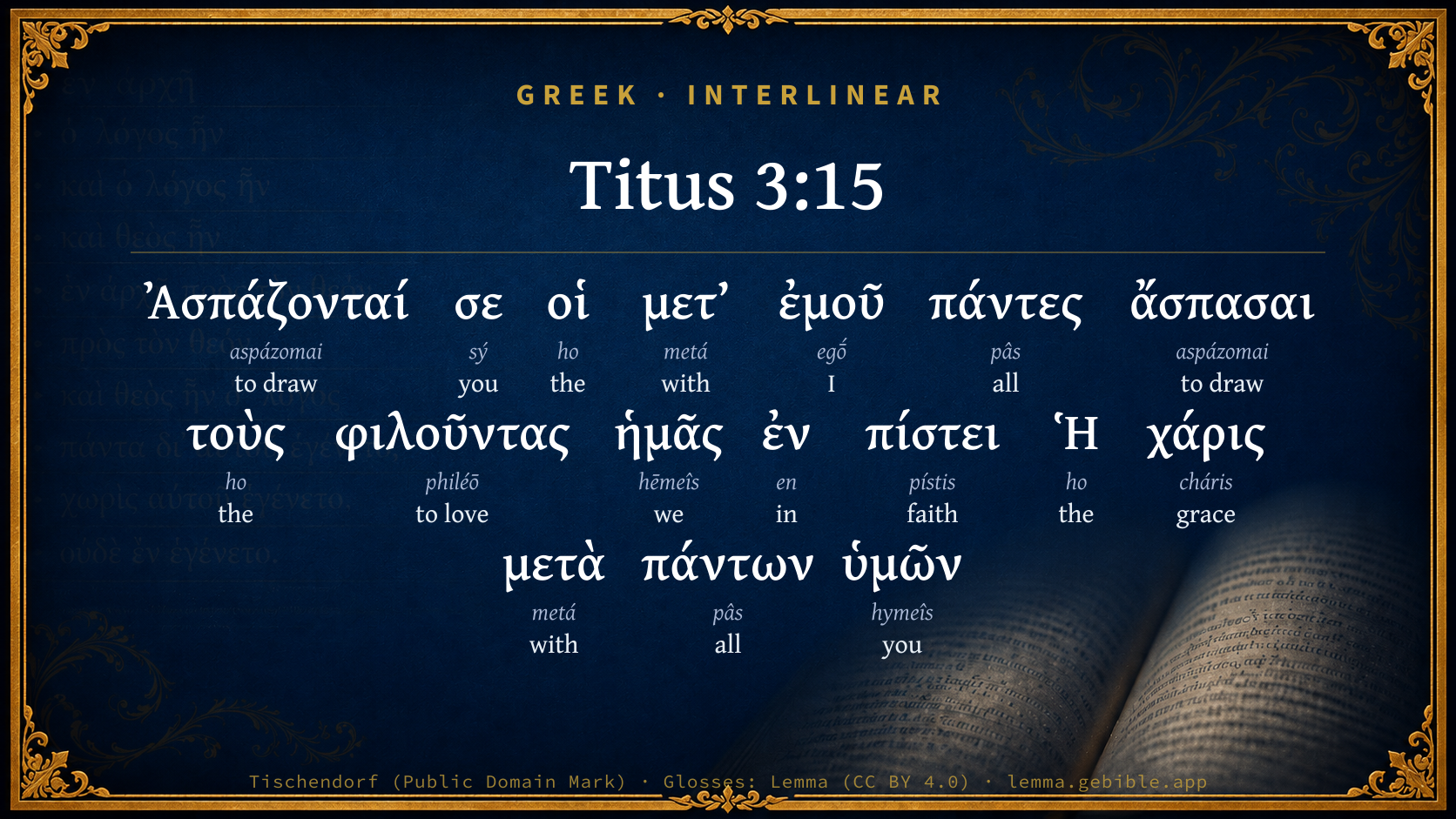
  1. Ἀσπάζονταί aspázomai G782 “to draw” Verb, Present, Middle or Passive deponent, Indicative, 3rd person, Plural
  2. σε sý G4771 “you” Personal pronoun, 2nd person, Accusative, Singular
  3. οἱ ho G3588 “the” Article, Nominative, Plural, Masculine
  4. μετ’ metá G3326 “with” Preposition
  5. ἐμοῦ egṓ G1473 “I” Personal pronoun, 1st person, Genitive, Singular
  6. πάντες pâs G3956 “all” Adjective, Nominative, Plural, Masculine
  7. ἄσπασαι aspázomai G782 “to draw” Verb, Aorist, Middle deponent, Imperative, 2nd person, Singular
  8. τοὺς ho G3588 “the” Article, Accusative, Plural, Masculine
  9. ἡμᾶς hēmeîs G2249 “we” Personal pronoun, 1st person, Accusative, Plural
  10. ἐν en G1722 “in” Preposition
  11. πίστει pístis G4102 “faith” Noun, Dative, Singular, Feminine
  12. Ἡ ho G3588 “the” Article, Nominative, Singular, Feminine
  13. χάρις cháris G5485 “grace” Noun, Nominative, Singular, Feminine
  14. μετὰ metá G3326 “with” Preposition
  15. πάντων pâs G3956 “all” Adjective, Genitive, Plural, Masculine
  16. ὑμῶν hymeîs G5210 “you” Personal pronoun, 2nd person, Genitive, Plural

About this verse

These counts appear in no published source. They are computed here, from the morphology-tagged text and Lemma’s own curated glosses. What Lemma adds →

17
words
12
distinct lemmas
Pauline Epistles
section

Notable vocabulary

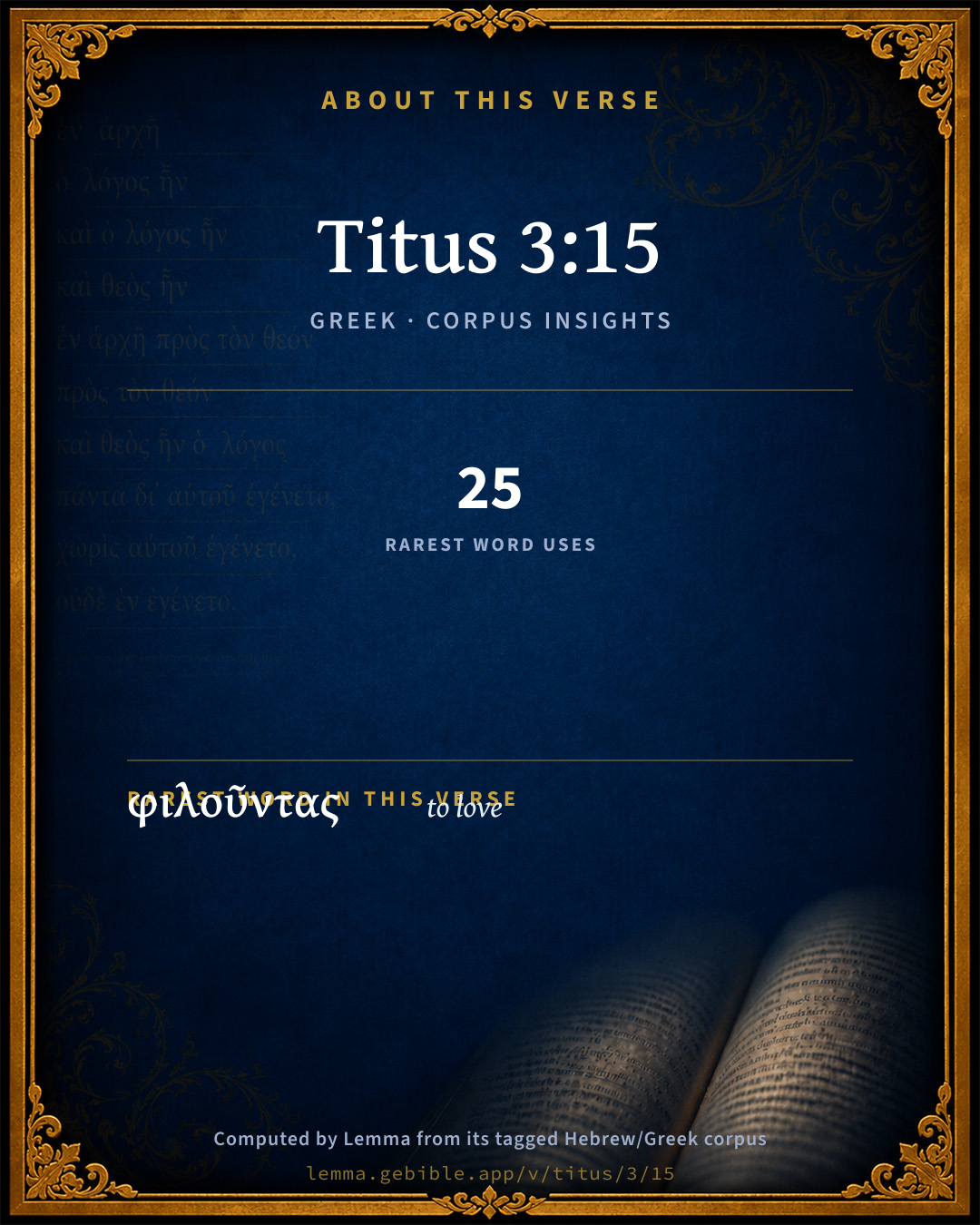
The rarest word here is φιλοῦντας to love G5368 — appearing just 25 times in the whole Greek New Testament.

Shared distinctive vocabulary

φιλοῦντας to love G5368 occurs in 21 verses of the Greek New Testament. Also found in:

Repetition

Words recur within this verse:

  • Ἀσπάζονταί to draw G782 ×2
  • πάντες all G3956 ×2
  • οἱ the G3588 ×3
  • μετ’ with G3326 ×2

Cross-references

12

Topical passages linked to Titus 3:15 in the Treasury of Scripture Knowledge — connected by theme and wording, ordered by reader-vote popularity; previews shown in the World English Bible.

  • Galatians 5:6 For in Christ Jesus neither circumcision amounts to anything, nor uncircumcision, but faith working through love.
  • Ephesians 6:23–24 Peace be to the brothers, and love with faith, from God the Father and the Lord Jesus Christ.
  • Colossians 4:18 The salutation of me, Paul, with my own hand: remember my bonds. Grace be with you. Amen.
  • 1 Timothy 1:5 but the end of the charge is love, out of a pure heart and a good conscience and unfeigned faith;
  • Hebrews 13:25 Grace be with you all. Amen.
  • 2 John 1:1–2 The elder, to the chosen lady and her children, whom I love in truth; and not I only, but also all those who know the truth;
  • Romans 16:1–23 I commend to you Phoebe, our sister, who is a servant of the assembly that is at Cenchreae,
  • 1 Corinthians 16:23 The grace of the Lord Jesus Christ be with you.
  • 1 Timothy 1:2 to Timothy, my true child in faith: Grace, mercy, and peace, from God our Father and Christ Jesus our Lord.
  • 2 Timothy 4:22 The Lord Jesus Christ be with your spirit. Grace be with you. Amen.
  • Philemon 1:5 hearing of your love, and of the faith which you have toward the Lord Jesus, and toward all the saints;
  • 3 John 1:1 The elder to Gaius the beloved, whom I love in truth.

Cross-references courtesy of OpenBible.info (CC BY 4.0).

Where the printed editions differ

2 variants

Places in this verse where the major printed Greek editions disagree on the wording in a way that affects the translation — a comparison of editions, not a manuscript-by-manuscript collation. The editions are the modern critical texts (Nestlé-Aland 28/27, SBL, Westcott-Hort, Tregelles, Tyndale House) and the traditional texts behind the KJV (the Textus Receptus and the Byzantine/Majority text). It is not a claim about which reading is original.

  1. Extra text
    ἀμήν.

    “Amen.”

    In TRByz Not in NA28NA27TynSBLWHTreg
  2. Extra text
    πρός Τίτον τῆς Κρητῶν ἐκκλησίας πρῶτον ἐπίσκοπον χειροτονηθέντα ἐγράφη ἀπό Νικοπόλεως τῆς Κρητῶν.¶

    “to Titus of the Cretan church first overseer having been chosen It was written from Nicopolis <the> of Macedonia.”

    In TR Not in NA28NA27TynSBLWHTregByz

    ἀμήν. πρός Τίτον τῆς Κρητῶν ἐκκλησίας πρῶτον ἐπίσκοπον χειροτονηθέντα ἐγράφη ἀπό Νικοπόλεως τῆς Κρητῶν.¶ (amēn pros Titon tēs Krētōn ekklēsias prōton episkopon cheirotonēthenta egraphē apo Nikopoleōs tēs Krētōn) 'Amen. to Titus of the Cretan church first overseer having been chosen It was written from Nicopolis of Macedonia.' is only in traditional manuscripts (TR)

Textual data: Translators Amalgamated Greek New Testament (STEPBible TAGNT) · CC BY 4.0.

Commentary

Notes on Titus 3:15 from classic Christian and Jewish commentators (each source and its license shown beneath its notes). The classic Christian expositions comment on the surrounding passage and are grouped to its opening verse, so a note may address several verses; the Jewish commentaries on the Tanakh (Rashi and others) are per-verse, so they appear only where the commentator wrote on this verse.

Lemma curates 59 commentaries, every one of them public domain or Creative Commons licensed, each selected and text-cleaned for this edition rather than reprinted as found. About our sources →

The Biblical Illustrator

Joseph S. Exell

Tit_3:15

Greet them that love us in the faith

Christian love

Hence note that religion bindeth man to man in the straightest bond; for

1.

The Spirit is the tier of it; and hence is it called the unity of the Spirit in the bond of peace; and indeed it must be a wonderful bond that can reconcile such deadly enemies as men are before they come into the kingdom of Christ (Isa_11:6).

2. Gods image, wheresoever it is, is exceeding beautiful, and a great binder, especially where renewed and repaired; which being once espied, let the outward condition be what it can be, a religious heart seeth sufficient matter of love, and will knit the soul unto the soul of such a one.

3. It addeth strength and firmness to all other bonds of nature, affinity, desert, etc., and maketh them more natural. What a true friend was Jonathan to David! Because he saw that God was with him his soul clave unto him; though the kingdom was to be rent from him for it, yet could he not rend his heart from David. If Joseph had not had more than nature, he could not but have revenged such infinite wrongs upon his brethren; whereas the grace of his heart made him say, It was not you, my brethren, but God sent me before you. Consider also of the example beyond all imitation of our Lord Jesus Christ, who gave Himself to the death for us when we were yet His enemies.

4. This love must needs be most lasting; for being love in the truth for the truths sake, it shall continue so long as the truth doth; but the truth abideth with us, and shall abide with us forever; and this is the cause, that whereas the love of nature dieth with it, and the love of wicked men dieth with their persons, this love liveth in death, yea, when it goeth to heaven with a man, and getteth strength and perfection thee faith ceaseth, and hope vanisheth away.

Use

1. Whence we are taught most familiarly to embrace them that love us in the faith, and to make most account of their love. Many love in the face, many in the flesh, many in nature, only the love of Christians is a fruit of faith, a work of the Spirit, and therefore a surer bond than they all. Well knew the apostle that none was in comparison worth having but this; he calleth for no other, he careth for no other, he mentioneth no other.

2. Such as set into any society with others, if he would have it comfortable unto him, let him strengthen all other natural or civil bonds by this bond of religion; let him labour to begin his love in the faith, or, if he have begun elsewhere already, let him reform the same hereby if he look for any sound comfort in his estate; for this is the cause that men often have so little return of love from their wives, so little obedience from their children, so little duty from their servants, so slender respect from their equals, because they begin their love and duties at a wrong end, and have for other respects affected those with whom they live, but the least, if at all, for grace and religion, which of all is the soundest, most profitable, and most comfortable. (T. Taylor, D. D.)

Shake hands

Shake hands with somebody as you go out of church. The more of it the better, if it is expressive of real interest and feeling. There may be a great deal of the spirit of the gospel put into a hearty shake of the hand. Think of St. Pauls four times repeated request--Greet one another--after the custom then in common use, and one which is expressive of even warmer feeling than our common one of handshaking. Why not give your neighbours the benefit of the warm Christian feeling that fills you to your finger tips, and receive the like from them in return? You will both be benefited by it; and the stranger will go away feeling that the Church is not, after all, so cold as he had thought it to be.

Christian love

A lady and her little daughter, passing out of church, the child bade goodbye to a poorly dressed little girl. How did you know her? inquired the mother. Why, you see, mamma, she came into our Sabbath School alone, and I made a place for her on my seat, and I smiled and she smiled, and then we were acquainted.

The Biblical Illustrator, edited by Joseph S. Exell (c. 1880s–1900s) — public domain. Text from a community e-Sword module.

Tyndale Open Study Notes

Tyndale Open Resources

3:15 you all: The letter was addressed to Titus (1:4), but the whole church was the audience for the letter.

Tyndale Open Study Notes — © Tyndale Open Resources, licensed CC BY-SA 4.0. Text via the HelloAO Bible API.

Meyer's Critical & Exegetical Commentary

Heinrich August Wilhelm Meyer

Tit_3:15. End.

ἀσπάζονταί σε οἱ μετʼ ἐμοῦ πάντες] is not to be understood generally of believers, but of the apostles fellow-workers.

ἄσπασαι τοὺς φιλοῦντας ἡμᾶς ἐν πίστει] φιλεῖν marks the inner, personal relation. The distinction between ἀγαπᾷν and φιλεῖν is plain from a comparison of Joh_3:16, ἠγάπησεν ὁ Θεὸς τὸν κόσμον, with Joh_16:17, ὁ πατὴρ φιλεῖ ὑμᾶς; also Mat_10:37 : Ἡμᾶς, i.e. the apostle.Ἡ χάρις μετὰ πάντων ὑμῶν] with you all, i.e. with thee and all Cretan believers. The form of the benediction does not imply that Titus was to communicate the epistle to the churches in Crete.

Meyer — Critical and Exegetical Commentary on the New Testament — English translation by Peter Christie, edited by Frederick Crombie (T&T Clark, 1880) — public domain. Text from a community e-Sword module.

Expositor's Greek Testament

ed. W. Robertson Nicoll

Tit 3:15 . Final Salutation.

οἱ μετʼ ἐμοῦ : The preposition is different elsewhere in Paul: οἱ σὺν ἐμοὶ πάντες ἀδελφοί , Gal 1:2 ; οἱ σὺν ἐμοὶ ἀδελφοί , Phi 4:21 . οἱ μετʼ αὐτοῦ is a constant phrase in the Synoptists. There is a similar use of μετά in Act 20:34 (a speech of St. Paul’s), and in 2Ti 4:11 .

τοὺς φιλοῦντας ἡμᾶς ἐν πίστει ; The faith (see note on 1Ti 1:2 ) is that which binds Christians together more or less closely. Timothy and Titus were St. Paul’s τέκνα ἐν πίστει ; others were more distantly related to him, though of the same family, “the household of faith”.

Dean Armitage Robinson ( Ephesians , p. 281) gives several examples from papyri of similar formulas of closing, especially two, which read, ἀσπάζου … τοὺς φιλοῦντες σε (or ἡμᾶς ) πρὸς ἀληθίαν . This suggests the rendering here, those who love us truly .

The Expositor's Greek Testament, edited by W. Robertson Nicoll (1897–1910) — public domain. Text from a community e-Sword module.

Jamieson, Fausset & Brown

Robert Jamieson, A. R. Fausset & David Brown

Greet--"Salute them that love us in the faith." All at Crete had not this love rooted in faith, the true bond of fellowship. A salutation peculiar to this Epistle, such as no forger would have used.

Grace--Greek, "The grace," namely, of God.

with you all--not that the Epistle is addressed to all the Cretan Christians, but Titus would naturally impart it to his flock.

Next: Philemon Introduction

Jamieson, Fausset & Brown — Commentary Critical and Explanatory on the Whole Bible (1871) — public domain (CC PDM 1.0). Text via the HelloAO Bible API.

Adam Clarke's Commentary

Verse 15. All that are with me] He means his companions in the ministry.

Salute thee.] Wish thee well, and desire to be affectionately remembered to thee.

Greet them that love us in the faith,] All that love us for Christ's sake, and all that are genuine Christians.

Grace be with you] May the Divine favour be your portion for ever.

Some MSS. read, The grace of the Lord be with you all; others, The grace of God be with you all; and one, Grace be with THY spirit, as if the greeting was sent to Titus only, whereas the others send it to the whole Church at Crete.

Amen.] This is wanting in ACD, and some others.

The subscriptions are, as usual, various. Those of the VERSIONS are the following: -

The Epistle to Titus was written from Nicopolis; and sent by the hands of Zena and Apollo. - SYRIAC.

To the man Titus. - AETHIOPIC.

The end of the epistle: it was written from Nicopolis. Incessant and eternal praise be to the God of glory. Amen. - ARABIC.

Written in Nicopolis, and sent by Artemas, his disciple. - COPTIC.

The Epistle to Titus is ended, who was the first bishop of the Church of the Cretans: and it was written from Nicopolis of Macedonia. - PHILOXENIAN SYRIAC.

There is no subscription in the VULGATE.

The MANUSCRIPTS are also various.

To Titus. - C, and Clarom.

That to Titus is completed: that to Philemon begins. - DEFG.

To Titus, written from Nicopolis. - A.

To Titus, written from Nicopolis of Macedonia. - of the Macedonians. - From Nicopolis, which is a province of Macedonia.

Paul the apostle's Epistle to Titus.

To Titus, ordained the first bishop of the Church of the Cretans: written from Nicopolis of Macedonia. - Common Greek Text.

To Titus, archbishop of Crete. - One of the Vienna MSS., written A. D. 1331.

THERE is not one of these subscriptions of any authority, and some of them are plainly ridiculous. We do not know that Titus was what we term bishop, much less that he was ordained bishop of Crete, as appointed to a particular see; and still less that he was the first bishop there. As to his being archbishop, that is the fiction of a time of deep darkness. That the epistle was written from some place near to Nicopolis, of Epirus, is very probable. That it was not written at Nicopolis is evident; and that this was not Nicopolis of Macedonia is also very probable. See the preface to this epistle for farther information on this point. And see a treatise by old Mr. Prynne entitled, The unbishoping of Timothy and Titus, 4to. Lond. 1636 and 1660, where, among many crooked things, there are some just observations.

Adam Clarke's Commentary on the Bible (1810–1826) — public domain. Text from a community e-Sword/MySword module.

Ellicott's Commentary for English Readers

(15) All that are with me salute thee.—It is uncertain where Paul was when he wrote this letter. “All that are with me” include those with him, journeying in his company. They are not named, because the individuals composing the immediate following of St. Paul would be likely to be well known to Titus.

Greet them that love us in the faith.—An inclusive greeting, embracing each member of the Cretan Church whose love to him (St. Paul) was based upon the common faith in the Lord Jesus. Greet all who love me, as the earnest preacher of their faith and mine.

Amen.—The greater number of the ancient authorities omit “Amen.”

A Bible Commentary for English Readers, edited by Charles John Ellicott (1878–1897) — public domain. Text from a community e-Sword module.

The Cambridge Bible for Schools and Colleges

gen. ed. J. J. S. Perowne

15. Closing Salutation

15. All that are with me salute thee] The companions of his journey or sojourn, cf. Gal_1:2; Col_4:7-14. They are not specified and would be changing, as his needs and their feelings changed, cf. 2Ti_4:9-12.

Greet them that love us in the faith] Rather: salute them that love us in faith, ‘in faith,’ as 1Ti_1:2 ‘my true child in faith,’ i.e. spiritually, where see note. The phrase marks the gradual crystallising of the word ‘faith,’ somewhat as ‘our Christian friends’ has become a modern formula: cf. Tit_1:4 ‘in communion of faith.’

Grace be with you all. Amen] The shortest form of the Benediction, the fullest being at the end of 2 Cor. ‘An inclusive benediction that comprehends the episcopus and those committed to his oversight, Titus and all the faithful in Crete.’ Bp Ellicott; who rejects the final ‘Amen,’ as at the end of both the letters to Timothy, though the ms. authority for it is stronger here, on the ground that accidental omission seems less probable than insertion. The end recalls the beginning; the Apostle, whose sphere of ministry was the faith and full knowledge of the Cretan Christians, prays for ‘grace’ to be with them ‘all.’

The subscription given above has no sufficient authority; see note at end of 1 Tim.; and for ‘Macedonia’ note above, Tit_3:12. The best supported subscription here is simply To Titus.

The Cambridge Bible for Schools and Colleges (gen. ed. J. J. S. Perowne; Cambridge University Press, 1878–1918) — public domain. Text from a community e-Sword module.

John Gill's Exposition

All that are with me salute thee,.... All the apostles, fellow labourers, and the ministers of the Gospel that were with him; and all the members of the church where he was, sent their Christian salutation to Titus; he being a person greatly esteemed, and whose praise was in all the churches:

greet them that love us in the faith; not merely as men, as their countrymen, as related to them in the flesh; or on account of any external things, but as believers; because of the doctrine of faith, professed and preached; and because of the grace of faith obtained and possessed; or who love us faithfully, sincerely, and uprightly, from their hearts, and not in word and tongue only:

grace be with you all, Amen; which is the common concluding salutation in all Paul's epistles. This shows that this epistle was not designed for Titus only, but for the saints at Crete.

It was written to Titus the first bishop of the church of the Cretians. But this subscription, as many others, is not to be depended upon; it is not very likely that Titus was bishop of this church at all; since his stay there was but short, nor indeed elsewhere, seeing he was an evangelist; though this is asserted both by Eusebius (d), and Sophronius (e), who adds, that he died and was buried here: and what follows, that it was written

from Nicopolis of Macedonia, does not seem to be just, as may be concluded from Tit 3:12. Many learned men think it was written from Colosse, or some neighbouring place; though when he wrote his epistle to the Colossians it looks as if he had never been there before: the Syriac version adds, "sent by the hands of Zenas and Apollos"; which is not unlikely, since he desires they might be accommodated by Titus with what was necessary for the remaining part of their journey, Tit 3:13.

(d) Eccl. Hist. l. 3. c. 4. (e) In Hieron. Eccl. Script. Catalog. sect. 12.

Next: Philemon Introduction

John Gill's Exposition of the Whole Bible (1746–1763) — public domain (CC PDM 1.0). Text via the HelloAO Bible API.

Trapp's Complete Commentary

John Trapp

15 All that are with me salute thee. Greet them that love us in the faith. Grace be with you all. Amen. It was written to Titus, ordained the first bishop of the church of the Cretians, from Nicopolis of Macedonia.>>

Ver. 15. That love us in the faith] That best ligament of love. The Church is the only daughter of her mother, and is called Ecclesia , of calling all hers together. Religion hath its name of binding, because it binds men all in a bundle, and makes them be of one heart and of one soul, Act 4:32, to serve the Lord with one shoulder, Zep 3:9, to glorify God with "one mind and with one mouth," Rom 15:6, there being no such oneness in the world as among true believers.

John Trapp, A Commentary or Exposition upon All the Books of the Old and New Testament (1647–1656) — public domain. Text from a community e-Sword module.

Albert Barnes' Notes on the Bible

All that are with me salute thee - Notes, Rom 16:3. Paul, at the close of his epistles, usually mentions the names of those who sent affectionate salutations. Here it would seem to be implied that Titus knew who were with Paul, and also that he himself had been traveling with him. He evidently refers not to those who were residing in the place where he was, but to those who had gone with him from Crete as his companions.

Greet them that love us in the faith - In the faith of the gospel, or as Christians. No names are here mentioned; compare 1Th 5:26; Col 4:15.

Grace be with you all - Notes, Rom 1:7; Rom 16:20.

The subscription, “It was written to Titus,” etc., is, like the other subscriptions at the close of the epistles, of no authority whatever; see the close of the notes at 1 Cor. In this subscription there are probably two errors:

(1) In the statement that Titus was “ordained the first bishop of the church of the Cretians;” because:

(a)There is no evidence that there was a church there called “the church of the Cretians,” as there were doubtless many churches on the island;

(b)There is no evidence that Titus was the first Bishop of the church there, or that he was the first one there to whom might be properly applied the term “bishop” in the Scriptural sense. Indeed, there is positive evidence that he was not the first, for Paul was there with him, and Titus was “left” there to complete what he had begun.

There is no evidence that Titus was “bishop” there at all in the prelatical sense of the term, or even that he was a settled pastor; see the notes at Tit 3:1, Tit 3:5.

(2) That the epistle was written “from Nicopolis of Macedonia;” for

(a)There is no certain evidence that it was written at Nicopolis at all, though this is probable;

(b)There is no reason to believe that the Nicopolis referred to was in Macedonia; see Introduction 4.

These subscriptions are so utterly destitute of authority, and are so full of mistakes, that it is high time they were omitted in the editions of the Bible. They are no part of the inspired writings, but are of the nature of “notes and comments,” and are constantly doing something, perhaps much, to perpetuate-error. “The opinion that Timothy and Titus were prelatical bishops, the one of Ephesus and the other of Crete, depends far more on these worthless subscriptions than on anything in the epistles themselves.” Indeed, there is no evidence of it in the epistles; and, if these subscriptions were removed, no man from the New Testament would ever suppose that they sustained this office at all.

Albert Barnes' Notes on the Bible (1834–1885) — public domain. Text from a community e-Sword/MySword module.

Haydock's Catholic Bible Commentary

There is no tie so tender or so strong as that of faith and charity. Nothing unites us truly together, but that which unites us all to God and to Jesus Christ, by an union of the same sentiments of faith, the same emotions of love, and the same inclinations of grace.

George Leo Haydock (1774–1849), Haydock's Catholic Family Bible and Commentary, 1859 edition — public domain. Excludes Psalms (Douay-Rheims chapter numbering differs from Protestant) and Deuterocanonical books (Catholic canon only).

Matthew Poole's English Annotations

Greet them that love us in the faith; that love us as we are Christians, in and for the gospel.

Grace be with you all. Amen: the free love of God be thy portion, and the portion of all the Christians in Crete.

It was written to Titus, ordained the first Bishop of the church of the Cretians, from Nicopolis of Macedonia.

Matthew Poole's English Annotations on the Holy Bible (1683–1685) — public domain. Text from a community e-Sword/MySword module.

Whedon's Commentary on the Bible

Daniel D. Whedon

15. All… with me—Though Paul now calls Titus and others to him, there are a number with him. These were his retinue (see notes Act_20:4; Act_21:18) of fellow-labourers. They came and went by his direction.

Love us—Christian acquaintances who specially cherished his remembrance.

You all—Not all the Churches of Crete, but all the attendant labourers of Titus. It was a salutation from Paul’s retinue to Titus. The subscription affirming that the epistle was written from Nicopolis is clearly erroneous, as is shown by the word there in Tit_3:12.

Daniel D. Whedon (gen. ed.), Commentary on the Old and New Testaments (1874–1909) — public domain. Text from a community e-Sword module.

The Pulpit Commentary

Salute for greet, A.V; faith for the faith, A.V That love us in faith has no sense. "The faith" is right. (see 1Ti_1:2, note) Grace be with you all. So, with slight varieties, end St. Paul"s other Epistles. The T.R. has Amen, as have most of the other Epistles.

Salutation and conclusion.

"All that are with me salute thee. Greet them that love us in the faith. Grace be with you all. Amen.

I MARK HOW THE EPISTLE, WHICH BEGAN WITH THE FAITH OF GOD"S ELECT, ENDS WITH GRACE AND LOVE.

II MARK THE CLOSE RELATIONSHIPS ESTABLISHED BY GRACE BETWEEN THE WIDELY SCATTERED MEMBERS OF THE CHURCH. They are one holy, happy family, united by love. The threefold repetition of the word "all" suggests the deep unity of the body of Christ, in spite of its inward distractions and errors and sins.

III THE SALUTATION IMPLIES THAT, THOUGH ADDRESSED TO TITUS, THE EPISTLE WAS TO RE COMMUNICATED TO THE WHOLE CHURCH IN CRETE. T.C.

The Pulpit Commentary (1880–1919), ed. H.D.M. Spence-Jones & Joseph S. Exell — public domain. Text from a community e-Sword module.

Fairbairn on Ezekiel, Jonah & the Pastoral Epistles

Patrick Fairbairn

Ver. 15. The conclusion is brief and simple; All that are with me (that is, probably, such as were labouring with him in the ministry of the gospel) salute thee; salute those that love us in the faith; the grace (namely, of God) be with you all. No other epistle of the apostle’s ends quite similarly. The mode of salutation may be said to be Pauline in spirit; but in form it differs too much from those found in the other epistles, to have been at all likely to occur to any one but the apostle himself. But including, as it did, all who loved the apostle in the faith, it implies that the epistle was to be made known to the churches in Crete.

Patrick Fairbairn — An Exposition of Ezekiel (1851), Jonah (1849), and The Pastoral Epistles (1874) — public domain. Text from a community e-Sword module.

Burkitt's Expository Notes on the New Testament

William Burkitt

All that are with me salute thee.--By these words St. Paul gives Titus to understand, that all the Christians that were then with him did embrace him with an endearing and loving affection, and would have their mindfulness of him witnessed by a kind and familiar salutation. These salutations had more in them than humanity, civility, and common courtesy; they were attestations of a truly Christian love and brotherly affection of one member of Christ towards another, for grace’s sake.

Greet them that love us in the faith--That is, as Christians, as brethern, and fellow-members in Christ, Verus Amicus qui vere & in Deo diligit. Grace binds man to man in the strongest and most indissoluble bonds and ties.

Grace be with you all. Amen.--This is the salutation of St. Paul, always written with his own hand, in all his epistles, although the epistles themselves were writ by others; he did it to prevent counterfeits, that no spurious writings might be obtruded upon the church: and whereas he says, Grace be with you all, it plainly intimates, that although this epistle be written by name to Titus, that yet it was intended for the benefit and advantage of the whole church.

William Burkitt's Expository Notes on the New Testament (1700–1703) — public domain. Text from a community e-Sword module.

unfoldingWord translationNotes

Door43 World Missions Community

General Information:

Paul ends his letter to Titus.

All those

"All the people"

those who love us in faith

Possible meanings are 1) "the believers who love us" or 2) "the believers who love us because we share the same belief."

Grace be with all of you

This was a common Christian greeting. AT: "May God's grace be with you" or "I ask that God will be gracious to all of you"

translationWords

faith

grace

unfoldingWord translationNotes — © Distant Shores Media and the Door43 World Missions Community, licensed CC BY-SA 4.0. Source: git.door43.org/Door43/en_tn.

Cambridge Greek Testament for Schools and Colleges

15. The rec. text adds at the end ἀμήν with the great bulk of manuscripts and versions, and the Greek Fathers; but Tischendorf, Tregelles and WH omit it with the important group א*ACD2* 17 d and the Latin Fathers.

The subscription printed in the rec. text is:

Πρὸς Τίτον, τῆς Κρητῶν ἐκκλησίας πρῶτον ἐπίσκοπον χειροτονηθέντα, ἐγράφη ἀπὸ Νικοπόλεως τῆς Μακεδονίας. This is found in K and in some cursives, and substantially the same colophon is preserved in HL.

אC 17 have simply πρὸς Τίτον; D2E add to this ἐπληρώθη, G has ἐτελέσθη ἐπιστολὴ πρὸς Τίτον; AP have πρ. Τίτον ἐγράφη ἀπὸ Νικοπόλεως. See Introd. p. xxxii., and note on Tit 3:12 below.

15. SALUTATIONS

15. ἀσπάζονταί σε οἱ μετʼ ἐμοῦ πάντες. All that are with me salute thee.

This exact form of salutation is not used elsewhere by St Paul (though cp. 2Ti 4:21), which again may be urged as a point in favour of the genuineness of the letter, a forger not being likely to introduce unfamiliar features.

Cp. Gal 1:2, οἱ σὺν ἐμοὶ πάντες ἀδελφοί; it is worth remarking that σύν is not once found (save in composition) in the Pastoral Epistles, its place being always supplied by μετά[515].

[515] In like manner, σύν is very rare in St John’s Gospel, and never occurs in his Epistles or in the Apocalypse.

ἄσπασαι τοὺς φιλοῦντας ἡμᾶς ἐν πίστει. Salute them that love us in faith. ἐν πίστει seems to be used as at 1Ti 1:2, their πίστις being as it were the bond which unites Paul and the Cretan Christians.

BENEDICTION

ἡ χάρις μετὰ πάντων ὑμῶν. The Grace, sc. of our Lord, be with you all. This is the σημεῖον ἐν πάσῃ ἐπιστολῇ (2 Thessalonians 3

Cambridge Greek Testament for Schools and Colleges (Cambridge University Press, 1896; 21 vols, various authors incl. Carr, Maclear, Plummer, Farrar, Lumby, Moule, M. R. James, Simcox) — public domain. Text from a community e-Sword module.

Alford’s Greek Testament

Henry Alford

15.] Salutations: greetings: Apostolic; benedictions. All that are with me salute thee. Salute those that love us in the faith (not ‘in faith:’ see note, 1Ti 1:2. This form of salutation, so different from any occurring in St. Paul’s other Epistles, is again [see on ch. 1:1] a strong corroboration of genuineness. An apocryphal imitator would not have missed the Apostle’s regular formulæ of salutation). God’s (ἡ) grace be with all of you (of the Cretan churches. It does not follow from this that the letter was to be imparted to them: but in the course of things it naturally would be thus imparted by Titus).

On the subscription in the rec., making our Epistle date from Nicopolis, see in Prolegg. § ii. 30 ff.

Henry Alford, The Greek Testament (1849–1861) — public domain. Text from a community e-Sword module.

International Critical Commentary

15. οἱ μετʼ ἐμοῦ] perhaps “my travelling companions,” as no place is mentioned; cf. Gal 1:2.

ἄσπ. τοὺς φιλ.] cf. BGU. 332, Ἀσπάζου Ἀμμωνοῦν σὺν τέκνοις καὶ συμβίῳ καὶ τοὺς φιλοῦντάς σε, other and instances in A. Robinson on Eph., p. 281. Our real friends in contrast to false teachers, 1:9, 2:8.

ἐν πίστει] possibly “in loyalty”; cf. Fay. Pap. 118, τοῦς φιλοῦντας ἡμᾶς πρὸς ἀλήθιαν, but 1:4, 1Ti 1:2 make it almost certain that it is “in a common faith,” “in loyalty to Christ.”

μετὰ πάντων ὑμῶν] even with those to whom he could not send a warm greeting. This implies that the substance of the letter would become known to the whole church.

Tynd. Tyndale’s New Testament, 1534.

Trench, Synonyms of the New Testament, by Archbishop Trench, 8th edition, 1876.

Clem. Hom. Clementis Romani Homiliæ, ed. Dressel, 1853.

Pap. Oxyr. The Oxyrhynchus Papyri, ed. Grenfell and Hunt, vols. i.-xv., London, 1898-

R.V. Revised Version of the English Bible.

Const. Apost. Constitutiones Apostolorum, ed. P. A. de Lagarde, 1862.

International Critical Commentary — older volumes (1896–1929), various authors — public domain. Text from a community e-Sword module.

Vincent's Word Studies in the New Testament

Marvin R. Vincent

Them that love us in the faith [τους φιλουντας ημας εν πιστει] . Better, in faith. The phrase N. T. o. Filein to love, only here in Pastorals, and in Paul, only 1Co 16:22. See on ajgaph love, Gal. verse

Const. in faith with that love us.

Marvin R. Vincent, Word Studies in the New Testament (1887–1900) — public domain. Text from a community e-Sword/MySword module.

Lesson kit

Teaching starters — assembled from the data on this page, not authored interpretation. Every prompt links to the verse data it draws on. Edit before teaching.

Titus, in the Pauline Epistles, opens this verse with 17 words (12 distinct Greek lemmas). Its most distinctive word is philéō (“to love”). A historical commentator’s framing appears above. Read the whole chapter for the surrounding context.

Discussion questions

  1. How does “to love” (philéō) shape what this verse is saying?
  2. Matthew 6:5 shares the word «to love» with this verse. How do the two illuminate each other?
  3. “to draw” occurs 2× in this one verse. What is the effect of the repetition?
  4. These translations render this verse differently. What is at stake in choosing one wording over another?
  5. Reading how The Biblical Illustrator and Tyndale Open Study Notes read this verse, where do the two commentators agree and where do they part?

Things to notice

  • These translations choose different wording for 6 words in this verse.
  • “to draw” occurs 2× in this single verse.
  • 12 distinct Greek lemmas span 17 words in this verse.

Reading settings

Reading text

Shown beneath each verse's original-language words.

Old Testament
Old Testament edition

Read the OT as the Masoretic Hebrew (MT) or the Greek Septuagint (LXX).

English shown for the Greek Septuagint (in the Hebrew ↔ Greek comparison).

Comparing translations? Open the Compare panel on any verse page to stack up to four side by side.