1 Peter 4:10

Greek (Tischendorf 8th ed.) 1 Peter 4:10 appears in the Greek New Testament. The text above is from the Tischendorf 8th edition. Each word links to its Strong’s number and a concise gloss. Click any word for its full Thayer’s Greek Lexicon entry.
Download image
Cite this verse

1 Peter 4:10 (World English Bible). Public Domain. Lemma interlinear Bible study tool, https://lemma.gebible.app/v/1-peter/4/10.

Show BibTeX & RIS
BibTeX
RIS
English Translation
According as each has received a gift, be ministering it among yourselves, as good stewards of the grace of God in its various forms.
World English Bible · Public Domain
Download a study sheet

One document with this verse’s original text, its word-by-word gloss line, the meaning frame, cross-references with their text, attributed commentary, and full source and license credits — printable, and it pastes into notes with its structure intact.

This verse Autodidact and up

Study sheet (.html) Plain text (.txt)

A passage Seminary Student

Up to 50 verses in one chapter. A passage sheet keeps up to 6 commentary sources and 12 cross-references per verse, in the order this page ranks them, and says so on the sheet whenever that leaves anything out. Ask for a single verse and you get the Autodidact verse sheet above.

Everything on this page stays free to read, with no account — the sheet is a download of what is already on screen, not access to it.

Want to remove ads? Support Godless Engineer
Compare translations 3

The same verse in 3 English versions, stacked beneath the original-language interlinear above. Click any original word for its lexicon entry.

Each is an independent rendering of the whole verse — the interlinear is not word-aligned to these translations.

Highlighted words mark where these versions differ — a whole-verse word diff, not a word-by-word alignment.

  • World English Bible Public Domain
    According as each has received a gift, be ministering it among yourselves, as good stewards of the grace of God in its various forms.
  • King James Version Public Domain
    As every man hath received the gift, even so minister the same one to another, as good stewards of the manifold grace of God.
  • unfoldingWord Literal Text CC BY-SA 4.0
    just as each one has received a gift, ministering it to one another, as good stewards of the diverse grace of God.

unfoldingWord Literal Text — © unfoldingWord, licensed CC BY-SA 4.0. Word-aligned USFM3 via Door43 (git.door43.org/unfoldingWord/en_ult).

Versions to compare (up to 4)

3 of 4 selected

Show all 19 translations

Every available English version of this verse, each an independent rendering of the whole verse.

  • World English Bible Public Domain
    According as each has received a gift, be ministering it among yourselves, as good stewards of the grace of God in its various forms.
  • Berean Standard Bible Public Domain
    As good stewards of the manifold grace of God, each of you should use whatever gift he has received to serve one another.
  • Majority Standard Bible Public Domain
    As good stewards of the manifold grace of God, each of you should use whatever gift he has received to serve one another.
  • King James Version Public Domain
    As every man hath received the gift, even so minister the same one to another, as good stewards of the manifold grace of God.
  • American Standard Version (1901) Public Domain
    according as each hath received a gift, ministering it among yourselves, as good stewards of the manifold grace of God;
  • Revised Version (1885) Public Domain
    according as each hath received a gift, ministering it among yourselves, as good stewards of the manifold grace of God;
  • Geneva Bible (1599) Public Domain
    Let euery man as hee hath receiued the gift, minister the same one to another, as good disposers of the manifolde grace of God.
  • Douay-Rheims (1899) Public Domain
    As every man hath received grace, ministering the same one to another: as good stewards of the manifold grace of God.
  • Young's Literal Translation Public Domain
    each, according as he received a gift, to one another ministering it, as good stewards of the manifold grace of God;
  • Literal Standard Version CC BY-SA 4.0
    each [one], according as he received a gift, ministering it to one another, as good stewards of the manifold grace of God;
  • Unlocked Literal Bible CC BY-SA 4.0
    As each one of you has received a gift, use it to serve one another, faithfully administering God's grace in its various forms.
  • unfoldingWord Literal Text CC BY-SA 4.0
    just as each one has received a gift, ministering it to one another, as good stewards of the diverse grace of God.
  • Darby Bible Public Domain
    each according as he has received a gift, ministering it to one another, as good stewards of [the] various grace of God.
  • World Messianic Bible Public Domain
    As each has received a gift, employ it in serving one another, as good managers of the grace of God in its various forms.
  • Webster's Bible Public Domain
    As every man hath received the gift, even so minister the same one to another, as good stewards of the manifold grace of God.
  • Free Bible Version CC BY-SA 4.0
    Whatever gift you've been given, share it with others among you, as people who wisely demonstrate God's grace in all its different forms.
  • Bible in Basic English Public Domain
    Making distribution among one another of whatever has been given to you, like true servants of the unmeasured grace of God;
  • Text-Critical English NT CC BY 4.0
    As each of you has received a gift, use it to serve one another, as good stewards of the manifold grace of God.
  • Tyndale New Testament (1534) Public Domain
    As every man hath receaved the gyfte minister the same one to another as good ministers of the manyfolde grace of God.

Literal Standard Version (2020), Covenant Press — licensed CC BY-SA 4.0. Text via the HelloAO Bible API (eBible.org). Unlocked Literal Bible (unfoldingWord) — licensed CC BY-SA 4.0. Text via the HelloAO Bible API (eBible.org). unfoldingWord Literal Text — © unfoldingWord, licensed CC BY-SA 4.0. Word-aligned USFM3 via Door43 (git.door43.org/unfoldingWord/en_ult). Free Bible Version, Dr. Jonathan Gallagher — licensed CC BY-SA 4.0. Text via the HelloAO Bible API (eBible.org).

Word by word

More ways to search: Search by grammar → Find every occurrence → Compare this word →

Practice this passage: Drill this verse → Learn its vocabulary →

οἰκονόμοι
oikonómos
G3623
“steward”
Noun, Nominative, Plural, Masculine
Part of Speech
Noun
Case
Nominative
Number
Plural
Gender
Masculine
Full Thayer's Definition

Origin: from G3624 and the base of G3551

TDNT: 07:29,7

1. the manager of household or of household affairs a. esp. a steward, manager, superintendent (whether free-born or as was usually the case, a freed-man or a slave) to whom the head of the house or proprietor has intrusted the management of his affairs, the care of receipts and expenditures, and the duty of dealing out the proper portion to every servant and even to the children not yet of age b. the manager of a farm or landed estate, an overseer c. the superintendent of the city's finances, the treasurer of a city (or of treasurers or quaestors of kings) 2. metaph. the apostles and other Christian teachers and bishops and overseers
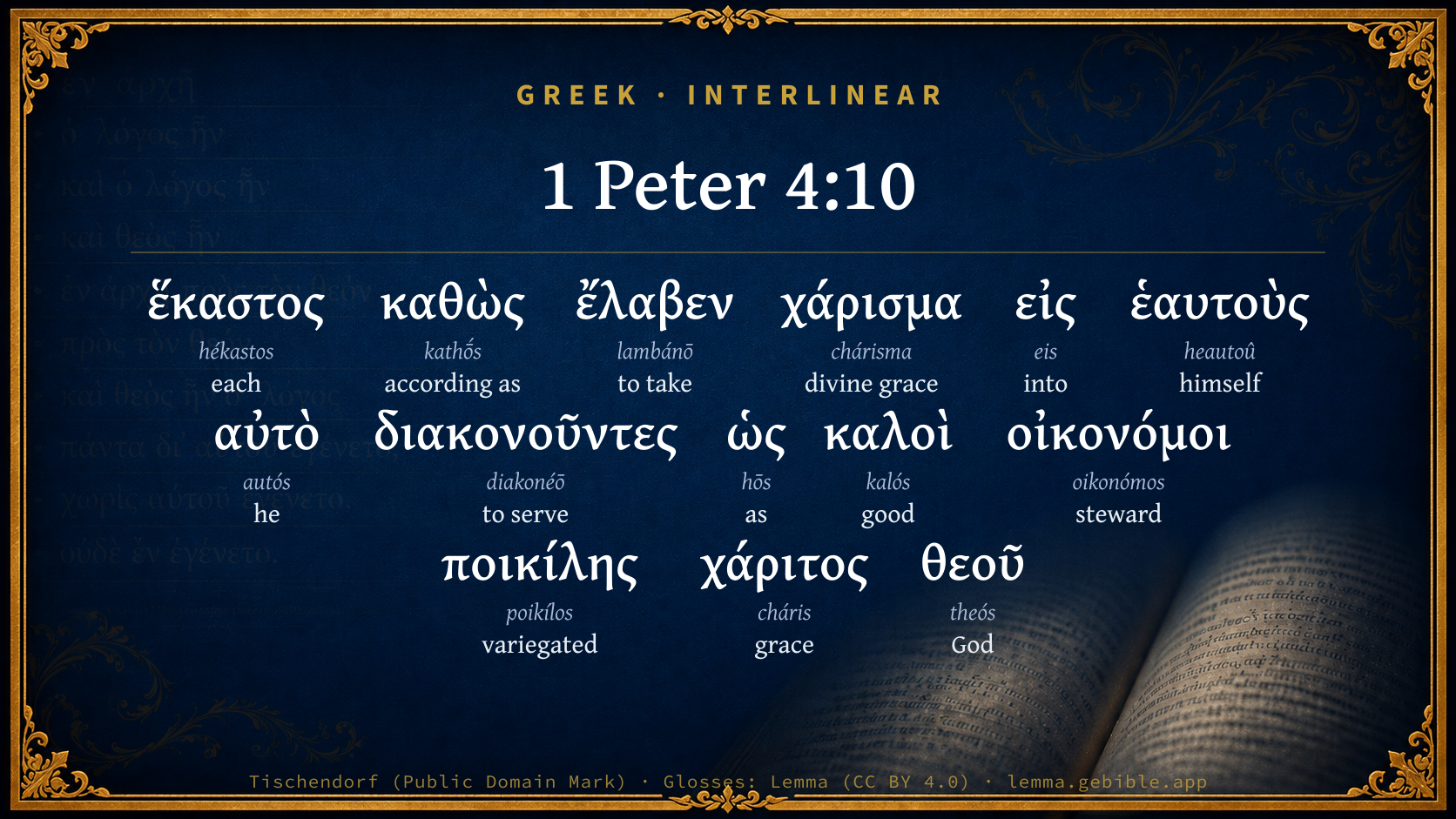
  1. ἕκαστος hékastos G1538 “each” Adjective, Nominative, Singular, Masculine
  2. καθὼς kathṓs G2531 “according as” Adverb
  3. ἔλαβεν lambánō G2983 “to take” Verb, Aorist, Active, Indicative, 3rd person, Singular
  4. χάρισμα chárisma G5486 “divine grace” Noun, Accusative, Singular, Neuter
  5. εἰς eis G1519 “into” Preposition
  6. ἑαυτοὺς heautoû G1438 “himself” Reflexive pronoun, 3rd person, Accusative, Plural, Masculine
  7. αὐτὸ autós G846 “he” Personal pronoun, Accusative, Singular, Neuter
  8. διακονοῦντες diakonéō G1247 “to serve” Verb, Present, Active, Participle, Nominative, Plural, Masculine
  9. ὡς hōs G5613 “as” Adverb
  10. καλοὶ kalós G2570 “good” Adjective, Nominative, Plural, Masculine
  11. ποικίλης poikílos G4164 “variegated” Adjective, Genitive, Singular, Feminine
  12. χάριτος cháris G5485 “grace” Noun, Genitive, Singular, Feminine
  13. θεοῦ theós G2316 “God” Noun, Genitive, Singular, Masculine

About this verse

These counts appear in no published source. They are computed here, from the morphology-tagged text and Lemma’s own curated glosses. What Lemma adds →

14
words
14
distinct lemmas
General Epistles
section

Notable vocabulary

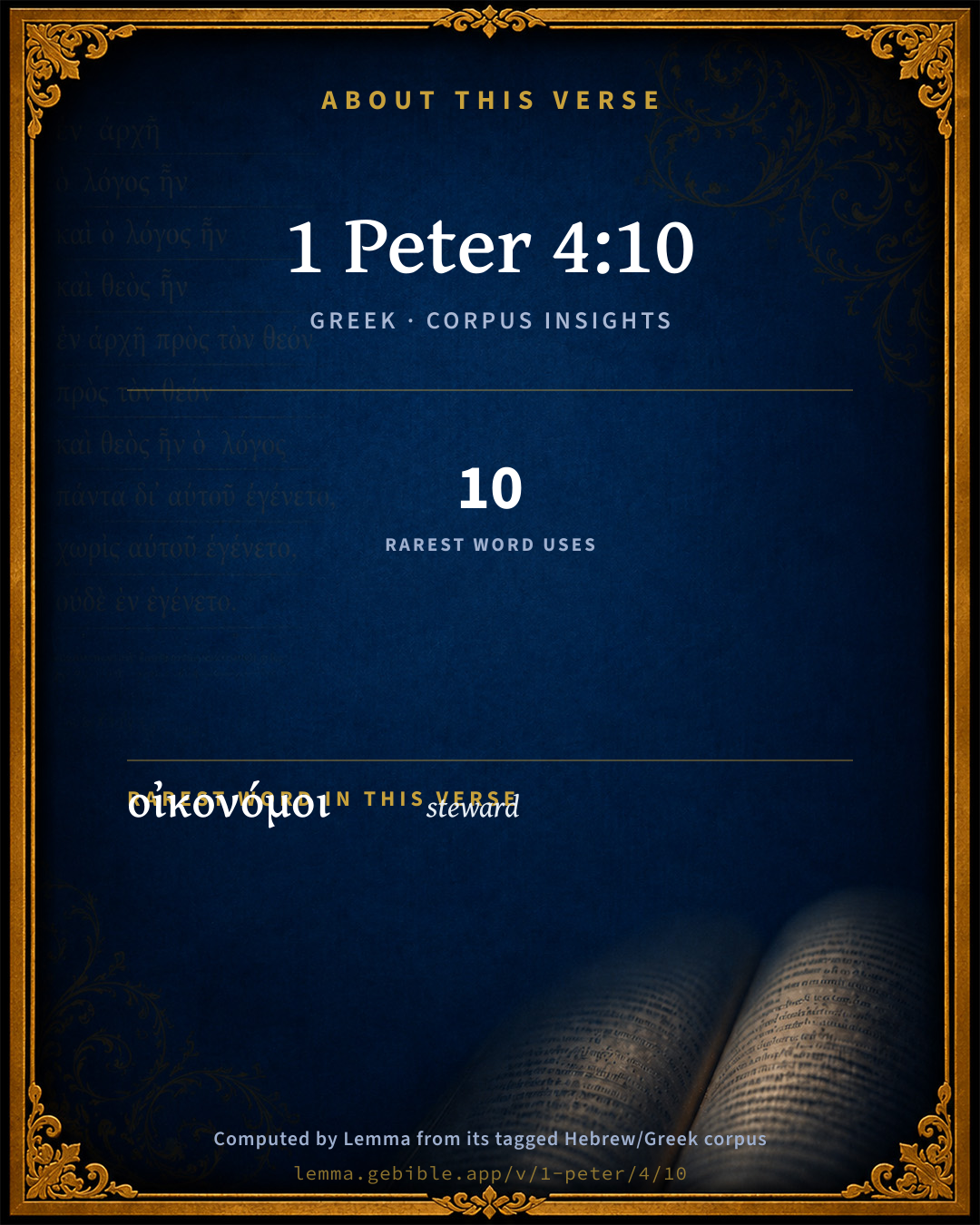
The rarest word here is οἰκονόμοι steward G3623 — appearing just 10 times in the whole Greek New Testament.

Shared distinctive vocabulary

οἰκονόμοι steward G3623 occurs in 10 verses of the Greek New Testament. Also found in:

Cross-references

26

Topical passages linked to 1 Peter 4:10 in the Treasury of Scripture Knowledge — connected by theme and wording, ordered by reader-vote popularity; previews shown in the World English Bible.

  • Romans 12:6–8 Having gifts differing according to the grace that was given to us, if prophecy, let us prophesy according to the proportion of our faith;
  • 1 Corinthians 12:4–11 Now there are various kinds of gifts, but the same Spirit.
  • 1 Corinthians 4:1–2 So let a man think of us as Christ's servants, and stewards of God's mysteries.
  • Mark 10:45 For the Son of Man also came not to be served, but to serve, and to give his life as a ransom for many."
  • Hebrews 6:10 For God is not unrighteous, so as to forget your work and the labor of love which you showed toward his name, in that you served the saints, and still do serve them.
  • 1 Corinthians 15:10 But by the grace of God I am what I am. His grace which was bestowed on me was not futile, but I worked more than all of them; yet not I, but the grace of God which was with me.
  • Romans 15:27 Yes, it has been their good pleasure, and they are their debtors. For if the Gentiles have been made partakers of their spiritual things, they owe it to them also to serve them in fleshly things.
  • 1 Corinthians 3:10 According to the grace of God which was given to me, as a wise master builder I laid a foundation, and another builds on it. But let each man be careful how he builds on it.
  • Ephesians 4:11 He gave some to be apostles; and some, prophets; and some, evangelists; and some, shepherds and teachers;
  • 1 Corinthians 4:7 For who makes you different? And what do you have that you didn't receive? But if you did receive it, why do you boast as if you had not received it?
  • Luke 12:42 The Lord said, "Who then is the faithful and wise steward, whom his lord will set over his household, to give them their portion of food at the right times?
  • Ephesians 3:8 To me, the very least of all saints, was this grace given, to preach to the Gentiles the unsearchable riches of Christ,
  • Titus 1:7 For the overseer must be blameless, as God's steward; not self-pleasing, not easily angered, not given to wine, not violent, not greedy for dishonest gain;
  • Luke 19:13 He called ten servants of his, and gave them ten mina coins, and told them, 'Conduct business until I come.'
  • Matthew 20:28 even as the Son of Man came not to be served, but to serve, and to give his life as a ransom for many."
  • Matthew 25:44 "Then they will also answer, saying, 'Lord, when did we see you hungry, or thirsty, or a stranger, or naked, or sick, or in prison, and didn't help you?'
  • Luke 8:3 and Joanna, the wife of Chuzas, Herod's steward; Susanna; and many others; who ministered to them from their possessions.
  • Romans 15:25 But now, I say, I am going to Jerusalem, serving the saints.
  • 2 Corinthians 6:1 Working together, we entreat also that you not receive the grace of God in vain,
  • Matthew 24:14 This Gospel of the Kingdom will be preached in the whole world for a testimony to all the nations, and then the end will come.
  • Matthew 25:14–15 "For it is like a man, going into another country, who called his own servants, and entrusted his goods to them.
  • Luke 16:1–8 He also said to his disciples, "There was a certain rich man who had a manager. An accusation was made to him that this man was wasting his possessions.
  • Matthew 24:45 "Who then is the faithful and wise servant, whom his lord has set over his household, to give them their food in due season?
  • 2 Timothy 1:18 (the Lord grant to him to find the Lord's mercy in that day); and in how many things he served at Ephesus, you know very well.
  • Matthew 24:21 for then there will be great oppression, such as has not been from the beginning of the world until now, no, nor ever will be.
  • 2 Corinthians 9:1 It is indeed unnecessary for me to write to you concerning the service to the saints,

Cross-references courtesy of OpenBible.info (CC BY 4.0).

Commentary

Notes on 1 Peter 4:10 from classic Christian and Jewish commentators (each source and its license shown beneath its notes). The classic Christian expositions comment on the surrounding passage and are grouped to its opening verse, so a note may address several verses; the Jewish commentaries on the Tanakh (Rashi and others) are per-verse, so they appear only where the commentator wrote on this verse.

Lemma curates 59 commentaries, every one of them public domain or Creative Commons licensed, each selected and text-cleaned for this edition rather than reprinted as found. About our sources →

Joseph Benson's Commentary

1Pe 4:10-11. As every man hath received the gift — Or, a gift, spiritual or temporal, ordinary or extraordinary, (although the latter seems primarily intended,) so minister the same one to another — Employ that gift for the common good; as good stewards of the manifold grace of God — Of the talents wherewith his free love has intrusted you. If any man speak — In public assemblies, or in the social meetings of his Christian brethren; let him speak as the oracles of God — Let all his words be according to that pattern, both as to matter and manner, and more especially when he speaks in public. By this mark we may always know who are, so far, the true or false prophets. The oracles of God teach that men should repent, believe, and obey; he that treats of faith, and leaves out repentance, and fruits worthy of repentance; or treats of repentance and its fruits, but omits inculcating faith; or who does not enjoin practical holiness to believers, does not speak as the oracles of God; he does not preach Christ, let him think as highly of himself as he will. If any man minister — Serve his brother in love, whether in temporal or spiritual things; let him do it as of the ability which God giveth — That is, humbly and diligently, ascribing all his power to God, and using it with his might; that God in all things — Whether of nature or of grace; may be glorified through Jesus Christ — The wise dispenser of these gifts; to whom — As our great Redeemer and Saviour; be praise and dominion — Greek, η δοξα και το κρατος, the glory of them, and the power of dispensing them; or the glory of his wisdom, which teaches us to speak, and the might which enables us to act.

Joseph Benson's Commentary on the Old and New Testaments (1811–1818) — public domain. Text from a community e-Sword module.

Tyndale Open Study Notes

Tyndale Open Resources

4:10 his great variety of spiritual gifts: See Rom 12:6-8; 1 Cor 12:1-31; Eph 4:7-16. • Use (literally manage) them well: Believers are like managers: They have been entrusted by God, their Master, with gifts to be used to glorify him.

Tyndale Open Study Notes — © Tyndale Open Resources, licensed CC BY-SA 4.0. Text via the HelloAO Bible API.

Bengel's Gnomon

Johann Albrecht Bengel

1Pe 4:10. Καθὼς, even as) Understand shortly afterwards, so.—αὐτὸ, that (gift) itself) without striving after another.—ποικίλης, [“manifold”] varied) distributing various gifts, with reference to the speech, or ministering. See next verse.

Bengel's Gnomon of the New Testament — English translation (T&T Clark, Edinburgh, 1860) — public domain. Text from a community e-Sword module.

Meyer's Critical & Exegetical Commentary

Heinrich August Wilhelm Meyer

1Pe_4:10. Second manifestation of love. It is presupposed that each one has received a χάρισμα: ἕκαστος καθὼς ἔλαβε χάρισμα] καθώς, not equal to ὅς, but pro ratione qua, prouti (Wahl), according as.

χάρισμα] as in Rom_12:6; 1Co_12:4; 1Co_12:28; not an office in the church. Every man should, according to the kind of gift he has received (not: according to the measure of it, ἐν τούτῳ τῷ μέτρῳ, ἐν ᾧ ἔλαβε vel ut Paulus: ὡς ὁ Θεὸς ἐμέρισε μέτρον χαρισμάτων, Rom_12:3. Pott: still less can καθώς be referred to the manner of receiving; Lorinus: sicut gratis accepimus, ita gratis demus), administer it for his brethren, εἰς ἑαυτούς, i.e. for their benefit, and therefore for that of the entire community. διακονεῖν (a transitive verb, as in chap. 1Pe_1:12): vocula emphatica; innuit Ap. quod propter dona illa nemo se debeat supra alios efferre, aut dominium in alios affectare, sed aliorum ministrum sese sponte constituere (Gerhard).

ὡς καλοὶ οἰκονόμοι ποικίλης χάριτος Θεοῦ] With ὡς, cf. chap. 1Pe_1:14 : as is peculiar to the καλοῖς οἰκονόμοις, which, from their vocation, Christians should be. With οἰκονόμοι, cf. 1Co_4:1; Tit_1:7. According to de Wette and Weiss, there is here an allusion to the parable of the talents, Mat_25:14.

καλός] expression of irreproachable excellence; see 1Ti_4:6; 2Ti_2:3. The Lord of the Christians, as the οἰκονόμοι, is God; the goods which He entrusts to their stewardship are His ποικίλη χάρις; χάρις is here the sum of all that has fallen to the share of believers through the grace of God; the individual manifestations of it are the χαρίσματα, the homogeneous character of which is marked by the singular, and their variety by ποικίλη here subjoined with reference to the preceding καθὼς … χάρισμα.

Meyer — Critical and Exegetical Commentary on the New Testament — English translation by Peter Christie, edited by Frederick Crombie (T&T Clark, 1880) — public domain. Text from a community e-Sword module.

Expositor's Greek Testament

ed. W. Robertson Nicoll

1Pe 4:10 f. supplement the foregoing directions for the inner life of the Church and rest partly on Rom 12:6 (with simpler classification of gifts ), partly on the conception of disciples as stewards (Luk 12:42 ) serving out rations in God’s house. διακονοῦντες , in the widest sense (as διακονία in Act 6:1 ; Act 6:4 ; 1Co 12:5 ) in accordance with the saying, the Son of Man came … to minister (Mar 10:45 ), which is interpreted here, as part of the pattern, by the addition of an object (only here and 1Pe 1:12 ); cf. 2Co 8:19 , τῇ χάριτι … τῇ διακονουμένῃ ὑφʼ ἡμῶν . οἰκονόμοι . The title is applied to all and not only to the governors as by St. Paul (1Co 4:1 ; Tit 1:7 ); compare the question of St. Peter which precedes the source (Luk 12:41 f.).

The Expositor's Greek Testament, edited by W. Robertson Nicoll (1897–1910) — public domain. Text from a community e-Sword module.

Geneva Bible (1599)

Geneva Bible translators

He showeth the use of charity, to wit, that every man bestow that gift which he hath received to the profit of his neighbor.

A reason, because that what gift soever we have we have received it of God upon this condition, to be his disposers and stewards.

Geneva Bible (1599) marginal notes — public domain. Text via Bolls.life.

Jamieson, Fausset & Brown

Robert Jamieson, A. R. Fausset & David Brown

every--"even as each man hath received," in whatever degree, and of whatever kind. The Spirit's gifts (literally, "gift of grace," that is, gratuitously bestowed) are the common property of the Christian community, each Christian being but a steward for the edifying of the whole, not receiving the gift merely for his own use.

minister the same--not discontentedly envying or disparaging the gift of another.

one to another--Greek as in Pe1 4:8, "towards yourselves"; implying that all form but one body, and in seeking the good of other members they are promoting the good of themselves.

stewards--referring to Mat 25:15, &c.; Luk 19:13-26.

Jamieson, Fausset & Brown — Commentary Critical and Explanatory on the Whole Bible (1871) — public domain (CC PDM 1.0). Text via the HelloAO Bible API.

Adam Clarke's Commentary

Verse 10. Hath received the gift] χαρισμα. A gift; any blessing of providence or grace. I cannot think that the word means here the Holy Ghost, or any of his supernatural gifts or influences; it may include those, but it signifies any thing given by the mere mercy and bounty of God: but perhaps in this place it may signify some or any office in the Church; and this sense, indeed, the connection seems to require.

Stewards of the manifold grace] Whatever gifts or endowments any man may possess, they are properly speaking, not his own; they are the Lord's property, and to be employed in his work, and to promote his glory.

Adam Clarke's Commentary on the Bible (1810–1826) — public domain. Text from a community e-Sword/MySword module.

John Calvin's Commentaries

10 As every one hath received He reminds us what we ought to bear in mind when we do good to our neighbors; for nothing is more fitted to correct our murmurings than to remember that we do not give our own, but only dispense what God has committed to us. When therefore he says, “Minister the gift which every one has received,” he intimates that to each had been distributed what they had, on this condition, that in helping their brethren they might be the ministers of God. And thus the second clause is an explanation of the first, for instead of ministry he mentions stewardship; and for what he had said, “as every one hath received the gift,” he mentions the manifold graces which God variously distributes to us, so that each might confer in common his own portion. If then we excel others in any gift, let us remember that we are as to this the stewards of God, in order that we may kindly impart it to our neighbors as their necessity or benefit may require. Thus we ought to be disposed and ready to communicate.

But this consideration is also very important, that the Lord hath so divided his manifold graces, that no one is to be content with one thing and with his own gifts, but every one has need of the help and aid of his brother. This, I say, is a bond which God hath appointed for retaining friendship among men, for they cannot live without mutual assistance. Thus it happens, that he who in many things seeks the aid of his brethren, ought to communicate to them more freely what he has received. This bond of unity has been observed and noticed by heathens. But Peter teaches us here that God had designedly done this, that he might bind men one to another.

John Calvin's Commentaries (1540-1563) — public domain. Text from the Calvin Translation Society English edition (1840s-50s) via the Christian Classics Ethereal Library (ccel.org). Calvin's coverage is partial (roughly two-thirds of the Bible); uncommented books and verses are honest gaps, never fabricated. The 19th-century editor's footnotes and remarks are omitted so the notes are faithfully Calvin's own voice.

Ellicott's Commentary for English Readers

(10) As every man hath received the gift.—There is no definite article in the-Greek, which might be rendered, According as every man was gifted. They are reminded, as in 1Co_4:7, that the gift was received, and for the same purpose. At what period these gifts were received it is hard to say, as in some instances the gift was of a spiritual nature, in others of a temporal nature. Each, however, has a gift of some kind for the benefit of the community.

Even so minister.—In the original, ministering. It is still an exhibition of the “intense charity” of 1Pe_4:8. The verb is the same as in 1Pe_1:12, where see Note.

As good stewards.—No one receives these gifts, spiritual or temporal, as his own; he is but a “steward,” and when he offers them to the Church it is not as a benefactor, but as a servant, “ministering.”

Of the manifold grace of God.—“Grace” is here used, not in its theological sense, but, as in 1Pe_3:7, in the sense of bountiful giving; and the beautiful word rendered “manifold” brings out the subtle and picturesque variety with which God arranges and distributes His bounty. But the emphatic word of the sentence is “of God.”

A Bible Commentary for English Readers, edited by Charles John Ellicott (1878–1897) — public domain. Text from a community e-Sword module.

The Cambridge Bible for Schools and Colleges

gen. ed. J. J. S. Perowne

10. As every man hath received the gift] The two verses remind us of the like precepts in Rom_12:6; 1Co_12:4; 1Co_12:28. The tense of the Greek verb (“as every man received the gift”) implies the thought that the gift came at a definite moment, probably at that of the laying on of hands. Comp. Act_19:6; 1Ti_4:14. The words “As every man received” may be equivalent to “Let every man use his gift according to its nature or purpose,” which agrees best with Rom_12:6, or they may, more probably, be an echo of the “freely ye received, freely give” of Mat_10:8.

even so minister the same one to another] The Greek verb means something more than “use” or “administer.” It implies that men were to see in the gifts they possessed no ground for boasting, but only a call to more lowly service. They were to be, as in the next clause, “stewards” of those gifts. The thought that men are stewards, not possessors, of what God has given them in their outward or their inward life was, of course, a natural one (1Co_4:1; Tit_1:7), but here we can scarcely fail to recognise an echo of our Lord’s teaching. Peter had heard the parable of the steward who “wasted his lord’s goods” (Luk_16:1-12) and his Lord’s question, Who then is the faithful and wise steward? (Luk_12:42). In the “manifold,” or better, perhaps, varied grace of God, we have implied a much greater diversity of gifts, such as we find in 1Co_12:8-10, Eph_4:11, than those which the Apostle specifies. He confines himself, indeed, to the one broad division between the gifts that shewed themselves in speech and those that shewed themselves in act.

The Cambridge Bible for Schools and Colleges (gen. ed. J. J. S. Perowne; Cambridge University Press, 1878–1918) — public domain. Text from a community e-Sword module.

John Gill's Exposition

As every man hath received the gift,.... That is, from God, as the Syriac and Ethiopic versions add. This is a general rule laid down by the apostle, according to which, distribution of every kind, whether in things temporal or spiritual, is to be made, even according to the nature, quality, and quantity of the gift received: the greatest gift God bestows on men, next to himself, Son, and Spirit, and received by them in this life, is special grace; which God gives of his sovereign will and pleasure, liberally, abundantly, without the deserts of men, or conditions to be performed by them; of this kind are faith, repentance, hope, and love: the next to this is the ministerial gift, or what qualifies men for the work of the ministry; which is not anything in nature, or what is acquired by art and industry, but is a gift of grace, which is bestowed on some in a higher, on others in a lower degree: and besides these, there are the gifts of nature and providence, as human wisdom, and the knowledge of things natural and civil, riches and wealth, and the various good things of life; for there is nothing a man has in nature and in grace but what is a gift to him, and what he has received: and according to the measure of the gift received, be it what it will, the exhortation is,

even so minister the same one to another; or to, and among yourselves; to your neighbours or companions, as the Syriac, version renders it; if the gift be special grace though that itself cannot be imparted from one to another, yet the knowledge of it may; and it becomes such who have an experience of the grace of God upon their hearts to make it known, both to particular friends in private conversation, and to the church of God in public, for the use and edification of others, and the glory of God's grace: if the gift be a ministerial one, whether it be greater or less, for it is not in all alike, it is not to be wrapped up in a napkin, and hid in the earth, or to lie neglected, but to be stirred up, and used for the benefit of the souls of men: and if it is a temporal one, the good things of this life, according to the measure of them, that a man has, he is to minister to the supply of the poor; and as God has prospered him, he is to distribute to the necessities of others; as men freely receive, be it what it will, they should freely minister it, according to the nature and measure of it:

as good stewards of the manifold grace of God; for they are but stewards of whatsoever gifts they have; and therefore, if they would approve themselves good stewards, they should minister the same in proportion to their reception of them. Manifold and various are the graces of the Spirit of God, and the rich experiences communicated to men, which are not only for themselves, but for the good of others also: gifts for public usefulness are different one from another; one man has one gift, and another has another; or the same gift is not alike in all, in some greater, and in others less; and all are but stewards: they are accountable for them, and the use of them, to their great Lord and master: and various are the doctrines of the grace of God; of the grace of the Father in election, in the everlasting covenant, in the mission of his Son, in the free justification of sinners by his righteousness, in the free and full pardon of all their sins, in the adoption of any into his family, and in the gift of eternal life; and of the Son of God, in engaging as the surety of his people from everlasting, in assuming their nature in time, in obeying, suffering, and dying in their room and stead; and of the Spirit of God in regeneration and sanctification; and of all these mysteries of grace the ministers of the Gospel are stewards; and it is required of them that they be faithful. Temporal good things are given to men, not for their own use only, but for others; and they are but stewards of them; the original proprietor is God, and to him they must give an account of their stewardship, and how they have used and disposed of the manifold gifts which God of his goodness has put into their hands; so that this last clause contains a reason or argument enforcing the above rule.

John Gill's Exposition of the Whole Bible (1746–1763) — public domain (CC PDM 1.0). Text via the HelloAO Bible API.

Trapp's Complete Commentary

John Trapp

10 As every man hath received the gift, even so minister the same one to another, as good stewards of the manifold grace of God.

Ver. 10. Even so minister] Clouds when full, pour down, and the spouts run, and the eaves shed, and the presses overflow, and the aromatical trees sweat out their precious and sovereign oils; and every learned scribe brings out his rich treasure, &c. "The manifestation of the Spirit is given to every man to profit withal," 1Co 12:7. There are some that make it their chief work proficere potius quam prodesse, to inform themselves, rather than to instruct others; to know, than to teach. Synesius inveighs against a sort of such in his times, as, having a treasure of rare abilities in them, would as soon part with their hearts as with their conceptions, the canker of whose great skill shall be a swift witness against them. Cardan speaketh of one that had a receipt that would suddenly and certainly dissolve the stone in the bladder; and concludes of him that he was undoubtedly damned, because he never revealed it before he died, to any one. {a} Let men be ready to communicate the good they have, as the moon doth her borrowed light, as the stars are still in motion for the good of others; as the heart receiving spirits from the liver, ministereth them to the brain, and the brain to the other parts of the body.

{a} Non dubito quin iste sit apud inferos.

John Trapp, A Commentary or Exposition upon All the Books of the Old and New Testament (1647–1656) — public domain. Text from a community e-Sword module.

Albert Barnes' Notes on the Bible

As every man hath received the gift - The word rendered “the gift” (χάρισμα charisma,) in the Greek, without the article, means “endowment” of any kind, but especially that conferred by the Holy Spirit. Here it seems to refer to every kind of endowment by which we can do good to others; especially every kind of qualification furnished by religion by which we can help others. It does not refer here particularly to the ministry of the word - though it is applicable to that, and includes that - but to all the gifts and graces by which we can contribute to the welfare of others. All this is regarded as a gift, or charisma, of God. It is not owing to ourselves, but is to be traced to him. See the word explained in the notes at 1Ti 4:14.

Even so minister the same one to another - In anything by which you can benefit another. Regard What you have and they have not as a gift bestowed upon you by God for the common good, and be ready to impart it as the needs of ethers require. The word “minister” here (διακονοῦντες diakonountes) would refer to any kind of ministering, whether by counsel, by advice, by the supply of the needs of the poor, or by preaching. It has here no reference to any one of these exclusively; but means, that in whatever God has favored us more than others, we should be ready to minister to their needs. See 2Ti 1:18; 2Co 3:8; 2Co 8:19-20.

As good stewards - Regarding yourselves as the mere stewards of God; that is, as appointed by him to do this work for him, and entrusted by him with what is needful to benefit others. He intends to do them good, but he means to do it through your instrumentality, and has entrusted to you as a steward what he designed to confer on them. This is the true idea, in respect to any special endowments of talent, property, or grace, which we may have received from God. Compare the 1Co 4:1-2 notes; Luk 16:1-2, Luk 16:8 notes.

Of the manifold grace of God - The grace or favor of God evinced in many ways, or by a variety of gifts. His favors are not confined to one single thing; as, for example, to talent for doing good by preaching; but are extended to a great many things by which we may do good to others - influence, property, reputation, wisdom, experience. All these are to be regarded as his gifts; all to be employed in doing good to others as we have opportunity.

Albert Barnes' Notes on the Bible (1834–1885) — public domain. Text from a community e-Sword/MySword module.

Haydock's Catholic Bible Commentary

As good stewards of the manifold grace of God. An admonition to the ministers of the gospel, to employ well their talents and the graces received to the honour and glory of God. (Witham)

George Leo Haydock (1774–1849), Haydock's Catholic Family Bible and Commentary, 1859 edition — public domain. Excludes Psalms (Douay-Rheims chapter numbering differs from Protestant) and Deuterocanonical books (Catholic canon only).

Matthew Poole's English Annotations

As every man hath received the gift; any gift, office, faculty, or ability, whereby he may be serviceable to the good of others, all which are received of God, 1Co 12:11; Eph 4:7.

Minister the same one to another; dispense and communicate modestly and humbly, not lifting himself up above others upon the account of his gifts, but remembering he hath received them, and is a steward to dispense them.

As good stewards; and therefore faithful in distributing his Lord’s goods.

Of the manifold grace of God: by grace he means the same as by gift before; and so by manifold grace, the various gifts given to them of God, 1Co 12:4-6.

Matthew Poole's English Annotations on the Holy Bible (1683–1685) — public domain. Text from a community e-Sword/MySword module.

Whedon's Commentary on the Bible

Daniel D. Whedon

10. So also in the exercise of supernatural gifts, referring to the charisms bestowed upon the primitive Christians, though doubtless including God’s gifts of a temporal character. 1Co_12:4-11; 1Co_12:28.

As good stewards—Put in trust, for the Lord’s gracious purposes, with the precious gift, to be used for him in doing good to others, and not for one’s own personal and selfish ends. The rule is, according as every man hath received, and applies to the use of our talents, money, influence, and whatever God has given.

Daniel D. Whedon (gen. ed.), Commentary on the Old and New Testaments (1874–1909) — public domain. Text from a community e-Sword module.

The Pulpit Commentary

As every man hath received the gift; rather, according as each received a gift. The aorist e]laben, "received," seems to point to a definite time, as baptism, or the laying on of hands. (comp. Act_8:17; 1Ti_4:14) For the gift (carisma), comp. Romans 1Co_12:4, "There are diversities of gifts." Even so minister the same one to another; literally, ministering it towards one another. The gifts of grace, whatever they may be, are talents entrusted to individual Christians for the good of the whole Church; those who have them must use them to minister to the wants of others. (comp. 1Pe_1:12, where the same word, diakonein, to minister, is used of the gift of prophecy) As good stewards of the manifold grace of God. We seem to see here a reference to the parable of the talents. (comp. also 1Co_4:1; Tit_1:7) Christians must be "good stewards (kaloimoi)." There should be not only exactness, but also grace and beauty in their stewardship the beauty which belongs to holy love, and flows from the imitation of him who is "the good Shepherd (oJ poimhv)."; ; The gifts (carismata) are the manifestations of the grace (cariv) of God; that grace from which all gifts issue is called manifold (poikilh), because of the diversities of its gifts, the variety of its manifestations.

HOMILIES BY A. MACLAREN Ver. 10.

Gifts and service.

If we may venture to connect these words with the preceding injunction as well as with the following, the power of rendering simple hospitality is as truly a gift of God"s grace for the use of which a man is responsible as is the loftiest endowment of eloquent speech or eminent service. The large principles embodied in these simple words would revolutionize the Church, and go far to regenerate the world, if they were honestly carried out. All powers are gifts. All gifts are trusts. What simplicity, what power, what unselfishness, what diligence, what regard for others" work, what humility as to one"s own, would fill the life which was wholly molded by these convictions.

I THE UNIVERSALITY OF GIFT. "Every man hath received," says Peter, and builds upon it as a well-recognized fact. All these poor ignorant Asiatics, picked from the filth of idolatry, slaves and outcasts as some of them had been, rude and uncultured and lowly of station and imperfectly Christianized as many of them were, they each had some Divine gift which needed only to be burnished and shown to shine afar with heavenly brightness. Every Christian man today, in like manner, is endowed with some gift; for every Christian has the Spirit of God dwelling in him, and that Spirit never comes empty-handed. Whatever subordination there may be in the Church, as in all organized communities, its very life depends on the fact that all its members possess the Divine Spirit, and no claim of authority to rule nor prerogative of teaching, which does not recognize that fact, can stand for a moment. The aspiration of Moses has been fulfilled, (Num_11:29) "All the Lord"s people" are prophets," and "the Lord" has "put his Spirit upon them." Miraculous powers were widely diffused in the early Church, and, with the gift of tongues, constituted the most conspicuous tokens of the gift of the Pentecostal Spirit. But even then these were not "the best gifts." The graces of faith, hope, and charity, those fruits of the Spirit which consist of a holy character and a heart transparent for the heavenly light which burns within it, as a light fed by perfumed oil in an alabaster lamp, these are better gifts of an indwelling Spirit than all supernatural endowments. The natural faculties, of course, are gifts. To each man the question may be addressed concerning these, "What hast thou which thou hast not received?" But the natural faculties of the Christian, reinforced, quickened, directed by the indwelling Spirit, are still more emphatically gifts. The power of brain or tongue, the spirit of counsel or of might, which he received from the creative breath of God, is intensified by the Spirit, which brings the breath of a new Divine life, as a lamp burns brighter when plunged into a jar of oxygen. And besides the new graces and heightened action of native power, all ability or opportunity dependent on outward circumstances is gift. Health, any skill of hand or eye, wealth, position, everything must come into this category. All which we have is gift. In that sense the gift is universal. And we all have the gift. In that sense, too, it is universal.

II THE VARIETY OF GIFTS. The apostle speaks here of the "manifold" literally, the "variegated" or "many-colored" grace; and exhorts tovariety of service based upon dissimilarity of gifts. It cannot but be that the fullness of God passing into the limits of created minds should manifest itself in an infinite variety. The light flashed at different angles from a million dewdrops twinkles and glitters from their tiny spheres in all differing tints of green and purple and gold. The unlimited variety of innumerable recipients growing in the measure of their possessions through eternity is the only adequate manifestation of the infinite God. Such variety is essential, too, to the existence of a community. "If the whole were an eye, where were the body?" The homely proverb says, "It takes all sorts to make a world." With diversity comes room for mutual help and mutual tolerance. Every man has some gift; no man has all. Therefore they are bound together by reciprocal wants and supplies, and convexities here and concavities there fit in to one another and make a solid whole. The same life works, but variously, in the different organs of the one body, so that there should be no schism in the body. This variety constitutes an imperative call to service. Each man has something which some of his brethren want.

The least flower with a brimming cup may stand, And share its dewdrop with another near.

The concert will not be complete, though the roll of the great ocean of praise that surges round the throne be as the noise of many waters, without the tinkle of the little rill of my praise. And some poor soul, which God meant to go shares with me, will have to starve if I do not part my portion among the needy. It constitutes, too, an authoritative prescription of the manner of service. "As every one hath received, so minister the same. " I)o net minister anything else, but that very thing which you have received. God shows you what he intends you to do by what he gives you. Do not copy other people; do not try to be anybody else. Be true to yourself. If your gifts impel you to a special mode of service, follow them. Find out what you are fit for, and do it in your own fashion. Take your directions at first hand from God, and don"t spoil your own little gift by trying to bend it into the shape of somebody else"s. Flutes cannot be made to sound like drums. Be content to give out your own note, and leave the care of the harmony to God. And, on the other hand, beware of interfering with your brother"s equal liberty. Do not hastily condemn modes of action because they are not yours. A Salvation Army captain and a philosophical theologian may not understand each other"s dialect; but there is room for them both, and they should not hinder each other. There are many vessels of different materials and shapes for different uses in Christ"s great house. The widest tolerance of the diversities of operation is the truest recognition of the one Spirit which worketh all in all.

III THE RESPONSIBILITY OF GIFTS. "As good stewards." Peter is probably here repeating the thought which he had learned from his Master"s parables. The thought of stewardship is no doubt a natural one, even apart from the reminiscence of our Lord"s teaching; but we can scarcely suppose that Christ"s words did not suggest it here. All gifts are trusts, Peter thinks; that is to say, no Christian gets his natural endowments, nor his material possessions, and still less his spiritual graces, for himself alone. We all admit that in theory about the two former, and in some degree about the latter. But Christian men do not sufficiently consider that God gives them even salvation for the sake of others as well as for their own. No creature is so small but that its well-being is a worthy end for God"s gifts and care. No being is so great that its well-being is worthy to be an exclusive end of God"s gifts and care. We are saved "that we may show forth the praises of him who has called us out of darkness into his marvelous light." The joy of forgiveness, the peace of conscience, the blessed assurance of the Father"s love, the hopes of an immortal heaven, these are not given us for self-absorbed and solitary enjoyment, but that, saved, we may glorify and proclaim the Savior, and bring to others the unspeakable gift. So with all the lesser gifts which flow from that greatest all spiritual endowments, natural capacities heightened by the Spirit"s indwelling, or outward endowments and possessions they are our Lord"s goods put into our hands to administer for him. They were his before they became ours. They are his while they are called ours. They are ours that we may have the joy of bringing him somewhat, and may not only know the blessedness of receiving, but the greater blessedness of giving, even though we have to say, while we bring our gifts, "Of thine own have we given thee." If Christian men really believed what they say they do, that they are stewards, not owners, trustees and not possessors, the whole face of Christianity would be altered. There would be men and money for all noble service, and the world would be bright with unselfish and various ministries, worthily representing the manifold grace of God.

A.M.

Stewardship.

It is too common for men to pride themselves upon their advantages, the strength of body, the gifts of intellect, the bestowments of fortune, which they call their own. But the spirit of Christianity is altogether opposed to such a habit of mind. Peter as well as Paul took occasion to remind Christians that their advantages should be estimated and employed in a very different manner.

I THE CHRISTIAN"S ENDOWMENTS, ACQUISITIONS, AND POSSESSIONS ARE THE FREE GIFT OF GOD"S KINDNESS. Those who do not believe in a Divine Giver cannot regard their possessions as a gift. But many who do not deny that they are the creatures of God"s power and the dependents upon God"s bounty, nevertheless think and act as if they had only themselves to thank for their advantages. We are therefore again and again reminded that we owe all that we have to the unmerited favor of Heaven. What hast thou that thou didst not receive?

II THE CHRISTIAN"S ENDOWMENTS, ACQUISITIONS, AND POSSESSIONS ARE A TRUST WHICH HE HOLDS FROM GOD, AND FOR WHICH HE MUST GIVE ACCOUNT. We are called to be "good stewards." Now, a steward is not an owner of the property; he is the responsible administrator of a trust. Why have our various advantages been conferred? Certainly not that we may use them for our personal pleasure or emolument or aggrandizement, but that by their means we may be serviceable to others. The former course would be an abuse of the trust reposed in us. The conferring of such a trust is a personal probation. He who has five talents is expected so to use them as to increase his means and powers of usefulness, and to offer to the Judge the interest which accrues to him who faithfully employs his deposit.

III THE CHRISTIAN"S ENDOWMENTS, ACQUISITIONS, AND POSSESSIONS ARE DESIGNED FOR THE SERVICE AND BENEFIT OF Ills FELLOW-MEN. The expression of St. Peter is noticeable in its definiteness and graphic force: "ministering it among yourselves.

1. This, then, is an appointed service.

2. A beneficial service.

3. A mutual service. In the Church of Christ no one is wholly and only a giver, or wholly and only a receiver. Every one has some gift, and every one has some need. It is by mutual ministration that the general welfare is secured.

4. A service acceptable to Christ. He who gave not only his gifts, but himself, for men, cannot but take pleasure in every manifestation of sympathy, in every ministration of helpfulness, to be met with in his Church. J.R.T.

The Pulpit Commentary (1880–1919), ed. H.D.M. Spence-Jones & Joseph S. Exell — public domain. Text from a community e-Sword module.

John Wesley's Explanatory Notes

As every one hath received a gift - Spiritual or temporal, ordinary or extraordinary, although the latter seems primarily intended. So minister it one to another - Employ it for the common good. As good stewards of the manifold grace of God--The talents wherewith his free love has intrusted you.

John Wesley, Explanatory Notes Upon the Whole Bible (1754–1765) — public domain. Text via the GEBible commentary corpus.

Scofield Reference Notes

C. I. Scofield

grace

Grace (imparted). 1Pe 5:5; 1Pe 5:10; Rom 6:1; 2Pe 3:18

The Scofield Reference Bible (1917 edition), notes by C. I. Scofield — public domain. Text from a community e-Sword module.

Burkitt's Expository Notes on the New Testament

William Burkitt

His next exhortation is, That they endeavour rightly to employ, and wisely to improve, their spiritual gifts, (as well as their temporal, mentioned in the foregoing verse,) which they had received for the good and benefit of others in their respective places in the church, looking upon themselves not as proprietors, but as stewards, of the various gifts bestowed upon them by the free favour of God, and which they must give an impartial account.

Learn hence, 1. That several men have their several gifts, as it pleaseth the gift-giving Spirit to give unto them: As every man has received the gift.

Learn, 2. That gifts are given for the benefit of others, we are to minister one to another, that is, to improve our gifts to the mutual edification of each other.

Learn, 3. That such as look upon themselves as stewards of the manifold gifts of God, will wisely improve them for his glory, and the good of others, the great ends for which he has conferred them.

William Burkitt's Expository Notes on the New Testament (1700–1703) — public domain. Text from a community e-Sword module.

The People's New Testament

B. W. Johnson

10. Even as each hath received a gift. All these are to be freely used for others. Spiritual gifts (1 Cor. 12:4, 28) are primarily meant, but the principle is of general application. As good stewards. Those to whom God has given gifts must use them, not as their own, but as God's.

B. W. Johnson's The People's New Testament with Notes (1889–1891) — public domain. Electronic text from the Christian Classics Ethereal Library (CCEL) ThML edition.

unfoldingWord translationNotes

Door43 World Missions Community

As each one of you has received a gift

This refers to special spiritual abilities that God gives to believers. AT: "Because each one of you has received a special spiritual ability as a gift from God" (See: Assumed Knowledge and Implicit Information)

so that in all ways God would be glorified

This can be stated in active form. AT: "so that in all ways you will glorify God" (See: Active or Passive)

glorified

praised, honored

translationWords

receive

gift

servant

manager

God

strength

glory

Jesus

glory

power

eternity

amen

unfoldingWord translationNotes — © Distant Shores Media and the Door43 World Missions Community, licensed CC BY-SA 4.0. Source: git.door43.org/Door43/en_tn.

Cambridge Greek Testament for Schools and Colleges

10. καθὼς ἔλαβεν χάρισμα. The aorist most naturally refers to their conversion or their baptism but, if worldly goods to be used in hospitality are included as a χάρισμα, these would be possessed before conversion, and the aorist may refer to God’s endowment of His future stewards.

διακονοῦντες. διακονεῖν, διακονία, and διάκονος can be used of any kind of ministry or service. Thus our Lord uses it of His own work and it is used of the ministry of angels, or of prophets, 1Pe 1:12, or of apostles, but it is specially used of ministering to the wants of others. The word is used both in its general and special sense in Act 6:1-4 where διακονία is first used of the distribution of alms (cf. διακονεῖν τραπέζαις) and then of “the ministry of the word” i.e. preaching. Again in Rom 12:7 διακονία is mentioned as a special duty, side by side with prophesying, teaching, exhortation. So here διακονοῦντες is first used generally of all kinds of Christian service and then specially εἴ τις διακονεῖ.

There are such numerous echoes of Romans 12, 13 in 1 Pet. (see Int. p. lx.) that there can be little doubt that in this passage about the use of various χαρίσματα St Peter is borrowing from Rom 12:6 ff. but instead of employing St Paul’s characteristic illustration of the body and its members he uses that of stewardship.

οἰκονόμοι. οἰκονομία means primarily “the office of a steward” or “household management,” but the latter meaning was used in a very wide sense of any kind of provision or arrangement, cf. the English word “dispensation,” so in Eph 1:10; Eph 3:2; Eph 3:9; Col 1:25 it is used of God’s plan or arrangement; but in 1Co 4:1-2; 1Co 9:17 St Paul speaks of his own stewardship and says that he and his fellow-workers should be regarded as “stewards,” so Tit 1:7 the ἐπίσκοπος must be blameless as being “the steward of God” (cf. the Parable of the unjust steward and Luk 12:42). In the latter passage the steward, though himself a slave, is evidently regarded as being in a position of authority over the other servants, but here St Peter seems to regard every man as an οἰκονόμος. As members of “the household of God” each one is responsible for using what his Master has given him for the benefit of the household in accordance with God’s “housekeeping arrangements.”

ποικίλης χάριτος. All the different gifts (χαρίσματα) are bestowed by God’s free favour (χάρις) which shows itself in a variety (ποικίλης) of forms (cf. 1Co 12:4-11; Rom 12:3-8).

Cambridge Greek Testament for Schools and Colleges (Cambridge University Press, 1896; 21 vols, various authors incl. Carr, Maclear, Plummer, Farrar, Lumby, Moule, M. R. James, Simcox) — public domain. Text from a community e-Sword module.

Alford’s Greek Testament

Henry Alford

10.] And this is to be so, not merely in the interchange of this world’s good offices, but also in the communication of the gifts of the Spirit, which are the common endowment of the whole body, individual Christians being only the stewards of them. Each man even as (in whatever quality and quantity: but the subsequent injunctions seem more to regard the quality than the quantity. It is otherwise in Eph 4:7; Rom 12:3. The καθώς has no reference to the manner of reception,—“Sicut gratis accepimus, ita gratis demus,” Lorinus in Huther) he received a gift of grace (see Rom 12:6 ff.: 1Co 12:4, 1Co 12:28. χάρισμα, anarthrous, any one of the gifts known by that name), to each other (see above ver. 8: the ἑαυτούς here brings up strikingly the idea that all are members of one body) ministering it (διακονεῖν, transitive, as in ch. 1:12: ministering to the need of others; his store out of which he ministers being that gift thus bestowed upon him) as (being: or, as becometh: see ch. 1:14) good (reff.) stewards (reff., there is most likely a reference to our Lord’s parable of the talents) of the various (see this illustrated 1Co 12:4; Mat 25:15; Luk 19:13) grace of God.

Henry Alford, The Greek Testament (1849–1861) — public domain. Text from a community e-Sword module.

Vincent's Word Studies in the New Testament

Marvin R. Vincent

A gift [χαρισμα] . Originally, something freely given : a gift of grace [χαρις] . Used in New Testament (a) of a blessing of God graciously bestowed, as upon sinners (Rom 5:15, 16; Rom 11:29); (b) of a gracious divine endowment : an extraordinary gift of the Holy Spirit dwelling and working in a special manner in the individual (1Ti 4:14; 2Ti 1:6; Rom 12:6, 8). So here.

Manifold. See on ch. 1Pe 1:6.

Marvin R. Vincent, Word Studies in the New Testament (1887–1900) — public domain. Text from a community e-Sword/MySword module.

Lesson kit

Teaching starters — assembled from the data on this page, not authored interpretation. Every prompt links to the verse data it draws on. Edit before teaching.

1 Peter, in the General Epistles, opens this verse with 14 words (14 distinct Greek lemmas). Its most distinctive word is oikonómos (“steward”). A historical commentator’s framing appears above. Read the whole chapter for the surrounding context.

Discussion questions

  1. How does “steward” (oikonómos) shape what this verse is saying?
  2. Luke 12:42 shares the word «steward» with this verse. How do the two illuminate each other?
  3. These translations render this verse differently; the difference is in the English rendering, not the original. What questions does that raise?
  4. Reading how Joseph Benson's Commentary and Tyndale Open Study Notes read this verse, where do the two commentators agree and where do they part?

Things to notice

Reading settings

Reading text

Shown beneath each verse's original-language words.

Old Testament
Old Testament edition

Read the OT as the Masoretic Hebrew (MT) or the Greek Septuagint (LXX).

English shown for the Greek Septuagint (in the Hebrew ↔ Greek comparison).

Comparing translations? Open the Compare panel on any verse page to stack up to four side by side.