

1 Peter 5:10
Greek (Tischendorf 8th ed.) 1 Peter 5:10 appears in the Greek New Testament. The text above is from the Tischendorf 8th edition. Each word links to its Strong’s number and a concise gloss. Click any word for its full Thayer’s Greek Lexicon entry.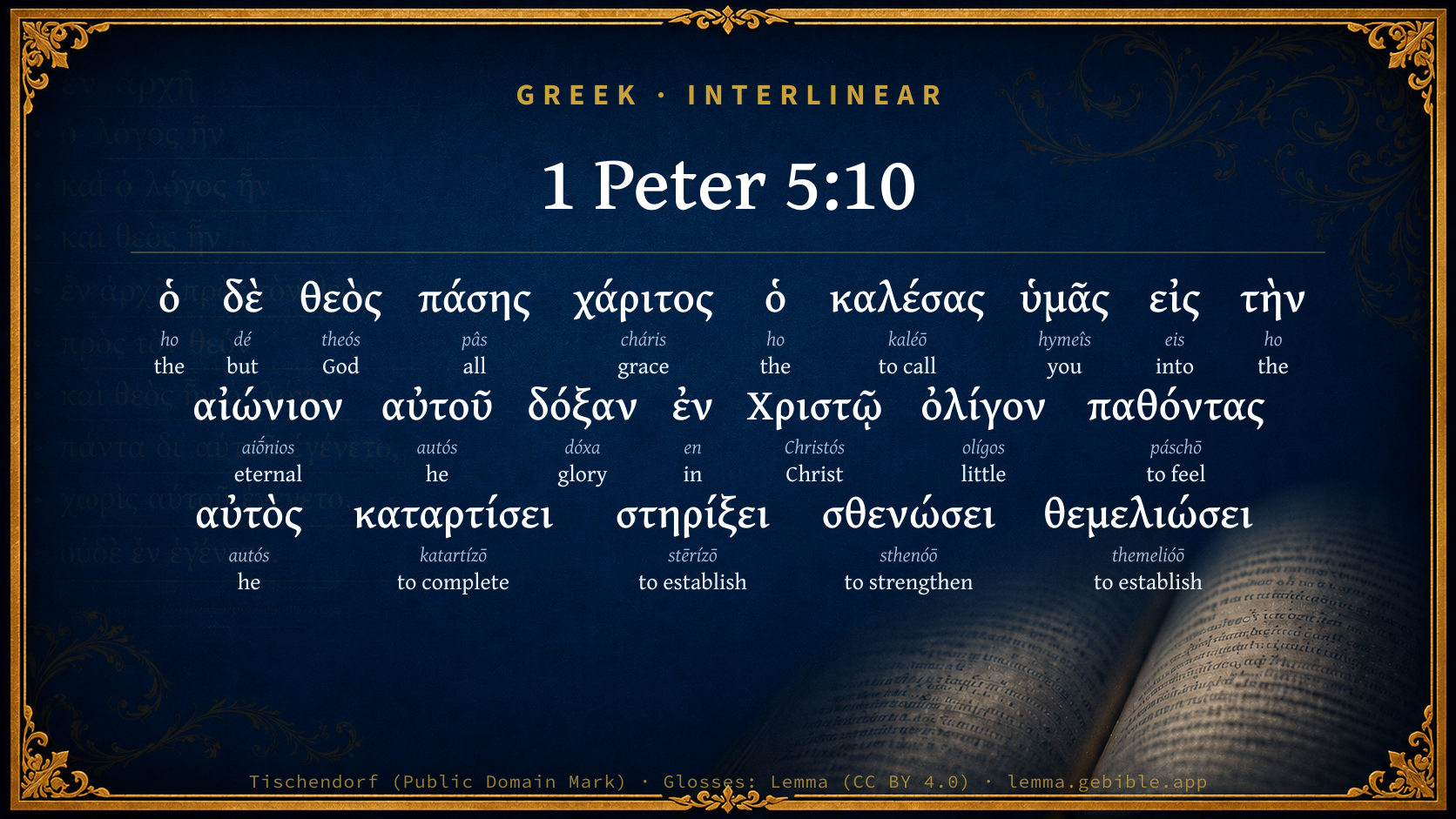
But may the God of all grace, who called you to his eternal glory by Christ Jesus, after you have suffered a little while, perfect, establish, strengthen, and settle you.
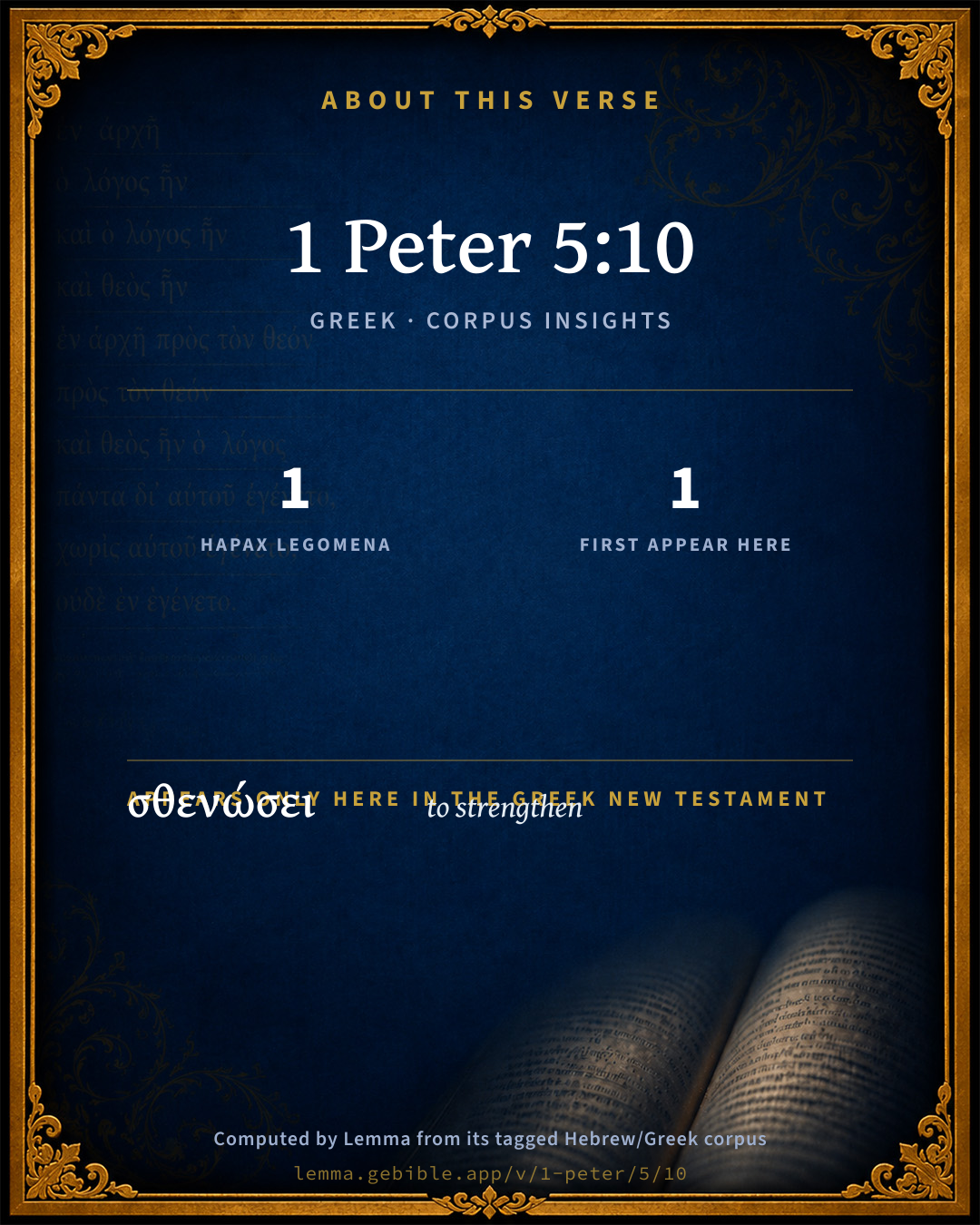
- 1 hapax legomenon — only here in the Greek New Testament
- 1 first appearance in the Greek New Testament
Download a study sheet
One document with this verse’s original text, its word-by-word gloss line, the meaning frame, cross-references with their text, attributed commentary, and full source and license credits — printable, and it pastes into notes with its structure intact.
This verse Autodidact and up
A passage Seminary Student
Up to 50 verses in one chapter. A passage sheet keeps up to 6 commentary sources and 12 cross-references per verse, in the order this page ranks them, and says so on the sheet whenever that leaves anything out. Ask for a single verse and you get the Autodidact verse sheet above.
Everything on this page stays free to read, with no account — the sheet is a download of what is already on screen, not access to it.
Compare translations 3
The same verse in 3 English versions, stacked beneath the original-language interlinear above. Click any original word for its lexicon entry.
Each is an independent rendering of the whole verse — the interlinear is not word-aligned to these translations.
Highlighted words mark where these versions differ — a whole-verse word diff, not a word-by-word alignment.
-
World English Bible Public Domain
But may the God of all grace, who called you to his eternal glory by Christ Jesus, after you have suffered a little while, perfect, establish, strengthen, and settle you.
-
King James Version Public Domain
But the God of all grace, who hath called us unto his eternal glory by Christ Jesus, after that ye have suffered a while, make you perfect, stablish, strengthen, settle you.
-
unfoldingWord Literal Text CC BY-SA 4.0
But the God of all grace, the one having called you to his eternal glory in Christ, having suffered for a little, will himself restore, confirm, strengthen, establish.
unfoldingWord Literal Text — © unfoldingWord, licensed CC BY-SA 4.0. Word-aligned USFM3 via Door43 (git.door43.org/unfoldingWord/en_ult).
Show all 19 translations
Every available English version of this verse, each an independent rendering of the whole verse.
-
World English Bible Public Domain
But may the God of all grace, who called you to his eternal glory by Christ Jesus, after you have suffered a little while, perfect, establish, strengthen, and settle you.
-
Berean Standard Bible Public Domain
And after you have suffered for a little while, the God of all grace, who has called you to His eternal glory in Christ, will Himself restore you, secure you, strengthen you, and establish you.
-
Majority Standard Bible Public Domain
And after you have suffered for a little while, the God of all grace, who has called you to His eternal glory in Christ Jesus, will Himself restore you, secure you, strengthen you, and establish you.
-
King James Version Public Domain
But the God of all grace, who hath called us unto his eternal glory by Christ Jesus, after that ye have suffered a while, make you perfect, stablish, strengthen, settle you.
-
American Standard Version (1901) Public Domain
And the God of all grace, who called you unto his eternal glory in Christ, after that ye have suffered a little while, shall himself perfect, establish, strengthen you.
-
Revised Version (1885) Public Domain
And the God of all grace, who called you unto his eternal glory in Christ, after that ye have suffered a little while, shall himself perfect, stablish, strengthen you.
-
Geneva Bible (1599) Public Domain
And the God of all grace, which hath called vs vnto his eternall glory by Christ Iesus, after that ye haue suffered a litle, make you perfite, confirme, strengthen and stablish you.
-
Douay-Rheims (1899) Public Domain
But the God of all grace, who hath called us into his eternal glory in Christ Jesus, after you have suffered a little, will himself perfect you, and confirm you, and establish you.
-
Young's Literal Translation Public Domain
And the God of all grace, who did call you to His age-during glory in Christ Jesus, having suffered a little, Himself make you perfect, establish, strengthen, settle `you';
-
Literal Standard Version CC BY-SA 4.0
And the God of all grace, who called you to His perpetual glory in Christ Jesus, having suffered a little, Himself make you perfect, establish, strengthen, settle [you];
-
Unlocked Literal Bible CC BY-SA 4.0
After you suffer for a little while, the God of all grace, who called you to his eternal glory in Christ, will perfect you, establish you, and strengthen you.
-
unfoldingWord Literal Text CC BY-SA 4.0
But the God of all grace, the one having called you to his eternal glory in Christ, having suffered for a little, will himself restore, confirm, strengthen, establish.
-
Darby Bible Public Domain
But the God of all grace who has called you to his eternal glory in Christ Jesus, when ye have suffered for a little while, himself shall make perfect, stablish, strengthen, ground:
-
World Messianic Bible Public Domain
But may the God of all grace, who called you to his eternal glory by Messiah Yeshua, after you have suffered a little while, perfect, establish, strengthen, and settle you.
-
Webster's Bible Public Domain
But the God of all grace, who hath called us to his eternal glory by Christ Jesus, after ye have suffered a while, make you perfect, establish, strengthen, settle you.
-
Free Bible Version CC BY-SA 4.0
After you have suffered for a little while, the God of all grace who called you into his eternal glory in Christ, will himself restore you, support you, strengthen you, and give you a solid foundation.
-
Bible in Basic English Public Domain
And after you have undergone pain for a little time, the God of all grace who has given you a part in his eternal glory through Christ Jesus, will himself give you strength and support, and make you complete in every good thing;
-
Text-Critical English NT CC BY 4.0
And after you have suffered for a little while, may the God of all grace, who called you to his eternal glory in Christ Jesus, himself perfect you; he will establish, strengthen, and settle you.
-
Tyndale New Testament (1534) Public Domain
The God of all grace which called you vnto his eternall glory by Christ Iesus shall his awne silfe after ye have soffred a lytell affliccion make you perfect: shall settle strenght and stablishe you.
Literal Standard Version (2020), Covenant Press — licensed CC BY-SA 4.0. Text via the HelloAO Bible API (eBible.org). Unlocked Literal Bible (unfoldingWord) — licensed CC BY-SA 4.0. Text via the HelloAO Bible API (eBible.org). unfoldingWord Literal Text — © unfoldingWord, licensed CC BY-SA 4.0. Word-aligned USFM3 via Door43 (git.door43.org/unfoldingWord/en_ult). Free Bible Version, Dr. Jonathan Gallagher — licensed CC BY-SA 4.0. Text via the HelloAO Bible API (eBible.org).
Word by word
More ways to search: Search by grammar → Find every occurrence → Compare this word →
Practice this passage: Drill this verse → Learn its vocabulary →
- Appears 1× in the Greek New Testament
- First appears here
- Part of Speech
- Verb
- Tense
- Future
- Voice
- Active
- Mood
- Indicative
- Person
- 3rd person
- Number
- Singular
Full Thayer's Definition
- ὁ ho G3588 “the” Article, Nominative, Singular, Masculine
- δὲ dé G1161 “but” Conjunction
- θεὸς theós G2316 “God” Noun, Nominative, Singular, Masculine
- πάσης pâs G3956 “all” Adjective, Genitive, Singular, Feminine
- χάριτος cháris G5485 “grace” Noun, Genitive, Singular, Feminine
- ὁ ho G3588 “the” Article, Nominative, Singular, Masculine
- καλέσας kaléō G2564 “to call” Verb, Aorist, Active, Participle, Nominative, Singular, Masculine
- ὑμᾶς hymeîs G5210 “you” Personal pronoun, 2nd person, Accusative, Plural
- εἰς eis G1519 “into” Preposition
- τὴν ho G3588 “the” Article, Accusative, Singular, Feminine
- αἰώνιον aiṓnios G166 “eternal” Adjective, Accusative, Singular, Feminine
- αὐτοῦ autós G846 “he” Personal pronoun, Genitive, Singular, Masculine
- δόξαν dóxa G1391 “glory” Noun, Accusative, Singular, Feminine
- ἐν en G1722 “in” Preposition
- Χριστῷ Christós G5547 “Christ” Noun, Dative, Singular, Masculine
- ὀλίγον olígos G3641 “little” Adverb
- παθόντας páschō G3958 “to feel” Verb, Aorist, Active, Participle, Accusative, Plural, Masculine
- αὐτὸς autós G846 “he” Personal pronoun, Nominative, Singular, Masculine
- καταρτίσει katartízō G2675 “to complete” Verb, Future, Active, Indicative, 3rd person, Singular
- στηρίξει stērízō G4741 “to establish” Verb, Future, Active, Indicative, 3rd person, Singular
- σθενώσει sthenóō G4599 “to strengthen” Verb, Future, Active, Indicative, 3rd person, Singular
- θεμελιώσει themelióō G2311 “to establish” Verb, Future, Active, Indicative, 3rd person, Singular
About this verse
These counts appear in no published source. They are computed here, from the morphology-tagged text and Lemma’s own curated glosses. What Lemma adds →
- 22
- words
- 19
- distinct lemmas
- General Epistles
- section
Notable vocabulary
1 hapax legomenon — a word that appears only here in the entire Greek New Testament:
- σθενώσει to strengthen G4599
First appearance in Scripture
This word makes its first canonical appearance in the Greek New Testament here:
- σθενώσει to strengthen G4599
Shared distinctive vocabulary
θεμελιώσει to establish G2311 occurs in 5 verses of the Greek New Testament. Also found in:
Cross-references
36Topical passages linked to 1 Peter 5:10 in the Treasury of Scripture Knowledge — connected by theme and wording, ordered by reader-vote popularity; previews shown in the World English Bible.
- 2 Corinthians 4:17 For our light affliction, which is for the moment, works for us more and more exceedingly an eternal weight of glory;
- 2 Thessalonians 3:3 But the Lord is faithful, who will establish you, and guard you from the evil one.
- 1 Peter 1:6–7 Wherein you greatly rejoice, though now for a little while, if need be, you have been put to grief in various trials,
- Jude 1:24 Now to him who is able to keep them from stumbling, and to present you faultless before the presence of his glory in great joy,
- Psalms 138:7 Though I walk in the midst of trouble, you will revive me. You will stretch forth your hand against the wrath of my enemies. Your right hand will save me.
- 1 Timothy 6:12 Fight the good fight of faith. Lay hold of the eternal life to which you were called, and you confessed the good confession in the sight of many witnesses.
- 2 Thessalonians 2:17 comfort your hearts and establish you in every good work and word.
- Romans 8:28–30 We know that all things work together for good for those who love God, to those who are called according to his purpose.
- 2 Corinthians 13:11 Finally, brothers, rejoice. Be perfected, be comforted, be of the same mind, live in peace, and the God of love and peace will be with you.
- Hebrews 13:20–21 Now may the God of peace, who brought again from the dead the great shepherd of the sheep with the blood of an eternal covenant, our Lord Jesus,
- 1 Corinthians 1:9 God is faithful, through whom you were called into the fellowship of his Son, Jesus Christ, our Lord.
- Romans 16:25
- Zechariah 10:6 "I will strengthen the house of Judah, And I will save the house of Joseph, And I will bring them back; For I have mercy on them; And they will be as though I had not cast them off: For I am Yahweh their God, and I will hear them.
- Zechariah 10:12 I will strengthen them in Yahweh; And they will walk up and down in his name," says Yahweh.
- Philippians 4:13 I can do all things through Christ, who strengthens me.
- 1 Thessalonians 2:12 to the end that you should walk worthily of God, who calls you into his own Kingdom and glory.
- 1 Peter 1:15 but just as he who called you is holy, you yourselves also be holy in all of your behavior;
- 2 Peter 1:3 seeing that his divine power has granted to us all things that pertain to life and godliness, through the knowledge of him who called us by his own glory and virtue;
- Micah 7:18–19 Who is a God like you, who pardons iniquity, And passes over the disobedience of the remnant of his heritage? He doesn't retain his anger forever, Because he delights in loving kindness.
- Psalms 86:5 For you, Lord, are good, and ready to forgive; Abundant in loving kindness to all those who call on you.
- Colossians 1:22–23 yet now he has reconciled in the body of his flesh through death, to present you holy and without blemish and blameless before him,
- 2 Timothy 2:10 Therefore I endure all things for the chosen ones' sake, that they also may obtain the salvation which is in Christ Jesus with eternal glory.
- Luke 22:32 but I prayed for you, that your faith wouldn't fail. You, when once you have turned again, establish your brothers."
- Psalms 86:15 But you, Lord, are a merciful and gracious God, Slow to anger, and abundant in loving kindness and truth.
- 2 Thessalonians 2:14 to which he called you through our Gospel, for the obtaining of the glory of our Lord Jesus Christ.
- Exodus 34:6–7 Yahweh passed by before him, and proclaimed, "Yahweh! Yahweh, a merciful and gracious God, slow to anger, and abundant in loving kindness and truth,
- 2 Timothy 1:9 who saved us and called us with a holy calling, not according to our works, but according to his own purpose and grace, which was given to us in Christ Jesus before times eternal,
- Romans 15:5 Now the God of patience and of encouragement grant you to be of the same mind one with another according to Christ Jesus,
- Romans 15:13 Now may the God of hope fill you with all joy and peace in believing, that you may abound in hope, in the power of the Holy Spirit.
- Colossians 2:7 rooted and built up in him, and established in the faith, even as you were taught, abounding in it in thanksgiving.
- 1 John 2:25 This is the promise which he promised us, the eternal life.
- Romans 5:20–21 The law came in besides, that the trespass might abound; but where sin abounded, grace did abound more exceedingly;
- Romans 9:11 For being not yet born, neither having done anything good or bad, that the purpose of God according to election might stand, not of works, but of him who calls,
- Hebrews 9:15 For this reason he is the mediator of a new covenant, since a death has occurred for the redemption of the transgressions that were under the first covenant, that those who have been called may receive the promise of the eternal inheritance.
- 1 Peter 4:11 If any man speaks, let it be as it were oracles of God. If any man serves, let it be as of the strength which God supplies, that in all things God may be glorified through Jesus Christ, to whom belong the glory and the dominion forever and ever. Amen.
- Romans 9:24 us, whom he also called, not from the Jews only, but also from the Gentiles?
Cross-references courtesy of OpenBible.info (CC BY 4.0).
Where the printed editions differ
1 variantPlaces in this verse where the major printed Greek editions disagree on the wording in a way that affects the translation — a comparison of editions, not a manuscript-by-manuscript collation. The editions are the modern critical texts (Nestlé-Aland 28/27, SBL, Westcott-Hort, Tregelles, Tyndale House) and the traditional texts behind the KJV (the Textus Receptus and the Byzantine/Majority text). It is not a claim about which reading is original.
-
Different wording
ὑμᾶς
“you”
In NA28NA27TynSBLWHTregByz Not in TRἡμᾶς (hēmas) 'us' occurs in traditional manuscripts (TR) instead of ὑμᾶς (humas) 'you' in older manuscripts (NA28+NA27+Tyn+SBL+WH+Treg+Byz)
Textual data: Translators Amalgamated Greek New Testament (STEPBible TAGNT) · CC BY 4.0.
Lesson kit
Teaching starters — assembled from the data on this page, not authored interpretation. Every prompt links to the verse data it draws on. Edit before teaching.
1 Peter, in the General Epistles, opens this verse with 22 words (19 distinct Greek lemmas). Its most distinctive word is sthenóō (“to strengthen”). A historical commentator’s framing appears above. Read the whole chapter for the surrounding context.
Discussion questions
- How does “to strengthen” (sthenóō) shape what this verse is saying?
- 1 word here appears nowhere else in the Greek New Testament. Why might the author reach for such rare wording?
- This is the first place “to strengthen” appears in Scripture (first appears here). What does its debut here establish?
- How does Matthew 7:25, which shares the word «to establish», read alongside this verse?
- What does the repetition of “the” (3× in this one verse) do in this verse?
- These translations render this verse differently. What is at stake in choosing one wording over another?
- Compare how The Biblical Illustrator and Joseph Benson's Commentary read this verse. Where do they agree or differ?
Things to notice
- 1 word in this verse appears nowhere else in the Greek New Testament.
- 1 word makes its first canonical appearance in Scripture here.
- These translations choose different wording for 19 words in this verse.
- “the” occurs 3× in this single verse.
- 19 distinct Greek lemmas span 22 words in this verse.
Commentary
Notes on 1 Peter 5:10 from classic Christian and Jewish commentators (each source and its license shown beneath its notes). The classic Christian expositions comment on the surrounding passage and are grouped to its opening verse, so a note may address several verses; the Jewish commentaries on the Tanakh (Rashi and others) are per-verse, so they appear only where the commentator wrote on this verse.
Lemma curates 59 commentaries, every one of them public domain or Creative Commons licensed, each selected and text-cleaned for this edition rather than reprinted as found. About our sources →
The Biblical Illustrator
Joseph S. Exell
The Biblical Illustrator, edited by Joseph S. Exell (c. 1880s–1900s) — public domain. Text from a community e-Sword module.
Joseph Benson's Commentary
Joseph Benson's Commentary on the Old and New Testaments (1811–1818) — public domain. Text from a community e-Sword module.
Whedon's Commentary on the Bible
Daniel D. Whedon
Daniel D. Whedon (gen. ed.), Commentary on the Old and New Testaments (1874–1909) — public domain. Text from a community e-Sword module.
The Preacher's Complete Homiletical Commentary
Joseph S. Exell (gen. ed.)
The Preacher's Complete Homiletical Commentary (gen. ed. Joseph S. Exell; Funk & Wagnalls, c. 1892) — public domain (pre-1929). A full-Bible homiletical/sermon-outline anthology covering 65 of 66 books (2 John is absent from the source module). Text from a community e-Sword module.
Scofield Reference Notes
C. I. Scofield
The Scofield Reference Bible (1917 edition), notes by C. I. Scofield — public domain. Text from a community e-Sword module.
Tyndale Open Study Notes
Tyndale Open Resources
Tyndale Open Study Notes — © Tyndale Open Resources, licensed CC BY-SA 4.0. Text via the HelloAO Bible API.
Bengel's Gnomon
Johann Albrecht Bengel
Bengel's Gnomon of the New Testament — English translation (T&T Clark, Edinburgh, 1860) — public domain. Text from a community e-Sword module.
Meyer's Critical & Exegetical Commentary
Heinrich August Wilhelm Meyer
Meyer — Critical and Exegetical Commentary on the New Testament — English translation by Peter Christie, edited by Frederick Crombie (T&T Clark, 1880) — public domain. Text from a community e-Sword module.
Expositor's Greek Testament
ed. W. Robertson Nicoll
The Expositor's Greek Testament, edited by W. Robertson Nicoll (1897–1910) — public domain. Text from a community e-Sword module.
Geneva Bible (1599)
Geneva Bible translators
Geneva Bible (1599) marginal notes — public domain. Text via Bolls.life.
Matthew Henry's Commentary
Matthew Henry's Commentary on the Whole Bible (1708–1710) — public domain (CC PDM 1.0). Text via the HelloAO Bible API.
Jamieson, Fausset & Brown
Robert Jamieson, A. R. Fausset & David Brown
Jamieson, Fausset & Brown — Commentary Critical and Explanatory on the Whole Bible (1871) — public domain (CC PDM 1.0). Text via the HelloAO Bible API.
Adam Clarke's Commentary
Adam Clarke's Commentary on the Bible (1810–1826) — public domain. Text from a community e-Sword/MySword module.
John Calvin's Commentaries
John Calvin's Commentaries (1540-1563) — public domain. Text from the Calvin Translation Society English edition (1840s-50s) via the Christian Classics Ethereal Library (ccel.org). Calvin's coverage is partial (roughly two-thirds of the Bible); uncommented books and verses are honest gaps, never fabricated. The 19th-century editor's footnotes and remarks are omitted so the notes are faithfully Calvin's own voice.
Ellicott's Commentary for English Readers
A Bible Commentary for English Readers, edited by Charles John Ellicott (1878–1897) — public domain. Text from a community e-Sword module.
The Cambridge Bible for Schools and Colleges
gen. ed. J. J. S. Perowne
The Cambridge Bible for Schools and Colleges (gen. ed. J. J. S. Perowne; Cambridge University Press, 1878–1918) — public domain. Text from a community e-Sword module.
John Gill's Exposition
John Gill's Exposition of the Whole Bible (1746–1763) — public domain (CC PDM 1.0). Text via the HelloAO Bible API.
Trapp's Complete Commentary
John Trapp
John Trapp, A Commentary or Exposition upon All the Books of the Old and New Testament (1647–1656) — public domain. Text from a community e-Sword module.
Albert Barnes' Notes on the Bible
Albert Barnes' Notes on the Bible (1834–1885) — public domain. Text from a community e-Sword/MySword module.
Matthew Poole's English Annotations
Matthew Poole's English Annotations on the Holy Bible (1683–1685) — public domain. Text from a community e-Sword/MySword module.
The Pulpit Commentary
The Pulpit Commentary (1880–1919), ed. H.D.M. Spence-Jones & Joseph S. Exell — public domain. Text from a community e-Sword module.
John Wesley's Explanatory Notes
John Wesley, Explanatory Notes Upon the Whole Bible (1754–1765) — public domain. Text via the GEBible commentary corpus.
Kretzmann's Popular Commentary
Paul E. Kretzmann
Paul E. Kretzmann, Popular Commentary of the Bible (1921–1924) — public domain. Text from a community e-Sword module.
Burkitt's Expository Notes on the New Testament
William Burkitt
William Burkitt's Expository Notes on the New Testament (1700–1703) — public domain. Text from a community e-Sword module.
The People's New Testament
B. W. Johnson
B. W. Johnson's The People's New Testament with Notes (1889–1891) — public domain. Electronic text from the Christian Classics Ethereal Library (CCEL) ThML edition.
unfoldingWord translationNotes
Door43 World Missions Community
unfoldingWord translationNotes — © Distant Shores Media and the Door43 World Missions Community, licensed CC BY-SA 4.0. Source: git.door43.org/Door43/en_tn.
Cambridge Greek Testament for Schools and Colleges
Cambridge Greek Testament for Schools and Colleges (Cambridge University Press, 1896; 21 vols, various authors incl. Carr, Maclear, Plummer, Farrar, Lumby, Moule, M. R. James, Simcox) — public domain. Text from a community e-Sword module.
Alford’s Greek Testament
Henry Alford
Henry Alford, The Greek Testament (1849–1861) — public domain. Text from a community e-Sword module.
Vincent's Word Studies in the New Testament
Marvin R. Vincent
Marvin R. Vincent, Word Studies in the New Testament (1887–1900) — public domain. Text from a community e-Sword/MySword module.