
Ephesians 2:5

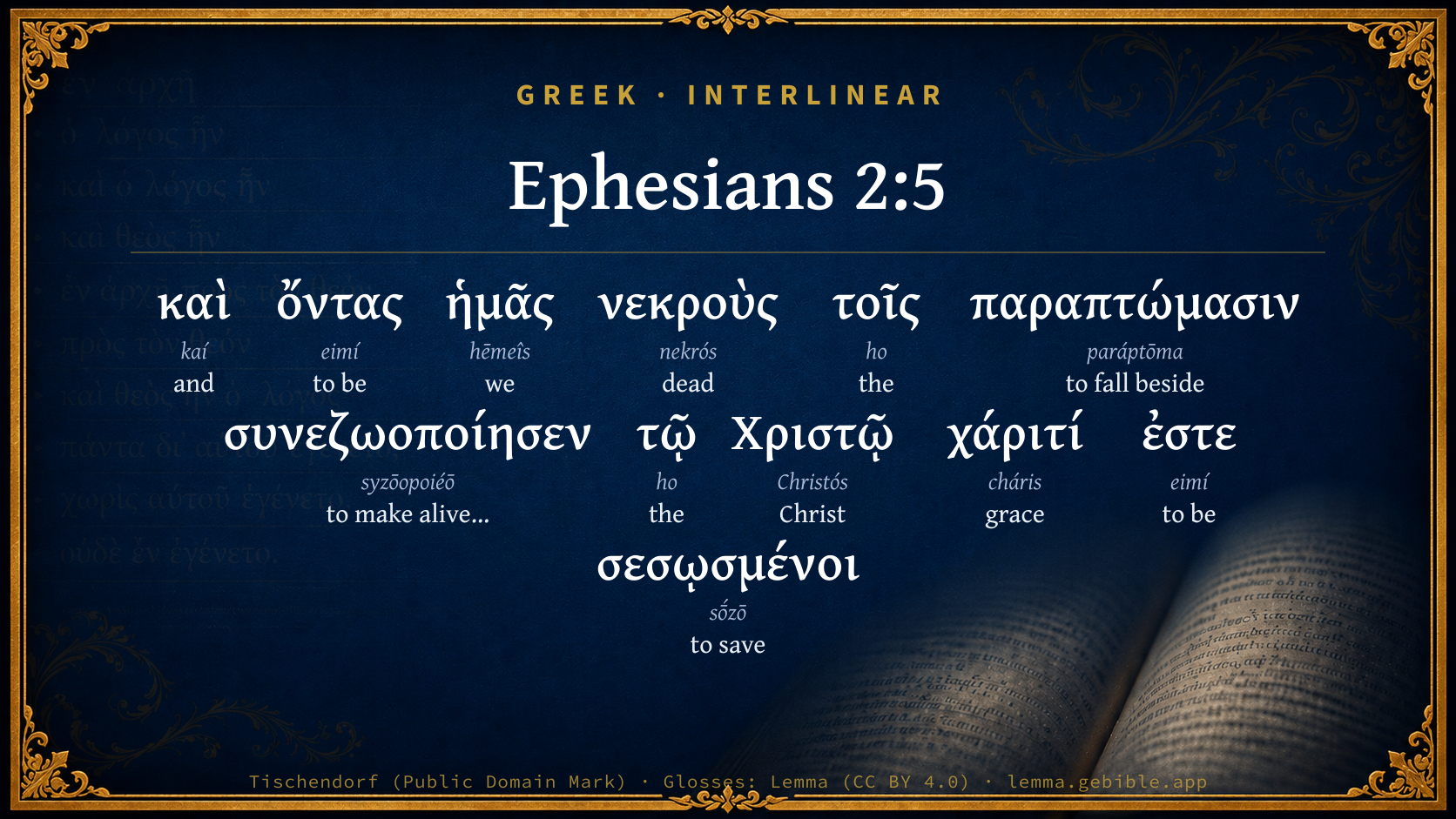
Greek (Tischendorf 8th ed.) Ephesians 2:5 appears in the Greek New Testament. The text above is from the Tischendorf 8th edition. Each word links to its Strong’s number and a concise gloss. Click any word for its full Thayer’s Greek Lexicon entry.
Download image
Cite this verse

Ephesians 2:5 (World English Bible). Public Domain. Lemma interlinear Bible study tool, https://lemma.gebible.app/v/ephesians/2/5.

Show BibTeX & RIS
BibTeX
RIS
English Translation
even when we were dead through our trespasses, made us alive together with Christ (by grace you have been saved),
World English Bible · Public Domain
Highlights
  • 1 first appearance in the Greek New Testament
Full analysis ↓
Download a study sheet

One document with this verse’s original text, its word-by-word gloss line, the meaning frame, cross-references with their text, attributed commentary, and full source and license credits — printable, and it pastes into notes with its structure intact.

This verse Autodidact and up

Study sheet (.html) Plain text (.txt)

A passage Seminary Student

Up to 50 verses in one chapter. A passage sheet keeps up to 6 commentary sources and 12 cross-references per verse, in the order this page ranks them, and says so on the sheet whenever that leaves anything out. Ask for a single verse and you get the Autodidact verse sheet above.

Everything on this page stays free to read, with no account — the sheet is a download of what is already on screen, not access to it.

Want to remove ads? Support Godless Engineer
Compare translations 3

The same verse in 3 English versions, stacked beneath the original-language interlinear above. Click any original word for its lexicon entry.

Each is an independent rendering of the whole verse — the interlinear is not word-aligned to these translations.

Highlighted words mark where these versions differ — a whole-verse word diff, not a word-by-word alignment.

  • World English Bible Public Domain
    even when we were dead through our trespasses, made us alive together with Christ (by grace you have been saved),
  • King James Version Public Domain
    Even when we were dead in sins, hath quickened us together with Christ, (by grace ye are saved;)
  • unfoldingWord Literal Text CC BY-SA 4.0
    and we being dead in the trespasses, he made us alive together in Christ—by grace you have been saved—

unfoldingWord Literal Text — © unfoldingWord, licensed CC BY-SA 4.0. Word-aligned USFM3 via Door43 (git.door43.org/unfoldingWord/en_ult).

Versions to compare (up to 4)

3 of 4 selected

Show all 19 translations

Every available English version of this verse, each an independent rendering of the whole verse.

  • World English Bible Public Domain
    even when we were dead through our trespasses, made us alive together with Christ (by grace you have been saved),
  • Berean Standard Bible Public Domain
    made us alive with Christ even when we were dead in our trespasses. It is by grace you have been saved!
  • Majority Standard Bible Public Domain
    made us alive with Christ even when we were dead in our trespasses. It is by grace you have been saved!
  • King James Version Public Domain
    Even when we were dead in sins, hath quickened us together with Christ, (by grace ye are saved;)
  • American Standard Version (1901) Public Domain
    even when we were dead through our trespasses, made us alive together with Christ (by grace have ye been saved),
  • Revised Version (1885) Public Domain
    even when we were dead through our trespasses, quickened us together with Christ (by grace have ye been saved),
  • Geneva Bible (1599) Public Domain
    Euen when we were dead by sinnes, hath quickened vs together in Christ, by whose grace ye are saued,
  • Douay-Rheims (1899) Public Domain
    Even when we were dead in sins, hath quickened us together in Christ, (by whose grace you are saved,)
  • Young's Literal Translation Public Domain
    even being dead in the trespasses, did make us to live together with the Christ, (by grace ye are having been saved,)
  • Literal Standard Version CC BY-SA 4.0
    even being dead in the trespasses, made us alive together with the Christ (by grace you are saved),
  • Unlocked Literal Bible CC BY-SA 4.0
    While we were dead in trespasses, he made us alive together in Christ—by grace you have been saved.
  • unfoldingWord Literal Text CC BY-SA 4.0
    and we being dead in the trespasses, he made us alive together in Christ—by grace you have been saved—
  • Darby Bible Public Domain
    (we too being dead in offences,) has quickened us with the Christ, (ye are saved by grace,)
  • World Messianic Bible Public Domain
    even when we were dead through our trespasses, made us alive together with Messiah—by grace you have been saved—
  • Webster's Bible Public Domain
    Even when we were dead in sins, hath made us alive together with Christ, (by grace ye are saved;)
  • Free Bible Version CC BY-SA 4.0
    even while we were dead in our sins, has made us alive together with Christ. Trusting in him has saved you!
  • Bible in Basic English Public Domain
    Even when we were dead through our sins, gave us life together with Christ (by grace you have salvation),
  • Text-Critical English NT CC BY 4.0
    made us alive together with Christ even when we were dead in our trespasses—by grace you have been saved.
  • Tyndale New Testament (1534) Public Domain
    even when we were deed by synne hath quickened vs together in Christ (for by grace are ye saved)

Literal Standard Version (2020), Covenant Press — licensed CC BY-SA 4.0. Text via the HelloAO Bible API (eBible.org). Unlocked Literal Bible (unfoldingWord) — licensed CC BY-SA 4.0. Text via the HelloAO Bible API (eBible.org). unfoldingWord Literal Text — © unfoldingWord, licensed CC BY-SA 4.0. Word-aligned USFM3 via Door43 (git.door43.org/unfoldingWord/en_ult). Free Bible Version, Dr. Jonathan Gallagher — licensed CC BY-SA 4.0. Text via the HelloAO Bible API (eBible.org).

Word by word

More ways to search: Search by grammar → Find every occurrence → Compare this word →

Practice this passage: Drill this verse → Learn its vocabulary →

συνεζωοποίησεν
syzōopoiéō
G4806
“to make alive together”
Verb, Aorist, Active, Indicative, 3rd person, Singular
Part of Speech
Verb
Tense
Aorist
Voice
Active
Mood
Indicative
Person
3rd person
Number
Singular
Full Thayer's Definition

Origin: from G4862 and G2227

TDNT: 20:07,1

1. to make one alive together a. of Christians, with Christ
  1. καὶ kaí G2532 “and” Conjunction
  2. ὄντας eimí G1510 “to be” Verb, Present, Active, Participle, Accusative, Plural, Masculine
  3. ἡμᾶς hēmeîs G2249 “we” Personal pronoun, 1st person, Accusative, Plural
  4. νεκροὺς nekrós G3498 “dead” Adjective, Accusative, Plural, Masculine
  5. τοῖς ho G3588 “the” Article, Dative, Plural, Neuter
  6. παραπτώμασιν paráptōma G3900 “to fall beside” Noun, Dative, Plural, Neuter
  7. τῷ ho G3588 “the” Article, Dative, Singular, Masculine
  8. Χριστῷ Christós G5547 “Christ” Noun, Dative, Singular, Masculine
  9. χάριτί cháris G5485 “grace” Noun, Dative, Singular, Feminine
  10. ἐστε eimí G1510 “to be” Verb, Present, Active, Indicative, 2nd person, Plural
  11. σεσῳσμένοι sṓzō G4982 “to save” Verb, Perfect, Passive, Participle, Nominative, Plural, Masculine

About this verse

These counts appear in no published source. They are computed here, from the morphology-tagged text and Lemma’s own curated glosses. What Lemma adds →

12
words
10
distinct lemmas
Pauline Epistles
section

Notable vocabulary

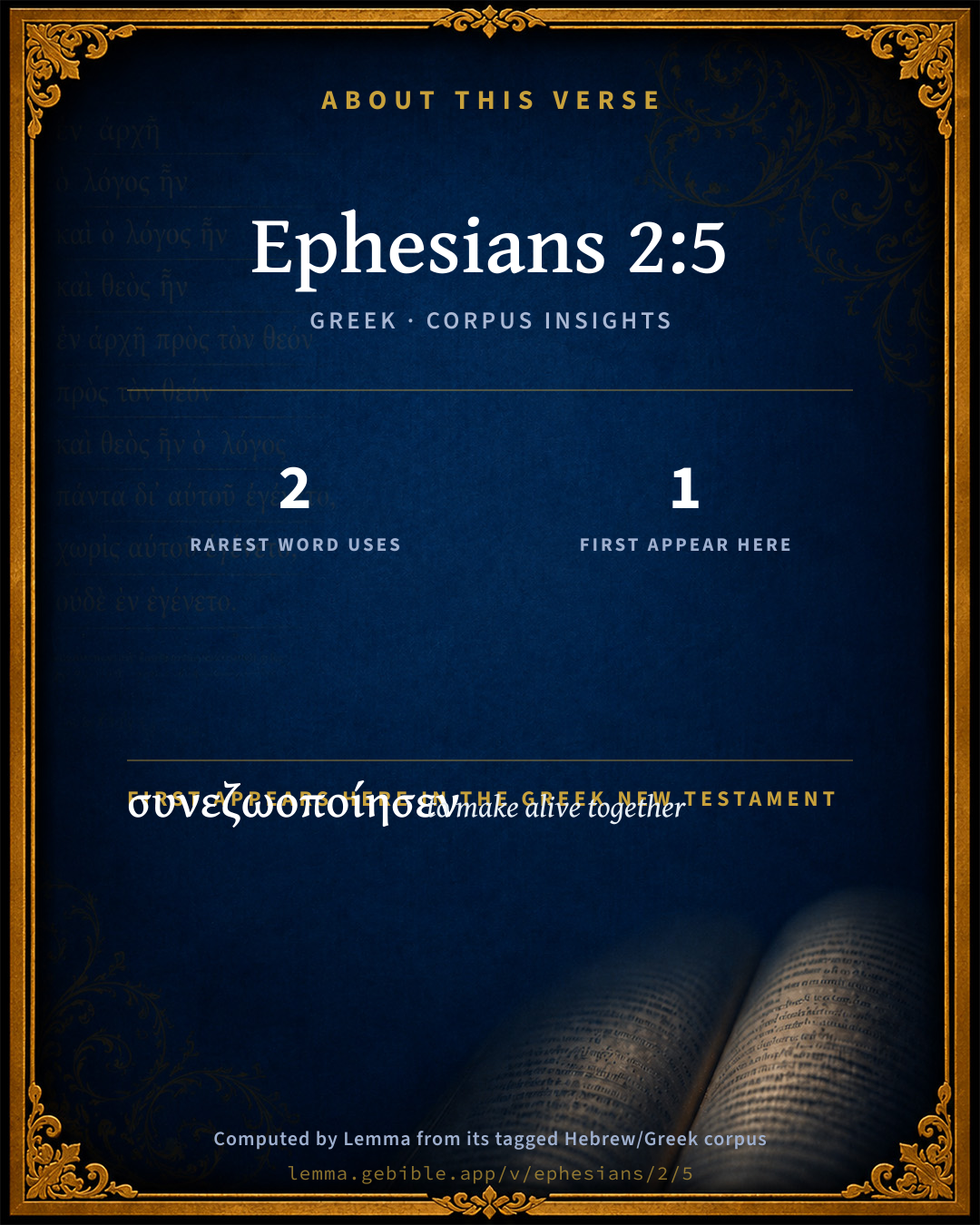
The rarest word here is συνεζωοποίησεν to make alive together G4806 — appearing just 2 times in the whole Greek New Testament.

First appearance in Scripture

This word makes its first canonical appearance in the Greek New Testament here:

  • συνεζωοποίησεν to make alive together G4806

Shared distinctive vocabulary

συνεζωοποίησεν to make alive together G4806 occurs in 2 verses of the Greek New Testament. Also found in:
Repetition

Words recur within this verse:

  • ὄντας to be G1510 ×2
  • τοῖς the G3588 ×2

Cross-references

18

Topical passages linked to Ephesians 2:5 in the Treasury of Scripture Knowledge — connected by theme and wording, ordered by reader-vote popularity; previews shown in the World English Bible.

  • Romans 3:24 being justified freely by his grace through the redemption that is in Christ Jesus;
  • Ephesians 2:8 for by grace you have been saved through faith, and that not of yourselves; it is the gift of God,
  • Romans 5:10 For if, while we were enemies, we were reconciled to God through the death of his Son, much more, being reconciled, we will be saved by his life.
  • Romans 5:8 But God commends his own love toward us, in that while we were yet sinners, Christ died for us.
  • Acts 15:11 But we believe that we are saved through the grace of the Lord Jesus, just as they are."
  • Romans 8:2 For the law of the Spirit of life in Christ Jesus made me free from the law of sin and of death.
  • Ephesians 2:1 You were made alive when you were dead in transgressions and sins,
  • Titus 2:11 For the grace of God has appeared, bringing salvation to all men,
  • Romans 4:16 For this cause it is of faith, that it may be according to grace, to the end that the promise may be sure to all the seed, not to that only which is of the law, but to that also which is of the faith of Abraham, who is the father of us all.
  • Ephesians 5:14 Therefore he says, "Awake, you who sleep, and arise from the dead, and Christ will shine on you."
  • Titus 3:5 not by works of righteousness, which we did ourselves, but according to his mercy, he saved us, through the washing of regeneration and renewing by the Holy Spirit,
  • John 5:21 For as the Father raises the dead and gives them life, even so the Son also gives life to whom he desires.
  • Romans 5:6 For while we were yet weak, at the right time Christ died for the ungodly.
  • 2 Corinthians 13:14 The grace of the Lord Jesus Christ, the love of God, and the communion of the Holy Spirit, be with you all. Amen.
  • Romans 16:20 And the God of peace will quickly crush Satan under your feet. The grace of our Lord Jesus Christ be with you.
  • John 6:63 It is the spirit who gives life. The flesh profits nothing. The words that I speak to you are spirit, and are life.
  • Romans 11:5–6 Even so then at this present time also there is a remnant according to the election of grace.
  • Revelation 22:21 The grace of the Lord Jesus Christ be with all the saints. Amen.

Cross-references courtesy of OpenBible.info (CC BY 4.0).

Commentary

Notes on Ephesians 2:5 from classic Christian and Jewish commentators (each source and its license shown beneath its notes). The classic Christian expositions comment on the surrounding passage and are grouped to its opening verse, so a note may address several verses; the Jewish commentaries on the Tanakh (Rashi and others) are per-verse, so they appear only where the commentator wrote on this verse.

Lemma curates 59 commentaries, every one of them public domain or Creative Commons licensed, each selected and text-cleaned for this edition rather than reprinted as found. About our sources →

The Biblical Illustrator

Joseph S. Exell

Eph_2:5-6

Even when we were dead in sins, hath quickened us together with Christ (by grace ye are saved) and hath raised us up together, and made us sit together in heavenly places in Christ Jesus.

Salvation for the lost

I. First, then, the text shows you the misery from which you must be rescued. Even when we were dead in sins. Every individual, descended from Adam, having a polluted nature, and living in this world, is dead in sins. This is an awfully emphatic expression--dead in sins. A more wretched state can scarcely be conceived, except that of the angels who kept not their first estate, and whom God has reserved in everlasting chains under darkness unto the judgment of the great day. But I need not tell you that it is a metaphorical expression, because it declares that a living man is dead. Not dead naturally. He is not dead as to natural actions; he can eat, and drink, and sleep. Nor as to rational actions; he can reason, and judge, and consider. Nor as to civil actions; he can buy and sell and get gain. Nor as to moral actions; he can be kind, he can read and pray and hear the Word and meditate upon it; he can listen to the voice of Gods judgments; he can call his ways to remembrance; he can humble himself before the God of his mercies. So far went Ahab and Herod, yet continued spiritually dead. Let me try to describe this death. It consists of two parts.

1. The sinner living in enmity to God is condemned to death.

2. The symptoms of spiritual death are manifest upon him. Sin has separated the soul from God, so that man cannot commune with God, and God cannot commune with man; your iniquities, says the prophet, have separated between you and your God.

II. In the second place, the agent and the means of deliverance are here presented. God hath quickened us together with Christ. Your case, my brethren, is too desperate for the arm of man to reach. No expedients, which human might and human wisdom can afford, can remedy your misery. God hath quickened us together with Christ.

III. Thirdly, the felicity to which this deliverance will raise you, is also here presented. And hath raised us up together, and made us sit together in heavenly places in Christ Jesus. Here you see that a regenerate sinner is a living saint. Before, the man was dead; now, he lives. Before, as death locks up the senses and all the powers and faculties of the soul, so did a state of sin to the performance and enjoyment of anything that is really good; but now, when a change takes place, grace unlocks and opens all, and so enlarges the soul that it brings every faculty into operation as that of a living man. And do you ask me, what is this life? A life of justification; when no charge can be brought against the sinner. A life of sanctification; where holiness is the element of being. A life of dignity; where Christ is the companion forever.

IV. But, fourthly, you have here the source from whence you must expect this life. God who is rich in mercy, for His great love wherewith He loved us. Mark how language labours for expression: rich mercy and great love. Inexhaustibly rich mercy; inexpressibly great love.

V. But there is one more point to be noticed: the end to be secured by this wonderful manifestation of His mercy. That in the ages to come He might show the exceeding riches of His grace, in His kindness towards us through Jesus Christ. This expression, the ages to come, sometimes refers to any future period; but it has especial reference to two.

1. To the times of the gospel. Brethren, these are the ages which were to come. This is the acceptable year; this is the day of the Lord; this is the accepted time; this is the day of salvation. The days since Christ was born and suffered are the most blessed and happy days that ever shone upon our fallen world. No days have been like them.

2. The phrase refers also to the last great day. Then will be the full and wondrous exhibition of the scheme of mercy, at which the world may wonder. (James Sherman)

.

Deliverance

I. The free love and undeserved grace of God, as the sole origin and moving cause of our deliverance.

II. See, then, how the purpose of Gods love has been effected. See the Divine precision--the exact adaptation of the means to the end--the finished perfection in the result.

III. But we are led on a step higher at verse 6--we are introduced into heavenly places. What, then, is the peculiar significance of the expression in that sixth verse--raised up together, and made to sit together in heavenly places in Christ Jesus. Five times over in the course of the Epistle, you meet with the phrase heavenly places, or (literally) the heavenlies. Thus, in Eph_1:20, we are told that after God raised Jesus from the dead, He set Him at His own right hand in the heavenly places. It was not enough that He should rise out of the grave, however necessary might be His resurrection as one intermediate link in the process. So long as He remained on earth (as He did for forty days), He had not entered on the fulness of His joy. A crowning proof was awanting, and that was not furnished until the hour of His enthronement in the heavenly places. Then was Jesus in all the glory of His acceptance, in the fulness of His honour! Into the places of reward, and enjoyment, and unfading glory, He entered, and there lives an everlasting sign that the work for which He visited the earthly places has been perfectly fulfilled. But Jesus is not alone in these heavenly places. Every true believer is there in Him. Seated together with Christ, therefore, ought we not now to be made partakers with Him, in some measure, of heavenly blessings? to he sharers here, in some degree, of the joy that fills His heart? Let us see, then, what some of those things are which are now making glad the heart of Christ in heaven, and look at them, that we may ask of God to enter more fully into the power and experience of them.

1. One great joy of His heart in heaven must be in His own deliverance, and in the certainty of the deliverance of His people with Him from the curse of hell, in His having so satisfied the everlasting demands of Divine justice and truth, that the law has now no more any claims against Him, or those for whom He died! And ought not we to share with Him in that joy, by tasting something of the rest, the satisfaction, the quietness and assurance of knowing that in Him we are justified from all things, and freed from the curse?

2. Another joy of His heart in heaven must be, in seeing the guilt of countless multitudes of human beings (though the sins of each of them be more in number than the sand) daily met ,and taken away by an atonement, whose efficacy is inexhaustible to the close of time. And ought not we to rejoice before Him in that which is the cause of our cleansing in His sight, and continually to make use of it for bringing us and keeping us near to Himself, and for renewing in us the joy of our salvation?

3. Another cause of joy to Christ in heaven is the manifestation of the glory of all the attributes of God, and the vindication of the holiness of His name in a work which has magnified His law and made it honourable. And should not we who are in Him be enabled to sing at once of mercy and of judgment, to give thanks at the remembrance of His holiness, as the very bulwark of our safety; and even in the midst of all that is terrible in the execution of His righteous judgments, be preserved in holy calms, as those that are at home with God, dwelling in the secret place of the Most High, and under the shadow of the Almighty.

4. Another joy of His elevation to the heavenly places must be in the overthrow of Satans kingdom, and in the certain prospect of the everlasting fall of every foe. And should not we, who are yet in the midst of the conflict, be encouraged in Him to anticipate certain victory, and be assured that we too shall be made more than conquerors through Him that loved us? (J. S. Muir.)

The cause, means, and effects of salvation

I. The cause of salvation. Gods rich, free, sovereign grace. No other source of salvation to guilty man.

1. There is no power in man to save himself. A dead body cannot walk; nor can a dead soul move by its own will.

2. There is nothing to attract love in a dead, corrupting carcase, and there is nothing to attract Gods love in a dead, corrupting soul.

II. The means of salvation. Christs death. We must here dwell on the contrast, and at the same time the union, between Christ and the sinner, as mutually interchanging their condition each with the other; the sinner transferring through Gods grace, or rather God transferring through His grace, and the sinner embracing with gratitude by faith the blessed transfer, of all his guilt, misery and curse to Jesus; and Jesus transferring, God the Father imputing, and the sinner by faith with joyful gratitude receiving, all the riches of Christs righteousness, redemption, and salvation, put down to his account as a guilty sinner.

III. The effects of salvation. Hath raised us up together, and made us sit together in heavenly places in Christ Jesus. Believers become the children of God, and sharers in His inheritance. Your children, you would say, are your heirs; they are to possess your property. Men make their eldest son the heir of their properties. The law which subverts that of primogeniture, which divides estates and necessitates that property be divided among all the members of a family, soon reduces the family to beggary, for our poor earthly properties are easily exhausted. But the children of the King of kings are all heirs of eternal glory. The rays of the sun are undiminished in their bright effulgence, the lustre of that luminary is not dimmed, although the beams of His glorious orb have been diffused throughout the world from the first moment of the morning when God set him in the firmament of the heavens to rule the day; he still pours forth from his redundant fountain floods of unexhausted and exhaustless light, and every creature that basks beneath his beams enjoys the fulness of their power too much to leave him room to grudge the world beside. But what is all the glory of the orb of day compared with that of Him whose fiat struck that orb but as a spark from solid darkness? and what is the inheritance of him who is an heir of God and a joint heir with Christ? (Joh_17:22.) Christs inheritance. Christs glory is their inheritance and their glory, and there is not one whose glory is diminished by the fulness of glory that all enjoy. (P. J. McGhee, M. A.)

Resurrection with Christ

I. Celebrate first a great solemnity, and descend into the charnel house of our poor humanity. According to the teaching of the sacred Scripture, men are dead, spiritually dead. Certain vain men would make it out that men are only a little disordered and bruised by the Fall, wounded in a few delicate members, but not mortally injured. However, the Word of God is very express upon the matter, and declares our race to be not wounded, not hurt merely, but slain outright, and left as dead in trespasses and sin. There are those who fancy that fallen human nature is only in a sort of syncope or fainting fit, and only needs a process of reviving to set it right. You have only, by education and by other manipulations, to set its life floods in motion, and to excite within it some degree of action, and then life will speedily be developed. There is much good in every man, they say, and you have only to bring it out by training and example. This fiction is exactly opposite to the teaching of sacred Scripture. Within these truthful pages we read of no fainting fit, no temporary paralysis, but death is the name for natures condition, and quickening is its great necessity. Man is not partly dead, like the half-drowned mariner, in whom some spark of life may yet remain, if it be but fondly tendered, and wisely nurtured. There is not a spark of spiritual life left in man--manhood is to all spiritual things an absolute corpse. Step with me, then, into the sepulchre house, and what do you observe of yonder bodies which are slumbering there? They are quite unconscious! Whatever goes on around them neither occasions them joy nor causes them grief. The dead in their graves may be marched over by triumphant armies, but they shout not with them that triumph. It is thus with men spiritually dead; they are unaffected by spiritual things. A dying Saviour, whose groans might move the very adamant, and make the rocks dissolve, they can hear of all unmoved. Even the all-present Spirit is undiscerned by them, and His power unrecognized. Angels, holy men, godly exercises, devout aspirations, all these are beyond and above their world. Observe that corpse; you may strike it, you may bruise it, but it will not cry out; you may pile burdens upon it, but it is not weary; you may shut it up in darkness, but it feels not the gloom. So the unconverted man is laden with the load of his sin, but he is not weary of it; he is shut up in the prison of Gods justice, but he pants not for liberty; he is under the curse of God, but that curse causes no commotion in his spirit, because he is dead.

II. We now change the subject for something more pleasant, and observe a miracle, or dead men made alive. The great object of the gospel of Christ is to create men anew in Christ Jesus. It aims at resurrection, and accomplishes it. The gospel did not come into this world merely to restrain the passions or educate the principles of men, but to infuse into them a new life which, as fallen men, they did not possess.

1. In this idea of quickening, there is a mystery. What is that invisible something which quickens a man? Who can track life to its hidden fountain? In the language of the text, you trace it to God, you believe your new life to be of Divine implantation. You are a believer in the supernatural; you believe that God has visited you as He has not visited other men, and has breathed into you life. You believe rightly, but you cannot explain it. He is the great worker, but how He works is not revealed to us.

2. It is a great mystery then, but while it is a mystery it is a great reality. We know and do testify, and we have a right to be believed, for we trust we have not forfeited our characters, we know and do testify that we are now possessors of a life which we knew nothing of some years ago, that we have come to exist in a new world, and that the appearance of all things outside of us is totally changed from what it used to be.

3. This life brings with it the exercise of renewed faculties. The man who begins to live unto God has powers now which he never had before: the power really to pray, the power heartily to praise, the power actually to commune with God, the power to see God, to talk with God, the power to receive tidings from the invisible world, and the power to send messages up through the veil which hides the unseen up to the very throne of God.

III. I must pass on very briefly to the third point. The text indicates a sympathy: He hath quickened us together with Christ. What does that mean? It means that the life which lives in a saved man is the same life which dwells in Christ. To put it simply--when Elisha had been buried for some years, we read that they threw a man who was dead into the tomb where the bones of Elisha were, and no sooner did the corpse touch the prophets bones than it lived at once. Yonder is the cross of Christ, and no sooner does the soul touch the crucified Saviour than it lives at once, for the Father hath given to Him to have life in Himself, and life to communicate to others. We are quickened together with Christ in three senses:

1. Representatively. Christ represents us before the eternal throne; He is the second Adam to His people. Christ is accepted, believers are accepted.

2. Next, we live by union with Christ. So long as the head is alive the members have life.

3. Then we also live together with Christ as to likeness. We are quickened together with Christ, that is, in the same manner. Now, Christs quickening was in this wise. He was dead through the law, but the law has no more dominion over Him now that He lives again. So you, Christian, you are cursed by the old law of Sinai, but it has no power to curse you now, for you are risen m Christ. You are not under the law; its terrors and threatenings have nought to do with you. Christs life is a life unto God. Such is yours. He does not quicken us with the inward life, and then leave us to perish; grace is a living, incorruptible seed, which liveth and abideth forever.

IV. And this brings us to the last word, which was a song. We have not time to sing it, we will just write the score before your eyes, and ask you to sing it at your leisure, your hearts making melody to God. Brethren and sisters, if you have indeed been thus made alive as others are not, you have first of all, in the language of the text, to praise the great love of God, great beyond all precedent. (C. H. Spurgeon.)

Salvation in Christ

I. The progress of a sinners salvation.

1. God loves him, though dead in sins.

2. He quickens him.

3. He raises him up.

(1) Spiritually here (Col_3:1, etc.).

(2) Corporally hereafter (Rom_8:11).

4. He sets him in heavenly places.

(1) By faith now.

(2) In fact hereafter.

II. Why the blessings of Gods chosen are said to be in and with Christ. Because they are first in Him as Head, and from Him communicated to them as members, viz., their election, justification, sanctification, etc.

III. Why the Scripture speaks of what is yet to be done for Gods people as done already. From the certainty of their accomplishment. To encourage the faith and hope of His. God hath spoken in His holiness, etc. (Psa_55:6, etc.). Believers may look backward and forward, and see themselves surrounded with mercies. How different their end from what they deserve! Woe to them that think of going to heaven without Christ. (H. Foster, M. A.)

Mans misery and Gods mercy

1. Mans misery commends Gods mercy (Eze_16:8; Eze_16:4-5; 1Co_6:11; Tit_3:8; 1Jn_4:10; Rom_5:10).

(1) If we would see the love of God, we must get a true knowledge and sense of our natural condition. Dead men, in whom there is not by nature the least spark of spiritual and heavenly life: our natural life being but a shadow of life: it is but a goodly vizor drawn over a dead and rotten corpse. The consideration of this will work true humility.

(2) This also is a ground of hope that God will never leave us; for that mercy of God which when we were dead put life in us and quickened us, will now much more help us and comfort us in all our miseries (Isa_49:15; Rom_5:10).

2. Man has no power or disposition to save himself.

3. The believer is brought to partake of the life of God.

(1) The life of God is nothing but the created gift of grace which frames the whole man to live according to God, or supernatural grace giving life, and bringing forth motions according to God, as the natural life.

(2) The power of God alone, with the Word and Sacraments, give this life.

(3) The order in which this life is wrought.

(a) There is a taking away of sins, for while we live in them we are in death.

(b) There is a taking of life in our behalf.

(c) A holding out of these things, with the voice of God unto the soul (Joh_5:25). A receiving of Christ, a forgiving of our sins, and quickening with the Spirit.

(4) The property of this life is eternal; it has no ending. Christ being raised, dieth no more, nor a Christian.

(5) How may we know that we have this life?

(a) Every life seeks its own preservation; as natural life seeks that which is fit for that life, so does this spiritual life that which is fit for itself. As the life is immortal, so it seeks immortal food by which it lives to God; the life of grace is maintained by bread from heaven, from the living God.

(b) Every natural life, in the several kinds of it, seeks its preservation of him and by him who is the author of it; children of their parents, etc. So here they that are quickened with the life of God are ever and anon turning to Him as their Father, crying and calling upon Him for supply in all their wants.

(c) He who has this spiritual life in any measure is sensible, and ever complaining of spiritual death, and of corrupt nature, the sight of which is most noisome to his sense.

(d) Life is active and stirring. If I see an image still without motion, I know for all the eyes, nose, etc., that it has no life in it: so the want of spiritual motion in the soul toward God, and the practice of godliness, argues want of spiritual life.

(e) Love to the brethren (1Jn_3:14). (Paul Bayne.)

The dead quickened

I. The past estate of those to whom the apostle wrote.

1. Dead in point of law.

2. Dead as under the power of sin.

II. Their present state. Quickened. The mercy of God is exercised still in the same way.

1. He has delivered you from the sentence of condemnation.

2. You have experienced the production of spiritual life by the influences of the Holy Spirit.

III. The source of this quickening. Union with Christ.

IV. The light in which this subject places the love of God. (Thomas Young.)

By the grace of God

An officer during an engagement received a ball which struck him near his waistcoat pocket, where a piece of silver stopped the progress of the nearly spent ball. The coin was slightly marked at the words Dei gratia. This providential circumstance deeply impressed his mind, and led him to read a tract, which his beloved and pious sister gave him on leaving his native land, entitled The sin and danger of neglecting the Saviour. This text it pleased God to bless to his conversion.

Quickening the dead

When a man is dead it is hopeless for us to attempt to quicken him. But what we cannot do Christ does. Henry Varley says, A coachman in a family at the West End of London was taken seriously ill, and a few days afterwards saw him pass into the presence of God. I knew and had visited him before in order to bring to his mind and heart the Saviour of sinners. Again I called at the house, found the door open, and quietly ascended the staircase which led to the room where the sick man lay. There, bent over the prostrate, form of the man, was his eldest son, deeply affected and weeping bitterly. His face was close to that of the fathers, and I heard him, in an agony of earnest words, say, Father, This is a faithful saying, and worthy of all acceptation, that Jesus Christ came into the world to save sinners. Oh, my father, do trust Jesus! His precious blood cleanses from all sin. Only believe. My father I my father! O God, save my father! The hot tears and the intense anxiety of that young man I shall never forget. Poor fellow! he literally shouted into the ear that lay close to his lips. I had watched the scene for some minutes almost transfixed at the door. At length, approaching the bed, I observed that the father was dead. Tenderly I raised the young man, and quietly said, His spirit has passed away; he cannot hear; you cannot reach him now! Poor fellow! he had been speaking into the ear of a corpse; the father had been dead some minutes.

The grace of God

When a friend observed to him that we must run deeper and deeper in graces debt, he replied, Oh yes; and God is a good creditor; He never seeks back the principal sum, and, indeed, puts up with a poor annual rent (Life of Rev. John Brown, of Haddington.)

Salvation by grace

A physician who was anxious about his soul, asked a believing patient of his, how he should find peace. His patient replied, Doctor, I felt that I could do nothing, and I have put my case in your hand: I am trusting in you. This is exactly what every poor sinner must do, trust in the Lord Jesus Christ. He saw the simplicity of the way, and soon found peace in Christ.

Heavenly places

When Paul wrote of heavenly places as the lot of Christs people on earth, it was not to please the imagination or dazzle the fancy with mere spiritual visions--but to show us how near and how available is the source of spiritual and saving strength for daily life. To be with Christ, therefore, in the heavenlies, is--

I. To be living at the source of power for new obedience, and to draw from thence for support in that service which is true freedom, freedom from slavish fears, from corroding cares, from every inordinate affection which would hinder you in the doing of His will. Brought nigh to God--living in the fellowship of God, through Jesus--you have a well-spring of new motives of action opened for you in His service, and of strength for patient rest in His will. That well-spring is ever full and never failing. These Divine resources are ever near, and ever the same; though your experience of them, alas! may ebb, and flow, and fluctuate.

II. But we come now to notice another view of the position of those who are raised up to sit with Christ. It is to be armed for conflict. The spirits of evil have still power to tempt and molest. And if these evil influences are to be repelled and quenched, it can only be done from within the citadel of power which is provided in the fellowship of a risen Lord.

III. The heavenly places to which all believing ones are raised up on earth to sit with Christ, are (in a peculiar manner) places of thanksgiving. As the cleft of the Rock to which you have fled from the fury of the storm, what else should your place be but one fitted for thanksgiving,--a tabernacle to be filled with the voices of rejoicing and salvation and praise ever going forth in testimony to Him, whose almighty hand opened the refuge and averted the destruction!

IV. And now, in conclusion, the text points to the future--into the ages of eternity--to that great hereafter on whose brink we are ever walking, and which at any moment we may be called to enter. (J. S. Muir.)

Heaven won

Won by other arms than theirs, it presents the strongest contrast imaginable to the spectacle seen in Englands palace on that day when the king demanded of his assembled nobles by what title they held their lands. What title? At the rash question a hundred swords, leaped from their scabbards. Advancing on the alarmed monarch, By these we won, and by these we will keep them! they replied. How different the scene which heaven presents! All eyes are fixed on Jesus: every look is one of love and gratitude, which are glowing in every bosom, and swelling in every song. Now with golden harps they swell the Saviours praises; and now descending from their thrones to do Him homage, they cast their crowns in one glittering heap at the feet which were nailed to Calvarys shameful cross. (T. Guthrie, D. D.)

Religion raises men up

Ah! brethren, you will not mind my telling out some of the secrets, secrets that bring the tears to my eyes as I reflect upon them. When I speak of the thief, the harlot, the drunkard, the sabbath breaker, the swearer, I may say, Such were some of you, but ye are washed, but ye are sanctified, but ye rejoice in the name of our Lord Jesus Christ. How many a man has been going by the door there, and has said, Ill go in and hear Old Spurgeon. He came in to make merriment of the preacher, and very little that troubles him. But the man has stood there until the Word goes home to him, and he who was wont to beat his wife, and to make his home a hell, has before long been to see me, and has given me a grip of the hand and said, God Almighty bless you, sir; there is something in true religion! Well, let us hear your tale. We have heard it, and delightful it has been in hundreds of instances, Very well, send your wife, and let us hear what she says about you. The woman has come, and we have said, Well, what think you of your husband now, maam? Oh, sir, such a change I never saw in my life! He is so kind to us; he is like an angel now, and he seemed like a fiend before; oh! that cursed drink, sir! everything went to the public house; and then if I went up to the house of God, he did nothing but abuse me! Oh! to think that now he comes with me on Sunday; and the shop is shut up, sir; and the children who used to be running about without a bit of shoe or stocking, he takes them on his knee, and prays with them so sweetly. Oh! there is such a change! (C. H. Spurgeon.)

Promotion by goodness

In old times it was the custom to crown a brave soldier with laurel before all the people. Zeno never went out to fight for his country, but spent his life in a better service, for he tried to teach a nation to be wise and good. At last the people felt that the only way to be great is to do good. They gave to Zeno the laurel crown; but he won for himself a far nobler prize--the respect and love of all who knew him. (Denton.)

Heavenly places

Dr. Preston, when he was dying, used these words, Blessed be God, though I change my place I shall not change my company; for I have walked with God while living, and now I go to rest with God. (Baxendale.)

The Biblical Illustrator, edited by Joseph S. Exell (c. 1880s–1900s) — public domain. Text from a community e-Sword module.

Tyndale Open Study Notes

Tyndale Open Resources

2:5 gave us life when he raised Christ from the dead (literally made us alive together with Christ): Joined with Christ, believers share in his resurrection, now and in the future (see 2:6; Rom 6:4-14; Col 3:1-4). • It is only by God’s grace that you have been saved: See Eph 1:2; 2:8-9.

Tyndale Open Study Notes — © Tyndale Open Resources, licensed CC BY-SA 4.0. Text via the HelloAO Bible API.

Bengel's Gnomon

Johann Albrecht Bengel

Eph 2:5. Καὶ, even) This is connected with you, when you were, Eph 2:1.—ἡμᾶς, us) both, Jews and Gentiles.—συνεζωοποίησε τῷ Χριστῷ· χάριτί ἐστε σεσωσμένοι, hath quickened together with Christ; by grace ye are saved) Quickening precedes the “raising up” [Eph 2:6], and ch. Eph 1:20; the raising up presupposes life. We were made alive at the time when Christ was made alive; comp. 2Co 5:15, concerning the death of Christ, and so of the other steps. But when faith is received, all those things are applied to man by God, and they are considered as ratified by man. The apostle, enumerating this very order of salvation, shows that grace is the beginning and the end [proram et puppim] in this and in the eighth verse, and sometimes he uses indiscriminately the first and second person, on account of the equal footing of the Jews and Gentiles.—τῷ Χριστῷ, together with Christ) Hence He is the fountain-head, Eph 2:6-10.

Bengel's Gnomon of the New Testament — English translation (T&T Clark, Edinburgh, 1860) — public domain. Text from a community e-Sword module.

Meyer's Critical & Exegetical Commentary

Heinrich August Wilhelm Meyer

Eph_2:5. The καί is not to be taken as in Eph_2:1 (also us collectively, Meier, Baumgarten-Crusius, and earlier expositors), which, apart from the universal reference of the ἡμᾶς, the order of the words forbids (καὶ ἡμᾶς must have been written), according to which, also, the καί of Eph_2:1 can by no, means be here resumed (Rückert, Matthies, Holzhausen, and most of the older expositors); further, καί is not, with Koppe, to be taken as although, seeing that, in fact, a making alive cannot take place otherwise than from a state of death, and consequently καί cannot convey any climactic stress, on which account Harless explains incorrectly from a logical point of view: even in the state of death, in which we were (comp. Calvin and de Wette). Erasmus paraphrases as though καί stood before συνεζωοπ., and even the shift to which Morus has recourse, that καί corresponds to the καί of Eph_2:6 (non modo … verum etiam), would demand this position. Others give other explanations, and many are silent with regard to it. If καί were also, it would have to be referred to ὄντας,[141] and would express the reality of the relation asserted in Eph_2:1 (Hartung, I. p. 132 f.). But there would be nothing to call for the assurance of this reality. It is rather the simple copula: and, annexing to the διὰ τ. πολλ. ἀγ. ἣν ἠγ. ἡμ. a further element.[142] The two elements, side by side, place in the full light what God has done. God has, on account of His much love, and when we were dead in the sins, made us alive with Christ. The καί might also be omitted; but the keeping of the points thus apart strengthens the representation.

τοῖς παραπτ.] The article denotes the sins, which we had committed, with a retrospective glance at Eph_2:1.

συνεζωοποίησε τῷ Χρ.] is by most expositors (including Flatt, Rückert, Meier, Matthies, Harless, Olshausen, de Wette, Baumgarten-Crusius, Schenkel, Hofmann, Bleek) understood of new spiritual quickening (justificationem et regenerationem nostram complectitur, Boyd; Rückert would have us think mainly of the justification). But how is this to be justified from the context? If the reader was reminded by νεκροὺς τοῖς παραπτ. of the eternal death, to which he had been subjected by his pre-Christian life of sin (see on Eph_2:1), he would now have to think of the eternal life, which begins with the resurrection, and he could the less think of anything else than of this real resurrection-life, since afterwards there is further expressed the translation together into heaven, and then, in Eph_2:7, the intention of God is referred to the times after the Parousia. And had not already Eph_1:18 f. pointed definitely to the future κληρονομία? How, in this connection, could a reader light upon the merely ethical, spiritual quickening (Rom_6:4 f.; 2Co_5:15; Gal_2:19 f.)? No, God has made believers alive with Christ; i.e. in Christs revivification, which God has wrought, theirs also is included. By virtue of the dynamic connection in which Christ stands with His believers, as the head with its body (Eph_1:23), their revivification is objectively comprehended in His,a relation, in fact, of which the Christian is conscious in faith; quum autem fides suscipitur, ea omnia a Deo applicantur homini, et ab homine rata habentur, Bengel. So the matter stands in the view of the apostle as accomplished, because the making alive of Christ is accomplished; the future actual making alive, or, as the case may be, change at the Parousia (1Co_15:23), is then the subjective individual participation of that which is already objectively given on the part of God in the resurrection of Christ. Certainly Paul might, in accordance with another mode of looking at it, have expressed himself by the future, as at 1Co_15:22; cf. Rom_8:17; but who does not feel that by means of the aorist (ponitur autem aoristus de re, quae, quamvis futura sit, tamen pro peracta recte censeatur, cum … alia re jam facta contineatur, Fritzsche, ad Rom. II. p. 206) the matter stands forth more forcibly and triumphantly out of the believing conviction of the apostle? οὓς ἐδικαίωσε τούτους καὶ ἐδόξασε, Rom_8:30.

The ΣΎΝ in ΣΥΝΕΖΩΟΠ. is by Beza, erroneously referred to the coagmentatio gentium et Judaeorum, a reference which is forbidden by the τῷ Χριστῷ; and by Grotius, Koppe, Rosenmüller, and others, it is explained ad exemplum (comp. Anselm: sicut), by which the Pauline idea of fellowship with Christ, which also lay at the bottom of Eph_1:19, is quite arbitrarily explained away.

Comp. on Col_2:13; Rom_8:17; 2Ti_2:12.

χάριτί ἐστε σεσωσμ.] by grace (not by merit) are ye partakers of the Messianic salvation! an impassioned (hence expressed in the second person), parenthetic reminding the readers of the divine basis of the salvation which had accrued to them, designated by συνεζωοποίησε; a reminding, which was very natural for the apostle in general (for its tenor was the sum of his doctrine and the constant echo of his own experience, 1Co_15:10), and more especially here, where he represents the quickening of believers as accomplished with the making alive of Christ, which could not but repel even the most distant thought of personal merit. In connection with ΣΥΝΕΖΩΟΠ. Τ. ΧΡ. the possession of the Messianic bliss is designated as an already accomplished fact, although it was before the Parousia (Col_3:3 f.) merely a possession in hope (Rom_8:24), and the final realization was yet future (Rom_5:10). That the ΧΆΡΙΤΙ emphatically placed at the beginning (for gratiam esse docet proram et puppim, Bengel) means the grace of God, not of Christ (Beza; comp. the inserted οὗ in D* E F G, Vulg. It. Victorin. Aug. Ambrosiaster), is manifest from the context, in which God is constantly the subject.

[141] For, as to the fact that καί, also, always lays the stress upon that word, before which it stands, see Haupt, Obss. Crit. p. 55 ff. Klotz, ad Devar. p. 638.

[142] Bleek describes this view of mine as probably the correct one, and follows it.

Meyer — Critical and Exegetical Commentary on the New Testament — English translation by Peter Christie, edited by Frederick Crombie (T&T Clark, 1880) — public domain. Text from a community e-Sword module.

Expositor's Greek Testament

ed. W. Robertson Nicoll

Eph 2:5 . καὶ ὄντας ἡμᾶς νεκροὺς τοῖς παραπτώμασιν : even when we were dead by our trespasses . The condition of death in which we are by nature is now reaffirmed, and in a still more emphatic way than in Eph 2:1 . The καί is not the copula, simply attaching one statement to another (Mey.), nor a mere repetition of the καί of the opening verse, nor = “also,” “also us” collectively (which would require καί ἡμᾶς ), but the ascensive καί = even (Syr.-Phil., AV, RV, Ell., etc.). It qualifies the ὄντας (while the νεκροὺς is thrown emphatically forward), and heightens the sense of the greatness of the Divine power as a power operating on us when we were yet held fast in the state of inexorable death. The τοῖς defines the trespasses as those already mentioned in connection with that state of death, and so has much the sense of “our”. συνεζωοποίησεν τῷ Χριστῷ : quickened us together with the Christ . Some authorities (including B 17, Arm.) insert ἐν before τῷ Χριστῷ ; which is favoured so far by Lachm. and gets a place in the margin with WH and RV. But the mass of authorities omit it. The συν -, therefore, of the compound verb refers to the Χριστῷ , and the idea expressed is that of fellowship with Him, not the fellowship or comprehension of Jew and Gentile alike in the Divine act of quickening (Beza). Here again the article probably designates Christ in His official relation to us. The quickening here in view is understood by some (including Meyer) to refer to the first act in the raising of the dead at the great day; the following verbs συνήγειρεν , συνεκάθισεν being similarly understood in the literal sense, as referring proleptically to events that belong to the ultimate future. Thus the standing rather than the moral condition is supposed to be primarily in view, the idea being that when Christ was raised from the dead we also as members of His body were raised in principle with Him, so that the resurrection of the future which we await will be simply the application to the individual of what was accomplished once for all for the whole of His members then. It must be admitted that the analogous passage in Col 2:12-13 , which associates the quickening with the forgiveness of trespasses and the blotting out of the hand-writing of ordinances, on the whole favours that interpretation. Looking, however, to the express and particular description of the worldly walk and the conversation in the lusts of the flesh, which is given in Eph 2:2-3 , and which seems to explain what is said in Eph 2:1 of the state of being “dead by trespasses and sins”; and having regard also to the application to the moral life which is made in the second half of the Epistle, most interpreters understand the quickening here affirmed to be that of regeneration the communication of spiritual life. χάριτί ἐστε σεσωσμένοι : by grace have ye been saved . So the RV, while the AV is content with “are ye saved”. The idea is that they were saved and continued to be so. The χάριτι is put emphatically first “by grace it is that ye have been saved”. The parenthetical mention of grace is in place. Nothing else than grace could give life to the dead, but grace could indeed do even that.

The Expositor's Greek Testament, edited by W. Robertson Nicoll (1897–1910) — public domain. Text from a community e-Sword module.

Hodge's Commentary on Romans, Ephesians & First Corinthians

Charles Hodge

Eph_2:5

Καὶ ὄντας ἡμᾶς. The conjunction καὶ does not serve merely to resume the connection; nor is it to be referred to ἡμᾶς, us also, us as well as others; but it belongs to the participle. And being, i.e. even when we were dead in trespasses. Notwithstanding our low, and apparently helpless condition, God interfered for our recovery.

Συνεζωοποίησεν τῷ Χριστῷ, he quickened us together with Christ. Ζωοποιεῖν means, to make alive, to impart life. In the New Testament it is almost always used of the communication of the life of which Christ is the author. It either comprehends everything which is included in salvation, the communication of life in its widest scriptural sense; or it expresses some one point or moment in this general life-giving process. As the death from which the Christian is delivered includes condemnation (judicial death), pollution, and misery; so the life which he receives comprehends forgiveness (justification), regeneration, and blessedness. Thus in Col_2:12 the apostle says, And you being dead in your sins and the uncircumcision of your flesh, hath he quickened together with him, having forgiven you all trespasses. As, however, in the passage before us, the words hath raised us up, and hath made us to sit in heavenly places, are connected with the word he hath quickened, the latter must be limited to the commencement of this work of restoration. That is, it here expresses deliverance from death and the imparting of life, and not the whole work of salvation.

We are said to be quickened together with Christ. This does not mean merely that we are quickened as he was, that there is an analogy between his resurrection from the grave, and our spiritual resurrection; but the truth here taught is that which is presented in Rom_6:6, Rom_6:8; Gal_2:19, Gal_2:20; 2Co_5:14; 1Co_15:22, 1Co_15:23, and in many other passages, viz. that in virtue of the union, covenant and vital, between Christ and his people, his death was their death, his life is their life, and his exaltation is theirs. Hence all the verbs used in this connection, συνεζωοποίησε, συνήγειρε, συνεκάθισε, are in the past tense. They express what has already taken place, not what is future; not what is merely in prospect. The resurrection, the quickening and raising up of Christs people were in an important sense accomplished, when he rose from the dead and sat down at the right hand of God. Εἰ γὰρ ἡ ἀπαρξὴ ζῆ, καὶ ἡμεῖς, is the pregnant comment of Chrysostom. The life of the whole body is in the head, and therefore when the head rose, the body rose. Each in his order however; first Christ, and then they that are Christs.

The apostle says, by way of parenthesis, by grace are ye saved. The gratuitous nature of salvation is one of the most prominent ideas of the context and of the epistle. The state of men was one of helplessness and ill-desert. Their deliverance from that state is due to the power and the unmerited love of God. They neither deserved to be saved, nor could they redeem themselves. This truth is so important and enters so deeply into the very nature of the Gospel, that Paul brings it forward on every fit occasion. And if the mode in which he speaks of our deliverance, does not of itself show it to be gratuitous, he introduces the declaration parenthetically, lest it should be for a moment forgotten.

Charles Hodge — Commentary on Romans (1835), First Corinthians (1857), and Ephesians (1856) — public domain. Text from a community e-Sword module.

Jamieson, Fausset & Brown

Robert Jamieson, A. R. Fausset & David Brown

dead in sins--The best reading is in the Greek, "dead in our (literally, 'the') trespasses."

quickened--"vivified" spiritually, and consequences hereafter, corporally. There must be a spiritual resurrection of the soul before there can be a comfortable resurrection of the body [PEARSON] (Joh 11:25-26; Rom 8:11).

together with Christ--The Head being seated at God's right hand, the body also sits there with Him [CHRYSOSTOM]. We are already seated there IN Him ("in Christ Jesus," Eph 2:6), and hereafter shall be seated by Him; IN Him already as in our Head, which is the ground of our hope; by Him hereafter, as by the conferring cause, when hope shall be swallowed up in fruition [PEARSON]. What God wrought in Christ, He wrought (by the very fact) in all united to Christ, and one with Him.

by grace ye are saved--Greek, "Ye are in a saved state." Not merely "ye are being saved," but ye "are passed from death unto life" (Joh 5:24). Salvation is to the Christian not a thing to be waited for hereafter, but already realized (Jo1 3:14). The parenthetic introduction of this clause here (compare Eph 2:8) is a burst of Paul's feeling, and in order to make the Ephesians feel that grace from first to last is the sole source of salvation; hence, too, he says "ye," not "we."

Jamieson, Fausset & Brown — Commentary Critical and Explanatory on the Whole Bible (1871) — public domain (CC PDM 1.0). Text via the HelloAO Bible API.

Adam Clarke's Commentary

Verse 5. Even when we were dead in sins] Dead in our souls; dead towards God; dead in law; and exposed to death eternal,

Hath quickened us together with Christ] God has given us as complete a resurrection from the death of sin to a life of righteousness, as the body of Christ has had from the grave. And as this quickening, or making alive, was most gratuitous on God's part, the apostle, with great propriety, says; By grace ye are saved.

Adam Clarke's Commentary on the Bible (1810–1826) — public domain. Text from a community e-Sword/MySword module.

John Calvin's Commentaries

5. Even when we were dead in sin. These words have the same emphasis as similar expressions in another Epistle.

“For when we were yet without strength, in due time Christ died, for the ungodly. — But God commendeth his love toward us, in that, while we were yet sinners, Christ died for us.” (Romans 5:6,8.)

Whether the words, by grace ye are saved, have been inserted by another hand, I know not; but, as they are perfectly agreeable to the context, I am quite willing to receive them as written by Paul. They show us that he always feels as if he had not sufficiently proclaimed the riches of Divine grace, and accordingly expresses, by a variety of terms, the same truth, that everything connected with our salvation ought to be ascribed to God as its author. And certainly he who duly weighs the ingratitude of men will not complain that this parenthesis is superfluous.

John Calvin's Commentaries (1540-1563) — public domain. Text from the Calvin Translation Society English edition (1840s-50s) via the Christian Classics Ethereal Library (ccel.org). Calvin's coverage is partial (roughly two-thirds of the Bible); uncommented books and verses are honest gaps, never fabricated. The 19th-century editor's footnotes and remarks are omitted so the notes are faithfully Calvin's own voice.

Ellicott's Commentary for English Readers

(5) Even when we were dead in sins.—These words should be connected, not with “loved us,” but with “hath quickened,” or rather, quickened. He brought life out of spiritual death.

(5, 6) The thought in these verses follows exactly the same course as in Eph_1:19-20. There the type and earnest of the working of God’s mighty power are placed in the resurrection, the ascension, the glorification of Christ Himself in His human nature. Here what is there implied is worked out—(1) All Christians are declared to be quickened (or, risen again) to spiritual life with Christ, according to His promise, “Because I live, ye shall live also” (Joh_14:19). (See the exact parallel in Col_2:13.) But there is a promise even beyond this: “I am the life: whosoever liveth and believeth in Me shall never die” (Joh_11:25; comp. also Joh_5:24; Joh_17:2). Hence, even more emphatically, and in full accordance with this latter promise, we have in Col_3:4, “Christ who is our life;” as in 2Co_4:10-11, “The life of Jesus is made manifest in us.” What this “life eternal” is He Himself declares (Joh_17:3)—“to know the only true God and Jesus Christ, whom He has sent.” (2) Next, this partaking of the life of Christ is brought out in two striking forms—as a partaking, not only of His resurrection (as in Rom_6:5; 1Co_15:20-22; Php_3:11), but also (in a phase of thought peculiar to these Epistles) of His ascension “to the heavenly places.” This is “in Christ Jesus,” in virtue of a personal and individual union with Christ. It implies blessings, both present and future, or rather one blessing, of which we have the earnest now and the fulness hereafter—for the resurrection and ascension of Christ are even now the perfection and glorification of humanity in Him. (3) So far as we are really and vitally His members, such perfection and glorification are ours now, by His intercession (that is, His continued mediation for us in heaven) and by His indwelling in us by the Spirit on earth. The proof of partaking His resurrection is “newness of life,” “death unto sin, and new birth unto righteousness” (Rom_6:5-11), which is in Col_3:12 expressly connected with the entrance upon unity with Christ in baptism. The proof of having “our life hid in Christ at the right hand of God,” is “the setting our affection on things above” (Col_3:1), by which “in heart and mind we thither ascend, and with Him continually dwell.” (4) These proofs are seen only in measure here. Through the change which we call death, we pass at once to a still higher stage of life, by fuller union with Christ (2Co_5:6-8), and at the great day we shall have both in perfection—perfect newness of life in “likeness to Him” (1Jn_3:2), and perfect glorification in Him in that communion with God which is heaven (Joh_17:5; Joh_17:10; Joh_17:24). The one thing which St. Paul does not attribute to us is that which is His alone—the place “at the right hand of the Father.”

A Bible Commentary for English Readers, edited by Charles John Ellicott (1878–1897) — public domain. Text from a community e-Sword module.

The Cambridge Bible for Schools and Colleges

gen. ed. J. J. S. Perowne

5. dead in sins] Better, in respect of our trespasses. See on Eph_2:1 the construction is the same.

hath quickened] Did quicken, i.e., bring from death to life; ideally, when our Lord and Head rose to life; actually, when we, by faith, were united to Him.

together with Christ] As vitally and by covenant one with Him. For all His true “members,” His Death of propitiation is as if theirs; His Life of acceptance before the Father, and of spiritual triumph and power, is as if theirs also. As it is to Him the Divine pledge of the finished work of satisfaction, that pledge is theirs; as He appears in it “in the power of indissoluble life” (Heb_7:16), they, “because He lives, live also” (Joh_14:19). For the phrase cp. Col_2:13, which fixes the main reference to Acceptance. See accordingly Rom_4:25; “He was raised again by reason of our justification.”—Another reading, but not well supported, gives, “He quickened us together in Christ.”

(by grace ye are saved)] Lit. ye have been saved; and so Eph_2:8. The verb is perfect. More usually the present tense appears, “ye are being saved;” e.g. 1Co_15:2; 2Co_2:15 (“them that are being saved; them that are perishing”); the Christian being viewed as under the process of preservation which is to terminate in glory. See 1Pe_1:5. And again a frequent meaning of the noun “salvation” is that glory itself, as in the text just quoted and Rom_13:11. Here, where the whole context favours such a reference, the reference is to the completeness, in the Divine purpose and covenant, of the rescue of the members of the true Church. From the Divine point of view that is a fait accompli which from the human point of view is a thing in process, or in expectation.—“By grace:”—for commentary, see the Ep. to the Romans, esp. cch. 3, 4. and Rom_11:5-6. The emphatic statement here is due to the whole context, (so full of the thought of a salvation which the saved could not possibly have generated, dead as they were,) and, immediately, to the phrase “quickened with Christ,” which involves the thought of the entire dependence of their “life” on Him.

The Cambridge Bible for Schools and Colleges (gen. ed. J. J. S. Perowne; Cambridge University Press, 1878–1918) — public domain. Text from a community e-Sword module.

John Gill's Exposition

Even when we were dead in sins,.... See Gill on Eph 2:1.

Hath quickened us together with Christ: which may be understood either of regeneration, when a soul that is dead in a moral or spiritual sense, is quickened and made alive; a principle of life is infused, and acts of life are put forth; such have their spiritual senses, and these in exercise; they can feel the load and weight of sin; see their lost state and condition, the odiousness of sin, and the beauty of a Saviour, the insufficiency of their own righteousness, and the fulness and suitableness of Christ's; breathe after divine and spiritual things; speak in prayer to God, and the language of Canaan to fellow Christians; move towards Christ, exercise grace on him, act for him, and walk on in him: and this life they have not from themselves, for previous to it they are dead, and in this quickening work are entirely passive; nor can regenerate persons quicken themselves, when in dead and lifeless frames, and much less unregenerate sinners; but this is God's act, the act of God the Father; though not exclusive of the Son, who quickens whom he will; nor of the Spirit, who is the Spirit of life from Christ; and it is an instance of the exceeding greatness, both of his power and love; and this may be said to be done with Christ, because he is the procuring and meritorious cause of it, by his death and resurrection from the dead; and is the author and efficient cause of it; and he is the matter of it, it is not so much the quickened persons that live, as Christ that lives in them, and it is the same life he himself lives; and because he lives, they shall live also; it is in him as in the fountain, and in them as in the stream: or else this may be understood of justification; men are dead in a legal sense, and on account of sin, are under the sentence of death; though they naturally think themselves alive, and in a good state; but when the Spirit of God comes, he strikes dead all their hopes of life by a covenant of works; not merely by letting in the terrors of the law upon the conscience, but by showing the spirituality of it, and the exceeding sinfulness of sin; and how incapable they are of satisfying the law, for the transgressions of it; and then he works faith in them, whereby they revive and live; they see pardon and righteousness in Christ, and pray for the one, and plead the other; and also lay hold and live upon the righteousness of Christ, when the Spirit seals up the pardon of their sins to them, and passes the sentence of justification on them, and so they reckon themselves alive unto God; and this is the justification of life, the Scripture speaks of; and this is in consequence of their being quickened with Christ, at the time of his resurrection; for when he rose from the dead, they rose with him; when he was justified, they were justified in him; and in this sense when he was quickened, they were quickened with him:

by grace ye are saved: the Claromontane copy and the Vulgate Latin version read, "by whose grace"; and the Arabic and Ethiopic versions, "by his grace"; either by the grace of him that quickens, or by the grace of Christ with whom they were quickened; the Syriac version renders it, "by his grace he hath redeemed us"; which seems to refer to the redeeming grace of Christ; and so the Ethiopic version, "and hath delivered us by his grace"; and there is a change of the person into "us", which seems more agreeable to what goes before, and follows after; See Gill on Eph 2:8.

John Gill's Exposition of the Whole Bible (1746–1763) — public domain (CC PDM 1.0). Text via the HelloAO Bible API.

Trapp's Complete Commentary

John Trapp

5 Even when we were dead in sins, hath quickened us together with Christ, (by grace ye are saved;)

Ver. 5. Hath quickened, &c.] The very first stirrings in the womb of grace are precious to God; he blesseth our very buds, Isa 44:3, according to the Geneva translation.

Even when we were dead] This is again repeated, because hardly believed. We are apt to conceit better of ourselves than there is cause for, and can hardly be persuaded that we are dead in sins and trespasses, and lie rotting and stinking in the graves of corruption, much worse than Lazarus did after he had lain four days in his sepulchre. We would be sorry but our penny should be as good silver as another’s, and are ready, with the Pharisee, to set up our counter for a thousand pound. In fine, a dead woman we say must have four to carry her forth. A man shall have much ado to persuade the merry Greeks of this world, but that they have the only life of it, and that others are dead in comparison of them. Hence this iteration of the blow upon the natural man, to knock him down dead, as it were, to bring him to Paul’s pass, Rom 7:9.

John Trapp, A Commentary or Exposition upon All the Books of the Old and New Testament (1647–1656) — public domain. Text from a community e-Sword module.

Albert Barnes' Notes on the Bible

Even when we were dead in sins - notes, Eph 2:1; compare Rom 5:8. The construction here is, “God, who is rich in mercy, on account of the great love which he bare unto us, even being dead in sin, hath quickened us,” etc. It does not mean that he quickened us when we were dead in sin, but that he loved us then, and made provision for our salvation. It was love to the children of wrath; love to those who had no love to return to him; love to the alienated and the lost. That is true love - the sincerest and the purest benevolence - love, not like that of people, but such only as God bestows. Man loves his friend, his benefactor, his kindred - God loves his foes, and seeks to do them good.

Hath quickened us - Hath made us alive see Eph 2:1.

Together with Christ - In connection with him; or in virtue of his being raised up from the grave. The meaning is, that there was such a connection between Christ and those whom the Father hath given to him, that his resurrection from the grave involved their resurrection to spiritual life. It was like raising up the head and the members - the whole body together; compare the notes at Rom 6:5. Everywhere in the New Testament, the close connection of the believer with Christ is affirmed. We are crucified with him. We die with him. We rise with him. We live with him. We reign with him. We are joint heirs with him. We share his sufferings on earth 1Pe 4:13, and we share his glory with him on his throne; Rev 3:21.

By grace ye are saved - Margin, “by whose;” see the notes at Rom 3:24. Paul’s mind was full of the subject of salvation by grace, and he throws it in here, even in an argument, as a point which he would never have them lose sight of. The subject before him was one eminently adapted to bring this truth to mind, and though, in the train of his arguments, he had no time now to dwell on it, yet he would not suffer any opportunity to pass without referring to it.

Albert Barnes' Notes on the Bible (1834–1885) — public domain. Text from a community e-Sword/MySword module.

Haydock's Catholic Bible Commentary

Quickened us together in Christ. Faith, baptism, and grace, are pledges of our future resurrection and glorification in heaven. Our present conversion is also a kind of resurrection. The time is come, when the dead shall hear the voice of the Son of God, and those who hear shall live. (St. Augustine upon St. John, No. 7.)

George Leo Haydock (1774–1849), Haydock's Catholic Family Bible and Commentary, 1859 edition — public domain. Excludes Psalms (Douay-Rheims chapter numbering differs from Protestant) and Deuterocanonical books (Catholic canon only).

Matthew Poole's English Annotations

Hath quickened us; hath raised us up from the death of sin to the life of righteousness, not only in our justification, in which God frees us from our obnoxiousness to eternal death, and gives us a right to eternal life, who before were dead in law, (though this may be included), but especially in our regeneration, by the infusion of a vital principle.

Together with Christ; either:

1. God, in quickening Christ, hath also quickened us; Christ’s quickening, or receiving his life after death, being not only the type and exemplar of our spiritual enlivening or regeneration, but the cause of it, inasmuch as we are quickened, as meritoriously by his death, so effectively by his life: Christ, as having died and risen again, exerciseth that power the Father gave him of quickening whom he will, Joh 5:21. Or:

2. In Christ as our Head virtually, and by the power of his resurrection actually. Or:

3. By the same power whereby he raised up Christ from the dead, Eph 1:20. See the like expression, Col 2:13.

(By grace are ye saved); some read the words without a parenthesis, supplying by whose, and so refer them to Christ, quickened us together with Christ, by whose grace ye are saved; but if the parenthesis stand, yet here seems to be a connection with the foregoing words, at least a reason of the apostle’s bringing in these; for having mentioned God’s great love, Eph 2:4, as the cause of their spiritual enlivening here, which is the beginning of their salvation, he infers from thence that the whole of their salvation is of grace, i.e. alike free, and as much out of God’s great love, as the beginning of it, viz. their quickening, is.

Matthew Poole's English Annotations on the Holy Bible (1683–1685) — public domain. Text from a community e-Sword/MySword module.

Whedon's Commentary on the Bible

Daniel D. Whedon

5. Even… dead—His mercy was alive when we were dead. He loved us even when we were most unlovely. Hence how truly is all by grace.

And, here, at the commencement of the picture of the redemptive process, at the first mention of our life-dawn in Christ, Paul flings abruptly in this hint, by grace… saved, preparatory to his expanding the complete statement at the close of the process, Eph_2:8. Mercy, goodness, grace, and all from nothing less than God, is what he is so impatient to bring out that he can hardly wait to state the process in which those glorious and melting attributes display themselves. This grace is understood best by emphasizing the even… dead—intensely. Dead; given over to darkness, depravity, the devil, and wrath; over that scene it is that the light of grace breaks with healing in its beams.

Quickened—Inspired with life; life for soul first, life for body next, life in eternity last.

With Christ—Who was raised, as pictured in Eph_1:20.

Daniel D. Whedon (gen. ed.), Commentary on the Old and New Testaments (1874–1909) — public domain. Text from a community e-Sword module.

The Pulpit Commentary

Even when we were dead in our sins. Repeated from ver. 1, in order to set in its true light the declaration that follows of what God did for us to make more emphatic the free and sovereign mercy of God. Though sin is the abominable thing which he hates, loathsome to him in the last degree, he did not turn from us when we were immersed in it; nor did he wait till we began to move towards him: he began to influence us even when we were dead. Made us alive together with Christ (sunezwopoihse tw Cristw). Made us alive with the life which is in Christ and which flows from Christ. A parallel is run between the way in which God"s power operated on the body of Christ, and the way in which it operates on the souls of believers in him in respect of

(1) the quickening;

(2) the raising up from the grave;

(3) the seating of them in heavenly places.

The Father, having "given to the Son to have life in himself," and "the Son quickening whom he will", (Joh_6:21, Joh_6:26) by God"s decree we were first quickened by him, made partakers of Christ"s life (Joh_11:25; Joh_14:19 Joh_15:5; Col_3:4; Gal_2:20, etc.) All the life we had lost was restored the life forfeited by transgression, the life of a calm and well-ordered heart, the sublime life of fellowship with God. By grace have ye been saved. This is a parenthetical clause, more fully dwelt on in ver. 8, thrown in here abruptly by the apostle in the fullness of his heart, to throw light on this great wonder that Christ should impart his own life to souls dead in sin. Grace in opposition to human merit is at the root of the whole arrangement; free, undeserved mercy. It is not anything that God is bound to by the necessity of his nature. It is the result of his will, not of his nature. Had it not been for his good pleasure, salvation had never been. "Saved" is the past participle (seswsmenoi), denoting, not the act of being saved, but the fact of having been saved. Salvation in a real sense is a present possession. When we are one with Christ we are justified freely by God"s grace, our trespasses are all forgiven. The spirit of new moral life has been given to us; we are made alive to God. But while salvation is a present attainment in a real sense, its full realization is future, for that includes perfect holiness, and also the glorification of the body. In this sense salvation is to come. (Rom_8:24 Rom_13:11)

The believer"s union with Christ.

The apostle teaches that, in virtue of the union between Christ and his people, his death was their death, his life their life, his exaltation their exaltation. It is the familiar doctrine of Rom_6:4, "Therefore we are buried with him by baptism into death: that like as Christ was raised up from the dead by the glory of the Father, even so we also should walk in newness of life." These words indicate a bond of connection between the spiritual life of the believer and the resurrection of Christ. The new life is, in fact, a participation in the risen life of the Savior.

I QUICKENED TOGETHER WITH CHRIST.

1. Consider the nature of this quickening. It implies a previous identification with Christ in his death. "We are buried with Christ by baptism into death." We have, in fact, died unto sin exactly as Christ died unto sin; for in that he died, he died unto sin once". (Rom_6:10) Christ died unto sin when he underwent death as the wages of sin and exhausted all the woe that sin entails as its punishment. He died for sin that he might become dead to sin; the parties having become dead to each other, taking their own path henceforth, never to meet or cross each other unto eternity again. And we are dead unto sin in precisely the same sense in which Christ is dead unto sin; for the apostle says, "Likewise reckon ye also yourselves to be dead indeed unto sin," because we are exempted from all its curse on the ground of its curse being already executed. How can this be, as we never suffered the curse of sin? Because we have been baptized into Christ. Mere water-baptism cannot accomplish this blessed result. It is the Holy Spirit who is the Baptist, for he engrafts us into Christ and makes us one body with him. (1Co_12:12, 1Co_12:13) We are united to Christ by faith.

2. Consider the effects of this quickening. This new position involves our seeing what the dead can never see. When we are quickened by the Spirit of God:

(1) We see God: Blessed are the pure in heart: for they shall see God." We see him as a Father, because we have seen Christ, for he that hath seen me hath seen the Father." We see a Father"s power, love, and compassion.

(2) We see Christ in his person and in his work, as a sufficient Savior, as a willing Savior, as a loving Savior, with a work accomplished on the ground of which we shall be accepted and saved.

(3) We see the sin that is in ourselves and the sin that is in the world. The dead see nothing. "They have no speculation in their eyes." Men of the world do not see sin as sin, but often as a source of profit or amusement. "Fools make a mock at sin." But the quickened sinner sees the sin of the world as he sees the sin of his own heart, and mourns over it.

(4) He sees heaven and hell. The eye of man sees many stars in the sky on a dark night, but there are many blank spaces in which no twinkling glories can be seen. Men of the world see heaven and hell as blank spaces, or, at best, as dim and shadowy. But the quickened see them as supreme and transcendent realities. They see heaven as the home of Jesus and the saints; they see hell as the place prepared for the devil and his angels.

(5) He sees the world in its true character. How different the view of the same city from two opposite standpoints! Not more different is the view of the world from the standpoint of eternity, for the saint sees it as a doomed world at enmity with God, and is thus led to place his citizenship on high, "setting his affections on things above, not on things on the earth". (Col_3:2)

II RAISED TOGETHER WITH CHRIST. For as Christ was raised from the dead by the glory of the Father, so we also should walk in newness of life. The connection between the believer"s life and the Redeemer"s resurrection is one not merely of certainty and similarity, but of participation, and thus we come to know the power of his resurrection. (Php_3:10) There was a change in Christ"s own relation to God established by his resurrection; "for in that he died, he died unto sin once: but in that he liveth, he liveth unto God in an entirely new relation to God, which shall endure forever, for when he shall appear the second time, it will be without sin unto salvation. Formerly he was condemned, now is he justified in the Spirit; he liveth now to God with no curse to bear, no sacrifice to offer, no suffering to endure, no service to achieve; and therefore the God of peace, in token of the acceptance of the Surety, brings again from the dead that great Shepherd of the sheep, through the blood of the everlasting covenant. So likewise we are to count ourselves "alive unto God through Jesus Christ," in that same relation of irreversible acceptance into which Jesus has entered. The apostle here not only represents believers as ideally raised in Christ, but as actually raised just as Christ actually came forth from his sepulcher, leaving his grave-clothes behind him. Similarly we are not to be as "the living among the dead;" we are to cast from us our grave-clothes, which only impede the free movements of our spiritual life.

III THE SESSION WITH CHRIST IN THE HEAVENLY PLACES. We are enthroned with Christ. Christ is already represented as "set at God"s own right hand in the heavenly places". (Eph_1:20) We sit there representatively, because our Head is there, and therefore we are, though still on earth as to our practical calling and life, citizens of heaven. (Php_3:20) We are guided by the laws of heaven; our hearts are cheered by the hope which, as an anchor, is fastened within the veil, and we now by faith enter the holiest of all by the blood of Jesus. We are even now" kings and priests". (Rev_1:6) We are justified in regarding our future glorification as only a continuation of our present spiritual life. The guarantee of both is alike in Christ. Meanwhile, though representatively in heaven, we are personally and actually here. Sin is here; we are to watch and fight against it; but "our life is hid with Christ in God," only hereafter to be manifested in full glory. T.C.

The Pulpit Commentary (1880–1919), ed. H.D.M. Spence-Jones & Joseph S. Exell — public domain. Text from a community e-Sword module.

John Wesley's Explanatory Notes

He hath quickened us together with Christ - In conformity to him, and by virtue of our union with him. By grace ye are saved - Grace is both the beginning and end. The apostle speaks indifferently either in the first or second person; the Jews and gentiles being in the same circumstance, both by nature and by grace. This text lays the axe to the very root of spiritual pride, and all glorying in ourselves. Therefore St. Paul, foreseeing the backwardness of mankind to receive it, yet knowing the absolute necessity of its being received, again asserts the very same truth, ver. 8, in the very same words.

John Wesley, Explanatory Notes Upon the Whole Bible (1754–1765) — public domain. Text via the GEBible commentary corpus.

Scofield Reference Notes

C. I. Scofield

dead

Death (spiritual), Summary: Spiritual death is the state of the natural or unregenerate man as still in his sins. Eph 2:1 alienated from the life of God Eph 4:18; Eph 4:19 and destitute of the Spirit. Prolonged beyond the death of the body, spiritual death is a state of eternal separation from God in conscious suffering. This is called "the second death."; Rev 2:11; Rev 20:6; Rev 20:14; Rev 21:8.

saved (See Scofield "Rom 1:16").

The Scofield Reference Bible (1917 edition), notes by C. I. Scofield — public domain. Text from a community e-Sword module.

The People's New Testament

B. W. Johnson

5. Hath quickened us together with Christ. As he quickened Christ and raised him, so when we were dead in sins he gave us spiritual life by the gospel and lifted us to a new life. “We were planted in the likeness of his death and resurrection” (Rom. 6:5). By grace ye are saved. Not by works of the law, as he has shown so fully in the Galatian letter.

B. W. Johnson's The People's New Testament with Notes (1889–1891) — public domain. Electronic text from the Christian Classics Ethereal Library (CCEL) ThML edition.

Cambridge Greek Testament for Schools and Colleges

5. συνεζωοποίησεν [ἐν] τῷ χριστῷ. The various readings here are of great interest and it is hard to decide between them. Either of them might quite easily have given rise to the other, though perhaps the accidental omission of εν after σεν would be slightly more probable than its accidental repetition. Intrinsically the difficulty of the phrase ἐν τῷ χριστῷ might have led to alteration. On the other hand it is possible, though not so likely, that the ἐν was inserted by assimilation to ἐν Χριστῷ Ἰησοῦ in Eph 2:6. If ἐν is retained the συν must refer to the common quickening of all the members together in the Christ, and not to the fact of their sharing individually in His quickening. This sense of the compound seems to be required later in the phrase συνεκάθισεν ἐν τοῖς ἐπουρανίοις ἐν Χριστῷ Ἰησοῦ and inferentially in the συνήγειρεν that precedes it. It is therefore difficult to give the preposition a different meaning in συνεζωοποίησεν. No doubt elsewhere in St Paul similar compounds, συνζήσομεν (Rom 6:8; 2Ti 2:11), συμβασιλεύσομεν (2Ti 2:12), συνταφέντες (Rom 6:4; Col 2:12), as well as συνήγειρεν and συνεζωοποίησεν, in a closely similar context in Col 2:12, are used constantly of union with Christ. Yet St Paul uses both συνζῇν (2Co 7:3) and συμβασιλεύειν (1Co 4:8) in the other sense, and with συνκληρονόμα, σύνσωμα, συνμέτοχα to come in Eph 3:6 we cannot say that such a meaning is anything but natural in this epistle. It is better therefore to retain the ἐν. This has a further advantage as it helps to explain the change from τῷ χριστῷ to Χριστῷ Ἰησοῦ in the next verse. See Additional Note on ὁ χριστός, p. 132.

χάριτί ἐστι σεσωσμένοι. A parenthetic clause to show that the blessings spoken of were already bestowed on Gentile believers in ideal completeness. Salvation (cf. on Eph 1:13) is here seen to include resurrection to new life and a share in the present sovereignty of Jesus Christ. The stress lies on the fact. By an act of Divine grace (independent of any works or merit or feelings on your part) you have already been brought into a state of salvation. In Eph 2:8 the stress lies on the method of the deliverance.

Cambridge Greek Testament for Schools and Colleges (Cambridge University Press, 1896; 21 vols, various authors incl. Carr, Maclear, Plummer, Farrar, Lumby, Moule, M. R. James, Simcox) — public domain. Text from a community e-Sword module.

International Critical Commentary

5. καὶ ὄντας ἡμᾶς νεκρούς. The καί does not signify “us also altogether,” which is forbidden by the position of ἡμᾶς (not καὶ ἡμᾶς), and for the same reason it does not resume the καί of ver. 1. It is best taken as “Even,” “Even when we were dead,” etc. It is objected, indeed, that it is only the dead who can be “brought to life,” and for this reason Meyer takes καί as the copula, “on account of His great love, and when we were dead”; but these two ideas are not co-ordinate. Soden, for the same reason, joins the words with the preceding, “loved us even when,” etc. This, no doubt, gives a good sense, although the antithesis between “loved” and “when dead” is not very natural, whereas that between νεκρούς and ἐξωοποίησε is striking. Besides, the proposed construction would require ἡμᾶς to be expressed with συνεζ. not with ὄντας, since ἠγάπησεν already has its object expressed. But the objection is hypercritical. The answer to it is, not that νεκ. is qualified by τοῖ παραπτ. which has no emphasis, nor that συνεζ. is defined by ἐν Χριστῷ. The true answer is found in the position of the verb. “Gave life even to the dead” would not be a natural mode of expression, but “Even the dead He restored to life” is perfectly natural. The καὶ ὄντας, κ.τ.λ., attracts the reader’s attention to some striking instance of God’s love about to be mentioned. Comp. Col 2:13, where the connexion is unambiguous. Indeed, it is not quite true that ζωοποιεῖν can be only of the dead. See Joh 6:63 compared with ver. 54; also 1Co 15:36; 2Co 3:6.

τοῖς παραπτώμασιν = our trespasses, the trespasses already mentioned in ver. 1.

συνεζωοποίησε τῷ Χριστῷ.

B adds ἐν after the verb with 17 Arm. and some other authorities, —a reading admitted to the margin by Westcott and Hort, and in brackets by Lachmann. It might, with equal ease, be omitted or inserted accidentally. There could be no reason for intentional omission, but it might be added intentionally from the construction being mistaken. It is observable that B, Arm. also insert ἐν after νεκροῖς, if, indeed, a version can be safely cited in such a case. Internal evidence is against ἐν, as we get a better sense by taking χριστῷ as dependent on συν.

Meyer, having understood νεκρούς to refer to future eternal death, of course understands συνεζ. as referring to the eternal life which begins with the resurrection. This view he regards as alone consistent with the context in which the translation into heaven is expressed, and again in ver. 7 the times after the Parousia are referred to. His view then is, that God has made believers alive with Christ; that is, that by virtue of the dynamic connexion of Christ with His believers as the Head with its body, their revivification is objectively included in His; “quum autem fides suscipitur ea omnia a Deo applicantur homini et ab homine rata habentur,” Bengel. The apostle therefore views this as having already taken place, although the subjective individual participation remains future, and he might have used the future as in 1Co 15:22. The peculiar use of the aorist here he refers to the principle thus stated by Fritzsche (on Rom 8:30, ii. p. 206), “Ponitur Aoristus de re, quae, quamvis futura sit, tamen pro peractâ recte censeatur, quum vel aliâ re jam factâ contineatar, ut h. 1., vel a conditione suspensa cogitetur, quam jam obtinuisse finxeris, v. Hom. Il. iv. 161; Joh 15:6.” This usage was first explained by Hermann, “De emend. ratione graecae gr.” pp. 190 ff., but, as stated by him, does not apply here.

Of the two passages to which Fritzsche after Hermann refers, that from Homer is, says Hermann, the only instance known to me in which it may be reasonably questioned whether the aorist has not the signification of the future, viz. Hom. Il. iv. 160-162. It is as follows:—

εἴπερ γάρ τε καὶ αὐτικʼὈλύμπιος οὐκ ἐτέλεσσεν,

ἔκ τε καὶ ὀψὲ τελεῖ, σύν τε μεγάλῳ ἀπέτισαν,

σὺν σφῇσιν κεφαλῇσι γυναιξί τε καὶ τεκέεσσιν.

Here the poet throws himself forward into the time of the verb τελεῖ and sees the instantaneous carrying out of this vindication of oaths; as if he said, “And, lo! at once they have paid the penalty.” “Rem futuram non ut futuram sed ut praeteritam narrat: nimirum post quam Troianos punierit Iuppiter turn illi poenas dederunt” (Hermann). The other example is from Joh 15:6, ἐὰν μή τις μείνῃ ἐν ἐμοί, ἐβλήθη ἔξω ὡς τὸ κλῆμα, καὶ ἐξηράνθη. Here also a condition is expressed from which the consequence necessarily follows. Similarly Epictetus, cap. 59, ἂν ὑπὲρ δύναμιν ἀναλάβῃς τι πρόσωπον, καὶ ἐν τούτῳ ἠσχημόνησας, καὶ ὃ ἠδύνασο ἐκπληρῶσαι, παρέλιπες (see Jelf, § 403). In the present passage, if συνεζ. is referred to the future, there is no resemblance to these instances. We have already seen, however, that νεκρούς includes present spiritual death, and that indeed as its primary notion, although it cannot be limited to that, since the consequence, natural and eternal death, is necessarily suggested with it. Accordingly, the vivification, though primarily spiritual, includes in it our share in the resurrection and exaltation of Christ. In 1:20, 21 the writer has pointed to the resurrection and exaltation of Christ as an exhibition of Divine power; here he declares that by virtue of our union with Him as of members with the head, we participate in the same. “Quamvis salus nostra in spe sit adhuc abscondita quantum ad nos spectat: in Christo nihilominus beatam im-mortalitatem possidemus,” Calvin. Col 2:13 is closely parallel. The fact that baptism is there referred to as the means by which the individual entered subjectively into fellowship with Christ, and is not mentioned here, does not justify the adoption of a different meaning for συνεζ. here, such as that of Harless, whose view is that the risen life and glorification of Christ are here spoken of as ours, because they are the glory of “our” Redeemer.

Chrysostom’s comment is: εἰ ἡ ἀπαρχὴ ζῇ, καὶ ἡμεῖς· ἐζωοποίησε κἀκεῖνον καὶ ἡμᾶς, to which Theophylact adds: ἐκεῖνον ἐνεργείᾳ, ἡμᾶς δυνάμει νῦν, μετʼ ὀλίγον δὲ καὶ ἐνεργείᾳ. συν- clearly “with Christ,” Col 2:13.

χάριτί ἐστε σεσωσμένοι. “It is by grace that ye have been saved,”—a lively parenthetical reminder suggested by the preceding words, and vindicating the expression “vivified when dead.” Being dead, ye could do nothing of yourselves, so that it must needs be all by grace, i.e. simply by God’s free gift. We are so accustomed to use “grace” in a technical theological sense, that we are prone to think of that sense where it does not really come in. This technical sense of “grace” as something conferred is not in question here, and any reference to the distinction between prevenient and co-operating grace, etc., is out of place. The word is used just as in royal letters the words “by our special grace and mere motion.”

D G, Vulg. al. prefix οὗ(D οὗ τῇ) to χάριτι.

The perfect ἐστε σεσωσμένοι here is in striking contrast with the aorist ἐσώθημεν in Rom 8:24, τῇ γὰρ ἐλπίδι ἐς. But the perfect is as suitable here as it would have been unsuitable there, where it would contradict ἐλπίδι. Then, what was to be said had reference to the definite moment of the readers’ introduction into the Christian Church, and the point was that the σωτηρία obtained at that definite moment was in part a matter of hope. Here it is not a past moment that is in question, as if χάρις was over and done with, but the readers’ present condition as the continuing result of their conversion. In one sense their σωτηρία was complete, viz. regarded with respect to that from which they were delivered; in another incomplete, viz. with respect to that which was reserved for them. So to persons rescued from a wreck, but not yet arrived in port, we might say either ἐσώθητε or σεσωσμένοι ἐστε.

International Critical Commentary — older volumes (1896–1929), various authors — public domain. Text from a community e-Sword module.

Lesson kit

Teaching starters — assembled from the data on this page, not authored interpretation. Every prompt links to the verse data it draws on. Edit before teaching.

Ephesians, in the Pauline Epistles, opens this verse with 12 words (10 distinct Greek lemmas). Its most distinctive word is syzōopoiéō (“to make alive together”). A historical commentator’s framing appears above. Read the whole chapter for the surrounding context.

Discussion questions

  1. The word syzōopoiéō carries the sense “to make alive together.” How does it shape the verse?
  2. This is the first place “to make alive together” appears in Scripture (first appears here). What does its debut here establish?
  3. How does Colossians 2:13, which shares the word «to make alive together», read alongside this verse?
  4. What does the repetition of “to be” (2× in this one verse) do in this verse?
  5. These translations render this verse differently. What is at stake in choosing one wording over another?
  6. Compare how The Biblical Illustrator and Tyndale Open Study Notes read this verse. Where do they agree or differ?

Things to notice

  • 1 word makes its first canonical appearance in Scripture here.
  • These translations choose different wording for 14 words in this verse.
  • “to be” occurs 2× in this single verse.
  • 10 distinct Greek lemmas span 12 words in this verse.

Reading settings

Reading text

Shown beneath each verse's original-language words.

Old Testament
Old Testament edition

Read the OT as the Masoretic Hebrew (MT) or the Greek Septuagint (LXX).

English shown for the Greek Septuagint (in the Hebrew ↔ Greek comparison).

Comparing translations? Open the Compare panel on any verse page to stack up to four side by side.