
Colossians 3:16

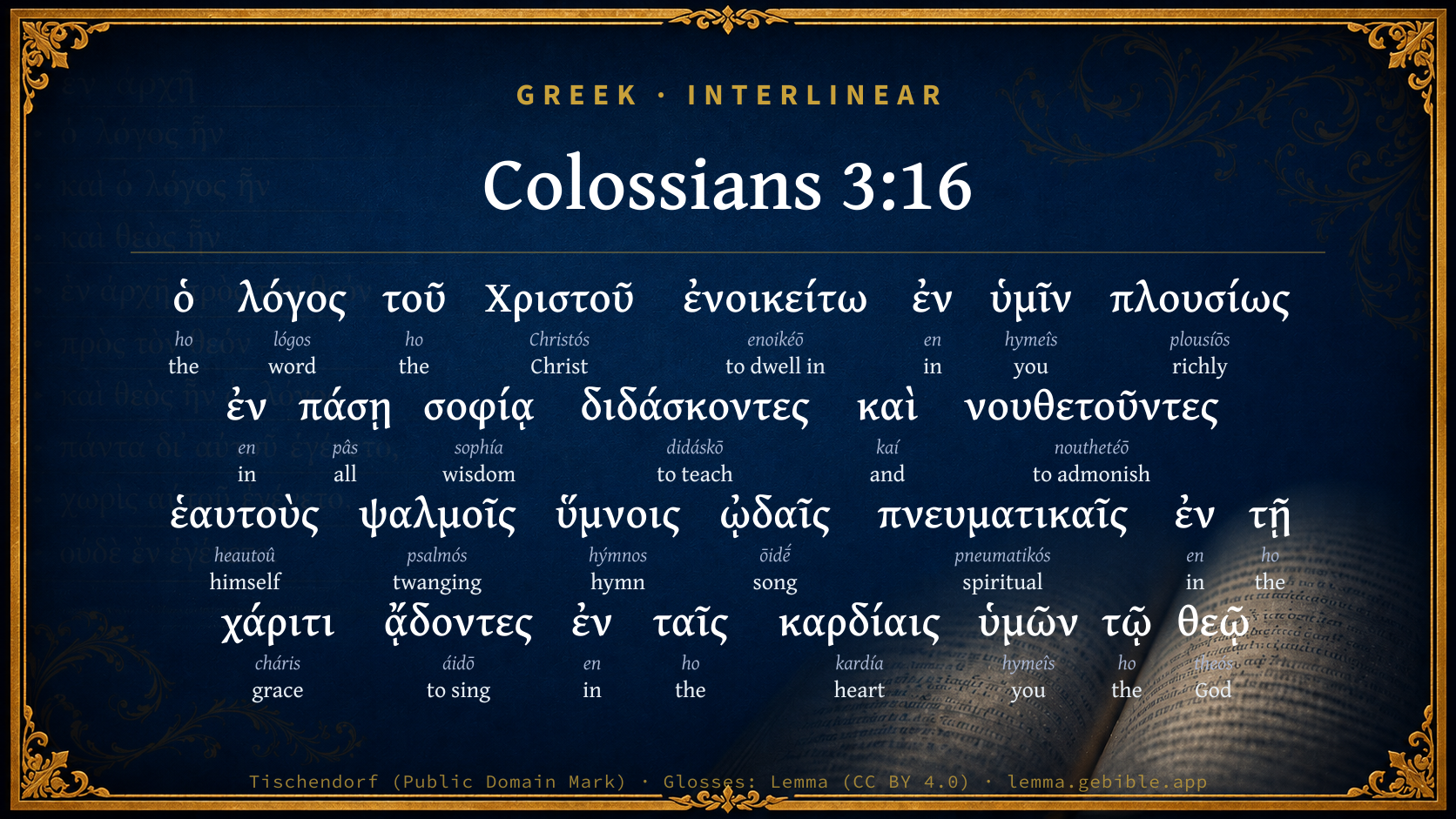
Greek (Tischendorf 8th ed.) Colossians 3:16 appears in the Greek New Testament. The text above is from the Tischendorf 8th edition. Each word links to its Strong’s number and a concise gloss. Click any word for its full Thayer’s Greek Lexicon entry.
Download image
Cite this verse

Colossians 3:16 (World English Bible). Public Domain. Lemma interlinear Bible study tool, https://lemma.gebible.app/v/colossians/3/16.

Show BibTeX & RIS
BibTeX
RIS
English Translation
Let the word of Christ dwell in you richly; in all wisdom teaching and admonishing one another with psalms, hymns, and spiritual songs, singing with grace in your heart to the Lord.
World English Bible · Public Domain
Highlights
  • 1 first appearance in the Greek New Testament
Full analysis ↓
Download a study sheet

One document with this verse’s original text, its word-by-word gloss line, the meaning frame, cross-references with their text, attributed commentary, and full source and license credits — printable, and it pastes into notes with its structure intact.

This verse Autodidact and up

Study sheet (.html) Plain text (.txt)

A passage Seminary Student

Up to 50 verses in one chapter. A passage sheet keeps up to 6 commentary sources and 12 cross-references per verse, in the order this page ranks them, and says so on the sheet whenever that leaves anything out. Ask for a single verse and you get the Autodidact verse sheet above.

Everything on this page stays free to read, with no account — the sheet is a download of what is already on screen, not access to it.

Want to remove ads? Support Godless Engineer
Compare translations 3

The same verse in 3 English versions, stacked beneath the original-language interlinear above. Click any original word for its lexicon entry.

Each is an independent rendering of the whole verse — the interlinear is not word-aligned to these translations.

Highlighted words mark where these versions differ — a whole-verse word diff, not a word-by-word alignment.

  • World English Bible Public Domain
    Let the word of Christ dwell in you richly; in all wisdom teaching and admonishing one another with psalms, hymns, and spiritual songs, singing with grace in your heart to the Lord.
  • King James Version Public Domain
    Let the word of Christ dwell in you richly in all wisdom; teaching and admonishing one another in psalms and hymns and spiritual songs, singing with grace in your hearts to the Lord.
  • unfoldingWord Literal Text CC BY-SA 4.0
    Let the word of Christ dwell in you richly, in all wisdom teaching and admonishing one another with psalms, hymns, spiritual songs, singing with thankfulness in your hearts to God.

unfoldingWord Literal Text — © unfoldingWord, licensed CC BY-SA 4.0. Word-aligned USFM3 via Door43 (git.door43.org/unfoldingWord/en_ult).

Versions to compare (up to 4)

3 of 4 selected

Show all 19 translations

Every available English version of this verse, each an independent rendering of the whole verse.

  • World English Bible Public Domain
    Let the word of Christ dwell in you richly; in all wisdom teaching and admonishing one another with psalms, hymns, and spiritual songs, singing with grace in your heart to the Lord.
  • Berean Standard Bible Public Domain
    Let the word of Christ richly dwell within you as you teach and admonish one another with all wisdom, and as you sing psalms, hymns, and spiritual songs with gratitude in your hearts to God.
  • Majority Standard Bible Public Domain
    Let the word of Christ richly dwell within you as you teach and admonish one another with all wisdom, and as you sing psalms, hymns, and spiritual songs with gratitude in your hearts to the Lord.
  • King James Version Public Domain
    Let the word of Christ dwell in you richly in all wisdom; teaching and admonishing one another in psalms and hymns and spiritual songs, singing with grace in your hearts to the Lord.
  • American Standard Version (1901) Public Domain
    Let the word of Christ dwell in you richly; in all wisdom teaching and admonishing one another with psalms `and' hymns `and' spiritual songs, singing with grace in your hearts unto God.
  • Revised Version (1885) Public Domain
    Let the word of Christ dwell in you richly in all wisdom; teaching and admonishing one another with psalms and hymns and spiritual songs, singing with grace in your hearts unto God.
  • Geneva Bible (1599) Public Domain
    Let the worde of Christ dwell in you plenteously in all wisdome, teaching and admonishing your owne selues, in Psalmes, and hymnes, and spirituall songs, singing with a grace in your hearts to the Lord.
  • Douay-Rheims (1899) Public Domain
    Let the word of Christ dwell in you abundantly, in all wisdom: teaching and admonishing one another in psalms, hymns, and spiritual canticles, singing in grace in your hearts to God.
  • Young's Literal Translation Public Domain
    Let the word of Christ dwell in you richly, in all wisdom, teaching and admonishing each other, in psalms, and hymns, and spiritual songs, in grace singing in your hearts to the Lord;
  • Literal Standard Version CC BY-SA 4.0
    Let the word of Christ dwell in you richly, in all wisdom, teaching and admonishing each other, in psalms, and hymns, and spiritual songs, in grace singing in your hearts to the LORD;
  • Unlocked Literal Bible CC BY-SA 4.0
    Let the word of Christ live in you richly. With all wisdom teach and admonish one another with psalms and hymns and spiritual songs. Sing with thankfulness in your hearts to God.
  • unfoldingWord Literal Text CC BY-SA 4.0
    Let the word of Christ dwell in you richly, in all wisdom teaching and admonishing one another with psalms, hymns, spiritual songs, singing with thankfulness in your hearts to God.
  • Darby Bible Public Domain
    Let the word of the Christ dwell in you richly, in all wisdom teaching and admonishing one another, in psalms, hymns, spiritual songs, singing with grace in your hearts to God.
  • World Messianic Bible Public Domain
    Let the word of Messiah dwell in you richly; in all wisdom teaching and admonishing one another with psalms, hymns, and spiritual songs, singing with grace in your heart to the Lord.
  • Webster's Bible Public Domain
    Let the word of Christ dwell in you richly in all wisdom; teaching and admonishing one another in psalms, and hymns, and spiritual songs, singing with grace in your hearts to the Lord.
  • Free Bible Version CC BY-SA 4.0
    Let Christ's message fully live in you. In every wise way teach and instruct one another through psalms and hymns and spiritual songs, singing praises to God in gratitude and sincerity.
  • Bible in Basic English Public Domain
    Let the word of Christ be in you in all wealth of wisdom; teaching and helping one another with songs of praise and holy words, making melody to God with grace in your hearts.
  • Text-Critical English NT CC BY 4.0
    Let the word of Christ dwell in you richly, teaching and admonishing one another with all wisdom as you sing psalms, hymns, and spiritual songs to the Lord with gratitude in your hearts.
  • Tyndale New Testament (1534) Public Domain
    Let the worde of Christ dwell in you plenteously in all wisdome. Teache and exhorte youre awne selves in psalmes and hymnes and spretuall songes which have favour with them syngynge in youre hertes to the lorde.

Literal Standard Version (2020), Covenant Press — licensed CC BY-SA 4.0. Text via the HelloAO Bible API (eBible.org). Unlocked Literal Bible (unfoldingWord) — licensed CC BY-SA 4.0. Text via the HelloAO Bible API (eBible.org). unfoldingWord Literal Text — © unfoldingWord, licensed CC BY-SA 4.0. Word-aligned USFM3 via Door43 (git.door43.org/unfoldingWord/en_ult). Free Bible Version, Dr. Jonathan Gallagher — licensed CC BY-SA 4.0. Text via the HelloAO Bible API (eBible.org).

Word by word

More ways to search: Search by grammar → Find every occurrence → Compare this word →

Practice this passage: Drill this verse → Learn its vocabulary →

ὕμνοις
hýmnos
G5215
“hymn”
Noun, Dative, Plural, Masculine
Part of Speech
Noun
Case
Dative
Number
Plural
Gender
Masculine
Full Thayer's Definition

Origin: apparently from a simpler (obsolete) form of hudeo (to celebrate, probably akin to G103 , cf G5667 )

TDNT: 16:09,1

1. a song in tithe praise of gods, heroes, conquerors 2. a sacred song, hymn
  1. ὁ ho G3588 “the” Article, Nominative, Singular, Masculine
  2. λόγος lógos G3056 “word” Noun, Nominative, Singular, Masculine
  3. τοῦ ho G3588 “the” Article, Genitive, Singular, Masculine
  4. Χριστοῦ Christós G5547 “Christ” Noun, Genitive, Singular, Masculine
  5. ἐνοικείτω enoikéō G1774 “to dwell in” Verb, Present, Active, Imperative, 3rd person, Singular
  6. ἐν en G1722 “in” Preposition
  7. ὑμῖν hymeîs G5210 “you” Personal pronoun, 2nd person, Dative, Plural
  8. πλουσίως plousíōs G4146 “richly” Adverb
  9. ἐν en G1722 “in” Preposition
  10. πάσῃ pâs G3956 “all” Adjective, Dative, Singular, Feminine
  11. σοφίᾳ sophía G4678 “wisdom” Noun, Dative, Singular, Feminine
  12. διδάσκοντες didáskō G1321 “to teach” Verb, Present, Active, Participle, Nominative, Plural, Masculine
  13. καὶ kaí G2532 “and” Conjunction
  14. νουθετοῦντες nouthetéō G3560 “to admonish” Verb, Present, Active, Participle, Nominative, Plural, Masculine
  15. ἑαυτοὺς heautoû G1438 “himself” Reflexive pronoun, 2nd person, Accusative, Plural, Masculine
  16. ψαλμοῖς psalmós G5568 “twanging” Noun, Dative, Plural, Masculine
  17. ᾠδαῖς ōidḗ G5603 “song” Noun, Dative, Plural, Feminine
  18. πνευματικαῖς pneumatikós G4152 “spiritual” Adjective, Dative, Plural, Feminine
  19. ἐν en G1722 “in” Preposition
  20. τῇ ho G3588 “the” Article, Dative, Singular, Feminine
  21. χάριτι cháris G5485 “grace” Noun, Dative, Singular, Feminine
  22. ᾄδοντες áidō G103 “to sing” Verb, Present, Active, Participle, Nominative, Plural, Masculine
  23. ἐν en G1722 “in” Preposition
  24. ταῖς ho G3588 “the” Article, Dative, Plural, Feminine
  25. καρδίαις kardía G2588 “heart” Noun, Dative, Plural, Feminine
  26. ὑμῶν hymeîs G5210 “you” Personal pronoun, 2nd person, Genitive, Plural
  27. τῷ ho G3588 “the” Article, Dative, Singular, Masculine
  28. θεῷ theós G2316 “God” Noun, Dative, Singular, Masculine

About this verse

These counts appear in no published source. They are computed here, from the morphology-tagged text and Lemma’s own curated glosses. What Lemma adds →

29
words
21
distinct lemmas
Pauline Epistles
section

Notable vocabulary

The rarest word here is ὕμνοις hymn G5215 — appearing just 2 times in the whole Greek New Testament.

First appearance in Scripture

This word makes its first canonical appearance in the Greek New Testament here:

  • πλουσίως richly G4146

Shared distinctive vocabulary

ὕμνοις hymn G5215 occurs in 2 verses of the Greek New Testament. Also found in:
Repetition

Words recur within this verse:

Cross-references

60

Topical passages linked to Colossians 3:16 in the Treasury of Scripture Knowledge — connected by theme and wording, ordered by reader-vote popularity; previews shown in the World English Bible.

  • Psalms 119:11 I have hidden your word in my heart, That I might not sin against you.
  • Ephesians 5:19 speaking to one another in psalms, hymns, and spiritual songs; singing, and singing praises in your heart to the Lord;
  • John 15:7 If you remain in me, and my words remain in you, you will ask whatever you desire, and it will be done for you.
  • Romans 10:17 So faith comes by hearing, and hearing by the word of God.
  • Jeremiah 15:16 Your words were found, and I ate them; and your words were to me a joy and the rejoicing of my heart: for I am called by your name, Yahweh, God of hosts.
  • 1 John 2:24 Therefore, as for you, let that remain in you which you heard from the beginning. If that which you heard from the beginning remains in you, you also will remain in the Son, and in the Father.
  • Hebrews 4:12–13 For the word of God is living, and active, and sharper than any two-edged sword, and piercing even to the dividing of soul and spirit, of both joints and marrow, and is able to discern the thoughts and intentions of the heart.
  • Deuteronomy 6:6–9 These words, which I command you this day, shall be on your heart;
  • Ephesians 1:17 that the God of our Lord Jesus Christ, the Father of glory, may give to you a spirit of wisdom and revelation in the knowledge of him;
  • Job 23:12 I haven't gone back from the commandment of his lips. I have treasured up the words of his mouth more than my necessary food.
  • James 3:17 But the wisdom that is from above is first pure, then peaceful, gentle, reasonable, full of mercy and good fruits, without partiality, and without hypocrisy.
  • 2 Timothy 3:15 From infancy, you have known the sacred writings which are able to make you wise for salvation through faith, which is in Christ Jesus.
  • 2 John 1:2 for the truth's sake, which remains in us, and it will be with us forever:
  • Revelation 5:9 They sang a new song, saying, "You are worthy to take the book, And to open its seals: For you were killed, And bought us for God with your blood, Out of every tribe, language, people, and nation,
  • Colossians 1:9 For this cause, we also, since the day we heard this, don't cease praying and making requests for you, that you may be filled with the knowledge of his will in all spiritual wisdom and understanding,
  • Proverbs 2:6–7 For Yahweh gives wisdom. Out of his mouth comes knowledge and understanding.
  • Psalms 30:11–12 You have turned my mourning into dancing for me. You have removed my sackcloth, and clothed me with gladness,
  • 1 John 2:27 As for you, the anointing which you received from him remains in you, and you don't need for anyone to teach you. But as his anointing teaches you concerning all things, and is true, and is no lie, and even as it taught you, you will remain in him.
  • Colossians 4:6 Let your speech always be with grace, seasoned with salt, that you may know how you ought to answer each one.
  • Deuteronomy 11:18–20 Therefore shall you lay up these my words in your heart and in your soul; and you shall bind them for a sign on your hand, and they shall be for symbols between your eyes.
  • Psalms 28:7 Yahweh is my strength and my shield. My heart has trusted in him, and I am helped. Therefore my heart greatly rejoices. With my song I will thank him.
  • Ephesians 5:17 Therefore don't be foolish, but understand what the will of the Lord is.
  • Psalms 71:23 My lips shall shout for joy! My soul, which you have redeemed, sings praises to you!
  • 1 Thessalonians 5:11–12 Therefore exhort one another, and build each other up, even as you also do.
  • James 5:13 Is any among you suffering? Let him pray. Is any cheerful? Let him sing praises.
  • 1 Corinthians 14:26 What is it then, brothers? When you come together, each one of you has a psalm, has a teaching, has a revelation, has another language, has an interpretation. Let all things be done to build each other up.
  • 1 Peter 1:11–12 searching for who or what kind of time the Spirit of Christ, which was in them, pointed to, when he predicted the sufferings of Christ, and the glories that would follow them.
  • 1 Kings 3:28 All Israel heard of the judgment which the king had judged; and they feared the king: for they saw that the wisdom of God was in him, to do justice.
  • 1 Corinthians 14:15 What is it then? I will pray with the spirit, and I will pray with the understanding also. I will sing with the spirit, and I will sing with the understanding also.
  • Colossians 1:28 whom we proclaim, admonishing every man and teaching every man in all wisdom, that we may present every man perfect in Christ Jesus;
  • 1 Thessalonians 4:18 Therefore comfort one another with these words.
  • Titus 3:6 which he poured out on us richly, through Jesus Christ our Savior;
  • 1 Kings 3:9–12 Give your servant therefore an understanding heart to judge your people, that I may discern between good and evil; for who is able to judge this your great people?
  • Nehemiah 12:46 For in the days of David and Asaph of old there was a chief of the singers, and songs of praise and thanksgiving to God.
  • Psalms 32:7 You are my hiding place. You will preserve me from trouble. You will surround me with songs of deliverance. Selah.
  • Psalms 47:6–7 Sing praise to God, sing praises. Sing praises to our King, sing praises.
  • James 1:5 But if any of you lacks wisdom, let him ask of God, who gives to all liberally and without reproach; and it will be given to him.
  • Psalms 103:1–2 Praise Yahweh, my soul! All that is within me, praise his holy name!
  • Proverbs 14:8 The wisdom of the prudent is to think about his way, But the folly of fools is deceit.
  • Matthew 26:30 When they had sung a hymn, they went out to the Mount of Olives.
  • 1 Timothy 6:17 Charge those who are rich in this present world that they not be haughty, nor have their hope set on the uncertainty of riches, but on the living God, who richly provides us with everything to enjoy;
  • Hebrews 12:12–15 Therefore, lift up the hands that hang down and the feeble knees,
  • 1 John 2:14 I have written to you, fathers, because you know him who is from the beginning. I have written to you, young men, because you are strong, and the word of God remains in you, and you have overcome the evil one.
  • Revelation 15:3 They sang the song of Moses, the servant of God, and the song of the Lamb, saying, "Great and marvelous are your works, Lord God, the Almighty; Righteous and true are your ways, you King of the nations.
  • Psalms 63:4–6 So I will bless you while I live. I will lift up my hands in your name.
  • 1 Chronicles 25:7 The number of them, with their brothers who were instructed in singing to Yahweh, even all who were skillful, was two hundred eighty-eight.
  • Psalms 119:54 Your statutes have been my songs, In the house where I live.
  • Psalms 138:1 I will give you thanks with my whole heart. Before the gods, I will sing praises to you.
  • Luke 2:51 And he went down with them, and came to Nazareth. He was subject to them, and his mother kept all these sayings in her heart.
  • Isaiah 5:1 Let me sing for my well beloved a song of my beloved about his vineyard. My beloved had a vineyard on a very fruitful hill.
  • John 5:39–40 "You search the Scriptures, because you think that in them you have eternal life; and these are they which testify about me.
  • Romans 15:14 I myself am also persuaded about you, my brothers, that you yourselves are full of goodness, filled with all knowledge, able also to admonish others.
  • 2 Thessalonians 3:15 Don't count him as an enemy, but admonish him as a brother.
  • Isaiah 10:2 to turn aside the needy from justice, and to rob the poor of my people of their right, that widows may be their spoil, and that they may make the fatherless their prey!
  • Revelation 14:3 They sing a new song before the throne, and before the four living creatures and the elders. No one could learn the song except the one hundred forty-four thousand, those who had been redeemed out of the earth.
  • Revelation 19:10 I fell down before his feet to worship him. He said to me, "Look! Don't do it! I am a fellow bondservant with you and with your brothers who hold the testimony of Jesus. Worship God, for the testimony of Jesus is the Spirit of Prophecy."
  • Song of Solomon 1:1 The Song of songs, which is Solomon's. Beloved
  • Isaiah 26:1 In that day shall this song be sung in the land of Judah: we have a strong city; salvation will he appoint for walls and bulwarks.
  • Isaiah 30:29 You shall have a song as in the night when a holy feast is kept; and gladness of heart, as when one goes with a pipe to come to the mountain of Yahweh, to the Rock of Israel.
  • Proverbs 18:1 An unfriendly man pursues selfishness, And defies all sound judgment.

Cross-references courtesy of OpenBible.info (CC BY 4.0).

Where the printed editions differ

1 variant

Places in this verse where the major printed Greek editions disagree on the wording in a way that affects the translation — a comparison of editions, not a manuscript-by-manuscript collation. The editions are the modern critical texts (Nestlé-Aland 28/27, SBL, Westcott-Hort, Tregelles, Tyndale House) and the traditional texts behind the KJV (the Textus Receptus and the Byzantine/Majority text). It is not a claim about which reading is original.

  1. Different wording
    θεῷ·

    “to God;”

    In NA28NA27TynSBLWHTreg Not in TRByz

    κυρίῳ (kuriō) 'Lord' occurs in traditional manuscripts (TR+Byz) instead of θεῷ· (theō) 'to God;' in older manuscripts (NA28+NA27+Tyn+SBL+WH+Treg)

Textual data: Translators Amalgamated Greek New Testament (STEPBible TAGNT) · CC BY 4.0.

Commentary

Notes on Colossians 3:16 from classic Christian and Jewish commentators (each source and its license shown beneath its notes). The classic Christian expositions comment on the surrounding passage and are grouped to its opening verse, so a note may address several verses; the Jewish commentaries on the Tanakh (Rashi and others) are per-verse, so they appear only where the commentator wrote on this verse.

Lemma curates 59 commentaries, every one of them public domain or Creative Commons licensed, each selected and text-cleaned for this edition rather than reprinted as found. About our sources →

John Calvin's Commentaries

16. Let the word of Christ dwell. He would have the doctrine of the gospel be familiarly known by them. Hence we may infer by what spirit those are actuated in the present day, who cruelly interdict the Christian people from making use of it, and furiously vociferate, that no pestilence is more to be dreaded, than that the reading of the Scriptures should be thrown open to the common people. For, unquestionably, Paul here addresses men and women of all ranks; nor would he simply have them take a slight taste merely of the word of Christ, but exhorts that it should dwell in them; that is, that it should have a settled abode, and that largely, that they may make it their aim to advance and increase more and more every day. As, however, the desire of learning is extravagant on the part of many, while they pervert the word of the Lord for their own ambition, or for vain curiosity, or in some way corrupt it, he on this account adds, in all wisdom — that, being instructed by it, we may be wise as we ought to be.

Farther, he gives a short definition of this wisdom — that the Colossians teach one another Teaching is taken here to mean profitable instruction, which tends to edification, as in Romans 12:7 — He that teacheth, on teaching; also in Timothy — “All Scripture is profitable for teaching.” (2 Timothy 3:16.) This is the true use of Christ’s word. As, however, doctrine is sometimes in itself cold, and, as one says, when it is simply shewn what is right, virtue is praised and left to starve, he adds at the same time admonition, which is, as it were, a confirmation of doctrine and incitement to it. Nor does he mean that the word of Christ ought to be of benefit merely to individuals, that they may teach themselves, but he requires mutual teaching and admonition.

Psalms, hymns. He does not restrict the word of Christ to these particular departments, but rather intimates that all our communications should be adapted to edification, that even those which tend to hilarity may have no empty savor. “Leave to unbelievers that foolish delight which they take from ludicrous and frivolous jests and witticisms; and let your communications, not merely those that are grave, but those also that are joyful and exhilarating, contain something profitable. In place of their obscene, or at least barely modest and decent, songs, it becomes you to make use of hymns and songs that sound forth God’s praise.” Farther, under these three terms he includes all kinds of songs. They are commonly distinguished in this way — that a psalm is that, in the singing of which some musical instrument besides the tongue is made use of: a hymn is properly a song of praise, whether it be sung simply with the voice or otherwise; while an ode contains not merely praises, but exhortations and other matters. He would have the songs of Christians, however, to be spiritual, not made up of frivolities and worthless trifles. For this has a connection with his argument.

The clause, in grace, Chrysostom explains in different ways. I, however, take it simply, as also afterwards, in Colossians 4:6, where he says, “Let your speech be seasoned with salt, in grace,” that is, by way of a dexterity that may be agreeable, and may please the hearers by its profitableness, so that it may be opposed to buffoonery and similar trifles.

Singing in your hearts. This relates to disposition; for as we ought to stir up others, so we ought also to sing from the heart, that there may not be merely an external sound with the mouth. At the same time, we must not understand it as though he would have every one sing inwardly to himself, but he would have both conjoined, provided the heart goes before the tongue.

John Calvin's Commentaries (1540-1563) — public domain. Text from the Calvin Translation Society English edition (1840s-50s) via the Christian Classics Ethereal Library (ccel.org). Calvin's coverage is partial (roughly two-thirds of the Bible); uncommented books and verses are honest gaps, never fabricated. The 19th-century editor's footnotes and remarks are omitted so the notes are faithfully Calvin's own voice.

The Cambridge Bible for Schools and Colleges

gen. ed. J. J. S. Perowne

16. the word of Christ] The precise phrase occurs here only. It is (surely, though Lightfoot advocates the explanation, “Christ’s word to the Christian; His influence speaking in the heart”) the message of His Gospel, the terms of the revelation of His personal Glory, redeeming work, and holy will. This “word” might be conveyed in the Old Scriptures (see e.g. Rom_15:4; Rom_16:26; Gal_3:8; 1Pe_2:6), or by the mouth or pen of Christian Apostles and Prophets.—Cp. e.g. Act_4:29; Act_6:2; Act_8:14; Act_13:26; Act_15:7; Act_15:35; Act_17:13; Act_19:10; Act_20:32; 1Co_1:18; 1Co_14:36; 2Co_5:19; Eph_1:13; 1Th_4:15; 2Th_3:1; 2Ti_2:9; Tit_1:9; Heb_6:1; Jas_1:18; 1Pe_1:23; Rev_1:9; Rev_6:9.—Thus both O. T. citations and such Christian watchwords as 1Ti_1:15; 2Ti_2:11, would be “the word of Christ”; and as each portion of the New Scriptures (2Pe_3:16) appeared and was received its words too would be “the word of Christ.”—The definiteness of the Gospel is powerfully emphasized by its designation as a word, a message.

dwell in you] as what has become a permanent part of your thought.

richly] See on Col_1:27 for St Paul’s love of the imagery of wealth.—The heavenly “word” was to be abundant as a store (Psa_119:11) in their memories, and also as an element in their thought and utterance.

in all wisdom] They were not merely to know “the word” verbally, but to handle and apply it with spiritual fitness and rightness. The supreme example appears in our Lord’s use of “the word” of the O.T.; Matthew 4—Such “wisdom,” infinitely higher than that of the mere critical enquirer, would be learnt in communion with the Lord of the Word. Cp. Eph_1:17.

teaching and admonishing one another] The Greek is out of grammatical connexion with the previous clauses, but fully intelligible. See Lightfoot’s excellent note.—“One another”:—lit. “yourselves.” See note on Col_3:13; and on Eph_5:19.

“Teaching … admonishing”:—in the parallel, Eph_5:19 (where see our notes throughout), we have merely “speaking.”—The spiritual importance of Christian hymnody comes out impressively here. It is no mere luxury of devotion, certainly no mere musical pleasure; it is an ordained vehicle of instruction and warning.

psalms … hymns … spiritual songs] Verbatim as Eph_5:19. To summarize our comment there; it is impossible to draw absolute limits between these kinds of sacred music; but on the whole the psalm may be exemplified by (in the O.T.) the songs of the Psalter, and (in the N.T.) those of Luke 1, 2, their Christian parallel; the hymn by the chant of the disciples, Acts 4; and the song or ode (ôdê) by such rhythmic “words” as those of 2Ti_1:11. This last citation is notably full of both “teaching” and “admonition.”

“Spiritual songs”:—not necessarily inspired, as Scripture, but pregnant with spiritual truth. Yet it is at least possible, from the recent mention of “the word of Christ,” that “songs” due to inspired authorship are here referred to, at least specially.—Luther, master and lover of hymns, writes in his Version here, out of the fulness of his heart, mit geistlichen lieblichen Liedern.

with grace] Lit., “in the grace”; conditioned by “the grace given unto you.”—“Grace” here is, in effect, the presence of God in the believer, with its holy, loving power.

The Cambridge Bible for Schools and Colleges (gen. ed. J. J. S. Perowne; Cambridge University Press, 1878–1918) — public domain. Text from a community e-Sword module.

The Biblical Illustrator

Joseph S. Exell

Col_3:16

Let the Word of Christ dwell in you richly.

The Word of Christ

I. What is it? The Scriptures of the Old and New Testament.

1. Christ is their author.

2. He is their subject-matter--they testify of Him. Christ is the Word, the wisdom of God, the truth; and truth as well as grace came by Him.

II. How shall we treat it?

1. Let it dwell in us. It must not be as a stranger, or a visitor, or as an acquaintance with whom we are not specially intimate, or as a friend away and seldom seen, but rather as a resident member of our family with whom we are in constant and loving communication.

2. Let it dwell in you. It is not enough that it be in our house, study, pocket, and so at hand. It must be in our heart, pervading our whole spiritual nature, directing and controlling all our life and conduct. Thy Word have I hid in my heart. Out of the heart are the issues of life.

3. Let it dwell in you richly, plentifully, profoundly. This implies--

(1) An intimate knowledge of the truth.

(2) A believing, saving experience of the truth.

We should seek to understand it in its inmost compass; in all its bearings and relations, and then gladly receive it, in the love of it, into good and honest hearts (Jam_1:2). (T. W. Sydnor.)

The school of the Word

I. The lesson-book. The Word of Christ, so called, because--

1. He is its central theme. The beginning of the story of the race is told that the first Adam may prepare the way for the second: then the mass of the race is forgotten, and one chosen family selected because Christ was to come out of it. The songs, prophecies, teachings of the Old Testament are full of Christ, and its characters are as fragments of the perfect character of Jesus. The ethics of the book find their full manifestation in Him. The Gospels are biographies of Him, and the Epistles expositions of the truths of that biography.

2. It was originated by Christ. Some write of what they see or hear, but Christ produces the history He causes to be recorded. He not only breathed His Spirit upon mens minds that they might write its doctrines; He produced the facts which are the basis of the doctrines. Pardon is taught; but He made the atonement by His death. Immortality is taught; but He revealed it first by His resurrection.

3. He dwells in it. Men are in quest of Christ, and seek Him in sacraments and holy things and places. But we have not to ascend into heaven to bring Him down, etc. The Word is nigh thee. Christ is in His Word, not as Plato in his republic or Shakespeare in his plays, but as a living and operating power. My words are spirit, and they are life.

4. Through it He works. There is not a process of grace promised or commended that it does not promote.

(1) Conviction of sin. The entrance of Thy Word giveth light. The Word is powerful, sharper than any two-edged sword.

(2) Conversion. The law of the Lord is perfect, converting the soul.

(3) Salvation from sin. Thy Word have I hid in my heart, etc.

(4) Edification. The Word of His grace … is able to build you up, etc.

(5) All sound Christian profit. Is profitable for doctrine, etc

II. The school.

1. The Church generally. Christ appointed the Church to teach His Word, and His Word forms the basis of her creeds, and the final authority when those creeds are questioned. It is to be exalted in her worship, commemorated in her sacraments, and proclaimed and defended in her pulpits.

2. The school of devotion; the prayer-meeting.

3. The school of experience; the class or fellowship-meeting.

4. The school of the family, where children learn theology, and the Divine character and administration, by object lessons, by what father and mother say and do.

5. But pre-eminently is the Sunday school the school of the Word.

III. The teacher.

1. His qualification. The Word is to dwell in him richly--in his tongue as its expounder; in his memory as a student; in his heart as a believer: so that when he prays he uses it, when he teaches texts come to his tongue-ends, and as he lives he illustrates it. It must so dwell in him that he will delight in it, love to quote it, go to sleep in times of storm resting upon it, and use it in the hour of death as the key to the kingdom.

2. His method.

(1) Teaching;

(2) admonishing;

(3) translating into life. (Bishop Vincent.)

The indwelling of the Word

There is nothing easier than to hear the Word with a general regard, and few things more difficult than to receive it as a principle of spiritual life. Satan hinders; cumbering with much business, diverting with trifles, or disturbing with wicked imaginations or affections.

I. The word of Christ.

1. In a special and limited sense this is the gospel, because He preached and published it.

2. In a larger sense it is both Testaments, for He is the author of both.

3. Then in listening to Bible teaching we are listening to Christ Himself. The Word is one of His titles, and He would have us honour it by honouring the Scriptures which testify of Him.

4. It is sometimes called the Word of the Kingdom, because it shows the way to the kingdom of grace, that we may be partakers of the kingdom of glory; the Word of life, because the instrument of regeneration and spiritual sustentation.

5. But though necessary, how many unnecessary things are preferred before it. It is the polar star which shines out in the spiritual firmament to point you to Christ; and yet in how many instances is the glimmering taper of human reason preferred! It opens a well of life; yet many choose the broken cistern.

II. Its dwelling-place.

1. It is to dwell.

(1) This points out a contrast between a settled and vagrant life. With the mere wanderer we hold little in common: the resident is well known. As you give yourself up to the study of the sacred oracles, the mind of the Spirit becomes imparted to your own.

(2) This is an allusion to Gods dwelling in the Holy of Holies. Christs Word is to be as the Shekinah.

2. It is to dwell within: not in the understanding merely to enlighten it, nor in the judgment to inform and convince it, but to be deeply seated and treasured up in the heart. I will write My law in their inward parts, etc. And unless it is so written it is quite certain that we have no interest in the covenant.

(1) It is to dwell there as a man dwells in his own house, which he is proud of calling his castle, and which is not as a temporary tent. If ye continue in My Word, etc. How many there are who give it only the entertainment of a wayfaring man who obtains with difficulty a lodging for the night, and in the morning is gone.

(2) In order thus to dwell it must be mixed with faith. Without faith it may produce various effects: it may make you, like Herod, do many things, and induce yon, like Felix, to hear Paul gladly; it may produce feelings of wonder, etc.; but it is only when received in faith that it can really profit.

III. The measure in which it is to dwell in us.

1. Richly: not as a scanty stream, but as a full flowing river. You are not to be content with partial views of Gods truth. The whole written Word is the souls pasturage. All Scripture … is profitable. Man shall not live by bread alone, but by every word, etc.

2. This requires prayerful searching, and much more than reading in haste a chapter in the morning or at night. We do not search after worldly wealth so.

3. This rich indwelling will be fruitful in

(1) comfort;

(2) holiness;

(3) revived spiritual life. (T. Watson, B. A.)

The indwelling Word of Christ

I. This exhortation is connected with the exhortation out of which it springs (Col_3:14-15); and with the outward expression in which it finds vent (Col_3:16).

2. The Word of Christ is not His personal teaching merely, but the whole Bible as His present Word, affording the materials of present speech.

3. Its indwelling is personal, and is not to be evaporated, as if it referred to the Church collective (Rom_8:11; 2Co_6:16; Eph_3:17; 2Ti_1:5; 2Ti_1:14).

I. Let the word of Christ dwell in you.

1. This implies a sense of the preciousness of Christ Himself realized by faith.

(1) No ones word will be precious to you unless he is precious whose word it is. The word of one you dislike will be contemptuously rejected; the word of one who is an object of indifference will pass swiftly by you.

(2) How much of the Word of Christ may be missed unless He is precious. In many parts you think that He is only dimly and distantly to be found, and even passages fullest of Him do not bring Him as speaking personally to you. But it is only as it does that that the Bible is the Word of Christ. A friends letter is his word to me when by means of it I call him up before me in his own loved person speaking to me. Then it dwells in me. Thus, through my love to Him and His preciousness to me, Scriptures which seem to have little to do with Him may become His Word to me.

2. The preciousness of Christs Word, as well as of Christ Himself, is essential to its dwelling in you.

(1) If Christ is precious, His Word must be precious. The word of a precious friend is precious even before you know what it contains. Its very outside is welcome. But it becomes more so as you study it, and especially if it be of real value.

(2) Most Christians can name a text apparently having little to do with Christ, which has become, nevertheless, one of His best remembrancers. It is connected with some marked crisis; as a whisper of consolation, a breath of pity in sinfulness, felt as the Word of Christ just then wanted.

(3) The way of finding Christ all through the Bible is not merely to get it to speak of Christ, but to get Christ to speak to you about it; and so to make it all His, i.e., let it all, every bit and fragment of it, be welded into your experience, with Christ living in you the hope of glory.

(4) This may be by the Spirit being given in answer to the prayer of faith. He teaches you all things as said by Christ. Do not force it to tell of Christ formally, so as to offend critics and offend ordinary readers. Take it in its plain meaning, but expect that Christ in it may have some lesson to teach; some comfort to impart; some rebuke to administer.

3. The felt preciousness of real present and living intercourse between Christ and you will cause the Word, as His, to abide in you.

(1) That Word sustains the intercourse, and is for colloquial uses. You are to dwell in Christ and He in you, but communion cannot long be maintained without language. We may dream of this mutual indwelling after some vague, sleepy fashion; but if it is to be more than a dream there must be talk between us. He Himself deals with this subject (Joh_15:7; Joh_16:23). This can only be realized by the Comforter bringing to remembrance whatsoever He hath said unto you. His Word, then, must be the staple of the verbal intercourse. He uses it in speaking to you, and you in speaking to Him.

(2) Thus used, it will dwell. Otherwise, while whole strings of texts or chapters may be retained in the memory, and may be glibly quoted, the virtue will be gone out of them. If you would have the Word to abide in you as the precious Word of a precious Saviour, you must always turn it to account in fellowship with Him.

II. Richly.

1. In quantity. Let the mind and soul be richly stored. Ah! how much there is of the Bible that does not dwell in you because you do not realize it as the Word of Christ; whole chapters that have not been linked to any gracious dealing of Christ.

2. In quality.

(1) A rich manure is one that enriches the soil; and it dwells in the soil richly in proportion as it enriches it, turning its hard, dry sterility into fruitful mould. So let the Word of Christ dwell in you as to enrich your souls.

(2) But it must be as the Word of Christ. For such is the poverty and perversity of the soil, that otherwise even the Word will, instead of enriching the soul, become partaker of its deadness, and end in being as salt which has lost its savour. The letter killeth, but the Spirit giveth life, making it truly the living Word of a living Christ.

(3) And how penetrating, as well as powerful, should be its virtue. It should reach to every nook of your life.

3. In correspondence to the riches of Him whose Word it is. Riches of goodness, glory, wisdom, knowledge, grace; unsearchable riches of Christ.

4. It is to dwell in you, not only as rich receivers, but dispensers. Freely ye have received, freely give. You are to be richly productive, fruit-bearing, in faith, in good works.

5. Notice the social hearing of the precept as embedded in the context (Col_3:12-15 on the one hand, and Col_3:16 on the other). In either view this indwelling is not to be like a mass of dead matter crammed into a dead receptacle; as bales are packed in a warehouse, or loads of unread learning are crowded on library shelves for show. Out of the abundance of the heart the mouth, the life, the hand must speak. (R. S. Candlish, D. D.)

Indwelling of the Word of Christ

I. The Word of Christ.

1. The literal Word of Christ is one of the most wonderful things that ever has been in the world. Not from Roman rostrum, nor in terms of Greek philosophy, nor as a Jewish rabbi, but simply and naturally to simple and ordinary men wherever they could be got together, and as He spake the words seem to root themselves in the heart, and grew a living force in the life of the nation. Then came the alternative that He must keep silence or die; but He went on speaking till lie said, It is finished. Immediately on His resurrection He began to speak, and when He went away He left nothing behind Him but His Word. At that time His life and death were unknown powers, and He did not leave the least written explanation of them, nor were the Gospels in existence at the time of this Epistle; but there was the Word of Christ in its newness and energy.

2. Whether or not that Word would have lived without a literary embodiment we are not required to settle. For evidently it was Christs purpose to condense His living speech into writings for the instruction of men. And there is clear reference here to the written as well as the spoken Word. Thus the phrase takes its most comprehensive sense--the gospel--all that is revealed of God for human salvation.

3. Manifestly all this lies solely in the Scriptures. There is authoritative Word of Christ for us nowhere else. But here the Book is all His. He has fulfilled it, explained it, inspired it, made it a living Word from first to last, that He might by His Spirit give it living and blessed applications.

II. Its indwelling. Yield yourselves up as sacred dwellings to be occupied with it.

1. This means that other tenants are not to remain unless in full agreement with this chief dweller. Thoughts and words of men, plans of earthly ambition, pleasures of sin--away! All thoughts are to be ruled, all cares hallowed by it, and all enjoyments made safe and good. It must be this much, or it can be nothing vital. Christs Word in the morning, selfish prudence all through the day; Christs Word for religious service, the word of man for the mercantile transaction; Christs Word for sickness and death, other words for times of health and pleasure; will not do. The tenant will only occupy as sole possessor of the tenement.

2. Let it dwell. There is plenty of it to fill the wonderful house.

(1) Down to the deepest base of life it will go, where passions lurk, and flowing round and through them, it will purge away what is unhallowed, leaving only wholesome forces to strengthen and perfect character.

(2) Into the rooms that lie more open to common day, and more level with the world, where many busy feet come and go--where knowledge gathers her stores, prudence holds her scales, judgment records her decisions, diligence plies her tasks, acquisition counts her gains, and foresight watches the opening future; into all these the living Word will enter, and at her ingress the darkening shadow melts, the wrinkles of care are smoothed, and slippery things cease their blandishments, and injustice and unkindness hide their heads.

(3) Up higher yet, where imagination lights her lamp, and invention stirs her fires, and desire bends the knee, looking upward, and hope sits watching with nothing between her and the stars.

3. Richly--in its best forms and sweetest fragrance, with all its luminous, guiding powers. Fill yourselves with it. Open all the doors, fling wide the windows. You have only to do that. You have not to make the Word: it is nigh thee in thy heart and in thy mouth if thou wilt but let it dwell in thee richly.

4. But here is more than a mere passive allowance. There is a direct appeal to the will and to the activity of the mind. The Word, abundant as it is, will not come to dwell at all without consent and careful and diligent endeavour. Much wisdom is needed for the due remembrance and seasonable entertainment of the various parts in order to apply it to meet the wants of life as they arise. In this every man must be his own minister. We do not need the whole Bible every day; we need it as we need corn in the granary, as the lamps by night. There is many a passage in reserve. We glance at them to-day with only a general interest, but the day will come when they will be as thousands of gold and silver. Meantime it is a great matter to know what is daily bread for this day.

(1) Am I in the dark about myself, about the world? Then it will be wise to let the Word of Christ dwell in me as a revelation.

(2) Am I doubting and desponding, finding few signs of grace? Then let me remember the Word of Christ as a word of assured salvation, saving the eyes from tears, the feet from falling, and the soul from death.

(3) Am I, though calmed with forgiveness, very weak, and unfit for continuing the struggle of the nobler life? Then let me take some strong promise, adapted to the need, and drink it up as a tainting man would drink a cordial until I am refreshed.

(4) Am I sorrowing? Can I forget Let not your heart ,be troubled.

(5) Am I passing away from earth and time? More than ever do I need to take Him at His word: I will not leave nor forsake.

III. The outflow. One of the divinest and most necessary truths is that we must give in order to have. The Word of Christ, in order to secure continuance, must be always leaving us. Go among the mountains, and you will see that it is the living stream that flows away; and where it flows the grass is green, and the flowers bloom, and the cattle drink, and the children linger to dip the foot and hear the song. Yet the spring is in no way exhausted. It is fed by the drawing sun, the condensing mountains, the bountiful clouds, the wide sea. Let your inner life, nourished by the indwelling Word, have not ostentatious and noisy, but natural and continuous expression. Its light will come to you from the land of lights. So will you draw from the infinite ocean of Divine love (see Col_3:16-17). A beautiful life; a life of poetry and heart music; a life, too, open alike to all. (A. Raleigh, D. D.)

Psalms and hymns and spiritual songs.

I. The Psalms of the Old Testament have no single and universally accepted designation in the Hebrew Scriptures. They first obtained such in the Septuagint. Psalm comes from a word signifying properly a touching, and then a touching of a stringed instrument with a plectrum, and next the instrument itself, and lastly the song sung with this musical accompaniment. It was in this latest stage that the word was adopted by the Septuagint, and to this agree the ecclesiastical definitions of it. In all probability the word here and in Eph_5:19 refers to the inspired Psalms of the Hebrew canon, and certainly designates these on all other occasions where it is met with in the New Testament, with the doubtful exception of 1Co_14:16. The psalms, then, which the apostle would have the faithful to sing to one another are those of David, Asaph, and the other sweet singers of Israel.

II. Hymns. While the psalm by right of primogeniture, as at once the oldest and most venerable, occupies the foremost place, the Church of Christ does not restrict herself to such, but claims the freedom of bringing new things as well as old out of her treasure house, a new salvation demanding a new song. It was the essence of a Greek hymn that it should be addressed to, or be in praise of a god or a hero, i.e., a deified man, as Callisthenes reminded Alexander, who, claiming hymns for himself, or suffering them to be addressed to him, implicitly accepted divine honours. In the gradual breaking down of the distinction between the human and the divine which marked the fallen days of Greece and Rome, with the usurping on the part of men of divine honours, the hymn came more and more to be applied to men; although this was not without remonstrance. When the word was assumed into the language of the Church, this essential distinction clung to it still. A psalm might be a De profundis, the story of mans deliverance, or a commemoration of mercies received; and of a spiritual song much the same could be said; a hymn must always be more or less of a Magnificat, a direct address of praise and glory to God. Augustine in more places than one states the essentials of a hymn.

1. It must be sung.

2. It must be praise.

3. It must be to God.

But though hymn was a word freely adopted in the fourth century, it nowhere occurs in the early Fathers, probably because it was so steeped in heathenism, so linked with profane associations, there were so many hymns to Zeus, Hermes, Aphrodite, etc., that the early Christians shrank from it. We may confidently assume that the hymns referred to in the text were direct addresses to God, such as Luk_1:46-55; Luk_1:68-79; Act_4:24, and that which Paul and Silas sang in the Philippian dungeon (Act_16:25). How noble, how magnificent uninspired hymns could prove we have evidence in the Te Deum, in the Veni Creator Spiritus, and in many a later heritage which the Church has acquired. That the Church, brought at the time when St. Paul wrote into a new and marvellous world of realities, would be rich in those we might be sure, even if no evidence existed to this effect. Of such evidence, however, there is abundance (Eph_5:14; 1Ti_3:16; 2Ti_2:11-14). And as it was quite impossible that the Church, releasing itself from the Jewish synagogue, should fall into the same mistake as some portions of the Reformed Church, we may be sure that it adopted into liturgic use, not psalms only, but also hymns, singing them to Christ as God (Pliny, Ephesians 10.96); though this we may conclude, more largely in Churches gathered out of the heathen world than in those wherein a strong Jewish element existed.

III. Spiritual songs. Ὀδή is the only word of this group which the Apocalypse knows (Rev_5:9; Rev_14:3; Rev_15:3). St. Paul, on the two occasions when he employs it, adds spiritual to it, and this, no doubt, because Ode by itself might mean any kind of song, as of battle, of harvest, or festal, or hymeneal, while psalm, from its Hebrew use, and hymn, from its Greek, did not need such qualification. The epithet thus applied does not affirm that these odes were Divinely inspired, any more than the spiritual man is an inspired man (1Co_3:1; Gal_6:1), but only that they were such as were composed by spiritual men, and moved in the sphere of spiritual things. How are we, then, to distinguish these from the former two. If psalms represent the heritage of sacred song derived by the Christian Church from the Jewish, the hymns and spiritual songs will cover what further in the same kind it produced out of its own bosom; but with a difference. What the hymns were we have seen; but Christian thought and feeling will soon have expanded into a wider range of poetic utterances than those in which there is a direct address to the Deity. If we turn, e.g., to Herberts Temple, or Kebles Christian Year, there are many poems in both, which, as certainly they are not psalms, so as little do they possess the characteristics of hymns. Spiritual songs these might be fitly called; even as in almost all our collections of so-called hymns there are not a few which by much juster title would bear this name. (Archbishop Trench.)

The poets of the New Testament

I. The extent of the poetic endowment in the primitive churches. That it was extensively bestowed we may conceive--

1. From the frequent reference made to it (1Co_14:26). In Corinth it was valued as a charismata (see also Eph_5:19; Jam_5:13).

2. From the universality of the preternatural endowment. The gift of the Spirit was generally bestowed, and this would rouse the poetic faculty in all who had it, and consecrate it to sacred uses.

3. From the universality of excited feelings in the apostolic Churches. Most of those who embraced religion were subject to extraordinary excitement, and poetry is the language of excited feelings. To the unconverted this inspiration was madness or intoxication.

II. Its character. Poetical productions have a character. They are fruitful or barren, corrupt or chaste. There is much in our great poets repugnant to our sense of propriety and which we would fain suppress; but the mere fact that these early Christian poets were under the power of the Spirit would show that their poetry must have been high and pure. There are three things which determine the value of poetry.

1. Intellectual merit. This was high with the primitive Christians. Let the Word of Christ dwell in you richly. Christian truth is calculated to incite the highest feelings of the soul, and these lofty emotions would find utterance in psalms and hymns and spiritual songs. The profoundest feelings of our nature can only be expressed in poetry. The highest strains of the orator are poetical.

2. Moral purity. Admonishing one another. This implies a deep concern for each others moral welfare. The basis of this concern is personal morality, and issued in strains that were morally improving.

3. Poetic conception. The ideas of the primitive Christians were imaginative and creative.

III. Its utility. Every Divine gift is bestowed for a useful purpose. What is the use of this?

1. For personal enjoyment. The true poet lives in a creation of his own, and in the deepest solitude he communes with the infinite source of light, life, love, and beauty. Poetry, said Coleridge, has been to me its own exceeding great reward. It has soothed my affliction, it has endeared solitude, and it has given me the habit of wishing to discover the good and beautiful in all that surrounds me.

2. As an element in public worship. Nothing adorns, enlivens, and augments the interest of public worship more than music. It secures the harmony of hearts as well as of voices.

3. It is of social utility. Poetry has exercised a powerful influence on society in all ages, for consolation, inspiration, etc. (P. L. Davies, M. A.)

The service of song

I. The duty.

1. Singing is Gods ordinance, binding all sorts of men (Eph_6:19; Jam_5:13; Psa_66:1-2; Psa_92:1; Psa_135:3). This is a part of our piety, and is a most comely thing.

2. A Christian should recreate himself chiefly this way (Jam_5:13). God does not allow us to shoulder out this with other recreations.

3. We should sing in our houses as well as in our Churches.

(1) For daily exercise (Psa_101:1-2).

(2) When Christians meet together (1Co_14:26; Eph_5:19).

II. The manner.

1. We should teach and admonish by singing, and that--

(1) ourselves, by considering the matter.

(2) Others, as ministers in appointing hymns for the congregation, or masters of the family, or when Christians meet, there should be choice of such psalms as may comfort or rebuke according to occasion (1Co_14:26).

2. We must sing with grace. This is diversely interpreted; some understand it of the dexterity that should be used in singing; others of the comeliness, right order, reverence, or delight of the heart; others of thanksgiving. Rut I think that to sing with grace is to exercise the graces of the heart in singing, i.e., with holy joy (Psa_9:2); trust in Gods mercies (Psa_13:5); a holy commemoration of Gods benefits (Psa_47:6); yea, with the desire of our hearts that our singing may be acceptable (Psa_104:33-34).

3. We must sing with our hearts, not with our tongues only for ostentation. To sing with the heart is to sing with the understanding (Psa_47:7; 1Co_14:14), with sense and feeling. Hence we are said to prepare our hearts before we sing (Psa_57:7). Then we must sing earnestly and awake out of our lethargy (Psa_57:8).

4. We must sing to the Lord (Eph_5:19), both to Gods glory and with a sense of His presence, and upon a holy remembrance of His blessings.

III. The uses.

1. For instruction. When we are merry to sing psalms (Jam_5:13), yea, to account this a heavenly melody (Eph_5:19).

2. For reproof of such as delight in profane songs. (N. Byfield.)

The conditions of the service of song

I. Psalms, etc., must be spiritual.

1. As to the origin. As Moses, David, and others under the impulse of the Holy Spirit, composed their psalms, etc., so we, whether we sing the same or others, ought to do it under the same direction (Eph_5:18-19).

2. As to matter: they treat of spiritual things, relating to the glory of God and our salvation; not of secular and vain matters.

II. They must be sung with grace.

1. With gratitude. The word sometimes means this (1Co_15:57; 2Co_2:14). Gratitude is not improperly joined to songs; because we are moved to sing in joyous and prosperous circumstances, in which condition thankfulness is binding and necessary.

2. With gracious affability, which conveys both pleasure and utility to the hearers; so that what Horace says concerning poets may he said of these spiritual songs. They would both profit and delight. So the word means in Col_4:6, and Eph_4:29.

III. They must be sung in the heart, i.e., from the inmost affection. And rightly is an ardent emotion required, for the action of singing declares the inward exultation of the heart. He therefore acts the hypocrite who sings with the heart asleep. Hence David not only tunes his voice to the harp, but his voice before either (Psa_57:7-8). So Mary (Luk_1:46-47). Do not think one thing and sing another.

IV. They must be sung unto the Lord. The songs of Christians ought not to aim at promoting dissoluteness or gain; but to be employed in celebrating the praises of the Redeemer. Corollaries:

1. The custom of singing is useful, and is to be adopted in the assembling of Christians, as well in public as in private.

2. It is so to be performed, that they who hear may from thence derive spiritual pleasure and edification. Therefore farewell to all nugatory, and much more to impure songs.

3. In singing it ought to be our especial care that the heart be affected; they who neglect this, may perhaps please men by an artificial sweetness of voice, but they will displease God by an odious impurity of heart.

4. What things are done for cheerfulness and relaxation of the mind by Christians, ought to be of such a kind as are agreeable to Christ and religion: we must therefore detest the madness of those who cannot be cheerful without the reproach of Christ and the ridicule of religion. (Bp. Davenant.)

The service of song a means of Christian edification

Whenever a great quickening of religious life comes, a great burst of Christian song comes with it. The mediaeval Latin hymns cluster round the early pure days of the monastic orders; Luthers rough stormy hymns were as powerful as his treatises; the mystic tenderness and rapture of Charles Wesley have become the possession of the whole Church. The early hymns were of a dogmatic character. No doubt just as in many a missionary Church a hymn is found to be the best vehicle for conveying the truth, so it was in these early Churches, which were made up largely of slaves and women--both uneducated. Singing the gospel is a very old invention though the name be new. In these early communities Paul said, Every one of you hath a psalm, a doctrine. If a man had some fragment of an old psalm, or some strain that bad come fresh from the Christian heart, he might sing it, and his brethren would listen. We do not have that sort of psalmody now. But what a long way we have travelled from it to a modern congregation, standing with hooks that they scarcely look at, and worshipping in a hymn which half of them do not open their mouths to sing at all, and the other half do in a voice inaudible three pews off. (A. Maclaren, D. D.)

The hymnology of the Church

has from the first been a most important element in her holy progress and means of usefulness. A large part of the Bible is poetry. Instruction thus conveyed aids the memory and makes a greater impression on the mind. How constantly did David find relief in expressing his hopes and fears, his joys and sorrows in song; and in the record of his experience how precious is the boon he has left for the instruction and encouragement of Gods children in all ages. There was a special impressiveness in the use of psalms and hymns in the early Church. The first forms of literature in every country and in great national movements are for the most part in song. Thus it was in Greece; thus it was in Scot land. Facts of history, deeds of prowess, wonderful providences, are handed down in song, and are in this form better remembered and more easily preserved. In our own day, with the power of the printing press, this may not be so necessary; but when books had to be copied in MS., and books were scanty, the citation of song and psalm formed an important element of instruction. It has been said, by a well-known author, that if he were allowed to make the songs of a nation, he cared not who made the laws. The hymns of the Church have often been as the very shrine of spiritual life, for the preservation of doctrine, and the means of progress. How many cares have been relieved by some well-known hymn? How many Christians have crossed the river strong in the faith with the words of some precious stanza on their tongues which they learnt in the Sunday school? (J. Spence, D. D.)

Singing with grace in your hearts unto the Lord.--

Phrygia was proverbially a land of music

A music of wild excitement was used in the worship of Cybele, and of Salazion, the Phrygian Diouysos. Hence St. Paul might be the more anxious that Christian singing should be sweet and graceful in a Phryglan Church. For a deep feeling of anxiety on the part of a ruler in the ancient Church that sacred song should be beautiful, see the story how Ignatius brought back the melody of angels heard in vision to his Church at Antioch (Socrates, Hist. 6:8). Heartfelt singing is not voiceless singing (Psa_111:1). The Psalmists praise was in his heart, but it must have been vocal also, for it was such praise as is offered in the assembly. The three conditions of sacred song are sweetness of vocal expression, fulness of inward devotion, direction to a Divine object. These are expressed in this clause.

(1) As to outward expression--gracefully, sweetly, so as to give pleasure and be attractive.

(2) As to inward devotion--heartfelt.

(3) As to the Being addressed--to the Lord.

The clue to the real meaning of the passage is to bear in mind that the apostle is speaking of singing as a Church duty, a part of the Churchs corporate life, a declaration of peace among her children, and a means of edification. The recognition of sweetness and pleasingness as an element of public worship is very interesting and important. Such care for singing, again, is quite of a piece with Pauls high ideal of womanly grace and beauty in youth (1Co_11:15), priestlike dignity in age (Tit_2:3), with his recognition of things lovely (Php_4:3), with his appeal to primary aesthetic instincts (1Co_11:13), with his horror of confusion in public worship (1Co_14:33), with the word for agrave and majestic beauty in public service expressed in that great foundation-rubric (1Co_14:40). It shows how thoughtfully he considered local circumstances, and adapted his lessons to them. Phrygian music was apt to become the accompaniment of the passionate and unmanly wailing of Asian barbarism. As Plato says, The Phrygian strain was adapted for sacred rites and fanatical excitement, being of almost frenzied wildness. (Bp. Alexander.)

Power of a hymn

On one of the days when President Garfield lay dying at the seaside, he was a little better, and was permitted to sit by the window, while Mrs. Garfield was in the adjoining room. Love, hope, and gratitude filled her heart as she sang the hymn commencing Guide me, O Thou great Jehovah! As the soft and plaintive notes floated into the sick chamber, the President turned his eyes up to Dr. Bliss, and asked, Is that Crete Yes, replied the doctor; it is Mrs. Garfield. Quick, open the door a little, anxiously responded the sick man. Dr. Bliss opened the doer, and after listening a few moments Mr. Garfield exclaimed, as the large tears coursed down his sunken cheeks, Glorious, Bliss, isnt it? (W. Baxendale.)

Power of a hymn

A little boy came to one of our city missionaries, and holding out a dirty and well-worn bit of printed paper, said, Please, sir, father sent me to get a clean paper like that. Taking it from his hand the missionary found it was a bill with the hymn Just as I am printed upon it.. He looked down into the little earnest face and asked the boy where he got it, and why he wanted a clean copy. We found it, sir, in sisters pocket after she died; and she used to sing it all the time she was sick, and loved it so much that father wanted to get a clean one to put in a frame to hang up. Wont you give us one, sir? (G. F. Pentecost, D. D.)

Saved by a hymn

On board the ill-fated steamer Seawanhaka was one of the Fisk University singers. Before leaving the burning steamer and committing himself to the merciless waves, he carefully fastened upon himself and his wife life preservers. Some one cruelly dragged away that of his wife, leaving her without hope, except as she could cling to her husband. This she did, placing her hands firmly on his shoulders, and resting there until, her strength becoming exhausted, she said, I can hold on no longer! Try a little longer, was the response of the wearied and agonized husband, let us sing Rock of Ages. And as the sweet strains floated over the troubled waters, reaching the ears of the sinking and dying, little did they know, those sweet singers of Israel, whom they comforted. But, lo! as they sang, one after another of the exhausted ones were seen raising their heads above the overwhelming waves, joining with a last effort in the sweet, dying, pleading prayer, Rock of Ages, cleft for me, etc. With the song seemed to come strength; another and yet another was encouraged to renewed effort. Soon in the distance a boat was seen approaching! Could they hold out a little longer? Singing still, they tried, and soon with superhuman strength, laid hold of the lifeboat, upon which they were borne in safety to land. This is no fiction; it was related by the singer himself, who said he believed Topladys sweet Rock of Ages saved many another besides himself and wife. And this was only salvation from temporal death I But, methinks, from the bright world yonder the good Toplady must be rejoicing that God ever taught him to write that hymn, which has helped to save so many from eternal death, as, catching its spirit, they have learned to cast themselves alone for help on that dear Rock of Ages,--cleft, sinner, for them, for you, and for me, and which ever stands rent asunder that it may shelter those who Utter the cry, Let me hide myself in Thee. (Canadian Baptist)

.

The Biblical Illustrator, edited by Joseph S. Exell (c. 1880s–1900s) — public domain. Text from a community e-Sword module.

The Pulpit Commentary

Let the word of Christ dwell in you richly, in all wisdom (Col_1:5, Col_1:9, Col_1:27, 28 2:2, 3 4:5, 6; Eph_1:17, 18 3:8; 1Co_1:5, 1Co_1:6; 2Ti_3:15) The "word of Christ" is the Christian doctrine, the gospel in the widest sense of the term, (Col_1:5) as proceeding from Christ (Gal_1:11, Gal_1:12; Heb_2:3; Mat_28:20; 2Co_13:3) This precise phrase occurs only here, where the name of Christ is emphasized in so many ways. (comp. 1Th_1:8; 2Th_3:1) The apostle, it may be, alludes primarily to the personal teaching of Christ himself. (comp. Act_20:35; 1Co_7:10) "You" is understood collectively by Meyer and others ("amongst you"); but the verb "dwell in" (Rom_8:11; 2Ti_1:5, 2Ti_1:14) requires the stronger sense, suggested also by the "in your hearts" of ver. 15 (comp. note on "in you,". (Col_1:27) As "the word" is rich in the Divine wealth stored in it (Col_1:27; Eph_1:7, 18 2:4, 7 3:8; Tit_3:6) so it is to dwell "richly" in those who possess it. "In all wisdom" God"s grace abounded, (Eph_1:8) and St. Paul himself taught; (Col_1:28) so with the richly indwelling word in the minds of the Colossians, especially as they were beset by intellectual forms of error (Col_1:9 Col_2:2-4, Col_2:8, 23: comp. Col_4:5; Eph_5:15) In this connection of thought, the phrase appears to belong to the previous sentence; so English Version and Lightfoot. Bengel, Meyer, Alford, and Ellicott, however, attach it to the words which follow. Teaching and admonishing each other or, yourselves: comp. ver. 13, (Col_1:28; Rom_15:14; Heb_5:12 Heb_10:24, Eph_4:15, Eph_4:16) (For this absolute participial nominative, so marked a feature of St. Paul"s style, comp. Col_1:10 Col_2:2; Eph_1:18 Eph_4:2; Php_1:30 3:10; 2Co_7:5; Winer, p. 716.) What he is doing in his own ministry and by writing this letter, he bids the Colossians do for each other. "Teaching" precedes, being suggested by "wisdom." With psalms, hymns, spiritual songs (Eph_5:19; 1Co_14:26) These are to be a chief means of mutual edification. The repeated "and," also the singular "heart," and "Lord" in place of "God" in the sequel of the verse, are borrowed by the Received Text from Eph_5:19. The Greeks, the Asiatic Greeks in particular, were devoted to the arts of music. Song and jest, stimulated by the wine cup, were the entertainment of their social hours. (Eph_5:4, Eph_5:18, Eph_5:19) Their Christian intercourse is still to be enlivened by the varied use of song, and by the play of wholesome wit (Col_4:6; Eph_4:29) but both song and speech are to be "in grace," stamped with a spiritual character and governed by a serious Christian purpose. A "psalm" (from yallw, to play an instrument) is "a song set to music;" but this name was already in the LXX appropriated to its present use. Whether its application here is restricted to the psalms of the Old Testament is doubtful. (comp. 1Co_14:15, 1Co_14:26) "Hymn" (umnov) denotes a solemn, religions composition, or song of Divine praise. The word "song" ( ode, wjdh) is wider in sense; hence is qualified by "spiritual," equivalent to "with or, "in" the Spirit" (Eph_5:18) of a spiritual nature, inspired by the Holy Ghost" (comp. "spiritual wisdom,". (Col_1:9) Such songs would echo the varied sentiments and experiences of the Christian life. In Eph_5:14 and 2Ti_2:11-13, very possibly, we have fragments of early Christian song. St. Paul"s own language, in more exalted moods, tends to assume a rhythmic and lyrical strain. (see introductory note Col_1:15-20) In grace singing, in your hearts, to God (Col_4:5; Eph_5:19; 1Co_14:2, 1Co_14:15, 1Co_14:28; Rom_8:27; 1Jn_3:19; Rev_2:23; 1Ch_28:9) "The correct reading is ejn th cariti (in the grace);" so Lightfoot, Tischendorf, Tregelles, Westcott and Herr in margin, rejected by the Revisers. The tendency to omit the article in prepositional phrases should be taken into account in its favour here. And the article helps the sense by giving "grace" a definite Christian meaning (so "the love," ver. 14). Otherwise, ejn cariti may mean no more than "gracefully," "pleasantly;" (comp. Col_4:6) "The (Divine) grace" is the pervasive element and subject matter of Christian song. Its constant refrain will be, "to the praise of the glory of his grace!" (Eph_1:6, Eph_1:12, 14: comp. Rom_1:5, Rom_1:6) "In your hearts" (ver. 15) the inner region of the soul there is the counterpart, audible "to God," of the song that vibrates on the lips. In Eph_5:19 we read, "with your hearts the instrument (here the region) of the song. (For the connection of "in your hearts" and "to God," comp. vers. 22, 23; Act_1:24 Act_15:8; Rom_8:27; 1Th_2:4; 1Jn_3:19)

The use of the Word for spiritual edification.

The apostle, in view of the right exercise of the foregoing graces, counsels the Colossians to make the Word of Christ the subject of experimental study. "Let the Word of Christ dwell in you richly in all wisdom.

1. THE EFFICACY OF CHRIST"S WORD.

1. The Scriptures are Christ"s Word. They have Christ for their Author, for their Subject, for their End. This is the Word that is "sounded forth" everywhere, (1Th_1:8) that "runs" everywhere, to be glorified in its success. It is Christ, too, who gives power to this Word.

2. This Word ought to dwell in us. Not come and go, but tarry as in a fixed abode. It ought to be an abiding power within us. "The Word of God abideth in you". (1Jn_2:14)

3. The place of its indwelling is the heart; not the memory or the head, but the heart. "Thy Word have I hid in my heart" (is. 119:11).

4. The manner of its indwelling. "Richly in all wisdom.

(1) Not "with a scanty foothold, but with a large and liberal occupancy.

(2) It implies

(a) receiving the Word with all meekness and humility; (Jam_1:21)

(b) dividing it aright; (2Ti_2:15)

(c) trying all things so as to keep that which is good. (1Th_5:21)

II THE USE OR END OF CHRIST"S WORD. "Teaching and admonishing one another with psalms and hymns and spiritual songs, singing with grace in your hearts to the Lord." There is a double function here assigned to the Word: one making its influence felt upon the mind the other upon the heart with thanksgiving.

1. The Word is useful for teaching and for warning. These represent the positive and the negative sides of instruction.

(1) Teaching.

(a) This implies that the Word is to be used by every Christian for the purposes of instruction. (Exo_24:12) When we have received the "ingrafted Word" into our hearts, we must spread it abroad.

(b) It deepens our sense of the value of the Word to impart it to others.

(c) It is a test of the sincerity of our attachment to make it known.

(d) It is by the efforts of all Christians in this way that the Word will eventually reach the ends of the earth.

(2) Admonition.

(a) It must be grounded on the Word. (Tit_1:6)

(b) It must be done in love and meekness (2Th_3:1; Gal_6:1)

(c) With a reasonable secrecy. (Mat_18:15)

(d) With compassion and tenderness. (2Co_2:4)

(e) With perseverance. (Pro_13:19)

2. The Word is useful for the purpose of sacred song. As those who make the songs of a nation can shape its political and moral life, so the hymn writers have in a large degree shaped the theology of the Church.

(1) Singing is a necessary part of Divine worship (Eph_6:19; Jam_5:13; Psa_66:1, Psa_66:2) It is good for spiritual recreation. (Jam_5:13) We should sing in our houses as well as in our churches. (Psa_101:1, 2 1Co_14:26)

(2) The matter of singing hymns, spiritual songs." These are supposed to represent three varieties of the psalms of Scripture. There is evidence, however, that Christians themselves composed hymns for public worship. (1Co_14:26)

(3) The manner of singing with grace in your hearts to the Lord.

(a) It was to be with the accompaniment of Divine grace, that is, with a holy joy, (Psa_9:2) with a humble trust in the Lord"s mercies, (Psa_13:5) with a lively recollection of his benefits. (Psa_47:7)

(b) It was to be the outcome of the heart"s feeling as well as the expression of the life. This implies singing with understanding. (1Co_14:14) Therefore we are to prepare our hearts before we sing. (Psa_57:7)

(c) It was to be addressed to the Lord, not to man. T. C.

Vers. 16, 17.

The power of the Word and the Name of Christ.

exhorted them to be thankful, he also shows them the way" (Chrysostom). But the connection is wider than this. In ver. 16 the apostle shows how a right use of Christ"s gospel may promote the graces to which he has been exhorting; and in ver. 17 how the right recognition of the Name of Christ will be a comprehensive rule to aid us in every duty of life.

I THE POWER OF THE WORD OF CHRIST.

1. Let the Word of Christ dwell in you richly in all wisdom. If "every word of God is pure," and therefore both powerful and precious, this is pre-eminently so with "the word of the truth of the gospel." To exert its power it must not be a transient visitor, (cf. Jer_14:8) but a resident in the soul, and that "richly. We must welcome it impartially its doctrines, (Rom_1:16, Rom_1:17, etc. ) precepts, (Psa_119:128) and promises. (Rom_4:20, Rom_4:21) We must receive it with joy as a treasure we prize (Psa_119:72; Jer_15:16) like sweet poetry that lingers in the memory, or a friend enshrined in the heart. (Pro_4:21, Pro_4:22) We may expect it to be a power to ourselves; it will promote in us every kind of wisdom, making us "wise unto salvation," and enlightening the intelligence as well as the heart. (Psa_19:7, 8 119:130) One chief motive for seeking this blessed occupancy of the soul is that we may be useful to others.

2. Teaching and admonishing one another, etc. The picture presented is one of unconstrained, cheerful, social religion, as in Act_2:42-47; mutual counsel, encouragement, reproof, and interchange of experience (Psa_141:5; Mal_3:16; 1Th_5:14; Heb_3:13 Heb_10:24, Heb_10:25, etc.) For this end "the sacrifice of praise" has an especial value. (Power of poetry and song: e.g. Act_16:25; Jam_5:13. Pliny"s testimony; the psalmody of the Reformation; recent developments of sacred song, and conversions therefrom.) Let us seek to sing "with grace in our hearts," so that every hymn may be a means of grace to ourselves and to others. (Psa_50:23)

II THE POWER OF THE NAME OF CHRIST. We may be said to do or suffer anything in the Name of Christ when we do it or endure it in recognition of the authority of the Lord Jesus Christ and in subordination to him. As all thoughtful men have some ruling passion in life wealth, fame, patriotism, etc. the Christian"s will be the will and honour of his Divine Lord. This is:

1. A comprehensive rule. It applies to words and deeds. (1Co_10:31 1Pe_4:10, 1Pe_4:11) "It is one thing to be reproached, another to be saved, another to be baptized, another to command, another to pray,

2. another to give thanks in the Name of the Lord;" but all may be done by his authority and for his honour.

3. A valuable test; as was "the peace of Christ." (Ver. 15.) Can I do this "in the Name of Christ," "giving thanks to God"? Illustrate this in relation to business (e.g. a godly grocer thinking about going into the liquor traffic), amusements, politics, etc. We are not at liberty to take any part of our life from under this rule. The doctrine that religion and business are disconnected is a "damnable heresy.

4. A powerful encouragement. It dignifies drudgery, sanctifies commerce, hallows recreation. Having traded in the Name of Christ, we may pray in that Name and be assured of an answer. (Joh_14:14) We may thank God for our subjection to the power of that Name, which ennobles every service and lightens every trial (Eph_5:20; 1Th_5:18) But the first thing to be done in the Name of Christ is to trust in him for salvation (Joh_3:18; Act_4:12) Unless that is done, nothing can be truly done "in the Name of the Lord Jesus E.S.P. (Joh_6:29; 1Jn_3:23)

Psalmody.

Psalmody held a very prominent position in Jewish worship, and there are evidences from the apostolic writings that it was not less honoured in the Christian Church. Certainly a dispensation which was ushered in by angel anthems, and which surpassed all that went before it in gladness, should not be wanting in scope for praise and adoration. The Church that neglects psalmody neglects a most important element of its life and work, and will assuredly suffer in consequence. Let us especially beware of the absurd notion that good music is essentially allied to any particular kind of teaching, and the most foolish, suicidal policy of degrading the service of song because we may not agree with the doctrines of those people who develop it most richly. This is to leave to them a monopoly of a pleasing attraction and of a function of the Christian life which all Christians have a right and a duty to employ. If it was wise not to "let the devil have all the best tunes," it must be unwise to permit those people whose religious teaching we think erroneous to have all the good music. Consider some of the leading characteristics of good psalmody.

I IT SHOULD BE BEAUTIFUL. This is but an external condition, and worthless without higher qualifications. But it is not unimportant.

1. We should offer our best to God. It is unworthy to cultivate good music in our homes and to seek the best music for our entertainments, and to yet offer our praises to God in slovenly, unmusical tones.

2. We should help the expression of our own devotion by all means in our power. Good psalmody will not create devotion in an undevout heart, but it will assist it in one that is devout, while wearisome dulness and jarring discords will greatly hinder it.

3. We should attract others to our religion. It is not only lawful, it is our duty, to use all means that we may win some. No means are more effective than good psalmody. Now, this beauty of psalmody is evidently contemplated by St. Paul. "Psalms" represent what is sung to musical accompaniments; "songs," what is rendered in poetry. Poetry and music constitute the external beauty of psalmody.

II IT SHOULD BE HEARTFELT. "Singing with grace in your hearts.

1. The first condition is the enjoyment of Divine grace. Psalmody should be the expression of adoration and praise in response to the grace of God. If we have not the grace we cannot truly take our part in the Church"s song of praise. But let us not distress ourselves with the narrow notion that none who are not clearly spiritual Christians can take part in Christian psalmody. For the grace of God is so wide and various that every man has tasted some, and they who have not the highest grace have still enough for devout thankfulness.

2. The praise must come from the heart. Whether we have received much or little grace we must be consciously thankful, and must sing God"s praises in our souls if we are really to praise him at all. After all, the music of the heart, even if it be sounded forth by a very harsh voice, is what God most values.

III IT SHOULD BE OFFERED TO GOD, THOUGH ALSO AIMED AT OUR OWN MUTUAL INSTRUCTION.

1. The first great object of psalmody is "singing unto God." This givesto it its peculiar solemn interest. Worship is expressed by it, and worship is the noblest act of the soul.

2. Nevertheless, indirectly we teach and admonish one another by these songs. Strictly didactic poetry is not, perhaps, either very interesting or very instructive. But the experience of one soul when breathed forth in song may be helpful to another soul. Hence the supreme value of the Hebrew psalms, those inimitable expressions of universal religious experience. We may receive in song what we would not heed or feel when offered in formal instruction. W.F.A.

The Pulpit Commentary (1880–1919), ed. H.D.M. Spence-Jones & Joseph S. Exell — public domain. Text from a community e-Sword module.

The Preacher's Complete Homiletical Commentary

Joseph S. Exell (gen. ed.)

CRITICAL AND EXPLANATORY NOTES

Col_3:16. Let the word of Christ dwell in you richly.—The word for “dwell in” is the same which assures the believer of an indwelling power which shall quicken the mortal body, and which describes the divine act of grace, “I will dwell in them.” In psalms and hymns and spiritual songs.—See on Eph_5:18-19. The same composition may be either psalm, hymn, or spiritual song. The first may be a technical word, as in Luk_24:44. It indicates a song accompanied by a stringed instrument. A hymn is a song in praise of some one, exalting the character and attributes. The third term is the most comprehensive, and to it, with good reason, St. Paul prefixes “spiritual.” Bacchanalian songs were common enough about Colossæ with their noisy, unhallowed mirth. St. Paul, like St. James, would not object to his readers being merry if the spiritual joys

“From out their hearts arise

And speak and sparkle in their eyes

And vibrate on their tongues.”

MAIN HOMILETICS OF Col_3:16

The Poetry of the Christian Life.

In the life of the individual and of nations the era of poetry comes first, and is followed by the era of criticism. The impulse of a youthful and enthusiastic passion and the boundless play of a prolific imagination produce certain artistic results; and then comes the cool, reflective critic, with microscopic eye and mathematical rules, to measure and appraise the loved production. How soon the glowing efflorescence withers, and the expanding magnitude dwindles to the smallest practical limits. Genuine poetry is superior to all criticism, outlives the most violent opposition, and is imperishable as humanity. Poetry is the language of the soul in its highest and holiest mood, when it is fired with a divinely kindled rapture, when it strives to grasp the invisible and pants to express the grandest truths of the universe. The Christian life has its poetry. It is of the loftiest order, its theme the noblest, and its melody haunts the soul for ever with strains of ravishing harmony. In this verse we learn that the poetry of the Christian life draws its inspiration from the divine word and ministers to the culture and enjoyment of the Church. Observe:—

I. That the poetry of the Christian life draws its deepest inspiration from the divine word.—“Let the word of Christ dwell in you richly.”

1. That the divine word is fitly called the word of Christ.—It contains the record of His personal teaching—the revelation of new and startling truths, and the resetting of old truths in such a light as to connect the old and new dispensations, and blend them in an unbroken homogeneousness. It unfolds the mystery of that redemption He died to accomplish, and which forms so prominent a part of the teaching of this epistle. It is inspired by the Spirit of Christ, and gleams in every part with brilliant manifestations of His supernal glory. Christ is the all-pervading theme of the Scriptures—the key of the arch—the cornerstone of the foundation—the sun, illuminating with light and salvation the whole gospel system to its remotest circumference.

2. The divine word to create a true poetic fervour must wholly occupy the soul.—“Dwell in you richly.” The word of Christ is to be embraced as a whole, and due prominence given to every part of His character and work. Not to exalt His humanity to the denial of His divinity; not to be so enamoured with the moral beauty of His life as to overlook the significance and power of His death. The word is to dwell in us so completely as to possess and enrich every faculty and power of our nature. Not simply to give it a place in the region of intellectual opinion or in judging of moral questions, but to let it have a mighty sway over the affections of the heart—let it enter, saturate, purify, and govern the whole mental, moral, and spiritual being. It is to occupy the soul as a constant and permanent inspiration; to dwell—not as a stranger to stand without, or be saluted at a distance, but to enter, to abide, and be treated as a loved and intimate guest. Let the word of Christ be clearly apprehended, diligently pondered, and firmly grasped, and it will fill the soul with heavenly visions and inflame it with the holiest poetic ardour.

II. That the poetry of the Christian life has made valuable literary contributions to the psalmody of the Church.—“In psalms and hymns and spiritual songs.” It is not easy to make arbitrary distinctions between these poetic effusions. The psalm was a sacred poem on whatever subject, and similar to the productions in the book of Psalms in the Old Testament; the hymn specially celebrated the praises of the Almighty; and the spiritual song, or ode, was more mixed in its matter and more artificial in its arrangement, and referred to personal effusions of a more general character. The gift of poesy was among the supernatural gifts of the Holy Spirit in the early Church (1Co_14:26). The first form of literature in all countries is for the most part in song. A certain writer has said, that if he were allowed to make the songs of a nation, he cared not who made the laws. And in the Christian Church, from the earliest period, sacred psalmody has been a mighty power for edification and comfort. The hymnology of the Church is becoming increasingly rich in its poetic treasures.

III. That the poetry of the Christian life ministers to the mutual culture and happiness of the Church.—

1. It is intellectual in its character. “In all wisdom teaching one another.” A more correct punctuation connects the clause “in all wisdom” with the words that follow, not, as in our version, with the words that precede. To teach in all wisdom demands the highest intellectual exercise, especially when poetry is the medium of instruction and the word of Christ the theme. Without wisdom, poetry would sink into a maudlin sensuousness, a mere verbal jingling, an intolerable monotony. Wisdom is necessary to compare and balance the different parts of Scripture truth, to apply the word on proper occasions to its proper ends and in harmony with its spirit, and to adopt the best means for attaining the highest results in mutual instruction. The profoundest feelings of our nature can only be expressed in poetry. The orator, as he reaches the loftiest strains of eloquence, becomes poetical.

2. It is moral in its tendency.—“And admonishing one another.” There is implied a deep concern for each other’s moral condition and safety. The poetry of the early Christians was moral in its exercise and tendency. No one can feel an interest in another’s morality who is himself immoral. An eminent critic has said: “The element in which poetry dwells is truth, and when imagination divorces itself from that relation, it declines into the neighbourhood of empty fiction or the dreams of lunacy.” The poetry of the Christian life is based on eternal truth, and it is to be judiciously used as an instrument of admonition as well as of instruction. There is need for warning and brotherly counsel to restore the wanderer, to raise him if he has fallen, to reprove him if he is wrong, to protect and admonish him if he is in danger (Psa_141:5).

3. It is joyous in its effects.—“Singing with grace in your hearts to the Lord.” Music and poetry are sometimes prostituted to the basest purposes, ministering to the lowest passions, and inciting to the vilest actions. But the poetry of the Christian life refines the soul, raises it towards God, and fills it with the music of unspeakable delight. The proper sphere of music is the heavenly and the spiritual.

“Beyond the visible world she soars to seek,

For what delights the sense is false and weak;

Ideal form, the universal mould.”

As the sea-shell conveys to the ear the faint music of the distant waves, so the poetry of the Christian life indicates in some degree the rapturous music that awaits us on the heavenly shore. Coleridge said: “Poetry has been to me its own exceeding great reward. It has soothed my affliction, it has endeared solitude, and it has given me the habit of wishing to discover the good and beautiful in all that surrounds me.” And Keats said: “Let me have music dying, and I seek no more delight.”

Lessons.—

1. The highest poetry is found in the divine word.

2. To administer instruction and admonition through the medium of song is at once modest and significant.

3. The Christian life should be one sweet harmonious poem.

GERM NOTES ON THE VERSE

The Word of Christ: its Characteristics as the Saviour’s Book and the Sinner’s Book.

I. It is simple.

II. Significant.

III. Saving.

IV. Sanctifying.

V. Supporting.

VI. Suited to all.

Lessons.—

1. Let its truths and realities inhabit your convictions.

2. Let its tone be infused into your temper.

3. Let the word of Christ dwell in you richly.—James Hamilton, D.D.

The Indwelling Word of Christ.

Let the word of Christ dwell in you.—

1. Implies a sense of the preciousness of Christ Himself.

2. The preciousness of Christ’s words, as well as of Christ Himself, is essential to its dwelling in you.

3. The felt preciousness of real present and living intercourse between Christ and you will cause the word, as His word, to abide in you.

II. Dwell in you richly.—

1. It may refer to quantity.

2. It may have respect to quality.

3. This rich indwelling of the word of Christ in you may be held to correspond to the riches of Him whose word it is.

4. It is to dwell in you not only as rich receivers but as rich dispensers also.

Lessons.—

1. Make sure of the first condition of Christ’s word in you—the preciousness of Christ Himself.

2. Make full proof of all suitable helps for the indwelling of the word of Christ in you.—R. S. Candlish.

The Preacher's Complete Homiletical Commentary (gen. ed. Joseph S. Exell; Funk & Wagnalls, c. 1892) — public domain (pre-1929). A full-Bible homiletical/sermon-outline anthology covering 65 of 66 books (2 John is absent from the source module). Text from a community e-Sword module.

Tyndale Open Study Notes

Tyndale Open Resources

3:16 Psalms and hymns and spiritual songs are songs of praise and worship (see 1 Cor 14:26; Eph 5:19). The prototype is the book of Psalms.

Tyndale Open Study Notes — © Tyndale Open Resources, licensed CC BY-SA 4.0. Text via the HelloAO Bible API.

Bengel's Gnomon

Johann Albrecht Bengel

Col 3:16. Ὁ λόγος, the word) by which ye have been called.—ἐνοικείτω, have its indwelling in you) as in a temple, for ever.—ἐν ὑμῖν, in you) in your inner man; comp. full, Rom 15:14.—πλουσίως, richly) The distribution follows: in all wisdom[25]—one another [ἑαυτοὺς, admonishing yourselves]: with grace—in[26] your heart, i.e. mutually and apart. In wisdom, with grace, occur again, ch. Col 4:5-6.—ἐν πάσῃ σοφίᾳ διδάσκοντες, teaching in all wisdom) So it must be construed, comp. ch. Col 1:28. The nominative, by Syllepsis,[27] depends on ἐνοικείτω, “let the peace dwell in you,” i.e. have ye it dwelling in you [and therefore διδάσκοντες, agreeing with ὑμεῖς, is put]; and this construction is the more suitable on this account, that γίνεσθε, be ye, which occurs a little before, has possession of the reader’s mind.—ἑαυτοὺς, yourselves) ἀλλήλους, one another. There are parallel expressions at Col 3:13.—ψαλμαῖς, in Psalms) Eph 5:19.—ἐν χάριτι, with grace) χάρις, חן, Psa 45:3.

[25] Engl. Vers. loses this ‘distribution’ of the rich indwelling of the word of Christ, by putting a semicolon after wisdom, “Let the word of Christ dwell in you richly in all wisdom;” Lachm. rightly puts (ὁ λογος τοῦ Χριστου ἐνοικίτω ἐν ὑμῖν πλουσίως) in a parenthesis, and thus ἐν πάσῃ σοφίᾳ διδασκουτες, etc., is joined with the previous ἐυχάριοτοι γινεσθε.—ED.

[26] The 2d Ed. prefers, and the Germ. Vers. distinctly expresses the plural, ἐν ταῖς καρδίαις, which is not approved in the margin of the older Ed.—E. B.

[27] Where the concord of the parts of speech is regulated not by strict syntax, but by the meaning in the mind, as here, ἐν ὑμῖν—διδάσκοντες, for διδάσκουσιν. But Lachmann’s punctuation makes this needless. See my note above.—ED.

ABCD(Δ)Gfg Vulg. read ταῖς καρδίαις. So Lachm. Tisch., without any of the oldest authorities, reads as Rec. Text, τῇ καρδίᾳ.—ED.

Bengel's Gnomon of the New Testament — English translation (T&T Clark, Edinburgh, 1860) — public domain. Text from a community e-Sword module.

Meyer's Critical & Exegetical Commentary

Heinrich August Wilhelm Meyer

Col_3:16 f. The series of exhortations begun in Col_3:12 is now closed,[157] and Paul proceeds to give, before going on in Col_3:18 to the duties of particular callings, an encouraging allusion to the Christian means of grace for furthering the common life of piety, namely, the word of Christ. This ought to dwell richly among them, so that they might by means of its operation (1) instruct and admonish each other in all wisdom with psalms, etc.; (2) by the divine grace sing to God in their hearts; and (3) let all that they do, in word or deed, be done in the name of Jesus with thanksgiving to God. Accordingly, the previous paraenesis by no means ends in a loose aggregation (as Hofmann objects), but in a well-weighed, steadily-progressive, and connected conclusion on the basis of the λόγος of Christ[158] placed at the very beginning. According to Hofmann, Col_3:16 f. is only meant to be an amplification of the εὐχάριστοι γίνεσθε in Col_3:15. This would be a disproportionate amplificationespecially as εὐχ. γίν. is not the leading thought in the foregoingand could only be plausibly upheld by misinterpretations in the details; see below.

ὁ λόγος τ. Χριστοῦ] i.e. the gospel. The genitive is that of the subject; Christ causes it to be proclaimed, He Himself speaks in the proclaimers (2Co_13:3), and has revealed it specially to Paul (Gal_4:11 f.); it is His word. Comp. 1Th_1:8; 1Th_4:15; 2Th_3:1; Heb_6:1. The designation of it, according to its principal author: ὁ λ. τοῦ Θεοῦ, is more current.

ἐνοικείτω ἐν ὑμῖν] not: among you (Luther and many others), which would not be in keeping with the conception of indwelling; nor yet: in animis vestris (Theodoret, Melanchthon, Beza, Zanchius, and others, including Flatt, Böhmer, and Olshausen), so that the indwelling which depends on knowledge and faith would be meant, since the subsequent modal definition is of an oral nature: but in you, i.e. in your church, the ὑμεῖς, as a whole, being compared to a house, in which the word has the seat of its abiding operation and rule (comp. Rom_8:11; 2Ti_1:5).

πλουσίως] in ample measure. In proportion as the gospel is recognised much or little in a church as the common living source and contents of mutual instruction, quickening, discipline, and edification, its dwelling there is quantitatively various. De Wette explains it, not comprehensively enough, in accordance with what follows: so that many come forward as teachers, and often. In another way Hofmann limits it arbitrarily: the letting the word of Christ dwell richly in them is conceived as an act of gratitude. How easy it would have been for Paul to have indicated this intelligibly! But the new point which he wishes to urge upon his readers, namely, to let the divinely-powerful means of Christian life dwell richly in them, is placed by him without any link of connection, and independently, at the head of his closing exhortation.

The following ἐν πάσῃ … τῷ Θεῷ is the modal definition of the foregoing; so that ye, etc.; construction according to the logical subject, as in Col_2:2.

ἐν πάσῃ σοφίᾳ] Since what precedes has its defining epithet in πλουσίως, and that with all the emphasis of the adverb put at the end, and since, moreover, the symmetry of the following participial clauses, each of which begins with ἐν (ἐν πάσῃ σοφίᾳ … ἐν τ. χάριτι), ought not to be abandoned without some special reason, the ἐν τ. σοφ. is to be referred to what follows (so Bos, Bengel, Storr, Flatt, Bähr, Steiger, Olshausen, Huther, de Wette, Baumgarten-Crusius, Ewald, Dalmer, Reiche, Bleek, Hofmann, and others; Böhmer hesitates, and Beza permits this reference), and not to what precedes (so Syriac, Chrysostom, Luther, and many others). Comp. Col_1:28. Every sort of (Christian) wisdom is to be active in the mutual instruction and admonition. Regarding the details, see on Col_1:28.

ἑαυτούς] mutually, among yourselves, comp. Col_3:13.

ψαλμοῖς κ.τ.λ.] modal definition of the mutual διδάσκειν and νουθετεῖν, which are to take place by means of (see below, ἐν χάρ. ᾄδοντες κ.τ.λ.) psalms, etc. It is all the more arbitrary to refer it merely to νουθετ. (de Wette), seeing that the position of ἑαυτούς binds the two participles together, and seeing that inspired songs by no means exclude a doctrinal purport. The conceivableness of a didactic activity in mutual singing (in opposition to Schenkel and Hofmann), and that without confounding things radically different, is still clearly enough recognisable in many of our best church songs, especially in those born of the fresh spirit of the Reformation. Storr and Flatt, Schenkel and Hofmann join the words with ᾄδοντες, although the latter has already a definition both before and after it, and although one does not say ψαλμοῖς κ. τ. λ., ᾄδειν (dative), but ψαλμοὺς κ.τ.λ. (accusative), as in Exo_14:31; Plat. Symp. 197 E, Rep. p. 388 D, and in all Greek authors. The dative of the instrument with ᾄδειν would be appropriate, if it had along with it an accusative of the object praised (as e.g. Eur. Ion. 1091). See, moreover, on Eph_5:19. Concerning the distinction between ψαλμοί (religious songs after the manner of the Psalms of the O. T., to be regarded partly as Christian songs already in use, partly as improvised effusions, 1Co_14:15; 1Co_14:26) and ὕμνοι (songs of praise), to both of which ᾠδαὶ πνευματικαί (i.e. songs inspired by the Holy Spirit) are then added as the general category,[159] see on Eph_5:19. Observe, moreover, that Paul is here also (comp. Eph. l.c.) speaking not of divine worship[160] in the proper sense of the term, since the teaching and admonition in question are required from the readers generally and mutually, and that as a proof of their abundant possession of the word of Christ, but rather of the communication one with another in religious intercourse (e.g. at meals, in the agapae and other meetings, in family circles, etc.)in which enthusiasm makes the fulness of the heart pass from mouth to mouth, and brotherly instruction and admonition thus find expression in the higher form of psalms, etc., whether these may have been songs already well known, or extemporized according to the peculiar character and productive capacity of the individual enthusiasm, whether they may have been sung by individuals alone (especially if they were improvised), or chorally, or in the form of alternating chants (Plin. Ep. x. 97). How common religious singing was in the ancient church, even apart from divine service proper, may be seen in Suicer, Thes. II. p. 1568 f. The existence of a multitude of rhythmic songs, composed ἀπʼ ἀρχῆς by Christians, is attested by Eus. H. E. ii. 17, v. 28. Regarding singing in the agapae, see Tertullian, Apol. 39: post aquam manualem et lumina, ut quisque de scripturis sanctis vel proprio ingenio potest, provocatur in medium Deo canere. See generally, Augusti, Denkw. II. p. 110 ff.

The asyndetic (see the critical remarks) juxtaposition of ψαλμ., ὕμν., and ᾠδαῖς πν. renders the discourse more urgent and animated.

ἐν τῇ χάριτι ᾄδοντες κ.τ.λ.] is commonly regarded as subordinate to what goes before; as if Paul would say: the heart also is to take part in their singing, οὐχ ἁπλῶς τῷ στόματι, ἀλλʼ ἐν τῇ καρδίᾳ, ὅ ἐστι μετὰ προσοχῆς, Theophylact. But Paul himself has not in the least expressed any such contrasting reference; and how superfluous, nay, even inappropriate, would such an injunction be, seeing that the διδάσκειν and νουθετεῖν takes place in fact by the ψαλμοὶ κ.τ.λ., and this is to be the outcome of the abundant indwelling of the gospel; and seeing, further, that there is no mention at all of a stated common worship (where, possibly, lip-service might intrude), but, on the contrary, of mutual edifying intercourse! The entire view is based upon the unfounded supposition of a degeneracy of worship in the apostolic age, which, even though it were true in itself, would be totally inapplicable here. Moreover, we should expect the idea, that the singing is to be the expression of the emotion of the heart, to be represented not by ἐν τ. καρδ., but by ἐκ τῶν καρδ. (comp. 2Ti_2:22; Mat_12:34) or ἀπὸ τ. κ. Comp. Wis_8:21, also classical expressions like ἐκ φρενός and the like. No, the participial clause is co-ordinate with the preceding one (as also at Eph_5:19, see in loc.), and conveysafter the audible singing for the purpose of teaching and admonition, to be done mutuallyas a further element of the pious life in virtue of the rich indwelling of the word of Christ, the still singing of the heart, which each one must offer to God for himself inwardly; i.e. the silent praising of God, which belongs to self-edification in the inner man. Chrysostom already indicates this view, but mixes it up, notwithstanding, with the usual one; Theophylact quotes it as another (ἄλλως), giving to it, moreover, the inappropriate antithesis: μὴ πρὸς ἐπίδειξιν, but adding with Chrysostom the correct illustration: κἂν γὰρ ἐν ἀγορᾷ ᾖς, δύνασαι κατὰ σεαυτὸν ᾄδειν μηδενὸς ἀκούοντος. Bengel well describes the two parallel definitions ἐν πάσῃ σοφίᾳ κ. τ. λ. and ἐν χάριτι κ.τ.λ. as distributio of the πλουσίως, and that mutuo et seorsim.

ἐν τῇ χάριτι] does not belong to ᾠδαῖς πνευμ. (Luther: with spiritual pleasant songs, also Calvin), but to ᾄδοντες as the parallel element to ἐν πάσῃ σοφίᾳ. In the same way, namely, as the teaching and admonition above mentioned are to take place by means of every wisdom, which communicates and operates outwardly through them, so the still singing of the heart now spoken of is to take place by means of the divine grace, which stirs and moves and impels mens minds,a more precise definition, which is so far from being useless and idle (as Hofmann objects), that it, on the contrary, excludes everything that is selfish, vain, fanatical, and the like. Chrysostom says rightly: ἀπὸ τῆς χάριτος τοῦ πνεύματος, φησὶν, ᾄδοντες κ.τ.λ.; comp. Oecumenius: διὰ τῆς παρὰ τοῦ ἁγίου πνεύματος δοθείσης χάριτος, also Estius and Steiger. Hofmanns view is erroneous: that ᾄδειν ἔν τινι means to sing of something, thus making the grace experienced the subject-matter of the songs. This it does not mean even in the LXX. Psa_138:5, where בִּ is taken in a local sense.[161] The subject-matter of the singing would have been expressed by an accusative (as μῆνιν ἄειδε), or with ΕἸς.[162] Inappropriate as to sense (since the discourse concerns singing in the heart) is the view of others: with gracefulness. So Theophylact (who, however, permits a choice between this and the true explanation), Erasmus, Luther, Melanchthon (sine confusione, εὐσχημόνως), Castalio, Calvin, Beza, Grotius, Calovius, Cornelius a Lapide, Wetstein, Bengel, and others, including Bähr, Baumgarten-Crusius, Schenkel, Reiche. Even though the singing in public worship were spoken of, the injunction to sing gracefully, and especially with the emphasis of being placed first, would touch on too singular an element. Anselm, and in more modern times Böhmer, Huther, de Wette, and Bleek take it: with thankfulness, in which case the article, which Bleek rejects (see the critical remarks), would denote not the gratitude already required in Col_3:15 (so Huther), but that which is due. But the summons to general thanksgiving towards God (in Col_3:15, grateful conduct was meant by εὐχάρ. γίν.) only follows in Col_3:17; and inasmuch as the interpretation which takes it of the divine grace is highly suitable both to the connection and to the use of the article (which sets forth the χάρις as a conception formally set apart), and places an admirably characteristic element in the foreground, there is no reason for assuming here a call to thanksgiving.

As ἐν ταῖς καρδ. ὑμ. was contrasted with the preceding oral singing, so is τῷ Θεῷ contrasted with the destination for others; the still heart-singer sings to God. It is just for this reason that the otherwise superfluous τῷ Θεῷ is added. Comp. 1Co_14:28.

[157] Lachmann and Steiger have put ὁ λόγος … πλουσίως in a parenthesis, which just as arbitrarily sets aside the new and regulative idea introduced by ὁ λόγος, as it very unnecessarily comes to the help of the construction.

[158] This applies also in opposition to Holtzmann, p. 54 f., who finds in ver. 16 an echo of Eph_5:19, which at the same time interrupts the entire connection, and presents something un-Pauline almost in every word (p. 164). Un-Pauline, in his view, is ὁ λόγος τ. Χριστοῦ (but see 1Th_1:8; 1Th_4:15); un-Pauline the juxtaposition of ψαλμοῖς, ὕμνοις, ᾠδαῖς (the reason why it is so, is not plain); un-Pauline the ᾁδειν itself, and even the adverb πλουσίως. How strangely has the apostle, so rich in diction, become impoverished!

[159] Many arbitrary more special distinctions are to be found in expositors. See Bähr. Even Steiger distinguishes them very precariously into (1) songs accompanied by stringed instruments; (2) solemn church songs; (3) songs sung in the house and at work.

[160] This applies also in opposition to Holtzmann, who discovers here and in Eph_5:19 an already far advanced stage of worship.

[161] As in the Vulgate, and by Luther.

[162] Nevertheless, Holtzmann, p. 164, adopts the linguistically quite incorrect explanation of Hofmann: he thinks that it alone yields a tolerable sense, but that it is foreign to the linguistic usage of Paul (no, it is foreign to all linguistic usage).

Meyer — Critical and Exegetical Commentary on the New Testament — English translation by Peter Christie, edited by Frederick Crombie (T&T Clark, 1880) — public domain. Text from a community e-Sword module.

Expositor's Greek Testament

ed. W. Robertson Nicoll

Col 3:16-17 . Partially parallel to Eph 5:19-20 .

Col 3:16 . ὁ λόγος τοῦ Χριστοῦ : probably, as usually explained, “the Gospel,” so called because He proclaimed it and speaks it through His messengers. Lightfoot interprets it as “the presence of Christ in the heart as an inward monitor”. The phrase occurs only here, but cf. 1Th 1:8 , 2Th 3:1 . ἐν ὑμῖν : according to Pauline usage must mean within you, and probably not collectively (Mey., Alf., Abb.) “in you as a Church,” but individually. ἐν πάσῃ σοφίᾳ : to be taken with the following words (Beng., Mey., Alf., Ell., Ol., Haupt, Abb.), since ἐνοικ . is sufficiently qualified by πλουσίως , and σοφ . suits διδάσκ . much better than ἐνοικ . The balance is better preserved, as ἐν π . ς . is then parallel to ἐν χάρ . Lightfoot meets the last point by taking ἐν χάρ . with διδάσκ ., but even if this were probable the other arguments are decisive for the connexion with the following words. διδάσκοντες καὶ νουθετοῦντες : cf. Col 1:28 . Lightfoot regards the participles as used for imperatives, which Ellicott thinks impossible. There is a slight, but quite intelligible, anacoluthon here. ἑαυτοὺς , as in Col 3:13 . ψαλμοῖς , ὕμνοις , ᾠδαῖς πνευματικαῖς : to be connected with διδ . κ . νουθ ., not with ᾄδοντες (Hofm., Kl [20] , Weiss), with which the accusative should have been used. The precise distinctions intended are not certain, and perhaps they should not be sharply drawn. The meaning is, whatever kind of song it may be, let it be made the vehicle of religious instruction and admonition. ψαλ . may be restricted to the Old Testament Psalms, but this is improbable, ὕμν . are songs of praise to God. ᾠδ . has a wider sense, and was used of any class of song. Hence πν . is added to it, and not to the others, for ψαλ . is used exclusively and ὕμν . usually in a religious sense. The word of Christ is to dwell in them so richly that it finds spontaneous expression in religious song in the Christian assemblies or the home. ἐν τῇ χάριτι . Not with sweetness or acceptableness (Col 4:6 ), which does not suit τ . Θεῷ or the emphatic position. It may be “by the help of Divine grace,” but more probably the meaning is “with thankfulness” (De W., Sod., Haupt, Abb.), on account of the reference to thankfulness in Col 3:15 ; Col 3:17 . Thankfulness finds expression in song. ἐν ταῖς καρδίαις . The reference is to the inner song of praise, which is to be the counterpart of the audible singing. What is meant is probably not singing from the heart, though cf. Mat 22:37 .

[20] Klöpper.

The Expositor's Greek Testament, edited by W. Robertson Nicoll (1897–1910) — public domain. Text from a community e-Sword module.

Vincent's Word Studies in the New Testament

Marvin R. Vincent

The word of Christ. The only occurrence of the phrase. The word spoken by Christ.

Richly. See on Rom 2:4, and compare ch. 1 27.

In all wisdom. Some connect with the preceding words, others with the following - in all wisdom, teaching, etc. The latter seems preferable, especially in view of ch. 1 28, where the phrase occurs teaching and admonishing in all wisdom; because the adverb richly forms an emphatic qualification of dwell in, and so appropriately terminates the clause; and because the whole passage is thus more symmetrical. "Dwell in has its single adverb richly, and is supported and expanded by two coordinate participial clauses, each of which has its spiritual manner or element of action (in all wisdom, in grace) more exactly defined" (Ellicott).

Admonishing. See on ch. Col 1:28. The participles teaching and admonishing are used as imperatives, as Rom 12:9 - 13 16 - 19; Eph 4:2, 3; Heb 13:5; 1Pe 3:1, 7, 9, 16.

One another [εαυτους] . Yourselves. See on ver. 13.

Psalms. See the parallel passage, Eph 5:19. A psalm was originally a song accompanied by a stringed instrument. See on 1Co 14:15. The idea of accompaniment passed away in usage, and the psalm, in New - Testament phraseology, is an Old - Testament psalm, or a composition having that character. A hymn is a song of praise, and a song [ωδη οδε] is the general term for a song of any kind. Hymns would probably be distinctively Christian. It is supposed by some that Paul embodies fragments of hymns in his epistles, as 1 Corinthians 13; Eph 5:14; 1Ti 3:16; 2Ti 2:11 - 14. Jas 1:17, and Rev 1:5, 6; Rev 14:3, are also supposed to be of this character. In both instances of his use of wjdh song, Paul adds the term spiritual. The term may, as Trench suggests, denote sacred poems which are neither psalms nor hymns, as Herbert's "Temple," or Keble's "Christian Year." 206 This is the more likely, as the use of these different compositions is not restricted to singing nor to public worship. They are to be used in mutual christian teaching and admonition.

With grace [εν τη χαριτι] . Lit., the grace. The article limits the meaning to the grace of God. With grace begins the second participial clause.

Marvin R. Vincent, Word Studies in the New Testament (1887–1900) — public domain. Text from a community e-Sword/MySword module.

Geneva Bible (1599)

Geneva Bible translators

By Psalms he meaneth all godly songs, which were written upon divers occasions, and by hymns, all such as contain the praise of God, and by spiritual songs, other more peculiar and artificious songs which were also in praise of God, but they were made fuller of music.

Geneva Bible (1599) marginal notes — public domain. Text via Bolls.life.

Jamieson, Fausset & Brown

Robert Jamieson, A. R. Fausset & David Brown

The form which "thankfulness" (Col 3:15) ought to take.

Let the word of Christ--the Gospel word by which ye have been called.

richly-- (Col 2:2; Rom 15:14).

in all wisdom--ALFORD joins this clause with "teaching," &c., not with "dwell in you," as English Version, for so we find in Col 1:28, "teaching in all wisdom," and the two clauses will thus correspond, "In all wisdom teaching," and "in grace singing in your hears" (so the Greek order).

and . . . and--The oldest manuscripts read "psalms, hymns, spiritual songs" (see on Eph 5:19). At the Agapæ or love-feasts, and in their family circles, they were to be so full of the Word of Christ in the heart that the mouth should give it utterance in hymns of instruction, admonition, and praise (compare Deu 6:7). TERTULLIAN [Apology, 39], records that at the love-feasts, after the water had been furnished for the hands and the lights had been literally, according as any had the power, whether by his remembrance of Scripture, or by his powers of composition, he used to be invited to sing praises to God for the common good. Paul contrasts (as in Eph 5:18-19) the songs of Christians at their social meetings, with the bacchanalian and licentious songs of heathen feasts. Singing usually formed part of the entertainment at Greek banquets (compare Jam 5:13).

with grace--Greek, "IN grace," the element in which your singing is to be: "the grace" of the indwelling Holy Spirit. This clause expresses the seat and source of true psalmody, whether in private or public, namely, the heart as well as the voice; singing (compare Col 3:15, "peace . . . rule in your hearts"), the psalm of love and praise being in the heart before it finds vent by the lips, and even when it is not actually expressed by the voice, as in closet-worship. The Greek order forbids English Version, "with grace in your hearts"; rather, "singing in your hearts."

to the Lord--The oldest manuscripts read, "to God."

Jamieson, Fausset & Brown — Commentary Critical and Explanatory on the Whole Bible (1871) — public domain (CC PDM 1.0). Text via the HelloAO Bible API.

Adam Clarke's Commentary

Verse 16. Let the word of Christ dwell in you richly] I believe the apostle means that the Colossians should be well instructed in the doctrine of Christ; that it should be their constant study; that it should be frequently preached, explained, and enforced among them; and that all the wisdom comprised in it should be well understood. Thus the doctrine of God would dwell richly, that is, abundantly, among them. But there appears to be here an allusion to the Shechinah, or symbol of the Divine presence, which dwelt in the tabernacle and first temple; and to an opinion common among the Jews, which is thus expressed in Melchita, fol. 38, 4: כל מקום שהתורה שם שבינה שם עמה; In whatever place the LAW is, there the SHECHINAH is present with it. Nor is this a vain supposition; wherever God's word is seriously read, heard, or preached, there is God himself; and in that Church or religious society where the truth of God is proclaimed and conscientiously believed, there is the constant dwelling of God. Through bad pointing this verse is not very intelligible; the several members of it should be distinguished thus: Let the doctrine of Christ dwell richly among you; teaching and admonishing each other in all wisdom; singing with grace in your hearts unto the Lord, in psalms, hymns, and spiritual songs. This arrangement the original will not only bear, but it absolutely requires it, and is not sense without it. See Clarke on Eph 5:19.

The singing which is here recommended is widely different from what is commonly used in most Christian congregations; a congeries of unmeaning sounds, associated to bundles of nonsensical, and often ridiculous, repetitions, which at once both deprave and disgrace the Church of Christ. Melody, which is allowed to be the most proper for devotional music, is now sacrificed to an exuberant harmony, which requires, not only many different kinds of voices, but different musical instruments to support it. And by these preposterous means the simplicity of the Christian worship is destroyed, and all edification totally prevented. And this kind of singing is amply proved to be very injurious to the personal piety of those employed in it; even of those who enter with a considerable share of humility and Christian meekness, how few continue to sing with GRACE in their hearts unto the Lord?

Adam Clarke's Commentary on the Bible (1810–1826) — public domain. Text from a community e-Sword/MySword module.

Ellicott's Commentary for English Readers

(16) The word of Christ.—Here again the definite phrase, “the word of Christ,” takes the place of the commoner phrase, “the word of the Lord,” “the word of God.” It is to “dwell in their hearts.” Hence it is the engrafted word” (Jas_1:21)—the truth of Christ conceived in the heart, striking root into it, and making it its dwelling-place. It will be observed how all such phrases prepare for the full conception of Him as Himself “the Word of God.”

In all wisdom.—The symmetry of the original, “in all wisdom teaching . . . in grace singing,” suggests the connection of the words with those following, not, as in our version, with those going before. The indwelling Word of God is described as manifesting itself, first, in the wisdom of mutual teaching, next, in the grace of hearty thanksgiving.

Teaching and admonishing . . .—Here again we have at once general identity and special distinction between this and the parallel passage in Eph_5:19-20. There, as here, we have the “speaking to one another in psalms and hymns and spiritual songs,” “the singing in the hearts to the Lord,” and the spirit of “thankfulness.” But there the whole is described as a consequence of “being filled with the Spirit,” and, as an outburst of that spiritual enthusiasm, of which the spurious excitement of drunkenness is the morbid caricature. Here the thought starts from “the word of Christ in the soul,” realised through the gift of the Spirit by all our faculties; and it divides itself accordingly into the function of teaching, which bears on the mind; “the singing in grace” of thankfulness, which comes from and goes to the heart; and the “doing all in the name of Christ,” which belongs to the outer sphere of action.

Psalms and hymns.—The ascription to those of an office of “teaching and admonition” describes what is their real, though indirect, effect. In the Church, as in the world, he who “makes a people’s songs” really guides their minds as well as their hearts. For good and for evil the hymns of the Christian Church have largely influenced her theology.

A Bible Commentary for English Readers, edited by Charles John Ellicott (1878–1897) — public domain. Text from a community e-Sword module.

John Gill's Exposition

Let the word of Christ dwell in you,.... The Alexandrian copy and Arabic version read, "the word of God"; by which may be meant the whole Scripture, all the writings of the Old and New Testament, which are by inspiration of God, were endited by the spirit of Christ, speak and testify of him, and were written for his sake, and on his account, and therefore may be called his word; and are what should be searched into, carefully attended to, diligently read, and frequently meditated upon; and which are able, under a divine blessing, to furnish with all spiritual wisdom, or to make men wise unto salvation: or by the word of Christ may be meant more especially the Gospel, which Christ is the author of as God, the preacher of as man, and the subject matter of as God-man and Mediator: it is the word concerning him, his person and offices; concerning peace and pardon by his blood, justification by his righteousness, and complete salvation through his obedience, sufferings and death. The exhortation to let it

dwell in them, supposes that it had entered into them, and had a place in them through the spirit and power of Christ; and that it should have a constant and fixed place there, and not be like a stranger or wayfaring man, that tarries but for a night, or like a sojourner, that continues but for a while; but as an inhabitant that takes up its residence and abode, never more to depart; and intends not only a frequent reading, and hearing of, and meditating upon the word of God but continuance in the doctrines of the Gospel, with a steady faith in them, and a hearty affection for them; for such an inhabitation imports a very exact knowledge of the Gospel, and familiarity with it, and affectionate respect for it; as persons that dwell in a house, they are well known by those of the family, they are familiarly conversed with, and are treated with love and respect by them: and so the word of Christ, when it has a fixed and established abode in a man's heart, he has an inward, spiritual, experimental knowledge of it; he is continually conversant with it; this word of Christ is his delight, and the men of his counsel his guide, his acquaintance, with whom he takes sweet counsel together, and esteems it above the most valuable things in the world, and receives and retains it as the word of God. The manner in which the apostle would have it dwell is

richly; that is, largely, plentifully, in an abundant manner, as this word signifies; see Ti1 6:17 and so the Vulgate Latin version renders it here, "abundantly"; and to the same sense the Arabic version. His meaning is, that not one part of the Scripture only should be regarded and attended to but the whole of it, every truth and doctrine in it, even the whole counsel of God; which as it is to be declared and preached in its utmost compass, so all and every part of it is to be received in the love of it, and to be abode in and by; there is a fulness in the Scriptures, an abundance of truth in the Gospel, a large affluence of it; it is a rich treasure, an invaluable mine of precious truths; all which should have a place to their full extent, in both preacher and hearer: and that

in all wisdom; or, "unto all wisdom"; in order to attain to all wisdom; not natural wisdom, which is not the design of the Scriptures, nor of the Gospel of Christ; but spiritual wisdom, or wisdom in spiritual things, in things relating to salvation; and which is, and may be arrived unto through attendance to the word of Christ, reading and hearing of it, meditating on it; and especially when accompanied with the spirit of wisdom and revelation in the knowledge of Christ, and which is to be desired and prayed for.

Teaching and admonishing one another. The Syriac version renders it, "teach and instruct yourselves"; and may regard not only publicly teaching Christ, his Gospel, the truths and doctrines of it, and all his commands and ordinances, for which he qualifies men, and sends them forth in his name; but private teaching, by conference, prayer, and singing the praises of God, according to the measure of the gift of grace bestowed on everyone: and so admonishing may not only respect that branch of the public ministry, which is so called, and intends a putting into the mind, or putting persons in mind both of their privilege and duty; nor only that part of church discipline which lies in the admonition of a delinquent, but private reproofs, warnings, and exhortations; and as by other ways, so, among the rest,

in psalms, and hymns, and spiritual songs; referring very probably to the title of several of David's psalms, "Maschil", which signifies giving instruction, or causing to understand; these psalms, and the singing of them, being appointed as an ordinance, of God to teach, instruct, admonish, and edify the saints; for the meaning of these three words, and the difference between them; see Gill on Eph 5:19.

singing with grace in your hearts to the Lord; that is, singing psalms, hymns, and spiritual songs; and what is meant by singing of them, see the note on the above place: the manner in which they are to be sung is, "with grace"; meaning either by the assistance of the spirit and grace of God, without which no ordinance can be performed aright, to the glory of God, and to spiritual profit and edification, see Co1 14:15, or with grace in the heart in exercise, particularly faith, without which it is impossible to please God, see Heb 11:6 or with gratitude to God, with thankfulness of heart for his mercies, and under a grateful sense of them; or in such a manner as will minister grace unto the hearers, be both amiable and edifying, see Col 4:6 all these senses may be taken in: that the phrase, "in your hearts"; does not mean mental singing, or what is opposed to singing with the voice; see Gill on Eph 5:19. The object here, as there, is "to the Lord"; the Lord Jesus Christ, to the glory, of his person and grace: the Alexandrian copy, and the Vulgate Latin, Syriac, and Ethiopic versions read, "to God": and indeed God, in the three divine Persons, and in all his perfections and works, is the object of praise, and his glory is the end of singing praise.

John Gill's Exposition of the Whole Bible (1746–1763) — public domain (CC PDM 1.0). Text via the HelloAO Bible API.

Trapp's Complete Commentary

John Trapp

16 Let the word of Christ dwell in you richly in all wisdom; teaching and admonishing one another in psalms and hymns and spiritual songs, singing with grace in your hearts to the Lord.

Ver. 16. Dwell in you richly] ενοικειτω πλουσιως, indwell in you, as an ingrafted word, incorporated into your souls; so concocted and digested by you, as that you turn it in succum et sanguinem, into a part of yourselves. This is your riches; and thus David reckons of his wealth Psa 119:32.

Teaching and admonishing one another] It is rightly observed by a late reverend writer, {a} that although we know that which we ask of others as well as they do, yet good speeches will draw us to know it better, by giving occasion to speak more of it, wherewith the Spirit works more effectually, and imprints it deeper, so that it shall be a more rooted knowledge than before. For that doth good that is graciously known; and that is graciously known that the Spirit, seals upon our souls.

In psalms and hymns] Papists forbid people to sing psalms, and permit only choristers to sing, lest the music should be marred. (Binnius.) But the apostle biddeth every saint to sing. And Nicephorus writeth that the Christians of his time, even as they travelled and journeyed, were wont to sing psalms. Tatianus also saith, That every age and order among the Christians were Christian philosophers, yea, that the very virgins and maids, as they sat at their work in wool, were wont to speak of God’s word. {Hist. Eccl. iii. 37}

With grace in your heart] This is the best tune to any Psalm.

{a} Dr Sibbs on Cant. v.

John Trapp, A Commentary or Exposition upon All the Books of the Old and New Testament (1647–1656) — public domain. Text from a community e-Sword module.

Albert Barnes' Notes on the Bible

Let the word of Christ - The doctrine of Christ.

Dwell in you richly in all wisdom - Abundantly, producing the spirit of true wisdom. That doctrine is adapted to make you wise. The meaning is, that they were to lay up the doctrines of the gospel in their hearts, to meditate upon them; to allow them to be their guide, and to endearor wisely to improve them to the best purpose.

Teaching and admonishing ... - See this explained in the notes at Eph 5:19-20. The only additional thought here is, that their psalms and hymns were to be regarded as a method of “teaching” and “admonishing;” that is, they were to be imbued with truth, and to be such as to elevate the mind, and withdraw it from error and sin. Dr. Johnson once said, that if he were allowed to make the ballads of a nation, he cared not who made the laws. It is true in a more important sense that he who is permitted to make the hymns of a church, need care little who preaches, or who makes the creed. He will more effectually mould the sentiments of a church than they who preach or make creeds and confessions. Hence, it is indispensable, in order to the preservation of the truth, that the sacred songs of a church should be imbued with sound evangelical sentiment.

Albert Barnes' Notes on the Bible (1834–1885) — public domain. Text from a community e-Sword/MySword module.

Haydock's Catholic Bible Commentary

Employ yourselves in studying and reading the Scriptures; meditating on what our Saviour has done and suffered for you. It is a calumny of our enemies, that we forbid the reading of the Testament. But the Church, fearing lest the faithful should read to their own destruction what was ordained for their salvation, wisely ordains that they should have recourse to their pastors, and receive from them those versions which she approves as most conformable to the Latin Vulgate, which has received the sanction of the holy Catholic Church, and at the same time forbids them those which might corrupt their faith. In this she acts the part of a good and provident mother, conducting her children to the rich and salutary pastures of peace and plenty, and carefully guarding then from others where tempting but noxious weeds luxuriantly grow up, watered with the baneful streams of polluted and poisoned sources. If pure be the steams from the fountain,

As purely the river will flow;

If noxious the stream from the mountain,

It poisons the valley below.

George Leo Haydock (1774–1849), Haydock's Catholic Family Bible and Commentary, 1859 edition — public domain. Excludes Psalms (Douay-Rheims chapter numbering differs from Protestant) and Deuterocanonical books (Catholic canon only).

Matthew Poole's English Annotations

Let the word of Christ dwell in you richly in all wisdom: one learned man conceives Paul to have written this first clause of the verse as in a parenthesis, joining in the sense what next follows to be ye thankful in the foregoing verse; another would have the parenthesis to begin from Col 3:14. The thing here exhorted to, is the plentiful inhabitation of the doctrine of the Bible, more especially of the gospel, that it may take up its residence and abode in our souls, which comes from the spiritual incorporation or mixing of it with faith, Heb 4:2; without which it may enter in as a stranger, but will not abide; it may cast a ray, or shine, but is not comprehended and doth not enlighten, Joh 1:5; 2Co 4:4; it may afford some present delight, Mar 6:20, but not lasting. The apostle would have the word to be diligently searched, heartily received, and carefully observed; a child may have it in his memory, that hath it not in his heart: this indwelling of the word imports a regarding, as well as a remembering of it, Psa 1:2; Joh 5:39; 20:31; Act 17:11; 2Ti 3:15-17. If all the saints at Colosse were concerned in this exhortation, the papists oppose the Spirit of God in excluding (those they call) the laity from familiarity with the Scriptures in their mother tongue, being that all Christians are; here indispensably obliged to instruct and warn themselves, (according to the original word), as well as each other mutually, see Eph 5:19. Then the use of the word, and the manner of expressing their thankfulness to God amongst themselves, is in singing to his praise

psalms, and hymns and spiritual songs. He doth not say, teaching and admonishing from these, (as elsewhere, Act 8:35; 28:23), but in them; implying it is a peculiar ordinance of Christ for Christians to be exercised in holy singing, as Jam 5:13, with an audible voice musically, Psa 95:1,2; 100:1,2; Ac 16:25, as foretold, Isa 52:8, with Rom 10:14. Some would distinguish the three words the apostle here useth from the manner of singing, as well as the matter sung; others, from the Hebrew usage of words expressed by the seventy, in the book of Psalms; yet, whoever consults the titles of the Psalms and other places of the Old Testament, they shall find the words used sometimes promiscuously; compare Jdg 5:3; 1Ch 16:8,9; 2Ch 7:6; 23:13; 2Ch 29:30; Psa 39:3; 45:1; 47:1; 48:1; 65:1; 105:1,2; Isa 12:2,4; 42:10; or conjunctly to the same matter, Psa 30:1-12; 48:1-14; 65:1-13; 66:1-20; Psa 75:1-10; 83:1-18; 87:1-7, titles. Hereupon others stand not open any critical distinction of the three words, yet are inclined here to take psalms by way of eminency, Luk 24:44; or more generally, as the genus, noting any holy metre, whether composed by the prophets of old, or others since, assisted by the Spirit extraordinarily or ordinarily, Luk 24:44; Act 16:25; 1Co 14:15,26; Jas 5:13. Here for clearness’ sake two modes of the psalms, viz. hymns, whereby we celebrate the excellencies of God and his benefits to man, Psa 113:1-9; Mat 26:30; and odes or songs, which word, though ordinarily in its nature and use it be more general, yet here synecdochically, in regard of the circumstances of the conjoined words, it may contain the rest of spiritual songs, of a more ample, artificial, and elaborate composure, besides hymns, Rev 14:2,3; 15:2,3; which may be called spiritual or holy songs from the efficient matter, or end, viz. that they proceed from the Holy Spirit, or in argument may agree and serve thereto; being convenient they be so called from the argument, as opposed to carnal, sensual, and worldly ditties.

Singing with grace in your hearts; and then that this holy singing be not only harmonious and tunable to the ear, but acceptable to God, it is requisite it do proceed from a gracious spirit, or grace wrought in the heart by the Holy Spirit, and the inhabitation of the word, Isa 29:13; Mat 15:8.

To the Lord; to the honour of God through Christ our Lord, Luk 1:46,47; Joh 5:23; 1Pe 4:11.

Matthew Poole's English Annotations on the Holy Bible (1683–1685) — public domain. Text from a community e-Sword/MySword module.

Whedon's Commentary on the Bible

Daniel D. Whedon

16. The word… dwell—So that the individual members of the Church shall have a perfect familiarity with the teaching of Christ as given by the evangelists and apostles. Ellicott and Alford, following Bengel and others, agree that this clause properly ends with the word richly. The remaining clauses will then correspond: in all wisdom teaching, etc., almost identical with Col_1:28, and in grace… singing, etc. The former refers to their singing to each other in public and social worship, and for their mutual edification; the latter is a singing silently, in their hearts, when alone, and to God. See on Eph_5:19.

Daniel D. Whedon (gen. ed.), Commentary on the Old and New Testaments (1874–1909) — public domain. Text from a community e-Sword module.

John Wesley's Explanatory Notes

Let the word of Christ - So the apostle calls the whole scripture, and thereby asserts the divinity of his Master. Dwell - Not make a short stay, or an occasional visit, but take up its stated residence. Richly - In the largest measure, and with the greatest efficacy; so as to fill and govern the whole soul.

John Wesley, Explanatory Notes Upon the Whole Bible (1754–1765) — public domain. Text via the GEBible commentary corpus.

Scofield Reference Notes

C. I. Scofield

grace

Grace (imparted). vs. Col 4:6; Rom 6:1; 2Pe 3:18.

The Scofield Reference Bible (1917 edition), notes by C. I. Scofield — public domain. Text from a community e-Sword module.

Burkitt's Expository Notes on the New Testament

William Burkitt

These words come in by way of direction and advice, to help the Colossians in the exercise of the foregoing graces; seeing it is the word of Christ, or the holy scriptures, which teach the forementioned duties, he advises that that word of God may dwell in, and take up its abode with them, richly and plentifully, that they may be furnished thereby with all true and sound wisdom.

Note here, 1. The title given to the holy scriptures, they are the word of Christ, because they have Christ for their author, Christ for their object, and Christ for their end.

Note, 2. The advice given with respect to the word of Christ, Let it dwell: Not come for an hour, but to tarry; not to tarry for a night, but to take up its fixed residence and abode.

Note, 3. Where it should dwell, not in the ear, nor in the head only, not in the memory barely, nor in the affections, but in the heart and soul, Thy word have I hid in my heart, that I might not sin against thee. Psa 119:11

The law of God is in his heart, none of his steps shall slide. Psa 37:31

Note, 4. How the word should dwell in us, richly, copiously, and plentifully, in its commands, in its promises, in it threatenings; let the word, the whole word, dwell in you, being diligently searched, heartily received, and carefully observed.

Note, 5. The persons to whom this advice is given by the apostle, all the saints at Colosse, the whole body of the people are injoined an holy familiarity with the Bible, it is to be in their houses, in their hands, and in their hearts, that it may dwell richly in them.

Why then, and with what face dare the church of Rome forbid the common people to read the Bible, calling it an heretical book?

For a reason they very well know, namely, Because it is the most dangerous book against Popery, that ever was written in the world.

Here our apostle declares one special benefit which the Colossians would receive, by having the word of Christ dwell richly in them; it would enable them to teach and admonish one another, and also to excite and stir up the affections of each other, by singing those psalms, hymns, and spiritual songs therein contained, or such others as were composed by the inspiration and direction of the holy Spirit of God: always remembering, not to sing gracefully only, but with grace; that is, with attention and devotion in our hearts to the Lord.

Learn hence, The singing psalms, both in public assemblies, and private families, and therein praising and blessing of God for mercies received, is a great and necessary duty, to be jointly performed by all persons capable of it.

Learn, 2. That in singing, a special regard must be had, that there be an inward harmony, and a gracious melody in the soul, by the exercise of the understanding, and the orderly motion of the affections; if the heart and affections be not stirred up in this duty, the outward grace, though never so graceful, availeth nothing.

William Burkitt's Expository Notes on the New Testament (1700–1703) — public domain. Text from a community e-Sword module.

The People's New Testament

B. W. Johnson

16, 17. Let the word of Christ. The word that has been preached to you. Dwell in you. As in a temple. Richly in all wisdom. If we treasure it up richly we will have the divine wisdom in our hearts. Teaching and admonishing. Those having the indwelling word would have ability to teach. In psalms, etc. Teaching and admonishing were to be present even in song. Song was to have another object than to please the ear. It was not for enjoyment, but for edification. The species of song are named here and in Eph. 5:19. For the distinction, see notes there. Singing with grace. With Christ's grace in your hearts; that is, with hearts pervaded by the love of Christ.

B. W. Johnson's The People's New Testament with Notes (1889–1891) — public domain. Electronic text from the Christian Classics Ethereal Library (CCEL) ThML edition.

Cambridge Greek Testament for Schools and Colleges

16. ὁ λόγος τοῦ χριστοῦ, אcBC2DGL, etc. vulg. sahid., Syr.Harcl. τοῦ κυρίου, א* memph. Clem. Alex. τοῦ θεοῦ, AC* Thdrt. The fact that ὁ λόγ. τ. χρ. is unique doubtless gave rise to the other readings.

16. ὁ λόγος τοῦ χριστοῦ. See notes on Textual Criticism.

As in Col 3:15 St Paul bade his readers allow the peace of Christ to decide any conflict of motives, etc., so here he desires that the word of Christ may dwell in them. Further this indwelling of Christ’s word is closely connected with thanksgiving, of which indeed it is both cause and effect.

The phrase ὁ λόγος τοῦ χριστοῦ is unique, but is so akin to ὁ λόγος τοῦ κυρίου, 1Th 1:8; 2Th 3:1, and ὁ λόγος τοῦ θεοῦ, Col 1:25 (where see note), that the genitive is doubtless subjective as in those phrases. It is the word uttered by Christ, the revelation that He brought in speech and act.

ἐνοικείτω. See note on Col 1:19 (κατοικῆσαι).

ἐνοικεῖν also is used of sin dwelling in St Paul (Rom 7:17), of God dwelling in the believer as in a temple (2Co 6:16), of “His Spirit” dwelling in believers (Rom 8:11; 2Ti 1:14), and of faith dwelling in Timothy’s grandmother and mother (2Ti 1:5)†.

The expression is more personified than ὁ λόγ· [τοῦ θεοῦ] ἐν ὑμῖν μένει (1Jn 2:14), and more comprehensive than ἐὰν … τὰ ῥήματά μου ἐν ὑμῖυ μείνῃ (Joh 15:7).

ἐν ὑμῖν. Even though St Paul is about to speak of the oral intercourse that believers are to have with one another, the force of ἐν is not to be weakened to mean “in you as a collective body,” but must be taken in its full sense, “in your innermost being.” Cf. ὅ ἐστιν Χριστὸς ἐν ὑμῖν, Col 1:27.

πλουσίως. Cf. Tit 3:6, 2Pe 1:11. Here the meaning is, Let the word be well known by you, and let much of it be well known by you, so that as you need it there may be abundance of it at your disposal. To change the figure, be at home in the Gospel story, and let it be at home in you, so that it may be always ready for use.

ἐν πάσῃ σοφίᾳ. On each part of this phrase see the notes at Col 1:9.

Commentators are greatly divided upon the question of the reference of these words, whether to the following διδάσκοντες κ.τ.λ., or to the preceding, Col 1:28 has been taken to support either way, for while the phrase there evidently belongs to that which precedes, this is, in fact, “warning and teaching,” which here follows. But Eph 1:8, and probably c. Col 1:9, are in favour of joining it with the preceding words. The sense then will be that the word of Christ should dwell in them not only abundantly but in that “knowledge which sees into the heart of things, which knows them as they really are” (J. A. R. on Eph 1:8), and this in every case which requires the exercise of such knowledge.

διδάσκοντες καὶ νουθετοῦντες. See notes, Col 1:28.

Observe the loose connexion of these participles with an imperative having a different subject; cf. esp. Rom 12:9. And see Blass, Gram. § 79. 10. Cf. Moulton, Gram. Proleg. 1906, pp. 180 sqq.

ἑαυτοὺς, Col 3:13, note.

ψαλμοῖς, ὕμνοις, ᾠδαῖς πνευματικαῖς. Cf. Eph 5:19. “The datives describe the instruments of the διδαχή and νουθεσία” (Lightfoot).

Of the three synonyms ψαλμός suggests a musical accompaniment (cf. the κιθάραι of the Elders in Rev 5:8, where see Swete), and therefore perhaps words composed with special attention to rhythm and musical cadence, of which the O.T. Psalms and the Songs of Zechariah, Mary, and perhaps Simeon, are typical examples. ὕμνος (here and Eph 5:19†) suggests praise to God; cf. Heb 2:12. ᾠδή on the other hand is a general word, used of secular songs, and therefore duly limited here by πνευματική. See further Trench, Synon. § lxxviii.

Observe (a) The use of hymns and sacred songs would naturally be taken over by the Christians from the Jews, in whose Prayer-books sacred songs have always held an important place. For quotations from Philo see Lightfoot. (b) St Paul is however speaking primarily of singing not in “Church,” but at less formal, and apparently social meetings. There is nothing in the context to suggest the former. In order to enter into the meaning of the passage we must suppose the early Christians to be like persons who have received deep spiritual blessing at a Mission or in a Revival. Such is the sense of the greatness of the salvation they have received that all their thoughts and interests turn to spiritual things, and they readily, and as it were naturally, speak of them and praise God for His mercies, and that in more emotional forms than ordinary speech. We indeed have been accustomed to regard such raptures as abnormal, but perhaps they are rather the earnest of the full spiritual results hereafter to be enjoyed.

ἐν χάριτι. (1) Probably “in thanksgiving,” not exactly “thankfulness,” gratitude, the feeling, but the act of giving thanks, the utterance itself. So τῷ δὲ θεῷ χάρις, 1Co 15:57; 2Co 2:14; cf. 2Co 9:15; Rom 7:25. So also probably 1Co 10:30. Cf. also the var. lect. in Phm 1:7. If this interpretation be right the phrase is to be taken preferably with the preceding words. It then describes the sphere in which the teaching and warning take place—“by means of Psalms, hymns, spiritual songs in (your) utterance of praise.” The article, if it had been genuine, would have defined the utterance as “yours.” The following clause then naturally turns to their inmost feeling. Observe that the phrase indicates the existence of an undercurrent of thanksgiving that appeared in Col 3:15 and reappears in Col 3:17.

(2) Many expositors however, especially those who read ἐν τῇ χάριτι, translate “in grace,” understanding the article either of the grace of the Spirit (or the grace brought to them at first, Col 1:6), or of the grace that the Colossians enjoyed. But there is nothing in the context to suggest this special mention of grace, whether it be connected with “teaching and warning,” or with “singing.”

(3) A few have understood χάρις here in the sense of “acceptableness,” “sweetness” (cf. Col 4:6), joining it either with what precedes (so Luther, “Lehret und vermahnet euch selbst mit Psalmen und Lobsängen und geistlichen lieblichen Liedern,” and Tyndale, “and spretuall songes which have favour with them”) or with what follows. So Davenant and Grotius and especially Reiche (quoted by Abbott), “recte et perspicue ἐν χάριτι ᾅδοντες ii dicuntur, qui carmina sacra cantant et modulantur venuste, decore, suaviter, ita ut etiam cultioribus et pulchri sensu praeditis placeant.”

But this may be regarded rather as a conceit than a serious interpretation; St Paul was not training a choir.

ᾄδοντες ἐν ταῖς καρδίαις ὑμῶν. ᾄδω is found in the N.T., || Eph 5:19; Rev 5:9; Rev 14:3; Rev 15:3 only. Probably it does not, strictly speaking, qualify διδάσκοντες κ.τ.λ., but adds a fresh and independent form in which the indwelling of Christ’s word shows itself.

ἐν (1) Perhaps instrumental “singing with your hearts.” Such, apparently, is the meaning of the simple dative in the parallel passage, Eph 5:19; cf. Jdt 16:2, ᾄσατε τῷ κυρίῳ ἐν κυμβάλοις. In that case St Paul lays stress only on the heart-reality of this singing.

(2) But probably local, “singing in your hearts,” suggesting not only reality but also silence. Observe that if Christ’s peace is umpire there (Col 3:15) songs will easily arise there.

On καρδίαις cf. Col 2:2.

τῷ θεῷ. In contrast to teaching man by external utterance, as in the earlier part of the verse. Not τῷ κυρίῳ (|| Eph.), which would have been ambiguous here. The Father is the final aim of everything, including praise and thanksgiving, Col 3:17.

Cambridge Greek Testament for Schools and Colleges (Cambridge University Press, 1896; 21 vols, various authors incl. Carr, Maclear, Plummer, Farrar, Lumby, Moule, M. R. James, Simcox) — public domain. Text from a community e-Sword module.

Alford’s Greek Testament

Henry Alford

16.] See the connexion in Chrys. above. This thankfulness to God will shew itself in the rich indwelling in you and outflowing from you of the word of Christ, be it in mutual edifying converse, or in actual songs of praise. Let Christ’s word (the Gospel: genitive subjective; the word which is His—He spoke it, inspired it, and gives it power) dwell in you (not ‘among you,’ as Luther, De W., al.: which does not suit ἐνοικ. As Ellic. observes, St. Paul’s usage (reff., remembering that ref. 2 Cor. is a quotation) seems to require that the indwelling should be individual and personal. Still we may say with Mey. that the ὑμεῖς need not be restricted to individual Christians: it may well mean the whole community—you, as a church. The word dwelling in them richly, many would arise to speak it to edification, and many would be moved to the utterance of praise. And to this collective sense of ὑμῖν, ἑαυτούς below seems to correspond; see above on ver. 13) richly (i.e. in abundance and fulness, so as to lead to the following results), in all wisdom (these words seem to be better taken with the following than with the foregoing. For 1) ch. 1:28 already gives us νουθ … κ. διδ … ἐν πάσῃ σοφίᾳ. 2) ἐνοικείτω has already its qualifying adverb πλουσίως emphatically placed at the end of the sentence. 3) The two following clauses will thus correspond—ἐν πάσῃ σοφίᾳ διδάσκοντες … ἐν τῇ χάριτι ᾄδοντες. And so Beng., Olsh., De W., Mey., al.: the usual arrangement has been with E. V., all. (not Chrys.), to join them with the preceding) teaching and warning (see on ch. 1:28) each other (see on ver. 13) in psalms, hymns, spiritual songs (on the meaning of the words, see notes, Eph 5:19. The arrangement here adopted may be thus vindicated: ψ. ὕμν. ᾠδ. πν. must be joined with the preceding, not with the following, because 1) the instrumental dative is much more naturally taken after διδ. κ. νουθ. ἑαυτ., from the analogy of Eph 5:19, λαλοῦντες ἑαυτοῖς ψ. κ. ὕμν. κ. ᾠδ. [πν.], ᾄδοντες κ.τ.λ. 2) ᾄδοντες here has already two qualifying clauses, one before and one after, ἐν τῇ χάριτι and ἐν ταῖς καρδίαις ὑμῶν. Meyer’s note here is important: “Notice moreover that Paul here also (see on Eph. ut supra) is not speaking of ‘divine service’ properly so called, for this teaching and admonishing is required of his readers generally and mutually, and as a proof of their rich possession of the word of Christ:—but of the communication of the religious life among one another (e.g. at meals, at the Agapæ, and other meetings, in their family circles, &c.), wherein spiritual influence caused the mouth to overflow with the fulness of the heart, and gave utterance to brotherly instruction and reproof in the higher form of psalms, &c.; perhaps in songs already known,—or extemporized, according to the peculiarity and productivity of each man’s spiritual gift: perhaps sung by individuals alone (which would especially be the case when they were extemporized), or in chorus, or in the form of antiphonal song (Plin. Ep. x. 97).” How common religious singing was in the ancient church, independently of ‘divine service’ properly so called, see in Suicer, Thes. 2. p. 1568 f. Euseb., H. E. ii. 17, v. 28, testifies to the existence of a collection of rhythmical songs which were composed ἀπαρχῆς by Christians (ψαλμοὶ δὲ ὅσοι κ. ᾠδαί, ἀδελφῶν ἀπαρχῆς ὑπὸ πιστῶν γραφεῖσαι, τὸν λόγον τοῦ θεοῦ τὸν χριστὸν ὑμνοῦσι θεολογοῦντες, v. 28). On singing at the Agapæ, see Tert. Apol. 39, vol. i. p. 477: “post aquam manualem et lumina, ut quisque de scripturis Sanctis vel proprio ingenio potest, provocatur in medium Deo canere”); in grace (the grace—of Christ (see reff. for the absolute use of ἡ χάρις)—ἀπὸ τῆς χάριτος τοῦ πνεύματός φησιν ᾄδοντες, Chrys.: so Œc., διὰ τῆς παρὰ τοῦ ἁγίου πνεύματος δοθείσης χάριτος: not as Erasm., Luth., Melaneth., Calv. (‘pro dexteritatc quæ grata sit’), and indeed Chrys. (alten.: ταῖς ἐν χάριτι ᾠδαῖς), Beza, Corn.-a-lap., al., ‘gracefully,’—which would be irrelevant as applied to the singing of the heart: see below—nor as Anselm, and De W., Conyb., al., ‘thankfully,’ which would be a flat and unmeaning anticipation of εὐχαριστοῦντες below. The article marks ‘the grace,’ which is yours by God’s indwelling Spirit) singing in your hearts to God (this clause has generally been understood as qualifying the former. But such a view is manifestly wrong. That former spoke of their teaching and warning one another in effusions of the spirit which took the form of psalms, &c.: in other words, dealt with their intercourse with one another; this on the other hand deals with their own private intercourse with God. The second participle is coordinate with the former, not subordinate to it. The mistake has partly arisen from imagining that the former clause related to public worship, in its external form: and then this one was understood to enforce the genuine heartfelt expression of the same. But this not being so, that which is founded on it falls with it. The singing τῷ θεῷ is an analogous expression to that in 1Co 14:28,—ἐὰν δὲ μὴ ᾖ διερμηνευτής, … ἑαυτῷ … λαλείτω κ. τῷ θεῷ. So the ἐν ταῖς καρδ. ὑμ. describes the method of uttering this praise, viz. by the thoughts only: τῷ θεῷ designates to whom it is to be addressed,—not, as before, to one another, but to God):

Henry Alford, The Greek Testament (1849–1861) — public domain. Text from a community e-Sword module.

International Critical Commentary

16. ὁ λόγος τοῦ Χριστοῦ. In 1Th 1:8, 1Th 4:15 St. Paul has ὁ λόγος τοῦ Κυρίου, but more usually ὁ λ. τοῦ Θεοῦ. The change here is probably owing to the apostle’s purpose of exalting the position of Christ, which is characteristic of this Epistle. The gen. may be either objective, as in εὐαγγέλιον Χριστοῦ, or subjective (as most comm.), “the word delivered by Christ.” It is generally understood as = the gospel, but Lightfoot interprets it as denoting “the presence of Christ in the heart as an inward monitor. Comp. 1Jn 2:14, ὁ λόγος τοῦ Θεοῦ ἐν ὑρῖν μένει, with ib. 1:10, ὁ λόγος αὐτοῦ οὐκ ἔστιν ἐν ὑμῖν: and so perhaps Act 18:5, συνείχετο τῷ λόγῳ (the correct reading).” Probably the “teaching of Christ” generally is meant; and so apparently Chrysostom, τούτεστιν, ἡ διδασκαλία, τὰ δόγματα, ἡ παραίνεσις. See on Luk 8:11.

ἐν ὑμῖν. Not “among you,” which would not agree with the idea of “indwelling”. Yet it cannot well be understood of each in dividual, as if referring to the faith and knowledge of each. Since the context speaks of oral communication one with another, ἐν ὑμῖν then means, probably, “in you as a collective body.” This is not the same as “among you.”

πλουσίως. The fulness of this indwelling exhibits itself in the following words.

ἐν πάσῃ σοφία. Lightfoot joins these words with the foregoing, comparing for their position ch. 1:9 and Eph 1:8, which, however, determine nothing. He thinks this connexion is favoured by the parallel in Eph 5:18, Eph 5:19; but this only decides that ψαλμοῖς, κ.τ.λ., are to be connected with the preceding words. On the other hand, it may be observed that ἐνοικείτω is already qualified by πλουσίως, which emphatically stands at the end. Ch. 1:28 is strongly in favour of the connexion with the following, νουθετοῦντες πάντα ἄνθρωπον καὶ διδάσκοντες πάντα ἄνθρωπον ἐν πάσῃ σοφίᾳ.Here the correspondence in meaning is surely of more weight than the position of the words, which precede in the one case as appropriately as they follow in the other.

On διδάσκοντες and νουθετοῦντες comp. 1:28; and on ψαλμοῖς, κ.τ.λ, Eph 5:18. Here as there the reference does not appear to be exclusively or chiefly to public worship, for mutual instruction is what is prescribed.

καί both before and after ὕμνοις is omitted by א A B C*D*F G, d e f g Vulg. (best MSS.) Syr-Pesh, Goth., al.

It was much more likely to be added than omitted erroneously, and the omission is quite Pauline.

ἐν[τῇ] χάριτι.

τῇ is inserted in אc B D G 672, Chrys. comm.

Omitted in א A K L (to which we may perhaps add C, in which εν χαρι is written but expunged by dots above and below), Chrys. text.

The reading with the article is adopted by critical editors generally, but Reiche argues strongly in favour of the omission. If it is read there are two interpretations possible, for χάρις may mean either the Divine grace, or thanksgiving. The former meaning is adopted by Meyer, Alford, Ellicott, Lightfoot, etc. For ἡ χάρις = the grace of God, compare ch. 4:18, ἡ χάρις μεθʼ ὑμῶν: Act 18:27, τοῖς πεπιστευκόσι διὰ τῆς χάριτος: 2Co 4:15; Gal 5:4; Eph 4:7; Php 1:7, συγκοινωνούς μου τῆς χάριτος. It must, however, be admitted that none of these passages is parallel to the present. In all of them ἡ χάρις is spoken of as something conferred, and therefore can only be ἡ χ. τοῦ Θεοῦ. It is different here, where the readers are directed to do something ἐν τῇ χάριτι.

Hence the other interpretation, “with thankfulness,” which is that of Anselm, De Wette, Bleek (omitting τῇ), Soden, seems preferable. For χάρις in this sense see 1Co 10:30, εἰ δὲ ἐγὼ χάριτι μετέχω, where the apostle himself interprets χάριτι in the following clause: ὑπὲρ οὗ ἐγὼ εὐχαριστῶ. The article is sufficiently accounted for by the reference to the previous εὐχαριστοί. Meyer, on the supposition that χάρις is understood as “thanksgiving,” would interpret the article as meaning “that which is due.”

It is not a valid objection to this view of χάρις that the idea of thanksgiving is introduced in the next verse; on the contrary, the precept there is an extension of this one; what is here said of singing is there said of everything.

Theophylact’s interpretation is different; he takes χαρις in the sense “venustas,” “pleasingness,” μετὰ χάριτος καὶ ἡδονῆς πνευ ματικῆς ὥσπερ γὰρ τὰ ἀνθρώπινα ᾄσματα χάριν ἔχειν δοκοῦσιν, εἰ μὴ πνευματικήν, οὕτω τὰ θεῖα, πνευματικήν; so also Bengel. Compare for this use of χάρις Psa 45:3, ἐξεχύθη χάρις ἐν χείλεσί σου; Ecc 10:12, λόγοι στόματος σοφοῦ χάρις; Luk 4:22, ἐθαύμαζον ἐπὶ τοῖς λόγοις τῆς χάριτος; also ch. 4:6, ὁ λόγος ὑμῶν πάντοτε ἐν χάριτι. Compare also Demosth. p. 51 (Phil. i. 38), ἡ τῶν λόγων χάρις, and so in classical writers frequently. Reiche, adopting this interpretation, remarks: “recte et perspicue ἐν χάριτι ᾄδοντες ii dicuntur, qui carmina sacra cantant et modulantur venuste, decore, suaviter, ita ut etiam cultioribus et pulchri sensu praeditis placeant.” To the objection that the following words show that the apostle is speaking of silent singing in the heart, he replies by defending the reading ἐν τῇ καρδίᾳ and interpreting it as =“ex animo, i.e. non ore tantum sed etiam cum animi assensu,” a questionable sense of ἐν τῇ καρδίᾳ ὑμῶν. See on Luk 4:22 and Rom 1:5.

In conformity with the connexion assigned to ἐν πάσῃ σοφίᾳ, ἐν τῇ χάριτι is to be joined to what follows. Lightfoot naturally takes it with the preceding.

ᾄδοντες ἐν ταῖς καρδίαις ὑμῶν. These words may either specify another effect of the ἐνοικεῖν,κ.τ.λ. (Alford, al.), or they may denote the inward disposition which was to accompany the διδάσκοντες, κ.τ.λ. If τῇ χάριτι is understood as above, the latter view would be the more suitable (Soden). It is preferred apart from that by Lightfoot.

ἐν ταῖς καρδίαις is supported by preponderant authority, א A B C D* G, d e f g Vulg., Goth., Syr. ( both), Sah., Boh., Arm., Chrys.

ἐν τῇ καρδίᾳ is supported by Dc k L most MSS., Eth., Clem., Ephr., Theodoret. Compare Eph 5:19, where the singular appears to be the genuine reading. The singular here, as the plural there, is probably due to an attempt to harmonise Eph. and Col.

τῷ Θεῷ is the reading of אABC*D*G 17 47 672 al., d f g Vulg., Sah., Syr. (both), Arm., Clem., al.

τῷ Κυρίῳ is that of C2 Dc K L most MSS., Goth., Boh., Ephr., Theodoret, al. (Chrys. varies). This, again, is harmonistic, the parallel in Eph. having τῷ Κυρίῳ without variation.

International Critical Commentary — older volumes (1896–1929), various authors — public domain. Text from a community e-Sword module.

Lightfoot's Colossians and Philemon

J. B. Lightfoot

16, 17. ‘Let the inspiring word of Christ dwell in your hearts, enriching you with its boundless wealth and endowing you with all wisdom. Teach and admonish one another with psalms, with hymns of praise, with spiritual songs of all kinds. Only let them be pervaded with grace from heaven. Sing to God in your hearts and not with your lips only. And generally; whatever ye do, whether in word or in deed, let everything be done in the name of Jesus Christ. And (again I repeat it) pour out your thanksgiving to God the Father through Him’.

16. Ὁ λόγος τοῦ Χριστοῦ] ‘the word of Christ’, τοῦ Χριστοῦ being the subjective genitive, so that Christ is the speaker. Though ὁ λόγος τοῦ Θεοῦ and ὁ λόγος τοῦ Κυρίου occur frequently, ὁ λόγος τοῦ Χριστοῦ is found here only. There seems to be no direct reference in this expression to any definite body of truths either written or oral, but ὁ λόγος τοῦ Χριστοῦ denotes the presence of Christ in the heart, as an inward monitor: comp. 1 Joh. ii. 14 ὁ λόγος τοῦ Θεοῦ ἐν ὑμῖν μένει, with ib. i. 10 ὁ λόγος αὐτοῦ οὐκ ἔστιν ἐν ἡμῖν, and so perhaps Acts xviii. 5 συνέιχετο τῷ λόγῳ (the correct reading).

ἐν ὑμῖν] ‘in your hearts’, not ‘among you’; comp. Rom. viii. 9, 11 τὸ ἐνοικοῦν αὐτοῦ πνεῦμα ἐν ὑμῖν, 2 Tim. i. 5, 14, and Lev. xxvi. 12, as quoted in 2 Cor. vi. 16, ἐνοικήσω ἐν αὐτοῖς.

πλουσίως] See above p. 43 sq., and the note on i. 27.

ἐν πάσῃ σοφίᾳ] ‘in every kind of wisdom’. It seems best to take these words with the preceding clause, though Clem. Alex. Pæd. ii. 4 (p. 194) attaches them to what follows. For this position of ἐν πάσῃ σοφίᾳ, at the end of the sentence to which it refers, comp. i. 9, Ephes. i. 8. The connexion here adopted is also favoured by the parallel passage Ephes. v. 18, 19 (see the note below). Another passage i. 28 νουθετοῦντες πάντα ἄνθρωπον καὶ διδάσκοντες πάντα ἄνθρωπον ἐν πάσῃ σοφίᾳ has a double bearing: while the connexion favours our taking ἐν πάσῃ σοφίᾳ here with the following words, the order suggests their being attached to the preceding clause.

διδάσκοντες κ.τ.λ.] The participles are here used for imperatives, as frequently in hortatory passages, e.g. Rom. xii. 9 sq., 16 sq., Ephes. iv. 2, 3, Hebr. xiii. 5, 1 Pet. ii. 12[?], iii. 1, 7, 9, 15, 16. It is not, as some insist, that the participle itself has any imperatival force; nor, as maintained by others, that the construction should be explained by the hypothesis of a preceding parenthesis or of a verb substantive understood or by any other expedient to obtain a regular grammatical structure (see Winer, § xlv. p. 441 sq., § lxii. p. 707, § lxiii. p. 716, § lxiv. p. 732). But the absolute participle, being (so far as regards mood) neutral in itself, takes its colour from the general complexion of the sentence. Thus it is sometimes indicative (e.g. 2 Cor. vii. 5, and frequently), sometimes imperative (as in the passages quoted), sometimes optative (as above, ii. 2, 2 Cor. ix. 11, comp. Ephes. iii. 17). On the distinction of διδάσκειν and νουθετεῖν see the note on i. 28; they describe respectively the positive and the negative side of instruction. On the reciprocal ἑαυτούς see the note on iii. 13.

ψαλμοῖς κ.τ.λ.] to be connected with the preceding sentence, as suggested by Ephes. v. 18 sq. ἀλλὰ πληροῦσθε ἐν πνεύματι, λαλοῦντες ἑαυτοῖς [ἐν] ψαλμοῖς καὶ ὑμνοῖς καὶ ᾠδαῖς [πνευματικαῖς], ᾄδοντες καὶ ψάλλοντες τῇ καρδίᾳ ὑμῶν τῷ Κυρίῳ. The datives describe the instruments of the διδαχή and νουθεσία.

The three words ψαλμός, ὕμνος, ᾠδή, are distinguished, so far as they are distinguishable, in Trench N.T. Syn. § lxxviii. p. 279 sq. They are correctly defined by Gregory Nyssen in Psalm. c. iii (I. p. 295) ψαλμὸς μέν ἐστιν ἡ διὰ τοῦ ὀργάνου τοῦ μουσικοῦ μελωδία, ᾠδὴ δὲ ἡ διὰ στόματος γενομένη τοῦ μέλους μετὰ ῥημάτων ἐπιφώνησις ... ὕμνος δὲ ἡ ἐπὶ τοῖς ὑπάρχουσιν ἡμῖν ἀγαθοῖς ἀνατιθεμένη τῷ Θεῷ εὐφημία; see also Hippol. p. 191 sq. (ed. de Lagarde). In other words, while the leading idea of ψαλμός is a musical accompaniment and that of ὕμνος praise to God, ᾠδή is the general word for a song, whether accompanied or unaccompanied, whether of praise or on any other subject. Thus it was quite possible for the same song to be at once ψαλμός, ὕμνος, and ᾠδή. In the text the reference in ψαλμοῖς, we may suppose, is specially, though not exclusively (1 Cor. xiv. 26), to the Psalms of David, which would early form part of the religious worship of the Christian brotherhood. On the other hand ὕμνοις would more appropriately designate those hymns of praise which were composed by the Christians themselves on distinctly Christian themes, being either set forms of words or spontaneous effusions of the moment. The third word ᾠδαῖς gathers up the other two, and extends the precept to all forms of song, with the limitation however that they must be πνευματικαί. St Chrysostom treats ὕμνοι here as an advance upon ψαλμοί, which in one aspect they are; οἱ ψαλμοί, he says, πάντα ἔχουσιν, ὁι δὲ ὕμνοι πάλιν οὐδὲν ἀνθρώπινον· ὅταν ἐν τοῖς ψαλμοῖς μάθῃ, τότε καὶ ὕμνους εἴσεται, ἅτε θείοτερον πρᾶγμα.

Psalmody and hymnody were highly developed in the religious services of the Jews at this time: see Philo in Flacc. 14 (II. p. 535) πάννυχοι δὲ διατελέσαντες ἐν ὕμνοις καὶ ᾠδαῖς, de Vit. Cont. § 3 (II. p. 476) ποιοῦσιν ᾄσματα καὶ ὕμνους εἰς Θεὸν διὰ παντοίων μέτρων καὶ μελῶν, ἃ ῥυθμοῖς σεμνοτέροις ἀναγκαίως χαράττουσι, § 10 (p. 484) ὁ ἀναστὰς ὕμνον ᾄδει πεποιημένον εἰς τὸν Θεόν, ἢ καινὸν αὐτὸς πεποιηκὼς ἢ ἀρχαῖόν τινα τῶν πάλαι ποιητῶν· μέτρα γὰρ καὶ μέλη καταλελοίπασι πολλὰ ἐπῶν τριμέτρων, προσοδίων, ὕμνων, παρασπονδείων, παραβωμίων, στασίμων, χορικῶν, στροφαῖς πολυστρόφοις εὖ διαμεμετρημένων κ.τ.λ., § 11 (p. 485) ᾄδουσι πεποιημένους εἰς τὸν Θεὸν ὕμνους πολλοῖς μέτροις καὶ μέλεσι κ.τ.λ., with the whole context. They would thus find their way into the Christian Church from the very beginning. For instances of singing hymns or psalms in the Apostolic age see Acts iv. 24, xvi. 25, 1 Cor. xiv. 15, 26. Hence even in St Paul’s epistles, more especially his later epistles, fragments of such hymns appear to be quoted; e.g. Ephes. v. 14 (see the note there). For the use of hymnody in the early Church of the succeeding generations see Plin. Epist. x. 97 ‘Ante lucem convenire, carmenque Christo quasi Deo dicere secum invicem,’ Anon. [Hippolytus] in Euseb. H.E. v. 28 ψαλμοὶ δὲ ὅσοι καὶ ᾠδὰι ἀδελφῶν ἀπ’ )αρχῆς ὑπὸ πιστῶν γραφεῖσαι τὸν Λόγον τοῦ Θεοῦ τὸν Χριστὸν ὑμνοῦσι θεολογοῦντες. The reference in the text is not solely or chiefly to public worship as such. Clem. Alex. Pæd. ii. 4 (p. 194) treats it as applying to social gatherings; and again Tertullian says of the agape, Apol. 39 ‘Ut quisque de scripturis sanctis vel de proprio ingenio potest, provocatur in medium Deo canere,’ and of the society of husband and wife, Ad Uxor. ii. 8 ‘Sonant inter duos psalmi et hymni, et mutuo provocant quis melius Domino suo cantet.’ On the psalmody etc. of the early Christians see Bingham Antiq. xiv. c. 1, and especially Probst Lehre und Gebet p. 256 sq.

ἐν τῇ χάριτι] ‘in God’s grace’; comp. 2 Cor. i. 12 οὐκ ἐν σοφία σαρκικῇ ἀλλ’ ἐν χάριτι Θεοῦ. These words are perhaps best connected with the preceding clause, as by Chrysostom. Thus the parallelism with ἐν πάσῃ σοφίᾳ is preserved. The correct reading is ἐν τῇ χάριτι, not ἐν χάριτι. For ἡ χάρις, ‘divine grace’, see Phil. i. 7 συγκοινωνούς μου τῆς χάριτος with the note. The definite article seems to exclude all lower senses of χάρις here, such as ‘acceptableness’, ‘sweetness’ (see iv. 6). The interpretation ‘with gratitude’, if otherwise tenable (comp. 1 Cor. x. 30), seems inappropriate here, because the idea of thanksgiving is introduced in the following verse.

J. B. Lightfoot, St Paul's Epistles to the Colossians and Philemon: a revised text with introductions, notes and dissertations (London: Macmillan, 1875) — public domain. Electronic text from Project Gutenberg (ebook #50857). Covers Colossians and Philemon only (the verse-by-verse notes; introductions and dissertations are omitted); Lightfoot's companion Galatians and Philippians volumes are not included, as the available public-domain scans carry garbled Greek that cannot be faithfully reproduced.

Lesson kit

Teaching starters — assembled from the data on this page, not authored interpretation. Every prompt links to the verse data it draws on. Edit before teaching.

Colossians, in the Pauline Epistles, opens this verse with 29 words (21 distinct Greek lemmas). Its most distinctive word is hýmnos (“hymn”). A historical commentator’s framing appears above. Read the whole chapter for the surrounding context.

Discussion questions

  1. The word hýmnos carries the sense “hymn.” How does it shape the verse?
  2. The word “richly” first appears here in Scripture. What is being introduced at this debut?
  3. Ephesians 5:19 shares the word «hymn» with this verse. How do the two illuminate each other?
  4. “the” occurs 5× in this one verse. What is the effect of the repetition?
  5. These translations render this verse differently. What is at stake in choosing one wording over another?
  6. Reading how John Calvin's Commentaries and The Cambridge Bible for Schools and Colleges read this verse, where do the two commentators agree and where do they part?

Things to notice

  • 1 word makes its first canonical appearance in Scripture here.
  • These translations choose different wording for 6 words in this verse.
  • “the” occurs 5× in this single verse.
  • 21 distinct Greek lemmas span 29 words in this verse.

Reading settings

Reading text

Shown beneath each verse's original-language words.

Old Testament
Old Testament edition

Read the OT as the Masoretic Hebrew (MT) or the Greek Septuagint (LXX).

English shown for the Greek Septuagint (in the Hebrew ↔ Greek comparison).

Comparing translations? Open the Compare panel on any verse page to stack up to four side by side.