Titus 1:4

Greek (Tischendorf 8th ed.) Titus 1:4 appears in the Greek New Testament. The text above is from the Tischendorf 8th edition. Each word links to its Strong’s number and a concise gloss. Click any word for its full Thayer’s Greek Lexicon entry.
Download image
Cite this verse

Titus 1:4 (World English Bible). Public Domain. Lemma interlinear Bible study tool, https://lemma.gebible.app/v/titus/1/4.

Show BibTeX & RIS
BibTeX
RIS
English Translation
to Titus, my true child according to a common faith: Grace, mercy, and peace from God the Father and the Lord Jesus Christ our Savior.
World English Bible · Public Domain
Download a study sheet

One document with this verse’s original text, its word-by-word gloss line, the meaning frame, cross-references with their text, attributed commentary, and full source and license credits — printable, and it pastes into notes with its structure intact.

This verse Autodidact and up

Study sheet (.html) Plain text (.txt)

A passage Seminary Student

Up to 50 verses in one chapter. A passage sheet keeps up to 6 commentary sources and 12 cross-references per verse, in the order this page ranks them, and says so on the sheet whenever that leaves anything out. Ask for a single verse and you get the Autodidact verse sheet above.

Everything on this page stays free to read, with no account — the sheet is a download of what is already on screen, not access to it.

Want to remove ads? Support Godless Engineer
Compare translations 3

The same verse in 3 English versions, stacked beneath the original-language interlinear above. Click any original word for its lexicon entry.

Each is an independent rendering of the whole verse — the interlinear is not word-aligned to these translations.

Highlighted words mark where these versions differ — a whole-verse word diff, not a word-by-word alignment.

  • World English Bible Public Domain
    to Titus, my true child according to a common faith: Grace, mercy, and peace from God the Father and the Lord Jesus Christ our Savior.
  • King James Version Public Domain
    To Titus, mine own son after the common faith: Grace, mercy, and peace, from God the Father and the Lord Jesus Christ our Saviour.
  • unfoldingWord Literal Text CC BY-SA 4.0
    To Titus, a true son in a common faith. Grace and peace from God the Father and Christ Jesus our Savior.

unfoldingWord Literal Text — © unfoldingWord, licensed CC BY-SA 4.0. Word-aligned USFM3 via Door43 (git.door43.org/unfoldingWord/en_ult).

Versions to compare (up to 4)

3 of 4 selected

Show all 19 translations

Every available English version of this verse, each an independent rendering of the whole verse.

  • World English Bible Public Domain
    to Titus, my true child according to a common faith: Grace, mercy, and peace from God the Father and the Lord Jesus Christ our Savior.
  • Berean Standard Bible Public Domain
    To Titus, my true child in our common faith: Grace and peace from God the Father and Christ Jesus our Savior.
  • Majority Standard Bible Public Domain
    To Titus, my true child in our common faith: Grace, mercy, and peace from God the Father and the Lord Jesus Christ our Savior.
  • King James Version Public Domain
    To Titus, mine own son after the common faith: Grace, mercy, and peace, from God the Father and the Lord Jesus Christ our Saviour.
  • American Standard Version (1901) Public Domain
    to Titus, my true child after a common faith: Grace and peace from God the Father and Christ Jesus our Saviour.
  • Revised Version (1885) Public Domain
    to Titus, my true child after a common faith: Grace and peace from God the Father and Christ Jesus our Saviour.
  • Geneva Bible (1599) Public Domain
    To Titus my naturall sonne according to the common faith, Grace, mercie and peace from God the Father, and from the Lord Iesus Christ our Sauiour.
  • Douay-Rheims (1899) Public Domain
    To Titus my beloved son, according to the common faith, grace and peace from God the Father, and from Christ Jesus our Savior.
  • Young's Literal Translation Public Domain
    to Titus -- true child according to a common faith: Grace, kindness, peace, from God the Father, and the Lord Jesus Christ our Saviour!
  • Literal Standard Version CC BY-SA 4.0
    to Titus—true child according to a common faith: Grace, [[kindness,]] peace, from God the Father and the Lord Jesus Christ our Savior!
  • Unlocked Literal Bible CC BY-SA 4.0
    To Titus, a true son in our common faith. Grace and peace from God the Father and Christ Jesus our savior.
  • unfoldingWord Literal Text CC BY-SA 4.0
    To Titus, a true son in a common faith. Grace and peace from God the Father and Christ Jesus our Savior.
  • Darby Bible Public Domain
    to Titus, my own child according to [the] faith common [to us]: Grace and peace from God [the] Father, and Christ Jesus our Saviour.
  • World Messianic Bible Public Domain
    to Titus, my true child according to a common faith: Grace, mercy, and peace from God the Father and the Lord Yeshua the Messiah our Savior.
  • Webster's Bible Public Domain
    To Titus, my own son after the common faith: Grace, mercy, and peace, from God the Father, and the Lord Jesus Christ our Savior.
  • Free Bible Version CC BY-SA 4.0
    This letter is sent to Titus, my true son through the trust in God we share in common. May you have grace and peace from God the Father and Christ Jesus our Savior.
  • Bible in Basic English Public Domain
    To Titus, my true child in our common faith: Grace and peace from God the Father and Christ Jesus our Saviour.
  • Text-Critical English NT CC BY 4.0
    to Titus, my true child in our common faith: Grace, mercy, and peace from God the Father and the Lord Jesus Christ our Savior.
  • Tyndale New Testament (1534) Public Domain
    To Titus his naturall sonne in the commen fayth. Grace mercie and peace from God the father and from the lord Iesu Christ oure saveoure.

Literal Standard Version (2020), Covenant Press — licensed CC BY-SA 4.0. Text via the HelloAO Bible API (eBible.org). Unlocked Literal Bible (unfoldingWord) — licensed CC BY-SA 4.0. Text via the HelloAO Bible API (eBible.org). unfoldingWord Literal Text — © unfoldingWord, licensed CC BY-SA 4.0. Word-aligned USFM3 via Door43 (git.door43.org/unfoldingWord/en_ult). Free Bible Version, Dr. Jonathan Gallagher — licensed CC BY-SA 4.0. Text via the HelloAO Bible API (eBible.org).

Word by word

More ways to search: Search by grammar → Find every occurrence → Compare this word →

Practice this passage: Drill this verse → Learn its vocabulary →

γνησίῳ
gnḗsios
G1103
“genuine”
Adjective, Dative, Singular, Neuter
Part of Speech
Adjective
Case
Dative
Number
Singular
Gender
Neuter
Full Thayer's Definition

Origin: from the same as G1077

TDNT: 13:07,1

1. legitimately born, not spurious 2. true, genuine, sincere
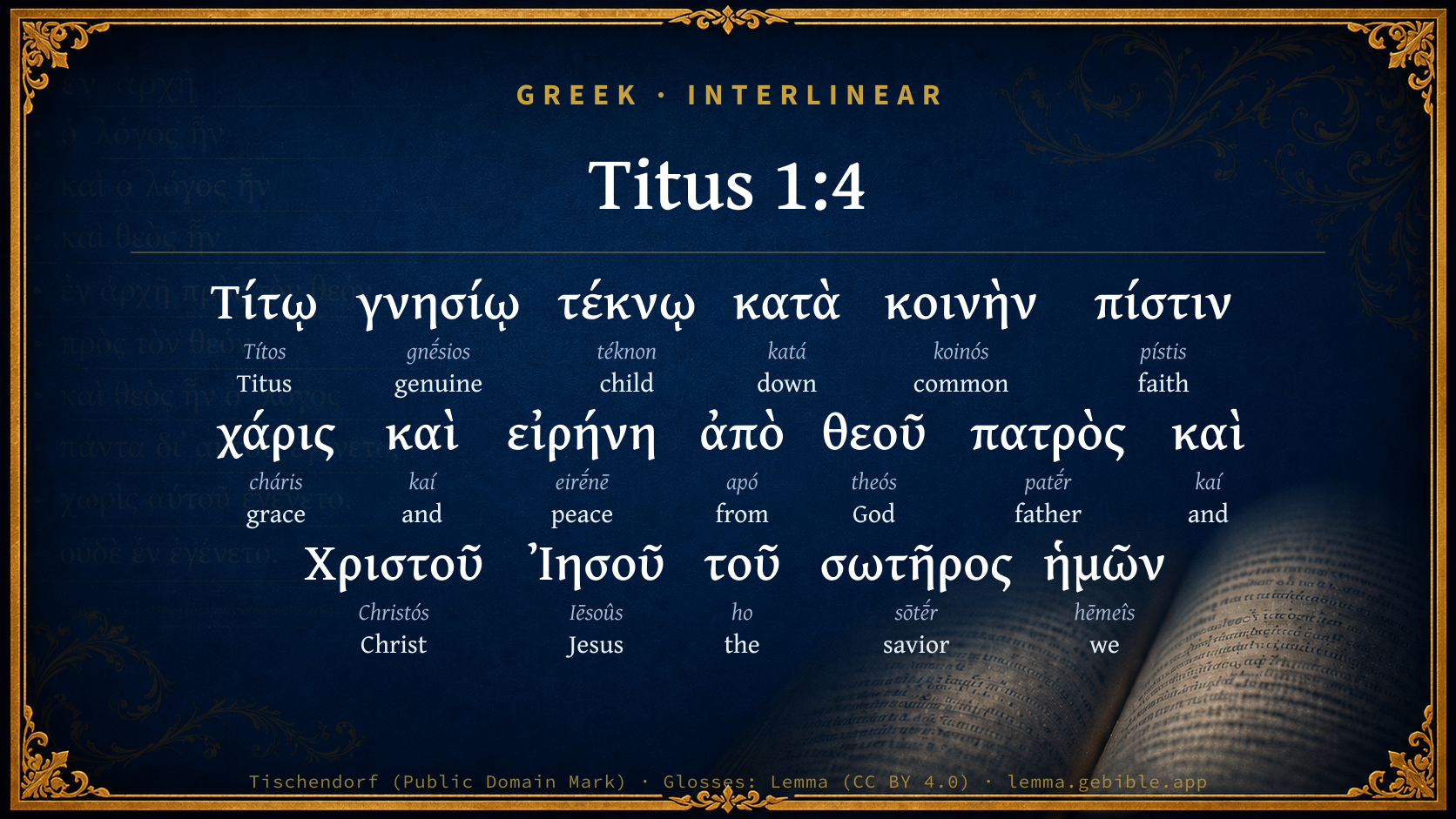
  1. Τίτῳ Títos G5103 “Titus” Noun, Dative, Singular, Masculine
  2. τέκνῳ téknon G5043 “child” Noun, Dative, Singular, Neuter
  3. κατὰ katá G2596 “down” Preposition
  4. κοινὴν koinós G2839 “common” Adjective, Accusative, Singular, Feminine
  5. πίστιν pístis G4102 “faith” Noun, Accusative, Singular, Feminine
  6. χάρις cháris G5485 “grace” Noun, Nominative, Singular, Feminine
  7. καὶ kaí G2532 “and” Conjunction
  8. εἰρήνη eirḗnē G1515 “peace” Noun, Nominative, Singular, Feminine
  9. ἀπὸ apó G575 “from” Preposition
  10. θεοῦ theós G2316 “God” Noun, Genitive, Singular, Masculine
  11. πατρὸς patḗr G3962 “father” Noun, Genitive, Singular, Masculine
  12. καὶ kaí G2532 “and” Conjunction
  13. Χριστοῦ Christós G5547 “Christ” Noun, Genitive, Singular, Masculine
  14. Ἰησοῦ Iēsoûs G2424 “Jesus” Noun, Genitive, Singular, Masculine
  15. τοῦ ho G3588 “the” Article, Genitive, Singular, Masculine
  16. σωτῆρος sōtḗr G4990 “savior” Noun, Genitive, Singular, Masculine
  17. ἡμῶν hēmeîs G2249 “we” Personal pronoun, 1st person, Genitive, Plural

About this verse

These counts appear in no published source. They are computed here, from the morphology-tagged text and Lemma’s own curated glosses. What Lemma adds →

18
words
17
distinct lemmas
Pauline Epistles
section

Notable vocabulary

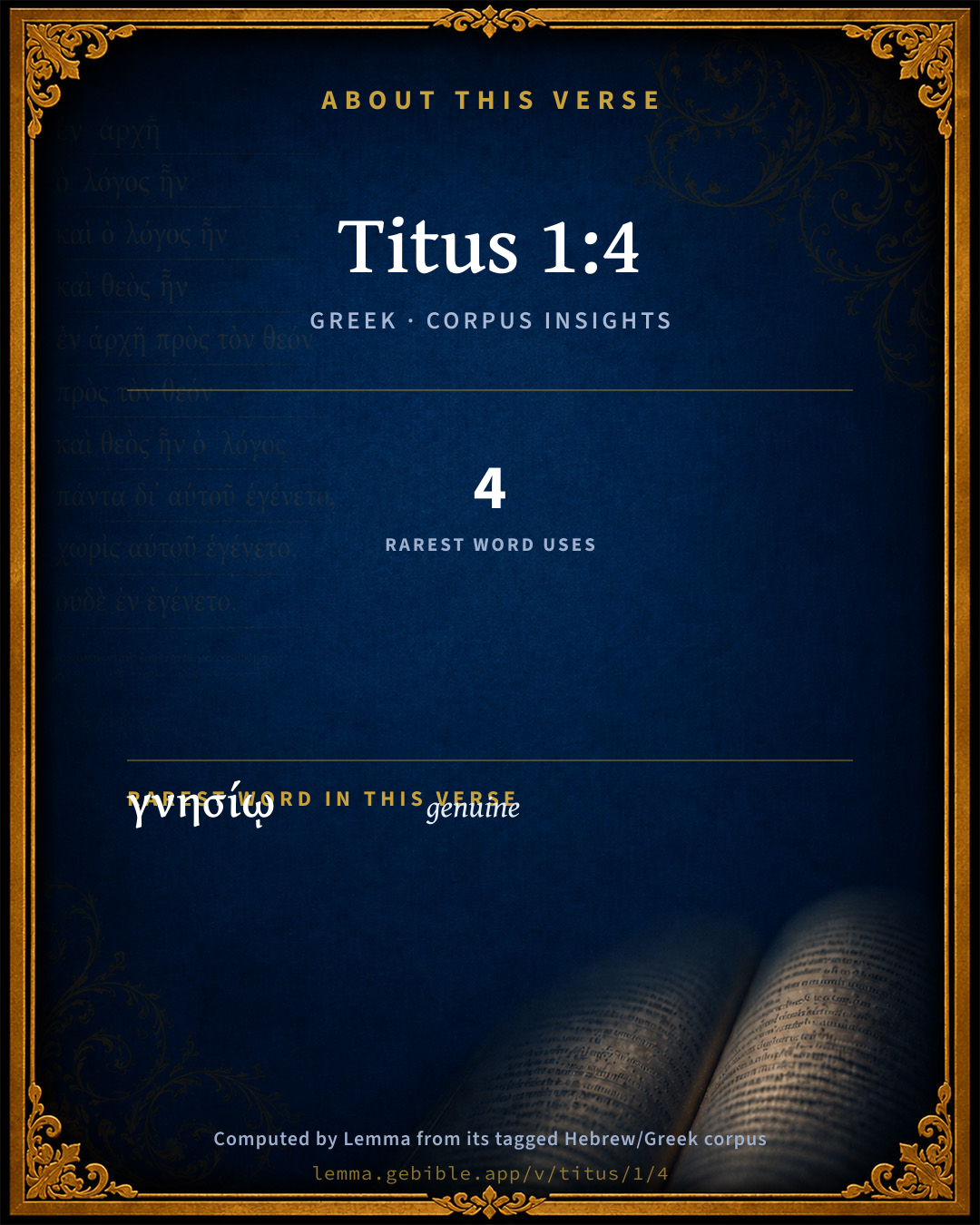
The rarest word here is γνησίῳ genuine G1103 — appearing just 4 times in the whole Greek New Testament.

Shared distinctive vocabulary

γνησίῳ genuine G1103 occurs in 4 verses of the Greek New Testament. Also found in:

Repetition

A word recurs within this verse:

Cross-references

25

Topical passages linked to Titus 1:4 in the Treasury of Scripture Knowledge — connected by theme and wording, ordered by reader-vote popularity; previews shown in the World English Bible.

  • 2 Timothy 1:2 to Timothy, my beloved child: Grace, mercy, and peace, from God the Father and Christ Jesus our Lord.
  • Jude 1:3 Beloved, while I was very eager to write to you about our common salvation, I was constrained to write to you exhorting you to contend earnestly for the faith which was once for all delivered to the saints.
  • 2 Corinthians 2:13 I had no relief for my spirit, because I didn't find Titus, my brother, but taking my leave of them, I went out into Macedonia.
  • 2 Peter 1:1 Simon Peter, a servant and apostle of Jesus Christ, to those who have obtained a like precious faith with us in the righteousness of our God and Savior, Jesus Christ:
  • 2 Peter 1:11 For thus will be richly supplied to you the entrance into the eternal Kingdom of our Lord and Savior, Jesus Christ.
  • John 4:42 They said to the woman, "Now we believe, not because of your speaking; for we have heard for ourselves, and know that this is indeed the Christ, the Savior of the world."
  • Romans 1:12 that is, that I with you may be encouraged in you, each of us by the other's faith, both yours and mine.
  • 2 Corinthians 8:23 As for Titus, he is my partner and fellow worker for you. As for our brothers, they are the apostles of the assemblies, the glory of Christ.
  • 2 Peter 3:18 But grow in the grace and knowledge of our Lord and Savior Jesus Christ. To him be the glory both now and forever. Amen.
  • Luke 2:11 For there is born to you, this day, in the city of David, a Savior, who is Christ the Lord.
  • Romans 1:7 to all who are in Rome, beloved of God, called to be saints: Grace to you and peace from God our Father and the Lord Jesus Christ.
  • 2 Corinthians 4:13 But having the same spirit of faith, according to that which is written, "I believed, and therefore I spoke." We also believe, and therefore also we speak;
  • 2 Corinthians 7:6 Nevertheless, he who comforts the lowly, God, comforted us by the coming of Titus;
  • 2 Corinthians 7:13–14 Therefore we have been comforted. In our comfort we rejoiced the more exceedingly for the joy of Titus, because his spirit has been refreshed by you all.
  • 2 Corinthians 8:6 So we urged Titus, that as he made a beginning before, so he would also complete in you this grace.
  • 2 Corinthians 8:16 But thanks be to God, who puts the same earnest care for you into the heart of Titus.
  • 2 Corinthians 12:18 I exhorted Titus, and I sent the brother with him. Did Titus take any advantage of you? Didn't we walk in the same spirit? Didn't we walk in the same steps?
  • Galatians 2:3 But not even Titus, who was with me, being a Greek, was compelled to be circumcised.
  • Ephesians 1:2 Grace to you and peace from God our Father and the Lord Jesus Christ.
  • Colossians 1:2 to the saints and faithful brothers in Christ at Colossae: Grace to you and peace from God our Father, and the Lord Jesus Christ.
  • 1 Timothy 1:1–2 Paul, an apostle of Christ Jesus according to the commandment of God our Savior, and Christ Jesus our hope;
  • Titus 1:3 but in his own time revealed his word in the message with which I was entrusted according to the commandment of God our Savior;
  • 2 Peter 2:20 For if, after they have escaped the defilement of the world through the knowledge of the Lord and Savior Jesus Christ, they are again entangled therein and overcome, the last state has become worse with them than the first.
  • 2 Peter 3:2 that you should remember the words which were spoken before by the holy prophets, and the commandments of us, the apostles of the Lord and Savior:
  • 1 John 5:14 This is the boldness which we have toward him, that, if we ask anything according to his will, he listens to us.

Cross-references courtesy of OpenBible.info (CC BY 4.0).

Where the printed editions differ

2 variants

Places in this verse where the major printed Greek editions disagree on the wording in a way that affects the translation — a comparison of editions, not a manuscript-by-manuscript collation. The editions are the modern critical texts (Nestlé-Aland 28/27, SBL, Westcott-Hort, Tregelles, Tyndale House) and the traditional texts behind the KJV (the Textus Receptus and the Byzantine/Majority text). It is not a claim about which reading is original.

  1. Different wording
    καὶ

    “and”

    In NA28NA27TynSBLWHTreg Not in TRByz

    ἔλεος (eleos) 'mercy' occurs in traditional manuscripts (TR+Byz) instead of καὶ (kai) 'and' in older manuscripts (NA28+NA27+Tyn+SBL+WH+Treg)

  2. Extra text
    κυρίου

    “Lord”

    In TRByz Not in NA28NA27TynSBLWHTreg

    κυρίου (kuriou) 'Lord' is only in traditional manuscripts (TR+Byz)

Textual data: Translators Amalgamated Greek New Testament (STEPBible TAGNT) · CC BY 4.0.

Commentary

Notes on Titus 1:4 from classic Christian and Jewish commentators (each source and its license shown beneath its notes). The classic Christian expositions comment on the surrounding passage and are grouped to its opening verse, so a note may address several verses; the Jewish commentaries on the Tanakh (Rashi and others) are per-verse, so they appear only where the commentator wrote on this verse.

Lemma curates 59 commentaries, every one of them public domain or Creative Commons licensed, each selected and text-cleaned for this edition rather than reprinted as found. About our sources →

The Biblical Illustrator

Joseph S. Exell

Tit_1:4

To Titus, mine own son after the common faith

Lessons

I.

A spiritual relationship (Cf. Act_15:1-41; Gal_2:2; 2Co_2:13; 2Co_7:6, etc.)

II. A threefold blessing.

1. Grace, the source of our redemption.

2. Mercy, displayed in our redemption.

3. Peace, the result of our redemption.

III. The source and medium of the blessing. God the Father from whom it comes, and Christ the Son through whom it comes. (F. Wagstaff.)

Spiritual parentage

I. That ministers are spiritual fathers to beget children to god, appeareth in that the Hebrew phrase not only styleth them by the name of fathers.

1. Who indeed are so properly by the way of blood and natural generation?

2. Neither, only those who are in a right descending line, though never so far off.

3. Neither, only those who adopt others into the room and place of children.

4. But those also that are in the room of fathers, either generally, as all superiors, in age, place, or gifts; or more specially such as by whose counsel, wisdom, tenderness and care, we are directed as by fathers; who in these offices and not in themselves (for sometimes they be inferiors otherwise) become fathers unto us.

Thus was Joseph an inferior, called a father of Pharaoh; that is, a counsellor. Job, for his tenderness and care, called a father of the poor. Scholars of the prophets, called sons of the prophets. Elisha, saith of Elijah, my father, my father; and Jubal was the father of all that play on harps. But much more properly is the minister called the father of such as he converts unto the faith, because they beget men unto God, as Paul did Onesimus in his bonds, in which regeneration the seed is that heavenly grace whereby a Divine nature is framed, the instrument by which it is conveyed, is the Word of God in the ministry of it. Now if any be desirous to carry themselves towards their ministers, as children towards their parents, they must perform unto them these duties.

1. They must give them double honour (1Ti_5:17), reverencing their persons, their places.

2. They must partake in all their goods, as the Levites in the law did; yea, if need be, lay down their necks for their sakes (Rom_16:4) in way of thankfulness.

3. No accusations must be received against them under two or three witnesses; a dutiful child will not hear, much less believe, evil reports of his father.

4. In doubtful cases of conscience resort unto them for counsel, as children to their father.

5. Obey them in all godly precepts, endure their severity, be guided by their godly directions, as those who have the oversight of souls committed unto them, even as the child ingeniously imitateth and obeyeth his father.

II. Faith is one and the same in all the elect, and is therefore called the common faith (Eph_4:5), there is one faith which is true. Which grace is but one, and common to all the elect, notwithstanding there be diverse measures and degrees of it peculiar to some. Hence the apostle Peter calleth it the like precious faith.

1. In respect of the kind of it being a justifying faith, by which all that believe have power to be the sons of God (Joh_1:12; Gal_3:26).

2. Of the object of it, which is one Christ, the same yesterday, and today, and forever; who dwelleth in the hearts of every believer (Eph_3:17), whom, although the fathers of former ages beheld Him to come, and the latter ages already come: yet both rejoice in seeing His day with the same eye of faith: the difference is, that one seeth it somewhat more clearly than the other.

3. Of the same end of it, which is salvation, common to all believers; called therefore by Jude the common salvation. (T. Taylor, D. D.)

Spiritual children

Calvins three children all died in infancy. Of the last he wrote to a friend: The Lord gave me another son, and the Lord hath taken him away; but have I not thousands of children in the faith of Christ?

Grace, mercy, and peace

Grace bringing peace

I. The grace of god is the whole sufficiency of his people. The first, middle, and last cause of every good thing conveyed unto them, or issuing from them: not once did the Lord enforce this point upon His own people, teaching them by things temporal, their spiritual estate and condition (Deu_7:7).

II. Only they that are by grace and mercy accepted of god have their portion in this peace here mentioned.

1. Peace, that is all kind of prosperity, is promised only to the godly. They shall prosper in everything; and the apostle pronounceth it, only upon the Israel of God.

2. It is accordingly bestowed upon those only that are justified by faith; seeing they only have peace with God, which is the principal part of it.

3. To show it to be a fruit of Gods grace, sundry phrases in Scripture might be alleged; as that it is called the peace of God, and that God is called the God of peace; as also that difference which is worthy to be observed between the salutations of the Old and New Testament. In, the Old Testament, grace and peace are never joined. The ordinary form of salutation was, peace be with thee, peace be to this house, go in peace; but the apostles, after the mystery of redemption was revealed and perfected before the ordinary salutation, prefix this word--grace, or mercy, or both; that as they are never joined in the Old Testament, so are they never separated in the New, to show that we cannot look to have one of them alone, or separate them, no more than we can safely sunder the branch from the root, or the stream from the fountain. (T. Taylor, D. D.)

Peace through Christ

A minister was asked to visit a poor dying woman. The messenger being ignorant could give no account of her state, except that she was a very good woman and very happy, and was now at the end of a well-spent life, therefore sure of going to heaven. The minister went, saw that she was very ill, and after a few kindly inquiries about her bodily condition, said: Well, I understand you are in a very peaceful state of mind, depending upon a well-spent life. The dying woman looked hard at him, and said: Yes, I am in the enjoyment of peace. You are quite right; sweet peace, and that from a well-spent life. But it is the well-spent life of Jesus; not my doing, but His; not my merits, but His blood. Yes; only one man has spent a life that has met all the requirements of Gods holy law, and on which we rest before God. (Preachers Lantern.)

The Biblical Illustrator, edited by Joseph S. Exell (c. 1880s–1900s) — public domain. Text from a community e-Sword module.

Tyndale Open Study Notes

Tyndale Open Resources

1:4 Titus was Paul’s delegate in dealing with the church in Crete. • my true son: The wording authorizes the delegate (as in 1 Tim 1:2).

Tyndale Open Study Notes — © Tyndale Open Resources, licensed CC BY-SA 4.0. Text via the HelloAO Bible API.

Bengel's Gnomon

Johann Albrecht Bengel

Tit 1:4. Κοινὴν, common) Otherwise Titus, who was born of Gentile parents, would fall short of 1

Bengel's Gnomon of the New Testament — English translation (T&T Clark, Edinburgh, 1860) — public domain. Text from a community e-Sword module.

Meyer's Critical & Exegetical Commentary

Heinrich August Wilhelm Meyer

Tit_1:4. Τίτῳ γνησίῳ τέκνῳ κατὰ κοινὴν πίστιν] On γνησίῳ τέκνῳ, see 1Ti_1:2. Κατὰ κοινὴν πίστιν gives the point of view from which Titus can be considered the genuine son of the apostle. Beza: i.e. fidei respectu quae quidem et Paulo patri et Tito filio communis erat. There is nothing to indicate that in using κοινήν Paul was thinking of an original difference between them, he being a Jewish Christian, Titus a Gentile Christian.

χάρις [ἔλεος], εἰρήνη κ.τ.λ.] see on 1Ti_1:2.

The designation appended to Χριστοῦ, viz. τοῦ σωτῆρος ἡμῶν, is peculiar to this epistle.

Meyer — Critical and Exegetical Commentary on the New Testament — English translation by Peter Christie, edited by Frederick Crombie (T&T Clark, 1880) — public domain. Text from a community e-Sword module.

Expositor's Greek Testament

ed. W. Robertson Nicoll

Tit 1:4 . γνησίῳ τέκνῳ : See note on 1Ti 1:2 .

κατὰ κοινὴν πίστιν , like ἐν πίστει in 1Ti 1:2 , qualifies τέκνῳ , but is less ambiguous than ἐν πίστει . It must not be restricted to a faith shared only by St. Paul and Titus; but, like the κοινὴ σωτηρία (Jud 1:3 ), it is common to all Christians who “have obtained a like precious faith with us” (2Pe 1:1 ).

χάρις κ . τ . λ .: See on 1Ti 1:2 .

σωτῆρος : for the more usual κυρίου , 1Ti 1:2 , 2Ti 1:2 . The Father and the Son are here co-ordinated as Saviours.

The Expositor's Greek Testament, edited by W. Robertson Nicoll (1897–1910) — public domain. Text from a community e-Sword module.

International Critical Commentary

4. Τίτῳ] Personal references to the life or character of Titus are very slight in the Epistle; such as occur are quite consistent with the little that is known of him elsewhere. He is never mentioned in the Acts. A Gentile by birth, he was perhaps converted by St. Paul on his First Missionary Journey at Iconium (Acta Pauli et Theclœ, c. 2). He is first mentioned in the Epistles as accompanying St. Paul on the visit from Antioch to Jerusalem, mentioned in Gal_2. There his case was apparently taken as a test case of the need of circumcising Gentile converts, and (although the reading and meaning of Gal 2:3-5 are not quite certain) the demand was almost certainly successfully resisted. Later he becomes St. Paul’s delegate to Corinth: he begins there to organize the Collection for the Saints (2Co 8:6-10); he goes later, perhaps taking the severe letter of 2Co_2 and 7, to deal with the refusal of that Church to obey the Apostle: he deals successfully with the difficulty and returns to gladden the Apostle’s heart in Macedonia; he then gladly returns to complete the Collection (2Co 8:16). On another occasion he is sent on a mission to Dalmatia (2Ti 4:10). He is a trustworthy, confidential delegate, walking in the Apostle’s steps, walking in the same spirit (2Co 12:18), his “brother” (2Co 2:13), his fellow-worker and sharer of his toils (8:23). So here he is a “genuine son, sharing the same faith (1:4); his life is to be a pattern to younger men (2:7); but there is less of personal guidance and exhortation than there was to the younger and more timid Timothy. His name does not occur in the Acts, but two interesting suggestions have been made: (1) that he was a relative (Ramsay, St. Paul the Traveller and Roman Citizen, pp. 284-86, 390), or even the brother (Souter, Expository Times, March 1907, cf. 2Co 8:17, 2Co 8:18, 2Co 8:12:18) of St. Luke; (2) that he was the author of the “we” sections in the Acts. Either would account for the absence of any mention of him in Acts; but both are precarious. Later ecclesiastical tradition spoke of him as Bishop of Crete (Euseb. H.E. iii. 4), and as living to a very old age; and there was an Acts of Titus, which is no longer extant (cf. Lipsius, Die Apokr. Apostelgeschichte, 3. pp. 401-06), and a panegyric on him is found in the works of Andrew of Crete (Migne, Patrol. Gr., vol. 97). He is commemorated on Jan. 4 in the Latin Church, on Aug. 25 in the Greek, Syriac, and Maronite Churches (Acta Sanctorum, 1. pp. 163, 164; Nilles, Kalendarium Manuale).

γνησίῳ] cf. 1Ti 1:2. κατὰ κοινὴν πίστιν: “in virtue of a faith which is common to you, to me”—to you a Gentile as much as to me a Jew—but also with the wider suggestion, “a faith common to all Christians”: cf. Jud 1:3; but not so definite as “secundam fidem catholicam” (Holtzmann). Cf. Acta Carpi et Papyli, § 30, ὁ ἀνθύπατος εἶπεν· Τέκνα ἔχεις; Παπύλος εἶπεν· καὶ πολλὰ διὰ τὸν Θεόν. εἷς τις ἐκ τοῦ δήμου ἐβόησεν λέγων· κατὰ τὴν πίστιν τῶν Χριστιανῶν λέγει τέκνα ἔχειν. Παπύλος εἶπεν . . . ἐν πάσῃ ἐπαρχίᾳ καὶ πόλει εἰσί μοι τέκνα κατὰ Θεόν.

Θεοῦ πατρός] ἡμῶν is perhaps to be supplied from τοῦ σωτῆρος ἡμῶν: if not, πατρός is used in its widest sense (cf. 1Th 1:1, 1Ti 1:2, 2Ti 1:2 only), Father of all, ἐξ οὗ πᾶσα πατριὰ . . . ὀνομάζεται, Eph 3:15, perhaps (so Chrys.) recalling γνησίῳ τέκνῳ, God the source of all fatherhood, and of my relation to you my son.

τοῦ σωτῆρος ἡμῶν] Christ is placed on the same level as God 3; the phrase anticipates the stress on salvation from sin in 2:11-14, 3:4-7.

International Critical Commentary — older volumes (1896–1929), various authors — public domain. Text from a community e-Sword module.

Geneva Bible (1599)

Geneva Bible translators

There is but one way of salvation, common both to the Pastor and the flock.

The Apostle moveth the Cretans to hear Titus, by setting forth his consent and agreement with him in the faith, and therewithal showeth by what special note we may distinguish true ministers from false.

Geneva Bible (1599) marginal notes — public domain. Text via Bolls.life.

Jamieson, Fausset & Brown

Robert Jamieson, A. R. Fausset & David Brown

Titus, mine own son--Greek, "my genuine child" (Ti1 1:2), that is, converted by my instrumentality (Co1 4:17; Plm 1:10).

after the common faith--a genuine son in respect to (in virtue of) the faith common to all the people of God, comprising in a common brotherhood Gentiles as well as Jews, therefore embracing Titus a Gentile (Pe2 1:1; Jde 1:3).

Grace, mercy, and peace--"mercy" is omitted in some of the oldest manuscripts. But one of the best and oldest manuscripts supports it (compare Notes, see on Ti1 1:2; Ti2 1:2). There are many similarities of phrase in the Pastoral Epistles.

the Lord Jesus Christ--The oldest manuscripts read only "Christ Jesus."

our Saviour--found thus added to "Christ" only in Paul's Pastoral Epistles, and in Pe2 1:1, Pe2 1:11; Pe2 2:20; Pe2 3:18.

Jamieson, Fausset & Brown — Commentary Critical and Explanatory on the Whole Bible (1871) — public domain (CC PDM 1.0). Text via the HelloAO Bible API.

Adam Clarke's Commentary

Verse 4. To Titus, mine own son] Him whom I have been the instrument of converting to the Christian faith; and in whom, in this respect, I have the same right as any man can have in his own begotten son. See the preface; and 1Ti 1:2.

Adam Clarke's Commentary on the Bible (1810–1826) — public domain. Text from a community e-Sword/MySword module.

John Calvin's Commentaries

4 To Titus, my own son, according to the common faith. Hence it is evident in what sense a minister of the word is said to beget spiritually those whom he brings to the obedience of Christ, that is, so that he himself is also begotten. Paul declares himself to be the father of Titus, with respect to his faith; but immediately adds, that this faith is common to both, so that both of them alike have the same Father in heaven. Accordingly, God does not diminish his own prerogative, when he pronounces those to be spiritual fathers along with himself, by whose ministry he regenerates whom he chooses; for of themselves they do nothing, but only by the efficacy of the Spirit. As to the remainder of the verse, the exposition of it will be found in the Commentaries on the former Epistles, and especially on the First Epistle to Timothy.

John Calvin's Commentaries (1540-1563) — public domain. Text from the Calvin Translation Society English edition (1840s-50s) via the Christian Classics Ethereal Library (ccel.org). Calvin's coverage is partial (roughly two-thirds of the Bible); uncommented books and verses are honest gaps, never fabricated. The 19th-century editor's footnotes and remarks are omitted so the notes are faithfully Calvin's own voice.

Ellicott's Commentary for English Readers

(4) To Titus.—We know comparatively little of Titus’ earlier career. In the Acts he, singularly enough, is never mentioned; for what knowledge of him we possess we are entirely dependent upon a few casual allusions to him in the Epistles. This presbyter, in charge of the Cretan Church, was a Greek, the son of Gentile parents, and uncircumcised. It has been suggested, but upon very slight grounds, that his family was resident at Antioch in Syria. He owed his conversion to Christianity to St. Paul, with whom ever after he seems to have been connected by ties of intimate friendship, though he was by no means the Apostle’s constant companion, as was Timothy, or Silas, or Luke. He was with St. Paul and Barnabas when they went up together to Jerusalem to plead for Gentile liberty but in no other of the journeys of St. Paul is he directly mentioned as one of the companions of the Apostle. Only during the Apostle’s long residence at Ephesus (nearly three years) Titus appears to have been, for at least part of the time, closely associated with St. Paul, and his confidant in his complicated relations with foreign churches. It is clear that during this long Ephesian residence he was drawn into close and intimate friendship with St. Paul, who then had opportunity of becoming acquainted with Titus’ varied powers and evident skill in administration and in dealing with men and women.

From the several casual notices in the Second Corinthian Epistle, we gather considerable insight into the character and powers of the Gentile convert. The Church of Corinth was perhaps the largest and most wealthy of all the churches founded by St. Paul. It was soon, however, rent asunder by party divisions, and was ever distracted and disturbed by moral disorders among its members. Yet, in spite of this, the great Greek congregation of believers was full of life and zeal and earnestness, ready evidently to make the greatest sacrifices for its Master’s cause. Delegated apparently by St. Paul to restore order and to introduce a severer discipline in this great and turbulent Christian centre—the example for good or for evil to so many smaller and less important churches—Titus seems to have fulfilled with rare tact, and with admirable prudence and wisdom, his difficult mission. Amongst other works, he apparently completed the collection St. Paul had set on foot in the various Gentile churches for the poor Jewish Christians at Jerusalem. His services, assisting materially to bring this famous work of charity to a successful issue, seem not to have been the least among his titles to St. Paul’s friendship and high esteem. The great importance and difficult nature of this collection for the poor saints at Jerusalem are little understood or thought of now. Three weighty points connected with it deserve mention, as Titus’ special task it probably was to complete and bring it to a successful issue. (1) It seems to have been the first public relief fund ever collected to help a foreign and a strange race—the first of a long line of gallant acts of self-sacrifice men have made for men for Christ’s sake; but when Titus, at St. Paul’s bidding, took charge of it, it was a thing unheard of in the Pagan world. Hence the many obstacles which appear to have cropped up so perpetually during the collection. (2) It was the right hand of fellowship offered by Gentile to Jew. It was the welding together, by an unprecedented act of kindness, of the two opposing and hostile elements of Christendom into one Church. (3) It was the silent yet eloquent protest of St. Paul and his school against the attempted communism of the Church of the very first days—that fatal misunderstanding of some of the Master’s words which had brought ruin and poverty on the Jerusalem Christians. Titus acted as St. Paul’s commissioner in the matter—which he evidently successfully completed. We know nothing of his work and employment from this period, A.D. 57, until the date of this Epistle, A.D. 65-66, early Christian history being silent respecting him. In these nine years of restless activity and burning zeal on the part of the Christian leaders, Titus, no doubt, did his part without falling short of his early promise; as we find him again, in the last years of his old master, occupying in the Christian community a post so high and responsible as that of chief presbyter of the churches of the wealthy and populous island of Crete.

Mine own son.—Alluding, no doubt, to the relation between them in religion. St. Paul converted Titus to the faith, and ever after Titus stood to St. Paul in the position of a son in the faith, without being to him what Timothy was for so long a time—his constant companion. Titus still evidently (see preceding Note) filled with St. Paul the position of one of his most trusty disciples, of one who knew the inmost thoughts of his master. The tone of the Epistle to Titus is somewhat different from St. Paul’s Letter to Timothy. There was evidently a greater intimacy between St. Paul and Timothy than between the Apostle and Titus.

Grace, mercy, and peace . . .—Many of the older authorities omit “mercy.” (See Notes on 1Ti_1:2.)

Our Saviour.—This expression is a rare one. We find it only in these Pastoral Letters. (See Note above on St. Paul’s using it also of the “Father.”)

A Bible Commentary for English Readers, edited by Charles John Ellicott (1878–1897) — public domain. Text from a community e-Sword module.

The Cambridge Bible for Schools and Colleges

gen. ed. J. J. S. Perowne

4. to Titus, mine own son] With R.V. render my true child, as in 1Ti_1:2, where the force of the phrase is drawn out. On the connexion of Titus with St Paul see Introduction, p. 67 sqq.

after the common faith] The insertion of ‘the’ implies ‘the faith common to the Church, to believers generally’: as the words stand without an article, it is rather the faith common to St Paul and Titus, in a common faith, or ‘in communion of faith;’ see note on 1Ti_1:2.

Grace, mercy, and peace] The mss. authority is against the insertion of ‘mercy’ here, though occurring in the salutation of both the letters to his other ‘true child’ Timothy. If the reason for the insertion in Timothy’s case suggested on 1Ti_1:2 be true, its absence is appropriate here in the case of Titus. Though true son and trusted colleague, he had not been, like Timothy, the constant companion and the alter ego of one who, while ‘fain to serve the best,’ was ever ‘conscious most of wrong within.’

from God the Father] The later form in these Epistles for ‘our Father,’ cf. 1Ti_1:2; 2Ti_1:2.

For the sense of the ‘Father’ see Bp Westcott, add. note on 1Jn_1:2. ‘St John does not use the Pauline phrase “our Father” in his own writings; in the Epistles he uses uniformly the absolute title “the Father” without any addition; and in the Apocalypse “his (my) Father” but not “the Father.” “The Father” suggests those thoughts which spring from the consideration of the moral connexion of God and man in virtue of the creation of man “in the image of God”; “my Father” points to those which spring from the revelation of the connexion of the Incarnate Son with God and with man, “the Son of God,” “the Christ.” In his latest writings S. John regards the relation of the Divine Fatherhood in its eternal, that is, in its present realisation—“the Father” from its absolute side.’

and the Lord Jesus Christ] This fullest and most emphatic title, according to the true text, occurs only in 1Ti_6:3 (note there and on 1Ti_1:1) and 1Ti_6:14. Read here, Christ Jesus.

our Saviour] See note on 1Ti_1:1 for this title given to Christ in the Pastoral Letters and in St Peter. It occurs not seldom in the Prayer Book, though much less often than ‘Jesus Christ our Lord’; e.g. in the 2nd and 3rd Collects for Evening Prayer, Collect for 2nd S. in Advent, Septuagesima, Easter Even, Prayer of Consecration, &c.

The Cambridge Bible for Schools and Colleges (gen. ed. J. J. S. Perowne; Cambridge University Press, 1878–1918) — public domain. Text from a community e-Sword module.

John Gill's Exposition

To Titus, mine own son after the common faith,.... Not in a natural, but in a spiritual sense; the apostle being the instrument of his conversion, as he was of the conversion of Onesimus, and of many of the Corinthians, and therefore is said to beget them, Plm 1:10 and so was their spiritual father, and they his children: Titus was, in this sense, his "own son", or a true son, a legitimate one; a true convert; one really born again; a sincere believer, an Israelite indeed: and this he was "after the common faith"; either the doctrine of faith, which is but one, and is common to all the saints; or the grace of faith, which though different in degrees, yet is alike precious faith in all; the same for nature, kind, object, operation, and effects: and this phrase is used to show in what sense Titus was son to the apostle; as he was a believer, and no otherwise.

Grace, mercy, and peace, &c. which is the apostle's usual salutation; see Ti1 1:2. The word "mercy" is left out in the Claromontane copy, and in the Vulgate Latin, Syriac, and Ethiopic versions.

John Gill's Exposition of the Whole Bible (1746–1763) — public domain (CC PDM 1.0). Text via the HelloAO Bible API.

Trapp's Complete Commentary

John Trapp

4 To Titus, mine own son after the common faith: Grace, mercy, and peace, from God the Father and the Lord Jesus Christ our Saviour.

Ver. 4. Common faith] Common to the communion of saints, Tit 1:1, and to them proper and peculiar; for all men have not faith, 2Th 3:2. Or common, that is, Symbolo Apostolico comprehensum, saith one, contained in the Apostle’s Creed.

John Trapp, A Commentary or Exposition upon All the Books of the Old and New Testament (1647–1656) — public domain. Text from a community e-Sword module.

Albert Barnes' Notes on the Bible

To Titus - See the Introduction, Section 1.

Mine own son - Notes, 1Ti 1:2.

After the common faith - The faith of all Christians; - equivalent to saying “my son in the gospel.” That is, Paul had been the means of converting him by preaching that gospel which was received by all who were Christians.

Grace, mercy, and peace ... - See the notes at Rom 1:7.

Albert Barnes' Notes on the Bible (1834–1885) — public domain. Text from a community e-Sword/MySword module.

Haydock's Catholic Bible Commentary

To Titus, my beloved, (in the Greek, my true and[3] genuine son,...grace and peace. In the present ordinary Greek copies is added mercy, which the Protestant translators followed; but it is judiciously omitted by Dr. Wells, as not found in the best manuscripts nor in St. John Chrysostom’s Greek edition, nor in the ancient Greek and Latin Fathers. (Witham)

===============================

[BIBLIOGRAPHY]

Dilecto filio, Greek: gnesio tekno.

George Leo Haydock (1774–1849), Haydock's Catholic Family Bible and Commentary, 1859 edition — public domain. Excludes Psalms (Douay-Rheims chapter numbering differs from Protestant) and Deuterocanonical books (Catholic canon only).

Matthew Poole's English Annotations

Mine own son after the common faith; from hence we learn that Titus was converted to Christianity by Paul. Timothy was so called, 1Ti 1:2. The salutation is the same with that to Timothy, 1Ti 1:2; 2Ti 1:2, and in most of the Epistles, with small variation: See Poole on "1Ti 1:2", See Poole on "2Ti 1:2", and in the beginning of most of the Epistles.

Matthew Poole's English Annotations on the Holy Bible (1683–1685) — public domain. Text from a community e-Sword/MySword module.

Whedon's Commentary on the Bible

Daniel D. Whedon

4. Own son—Literal Greek, genuine or legitimate son; son, that is, by regeneration, as Paul does not hesitate to call even the humble Onesimus son, as being under his ministry converted. Genuine son, as being in his own true spiritual likeness; begotten to the Pauline gospel, and competent to represent and establish it in Crete. Extended as is his own style and title, that assigned to Titus is brief and simple. Note, 1Ti_1:2. Yet, as son, Titus seems to be made heir to a very full amount of apostolic authority, as appears in the very strong terms conveying functions in this epistle and in this chapter. Even if it could be supposed that Timothy was appointed pastor of but a single Church in Ephesus, Titus was certainly a super-presbyterial superintendent of several Churches, with their pastors, in Crete. He was, however, more an itinerant bishop than a diocesan.

Common faith—Common to all the elect, Tit_1:1. The sonship of Titus was not after the flesh, but after the faith.

Grace—Note 1Ti_1:2.

Daniel D. Whedon (gen. ed.), Commentary on the Old and New Testaments (1874–1909) — public domain. Text from a community e-Sword module.

The Pulpit Commentary

My true child for mine own son, A.V; a common for the common, A.V; grace and peace for grace, mercy, and peace, A.V and T.R.; Christ Jesus for the Lord Jesus Christ, A.V and T.R. My true child (gnhsiw teknw : 1Ti_1:2) after a common faith (kata kinhstin). In 1Ti_1:2 it is en pistei (where see note). Beyond all doubt, Alford is right in both cases in rendering "the faith". (see his note 1Ti_1:2) The common faith" means the faith of all God"s elect. Grace and peace. So the R.T., omitting eleov , mercy, which is found in 1Ti_1:2 and 2Ti_1:2. But the manuscripts vary, and the critics are divided as to whether eleov ought to be retained here or not.

Believed in everywhere.

"The common faith." Amid all diversities there is unity. In this sense we know that what is called "Catholic" authority rests on what was believed always, everywhere, and by all." Theories of religion vary, but the great facts and doctrines are the things which cannot be shaken, and still remain. The word "faith" is sometimes used for that experience of the soul which we call trust, and as such is an inward reception of Christ and his cross; but it is also used, and is so used here, as descriptive of the gospel revelation itself.

I THE APOSTLES DIE, BUT THE FAITH REMAINS. We are not disciples of Paul, or Barnabas, or Timothy, or Titus, but of Christ. These apostles did not draw men to themselves, but to Christ. They were, as Paul declares, "ministers by whom ye believed." To be in the true succession is to have the spirit of the apostles, and to hold the faith of the apostles. So far as the gospel has been perverted by mediaeval superstition or the earlier traditions of the fathers, it is not the common faith. An inspired revelation of truth enables us in every age to preserve the common faith. As the philosophic Coleridge said, "It is evident that John and Paul held Christ to be Divine." The glorious gospel of the grace of God is preserved to us intact by the holy Gospels and the Epistles, and men true to the Bible harmonize in their acceptance of "the common faith.

II THE LIFE OF THE TRUE CHURCH IS THE SAME IN EVERY AGE. The root must be the same, because the fruit is the same. First truth and then life. The cry for forgiveness, and the peace that comes through the cross. The power of the atonement to crucify selfishness, and to lead men to live as not their own. The consciousness of human impotence, and of the might of the Holy Spirit in the inner man. All these are inward experiences of life, resulting from a common faith. Added to these are the experiences which attest life in conduct. We know the same artist"s touch in the picture, the same sculptor"s hand in the molding of a figure, the same architect"s design in the buildings; and we know Christians by the "life hid with Christ in God," producing those "fruits of the Spirit" which attest, in their beauty and their purity, the energy and the sanctity of the Divine life. It is "the common faith" which gives to Christians, in every land and every age, the same likeness to their Lord. W.M.S.

The Pulpit Commentary (1880–1919), ed. H.D.M. Spence-Jones & Joseph S. Exell — public domain. Text from a community e-Sword module.

John Wesley's Explanatory Notes

My own son - Begot in the same image of God, and repaying a paternal with a filial affection. The common faith - Common to me and all my spiritual children.

John Wesley, Explanatory Notes Upon the Whole Bible (1754–1765) — public domain. Text via the GEBible commentary corpus.

Scofield Reference Notes

C. I. Scofield

Saviour

(See Scofield Rom 1:16).

The Scofield Reference Bible (1917 edition), notes by C. I. Scofield — public domain. Text from a community e-Sword module.

The People's New Testament

B. W. Johnson

4. To Titus, mine own son. Concerning Titus, see Introduction. The language here shows that he was one of Paul's converts.

B. W. Johnson's The People's New Testament with Notes (1889–1891) — public domain. Electronic text from the Christian Classics Ethereal Library (CCEL) ThML edition.

unfoldingWord translationNotes

Door43 World Missions Community

a true son

Though Titus was not Paul's biological son, they share a common faith in Christ. Thus, in Christ, Paul considers Titus as his own son. AT: "you are like a son to me" (See: Metaphor)

our common faith

Paul expresses the same faith in Christ that they both share. AT: "the teachings that we both believe"

Grace and peace

This was a common greeting Paul used. You can state clearly the understood information. AT: "May you experience kindness and peace within" (See: Ellipsis)

Christ Jesus our savior

"Christ Jesus who is our savior"

For this purpose

"This is the reason"

I left you in Crete

"I told you to stay in Crete"

that you might set in order things not yet complete

"so that you would finish arranging things that needed to be done"

ordain elders

"appoint elders" or "designate elders"

elders

In the early Christian churches, Christian elders gave spiritual leadership to the assemblies of believers.

translationWords

Titus

grace

peace

God the Father

Christ

Savior

Crete

elder

unfoldingWord translationNotes — © Distant Shores Media and the Door43 World Missions Community, licensed CC BY-SA 4.0. Source: git.door43.org/Door43/en_tn.

Cambridge Greek Testament for Schools and Colleges

4. χάρις καὶ εἰρήνη. This, the usual form of salutation in St Paul’s letters (see exegetical note on 1Ti 1:2), is supported by אC*D2EGIP and most of the versions; the rec. text (following the analogy of 1Ti 1:2 and 2Ti 1:1) reads χάρις ἔλεος εἰρήνη with ACbKL.

Χριστοῦ Ἰησοῦ. So אACD2*I d e and the Bohairic; the reading of the rec. text κυρίου Ἰησοῦ Χριστοῦ (D2cEGKLP f g and the Syriac versions) probably arose from a tendency to assimilate the salutation to St Paul’s usual form, it not having been observed that here that form is modified by the addition of the words τοῦ σωτῆρος (see exegetical note and note on 1Ti 1:2).

4. Τίτῳ γνησίῳ τέκνῳ. To Titus, true child. See on 1Ti 1:2. It seems not improbable from the application of this phrase to Titus that he had been converted to the faith by St Paul; but we have no certain information on the point. See Gal 2:1 ff.

κατὰ κοινὴν πίστιν, after a common faith, corresponding to ἐν πίστει of 1Ti 1:2. The κοινὴ πίστις is the sphere of their spiritual relationship; cp. κοινὴ σωτηρία in Jud 1:3.

Χάρις καὶ εἰρήνη. Cp. the critical note, and see on 1Ti 1:2.

ἀπὸ θεοῦ πατρὸς κ.τ.λ. See the critical note. The exact title Χριστοῦ Ἰησοῦ τοῦ σωτῆρος ἡμῶν does not occur in the salutation of any other of the Pauline Epistles; and is only found elsewhere 2Ti 1:10; Tit 2:13; Tit 3:6; 2Pe 1:1; 2Pe 1:11; 2Pe 2:20; 2Pe 3:18. Cp. Php 3:20.

Cambridge Greek Testament for Schools and Colleges (Cambridge University Press, 1896; 21 vols, various authors incl. Carr, Maclear, Plummer, Farrar, Lumby, Moule, M. R. James, Simcox) — public domain. Text from a community e-Sword module.

Alford’s Greek Testament

Henry Alford

4.] to Titus (see Prolegg. § i.) my true (genuine, see on 1Ti 1:2) child according to (in respect of, or agreeably to, in conformity with the appointed spread and spiritually generative power of that faith) the common faith (common to us both and to all the people of God: hardly as Grot., ‘Judæis, qualis Paulus, et Græcis qualis Titus:’ for there is no hint of such a distinction being brought out in this Epistle): grace and peace from God the Father (see on 1Ti 1:2), and Christ Jesus our Saviour (reff.).

Henry Alford, The Greek Testament (1849–1861) — public domain. Text from a community e-Sword module.

Vincent's Word Studies in the New Testament

Marvin R. Vincent

Own [γνησιω] . See on 1Ti 1:2.

According to the common faith [κατα κοινην πιστιν] . The phrase N. T. o. Koinov common, usually in contrast with kaqarov pure or agiov holy, as Act 10:14; Act 11:8; Rev 21:27. In the sense of general as here, Act 2:44; Act 4:32; Jude 1:3. Comp. 2Pe 1:1. The "catholic" faith. Kata according to, as verse 1.

Marvin R. Vincent, Word Studies in the New Testament (1887–1900) — public domain. Text from a community e-Sword/MySword module.

Lesson kit

Teaching starters — assembled from the data on this page, not authored interpretation. Every prompt links to the verse data it draws on. Edit before teaching.

Titus, in the Pauline Epistles, opens this verse with 18 words (17 distinct Greek lemmas). Its most distinctive word is gnḗsios (“genuine”). A historical commentator’s framing appears above. Read the whole chapter for the surrounding context.

Discussion questions

  1. The word gnḗsios carries the sense “genuine.” How does it shape the verse?
  2. 2 Corinthians 8:8 shares the word «genuine» with this verse. How do the two illuminate each other?
  3. “and” occurs 2× in this one verse. What is the effect of the repetition?
  4. These translations render this verse differently. What is at stake in choosing one wording over another?
  5. Reading how The Biblical Illustrator and Tyndale Open Study Notes read this verse, where do the two commentators agree and where do they part?

Things to notice

Reading settings

Reading text

Shown beneath each verse's original-language words.

Old Testament
Old Testament edition

Read the OT as the Masoretic Hebrew (MT) or the Greek Septuagint (LXX).

English shown for the Greek Septuagint (in the Hebrew ↔ Greek comparison).

Comparing translations? Open the Compare panel on any verse page to stack up to four side by side.