1 Timothy 6:21

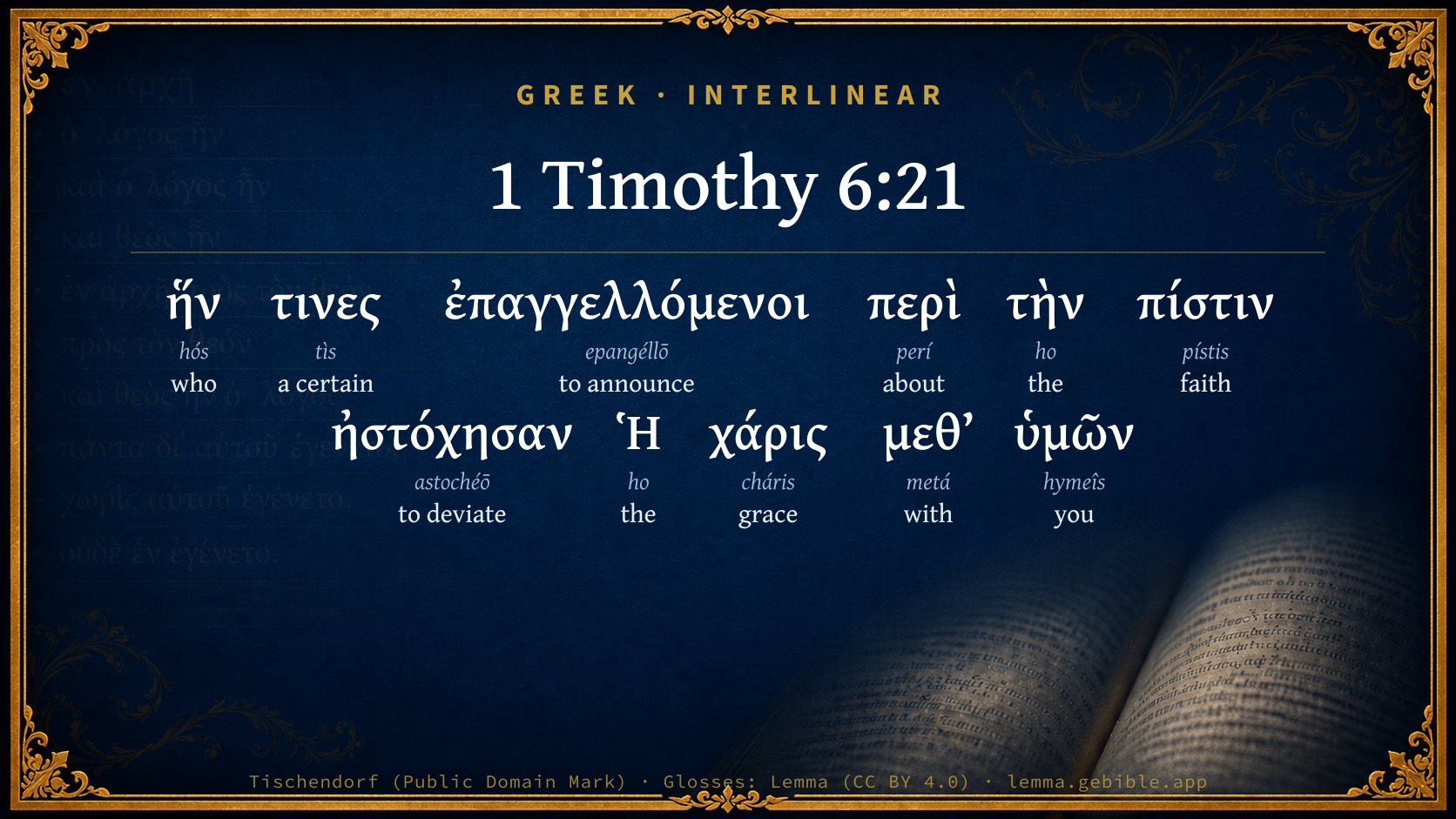
Greek (Tischendorf 8th ed.) 1 Timothy 6:21 appears in the Greek New Testament. The text above is from the Tischendorf 8th edition. Each word links to its Strong’s number and a concise gloss. Click any word for its full Thayer’s Greek Lexicon entry.
Download image
Cite this verse

1 Timothy 6:21 (World English Bible). Public Domain. Lemma interlinear Bible study tool, https://lemma.gebible.app/v/1-timothy/6/21.

Show BibTeX & RIS
BibTeX
RIS
English Translation
which some professing have erred concerning the faith. Grace be with you. Amen.
World English Bible · Public Domain
Download a study sheet

One document with this verse’s original text, its word-by-word gloss line, the meaning frame, cross-references with their text, attributed commentary, and full source and license credits — printable, and it pastes into notes with its structure intact.

This verse Autodidact and up

Study sheet (.html) Plain text (.txt)

A passage Seminary Student

Up to 50 verses in one chapter. A passage sheet keeps up to 6 commentary sources and 12 cross-references per verse, in the order this page ranks them, and says so on the sheet whenever that leaves anything out. Ask for a single verse and you get the Autodidact verse sheet above.

Everything on this page stays free to read, with no account — the sheet is a download of what is already on screen, not access to it.

Want to remove ads? Support Godless Engineer
Compare translations 3

The same verse in 3 English versions, stacked beneath the original-language interlinear above. Click any original word for its lexicon entry.

Each is an independent rendering of the whole verse — the interlinear is not word-aligned to these translations.

Highlighted words mark where these versions differ — a whole-verse word diff, not a word-by-word alignment.

  • World English Bible Public Domain
    which some professing have erred concerning the faith. Grace be with you. Amen.
  • King James Version Public Domain
    Which some professing have erred concerning the faith. Grace be with thee. Amen.
  • unfoldingWord Literal Text CC BY-SA 4.0
    which some, professing, have missed the mark concerning the faith. Grace with you.

unfoldingWord Literal Text — © unfoldingWord, licensed CC BY-SA 4.0. Word-aligned USFM3 via Door43 (git.door43.org/unfoldingWord/en_ult).

Versions to compare (up to 4)

3 of 4 selected

Show all 19 translations

Every available English version of this verse, each an independent rendering of the whole verse.

  • World English Bible Public Domain
    which some professing have erred concerning the faith. Grace be with you. Amen.
  • Berean Standard Bible Public Domain
    which some have professed and thus swerved away from the faith. Grace be with you all.
  • Majority Standard Bible Public Domain
    which some have professed and thus swerved away from the faith. Grace be with you all. Amen.
  • King James Version Public Domain
    Which some professing have erred concerning the faith. Grace be with thee. Amen.
  • American Standard Version (1901) Public Domain
    which some professing have erred concerning the faith. Grace be with you.
  • Revised Version (1885) Public Domain
    which some professing have erred concerning the faith. Grace be with you.
  • Geneva Bible (1599) Public Domain
    Which while some professe, they haue erred concerning the faith. Grace be with thee, Amen. The first Epistle to Timotheus, written from Laodicea, which is the chiefest citie of Phrygia Pacaciana.
  • Douay-Rheims (1899) Public Domain
    Which some promising, have erred concerning the faith. Grace be with thee. Amen.
  • Young's Literal Translation Public Domain
    which certain professing -- concerning the faith did swerve; the grace `is' with you. Amen.
  • Literal Standard Version CC BY-SA 4.0
    which certain [ones] professing—swerved concerning the faith. The grace [is] with you! Amen.
  • Unlocked Literal Bible CC BY-SA 4.0
    Some men proclaim these things and so they have missed the faith. May grace be with you.
  • unfoldingWord Literal Text CC BY-SA 4.0
    which some, professing, have missed the mark concerning the faith. Grace with you.
  • Darby Bible Public Domain
    of which some having made profession, have missed the faith. Grace [be] with thee.
  • World Messianic Bible Public Domain
    which some profess, and thus have wandered from the faith. Grace be with you. Amen.
  • Webster's Bible Public Domain
    Which some professing, have erred concerning the faith. Grace be with thee. Amen.
  • Free Bible Version CC BY-SA 4.0
    Some who promote these ideas have wandered away from their trust in God. May grace be with you.
  • Bible in Basic English Public Domain
    Through which some, who gave their minds to it, have been turned away from the faith. Grace be with you.
  • Text-Critical English NT CC BY 4.0
    By professing it, some have strayed from the faith. Grace be with yoʋ. Amen.
  • Tyndale New Testament (1534) Public Domain
    which science whyll some professed they have erred as concernynge the fayth. Grace be with the Amen. ‘Sent from Laodicea which is the chefest cite of Phrigia Pacaciana.’

Literal Standard Version (2020), Covenant Press — licensed CC BY-SA 4.0. Text via the HelloAO Bible API (eBible.org). Unlocked Literal Bible (unfoldingWord) — licensed CC BY-SA 4.0. Text via the HelloAO Bible API (eBible.org). unfoldingWord Literal Text — © unfoldingWord, licensed CC BY-SA 4.0. Word-aligned USFM3 via Door43 (git.door43.org/unfoldingWord/en_ult). Free Bible Version, Dr. Jonathan Gallagher — licensed CC BY-SA 4.0. Text via the HelloAO Bible API (eBible.org).

Word by word

More ways to search: Search by grammar → Find every occurrence → Compare this word →

Practice this passage: Drill this verse → Learn its vocabulary →

About this verse

These counts appear in no published source. They are computed here, from the morphology-tagged text and Lemma’s own curated glosses. What Lemma adds →

11
words
10
distinct lemmas
Pauline Epistles
section

Notable vocabulary

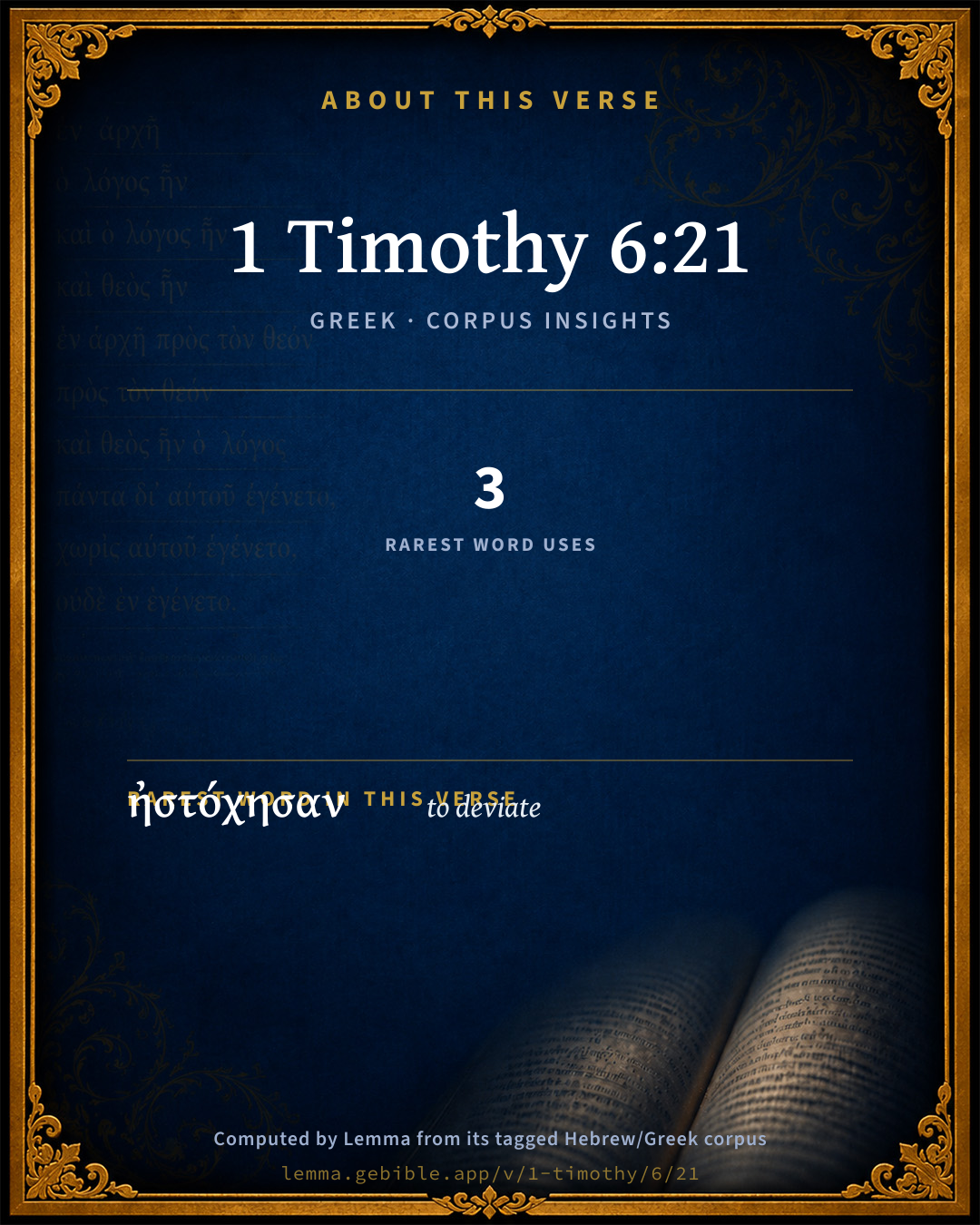
The rarest word here is ἠστόχησαν to deviate G795 — appearing just 3 times in the whole Greek New Testament.

Shared distinctive vocabulary

ἠστόχησαν to deviate G795 occurs in 3 verses of the Greek New Testament. Also found in:

Repetition

A word recurs within this verse:

Cross-references

13

Topical passages linked to 1 Timothy 6:21 in the Treasury of Scripture Knowledge — connected by theme and wording, ordered by reader-vote popularity; previews shown in the World English Bible.

  • 2 Timothy 2:18 men who have erred concerning the truth, saying that the resurrection is already past, and overthrowing the faith of some.
  • Matthew 6:13 Bring us not into temptation, but deliver us from the evil one. For yours is the Kingdom, the power, and the glory forever. Amen.'
  • Romans 1:7 to all who are in Rome, beloved of God, called to be saints: Grace to you and peace from God our Father and the Lord Jesus Christ.
  • Romans 16:20 And the God of peace will quickly crush Satan under your feet. The grace of our Lord Jesus Christ be with you.
  • Romans 16:23 Gaius, my host and host of the whole assembly, greets you. Erastus, the treasurer of the city, greets you, as does Quartus, the brother.
  • Colossians 4:18 The salutation of me, Paul, with my own hand: remember my bonds. Grace be with you. Amen.
  • 1 Timothy 1:6 from which things some, having missed the mark, have turned aside to vain talking;
  • 1 Timothy 1:19 holding faith and a good conscience; which some having thrust away made a shipwreck concerning the faith;
  • 1 Timothy 6:10 For the love of money is a root of all kinds of evil. Some have been led astray from the faith in their greed, and have pierced themselves through with many sorrows.
  • 2 Timothy 4:22 The Lord Jesus Christ be with your spirit. Grace be with you. Amen.
  • Titus 3:15 All who are with me greet you. Greet those who love us in faith. Grace be with you all. Amen.
  • Hebrews 10:1–12 For the law, having a shadow of the good to come, not the very image of the things, can never with the same sacrifices year by year, which they offer continually, make perfect those who draw near.
  • Hebrews 13:25 Grace be with you all. Amen.

Cross-references courtesy of OpenBible.info (CC BY 4.0).

Commentary

Notes on 1 Timothy 6:21 from classic Christian and Jewish commentators (each source and its license shown beneath its notes). The classic Christian expositions comment on the surrounding passage and are grouped to its opening verse, so a note may address several verses; the Jewish commentaries on the Tanakh (Rashi and others) are per-verse, so they appear only where the commentator wrote on this verse.

Lemma curates 59 commentaries, every one of them public domain or Creative Commons licensed, each selected and text-cleaned for this edition rather than reprinted as found. About our sources →

Tyndale Open Study Notes

Tyndale Open Resources

6:21 The letter closes abruptly. Evidently there was no need of directions for the mission (cp. Titus 3:12-14) and greetings were unnecessary or unsuitable (cp. Titus 3:15; Rom 16:3-16). • you all: The letter was sent to Timothy but was intended to be read to the whole church (see 1 Timothy Book Introduction, “Literary Genre”).

Tyndale Open Study Notes — © Tyndale Open Resources, licensed CC BY-SA 4.0. Text via the HelloAO Bible API.

Bengel's Gnomon

Johann Albrecht Bengel

1Ti 6:21. Περὶ τὴν πίστιν ἠστόχησαν, they have erred concerning the faith) Although they attempt to appropriate to themselves ἐπισήμην, science, and γνῶσιν, knowledge, 1Ti 6:4; 1Ti 6:20, and its εὐστοχίαν, accurate reasoning [hitting the mark, opposed to ἀστοχέω, I miss the mark, err] and sagacity, yet they have lost the true sagacity, which is connected with faith, not comprehending what is to be believed, and what it is to believe; comp. 2Ti 3:7-8.—ἡ χάρις, grace) not unknown to thee. He briefly indicates it.—μετὰ σοῦ, with thee) No salutations to others are here added, for the epistle was not to be read in public.[56]

[56] Bengel, J. A. (1860). Vol. 4: Gnomon of the New Testament (M. E. Bengel & J. C. F. Steudel, Ed.) (J. Bryce, Trans.) (239–288). Edinburgh: T&T Clark.

Bengel's Gnomon of the New Testament — English translation (T&T Clark, Edinburgh, 1860) — public domain. Text from a community e-Sword module.

Meyer's Critical & Exegetical Commentary

Heinrich August Wilhelm Meyer

1Ti_6:21. The benediction, as in the other Pauline Epistles. If ὑμῶν is the right reading, we can only infer from it that Paul intends the benediction for the whole church, not that he addresses the epistle to the whole church along with Timothy.

Meyer — Critical and Exegetical Commentary on the New Testament — English translation by Peter Christie, edited by Frederick Crombie (T&T Clark, 1880) — public domain. Text from a community e-Sword module.

Expositor's Greek Testament

ed. W. Robertson Nicoll

1Ti 6:21 . τινες : See note on 1Ti 1:3 .

ἐπαγγελλόμενοι : See note on 1Ti 2:10 .

περὶ τὴν πίστιν ἠστόχησαν : See notes on 1Ti 1:6 ; 1Ti 1:19 , and reff.

μεθʼ ὑμῶν : An argument in support of the μετὰ σοῦ of the Received Text is that μεθʼ ὑμῶν is indisputably the right reading in the corresponding place in 2 Tim. and Tit., and might have crept in here by assimilation. Ell. has reason on his side when he maintains that the plural here is not sufficient to prove that the epistle as a whole was intended for the Church. “The study of papyri letters will show that the singular and the plural alternated in the same document with apparently no distinction of meaning” (Moulton, Expositor , vi., vii. 107). The colophon in the T.R., “The First to Timothy was written from Laodicea, which is the chiefest city of Phrygia Pacatiana,” has a double interest: as an echo of the notion that this is the Epistle from Laodicea (Col 4:16 ), a notion sanctioned by Theophyl.; and the mention of Phrygia Pacatiana proves that the author of the note lived after the fourth century, towards the close of which that name for Phrygia Prima came into use.

The Expositor's Greek Testament, edited by W. Robertson Nicoll (1897–1910) — public domain. Text from a community e-Sword module.

Geneva Bible (1599)

Geneva Bible translators

Not only in word, but also in countenance and gesture: to be short, while their behavior was such that even when they held their peace, they would make men believe their heads were occupied about nothing but high and weighty matters, even then they erred concerning the faith.

Geneva Bible (1599) marginal notes — public domain. Text via Bolls.life.

Jamieson, Fausset & Brown

Robert Jamieson, A. R. Fausset & David Brown

Which some professing--namely, professing these oppositions of science falsely so called.

erred--(See on Ti1 1:6; Ti1 2:11) --literally, "missed the mark" (Ti2 3:7-8). True sagacity is inseparable from faith.

Grace--Greek, "the grace," namely, of God, for which we Christians look, and in which we stand [ALFORD].

be with thee--He restricts the salutation to Timothy, as the Epistle was not to be read in public [BENGEL]. But the oldest manuscripts read, "be with you"; and the "thee" may be a transcriber's alteration to harmonize with Ti2 4:22; Tit 3:15.

Amen--omitted in the oldest manuscripts.

Next: 2 Timothy Introduction

Jamieson, Fausset & Brown — Commentary Critical and Explanatory on the Whole Bible (1871) — public domain (CC PDM 1.0). Text via the HelloAO Bible API.

Adam Clarke's Commentary

Verse 21. Which some professing] Which inspired knowledge some pretending to, have set up Levitical rites in opposition to the great Christian sacrifice, and consequently have erred concerning the faith - have completely mistaken the whole design of the Gospel. See 1Ti 1:6; 1Ti 1:7.

Grace be with thee.] May the favour and influence of God be with thee, and preserve thee from these and all other errors!

Amen.] This word, as in former cases, is wanting in the most ancient MSS. In a majority of cases it appears to have been added by different transcribers nearly in the same way in which we add the word FINIS, simply to indicate the end of the work.

The subscriptions as usual are various. The following are the most remarkable afforded by the MSS.: -

The first to Timothy is completed; the second to Timothy begins. - DE. The First Epistle to Timothy is completed; the second to him begins. - G. The first to Timothy, written from Laodicea. - A. The first to Timothy, written from Ladikia. - CLAROMONT. Written from Laodicea, which is the metropolis of Phrygia. - The first to Timothy, written from Laodicea, which is the metropolis of Phrygia of Pacatiana. - Common GREEK TEXT, and several MSS. Instead of Pacatiana, some have Pancatiana, Capatiana, and Paracatiana.

The VERSIONS are not less discordant: -

The First Epistle to Timothy, which, was written from Laodicea. - SYR.

The VULGATE has no subscription.

The end of the epistle. It was written from Laodicea, which is the metropolis of the cities of Phrygia. - ARAB.

To the man Timothy. - AETHIOPIC.

The First Epistle to Timothy, written from Athens. - ARABIC of Erpenius.

Written from Athens, and sent by Titus, his disciple. - COPTIC.

Written from Macedonia. - AUCTOR SYNOPS.

The First Epistle to Timothy is ended. It was written from Laodicea, the metropolis of Phrygia of Pacatiana. - PHILOXENIAN SYRIAC.

There is one authority in Griesbach, Mt. c., for its being written from NICOPOLIS. This is the opinion also of Dr. Macknight.

That the epistle was not written from Laodicea nor Athens, but from Macedonia, has been rendered probable by the arguments produced in the preface, to which the reader is referred for this and the date of the epistle itself.

IN reviewing the whole of this epistle, I cannot help considering it of the first consequence to the Church of God. In it we see more clearly than elsewhere what the ministers of the Gospel should be, and what is the character of the true Church. Bishops, presbyters, and deacons are particularly described; and their qualifications so circumstantially detailed, that it is impossible to be ignorant on this head. What the Church should be is also particularly stated; it is the house of the living God; the place where he lives, works, and manifests himself. The doctrines and discipline of the Church are not less specifically noted. All these subjects are considered at large in the notes, and here nothing need be added.

Should it be said, the apostle, in giving the qualifications of a bishop, "nowhere insists on human learning," it may be answered in general, that no ignorant person in those times could have possibly got admittance into the Church as a teacher of Christianity. Every person, acknowledged as a teacher, was himself well taught in the word of God, and well taught by the Spirit of God; and much teaching of the Divine Spirit was then necessary, as the New Testament Scriptures were not then completed; and, if we were to allow the earlier date of this epistle, scarcely any part of the New Testament had then been written. The gospels had not come as yet into general circulation; and only a few of St. Paul's epistles, viz. those to the Thessalonians, and that to the Galatians, and the first to the Corinthians, had been written before the year 56. At such times much must have been done by immediate revelations, and a frequent communication of miraculous powers.

It is natural for men to run into extremes; and there is no subject on which they have run into wider extremes than that of the necessity of human learning; for in order to a proper understanding of the sacred Scriptures, on one hand, all learning has been cried down, and the necessity of the inspiration of the Holy Spirit, as the sole interpreter, strongly and vehemently argued. On the other, all inspiration has been set aside, the possibility of it questioned, and all pretensions to it ridiculed in a way savouring little of Christian charity or reverence for God. That there is a middle way from which these extremes are equally distant, every candid man who believes the Bible must allow. That there is an inspiration of the Spirit which every conscientious Christian may claim, and without which no man can be a Christian, is sufficiently established by innumerable scriptures, and by the uninterrupted and universal testimony of the Church of God; this has been frequently proved in the preceding notes. If any one, professing to be a preacher of the Gospel of Jesus, denies, speaks, or writes against this, he only gives awful proof to the Christian Church how utterly unqualified he is for his sacred function. He is not sent by God, and therefore he shall not profit the people at all. With such, human learning is all in all; it is to be a substitute for the unction of Christ, and the grace and influences of the Holy Spirit.

But while we flee from such sentiments, as from the influence of a pestilential vapour, shall we join with those who decry learning and science, absolutely denying them to be of any service in the work of the ministry, and often going so far as to assert that they are dangerous and subversive of the truly Christian temper and spirit, engendering little besides pride, self-sufficiency, and intolerance?

That there have been pretenders to learning, proud and intolerant, we have too many proofs of the fact to doubt it; and that there have been pretenders to Divine inspiration, not less so, we have also many facts to prove. But such are only pretenders; for a truly learned man is ever humble and complacent, and one who is under the influence of the Divine Spirit is ever meek, gentle, and easy to be entreated. The proud and the insolent are neither Christians nor scholars. Both religion and learning disclaim them, as being a disgrace to both.

But what is that learning which may be a useful handmaid to religion in the ministry of the Gospel? Perhaps we may find an answer to this important question in one of the qualifications which the apostle requires in a Christian minister, 1Ti 3:2: He should be apt to teach - capable of teaching others. See the note. Now, if he be capable of teaching others, he must be well instructed himself; and in order to this he will need all the learning that, in the course of the Divine providence, he is able to acquire. But it is not the ability merely to interpret a few Greek and Latin authors that can constitute a man a scholar, or qualify him to teach the Gospel. Thousands have this knowledge who are neither wise unto salvation themselves, nor capable of leading those who are astray into the path of life. Learning is a word of extensive import; it signifies knowledge and experience; the knowledge of God and of nature in general, and of man in particular; of man in all his relations and connections; his history in all the periods of his being, and in all the places of his existence; the means used by Divine providence for his support; the manner in which he has been led to employ the powers and faculties assigned to him by his Maker; and the various dispensations of grace and mercy by which he has been favoured. To acquire this knowledge, an acquaintance with some languages, which have long ceased to be vernacular, is often not only highly expedient, but in some cases indispensably necessary. But how few of those who pretend most to learning, and who have spent both much time and much money in seats of literature in order to obtain it, have got this knowledge! All that many of them have gained is merely the means of acquiring it; with this they become satisfied, and most ignorantly call it learning. These resemble persons who carry large unlighted tapers in their hand, and boast how well qualified they are to give light to them who sit in darkness, while they neither emit light nor heat, and are incapable of kindling the taper they hold. Learning, in one proper sense of the word, is the means of acquiring knowledge; but multitudes who have the means seem utterly unacquainted with their use, and live and die in a learned ignorance. Human learning, properly applied and sanctified by the Divine Spirit, is of inconceivable benefit to a Christian minister in teaching and defending the truth of God. No man possessed more of it in his day than St. Paul, and no man better knew its use. In this, as well as in many other excellences, he is a most worthy pattern to all the preachers of the Gospel. By learning a man may acquire knowledge; by knowledge reduced to practice, experience; and from knowledge and experience wisdom is derived. The learning that is got from books or the study of languages is of little use to any man, and is of no estimation, unless practically applied to the purposes of life. He whose learning and knowledge have enabled him to do good among men, and who lives to promote the glory of God and the welfare of his fellow creatures, can alone, of all the literati, expect to hear in the great day: Well done, good and faithful servant! Enter thou into the joy of thy Lord.

How necessary learning is at present to interpret the sacred writings, any man may see who reads with attention; but none can be so fully convinced of this as he who undertakes to write a comment on the Bible. Those who despise helps of this kind are to be pitied. Without them they may, it is true, understand enough for the mere salvation of their souls; and yet even much of this they owe, under God, to the teaching of experienced men. After all, it is not a knowledge of Latin and Greek merely that can enable any man to understand the Scriptures, or interpret them to others; if the Spirit of God take not away the veil of ignorance from the heart, and enlighten and quicken the soul with his all-pervading energy, all the learning under heaven will not make a man wise unto salvation.

Finished correcting for a new edition, Dec. 22d, 1831. - A.C.

Adam Clarke's Commentary on the Bible (1810–1826) — public domain. Text from a community e-Sword/MySword module.

John Calvin's Commentaries

21 Which some professing, have erred concerning the faith. From the result, also, he demonstrates how dangerous a thing it is, and how much it ought to be avoided. The way in which God punishes the haughtiness of those who, through the desire of obtaining reputation, corrupt and disfigure the doctrine of godliness, is, that he allows them to fall away from soundness of understanding, so that they involve themselves in many absurd errors. We see that this has taken place in Popery; for, after they began to speculate in profane manner, about the mysteries of our religion, there followed innumerable monsters of false opinions. Faith is here taken, as in some former passages, for the summary of religion and sound doctrine. Warned by such examples, if we abhor revolt from “the faith,” let us adhere to the pure word of God, and let us detest sophistry and all useless subtleties, because they are abominable corruptions of religion.

END OF THE FIRST EPISTLE TO TIMOTHY.

John Calvin's Commentaries (1540-1563) — public domain. Text from the Calvin Translation Society English edition (1840s-50s) via the Christian Classics Ethereal Library (ccel.org). Calvin's coverage is partial (roughly two-thirds of the Bible); uncommented books and verses are honest gaps, never fabricated. The 19th-century editor's footnotes and remarks are omitted so the notes are faithfully Calvin's own voice.

Ellicott's Commentary for English Readers

(21) Which some professing have erred concerning the faith.—In this most probably wild and visionary “knowledge” the false teachers and their hearers sought salvation and a rule of life, and miserably failed in their efforts. The result with them was, that they lost all hold on the great doctrine of Faith in a crucified Saviour.

Grace be with thee.—The ancient authorities are almost equally divided between “with thee” and “with you,” the congregation. The public nature of so many of the directions and instructions contained in this Epistle account for the absence of those private greetings which we find in the Second Epistle of St. Paul to Timothy.

A Bible Commentary for English Readers, edited by Charles John Ellicott (1878–1897) — public domain. Text from a community e-Sword module.

The Cambridge Bible for Schools and Colleges

gen. ed. J. J. S. Perowne

21. which some professing] ‘Which,’ this misnamed Gnosis. ‘Professing’ has occurred in this sense 1Ti_2:10.

have erred] Lit., ‘missed the mark,’ as 1Ti_1:6 and 2Ti_2:18; aorist as 1Ti_6:10.

the faith] As above, 1Ti_6:10.

Grace be with thee] ms. authority gives the plural with you, as at the end of 2 Tim. and Titus; the Apostolic benediction being sent through the delegate episcopus to his Church.

There is, of course, no sufficient authority for the Subscription, which (like the Subscriptions to the other epistles of St Paul) is ascribed to Bp Euthalius (5th cent.) and is therefore later than the best mss. The Alexandrian and Sinaitic mss. read only First Epistle to Timothy. Its statement that the letter was written from Laodicea is supposed to be drawn from Col_4:16. See the paraphrase of Erasmus: ‘vicissim vos legatis epistolam quae Timotheo scripta fuit ex Laodicensium urbe.’ But Bp Lightfoot, Coloss. p. 343, gives strong reasons against this identification; (1) that St Paul had not ever been at Laodicea, indeed had been long a prisoner either at Cæsarea or Rome, when he wrote to the Colossians; (2) that Timothy bears many proofs of having been written elsewhere than at Laodicea, and of being separated by an interval of some years at least from the Colossian letter.

The Cambridge Bible for Schools and Colleges (gen. ed. J. J. S. Perowne; Cambridge University Press, 1878–1918) — public domain. Text from a community e-Sword module.

John Gill's Exposition

Which some professing,.... Pretending to be masters of the above science, boasting and making great show of it, and valuing themselves upon it:

have erred concerning the faith: have wandered from the way of truth, and gone into the path of error; have fallen from the doctrine of faith, and made shipwreck of it, and become entire apostates: from the danger attending vain jangling, the use of new words, the profession of a false science, and making objections from it against the truth, does the apostle dissuade Timothy from them, since they generally issue in apostasy.

Grace be with thee. Amen. This the apostle wishes to him, that he might be enabled to discharge every branch of his duty he had pointed to him in this epistle, and to keep him from all evil, and every false way, and preserve him safe to the kingdom and glory of God. And which he doubted not but would be his case, and therefore puts his "Amen" to it. The Alexandrian copy and Arabic version read, "grace be with you. Amen".

The first to Timothy was written from Laodicea, which is the chiefest city of Phrygia Pacatiana. This last clause is left out in the Alexandrian copy and Syriac version; and indeed, in the apostle's time, Phrygia was not known by such an appellation as "Pacatiana", which was given it some years after by the Romans; and which shows, that the subscriptions to the epistles are not only of human authority, but of later date, at least some of them. The Arabic version calls it the metropolis of Phrygia, and leaves out "Pacatiana"; and one of Beza's manuscripts, instead of "Laodicea", reads "Macedonia", from whence, as from Philippi, or some other city there, he thinks it was written; and several learned men have been of opinion that it was written from Philippi.

Next: 2 Timothy Introduction

John Gill's Exposition of the Whole Bible (1746–1763) — public domain (CC PDM 1.0). Text via the HelloAO Bible API.

Trapp's Complete Commentary

John Trapp

21 Which some professing have erred concerning the faith. Grace be with thee. Amen. The first to Timothy was written from Laodicea, which is the chiefest city of Phrygia Pacatiana.>>

Ver. 21. Which some professing] Gr. Promising, as the Gnostics and other heretics.

John Trapp, A Commentary or Exposition upon All the Books of the Old and New Testament (1647–1656) — public domain. Text from a community e-Sword module.

Albert Barnes' Notes on the Bible

Which some professing - Evidently some who professed to be true Christians. They were attracted by false philosophy, and soon, as a consequence, were led to deny the doctrines of Christianity. This result has not been uncommon in the world.

Have erred concerning the faith - see notes on 1Ti 1:6-7; 1Ti 6:10.

Grace be with thee - see the notes, Rom 1:7.

On the subscription at the close of this Epistle, see Intro., Section 2. It is, like the other subscriptions at the close of the epistles, of no authority.

Albert Barnes' Notes on the Bible (1834–1885) — public domain. Text from a community e-Sword/MySword module.

Matthew Poole's English Annotations

Which some professing have erred concerning the faith; which kind of science, some pretending and boasting of, studying to show themselves learned and subtle men, they have been led into errors in Christianity, apostatizing from the doctrine of faith.

Grace be with thee; viz. the grace, mercy, and peace, from God the Father and Christ Jesus our Lord, mentioned 2Ti 1:2.

(The first to Timothy was written from Laodicea, which is the chiefest city of Phrygia Pacatiana.)

Matthew Poole's English Annotations on the Holy Bible (1683–1685) — public domain. Text from a community e-Sword/MySword module.

The Pulpit Commentary

You for thee, A.V and T.R. The R.T. omits Amen. Professing (ejpaggellomenoi) seechsan); 1Ti_2:10, note. Have erred (hjsto) 1Ti_1:6, note. Grace be with you. The authorities for sou and uJmwn respectively are somewhat evenly balanced. The T.R. sou seems in itself preferable, as throughout St. Paul addresses Timothy personally, and as there are no salutations here, as in 2 Timothy and Titus (see 1Ti_1:18 1Ti_3:14 1Ti_4:6, etc.; 6:11, 20). This shorter form, hJ cariv, is used in the pastoral Epistles (2Ti_4:22; for Tit_3:3-5) the fuller and more usual form, JH cariv tou Kuriou hJmwn jIhsou Cristou (Rom_16:20; 1Co_16:23; 2Th_3:18, and elsewhere) The short form also occurs in Heb_13:25. The words are a gracious, peaceful ending to the Epistle.

The Pulpit Commentary (1880–1919), ed. H.D.M. Spence-Jones & Joseph S. Exell — public domain. Text from a community e-Sword module.

Cambridge Greek Testament for Schools and Colleges

21. μεθʼ ὑμῶν. So אAGP; μετὰ σοῦ is the reading of rec. text, following D2EKL &c. Cp. 2Ti 4:22 and Tit 3:15.

אcD2bcEKLP &c. add ἀμήν; this is absent from א*AD2*G &c.

The subscription printed in the rec. text, viz. Πρὸς Τιμόθεον πρώτη ἐγράφη ἀπὸ Λαοδικείας, ἥτις ἐστὶ μητρόπολις Φρυγίας τῆς Πακατιανῆς, is found in KL and elsewhere; א17 have simply πρὸς Τιμόθεον ᾱ; D2E add ἐπληρώθη; A 120 &c. have πρὸς τιμοθ. ᾱ ἐγράφη ἀπὸ Λαοδικείας·; P has πρ. τιμόθ. ᾱ ἐγράφη ἀπὸ νικοπόλεως, and there are other variants. See Introd. p. xxxii.

21. ἥν τινες ἐπαγγελλόμενοι, which some (as usual, the false teachers are vaguely hinted at, without specification of individuals) professing. For ἐπαγγέλλεσθαι see on 1Ti 2:10.

περὶ τὴν πίστιν ἠστόχησαν, missed their aim in the matter of the faith. See 1Ti 1:19; 2Ti 2:18 for a similar use of περί, and for ἀστοχέω on 1Ti 1:6, ὦν τινὲς ἀστοχήσαντες ἐξετράπησαν εἱς ματαιολογίαν. The aorist ἠστόχησαν points to a definite failure on the part of some; not, as the perfect would, to a continued ἀστοχία apparent at the time of writing. See the note on 1Ti 1:19.

BENEDICTION

ἡ χάρις μεθʼ ὑμῶν. See the critical note.

The ordinary conclusion of a private letter of the period was ἔρρωσο or ἔρρωσθε, as χαίρειν was the introductory greeting (see note on 1Ti 1:1). The Epistles of James, 1 John, 2 John have no formal ending, 2 Peter and Jude end in a doxology, and 1 Peter and 3 John with the salutation of peace (εἰρήνη). St Paul’s usage is quite peculiar; and he calls it the σημεῖον ἐν πάσῃ ἐπιστολῇ (2Th 3:17). All his letters end with the salutation The Grace, ἡ χάρις. In the earlier letters this is put in the form The grace of the Lord [Jesus Christ] be with you. When we come to Ephesians we find that the word grace is used absolutely, and that the words ‘of the Lord Jesus,’ or the like, are no longer added. And in Colossians, 1 Timothy and 2 Timothy we have simply ‘grace (or, rather, the grace) be with you,’ and in Titus ‘the grace be with you all.’

This usage had many imitators afterwards, as e.g. the Ep. to the Hebrews which ends ἡ χάρις μετὰ πάντων ὑμῶν, and the Epistle of Clement of Rome which has the longer form ἡ χάρις τοῦ κυρίου ἡμῶν Ἰησοῦ Χριστοῦ μεθʼ ὑμῶν κ.τ.λ. But Ignatius and Polycarp do not follow it; all their letters end with the customary ἔρρωσθε, adding words such as ἐν θεῷ πατρί, ἐν Χριστῷ Ἰησοῦ and the like, which fill it with a Christian meaning.

Cambridge Greek Testament for Schools and Colleges (Cambridge University Press, 1896; 21 vols, various authors incl. Carr, Maclear, Plummer, Farrar, Lumby, Moule, M. R. James, Simcox) — public domain. Text from a community e-Sword module.

Alford’s Greek Testament

Henry Alford

21.] Concluding exhortation to Timotheus. O Timotheus (this personal address comes with great weight and solemnity: ‘appellat familiariter ut filium, cum gravitate et amore,’ Beng.), keep the deposit (entrusted to thee: reff. 2 Tim. (μὴ μειώσῃς· οὐκ ἔστι σά· τὰ ἀλλότρια ἐνεπιστεύθης· μηδὲν ἐλαττώσῃς, Chrys. I cannot forbear transcribing from Mack and Wiesinger the very beautiful comment of Vincentius Lirinensis in his Commonitorium (a.d. 434), § 22 f. p. 667 f.: “O Timothee, inquit, depositum custodi, devitans profanas vocum novitates (reading καινοφωνίας—see var. readd.). ‘O!’ exclamatio ista et præscientiæ est pariter et caritatis. Prævidebat enim futuros, quos etiam prædolebat, errores. Quid est ‘depositum custodi?’ Custodi, inquit, propter fures, propter inimicos, ne dormientibus hominibus superseminent zizania super illud tritici bonum semen quod seminaverat filius hominis in agro suo. ‘Depositum,’ inquit, ‘custodi.’ Quid est ‘depositum?’ id est quod tibi creditum est, non quod a te inventum: quod accepisti, non quod excogitasti: rem non ingenii sed doctrinæ, non usurpationis privatæ sed publicæ traditionis: rem ad te perductam, non a te prolatam, in qua non auctor debes esse sed custos, non institutor sed sectator, non ducens sed sequens. ‘Depositum,’ inquit, ‘custodi:’ catholicæ fidei talentum inviolatum illibatumque conserva. Quod tibi creditum est, hoc penes te maneat, hoc a te tradatur. Aurum accepisti, aurum redde. Nolo mihi pro aliis alia subjicias, nolo pro auro aut impudenter plumbum, aut fraudulenter æramenta supponas: nolo auri speciem, sed naturam plane … Sed forsitan dicit aliquis: nullusne ergo in ecclesia Christi profectus habebitur religionis? Habeatur plane, et maximus … sed ita tamen, ut vere profectus sit ille fidei, non permutatio. Siquidem ad profectionem pertinet, ut in semetipsa unaquæque res amplificetur,—ad permutationem vero, ut aliquid ex alio in aliud transvertatur. Crescat igitur oportet et multum vehementerque proficiat tam singulorum quam omnium, tam unius hominis quam totius ecclesiæ ætatum et seculorum gradibus, intelligentia, scientia, sapientia: sed in suo duntaxat genere, in eodem scilicet dogmate, eodem sensu, eademque sententia. Imitetur animarum religio rationem corporum, quæ licet annorum processu numeros suos evolvant et explicent, eadem tamen quæ erant permanent …”), viz., the sound doctrine which thou art to teach in thy ministry in the Lord, cf. Col 4:17. This is the most probable explanation. Some regard it as the ἐντολή above, ver. 14: some as meaning the grace given to him for his office, or for his own spiritual life: but ch. 1:18, compared with 2Ti 2:2, seems to fix the meaning as above. Herodotus has a very similar use of the word, ix. 45, ἄνδρες Ἀθηναῖοι, παραθήκην ὑμῖν τὰδε τὰ ἔπεα τίθεμαι. And with this the following agrees: for it is against false doctrine that the Apostle cautions him), turning away from (cf. ἀποτρέπου, 2Ti 3:5) the profane babblings (empty discourses: so also 2Ti 2:16) and oppositions (apparently, dialectic antitheses and niceties of the false teachers. The interpretations have been very various: Chrys. says, ὁρᾷς τῶς πὰλιν κελεύει μηδὲ ὁμόσε χωρεῖν πρὸς τοὺς τοιούτους; ἐκτρεπόμενός, φησιν, τὰς ἀντιθέσεις. ἄρα εἰσὶν ἀντιθέσεις, πρὸς ἃς οὐδὲ ἀποκρίνεσθαι χρή;—understanding by ἀντιθ., sayings of theirs opposed to this teaching. But this can hardly be. Grot., ‘nam ipsi inter se pugnabant:’ but this is as unlikely. Pelag., Luth., al., understand ‘disputations:’ Mosheim, the dualistic oppositions in the heretical systems: Mack, the contradictions which the heretics try to establish between the various doctrines of orthodoxy: Baur, the oppositions between the Gospel and the law maintained by Marcion. On this latter hypothesis, see Prolegomena. There would be no objection philologically to understanding ‘propositions opposed to thee;’ and τοὺς ἀντιδιατιθεμένους, cf. 2Ti 2:25, would seem to bear out such meaning: but seeing that it is coupled with κενοφωνίας, it is much more probably something entirely subjective to the ψευδώνυμος γνῶσις) of that which is falsely-named (ὅταν γὰρ πίστις μὴ ᾖ, γνῶσις οὐκ ἔστι. Chrys.) knowledge (the true γνῶσις, being one of the greatest gifts of the Spirit to the Church, was soon counterfeited by various systems of hybrid theology, calling themselves by this honoured name. In the Apostle’s time, the misnomer was already current: but we are not therefore justified in assuming that it had received so definite an application, as afterwards it did to the various forms of Gnostic heresy. All that we can hence gather is, that the true spiritual γνῶσις of the Christian was already being counterfeited by persons bearing the characteristics noticed in this Epistle. Whether these were the Gnostics themselves, or their precursors, we have examined in the Prolegomena to the Pastoral Epistles),

21.] which (the ψευδών. γνῶσις) some professing (ch. 2:10) erred (reff.: the indefinite past, as marking merely the event, not the abiding of these men still in the Ephesian church) concerning the faith.

Henry Alford, The Greek Testament (1849–1861) — public domain. Text from a community e-Sword module.

International Critical Commentary

21. ἐπαγγελλόμενοι] cf. 2:10: ἠστόχησαν, 1:6.

ἡ χάρις μεθʼ ὑμῶν] as in II and Tit the blessing is for the whole Church; but there is considerable MSS support for μετα σοῦ: cf. Introd. p. xxxvii.

W.-H The New Testament in Greek, with Introduction and Appendix, by Westcott and Hort, Cambridge, 1881.

OGIS. Orientis Grœci Inscriptiones Selectœ, ed. W. Dittenberger, 1903-1905.

Nägeli Das Wortschatz des Apostel’s Paulus, von T. Nägeli, 1905.

Apost. K.O. Apostolische Kirchen-Ordnung, in Texte und Untersuchungen, ii. 5.

International Critical Commentary — older volumes (1896–1929), various authors — public domain. Text from a community e-Sword module.

Vincent's Word Studies in the New Testament

Marvin R. Vincent

Professing. See on ch. 1ti 2:10.

Erred [ηστοχησαν] . See on ch. 1ti 1:6, and comp. 2Ti 2:18.

Grace be with thee. The correct reading is meq' uJmwn with you. Although addressed to an individual, he is included in the church. This brief benediction occurs in Paul only in Colossians. ===2Ti1

CHAPTER I

1 An apostle by the will of God. So 2nd Corinthians, Ephesians, Colosians. 1st Corinthians adds called or by call [κλητος] .

According to the promise, etc. [κατ επαγγελιαν] . Apostolov kata does not appear in any of the Pauline salutations. In 1 Timothy. kat' ejpitaghn according to the commandment, and in Titus kata pistin etc., according to the faith, etc. Kat' ejpaggelian, though in other connections, Act 13:23; Gal 3:29. Epaggelia, primarily announcement, but habitually promise in N. T. In Pastorals only here and 1Ti 4:8. With the promise of the life in Christ goes the provision for its proclamation. Hence the apostle, in proclaiming "ye shall live; through Christ," is an apostle according to the promise.

Of life which is in Christ Jesus. The phrase promise of life only here and 1Ti 4:8. o P. Life in Christ is a Pauline thought. See Rom 8:2; 2Co 4:10; Rom 6:2 - 14; Gal 2:19, 20; Col 3:4; Phi 1:21. It is also a Johannine thought; see Joh 1:4; Joh 3:15; Joh 6:25; Joh 14:6; 1Jo 5:11.

Marvin R. Vincent, Word Studies in the New Testament (1887–1900) — public domain. Text from a community e-Sword/MySword module.

Lesson kit

Teaching starters — assembled from the data on this page, not authored interpretation. Every prompt links to the verse data it draws on. Edit before teaching.

1 Timothy, in the Pauline Epistles, opens this verse with 11 words (10 distinct Greek lemmas). Its most distinctive word is astochéō (“to deviate”). A historical commentator’s framing appears above. Read the whole chapter for the surrounding context.

Discussion questions

  1. What does “to deviate” (astochéō) contribute to the verse as a whole?
  2. 1 Timothy 1:6 shares the word «to deviate» with this verse. How do the two illuminate each other?
  3. “the” occurs 2× in this one verse. What is the effect of the repetition?
  4. These translations render this verse differently. What is at stake in choosing one wording over another?
  5. Reading how Tyndale Open Study Notes and Bengel's Gnomon read this verse, where do the two commentators agree and where do they part?

Things to notice

Reading settings

Reading text

Shown beneath each verse's original-language words.

Old Testament
Old Testament edition

Read the OT as the Masoretic Hebrew (MT) or the Greek Septuagint (LXX).

English shown for the Greek Septuagint (in the Hebrew ↔ Greek comparison).

Comparing translations? Open the Compare panel on any verse page to stack up to four side by side.