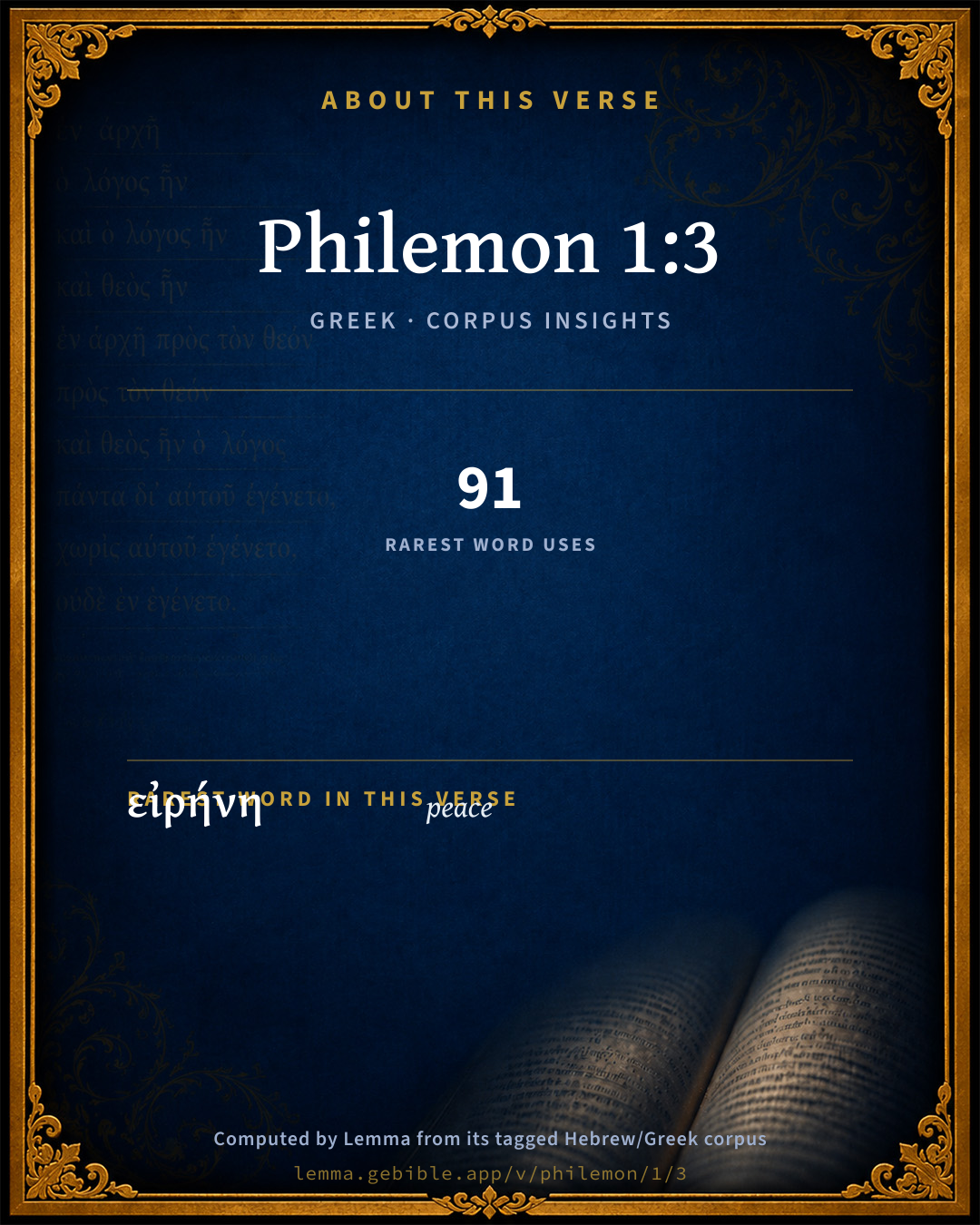
Philemon 1:3

Greek (Tischendorf 8th ed.) Philemon 1:3 appears in the Greek New Testament. The text above is from the Tischendorf 8th edition. Each word links to its Strong’s number and a concise gloss. Click any word for its full Thayer’s Greek Lexicon entry.
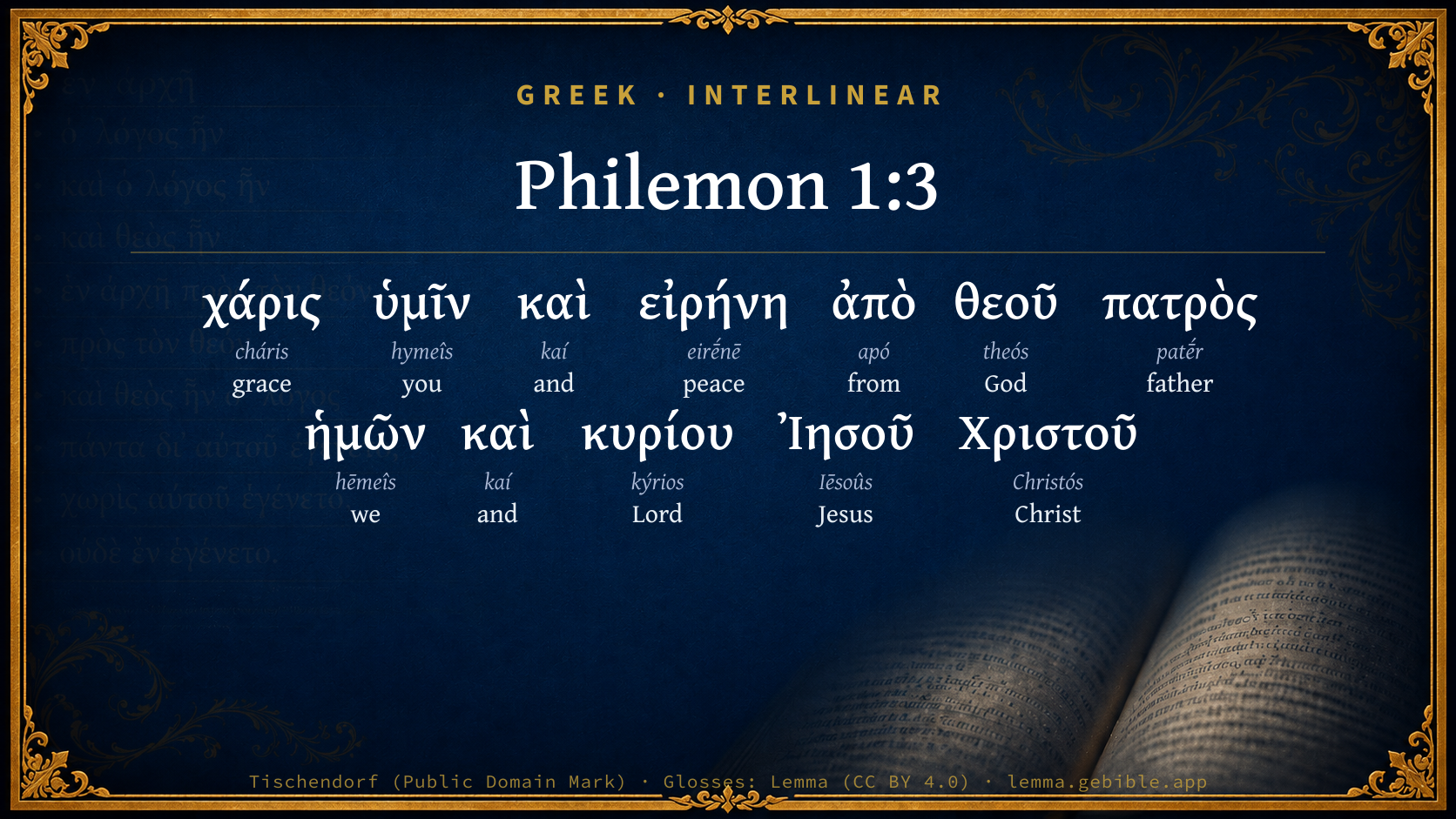
Download image
Cite this verse

Philemon 1:3 (World English Bible). Public Domain. Lemma interlinear Bible study tool, https://lemma.gebible.app/v/philemon/1/3.

Show BibTeX & RIS
BibTeX
RIS
English Translation
Grace to you and peace from God our Father and the Lord Jesus Christ.
World English Bible · Public Domain
Download a study sheet

One document with this verse’s original text, its word-by-word gloss line, the meaning frame, cross-references with their text, attributed commentary, and full source and license credits — printable, and it pastes into notes with its structure intact.

This verse Autodidact and up

Study sheet (.html) Plain text (.txt)

A passage Seminary Student

Up to 50 verses in one chapter. A passage sheet keeps up to 6 commentary sources and 12 cross-references per verse, in the order this page ranks them, and says so on the sheet whenever that leaves anything out. Ask for a single verse and you get the Autodidact verse sheet above.

Everything on this page stays free to read, with no account — the sheet is a download of what is already on screen, not access to it.

Want to remove ads? Support Godless Engineer
Compare translations 3

The same verse in 3 English versions, stacked beneath the original-language interlinear above. Click any original word for its lexicon entry.

Each is an independent rendering of the whole verse — the interlinear is not word-aligned to these translations.

Highlighted words mark where these versions differ — a whole-verse word diff, not a word-by-word alignment.

  • World English Bible Public Domain
    Grace to you and peace from God our Father and the Lord Jesus Christ.
  • King James Version Public Domain
    Grace to you, and peace, from God our Father and the Lord Jesus Christ.
  • unfoldingWord Literal Text CC BY-SA 4.0
    Grace to you and peace from God our Father and our Lord Jesus Christ.

unfoldingWord Literal Text — © unfoldingWord, licensed CC BY-SA 4.0. Word-aligned USFM3 via Door43 (git.door43.org/unfoldingWord/en_ult).

Versions to compare (up to 4)

3 of 4 selected

Show all 19 translations

Every available English version of this verse, each an independent rendering of the whole verse.

  • World English Bible Public Domain
    Grace to you and peace from God our Father and the Lord Jesus Christ.
  • Berean Standard Bible Public Domain
    Grace and peace to you from God our Father and the Lord Jesus Christ.
  • Majority Standard Bible Public Domain
    Grace and peace to you from God our Father and the Lord Jesus Christ.
  • King James Version Public Domain
    Grace to you, and peace, from God our Father and the Lord Jesus Christ.
  • American Standard Version (1901) Public Domain
    Grace to you and peace from God our Father and the Lord Jesus Christ.
  • Revised Version (1885) Public Domain
    Grace to you and peace from God our Father and the Lord Jesus Christ.
  • Geneva Bible (1599) Public Domain
    Grace be with you, and peace from God our Father, and from the Lord Iesus Christ.
  • Douay-Rheims (1899) Public Domain
    Grace to you and peace from God our Father, and from the Lord Jesus Christ.
  • Young's Literal Translation Public Domain
    Grace to you, and peace, from God our Father, and the Lord Jesus Christ!
  • Literal Standard Version CC BY-SA 4.0
    Grace to you and peace from God our Father and the Lord Jesus Christ!
  • Unlocked Literal Bible CC BY-SA 4.0
    May grace be to you and peace from God our Father and the Lord Jesus Christ.
  • unfoldingWord Literal Text CC BY-SA 4.0
    Grace to you and peace from God our Father and our Lord Jesus Christ.
  • Darby Bible Public Domain
    Grace to you and peace from God our Father, and [the] Lord Jesus Christ.
  • World Messianic Bible Public Domain
    Grace to you and peace from God our Father and the Lord Yeshua the Messiah.
  • Webster's Bible Public Domain
    Grace to you, and peace, from God our Father and the Lord Jesus Christ.
  • Free Bible Version CC BY-SA 4.0
    May you have grace and peace from God our Father and the Lord Jesus Christ.
  • Bible in Basic English Public Domain
    Grace to you and peace from God our Father and the Lord Jesus Christ.
  • Text-Critical English NT CC BY 4.0
    Grace to you and peace from God our Father and the Lord Jesus Christ.
  • Tyndale New Testament (1534) Public Domain
    Grace be with you and peace from God oure father and from the Lorde Iesus Christ.

Literal Standard Version (2020), Covenant Press — licensed CC BY-SA 4.0. Text via the HelloAO Bible API (eBible.org). Unlocked Literal Bible (unfoldingWord) — licensed CC BY-SA 4.0. Text via the HelloAO Bible API (eBible.org). unfoldingWord Literal Text — © unfoldingWord, licensed CC BY-SA 4.0. Word-aligned USFM3 via Door43 (git.door43.org/unfoldingWord/en_ult). Free Bible Version, Dr. Jonathan Gallagher — licensed CC BY-SA 4.0. Text via the HelloAO Bible API (eBible.org).

Word by word

More ways to search: Search by grammar → Find every occurrence → Compare this word →

Practice this passage: Drill this verse → Learn its vocabulary →

εἰρήνη
eirḗnē
G1515
“peace”
Noun, Nominative, Singular, Feminine
Part of Speech
Noun
Case
Nominative
Number
Singular
Gender
Feminine
Full Thayer's Definition

Origin: probably from a primary verb eiro (to join)

TDNT: 08:40,2

1. a state of national tranquillity a. exemption from the rage and havoc of war 2. peace between individuals, i.e. harmony, concord 3. security, safety, prosperity, felicity, (because peace and harmony make and keep things safe and prosperous) 4. of the Messiah's peace a. the way that leads to peace (salvation) 5. of Christianity, the tranquil state of a soul assured of its salvation through Christ, and so fearing nothing from God and content with its earthly lot, of whatsoever sort that is 6. the blessed state of devout and upright men after death
  1. χάρις cháris G5485 “grace” Noun, Nominative, Singular, Feminine
  2. ὑμῖν hymeîs G5210 “you” Personal pronoun, 2nd person, Dative, Plural
  3. καὶ kaí G2532 “and” Conjunction
  4. ἀπὸ apó G575 “from” Preposition
  5. θεοῦ theós G2316 “God” Noun, Genitive, Singular, Masculine
  6. πατρὸς patḗr G3962 “father” Noun, Genitive, Singular, Masculine
  7. ἡμῶν hēmeîs G2249 “we” Personal pronoun, 1st person, Genitive, Plural
  8. καὶ kaí G2532 “and” Conjunction
  9. κυρίου kýrios G2962 “Lord” Noun, Genitive, Singular, Masculine
  10. Ἰησοῦ Iēsoûs G2424 “Jesus” Noun, Genitive, Singular, Masculine
  11. Χριστοῦ Christós G5547 “Christ” Noun, Genitive, Singular, Masculine

About this verse

These counts appear in no published source. They are computed here, from the morphology-tagged text and Lemma’s own curated glosses. What Lemma adds →

12
words
11
distinct lemmas
Pauline Epistles
section

Repetition

A word recurs within this verse:

Cross-references

3

Topical passages linked to Philemon 1:3 in the Treasury of Scripture Knowledge — connected by theme and wording, ordered by reader-vote popularity; previews shown in the World English Bible.

  • Romans 1:7 to all who are in Rome, beloved of God, called to be saints: Grace to you and peace from God our Father and the Lord Jesus Christ.
  • Ephesians 1:2 Grace to you and peace from God our Father and the Lord Jesus Christ.
  • 2 Corinthians 13:14 The grace of the Lord Jesus Christ, the love of God, and the communion of the Holy Spirit, be with you all. Amen.

Cross-references courtesy of OpenBible.info (CC BY 4.0).

Commentary

Notes on Philemon 1:3 from classic Christian and Jewish commentators (each source and its license shown beneath its notes). The classic Christian expositions comment on the surrounding passage and are grouped to its opening verse, so a note may address several verses; the Jewish commentaries on the Tanakh (Rashi and others) are per-verse, so they appear only where the commentator wrote on this verse.

Lemma curates 59 commentaries, every one of them public domain or Creative Commons licensed, each selected and text-cleaned for this edition rather than reprinted as found. About our sources →

Trapp's Complete Commentary

John Trapp

3 Grace to you, and peace, from God our Father and the Lord Jesus Christ.

Ver. 3. Grace to you, &c.] {See Trapp on "1Co 1:3"} {See Trapp on "2Co 1:2"}

John Trapp, A Commentary or Exposition upon All the Books of the Old and New Testament (1647–1656) — public domain. Text from a community e-Sword module.

Matthew Poole's English Annotations

The common salutation: See Poole on "Rom 1:7", See Poole on "1Co 1:3" and See Poole on "2Co 1:2".

Matthew Poole's English Annotations on the Holy Bible (1683–1685) — public domain. Text from a community e-Sword/MySword module.

The Biblical Illustrator

Joseph S. Exell

Phm_1:3

Grace to you, and peace

A touching prayer

The word grace would be peculiarly touching to Philemon in connection with the plea for Onesimus.

The speech to us of grace is to remind us of our sins and of their forgiveness by an infinite compassion. Think, he seems to say, how much God hath forgiven thee, how thou art saved by grace. Imitate thy God. (Bp. Wm. Alexander.)

A loving wish

The two main points to be observed are the comprehensiveness of the apostles loving wish, and the source to which he looks for its fulfilment. It is perhaps accidental that we have here the union of the Greek and of the Eastern forms of salutation. Just as the regal title of the King, whose throne was the Cross, was written in the languages of culture, of law, and of religion, as an unconscious prophecy of His universal reign; so, with like unintentional felicity, we have blended here the ideals of good which the East and the West have framed for those to whom they wish good, in token that Christ is able to slake all the thirsts of the soul, and that whatsoever things any races of men have dreamed as the chiefest blessing, these are all to be reached through Him, and Him only. But the deeper lesson here is to be found by observing that grace refers to the action of the Divine heart, and peace to the result thereof in mans experience. Grace is free, undeserved, unmotived, self-springing love. It is love which stoops, forgives, communicates. Hence it comes to mean, not only the deep fountain in the Divine nature, and that property in His love by which, like some strong spring, it leaps up and gushes forth by an inward impulse, in neglect of all motives drawn from the lovableness of its objects, such as determine our poor human loves, but also the results of that bestowing love in mens characters, or, as we say, the graces of the Christian soul. Whatsoever things are lovely and of good report, all nobilities, tendernesses, exquisite beauties, and steadfast strengths of mind and heart, of will and disposition--all are the gifts of Gods undeserved and open-handed love. The fruit of such grace received is peace. That old Eastern salutation peace recalls a state of society when every stranger might be a foe; but it touches a chord which vibrates in all hearts. We have little fear of war, but we are all weighed upon with sore unrest, and repose sometimes seems to us the one thing needful. All the discords of nature and circumstances can be harmonised by that grace which is ready to flow into our hearts. Peace with God, with ourselves, with our fellows, repose in the midst of change, calm in conflict, may be ours. (A. Maclaren, D. D.)

The apostles prayer

1. The matter of his prayer, what it is. He asketh not the favour of men, but of God; he craveth not earthly and worldly peace, but spiritual and heavenly. True it is, the favour of God and goodwill of men, the outward peace and tranquillity one with another, are excellent gifts, but the free and fatherly favour of God, together with peace with God the Father, being reconciled unto us in His dear Son, are much to be preferred in our desires.

2. As we learn chiefly to ask spiritual blessings, so we see what blessings among such as are spiritual are the principal and predominant--to wit, the favour of God and peace of conscience. He that is possessed of these two, hath a hidden mine of treasures, with which all the riches of the world are not to be compared. For these blessings are heavenly, spiritual, eternal; whereas all the substance of this world is temporal, transitory, corruptible.

3. The apostle in some of his Epistles useth three words--grace, mercy, and peace. Here he contenteth himself with naming two--grace and peace, wherein there is no contrariety, forasmuch as mercy is included under peace. For by mercy is understood our justification, which consisteth partly in the forgiveness of our sins, and partly in the imputation of Christs righteousness, which do bring true peace with them.

4. We see from whom he asketh all these--first from God the Father, to teach that he is the author of every good and perfect gift. If then we stand in need of them we can receive none but of Him.

5. We see that to God the Father he joineth Jesus Christ; for all blessings are bestowed through Christ, the Mediator of the New Testament. God the Father is the fountain, Christ is the pipe or conduit, by whom they are conveyed unto us. He that hath not Him hath not the Father. He that is not in Him, remaineth in death. He that believeth in the Son, hath everlasting life, and he that obeyeth not the Son, shall not see life, but the wrath of God abideth on him.

6. The title given unto Him: He is called the Lord of His Church; it is a kingdom, whereof He is the Prince; it is a city, whereof He is the governor; it is a house, whereof He is the master or owner; it is a body, whereof He is the head. So then, all obedience is due to Him, and all men must acknowledge His worship over them. Lastly, in that he craveth grace and peace from Christ our Lord, as well as from God the Father, it confirmeth our faith in a fundamental point of Christian religion, touching the Deity of Christ, Who is God equal with the Father. (W. Attersoll.)

Grace

I. From hence let us observe the chiefest cause of Gods favour to us, namely, His own free will and gracious disposition to favour us. The use of this doctrine is to humble us in ourselves, as having not the least spark of goodness in ourselves, and to make us ascribe all glory in everything to God, whose grace is the fountain and foundation of all good things whatsoever.

II. In the example of Paul, in all his salutations wishing first of all grace, that is, the favour of God, we learn what it is that we should chiefly desire, either for ourselves or for others, our children, wives, kindred, fathers and mothers, acquaintance, etc., viz., the grace of St. Paul.

1. Gods favour is the ground of all other mercies whatsoever; it is the main and mother blessing, the very seed of all other mercies whatsoever--so that in desiring it, we desire all other, and getting it, we get other.

2. Gods grace is instead of all other blessings, in case they be wanting.

III. Since whatsoever we desire, we are likewise to seek it, is the use of the means. Paul in his example commending unto us the desire of Gods favour withal further showeth us that we must use means for the attainment of it.

1. Taking thorough notice of that disgrace and displeasure thou art in with God, and that most deservedly for thy sins, thou must first of all come as Benhadads servants came to Ahab, even with a halter about thy neck, creeping and crouching before the throne of grace, abasing and abjecting thyself at His footstool, in the humble and penitent confession of thy sins.

2. Thou must shroud thyself under Christs wings. Clothe thyself with His righteousness, that so thou mayest appear lovely in the eyes of the Lord, for in Christ only is the Father well pleased; and so if thou wouldst have Him well pleased with thee, thou must become a member of Him, bone of His bone, and flesh of His flesh. This thou doest when by faith thou takest hold upon Christs righteousness, and gripest the promises of the gospel.

3. By faith having clad thyself with the robes of Christs imputed righteousness, thou must be clothed upon with the garment of thy own righteousness and obedience, which howsoever being in itself a menstruous cloth as it comes from us yet being of the Spirits own weaving, in that regard is acceptable to God, and causeth Him to take a further delight in us. (Pro_3:3.) (D. Dyke, B. D.)

Grace to be used

Grace is always a gift, and not to be enjoyed only but to be used. For it is use that makes all things bright in creation, that keeps the diamond from accretions, and the fine gold from being tarnished. The great lesson of the universe is the blessedness of use. The purest atmosphere obeys the law of circulation, and the most crystal river is always sending up clouds of blessing from its living waters. (W. M. Statham, M. A.)

Varieties of grace

Ever in each individual Christian life there is seen a manifold grace--grace of forgiveness, grace of new life and peace, grace of birth at the Cross, grace of growth by the Holy Spirit, growth in power and purity and in likeness to God. How many varieties of life Nature has! We are struck with her grace and beauty in her myriad forms. She never seems to exhaust the variety of her wardrobe, as in garments of light, now of subdued colour, now of effulgent beauty, she proclaims the majesty and glory of God. (W. M. Statham, M. A.)

Peace

I do willingly assent to those who by peace understand all prosperity and felicity, both earthly and heavenly, in this life, and that to come.

1. First, the inward peace of conscience with God, which springeth out of the grace and favour of God (Rom_5:1). A mans conscience will never be at quiet within him till it feels this grace.

2. The peace of charity among ourselves. This also is an effect of Gods grace, which as it maketh a man at peace with himself and God, so with his brethren. The love of God shed into our hearts will make us love our brethren also.

3. The peace of amity, and a holy kind of league with all Gods creatures. This also is an effect of grace; for when we have His favour, who is the Lord, we have the good will also of His servants the creatures.

4. Outward prosperity and good success in our ways; so it is commonly taken in all their salutations (1Ch_12:18). Now, the reason why outward prosperity is signified by this name of peace is--first, because to the godly they are pledges of that sweet peace they have with God. Secondly, they are notable maintainers of the peace and quietness of our affections; for in the want of outward things how are we disquieted. But peace, in this fourth signification, is so taken for outward prosperity, that which all this outward prosperity hath security annexed unto it, and is a forerunner of that eternal prosperity and felicity in Gods kingdom; for both these things are understood by the name of peace.

I. From hence observe, that as we may lawfully desire for ourselves and others outward prosperity and the blessing of this life, so how and in what manner we must desire them.

1. Having desired grace in the first place First seek the kingdom of God (Mat_6:1-34); and then in the second place we may seek temporal things; but now men are all for peace, Who will shew us any good? few or none for grace; peaceable men, as I may call them, enough, very few gracious men that do first of all seek Gods grace, and then in the second place peace.

2. In desiring of outward things we must moderate our desires, that they go not beyond their bounds, to desire abundance and superfluity of them; for we desire them by the name of peace: therefore no more must we desire, but that which will serve us, to attend the works of our calling with free and quiet minds, without disturbance or distraction.

II. Paul first desiring grace and then peace, showeth us that peace, namely, outward prosperity, is a fruit of grace, and so, that the nearest and most compendious way to get peace, is first to get grace and favour with God. Joseph and David had wonderful success in all their ways, and the reason the Holy Ghost yieldeth thereof is this, The Lord was with them (Gen_39:1-23; 1Sa_18:1-30). Grace is the only means to draw on peace. When we have got Christs righteousness, it is that grace which makes us graceful to God (Mat_6:1-34). Then outward things come voluntarily, as it were, without our seeking or desiring; no marvel then if oftentimes things go cross with us, we by our sins having drawn down the curse of God upon all our enterprises. This is the reason why Gods children live better, even with greater credit and reputation in the world with a little, than many times the wicked do, which have far more. Gods blessing sets forward the one, and his curse blows upon the other. But we oftentimes see those that are not in greatest favour with God abounding with these earthly blessings. And on the contrary, those that have greatest store of grace, to have a very small pittance of peace.

1. For the godly, who, having their part in grace, have always in some measure their portion in peace also; for--

(1) The end of all his afflictions, whereto they are disposed, is peace.

(2) He hath the peace of security in his greatest distresses (Psa_3:6; Psa_4:9).

(3) He hath the peace of contentation, grace supplying and sweetening the want of peace, and turning very war itself into peace, darkness into light to the godly, his heart is at rest and at peace within itself. There is no warring of the affections against God, whatsoever his outward estate is.

2. For the wicked. It is far otherwise with them in their peace, which being a graceless peace, is in truth a peaceless peace, for in the midst of their peace they want the peace of security, their hearts tremble like an aspen leaf, in fear of change; or if they have security, it is a presumptuous and false security; for when they cry, Peace, peace, then is their destruction at hand (1Th_5:3). And let their peace be never so flourishing, yet still want they the peace of contentation. They think all too little; if they had the whole world, with Alexander, they would grieve there were no more for them to get. Again, as the end of the godly mans warfare is peace, so the end of the wicked mans peace is warfare, even an eternal warfare, and wrestling with the anger of God in hell. Therefore a sound and safe peace ariseth only from the grace of God. (D. Dyke, B. D.)

From God our Father, and the Lord Jesus Christ--

The unity of the Divine Father and Son

The placing of both names under the government of one preposition implies the mysterious unity of the Father with the Son; while conversely St. John, in a parallel passage (2Jn_1:8), by employing two prepositions, brings out the distinction between the Father, who is the fontal source, and the Son, who is the flowing stream. But both forms of the expression demand for their honest explanation, the recognition of the divinity of Jesus Christ. How dare a man, who thought of Him as other than Divine, put His name thus by the side of Gods, as associated with the Father in the bestowal of grace?…The double source is one source, for in the Son is the whole fulness of the Godhead: and the grace of God, bringing with it the peace of God, is poured into that spirit which bows humbly before Jesus Christ, and trusts Him when He says, with love in His eyes and comfort in His tones, My grace is sufficient for thee; My peace give I unto you. (A. Maclaren, D. D.)

God our Father

Dr. Pentecost said that he once gave some Bible readings at Wellesley College, in America, where about three hundred young ladies were being educated. The principal of the College asked him to give them to two of the students who were confined to their room by sickness. On being introduced to them, he inquired if they were Christians. One replied, I hope so; the other answered, Sometimes I think I am, and sometimes I think I am not. Mr. Pentecost said: If I met your father in Boston and told him that I had met a young lady at Wellesley who said that she thought that you were her father, what would he think? The tears streamed over her cheeks as she replied, Do you mean to say that it is our privilege to call God our Father in the same way as our earthly father? This circumstance was the means of leading her to Christ.

Grace from God

We may conceive of grace and peace being connected with God our Father and the Lord Jesus Christ, as we conceive of the water with which a town is supplied in relation to the reservoir of storage on the one hand, and the channel of communication and distribution on the other. We may think of God our Father as the exhaustless fount of these perennial blessings--He is the God of all grace, and the very God of peace. Yet all this grace and peace are not gathered up in Him like water in some lake from which there is no outlet, but, like reservoir supplies, these unspeakable mercies are meant to be communicated and enjoyed through the channel and conduit of the Lord Jesus Christ. And while the whole appliances are regulated and managed by the continual operation of the Holy Ghost, there is nothing derogatory to that Divine Spirit, although in this salutation no specific mention is made, in so many words, of His work and offices, because the greater function includes all the separate distributions for individual use and benefit. Grace, therefore, is peace prepared for us, and peace is grace enjoyed by us. For grace is simply that free favour that spontaneously emanates from love--the grace of God our Father and the Lord Jesus Christ being the self-moved and self-moving operations of Divine love to sinful men. Such kindness is called grace, because the inherent goodness of the Divine disposition alone can account for it--grace being the word that brings into special prominence the Divine motive in redemption as unbought, unsought, and unconstrained by principles from without, just as mercy has reference particularly to the unworthy character of its objects. A many-sided word like grace is best explained by analogies suggested by some similar many-sided word, such as life, vegetation, and the like. Grace, like life, may be regarded as a great and blessed gift from without, or a Divine power working mercifully towards us, and ultimately working in us; bringing salvation for us, and securing its mightiest triumph when it secures a lodgment of itself within us. And just as life receives various names from the various blessings it includes--feeling, moving, seeing, hearing, which are but varieties of the one great privilege of living--so grace is the comprehensive term including the supply of all favours and privileges needful for our fallen and undeserving condition as sinners to be saved. It is enlightenment for darkness, pardon for transgression, comfort for trial, hope for despondency, strength for weakness, and all help for all need. And just as life brought into play as a power within us will be sight if it operate through the eye, speech if through the tongue, hearing if through the ear; so with grace--if it work upon our convictions of sin, it will be the grace of repentance; if on Gods testimony, it is the grace of faith; if on Gods commandments, it is the grace of obedience--and so on through the whole range of Christian excellence. We thus use grace with the varied applications attachable to any kindred word, like vegetation; as when we say Vegetation is at work, we mean the hidden power or influence which produces the buds, leaves, fruits, and all the riches and beauty of the face of nature; or when, on the other hand, we say, Vegetation is looking lovely, we refer to the effects themselves of the hidden power as they strike and delight the eye. So grace is the Divine agency or quickening power which, when it takes hold of us, produces all good thoughts, all holy desires, and all heavenly life, while it is no less the name for those thoughts, desires, and graces themselves, considered as its fruits. If, further, it be viewed as dealing with Divine truth and promise, with Gods gospel message of mercy, with Christ and His work, with the Holy Spirits aid, with the heavenly inheritance, and the like, under the aspect of blessings appropriated and enjoyed, then grace becomes peace. When, in short, we think of spiritual and saving benefits as connected with the Divine nature, and as communicated through our Lord Jesus Christ, we call them all grace; and, on the other hand, we call them all peace when we think of them with special relation to our own good--when we think of their precious value for us, and their tranquillising and enjoyable effects upon us. Oh! if our peace were not of grace, we should be doomed to perish for want of it, like a population whose whole water supply depended on two or three trickling streams, that might dry up and fail when most needed. If we are to live beyond the fear of our peace getting exhausted, it must be by drawing on the perennial resources of heavenly grace, ever full and ever flowing among the everlasting hills--the free, the sovereign, self-moving and redeeming love of God in Christ Jesus our Lord. What an appeal there is to Philemon in such a salutation! As if the apostle would say, This is sufficient to enable you to do all I am to ask at your hands. And as you would find grace and favour with the Lord yourself, or enjoy peace in your own soul, you may not be inexorable or ungracious towards Onesimus, but must seek peace and pursue it, by sealing its comforts on the penitents heart. (A. H. Drysdale, M. A.)

The Biblical Illustrator, edited by Joseph S. Exell (c. 1880s–1900s) — public domain. Text from a community e-Sword module.

The Pulpit Commentary

Grace to you, and peace. The secular formula of salutation was cairein ; (Act_23:26) in Latin, multam or plurimare salutem ant plenissimam. St. Paul"s formula was almost invariably as above, "Grace to you, and peace". (Rom_1:7 1Co_1:3 Gal_1:3; and others) To Timothy (1Ti_1:2 2Ti_1:2) and Tit_1:4, "Grace, mercy, and peace.

The Christian family.

The family of Philemon was Christian, doubtless, both in profession and practice. Many families at the present day are Christian in profession, but not in practice. The family really Christian may be known (like the individual) by its fruits. (Mat_7:20)

I IN IT GOD"S NAME IS HONORED. He is habitually regarded and spoken of as the Giver of all the family happiness, and of whatever measure of prosperity it enjoys. The parents have received from him their children as a charge to be brought up "in the nurture and admonition of the Lord." Children recognize without hesitation the duty of obedience as paramount to all self-pleasing. (Eph_6:1)

II IN IT, THEREFORE, THE LAW OF GOD IS RECOGNIZED AS THE GUIDE OF LIFE by both parents and children.

III IN IT (that is, by its members) THE PUBLIC OBSERVANCES OF RELIGION ARE DILIGENTLY KEPT. The habits of the household are so arranged as not to put unnecessary hindrance in the way of either the family or servants attending public worship at the proper times. Unnecessary labor on Sunday is not required, nor even permitted.

IV IN IT, FURTHERMORE, GOD IS WILLINGLY ENTRUSTED WITH ITS DESTINIES. "In everything by prayer and supplication with thanksgiving let your requests be made known unto God", (Php_4:6) and, as the correlative of this," be careful for nothing;" that is, anxious and distressed about it. These are the rules which have been found of sovereign power in the Christian family.

V As the law of God is in it the restraining rule, so THE LOVE OF GOD IS THE INSPIRING MOTIVE. "Followers of God, as dear children", (Eph_5:1) not performing the mechanical and enforced obedience of the slave, nor even merely the habitual obedience which can be instilled by education and training; but the free, unforced, willing, elastic service which is prompted by the love of a child.

VI Lastly, IN THE CHRISTIAN FAMILY CHARITY IS TAUGHT BY PRECEPT AND BY EXAMPLE. The voice of slander is not heard in it. The elders are not "weary in well-doing," and the younger learn (1Jn_3:17) that to help those who have need is to have something of the likeness of God, and to act under the direction of God"s good Spirit.

The Pulpit Commentary (1880–1919), ed. H.D.M. Spence-Jones & Joseph S. Exell — public domain. Text from a community e-Sword module.

Tyndale Open Study Notes

Tyndale Open Resources

1:3 You is plural, referring to all those mentioned in 1:2. • Grace and peace represent traditional Greek and Hebrew greetings, respectively; they are now understood as gifts from God (cp. Rom 5:1-2).

Tyndale Open Study Notes — © Tyndale Open Resources, licensed CC BY-SA 4.0. Text via the HelloAO Bible API.

Expositor's Greek Testament

ed. W. Robertson Nicoll

Phm 1:3 . χάρις … εἰρήνη : Cf. Rom 1:7 , the usual Pauline greeting (exc. I. 2 Tim.); it is a combination of the Greek salutation, χαίρειν , and the Hebrew one, שׁלום . In the N.T. the word εἰρήνη expresses the spiritual state, which is the result of a right relationship between God and man. According to Jewish belief, the establishment of peace, in this sense, was one of the main functions of the Messiah ( cf. Luk 2:14 ), it was herein that His mediatorial work was to be accomplished. πατρὸς : see note on Jas 3:9 . The phrase ἀπὸ Θεοῦ … Χριστοῦ expresses the essence of Judaism and Christianity.

The Expositor's Greek Testament, edited by W. Robertson Nicoll (1897–1910) — public domain. Text from a community e-Sword module.

The Cambridge Bible for Schools and Colleges

gen. ed. J. J. S. Perowne

3. Grace be unto you, &c.] Verbatim as in the received text of Col_1:2; where see notes. In this private Letter, written about a practical matter, as much as in the public and didactic Letter, all is hallowed with the blessed Name.

The Cambridge Bible for Schools and Colleges (gen. ed. J. J. S. Perowne; Cambridge University Press, 1878–1918) — public domain. Text from a community e-Sword module.

John Gill's Exposition

Grace to you and peace, from God,.... Which is the same form of salutation used in the other epistles; See Gill on Rom 1:7 for though this epistle is but a very small one, yet it is introduced in the same form as the larger epistles are; and has an inscription in the former verse, a salutation in this, and a preface in the three following.

for though this epistle is but a very small one, yet it is introduced in the same form as the larger epistles are; and has an inscription in the former verse, a salutation in this, and a preface in the three following.

Philemon 1:4

plm 1:4

plm 1:4

plm 1:4I thank my God,.... Meaning on account, of Philemon, for the grace bestowed upon him, thereafter mentioned; See Gill on Rom 1:8 making other saints, Rom 1:9, the apostle was a man much in prayer, frequent at the throne of grace; and he prayed not for himself only, but for all the saints, for all the churches and ministers of the Gospel; whom he not only bore upon his mind and heart, but made mention of them, it may be by name; however, he remembered them, and put up petitions, with thanksgivings, for them; and so he did for Philemon; and which he takes notice of with the same view as before: the word, "always", is so placed in the original text, as to be put either to his thanks to God, or his prayers, and may be true of both; the Syriac and Arabic versions join it to the former; and the Vulgate Latin and the Ethiopic versions place it to the latter.

John Gill's Exposition of the Whole Bible (1746–1763) — public domain (CC PDM 1.0). Text via the HelloAO Bible API.

Albert Barnes' Notes on the Bible

Grace to you, and peace ... - See if the notes at Rom 1:7.

Albert Barnes' Notes on the Bible (1834–1885) — public domain. Text from a community e-Sword/MySword module.

The People's New Testament

B. W. Johnson

3. Grace. The benediction of grace would remind him of God's mercy.

B. W. Johnson's The People's New Testament with Notes (1889–1891) — public domain. Electronic text from the Christian Classics Ethereal Library (CCEL) ThML edition.

Cambridge Greek Testament for Schools and Colleges

3. χάρις κ.τ.λ. See notes on Col 1:2.

Cambridge Greek Testament for Schools and Colleges (Cambridge University Press, 1896; 21 vols, various authors incl. Carr, Maclear, Plummer, Farrar, Lumby, Moule, M. R. James, Simcox) — public domain. Text from a community e-Sword module.

International Critical Commentary

3. χάρις ὑμῖν, etc.: See on Php 1:2.

International Critical Commentary — older volumes (1896–1929), various authors — public domain. Text from a community e-Sword module.

Lesson kit

Teaching starters — assembled from the data on this page, not authored interpretation. Every prompt links to the verse data it draws on. Edit before teaching.

Philemon, in the Pauline Epistles, opens this verse with 12 words (11 distinct Greek lemmas). Its most distinctive word is eirḗnē (“peace”). A historical commentator’s framing appears above. Read the whole chapter for the surrounding context.

Discussion questions

  1. The word eirḗnē carries the sense “peace.” How does it shape the verse?
  2. Romans 1:7 shares this passage’s theme. How do the two illuminate each other?
  3. “and” occurs 2× in this one verse. What is the effect of the repetition?
  4. Reading how Trapp's Complete Commentary and Matthew Poole's English Annotations read this verse, where do the two commentators agree and where do they part?

Things to notice

Reading settings

Reading text

Shown beneath each verse's original-language words.

Old Testament
Old Testament edition

Read the OT as the Masoretic Hebrew (MT) or the Greek Septuagint (LXX).

English shown for the Greek Septuagint (in the Hebrew ↔ Greek comparison).

Comparing translations? Open the Compare panel on any verse page to stack up to four side by side.