Romans 6:14

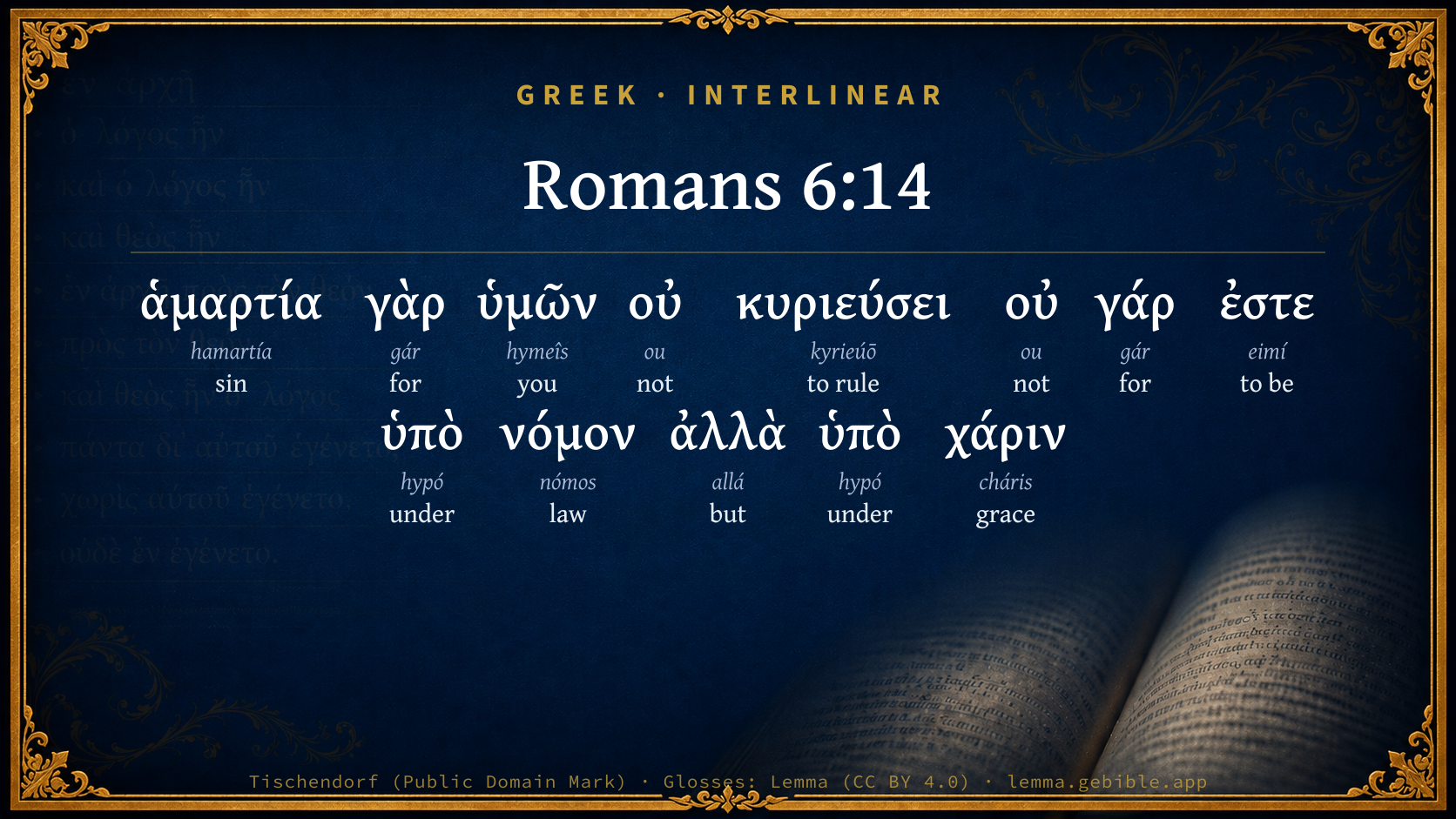
Greek (Tischendorf 8th ed.) Romans 6:14 appears in the Greek New Testament. The text above is from the Tischendorf 8th edition. Each word links to its Strong’s number and a concise gloss. Click any word for its full Thayer’s Greek Lexicon entry.
Download image
Cite this verse

Romans 6:14 (World English Bible). Public Domain. Lemma interlinear Bible study tool, https://lemma.gebible.app/v/romans/6/14.

Show BibTeX & RIS
BibTeX
RIS
English Translation
For sin will not have dominion over you. For you are not under law, but under grace.
World English Bible · Public Domain
Download a study sheet

One document with this verse’s original text, its word-by-word gloss line, the meaning frame, cross-references with their text, attributed commentary, and full source and license credits — printable, and it pastes into notes with its structure intact.

This verse Autodidact and up

Study sheet (.html) Plain text (.txt)

A passage Seminary Student

Up to 50 verses in one chapter. A passage sheet keeps up to 6 commentary sources and 12 cross-references per verse, in the order this page ranks them, and says so on the sheet whenever that leaves anything out. Ask for a single verse and you get the Autodidact verse sheet above.

Everything on this page stays free to read, with no account — the sheet is a download of what is already on screen, not access to it.

Want to remove ads? Support Godless Engineer
Compare translations 3

The same verse in 3 English versions, stacked beneath the original-language interlinear above. Click any original word for its lexicon entry.

Each is an independent rendering of the whole verse — the interlinear is not word-aligned to these translations.

Highlighted words mark where these versions differ — a whole-verse word diff, not a word-by-word alignment.

  • World English Bible Public Domain
    For sin will not have dominion over you. For you are not under law, but under grace.
  • King James Version Public Domain
    For sin shall not have dominion over you: for ye are not under the law, but under grace.
  • unfoldingWord Literal Text CC BY-SA 4.0
    For sin must not be lord over you, for you are not under law, but under grace.

unfoldingWord Literal Text — © unfoldingWord, licensed CC BY-SA 4.0. Word-aligned USFM3 via Door43 (git.door43.org/unfoldingWord/en_ult).

Versions to compare (up to 4)

3 of 4 selected

Show all 19 translations

Every available English version of this verse, each an independent rendering of the whole verse.

  • World English Bible Public Domain
    For sin will not have dominion over you. For you are not under law, but under grace.
  • Berean Standard Bible Public Domain
    For sin shall not be your master, because you are not under law, but under grace.
  • Majority Standard Bible Public Domain
    For sin shall not be your master, because you are not under law, but under grace.
  • King James Version Public Domain
    For sin shall not have dominion over you: for ye are not under the law, but under grace.
  • American Standard Version (1901) Public Domain
    For sin shall not have dominion over you: for ye are not under law, but under grace.
  • Revised Version (1885) Public Domain
    For sin shall not have dominion over you: for ye are not under law, but under grace.
  • Geneva Bible (1599) Public Domain
    For sinne shall not haue dominion ouer you: for ye are not vnder ye Lawe, but vnder grace.
  • Douay-Rheims (1899) Public Domain
    For sin shall not have dominion over you; for you are not under the law, but under grace.
  • Young's Literal Translation Public Domain
    for sin over you shall not have lordship, for ye are not under law, but under grace.
  • Literal Standard Version CC BY-SA 4.0
    for sin will not have lordship over you, for you are not under law, but under grace.
  • Unlocked Literal Bible CC BY-SA 4.0
    Do not allow sin to rule over you. For you are not under law, but under grace.
  • unfoldingWord Literal Text CC BY-SA 4.0
    For sin must not be lord over you, for you are not under law, but under grace.
  • Darby Bible Public Domain
    For sin shall not have dominion over *you*, for ye are not under law but under grace.
  • World Messianic Bible Public Domain
    For sin will not have dominion over you, for you are not under law, but under grace.
  • Webster's Bible Public Domain
    For sin shall not have dominion over you: for ye are not under the law, but under grace.
  • Free Bible Version CC BY-SA 4.0
    Sin won't rule over you, because you're not under law but under grace.
  • Bible in Basic English Public Domain
    For sin may not have rule over you: because you are not under law, but under grace.
  • Text-Critical English NT CC BY 4.0
    For sin will have no dominion over you, for you are not under law but under grace.
  • Tyndale New Testament (1534) Public Domain
    Let not synne have power over you. For ye are not vnder the lawe but vnder grace.

Literal Standard Version (2020), Covenant Press — licensed CC BY-SA 4.0. Text via the HelloAO Bible API (eBible.org). Unlocked Literal Bible (unfoldingWord) — licensed CC BY-SA 4.0. Text via the HelloAO Bible API (eBible.org). unfoldingWord Literal Text — © unfoldingWord, licensed CC BY-SA 4.0. Word-aligned USFM3 via Door43 (git.door43.org/unfoldingWord/en_ult). Free Bible Version, Dr. Jonathan Gallagher — licensed CC BY-SA 4.0. Text via the HelloAO Bible API (eBible.org).

Word by word

More ways to search: Search by grammar → Find every occurrence → Compare this word →

Practice this passage: Drill this verse → Learn its vocabulary →

About this verse

These counts appear in no published source. They are computed here, from the morphology-tagged text and Lemma’s own curated glosses. What Lemma adds →

13
words
10
distinct lemmas
Pauline Epistles
section

Notable vocabulary

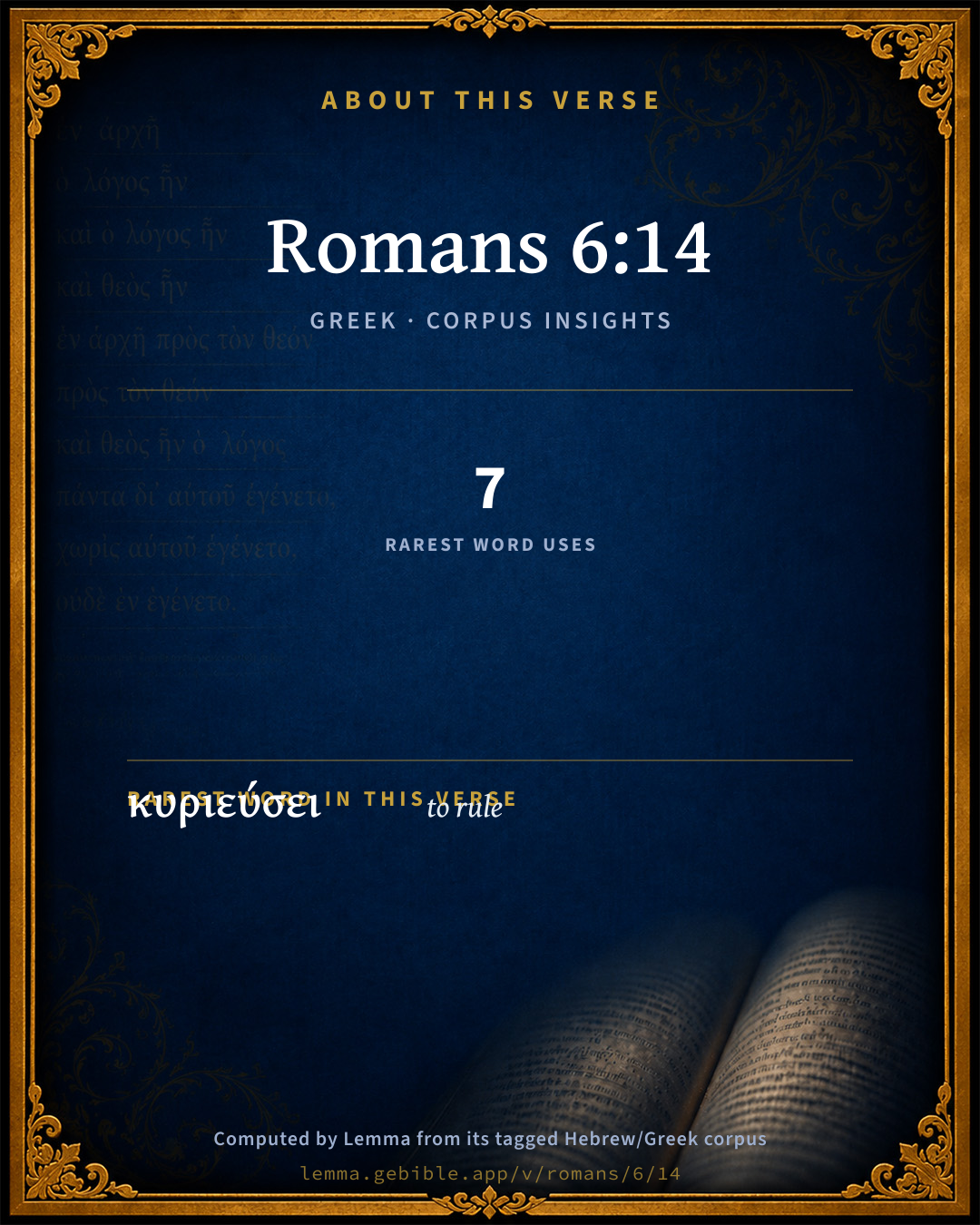
The rarest word here is κυριεύσει to rule G2961 — appearing just 7 times in the whole Greek New Testament.

Shared distinctive vocabulary

κυριεύσει to rule G2961 occurs in 7 verses of the Greek New Testament. Also found in:

Repetition

Words recur within this verse:

Cross-references

21

Topical passages linked to Romans 6:14 in the Treasury of Scripture Knowledge — connected by theme and wording, ordered by reader-vote popularity; previews shown in the World English Bible.

  • Galatians 5:18 But if you are led by the Spirit, you are not under the law.
  • Romans 8:2 For the law of the Spirit of life in Christ Jesus made me free from the law of sin and of death.
  • Romans 7:4–11 Therefore, my brothers, you also were made dead to the law through the body of Christ, that you would be joined to another, to him who was raised from the dead, that we might bring forth fruit to God.
  • Hebrews 8:10 "For this is the covenant that I will make with the house of Israel. After those days," says the Lord; "I will put my laws into their mind, I will also write them on their heart. I will be to them a God, And they will be to me a people.
  • Romans 6:12 Therefore don't let sin reign in your mortal body, that you should obey it in its lusts.
  • Galatians 4:4–5 But when the fullness of the time came, God sent out his Son, born to a woman, born under the law,
  • Romans 3:19–20 Now we know that whatever things the law says, it speaks to those who are under the law, that every mouth may be closed, and all the world may be brought under the judgment of God.
  • John 8:36 If therefore the Son makes you free, you will be free indeed.
  • Psalms 130:7–8 Israel, hope in Yahweh, For with Yahweh there is loving kindness. With him is abundant redemption.
  • John 1:17 For the law was given through Moses. Grace and truth came through Jesus Christ.
  • 2 Corinthians 3:6–9 who also made us sufficient as servants of a new covenant; not of the letter, but of the Spirit. For the letter kills, but the Spirit gives life.
  • Galatians 3:23 But before faith came, we were kept in custody under the law, shut up to the faith which should afterwards be revealed.
  • Romans 5:20–21 The law came in besides, that the trespass might abound; but where sin abounded, grace did abound more exceedingly;
  • Romans 11:6 And if by grace, then it is no longer of works; otherwise grace is no longer grace. But if it is of works, it is no longer grace; otherwise work is no longer work.
  • Galatians 4:21 Tell me, you that desire to be under the law, don't you listen to the law?
  • Titus 2:14 who gave himself for us, that he might redeem us from all iniquity, and purify for himself a people for his own possession, zealous for good works.
  • Micah 7:19 He will again have compassion on us. He will tread our iniquities under foot; And you will cast all their sins into the depths of the sea.
  • Matthew 1:21 She shall bring forth a son. You shall call his name Jesus, for it is he who shall save his people from their sins."
  • Romans 8:12 So then, brothers, we are debtors, not to the flesh, to live after the flesh.
  • Romans 4:16 For this cause it is of faith, that it may be according to grace, to the end that the promise may be sure to all the seed, not to that only which is of the law, but to that also which is of the faith of Abraham, who is the father of us all.
  • Romans 6:15 What then? Shall we sin, because we are not under law, but under grace? May it never be!

Cross-references courtesy of OpenBible.info (CC BY 4.0).

Commentary

Notes on Romans 6:14 from classic Christian and Jewish commentators (each source and its license shown beneath its notes). The classic Christian expositions comment on the surrounding passage and are grouped to its opening verse, so a note may address several verses; the Jewish commentaries on the Tanakh (Rashi and others) are per-verse, so they appear only where the commentator wrote on this verse.

Lemma curates 59 commentaries, every one of them public domain or Creative Commons licensed, each selected and text-cleaned for this edition rather than reprinted as found. About our sources →

The Biblical Illustrator

Joseph S. Exell

Rom_6:14

For sin shall not have dominion over you.

Domineering sin

(a Lenten sermon):--There are different states of sin. There is sin latent, and fully manifest; there is sin you are striving to subdue, and sin dominant. It is concerning this last state that we have this promise--Sin shall not lord it over you. And there is a state beyond this when the sin is so conquered that it is actually changed into grace. A besetting sin, a characterising virtue; strong passions, ardent love; fear, humility; credulity, faith; weakness, leaning on the strong. Consider--

I. How the state of domineering sin is formed.

1. We must never forget that it is in sins nature to grow. Weeds very generally grow faster than flowers. And this is the process. First, an empty space; a life unfenced; no sense of danger; no watch; no self-distrust; no trust in God. Under such conditions sin, in some form or other, must come in and get stronger and stronger and stronger, till it over-crops and over-shadows the whole moral being of the man.

2. Sin has a strange power of hiding itself, partly because Satan can turn himself into an angel of light, and trace everything in forms of beautiful colours, and partly because sin warps the judgment and dims the eye. And still more it hardens the heart and sears the conscience.

II. How it is to be overcome. I will suppose the case of one who has been conscious of the growth of some sin in his own heart, and who is very desirous of getting rid of it. What should you do?

1. Thank God that you have this consciousness and desire. It is a proof that the Holy Spirit has not left you.

2. Claim this as the ground of your argument with God: Lord, Thou hast showed me my sin, and made it hateful. Now, Lord, complete Thine own work.

3. Having said this to God, attend to the little things. Listen for the still small voices, and act out at once every conviction and any better desire which God has given you.

4. Next, have some definite work in hand which is for Gods service and Christs sake. Impart what you feel and what you know. By warming anothers heart, you best warm your own. A work for Christ is a great antagonism to a domineering sin.

5. Then take care of the first signs of declension from what you now begin to do. Remember that in your heart there is a great danger of a reaction taking place.

6. Do not be discouraged by your feeling and the returning of besetting sins. A religious life is a campaign; and in that campaign some battles will be victories, and others defeats. The great principle is how to rally after defeat.

7. Be very careful to encourage the habit of silent prayer at the critical moment, when you know that you are getting into danger, when you feel the enemy is strong.

8. Remember that spiritual life is in Christ. He is the life, and nothing lives but as it is in union with Him. Then, as He says, Because I live, ye shall live also.

9. There must be the constant inward breathing of the Holy Spirit in you. He must prompt, guide, strengthen, give both the will and the power. The only way to get rid of any sin is to put God in His right place. (J. Vaughan, M. A.)

Sin dethroned

I. The evil which we are encouraged to resist. The dominion of sin. St. Paul represents sin as a mighty usurper, exercising absolute dominion over the sinner, taking the heart for his throne, and the members for his slaves (Rom_5:20-21; Rom_6:12; Rom_6:20). By a successful stratagem sin obtained the supremacy over our first father; and his posterity, while they remain in their natural state, have never been able to break the yoke (1Jn_5:19). This dreadful dominion of sin is promoted--

1. By ignorance of Gods will. In some countries this is almost total; in ours it is partial, and in a great measure wilful (Rom_1:28; Joh_3:19).

2. By our corrupt passions and sensual propensities, which will be gratified, though health, reputation, yea, life itself, are at stake (Job_15:16; Isa_5:18).

3. By the worldly interests of men, to which they readily give the decided preference, when they happen to clash with their duty to God. Thus, for the sake of the world, the guests invited to the gospel feast, with one consent, desired to be excused; and the rich man departed from Jesus full of sorrow.

4. By the powerful temptations of Satan.

5. By the countenance and example of the multitude. Sinners readily follow the multitude to do evil. The broad road that leads to destruction is thronged with travellers.

II. The means afforded for our encouragement in resisting sin: for ye are not under the law, but under grace.

1. Grace is here opposed to the law, and signifies the gospel (Joh_1:17; 2Co_6:1; Act_14:3).

2. The law was a system of just, but awful severity, and God had wise and holy designs in the establishment of it (Rom_5:20). It was introduced among the Jews, not that they might be justified by it, but that, by discovering how far they fell short of the obedience it required, they might be more deeply impressed with a sense of their abounding sins; and thus it became a schoolmaster to lead them to Christ (Gal_3:24), and that so, where sin had abounded, grace might much more abound (Rom_5:20).

3. Now, believers in Christ are not under the law; they are dead to the law (Rom_7:4); they are delivered from the law (Rom_7:6). By these expressions we are not to suppose that they are discharged from obedience (1Co_2:1); but they are no longer under the law considered as a covenant, the terms of which are, the man that doeth them (all and everyone perfectly) shall live in them (Gal_3:12). Christ hath fulfilled all righteousness for His people (Rom_10:4). Being accounted righteous through faith in Christ, they are redeemed from the curse of the law (Rom_8:1-2).

4. Christians possess greater advantages for the destruction of sin than those under the law.

(1) While the law justly demanded obedience, it afforded no aid for the performance of it. Nor could it encourage anyone to hope for pardon in case of disobedience. The case is now altered. We are not called to Mount Sinai to hear the terrible threatenings of the law; but we are come to Mount Sion, where grace and mercy are published.

(2) The law included the substance of all the holy precepts now contained in the New Testament; but in the gospel they are expanded and full blown, and appear in all the beauty of holiness.

(3) There is a more abundant measure of the Holy Spirit poured out upon the people of God, by which they not only attain a clearer knowledge of His will, but a larger degree of His gracious assistance in overcoming sin (Heb_8:10).

(4) All grace is treasured up in Jesus for the use of His people; and of this fulness they may receive, daily, grace for grace (Joh_1:16; Php_4:13; 2Co_12:9).

(5) The love of Christ is another grand assistant in our victory over sin. Love is the most strong and generous of all the passions, and the hardest service becomes easy when this prevails (2Co_5:14).

(6) The grace of the gospel affords yet further aid in this great conflict by the cheering views it presents of everlasting glory (Rom_8:31; 1Co_15:55; 1Jn_3:3). Conclusion:

1. Who can behold the general dominion of sin over the world without the deepest concern (Jer_9:1).

2. Having learned that no means are effectual to stop the progress of sin but those afforded by the gospel of grace, let this serve to render the gospel more precious.

3. This subject effectually refutes that vile slander which is so unjustly cast on the doctrines of grace, that they are conducive to sin and unfriendly to holiness. (G. Burder.)

Believers free from the dominion of sin

We have here--

I. A peculiar position. Ye are not under the law.

1. We no longer dread the curse of the law which those who are under the law may well do. The careless try to shake off the thought, but still more or less it disturbs them; but when once awakened the dread of punishment fills them with terror. Now believers have no such fear, for our sin was laid upon Jesus, who hath redeemed us from the curse of the law, being made a curse for us.

2. We no longer drudge in unwilling obedience, seeking to reach a certain point of merit. The man under the law who is awakened labours as men who tug at the oar to escape from a tempest. But, alas! he has no power to attain even to his own ideal. His servile works are ill done, and fail to yield him peace. Now Christ has fulfilled the law for us, and we rest in that finished work. We now obey out of love, and delight in the law after the inner man.

3. We are no longer uncertain as to the continuance of Divine love. Under the law no mans standing can be secure, since by, a single sin he may forfeit his position. But the merit of Christ is always a constant and abiding quantity; if, therefore, we rest thereon, our foundation is always secure. If, when we were enemies, etc.

4. We are no longer afraid of the last great day. Judgment is a terrible word to those who are hoping to save themselves, for their doings are sure to be found wanting. But judgment has no terror in it to a believer, Bold shall I stand in that great day, etc.

5. We have no slavish dread of God. The soul under the law stands as the Israelites did, far off from the mountain, with a bound set between themselves and the glory of God. But we have access with boldness to the throne of grace, and we delight to avail ourselves of it. Perfect love has cast out fear. Stand fast, therefore, in the liberty, etc.

II. A special assurance. Sin shall not have dominion over you.

1. This is a very needful assurance.

(1) All around us we see sins operations and deadly results; and we cry in alarm, It will surely drag me down one of these days, but the dread fear is removed by the assurance, Sin shall not have dominion over you.

(2) Alas, the evil assails ourselves, and we are apt to be cast down. Here the sweet assurance cheers us Resist the devil, and he will flee from you.

(3) Sometimes sin forces its way into our souls and rouses our inward evil to an awful degree. Readers of the Holy War will remember how Diabolus besieged Mansoul after it had been occupied by Immanuel. After many battles and cunning plots the enemy entered into the city, filled all the streets with the yells of his followers, and polluted the whole place; but yet he could not take the castle, which held out for Immanuel. So sin may vex you and thrust itself upon you, but it cannot become your hearts lord.

(4) Sometimes sin prevails, and we are forced in anguish to confess that we have fallen beneath its power. Still a temporary defeat is not sufficient to effect a total subjugation. Though the believer fall he shall rise again.

(5) There are times when we feel greatly our danger; our feet have almost gone, our steps have well-nigh slipped; then how sweetly doth this assurance come, The Lord is able to keep you from falling.

2. This assurance secures us from the danger of being under the absolute sway of sin. What is meant by this?

(1) There are men who live in sin, and yet they do not appear to know it; but you shall be instructed, so that when you sin you shall be well aware of it.

(2) Many men live in gross sin and are not ashamed, they are at ease in it; but God has so changed your nature by His grace that when you sin you shall be like a fish on dry land, you shall be out of your element, and long to get into a right state again.

(3) An ungodly man loves sin, but as for you, you shall hate yourself to think you ever consented to its solicitations.

3. This assurance is confirmed by the context--Sin shall not have dominion over you, because you are dead to it by virtue of your union to Christ. Besides, you live in Christ in newness of life by reason of His living in you. You are bound for victory and you shall have it.

III. A remarkable reason. For ye are not under the law, but under grace. Those who are under the law must always be under the dominion of sin, because--

1. The law condemns immediately upon transgression, and affords no hope and no encouragement. It is not so with those who are under grace, for they are freely forgiven. The amazing love of God when shed abroad in the heart creates a desire for better things, and what the law could not do grace accomplishes.

2. The law drives to despair, and because there is no hope the sinner will often plunge into iniquity. The child of God saith, God, for Christs sake, hath cast my sins behind His back, and I am saved. Now, for the love I bear His name, I will serve Him with all my might.

3. The law rouses the opposition of the heart. There are many things which people never think of doing till they are forbidden. Lock up a closet and say to your children, Never enter that closet, nor even look into the keyhole, and they who have never wanted to look into the dingy old corner before now pine to inspect it. Law, by reason of our unruly nature, creates sin. But when we are under grace we love God for His love to us, and labour to please Him in all things.

4. The law affords no actual help. All it does is to say, Thou shalt, and Thou shalt not; but grace brings the Holy Spirit into the soul to work in us holy affections and a hatred of sin, and hence what the law could not do, in that it was weak through the flesh, grace accomplishes for us by its own almighty power.

5. The law inspires no love, and love after all is the fulfilling of the law. Law is hard and cold, like the two tables of Moses. Look at the legalist; he is a bondslave, and nothing more. But grace fires a man with love to God and enthusiasm for holiness. The most pleasing service in the world is that which is done from motives of affection and not for wages. (C. H. Spurgeon.)

The upper hand

I shall use the text as--

I. A test. Has sin dominion over you? If so; then you are not a believer. Try your own selves by this test. You may be under the dominion of sin, while successfully resisting some forms of it; but if there be but one sin that usurps authority, then sin has dominion over you. Satan does not send to all men the same temptations. The sin is adapted to the constitution.

1. Some are under the dominion of sin in the form of anger. Those who have a quick, hot temper, are like the small pot that quickly boils over and scalds terribly. There are others whose temper is rather slower in coming up, but when it has once risen it will last long, and make them sulky and unforgiving. Now if any man says, My temper is so bad that I cannot curb it, that temper has got dominion over him, and, according to my text, he is not a Christian. If the grace of God does not help us to bridle that lion that is within us, what has it done for us?

2. The propensity of others is to murmur. I know some who grumble at everything. Trade is always bad with them, and as for their meals--instead of being thankful to God they are perpetually finding fault. Their very garments are never to their minds. The weather never suits them. Now if any man murmurs, he may be a Christian needing to be purged of this defilement, but if you say, I cannot help murmuring, then it has got dominion over you. You must wage war against it, for if you are a child of God this sin shall not have dominion over you.

3. With others the reigning sin is covetousness. I do not say that they should be indifferent to business, but why so penurious? Covetousness is idolatry. Of course you may fall into fits of covetousness and yet be Christians, but if you are habitually covetous then your covetousness has got dominion over you, and according to the text you cannot be a child of God. Do then as the good man did who had resolved to give a pound to some good cause, and the devil tempted him not to do it. Said he, I will give two now. The devil said, Nay, you will be ruining yourself. Said he, I will give four. Another temptation came, and he said, I will give eight; and if the devil does not leave off tempting me I do not know to what lengths I shall go, but I will he master of him somehow. Do anything rather than let the golden call run over you.

4. Perhaps the sin of pride may be in the ascendant. Now, I do not say that you are no Christian because you occasionally forget the lowliness and modesty that become you, but I do say that if you tell me that you cannot help being proud, then pride is your master and Christ is not.

5. The dominant sin of many is sloth. Is there any reigning sin in your hearts? Never mind what it is. Then Christ cannot be in your soul, for When He comes, He comes to reign.

II. A promise. It does not say that sin shall not dwell in you. In the holiest there is enough sin to destroy if it were not for the grace of God, which restrains its deadly operation. Nor are you told that you shall never fall into sin. Need I mention such as David? The security is that sin shall not have dominion over you. The fair and lovely dove may fall into the mire, but the mire has not any dominion over it; but let the swine go there, and it rolls in it, for the mire has dominion over its nature. Notice--

1. A few of the general reasons for the promise. Sin cannot get confirmed dominion over the child of God because--

(1) God hath promised that it shall not.

(2) You belong to Christ, and He bought you at such a price that He will never lose you.

(3) The Holy Spirit has come to dwell in you.

(4) The Spirit has begun a good work in you, and it is His rule never to leave His work unfinished.

(5) There is in every Christian a new nature which cannot die and which cannot sin--a well of water springing up into everlasting life, a living, incorruptible seed, which liveth and abideth forever. Now, if this seed be incorruptible, then sin cannot corrupt it; if it abideth forever, then sin cannot expel it.

(6) Your will is not the slave of sin. You sin, but if you could you never would sin. The bent and bias of your mind are towards righteousness. Now, if such be the case, sin can never get dominion over your whole nature, for the sovereignty of all your manhood lies with Him who possesses the mastery of your will and your affections. You know how Bunyan represents Feeble-mind in the cave of Giant Slaygood. The giant had picked him up on the road, and taken him home to devour him at his leisure; but Feeble-mind said he had one comfort, for he had heard that the giant could never pick the bones of any man who was brought there against his will.

2. The reason given in the text--For ye are not under the law, but under grace. There are two principles in the world that are supposed to promote holiness--law and grace.

(1) It is a popular notion that if you tell men their duty, prove the authority of the lawgiver, and show the penalty of wrong-doing--this wilt give a just bias to their inclination, and help to keep their conduct right. All history goes to shew that this is without proof. Those who are under the law are always under sin. The moment we are commanded not to do a thing, such is our perverse disposition, we try to do it. Even the terrible penalties of hell have failed to inspire fear or promote holiness. When was there ever so much sheep stealing, and theft, and highway robbery, and forgery, as when men were hanged for these things?

(2) There is another principle, however, which is a main instigator to righteousness--the principle of grace and faith. Grace does not say to a man, You must do this or you shall be punished, but it says this, God, for Christs sake, has forgiven you; you are saved; heaven is yours; now, for the love you bear to God, who has done this for you, what will you do for Him? A constraining power, strong as death, has availed to consecrate the lives of those who have felt the sacred spell.

III. An encouragement.

1. There are not a few who are strangers to the holy jealousy which keeps a watch over the heart and a guard upon the lips, lest they should sin. Cultivate this jealousy; be very watchful, and let the text animate you.

2. There are some who are consciously very weak. Be encouraged. Sin shall no more get dominion over the weak than over the strong. The spark shall not be quenched, nor the bruised reed broken.

3. There are those who are fighting with some great sin. Put this cool water to your lips and be refreshed. You shall conquer yet; fight on!

4. There are those who have been lately converted. Your chains are broken, but there are some links that are left hanging, and sometimes they will catch hold of a nail, and you will think you are tied up again. But if you have given your heart to Christ you shall yet be helped.

5. Perhaps I address a backslider. Do you now hate your sin? Do you cry unto God for mercy, and rest in the work of Jesus? If so, be of good courage still, you shall be saved. (C. H. Spurgeon.)

For ye are not under the law, but under grace.--

Grace the deliverer from the bondage of sin

1. Man is constituted to obey! Thus constituted, his nature was provided for. Upon his first entrance on the stage of being he was placed under the dominion of holiness. But man severed himself from God. In the first act of disobedience, however, he was obedient to Satan, and at every step in his subsequent history we find him still under his dominion.

2. Man has never been able to free himself from this bondage. Philosophy has not helped him; and our text declares law has not. But we are to consider that which does. Notice--

I. The aspect of sin as a dominion.

1. The willing character of it. The consciousness of humanity ever charges itself with voluntary submission to such a dominion. Moreover, the Bible declares that man chooses it.

2. Its deceitful character. Having the understanding darkened. Satan promised our first parents to be as gods--he meant them to be the opposite.

3. Its gradual character, Like the conquest of a country, step by step new territory is won, and dominion gained in the heart of it,

4. Its cruel character. All its servants are slaves, and are led on to disaster and death. The cruelty of this dominion is seen in the increase of evil desires, and the diminution of pleasures to be derived from them; every desire ultimately ending in dissatisfaction and pain.

II. The inability of law to free from this dominion.

1. Law manifests sin. By law comes knowledge of sin. Think of the flame from the volcano revealing cities and plains in the far-off distance. So law enlightens conscience, casts its glare into the innermost recesses of the whited sepulchre, and discovers a dead soul.

2. Law causes disquietude about sin, showing its character and consequences.

3. Law revives the strength of sin (Rom_7:8).

III. The delivering power of grace.

1. The law which condemns sin is satisfied. We are delivered from sin as a curse. Christ bare our transgressions. This curse had dominion over us--made us fear death, judgment, etc.

2. The law of the Spirit of Life is imparted to us. Nevertheless I live, yet not I, but Christ liveth in me. Sin may exist, but it cannot reign in the heart of a Christian. (See preceding context.) Christ has promised that this Spirit shall quicken life in us. Let us escape from the slavery of sin, and become the servants of righteousness, and yield ourselves unto Christ. (T. G. Horton.)

Believers not under the law but under grace

I. They are not under the law.

1. The law of which the apostle is speaking is not of mans making, but is the law of God; and is unlike any human law. Note, e.g.--

(1) Its universality. Mans laws are confined to particular governments and countries. But the law of God is meant for every creature He has made.

(2) The length to which it goes. Human laws lay down rules for the conduct of the outward man, and even then do not take notice of every instance of iniquity. But Gods commandment is exceeding broad. It passes sentence on the very thoughts, and makes no allowances whatever for sin. Sins which we are apt to look upon as small and pardonable are in Gods sight without excuse.

(3) The sentence which it passes. Human laws make great distinctions between one crime and another. Gods law makes no differences, and its sentence is, in every instance, death.

2. The state of those for whom this law was made, This law is made for man. Is man then a fulfiller of this law? It is an awful truth that, so far from being frightened out of any evil practice by knowing that it is forbidden by the law of God, his knowing it to be forbidden makes him feel a greater relish for it, and so much the more desirous to commit it (Rom_7:8).

3. Believers are not under the law. They are not under--

(1) The curse and condemnation of the law (Gal_3:13; Col_2:14; Rom_8:33-34).

(2) The law is the covenant of works--a dispensation in which he is taught to look for acceptance with God as the consequence of his own merits. The law of God says, He that doeth these things shall live by them. Now, the Saviour does not say, Earn but heaven by your works--establish a righteousness of your own, and you shall purchase heaven by it. No; but He says, I have been your Law fulfiller, and My righteousness is unto all and upon all them that believe.

II. The believer is under grace.

1. He is under the grace of our Lord Jesus Christ. He is a man whom the free and undeserved love of his Redeemer has chosen unto life eternal. He is placed under a dispensation in which all he has, and all he hopes to have, are freely given him, not for works of righteousness which he has done, but as the gift of God, through Jesus Christ our Lord.

2. He is under grace, because the grace of the Divine Spirit enters in and dwells in him. His soul is made the temple of the Holy Ghost. It is illuminated, sanctified, and comforted by that glorious inhabitant.

III. The consequence of being not under the law, but under grace. Sin shall not have dominion over you, because--

1. The love of God is shed abroad in your heart by the Holy Ghost which is given unto you. A sense of the unspeakable mercy which our Lord has shown us begets such lively feelings of gratitude and love that to delight in that which God abhors becomes a thing impossible. Our heart burns, on the other hand, with holy fervour to render our redeemed life unto the Lord (2Co_5:15).

2. You are a partaker of a new nature (2Co_5:17). Sin is not indeed utterly destroyed, but it has no longer the dominion. (A. Roberts, M. A.)

Grace, not law, the motive for holiness

Wherein lies the force of the reason advanced? What is there in the covenant of grace, as set in contrast with the covenant of works, on which to rest the above declaration? At first sight we might be apt to suppose (arguing from the tendencies and susceptibilities of the human constitution) that men would be more energetic after holiness if left to earn heaven for themselves than if invited to accept it as a gift. But on second thoughts this will not be found so. Look at--

I. The covenant of works.

1. As it requires perfect obedience without containing any provision for pardon, mediation, or escape, will it not produce despair and even recklessness to fallen beings in whom there is a tendency to sin, and a decay in all the powers of resistance, and who at the best can only give an imperfect obedience, which is of no avail?

2. Such is the constitution of our nature that the prospect of success is indispensable for vigour and exertion. Place me, therefore, under a covenant of works--shut out from me all notices of a Redeemer--read me that, by keeping them, I may insure myself a blessed immortality--and I shall either fold my arms in inactivity or resign myself to my sinfulness, Why mortify imperious desires, why deny craving appetites in the face of a moral certainty that I could not come up to what the law demanded, and that, if I failed, I was irretrievably condemned? No, there must be some provision in the case of failure, else will there never be any effort to obey. There must be room for second thoughts for repentance, otherwise will the law, with all its rewards, be set at nought as unadapted to the beings on whom it is imposed.

II. The covenant of grace.

1. There is an energy of motive of the most powerful character. There is more--immeasurably more--to lead to the hatred of sin and the striving after holiness in the fact that Christ died for me than in a thousand statute books with multiplied enactments and many rewards. Only let this fact seat itself in the soul, and it must excite such love to the Being who bought us with His blood--such abhorrence of the sin which caused that blood to be shed--as will urge a man to exert every power that he may not crucify the Son of God afresh. And as he gathers all his strength to the overcoming of evil, urged by the freeness of salvation as proffered to him--every blessing reminding him of Calvary, every promise being eloquent of the great propitiation--and thus the whole Christian system exciting, in all its workings, recollections which make him shun even the appearance of evil--oh, will he not furnish the strongest practical evidence that St. Paul advanced an argument which made good his proposition when he gave, Ye are not under the law, but under grace as his reason for saying, Sin shall not have dominion over you?

2. The words are also a promise or prophecy.

(1) They point to Divine assistance. They assure us of the aids of the Holy Spirit in the mortification of evil passions, the abandonment of evil pursuits, and in the attainment of holiness and righteousness.

(2) Hence the gospel makes victory possible--nay, sure--exciting the spirit and then providing the means of resistance. It does all which the moral combatant can need; so that he who would have succumbed at once, feeling the case to be desperate, had he been brought under the law, girds himself to the task of the resisting of sin because brought under grace. (H. Melvill, B. D.)

The Biblical Illustrator, edited by Joseph S. Exell (c. 1880s–1900s) — public domain. Text from a community e-Sword module.

The Expositor's Bible

Chapter 15

JUSTIFICATION AND HOLINESS: ILLUSTRATIONS FROM HUMAN LIFE

Rom_6:14-23 - Rom_7:1-6

AT the point we have now reached, the Apostles thought pauses for a moment, to resume. He has brought us to self-surrender. We have seen the sacred obligations of our divine and wonderful liberty. We have had the miserable question, "Shall we cling to sin?" answered by an explanation of the rightness and the bliss of giving over our accepted persons, in the fullest liberty of will, to God, in Christ. Now he pauses, to illustrate and enforce. And two human relations present themselves for the purpose; the one to show the absoluteness of the surrender, the other its living results. The first is Slavery, the second is Wedlock.

For sin shall not have dominion over you; sin shall not put in its claim upon you, the claim which the Lord has met in your Justification; for you are not brought under law, but under grace. The whole previous argument explains this sentence. He refers to our acceptance. He goes back to the justification of the guilty, "without the deeds of law," by the act of free grace; and briefly restates it thus, that he may take up afresh the position that this glorious liberation means not license but divine order. Sin shall be no more your tyrant creditor, holding up the broken law in evidence that it has right to lead you off to a pestilential prison, and to death. Your dying Saviour has met your creditor in full for you, and in Him you have entire discharge in that eternal court where the terrible plea once stood against you. Your dealings as debtors are now not with the enemy who cried for your death, but with the Friend who has bought you out of his power.

What then? are we to sin, because we are not brought under law, but under grace? Shall our life be a life of license, because we are thus wonderfully free? The question assuredly is one which, like that of ver. 1, and like those suggested in Rom_3:8; Rom_3:31, had often been asked of St. Paul, by the bitter opponent, or by the false follower. And again it illustrates and defines, by the direction of its error, the line of truth from which it flew off. It helps to do what we remarked above, to assure us that when St. Paul taught "Justification by faith, without deeds of law," he meant what he said, without reserve; he taught that great side of truth wholly, and without a compromise. He called the sinner, "just as he was, and waiting not to rid his soul of one dark blot," to receive at once, and without fee, the acceptance of God for Anothers blessed sake. Bitter must have been the moral pain of seeing, from the first, this holy freedom distorted into an unhallowed leave to sin. But he will not meet it by an impatient compromise, or untimely confusion. It shall be answered by a fresh collocation; the liberty shall be seen in its relation to the Liberator; and behold, the perfect freedom is a perfect service, willing but. absolute, a slavery joyfully accepted, with open eyes and open heart, and then lived out as the most real of obligations by a being who has entirely seen that he is not his own.

Away with the thought. Do you not know that the party to whom you present, surrender, yourselves bondservants, slaves, so as to obey him, -bondservants you are, not the less for the freewill of the surrender, of the party whom you obey; no longer merely contractors with him, who may bargain, or retire, but his bondservants out and out; whether of sin, to death, or of obedience, to righteousness? (As if their assent to Christ, their Amen to His terms of peace, acceptance, righteousness, were personified; they were now the bondsmen of this their own act and deed, which had put them, as it were, into Christs hands for all things.) Now thanks be to our God, that you were bondmen of sin, in legal claim, and under moral sway; yes, every one of you was this, whatever forms the bondage took upon its surface; but you obeyed from the heart the mould of teaching to which you were handed over. They had been sins slaves. Verbally, not really, he "thanks God" for that fact of the past. Really, not verbally, he "thanks God" for the pastness of the fact, and for the bright contrast to it in the regenerated present. They had now been "handed over," by their Lords transaction about them, to another ownership, and they had accepted the transfer, "from the heart." It was done by Another for them, but they had said their humble, thankful that as He did it. And what was the new ownership thus accepted? We shall find soon (Rom_6:22), as we might expect, that it is the mastery of God. But the bold, vivid introductory imagery has already called it (Rom_6:16) the slavery of "Obedience." Just below (Rom_6:19-20) it is the slavery of "Righteousness," that is, if we read the word aright in its whole context, of "the Righteousness of God," His acceptance of the sinner as His own in Christ. And here, in a phrase most unlikely of all, whose personification strikes life into the most abstract aspects of the message of the grace of God, the believer is one who has been transferred to the possession of "a mould of Teaching." The Apostolic Doctrine, the mighty Message, the living Creed of life, the Teaching of the acceptance of the guilty for the sake of Him who was their Sacrifice, and is now their Peace and Life-this truth has, as it: were, grasped them as its vassals, to form them, to mould them for its issues. It is indeed their "tenet." It "holds them"; a thought far different from what is too often meant when we say of a doctrine that "we hold it." Justification by their Lords merit, union with their Lords life; this was a doctrine, reasoned, ordered, verified. But it was a doctrine warm and tenacious with the love of the Father and of the Son. And it had laid hold of them with a mastery which swayed thought, affection, and will; ruling their whole view of self and of God. Now, liberated from your sin, you were enslaved to the Righteousness of God. Here is the point of the argument. It is a point of steel, for all is fact; but the steel is steeped in love, and carries life and joy into the hearts it penetrates. They are not for one moment their own. Their acceptance has magnificently emancipated them from their tyrant enemy. But it has absolutely bound them to their Friend and King. Their glad consent to be accepted has carried with it a consent to belong. And if that consent was at the moment rather implied than explicit, virtual rather than articulately conscious, they have now only to understand their blessed slavery better to give the more joyful thanksgivings to Him who has thus claimed them altogether as His own.

The Apostles aim in this whole passage is to awaken them, with the strong, tender touch of his holy reasoning, to articulate their position to themselves. They have trusted Christ, and are in Him. Then, they have entrusted themselves altogether to Him. Then, they have, in effect, surrendered. They have consented to be His property. They are the bondservants, they are the slaves, of His truth, that is, of Him robed and revealed in His Truth, and shining through it on them in the glory at once of His grace and of His claim. Nothing less than such an obligation is the fact for them. Let them feel, let them weigh, and then let them embrace, the chain which after all will only prove their pledge of rest and freedom.

What St. Paul thus did for our elder brethren at Rome, let him do for us of this later time. For us, who read this page, all the facts are true in Christ today. Today let us define and affirm their issues to ourselves, and recollect our holy bondage, and realise it, and live it out with joy.

Now he follows up the thought. Conscious of the superficial repulsiveness of the metaphor-quite as repulsive in itself to the Pharisee as to the Englishman-he as it were apologises for it; not the less carefully, in his noble considerateness, because so many of his first readers were actually slaves. He does not lightly go for his picture of our Masters hold of us, to the market of Corinth, or of Rome, where men and women were sold and bought to belong as absolutely to their buyers as cattle, or as furniture. Yet he does go there, to shake slow perceptions into consciousness, and bring the will face to face with the claim of God. So he proceeds. I speak humanly, I use the terms of this utterly not-divine bond of man to man, to illustrate mans glorious bond to God, because of the weakness of your flesh, because your yet imperfect state enfeebles your spiritual perception, and demands a harsh paradox to direct and fix it., For-here is what he means by "humanly"-just as you surrendered your limbs, your functions and faculties in human life, slaves to your impurity and to your lawlessness, unto that lawlessness, so that the bad principle did indeed come out in bad practice, so now, with as little reserve of liberty, surrender your limbs slaves to righteousness, to Gods Righteousness, to your justifying God, unto sanctification-so that the surrender shall come out in your Masters sovereign separation of His purchased property from sin.

He has appealed to the moral reason of the regenerate soul. Now he speaks straight to the will. You are, with infinite rightfulness, the bondmen of your God. You see your deed of purchase; it is the other side of your warrant of emancipation. Take it, and write your own unworthy names with joy upon it, consenting and assenting to your Owners perfect rights. And then live out your life, keeping the autograph of your own surrender before your eyes. Live, suffer, conquer, labour, serve, as men who have themselves walked to their Masters door, and presented the ear to the awl which pins it to the doorway, each in his turn saying, "I will not go out free."

To such an act of the soul the Apostle calls these saints, whether they had done the like before or no. They were to sum up the perpetual fact, then and there, into a definite and critical act (παραστησατε, aorist) of thankful will. And he calls us to do the same today. By the grace of God, it shall be done. With eyes open, and fixed upon the face of the Master who claims us, and with hands placed helpless and willing within His hands, we will, we do, present ourselves bondservants to Him; for discipline, for servitude, for all His will.

For when you were slaves of your sin, you were freemen as to righteousness, Gods Righteousness. It had nothing to do with you, whether to give you peace or to receive your tribute of love and loyalty in reply. Practically, Christ was not your Atonement, and so not your Master; you stood, in a dismal independence, outside His claims. To you, your lips were your own; your time was your own; your will was your own. You belonged to self; that is to say, you were the slaves of your sin. Will you go back? Will the word "freedom" (he plays with it, as it were, to prove them) make you wish yourselves back where you were before you had endorsed by faith your purchase by the blood of Christ? Nay, for what was that "freedom," seen in its results, its results upon yourselves? What fruit, therefore, (the "therefore" of the logic of facts,) used you to have then, in those old days, from things over which you are ashamed now? Ashamed indeed; for the end, the issue, as the fruit is the trees "end," the end of those things is-death; perdition of all true life here and hereafter too. But now, in the blessed actual state of your case, as by faith you have entered into Christ, into His work and into His life, now liberated from sin and enslaved to God, you have your fruit, you possess indeed, at last, the true issues of being for which you were made, all contributing to sanctification, to that separation to Gods will in practice which is the development of your separation to that will in critical fact, when you met your Redeemer in self-renouncing faith. Yes, this fruit you have indeed; and as its end, as that for which it is produced, to which it always and forever tends, you have life eternal. For the pay of sin, sins military stipend (οψωνια), punctually given to the being which has joined its war against the will of God, is death; but the free gift of God is life eternal, in Jesus Christ our Lord.

"Is life worth living?" Yes, infinitely well worth, for the living man who has surrendered to "the Lord that bought him." Outside that ennobling captivity, that invigorating while most genuine bondservice, the life of man is at best complicated and tired with a bewildered quest, and gives results at best abortive, matched with the ideal purposes of such a being. We "present ourselves to God," for His ends, as implements, vassals, willing bondmen; and lo, our own end is attained. Our life has settled, after its long friction, into gear. Our root, after hopeless explorations in the dust, has struck at last the stratum where the immortal water makes all things live, and grow, and put forth fruit for heaven. The heart, once dissipated between itself and the world, is now "united" to the will, to the love, of God; and understands itself, and the world, as never before; and is able to deny self and to serve others in a new and surprising freedom. The man, made willing to be nothing but the tool and bondman of God, "has his fruit" at last; bears the true product of his now recreated being, pleasant to the Masters eye, and fostered by His air and sun. And this "fruit" issues, as acts issue in habit, in the glad experience of a life really sanctified, really separated in ever deeper inward reality, to a holy will. And the "end" of the whole glad possession, is "life eternal."

Those great words here signify, surely, the coming bliss of the sons of the resurrection, when at last in their whole perfected being they will "live" all through, with a joy and energy as inexhaustible as its Fountain, and unencumbered at last and forever by the conditions of our mortality. To that vast future, vast in its scope yet all concentrated round the fact that "we shall be like Him, for we shall see Him as He is," the Apostle here looks onward. He will say more of it, and more largely, later, in the eighth chapter. But as with other themes so with this, he preludes with a few glorious chords the great strain soon to come. He takes the Lords slave by the hand, amidst his present tasks and burthens, (dear tasks and burthens, because the Masters, but still full of the conditions of earth,) and he points upward-not to a coming manumission in glory; the man would be dismayed to foresee that; he wants to "serve forever"; -but to a scene of service in which the last remainders of hindrance to its action will be gone, and a perfected being will forever, perfectly, be not its own, and so will perfectly live in God. And this, so he says to his fellow servant, to you and to me, is "the gift of God"; a grant as free, as generous, as ever King gave vassal here below. And it is to be enjoyed as such, by a being which, living wholly for Him, will freely and purely exult to live wholly on Him, in the heavenly places.

Yet surely the bearing of the sentences is not wholly upon heaven. Life eternal, so to be developed hereafter that Scripture speaks of it often as it began hereafter, really begins here, and develops here, and is already "more abundant" {Joh_10:10} here. It is, as to its secret and also its experience, to know and to enjoy God, to be possessed by Him, and used for His will. In this respect it is "the end," the issue and the goal, now and perpetually, of the surrender of the soul. The Master meets that attitude with more and yet more of Himself, known, enjoyed, possessed, possessing. And so He gives, evermore gives, out of His sovereign bounty, life eternal to the bondservant who has embraced the fact that he is nothing, and has nothing, outside his Master. Not at the outset of the regenerate life only, and not only when it issues into the heavenly ocean, but all along the course, the life eternal is still "the free gift of God." Let us now, today, tomorrow, and always, open the lips of surrendering and obedient faith, and drink it in, abundantly, and yet more abundantly. And let us use it for the Giver.

We are already, here on earth, at its very springs; so the Apostle reminds us. For it is "in Jesus Christ our Lord"; and we, believing, are in Him, "saved in His life." It is in Him; nay, it is He. "I am the Life"; "He that hath the Son, hath the life." Abiding in Christ, we live "because He liveth." It is not to be "attained"; it is given, it is our own. In Christ, it is given, in its divine fulness, as to covenant provision, here, now, from the first, to every Christian. In Christ, it is supplied, as to its fulness and fitness for each arising need, as the Christian asks, receives, and uses for his Lord.

So from, or rather in, our holy bondservice the Apostle has brought us to our inexhaustible life, and its resources for willing holiness. But he has more to say in explaining the beloved theme. He turns from slave to wife, from surrender to bridal, from the purchase to the vow, from the results of a holy bondage to the offspring of a heavenly union. Hear him as he proceeds:

Or do you not know, brethren, (for I am talking to those acquainted with law, whether Mosaic or Gentile,) that the law has claim on the man, the party in any given case, for his whole lifetime? For the woman with a husband is to her living husband bound by law, stands all along bound to him. "His life," under normal conditions, is his adequate claim. Prove him living, and you prove her his. But if the husband should have died, she stands ipso facto cancelled from the husbands law, the marriage law as he could bring it to bear against her. So, therefore, while the husband lives, she will earn adulteress for her name if she weds another ("a second") husband. But if the husband should have died, she is free from the law in question, so as to be no adulteress, if wedded to another, a second, husband. Accordingly, my brethren, you too, as a mystic bride, collectively and individually, were done to death as to the Law, so slain that its capital claim upon you is met "and done," by means of the Body of the Christ, by the "doing to death" of His sacred Body for you, on His atoning Cross, to satisfy for you the aggrieved Law; in order to your wedding Another, a second Party, Him who rose from the dead; that we might bear fruit for God; "we," Paul and his converts, in one happy "fellowship," which he delights thus to remember and indicate by the way.

The parable is stated and explained with a clearness which leaves us at first the more surprised that in the application the illustration should be reversed. In the illustration, the husband dies, the woman lives, and weds again. In the application, the Law does not die, but we, its unfaithful bride, are "done to death to it," and then, strange sequel, are wedded to the Risen Christ. We are taken by Him to be "one spirit" with Him. {1Co_6:17} We are made one in all His interests and wealth, and fruitful of a progeny of holy deeds in this vital union. Shall we call all this a simile confused? Not if we recognise the deliberate and explicit carefulness of the whole passage. St. Paul, we may be sure, was quite as quick as we are to see the inverted imagery. But he is dealing with a subject which would be distorted by a mechanical correspondence in the treatment. The Law cannot die, for it is the preceptive will of God. Its claim is, in its own awful forum domesticum, like the injured Roman husband, to sentence its own unfaithful wife to death. And so it does; so it has done. But behold, its Maker and Master steps upon the scene. He surrounds the guilty one with Himself, takes her whole burthen on Himself, and meets and exhausts her doom. He dies. He lives again, after death, because of death; and the Law acclaims His resurrection as infinitely just. He rises, clasping in His arms her for whom He died, and who thus died in Him, and now, rises in Him. Out of His sovereign love, while the Law attests the sure contract, and rejoices as "the Bridegrooms Friend," He claims her-herself, yet in Him another-for His blessed Bride.

All is love, as if we walked through the lily gardens of the holy Song, and heard the call of the turtle in the vernal woods, and saw the King and His Beloved rest and rejoice in one another. All is law, as if we were admitted to watch some process of Roman matrimonial contract, stern and grave, in which every right is scrupulously considered, and every claim elaborately secured, without a smile, without an embrace, before the magisterial chair. The Church, the soul, is married to her Lord, who has died for her, and in whom now she lives. The transaction is infinitely happy. And it is absolutely right. All the old terrifying claims are amply and forever met. And now the mighty, tender claims which take their place instantly and of course begin to bind the Bride. The Law has "given her away"-not to herself, but to the Risen Lord.

For this, let us remember, is the point and bearing of the passage. It puts before us, with its imagery at once so grave and so benignant, not only the mystic Bridal, but the Bridal as it is concerned with holiness. The Apostles object is altogether this. From one side and from another he reminds us that "we belong." He has shown us our redeemed selves in their blessed bondservice; "free from sin, enslaved to God." He now shows us to ourselves in our divine wedlock; "married to Another," "bound to the law of" the heavenly Husband; clasped to His heart, but also to His rights, without which the very joys of marriage would be only sin. From either parable the inference is direct, powerful, and, when we have once seen the face of the Master and of the Husband, unutterably magnetic on the will. You are set free, into a liberty as supreme and as happy as possible. You are appropriated, into a possession, and into a union, more close and absolute than language can set forth. You are wedded to One who "has and holds from this time forward." And the sacred bond is to be prolific of results. A life of willing and loving obedience, in the power of the risen Bridegrooms life, is to have as it were for its progeny the fair circle of active graces, "love, joy, peace, longsuffering, gentleness, goodness, fidelity, meekness, self-control."

Alas, in the time of the old-abolished wedlock there was result, there was progeny. But that was the fruit not of the union but of its violation. For when we were in the flesh, in our unregenerate days, when our rebel self, the antithesis of "the Spirit," ruled and denoted us, (a state, he implies, in which we all were once, whatever our outward differences were,) the passions, the strong but reasonless impulses, of our sins, which passions were by means of the Law, occasioned by the fact of its just but unloved claim, fretting the self-life into action, worked actively in our limbs, in our bodily life in its varied faculties and senses, so as to bear fruit for death. We wandered, restive, from our bridegroom, the Law, to Sin, our paramour. And behold, a manifold result of evil deeds and habits, born as it were into bondage in the house of Death. But now, now as the wonderful case stands in the grace of God, we are (it is the aorist, but our English fairly represents it) abrogated from the Law, divorced from our first injured Partner, nay, slain (in our crucified Head) in satisfaction of its righteous claim, as having died with regard to that in which we were held captive, even the Law and its violated bond, so that we do bondservice in the Spirits newness, and not in the Letters oldness.

Thus he comes back, through the imagery of wedlock, to that other parable of slavery which has become so precious to his heart. So that we do bondservice, "so that we live a slave life." It is as if he must break in on the heavenly Marriage itself with that brand and bond, not to disturb the joy of the Bridegroom and the Bride, but to clasp to the Brides heart the vital fact that she is not her own; that fact so blissful, but so powerful also and so practical that it is "worth anything" to bring it home.

It is to be no dragging and dishonouring bondage, in which the poor toiler looks wistfully out for the sinking sun and the extended shadows. It is to be "not in the Letters oldness"; no longer on the old principle of the dread and unrelieved "Thou shalt," cut with a pen of legal iron upon the stones of Sinai; bearing no provision of enabling power, but all possible provision of doom for the disloyal. It is to be "in the Spirits newness"; on the new, wonderful principle, new in its full manifestation and application in Christ, of the Holy Ghosts empowering presence. In that light and strength the new relations are discovered, accepted, and fulfilled. Joined by the Spirit to the Lord Christ, so as to have full benefit of His justifying merit; filled by the Spirit with the Lord Christ, so as to derive freely and always the blessed virtues of His life; the willing bondservant finds in his absolute obligations an inward liberty ever "new," fresh as the dawn, pregnant as the spring. And the worshipping Bride finds in the holy call to "keep her only unto Him" who has died for her life, nothing but a perpetual surprise of love and gladness, "new every morning," as the Spirit shows her the heart and the riches of her Lord.

Thus closes, in effect, the Apostles reasoned exposition of the self-surrender of the justified. Happy the man who can respond to it all with the "Amen" of a life which, reposing on the Righteousness of God, answers ever to His Will with the loyal gladness found in "the newness of the Spirit." It is "perfect freedom" to understand, in experience, the bondage and the bridal of the saints.

William Robertson Nicoll, ed., The Expositor's Bible (London: Hodder & Stoughton, 1887–1910) — public domain. 65 of 66 books (1 Corinthians is not separately keyed, as that volume carries no machine-parseable verse references); section-level commentary keyed to the opening verse. Introductory and overview sections not keyed to a specific passage are excluded.

Tyndale Open Study Notes

Tyndale Open Resources

6:14 you no longer live under the requirements of the law: With the Messiah’s coming, the era governed by the law of Moses came to an end (see Gal 3:19-25). • you live under the freedom of God’s grace: God’s dealings with his people have always been characterized by grace, but grace dominates the new era in which Christians live in Christ. Cp. John 1:17.

Tyndale Open Study Notes — © Tyndale Open Resources, licensed CC BY-SA 4.0. Text via the HelloAO Bible API.

Bengel's Gnomon

Johann Albrecht Bengel

Rom 6:14. Οὐ κυριεύσει, Shall not have dominion) Sin has neither the right nor the power; it will not force men to become slaves to it against their will.—ὑπὸ νόμον, under the law) Sin has dominion over him, who is under the law.

Bengel's Gnomon of the New Testament — English translation (T&T Clark, Edinburgh, 1860) — public domain. Text from a community e-Sword module.

Meyer's Critical & Exegetical Commentary

Heinrich August Wilhelm Meyer

Rom_6:14. Not the ground and warrant for the exhortation (Hofmann), in which case the thought is introduced, that obedience is dependent on the readers; but an encouragement to do what is demanded in Rom_6:12-13, through the assurance that therein sin shall not become lord over them, since they are not in fact under the law, but under grace. Comp the similar encouragement in Php_2:13. In this assurance lies a dulcissima consolatio, Melancthon, comp Calvin. They have not to dread the danger of failure. Understood as an expression of good confidence, that they would not allow sin to become lord over them (Fritzsche), the sentence would lack an element assigning an objective reason, to which nevertheless the second half points. Heumann, Koppe, Rosenmüller, Flatt, and Umbreit take the future imperatively, which is erroneous for the simple reason that it is not in the second person (Bernhardy, p. 378).

οὐ γάρ ἐστε ὑπὸ νόμον (Gal_4:21), ἀλλʼ ὑπὸ χάριν: For not the law, but divine grace (revealed in Christ) is the power under which you are placed. This contrast, according to which the norm-giving position of the law is excluded from the Christian state (it is not merely the superfluousness of the law that is announced, as Th. Schott thinks), is the justification of the encouraging assurance previously given. Had they been under the law, Paul would not have been able to give it, because the merely commanding law is the δύναμις τῆς ἁμαρτίας (1Co_15:56), and accumulates sins (v. 20), in which reference he intends to discuss the matter still further in ch. 7. But they stand under a quite different power, under grace; and this relation of dependence is quite calculated to bring to the justified that consecration of moral strength, which they require against sin and for the divine life (Rom_5:21; Rom_6:1 ff.). Gratia non solum peccata diluit, sed ut non peccemus facit, Augustine.

Meyer — Critical and Exegetical Commentary on the New Testament — English translation by Peter Christie, edited by Frederick Crombie (T&T Clark, 1880) — public domain. Text from a community e-Sword module.

Expositor's Greek Testament

ed. W. Robertson Nicoll

Rom 6:14 . They can obey these exhortations, for sin will not be their tyrant now, since they are not under law, but under grace. It is not restraint, but inspiration, which liberate from sin: not Mount Sinai but Mount Calvary which makes saints. But this very way of putting the truth (which will be expanded in chaps. 7 and 8) seems to raise the old difficulty of Rom 3:8 , Rom 6:1 again. The Apostle states it himself, and proceeds to a final refutation of it.

The Expositor's Greek Testament, edited by W. Robertson Nicoll (1897–1910) — public domain. Text from a community e-Sword module.

Godet's Commentaries

Frédéric Louis Godet

Vv. 14. “In fact, sin will not have dominion over you: for ye are not under the law, but under grace.”

We have not here a disguised exhortation, expressed by a future taken in the sense of an imperative: “Let not sin reign any more”...! Why would the apostle not have continued the imperative form used in the preceding verses? It is a future fact made sure to the believer as a glorious promise: “What I have just asked of you (to die unto sin and consecrate yourselves to God), ye will certainly be able to do; for it will be impossible for sin to hold its place longer in you; it will no longer be able to reign over you.” This promise is the justification of the command given Rom 6:12 : “Let not sin reign”...! Rom 6:14 is thus the transition from the preceding exhortation to the subsequent development which treats of the believer’s emancipation.

The promise contained in the first proposition is justified in the second. The state of grace, χάρις, reconciliation to God, the enjoyment of His favor and the possession of His Spirit, communicate to the soul a victorious power all unknown to the legal state. In this latter there reign the feeling of sin, the fear of condemnation, and the servile spirit, which are the opposite of inward consecration.

And hence sin can be overcome under grace, while it reigns inevitably under law. The apostle has not put the article before the word νόμον, law; for, though he is thinking substantially of the Mosaic law, it is as law that he wishes to designate it here, and not as Mosaic law. What he affirms applies to every institution having the character of an external commandment.

But why use the preposition ύπό, under, and not the preposition ἐν, in, which seems more suitable to a notion like that of the state of grace? Is grace, then, a yoke, as well as the law? Is it not, on the contrary, an inner life, a power? In other connections Paul would certainly have made use of the preposition ἐν, in, with the word grace. But the idea of the whole passage about to follow is precisely that of the decisive control which grace exercises over the believer to subject him to righteousness with an authority not less imperious, and even more efficacious than the law (Rom 6:15-23). And it is this idea which is expressed and summed up by the preposition ὑπό, under.

In the same way, indeed, as the second passage of the section (Rom 6:15-23) is the development of the words under grace, the third (Rom 7:1-6), as we shall see, will be the development of the words, no more under the law. And the logical connection of the three passages is consequently this: After demonstrating in the first that faith in Christ crucified and risen contains in it the principle of a reign of holiness (Rom 6:1-14), the apostle proves that this principle is not less powerful than a law to subdue man to itself (Rom 6:15-23), and that in consequence of this moral subjugation the believer can henceforth without danger renounce the yoke of the law (Rom 7:1-6).

Frédéric Louis Godet — Commentaries on Luke, John, Romans, and 1 Corinthians — English translation (T&T Clark, Edinburgh, 1870s–1890s) — public domain. Text from a community e-Sword module.

Hodge's Commentary on Romans, Ephesians & First Corinthians

Charles Hodge

Rom_6:14

For sin shall not have dominion over you, etc. The future here is not to be understood as expressing either a command or an exhortation, not only because the third, and not the second person is used, but also because of the connection, as indicated by for. We should yield ourselves to God, for sin shall not have dominion, etc. It is not a hopeless struggle in which the believer is engaged, but one in which victory is certain. It is a joyful confidence which the apostle here expresses, that the power of sin has been effectually broken, and the triumph of holiness effectually secured by the work of Christ. The ground of the confidence that sin shall not have dominion, is to be found in the next clause: For ye are not under the law, but under grace. By law here, is not to be understood the Mosaic law. The sense is not, Sin shall not have dominion over you, because the Mosaic law is abrogated. The word is to be taken in its widest sense. It is the rule of duty, that which binds the conscience as an expression of the will of God. This is plain:

1. From the use of the word through this epistle and other parts of the New Testament.

2. From the whole doctrine of redemption, which teaches that the law from which we are delivered by the death of Christ, is not simply the Mosaic law; we are not merely delivered from Judaism, but from the obligation of fulfilling the law of God as the condition of salvation.

3. Deliverance from the Mosaic law does not secure holiness. A man may cease to be a Jew, and yet not be a new creature in Christ Jesus.

4. The antithesis between law and grace shows that more than the law of Moses is here intended. If free from the Mosaic law, they may still be under some other law, and as little under grace as the Pharisees.

To be under the law is to be under the obligation to fulfill the law of God as a rule of duty, as the condition of salvation. Whosoever is under the law in this sense, is under the curse; for the law says, Cursed is every one who continueth not in all things written in the book of the law to do them. As no man is free from sin, as no man can perfectly keep the commandments of God, every man who rests upon his personal conformity to the law, as the ground of his acceptance with God, must be condemned. We are not under the law in this sense, but under grace; that is, under a system of gratuitous justification. We are justified by grace, without works. We are not under a legal dispensation, requiring personal conformity to the law, and entire freedom from sin, past and present, as the condition of our acceptance; but we are under a gracious dispensation, according to which God dispenses pardon freely, and accepts the sinner as a sinner, for Christs sake, without works or merit of his own. Whoever is under the law in the sense just explained, is not only under condemnation, but he is of necessity under a legal or slavish spirit. What he does, he does as a slave, to escape punishment. But he who is under grace, who is gratuitously accepted of God, and restored to his favor, is under a filial spirit. The principle of obedience in him is love, and not fear. Here, as everywhere else in the Bible, it is assumed that the favor of God is our life. We must be reconciled to him before we can be holy; we must feel that he loves us before we can love him. Paul says it was the love of Christ to him, that constrained him to live for Him who thus loved him, and gave Himself for him. The only hope therefore of sinners, is in freedom from the law, freedom from its condemnation, freedom from the obligation to fulfill it as the condition of acceptance, and freedom from its spirit. Those who are thus free, who renounce all dependence on their own merit or strength, who accept the offer of justification as a free gift of God, and who are assured that God for Christs sake is reconciled to them, are so united to Christ that they partake of his life, and their holiness here and salvation hereafter are rendered perfectly certain.

Charles Hodge — Commentary on Romans (1835), First Corinthians (1857), and Ephesians (1856) — public domain. Text from a community e-Sword module.

Geneva Bible (1599)

Geneva Bible translators

He granteth that sin is not yet so dead in us that it is utterly extinct: but he promised victory to them that contend manfully, because we have the grace of God given us which worketh so, that the Law is not now in us the power and instrument of sin.

Geneva Bible (1599) marginal notes — public domain. Text via Bolls.life.

Jamieson, Fausset & Brown

Robert Jamieson, A. R. Fausset & David Brown

For Sin shall not have dominion over you--as the slaves of a tyrant lord.

for ye are not under the law, but under grace--The force of this glorious assurance can only be felt by observing the grounds on which it rests. To be "under the law" is, first, to be under its claim to entire obedience; and so, next under its curse for the breach of these. And as all power to obey can reach the sinner only through Grace, of which the law knows nothing, it follows that to be "under the law" is, finally, to be shut up under an inability to keep it, and consequently to be the helpless slave of sin. On the other hand, to be "under grace," is to be under the glorious canopy and saving effects of that "grace which reigns through righteousness unto eternal life through Jesus Christ our Lord" (see on Rom 5:20-21). The curse of the law has been completely lifted from off them; they are made "the righteousness of God in Him"; and they are "alive unto God through Jesus Christ." So that, as when they were "under the law," Sin could not but have dominion over them, so now that they are "under grace," Sin cannot but be subdued under them. If before, Sin resistlessly triumphed, Grace will now be more than conqueror.

Jamieson, Fausset & Brown — Commentary Critical and Explanatory on the Whole Bible (1871) — public domain (CC PDM 1.0). Text via the HelloAO Bible API.

Adam Clarke's Commentary

Verse 14. Sin shall not have dominion over you] God delivers you from it; and if you again become subject to it, it will be the effect of your own choice or negligence.

Ye are not under the law] That law which exacts obedience, without giving power to obey; that condemns every transgression and every unholy thought without providing for the extirpation of evil or the pardon of sin.

But under grace.] Ye are under the merciful and beneficent dispensation of the Gospel, that, although it requires the strictest conformity to the will of God, affords sufficient power to be thus conformed; and, in the death of Christ, has provided pardon for all that is past, and grace to help in every time of need.

Adam Clarke's Commentary on the Bible (1810–1826) — public domain. Text from a community e-Sword/MySword module.

John Calvin's Commentaries

14. For sin shall not rule over you, etc. It is not necessary to continue long in repeating and confuting expositions, which have little or no appearance of truth. There is one which has more probability in its favor than the rest, and it is this — that by law we are to understand the letter of the law, which cannot renovate the soul, and by grace, the grace of the Spirit, by which we are freed from depraved lusts. But this I do not wholly approve of; for if we take this meaning, what is the object of the question which immediately follows, “Shall we sin because we are not under the law?” Certainly the Apostle would never have put this question, had he not understood, that we are freed from the strictness of the law, so that God no more deals with us according to the high demands of justice. There is then no doubt but that he meant here to indicate some freedom from the very law of God. But laying aside controversy, I will briefly explain my view.

It seems to me, that there is here especially a consolation offered, by which the faithful are to be strengthened, lest they should faint in their efforts after holiness, through a consciousness of their own weakness. He had exhorted them to devote all their faculties to the service of righteousness; but as they carry about them the relics of the flesh, they cannot do otherwise than walk somewhat lamely. Hence, lest being broken down by a consciousness of their infirmity they should despond, he seasonably comes to their aid, by interposing a consolation, derived from this circumstance — that their works are not now tested by the strict rule of the law, but that God, remitting their impurity, does kindly and mercifully accept them. The yoke of the law cannot do otherwise than tear and bruise those who carry it. It hence follows, that the faithful must flee to Christ, and implore him to be the defender of their freedom: and as such he exhibits himself; for he underwent the bondage of the law, to which he was himself no debtor, for this end — that he might, as the Apostle says, redeem those who were under the law.

Hence, not to be under the law means, not only that we are not under the letter which prescribes what involves us in guilt, as we are not able to perform it, but also that we are no longer subject to the law, as requiring perfect righteousness, and pronouncing death on all who deviate from it in any part. In like manner, by the word grace, we are to understand both parts of redemption — the remission of sins, by which God imputes righteousness to us, — and the sanctification of the Spirit, by whom he forms us anew unto good works. The adversative particle, [ἀλλὰ, but,] I take in the sense of alleging a reason, which is not unfrequently the case; as though it was said — “We who are under grace, are not therefore under the law.”

The sense now is clear; for the Apostle intended to comfort us, lest we should be wearied in our minds, while striving to do what is right, because we still find in ourselves many imperfections. For how much soever we may be harassed by the stings of sin, it cannot yet overcome us, for we are enabled to conquer it by the Spirit of God; and then, being under grace, we are freed from the rigorous requirements of the law. We must further understand, that the Apostle assumes it as granted, that all who are without the grace of God, being bound under the yoke of the law, are under condemnation. And so we may on the other hand conclude, that as long as they are under the law, they are subject to the dominion of sin.

John Calvin's Commentaries (1540-1563) — public domain. Text from the Calvin Translation Society English edition (1840s-50s) via the Christian Classics Ethereal Library (ccel.org). Calvin's coverage is partial (roughly two-thirds of the Bible); uncommented books and verses are honest gaps, never fabricated. The 19th-century editor's footnotes and remarks are omitted so the notes are faithfully Calvin's own voice.

The Cambridge Bible for Schools and Colleges

gen. ed. J. J. S. Perowne

14. For sin, &c.] It is not quite clear whether this verse closes or opens a paragraph. Meyer takes it as opening the new section of argument. But it is quite in place as closing the previous one, while yet pointing forward also. On this view, St Paul makes the statement on purpose to animate the disciple to that exercise of will which yields his whole being to God. He is reminded of the reality of Justification, with its results of strength-giving peace and joy.

shall not have dominion] i.e. in the way of claim and doom. Same word as Rom_6:9, where see note. The future means that this freedom from condemnation shall be mercifully continued to them in their conflict; they “shall not come into condemnation.” This truth was to be their invigoration.

for] This clause fixes the reference of the last to justification, when read with the commentary on “law” and “grace” supplied by ch. 4.

under the law] Lit. under law; and so best here. Law in its widest reference is meant; a code of precepts, to be fulfilled as the preliminary to acceptance.—The Gr. suggests the paraphrase, “Ye are now placed not under the law but under grace;” with the idea not of the mere position, but of the transferring process.

The Cambridge Bible for Schools and Colleges (gen. ed. J. J. S. Perowne; Cambridge University Press, 1878–1918) — public domain. Text from a community e-Sword module.

John Gill's Exposition

For sin shall not have dominion over you,.... It has dominion over God's people in a state of unregeneracy: and after conversion it is still in them, and has great power oftentimes to hinder that which is good, and to effect that which is evil; it entices and ensnares, and brings into captivity, and seems as though it would regain its dominion, and reign again, but it shall not. This is not a precept, exhortation, or admonition, as before, though some read it as such, "let not sin have dominion over you"; nor does it express merely what ought not to be, but what cannot, and shall not be; it is an absolute promise, that sin shall not have the dominion over believers; and respects not acts of sin, but the principle of sin; and means not its damning power, though that is took away, but its tyrannical, governing power: "it shall not lord it over you", as the words may be rendered; for in regeneration, sin is dethroned; Christ enters as Lord, and continues to be so; saints are in another kingdom, the kingdom of Christ and grace; could sin reign again over them, they might be lost and perish, which they never can: now this is a noble argument why saints should use their members as weapons of righteousness for God and against sin; since they are sure of being conquerors, and are secure from the tyrannical government of sin over them. The Jewish doctors say (x), there are three persons, , "over whom the evil imagination", or "sin, had not the dominion"; and these are they, Abraham, Isaac, and Jacob; but these are not the only persons, for all Abraham's spiritual seed, all that are of the faith of Abraham, enjoy the same favour: the reason of this is,

for ye are not under the law; by which is meant, not the law of nature; nor the civil law of the Jews; nor their ceremonial law; but either the law of sin, as a governing principle; or rather the moral law: this they were under, so as to obey it, but not in order to obtain righteousness by it; or as forced to obey it by its threats and terrors; they were not under its rigorous exaction; nor under its curse and condemnation; nor as irritating sin, and causing it to abound; or as a covenant of works:

but under grace; under the covenant of grace, and in the enjoyment of the blessings of it; under the Gospel, and the dispensation of it, which leads and teaches men to deny ungodliness and worldly lusts; under and in the possession of the grace of justification and pardon, which strongly influence to righteousness and holiness; and under regenerating and sanctifying grace as a reigning governing principle in the soul. The apostle's view in this is, to affect the saints with their present privilege, and to engage them in a cheerful conflict with sin, and to stir up in them an abhorrence of living in it.

(x) T. Bab. Bava Bathra, fol. 17. 1.

John Gill's Exposition of the Whole Bible (1746–1763) — public domain (CC PDM 1.0). Text via the HelloAO Bible API.

Trapp's Complete Commentary

John Trapp

14 For sin shall not have dominion over you: for ye are not under the law, but under grace.

Ver. 14. Sin shall not have dominion] Rebel it may, but reign it shall not in any saint. It fareth with sin in the regenerate, as with those beasts, Dan 7:12; they had their dominion taken away, yet their lives were prolonged for a season and a time.

Ye are not under the law] i.e. Under the rigour, irritation, curse of the law, Quatenus est virtue peccati. Or, "ye are not under the law," sc. of sin, as Rom 7:23; Rom 7:25.

John Trapp, A Commentary or Exposition upon All the Books of the Old and New Testament (1647–1656) — public domain. Text from a community e-Sword module.

Albert Barnes' Notes on the Bible

For sin ... - The propensity or inclination to sin.

Shall not have dominion - Shall not reign, Rom 5:12; Rom 6:6. This implies that sin ought not to have this dominion; and it also expresses the conviction of the apostle that it would not have this rule over Christians.

For we are not under law - We who are Christians are not subject to that law where sin is excited, and where it rages unsubdued. But it may be asked here, What is meant by this declaration? Does it mean that Christians are absolved from all the obligations of the law? I answer,

The apostle does not affirm that Christians are not bound to obey the moral law. The whole scope of his reasoning shows that he maintains that they are. The whole structure of Christianity supposes the same thing; compare Mat 5:17-19.

(2)The apostle means to say that Christians are not under the law as legalists, or as attempting to be justified by it. They seek a different plan of justification altogether: and they do not attempt to be justified by their own obedience. The Jews did; they do not.

(3)It is implied here that the effect of an attempt to be justified by the Law was not to subdue sins, but to excite them and to lead to indulgence in them.

Justification by works would destroy no sin, would check no evil propensity, but would leave a man to all the ravages and riotings of unsubdued passion. If, therefore, the apostle had maintained that people were justified by works, he could not have consistently exhorted them to abandon their sins. He would have had no powerful motives by which to urge it; for the scheme would not lead to it. But he here says that the Christian was seeking justification on a plan which contemplated and which accomplished the destruction of sin; and he therefore infers that sin should not have dominion over them.

But under grace - Under a scheme of mercy, the design and tendency of which is to subdue sin, and destroy it. In what way the system of grace removes and destroys sin, the apostle states in the following verses.

Albert Barnes' Notes on the Bible (1834–1885) — public domain. Text from a community e-Sword/MySword module.

Haydock's Catholic Bible Commentary

You are not under the law of Moses, as some of you were before: but now you are all under grace, or the law of grace, where you may find pardon for your sins. But take care not to abuse this grace of pardon offered you, nor multiply your sins, and defer your conversion, as some may do, by presuming, that after all, by the merits of Christ, you can find pardon. This, says Tertullian, is the greatest ingratitude, to continue wicked, because God is good. Reflect that you make yourselves servants of him whom you obey. By yielding to your passions, you become slaves to sin. If you keep your obedience to the law of Christ, and to his doctrines, the form of which you have delivered to you by the gospel, you are the happy servants of justice, and the servants of God, who is justice itself. (Witham)

George Leo Haydock (1774–1849), Haydock's Catholic Family Bible and Commentary, 1859 edition — public domain. Excludes Psalms (Douay-Rheims chapter numbering differs from Protestant) and Deuterocanonical books (Catholic canon only).

Matthew Poole's English Annotations

In the Rom 6:12 it was an exhortation, but in this it is a promise, that sin shall not reign in and over us. Rebel it may, but reign it shall not in the regenerate. It hath lost its absolule and uncontrolled power. It fares with sin in such as with those beasts in Dan 7:12, who, though their lives were prolonged for a season, had their dominion taken away. It is an encouragement to fight, when we are sure of victory.

For ye are not under the law, but under grace: he adds this as a reason of that he had asserted and promised: you are not under a legal, but gospel dispensation; so some expound the words; grace is often put for the gospel: or, you are not under the old but the new covenant.

The law and grace thus differ; the one condemns the sinner, the other absolves him; the one requires perfect, the other accepts sincere, obedience; the one prescribes what we must do, the other assists us in the doing of our duty. This last seems to be the genuine sense: q.d. You may be sure sin shall have no dominion over you; for you are not under the law, which forbids sin, but gives no power against it, or which requires obedience, and gives no strength to perform it (like the Egyptian taskmasters, who required bricks but gave no straw); but under the gospel or covenant of grace, where sin is not only forbidden, but the sinner is enabled to resist and overcome it.

Question. But what shall be said of the godly in the times of the law; were not they under grace?

Answer. They were, Act 15:11; Heb 4:2; but not in the same degree. The godly had help and assistance under the law, but they had it not by the law. How believers are said not to be under the law: see Rom 7:4.

Matthew Poole's English Annotations on the Holy Bible (1683–1685) — public domain. Text from a community e-Sword/MySword module.

Whedon's Commentary on the Bible

Daniel D. Whedon

14. Not under the law—Under the dispensation of Christless law the dominion of sin could never be broken. It would rule and ruin. But under grace emancipation is offered and freedom may be secured. Yet the new freedom consists not in an abolishment of the law, but in the spirit by which the Christian fulfils the law, namely, not under compulsion of the law, but freely and with full purpose of heart. Thus the most perfect obedience to law is a most delightful freedom.

Daniel D. Whedon (gen. ed.), Commentary on the Old and New Testaments (1874–1909) — public domain. Text from a community e-Sword module.

The Pulpit Commentary

For sin shall not have dominion over you; for ye are not under law, but under grace. As to the force of the future here, ou kurieusei , see what was said under ver. 5. Here also no more seems, at first sight, to be meant than that God, if we respond to his grace, will not let sin have dominion over us; we shall, in fact, if we are willing, be enabled to resist it. "Invitos nos non coget peccatum ad serviendum tibi" (Bengel). And the reason given is suitable to this meaning: "For ye are not under law" (which, while it makes sin sinful and exacts its full penalty, imparts no power to overcome it), "but under grace" (which does communicate such power). Thus understanding the verse, we see the distinction between basileuetw in ver. 12 and kurieusei here. In ver. 12 we are exhorted not to let sin reign; we are to own no allegiance to it as a king whose rule we must obey. But it still will try to usurp lordship over us in vain, however, if we resist the usurpation: ou kurieusei hmwn . The sense thus given to the verse is what its own language and the previous context suggest. But ver. 15, which follows, suggests a different meaning. "What then? shall we sin, because we are not under law, but under grace?" Such a question could not arise on the statement of the preceding verse, if its meaning were understood to be that grace will enable us to avoid sin; it rather supposes the meaning that grace condones sin. Hence, in ver. 15 at least, a different aspect of the difference between being under law and being under grace seems evidently to come in; namely, this that the principle of law is to exact complete obedience to its behests; but the principle of grace is to accept faith in lieu of complete obedience. If, then, amartia umwn ou kurieusei in ver. 14 is to be understood in agreement with this idea, it must mean, "Sin, though it still infects you, shall not lord it over you so as to bring you into condemnation." Calvin has a good note on the verse. He allows the first of the expositions of it given above to be "una quae caeteris prohabilius sustineri queat." But he thinks that ver. 15, following, requires the other, and he concludes thus: "Vult enim nos consolari apostolus, ne animis fatiscamus in studio bene agendi, propterea quod multas imperfectiones adhuc in nobis sentiamus. Uteunque enim peccati aculeis vexemut, non petest tamen nos subigere, quia Spiritu Dei superiores reddimur: deinde in gratia constituti, sumus liberati a rigida Legis exactione." It may be that the apostle, when he wrote ver. 14, meant what the previous context suggests, but passed on in ver. 15 to the other idea in view of the way in which his words might be understood. In what follows next (vers. 15-23) is introduced the second illustration (see former note), drawn from the human relations between masters and slaves. It comes in by way of meeting the supposed abuse of the statement of ver. 14; but it serves as a further proof of the general position that is being upheld. The word kurieusei in ver. 14 suggests this particular illustration. We being under grace, it had been said, sin will not be our master, whence the inference was supposed to be drawn that we may sin with impunity, and without thereby subjecting ourselves to the mastery of sin. Nay, it is replied, but it will be our master, if in practice we consent to be its servants.

The enfranchisement by grace.

The Law, by exhibiting the heinousness of sin and its awful consequences, was the occasion of the introduction of the gospel and of the victories of God"s grace. If, then, where sin abounds, grace much more abounds, some sophistical reasoner may propose to continue in sin. It is against this wretched argument that the apostle appeals in the language of the text. "Sin shall not have dominion over you; for ye are not under law, but under grace." The very fact which was adduced by some as an excuse for sin is shown to be the chief reason for freedom from sin.

I SIN HAS HAD, AND HAS, MASTERY OVER MEN. Sinners are under the rule and bondage of a tyrannical and wicked lord. Turning away in a rebellious spirit from their rightful King and Ruler, they have submitted themselves to the usurper"s sway. Sin takes possession of their affections, their judgment, and their will.

II UNDER THE LAW, MEN WERE COMMONLY AND HABITUALLY UNDER THE MASTERY OF SIN. By the Law, the apostle means chiefly the Jewish Law; yet not this exclusively; for it appears that the unwritten law generally is intended in the argument of the Epistle. They were "under the Law" who lived under legal ordinances and sanctions, and who, in theory at all events, acknowledged its claim. Sin to them was transgression, and the motive for avoiding transgression was the fear of penalty to be inflicted by the Lawgiver and Judge. Now, it is urged that those under the Law were in very many cases the slaves of sin; for the Law entered that the offence might abound. History, sacred and profane, bears out these assertions. The standard of morality by which men judged themselves was low, and even to this they did not generally approach, much less attain. This was so with the Jews, and more conspicuously with the Gentiles.

III IT IS THE EFFECT OF THE DISPENSATION OF GRACE TO SET MEN FREE FROM THE MASTERY OF SIN.

1. What is it to be "under grace"? It is voluntarily and consciously to receive the free favour of God bestowed through Jesus Christ upon all who believe. It is to participate in the new and distinctively Christian righteousness. It is in the exercise of faith to be brought into harmony with God"s government and purposes. It is to come under the influence of a new, Divine, and powerful motive, furnished by the infinite love and clemency of God.

2. How does being "under grace" set and keep a man free from sin? The apostle explains the process by employing three figures. According to the first, by baptism, the initiative act of faith and consecration, the Christian is joined to his Saviour in his death upon the cross, and, thus being united to an almighty Saviour, must consequently rise in the likeness of his resurrection to a new and holy life. According to the second, the Christian, forsaking the service of sin, yields himself by faith to the service of Christ, and is therefore bound to fulfil the obligations which he has undertaken. The third figure represents his state under the Law as abolished by faith in Christ, just as a woman is released from her husband by his death; fidelity to Christ"s service and law are as binding upon the Christian as is fidelity to her second husband on the part of the newly married woman. Duty and love combine to render the obligation to holiness stringent and effective.

IV THE POWER OF GRACE EXCEEDS THE POWER OF THE LAW. In explaining how this is we may observe:

1. The principles appealed to are higher; love and gratitude are higher than fear and interest.

2. The aid afforded is greater; it is the aid of the Holy Spirit of God.

3. The example set before the Christian is more stimulating and inspiring.

4. The prospects presented are more alluring and glorious.

The Pulpit Commentary (1880–1919), ed. H.D.M. Spence-Jones & Joseph S. Exell — public domain. Text from a community e-Sword module.

John Wesley's Explanatory Notes

Sin shall not have dominion over you - It has neither right nor power. For ye are not under the law - A dispensation of terror and bondage, which only shows sin, without enabling you to conquer it. But under grace - Under the merciful dispensation of the gospel, which brings complete victory over it to every one who is under the powerful influences of the Spirit of Christ.

John Wesley, Explanatory Notes Upon the Whole Bible (1754–1765) — public domain. Text via the GEBible commentary corpus.

Burkitt's Expository Notes on the New Testament

William Burkitt

Our apostle having, in the foregoing verses, exhorted them to take care that sin get not any dominion over them by obeying its motions, yielding to its inclinations, and employing the faculties of the soul, and any of the members of the body in the service of sin; in this verse he gives them an encouraging promise, that though sin may rebel, yet is shall reign no more in a regenerate person: And that if they did pray and watch against it, strive and contend with it, though it would have a being and existence in them, yet it should not have a regency and dominion over them; because they were not under the law, or covenant of works, which gave the knowledge of sin, and required exact and perfect obedience, but gave no strength to perform it; but under grace, under a gospel-covenant, which administers strength to resist sin, and to overcome it: Shall sin not have dominion over you; for ye are not under the law, but under grace.

Here observe, 1. The privilege of every regenerate and gracious person; Sin shall not have dominion over him.

Learn hence, That sin should not, and shall not reign over those who are in a state of grace, and under the powerful influence of the Holy Spirit of Christ: De jure, it should not; de facto; it shall not reign.

Sin shall not reign in us, nor have dominion over us.

1. Because of the mischievous influences of it, it plucks the sceptre out of God’s hands, and puts it into Satan’s. The throne of the heart is never empty, ’tis the design of sin to dethrone God and set up itself. And no less mischievous is sin to ourselves; for its servitude is base and burthensome, painful and shameful; the devil is a sure but a sad paymaster; he plagues them most, who have done him most service.

2. Because of the unsuitableness of sin to our renewed state we are not our own, but Christ’s; his by purchase, his by conquest, his by convenant: Now if after such engagements we suffer sin to reign and have dominion over us, we rescind our baptismal vow, ratified by our personal consent.

3. The reason of the foregoing privilege, why sin shall not have dominion over us, because we are not under the law, but under grace.

Question, 1. But are not believers now under the law, though they live under the gospel?

Ans. Yes: They are under the rule and direction of the law, but not under the curse and malediction of the law: they are not under the law as a covenant of life, but they are under it as an eternal rule of living.

The law of God now binds the believer to the observation of it, as strictly as it did Adam in paradise; but upon the unwilling violation of it, he doth not incur the curse, Christ having redeemed us from the curse of the law, by being made a curse for us.

Quest. 2. But were not those that lived under the law of old, in a sort, under grace as well as we?

Ans. Yes, they were, but not in the same degree; good men then had help and assistance in the course of holiness and obedience, when they lived under the law; but they had it not by the law, but by the gospel, which was preached by them as well unto us, Heb 4:2. This administers stength to subdue sin, and power to overcome it.

Learn hence, That the gospel is a manifestation of the Spirit, and furnishes believers with sufficient helps against the power of sin, and with well grounded hopes of obtaining victory over it.

The grace of the gospel gives hopes of victory over sin several ways:

1. Because it was the end of Christ’s death to slay sin.

2. Because of the new nature put into us, which is to help us against sin.

3. By assuring us of the Spirit’s help, which is to assist us in the mortifying and subduing of sin; it inspires the Spirit’s operation that we begin, carry on, and accomplish the work of mortification.

4. Because the gospel furnishes us with promises, and thereby gives us assurance of success: So then, if from all these encouragements we bid a confident defiance unto, and make a courageous resistance against sin, it shall never have a final and full dominion over us, because we are not under the law, but under grace.

William Burkitt's Expository Notes on the New Testament (1700–1703) — public domain. Text from a community e-Sword module.

Godbey's Commentary on the New Testament

William B. Godbey

14. “For sin shall not have dominion over you; because you are not under law, but under grace.”The law has no quarrel with any one but the law- breaker, i. e., this old man of sin. Hence, when he is dead, you are as free from the law as if there was no law. When you get rid of everything in your nature that wants to violate the law, you are then just as free from the law as if there were none. In a great city like this (New York), full of policemen, jails, and penitentiaries, I am as free as a bird of paradise. Though I do not know the laws of the city, I have no fear; because I have no longer any disposition to violate any law, human or divine. The four stages, i. e., sin, law, grace, and glory, appertain to every soul in the transition from earth to heaven. Egypt is sin-vexed, Pharaoh emblematizing the devil! The wilderness is law-land, the law actually thundering forth from Sinai in the wilderness, and given to people who were in covenant relation with God and amenable to His law, yet possessed of inbred sin antagonizing the law, and destined to die verifying the penalty of the violated law. Pursuant to the violated law, old Adam is buried deep in the bottom of the Jordan, and Canaan, grace-land, is entered amid the triumphant shouts which knock down the walls of Jericho. In Egypt we had guilt; in the wilderness, depravity; and in Canaan, infirmity; justification taking us out of bondage, sanctification out of legalism, and finally glorification sweeping away all infirmities and transporting us out of grace into glory.

William B. Godbey, Commentary on the New Testament (1896–1900) — public domain. Text from a community e-Sword module.

McGarvey & Pendleton's Commentaries

J. W. McGarvey

For sin shall not have dominion over you: for ye are not under law, but under grace . [Thus the apostle vindicates his teaching, and shows that it does not justify any indulgence in sin. The Christian is to live realizing that in the person of Christ he has already actually passed from death unto life, and that therefore it is incumbent upon him to lead, as far as his strength permits, a life of heavenly perfection. He is to remember that however hard his conflict with sin may be, yet sin is not to lord it over him in the end, so as to procure his final condemnation, for he is under a system of grace which shall procure his pardon in the hour of judgment, and not under a system of law which would, in that hour, most certainly condemn him.]

J. W. McGarvey (with Philip Y. Pendleton), Commentaries on the New Testament (The Fourfold Gospel, 1914; Acts; and the epistles) — public domain. Text from a community e-Sword/MySword module.

The People's New Testament

B. W. Johnson

14. For sin shall not have dominion over you. Hence, has no right to the use of our bodily members. We are dead to sin. Are not under the law, but under grace. Paul has shown that law revealed sin. Where law exists, and the sinful nature remains, sin will continually manifest itself. But we are under grace. Our sins were forgiven on the ground that we have died to sin, been buried and risen with Christ. Hence, unless we trample all this under foot, there is no room for the dominion of sin.

B. W. Johnson's The People's New Testament with Notes (1889–1891) — public domain. Electronic text from the Christian Classics Ethereal Library (CCEL) ThML edition.

Cambridge Greek Testament for Schools and Colleges

14. οὐ κυριεύσει, a promise, not a command.

οὐ γὰρ κ.τ.λ. Cf. 1Co 15:56: a verse which shows that this line of argument had been already developed by S. Paul in his oral teaching.

ὑπὸ νόμον … χάριν. The contrast is the keynote of this section: from the point of view of ethics, the Christian state is a state of grace, that is, a state in which man is the object of GOD’s free favour and recipient of a new power of moral action, not a state of law, that is, a state in which man receives a revelation of GOD’s will, but not the power to fulfil it. The statement of the contrast leads to the question of what freedom from law means, and that to a fuller account of what subjection to law means (c. 7).

Cambridge Greek Testament for Schools and Colleges (Cambridge University Press, 1896; 21 vols, various authors incl. Carr, Maclear, Plummer, Farrar, Lumby, Moule, M. R. James, Simcox) — public domain. Text from a community e-Sword module.

Alford’s Greek Testament

Henry Alford

14.] An assurance, confirming (by the γάρ) the possibility of the surrender to God commanded in the last verse, that sin shall not be able to assert and maintain its rule in those who are not under the law but under grace. The future κυριεύσει cannot be taken as a command or exhortation, which use of the future would if not always, yet certainly here, require the second person,—and would hardly suit a personification like ἁμαρτία.

The second part of the verse refers back to ch. 5:20, 21, where the law is stated to be the multiplier of transgression,—and accords with 1Co 15:56, ἡ δύναμις τῆς ἁμαρτίας, ὁ νόμος. The stress is on κυριεύσει: q. d. ‘Your efforts to live a life of freedom from the tyranny of sin shall not be frustrated by its after all tyrannizing over you and asserting its dominion: for ye are not under that law which is the strength of sin, but under that grace (here in the widest sense, justifying and sanctifying,—grace in all its attributes and workings) in which is no condemnation,’ ch. 8:1.

It will be seen from the above, that I interpret κυριεύσει rather of the eventual triumph of sin by obtaining domination over us, than of its reducing us under its subjection as servants in this life. This is necessary, both to fit this verse into the context, and to suit the question which arises in the next. See Calvin’s masterly note. So also Tholuck and De Wette.

The discussions (in Stuart and al.) as to whether νόμ. is the moral or ceremonial law, and as to whether we are bound by the former, are irrelevant here: the assertion being merely that of the general matter of fact, about which there can be no question, that we (Christians) are not under the law, placed in a covenant of legal obedience, but under grace,—placed in a covenant of justification by faith and under the promise of the indwelling Spirit—subjects of a higher law—even the law of the spirit of life in Christ Jesus, ch. 8:2. Whether we are bound by the law, and how far, depends on how far the law itself spoke the immutable moral truth of God’s government of the world, or was adapted to temporary observances and symbolic rites now abolished,—the whole of which subject is not under consideration here. I make these remarks to justify myself for not entering into those long and irrelevant discussions with which many of our commentaries are interrupted, and the sense of the Apostle’s argument confounded.

Henry Alford, The Greek Testament (1849–1861) — public domain. Text from a community e-Sword module.

International Critical Commentary

14. ἁμαρτία γάρ. You are not, as you used to be, constantly harassed by the assaults of sin, aggravated to your consciences by the prohibitions of Law. The fuller explanation of this aggravating effect of Law is coming in what follows, esp. in ch. 7; and it is just like St. Paul to ‘set up a finger-post,’ pointing to the course his argument is to take, in the last clause of a paragraph. It is like him too to go off at the word νόμον into a digression, returning to the subject with which the chapter opened, and looking at it from another side.

The Doctrine of Mystical Union with Christ

How did St. Paul arrive at this doctrine of the Mystical Union? Doubtless by the guiding of the Holy Spirit. But that guiding, as it usually does, operated through natural and human channels. The channel in this instance would seem to be psychological. The basis of the doctrine is the Apostle’s own experience. His conversion was an intellectual change, but it was also something much more. It was an intense personal apprehension of Christ, as Master, Redeemer and Lord. But that apprehension was so persistent and so absorbing; it was such a dominant element in the life of the Apostle that by degrees it came to mean little less than an actual identification of will. In the case of ordinary friendship and affection it is no very exceptional thing for unity of purpose and aim so to spread itself over the character, and so to permeate thought and feeling, that those who are joined together by this invisible and spiritual bond seem to act and think almost as if they were a single person and not two. But we can understand that in St. Paul’s case with an object for his affections so exalted as Christ, and with influences from above meeting so powerfully the upward motions of his own spirit, the process of identification had a more than common strength and completeness. It was accomplished in that sphere of spiritual emotion for which the Apostle possessed such remarkable gifts—gifts which caused him to be singled out as the recipient of special Divine communications. Hence it was that there grew up within him a state of feeling which he struggles to express and succeeds in expressing through language which is practically the language of union. Nothing short of this seemed to do justice to the degree of that identification of will which the Apostle attained to. He spoke of himself as one with Christ. And then his thoughts were so concentrated upon the culminating acts in the Life of Christ—the acts which were in a special sense associated with man’s redemption—His Death, Burial and Resurrection —that when he came to analyze his own feelings, and to dissect this idea of oneness, it was natural to him to see in it certain stages, corresponding to those great acts of Christ, to see in it something corresponding to death, something corresponding to burial (which was only the emphasizing of death), and something corresponding to resurrection.

Here there came in to help the peculiar symbolism of Baptism. An imagination as lively as St. Paul’s soon found in it analogies to the same process. That plunge beneath the running waters was like a death; the moment’s pause while they swept on overhead was like a burial; the standing erect once more in air and sunlight was a species of resurrection. Nor did the likeness reside only in the outward rite, it extended to its inner significance. To what was it that the Christian died? He died to his old self, to all that he had been, whether as Jew or Gentile, before he became a Christian. To what did he rise again? Clearly to that new life to which the Christian was bound over. And in this spiritual death and resurrection the great moving factor was that one fundamental principle of union with Christ, identification of will with His. It was this which enabled the Christian to make his parting with the past and embracing of new obligations real.

There is then, it will be seen, a meeting and coalescence of a number of diverse trains of thought in this most pregnant doctrine. On the side of Christ there is first the loyal acceptance of Him as Messiah and Lord, that acceptance giving rise to an impulse of strong adhesion, and the adhesion growing into an identification of will and purpose which is not wrongly described as union. Further, there is the distributing of this sense of union over the cardinal acts of Christ’s Death, Burial and Resurrection. Then on the side of the man there is his formal ratification of the process by the undergoing of Baptism, the symbolism of which all converges to the same end; and there is his practical assumption of the duties and obligations to which baptism and the embracing of Christianity commit him—the breaking with his tainted past, the entering upon a new and regenerate career for the future.

The vocabulary and working out of the thought in St. Paul are his own, but the fundamental conception has close parallels in the writings of St. John and St. Peter, the New Birth through water and Spirit (Joh 3:5), the being begotten again of incorruptible seed (1Pe 1:23), the comparison of baptism to the ark of Noah (1Pe 3:20, 1Pe 3:21) in St. Peter; and there is a certain partial coincidence even in the ἀπεκύησεν of St. James (Jas 1:18).

It is the great merit of Matthew Arnold’s St. Paul and Protestantism, whatever its defects and whatever its one-sidedness, that it did seize with remarkable force and freshness on this part of St. Paul’s teaching. And the merit is all the greater when we consider how really high and difficult that teaching is, and how apt it is to shoot over the head of reader or hearer. Matthew Arnold saw, and expressed with all his own lucidity, the foundation of simple psychological fact on which the Apostle’s mystical language is based. He gives to it the name of ‘faith,’ and it is indeed the only kind of faith which he recognizes. Nor is he wrong in giving the process this name, though, as it happens, St. Paul has not as yet spoken of ‘faith’ in this connexion, and does not so speak of it until he comes to Eph 3:17. It was really faith, the living apprehension of Christ, which lies at the bottom of all the language of identification and union.

‘If ever there was a case in which the wonder-working power of attachment, in a man for whom the moral sympathies and the desire for righteousness were all-powerful, might employ itself and work its wonders, it was here. Paul felt this power penetrate him; and he felt, also, how by perfectly identifying himself through it with Christ, and in no other way, could he ever get the confidence and force to do as Christ did. He thus found a point in which the mighty world outside man, and the weak world inside him, seemed to combine for his salvation. The struggling stream of duty, which had not volume enough to bear him to his goal, was suddenly reinforced by the immense tidal wave of sympathy and emotion. To this new and potent influence Paul gave the name of faith’ (St. Paul and Protestantism, p. 69 f.).

‘It is impossible to be in presence of this Pauline conception of faith without remarking on the incomparable power of edification which it contains. It is indeed a crowning evidence of that piercing practical religious sense which we have attributed to Paul. … The elemental power of sympathy and emotion in us, a power which extends beyond the limits of our own will and conscious activity, which we cannot measure and control, and which in each of us differs immensely in force, volume, and mode of manifestation, he calls into full play, and sets it to work with all its strength and in all its variety. But one unalterable object is assigned by him to this power: to die with Christ to the law of the flesh, to live with Christ to the law of the mind. This is the doctrine of the necrosis (2Co 4:10), Paul’s central doctrine, and the doctrine which makes his profoundness and originality. … Those multitudinous motions of appetite and self-will which reason and conscience disapproved, reason and conscience could yet not govern, and had to yield to them. This, as we have seen, is what drove Paul almost to despair. Well, then, how did Paul’s faith, working through love, help him here? It enabled him to reinforce duty by affection. In the central need of his nature, the desire to govern these motions of unrighteousness, it enabled him to say: Die to them! Christ did. If any man be in Christ, said Paul,—that is, if any man identifies himself with Christ by attachment so that he enters into his feelings and lives with his life,—he is a new creature; he can do, and does, what Christ did. First, he suffers with him. Christ, throughout His life and in His death, presented His body a living sacrifice to God; every self-willed impulse, blindly trying to assert itself without respect of the universal order, he died to. You, says Paul to his disciple, are to do the same. … If you cannot, your attachment, your faith, must be one that goes but a very little way. In an ordinary human attachment, out of love to a woman, out of love to a friend, out of love to a child, you can suppress quite easily, because by sympathy you become one with them and their feelings, this or that impulse of selfishness which happens to conflict with them, and which hitherto you have obeyed. All impulses of selfishness conflict with Christ’s feelings, He showed it by dying to them all; if you are one with Him by faith and sympathy, you can die to them also. Then, secondly, if you thus die with Him, you become transformed by the renewing of your mind, and rise with Him. … You rise with Him to that harmonious conformity with the real and eternal order, that sense of pleasing God who trieth the hearts, which is life and peace, and which grows more and more till it becomes glory’ (ibid. pp. 75-78).

Another striking presentation of the thought of this passage will be found in a lay sermon, The Witness of God, by the philosopher, T. H. Green (London, 1883; also in Works). Mr. Green was as far removed as Matthew Arnold from conventional theology, and there are traces of Hegelianism in what follows for which allowance should be made, but his mind had a natural affinity for this side of St. Paul’s teaching, and he has expressed it with great force and moral intensity. To this the brief extracts given will do but imperfect justice, and the sermon is well worth reading in its entirety.

‘The death and rising again of the Christ, as [St. Paul] conceived them, were not separate and independent events. They were two sides of the same act—an act which relatively to sin, to the flesh, to the old man, to all which separates from God, is death; but which, just for that reason, is the birth of a new life relatively to God, … God was in [Christ], so that what He did, God did. A death unto life, a life out of death, must then be in some way the essence of the divine nature—must be an act which, though exhibited once for all in the crucifixion and resurrection of Christ, was yet eternal— the act of God Himself. For that very reason, however, it was one perpetually re-enacted, and to be re-enacted, by man. If Christ died for all, all died in Him: all were buried in His grave to be all made alive in His resurrection … In other words, He constitutes in us a new intellectual consciousness, which transforms the will and is the source of a new moral life.’ There is special value in the way in which the difference is brought out between the state of things to which the individual can attain by his own effort and one in which the change is wrought from without. The first ‘would be a self-renunciation which would be really the acme of self-seeking. On the other hand, presented as the continuous act of God Himself, as the eternal self-surrender of the Divine Son to the Father, it is for us and may be in us, but is not of us. Nay, it is just because not of us, that it may be in us. Because it is the mind of Christ, and Christ is God’s, in the contemplation of it we are taken out of ourselves, we slip the natural man and appropriate that mind which we behold. Constrained by God’s manifested love, we cease to be our own that Christ may become ours’ (The Witness of God, pp. 7-10).

We may quote lastly an estimate of the Pauline conception in the history of Religion. ‘It is in Christendom that, according to the providence of God, this power has been exhibited; not indeed either adequately or exclusively, but most fully. In the religions of the East, the idea of a death to the fleshly self as the end of the merely human, and the beginning of a divine life, has not been wanting; nor, as a mere idea, has it been very different from that which is the ground of Christianity. But there it has never been realized in action, either intellectually or morally. The idea of the withdrawal from sense has remained abstract. It has not issued in such a struggle with the superficial view of things, as has gradually constituted the science of Christendom. In like manner that of self-renunciation has never emerged from the esoteric state. It has had no outlet into the life of charity, but a back-way always open into the life of sensual licence, and has been finally mechanized in the artificial vacancy of the dervish or fakir’ (ibid. p. 21).

One of the services which Mr. Green’s lay sermon may do us is in helping us to understand—not the whole but part of the remarkable conception of ‘The Way’ in Dr. Hort’s posthumous The Way, the Truth, and the Life (Cambridge and London, 1893). When it is contended, ‘first that the whole seeming maze of history in nature and man, the tumultuous movement of the world in progress, has running through it one supreme dominating Way; and second, that He who on earth was called Jesus the Nazarene is that Way’ (The Way, &c. p. 20 f.), we can hardly be wrong, though the point might have been brought out more clearly, in seeking a scriptural illustration in St. Paul’s teaching as to the Death, Burial, and Resurrection of Christ. These to him are not merely isolated historical events which took place once for all in the past. They did so take place, and their historical reality, as well as their direct significance in the Redemption wrought out by Christ, must be insisted upon. But they are more than this: they constitute a law, a predisposed pattern or plan, which other human lives have to follow. ‘Death unto life,’ ‘life growing out of death,’ is the inner principle or secret, applied in an indefinite variety of ways, but running through the history of most, perhaps all, religious aspiration and attainment. Everywhere there must be the death of an old self and the birth of a new. It must be admitted that the group of conceptions united by St. Paul, and, as it would seem, yet more widely extended by St. John, is difficult to grasp intellectually, and has doubtless been acted upon in many a simple unspeculative life in which there was never any attempt to formulate it exactly in words. But the conception belongs to the length and depth and height of the Gospel: here, as we see it in St. Paul, it bears all the impress of his intense and prophet-like penetration: and there can be little doubt that it is capable of exercising a stronger and more dominating influence on the Christian consciousness than it has done. This must be our excuse for expanding the doctrine at rather considerable length, and for invoking the assistance of those who, just by their detachment from ordinary and traditional Christianity, have brought to bear a freshness of insight in certain directions which has led them, if not exactly to discoveries, yet to new and vivid realization of truths which to indolent minds are obscured by their very familiarity.

THE TRANSITION FROM LAW TO GRACE. ANALOGY OF SLAVERY

6:15-23. Take an illustration from common life—the condition of slavery. The Christian was a slave of sin; his business was uncleanness; his wages, death. But he has been emancipated from this service, only to enter upon another—that of Righteousness.

15Am I told that we should take advantage of our liberty as subjects of Grace and not of Law, to sin? Impossible! 16Are you not aware that to render service and obedience to any one is to be the slave of that person or power to which obedience is rendered? And so it is here. You are either slaves of Sin, and the end before you death; or you are true to your rightful Master, and the end before you righteousness. 17But, thank God, the time is past when you were slaves of Sin; and at your baptism you gave cordial assent to that standard of life and conduct in which you were first instructed and to the guidance of which you were then handed over by your teachers. 18Thus you were emancipated from the service of Sin, and were transferred to the service of Righteousness.

19I am using a figure of speech taken from every-day human relations. If ‘servitude’ seems a poor and harsh metaphor, it is one which the remains of the natural man that still cling about you will at least permit you to understand. Yours must be an undivided service. Devote the members of your body as unreservedly to the service of righteousness for progressive consecration to God, as you once devoted them to Pagan uncleanness and daily increasing licence. 20I exhort you to this. Why? Because while you were slaves to Sin, you were freemen in regard to Righteousness. 21What good then did you get from conduct which you now blush to think of? Much indeed! For the goal to which it leads is death. 22But now that, as Christians, you are emancipated from Sin and enslaved to God, you have something to show for your service—closer and fuller consecration, and your goal, eternal Life! 23For the wages which Sin pays its votaries is Death; while you receive—no wages, but the bountiful gift of God, the eternal Life, which is ours through our union with Jesus Messiah, our Lord.

International Critical Commentary — older volumes (1896–1929), various authors — public domain. Text from a community e-Sword module.

Lesson kit

Teaching starters — assembled from the data on this page, not authored interpretation. Every prompt links to the verse data it draws on. Edit before teaching.

Romans, in the Pauline Epistles, opens this verse with 13 words (10 distinct Greek lemmas). Its most distinctive word is kyrieúō (“to rule”). A historical commentator’s framing appears above. Read the whole chapter for the surrounding context.

Discussion questions

  1. The word kyrieúō carries the sense “to rule.” How does it shape the verse?
  2. How does Luke 22:25, which shares the word «to rule», read alongside this verse?
  3. What does the repetition of “under” (2× in this one verse) do in this verse?
  4. These translations render this verse differently. What is at stake in choosing one wording over another?
  5. Compare how The Biblical Illustrator and The Expositor's Bible read this verse. Where do they agree or differ?

Things to notice

  • These translations choose different wording for 6 words in this verse.
  • “under” occurs 2× in this single verse.
  • 10 distinct Greek lemmas span 13 words in this verse.

Reading settings

Reading text

Shown beneath each verse's original-language words.

Old Testament
Old Testament edition

Read the OT as the Masoretic Hebrew (MT) or the Greek Septuagint (LXX).

English shown for the Greek Septuagint (in the Hebrew ↔ Greek comparison).

Comparing translations? Open the Compare panel on any verse page to stack up to four side by side.