1 Corinthians 10:30

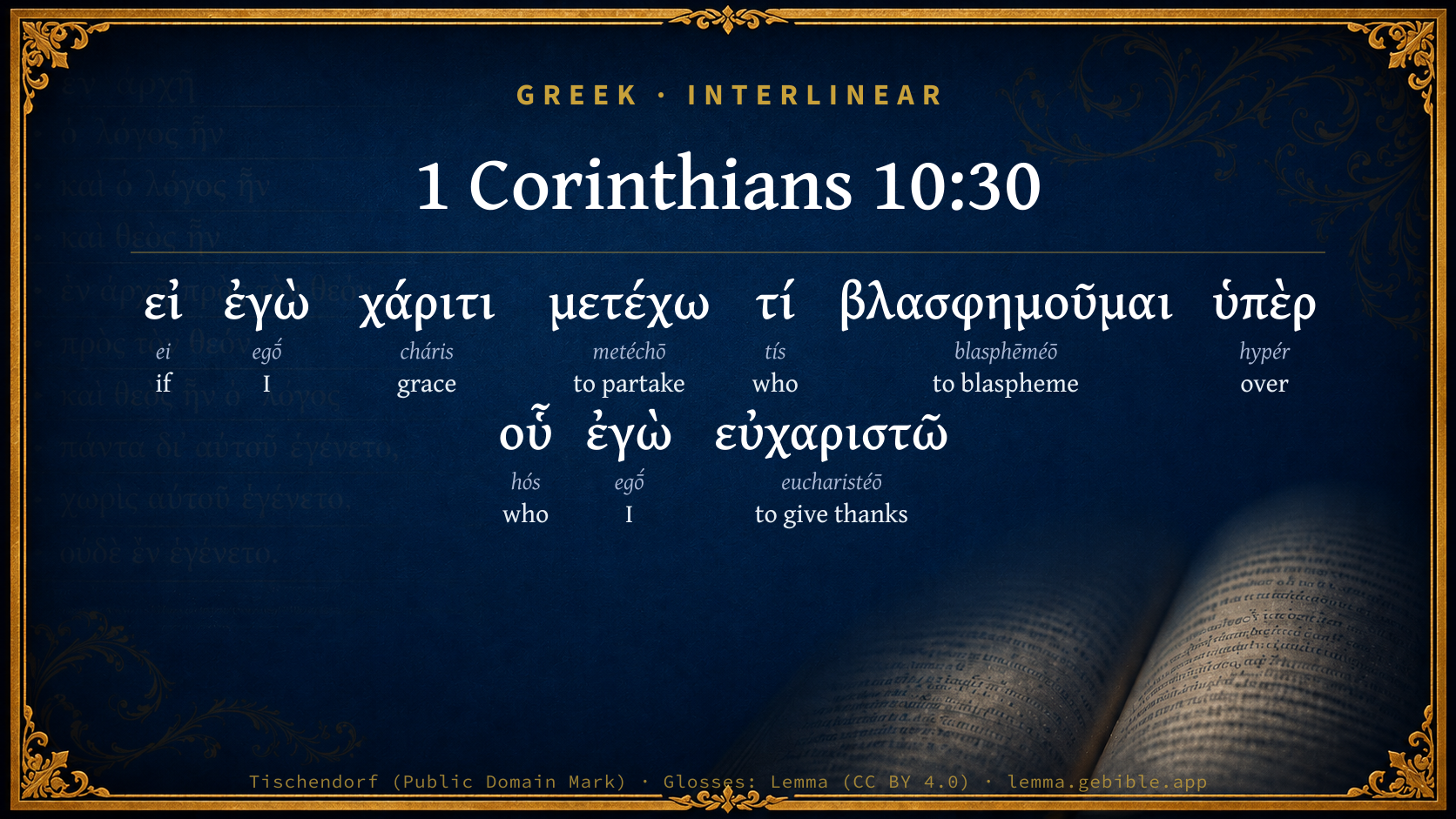
Greek (Tischendorf 8th ed.) 1 Corinthians 10:30 appears in the Greek New Testament. The text above is from the Tischendorf 8th edition. Each word links to its Strong’s number and a concise gloss. Click any word for its full Thayer’s Greek Lexicon entry.
Download image
Cite this verse

1 Corinthians 10:30 (World English Bible). Public Domain. Lemma interlinear Bible study tool, https://lemma.gebible.app/v/1-corinthians/10/30.

Show BibTeX & RIS
BibTeX
RIS
English Translation
If I partake with thankfulness, why am I denounced for that for which I give thanks?
World English Bible · Public Domain
Download a study sheet

One document with this verse’s original text, its word-by-word gloss line, the meaning frame, cross-references with their text, attributed commentary, and full source and license credits — printable, and it pastes into notes with its structure intact.

This verse Autodidact and up

Study sheet (.html) Plain text (.txt)

A passage Seminary Student

Up to 50 verses in one chapter. A passage sheet keeps up to 6 commentary sources and 12 cross-references per verse, in the order this page ranks them, and says so on the sheet whenever that leaves anything out. Ask for a single verse and you get the Autodidact verse sheet above.

Everything on this page stays free to read, with no account — the sheet is a download of what is already on screen, not access to it.

Want to remove ads? Support Godless Engineer
Compare translations 3

The same verse in 3 English versions, stacked beneath the original-language interlinear above. Click any original word for its lexicon entry.

Each is an independent rendering of the whole verse — the interlinear is not word-aligned to these translations.

Highlighted words mark where these versions differ — a whole-verse word diff, not a word-by-word alignment.

  • World English Bible Public Domain
    If I partake with thankfulness, why am I denounced for that for which I give thanks?
  • King James Version Public Domain
    For if I by grace be a partaker, why am I evil spoken of for that for which I give thanks?
  • unfoldingWord Literal Text CC BY-SA 4.0
    If I partake with gratitude, why am I insulted for that which I give thanks?

unfoldingWord Literal Text — © unfoldingWord, licensed CC BY-SA 4.0. Word-aligned USFM3 via Door43 (git.door43.org/unfoldingWord/en_ult).

Versions to compare (up to 4)

3 of 4 selected

Show all 19 translations

Every available English version of this verse, each an independent rendering of the whole verse.

  • World English Bible Public Domain
    If I partake with thankfulness, why am I denounced for that for which I give thanks?
  • Berean Standard Bible Public Domain
    If I partake in the meal with thankfulness, why am I denounced because of that for which I give thanks?
  • Majority Standard Bible Public Domain
    If I partake in the meal with thankfulness, why am I denounced because of that for which I give thanks?
  • King James Version Public Domain
    For if I by grace be a partaker, why am I evil spoken of for that for which I give thanks?
  • American Standard Version (1901) Public Domain
    If I partake with thankfulness, why am I evil spoken of for that for which I give thanks?
  • Revised Version (1885) Public Domain
    If I by grace partake, why am I evil spoken of for that for which I give thanks?
  • Geneva Bible (1599) Public Domain
    For if I through Gods benefite be partaker, why am I euill spoken of, for that wherefore I giue thankes?
  • Douay-Rheims (1899) Public Domain
    If I partake with thanksgiving, why am I evil spoken of, for that for which I give thanks?
  • Young's Literal Translation Public Domain
    and if I thankfully do partake, why am I evil spoken of, for that for which I give thanks?
  • Literal Standard Version CC BY-SA 4.0
    And if I partake thankfully, why am I spoken of [as] evil, for that for which I give thanks?
  • Unlocked Literal Bible CC BY-SA 4.0
    If I partake of the meal with gratitude, why am I being insulted for that for which I gave thanks?
  • unfoldingWord Literal Text CC BY-SA 4.0
    If I partake with gratitude, why am I insulted for that which I give thanks?
  • Darby Bible Public Domain
    If *I* partake with thanksgiving, why am I spoken evil of for what *I* give thanks for?
  • World Messianic Bible Public Domain
    If I partake with thankfulness, why am I denounced for something I give thanks for?
  • Webster's Bible Public Domain
    For if I by grace am a partaker, why am I evil spoken of for that for which I give thanks?
  • Free Bible Version CC BY-SA 4.0
    If I choose to eat with thankfulness, why should I be criticized for eating what I'm thankful to God for?
  • Bible in Basic English Public Domain
    But if I give praise to God for the food which I take, let no man say evil of me for that reason.
  • Text-Critical English NT CC BY 4.0
    If I partake with thankfulness, why should I be criticized because of something for which I give thanks?
  • Tyndale New Testament (1534) Public Domain
    For yf I take my parte with thakes: why am I evell spoken of for that thynge wherfore I geve thankes.

Literal Standard Version (2020), Covenant Press — licensed CC BY-SA 4.0. Text via the HelloAO Bible API (eBible.org). Unlocked Literal Bible (unfoldingWord) — licensed CC BY-SA 4.0. Text via the HelloAO Bible API (eBible.org). unfoldingWord Literal Text — © unfoldingWord, licensed CC BY-SA 4.0. Word-aligned USFM3 via Door43 (git.door43.org/unfoldingWord/en_ult). Free Bible Version, Dr. Jonathan Gallagher — licensed CC BY-SA 4.0. Text via the HelloAO Bible API (eBible.org).

Word by word

More ways to search: Search by grammar → Find every occurrence → Compare this word →

Practice this passage: Drill this verse → Learn its vocabulary →

About this verse

These counts appear in no published source. They are computed here, from the morphology-tagged text and Lemma’s own curated glosses. What Lemma adds →

10
words
9
distinct lemmas
Pauline Epistles
section

Notable vocabulary

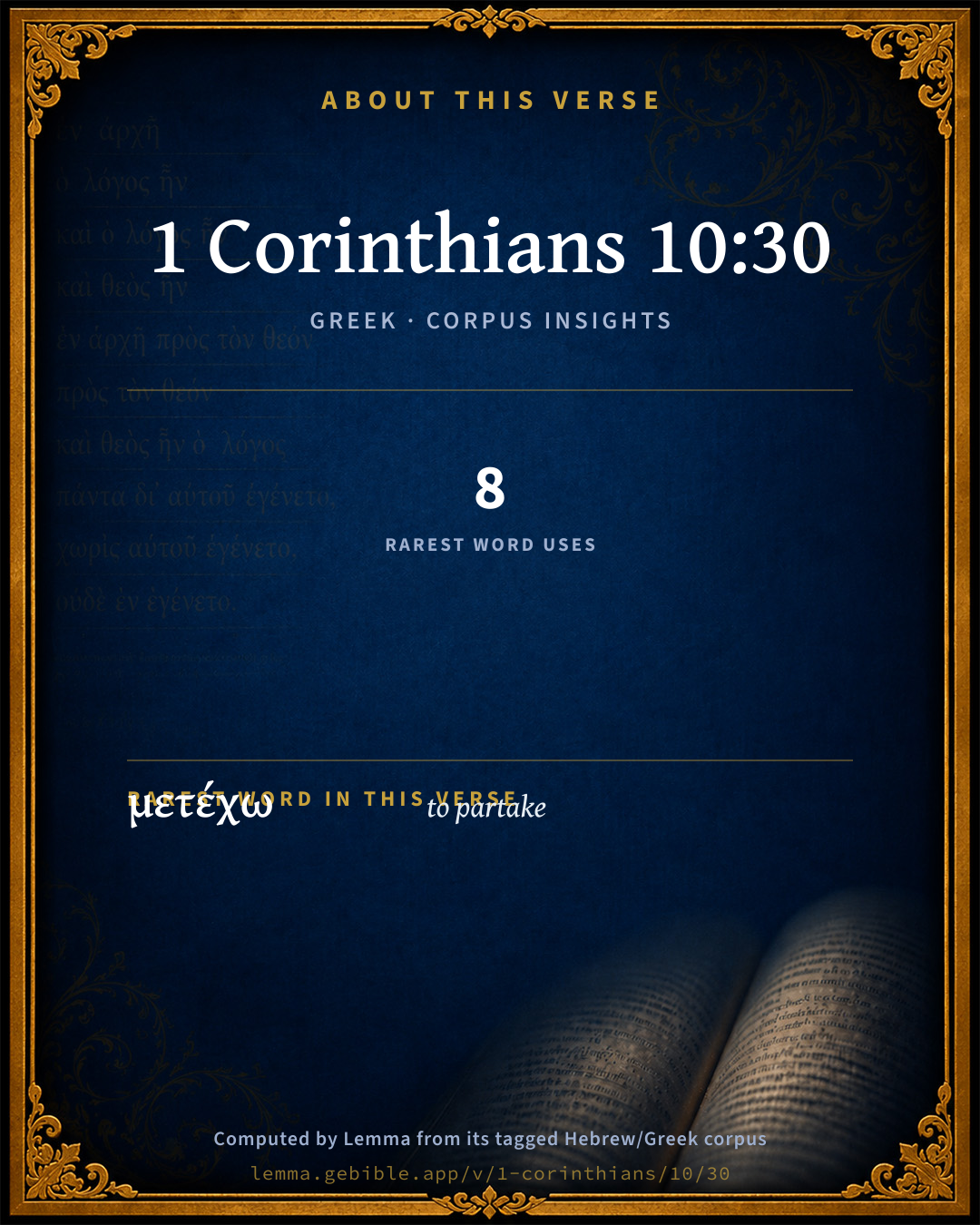
The rarest word here is μετέχω to partake G3348 — appearing just 8 times in the whole Greek New Testament.

Shared distinctive vocabulary

μετέχω to partake G3348 occurs in 8 verses of the Greek New Testament. Also found in:

Repetition

A word recurs within this verse:

Cross-references

2

Topical passages linked to 1 Corinthians 10:30 in the Treasury of Scripture Knowledge — connected by theme and wording, ordered by reader-vote popularity; previews shown in the World English Bible.

  • Romans 14:6 He who observes the day, observes it to the Lord; and he who does not observe the day, to the Lord he does not observe it. He who eats, eats to the Lord, for he gives God thanks. He who doesn't eat, to the Lord he doesn't eat, and gives God thanks.
  • 1 Timothy 4:3–4 forbidding marriage and commanding to abstain from foods which God created to be received with thanksgiving by those who believe and know the truth.

Cross-references courtesy of OpenBible.info (CC BY 4.0).

Commentary

Notes on 1 Corinthians 10:30 from classic Christian and Jewish commentators (each source and its license shown beneath its notes). The classic Christian expositions comment on the surrounding passage and are grouped to its opening verse, so a note may address several verses; the Jewish commentaries on the Tanakh (Rashi and others) are per-verse, so they appear only where the commentator wrote on this verse.

Lemma curates 59 commentaries, every one of them public domain or Creative Commons licensed, each selected and text-cleaned for this edition rather than reprinted as found. About our sources →

Whedon's Commentary on the Bible

Daniel D. Whedon

30. For—In enforcement of this view of the rights of his own conscience.

By grace—And, therefore, rightfully.

Give thanks—In a devout and conscientious spirit.

Why… evil spoken of—For I act in accordance with my own moral and religious nature.

We have given what we think to be clearly the sense of 1Co_10:28-30. But there are several other interpretations, of which we need notice but two.

1. That maintained by Stanley and others, which makes the two verses to be the objection of others, perhaps contained in the Corinthian letter, to Paul’s doctrine of compliance with the weak brother’s scruples on the ground that it is consenting to be judged by another’s conscience. The view is plausible, but it is not easy to see that the following verse (1Co_10:31) aims to be any reply to such an objection. On the contrary, the therefore seems to imply a conclusion drawn in accordance with 1Co_10:29-30.

2. The view of Alford, after Meyer, which makes 1Co_10:29 mean: For why incur by my license a condemnation from my fellow-Christian’s conscience? It makes 1Co_10:30 also say that I must not induce my good procedure to be evil spoken of. Such an interpretation accords well with the train of thought. But it cannot easily be forced upon 1Co_10:30, for that verse is clearly the utterance of one who is sure he is right, and therein ought not to be maligned by another.

Daniel D. Whedon (gen. ed.), Commentary on the Old and New Testaments (1874–1909) — public domain. Text from a community e-Sword module.

Bengel's Gnomon

Johann Albrecht Bengel

1Co 10:30. Ἐγω, I) This expression has reference to his legitimate power [See 1Co 10:23].—τί βλασφημοῦμαι, why am I evil spoken of) by him, who does not use his liberty, i.e. no man can reprove me (but βλασφημεῖν, to speak calumniously of, is even worse), as if I were acting contrary to my conscience.—ὑπὲρ οὗ, for which) i.e. why am I assailed with reproaches for my thanksgiving?—εὐχαριστῶ, I give thanks) Thanksgiving sanctifies all meat; it denies the authority of idols, and asserts the authority of God.—1Ti 4:3-4; Rom 14:6.

Bengel's Gnomon of the New Testament — English translation (T&T Clark, Edinburgh, 1860) — public domain. Text from a community e-Sword module.

Hodge's Commentary on Romans, Ephesians & First Corinthians

Charles Hodge

1Co_10:29, 1Co_10:30

Conscience, I say, not thine own, but of the other: for why is my liberty judged of another (mans) conscience? For it I by grace be a partaker, why am I evil spoken of for that for which I give thanks?

As in the preceding 1Co_10:25, 1Co_10:27 the word conscience refers to ones own conscience, to prevent its being so understood in 1Co_10:28, Paul adds the explanation, Conscience, I say, not thine own, but of the others. That is, I do not mean your conscience, but the conscience of the man who warned you not to eat. For why is my liberty judged of another mans conscience? These and the words following admit of three interpretations.

1. If connected with the preceding clause, they must give the reason why Paul meant the conscience of the other. Conscience I say, not ones own, but of the other; for why is my liberty (or conscience) to be judged by another mans conscience? if I eat with thanksgiving (and with a good conscience, why am I blamed?) The obvious objection to this interpretation is, that it exalts a subordinate clause into the principal matter. It was plain enough that Paul did not mean the mans own conscience, and therefore it is unnecessary to take up two verses to prove that he did not. Besides, this interpretation makes the apostle change sides. He has from the beginning been speaking in behalf of the weak. This interpretation makes him here speak almost in terms of indignation in behalf of the strong, who certainly need no advocate. They did not require to be told that their liberty was not to be restricted by the scruples of the weak.

2. A much better sense is obtained by connecting this passage with the 28th verse. Do not eat out of regard to the conscience of your brother; for why should my (your) liberty be judged (i.e. condemned) by another conscience; why should I be blamed for what I receive with thanksgiving? That is, why should I make such a use of my liberty as to give offense? This brings the passage into harmony with the whole context, and connects it with the main idea of the preceding verse, and not with an intermediate and subordinate clause. The very thing the apostle has in view is to induce the strong to respect the scruples of the weak. They might eat of sacrificial meat at private tables with freedom, so far as they themselves were concerned; but why, he asks, should they do it so as to give offense, and cause the weak to condemn and speak evil of them.

3. This passage is by some commentators regarded as the language of an objector, and not as that of the apostle. The strong, when told not to eat on account of the conscience of a weak brother, might ask, Why is my liberty judged by anothers conscience why should I be blamed for what I receive with thanksgiving? (The γάρ, according to this view, is not for, but intensive, ἱνατί γάρ, why then.) This gives a very good sense, but it is not consistent with the following verse (which is connected with 1Co_10:30 by οὖν, and not by δέ). Paul does not go on to answer that objection, but considers the whole matter settled. The second interpretation is the only one consistent alike with what precedes and with what follows. Do not eat when cautioned not to do so; for why should you so use your liberty as to incur censure? Whether therefore you eat or drink, do all for the glory of God. Why is my liberty judged (κρίνεται), i.e. judged unfavorably or condemned. If I by grace am a partaker; literally, if I partake with thanksgiving. The word χάρις, grace, is here used in the sense of gratia, thanks, as in the common phrase to say grace. See Luk_6:32, 1Ti_1:12, etc.

Charles Hodge — Commentary on Romans (1835), First Corinthians (1857), and Ephesians (1856) — public domain. Text from a community e-Sword module.

Geneva Bible (1599)

Geneva Bible translators

If I may through God’s benefits eat this meat, or that meat, why should I through my fault, cause that benefit of God to turn to my blame?

Geneva Bible (1599) marginal notes — public domain. Text via Bolls.life.

Jamieson, Fausset & Brown

Robert Jamieson, A. R. Fausset & David Brown

For--The oldest manuscripts omit "For."

by grace--rather, "thankfully" [ALFORD].

I . . . be partaker--I partake of the food set before me.

evil spoken of--by him who does not use his liberty, but will eat nothing without scrupulosity and questioning whence the meat comes.

give thanks--which consecrates all the Christian's acts (Rom 14:6; Ti1 4:3-4).

Jamieson, Fausset & Brown — Commentary Critical and Explanatory on the Whole Bible (1871) — public domain (CC PDM 1.0). Text via the HelloAO Bible API.

Adam Clarke's Commentary

Verse 30. 1Co 10:29

Adam Clarke's Commentary on the Bible (1810–1826) — public domain. Text from a community e-Sword/MySword module.

John Calvin's Commentaries

30. If therefore by grace. This argument is similar to the preceding one, or nearly so. “As it is owing to the kindness of God that all things are lawful for me, why should I act in such a manner, that it should be reckoned to my account as a vice?” We cannot, it is true, prevent the wicked from reviling us, nor even the weak from being sometimes displeased with us; but Paul here reproves the forwardness of those, who of their own accord give occasion of offense, and hurt weak consciences, when neither necessity or expediency calls for it. He would have us, then, make a good use of our benefits, that the weak may not have occasion of reviling from our inconsiderate use of liberty.

John Calvin's Commentaries (1540-1563) — public domain. Text from the Calvin Translation Society English edition (1840s-50s) via the Christian Classics Ethereal Library (ccel.org). Calvin's coverage is partial (roughly two-thirds of the Bible); uncommented books and verses are honest gaps, never fabricated. The 19th-century editor's footnotes and remarks are omitted so the notes are faithfully Calvin's own voice.

Ellicott's Commentary for English Readers

(30) For if I by grace be a partaker.—Better, If I thankfully partake, why am I evil spoken of for that for which I give thanks? Such a question might be asked by some who object to the restriction on their liberty which the advice just given implies. To the querulous objector the Apostle gives no definitely limited reply. He lays down in the following verses the great principles which should guide all Christian life, and by which therefore every detail of it should be regulated.

A Bible Commentary for English Readers, edited by Charles John Ellicott (1878–1897) — public domain. Text from a community e-Sword module.

The Cambridge Bible for Schools and Colleges

gen. ed. J. J. S. Perowne

30. by grace] Rather, with gratefulness.

The Cambridge Bible for Schools and Colleges (gen. ed. J. J. S. Perowne; Cambridge University Press, 1878–1918) — public domain. Text from a community e-Sword module.

John Gill's Exposition

Whether therefore ye eat or drink,.... Which may principally refer to eating things sacrificed to idols, and drinking the libations of wine offered to them, since this is the subject of the apostle's discourse; in doing of which he directs them to have the glory of God in view, and so to conduct, that that end may be answered: and it may also be applied to common eating and drinking, or to ordinary meals upon food, about which there is no dispute; and which common actions of life are done to the glory of God, when every mercy is considered and owned as coming from him; and when we confess ourselves unworthy of any; and when we ascribe all we have to the free and unmerited goodness of God; and enjoy every mercy of this kind, as a fruit of our Father's love to us, as a blessing of the covenant, and as coming to us through the blood of Christ; when we are contented and satisfied with what we have, and act faith continually on God for future fresh supplies, and give thanks for all we receive: and if this, then much more eating and drinking in an ordinance way should be directed to the glory of God and Christ, as eating the bread, and drinking the wine in the Lord's supper; and which is so done, when it is done in a decent and reverend manner, in the exercise of faith, discerning the Lord's body, eating his flesh, and drinking his blood in a spiritual manner, without dependence on the actions done, and in remembrance of the love of God and Christ.

Or whatsoever ye do; in a natural, civil, or religious respect, in preaching, hearing, praying, fasting, giving of alms, &c. whatever in the closet, in the family, in the church, or in the world, in private, or in public:

do all to the glory of God; God's glory is the end of all his works and actions; in creation, providence, and grace; in election, in the covenant, in the blessings and promises of it, in redemption, in the effectual calling, and in bringing many sons to glory. The same is the end of all Christ's actions, as man and Mediator, of his doctrines and miracles, of his obedience, sufferings, and death in this world, and of his interceding life in the other; who, as he lives to make intercession for us, lives unto God, to the glory of God; and therefore the glory of God should be the end of all our actions: besides, without this no action can be truly called a good one; if a man seeks himself, his own glory, and popular applause, or has any sinister and selfish end in view in what he does, it cannot be said, nor will it be accounted by God to be a good action. The Jews have a saying much like this, "let all thy works be done to the glory of God" (p); which one of their commentators (q) explains thus:

"even when thou art employed in eating and drinking, and in the business of life, thou shalt not design thy bodily profit, but that thou mayest be strong to do the will of thy Creator.''

(p) Pirke Abot, c. 2, sect. 12. (q) Bartenora in ib.

John Gill's Exposition of the Whole Bible (1746–1763) — public domain (CC PDM 1.0). Text via the HelloAO Bible API.

Trapp's Complete Commentary

John Trapp

30 For if I by grace be a partaker, why am I evil spoken of for that for which I give thanks?

Ver. 30. For if I by grace] Or, by thanksgiving. The same Greek word, χαρις, signifies both; to teach us, that a grateful man is a gracious man. The unthankful and the evil are set together as the same, Luk 6:35. God is "kind to the unthankful, and to the evil."

John Trapp, A Commentary or Exposition upon All the Books of the Old and New Testament (1647–1656) — public domain. Text from a community e-Sword module.

Albert Barnes' Notes on the Bible

For if I by grace be a partaker - Or rather, “If I partake by grace; if by the grace and mercy of God, I have a right to partake of this; yet why should I so conduct as to expose myself to the reproaches and evil surmises of others? Why should I lay myself open to be blamed on the subject of eating, when there are so many bounties of Providence for which I may be thankful, and which I may partake of without doing injury, or exposing myself in any manner to be blamed?”

Why am I evil spoken of - Why should I pursue such a course as to expose myself to blame or censure?

For that for which I give thanks - For my food. The phrase “for which I give thanks” seems to be a periphrasis for “food,” or for that of which he partook to nourish life. It is implied that he always gave thanks for his food; and that this was with him such a universal custom, that the phrase “for which I give thanks” might be used as convenient and appropriate phraseology to denote his ordinary food. The idea in the verse, then, is this: “By the favor of God, I have a right to partake of this food. But if I did, I should be evil spoken of, and do injury. And it is unnecessary. God has made ample provision elsewhere for my support, for which I may be thankful. I will not therefore expose myself to calumny and reproach, or be the occasion of injury to others by partaking of the food offered in sacrifice to idols.”

Albert Barnes' Notes on the Bible (1834–1885) — public domain. Text from a community e-Sword/MySword module.

Matthew Poole's English Annotations

If I by grace be a partaker; if I by the goodness of God, whose the earth is, and the fulness thereof; or by the grace of knowledge, by which God hath given me to understand that I may do that, as to which others less knowing stumble; can eat such meat (out of the idol’s temple) as part of it hath been offered to the idol, or with thanksgiving partake of such meat, (for so χαρις signifies, Luk 6:32; 17:9), why am I blasphemed, or evil spoken of, for that for which I can give God thanks? That is, I ought not to cause another to speak evil of me for using of meat, but rather than run that danger, to abstain from such meat which I could otherwise eat of, and give God thanks: for in so doing I should but abuse my liberty, and instead of giving God thanks, I should grievously offend God, not at all consulting his glory.

Matthew Poole's English Annotations on the Holy Bible (1683–1685) — public domain. Text from a community e-Sword/MySword module.

The Pulpit Commentary

For if I The "for" should be omitted. There is no copula in the best manuscripts. By grace. The word may also mean "with thankfulness" Rom_14:6. "He that eateth, to the Lord he eateth, for he giveth God thanks;. 1Ti_4:3, "Meats which God hath created to be received with thanksgiving;" compare our phrase," saying". (grace) Another view of these clauses interprets them to mean "You should refrain because, by net doing so, you give occasion to others to judge you a rule which has been compared with Rom_14:16, "Let not your good be evil spoken of." Whichever view be taken, it is clear that theoretically St. Paul sided with the views of the "strong," but sympathetically with those of the "weak." He pleaded for some concession to the scrupulosity of ever morbid consciences, he disapproved of a defiant, ostentatious, insulting liberalism. On the other hand, he discouraged the miserable micrology of a purblind and bigoted superstition, which exaggerated the importance of things external and indifferent. He desiderated more considerateness and self denial on the one side; and on the other, a more robust and instructed faith, he would always tolerate the scruples of the weak, but would not suffer either weakness or strength to develop itself into a vexatious tyranny.

The Pulpit Commentary (1880–1919), ed. H.D.M. Spence-Jones & Joseph S. Exell — public domain. Text from a community e-Sword module.

John Wesley's Explanatory Notes

If I by grace am a partaker - If I thankfully use the common blessings of God.

John Wesley, Explanatory Notes Upon the Whole Bible (1754–1765) — public domain. Text via the GEBible commentary corpus.

McGarvey & Pendleton's Commentaries

J. W. McGarvey

If I partake with thankfulness, why am I evil spoken of for that for which I give thanks? [The conscience of another man does not make it wrong for me to do that which I am not only permitted to do by my own conscience, but which I even do in a spirit of prayerful thankfulness. Nor does my doing such a thing give him, or any other, a right to speak evil of me, for I do not have to change my conscience to suit the judgment of others. In theory Paul sided with the strong, but in sympathy he was one with the weak; yet he did not permit them to exercise a vexatious tyranny over him because of their scruples.]

J. W. McGarvey (with Philip Y. Pendleton), Commentaries on the New Testament (The Fourfold Gospel, 1914; Acts; and the epistles) — public domain. Text from a community e-Sword/MySword module.

The People's New Testament

B. W. Johnson

30. For, if I by grace be a partaker, etc. If by God's gift I partake with thanksgiving to him, there should be no reproach.

B. W. Johnson's The People's New Testament with Notes (1889–1891) — public domain. Electronic text from the Christian Classics Ethereal Library (CCEL) ThML edition.

Cambridge Greek Testament for Schools and Colleges

30. χάριτι. In a thankful spirit.

βλασφημοῦμαι. The word means originally to speak ill of, to slander. So in ch. 1Co 4:13.

Cambridge Greek Testament for Schools and Colleges (Cambridge University Press, 1896; 21 vols, various authors incl. Carr, Maclear, Plummer, Farrar, Lumby, Moule, M. R. James, Simcox) — public domain. Text from a community e-Sword module.

International Critical Commentary

30. εἰ ἐγὼ χάριτι μετέχω. ‘If I with thanksgiving partake, why do I receive reviling about that for which I give thanks?’ This suggests, if it does not imply, that one’s being able to thank God for it is evidence that the enjoyment is innocent. One cannot thank God for a pleasure which one knows to be wrong. The connexion between χάριτι and εὐχαριστῶ should be preserved in translation. Apparently both refer to grace at meals, and the meaning is that all food, whether sacrificial or not, is sanctified, ‘if it be received with thanksgiving,’ μετὰ εὐχαριστίας, ἁγιάζεται γὰρ διὰ λόγου Θεοῦ καὶ ἐντεύξεως (1Ti 4:4). Evans translates, ‘If I with grace said have meat with others, why am I evil spoken of for having meat for which I have said grace?’ AV. and RV. render χάριτι ‘by grace,’ which means ‘by God’s grace’ (15:10), either His grace in providing food, or His grace in enlightening the conscience (Chrys.). So also Calvin; quum Dei beneficium sit, quad omnia mihi licent. But this is less likely than ‘thanksgiving.’ See Ellicott.

The δέ between εἰ and ἐγώ (C D 3 E H K L., Syrr.) may be safely omitted (א B D* F G P, Latt.). AV. has ‘For,’ which has no authority. No connecting particle is required, and δέ interrupts the sense. In any case ἐγώ is emphatic, ‘If I for my part.’ For χάριτι without the article cf. Eph 2:5; Heb 2:9, Heb 13:9.

International Critical Commentary — older volumes (1896–1929), various authors — public domain. Text from a community e-Sword module.

Vincent's Word Studies in the New Testament

Marvin R. Vincent

By grace [χαριτι] . Better, as Rev., in margin, with thankfulness : with an unsullied conscience, so that I can sincerely give thanks for my food. Compare Rom 14:6; 1Ti 4:4, 5, Am I evil - spoken of [βλασφημουμαι] . In the gospels this word, of which blaspheme is a transcript, has, as in the Septuagint, the special sense of treating the name of God with scorn. So Mt 9:3; Mt 26:65; Joh 10:36. In the epistles frequently as here, with the classical meaning of slandering or defaming.

Marvin R. Vincent, Word Studies in the New Testament (1887–1900) — public domain. Text from a community e-Sword/MySword module.

Godet's Commentaries

Frédéric Louis Godet

Vv. 30. “If I with thanksgiving be a partaker, why am I evil spoken of for that for which I give thanks?”

The asyndeton of itself proves that this verse reaffirms and explains the idea of the foregoing. It brings out still more forcibly the absurdity of the strong Christian’s conduct by the revolting contradiction which would arise between the thanksgiving with which he partakes of the food offered to him, and the wounding of the conscience testified by the blame of the weak. What! that for which a believer gives thanks, the other converts into a ground of defamation against him! This is what is expressed by the word βλασφημεῖν. “What sort of religion is that?” the heathen would say, who were witnesses of both actions. The apostle concludes by stating generally the principle which, in such matters of Christian liberty, ought to be the supreme guide of the believer’s conduct:

Frédéric Louis Godet — Commentaries on Luke, John, Romans, and 1 Corinthians — English translation (T&T Clark, Edinburgh, 1870s–1890s) — public domain. Text from a community e-Sword module.

Lesson kit

Teaching starters — assembled from the data on this page, not authored interpretation. Every prompt links to the verse data it draws on. Edit before teaching.

1 Corinthians, in the Pauline Epistles, opens this verse with 10 words (9 distinct Greek lemmas). Its most distinctive word is metéchō (“to partake”). A historical commentator’s framing appears above. Read the whole chapter for the surrounding context.

Discussion questions

  1. How does “to partake” (metéchō) shape what this verse is saying?
  2. How does 1 Corinthians 9:10, which shares the word «to partake», read alongside this verse?
  3. What does the repetition of “I” (2× in this one verse) do in this verse?
  4. These translations render this verse differently; the difference is in the English rendering, not the original. What questions does that raise?
  5. Compare how Whedon's Commentary on the Bible and Bengel's Gnomon read this verse. Where do they agree or differ?

Things to notice

  • These translations choose different wording for 9 words in this verse.
  • “I” occurs 2× in this single verse.
  • 9 distinct Greek lemmas span 10 words in this verse.

Reading settings

Reading text

Shown beneath each verse's original-language words.

Old Testament
Old Testament edition

Read the OT as the Masoretic Hebrew (MT) or the Greek Septuagint (LXX).

English shown for the Greek Septuagint (in the Hebrew ↔ Greek comparison).

Comparing translations? Open the Compare panel on any verse page to stack up to four side by side.