Romans 6:17

Greek (Tischendorf 8th ed.) Romans 6:17 appears in the Greek New Testament. The text above is from the Tischendorf 8th edition. Each word links to its Strong’s number and a concise gloss. Click any word for its full Thayer’s Greek Lexicon entry.
Download image
Cite this verse

Romans 6:17 (World English Bible). Public Domain. Lemma interlinear Bible study tool, https://lemma.gebible.app/v/romans/6/17.

Show BibTeX & RIS
BibTeX
RIS
English Translation
But thanks be to God, that, whereas you were bondservants of sin, you became obedient from the heart to that form of teaching whereunto you were delivered.
World English Bible · Public Domain
Download a study sheet

One document with this verse’s original text, its word-by-word gloss line, the meaning frame, cross-references with their text, attributed commentary, and full source and license credits — printable, and it pastes into notes with its structure intact.

This verse Autodidact and up

Study sheet (.html) Plain text (.txt)

A passage Seminary Student

Up to 50 verses in one chapter. A passage sheet keeps up to 6 commentary sources and 12 cross-references per verse, in the order this page ranks them, and says so on the sheet whenever that leaves anything out. Ask for a single verse and you get the Autodidact verse sheet above.

Everything on this page stays free to read, with no account — the sheet is a download of what is already on screen, not access to it.

Want to remove ads? Support Godless Engineer
Compare translations 3

The same verse in 3 English versions, stacked beneath the original-language interlinear above. Click any original word for its lexicon entry.

Each is an independent rendering of the whole verse — the interlinear is not word-aligned to these translations.

Highlighted words mark where these versions differ — a whole-verse word diff, not a word-by-word alignment.

  • World English Bible Public Domain
    But thanks be to God, that, whereas you were bondservants of sin, you became obedient from the heart to that form of teaching whereunto you were delivered.
  • King James Version Public Domain
    But God be thanked, that ye were the servants of sin, but ye have obeyed from the heart that form of doctrine which was delivered you.
  • unfoldingWord Literal Text CC BY-SA 4.0
    But thanks to God that you were slaves of sin, but you listened from the heart to the pattern of teaching that you were given over to.

unfoldingWord Literal Text — © unfoldingWord, licensed CC BY-SA 4.0. Word-aligned USFM3 via Door43 (git.door43.org/unfoldingWord/en_ult).

Versions to compare (up to 4)

3 of 4 selected

Show all 19 translations

Every available English version of this verse, each an independent rendering of the whole verse.

  • World English Bible Public Domain
    But thanks be to God, that, whereas you were bondservants of sin, you became obedient from the heart to that form of teaching whereunto you were delivered.
  • Berean Standard Bible Public Domain
    But thanks be to God that, though you once were slaves to sin, you wholeheartedly obeyed the form of teaching to which you were committed.
  • Majority Standard Bible Public Domain
    But thanks be to God that, though you once were slaves to sin, you wholeheartedly obeyed the form of teaching to which you were committed.
  • King James Version Public Domain
    But God be thanked, that ye were the servants of sin, but ye have obeyed from the heart that form of doctrine which was delivered you.
  • American Standard Version (1901) Public Domain
    But thanks be to God, that, whereas ye were servants of sin, ye became obedient from the heart to that form of teaching whereunto ye were delivered;
  • Revised Version (1885) Public Domain
    But thanks be to God, that, whereas ye were servants of sin, ye became obedient from the heart to that form of teaching whereunto ye were delivered;
  • Geneva Bible (1599) Public Domain
    But God be thanked, that ye haue beene the seruants of sinne, but yee haue obeyed from the heart vnto the forme of the doctrine, wherunto ye were deliuered.
  • Douay-Rheims (1899) Public Domain
    But thanks be to God, that you were the servants of sin, but have obeyed from the heart, unto that form of doctrine, into which you have been delivered.
  • Young's Literal Translation Public Domain
    and thanks to God, that ye were servants of the sin, and -- were obedient from the heart to the form of teaching to which ye were delivered up;
  • Literal Standard Version CC BY-SA 4.0
    And thanks to God, that you were servants of sin, and—were obedient from the heart to the form of teaching to which you were delivered up;
  • Unlocked Literal Bible CC BY-SA 4.0
    But thanks be to God! For you were slaves of sin, but you have obeyed from the heart the pattern of teaching that you were given.
  • unfoldingWord Literal Text CC BY-SA 4.0
    But thanks to God that you were slaves of sin, but you listened from the heart to the pattern of teaching that you were given over to.
  • Darby Bible Public Domain
    But thanks [be] to God, that ye were bondmen of sin, but have obeyed from the heart the form of teaching into which ye were instructed.
  • World Messianic Bible Public Domain
    But thanks be to God that, whereas you were bondservants of sin, you became obedient from the heart to that form of teaching to which you were delivered.
  • Webster's Bible Public Domain
    But God be thanked, that ye were the servants of sin; but ye have obeyed from the heart that form of doctrine which was delivered you.
  • Free Bible Version CC BY-SA 4.0
    Thank God that though you once were slaves to sin, you whole-heartedly chose to follow the truth about God that you learned.
  • Bible in Basic English Public Domain
    But praise be to God that though you were the servants of sin, you have now given yourselves freely to that form of teaching under which you were placed;
  • Text-Critical English NT CC BY 4.0
    But thanks be to God that, though you were slaves of sin, you have become obedient from the heart to the pattern of teaching to which you were entrusted,
  • Tyndale New Testament (1534) Public Domain
    God be thanked that though ye were once the servauntes of synne ye have yet obeyed with herte vnto the forme of doctryne wher vnto ye were delyvered.

Literal Standard Version (2020), Covenant Press — licensed CC BY-SA 4.0. Text via the HelloAO Bible API (eBible.org). Unlocked Literal Bible (unfoldingWord) — licensed CC BY-SA 4.0. Text via the HelloAO Bible API (eBible.org). unfoldingWord Literal Text — © unfoldingWord, licensed CC BY-SA 4.0. Word-aligned USFM3 via Door43 (git.door43.org/unfoldingWord/en_ult). Free Bible Version, Dr. Jonathan Gallagher — licensed CC BY-SA 4.0. Text via the HelloAO Bible API (eBible.org).

Word by word

More ways to search: Search by grammar → Find every occurrence → Compare this word →

Practice this passage: Drill this verse → Learn its vocabulary →

τύπον
týpos
G5179
“type”
Noun, Accusative, Singular, Masculine
Part of Speech
Noun
Case
Accusative
Number
Singular
Gender
Masculine
Full Thayer's Definition

Origin: from G5180

TDNT: 12:06,1

1. the mark of a stroke or blow, print 2. a figure formed by a blow or impression a. of a figure or image b. of the image of the gods 3. form a. the teaching which embodies the sum and substance of religion and represents it to the mind, manner of writing, the contents and form of a letter 4. an example a. in the technical sense, the pattern in conformity to which a thing must be made b. in an ethical sense, a dissuasive example, a pattern of warning 1. of ruinous events which serve as admonitions or warnings to others c. an example to be imitated 1. of men worthy of imitation d. in a doctrinal sense 1. of a type i.e. a person or thing prefiguring a future (Messianic) person or thing
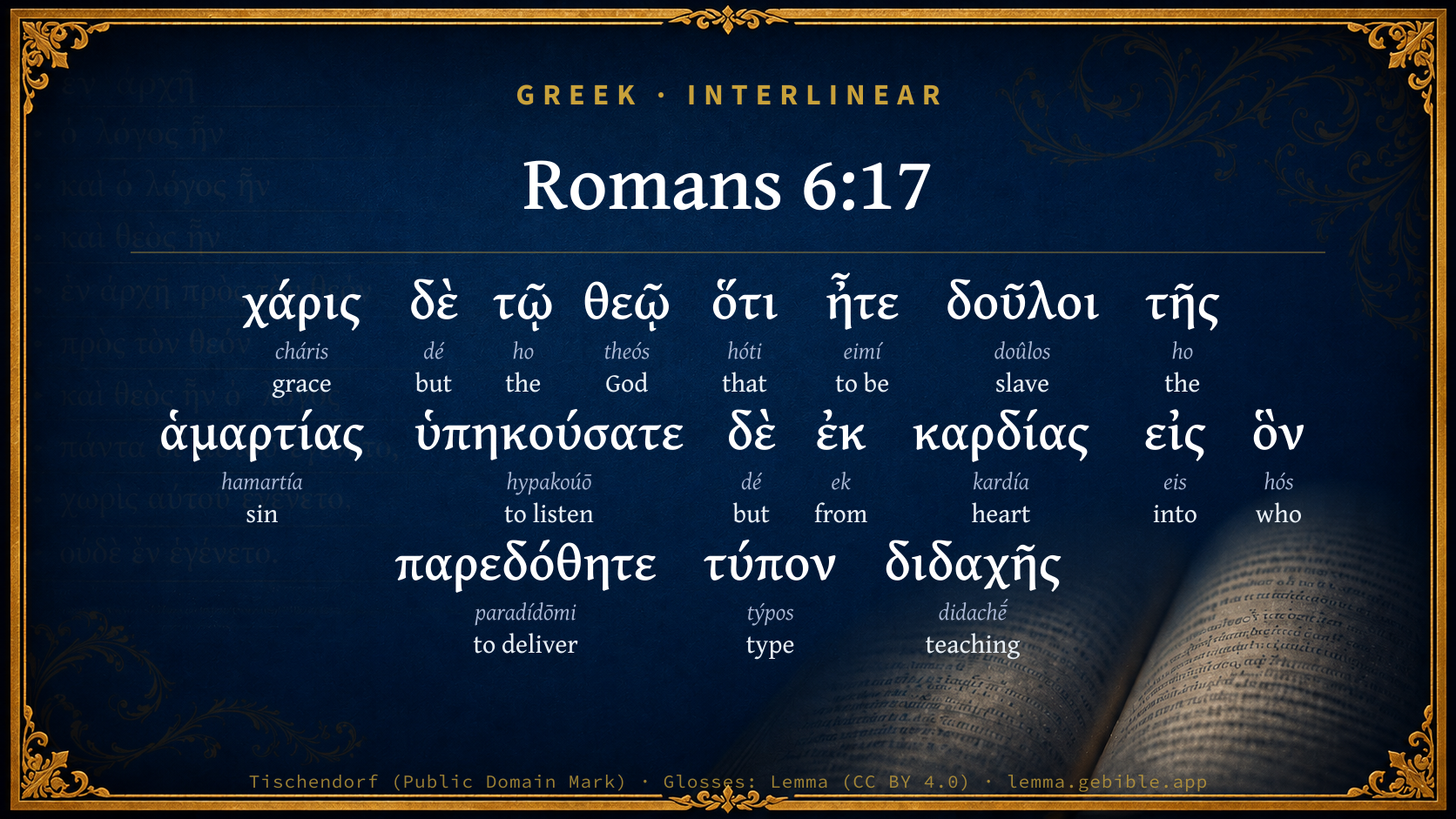
  1. χάρις cháris G5485 “grace” Noun, Nominative, Singular, Feminine
  2. δὲ dé G1161 “but” Conjunction
  3. τῷ ho G3588 “the” Article, Dative, Singular, Masculine
  4. θεῷ theós G2316 “God” Noun, Dative, Singular, Masculine
  5. ὅτι hóti G3754 “that” Conjunction
  6. ἦτε eimí G1510 “to be” Verb, Imperfect, Active, Indicative, 2nd person, Plural
  7. δοῦλοι doûlos G1401 “slave” Noun, Nominative, Plural, Masculine
  8. τῆς ho G3588 “the” Article, Genitive, Singular, Feminine
  9. ἁμαρτίας hamartía G266 “sin” Noun, Genitive, Singular, Feminine
  10. ὑπηκούσατε hypakoúō G5219 “to listen” Verb, Aorist, Active, Indicative, 2nd person, Plural
  11. δὲ dé G1161 “but” Conjunction
  12. ἐκ ek G1537 “from” Preposition
  13. καρδίας kardía G2588 “heart” Noun, Genitive, Singular, Feminine
  14. εἰς eis G1519 “into” Preposition
  15. ὃν hós G3739 “who” Relative pronoun, Accusative, Singular, Masculine
  16. παρεδόθητε paradídōmi G3860 “to deliver” Verb, Aorist, Passive, Indicative, 2nd person, Plural
  17. διδαχῆς didachḗ G1322 “teaching” Noun, Genitive, Singular, Feminine

About this verse

These counts appear in no published source. They are computed here, from the morphology-tagged text and Lemma’s own curated glosses. What Lemma adds →

18
words
16
distinct lemmas
Pauline Epistles
section

Notable vocabulary

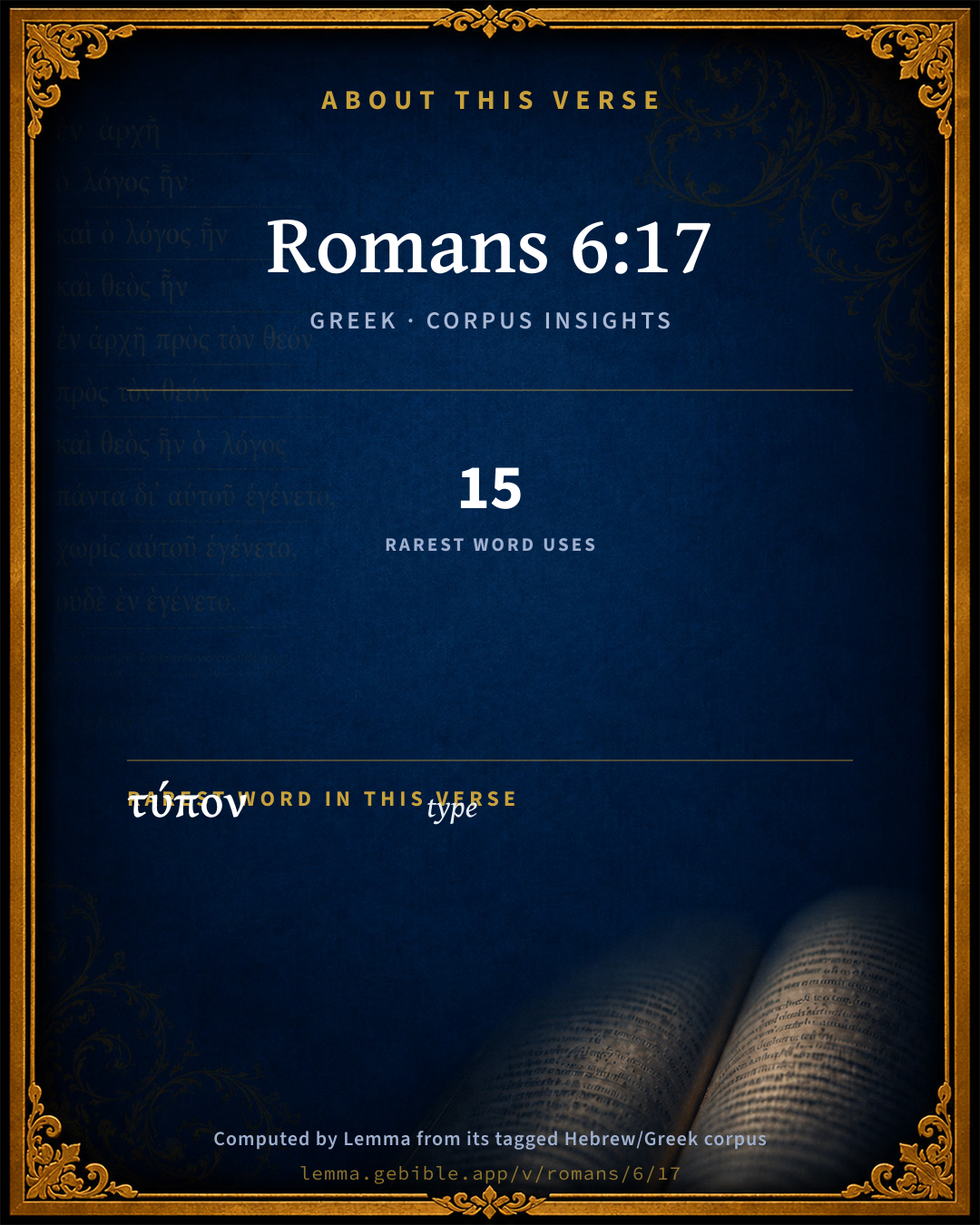
The rarest word here is τύπον type G5179 — appearing just 15 times in the whole Greek New Testament.

Shared distinctive vocabulary

τύπον type G5179 occurs in 15 verses of the Greek New Testament. Also found in:

Repetition

Words recur within this verse:

Cross-references

36

Topical passages linked to Romans 6:17 in the Treasury of Scripture Knowledge — connected by theme and wording, ordered by reader-vote popularity; previews shown in the World English Bible.

  • 1 Peter 2:9 But you are a chosen race, a royal priesthood, a holy nation, a people for God's own possession, that you may show forth the excellencies of him who called you out of darkness into his marvelous light:
  • 2 Corinthians 2:14 Now thanks be to God, who always leads us in triumph in Christ, and reveals through us the sweet aroma of his knowledge in every place.
  • 2 Timothy 1:13 Hold the pattern of sound words which you have heard from me, in faith and love which is in Christ Jesus.
  • Romans 1:8 First, I thank my God through Jesus Christ for all of you, that your faith is proclaimed throughout the whole world.
  • Romans 16:26
  • Ephesians 2:5–10 even when we were dead through our trespasses, made us alive together with Christ (by grace you have been saved),
  • 3 John 1:3 For I rejoiced greatly, when brothers came and testified about your truth, even as you walk in truth.
  • Acts 11:18 When they heard these things, they held their peace, and glorified God, saying, "Then God has also granted to the Gentiles repentance to life!"
  • Romans 15:18 For I will not dare to speak of any things except those which Christ worked through me, for the obedience of the Gentiles, by word and deed,
  • Philemon 1:4 I thank my God always, making mention of you in my prayers,
  • Hebrews 5:9 Having been made perfect, he became to all of those who obey him the author of eternal salvation,
  • 1 Peter 4:17 For the time has come for judgment to begin at the house of God. If it begins first with us, what will happen to those who don't obey the Gospel of God?
  • 2 John 1:4 I rejoice greatly that I have found some of your children walking in truth, even as we have been commanded by the Father.
  • Philippians 1:3–5 I thank my God whenever I remember you,
  • Colossians 1:3–4 We give thanks to God the Father of our Lord Jesus Christ, praying always for you,
  • 1 Thessalonians 1:2–3 We always give thanks to God for all of you, mentioning you in our prayers,
  • 2 Thessalonians 1:3 We are bound to always give thanks to God for you, brothers, even as it is appropriate, because your faith grows exceedingly, and the love of each and every one of you towards one another abounds;
  • 1 Timothy 1:13–16 although I was before a blasphemer, a persecutor, and insolent. However, I obtained mercy, because I did it ignorantly in unbelief.
  • 2 Timothy 1:3–5 I thank God, whom I serve as my forefathers did, with a pure conscience. How unceasing is my memory of you in my petitions, night and day
  • Titus 3:3–7 For we were also once foolish, disobedient, deceived, serving various lusts and pleasures, living in malice and envy, hateful, and hating one another.
  • 1 Peter 4:2–5 that you no longer should live the rest of your time in the flesh for the lusts of men, but for the will of God.
  • 1 Chronicles 29:12–16 Both riches and honor come of you, and you rule over all; and in your hand is power and might; and it is in your hand to make great, and to give strength to all.
  • Ezra 7:27 Blessed be Yahweh, the God of our fathers, who has put such a thing as this in the king's heart, to beautify the house of Yahweh which is in Jerusalem;
  • Psalms 18:44 As soon as they hear of me they shall obey me. The foreigners shall submit themselves to me.
  • Matthew 11:25–26 At that time, Jesus answered, "I thank you, Father, Lord of heaven and earth, that you hid these things from the wise and understanding, and revealed them to infants.
  • Romans 1:5 through whom we received grace and apostleship, for obedience of faith among all the nations, for his name's sake;
  • 1 Corinthians 1:4 I always thank my God concerning you, for the grace of God which was given you in Christ Jesus;
  • 1 Corinthians 6:9–11 Or don't you know that the unrighteous will not inherit the Kingdom of God? Don't be deceived. Neither the sexually immoral, nor idolaters, nor adulterers, nor male prostitutes, nor homosexuals,
  • 2 Corinthians 10:5–6 throwing down imaginations and every high thing that is exalted against the knowledge of God, and bringing every thought into captivity to the obedience of Christ;
  • Ephesians 1:16 don't cease to give thanks for you, making mention of you in my prayers,
  • 1 Thessalonians 3:9 For what thanksgiving can we render again to God for you, for all the joy with which we rejoice for your sakes before our God;
  • Hebrews 11:8 By faith, Abraham, when he was called, obeyed to go out to the place which he was to receive for an inheritance. He went out, not knowing where he went.
  • 1 Peter 1:22 Seeing you have purified your souls in your obedience to the truth through the Spirit in sincere brotherly affection, love one another from the heart fervently:
  • 1 Peter 3:1 In like manner, wives, be in subjection to your own husbands; so that, even if any don't obey the Word, they may be won by the behavior of their wives without a word;
  • Acts 28:15 From there the brothers, when they heard of us, came to meet us as far as The Market of Appius and The Three Taverns. When Paul saw them, he thanked God, and took courage.
  • Romans 2:8 but to those who are self-seeking, and don't obey the truth, but obey unrighteousness, will be wrath and indignation,

Cross-references courtesy of OpenBible.info (CC BY 4.0).

Commentary

Notes on Romans 6:17 from classic Christian and Jewish commentators (each source and its license shown beneath its notes). The classic Christian expositions comment on the surrounding passage and are grouped to its opening verse, so a note may address several verses; the Jewish commentaries on the Tanakh (Rashi and others) are per-verse, so they appear only where the commentator wrote on this verse.

Lemma curates 59 commentaries, every one of them public domain or Creative Commons licensed, each selected and text-cleaned for this edition rather than reprinted as found. About our sources →

MacLaren's Expositions of Holy Scripture

Alexander MacLaren

Romans

‘THE FORM OF TEACHING’

Rom 6:17.

There is room for difference of opinion as to what Paul precisely means by ‘form’ here. The word so rendered appears in English as type, and has a similar variety of meaning. It signifies originally a mark made by pressure or impact; and then, by natural transitions, a mould, or more generally a pattern or example, and then the copy of such an example or pattern, or the cast from such a mould. It has also the other meaning which its English equivalent has taken on very extensively of late years, such as, for instance, you find in expressions like ‘An English type of face,’ meaning thereby the general outline which preserves the distinguishing characteristics of a thing. Now we may choose between these two meanings in our text. If the Apostle means type in the latter sense of the word, then the rendering ‘form’ is adequate, and he is thinking of the Christian teaching which had been given to the Roman Christians as possessing certain well-defined characteristics which distinguished it from other kinds of teaching-such, for instance, as Jewish or heathen.

But if we take the other meaning, then he is, in true Pauline fashion, bringing in a vivid and picturesque metaphor to enforce his thought, and is thinking of the teaching which the Roman Christians had received as being a kind of mould into which they were thrown, a pattern to which they were to be conformed. And that that is his meaning seems to me to be made a little more probable by the fact that the last words of my text would be more accurate if inverted, and instead of reading, as the Authorised Version does, ‘that form of doctrine which was delivered you,’ we were to read, as the Revised Version does, ‘that form whereunto ye were delivered.’

If this be the general meaning of the words before us, there are three thoughts arising from them to which I turn briefly. First, Paul’s Gospel was a definite body of teaching; secondly, that teaching is a mould for conduct and character; lastly, that teaching therefore demands obedience. Take, then, these three thoughts.

I. First, Paul’s Gospel was a definite body of teaching.

Now the word ‘doctrine,’ which is employed in my text, has, in the lapse of years since the Authorised Version was made, narrowed its significance. At the date of our Authorised translation ‘doctrine’ was probably equivalent to ‘teaching,’ of whatever sort it might be. Since then it has become equivalent to a statement of abstract principles, and that is not at all what Paul means. He does not mean to say that his gospel was a form of doctrine in the sense of being a theological system, but he means to say that it was a body of teaching, the nature of the teaching not being defined at all by the word.

Therefore we have to notice that the great, blessed peculiarity of the Gospel is that it is a teaching, not of abstract dry principles, but of concrete historical facts. From these principles in plenty may be gathered, but in its first form as it comes to men fresh from God it is not a set of propositions, but a history of deeds that were done upon earth. And, therefore, is it fitted to be the food of every soul and the mould of every character.

Jesus Christ did not come and talk to men about God, and say to them what His Apostles afterwards said, ‘God is love,’ but He lived and died, and that mainly was His teaching about God. He did not come to men and lay down a theory of atonement or a doctrine of propitiation, or theology about sin and its relations to God, but He went to the Cross and gave Himself for us, and that was His teaching about sacrifice. He did not say to men ‘There is a future life, and it is of such and such a sort,’ but He came out of the grave and He said ‘Touch Me, and handle Me. A spirit hath not flesh and bones,’ and therefore He brought life and immortality to light, by no empty words but by the solid realities of facts. He did not lecture upon ethics, but He lived a perfect human life out of which all moral principles that will guide human conduct may be gathered. And so, instead of presenting us with a hortus siccus, with a botanic collection of scientifically arranged and dead propositions, He led us into the meadow where the flowers grow, living and fair. His life and death, with all that they imply, are the teaching.

Let us not forget, on the other hand, that the history of a fact is not the mere statement of the outward thing that has happened. Suppose four people, for instance, standing at the foot of Christ’s Cross; four other ‘evangelists’ than the four that we know. There is a Roman soldier; there is a Pharisee; there is one of the weeping crowd of poor women, not disciples; and there is a disciple. The first man tells the fact as he saw it: ‘A Jewish rebel was crucified this morning.’ The second man tells the fact: ‘A blaspheming apostate suffered what he deserved to-day.’ The woman tells the fact: ‘A poor, gentle, fair soul was martyred to-day.’ And the fourth one tells the fact: ‘Jesus Christ, the Son of God, died for our sins.’ The three tell the same fact; the fourth preaches the Gospel-that is to say, Christian teaching is the facts plus their explanation; and it is that which differentiates it from the mere record which is of no avail to anybody. So Paul himself in one of his other letters puts it. This is his gospel: Jesus of Nazareth ‘died for our sins according to the Scriptures, and He was buried, and rose again the third day, according to the Scriptures.’ That is what turns the bald story of the facts into teaching, which is the mould for life.

So on the one hand, dear brethren, do not let us fall into the superficial error of fancying that our religion is a religion of emotion and morality only. It is a religion with a basis of divine truth, which, being struck away, all the rest goes. There is a revolt against dogma to-day, a revolt which in large measure is justified as an essential of progress, and in large measure as an instance of progress; but human nature is ever prone to extremes, and in the revolt from man’s dogma there is danger of casting away God’s truth. Christianity is not preserved when we hold by the bare facts of the outward history, unless we take with these facts the interpretation of them, which declares the divinity and the sacrifice of the Son of God.

And on the other hand, let us keep very clear in our minds the broad and impassable gulf of separation between the Christian teaching as embodied in the Scripture and the systems which Christianity has evolved therefrom. Men’s intellects must work upon the pabulum that is provided for them, and a theology in a systematised form is a necessity for the intellectual and reasonable life of the Christian Church. But there is all the difference between man’s inferences from and systematising of the Christian truth and the truth that lies here. The one is the golden roof that is cast over us; the other is too often but the spiders’ webs that are spun across and darken its splendour. It is a sign of a wholesome change in the whole sentiment and attitude of the modern Christian mind that the word ‘doctrine,’ which has come to mean men’s inferences from God’s truth, should have been substituted as it has been in our Revised Version of my text, by the wholesome Christian word ‘teaching.’ The teaching is the facts with the inspired commentary on them.

II. Secondly, notice that this teaching is in Paul’s judgment a mould or pattern according to which men’s lives are to be conformed.

There can be no question but that, in that teaching as set forth in Scripture, there does lie the mightiest formative power for shaping our lives, and emancipating us from our evil.

Christ is the type, the mould into which men are to be cast. The Gospel, as presented in Scripture, gives us three things. It gives us the perfect mould; it gives us the perfect motive; it gives us the perfect power. And in all three things appears its distinctive glory, apart from and above all other systems that have ever tried to affect the conduct or to mould the character of man.

In Jesus Christ we have in due combination, in perfect proportion, all the possible excellences of humanity. As in other cases of perfect symmetry, the very precision of the balanced proportions detracts from the apparent magnitude of the statue or of the fair building, so to a superficial eye there is but little beauty there that we should desire Him, but as we learn to know Him, and live nearer to Him, and get more familiar with all His sweetness, and with all His power, He towers before us in ever greater and yet never repellent or exaggerated magnitude, and never loses the reality of His brotherhood in the completeness of His perfection. We have in the Christ the one type, the one mould and pattern for all striving, the ‘glass of form,’ the perfect Man.

And that likeness is not reproduced in us by pressure or by a blow, but by the slow and blessed process of gazing until we become like, beholding the glory until we are changed into the glory.

It is no use having a mould and metal unless you have a fire. It is no use having a perfect Pattern unless you have a motive to copy it. Men do not go to the devil for want of examples; and morality is not at a low ebb by reason of ignorance of what the true type of life is. But nowhere but in the full-orbed teaching of the New Testament will you find a motive strong enough to melt down all the obstinate hardness of the ‘northern iron’ of the human will, and to make it plastic to His hand. If we can say, ‘He loved me and gave Himself for me’ then the sum of all morality, the old commandment that ‘ye love one another’ receives a new stringency, and a fresh motive as well as a deepened interpretation, when His love is our pattern. The one thing that will make men willing to be like Christ is their faith that Christ is their Sacrifice and their Saviour. And sure I am of this, that no form of mutilated Christianity, which leaves out or falteringly proclaims the truth that Christ died on the Cross for the sins of the world, will ever generate heat enough to mould men’s wills, or kindle motives powerful enough to lead to a life of growing imitation of and resemblance to Him. The dial may be all right, the hours most accurately marked in their proper places, every minute registered on the circle, the hands may be all right, delicately fashioned, truly poised, but if there is no main-spring inside, dial and hands are of little use, and a Christianity which says, ‘Christ is the Teacher; do you obey Him?’ is as impotent as the dial face with the broken main-spring. What we need, and what, thank God, in ‘the teaching’ we have, is the pattern brought near to us, and the motive for imitating the pattern, set in motion by the great thought, ‘He loved me and gave Himself for me.’

Still further, the teaching is a power to fashion life, inasmuch as it brings with it a gift which secures the transformation of the believer into the likeness of his Lord. Part of ‘the teaching’ is the fact of Pentecost; part of the teaching is the fact of the Ascension; and the consequence of the Ascension and the sure promise of the Pentecost is that all who love Him, and wait upon Him, shall receive into their hearts the ‘Spirit of life in Christ Jesus’ which shall make them free from the law of sin and death.

So, dear friends, on the one hand, let us remember that our religion is meant to work, that we have nothing in our creed that should not be in our character, that all our credenda are to be our agenda; everything believed to be something done; and that if we content ourselves with the simple acceptance of the teaching, and make no effort to translate that teaching into life, we are hypocrites or self-deceivers.

And, on the other hand, do not let us forget that religion is the soul of which morality is the body, and that it is impossible in the nature of things that you shall ever get a true, lofty, moral life which is not based upon religion. I do not say that men cannot be sure of the outlines of their duty without Christianity, though I am free to confess that I think it is a very maimed and shabby version of human duty, which is supplied, minus the special revelation of that duty which Christianity makes; but my point is, that the knowledge will not work without the Gospel.

The Christian type of character is a distinct and manifestly separate thing from the pagan heroism or from the virtues and the righteousnesses of other systems. Just as the musician’s ear can tell, by half a dozen bars, whether that strain was Beethoven’s, or Handel’s, or Mendelssohn’s, just as the trained eye can see Raffaelle’s magic in every touch of his pencil, so Christ, the Teacher, has a style; and all the scholars of His school carry with them a certain mark which tells where they got their education and who is their Master, if they are scholars indeed. And that leads me to the last word.

III. This mould demands obedience.

By the very necessity of things it is so. If the ‘teaching’ was but a teaching of abstract truths it would be enough to assent to them. I believe that the three angles of a triangle are equal to two right angles, and I have done my duty by that proposition when I have said ‘Yes! it is so.’ But the ‘teaching’ which Jesus Christ gives and is, needs a good deal more than that. By the very nature of the teaching, assent drags after it submission. You can please yourself whether you let Jesus Christ into your minds or not, but if you do let Him in, He will be Master. There is no such thing as taking Him in and not obeying.

And so the requirement of the Gospel which we call faith has in it quite as much of the element of obedience as of the element of trust. And the presence of that element is just what makes the difference between a sham and a real faith. ‘Faith which has not works is dead, being alone.’ A faith which is all trust and no obedience is neither trust nor obedience.

And that is why so many of us do not care to yield ourselves to the faith that is in Jesus Christ. If it simply came to us and said, ‘If you will trust Me you will get pardon,’ I fancy there would be a good many more of us honest Christians than are so. But Christ comes and says, ‘Trust Me, follow Me, and take Me for your Master; and be like Me,’ and one’s will kicks, and one’s passions recoil, and a thousand of the devil’s servants within us prick their ears up and stiffen their backs in remonstrance and opposition. ‘Submit’ is Christ’s first word; submit by faith, submit in love.

That heart obedience, which is the requirement of Christianity, means freedom. The Apostle draws a wonderful contrast in the context between the slavery to lust and sin, and the freedom which comes from obedience to God and to righteousness. Obey the Truth, and the Truth, in your obeying, shall make you free, for freedom is the willing submission to the limitations which are best. ‘I will walk at liberty for I keep Thy precepts.’ Take Christ for your Master, and, being His servants, you are your own masters, and the world’s to boot. For ‘all things are yours if ye are Christ’s.’ Refuse to bow your necks to that yoke which is easy, and to take upon your shoulders that burden which is light, and you do not buy liberty, though you buy licentiousness, for you become the slaves and downtrodden vassals of the world and the flesh and the devil, and while you promise yourselves liberty, you become the bondsmen of corruption. Oh! then, let us obey from the heart that mould of teaching to which we are delivered, and so obeying, we shall be free indeed.

Alexander MacLaren, Expositions of Holy Scripture (1904–1910) — public domain. Text from a community e-Sword module.

Bengel's Gnomon

Johann Albrecht Bengel

Rom 6:17. Χάρις δὲ τῷ Θεῷ, but God be thanked) This is an idiom peculiar to Paul, who usually expresses categorical propositions, not categorically and nakedly, but, as it were, with some modifying qualification, i.e., with an intimation of affection, thanksgiving, prayerful wish for them, etc.—1Co 14:18; 2Ti 2:7, note. The enthymeme[61] of this passage stands thus: you were the servants of sin; but now you have become obedient to righteousness: but there is added the moral mode[62] or moral sentiment, God be thanked, that though ye were the servants of sin, ye have now obeyed righteousness. This mode, however, in this place, implies this also, that this is the blessed state of the Romans, which they ought by all means to maintain. This observation will clearly bring out the meaning of the apostle’s language in many passages, and will show the ardour that was within his breast.—ὃτι, that) so that, with indeed, to be understood, Joh 3:19.[63]—δοῦλοι, servants) especially in heathenism.—ἐκ καρδίας, from the heart) The truth and efficacy of the Christian religion [lies in its having its root in the heart.] Wicked men cannot be altogether wicked with their whole heart, but even unconsciously and continually repent of their past conduct, and of their slavery to sin; but good men are good from the heart, and without constraint. [It is not any doctrine of men, but the doctrine of God alone, which takes by storm (takes complete possession of) the human heart.—V. g.]—εἰς ὃν) This is the explanation ὙΠΗΚΟΎΣΑΤΕ ΕἸς ΤΎΠΟΝ ΔΙΔΑΧῆς ᾩ or ΕἸς ὋΝ ΠΑΡΕΔΌΘΗΤΕ, comp. ΕἸς, Gal 1:6; you were obedient to [with respect to, towards] the form of doctrine (comp. εἰς πάντα ὑπήκοοι, obedient in all things, 2Co 2:9) unto which you were delivered (which was delivered to you). The case of the relative, expressed in abbreviated form,[64] depends on the word preceding, ch. Rom 4:17, or following ch. Rom 10:14.—ΠΑΡΕΔΌΘΗΤΕ, you were delivered) Elsewhere the doctrine is said to be delivered. That phrase is here elegantly inverted, and is a very graceful expression respecting those who, when freed from sin, devote and yield [present] themselves, Rom 6:16, with a great change of masters, to the honourable service of righteousness.—τύπον, form) a very beautiful term, Exo 25:40. The form meant is the ‘form’ of Christ, Gal 4:19.—διδαχῆς, of doctrine) That rule and standard, to which the servant conforms himself, is merely shown to him by the doctrine; he does not need to be urged by constraint.

[61] The simple enunciation. See Appendix.

[62] See Appendix, under the title, Modalis Sermo. A proposition not stated nakedly, but with intimation of feeling accompanying it. Instead of the naked statement, “Ye were servants of sin,” Paul says, in the moral mode, “Thanks be to God, that, though ye were servants of sin, ye have now obeyed,” etc.

[63] Light is (indeed) come into the world, and (yet) men loved darkness, etc. So here, = though ye were,—yet now, etc.—ED.

[64] See App., tit. “Concisa Locutio.”

Bengel's Gnomon of the New Testament — English translation (T&T Clark, Edinburgh, 1860) — public domain. Text from a community e-Sword module.

Meyer's Critical & Exegetical Commentary

Heinrich August Wilhelm Meyer

Rom_6:17. Propositio minor.

χάρις δὲ τῷ Θεῷ, ὅτι] animated expression of piety; ardor pectoris apostolici, Bengel. Comp Rom_7:25.

ὍΤΙ ἮΤΕ ΔΟῦΛΟΙ Τ. ἉΜ., ὙΠΗΚ. Κ.Τ.Λ[1467]] ἮΤΕ has emphasis: that ye were slaves of sin (that this condition of bondage is past) etc. Comp Eph_5:8. The prefixing of ἦτε, and the non-insertion of a μέν, clearly prove that this is the true interpretation, and not that, by which the main idea is discovered in the second half: non Deo gratias agit, quod servierint peccato, sed quod, qui servierint peccato, postea obedierunt evangelio, Grotius. In that case μέν at least would be indispensable in the first clause. The mode of expression is purposely chosen, in order to render more forcibly apparent their earlier dangerous condition (whose further delineation in Rom_6:19, moreover, points to the former heathenism of the readers).

ἐκ καρδίας] οὐδὲ γὰρ ἠναγκάσθητε, οὐδὲ ἐβιάσθητε, ἀλλʼ ἑκόντες μετὰ προθυμίας ἀπέστητε, Chrysostom. Comp Job_8:10; Mar_12:30; Wis_8:21 al[1470]; Theocr. xxix. 4; also ἐκ θυμοῦ, ἐξ εὐμενῶν στέρνων, and similar phrases in Greek writers. The opposite: ἑκ βίας.

εἰς ὃν παρεδ. τύπ. διδ.] may either be resolved: τῷ τύπῳ τῆς διδ., εἰς ὃν παρεδ., with Chrysostom and others, including Rückert, Reiche, Köllner, Tholuck, de Wette, Fritzsche, Winer, and Philippi (see Fritzsche, Diss. II. p. 133, Conject. p. 34; Bornemann, Schol. in Luc. p. 177); or: εἰς τ. τύπ. τῆς διδ., εἰς ὃν παρεδ. (as in Rom_4:17); or: εἰς τ. τύπ. τῆς διδ., ὃν παρεδ. i. e. ὃς παρεδ. ὑμῖν (see Castalio and Grotius on the passage, Kypke, II. p. 167, Ewald and Hofmann). It is decisive in favour of the first mode of resolution that ὑπακούειν εἰς τι is never equivalent to ὑπακούειν τινί;[1471] while to take ὑπηκούσατε absolutely either in the sense of the obedience of faith, Rom_1:5 (Ewald), or in that of absolute obedience (as obedient servants in contrast to sinful ones, Hofmann), is inadmissible, because ὑπηκούσατε in its antithetical correlation with ΔΟῦΛΟΙ Τῆς ἉΜΑΡΤΊΑς needs a more precise definition. And this it has precisely in ΕἸς ὋΝ ΠΑΡΕΔΌΘ. Κ.Τ.Λ[1472], which cannot therefore indicate whereunto (Ewald and Hofmann) the ὑπακούειν has taken place,an artificial farfetched expedient, which is wrung from them, in order to get instead of obedience towards the doctrine obedience as effect of the doctrine (comp Mat_12:41, where however μετενοήσαν stands by its side, which is in fact of itself a complete conception). The τύπος διδαχῆς, εἰς ὃν παρεδ. is usually (and still by Hofmann) understood of Christian doctrine generally, so far as it is a definite, express form of teaching. But since the singular expression τύπος does not thus appear accounted for, and since the Roman church was undoubtedly planted through the preaching of Pauline Christianity, which is certainly a particular type, different from Judaistic forms of Christian teaching and in various points even contrasting with these, it is preferable to understand by it the distinct expression which the Gospel had received through Paul, consequently the doctrinal form of his Gospel (Rom_2:16, Rom_16:25), in opposition to anti-Paulinism (Rückert, ed. 1, de Wette, comp Philippi). This εἰς ὃν παρεδ. is decisive in favour of the interpretation form of doctrine in an objective sense, and against the subjective explanation: image of the doctrine, which is impressed on the heart (Kypke). Following Theodore of Mopsuestia, Oecumenius, Calvin, Grotius, Calovius, and many others, Reiche (as also Olshausen, Reithmayr and Krehl) take τύπος in the sense of exemplar, ideal which the doctrine holds up, consequently in that of the ethical rule, which as model of life is contained in the Gospel (διδαχ.).[1475] This is in harmony neither with the ὑπακούειν nor with the εἰς ὃν παρεδ. Unsuitable to the former is also the interpretation of Beza and others, to which Tholuck inclines, that the evangelical doctrine is quasi instar typi cujusdam, cui veluti immittamur, ut ejus figurae conformemur. Van Hengel understands ὑπηκούσατε in the sense of obedience toward God, and εἰς as quod attinet at; Paul in his view says: obedivistis Deo ad sequendam quam profiteri edocti estis doctrinae formam. This form of doctrine, to which the Romans were directed at the founding of their church, had been, he conceives, probably more Judaistic than purely Pauline. But against the absolute interpretation of ὑπηκούσ. see above; while the assumption of a τύπος διδαχῆς not truly Pauline is irreconcilable with the expression of thanksgiving, and is not supported by Php_1:15, a passage which is to be explained from the peculiar situation of the Apostle. We may add that Paul aptly specialises the ὑπακοήwhich was set forth in the major, in Rom_6:16, quite generally (as obedience to God in general)at the subsumption in the minor, Rom_6:17, as obedience to his Gospel.

παρεδόθ.] τὴν τοῦ Θεοῦ βοήθειαν αἰνίττεται, Chrysostom. The reference to God, which is also to be observed for the passives in Rom_6:18, is plain from χάρις τῷ Θεῷ. That it is not to be taken as middle (to yield themselves, so Fritzsche) is shown by the same passives in Rom_6:18. Παραδίδωμι either with the dative or with εἰς, in the sense of delivering over to the disposal and power of another, is very current everywhere in Greek literature (Jdt_10:15; Rom_1:26; Xen. Hell. 1, 7, 3; Dem. 515, 6, 1187, 5); but whether in a hostile sense or not, is conveyed not by the expression itself, but simply by the context. To the expression itself the abolition of ones own self-determination is essential. So also here. The Christian has at his conversion ceased to be sui juris, and has been given over to the morally regulative power of the Gospel. On τύπος διδαχῆς comp Jamblichus, de Pythag. vit. 16 : τῆς παιδεύσεως ὁ τύπος, Plat. Rep. p. 412 B: οἱ τύποι τῆς παιδεἰας, p. 397 C: τύπῳ τῆς λέξεως, Jamblichus l.c[1477] 23: τὸν τύπον τῆς διδασκαλίας, Isoc. Antid. 186: ὁ τύπος τῆς φιλοσοφίας.

[1467] .τ.λ. καὶ τὰ λοιπά.

[1470] l. and others; and other passages; and other editions.

[1471] In the passages quoted by Kypke from Greek authors ὑπακούειν εἰς τι means to obey in reference to something, to be obedient in a matter. Reiches judgment of these passages is erroneous. See on 2Co_2:9.

[1472] .τ.λ. καὶ τὰ λοιπά.

[1475] So probably Chrysostom took it, who explains ὁ τύπος τ. διδαχῆς by ὀρθῶς ζῆν καὶ μετὰ πολιτείας ἀρίστης. So also Theophylact.

[1477] .c. loco citato or laudato.

Meyer — Critical and Exegetical Commentary on the New Testament — English translation by Peter Christie, edited by Frederick Crombie (T&T Clark, 1880) — public domain. Text from a community e-Sword module.

Expositor's Greek Testament

ed. W. Robertson Nicoll

Rom 6:17 . Paul thanks God that his readers have already made their choice, and made it for obedience. ὅτι ἦτε … ὑπηκούσατε δὲ : the co-ordination seems to imply that Paul is grateful (1) that their servitude to sin is past ἦτε having the emphasis; (2) that they have received the Gospel. Yet the two things are one, and it would have been more natural to subordinate the first: “that though ye were slaves of sin, ye obeyed,” etc. ὑπηκούσατε εἰς ὃν παρεδόθητε τύπον διδαχῆς must be resolved into ὑ . τῷ τύπῳ τῆς διδαχῆς εἰς ὃν παρεδόθητε . The alternative is εἰς τὸν τύπον τῆς διδαχῆς ὃς παρεδόθη ὑμῖν (Kypke). But ὑπακούειν εἴς τι only means to be obedient with respect to something, not to be obedient to some one, or some thing, which is the sense required here. A true parallel is Cyril of Jerus. Catechet. lect. iv., § iii.: πρὸ δὲ τῆς εἰς τὴν πίστιν παραδόσεως ; the catechumens were handed over to the faith. But what is the τύπος διδαχῆς to which the converts at Rome were handed over? Many, in the line of these words of Cyril, conceive of it as a “type of doctrine,” a special mode of presenting the Gospel, which had as catchwords, e.g. , “not under law but under grace,” or “free from sin and slaves to righteousness,” or more probably, “dying with Christ and rising with Him”. In other words, Paulinism as modern theology conceives it. But this is an anachronism. It is only modern eyes that see distinct doctrinal types in the N.T., and Paul, as far as he knew (1Co 15:3-11 ), preached the same Gospel as the other Apostles. It is unnecessary, also, to the argument. In whatever form the Gospel won the obedience of men, it was inconsistent with their continuance in sin. Hence it seems nearer the truth to take τύπος διδαχῆς in a more general sense; it is teaching, of course in a definite form, but regarded chiefly in its ethical requirements; when received, or when men were handed over to it, it became a moral authority. Cf. Hort, Romans and Ephesians , p. 32 f. What is the time referred to in the aorists ὑπηκούσατε and παρεδόθητε ? It is the time when they became Christians, a time really fixed by their acceptance of the Gospel in faith, and outwardly marked by baptism. Baptism is the visible point of separation between the two servitudes to sin and to God.

The Expositor's Greek Testament, edited by W. Robertson Nicoll (1897–1910) — public domain. Text from a community e-Sword module.

Godet's Commentaries

Frédéric Louis Godet

Vv. 17, 18. “Now God be thanked that ye were the servants of sin, but ye obeyed from the heart that type of doctrine which was delivered you; then being made free from sin, ye became the servants of righteousness.”

Ver. 16 established the necessity of choosing between the two masters: sin which leads to death, and faith which produces righteousness. The apostle declares in Rom 6:17—and he gives God thanks for it—that the Romans have already made their choice, and that the good one. The exclamation: thanks be to God, is not an oratorical form; it is a cry of gratitude from the depths of the apostle’s heart for the marvellous work which God has wrought without him among those former Gentiles.

But can he give thanks because they were formerly servants of sin? There are two ways of understanding the form used here by St. Paul: either the thanksgiving is made to bear only on the second proposition, and the first is regarded as serving only to bring out by contrast the excellence of the change which has passed over his readers: “God be thanked that whereas formerly ye were servants..., ye have now obeyed”...Or it is held that the first proposition belongs also to the contents of the thanksgiving; for this view it is enough to emphasize strongly the imperfect were: “because ye were, that is to say, are no longer.” In this sense the analogous expressions are compared, 1Co 6:11; Eph 5:8 (see Meyer, Philippi). The second explanation is supported by the fact, that in the first meaning the contrast could not fail to be indicated by the particle μέν, as well as by the prominent position occupied at the beginning of the sentence by the verb ἦτε, ye were. But the use of the particle μέν is much rarer in the New Testament than in profane Greek. The place of the verb would undoubtedly be a more valid reason; in any case it explains how the apostle could follow up the expression: thanks be to God, immediately with the idea: servants of sin. But it is nevertheless true that the first meaning remains the simplest and most natural. Numerous examples of this mode of expression can be cited.

The imperfect ἦτε, ye were, brings out the duration of the past state; the aorist ὑπηκούσατε, ye obeyed, refers to the decisive fact by which they adhered to the gospel and broke with that former state.

The expression ἐκ καρδίας, from the heart, indicates their inward readiness, and the absence of all constraint. The gospel answered to a moral want within them.

The following proposition may be construed in three ways: 1. τῷ τύπῳ διδαχῆς εἰς ὃν παρεδόθητε, because ye obeyed the form of doctrine to which ye were given over (Chrys., Thol., De W., Mey., Philip., Winer); 2. εἰς τὸνV τύπον διδαχῆς ὃν παρεδόθητε, because ye gave obedience to (or: in relation to) the form of doctrine which was transmitted to you (ὃς παρεδόθη ὑμῖν); so Hofmann: 3. εἰς τὸν τύπον διδαχῆς εἰς ὃν παρεδόθητε (combining the meanings of the previous constructions). Of these three constructions the first alone is admissible, because to obey any one or anything is expressed in Greek by ὑπακούειν with the dative, and not with the preposition εἰς; the latter would denote quite a different thing (the aim of the obedience). Paul congratulates the Romans on the fact that they have adhered with faith, docility, and eagerness to the form of Christian doctrine which was brought to them by those who first communicated to them the knowledge of the gospel. Does this form of doctrine denote Christianity in general, or a more special form of Christian teaching? In the former case, would not Paul have simply said: “because from the heart ye obeyed Christ or the gospel?” The choice of so exceptional a term, and so unique as that which he thinks good to use here, leads us rather to think of a special and precisely-defined form of Christian teaching. The reference is to that gospel of Paul (Rom 2:16, Rom 16:25) which the first propagators of the gospel at Rome had preached there. Paul knew well from his own experience it was only in the pure spirituality of “his gospel” that the true power of Christian sanctification was to be found, and that every concession to the legal principle was at the same time a barrier interposed to the operation of the Holy Spirit. Hence his heartfelt joy because of the form of doctrine which had marked with its profound impress the moral life of the Christians of Rome. Could he without charlatanism have expressed himself thus, if, as so many critics think, the doctrine received by those Roman Christians had been of a Judaizing nature, and in contradiction to his own?

All the terms are, as it were, deliberately chosen to express the receptive condition of the readers. And first the word τύπος, type, form (from τύπτειν, to strike), which denotes an image deeply engraved, and pitted to reproduce its impress; comp. Act 23:25, where this word denotes the exact tenor of a missive, and the analogous term ὑποτύπωσις, 2Ti 1:13, used almost in the same meaning as here. Then the passive παραδοθῆναι, literally, to be given over, which strongly expresses the sort of moral subjection which results from the power of Christian truth once accepted. One is free to acquiesce in it or to reject it; but the Christ received becomes a master who instantly dispossesses the previous master.

If it is asked wherein exactly consisted this precise form of the truth of the gospel of which the apostle was here thinking, it seems to us that we find it best summed up in 1Co 1:30, where Christ is presented, first, as our righteousness, then as our sanctification, lastly, our final redemption. It may be said that the whole didactic part of our Epistle is embraced in these three terms: chap. 1-5 in the first (δικαιοσύνη, righteousness), chap. Rom 6:1 to Rom 8:11 in the second (ἁγιασμός, holiness), and the end of chap. 8 in the third (ἀπολύτρωσις, redemption).

Some critics regard Rom 6:18 as the conclusion of the argument; but instead of the particle δέ, now, it would require to have been οὖν, therefore, which is found indeed in two Mjj., led astray by this supposition. We are not yet at the conclusion. The assertion: ye were made subject to righteousness, belongs still to the premisses of the argument. Here in fact is the reasoning as a whole: In Rom 6:15 the objection: Will the believer wish to sin even once? From Rom 6:16 to Rom 6:18 the answer. Rom 6:16, the major: Man cannot be absolutely free; he cannot help choosing between two masters, sin or righteousness. Rom 6:17-18, the minor: Now when you decided for faith (Rom 6:17), you accepted subjection to righteousness (Rom 6:18). The conclusion follows of itself. Therefore your progress in goodness is henceforth a matter of necessity. Accordingly, the objection started is resolved: you could not sin even once without renouncing the new principle to which you have given yourselves. We thus see how Paul has succeeded in rediscovering a law even in grace, but a law inward and spiritual, like his whole gospel. It is Christ Himself who, after having freed us from sin by His death, by uniting us to His life as the Risen One, has made us subject to righteousness.

But the apostle, in his exposition of the relation between the believer and his new master, had used an expression which jarred on his own sense of propriety, and which he feels the need of excusing and explaining. It was the word servitude (slavery), applied to the believer’s dependence on righteousness. Is then the practice of goodness a servitude? Is it not, on the contrary, the most glorious freedom? Most certainly, and to this thought the remark applies which begins Rom 6:19; after which, in the second part of the verse, the apostle concludes this development with a practical exhortation.

Frédéric Louis Godet — Commentaries on Luke, John, Romans, and 1 Corinthians — English translation (T&T Clark, Edinburgh, 1870s–1890s) — public domain. Text from a community e-Sword module.

Hodge's Commentary on Romans, Ephesians & First Corinthians

Charles Hodge

Rom_6:17

But God be thanked, that ye were the servants of sin; but ye have obeyed from the heart, etc. As it is the apostles object to show that believers cannot live in sin, inasmuch as they have become the servants of another master, he applies the general truth stated in the preceding verses more directly to his immediate readers, and gives thanks that they, being emancipated from their former bondage, are now bound to a master whose service is perfect liberty. The expression in the first member of this verse is somewhat unusual, although the sense is plain: God be thanked, that ye were the servants of sin; that is, that this slavery is past; or, God be thanked, that ye, being the servants of sin, have obeyed, etc.

Ye have obeyed from the heart; this obedience is voluntary and sincere. They had not been passively transferred from one master to another; but the power of sin being broken, they gladly renounced their bondage, and gave themselves unto God. Ye obeyed, says the apostle, the form of doctrine which was delivered to you. The τύπος διδαχῆς, the form of doctrine, may mean the doctrine which is a τύπος, a model or standard to which we should conform sentiendi agendique norma et regula. Calvin says it means expressam justitiae imaginem, quam cordibus nostris Christus insculpsit. Another explanation assumes τύπος to be equivalent to form, contents, or substance of the doctrine. Compare μόρφωσις τῆς γνώσεως, Rom_2:20. The former explanation is sustained by a reference to 2Ti_1:13, where Paul speaks of a ὑποτύπωσις ὑγιαινόντων λόγων, a form of sound words; that is, sound words which are a pattern or standard of faith. Compare Act_23:25 : Having written an epistle containing this type, i.e. form of words. By form of doctrine is to be understood the Gospel, either in its limited sense of the doctrine of gratuitous justification through Christ, of which the apostle had been speaking; or in its wider sense of the whole doctrine of Christ as a rule both of faith and practice. The former includes the latter. He who receives Christ as priest, receives him as a Lord. He who comes to him for justification, comes also for sanctification; and therefore obedience to the call to put our trust in Christ as our righteousness, implies obedience to his whole revealed will. The words ὑπηκούσατε εἰς ὃν παρεδόθητε τύπον διδαξῆς, may be resolved thus, ὑπηκούσατε τύπῳ διδαξῆς, εἰς ὃν παρεδόθητε, ye have obeyed the type of doctrine to which ye have been delivered. That is, the mold into which, as it were, ye have been cast; as Beza says, the gospel is regarded quasi instar typi cujusdam, cui veluti immittamur, ut ejus figurae conformemur. This last idea is unnatural:, εἰς ὃν παρεδόθητε is either equivalent to ὃς παρεδόθη ὑμῖν, which was delivered unto you, (see Winer, §24, 2,) or, to which ye were delivered, cui divinitus traditi estis. That is, to which ye were subjected. The intimation is, that faith in the gospel is the gift of God, and obedience is our consequent act. The passive (παρεδόθητε) says Philippi, indicates the passive relation of man to work of regeneration of which his activity (ὑπηκούσατε) is the consequence, according to the familiar dictum: Ita a Spiritu Dei agimur ut ipsi quoque agamus.

Charles Hodge — Commentary on Romans (1835), First Corinthians (1857), and Ephesians (1856) — public domain. Text from a community e-Sword module.

Geneva Bible (1599)

Geneva Bible translators

By nature we are slaves to sin, and free from righteousness, but by the grace of God we are made servants to righteousness, and therefore free from sin.

This kind of speech hath a force in it: for he meaneth thereby that the doctrine of the Gospel is like a certain mold which we are cast into to be framed and fashioned like unto it.

Geneva Bible (1599) marginal notes — public domain. Text via Bolls.life.

Jamieson, Fausset & Brown

Robert Jamieson, A. R. Fausset & David Brown

But God be thanked, that ye were the servants of Sin--that is, that this is a state of things now past and gone.

but ye have obeyed from the heart that form of doctrine which was delivered you--rather, "whereunto ye were delivered" (Margin), or cast, as in a mould. The idea is, that the teaching to which they had heartily yielded themselves had stamped its own impress upon them.

Jamieson, Fausset & Brown — Commentary Critical and Explanatory on the Whole Bible (1871) — public domain (CC PDM 1.0). Text via the HelloAO Bible API.

Adam Clarke's Commentary

Verse 17. But God be thanked, that ye were the servants of sin] This verse should be read thus: But thanks be to God that, although ye were the servants of sin, nevertheless ye have obeyed from the heart that form of doctrine that was delivered unto you; or, that mould of teaching into which ye were cast. The apostle does not thank God that they were sinners; but that, although they were such, they had now received and obeyed the Gospel. The Hebrew phrase, Isa 12:1, is exactly the same as that of the apostle here: In that day thou shalt say, I will praise thee, for thou wast angry with me: that is, although thou wast angry with me, thou hast turned away thy wrath, c.

That form of doctrine] Τυπον διδαχης here Christianity is represented under the notion of a mould, or die, into which they were cast, and from which they took the impression of its excellence. The figure upon this die is the image of God, righteousness and true holiness, which was stamped on their souls in believing the Gospel and receiving the Holy Ghost. The words εις ὁν παρεδοθητε τυπον refer to the melting of metal; which, when it is liquified, is cast into the mould, that it may receive the impression that is sunk or cut in the mould; and therefore the words may be literally translated, into which mould of doctrine ye have been cast. They were melted down under the preaching of the word, and then were capable of receiving the stamp of its purity.

Adam Clarke's Commentary on the Bible (1810–1826) — public domain. Text from a community e-Sword/MySword module.

John Calvin's Commentaries

17. But thanks be to God, etc. This is an application of the similitude of the present subject. Though they were only to be reminded that they were not now the servants of sin, he yet adds a thanksgiving; first, that he might teach them, that this was not through their own merit, but through the special mercy of God; and secondly, that by this thanksgiving, they might learn how great was the kindness of God, and that they might thereby be more stimulated to hate sin. And he gives thanks, not as to that time during which they were the servants of sin, but for the liberation which followed, when they ceased to be what they were before. But this implied comparison between their former and present state is very emphatical; for the Apostle touches the calumniators of the grace of Christ, when he shows, that without grace the whole race of man is held captive under the dominion of sin; but that the kingdom of sin comes to an end, as soon as grace puts forth its power.

We may hence learn, that we are not freed from the bondage of the law that we may sin; for the law does not lose its dominion, until the grace of God restores us to him, in order to renew us in righteousness: and it is hence impossible that we should be subject to sin, when the grace of God reigns in us: for we have before stated, that under this term grace, is included the spirit of regeneration.

You have obeyed from the heart, etc. Paul compares here the hidden power of the Spirit with the external letter of the law, as though he had said, “Christ inwardly forms our souls in a better way, than when the law constrains them by threatening and terrifying us.” Thus is dissipated the following calumny, “If Christ frees us from subjection to the law, he brings liberty to sin.” He does not indeed allow his people unbridled freedom, that they might frisk about without any restraint, like horses let loose in the fields; but he brings them to a regular course of life. — Though Erasmus, following the old version, has chosen to translate it the “form” (formam) of doctrine, I have felt constrained to retain type, the word which Paul uses: some may perhaps prefer the word pattern. It seems indeed to me to denote the formed image or impress of that righteousness which Christ engraves on our hearts: and this corresponds with the prescribed rule of the law, according to which all our actions ought to be framed, so that they deviate not either to the right or to the left hand.

John Calvin's Commentaries (1540-1563) — public domain. Text from the Calvin Translation Society English edition (1840s-50s) via the Christian Classics Ethereal Library (ccel.org). Calvin's coverage is partial (roughly two-thirds of the Bible); uncommented books and verses are honest gaps, never fabricated. The 19th-century editor's footnotes and remarks are omitted so the notes are faithfully Calvin's own voice.

Ellicott's Commentary for English Readers

(17) Have obeyed.—Rather, obeyed. (See Note on Rom_6:2.) In like manner correct “have yielded” to “yielded” in Rom_6:19.

That form of doctrine.—That pattern of teaching, or express moral rule of life.

Delivered you.—Literally, to which you were delivered—to the direction of which you were handed over.

A Bible Commentary for English Readers, edited by Charles John Ellicott (1878–1897) — public domain. Text from a community e-Sword module.

The Cambridge Bible for Schools and Colleges

gen. ed. J. J. S. Perowne

17. that ye were] i.e. obviously, “that whereas you were, &c.”

servants of sin] Such, without exception, was the former state and position of the justified. They were ruled by the principles, and under the claim, of sin; the will alienated from God, the person liable to doom.

ye have obeyed] Better, ye obeyed; at the time of faith. See note on obedience, Rom_6:16.

from the heart] The words are added as indicating the grand requisite of reality, and as implying the heartiness of the consequent life of holy “bond-service” (see Rom_10:9-10); perhaps too in allusion and contrast to any idea of a forcible subjection which might be suggested by the phrase “ye were delivered over” just below. See next note.

that form of doctrine which was delivered you] This rendering of the Gr. cannot stand. The margin E. V. is correct: the form of doctrine into which yon were delivered. Here we have to ask, (1) what is the “form of doctrine”? The word rendered “form,” (same word as ch. Rom_5:14, but there certainly with different reference), usually means, in St Paul, something guiding or formative—whether fact, principle, or person; (e.g. Php_3:17; and 1Co_10:6, where literally “figures, types, of us”). The phrase here would thus mean, “the principle, the rule of doctrine;” i.e. that rule of life which the “doctrine” in question, viz. the apostolic teaching, furnishes. Such a reference of the word “form” is specially apt here, since the moral results of faith are now in view. The reference of the phrase to shades and varieties of Christian teaching is certainly wrong; for such a reference would be out of place here, where the subject is the antithesis of the main truths of sin and salvation.—The phrase thus = “The guiding principles learnt from the preaching of the Gospel.”—(2) What is the meaning of “into, or unto, which ye were delivered, or handed over”? The allusion is to that metaphor of slavery which runs through the context. The Christian has been taken, by Divine mercy, from the hands of one Master to be put into the hands of another. The transference is, in one aspect, voluntary, (“yield yourselves,” “from the heart,”) but in another aspect it is the sovereign act of grace. (See Col_1:13 for similar imagery). The new Master is here the Ruling-Principle of the Gospel, just as, in Rom_6:16, it was Obedience to that Gospel.

The Cambridge Bible for Schools and Colleges (gen. ed. J. J. S. Perowne; Cambridge University Press, 1878–1918) — public domain. Text from a community e-Sword module.

John Gill's Exposition

But God be thanked that ye were the servants of sin,.... Not that the apostle must be thought to give thanks to God for that these persons had been the servants of sin, than which nothing is more disagreeable to God, or caused more shame to themselves; but that inasmuch as they had been in the drudgery and service of sin, they were now freed from it. Just as if a person, that has been a slave for some time in Algiers, should bless God, or be thankful to the instrument of his deliverance, that whereas he had been in such slavery, he is now redeemed from it: wherefore it is added,

but ye have obeyed from the heart that form of doctrine which was delivered you. By "the form of doctrine", is meant the Gospel, which is the "doctrine" of the Scriptures, of Christ and his apostles, and is sound and according to godliness; and is a "form", or contains a summary and compendium of truths, and is a pattern or exemplar, according to which ministers are to preach, and people to hear and receive. So the word which is the same with here, is used by the Jewish (y) writers for a form, copy, pattern, or exemplar of any sort of writings This form of doctrine is "a Cabala", but not like that of the Jews' oral law, or form of traditions (z), handed down, as they say, from one man, and set of men, to another; but this is delivered from the Father to Christ, from Christ to his apostles, and by them to the saints; and "into which they were delivered", as it may be rendered, as into a mould; and so received the impression of it, and were evangelized by it: so such are who have a spirit of Gospel liberty, in opposition to a spirit of bondage; who live by faith on Christ, and not by the works of the law; who derive their comfort from him, and not from anything done by them; whose repentance and obedience are influenced by the grace of God, and who are zealous of good works, without any dependence on them. This form of doctrine was "obeyed" by them; by which is meant, not a mere obedience to the ordinances of the Gospel; nor a bare hearing of the doctrines of it, and giving an assent unto them; but an embracing of them by faith for themselves, so as to lay hold on Christ in them, submit to his righteousness therein revealed, and be willing to be saved by him, and him alone, in his own way; and this is the obedience of faith: the reason why faith is expressed by obedience is, because faith receives truth upon the veracity of God, and not upon the dictates of carnal reason; and is always more or less attended with external obedience to the will of God; and that is rightly performed only by faith. And this obedience did not lie in words, or proceed on mercenary views, and in an hypocritical way; but was "from the heart"; and was real and sincere: and good reason there is why a hearty, cheerful, and voluntary obedience should be yielded to t he Gospel; since it is from God; Christ is the substance of it; it is truth, and the word of our salvation. The Alexandrian copy reads, "from a pure heart"; and the Arabic version, "from the sincerity of your heart"; and the Ethiopic version, "with your whole heart".

(y) T. Bab. Gittin, fol. 26. 1. Bava Bathra, fol. 44. 2. R. Moses Kotzensis Mitzvot Tora, precept. Affirm. 50. (z) Vid. Pirke Abot, c. 1. sect. 1.

John Gill's Exposition of the Whole Bible (1746–1763) — public domain (CC PDM 1.0). Text via the HelloAO Bible API.

Trapp's Complete Commentary

John Trapp

17 But God be thanked, that ye were the servants of sin, but ye have obeyed from the heart that form of doctrine which was delivered you.

Ver. 17. That form of doctrine] Gr. "That type or mould;" the doctrine is the mould, hearers the metal, which takes impression from it in one part as well as another. And as the metal hath been sufficiently in the furnace, when it is not only purged from the dross, but willingly receiveth the form and figure of that which it is cast and poured into, so here.

John Trapp, A Commentary or Exposition upon All the Books of the Old and New Testament (1647–1656) — public domain. Text from a community e-Sword module.

Albert Barnes' Notes on the Bible

But God be thanked - The argument in this verse is drawn from a direct appeal to the feelings of the Roman Christians themselves. From their experience, Paul was able to draw a demonstration to his purpose, and this was with him a ground of gratitude to God.

That ye were ... - The sense of this passage is plain. The ground Of the thanksgiving was not that they had been the slaves of sin; but it is, that notwithstanding this, or although they had been thus, yet that they were now obedient. To give thanks to God that people were sinners, would contradict the whole spirit of this argument, and of the Bible. But to give thanks that although people had been sinners, yet that now they had become obedient; that is, that great sinners had become converted, is in entire accordance with the spirit of the Bible, and with propriety. The word “although” or “whereas,” understood here, expresses the sense, “But thanks unto God, that whereas ye were the servants of sin,” etc. Christians should thank God that they themselves, though once great sinners, have become converted; and when others who are great sinners are converted, they should praise him.

The servants of sin - This is a strong expression implying that they had been in bondage to sin; that they had been completely its slaves.

From the heart - Not in external form only; but as a cordial, sincere, and entire service. No other obedience is genuine.

That form of doctrine - Greek, type; see the note at Rom 5:14. The form or type of doctrine means that shape or model of instruction which was communicated. It does not differ materially from the doctrine itself, “you have obeyed that doctrine,” etc. You have yielded obedience to the instructions, the rules, the tenor of the Christian revelation. The word “doctrine” does not refer to an abstract dogma, but means instruction, that which is taught. And the meaning of the whole expression is simply, that they had yielded a cheerful and hearty obedience to what had been communicated to them by the teachers of the Christian religion; compare Rom 1:8.

Which was delivered you - Margin, “Whereto ye were delivered.” This is a literal translation of the Greek; and the sense is simply in which you have been instructed.

Albert Barnes' Notes on the Bible (1834–1885) — public domain. Text from a community e-Sword/MySword module.

Haydock's Catholic Bible Commentary

Thanks be to God, &c. He thanks God, not because they had been in sin, but because after having been so long under the slavery of sin, they had now been converted from their heart, and with their whole strength gave themselves to that form of doctrine to which they had been conducted by the gospel. He returns God thanks for their obedience to the faith, because this obedience of the human will is the work and gift of God, that so no one may glory in his sight. (Ephesians ii.) (Estius)

George Leo Haydock (1774–1849), Haydock's Catholic Family Bible and Commentary, 1859 edition — public domain. Excludes Psalms (Douay-Rheims chapter numbering differs from Protestant) and Deuterocanonical books (Catholic canon only).

Matthew Poole's English Annotations

But God be thanked, that ye were the servants of sin: q.d. But as for you, God be thanked, that though once you were the servants of sin, viz. when you were ignorant and unregenerate, yet now you are freed from that bondage, and set at liberty from the power and dominion of sin.

But ye have obeyed from the heart that form of doctrine which was delivered you: this phrase expresses the efficacy of Divine doctrine in the hearts of believers; it changeth and fashioneth their hearts according to its likeness, 2Co 3:18. Hence in Jam 1:21, it is called an ingrafted word; it turns the heart and life of the hearer into its own nature, as the stock doth the scion that is ingrafted into it. The doctrine of the gospel is the mould, and the hearer is the metal, which, when it is melted and cast into the mould, receives its form and figure.

Matthew Poole's English Annotations on the Holy Bible (1683–1685) — public domain. Text from a community e-Sword/MySword module.

Whedon's Commentary on the Bible

Daniel D. Whedon

17. Thanked… ye were—God be thanked that your service of sin is in the past tense, and is now forever over.

Form of doctrine—The true doctrine of grace; the opposite of and emancipation from your old service of sin and instalment under the rule of Christ.

Daniel D. Whedon (gen. ed.), Commentary on the Old and New Testaments (1874–1909) — public domain. Text from a community e-Sword module.

The Pulpit Commentary

Vers. 17, 18. But thanks be to God, that ye were the servants of sin, but ye obeyed from the heart that form of doctrine whereunto ye were delivered. (Not, as in the Authorized Version, which was delivered you). Being then made free from sin, ye became the servants of righteousness. There is no contradiction between what is here said and the fear previously implied lest the persons addressed might still serve sin. He refers them back to the time of their baptism, when he conceives them both to have understood their obligation (cf. ver. 3), and also to have been heartily sincere. The fear was lest they might have relaxed since, perhaps through infection with antinomian teaching. By the "form of doctrine" or "of instruction" (tupon didachv) is not at all likely to be meant (as some have supposed) any distinctive type of Christian teaching, such as the Pauline (so Meyer). Usually elsewhere, where St. Paul uses the word tupov , it is of persons being examples or patterns to others. (1Co_10:6 Php_3:17 1Th_1:7 2Th_3:9 1Ti_4:12Ti 1Ti_2:7) Somewhat similarly, Rom_5:14, Adam is tupov tou mellontov ; and in 1Co_10:6 the things which happened to the Israelites in the wilderness were tupoi to us. These are all the instances of the use of the word in St. Paul"s Epistles. Here, therefore, it may be best to understand it (so as to retain the idea of pattern) as the general Christian code into which converts had been indoctrinated, regarded as a norton agendi "Norma ilia et regula, ad quam se conformat servus, tautum ei per doctrinam ostenditur; urgeri eum non opus est" (Bengel on didachv).

The mould of Christian doctrine.

The Christian, in remembering what he was, deepens his impression of Divine grace, to which he owes it that the. change has been effected in which he now rejoices. St. Paul took a peculiar satisfaction in reviewing his own experience, and acknowledging his indebtedness to that Divine grace which had fashioned his character anew. And if the Christian will consider the state in which he would have been apart from the supernatural doctrine and influences of Christianity, he will see reason for gratitude in the provision made for the transformation and renewal of his character. In this verse the change is attributed, instrumentally, to the power of Christian doctrine, which is, as it were, a pattern by which he is reconstructed, or a mould into which the metal of his nature has been cast, in order to its taking a new and divinely ordered shape and form.

I THE CHRISTIAN DOCTRINE IS AS A MOULD PREPARED IN ORDER TO GIVE A NEW SHAPE AND FORM TO THE HUMAN CHARACTER. When iron is "cast," it is run, in a liquid state, into a shape or mould of earth or sand of the desired form; and thus the artificer produces a bolt or a cannon. Thus, in the intellectual and spiritual realm, ideas govern men; and the character and life are largely owing to the thoughts which are familiar and congenial And Christian doctrine is not an end, but a means; the righteousness and love of God, revealed in Christ, having power to reconstruct the character and to renew the life. The doctrine is alive with the power of the Holy Spirit of God.

II THE CHRISTIAN DISCIPLE IS CAST INTO THIS SPIRITUAL MOULD, THAT HE MAY TAKE ITS NEW SHAPE AND FORM. The old elements of human nature, old errors and old sins, are dissolved and melted down when brought into contact with the gospel of Jesus Christ.

Old things pass away, in order that all things may become new. We may fancy that the doctrine is delivered unto us, to do what we like with it; but the reverse is the case. We are delivered unto it, in order that it may do its work upon us. So it is with the Christian education of the young, and with the evangelization of the heathen. The mould of Christian doctrine imparts to him who is brought into living contact with it a new motive to holiness, in the redeeming and sacrificial love of the Saviour; a new rule of holiness, in his law and life; and new help towards holiness, in the provision of the Spirit"s help and grace. A moral transfiguration is effected, as the natural result of intelligent acceptance and voluntary allegiance. For if faith is the soul of obedience, obedience is the body of faith. There is no change so wonderful and so admirable as that which is wrought in human character by the moulding power of Christian doctrine.

The gospel a mould of obedience.

Some memories are best forgotten, like a horrid dream. Not so the Christian"s recollection of his conversion. As the Corinthians were reminded of their previous wretched career " such were some of you so here the Romans. In reading the Authorized Version stress must belaid on the past tense, "were;" then it suggests the clearer translation of the Revised edition.

I THE FORMER SLAVERY. Absolute freedom is impossible to man, who is surrounded by higher powers, and has a Divine law impressed on his nature. The headstrong youth is really in bondage to sin; and the recluse in his solitude, whilst free from some of the restrictions of civilization, yet deprives himself of some advantages, and thereby imposes on himself certain limits. The description of sin as bond-service is just when we think of the manner in which men are worn out by vice. The silken cords of pleasure become adamantine bonds. The man who delays to reform his life becomes a prisoner, unable to turn the key in the rusty lock. Dislike of the epithet, "servants of sin," must not blind us to its accuracy, in spite of the euphemistic terms which would hide the flagrancy of our transgressions. Without supposing that statistics of the members of Churches accurately embrace all servants of righteousness, the condition of slavery is all too common, even in Christian England. Press home this fact, and remember that the great, question is not whether we can fix the date and enumerate the details of our conversion, but whether we are conscious of a renewed heart and life.

II THE NEW SERVICE. The text speaks of a changed state of obedience to God and adoption of righteousness a state sanctioned by conscience, ratified by the judgment, pleasing to the Almighty, and every way beneficial to ourselves and others. Its cause is the new teaching concerning Jesus Christ. The tense is definite; these Christians had received the doctrine and embraced it gladly. Perhaps the good news is today too much encumbered with technical phraseology, or, having been frequently listened to from infancy, fails to excite in us the glad wonder which it evoked when fresh to the ear. To the Romans it brought tidings of the abrogation of the Sinaitic Law as a covenant of life; it told of the one perfect Offering whereby those that believe are sanctified; it spoke of the all-providing love of the Father for his erring children. The gospel comes as a law to be obeyed, but supplies adequate motives and spiritual power for its fulfilment. The code is discipleship to Christ, hearkening to his preaching and copying his life. This doctrine is represented in the text as "a mould" into which the life of the obedient is cast, imparting to them a righteous form a likeness to their teacher Christ. And in hearty obedience true freedom is realized. The father, toiling home laden with gifts for his children, does not look upon his load as a wearisome burden. The mother, with her fresh responsibilities and cares, delights in the maternal yoke. Love alters the bias, oils the wheels of duty. Christ has won the hearts of his people, and to serve him is an honour and a joy. He strikes off the shackles of sin, and we welcome the golden chains of righteous obedience. We do not deny that sin has its pleasures; but, in comparison with the sense of purity and elevation which the service of Christ furnishes, there is the difference between the hot, stifling atmosphere of the music-hall and the sweet bracing air of the mountain-top.

III THE THANKSGIVING FOR THE DELIVERANCE. None could think that the rendering of the Authorized Version implied Paul"s delight at the former unrighteousness; but the Revised rendering is less ambiguous to the hurried reader. The phrase, "thank God," used to be a stock insertion in ordinary letters. Here it is no unmeaning ascription, filling up the interstices of speech, but a devout acknowledgment of sincere gratitude to him who instituted the gracious plan of salvation, giving up his beloved Son, and by his Spirit opens the hearts of an audience to attend to the message of everlasting life. It is the outpouring of the heart for the safety and honourable obedience of fellow-Christians. A pastor may offer it for his flock, a teacher for her scholars. Give glory to God! thank him with lip and life, by seeking to understand and obey the statutes and principles of the Word of truth, and by leading others to know the joys of redemptive obedience. S.R.A.

The Pulpit Commentary (1880–1919), ed. H.D.M. Spence-Jones & Joseph S. Exell — public domain. Text from a community e-Sword module.

John Wesley's Explanatory Notes

The form of doctrine into which ye have been delivered - Literally it is, The mould into which ye have been delivered; which, as it contains a beautiful allusion, conveys also a very instructive admonition; intimating that our minds, all pliant and ductile, should be conformed to the gospel precepts, as liquid metal, take the figure of the mould into which they are cast.

John Wesley, Explanatory Notes Upon the Whole Bible (1754–1765) — public domain. Text via the GEBible commentary corpus.

Scofield Reference Notes

C. I. Scofield

sin Sin.

(See Scofield "Rom 3:23")

The Scofield Reference Bible (1917 edition), notes by C. I. Scofield — public domain. Text from a community e-Sword module.

Burkitt's Expository Notes on the New Testament

William Burkitt

We must understand these words, as if the apostle blessed God, because they were once slaves to sin and Satan: but thanks God, that the time of that bondage was past and over; as if he had said, "God be thanked, that though formerly ye were the servants of sin, yet, since your conversion, you are become obedient to the precepts of Christianity, having obeyed from the heart, that form of doctrine, or (according to the original) being cast into the mould of that doctrine, which was delivered to you.

Learn hence, That to be turned from the service of sin, to the sincere obedience of the gospel, is a mercy that we can never be sufficiently sensibly of, and bless God for. God be thanked, that although ye were the servants of sin, ye are no longer so.

Learn, 2. That the doctrine of the gospel has a divine efficacy attending and accompanying it on the hearts of believers; it has a transforming power to change and fashion men’s minds into the likeness of it, as the mould doth the metal that is cast into it: The doctrine of the gospel is the mould, and the heart is the metal, which, when melted and cast into the mould, receives its form and figure.

Oh happy they! who having all their days sat under dispensation of the gospel, are able at last to say, We are transformed and changed into the same image, from glory to glory, by the Spirit of the Lord.

William Burkitt's Expository Notes on the New Testament (1700–1703) — public domain. Text from a community e-Sword module.

Godbey's Commentary on the New Testament

William B. Godbey

17. “Grace belongeth unto God, because ye have obeyed from the heart that type of teaching unto which ye were committed,

William B. Godbey, Commentary on the New Testament (1896–1900) — public domain. Text from a community e-Sword module.

McGarvey & Pendleton's Commentaries

J. W. McGarvey

But thanks be to God, that, whereas ye were servants of sin, ye became obedient from the heart to that form of teaching whereunto ye were delivered ;

J. W. McGarvey (with Philip Y. Pendleton), Commentaries on the New Testament (The Fourfold Gospel, 1914; Acts; and the epistles) — public domain. Text from a community e-Sword/MySword module.

The People's New Testament

B. W. Johnson

17. But God be thanked. Not that they have been sinners, but that, having been sinners, they had become obedient to Christ. Obeyed from the heart. No outward obedience is of the slightest value unless the heart turns to God. The form of doctrine. Macknight paraphrases this: “I thank God, that although you were formerly the slaves of sin, ye have willingly obeyed the mould of doctrine into which ye were cast at baptism.” Others, Chrysostom for example, says it refers “to Christian teaching as a type of holy living.” The nature of Paul's argument, and the fact that it is founded on the significance of baptism, makes Macknight's explanation probable.

B. W. Johnson's The People's New Testament with Notes (1889–1891) — public domain. Electronic text from the Christian Classics Ethereal Library (CCEL) ThML edition.

unfoldingWord translationNotes

Door43 World Missions Community

But thanks be to God!

"But I thank God!"

For you were slaves of sin

Slavery of sin is a metaphor meaning having such a strong desire to sin that one is unable to stop himself from sinning. It is as if sin controls the person. AT: "you were like slaves of sin" or "you were controlled by sin" (See: Metaphor)

but you have obeyed from the heart

Here the word "heart" refers to having sincere or honest motives for doing something. AT: "but you truly obeyed" (See: Metonymy)

the pattern of teaching that you were given

Here "pattern" refers to the way of living that leads to righteousness. The believers change their old way of living to match this new way of living that Christian leaders teach to them. You can translate this in an active form. AT: "the teaching that Christian leaders gave you" (See: Active or Passive)

You have been made free from sin

You can translate this in an active form. AT: "Christ has freed you from sin" (See: Active or Passive)

You have been made free from sin

Here "free from sin" is a metaphor for no longer having a strong desire to sin and being able to stop oneself from sinning. AT: "Your strong desire to sin has been taken away" or "you have been made free from sin's control over you"

you have been made slaves of righteousness

Slavery of righteousness is a metaphor meaning having a strong desire to do what is right. It is as if righteousness controls the person. AT: "you have been made like slaves of righteousness" or "you are now controlled by righteousness" (See: Metaphor)

you have been made slaves of righteousness

This can be stated in active form. AT: "Christ has made you slaves of righteousness" or "Christ has changed you so that now you are controlled by righteousness"

translationWords

God

servant

sin

obey

heart

free

righteous

unfoldingWord translationNotes — © Distant Shores Media and the Door43 World Missions Community, licensed CC BY-SA 4.0. Source: git.door43.org/Door43/en_tn.

Cambridge Greek Testament for Schools and Colleges

17. χάρις δὲ τῷ θεῷ. The outburst of feeling is occasioned by the thought of the magnitude of the change which has been worked in them and in himself by GOD.

ἦτε δοῦλοι, really a μὲν clause, and to be translated ‘while you were’ or ‘though you were.’

ὑπηκούσατε δὲ ἐκ καρδίας, the expansion of ὑπακοή, Rom 6:16, as the effect of a deep heartwhole effort of self-surrender in response to the revelation of GOD: cf. exactly Rom 10:9-10, whence is seen the closeness of ὑπακοή as here used to πίστις. The aor. refers to the definite act of self-surrender made when they became Christians (contrast ἦτε).

εἰς ὃν παρεδόθητε τύπον διδαχῆς = τῷ τύπῳ τῆς διδαχῆς εἰς ὃν παρεδόθητε.

τύπον διδαχῆς, (1) not ‘a type of doctrine’ as some comm., e.g. the Pauline form of the Gospel as contrasted with the Judaistic: this is quite alien from S. Paul’s manner of thought and expression (2Ti 1:13 has quite a different meaning from that usually given), and also to the whole drift of the context: but (2) the model of conduct which they have been taught in the Gospel: cf. Eph 4:20, οὐχ οὕτως ἐμάθετε τὸν χριστόν.… The gen. διδαχῆς = ὃν ἐδιδάχθητε. The ‘model’ in question is ὁ χριστός: the new righteousness being GOD’s righteousness revealed in the character of the Christ: as Jesus ascended, He is here regarded not so much as the Master who claims, but as the personal Pattern who guides, the obedience of the surrendered life. This description of the object of obedience is therefore in line with the others (δικαιοσύνῃ, 18, 19, θεῷ, 22). For τύπος as a personal model for imitation cf. Php 3:17; 1Th 1:7; 2Th 3:9; 1Ti 4:12; Tit 2:7; 1Pe 5:3.

παρεδόθητε. The correct interpretation of τύπος makes the use of this verb natural—they had been handed over, in their Baptism (aor.), to a new kind of life; |[147] in thought to ἐβαπτίσθημεν εἰς Χριστόν, Rom 6:3. Cf. 2Co 4:11.

[147] | parallel to

Cambridge Greek Testament for Schools and Colleges (Cambridge University Press, 1896; 21 vols, various authors incl. Carr, Maclear, Plummer, Farrar, Lumby, Moule, M. R. James, Simcox) — public domain. Text from a community e-Sword module.

Alford’s Greek Testament

Henry Alford

17. ὑπ.… διδαχῆς] Attr.: the simple construction would be ὑπηκούσατε τῷ τύπῳ τῆς διδ. εἰς ὃν (or ὃν) παρεδόθητε), ye obeyed (ὑπ. on account of ὑπακοή above) from the heart (reff.) that form of teaching (so μόρφωσις ch. 2:20: see examples in Fritzsche, vol. i. p. 418; most probably used of the practical norma agendi accompanying the doctrine of the gospel; so Calv., Luth., Beza, Reiche:—De W. thinks it is the Pauline form of teaching, of justification by faith, distinguished from the Judaistic) to which ye were delivered ([not as E. V., ‘which was delivered you’] this inversion to the passive agrees admirably with τύπος, as a mould, exemplar, or pattern after which they were to be fashioned: so κατὰ τὰ δόγματα τυποῦσθαι, Arrian. Enchir. ii. 19 (Thol.): and Beza,—‘hoc dicendi genus magnam quandam emphasin videtur habere. Ita enim significatur evangelicam doctrinam quasi instar typi cujusdam esse, cui veluti immittamur, ut ejus figuræ conformemur, et totam istam transformationem aliunde provenire.’ (Thol.) And Chrys. remarks, τὸ παραδοθῆναι, τὴν τοῦ θεοῦ βοηθείαν αἰνίττεται. See on the construction, Winer, edn. 6, § 24. 2. b).

Henry Alford, The Greek Testament (1849–1861) — public domain. Text from a community e-Sword module.

International Critical Commentary

17. … εἰς ὃν … διδαχῆς: stands for [ὑπηκούσατε] τύπῳ διδαχῆς εἰς ὃν παρεδόθητε. We expect rather ὃς ὑμῖν παρεδόθη: it seems more natural to say that the teaching is handed over to the persons taught than that the persons taught are handed over to the teaching. The form of phrase which St. Paul uses however expresses well the experience of Christian converts. Before baptism they underwent a course of simple instruction, like that in the ‘Two Ways’ or first part of the Didaché (see the reff. in Hatch, Hibbert Lectures, p. 314). With baptism this course of instruction ceased, and they were left with its results impressed upon their minds. This was to be henceforth their standard of living.

τύπον διδαχῆς. For τύπος see the note on ch. 5:14. The third of the senses there given (‘pattern,’ ‘exemplar,’ ‘standard’) is by far the most usual with St. Paul, and there can be little doubt that that is the meaning here. So among the ancients Chrys. (τίς δὲ ὁ τύπος τῆς διδαχῆς; ὀρθῶς ζῆν καὶ μετὰ πολιτείας ἀρίστης) Euthym.-Zig. (εἰς τύπον, ἤγουν τὸν κανόνα καὶ ὅρον τῆς εὐσεβοῦς πολιτείας), and among moderns all the English commentators with Oltr. and Lips. To suppose, as some leading Continental scholars (De W. Mey.-W. Go.) have done, that some special ‘type of doctrine,’ whether Jewish-Christian or Pauline, is meant, is to look with the eyes of the nineteenth century and not with those of the first (cf. Hort, Rom. and Eph. p. 32 ‘Nothing like this notion of a plurality of Christian τύποι διδαχῆς occurs anywhere else in the N. T., and it is quite out of harmony with all the context’).

International Critical Commentary — older volumes (1896–1929), various authors — public domain. Text from a community e-Sword module.

Vincent's Word Studies in the New Testament

Marvin R. Vincent

That ye were. The peculiar form of expression is explained in two ways; either making the thanksgiving bear only on the second proposition, ye obeyed, etc., and regarding the first as inserted by way of contrast or background to the salutary moral change : or, emphasizing were; ye were the servants of sin, but are so no more. Rev. adopts the former, and inserts whereas.

From the heart. See on 1 21.

Form of doctrine [τυπον διδαχης] . Rev., form of teaching. For tupon, see on 1Pe 5:3. The Pauline type of teaching as contrasted with the Judaistic forms of Christianity. Compare my gospel, Rom 2:16; Rom 16:25. Others explain as the ideal or pattern presented by the gospel. Form of teaching, however, seems to point to a special and precisely defined type of christian instruction.

Was delivered unto you [εις δν παρεδοθητε] . But this rendering is impossible. Render, as Rev., whereunto ye were delivered. For the verb, see on 4 25. They had been handed over to the educative power of this form of teaching.

Marvin R. Vincent, Word Studies in the New Testament (1887–1900) — public domain. Text from a community e-Sword/MySword module.

Lesson kit

Teaching starters — assembled from the data on this page, not authored interpretation. Every prompt links to the verse data it draws on. Edit before teaching.

Romans, in the Pauline Epistles, opens this verse with 18 words (16 distinct Greek lemmas). Its most distinctive word is týpos (“type”). A historical commentator’s framing appears above. Read the whole chapter for the surrounding context.

Discussion questions

  1. The word týpos carries the sense “type.” How does it shape the verse?
  2. John 20:25 shares the word «type» with this verse. How do the two illuminate each other?
  3. “but” occurs 2× in this one verse. What is the effect of the repetition?
  4. These translations render this verse differently; the difference is in the English rendering, not the original. What questions does that raise?
  5. Reading how MacLaren's Expositions of Holy Scripture and Bengel's Gnomon read this verse, where do the two commentators agree and where do they part?

Things to notice

Reading settings

Reading text

Shown beneath each verse's original-language words.

Old Testament
Old Testament edition

Read the OT as the Masoretic Hebrew (MT) or the Greek Septuagint (LXX).

English shown for the Greek Septuagint (in the Hebrew ↔ Greek comparison).

Comparing translations? Open the Compare panel on any verse page to stack up to four side by side.