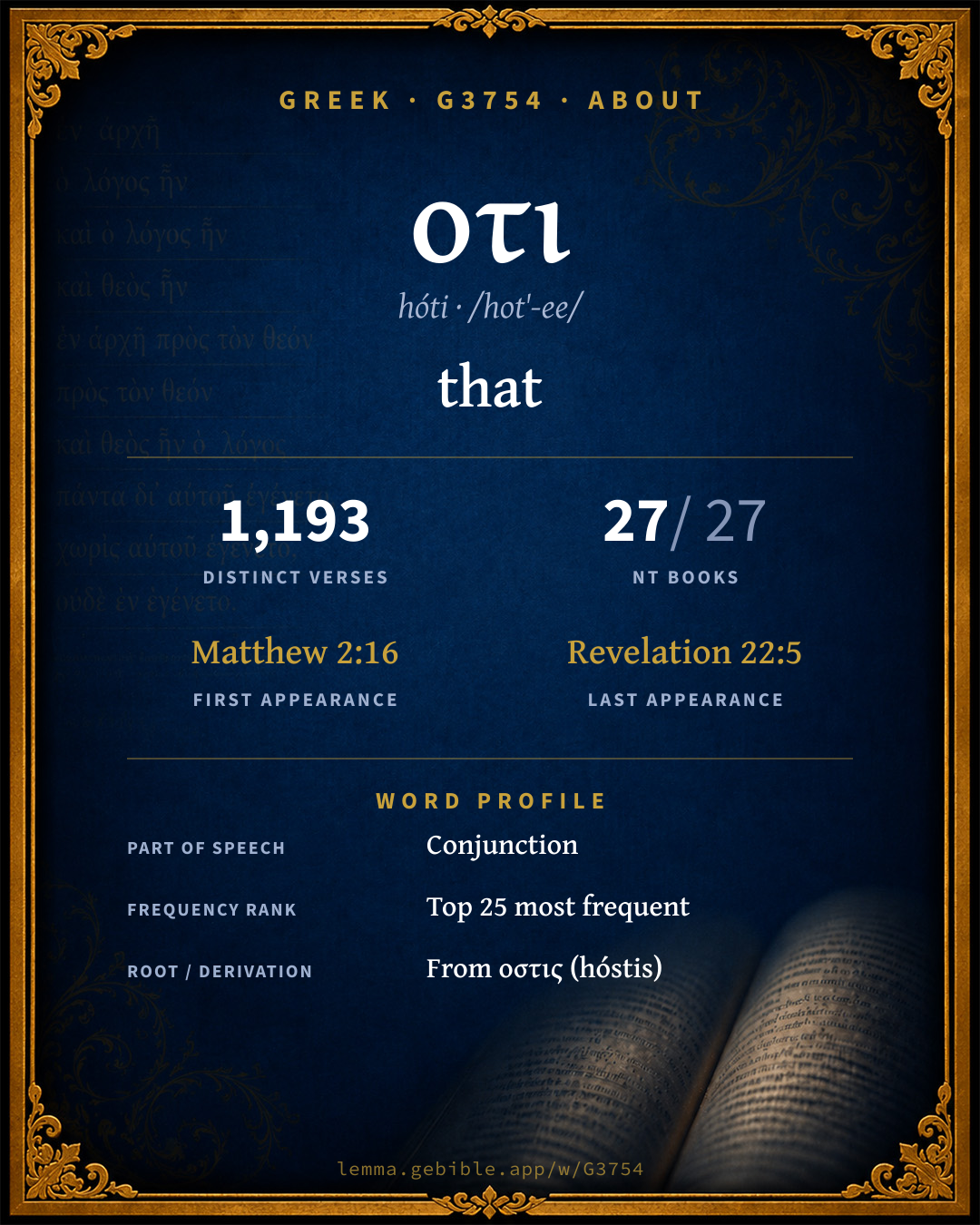
ὅτι
that
Full lexicon entry — Thayer's Greek Lexicon
From Thayer's Greek Lexicon
Where this word appears
Grammar key — what these labels mean
Part of speech
- Conjunction
- A joining word linking words or clauses.
Every verse where G3754 appears in the Book of Matthew — 138 distinct verses. Click any verse to open its interlinear word-by-word view. Verse text shown in the World English Bible for context — . Each verse’s Greek form is shown with its reference; the English is not keyword-highlighted, since the data carries no word-level English alignment. Use “Compare translations” on any verse to read it across multiple English versions. This concordance covers the Greek New Testament; Septuagint (Greek Old Testament) occurrences of this word are not indexed here.
Matthew
- Matthew 2:16 ὅτι conj Then Herod, when he saw that he was mocked by the wise men, was exceedingly angry, and sent out, and killed all the male children who were in Bethlehem and in all the surrounding countryside, from two years old and under, according to the exact time which he had learned from the wise men.
- Matthew 2:18 ὅτι conj "A voice was heard in Ramah, Lamentation, weeping and great mourning, Rachel weeping for her children; She wouldn't be comforted, Because they are no more."
- Matthew 2:22 ὅτι conj But when he heard that Archelaus was reigning over Judea in the place of his father, Herod, he was afraid to go there. Being warned in a dream, he withdrew into the region of Galilee,
- Matthew 2:23 ὅτι conj and came and lived in a city called Nazareth; that it might be fulfilled which was spoken through the prophets: "He will be called a Nazarene."
- Matthew 3:9 ὅτι conj Don't think to yourselves, 'We have Abraham for our father,' for I tell you that God is able to raise up children to Abraham from these stones.
- Matthew 4:6 ὅτι conj and said to him, "If you are the Son of God, throw yourself down, for it is written, 'He will give his angels charge concerning you.' and, 'On their hands they will bear you up, So that you don't dash your foot against a stone.'"
- Matthew 4:12 ὅτι conj Now when Jesus heard that John was delivered up, he withdrew into Galilee.
- Matthew 5:3 ὅτι conj "Blessed are the poor in spirit, For theirs is the Kingdom of Heaven.
- Matthew 5:4 ὅτι conj Blessed are those who mourn, For they shall be comforted.
- Matthew 5:5 ὅτι conj Blessed are the gentle, For they shall inherit the earth.
- Matthew 5:6 ὅτι conj Blessed are those who hunger and thirst after righteousness, For they shall be filled.
- Matthew 5:7 ὅτι conj Blessed are the merciful, For they shall obtain mercy.
- Matthew 5:8 ὅτι conj Blessed are the pure in heart, For they shall see God.
- Matthew 5:9 ὅτι conj Blessed are the peacemakers, For they shall be called children of God.
- Matthew 5:10 ὅτι conj Blessed are those who have been persecuted for righteousness' sake, For theirs is the Kingdom of Heaven.
- Matthew 5:12 ὅτι conj Rejoice, and be exceedingly glad, for great is your reward in heaven. For that is how they persecuted the prophets who were before you.
- Matthew 5:17 ὅτι conj "Don't think that I came to destroy the law or the prophets. I didn't come to destroy, but to fulfill.
- Matthew 5:20 ὅτι conj For I tell you that unless your righteousness exceeds that of the scribes and Pharisees, there is no way you will enter into the Kingdom of Heaven.
- Matthew 5:21 ὅτι conj "You have heard that it was said to the ancient ones, 'You shall not murder;' and 'Whoever shall murder shall be in danger of the judgment.'
- Matthew 5:22 ὅτι conj But I tell you, that everyone who is angry with his brother without a cause shall be in danger of the judgment; and whoever shall say to his brother, 'Raca!' shall be in danger of the council; and whoever shall say, 'You fool!' shall be in danger of the fire of Gehenna.
- Matthew 5:23 ὅτι conj "If therefore you are offering your gift at the altar, and there remember that your brother has anything against you,
- Matthew 5:27 ὅτι conj "You have heard that it was said, 'You shall not commit adultery;'
- Matthew 5:28 ὅτι conj but I tell you that everyone who gazes at a woman to lust after her has committed adultery with her already in his heart.
- Matthew 5:32 ὅτι conj but I tell you that whoever puts away his wife, except for the cause of sexual immorality, makes her an adulteress; and whoever marries her when she is put away commits adultery.
- Matthew 5:33 ὅτι conj "Again you have heard that it was said to them of old time, 'You shall not make false vows, but shall perform to the Lord your vows,'
- Matthew 5:34 ὅτι conj but I tell you, don't swear at all: neither by heaven, for it is the throne of God;
- Matthew 5:35 ὅτι ὅτι conj conj nor by the earth, for it is the footstool of his feet; nor by Jerusalem, for it is the city of the great King.
- Matthew 5:36 ὅτι conj Neither shall you swear by your head, for you can't make one hair white or black.
- Matthew 5:38 ὅτι conj "You have heard that it was said, 'An eye for an eye, and a tooth for a tooth.'
- Matthew 5:43 ὅτι conj "You have heard that it was said, 'You shall love your neighbor, and hate your enemy.'
- Matthew 5:45 ὅτι conj that you may be children of your Father who is in heaven. For he makes his sun to rise on the evil and the good, and sends rain on the just and the unjust.
- Matthew 6:5 ὅτι conj "When you pray, you shall not be as the hypocrites, for they love to stand and pray in the synagogues and in the corners of the streets, that they may be seen by men. Most assuredly, I tell you, they have received their reward.
- Matthew 6:7 ὅτι conj In praying, don't use vain repetitions, as the Gentiles do; for they think that they will be heard for their much speaking.
- Matthew 6:26 ὅτι conj See the birds of the sky, that they don't sow, neither do they reap, nor gather into barns. Your heavenly Father feeds them. Aren't you of much more value than they?
- Matthew 6:29 ὅτι conj yet I tell you that even Solomon in all his glory was not dressed like one of these.
- Matthew 6:32 ὅτι conj For the Gentiles seek after all these things, for your heavenly Father knows that you need all these things.
- Matthew 7:13 ὅτι conj "Enter in by the narrow gate; for wide is the gate and broad is the way that leads to destruction, and many are those who enter in by it.
- Matthew 7:14 ὅτι conj How narrow is the gate, and restricted is the way that leads to life! Few are those who find it.
- Matthew 7:23 ὅτι conj Then I will tell them, 'I never knew you. Depart from me, you who work iniquity.'
- Matthew 8:11 ὅτι conj I tell you that many will come from the east and the west, and will sit down with Abraham, Isaac, and Jacob in the Kingdom of Heaven,
- Matthew 8:27 ὅτι conj The men marveled, saying, "What kind of man is this, that even the wind and the sea obey him?"
- Matthew 9:6 ὅτι conj But that you may know that the Son of Man has authority on earth to forgive sins..." (then he said to the paralytic), "Get up, and take up your mat, and go up to your house."
- Matthew 9:28 ὅτι conj When he had come into the house, the blind men came to him. Jesus said to them, "Do you believe that I am able to do this?" They told him, "Yes, Lord."
- Matthew 9:36 ὅτι conj But when he saw the multitudes, he was moved with compassion for them, because they were harassed and scattered, like sheep without a shepherd.
- Matthew 10:7 ὅτι conj As you go, preach, saying, 'The Kingdom of Heaven is at hand!'
- Matthew 10:34 ὅτι conj "Don't think that I came to send peace on the earth. I didn't come to send peace, but a sword.
- Matthew 11:20 ὅτι conj Then he began to denounce the cities in which most of his mighty works had been done, because they didn't repent.
- Matthew 11:21 ὅτι conj "Woe to you, Chorazin! Woe to you, Bethsaida! For if the mighty works had been done in Tyre and Sidon which were done in you, they would have repented long ago in sackcloth and ashes.
- Matthew 11:23 ὅτι conj You, Capernaum, who are exalted to Heaven, you will go down to Hades. For if the mighty works had been done in Sodom which were done in you, it would have remained until this day.
- Matthew 11:24 ὅτι conj But I tell you that it will be more tolerable for the land of Sodom, on the day of judgment, than for you."
- Matthew 11:25 ὅτι conj At that time, Jesus answered, "I thank you, Father, Lord of heaven and earth, that you hid these things from the wise and understanding, and revealed them to infants.
- Matthew 11:26 ὅτι conj Yes, Father, for so it was well-pleasing in your sight.
- Matthew 11:29 ὅτι conj Take my yoke upon you, and learn from me, for I am gentle and lowly in heart; and you will find rest for your souls.
- Matthew 12:5 ὅτι conj Or have you not read in the law, that on the Sabbath day, the priests in the temple profane the Sabbath, and are guiltless?
- Matthew 12:6 ὅτι conj But I tell you that one greater than the temple is here.
- Matthew 12:36 ὅτι conj I tell you that every idle word that men speak, they will give account of it in the day of judgment.
- Matthew 12:41 ὅτι conj The men of Nineveh will stand up in the judgment with this generation, and will condemn it, for they repented at the preaching of Jonah; and behold, someone greater than Jonah is here.
- Matthew 12:42 ὅτι conj The queen of the south will rise up in the judgment with this generation, and will condemn it, for she came from the ends of the earth to hear the wisdom of Solomon; and behold, someone greater than Solomon is here.
- Matthew 13:11 ὅτι conj He answered them, "To you it is given to know the mysteries of the Kingdom of Heaven, but it is not given to them.
- Matthew 13:13 ὅτι conj Therefore I speak to them in parables, because seeing they don't see, and hearing, they don't hear, neither do they understand.
- Matthew 13:16 ὅτι ὅτι conj conj "But blessed are your eyes, for they see; and your ears, for they hear.
- Matthew 13:17 ὅτι conj For most assuredly I tell you that many prophets and righteous men desired to see the things which you see, and didn't see them; and to hear the things which you hear, and didn't hear them.
- Matthew 14:5 ὅτι conj When he would have put him to death, he feared the multitude, because they counted him as a prophet.
- Matthew 14:26 ὅτι conj When the disciples saw him walking on the sea, they were troubled, saying, "It's a ghost!" and they cried out for fear.
- Matthew 15:12 ὅτι conj Then the disciples came, and said to him, "Do you know that the Pharisees were offended, when they heard this saying?"
- Matthew 15:17 ὅτι conj Don't you understand that whatever goes into the mouth passes into the belly, and then out of the body?
- Matthew 15:23 ὅτι conj But he answered her not a word. His disciples came and begged him, saying, "Send her away; for she cries after us."
- Matthew 15:32 ὅτι conj Jesus summoned his disciples and said, "I have compassion on the multitude, because they continue with me now three days and have nothing to eat. I don't want to send them away fasting, or they might faint on the way."
- Matthew 16:7 ὅτι conj They reasoned among themselves, saying, "We brought no bread."
- Matthew 16:8 ὅτι conj Jesus, perceiving it, said, "Why do you reason among yourselves, you of little faith, 'because you have brought no bread?'
- Matthew 16:11 ὅτι conj How is it that you don't perceive that I didn't speak to you concerning bread? But beware of the yeast of the Pharisees and Sadducees."
- Matthew 16:12 ὅτι conj Then they understood that he didn't tell them to beware of the yeast of bread, but of the teaching of the Pharisees and Sadducees.
- Matthew 16:17 ὅτι conj Jesus answered him, "Blessed are you, Simon Bar Jonah, for flesh and blood has not revealed this to you, but my Father who is in heaven.
- Matthew 16:18 ὅτι conj I also tell you that you are Peter, and on this rock I will build my assembly, and the gates of Hades will not prevail against it.
- Matthew 16:20 ὅτι conj Then he charged the disciples that they should tell no one that he is Jesus the Christ.
- Matthew 16:21 ὅτι conj From that time, Jesus began to show his disciples that he must go to Jerusalem and suffer many things from the elders, chief priests, and scribes, and be killed, and the third day be raised up.
- Matthew 16:23 ὅτι conj But he turned, and said to Peter, "Get behind me, Satan! You are a stumbling-block to me, for you are not setting your mind on the things of God, but on the things of men."
- Matthew 16:28 ὅτι conj Most assuredly I tell you, there are some standing here who will in no way taste of death, until they see the Son of Man coming in his Kingdom."
- Matthew 17:10 ὅτι conj His disciples asked him, saying, "Then why do the scribes say that Elijah must come first?"
- Matthew 17:12 ὅτι conj but I tell you that Elijah has come already, and they didn't recognize him, but did to him whatever they wanted to. Even so the Son of Man will also suffer by them."
- Matthew 17:13 ὅτι conj Then the disciples understood that he spoke to them of John the Baptizer.
- Matthew 17:15 ὅτι conj "Lord, have mercy on my son, for he is epileptic, and suffers grievously; for he often falls into the fire, and often into the water.
- Matthew 18:10 ὅτι conj See that you don't despise one of these little ones, for I tell you that in heaven their angels always see the face of my Father who is in heaven.
- Matthew 18:13 ὅτι conj If he finds it, most assuredly I tell you, he rejoices over it more than over the ninety-nine which have not gone astray.
- Matthew 18:19 ὅτι conj Again, assuredly I tell you, that if two of you will agree on earth concerning anything that they will ask, it will be done for them by my Father who is in heaven.
- Matthew 19:4 ὅτι conj He answered, "Haven't you read that he who made them from the beginning made them male and female,
- Matthew 19:8 ὅτι conj He said to them, "Moses, because of the hardness of your hearts, allowed you to divorce your wives, but from the beginning it has not been so.
- Matthew 19:9 ὅτι conj I tell you that whoever divorces his wife, except for sexual immorality, and marries another, commits adultery; and he who marries her when she is divorced commits adultery."
- Matthew 19:23 ὅτι conj Jesus said to his disciples, "Most assuredly I say to you, a rich man will enter into the Kingdom of Heaven with difficulty.
- Matthew 19:24 ὅτι conj Again I tell you, it is easier for a camel to go through a needle's eye, than for a rich man to enter into the Kingdom of God."
- Matthew 19:28 ὅτι conj Jesus said to them, "Most assuredly I tell you that you who have followed me, in the regeneration when the Son of Man will sit on the throne of his glory, you also will sit on twelve thrones, judging the twelve tribes of Israel.
- Matthew 20:7 ὅτι conj "They said to him, 'Because no one has hired us.' "He said to them, 'You also go into the vineyard, and you will receive whatever is right.'
- Matthew 20:10 ὅτι conj When the first came, they supposed that they would receive more; and they likewise each received a denarius.
- Matthew 20:15 ὅτι conj Isn't it lawful for me to do what I want to with what I own? Or is your eye evil, because I am good?'
- Matthew 20:25 ὅτι conj But Jesus summoned them, and said, "You know that the rulers of the Gentiles lord it over them, and their great ones exercise authority over them.
- Matthew 20:30 ὅτι conj Behold, two blind men sitting by the road, when they heard that Jesus was passing by, cried out, "Lord, have mercy on us, you son of David!"
- Matthew 21:3 ὅτι conj If anyone says anything to you, you shall say, 'The Lord needs them,' and immediately he will send them."
- Matthew 21:16 ὅτι conj and said to him, "Do you hear what these are saying?" Jesus said to them, "Yes. Did you never read, 'Out of the mouth of babes and nursing babies you have perfected praise?'"
- Matthew 21:31 ὅτι conj Which of the two did the will of his father?" They said to him, "The first." Jesus said to them, "Most assuredly I tell you that the tax collectors and the prostitutes are entering into the Kingdom of God before you.
- Matthew 21:43 ὅτι conj "Therefore I tell you, the Kingdom of God will be taken away from you, and will be given to a nation bringing forth its fruits.
- Matthew 21:45 ὅτι conj When the chief priests and the Pharisees heard his parables, they perceived that he spoke about them.
- Matthew 22:16 ὅτι conj They sent their disciples to him, along with the Herodians, saying, "Teacher, we know that you are honest, and teach the way of God in truth, no matter who you teach, for you aren't partial to anyone.
- Matthew 22:34 ὅτι conj But the Pharisees, when they heard that he had put the Sadducees to silence, gathered themselves together.
- Matthew 23:10 ὅτι conj Neither be called masters, for one is your master, the Christ.
- Matthew 23:13 ὅτι conj "Woe to you, scribes and Pharisees, hypocrites! For you devour widows' houses, and as a pretense you make long prayers. Therefore you will receive greater condemnation.
- Matthew 23:15 ὅτι conj Woe to you, scribes and Pharisees, hypocrites! For you travel around by sea and land to make one proselyte; and when he becomes one, you make him twice as much of a son of Gehenna as yourselves.
- Matthew 23:23 ὅτι conj "Woe to you, scribes and Pharisees, hypocrites! For you tithe mint, dill, and cumin, and have left undone the weightier matters of the law: justice, mercy, and faith. But you ought to have done these, and not to have left the other undone.
- Matthew 23:25 ὅτι conj "Woe to you, scribes and Pharisees, hypocrites! For you clean the outside of the cup and of the platter, but within they are full of extortion and unrighteousness.
- Matthew 23:27 ὅτι conj "Woe to you, scribes and Pharisees, hypocrites! For you are like whitened tombs, which outwardly appear beautiful, but inwardly are full of dead men's bones, and of all uncleanness.
- Matthew 23:29 ὅτι conj "Woe to you, scribes and Pharisees, hypocrites! For you build the tombs of the prophets, and decorate the tombs of the righteous,
- Matthew 23:31 ὅτι conj Therefore you testify to yourselves that you are children of those who killed the prophets.
- Matthew 24:32 ὅτι conj "Now from the fig tree learn this parable. When its branch has now become tender, and puts forth its leaves, you know that the summer is near.
- Matthew 24:33 ὅτι conj Even so you also, when you see all these things, know that it is near, even at the doors.
- Matthew 24:42 ὅτι conj Watch therefore, for you don't know in what hour your Lord comes.
- Matthew 24:43 ὅτι conj But know this, that if the master of the house had known in what watch of the night the thief was coming, he would have watched, and would not have allowed his house to be broken into.
- Matthew 24:44 ὅτι conj Therefore also be ready, for in an hour that you don't expect, the Son of Man will come.
- Matthew 24:47 ὅτι conj Most assuredly I tell you that he will set him over all that he has.
- Matthew 25:8 ὅτι conj The foolish said to the wise, 'Give us some of your oil, for our lamps are going out.'
- Matthew 25:13 ὅτι conj Watch therefore, for you don't know the day nor the hour in which the Son of Man is coming.
- Matthew 25:24 ὅτι conj "He also who had received the one talent came and said, 'Lord, I knew you that you are a hard man, reaping where you did not sow, and gathering where you did not scatter.
- Matthew 25:26 ὅτι conj "But his lord answered him, 'You wicked and slothful servant. You knew that I reap where I didn't sow, and gather where I didn't scatter.
- Matthew 26:2 ὅτι conj "You know that after two days the Passover is coming, and the Son of Man will be delivered up to be crucified."
- Matthew 26:21 ὅτι conj As they were eating, he said, "Most assuredly I tell you that one of you will betray me."
- Matthew 26:34 ὅτι conj Jesus said to him, "Most assuredly I tell you that tonight, before the rooster crows, you will deny me three times."
- Matthew 26:53 ὅτι conj Or do you think that I couldn't ask my Father, and he would even now send me more than twelve legions of angels?
- Matthew 26:54 ὅτι conj How then would the Scriptures be fulfilled that it must be so?"
- Matthew 26:72 ὅτι conj Again he denied it with an oath, "I don't know the man."
- Matthew 26:74 ὅτι conj Then he began to curse and to swear, "I don't know the man!" Immediately the rooster crowed.
- Matthew 26:75 ὅτι conj Peter remembered the word which Jesus had said to him, "Before the rooster crows, you will deny me three times." He went out and wept bitterly.
- Matthew 27:3 ὅτι conj Then Judas, who betrayed him, when he saw that Jesus was condemned, felt remorse, and brought back the thirty pieces of silver to the chief priests and elders,
- Matthew 27:18 ὅτι conj For he knew that because of envy they had delivered him up.
- Matthew 27:24 ὅτι conj So when Pilate saw that nothing was being gained, but rather that a disturbance was starting, he took water, and washed his hands before the multitude, saying, "I am innocent of the blood of this righteous person. You see to it."
- Matthew 27:43 ὅτι conj He trusts in God. Let God deliver him now, if he wants him; for he said, 'I am the Son of God.'"
- Matthew 27:47 ὅτι conj Some of them who stood there, when they heard it, said, "This man is calling Elijah."
- Matthew 27:63 ὅτι conj saying, "Sir, we remember what that deceiver said while he was still alive: 'After three days I will rise again.'
- Matthew 28:5 ὅτι conj The angel answered the women, "Don't be afraid, for I know that you seek Jesus, who has been crucified.
- Matthew 28:7 ὅτι conj Go quickly and tell his disciples, 'He has risen from the dead, and behold, he goes before you into Galilee; there you will see him.' Behold, I have told you."
- Matthew 28:13 ὅτι conj saying, "Say that his disciples came by night, and stole him away while we slept.
About this entry
At a glance — auto-summarized from this page’s data, not written by a person. Every figure links to its source below. This summary describes the numbers; it doesn’t interpret them.
At its core, οτι (hóti) means “that.” Scripture first uses it in Matthew 2:16. Spanning 1,193 verses in 27 books, it ranks among the most common words of the Greek New Testament. From the same root come οστις and οτου. Each statement above links to its evidence; the full detail follows below.
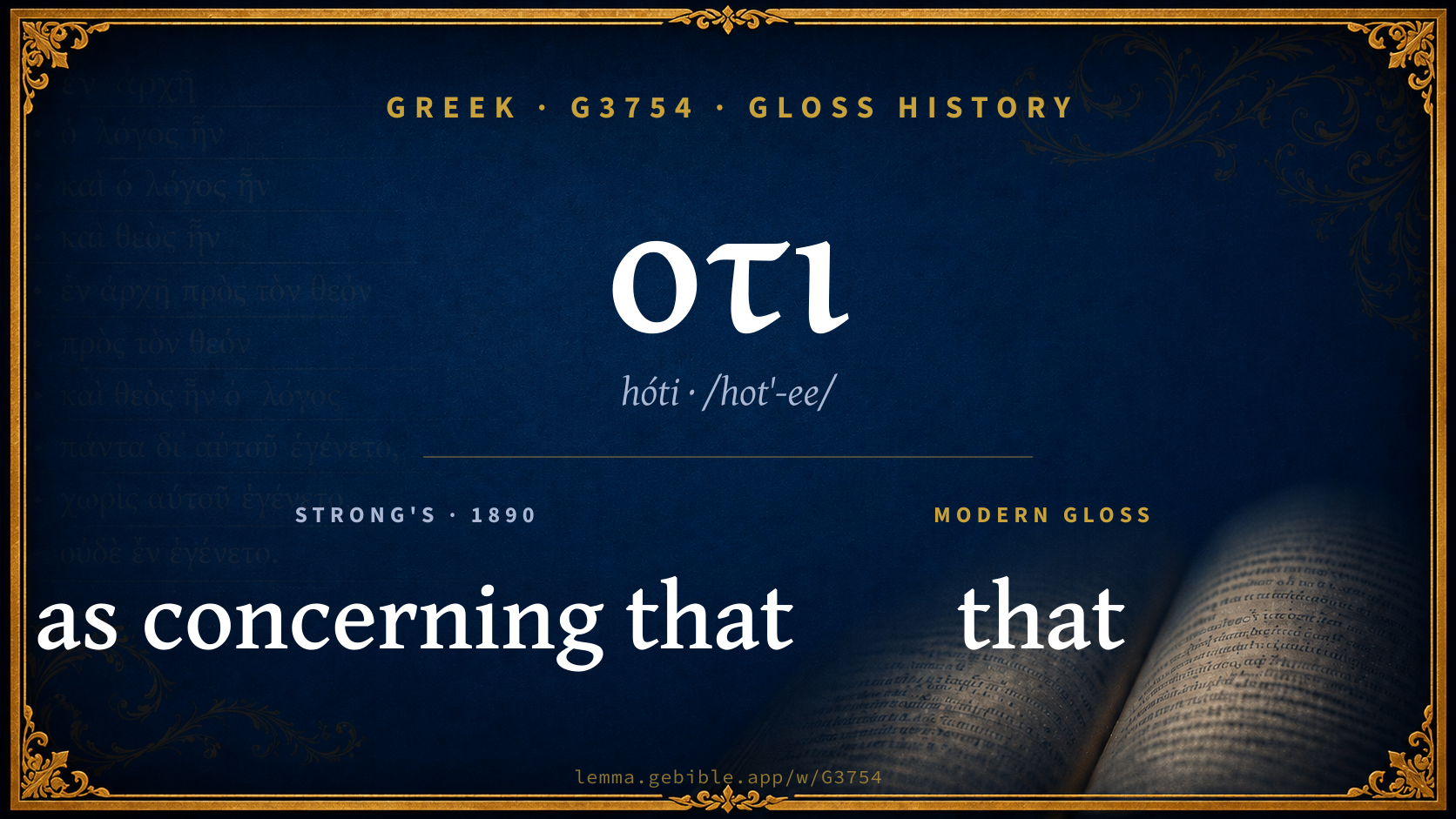
Gloss history
Strong's 1890 vs modern scholarship
About this word
Strong's G3754 catalogs a Greek word from the Greek New Testament.
These counts are not copied from any lexicon or concordance. They are computed here, from the morphology-tagged Greek New Testament. What Lemma adds →
- 1,193
- distinct verses
- The word appears in 1,193 distinct verses.
- 27 / 27
- NT books
- The word appears in 27 of 27 New Testament books.
- #15
- by frequency
- Top 25 most frequent Greek words (rank 15 of 5,347 Greek words by occurrence).
View all 1,193 occurrences in the concordance →
By section of the New Testament
By traditional corpus
Conventional, traditional groupings — biblical authorship is debated, so this is a traditional corpus grouping, not an authorship claim. Some books belong to more than one corpus (Luke is in both the Gospels and the Lukan corpus, and so on), so these shares overlap and need not total 100%. Each figure is a share of the word’s 1,193 distinct verses.
- Gospels 636 verses · 53%
- Johannine 357 verses · 30%
- Lukan (Luke–Acts) 280 verses · 23%
- Pauline corpus 269 verses · 23%
- General (Catholic) Epistles 102 verses · 9%
- Revelation 54 verses · 5%
- Hebrews 17 verses · 1%
How translations render this word
Counts come from each version’s own published word-to-Strong’s tagging or interlinear alignment — an approximate guide to how each version renders this word, not a word-level alignment the data otherwise carries. Because each total is that version’s own tagged count, the per-version totals vary from one another and need not match the appearance or distinct-verse counts above. These counts may also differ from a printed concordance because Lemma counts each distinctly tagged rendering and does not collapse phrase taggings into a single head-word total. This is a fixed set of word-tagged versions (KJV, ASV, BSB, ULT) and does not change with the reading translation you choose elsewhere. Each version’s license is shown beside its name below (and on Sources).
- King James Version: That 607×, For 258×, Because 178×
- American Standard Version: That 605×, For 237×, Because 161×
- Berean Standard Bible: That 520×, Because 207×, For 162×
- unfoldingWord Literal Text: That 681×, Because 221×, For 202×
King James Version Public Domain
Renders G3754 across 1,142 tagged occurrences — most commonly:
Plus other, less common renderings. Plus 35 renderings that appear only once — usually multi-word phrases or single function words the recovered tagging swept in, not distinct renderings. Not rendered by a distinct English word in 151 further occurrences.
American Standard Version Public Domain
Renders G3754 across 1,242 tagged occurrences — most commonly:
Plus other, less common renderings. Plus 98 renderings that appear only once — usually multi-word phrases or single function words the recovered tagging swept in, not distinct renderings. Not rendered by a distinct English word in 20 further occurrences.
Berean Standard Bible Public Domain
Renders G3754 across 935 tagged occurrences — most commonly:
Plus 24 renderings that appear only once — usually multi-word phrases or single function words the recovered tagging swept in, not distinct renderings. Not rendered by a distinct English word in 368 further occurrences.
unfoldingWord Literal Text CC BY-SA 4.0
Renders G3754 across 1,123 tagged occurrences — most commonly:
Plus 2 renderings that appear only once — usually multi-word phrases or single function words the recovered tagging swept in, not distinct renderings.
Senses in Thayer's
The 1 sense Thayer's distinguishes for this word, in lexicon order (not ranked by frequency or importance). The full entry — with sub-senses — is in the Lexicon Entry tab.
- that, because, since
Word origin
Derived from οστις (hóstis) (G3748) — whoever.
Neuter of G3748 as conjugation; demonstrative that (sometimes redundant); causatively because : - as concerning that as though because (that) for (that) how (that) (in) that though why.
— Strong’s Exhaustive Concordance (1890), public domain.
Same root — word family
Other Thayer's entries built from the same root as G3754, grouped by Strong’s listed origin. These share a root / origin per the lexicon — not necessarily a shared meaning. Each links to that word’s own entry.
Derives from
Shares the same root
Compare all same-root words → They share a root, not necessarily a meaning.
Septuagint usage
The same Greek word οτι appears 3,218 times in the Greek Old Testament (Septuagint), across 2,854 verses in 36 books.
- 3,218
- LXX occurrences
- Tagged occurrences of this Greek word in the Septuagint.
- 2,854
- verses
- Distinct Septuagint verses containing this word.
- 36 / 39
- OT books
- The word appears in 36 of the 39 Old Testament books.
Sample Septuagint occurrences
- Genesis 1:4 ὅτι
- Exodus 1:18 ὅτι
- Leviticus 5:11 ὅτι
- Numbers 6:7 ὅτι
- Deuteronomy 1:17 ὅτι
- Joshua 1:9 ὅτι
- Judges 1:15 ὅτι
- Ruth 1:6 ὅτι
- 1 Samuel 1:5 ὅτι
- 2 Samuel 1:4 ὅτι
- 1 Kings 1:11 ὅτι
- 2 Kings 1:4 ὅτι
Septuagint occurrences (same lexeme)
Every verse where the same Strong’s number (G3754) appears in the Greek Septuagint — showing the first 50 of 2,854. Verse text shown in the World English Bible for context; the Greek form is the matched word — the English is not keyword-highlighted.
- Genesis 1:4 ὅτι God saw the light, and saw that it was good. God divided the light from the darkness.
- Genesis 1:8 ὅτι God called the expanse sky. There was evening and there was morning, a second day.
- Genesis 1:10 ὅτι God called the dry land Earth, and the gathering together of the waters he called Seas. God saw that it was good.
- Genesis 1:12 ὅτι The earth brought forth grass, herbs yielding seed after their kind, and trees bearing fruit, with its seed in it, after their kind: and God saw that it was good.
- Genesis 1:18 ὅτι and to rule over the day and over the night, and to divide the light from the darkness. God saw that it was good.
- Genesis 1:21 ὅτι God created the large sea creatures, and every living creature that moves, with which the waters swarmed, after their kind, and every winged bird after its kind. God saw that it was good.
- Genesis 1:25 ὅτι God made the animals of the earth after their kind, and the cattle after their kind, and everything that creeps on the ground after its kind. God saw that it was good.
- Genesis 2:3 ὅτι God blessed the seventh day, and made it holy, because he rested in it from all his work which he had created and made.
- Genesis 2:23 ὅτι The man said, "This is now bone of my bones, and flesh of my flesh. She will be called Woman, because she was taken out of Man."
- Genesis 3:1 ὅτι Now the serpent was more subtle than any animal of the field which Yahweh God had made. He said to the woman, "Yes, has God said, 'You shall not eat of any tree of the garden?'"
- Genesis 3:5 ὅτι for God knows that in the day you eat it, your eyes will be opened, and you will be like God, knowing good and evil."
- Genesis 3:6 ὅτι When the woman saw that the tree was good for food, and that it was a delight to the eyes, and that the tree was to be desired to make one wise, she took of the fruit of it, and ate; and she gave some to her husband with her, and he ate.
- Genesis 3:7 ὅτι Both of their eyes were opened, and they knew that they were naked. They sewed fig leaves together, and made themselves aprons.
- Genesis 3:10 ὅτι The man said, "I heard your voice in the garden, and I was afraid, because I was naked; and I hid myself."
- Genesis 3:11 ὅτι God said, "Who told you that you were naked? Have you eaten from the tree that I commanded you not to eat from?"
- Genesis 3:14 ὅτι Yahweh God said to the serpent, "Because you have done this, cursed are you above all cattle, and above every animal of the field. On your belly shall you go, and you shall eat dust all the days of your life.
- Genesis 3:17 ὅτι To Adam he said, "Because you have listened to your wife's voice, and have eaten of the tree, of which I commanded you, saying, 'You shall not eat of it,' cursed is the ground for your sake. In toil you will eat of it all the days of your life.
- Genesis 3:19 ὅτι By the sweat of your face will you eat bread until you return to the ground, for out of it you were taken. For you are dust, and to dust you shall return."
- Genesis 3:20 ὅτι The man called his wife Eve, because she was the mother of all living.
- Genesis 4:12 ὅτι From now on, when you till the ground, it won't yield its strength to you. You shall be a fugitive and a wanderer in the earth."
- Genesis 4:23 ὅτι Lamech said to his wives, "Adah and Zillah, Hear my voice, You wives of Lamech, listen to my speech, For I have slain a man for wounding me, A young man for bruising me.
- Genesis 4:24 ὅτι If Cain will be avenged seven times, Truly Lamech seventy-seven times."
- Genesis 5:24 ὅτι Enoch walked with God, and he was not, for God took him.
- Genesis 6:2 ὅτι that God's sons saw that men's daughters were beautiful, and they took for themselves wives of all that they chose.
- Genesis 6:5 ὅτι Yahweh saw that the wickedness of man was great in the earth, and that every imagination of the thoughts of his heart was only evil continually.
- Genesis 6:6 ὅτι Yahweh was sorry that he had made man on the earth, and it grieved him in his heart.
- Genesis 6:7 ὅτι Yahweh said, "I will destroy man whom I have created from the surface of the ground; man, along with animals, creeping things, and birds of the sky; for I am sorry that I have made them."
- Genesis 6:12 ὅτι God saw the earth, and saw that it was corrupt, for all flesh had corrupted their way on the earth.
- Genesis 6:13 ὅτι God said to Noah, "The end of all flesh has come before me, for the earth is filled with violence through them. Behold, I will destroy them with the earth.
- Genesis 7:1 ὅτι Yahweh said to Noah, "Come with all of your household into the ark, for I have seen your righteousness before me in this generation.
- Genesis 8:9 ὅτι but the dove found no place to rest her foot, and she returned to him into the ark; for the waters were on the surface of the whole earth. He put forth his hand, and took her, and brought her to him into the ark.
- Genesis 8:11 ὅτι The dove came back to him at evening, and, behold, in her mouth was an olive leaf plucked off. So Noah knew that the waters were abated from off the earth.
- Genesis 8:13 ὅτι It happened in the six hundred first year, in the first month, the first day of the month, the waters were dried up from off the earth. Noah removed the covering of the ark, and looked. He saw that the surface of the ground was dried.
- Genesis 8:21 ὅτι Yahweh smelled the sweet savor. Yahweh said in his heart, "I will not again curse the ground any more for man's sake, because the imagination of man's heart is evil from his youth; neither will I ever again strike everything living, as I have done.
- Genesis 9:6 ὅτι Whoever sheds man's blood, by man will his blood be shed, for in the image of God made he man.
- Genesis 10:25 ὅτι To Eber were born two sons. The name of the one was Peleg, for in his days was the earth divided. His brother's name was Joktan.
- Genesis 11:9 ὅτι Therefore the name of it was called Babel, because Yahweh confused the language of all the earth, there. From there, Yahweh scattered them abroad on the surface of all the earth.
- Genesis 12:10 ὅτι There was a famine in the land. Abram went down into Egypt to live as a foreigner there, for the famine was sore in the land.
- Genesis 12:11 ὅτι It happened, when he was come near to enter into Egypt, that he said to Sarai his wife, "See now, I know that you are a beautiful woman to look on.
- Genesis 12:12 ὅτι It will happen, when the Egyptians will see you, that they will say, 'This is his wife.' They will kill me, but they will save you alive.
- Genesis 12:13 ὅτι Please say that you are my sister, that it may be well with me for your sake, and that my soul may live because of you."
- Genesis 12:14 ὅτι It happened that when Abram had come into Egypt, the Egyptians saw that the woman was very beautiful.
- Genesis 12:18 ὅτι Pharaoh called Abram, and said, "What is this that you have done to me? Why didn't you tell me that she was your wife?
- Genesis 12:19 ὅτι Why did you say, 'She is my sister,' so that I took her to be my wife? Now therefore, see your wife, take her, and go your way."
- Genesis 13:6 ὅτι The land was not able to bear them, that they might live together: for their substance was great, so that they could not live together.
- Genesis 13:8 ὅτι Abram said to Lot, "Please, let there be no strife between me and you, and between my herdsmen and your herdsmen; for we are relatives.
- Genesis 13:10 ὅτι Lot lifted up his eyes, and saw all the plain of the Jordan, that it was well watered every where, before Yahweh destroyed Sodom and Gomorrah, like the garden of Yahweh, like the land of Egypt, as you go to Zoar.
- Genesis 13:15 ὅτι for all the land which you see, I will give to you, and to your offspring forever.
- Genesis 13:17 ὅτι Arise, walk through the land in the length of it and in the breadth of it; for I will give it to you."
- Genesis 14:14 ὅτι When Abram heard that his relative was taken captive, he led forth his trained men, born in his house, three hundred and eighteen, and pursued as far as Dan.
These are occurrences of the same Greek lexeme (G3754) in the Septuagint — not a translation of any one Hebrew word. The store carries no word-level Hebrew↔Greek alignment, so no Hebrew original is asserted here. Counts come from the recovered LXX Strong's tagging — high-frequency vocabulary is well covered, while rare or late forms may be untagged — so they reflect tagged occurrences and may slightly undercount.